
I had hoped to activate Darke Peak next for the Summits On The Air (SOTA) program, but I was running short of time. So instead I activated the Darke Peak silo VK-DRK5.
Darke Peak is located on the Eyre Peninsula, about 516 km by road from the city of Adelaide.
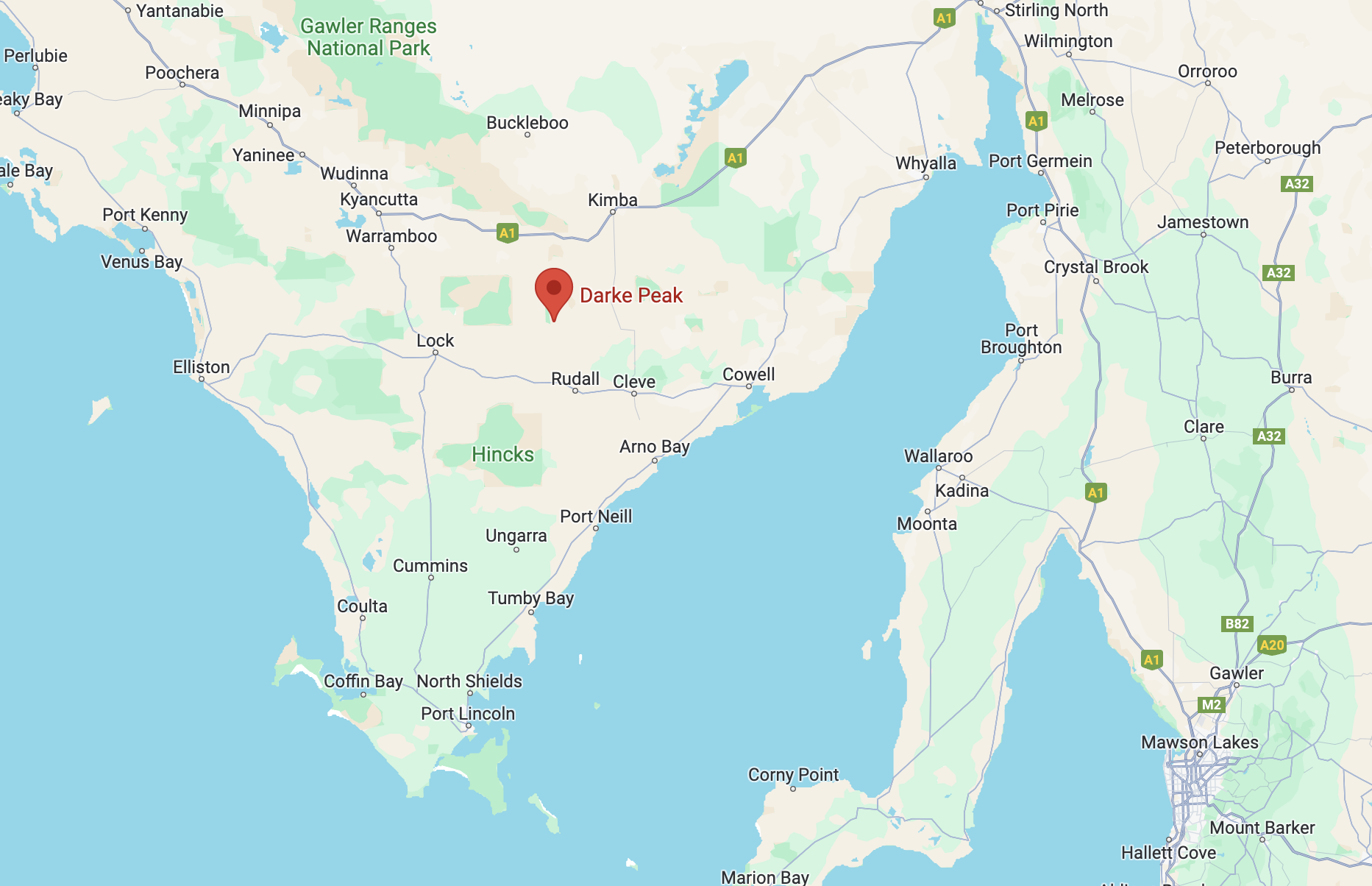
Darke Peak is a small agricultural town in central Eyre Peninsula. The Hundred of Darke was proclaimed on the 3rd day of February 1910. The town of Carappee (now Darke Peak) was proclaimed on the 4th day of June 1914. The town’s school opened in 1917. (SA Heritage Register) (SA Place Names 2012)

Above:- the proclamation of the town. Image c/o SA Govt Gazette, June 4th 1914.
The town of Carappee had its name changed on the 19th day of September 1940.

Above:- Article from the Chronicle, Adelaide, Thu 1 Aug 1940. Image c/o Trove.
The town is named in honour of John Charles Darke, an explorer and surveyor. He was born in 1806 in Hereford, England. He emigrated as a young man to Australia in 1824 and arrived in Van Diemen’s Land aboard the Heroine.

Above:- John Darke. Image c/o John Charles Darke Australian Explorer Facebook page.
In 1826 he was awarded 500 acres of land for his assistance in the pursuit of two bushrangers, Thomas Jeffries and Matthew Brady @ Gentleman Brady. He earned this alias due to his good treatment and manners when robbing his victims. In 1827 his father arrived in Van Diemens Land and took up land adjoining his son’s property. (Aust Dict Biography 2024) (Gentleman Brady 1932)

Above:- Bushranger Matthew Brady. Image c/o Wikipedia.
Darke did not take to the farming life and instead became an assistant surveyor in the Survey Department. He then became a private land agent and surveyor. By the mid 1830s Darke had moved to Victoria where he became surveyor to the Port Phillip Association. He assisted in laying out the city of Melbourne in 1837 and also Geelong and Williamstown. In 1838 he joined the South Australia Survey Department of South Australia. (Aust Dict Biography 2024) (Place Names 2012)
In 1843 ‘Darke’s North-Western Exploratory Expedition’ was organised for the purpose of searching for good country east of Anxious Bay and Coffin Bay. Two sailors who had run away from a whaling ship had reported the good land. On the 12th day of April 1844, Darke sailed on the Governor Gawler to Port Lincoln from Adelaide. On the 29th day of August 1844, the party of 4 led by Darke left Port Lincoln. The party comprised surveyor John Henry Theakston who was Darke’s friend and second in command. There were two other men hired as tent keepers and cooks, one called James Howard. (Aust DIct Biography 2024) (Darke’s NW Expl Expedition 9 Nov 1844) (JC Darke Expedition 1944) (Monuments Australia 2024) (Place Names 2012)
The party passed Lake Wangary to Wedge Hill and Wudinna Hill. In his journal Darke described the land as ‘excellent sheep and cattle country.‘ The party did not sight any suitable land beyond the Gawler Ranges and turned back. (Aust DIct Biography 2024) (JC Darke Expedition 1944)
On the 23rd day of October 1844, near Waddikee Rocks (northwest of Darke Peak), Darke was speared by Aboriginals and seriously injured. He sustained three spear wounds. (Aust Dict Biography 2024) (Darke’s NW Expl Expedition 9 Nov 1844)

Above:- The murder of John Darke. Image c/o John Charles Darke Australian Explorer Facebook page.
Sadly Darke died from his injuries the following day on the 24th day of October 1844, five minutes before midnight. He was buried at the foot of what is now known as Darke Peak. (Darke’s NW Expl Expedition 9 Nov 1844)
In his affidavit Theakston stated:
“Natives had accompanied our party the whole of the proceeding dat, and Mr. Darke has made presents to them of tools, & c. also of sugar and damper, the latter of which they would not eat.” (Darke’s NW Expl Expedition 9 Nov 1844)
In the South Australian Register, Saturday 9th November 1844, Charles Driver the Government Resident at Port Lincoln stated:
“Sir-It is my mournful duty to apprise you, for the information of his Excellency the Governor, that Mr. Darke, who, with an exploring party, left Port Lincoln on the 29th August last, died on the 24th ultimo, from injuries inflicted by natives unknown….” (Darke’s NW Expl Expedition 1844)

Above:- Article from the South Australian, Fri 8 Nov 1844. Image c/o Trove.
Darke’s final diary entry was on the 22nd day of October 1844:
“Accompanied by the [three] blacks who were joined by nine others, I proceeded to the waterhole, about three miles, but more easterly than our course; and came about 2 o’clock to a large gritstone rock where I found abundance of feed and water on a plain about 200 yards wide by half a mile long, surrounded by thick scrub. The natives accompanied us until just before encamping. I gave them all I could spare for taking us to the water. They seemed very friendly disposed…” (Darke’s NW Expl Expedition 13 Nov 1844)
Darke’s diary continues in the hand of Theakston who wrote:
“It is with sorrow I am compelled to continue the hourn al of Mr Darke, he having been speared by three natives – whom he had treated the most kind manner the day previous……….I here dressed the wounds of Mr Darke, and bled him, but found his extremities getting cold, and I informed him. I feared the event. At 10 o’clock he told me he was dying, that mortification had taken place, he was out of pain; he gave me his last commands and died at five minutes to twelve, quite calm to the last minute. I carried the body of Mr Darke to the Table Topped Peaks and buried him on a small grassy plain at the foot of them, in a grave five feet deep.” (Darke’s NW Expl Expedition 13 Nov 1844)
It was reported in 1944 that one theory for the hostile action was that there had been an encroachment on a ceremonial ground. Another account was that there was a plan to kill all of the party, but by Theakston firing a shot, prevented the plan from being carried out. (JC Darke Expedition 1944)
In 1865 surveyor Thomas Evans named the peak of Darke Peak in honour of John Charles Darke. He had been performing a trigonometrical survey of the Gawler Ranges. (Cleve 2020)


The prominent building in the town is the Darke Peak Hotel.

Across the road from the hotel is the ‘Hellbent Hotel’. It was built in 1980 so that locals could continue to celebrate following the closure for the night of the Darke Peak Hotel.


Alongside the Hellbent Hotel is an information shelter with lots of information about famous Darke Peak locals including John Darke, softballer Simone Morrow and AFL football Brett Chalmers.


There is also Erica the Emua sculpture, the work of Peter ‘Turtle’ Crosby.

The video below tells the story of Eric @ Erica
The Darke Peak silos are located on the western side of Balumbah-Kinnard Road (the main street of Darke Peak).
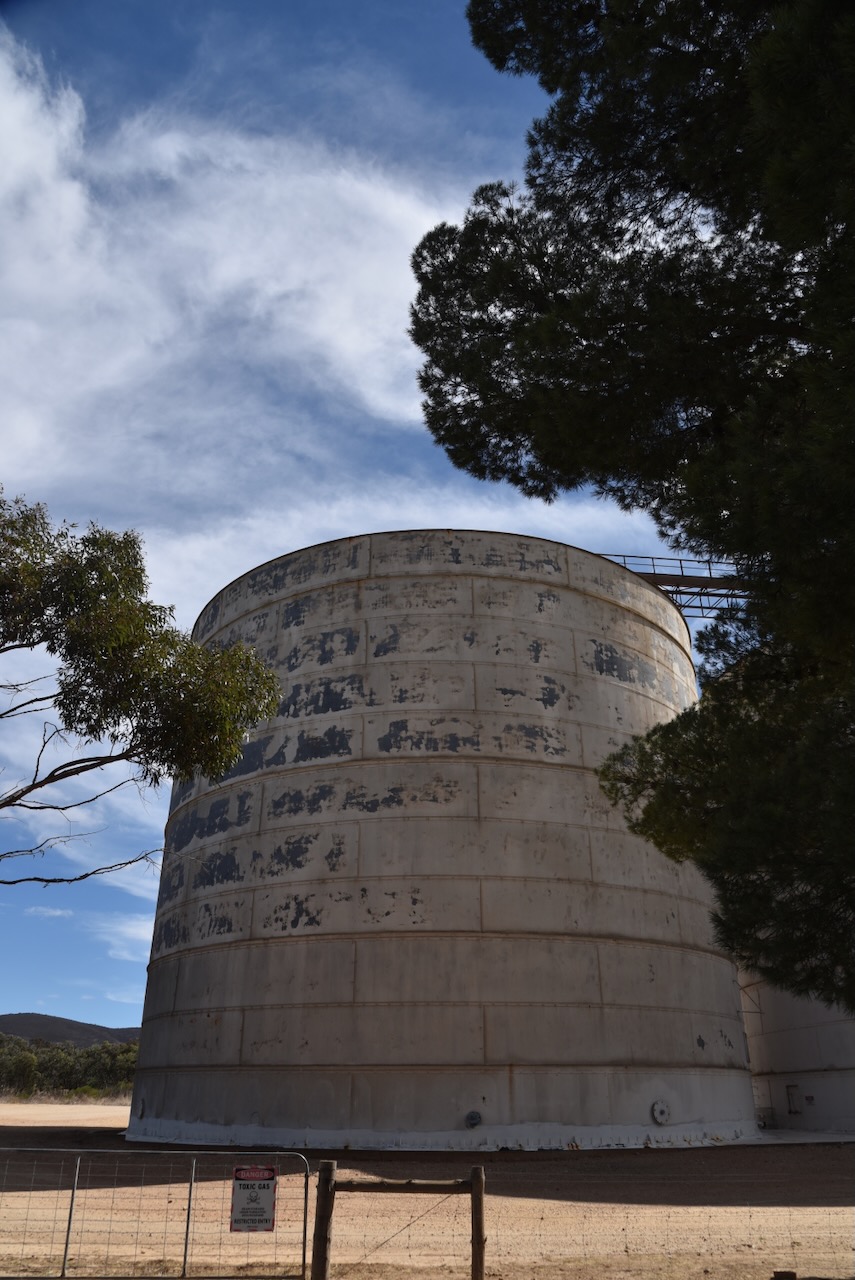


I operated from the 4WD, running the Icom IC-7300, 100 watts, and the Codan 9350 antenna with the 1.5 metre stainless steel whip.
I worked the following stations on 40m SSB:-
- VK5MAZ
- VK2IO/p (SOTA VK2/ ST-001)
- VK5HS
- VK8ZWM
- VK5TUX
- VK5KLV
- VK3PF
- VK5FB
- VK3APJ
- VK2YW
I worked the following stations on 20m SSB:-
- VK3PF
- VK1AO
- VK2MET
- VK5MAZ
- VK3EJ
- VK3GJG
- VK7HBR
- VK3CEO
- VK3UCD
- VK7XX
- VK3BEL
- VK4NH
- VK4DXA
- VK7AAE
- OH2CGU
- VK2VIN
Following the activation I visited the gravesite of John Charles Darke.


There are some excellent views of the Darke Range from this spot.


References.
- Dcceew.gov.au. (2023). Collaborative Australian Protected Areas Database (CAPAD) 2022 – DCCEEW. [online] Available at: https://www.dcceew.gov.au/environment/land/nrs/science/capad/2022.
- Cleve, D.C. of (2020). LOCAL HISTORY. [online] District Council of Cleve. Available at: https://www.cleve.sa.gov.au/community/history. [Accessed 3 Jun. 2024].
- DARKE’S NORTH-WESTERN EXPLORATORY EXPEDITION. (1844). South Australian Register. [online] 9 Nov. Available at: https://trove.nla.gov.au/newspaper/article/73841911?searchTerm=john%20darke [Accessed 3 Jun. 2024].
- DARKE’S NORTH WESTERN EXPLORATORY EXPEDITION. (1844). South Australian Register. [online] 13 Nov. Available at: https://trove.nla.gov.au/newspaper/article/27448479?searchTerm=john%20darke [Accessed 3 Jun. 2024].
‘GENTLEMAN BRADY.’ (1932). Queensland Times. [online] 26 Feb. Available at: https://trove.nla.gov.au/newspaper/article/113204554 [Accessed 3 Jun. 2024]. - monumentaustralia.org.au. (n.d.). Centenary of John Darke`s Expedition | Monument Australia. [online] Available at: https://monumentaustralia.org.au/themes/people/exploration/display/117413-centenary-of-john-darke%60s-expedition [Accessed 3 Jun. 2024].
- published.collections.slsa.sa.gov.au. (n.d.). A Compendium of the Place Names of South Australia. [online] Available at: https://published.collections.slsa.sa.gov.au/placenamesofsouthaustralia/ [Accessed 2 Jun. 2024].
- The J. C. Darke Expedition, 1844. (1944). Port Lincoln Times. [online] 7 Sep. Available at: https://trove.nla.gov.au/newspaper/article/99912031 [Accessed 3 Jun. 2024].
- South Australian Heritage Register. Department of Environment, Water and Natural Resources.
- Stancombe, G.H. (n.d.). Darke, John Charles (1806–1844). [online] Australian Dictionary of Biography. Available at: https://adb.anu.edu.au/biography/darke-john-charles-1955. [Accessed 2 Jun. 2024].
 VK5PAS