
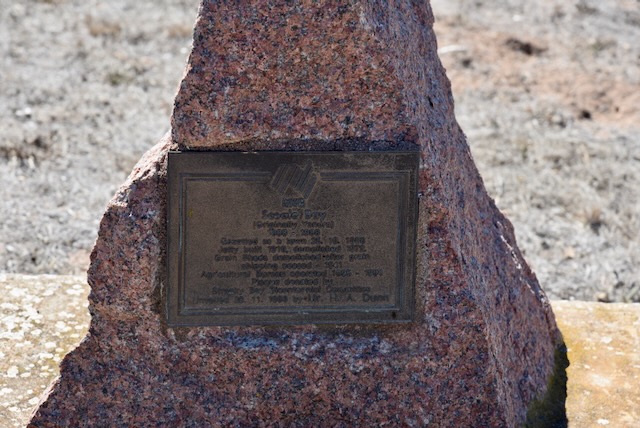
Next on the park activation agenda for Saturday 13th day of April 2024 was the Sceale Bay Conservation Park VKFF-1093. But before I activated the park I stopped off to have a look at Murphy’s Haystacks, an outcrop of pink granite boulders. They are located on the northern side of Benbarbar Road at Mortana between Streaky Bay and Port Kenny. They are known as Inselbergs, derived from the German word Insel meaning island, and berg meaning mountain.

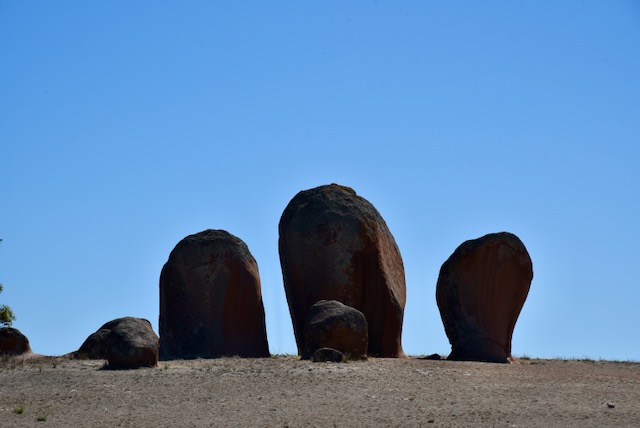


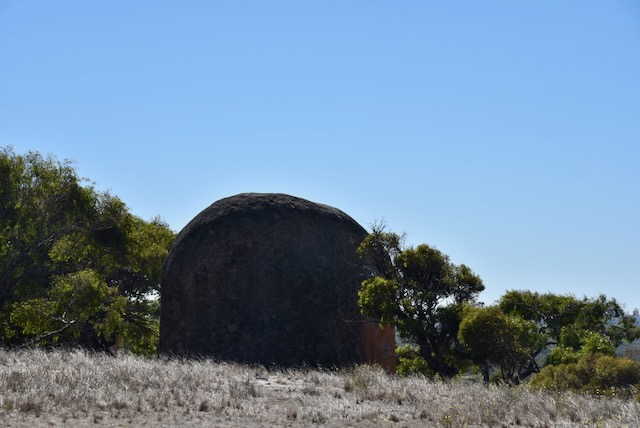
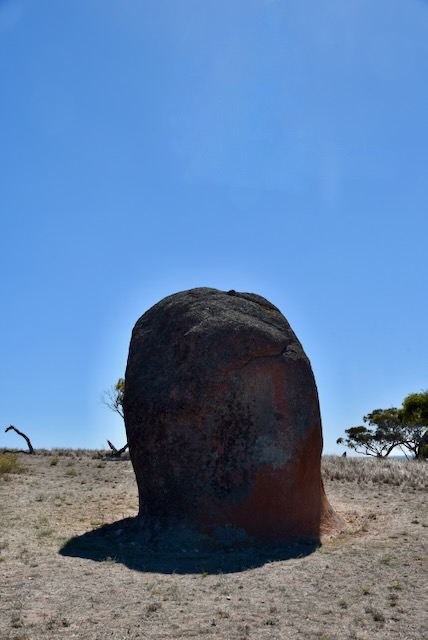
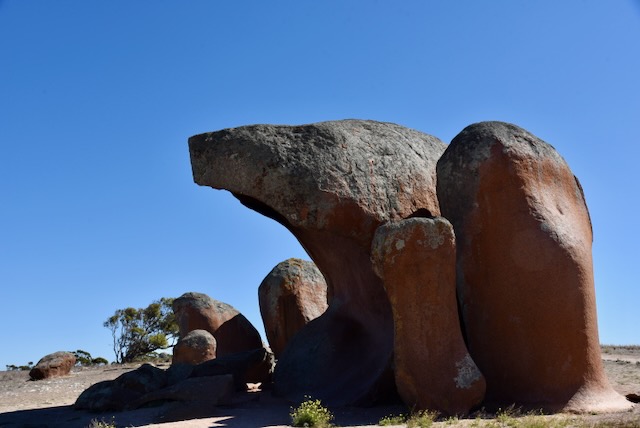
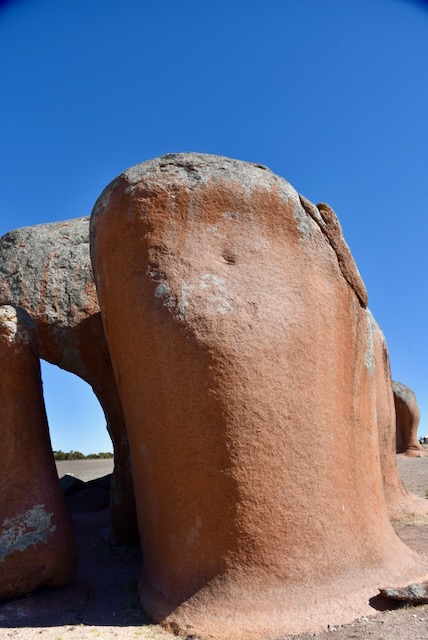
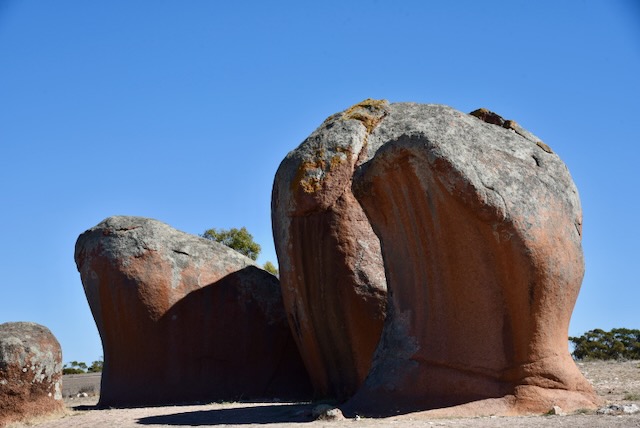


These unusual rock formations were named after Denis Murphy, a farmer on the Eyre Peninsula who owned the land on which the rocks are located. Denis Drinan Murphy was born in March 1858 in Limerick, Ireland. He emigrated to South Australia in 1882 aboard the ‘Nebo‘. He spent his first years in Australia in the mid-north of South Australia before taking up the first farming land at Calca. He named the property ‘Oakfront’ after Oakfront in Country Cork where his mother originated. He was the first man to cart and ship wheat from Port Kenny which was then known as Murphy’s Landing. (Exploroz 2024) (JEREMIAH D. MURPHY, FORESTVILLE., 1938)
It is recorded that a Scottish agricultural expert travelling by on a local mail coach saw the rocks on Denis Murphy’s property and commented that the farmer must harrow and remarked about all of the hay he had saved. The rocks became known as Murphy’s Haystacks. (Australian Traveller 2017)
After leaving Murphy’s Haystacks I continued west on Calca Road and soon reached the little settlement of Calca.
Calca is a derivative of Kolka, an aboriginal word meaning ‘stars.’ The Calca pastoral lease No. 554 was held by Adam Borthwick from 10th February 1856. The land was originally held in the late 1840s by James Baird (also known as Henry Baird and Beard) who called it ‘Kolka’. Baird Bay is named in his honour. The Calca school opened in 1892 and closed in 1939. (Monument Australia 2024) (Place Names 2012)
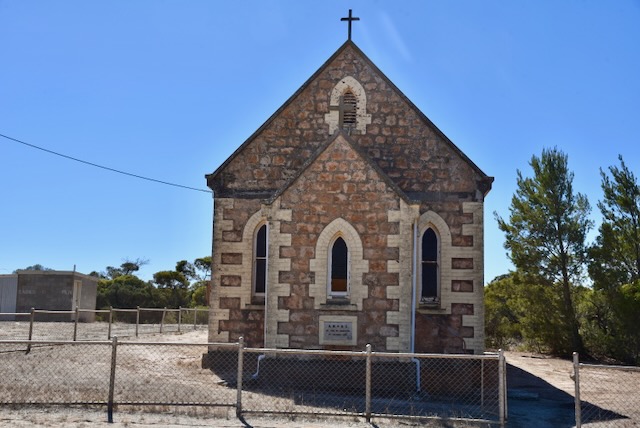
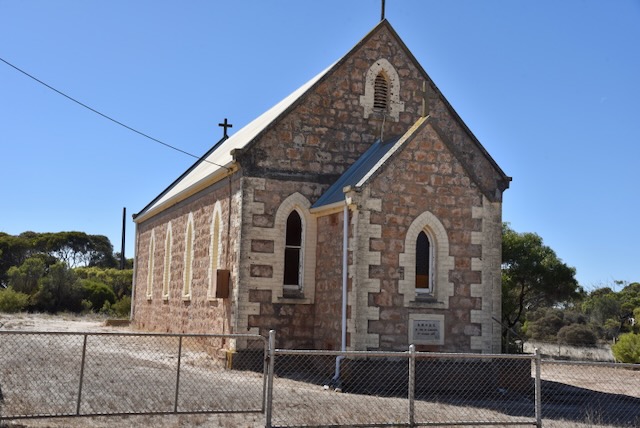
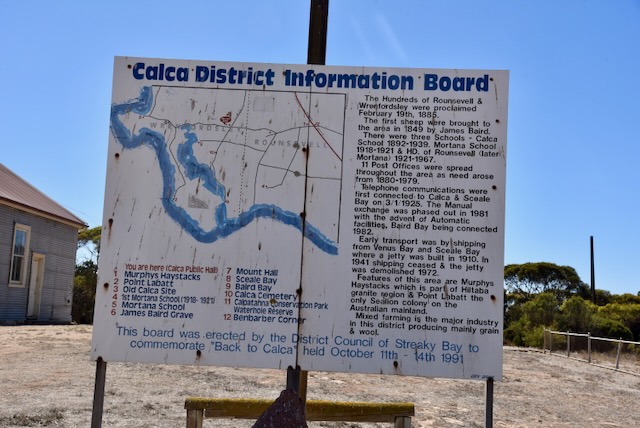
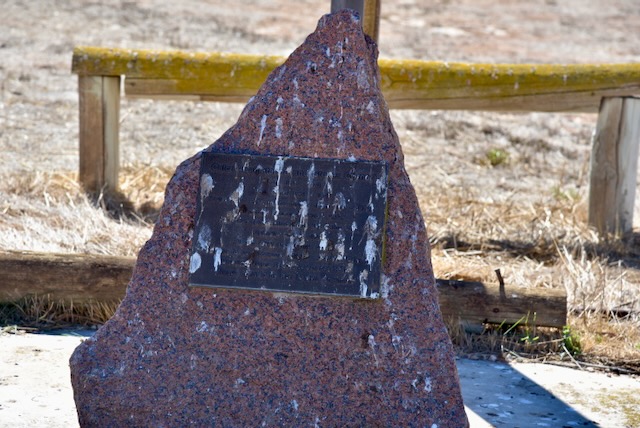
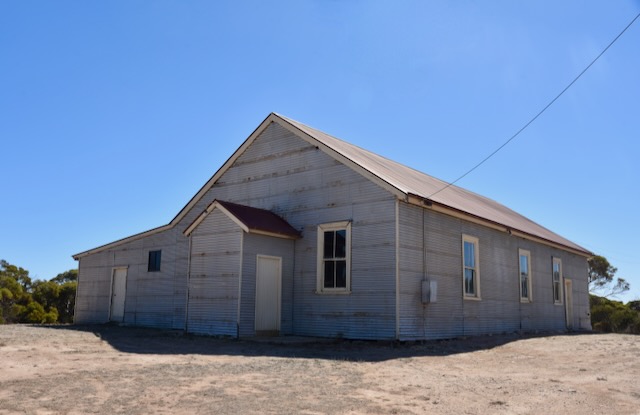
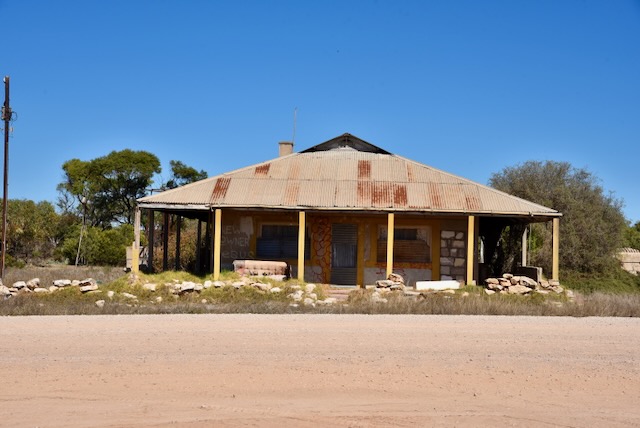
I found the story of James or Henry Baird to be very interesting. Here is what I found out, predominantly bey reading newspaper articles on the Trove website.
On Thursday the 31st day of October 1850, local aboriginal people attempted to separate Baird’s flock of sheep under the control of his shepherd Mr. William Townsend. They were unsuccessful, however, they attempted the same the following day on Friday 1st day of November 1850, and this time captured about 800 sheep. Townsend returned to Baird’s hut that evening and reported what had occurred. Baird set out to locate the sheep that evening but was not successful. (Port Lincoln Times 1940)
The following day, on Saturday the 2nd day of November 1850, Baird left at daybreak to locate the sheep. Townsend reported that he did not see Baird again. Over the following days Townsend reported that he watched aboriginal people unpacking the woolpacks and carrying away the wool sacks on Baird’s property. They also ‘rifled’ the hut. Townsend wounded one aboriginal man called Korbally after firing upon him. He sustained a wound to his arm. Townsend was reduced to just tea and sugar, and was forced to head to the nearest station owned by William Pinkerton. (Port Lincoln Times 1940) (SA Register 1851)
Townsend then penned a letter for Police Constable Dewson advising him of what had taken place. Upon receiving the letter, Police Constable Dewson and Police Constable Smith headed for Beard’s hut, arriving there on Saturday the 9th day of November 1850. (Port Lincoln Times 1940)
PC’s Dewson and Smith, accompanied by Pinkerton and his overseer a man called Stewart commenced a search for Baird’s sheep. They followed the sheep tracks for seven miles before locating a large group of aboriginal people with about 700 sheep on Tuesday the 12th day of November 1850. It is reported that as the police approached, the aboriginal people raised their spears. The police called on them to lay down their spears which they did not. PC Dewsen then ordered the party to fire. It was reported that Pinkerton fired two shots from a double-barrelled firearm. Stewart also fired his pistol which was loaded with small shot. One aboriginal person was shot dead. The sheep were recovered and an aboriginal person was taken prisoner. Property belonging to Baird was found at the camp. (Adelaide Times 1851) (Port Lincoln Times 1940) (SA Register 1851)
On Wednesday the 13th day of November 1850, tracks of Baird were found and followed. His body was found on the edge of a salt lagoon about eight miles from his hut. Baird was lying face down with spears in his back. The body was decomposing. It was reported in the South Australian newspaper that “pierced with twelve or fourteen spears.” It was ascertained by the police by track marks that Baird had located his sheep and taken them back from the aborigines and had commenced to return them to his property when he was attacked. His body was buried the following day by Police Constables Dewson and Smith. (Port Lincoln Times 1940) (SA Register 1851)
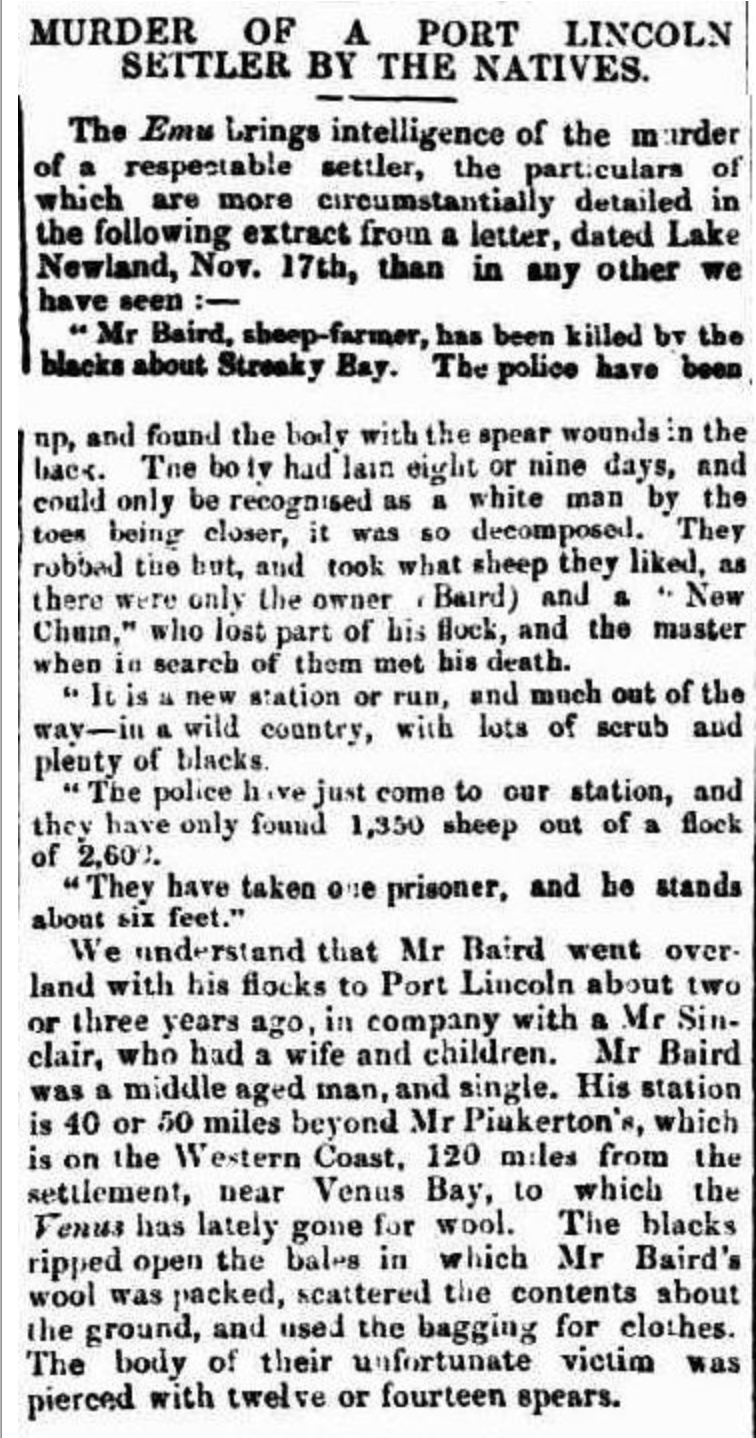
Above:- Article from the South Australian, Thu 28 Nov 1850. Image c/o Trove.
Police Constable Dewsen then travelled to Port Lincoln where he reported the murder to Corporal James Geharty on Thursday the 21st day of November 1850. On Friday the 22nd day of November 1850, Corporal Geharty then dispatched Police Constable Wilson to the Salt Creek Police Station to bring in Police Constables Moran and Kennings to form a party to search for those responsible for the murder of Baird. They arrived at the Port Lincoln Police Station the following day, and then on Sunday 24th November 1850, Geharty, Dewsen, Kennings and Wilson and a local Port Lincoln aboriginal man to be utilised as an interpreter, left Port Lincoln for Baird’s property. They arrived there on Friday the 29th day of November 1850. (Port Lincoln Times 1940) (SA Register 1851)
Through an aboriginal man called Poolulta, Corporal Geharty established that Baird’s sheep had been driven towards Streaky Bay by those responsible for Baird’s death. Poolulta also provided 11 names of those responsible for Baird’s murder including Kullgulta @ John Murray. Geharty and his party headed north and soon found tracks and other evidence of some of the sheep being slaughtered. (Port Lincoln Times 1940) (SA Register 1851)
By Tuesday the 3rd day of December, Geharty’s party had been reduced to about 10 lbs of flour and this had to last for their return back to Pinkerton’s station. (SA Register 1851)
The Port Lincoln Police Station Journal recorded the following:
“The scrub got so dense that we could not proceed more than about three miles per hour, or could have seen a native if one had been within five yards of us. The Port Lincoln native who was tracking, gave it up, having been informed by the native prisoner that the natives could subsist for many days, inland on the scrub root as a substitute for water“. (SA Register 1851)
Realising that there was no chance of apprehending those responsible for the murder of Baird, Geharty and his party headed south and returned to Baird’s property and then to Pinkerton’s property. (SA Register 1851)
Due to the ‘resort of firearms’ and ‘the number of wounded’, the Lieutenant Governor ‘deemed it expedient that particular enquiries should be made into these circumstances’. On the Friday 6th day of December 1850, George Dashwood, the Commissioner of Police, Matthew Moorhouse (b. 1813. d. 1876), the Protector of Aborigines, two police constables, and four horses, departed Port Adelaide aboard the Yatala, on an expedition to Port Lincoln to investigate the murder of Baird. (Port Lincoln Times 1940) (SA Register 1851)

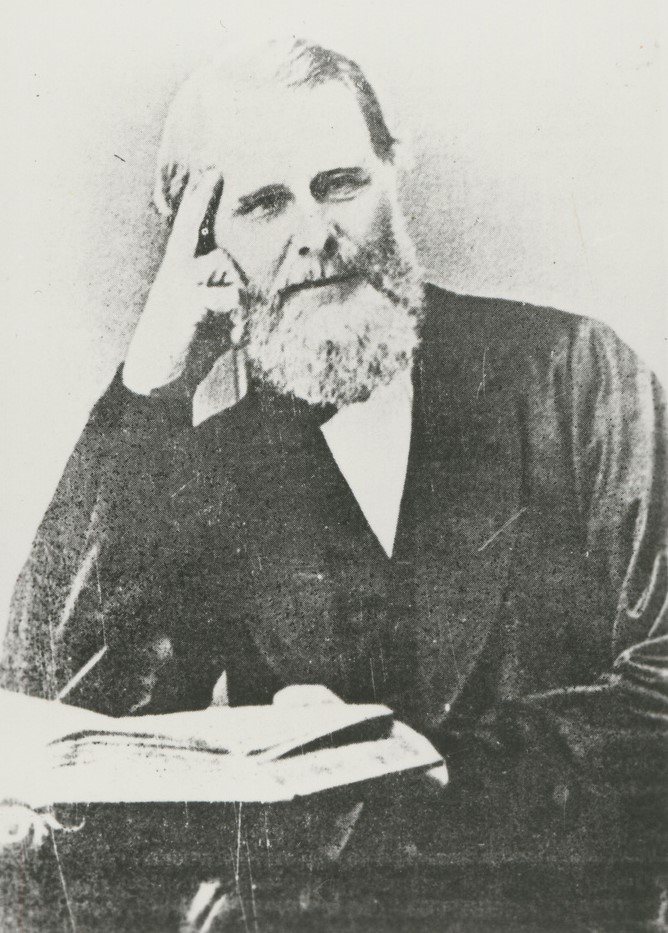
Above:- George Dashwood (left) and Matthew Moorhouse (right). Images c/o State Library SA & Wikipedia.
They arrived at Port Lincoln 2 days later on Sunday the 8th day of December 1850 and were joined by Mr Clamor Schurman and two Aboriginal interpreters. Schurman was a Lutheran missionary and pastor. (Aust Dict Biography 2024) (SA Register 1851)
Dashwood and Moorhouse and their party visited the site of the shooting. There they unearthed the body of an aboriginal male and located what appeared to be a bullet hole in the skull. (SA Register 1851)
Dashwood, Moorhouse and Geharty, and the interpreters then sailed from Venus Bay to Streaky Bay arriving there on Thursday the 19th day of December 1850. They gained the confidence of the aboriginal people with the supply of provisions. No person would admit to Baird’s murder, however some of the aboriginal people admitted to eating some of Baird’s sheep. (Port Lincoln Times 1940)
A full report was put before the Lieutenant Governor by the Dashwood and Moorhouse. They stated that the party was ‘justified in firing on the natives in defence of their own persons, being then and there engaged in a lawful pursuit’. (SA Register 1851)
Dashwood and Moorhouse also stated: “at the same time it may be questionable to what extent they, by heedlessly galloping up to the natives in the first instance, brought themselves into a position of danger, and whether the arrest of the prisoner could not have been effected by a more cautious mode of proceeding……It seems hardly fair, in the quietness of domestic life, to judge too harshly the acts of persons who, in a state of excitement, and engaged in a just cause, may have lacked judgement, but who, in point of fact, have not transgressed the law” (SA Register 1851)
They commented on the actions of Corporal Geharty stating “we feel it incumbent upon us to bring His Excellency’s notice the untiring zeal, activity, and perseverance of Corporal Geharty, who appears to have left no stone unturned to discover the murderers of the late Mr Baird.” (SA Register 1851)
Dashwood and Moorhouse also reported that “Mr Baird lost his life in very rashly attempting to recover single-handed the sheep which had been lost through Townsend’s neglect.” (SA Register 1851)
Following Baird’s death the Commissioner of Police suggested that flour and blankets be periodically distributed from Three Lakes Station to enable the police ‘to become acquainted with the natives’. (Port Lincoln Times 1940)
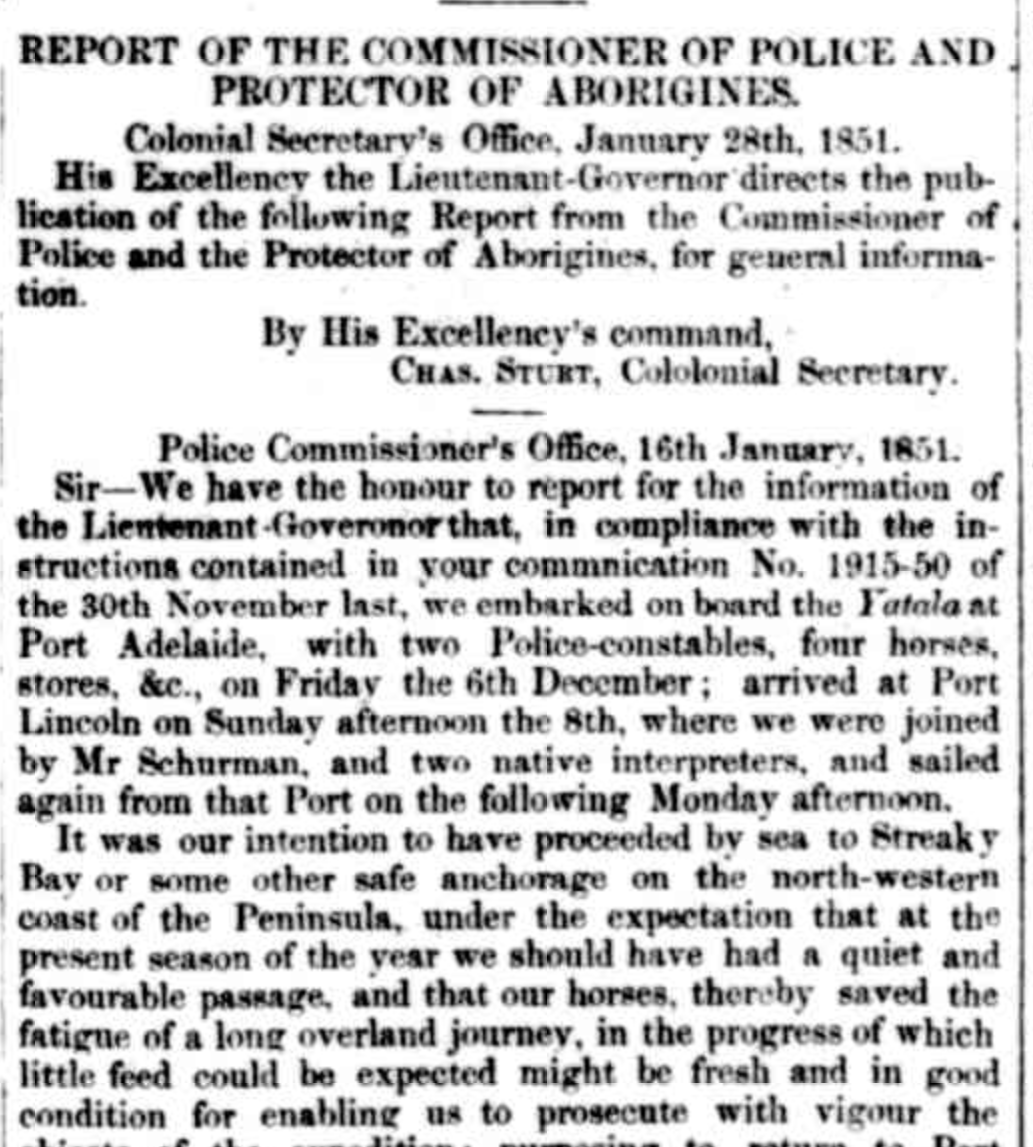
Above:- Part of the lengthy Report of The Commissioner of Police and the Protector of Aborigines, which appeared in the South Australian Register, Sat 1 Feb 1851. Image c/o Trove.
Sceale Bay is pronounced ‘Scale’ Bay. The bay after which it is named was named by Captain William Bloomfield Douglas (b. 1822. d. 1906) of the South Australian Marine Board in 1858. He named it in honour of a former Royal Navy companion. (Place Names 2012)
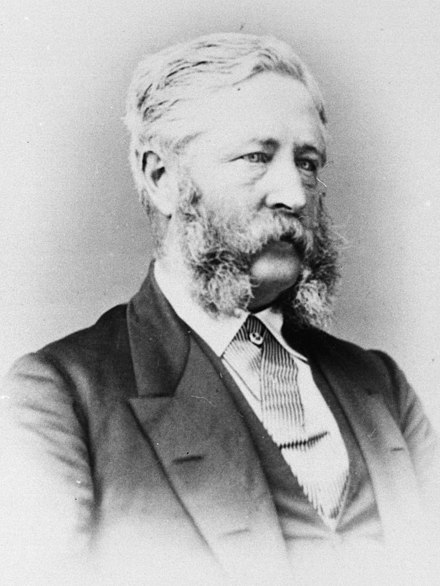
Above:- William Bloomfield Douglas. Image c/o Wikipedia.
The town, originally called Yanera was proclaimed on the 25th day of October 1888. It was renamed Sceale Bay in 1940.
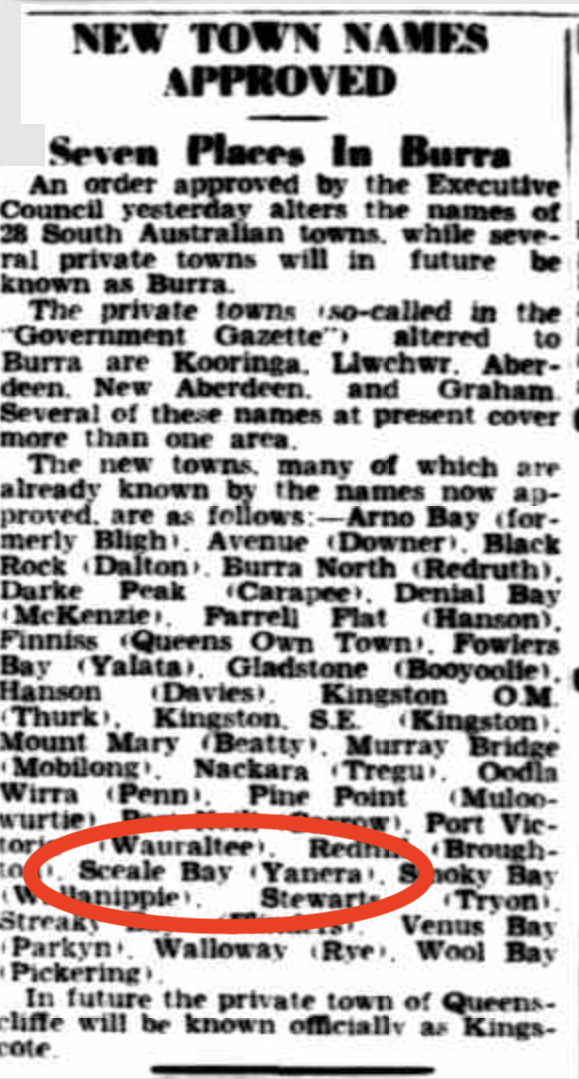
Above:- newspaper article from The Advertiser, Fri 26 Jul 1940. Image c/o Trove.
Today Sceale Bay is a quiet little coast town on the Eyre Peninsula with a population of about 30 people.


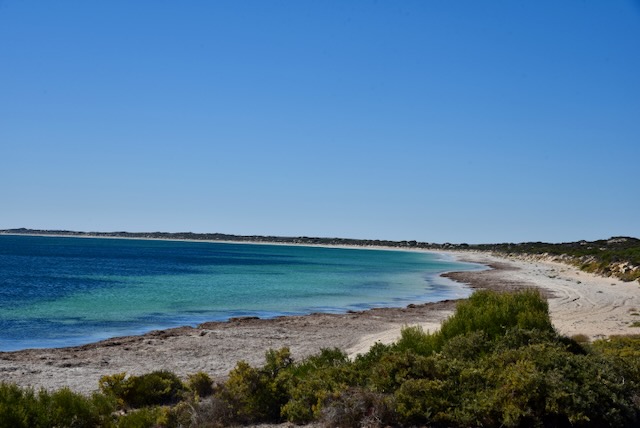


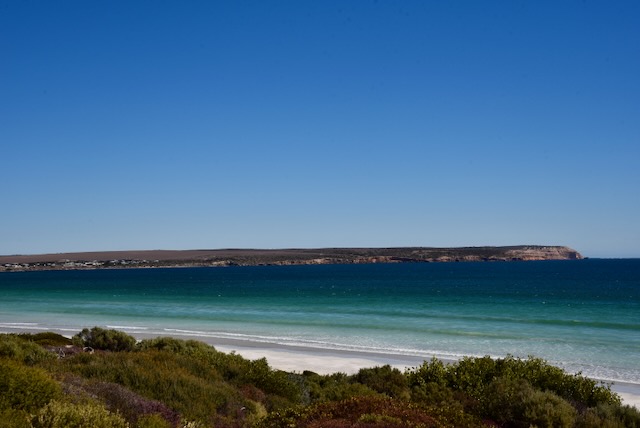
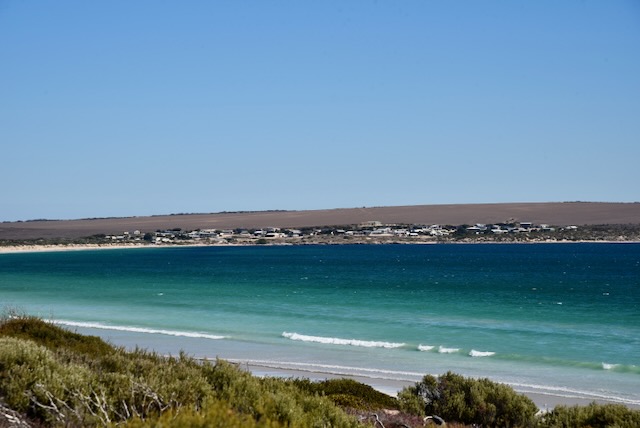
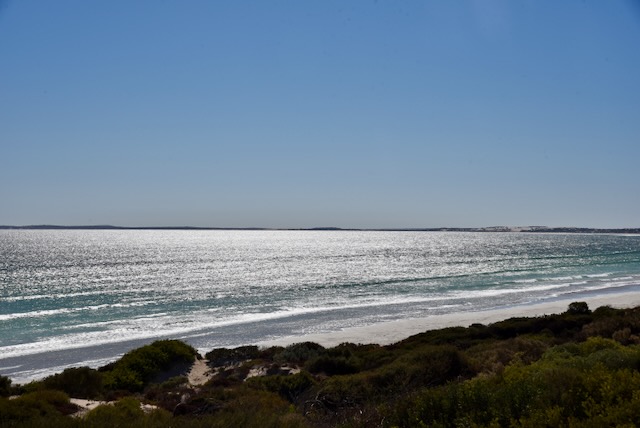
The Sceale Bay Conservation Park is about 532 hectares in size and was established on the 20th day of April 1995. (Wikipedia 2024)
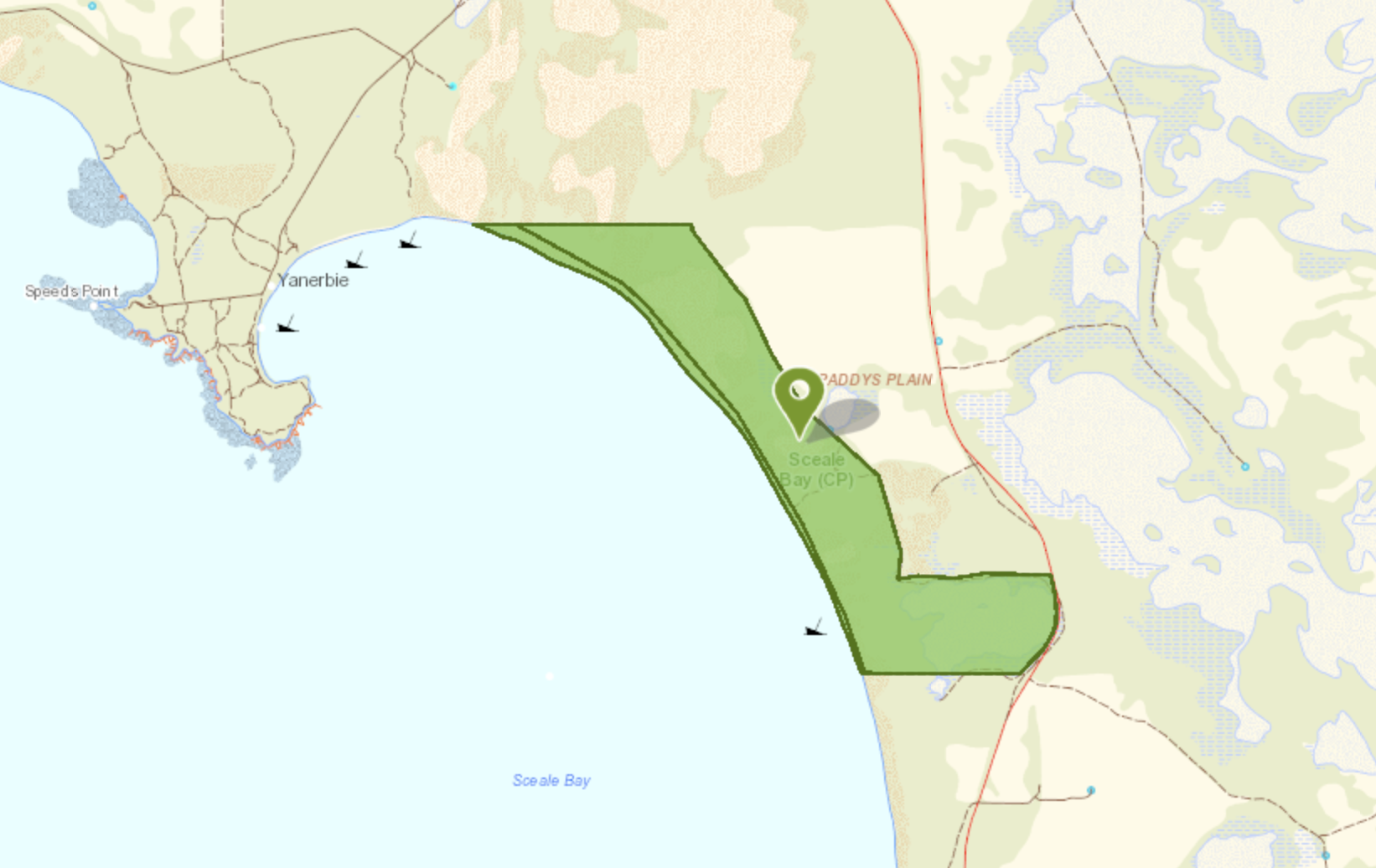
Above:- The Sceale Bay Conservation Park. Image c/o Location SA Map Viewer.
I set up on a dirt rack off Sceale Bay Road. I ran the Yaesu FT857, 40 watts, and the 20/40/80m linked dipole for this activation.
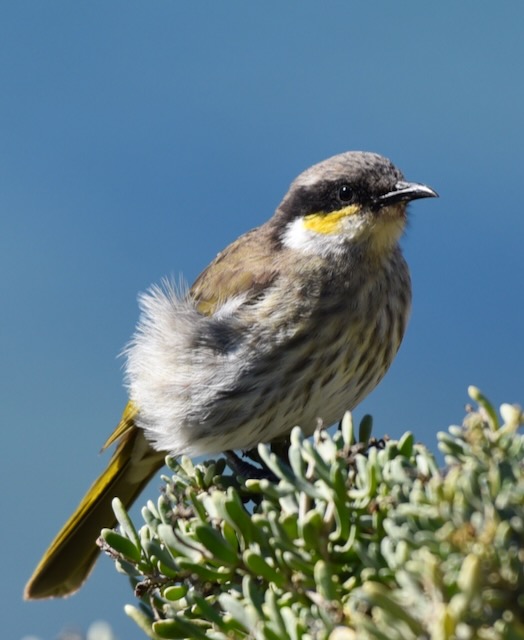
During my activation, I had the following little onlooker very close to my operating spot. It is a Singing Honeyeater.
I worked the following stations on 40m SSB:-
- VK5TUX
- VK5MAZ
- VK5FB
- VK2YW
- VK5LA/m
- VK5KAW/m
- VK5HS/m
- VK3YV
- VK3TNL
- VK3PF
- VK3KAI
- VK3MTT
I worked the following stations on 20m SSB:-
- VK2IO/p (Tallaganda State Conservation Area VKFF-1375)
- VK3APJ
- VK3VIN
- VK7XX
- VK4NH
- VK4DXA
- VK3PF
- VK3KAI
- VK1AO
- VK2mET
- VK3GJG
- VK2USH/p (Mole Creek Karst National Park VKFF-0322)
- VK3MAB
- VK6CB
- VK2VW
- VK2HFI
- VK2AKA
- VK2BUG
- VK2EXA
- Vk3PWG
- VK3TTK
- VK3SO
- VK3SFG
- VK3TZT
- IK4IDF
- OH1MM
- VK4MUD
- VK7AAE
- IW2NXI
- VK3ZSC
- ZL4NVW
- VK3EJ
- IK1GPG
- VK1DI
References.
- admin (2017). Murphy’s Haystacks in South Australia Explained. [online] Australian Traveller. Available at: https://www.australiantraveller.com/sa/murphys-haystacks-sa/. [Accessed 12th Jun 2024]
- DOMESTIC NEWS. (1851). Adelaide Times. [online] 8 Jan. Available at: https://trove.nla.gov.au/newspaper/article/207066253?searchTerm=baird%20speared [Accessed 13 Jun. 2024].
- ExplorOz. (n.d.). Murphy Landing SA. [online] Available at: https://www.exploroz.com/places/42659/sa+murphy-landing [Accessed 12 Jun. 2024].
- JEREMIAH D. MURPHY, FORESTVILLE. (1938). Southern Cross. [online] 22 Jul. Available at: https://trove.nla.gov.au/newspaper/article/167707742?searchTerm=DEnis%20drinan%20murphy [Accessed 12 Jun. 2024].
- Kneebone, H. (n.d.). Clamor Wilhelm Schürmann (1815–1893). [online] Australian Dictionary of Biography. Available at: https://adb.anu.edu.au/biography/schurmann-clamor-wilhelm-13284. [Accessed 13 Jun. 2024].
- LAND AND BUILDING SOCIETIES. (1851). Adelaide Observer. [online] 11 Jan. Available at: https://trove.nla.gov.au/newspaper/article/165043384?searchTerm=baird%20speared [Accessed 13 Jun. 2024].
- monumentaustralia.org.au. (n.d.). James Baird | Monument Australia. [online] Available at: https://monumentaustralia.org.au/themes/people/settlement/display/117157-james-baird [Accessed 12 Jun. 2024].
- MURDER OF A PORT LINCOLN SETTLER BY THE NATIVES. (1850). South Australian. [online] 28 Nov. Available at: https://trove.nla.gov.au/newspaper/article/71627721?searchTerm=baird%20speared# [Accessed 13 Jun. 2024].
- MURDER Of BAIRD AND BAIRDS BAY. (1940). Port Lincoln Times. [online] 7 Nov. Available at: https://trove.nla.gov.au/newspaper/article/96748117?searchTerm=baird%20%2B%20speared [Accessed 13 Jun. 2024].
- MURDER OF BAIRD AND BAIRDS BAY. (1940). Port Lincoln Times. [online] 31 Oct. Available at: https://trove.nla.gov.au/newspaper/article/96751206?searchTerm=baird%20%2B%20speared [Accessed 13 Jun. 2024].
- published.collections.slsa.sa.gov.au. (n.d.). A Compendium of the Place Names of South Australia. [online] Available at: https://published.collections.slsa.sa.gov.au/placenamesofsouthaustralia/ [Accessed 12th Jun. 2024].
- THE CRIMINAL SESSION. (1851). South Australian Register. [online] 10 Feb. Available at: https://trove.nla.gov.au/newspaper/article/38447194?searchTerm=james%20baird%20killed [Accessed 12 Jun. 2024].
- THE GOVERNMENT GAZETTE. (1851). South Australian Register. [online] 1 Feb. Available at: https://trove.nla.gov.au/newspaper/article/38449080?searchTerm=baird%20speared [Accessed 13 Jun. 2024].
- Trove. (n.d.). South Australian Register (Adelaide, SA : 1839 – 1900) – 1 Feb 1851 – p3. [online] Available at: https://trove.nla.gov.au/newspaper/page/3933554 [Accessed 13 Jun. 2024].
- Trove. (2014). MURDER Of BAIRD AND BAIRDS BAY – Port Lincoln Times (SA : 1927 – 1986; 1992 – 2002) – 7 Nov 1940. [online] Available at: https://trove.nla.gov.au/newspaper/article/96748117 [Accessed 12 Jun. 2024].
- Wikipedia. (2021). Sceale Bay Conservation Park. [online] Available at: https://en.wikipedia.org/wiki/Sceale_Bay_Conservation_Park [Accessed 13 Jun. 2024].
 VK5PAS