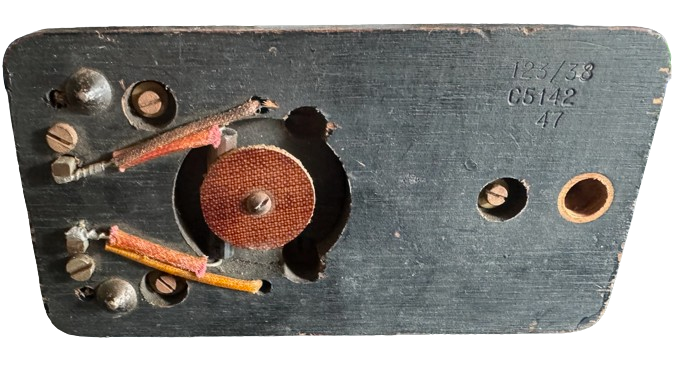
A few days ago I picked up the item below in an on-line auction.
But what is it?
It was advertised as a Morse key.
It is in fact a Telegraph sounder.
It was only with some help with John VK5BJE, Chris VK3QB, and Ian VK5CZ, and trusty Google, that I confirmed what this little device was.
A telegraph sounder is an antique electromechanical device used as a receiver on electrical telegraph lines during the 1800’s. The device was invented by American Alfred Lewis Vail (b. 1807. d. 1859) in c. 1850 to replace the previous receiving device known as the Morse register. (Wikipedia 2024)
The telegraph sounder converts electrical pulses into audible sounds and was used to receive Morse code messages. It was the first practical application of the electromagnet. When a telegraph message is received, the telegraph sounder receives an audible clicking sound representing the short and long keypresses “dots” and “dashes” that are used to represent text characters in Morse Code. A telegraph operator would interpret the sounds into characters representing the telegraph message. (Wikipedia 2024)
The telegraph sounder was used at the receiving end. It was used to make the Morse code message audible. The device consisted of an electromagnet attached to the telegraph line, with an iron armature near the magnet’s pole balanced on a pivot, held up by a counterweight. (Wikipedia 2024)
When current flowed through the electromagnet’s winding, it created a magnetic field that attracted the armature, pulling it down to the electromagnet, resulting in a “click” sound. When the current ended, the counterweight pulled the armature back up to its resting position, resulting in a “clack” sound. Thus, as the telegraph key at the sending end makes and breaks the contact, the sounder echoes the up-and-down state of the key. (Wikipedia 2024)
Below are some excellent videos explaining the telegraph sounder.
At this stage, I’m unsure who made this sounder or its history. I am still researching on the internet.
References.
Smithsonian Institution (2024). Telegraph Sounder | Smithsonian Institution. [online] Smithsonian Institution. Available at: https://www.si.edu/object/nmah_713674 [Accessed 7 Aug. 2024].





 VK5PAS