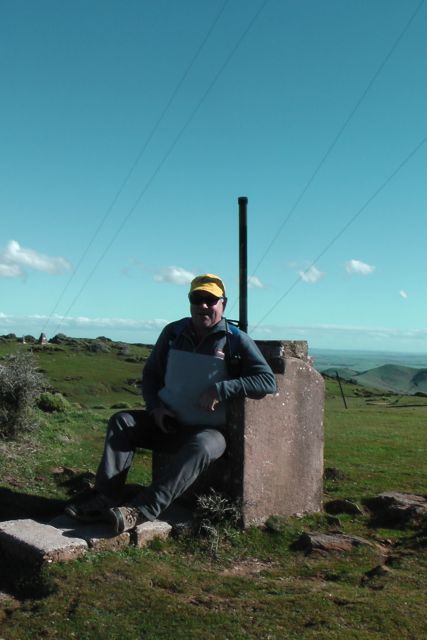
My first Victorian summit of the trip was Mount Napier, VK3/ VS-046.
After my 2 night stay at Mount Gambier, on Saturday 7th September, 2013, I headed over the Victorian border along the Princes Highway towards Heywood. I then headed towards MacArthur and north along the Hamilton-Port Fairy Road. It was about a 2 hour drive from Mount Gambier.
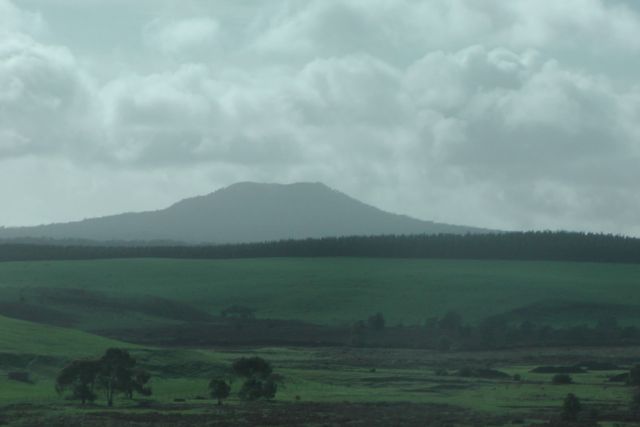
Mount Napier summit is located within the Mount Napier State Park, and is located about 270 km west of Melbourne, and about 17 km south of Hamilton. Mount Napier is one of the youngest volcanoes in Australia, which erupted about 32,000 years ago. The Mount Napier State Park consists of about 2,800 hectares, and along with nearby Mt Eccles, is the largest natural area on the volcanic plains of western Victoria. Mount Napier State Park was first reserved for public purposes in 1921 and covered an area of about 139 hectares, including the summit and part of the Manna gum woodland. This area together with adjacent public land was reserved as a State Park in 1987.
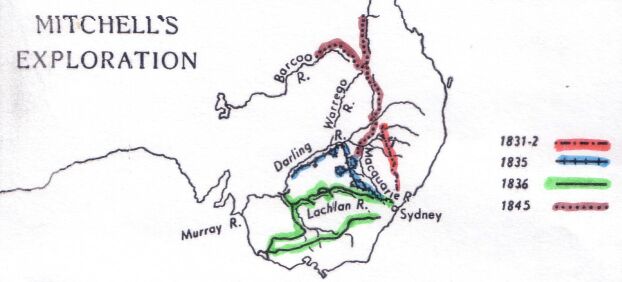
Mount Napier was climbed and named by explorer, Major Thomas Mitchell in 1836, during his expedition through ‘Australia Felix’.
Mount Napier has a composite lava shield with a superimposed scoria cone. The cone rises 500 feet (150 m) above the surrounding plains to an elevation of 1,440 feet (440 m), making it the highest point on the Western District Plains of Victoria. Mount Napier is part of the Newer Volcanics Province, which is the youngest volcanic centre in Australia. The Newer Volcanics Province covers an area of 6,000 square miles (15,000 square km) and contains over 400 vents.
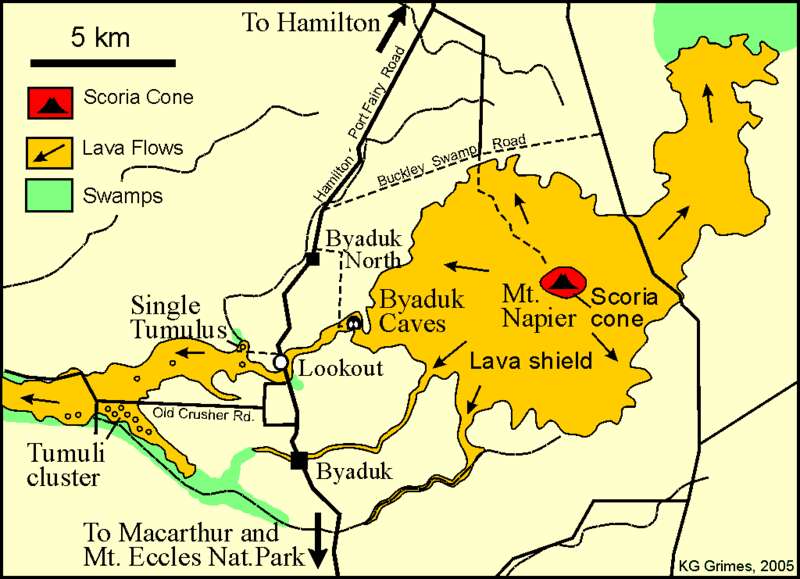
The Mount Napier Lava Flow followed the Harman Valley west from the volcano, and then south towards nearby Mount Eccles which is 25 km south-west of Mount Napier. Lava blisters or tumuli occur along the flow, and these are house-sized mounds of basalt rocks. The blisters are the best developed in Australia and uncommon in the rest of the world. They are formed by the pressure of liquid lava pushing up against the crust. Several caves and lava tubes can also be found at nearby Byaduk.
The native vegetation of Mount Napier State Park, on the western side of the mountain, varies from grassy woodland to tall open forest dominated by Manna Gum, Blackwood, Austral Bracken, and Common Tussock Grass. This hosts a variety of native fauna, including birds, marsupials and mammals, including bats.
The park’s fauna is diverse, with 27 native mammal and 127 native bird species recorded including kangaroos, koalas, Common Brushtail possums, and the endangered Eastern Barred Bandicoot.
I parked the car at the base of the summit, and walked the remaining 3 km along a very good track to the summit, which took me about 30 minutes. There are 2 benches along the way should you require a rest, which is exactly what I did. I sat back and took in the tranquility of the park and admired the views. The weather was a bit threatening, but at least I had the bothy bag in my backpack.
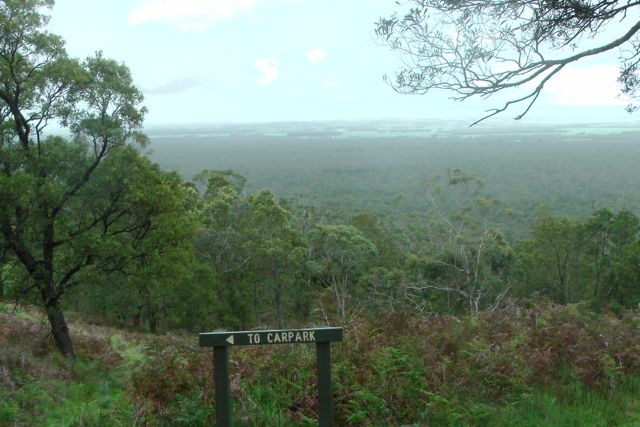
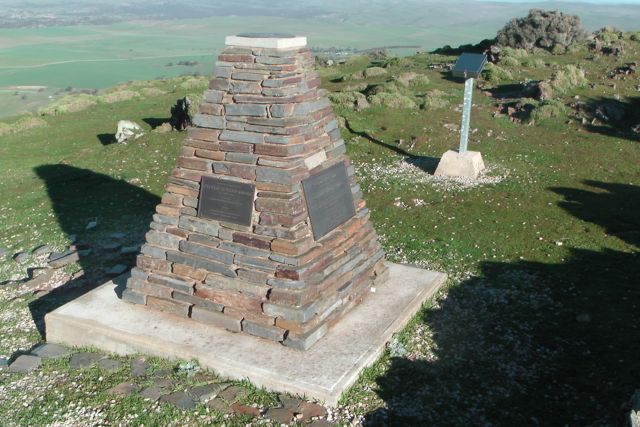
After reaching the summit I took another breather and admired the views in all directions. There is a memorial cairn and plaque at the top to commemorate Major Thomas Mitchell who climbed and named the hill, way back in 1836. There is also a trig point.
The weather was getting worse, and it was quite windy with very light showers, so I attached the 7m squid pole to the trig point and ran the coax over to the concrete and stone cairn and tried to hide behind that from the weather, with some degree of success. I weighted down the ends of the dipole with some rocks that I found on the summit. There are no trees.
My first 4 qualifying QSO’s were with Larry VK5LY, Ron VK3AFW, Tony VK3CAT running qrp, and Marshall VK3MRG/p. This was followed by a constant flow of the regular SOTA chasers. My 8th contact on the hill was with John VK5BJE who was portable in the Litte Desert National Park in western Victoria, as part of the Keith Roget Memorial National Parks Award. This was a park I was scheduled to activate the following Tuesday. John had a terrific strong 5/9 signal.
Whilst on the hill I managed 3 ‘Summit to Summit’ contacts’ with Peter VK3PF who was portable on VK3/ VG-064; Brian VK3MCD who was portable near Boroka Lookout VK3/ VW-007; and Allen VK3HRA who was portable on Galore Hill VK2/ RI-047. This was my first ever Summit to Summit with a VK2 activator.
I stayed on the summit for about 45 minutes, but the weather was getting worse, with heavier showers, so I decided it was time to head down and back to the warmth of the car. I ended up with 36 QSO’s on 40m SSB.
The following stations were worked:- Larry VK5LY; Ron VK3AFW; Tony VK3CAT/qrp; Marshall VK3MRG/p; Bernard VK3AMB/qrp; Ian VK5IS/qrp; Peter VK3FPSR; John VK5BJE/p; ANdrew VK2UH/qrp; Peter VK3PF/qrp; Brian VK3MCD/p; John VK5NJ/qrp; Glen VK3YY/m; Andrew VK2ONZ; Rod VK5FTTC; ANdrew VK3ARR/qrp; Mark VK3PI; Matt VK1MA; Colin VK3UBY; Mark VK1MDC; Andy VK5LA; Mark VK3DEE; VK3TKK; Ed VK2JI; Lou VK3ALB; VK3FMPB; Warren VK3BYD; Greg VK2FGJWp//qrp; Andrew VK1NAM; David VK5NQP; Allen VK3HRA/p; Terry VK5ATN; Tim VK5AV; Dave VK2JDS; Dave VK3VCE; and John VK5DJ.
I have added a video to You Tube of this activation.
My first summit of the trip was Mount Burr, VK5/ SE-019, which is about 240 metres ASL (787 feet) and is worth 1 SOTA point.
After a hearty cooked breakfast and a strong coffee, I left the motel at Mount Gambier, early on Friday morning, 6th September, 2013, and headed out north west along the Princes Highway, towards Millicent. I then turned right onto The Springs Road, to head north towards the town of Glencoe. The summit was clearly visible, shrouded in a bit of fog.
Before reaching the town of Glencoe I turned left onto Diagonal Road and continued west on Mile Hill Road. I then turned right onto the Glencoe-Mount Burr Road. There is then a dirt road on the left, with a TV tower sign. This is the required road to access the summit. A few kms up this road is the turn off on the left to the summit. It is well sign posted.
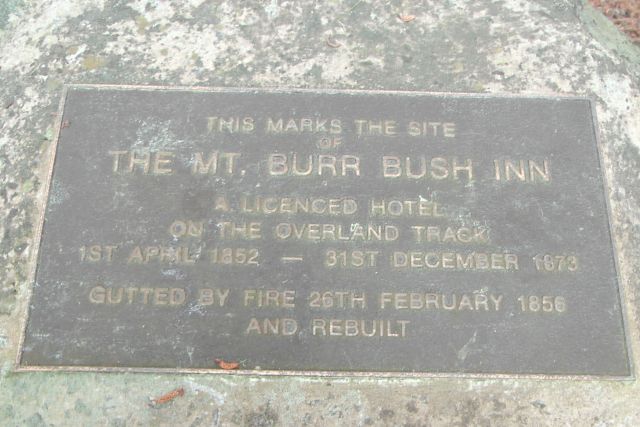
On the way to the summit I stopped off at the historical marker for the old Mount Burr Bush Inn, which is located on the western side of the Glencoe-Mount Burr Road. This little pub was a licenced hotel on the Overland track, and was built in 1852, and remained standing until 1873. In days gone by it was a significant watering hole for mail coach drivers and the general public travelling between Robe and Mt Gambier. It was actually the last stop between Kangaroo Inn and Mt Gambier on the old stock route. It was very popular during the gold rush years but wasnt frequented by the Chineses on route to the Victorian gold fields as it was a licensed Pub. Being illegal immigrants they didnt want to risk being caught by Government officials so they built Wells off of the main route.
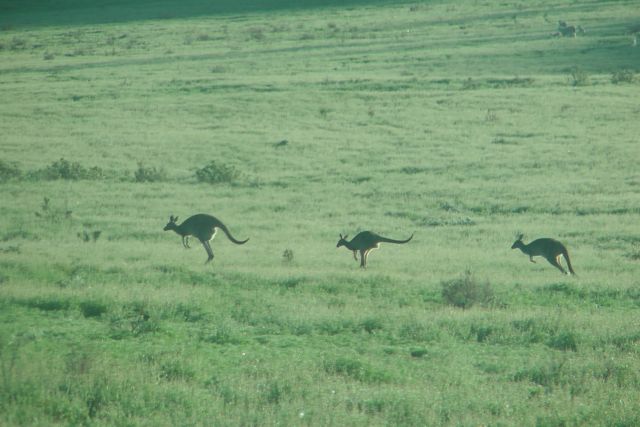
On the way to the summit I drove passed the Mount Burr Forest Reserve, and saw quite a few emus and kangaroos on the move. The Mount Burr Forest consists of 8 individual forest reserves with a total area of about 1,323 hectares. The reserves contain the threatened mammal species, Southern Brown Bandicoot, Suger Glider, and Red-necked Wallaby.
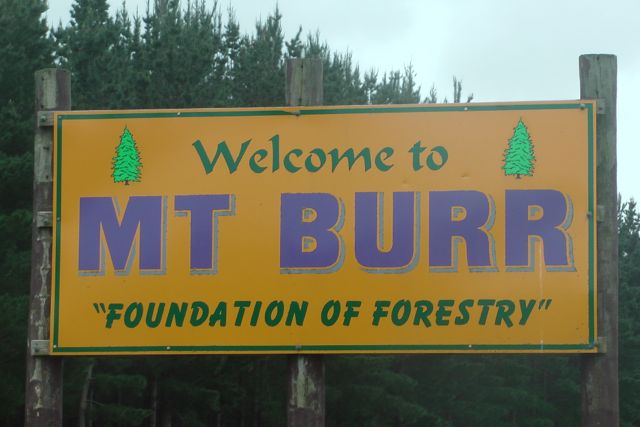
The Mount Burr summit shares its name with the nearby small town of Mount Burr, which is about 12 km east of Millicent, and about 50 km north east of Mount Gambier. Mount Burr has a small population of about 400 people. Mount Burr was once a thriving country town, which was home to a large timber mill. The mill was the first of its kind in the region, built in 1931. It was considered a turning point for industry on the Limestone Coast. Unfortunately in late 2000 the timber mill closed leaving many employees unemployed.
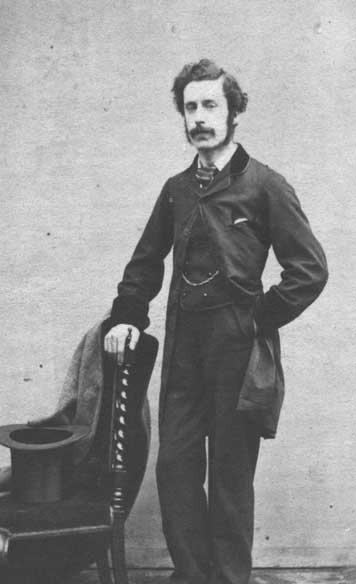
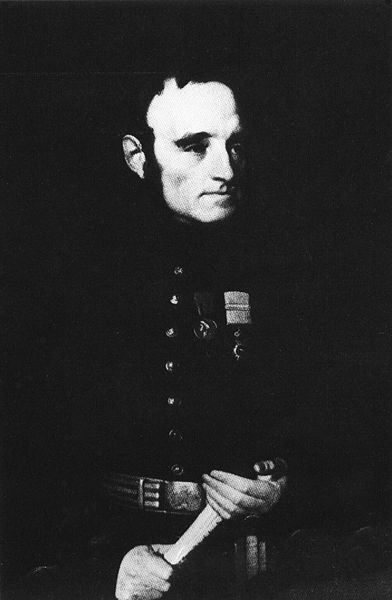
Mount Burr summit is one of fifteen extinct volcanoes on the Limestone Coast. The mountain was named by the Governor of South Australia George Grey (photo below), after George Dominicus Burr, a surveyor and Professor of Mathematics at Sandhurst Military College. His son, Thomas Burr, a surveyor, accompanied Governor Grey on the expedition in 1844.
Quoted from the account of the expedition published in the Journal of the Royal Geographical Society of London, vol 15, 1845: “Article III.- Account of Governor G Grey’s Exploratory Journey along the South-Eastern Sea-board of South Australia. By Mr Thos. Burr, Dep Surv.-Gen.” “7 May 1844: At about 2pm we made the top of a range, the principal summit of which his Excellency has done me the honour to call after my father. The Mount Burr range is about 1600 feet above the level of the sea…”
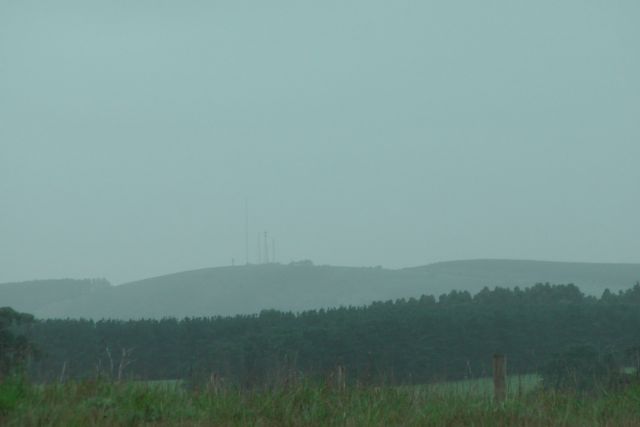
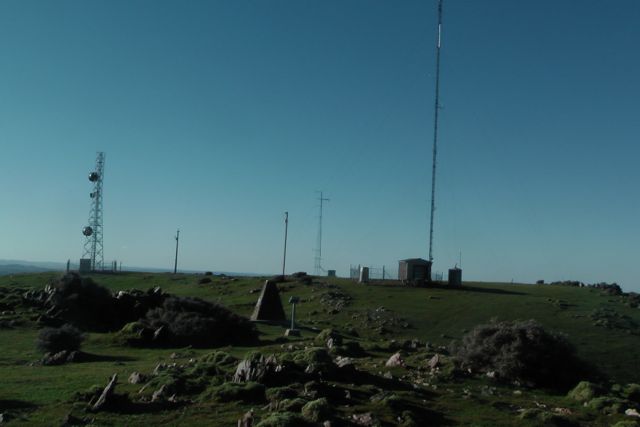
The summit is home to the SES 8 television transmitter, which is responsible for transmitting WIN, Seven SA, Ten SA, SBS, and ABC to households across the South East of SA and Western Victoria. When I saw all the towers, the first thing that went through my mine was ….HIGH noise floor.
There is an unlocked gate at the entrance to the summit, with a sign on it reading ‘Mt Burr Forest. Gate: MB28. Gri: 542 383″. It is a very short drive from there to the locked compound containing all of the towers. There is another unlocked gate which will take you around to the eastern side of the summit. There were some sheep and alpacas in this paddock, so if you enter here, please shut the gate/s.
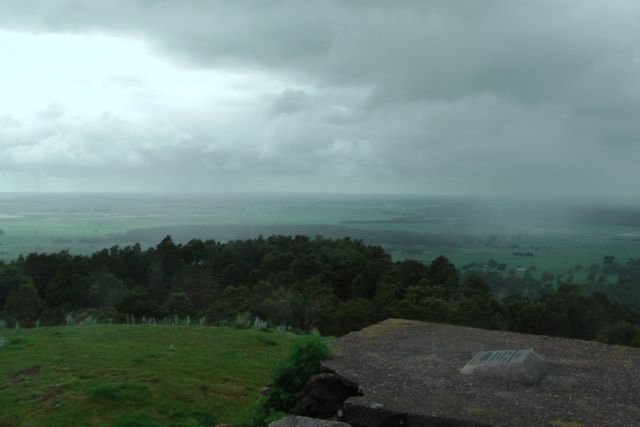
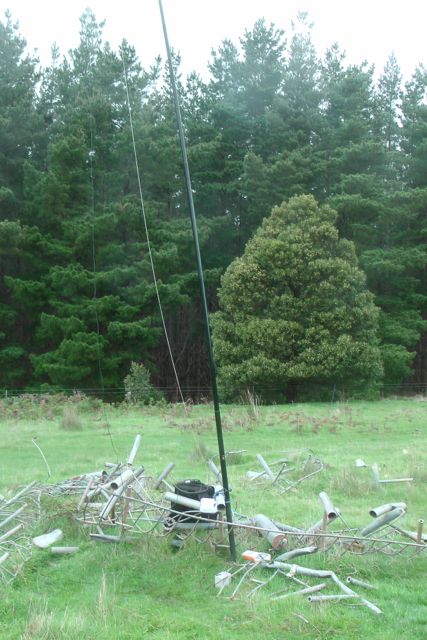
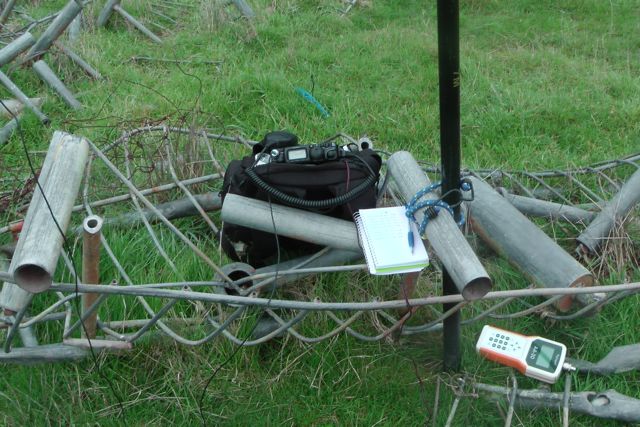
There are no real views out to the east due to the pine forest. The only views are out to the south west, and these are also obscured due to the pine forests. I set up on the eastern side of the summit near the pine forest. There was a large amount of metal pieces of tower lying around on the ground, and I used these to attach the 7m squid pole to, and also to secure down the legs of the 40m/20m linked dipole. And importantly, also as a seat !
I had reached the summit and set up by about 9.10 a.m. so I had about 20 minutes to play before the UTC roll over. Surprisingly enough after I turned on the radio I found that the noise floor was very low despite all the antennas on the summit. I was really happy with this ! My first 4 qualifying QSO’s were with Matt VK1MA, Peter VK3PF using qrp, Col VK5HCF also using qrp, and Mitch VK3FMDV. I worked 23 stations before the UTC rollover. This included John VK5BJE who was portable in the Mullinger Swamp Conservation Park, north east of Narracoorte.
The new UTC day then clicked over and I worked a further 25 stations. This included John VK5BJE again in the Mullinger Swamp CP, and Larry VK5LY who was portable in the Danggali Conservation Park. I also managed two ‘Summit to Summit’ QSO’s with Ian VK5CZ on Lagoon Hill VK5/ SE-008; and Wayne VK3WAM on Mount Matlock VK3/ VC-001.
After about an hour on the hill I had 48 QSO’s on 40m SSB into VK1, VK2, VK3, VK5, & VK7. Band conditions were very good. Quite a few fellas called in whilst operating QRP. They included Peter VK3PF, Col VK5HCF, Andrew VK3ARR, Tony VK3CAT, Rik VK3KAN, Andrew VK2ONZ, Mitch VK3FMDV, Ron VK3AFW, John VK5DJ, and Bernard VK3AMB. All had good signals, proving that there is no need to use 400 watts when calling a SOTA activator. If you can hear the Activator, you can almost guarantee they he/she will be able to hear you.
My last contact of the day was Bernard who was qrp with just 4 watts and was a solid 5/9. My little 5 watts to Bernard returned a strong 5/8 signal report. Time to head back to the car and off to the Canunda National Park.
The following stations were worked before the UTC rollover:-
Matt VK1MA; Peter VK3PF/qrp; Col VK5HCF/qrp; Mitch VK3FMDV; Tny VK3CAT/m; Rik VK3KAN/m; Greg VK7FGGT; John VK5DJ; Peter VK3FPSR; Robert VK7MGW; Colin VK3UBY; Tony VK5ZAI; Trevor VK5ATW; John VK5BJE/p; Andrew VK3ARR/qrp; Brian VK5FMID; Ed VK2JI; Allen VK3HRA; Andrew VK2ONZ; Mal VK3AZZ; Ron VK3AFW; Peter VK1XP; and Brian VK3MCD/5
The following stations were worked after the UTC roll over:-
Matt VK1MA; Brian VK5FMID; John VK5BJE/p; Tony VK3CAT; Rik VK3KAN; Peter VK3PF; Andrew VK2ONZ/qrp; Mitch VK3FMDV; Ron VK3AFW/qrp; Brian VK3MCD/5; Peter VK3FPSR; Larry VK5LY/p; VK5CZ/p; Mal VK3AZZ; John VK5DJ; Andrew VK3ARR/qrp; Ed VK2JI; VK3DYF; Colin VK3UBY; Wayne VK3WAM/p Rod VK5FTTC; Allen VK3HRA; Gary VK5ZK; Yern VK2KJJ; Bernard VK3AMB/qrp.
I have posted a video on You Tube of this activation.
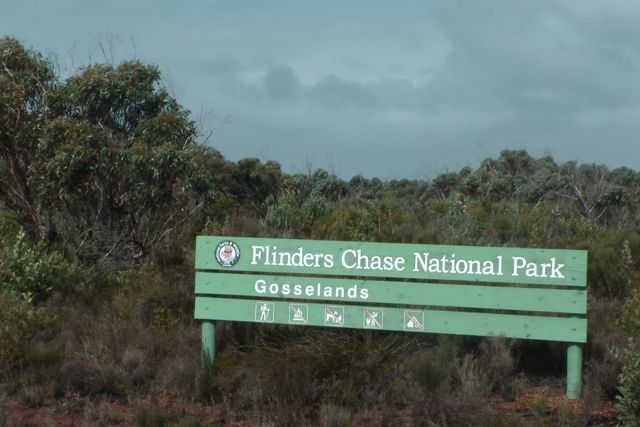
On Sunday, 18th August, 2013, Andy VK5AKH and I drove down to the western end of Kangaroo Island, OC-139, and activated an un-named summit, VK5/ SE-018 which is contained within the Flinders Chase National Park.
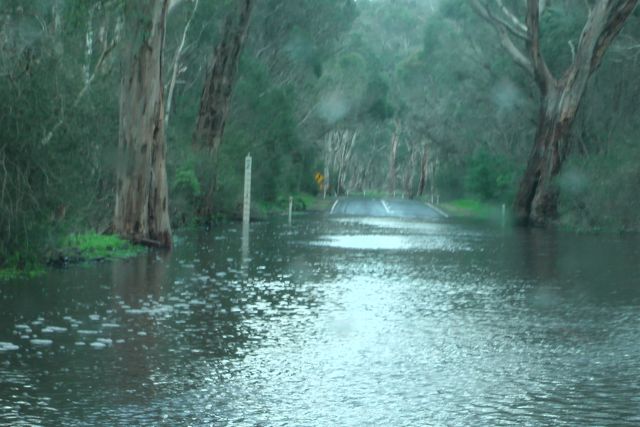
It was a 2 hour drive from the Cape Willoughby lighthouse at the eastern end of the island, where we were staying as part of the International Lighthouse & Lightship Weekend (ILLW). The weather on Friday and Saturday had been very severe, with heavy rain, hail, lightning and very strong winds. In fact the wind speeds had gusted to 140 kph on the Saturday. The road from the lighthouse back to Penneshaw was totally impassable by 2wd traffic, so Andy and I had to take some dirt backroads, to get onto the bitumised Hog Bay Road, and then the Playford Highway. In fact some parts of the main bitumen roads were also flooded, and there was lots of debris on the road.
We drove west along Playford Highway, through Parndana and continued on passed the West End Highway, following the northern side of the Flinders Chase National Park.
The Flinders Chase National Park is a vast area of wilderness which features the spectacular Remarkable Rocks and Admirals Arch as well as a colony of New Zealand fur-seals at Cape du Couedic. A network of walking trails and boardwalks enable you to enjoy the park and its diverse wildlife. The park which was established in 1919, is 328 km2 in size. It is situated about 110 km west of Kingscote, the largest town on Kangaroo Island. A large amount of wildlife can be located in the park including kangaroos, echidnas, koalas, platypus, and wallabies. About 267 species of birds have been recorded.
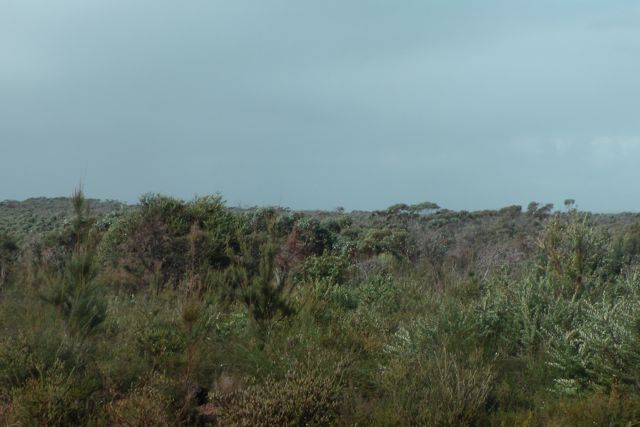
Andy I parked the car on the Playford Highway and walked 100 metres or so to the south, into the thick scrub of the park. We found a clearing and this is where we decided to set up, as there was a bit of room to stretch out the antenna. We didn’t want to go to far, because the weather was very threatening. As much as I wanted to test out my new bothy bag, the thought of cuddling up close to Andy in an enclosed space didn’t really appeal.
The summit is not really a traditional summit. It is simply the highest point on the island. VK5/ SE-018 is about 310 metres above sea level and is worth just 1 point. It is situated on the southern side of the Playford Highway and is contained within the Flinders Chase NP.
We hastily set up my Yaesu FT-817nd, and my 40m/20m linked dipole. There were no rocks present which we could use to support the 7m squid pole, so we quickly attached it to a small nearby gum tree using about 4 octopus straps. The weather was getting worse and it was very windy. The squid pole was on a real lean.
We turned the radio on to 40m, and went to 7.090 and I put out a call, only to be greeted with a massive pile up of hungry Chasers. Initially Andy and I operated by swapping the mic, but there were so many calling that we decided to work 10 and then swap operators.
My first 4 QSO’s were with Brian VK5FMID; Larry VK5LY; Gary VK5ZK; and Andy VK5LA, all of whom had very strong 5/9 signals.
Things were going great guns, but that was not to last long. A combination of antenna problems and poor weather put a quick halt to our activation. The BNC connection on my dipole gave up the ghost and signal strengths went down the gurglar.
I ended up with 19 QSO’s on 40m SSB.
I worked the following stations:- Brian VK5FMID; Larry VK5LY; Gary VK5ZK; Andy VK5LA; Ian VK5CZ; Mal VK3AZZ; Trevor VK5BAR (at the Cape Willoughby lighthouse); Tom VK5EE; Col VK5HCF; Nev VK5WG; Nick VK3ANL; Marc VK3OHM; Ernie VK3DET; Warren VK3BYD; Graham VK5KGP; Roy VK5NRG/p; Colin VK3UBY; Tony VK3CAT; and James VK2IB/p (qrp).
Apologies to all those that were calling and who missed out. The wet weather and a very sick antenna lead had triumphed.
I have added a video to You Tube of the activation.
The last summit of the weekend was Maurice Hill, VK5/ NE-049, which is a very short distance from the previous summit, Hogshead Hill. In fact it is about 8 km as the crow flies or about 15 km by road. Maurice Hill is about 782 metres above sea level, and is worth 4 points. It is situated just a few km south west of the little town of Pekina, which in turn is about 272 kms north of Adelaide. More information on the interesting history of Pekina can be found in the previous Hogshead Hill blog.
Maurice Hill was named after Mr Price Maurice, who was a large landowner and successful pastoralist.
The summit is located on private property, and Ian and I had obtained permission from the landowner, Tony Mannion, about 2 weeks prior to the activation. In fact I had met Tony in the Orroroo pub the night before the activation, and introduced myself.
We met Tony at a gate on the new bitumen road between Pekina and Wepowie. There is an old pumping station here with a windmill lying on its side. I parked my Ford Falcon just inside the gate and jumped into Ian’s 4WD. From here, Tony led us through his paddocks, and then up a 4WD track which followed a saddle between the summit and an adjacent hill. When the track started to get rough, Tony kindly allowed us onto the back tray of his 4WD and we were driven up closer to the summit itself. Otherwidee the climb would have taken hours. On the drive up, there were numerous kangaroos and euros (wallaroos) seen.
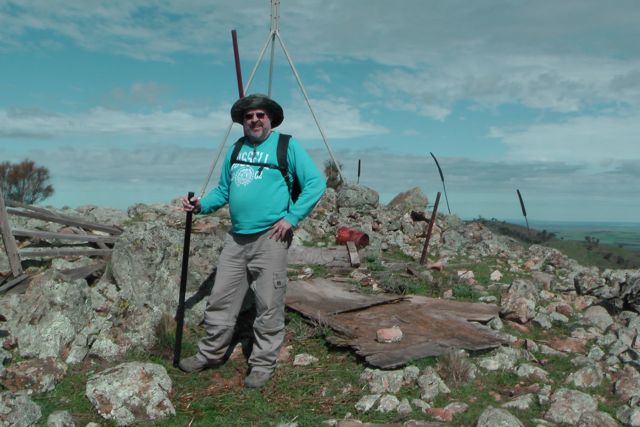
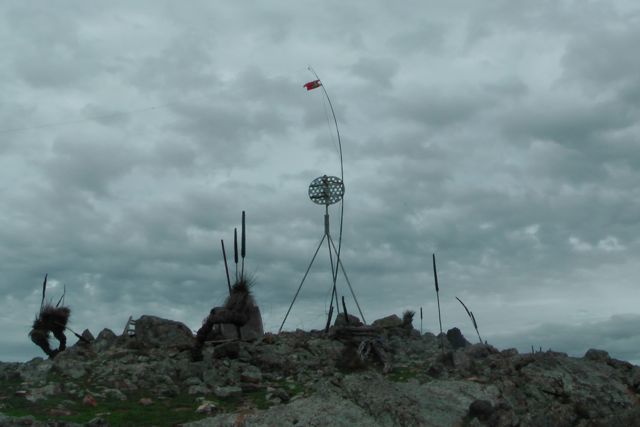
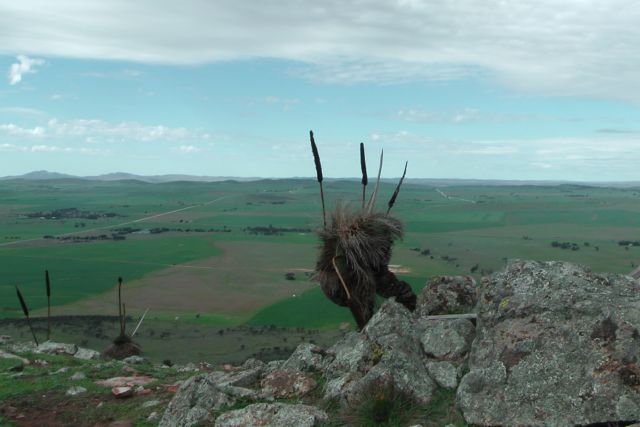
We were dropped off by Tony about 400 metres away from the summit and had a chat to Tony, explaining to him the SOTA program and the hobby of amateur radio in general. Ian and I then packed up our gear and made our way on foot into the activation zone along the rocky 4WD track. Ian and I finally reached the trig point at the very top. There was also the ruins of a wooden shack, which Tony earlier had explained to us had previously been used as a fire spotting shack. All that was left now were bits of rusting metal and old wooden panels.
Ian and I set up right alongside of the trig point. We utilised part of the old wooden hut as protection from the wind which was roaring in from the west. The day’s eathr had changed from bright sunshine to an overcast afternoon with the threat of some rain. There was a convenient star dropper which we utilised to secure the 7 metre squid pole to with some octopus straps.
My first contact on the hill was another summit to summit QSO. This time with Kevin VK3KAB who was portable on the top of Mount Torbreck, VK3/ VN-001. This was followed by the regular crowd of Chasers. Larry VK5LY, Ron VK3AFW, and Colin VK3UBY made up my 4 required QSO’s and all had excellent 5/9 + signals.
Congratulations to Tony VK3CAT who was my 9th contact on the summit. By contacting me, Tony had acquired his 1,000 points and had become a Shack Sloth. Well done Tony and I was really happy that I was the Activator that got you across the line. Tony was operating QRP and had an excellent 5/7 signal.
I was also fortunate to make contact with David VK5KC and John VK5BJE, who were both operating portable from the Ferries McDonald Conservation Park, as part of the VK5 National & Conservation Parks Award. A good 5/7 signal from both of them with their QRP setup.
I also managed a few other summit to summit QSO’s including an enjoyable chat with Michelle VK3FEAT and Terry VK3UP, who were on the top of Mount Buninyong, VK3/ VC-018, operating with just 4 watts (5/7 sent and 5/8 received).
This was followed by a summit to summit with Peter VK3PF who was on top of Hyde Hill, VK3/ VC-008. Not the strongest signal that I’ve heard from Peter, but still a good 5/4 and very readable, with a 5/7 signal report returned by Peter.
A few QSO’s later I spoke with Col, VK5HCF and Tom VK5EE, who were both portable in the Tantanoola Caves Conservation Park, as part of the VK5 National & Conservation Parks Award (5/8 sent and 5/4 received). Col & Tom had activated their first ever SOTA peak earlier in the day, at Mount Burr in the south east of South Australia. But alas, Ian and I had missed them by about one hour. Congratulations to both Col & Tom. Be careful, the SOTA bug bites hard !
My last QSO on the hill was another summit to summit. This time with Rik VK3KAN who was on top of Talbot Peak, VK3/ VT-010. This was a little bit of a struggle, but we managed to get through. Rik’s signal was down considerably at only 4/2, and I received a 4/3 in return from Rik. Thanks for picking us up out of your pile up Rik.
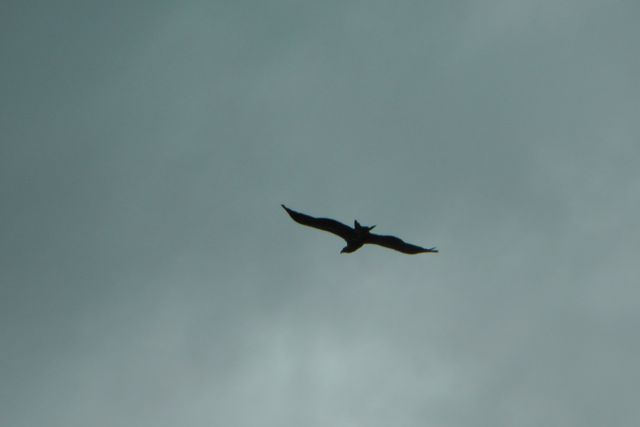
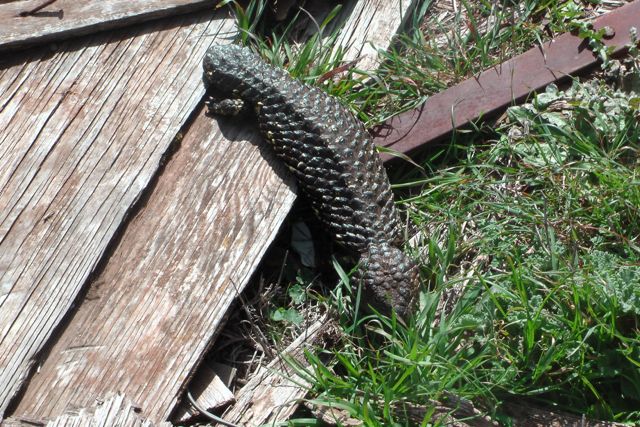
Whilst on top of the hill we were fortunate enough to have our own mascot, a Shingleback lizard which was enjoying the sunshine. At one point we also had an eagle soaring above us in the breeze. Maybe he was watching the lizard ?
Ian had just started working some DX on 20m CW when the weather forced us to pack up and head back down the hill to the 4WD. We could see it slowly moving in from the west across Mount Remarkable and every now & again we were hit by light showers. So we didn’t want to push our luck and get caught in the rain, as we had a few km to get back to Ian’s 4WD.
Between the 2 of us, Ian and I ended up with 46 QSO’s on 2m FM, 30m SSB, & 20m CW.
I worked the following stations:- VK3KABB/p (SOTA); Larry VK5LY; Ron VK3AFw; Colin VK3UBY; Grant VK5VGC; Nev VK5WG; Ernie Vk3DET; Phil VK3BHR; Tony VK3CAT; Ian VK3TCX; Ian VK3VIN; Shaun VK5FAKV; Ian VK5IS; David VK5KC/p(VK5 Parks); John VK5BJE/p (VK5 Parks); Michelle VK3FEAT/p (SOTA); Terry VK3UP/p (SOTA); Peter VK3PF/p (SOTA); Bernard VK3AMB; Albert VK3KLB; Col VK5HCF/p (VK5 Parks); Tom VK5EE/p (VK5 Parks); Peter VK3FPSR; & Rik VK3KAN/p (SOTA).
This was our last activation for the weekend. Ian headed home to Clare & I headed back to the Adelaide Hills, about 3 hours away. A really enjoyable weekend and many fond memories. My top 5 memories will be:-
1. Leaving my prescription glassed behind on the top of Olladie Hills. $200.00 later and an angry wife !
2. All of the summit to summit QSO’s. For me a total of 22 S2S QSO’s in 3 days. A S2S fiesta !
3. Reaching my 100 points as an Activator. A hard slog but have enjoyed every minute of it !
4. Working Tony VK3CAT and giving him his 1,000 point as a Shack Sloth.
5. The really hard slog to get to Stokes Hill. Now this is a very hard earned 4 points !
I have posted a video of the activation on You Tube.
My third planned summit of the weekend with Ian VK5CZ, was Hogshead Hill, VK5/ NE-051, which is situated about 7 km south east (as the crow flies) of the little town of Pekina in the Flinders Ranges, or about 272 km north of Adelaide. Hogshead Hill is about 770 metres above sea level and is worth 4 SOTA points. The summit is situated on private property owned by Gary Hawthorne.
Again it was an early start for me. I had stayed overnight at the Orroroo Hotel, and had enjoyed the cold beer and a good feed the night before. In fact probably a bit too much beer, as I was feeling a bit weary. I got up to the horrible sound of the alarm at 6.00 a.m. and almost felt like rolling over and going back to sleep. But after a nice warm shower and a hearty breakfast I was starting to fire on all 8 cylinders. Ian met me at 7.00 a.m. outside the hotel. It was a fresh morning again, but did not as cold and certainly not the low lying fog as was the case the day before on the Saturday morning.
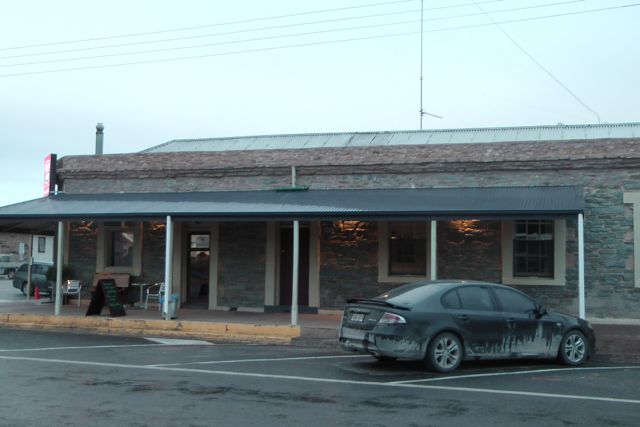
I would highly recommend the Orroroo Hotel, which was established in 1877. The owners Warren & Liz Campbell are very friendly. There are 2 hotels in the town, but the Orroroo is referred to as the ‘top pub’. More info on the pub can be found at…..
As we were going to be travelling south out of Orroroo, Ian and I decided to take both cars. That way at the end of the 2 activations, Ian could head home to Clare, and I could head home to the Adelaide Hills. So we checked our gear and drove south out of Orroroo on the Orroroo to Pekina Road, towards the little township of Pekina.
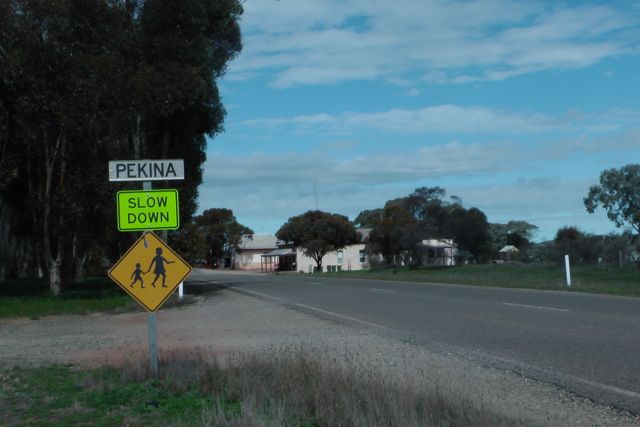
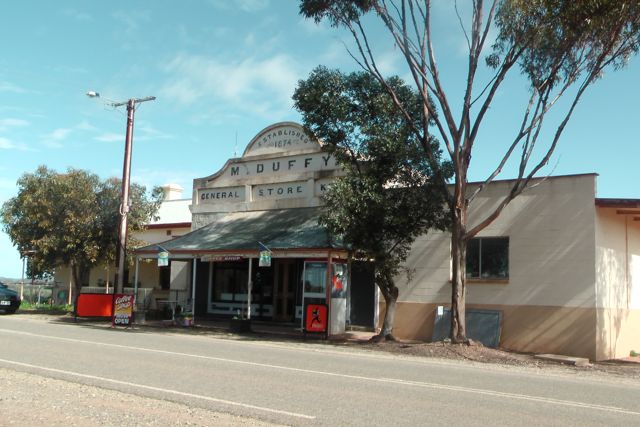
Pekina township is located about 14 km south of Orroroo. It is a tiny town with a population of only 172 people that live in the town itself, and the surrounding district. Nowadays the town consists basically of a general store, established in 1874, and a hotel which was established in 1877. The name of the town is thought to derive from the local Aboriginal word for “creek water” .
European settlement in the Pekina district began in earnest in 1846 when Price Maurice brought 3000 sheep to the district. The Pekina station was one of the most profitable sheep runs in South Australia. Pekina became a stopping-point for coaches on the run between the mining towns of Blinman and Burra to the north. By 1871, the station was resumed and broken up for closer settlement. The Pekina region was settled by German and especially Irish migrant farmers. However, problems with drought, rust (fungus), and locusts during the 1880s meant the town grew slowly with only around 75 residents at the turn of the 20th century.
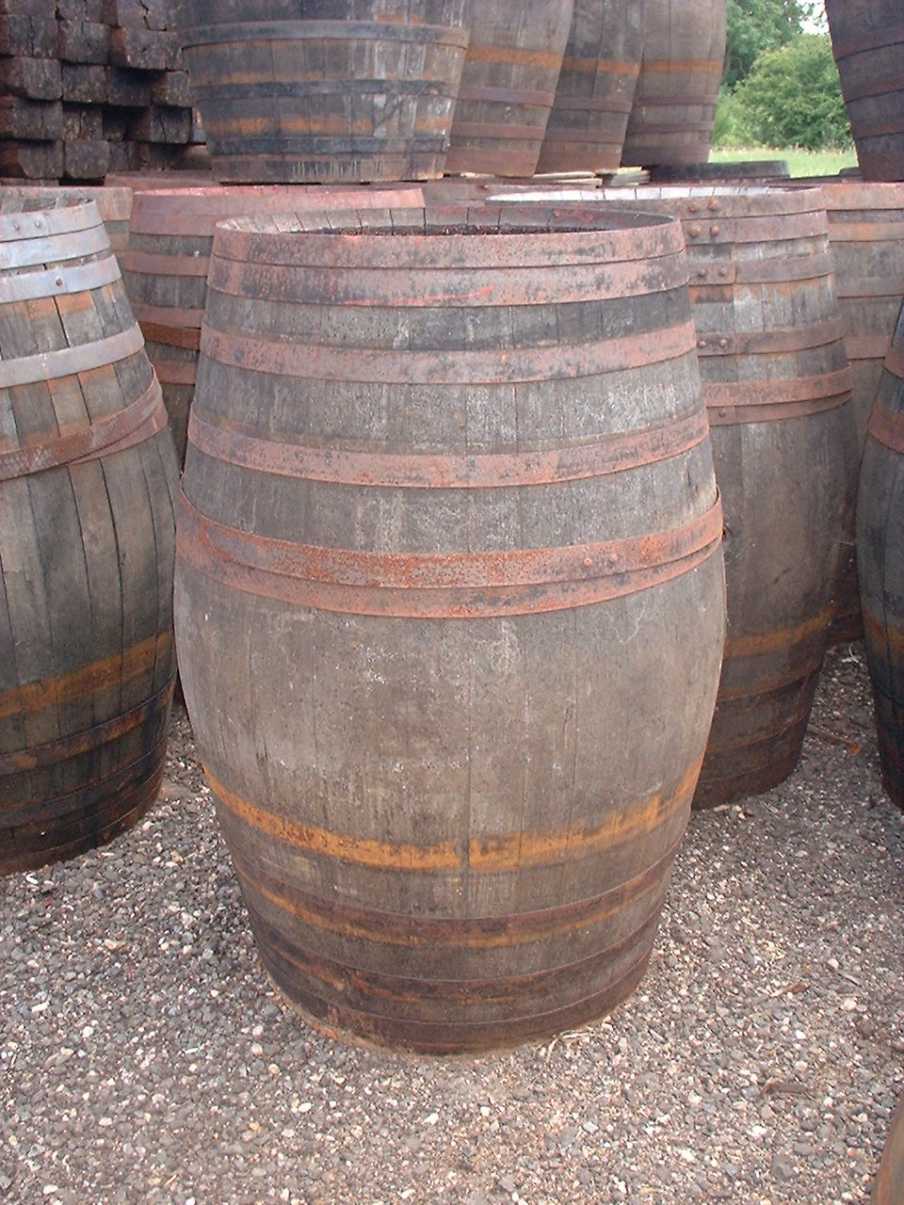
As we approached Pekina, Hogshead Hill summit to the east & the adjacent summit, Maurice Hill to the west, were clearly visible on either side of the Pekina Road. Hogshead Hill was named by Johnson Frederick ‘Fred’ Hayward in 1846 after the resemblance of the northern end of the hill to to a hogshead barrel. A hogshead is a large cask of liquid, or less often, of a food commodity. More specifically, it refers to a specified volume, measured in either imperial or US customary, primarily applied to alcoholic beverages such as wine , ale or cider. Below is a photo of a Hogshead barrel. Hayward was the Manager of Pekina Station at the time and was one of South Australia’s early pastoralists. In an 1865 article in The Register newspaper relating to the death of his wife, Hayward was referred to as ‘a fine type of English gentleman’. I kept looking at the hill to see the similarities between it and a barrel, but I could not see it myself. Maybe I didn’t have enough beers at the hotel the night before.
We continued south out of Pekina on the Pekina to Tarcowie Road. A few km out of Pekina, we turned left onto Stokes Hill Road which is a dirt toad, and then right onto Hogshead Road, another dirt road. We travelled along the Hogshead Road for about 5 km, up over a rise and into the scrub on either side of the road. Soon after we passed Naren Road on our left, and shortly after there was an old house ruin on the left. Directly opposite the ruin is a farmers gate. This is the access point to the summit. Please note that the summit is located on private property. So please obtain permission before entering onto the land.
I parked my Falcon just inside the gate, and Ian and I then drove through the mallee scrub and into the paddock following the track alongside the creekline. There was a large number of ewes in the paddock with their lambs. Many of those were very young. We reached a fenceline at the western end of the paddock, and parked the 4WD here and unloaded our backpacks from the car. We then scrambled over the barbed wire fence, ensuring we didn’t do ourselves an injury in the process. We walked the rest of the way to the summit, a distance of about 1 km.
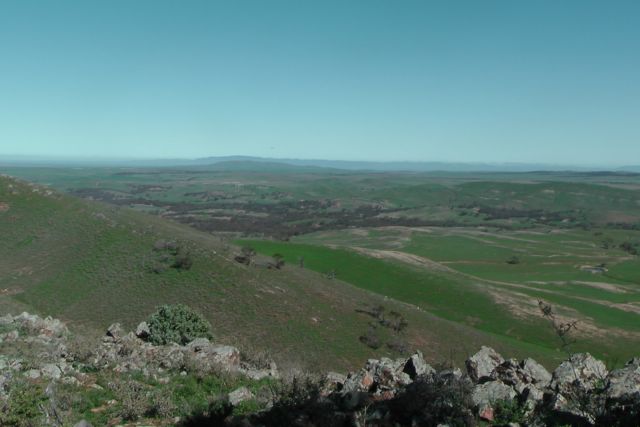
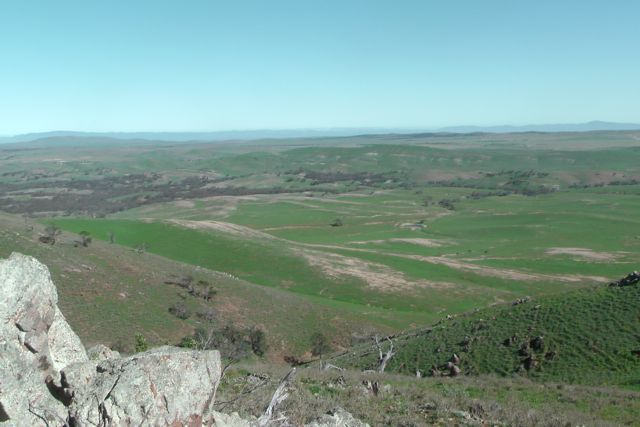
The walk to to the top of the hill is not too strenuos and took us about 45 minutes. We tried to follow the sheep tracks as they always seem to know the easiest way along the hills. The hill is covered in moss rocks, so it was a slow and steady climb. While climbing the eastern side of the hill, there were very nice views out to the east towards Peterborough and Black Rock, and north towards Orroroo.
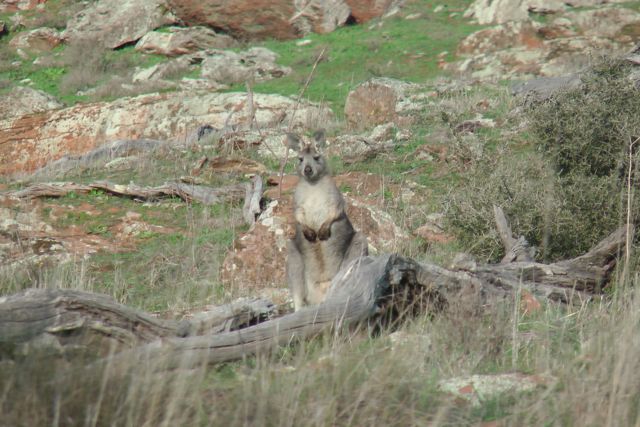
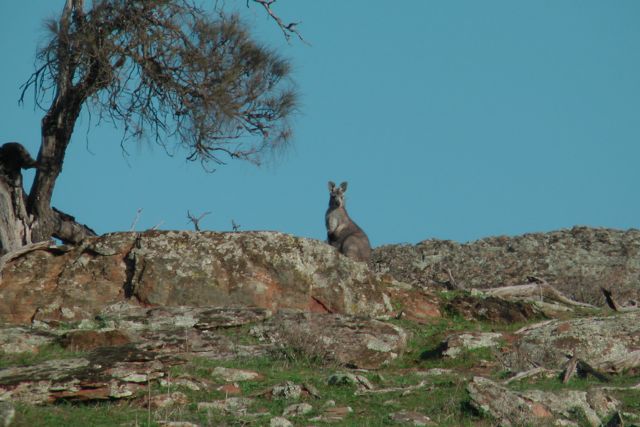
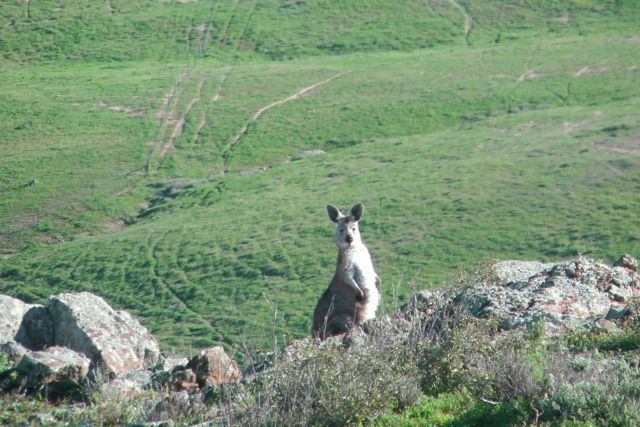
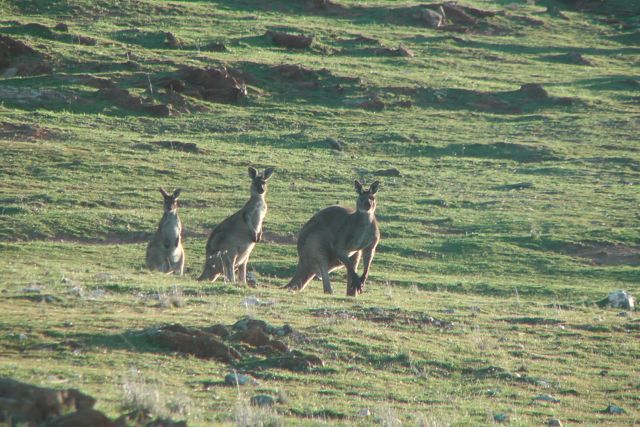
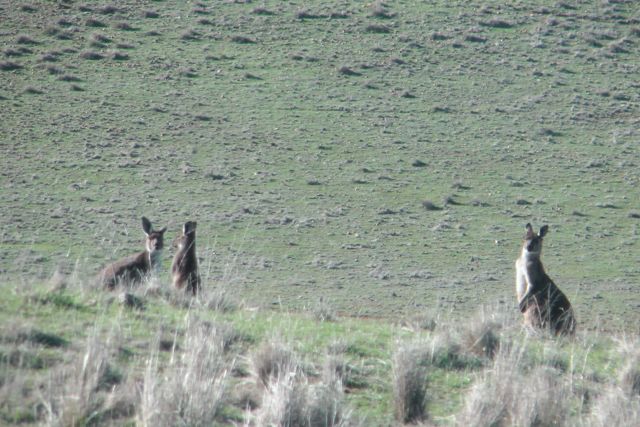
On our climb up we spotted a number of Euros (wallaroos). But one in particular appeared to be more interested in us, than we were of him. Rather than bounding away up into the rocks like his mates did when they spotted us, this little guy kept coming closer and closer to us, to find out who was encroaching on his territory. Eventually he became camera shy and bounded off, up to the top of the summit to join his friends.
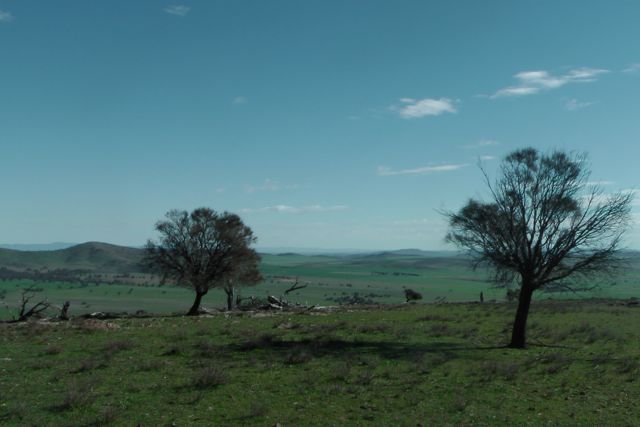
The climb up to the summit was no less rewarding than any other summit that I’ve climbed since starting SOTA in March this year. There are terrific views from the top in all directions.
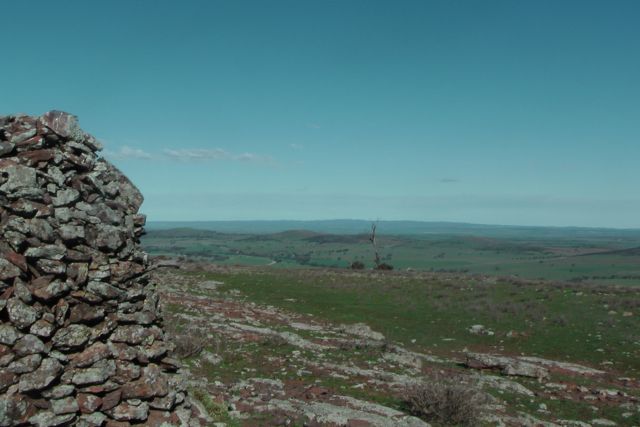
The top of Hogshead Hill is unique, in that it is relatively flat, and is similar to a plateau. It is rocky up the top with a few small trees and shrubs. But is is quite exposed and there is no significant cover. Fortunately the day was beautiful, with bright sunshine and a relative wind coming from the west. There isn’t a trig point, but there is a substantial stone cairn. And alongside the cairn is another one which is obviously in the process of having stones & rocks added to it as more people climb up to the summit.
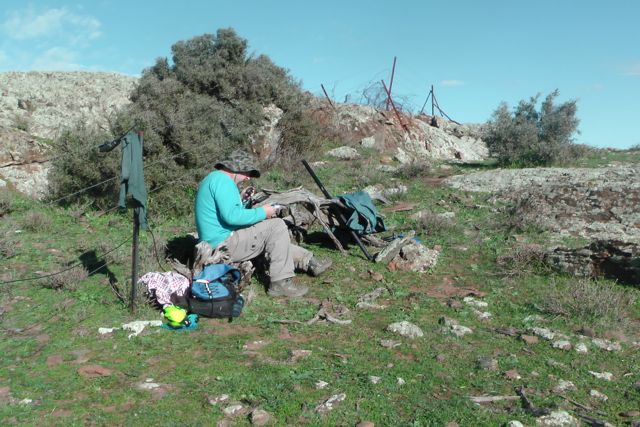
Ian and I set up just down from the summit itself, using a fencline to our advantage, as a support for the squid pole. We found a nice sturdy permapine post and attached the squid pole to this with some octopus straps. We strung out Ian’s home brew 40m/20m linked dipole and weighted down one of the legs with some moss rocks, and tied off the other end to a small shrub. There was certainly no shortage of rocks on the top of this hill.
We found a dead tree limb lying on its side alongside the fence, not far from the permapine post, and this looked like a nice seat. I set up my Yaesu FT-817nd, with Ian’s Elecraft KX3 at the ready. During the course of the weekend I had lost the DC cable for the radio, so I was relying on the internal NIMH battteries lasting the distance.
Ian and I had made it to the top of the hill at our expected time, so we stuck to our original plan that I would operate for the first hour on the hill, until the UTC roll over, and Ian would then take over for the new UTC day for all of the Chasers. And this was set to be an exciting activation as the ACT fellas were celebrating their 6 month SOTA anniversary. There was an expected 9 + operators who were activating various VK1 SOTA summits that morning.
My first contact of the morning was on 40m SSB with Al, VK1RX, who was portable on Mount Tuggeranong, VK1/ AC-038. Signal reports were 5/5 both ways. What a great way to start the activation, with a summit to summit QSO between VK5 to VK1. I then QSY’d up the band slightly to 7.095 and put out a call, only to be swamped with the regular pile up of chasers. Andy VK5LA in the Riverland, Colin VK3UBY in Mildura, and Ron VK3AFW in Melbourne, made up my 4 qualifying QSO’s for the summit.
Ron VK3AFW was a memorable contact for me, as my QSO with Ron, pushed me over the 100 point mark as an Activator. Thanks a lot Ron. It has been quite a challenge here to reach the 100 points. The tyrany of distance makes it difficult, but I have enjoyed every minute of my6 months of activating. I’ve printed out a special QSL card and a certificate and I’ve mailed this to Ron to celebrate my 100 Activator points.
In the hour of operating before the UTC rollover I managed a further seven summit to summit contacts with the VK1 guys, as follows:-
Mark, VK1MDC/p, VK1/ AC-040, Mount Ainslie.
Peter, VK1IRC/p, VK1/ AC-040, Mount Ainslie.
Ashley, VK2FAJG/1, VK1/ AC040, Mount Ainslie.
Ed, VK2JI/1, VK1/ AC-037, Mount Taylor.
Jim, VK2LC/1, VK1/ AC-037, Mount Taylor.
Rod, VK2LAX/1, VK1/ AC-037, Mount Taylor.
Ian, VK1DI/p, VK1/ AC-035, One Tree Hill.
Another interesting contact was with Peter VK3YE who was pedestrian mobile on the beach, about 32 km south of Melbourne. Peter was QRP 5 watts and was using a home brew, hand held Magentic loop antenna. Congratulations to Peter who had a terrific 5/6 signal. And a 5/7 signal report was received back from Peter. Peter has posted a terrific video on You Tube of his beach activation on the day and his SOTA contacts.
I had a few more QRP to QRP contacts including Ian VK5IS who was running 5 watts (5/6 sent & 5/4 received), Brendan VK4FADI who was also QRP (5/8 sent & 5/9 received), Steve VK3SE who was running QRP 5 watts (5/9 both ways), and Tom VK2KF, also QRP on 5 watts (5/9 both ways).
At the strike of 9.30 a.m. local time on my watch, which marked the new UTC day, Ian took over the reigns of the radio, whilst I took the opportunity to stretch my legs as I was getting pins & needles, take some photographs, and explore the summit.
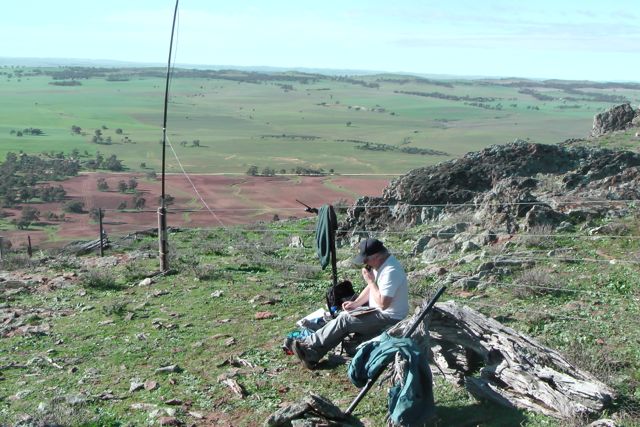
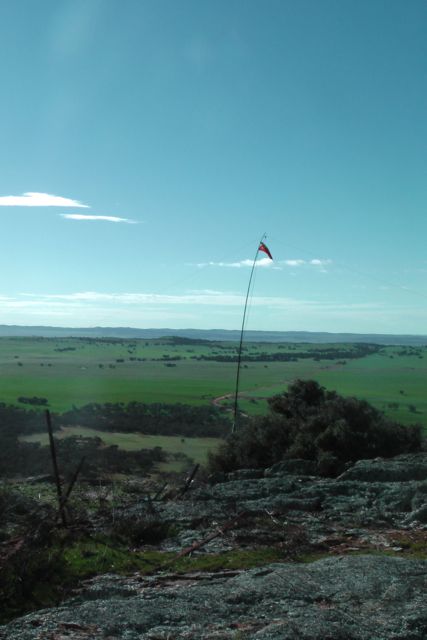
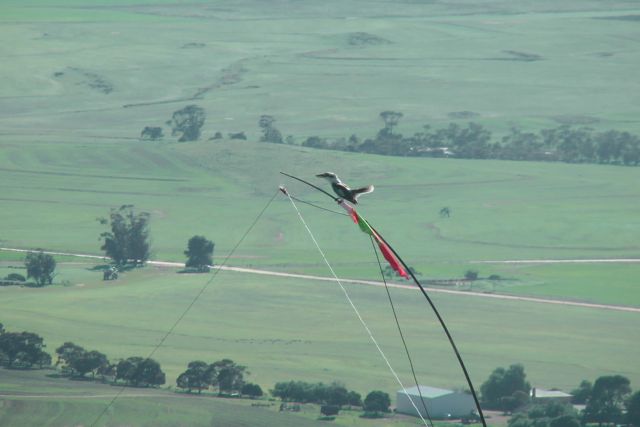
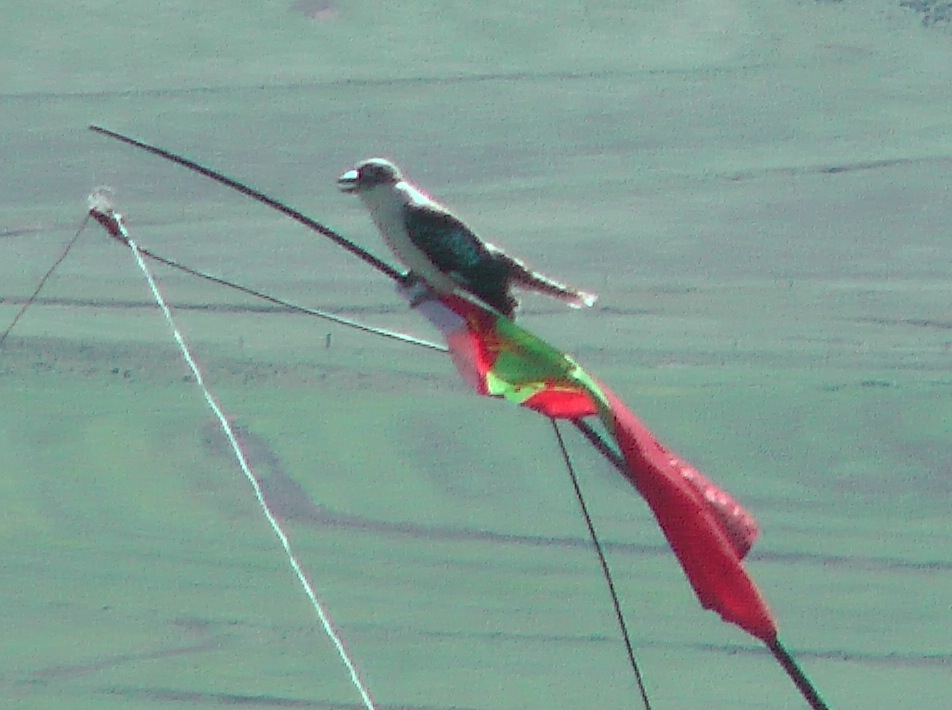
After a little over 30 minutes of exploring the summit, I started walking back towards our operating position and saw a rather large bird fly onto the top of the squid pole. I was in the process of taking a photograph when I saw the bird fly in. I was just far enough away that I couldn’t really tell what type of bird it was, so I zoomed in with the video camera and saw that it was a cheeky kookaburra that had decided to perch itself on the top of the squid pole, a few feet from where Ian was operating. As I got a bit closer, he/she decided to fly off, and as it did it let out its distinctive laughing call. It wasn’t until I got back to our operating spot, that Ian said he had noticed a drop in signal strength and that he hadn’t seen the bird.
I jumped back onto the radio and had a further 9 contacts including a further 6 summit to summit QSO’s as follows:-
Marshall VK3MRG/p, VK3/ VC-014.
Andrew VK1NAM/p, VK1/ AC-032, Castle Hill.
Mark VK1MDC/p, VK1/ AC-040, Mount Ainslie.
Peter VK1IRC/p, VK1/ AC-040, Mount Ainslie.
Peter VK3PF, VK3/ VT-026, Mt Toorongo Range.
Matt VK1MA/p, VK1/ AC-023, Mount Coreee.
My iphone went off with the goat bleating from SOTA Goat and it was a spot for Andrew VK1NAM calling CQ on 6m. Ian and I got quite excited, and we did have a listen and put a call out, but sadly we didn’t hear anything.
After an hour or so of operating on the summit, it was time for us to head down and drive to the next summit. Ian and I had a total of 71 QSO’s in the log, including 20 summit to summit contacts. What a morning ! And congratulations again to the VK1 SOTA Association.
I worked the following stations on 40m SSB:- Al VK1RX/p (SOTA); Andy VK5LA; Colin Vk3UBY; Ron VK3AFW; Ernie VK3DET; Rik VK3KAN/m; Nev VK5WG; Tony VK3CAT; Mark VK1MDC/p (SOTA); Peter VK1IRC/p (SOTA); Ian VK5IS/qrp; VK4FADI/qrp; VK2FAJG/1 (SOTA); Scott VK7FTTT/qrp; Larry VK5LY; Glenn VK3YY; Peter VK3FPSR; Warren VK3BYD; VK5MKA; VK3JM; David VK3KR; Andy VK5AKH; Adam VK2YK; Ed VK2JI/1 (SOTA); Steve VK3SE; Rob VK2FROB; Phil VK3BHR; Tom VK2KF/qrp; VK2LC/1 (SOTA); Shaun VK5FAKV; Brian VK5FMID; Rod VK2LAX/1 (SOTA); Theo VK5MTM; Ewen VK3OW; Peter VK3YE/ped mobile; Ian VK1DI/p (SOTA); Marshall VK3MRG/p (SOTA); Andrew VK1NAM/p (SOTA); Mark VK1MDC/p (SOTA); Peter Vk1IRC/p (SOTA); Peter VK3PF/p (SOTA); VK2FBKT/qrp; Rik VK3KAN; Matt VK1MA/p (SOTA); and Roy VK5NRG.
I have posted a video of the activation on You Tube.
My second summit for the Saturday with Ian, VK5CZ, was Stokes Hill, VK5/ NE-050, which is situated about 330 kms north of Adelaide, and about 20 kms west of the little town of Carrieton in the Flinders Ranges. Stokes Hill is 779 metres above sea level and is worth 4 points. After our journey it should be worth three times that. It was not easy getting there ! Lots of 4WDing and lots of climbing.
Following our activation of Oladdie Hills, Ian and I headed north on RM Williams Way, through the little towns of Walloway, Eurelia, and Carrieton. The history of these small towns is really quite amazing.
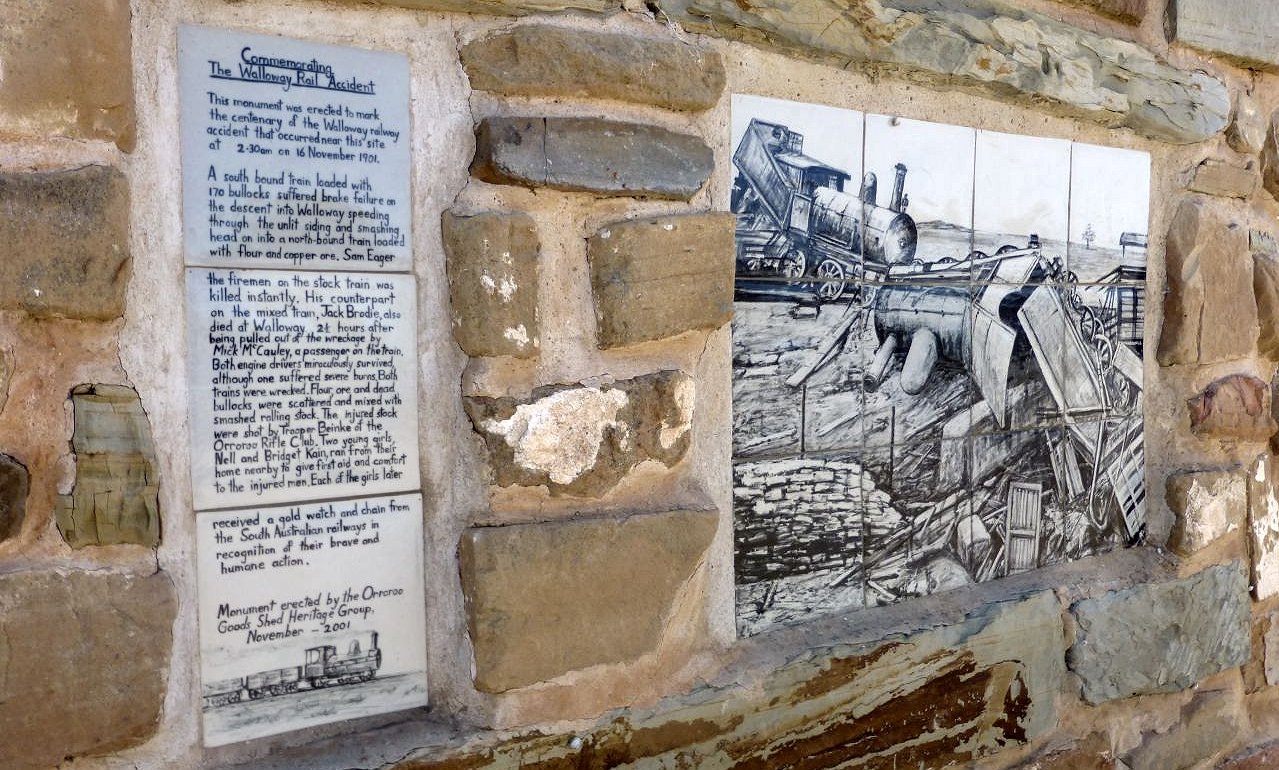
Walloway was the scene of a fatal train accident at about 2.30am on the 16th November 1901. Two trains collided killing the stock train fireman instantly, and later claiming the life of the fireman of the other train due to his injuries. A south bound locomotive travelling with 170 bullocks was to pull into the Walloway siding to enable a north bound train to pass. However to the train To the driver’s horror, the brakes locked up, and the slippery rails caused the wheels to slide. The train continued on passed the station and collided head on with an unsuspecting oncoming northbound train loaded with flour and copper ore, on a bridge over a small creek. Today Walloway is little more than a ghost town.
Eurelia is a tiny town which was once a major centre along the railway. The name is believed to originate from the local Jadliaura aboriginal dialect and translates to “place of the ear”. It is thought that local Dreamtime stories associated with the Ranges locates Eurelia as an “ear” of a prostrate man.
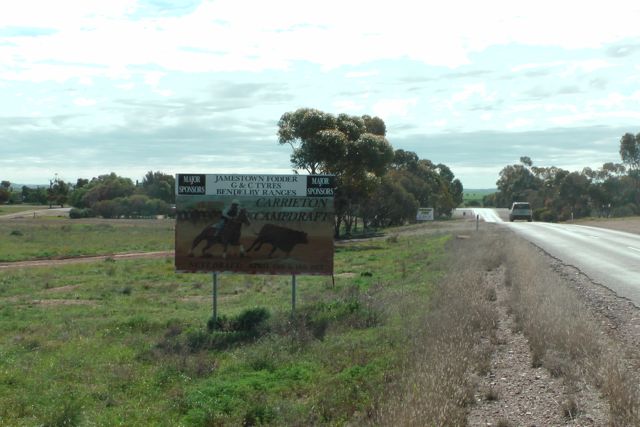
The larger town, Carrieton, has a population of about 50 people and is the home of the Carrieton Rodeo, a highlight event on the Australian rodeo circuit.
Stokes Hill is located on private property owned by Susan and Ben CARN. I met Susan the day before, on the Friday, and collected the key from her to open the padlocks to allow us access to their property. Susan is a lovely lady and had just arrived home with a 4WD full of food and beer for the shearers on her property. It is normally $50.00 per vehicle to access the Horsheshoe Rim 4WD track, but Susan kindly allowed us access for free. Susan & Ben offer quiet and tranquil accomodation in the Horsehoe Range. More information can be found on their website at…..
The 4WD track runs around the rim of the Horseshoe Range. There are two loop tracks, one for intermediate and one for experienced 4 wheel drivers. There are magnificent views of the Flinders Ranges from Mt Remarkable in the South to Wilpena Pound in the north, with lookouts along the way providing many spectacular photo opportunities. A highlight is the challenging section to the top of Mt Stokes – the highest point in the Horseshoe Range. And Ian and I certainly found this challenging.
At Carrieton, we turned onto the road to Hammond, which is located directly opposite the Carrieton Hotel, and we headed west. We travelled passed the rodeo grounds and travelled a further 14 km to the west. Here we reached a dirt road which had a signpost for the ‘Horseshoe Rim 4WD track’. We turned right here and travelled north. We passed a house on our right and just after this we came to another dirt road on the left with another ‘Horsehoe Rim 4WD track’ sign. We turned left here, travelling along the dirt road, and over 2 grids.
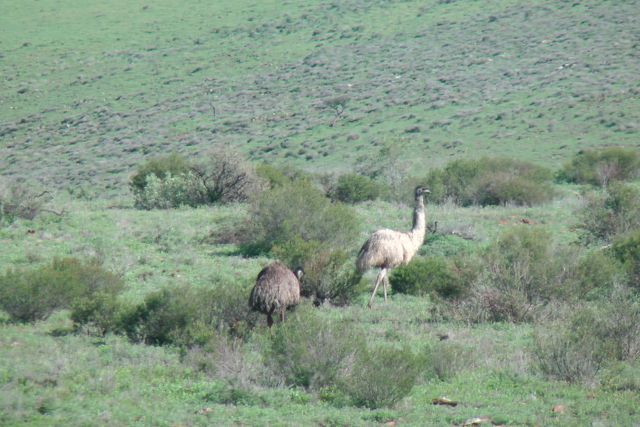
As we entered this area, there were lots of emus and kangaroos to be seen. Please drive carefully through this section as there is cattle grazing in this unfenced section of land.
We then came to a fork in the road. Do not go left here, but follow the road around to the right. This brought us into the spectacular Horseshoe Valley. We then travelled over a third grid, and this is when you are on Susan and Ben CARN’s property. Continue travelling along the dirt road and you reach a gate on your right which is marked number ‘9’. If you reach the double farmers gates with a sign for ‘Wilderness Cabin’, you have travelled to far.
Ian and I unlocked the padlock at gate number ‘9’ and commenced our way up the Horseshoe Rim 4WD track. We followed the old Dingo fence on our right to the next gate and into the paddock. In the 1880’s this paddock was used to lock the dingos inside. Later dogs and guns were used to round up and shoot the dingos.
Ian and I continued to follow the dirt 4WD track alongside the old dingo fence and then up along the ridgeline. The track is rocky so it is slow going, but the views are amazing. We reached a point in the valley where the 4WD track continues on up to the Stokes Hill summit. We had driven a distance of about 4 kms along the track. We parked Ian’s 4WD here and made the rest of the way up the very steep 4WD track to the summit on foot. A distance of about 3 km walking, and it was not easy !
Despite it being hard going, the views were amazing, and there were a large amount of wild flowers on display and plenty of friendly Euros (Wallabies). They were obviously very familiar with all the 4WDers that use the track as they were very tame & inquisitive.
After a considerable climb, Ian and I eventually reached the trig point. One of the legs had been bent out of shape considerably. I can only image it might have been a 4WDer that had reversed into it ? There is also a small rock cairn and a visitor book at the top which I signed. The walk had really taken it out of Ian and he had come down very quickly with a stomach bug. I’ll leave the rest up to your imagtion. Needless to say, Ian was not well.
The views from the top are really quite spectacular. Mount Stokes is the highest point in the Horeshoe Range. It is so named because of its shape when viewed from the air. If you look at Google Earth you can certainly see why it was given this name.
Not far from the Mount Stokes summit is another hill which has a tower on it which in turn services the Police Service and the Next G mobile phone service. An impressive feature is Moockra Tower which is 740 metres above sea level.
Because Ian was not feeling crash hot, we set up just one station. We used Ian’s Elecraft KX3, and his 40m/20m home brew linked dipole. There was a clump of trees not far from the trig point which not only could be used to attach the squid pole to, but also afforded some shade. Although it was not a hot day, there were no clouds in the sky and it was quite warm. In fact I even had to put on suns screen to prevent me from becoming sun burnt.
My first contact on the summit was with Wayne, VK3WAM, who was on the top of Mount Mitchell, VK3/ VN-012. This was a great way to start off, with a summit to summit contact. Wayne had a good strong signal of 5/8, and we received a 5/9 back from Wayne. This was followed by Larry VK5LY, Colin VK3UBY, and Ron VK3AFW, all of whom ahd very strong 5/9 + signals. The usual crowd of Chasers followed.
Just two qrp stations called in this time. Andrew VK2UH who was using just 5 watts had a very nice 5/8 signal from NSW. And Shaun VK5FAKV from the Riverland called in with a very strong 5/9 + signal with just 3 watts.
An interesting QSO was with John VK5AJQ who was using the call VK5BR for the Scouts, and was operating from the Woodhouse scout camp in the Adelaide Hills. I had a short chat with young Tom, a scout, and explained to him about SOTA and where we were located in the Flinders Ranges.
The following stations were worked:- Wayne VK3WAM/p (SOTA); Larry VK5LY; Colin VK3UBY; Ron VK3AFW; Ernie VK3DET; Marc VK3OHM; Col VK5HCF; Brian VK5FMID; Ed VK2JI; Phil VK3BHR; Marshall VK3MRG; Andrew VK2UH; Peter VK3PF; Shaun VK5FAKV; Roy VK5NRG; Rob VK2FROB; Nev VK5WG; Glenn VK3YY; Matt VK1MA; Andy VK5LA; Warren VK3BYD; Rob VK2ZRD; VK3AXH; Ian VK1DI; Mark VK3PI; Mark VK3YN; John VK5BP; and John VK5AJQ.
A challenging but rewarding summit. Time to get Ian off the hill and home to bed early for tomorrow’s 2 summits.
I have posted a video of the activation on You Tube.
My first planned activation for Saturday, 10th August, 2013, was Oladdie Hills, VK5/ NE-068. The summit is located on private property and is situated about 22 kms north of Orroroo. It is about 5 kms east of the little town of Eurelia.
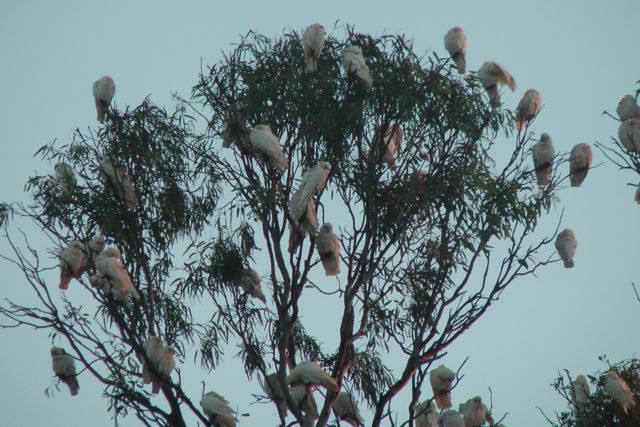
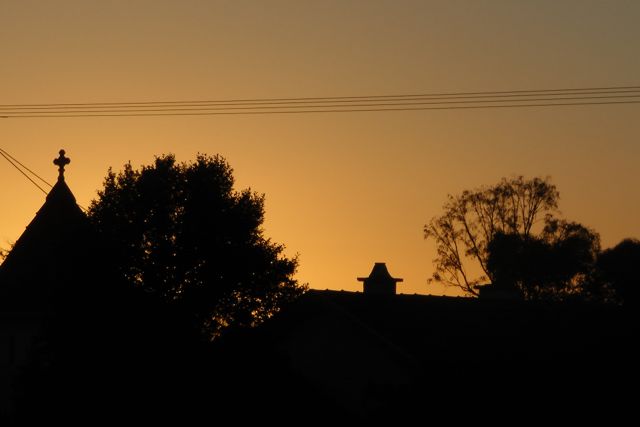
I got up at 6.00 a.m. to a nice warm hotel room, but outside the temperature was below zero, and there was a severe frost. After a warm shower and breakfast and preparing my gear, I headed outside to the cold, and waited for Ian, VK5CZ who was driving up from his home in Clare. Despite it being bitterly cold, there was a spectacular sunrise. And just across from the pub there was a noisy mob of corellas in a gum tree, obviously trying to wake up everyone in Orroroo.
Orroroo is a small town in the southern Flinders Ranges, about 270 kms north of Adelaide. It has a population of about 543. “Orroroo” is generally accepted as being derived from the Aboriginal “oorama” – “rendezvous of the magpie”, although others believe it to mean “early start“. My accomodation for 2 nights was the Orroroo Hotel (highly recommended – good food, cheap accomodation, cold beer, and friendly licencees).
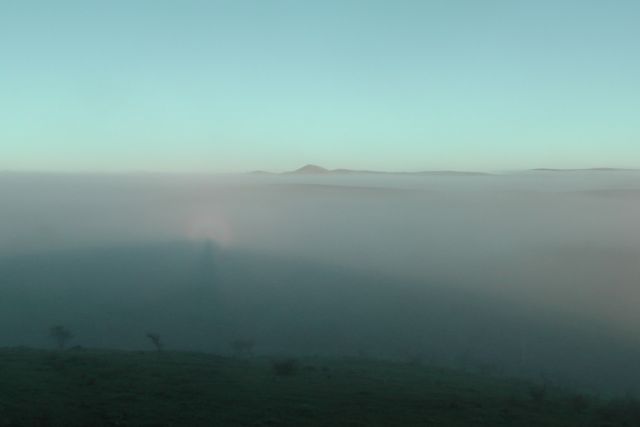
After Ian arrived at the pub to pick me up, we headed first to Tank Hill lookout at Orroroo, before making our way to the summit. Water is gravitated from the concrete tank at the “lookout” to the town. From the tank there is normally an excellent view over the artesian basin in the valley of the Walloway plain, the reservoir and the township of Orroroo. However the whole area this morning was fogged in and it was bitterly cold.
Ian and I then travelled north, out of Orroroo, along RM Williams Way. The road was named after Reginald Murray Williams, widely known as just ‘R.M.’, who was an Australian bushman and entrepreneur who rose from a swagman to a millionaire. He became known for creating an Australian style of bushwear recognised world wide.
The Oladdie Range stretches for quite some distance, north – south. We accessed the summit via private property off Hooper Road. It was quite a significant drive across paddocks (about 4 kms) until we could go no further in the 4WD, and then a 4 km walk to the summit. The drive is strictly 4wd, as the terrain is very rocky in parts and you are required to cross several significant creek beds.
The walk to the summit was quite pleasant. The fog had partially lifted although there was still quite a bit of very low lying club. But the good thing was that the sun was out. There was not a cloud in the sky. The countryside here in the southern Flinders Ranges was very green and lush, due to recent very heavy rainfall. As a consequence the sheep were looking in very good condition. Remember this is private property, so please shut all gates.
Ian and I walked through some fairly thick scrub enroute to the summit. The ground is also very rocky.
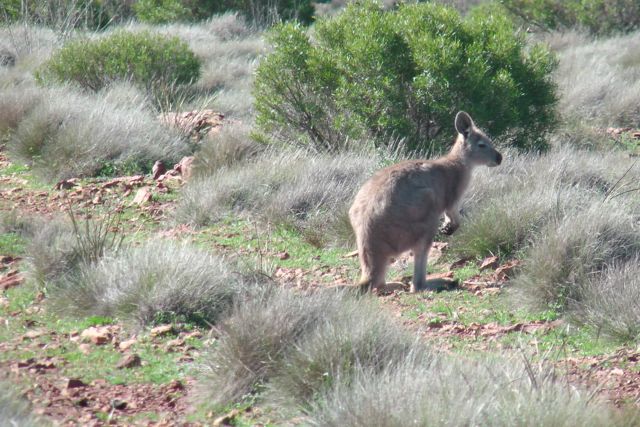
Ian and I saw dozens of kangaroos and euros on our way to the summit. I was recently asked in an e-mail by Ed, VK2JI, as to what a euro was ? The Euro is also referred to as the Common Wallaroo “Macropus robustus”. They are smaller in size to Red or Grey kangaroos. They are also of ‘high’ country, and have a distinct preference for ‘high’ places, and are typically found on rock ledges, escarpments, stony ridges and in fact anywhere where they can get a good view of their surroundings.
As is almost always the case with this SOTA activity, the hard walk was rewarded with spectacular views in all directions. Orroroo is visible down to the south, and the little towns of Walloway, Eurelia and Carrieton to the west. Down to the south west, the imposing Mount Remarkable was able to be clearly seen. Out to the east you could clearly see Black Rock Summit and Depot Hill.
There are no trees on the top of the summit, but I did find a nice fallen log which looked just right as a ‘shack’. I used the log to secure the 7 m squid pole, and stretched out the 40m/20m linked dipole. My transceiver was a Yaesu FT-817nd on the 5 watt output setting. Ian found a nearby dead tree which he used to secure his squid pole, and his chair for the morning was a pile of moss rocks. Ian also used his home brew linked dipole and his Elecraft KX3 transceiver.
My first QSO of the morning was with David VK5KC who was operating from “The Shack” belong to the Adelaide Hills Amateur Radio Society (AHARS). I then worked David as VK5BAR, the AHARS club call. My 3rd QSO was with old time mate Scott, VK7NWT with a good strong signal. And my 4th qualifying contact was with regular ‘Chaser’ Nev, VK5WG with his normal 5/9 +++ signal. This was followed by the regular pile up of SOTA chasers.
This was a fun activation. I spoke with Andrew VK2ONZ, who was operating QRP. Andrew is a regular and keen QRP operator. He was my 8th contact on top of the hill, so following working Andrew I called for more QRP stations, and what was to follow, was a constant stream of QRP ‘Chasers’ which was really pleasing to hear. And they all had terrific signals on top of Olladie Hills.
One other interesting contact was with John, VK5AJQ, who was using the call sign of VK5BP. He was operating from ‘Woodhouse’ scout camp in the Adelaide Hills.
I worked a total of 30 stations in 30 minutes on 40m SSB in VK1, VK2, VK3, & VK5.
The following stations were worked:- David VK5KC; David VK5BAR; Scott VK7NWT; Nev VK5WG; Andy VK5LA; Tony VK3CAT/m; Ed VK2JI; Andrew VK2ONZ/qrp; Col VK5HCF/qrp; Terry VK5ATN/qrp; Glen VK3YY/qrp; Peter VK3PF/qrp; Fred VK3JM/qrp; VK3OHM/qrp; Ernie VK3DET/qrp; Phil VK3BHR/qrp; Wayne VK3WAM/p (SOTA); Brian VK5FMID/qrp; John VK5BP; John VK5AJQ; Larry VK5LY; Andrew VK2UH; Steve VK3MEG; Ian VK3TCX; Rik VK3KAN; Matt VK1MA; Mark VK1MDC; VK3DEE/m; & Rob VK2FROB.
A good fun activation, but not without its associated issues. The signal reports on my last 5 contacts dropped dramatically. Upon checking the antenna, I found that the connection point from the coax to the BNC plug was faulty. The coax is RG174, so it is very lightweight and thin. I think the stress placed on the preterminated point at various windy SOTA activations, has finally taken its toll. Something to look at before my next set of activations.
I have posted a video of the activation on You Tube.
I had planned on activating four SOTA peaks with Ian VK5CZ on the weekend of the 10th & 11th August. So early on Friday morning (9th August 2013), I left home in the Adelaide Hills and travelled north towards Quorn, about 365 kms north from my home (about a 4 hour drive). I needed to collect a key from Quorn for the planned Saturday afternoon SOTA activation of Stokes Hill, north of Orroroo, as the summit is located on private property. And it is a good drive from Quorn to Orroroo. In fact a distance of about 91 kms. So I decided to activate 2 SOTA summits whilst I was in the Quorn area on Friday, including The Devil’s Peak, VK5/ NE-080, in the southern Flinders Ranges.
As I travelled north on the Augusta Highway towards Port Augusta, I could see the imposing figure of Mount Brown to my right. I had climbed this a few months earlier with my wife Marija. And I could also see my first climb of the day, The Devil’s Peak with its distinctive shape. But unfortunately you cannot access this mountain range from the west and need to travel all the way around to the eastern side.
Devil’s Peak is 665 metres above sea level, and in the native aboriginal Adnyamathanha language means ‘eagle’s nest‘ or ‘soaring eagle‘. The Devil’s Peak was so named by the European settlers, as it appeared that it was the devil lying on his back looking skywards.
Once I reached Stirling North, just south of Port Augusta, I turned right to travel west towards Quorn, along the Hawker-Quorn Road. This is a beautiful drive and follows part of the world famous Pichi Richi railroad, which runs between Quorn and Port Augusta. Pichi Richi Railway is an operating museum, operating regular heritage steam train journeys on the oldest remaining section of the famous narrow-gauge old Ghan railway.
Upon reaching the township of Quorn I then travelled south along the Richman Valley Road. This is the only way to access The Devil’s Peak, Mount Richmond, and Mount Brown summits. The road is dirt but is in good condition and easily passable by 2wd traffic. I travelled south along the Richman Valley Road, following the Capowie Creek.
After travelling about 5 kms out of Quorn, you will see a brown sign on your left saying “Devils Peak 6.2″ and a dirt road to your right. At the start of this dirt road you will also see a brown coloured sign saying “Devils Peak Walking Trail” and another brown coloured sign which reads “Devils Peak Walking Trail Fire Ban Season 1st Nov to 15th April“.
Travel west along this dirt road for a few kms and you will then reach an unlocked gate with two signs. One is a yellow sign reading “Dry Weather Road Only” and a brown sign which reads “Commencement of Devils Peak Climb 1.5 km“. Remember, The Devil’s Peak is on private property, so please respect any signs, and please close all gates.
After travelling through this gate, continue south along the dirt road, and you will then reach a parking area. There is at least one other gate at this spot, but this is the furtherest point you can go via vehicle. You need to park your car here and walk the remainder of the way to the top of the summit.
The bushwalk up to Devil’s Peak is steep in places and is recommended for experienced and fit walkers. There are signs warning of this. And although the walk is only 2.6 km return, do not be fooled. This is not an easy walk. It may take one-and-a-half to three hours for the return journey (not including rest periods and periods for enjoying the view). The walk is well worth it, with spectacular panoramic views at the summit of the Spencer Gulf, Port Augusta, Quorn, and Wilpena Pound on a clear day.
The Devil’s Peak Walking Trail is closed from 1 November to 15 April each year due to fire danger season.
The first 1 km walk along the track is quite easy. It is the last 300 metres that are hard and give the impression of 3 km rather than 300 m. There is a well marked track but it is rocky, particularly as you get towards the top. There were quite a few beautiful wild flowers that I saw as I headed up. About 500 metres into the climb you pass through an area of native pine trees and quite amazing rock formations.
The Devil’s Peak supports a wide variety of wildlife including euros, grey kangaroos, echidnas, emus, and a large number of reptiles including snakes. There is also a large variety of birds including eagles. I did see a few euros as I were climbing, but they were camera shy and didn’t want to stick around for a photo.
Once you reach the top of the ridge line, there are very good views out to the east and west. And if you are feeling really brave, you can climb to the very top of the summit itself. Do not attempt this unless you are confident. This part of the climb is quite difficult. You need to scamble over large rocks and make your way through narrow gorges, and then pull yourself up a rock ledge to get to the very top. But it is well worth it as the views are amazing.
If you do climb to the very top you will be rewarded by amazing views in all directions. The top of the summit is 700 million year old hard weather resistant Pound quartzite. There is a sheer cliff face on the eastern side, so please be careful not to venture too close.
It is impossible to set up at the top as there is virtually nothing to connect your squid pole or antenna to. The actual summit is very exposed and is all rock except for a singular dying small tree. So I decieded I was going to be blown off the cliff face, and I set up just below the summit. I used a large rock to get out of the wind, which was blowing a gale. I secured the squid pole to the base of a small shrub and a moss rock, using some octopus straps. And I then strung out the legs of the dipole and connected them to some trees. There wasn’t a lot of room to move and not a lot of clearance for the dipole.
I turned the radio on to 7.090 on 40 m and put out a call, and my first contact of the day was with Brian VK5FMID in Mount Gambier, who was patiently waiting for me. This was followed by Peter VK3PF, Larry VK5LY, and Brian VK3MCD. This was followed by a number of the regular chasers. Only one QRP contact on this summit and this was with Col VK5HCF, down in Mount Gambier, who was using just 5 watts. Col’s signal was down compared to usual, but he was still very readable (5/2 both ways).
After 30 minutes of operating I ended up with 15 QSO’s on 40m SSB into VK2, VK3, and VK5.
The following stations were worked:- Brian VK5FMID; Peter VK3PF; Larry VK5LY; Brian VK3MCD; Peter VK3FPSR; Col VK5HCF/qrp; Rob VK2FROB; Tony VK3CAT/m; Warren VK3BYD; Ed VK2JI; John VK5FMJC; Graham VK5WK; Colin VK3UBY; Nev VK5WG; and Rhett VK3GHZ.
I found this to be quite a strenuous climb and weather conditions were not great. It was extremely windy, and fortunately the squid pole survived. But I was really happy to have reached the top, and even happier to get 15 contacts on a Friday lunch time.
I have posted a video on You Tube of the activation.
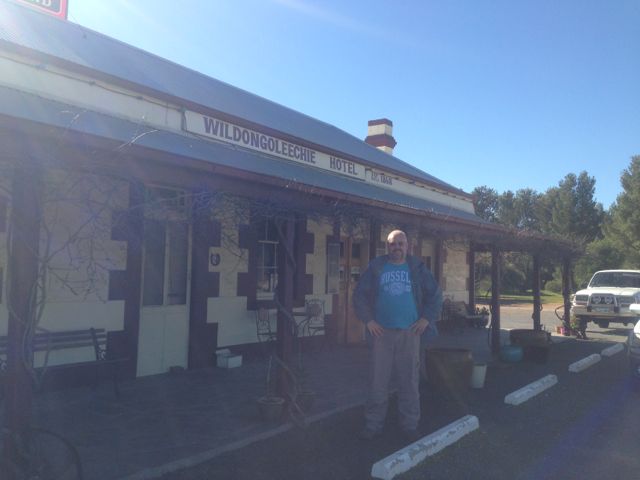
Following our activation of VK5/ SE-006, Ian and I got back to the car, only to find that Ian had left the lunches at home. Bugger ! We were both that hungry that we could have eaten a low flying duck. Our afternoon summit, Mount Bryan, VK5/ SE-001, was going to be a two hour climb, so we were in need for some tucker. So we travelled south on the Barrier Highway, and headed into the nearby town of Hallett, only to find that the local Servwell store, come take away was closed on Sundays. After some cursing & swearing, we headed to the local pub, the Wildongoleechie Hotel.
What a great pub. Not only did we pick up a meal & a couple of nice cold beers, but we got some directions from the licence on a short cut to reach the northern side of Mount Bryan. So with some local tips it cut down our 2 hour climb to a possible 20 minute climb. The new owners of this pub have only been here from Western Australia for the past 6 months, and they are making a go of it. They were very friendly, and if you are ever out this way, it is a terrific little country pub with a great atmosphere. It is a very historic pub, and was established way back in 1868. There are conflicting stories about what the name means.
Hallett is a small town in the Mid North of South Australia, situated about 220 kms north of Adelaide. It is about 32 kms north of Burra and about 38 kms south east of Jamestown. It lies very close to Goyder’s Line, which was plotted in the 1800’s by George Goyder, separating the land suitable for cropping from the land suitable for grazing. Hallett has a population of about 210 people. It was once a railhead for the local farming community.
Hallett is the closest town to Mount Bryan East, which is the birthplace of Sir Hubert Wilkins (1883-1958), a polar explorer, ornithologist, pilot, soldier, geographer and photographer. He was perhaps the last modern explorer in Australian history. Sir Hubert Wilkins birthplace and childhood home, Netfield, now restored as a historic site, is easily accessible from the renowned Mount Dare Driving Circuit between Hallett and Terowie.
After lunch we travelled north out of Hallett on the Barrier Highway and then turned right onto Mount Bryan East Road and travelled north east. We then turned right through a double farmers gate about 5 kms along Mount Bryan East Road. There is a sign on the gate warning about the removal of wood. We followed this dirt track, travelling north, and through a few more farmers gates.
Mount Bryan is the highest peak in the ‘South East’ region for Summits on the Air in South Australia. It is 933 metres above sea level and is worth 8 points. It is situated about 5 kms east of Hallett, and about 18 kms north east of the township of Mount Bryan. The weekend prior to our activation, there was snow all over Mount Bryan and the surrounding peaks.
The summit was first sighted by Edward John Eyre and his Party, who were the first Europeans to explore the area west of Hallett on a trek to the northern areas of South Australia in July, 1839.
The town of Mount Bryan was named by the Governor of South Australia, Lt. Col. George Gawler, after the nearby peak. He named it in honour of Henry Bryan, a young man who became lost and presumably perished of thirst during Gawler’s ‘Goolwa to Nor-West Bend expedition’ in December, 1839, which was to ‘examine the land along the Murray River, with the hope of finding fertile country; and also to determine the capabilities of river and lake for inland navigation‘.
Among those accompanying Gawler was Gawler’s aid, John Craig, the famous explorer Charles Sturt and the Chief of Police Henry Inman. Apparently a number of rash decisions plagued this expedition, which was otherwise notable for including ladies with a view of dispelling fear of the natives by settlers to the new colony. This included Charlotte Sturt who was Captain Sturt’s wife; Beatrix Sturt, who was Captain Charles Sturt’s biographer and his daughter in law; and also Julia, the daughter of Gov. Gawler.
The story of this expedition is truly remarkable, and whilst I sat on the top of Mt Bryan using technology like an amateur radio transceiver, I shut my eyes to imagine what it must have been like 174 years ago.
The Party set off from near present day Goolwa, and sailed in 4 little boats across Lake Alexandrina from Currency Creek, and proceeded up the Murray River to current day Morgan. After their arrival on Tuesday, the 10th December, at what was described as the ‘Great bend’ in the river at Morgan, they set up camp at the entrance of Bryan (Burra) Creek. The following day on Wednesday the 11th December, Gawler, Sturt, Inman, Craig, and Bryan, set off on horseback with a week’s provisions and 2 barrels of water to explore the country.
It was at approximately 12 noon on the 11th December, 1839, on a small hill to the north east of the campsite, that Gawler saw a mountain in the distance and immediately named it Mount Bryan after his young friend, Henry Bryan.
However by the first night, when about ’32 miles’ from the river, it was discovered that the barrels had leaked and much of the water had evaporated in the extreme heat.
A second day of extreme weather left barely a trace of water in the barrels and the situation was critical. Smoke was seen in the vicinity of Mount Bryan and the Party assumed that this indicated the presence of aboriginals, and thus water. Gawler later stated:-
“While contemplating the scene about us, smokes were observed to arise on Mount Bryan. Smokes indicate Natives, and Natives indicate the neighbourhood of water. Our casks had leaked, the bung had escaped from one of them, and the consequence was that our stock of water was just exhausted…..On the following morning, leaving Captain Sturt and Mr H Bryan in charge of our provisions and packhorses, I and Mr Inman set out in search of the Natives and water, but after toiling over the spurs and through the gullies during the morning of another hot day we could not find either. We found an extinguished Native fire and a ruined Native hut, but that was all, and we returned to the party to say that no alternative remained but to press through the night for our station on the Murray….”
It was at this time that Sturt bled one of the remaining three horses and all partook in this desperate attempt at survival.
On Friday the 13th of December, with all of their water gone and the temperatures rising, Sturt recommended that Gawler and Bryan set off on the strongest horses to seek help. They were about ’65 miles’ (110 kms) from the camp on the river. It was organised that Sturt, Inman, and Craig would follow a short time later.
On Saturday the 14th of December, Gawler and his horse could not proceed any further due to the heat and lack of water. Gawler and Bryan then swapped horses so that Bryan could ride the Governor’s horse slowly for the remaining ’12 miles’ to the camp, and Gawler would ride ahead.
By Sunday the 15th December, Gawler had reached the camp, however he had lost sight of Bryan at this time. He was followed soon after by Sturt, Inman and Craig. But there was no sign of Byran.
On Monday the 16th with the assistance of a local aboriginal, the group tracked the hoof prints of Bryan’s horse, about ‘five miles’ through the bush. They located Bryan’s blankets, coat, and stockings, and Gawler’s saddle, bridle, and telescope. On a scrap piece of paper, dated 9 p.m. Sunday 15th, Bryan had written that he ‘had been detained by exhaustion‘ but was going to the south-southeast.
Beatrice Sturt wrote:- “A second careful search at this spot disclosed the tree to which he had tethered his horse. The animal on escaping had taken a course due west to the hills with his rope trailing after him, and he eventually found his way back to Adelaide. But not search could disclose even to a native’s piercing eye any footprint or other mark in the direction indicated. Repeated efforts were made; they examined every bush, fired at intervals, constantly shouted; but to no purpose, nor was any further trace of ‘Bryan’ ever found”.
Bryan’s horse amazing eventually made its way back to Adelaide, with its hoofs grown to enormous lengths. And as for Bryan, he was never seen again, and has not been declared missing or presumed dead, nor has a death certificate been issued.
Gawler later wrote:-
“I never had so deep a regard for any young man that I had known for the same length of time, his character, looking at it with the severity of a Christian eye, was more faultless that that of any other individual of the same age”.
The town of Mount Bryan was once a busy hub of rail transport where up to 44 trains every week rolled to a halt. Shunting lines to the cattle and sheep yards, a cream and egg shed, a cloakroom, goods sheds, the Station Master’s Office and wheat stack yard filled the area around Mount Bryan. There was a daily passenger service to Adelaide, and the railway provided fresh fruit and vegetables, mail, and health services to the district. Passenger services operated from 1880 right up until 1988. Today Mount Bryan township is a sleepy hollow, with a population of about 140 people. It was once the heart of a thriving farming community, including some of Australia’s best known Merino sheep studs.
Ian and I parked the car about 1 km from the summit and climbed up a steep side of the hill to reach the trig point. It was a beautiful sunny day but blowing an absolute gale.
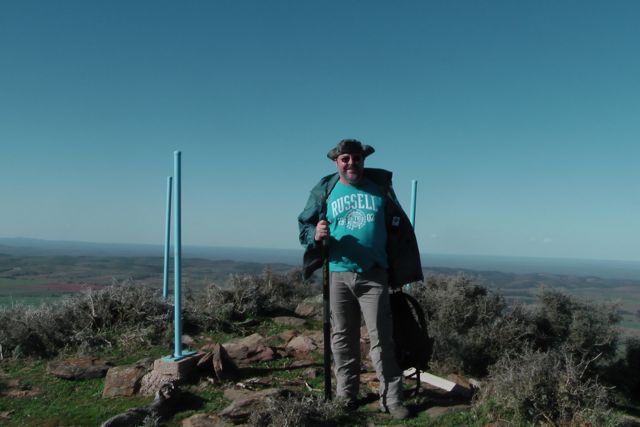
There is the remnants of a trig point at the top. It consists of three blue metal poles. Nearby is a concrete/besser block chair which faces the east. A bit cold on the backside, but an amazing view to the east from the comfort of the chair.
There is also a memorial cairn at the top of the summit, which was erected in 2002 by Mr. Glen Tiver, whose forebears owned the property ‘Rupera’ which encompassed Mount Bryan and its environs. It contains four commeorative plaques in memory of Edward John Eyre, Gawler Sturt & Bryan, Edward Frome, and three generations of the Tiver family.
Sadly, this was not the original cairn on the summit. In 1842, Colonial Surveyor, Lieutenant Edward Frome erected a cairn on the site, during his further explorations of the area. Following Mount Bryan being acquired as a Government Water Reserve in 1970, the S.A. Water Authority demolished Frome’s historic cairn to make way for other engineering works. What a disgrace !
There are also a number of towers with various radio repeaters, etc. Fortunately they did not create any interference and the noise floor was virtually undetectable. There is also a visitors book which we signed.
Going from the experience the day before with the squid pole snapping twice, we knew that today’s winds were just as bad as yesterday morning’s winds, so we looked around carefully for an operating spot. We walked down to a little gully just down from the trig point and this seemed to afford quite a bit of protection from the very strong winds.
We set up the squid pole, attaching it to a Heysen trail sign post, using the octopus straps, and we then attached the 40m/20m linked dipole, weighing down the ends with some rocks. The wind was so strong that the legs of the dipole went flying into the air on at least two occasions.
My first contact of the afternoon was with Col VK5HCF who was using just 5 watts QRP. Col had a terrific 5/8 signal. My next QSO was with John VK5BJE who was portable in the Ramco Point Conservation Park in South Australia’s riverland. John was activating quite a few Conservation parks as part of the VK5 National & Conservation Parks Award. John was also QRP and he too had a great 5/8 signal. Next was Ernie VK3DET, followed by Peter VK3PF to make my 4 required QSO’s.
Ian had already activated this park earlier in the year, so for him it was not worth any additional points. However whilst I got up to stretch the legs and go for a walk, Ian jumped onto 20m SSB and made 5 contacts into Europe, VK2, & VK6.
The views from the top of the summit are really quite something. There are 360 degree panoramic views.
After an hour of activating, it was time to get off the summit. Before leaving we bumped into the bushwalker whose car we had seen parked down at the base of the summit. He was a friendly guy and we explained why we were up the top of Mount Bryan and he was very interested.
On the way back to the car we saw a large number of kangaroos. It was getting on towards 4.00 p.m. and they were just starting to come out and graze on some of the lush greenery on the hills.
It was an enjoyable hour or so on the hill, with a total of 26 QSO’s on 40m SSB into VK1, VK2, VK3, VK4, & VK5, and 2 QSO’s on 20m SSB into Spain & New Zealand.
I worked the following stations:- Col VK5HCF/qrp; John VK5BJE/p/qrp; Ernie VK3DET; Peter VK3PF; Peter VK3ZPF; Andy VK5LA; Tony VK3CAT; Brian VK5FMID; Rhett VK3GHZ; Tom VK5EE; VK2LAX/p; VK5PEP; Peter VK3FPSR/m VK2; Nick VK3ANL; Brian VK3MCD/p; VK3OHM; Paul VK4CPS; Ron VK3AFW; Roy VK5NRG/qrp; Mal VK3AZZ; VK4FADI; Shaun VK5FAKV; Andrew VK2UH; David VK5NQP; Mark VK1MDC; VK4FBRI/p/qrp; John EA7BA; and Brian ZL2ASH.
I have posted a video of this activation on You Tube.
On Sunday morning, 28th July, 2013, Ian and I had another early start. Wide awake and out of bed at 5.30 a.m. for another one of Ian’s fine cooked breakfast consisting of eggs and bacon and fresh home made bread. It had been raining overnight, despite the weather forecast saying that today was mean’t to be sunny.
So we headed out, travelling north to un-named summit, VK5/ SE-006. The weather did not look good, and the rain was quite heavy. But we did have some hope, because as we looked to the north east the skies were clear. As it turned out the rain cleared and there was a spectacular sunrise.
We travelled north along the Barrier Highway, through the little town of Mount Bryan, and then passed the imposing Mount Bryan summit, which is South Australia’s third highest peak. Mount Bryan was to be our afternoon activation.
The VK5/ SE-006 summit is situated about 10 kms west of the little town of Whyte Yarcowie on the barrier Highway. Access to the summit is via private property.
Whyte Yarcowie was surveyed in 1875 and the name Yarcowie is said to be aboriginal for ‘wide water”. “Whyte” was added to the name in 1929, after an early pastoralist John Whyte. Alexander McCulloch was the first to pioneer the area and his name is given to McCulloch Square. The railway station was built in 1880 and Whyte Yarcowie was a good example of a bustling railway town in the early 1900s. The town had a flour mill, schools, hotels and an Anglican Church which, at the time, was reported to be the smallest in Australia.
After a 45 minute climb, Ian and I reached the summit and set up our gear in 2 different spots. Ian was using his Elecraft KX3, 5 watts output and a 40m/20m linked dipole supported on a 7m squid pole. I was using a Yaesu FT-817nd, also 5 watts output, and also a 40m/20m linked dipole supported on a 7m squid pole. It was a beautiful day on the top of the summit with bright sunshine but a very strong westerly wind.
My first QSO of the morning was a Summit to Summit contact with Mike VK3XL who was portable on Mount Johnston, VK3/ VG-122 (5/6 both ways). Dave VK3VCE then called in, followed by Peter VK3PF. My fourth contact was also a Summit to Summit QSO with Phil VK3BHR who was portable on Mount Kooyoora, VK3/ VU-007. This was followed by the regular crowd of Chasers, all of whom ahd very good signals.
Again I had a few enjoyable QRP contacts with Urey VK3ATA, Rik VK3KAN/p using just 3 watts, Peter VK3ZPF, & John VK3XR/m using just 10 watts. All had very good signals.
And I also spoke with John VK5BJE who was operating portable again. This time in the Maize Island Conservation Park as part of the VK5 National & Conservation Parks Award. John had been really active the past few days in the Riverland, activating parks as part of the Award. Well done John. Always a great signal.
I managed 35 QSO’s on 40m SSB into VK1, VK2, VK3, VK5, & VK7, including two Summit to Summit QSO’s, and one VK5 Parks Award contact.
The following stations were worked:-
Mike VK3XL/p (SOTA); Dave VK3VCE; Peter VK3PF; Phil VK3BHR/p (SOTA); Larry VK5LY; Col VK5HCF; Nev VK5WG; Andy VK5LA; Rhett VK3GHZ; Tom VK5EE; VK3OHM; Ernie VK3DET; Mark VK1MDC; Ron VK3AFW/m; Andrew VK2UH; Roy VK5NRG; Urey VK3ATA/qrp; Tony VK3CAT/p; Tom VK2KF/qrp; Brian VK5FMID; Brian VK3MCD; Shaun VK5FAKV; Rik VK3KAN/p; Peter VK3ZPF/qrp; John VK3XR/m/qrp; John VK5BJE/p/qrp; Ron VK3AFW; Peter VK2NEO; Ed VK2JI; David VK3EW; Graham VK5KGP; Ken VK3ALA; Al VK7AN; Scott VK7NWT; and Ken VK3XYC.
Time to head down and off to the next summit. The big climb at Mount Bryan.
I have posted a video on You Tube of the activation.













 VK5PAS