Murray River National Park VKFF-372

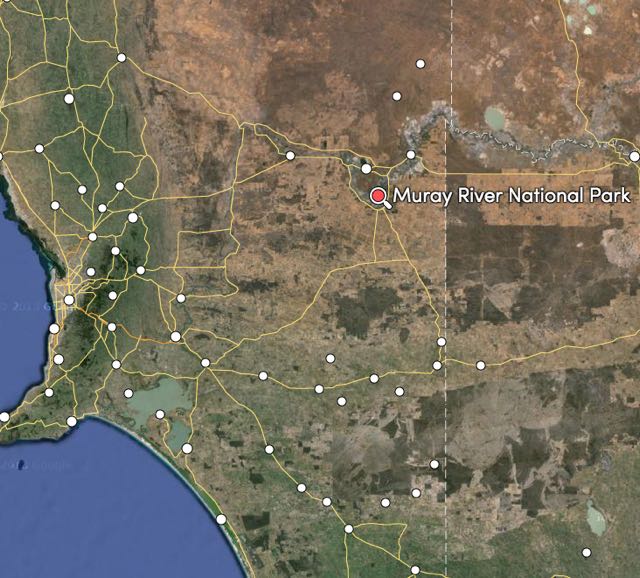
After activating the Pooginook Conservation Park, Marija and I headed to the Murray River National Park.  The park is located in the Riverland region of South Australia, and is about 220 km north east of Adelaide.  The park qualifies for the World Wide Flora Fauna (WWFF) program and is VKFF-372.
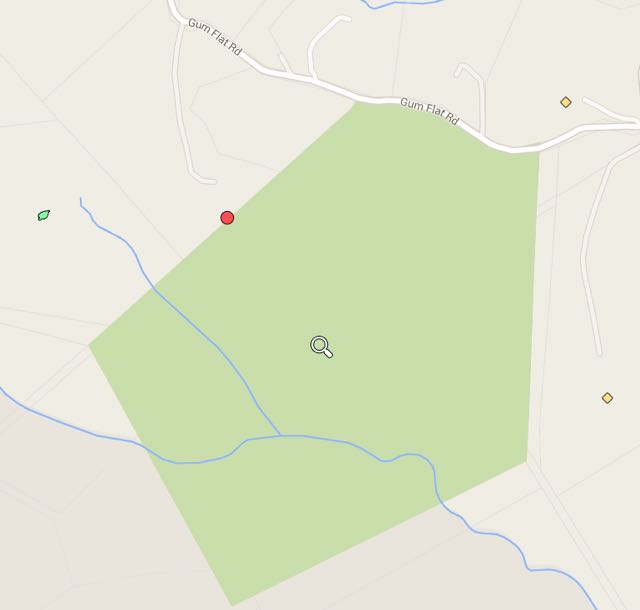
Screenshot 2015-04-23 11.41.06

Above: Map showing the location of the Murray River NP.  Courtesy of mapcarta.com

On the way we stopped off and had a look at the Lake Bonney Hotel ruins.  This is also known as Napper’s Ruins, and is located on the north side of Lake Bonney.  Napper’s Ruins once stood strong as a hotel built for former workers of Cobdogla Station.  It was originally called Lake Bonney Hotel and consisted of 11 rooms that included a well stocked bar and an eating room that could cater for 12 people.  This room was occasionally used as a dance room.  The hotel is now nothing more than ruins and includes some interpretive information signs.

The ruins are the remains of the accomodation house which was built by William Parnell in 1859 and later sold to William Napper in 1863.  Napper’s first wife is buried in Cobdogla and was the first white woman buried in the Riverland.  The graves of William Napper and his second wife are also in this cicinity.  The cottage behind the ruins is locally known as the Fisherman’s cottage.  During the 1956 flood, this building was inundated with water.

The buidlings belong to the local branch of the National Trust but unfortunately have fallen victim to vandals.  We were saddened to see all the grafitti over the Fishermans cottage.

This slideshow requires JavaScript.

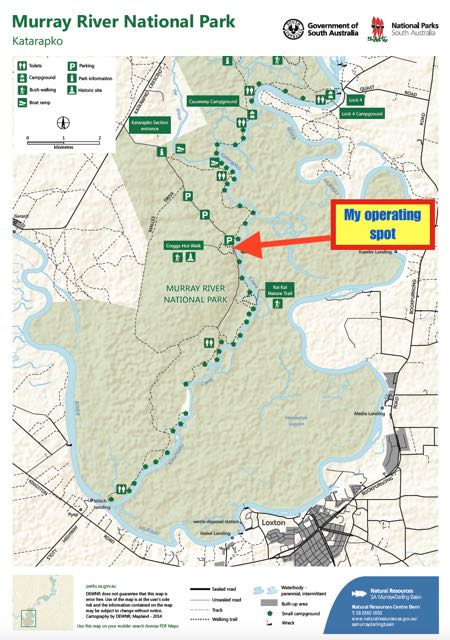
We continued on south down through Loveday and into the Katarapko Section of the Murray River National Park.  The park is very well signposted and easy to find.  We headed down to the water’s edge of Katarapko Creek and set up there, right alongside of the creek.

The Murray River National Park is 13,000 hectares in size and consists of three separate areas: Katarapko, Lyrup Flats, and Bulyong Island.  The largest and most popular area of the park is Katarapko.  This area features floodplains and several permanent and semi-permanent wetlands.  The area is a breeding ground for most of southern Australia’s waterfowl and other waterbirds.
Screenshot 2015-04-23 11.20.54

Above: Map showing my operating spot.  Map courtesy of National Parks SA.

It was still quite overcast, but fortunately no rain, so ideal for park activating.  And it was a very idealic setting alongside of Katarapko Creek.  I went to my nominated operating frequency of 7.144 and called CQ and this was answered by my old mate Dave VK3VCE in Victoria, followed by Tom VK5FTRG in Millicent, and then Rex VK3OF and then Les VK5KLV in Port Augusta.  This was a good spread for the first 4 callers, all the way from the north of South Australia down to the very south east and across to Victoria.  All had 5/9 signals.

Many thanks to Arno VK5ZAR, who was my fifth contact, for placing me on parksnpeaks.  A steady flow of callers followed from VK1, VK2, VK3, VK4, and VK5.

But only five calls in, I started to receive extremely bad bleed over from somebody nearby.  I tuned down the band and found that it was one of the AM fellas on 7.125.  And boy was he wide.  I thought perhaps it might have been the sensitive front end of the Yaesu FT-857, but Andrew VK1NAM agreed.  The VK2 on 7.125 was 10kc wide.

I worked a total of 21 stations on 40m including a few QRP stations.  This included Peter VK3PF and Cleeve VK2MOR who was running just 2 watts (5/9 sent and 5/8 received).

I then QSY’d up to 20m and started calling CQ.  My first taker there was Cleeve VK2MOR who had followed me up from 40m.  This was followed by Gerard VK2IO and then the first of the DX, Swa ON5SWA and then Albert S58AL.  A very big pile up ensued with so many stations calling it made it very very difficult to pull out callsigns.  So for the first time ever, I operated split.  Because I had not operated split previously using the FT-857d, I had to quickly work out via the menu on how to do this.  I couldn’t find out how to listen up, so I listened down 5 kc.

I worked a total of 43 DX stations in Belgium, Italy, Spain, England, Denmark, Germany, Portugal, Slovak Republic, Hungary, Canary Islands, Czech Republic, France, Japan, Puerto Rico, & USA.  This included my very good mate Marnix OP7M.  And also some VK’s amongst the DX including Greg VK8GM, Adam VK2YK, John VK6NU in the Avon National Park, and Mike VK6MB.

This slideshow requires JavaScript.

I then headed back to 40m briefly, on 7.144, for any last desperados who would like Murray River National Park.  First taker there was John VK2YW in Wagga, followed by Adam VK2YK, Ian VK5CZ, Adrian VK5FANA, and then Adrian VK4FBMW who was running QRP 5 watts.

Whilst I was working Adrian, I heard a very pronounced noise coming from behind me.  It sounded like a big gust of wind.  However, it was quite calm up until this point and the sun had just set and it was now almost completely dark.  As I looked over my should downstream along Katarapko Creek, I soon worked out what the noise was.  It wasn’t wind.  It was rain…and heavy rain!  So unfortunately in the middle of the QSO with Adrian I had to shut down in huge hurry and rush back to the 4WD with the FT-857D.  Sorry to cut it short so quickly Adrian.  And I am also sorry to others that I know were waiting to work me including Rob VK4FFAB.

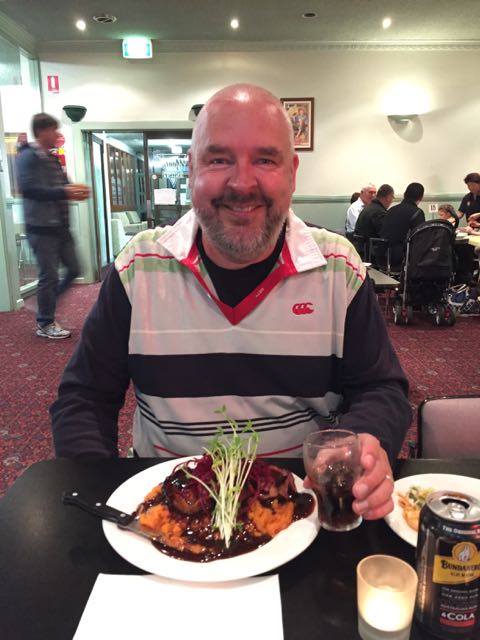
So after 90 minutes in Murray River NP, I had a total of 74 contacts in the log.  We then headed off the the Barmera Hotel for our evening meal and a few beverages.
IMG_1224

The following stations were worked on 40m SSB:-

  1. VK3VCE
  2. VK5FTRG
  3. VK3OF
  4. VK5KLV
  5. VK5ZAR
  6. VK4FBMW
  7. VK1NAM
  8. VK2YW
  9. VK5KPR
  10. VK1EM
  11. VK2UH
  12. VK3PF
  13. VK3OHM
  14. VK1MA
  15. VK1ATP
  16. VK3ARR
  17. VK3DAC
  18. VK3DBP
  19. VK3HRA
  20. VK2MOR
  21. VK5NQP
  22. VK2YW
  23. VK2YK
  24. VK5CZ
  25. VK5FANA
  26. VK4FBMW

The following stations were worked on 20m SSB:-

  1. VK2MOR
  2. VK2IO
  3. ON5SWA
  4. S58AL
  5. S52KM
  6. I5FLN
  7. IK1GPG
  8. EA4DTV
  9. ON4VY
  10. ON4BB
  11. M0WYZ
  12. OZ5HP
  13. OP7M
  14. VK8GM
  15. M0HDX
  16. DL5WW
  17. DK4RM
  18. RA3PCI
  19. IK2TTJ
  20. CT1IUA
  21. VK2YK
  22. HB9AFI
  23. EA3MP
  24. OM7OM
  25. DF1YQ
  26. VK6NU/p (Avon National Park)
  27. ON4GI
  28. HA6NF
  29. IZ1JMN
  30. ON5JE
  31. K4MIJ
  32. EA8AXT
  33. OK7WA
  34. EC7DZZ
  35. DL2NOM
  36. EA1DR
  37. JA8RJE
  38. F1RUK
  39. VK6MB
  40. OH6IUDL1EBR
  41. DL5JK
  42. I3FGX
  43. WP3EF
  44. EA2DT
  45. F4HJO
  46. EA1DFP
  47. F4FFH
  48. DD3SAT

References.

Barmera Visitor Information Centre, Historical Icons
Kenneth Stirling Conservation Park, VKFF-781

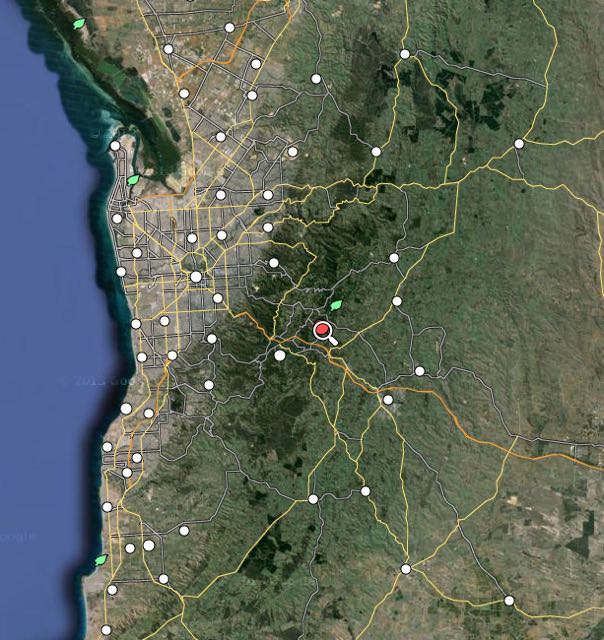
On Sunday 4th April 2015, I headed out to the Kenneth Stirling Conservation Park, which is located in the Mount Lofty Ranges ‘Adelaide Hills’, east of Adelaide.  Kenneth Stirling CP is one of the newly added parks to the World Wide Flora Fauna (WWFF) program– VKFF-781.  Although I have activated this park many times previously for the VK5 Parks award, this was the first time I would activate the park for the WWFF program.

Screenshot 2015-04-09 13.22.21

Above: Map showing the location of the Kenneth Stirling CP.  Map courtesy of mapcarta.com

This is a very interesting park. Not only because it consists of four completely autonomous sections, but also due to its history.

The park consists of four separate sections:-

  1. Wotton Scrub
  2. Filsell Hill
  3. White Scrub
  4. Burdett Scrub

I have spoken with Bill Filsell from Filsell’s Apples, which has been a family business operated since 1903. The Filsell Hill section is named after the Filsell family.

However, the park in its entirety was named in honour of Kenneth George Stirling.

Untitled

image courtesy of Graham Churchett

So who was Kenneth ‘Ken’ George Stirling? Well I have been fortunate enough to get in contact with a gentleman called Graham Churchett, who knew Ken, and this is what Graham had to say…..

The Environment Committee was a sub committee of the Town and Country Planning Association composed of the following:

Ron Caldicot, Dr John Coulter, David Strahle, Alwin Clements, Ray Holliday, Miss Erdley, Dr Peter Guldhurst, Ken Stirling, Ralph Middenway, Elise and Gordon Gardner and myself.

This committee was active across a broad spectrum of planning and environmental issues but it was not until money was given anonymously to the committee, and we employed Ron Caldicot as a Project Director, that some monumental changes occurred.

At the time the State Planning Authority was headed by Stewart Heart and sitting on the authority were developers and others who naturally pushed through every approval to further line their pockets at the expense of the environment and common good. The committee pressured the government and Ron was appointed to the Authority and in a short time the rules were changed to exclude those with vested interests. 

With the help of the Natural History Society we brought about the protection of the wedge tail eagle, and Improved planning laws.

In May 1980 tragedy occurred. David Strahle, a gentle, dedicated man and one who worked for a better world suddenly died due to a massive heart attack. We were all stunned, he was only in his 45th year.

In 1973 we were again shocked when Ken Stirling died from a heart attack when jogging by the uni bridge.  He was only 38.

Ken, and all of us for that matter, were appalled at the scarring taking place in the north Flinders by EX Oil and Ken knew more of what was going on as he was employed by two of Australia’s largest mining companies before joining Poseidon’s associate, Samin Ltd, in 1969.

 It was when Poseidon shares  went through the roof that Ken became a millionaire  and  in 1972 Ken resigned from the mining industry and sought a position in the Public Service with the Department for the Environment. A series of applications were rebuffed and some were not even answered and he was bitter at this.

While waiting for something to turn up he gave unpaid service to the Birdwood Mill Museum.

 His benefactions were not known to the Public service and his intense interest in conservation not realised.

 Those who examined his application may have noted with disapproval his association with the mining industry. The irony of it is that but for the mining boom, the entire conservation cause in South Australia would not have prospered without Ken’s personal service and financial help.

It was only after his death we found out that Ken had given money to a variety of organisations and in particular, for Ron’s full time employment as a director, $100.000 was given to set up Radio 5UV University radio employing Keith Conlon. $50,000 was given to State Archives, $200,000 to the Australian Conservation Foundation for the acquisition and establishment of a national park. This park is now rightly known as the Kenneth Stirling Conservation Park.

 Through Ron we achieved so much and it was then that I came to the earnest belief that if the conservation movement was to make any meaningful headway in this cockeyed world, we had to employ key people full time.

I was privileged to have known Ron, David and Ken as friends, all be it that our time together with regard to David and Ken was short. I was saddened to hear the other day that Ron, a man I knew with a mind as sharp as a tack and a gentle manner but one who would stand his ground with great conviction, was now in a home suffering severe dementure.

What can I say other than they are fondly remembered.

Below is part of what the Advertiser columnist, Stewart Cockburn said of Ken Stirling upon his death…..

Ken Stirling was the son of a railway man. He wanted to be a boundary rider on an outback station and, for a while, he became a multimillionaire. He made his money in the mining boom, and gave most of it away. Only since he died, have the benefactions of this humble, intensely private man become known outside his family and a small circle of friends and associates.

I set up in the Wotton Scrub section of the park and ran my Yaesu FT857d and the 40m/20m linked dipole, supported by my 7 metre telescopic squid pole.

Screenshot 2015-04-09 13.21.48  Above: Map showing the border of the Wotton Scrub section of the park. Map courtesy of mapcarta.comScreenshot 2015-04-09 13.22.02

Above: The Wotton Scrub Section.  Image courtesy of mapcarta.com

This was one of the best activations I had experience for a while when it came to working DX.  I started off on 40m first and worked a total of 21 stations in VK3 and VK5.  My first contact was with Nick VK3ANL who was activating the Terrick Terrick National Park, VKFF-630.  Next up I spoke with Hans VK5YX who was portable at Wombaroo in the Murray Mallee.  I then propped on 7.144 and called CQ where my first taker was Nev VK5WG, followed by Richard VK5ZRY, and then Ben VK5BB.

When things slowed down on 40m I headed off to 20m.  Unfortunately I could not get on to 14.244 as there were some European stations working close by.  So I started calling CQ on 14.241 and this was answered by Gerard VK2IO.  What followed was a huge pile up from Europe, the UK & North Ameerica.  The first European caller was Danny ON4VT, followed by Luk ON4BB, Max IK1GPG and then Luciano I5FLN.  The secret to my success was that they spotted me on the DX cluster.

I went on to work a total of 135 stations on 20m in Belgium, Italy, Germany, Russia, France, Netherlands, Ukraine, Spain, Hungary, Slovenia, Slovak Republic, Romania, Poland, USA, England, Croatia, Latvia, Canary Islands, Switzerland, Poland, Portugal, Luxembourg, Belarus, Austria, Denmark, Alaska, and Finland.  Thankyou to everyone who spotted me on the DX Cluster.

This slideshow requires JavaScript.

My last contact on 20m SSB was with Bob VK3SX.  I then headed off to 40m where I called CQ on 7.144 and worked a further 14 stations in VK2, VK3, VK4 VK5 and VK6.  Thanks to Paul VK2HV for getting the ball rolling and spotting me on the DX Cluster.  And also to Rob VK4FFAB.

One of my contacts was with Adam VK2YK who informed me that V6Z in Micronesia was up the band a little and had a great signal.  So I was pretty eager to love off and try my luck.  But Iwas still taking calls from other VK’s so I patiently waited until things slowed down and then tuned up to 7.152 and heard V6Z coming in very well, working split.  But unfortunately by this time he had a large pile up from Japan, the USA, VK & ZL.  I just couldn’t break through.

So I had a tune around the band and found the 7.1653 group and Jim WB2REM.  I called in and worked Jim and five other USA stations.  My signal report ranged from 44 to 57.  Not bad considering I was running 40 watts and a tiny dipole.

I thought I would try my luck one last time with V6Z and this time my persistence paid off.  After about 3 minutes of calling I got through.  I was very happy as this was a new DXCC entity for me on 40m whilst operating portable.

The following stations were worked on 40m SSB:-

  1. VK3ANL/p (Terrick Terrick NP)
  2. VK5YX/p
  3. VK5WG
  4. VK5ZRY
  5. VK5BB
  6. VK3FDAP
  7. VK5KLV
  8. VK5FANA
  9. VK3JP
  10. VK5ALX
  11. VK3AX
  12. VK3PF/m
  13. VK3DAC
  14. VK3TKK
  15. VK5ZAR
  16. VK3VT
  17. VK3FSPG
  18. VK5LOL/p
  19. VK5AV
  20. VK3VIN
  21. VK3AV
  22. VK2HV
  23. VK2FDJO
  24. VK3PMG
  25. VK5FLEX
  26. VK3ETC/5
  27. VK3NRG
  28. VK2YK
  29. VK3GFS
  30. VK5KFB
  31. VK4FFAB
  32. VK5AAH
  33. VK6HRC/P
  34. VK4FAAS
  35. VK3HRA
  36. WB2REM
  37. AH6GE
  38. W1RQ
  39. N7MIT
  40. W6PXE
  41. N7SEP
  42. V6Z

The following stations were worked on 20m SSB:-

  1. VK2IO
  2. ON4VT
  3. ON4BB
  4. IK1GPG
  5. I5FLN
  6. VK2YK
  7. DK4RM
  8. IK0OPS
  9. DK8FS
  10. RA3PCI
  11. IK5ORP
  12. DK0EE
  13. F1BLL
  14. DL5EBG
  15. OP7M
  16. ON5JE
  17. PB5X
  18. IK8FIQ
  19. DJ8QP
  20. IK0BGA
  21. UT4EX
  22. EA3MP
  23. DL1EBR
  24. PA3GRM
  25. UW5ZM
  26. HA6NF
  27. EA4DTV
  28. IZ8DFO
  29. S52KM
  30. PA3WB
  31. DL2ND
  32. ON7YZ
  33. OM7OM
  34. F2YT
  35. UR7ET
  36. EA3NW
  37. RX9WN
  38. YO3JW
  39. EA1DR
  40. F5TA
  41. SP6KEP
  42. ON6UQ
  43. HA6OB
  44. UX2KA
  45. KK4TXZ
  46. ON5SWA
  47. IZ2EWR
  48. DL4PT
  49. EA7AK
  50. F5IDJ
  51. IZ5UGP
  52. G0RBD
  53. I3KAN
  54. DL7HU
  55. UA3NM
  56. M1CMR
  57. IZ3QHB
  58. IK8BPY
  59. IZ1GRH
  60. OK1APV
  61. S58AL
  62. 9A2HQ
  63. OM1AX
  64. RC5F
  65. DK8PJ
  66. M6GHM
  67. SP2MPO
  68. EA2KV
  69. UA6NT
  70. IZ5CML
  71. IK3WDI
  72. YL2TQ
  73. I1POR
  74. DL5XU
  75. EA8JK
  76. G3MWV
  77. EA4FZC
  78. HB9TSI
  79. F6BWA
  80. DL6ATM
  81. IZ2IHO
  82. SP8GEY
  83. IZ0PED
  84. IZ1PLH
  85. S58N
  86. CT1AGS
  87. DK2BS
  88. W4REX
  89. IZ1NBX
  90. VK3PF/p (VKFF-758)
  91. VK7NWT
  92. DF8NY
  93. HB9RDE
  94. M0HDX
  95. UA1AKJ
  96. RN3B
  97. UK2PKT
  98. IZ5IOS
  99. OK2BPU
  100. IT9ZVL
  101. S57S
  102. EA3HND
  103. PD1RK
  104. DL4EBC
  105. DG8DBW
  106. IZ1JMN
  107. IZ5YHD
  108. IW2NXI
  109. PD2AD
  110. SP2GWH
  111. IZ8EFD
  112. LX90IARU
  113. IZ8GCE
  114. F4GWG
  115. F6KOP
  116. EU2MM
  117. UR8EW
  118. US2WU
  119. M0WYZ
  120. 9A3KS
  121. OH6RP
  122. IW2ETR
  123. CT1DQV
  124. DL1ASF
  125. F8PRD
  126. SP2ORL
  127. DJ1SD
  128. ON7LX
  129. EA3HSO
  130. EOE1DPS
  131. EA8OT
  132. OZ1W
  133. LX1IQ
  134. G1HPD
  135. DF1YQ
  136. VK2MCB
  137. KL2PM
  138. 2I0FLO
  139. M5AEC
  140. G0WKH
  141. VK3SX

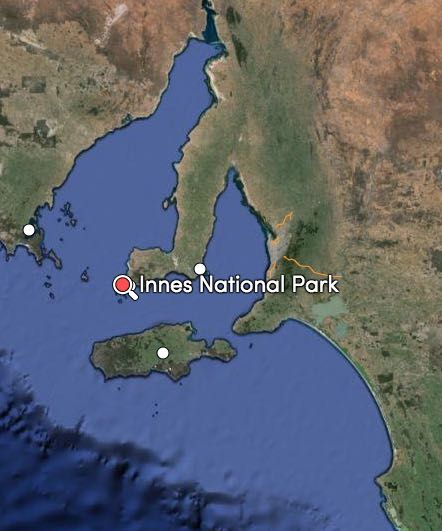
Innes National Park VKFF

My first park activation for the 2nd year anniversary was the Innes National Park, on Friday 27th March 2015.  Marija and I had a 315 km drive ahead of us from the Adelaide Hills down to the bottom of the Yorke Peninsula.  We initially drove through the bushfire devastated area of the Mount Lofty Ranges ‘Adelaide Hills’.  This is the area around Kersbrook which was severely affected by the bushfires back in January 2015, with 30 homes being destroyed.  We were very pleased to see a lot of regrowth with the scrub, but there is a long, long way to go.

We continued north on to the little town of Ardrossan on the western side of the Yorke Peninsula.  Ardrossan is a beautiful little town of about 1,200 people, which faces the Gulf St Vincent.  Prior to arriving there, Marija and I had arranged to meet Adrian VK5FANA at the local cafe.  Adrian is a very keen park activator and hunter.  I had spoken with Adrian many times on air, but I had never met him in person.  So we headed for the ‘Stump Jump Cafe’ in the main street of Ardrossan.

IMG_0831

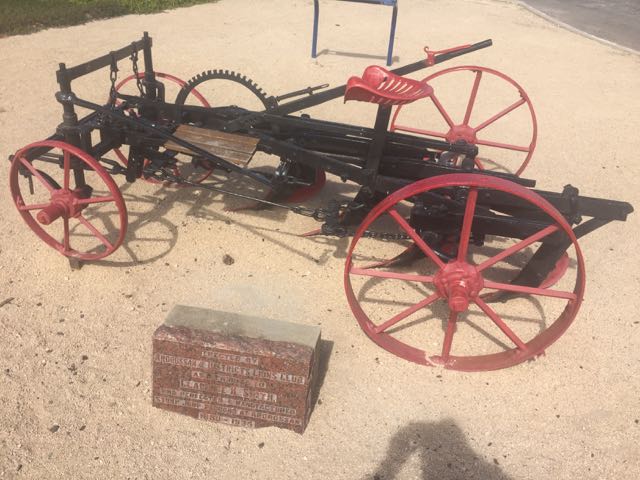
After having a coffee and a morning hotdog, and a chat with Adrian, we had a quick look around Ardrossan.  I mentioned the ‘Stump Jump Cafe’ above.  I hear you saying now, ‘what a strange name for a cafe’.  Well it was named after the stump jump plough.  Ardrossan was the home of Clarence Smith’s plough factory where he manufactured the stump jump plough between 1880 to 1935,  This South Australian invention was vital in opening mallee country throughout Australia to the plough.  Ploughing was difficult using a single furrow plough.  These were satisfactory where land had been adequately cleared, but were mallee roots and rocks were found, the ploughs would jump off course.  In 1876, Richard Bowyer Smith was ploughing on his farm when one of the bolts on the plough broke.  He discovered that it worked much better as it rode over the stumps.  This accident produced the concept of the stump jump plough.  If you would like some more information on this very unique South Australian invention, have a look at…..

http://en.wikipedia.org/wiki/Stump-jump_plough

IMG_0838

After leaving the town of Ardrossan, we took the quick detour up to the dolomite mine lookout where we enjoyed some great views of Ardrossan and along the coastline.  We then hit the road again and continued south down the Yorke Peninsula.

This slideshow requires JavaScript.

Our next stop was the little inland town of Minlaton which is another very interesting little town on the Yorke Peninsula.  Minlaton has a population of about 800 people and is known as the “Barley capital of the world”.  Minlaton was the home town of Harry Butler, a World War flying ace, who also flew an air mail run from Adelaide across Gult St Vincent to Minlaton back in 1919.  His mail run was the first over-water flight in the Southern Hemisphere.  Butler’s Bristol M1C monoplane has been restored and is on display in the town.  There is also a wildlife park here which is worth a look, which is exactly what we did, whilst we had morning tea.  We also called in to the Minlaton Tourist Information Centre which is located in the old Harvest Corner building, which was originally a fuel and fodder store, and a saddlery.  The building later became the district’s main shoe store, and in the 1930’s a cafe and delicatessen.

This slideshow requires JavaScript.

We then headed down to Yorketown, a small town of about 685 people, again with a very interesting history.  Yorketown was built on the junction of five roads, and this rather unique junction remains today.  Many of the original buildings exist, including the Yorke Hotel built in 1876, and the Melville Hotel built in 1872.  Here is how the intersection looks today…..

IMG_0876

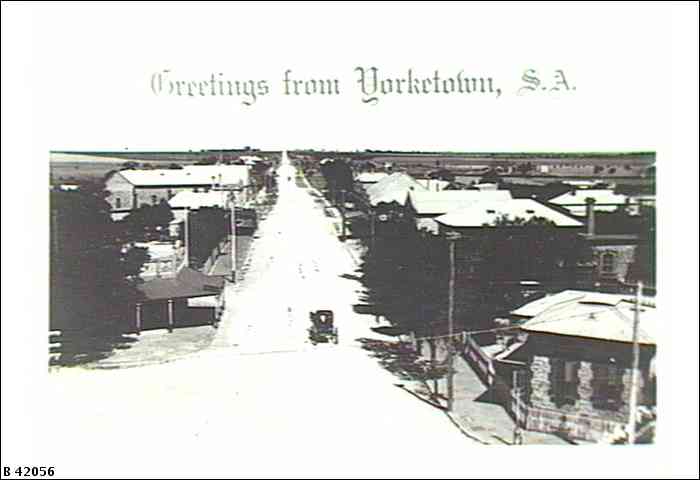
And here is how the intersection looked at the turn of the century…..

B42056-1


Image courtesy of the State Library South Australia.

After leaving Yorketown, we continued south through the town of Warooka and then on to Marion Bay, which is the gateway to the Innes National Park.  Marion Bay is set at the foot of the Yorke Peninsula and has some excellent surf and fishing beaches.  It is a very popular tourist destination and its population swells during the holiday periods.

Screenshot 2015-04-06 22.15.47

Above:- the lcoation of Innes National Park.  Image courtesy of mapcarta.com

We drove into the park and after a short photo stop, we headed for the Innes National Park Tourist Centre, where we needed to collect our accomodation key.  Marija and I had visited Innes back in 2013 for the 6 month anniversary of the parks award, and we had fond memories of the park and the visitor centre which had quite a bit to see.  However we were saddened to see that the Visitor Centre was closed ‘Until Further Notice’.  Now, I normally do not like getting political.  But I am going to here.  Innes National Park is one of the most popular park in South Australia, with tens of thousands of visitors each year.  And the Visitor Centre would not have been cheap to construct.  And here it is closed until further notice.  My own personal experience with DEWNR is that they are sadly lacking in funds.  All I can say is that the South Australian State Government should hang their head in shame.

This slideshow requires JavaScript.

And further, to enter the park, you are no longer blessed with a friendly ‘ranger’ to provide you with a permit and advice on where to go and what to see.  Now you book on line prior to entry to the park.  Clearly a cost cutting exercise.  Recently whilst up at the Mount Remarkable National Park, we were viewing an information board at the entrance to the park, when a Victorian couple drove in and asked us where they were to pay.  We told them about the on-line booking system, and because there was no internet coverage, they drove off.  Perhaps our friends in Parliament are trying to disuade visitors to our parks?  See the interesting story below about visitors to Innes.

http://www.adelaidenow.com.au/news/new-park-rules-deter-visitors-to-innes-national-park/story-e6frea6u-1226550718598

Enough of the negative comments.  As we drove towards Inneston, there were some spectacular photo opportunities.  Initially we took a detour to Stenhouse Bay to view the historic jetty and the beautiful blue waters of the Bay.  We then headed to the Cape Spencer lighthouse, and also enjoyed the amazing views of Chinamans Hat Island, Cable Bay, Althorpe Islands, and across the water to Kangaroo Island.

This slideshow requires JavaScript.

After settling in at the old Post Office, Marija helped me set up my radio gear.  Initially I set up my station at the back of the Post Office as it was a nice sheltered and enclosed area, but after turning on the radio I was saddened to hear that the noise floor was S8.  It was pretty much impossible to operate, so down came the antenna and I moved location, amongst the scrub, about 30 metres from our accommodation, close to some of the Inneston ruins.  Unfortunately the noise level was not much better.  Nearby was an ETSA power line running through the park, to supply power to the accomodation.  I suspect this is where the noise was coming from.

I called CQ on 7.088 and this was answered by park stalwart, Peter VK3TKK who was mobile (5/9 both ways).  This was followed by Doug VK2FMIA who was portable in the Somerton National Park, VKFF-607, in New South Wales (also 5/9 both ways).  So despite the high noise I was experiencing, the band seemed to be in very good condition.

A few calls later I was called by my first VK5 park for the weekend, Chris VK4FR/5 who was in the Dudley Conservation Park, VKFF-809, on Kangaroo Island OC-139.  Chris had a great 5/9 signal.  Chris was not to be my last park to park contact for this activation.  About 15 QSO’s later I was called by Greg VK5ZGY who was portable in the Mount Boothy Conservation Park in the Mallee region of South Australia.  Greg also had a nice 5/9 signal.

About a dozen contacts later I was called by Glenn VK6KY/5 who was mobile at Moonta at the top of the Yorke Peninsula.  I found out that Greg was travelling with a group of other VK6 amateurs and their wives, and in fact they had been at Inneston earlier in the day and had been standing right outside the old Post Office, reading the information board.  It is a small world.

Soon after I took a break for dinner, and when I returned my second caller was Steve VK5RU.  I was quite surprised when Steve told me that many years earlier he had lived at Inneston.  What is the chance of that?  A VK6 who had visited this remote location earlier in the day, and now an amateur who had actually lived at Inneston.  It was starting to get dark after quite a beautful sunset, and the Tamar wallabies were out in force.  Tamar wallabies were classed as extinct in the Australian wild until recently, and have now been reintroduced to Innes National Park.


This slideshow requires JavaScript.

I went on to work a dozen or so VK3, VK5 & VK7 stations, and I was then called by Owen ZL2OPB in New Plymouth on the South Island of New Zealand (5/9 both ways).

At about 0935 UTC (8.05 p.m.) I headed off to 7.130 for the 7130 DX Net, run by Roy VK7ROY.  I worked a total of 15 stations on the Net including William FO5JV in French Polynesia, John ZL2BH in Blenheim, and Brian ZL2ASH in Wellington.

Following the net, I headed to 7.135 and called CQ and this was answered by Mike VK3AUR, followed by Dennis VK5LDM with a huge signal.  I worked a further 3 stations, until I decided it was time to head inside and enjoy a bottle of red.

I had a total of 69 contacts on 40m SSB which I was very pleased with.

The following stations were worked on 40m SSB:-

  1.  VK3TKK/m
  2. VK2FMIA/p (Somerton National Park)
  3. VK3PF
  4. VK5EE
  5. VK5GJ
  6. VK5FANA
  7. VK5KLV
  8. VK4FR/5 (Dudley Conservation Park)
  9. VK4CPS
  10. VK5ND
  11. VK7NWT
  12. VK5FMID
  13. VK5FLEX
  14. VK3FQSO
  15. VK2YK
  16. VK5KPR
  17. VK3OHM
  18. VK5NAQ
  19. VK2LEE
  20. VK3FLCS
  21. VK5BMC
  22. VK3DAC
  23. VK3FMOL
  24. VK5ZGY/p (Mount Boothby Conservation Park)
  25. VK1DI
  26. VK3PMG
  27. VK5ZAR
  28. VK3VIN
  29. VK5CZ
  30. VK5NPP
  31. VK5HOS
  32. VK5GW
  33. VK3FSPG
  34. VK5FTRG/m
  35. VK3ANL
  36. VK6KY/5
  37. VK5YX
  38. VK5WG
  39. VK5FADS
  40. VK7VAZ
  41. VK5RU
  42. VK5FDEC
  43. VK3JP
  44. VK5JK
  45. ZL2OPB
  46. VK4NAI/p
  47. VK5ZRY/m
  48. VK3HK/5
  49. VK3KHZ
  50. VK5PET
  51. VK5TR
  52. VK2HFS
  53. VK3ADD
  54. VK7XX
  55. FO5JV
  56. ZL2BH
  57. VK6LCK
  58. VK2PKT
  59. VK3FMHY
  60. ZL2ASH
  61. VK7VEK
  62. VK5FAKV
  63. VK1AT/3
  64. VK5FMID
  65. VK3AUR
  66. VK5LDM
  67. VK7FGGT
  68. VK5WG
  69. VK5SFA


References.

Wikipedia, 2015, <http://en.wikipedia.org/wiki/Ardrossan,_South_Australia&gt;, viewed 7th April 2015

Wikipedia, 2015, <http://en.wikipedia.org/wiki/Minlaton,_South_Australia&gt;, viewed 7th April 2015

Onkaparinga River National Park, VKFF-402

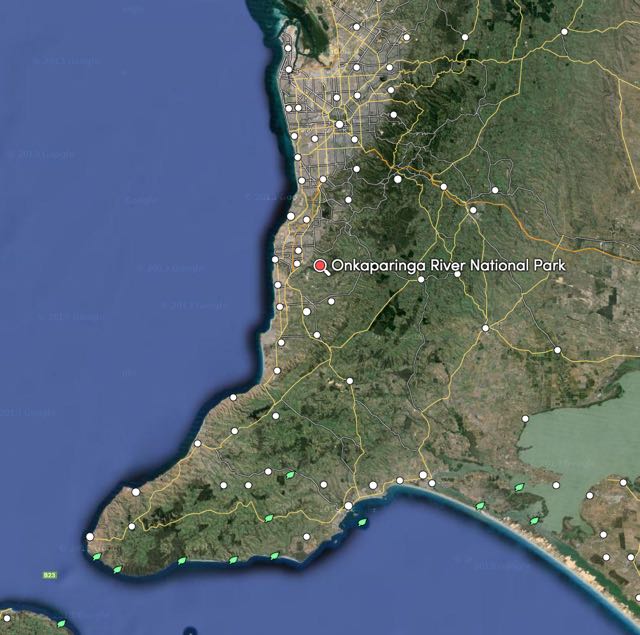
Last night (Friday 27th February 2015) was the 4th Summer activation event for the VK5 National and Conservation Parks Award.  So I headed out to the Onkaparinga River National Park, which qualifies for both the VK5 Parks Award and also the World Wide Flora Fauna (WWFF) program.  The park is VKFF-402 in the WWFF program.

Screenshot 2015-02-28 13.44.59

Above: Map showing the location of Onkaparinga River National Park.  Map courtesy of mapcarta.com

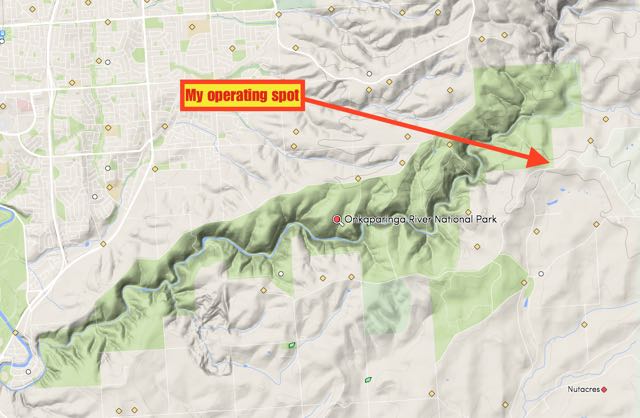
I set up near Gate 3 and the Bakers Gully track.  There is a good carpark here where you can park off Chapel Hill Road.  Just a short walk of 20 off metres is a wooden table and benches, which makes a great ‘shack’.  The scrub here is a bit thick, but there is enough room to string out a dipole which is exactly what I did.  For this activation I ran the Yaesu FT-857d, 40 watts and the 40m/20m linked dipole, supported on a 7 metre telescopic squid pole.  It was quite a warm afternoon, about 28 deg C, so the shade provided by the gum trees was very welcome.

Screenshot 2015-02-28 13.45.40

Above: Map showing my operating spot.  Map courtesy of mapcarta.com

Prior to calling CQ I had a look around the 40m band hoping that I would find some of the other park activators.  And it wasn’t long before I did.  My first contact was with John VK5BJE who was operating portable from the Scott Creek Conservation Park on 7.100.  John had a lovely strong 59 signal.  I then found Tom VK5EE in the Gower Conservation Park in the South East on 7.088.  Tom was also 59 and was conducting a joint activation with Col VK5HCF and new park activator, Alan VK5FAJS.  It was great to get Alan in the log.  Welcome to the world of park activating Alan.

My next contact was with another new park activator, Adrian VK5FANA, who was in the Clinton Conservation Park on the Yorke Peninsula.  Adrian was operating from near Port Arthur, and had a very nice 5/9 plus signal to Onkaparinga River.  This was a great start to the activation, five park to park contacts.

I then headed up to my nominated operating frequency of 7.144, but found that there was a lot of activity on either side, so I settled for 7.142 and started calling CQ.  In fact there were 2 G stations on 7.138 having a chat amongst themselves.  They were not very strong, but very readable.  But I didn’t call them as I wasn’t confident that they would hear me.  My CQ call was answered by Marc VK3OHM who has recently become an avid park hunter, followed by another park to park contact, this time with Chris VK4FR/5 who was portable in the Morialta Conservation Park.  Although Chris was running QRP, his signal was still 59 to me.  I went on to work a number of stations in VK3 & VK5, including Mick VK3PMG who has recently upgraded his call (formerly VK3FAFK).  Well done Mick.

When things slowed down I took the opportunity of QSYing and having a look around the band.  I found Richard VK5ZRY on 7.110 calling CQ from the Ramsay Way Conservation Park on the Yorke Peninsula.  I wasn’t expecting Richard to be out and about so this contact was a nice surprise.  I then worked Les VK5KLV who was portable in the Winninowie Conservation Park, south of Port Augusta.

This slideshow requires JavaScript.

I then lowered the squid pole and removed the links in the dipole, so I could try my luck on 20m.  The WWFF program is very popular in Europe, so I was hoping to work some of the European park hunters.  I headed to my nominated operating frequency of 14.244, however there was activity either side including a G station calling CQ on 14.245.  So I headed up to 14.250 and started calling CQ.  But unfortunately the same G station had followed me up the band and started calling CQ on 14.251.5, just above me.  Strike two!

I then moved up to 14.267 and started calling CQ again and this was answered by David VK5ADO with a very loud signal.  This was followed by a small group of European park hunters including F5TJC, DJ8QP, I5FLN, IZ2IHO, F1BLL, EA3MP, F2YT, DK0EE, EA1DFP, HA6OB, S52KM, ON4BB, and DK4RM.  Conditions were challenging to say the least.  Many thanks to my old mate Larry VK5LY for spotting me on the DX Cluster.  This certainly alerted the European stations to my presence in the park.  I also managed a few other VK contacts which included Andrew VK2AC, John VK5BJE in the Scott Creek Conservation Park, and my mate Greg VK8GM in Alice Springs.

Prior to heading back to 40m, I had a quick listen around the 20m band.  I’m very pleased I did, because I managed to work VK9LC on 14.199 on Lord Howe Island.  But the cream on the cake was a contact with Jerry PH9HB who was aeronautical mobile above the Canary Islands.  Jerry was a good 5/7 and he gave me a 4/4 with my 40 watts.  I have worked Jerry before whilst he has been in the air, but those contacts have been from home.  So this was a very exciting contact.

ph9hb-boeing-737-800-qsl-650x433

I then headed back to 40m, where I spoke with Geoff VK5HEL on 7.093, who was portable in the Ferries McDonald Conservation Park.  Geoff had a beautiful 59 signal from the Murray Mallee.  I then QSYd to 7.144 and called CQ and this was answered by Perrin Vk3XPT who was portable in the Alpine National Park, running QRP 5 watts from his Yaesu FT-817 and an end fed 1/2 wave antenna.  Perrin was camping near Mount Buller and had a nice 59 signal.

I worked a further 11 stations in VK2, VK4 & VK5.  This included Tom VK4FAJB at Hervey Bay, who only received his licence in the mail the day prior.  Welcome to amateur radio Tom.

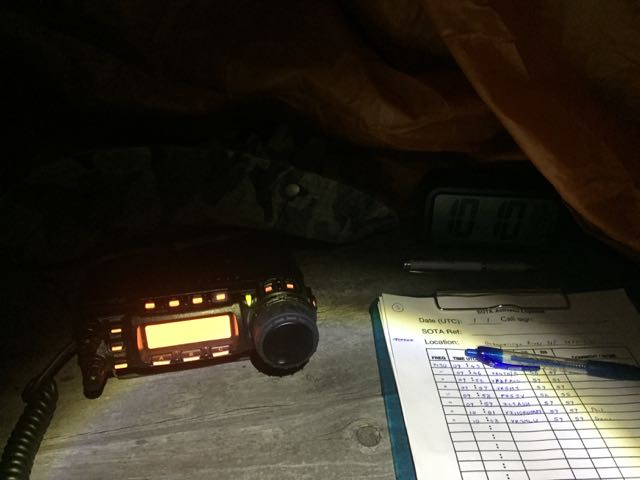
The drizzly rain had just started at this time, and it would continue on and off for the rest of the activation.  There were about five occasions when I had to drive underneath the bothy bag.

Again when things slowed down a little I had a look around the band.  I found Chris VK5FR/5 having a chat with Adrian VK5FANA who was portable in his second park, the Wills Creek Conservation Park.  After having a quick chat with Chris, Adrian came up asking Chris if he could quickly work me, to which Chris obliged.  It was great to get Adrian in the log from his second ever park activation.

I then spoke with Peter VK3YE who was pedestrian mobile at Port Phillip Bay.  Peter regularly goes pedestrian mobile and it never ceases to amaze me with the signal he puts out.  This evening was no exception, 5/8.

I then found Phil ZL2RO calling CQ on 7.167 from Hastings in New Zealand.  Phil had a very good 5/9 plus signal.

Following my contact with Phil, it was 8.00 p.m. local time (0930 UTC) so I headed to 7.130 for the 7130 DX Net.  On the net I had a total of 17 contacts including Bill W1OW in Massachusetts in the USA (5/7 sent & 5/5 received), William FO5JV in French Polynesia (5/8 sent and 5/5 received), Brian ZL2ASH in Wellington new Zealand (5/9 both ways) and Phil (VK2MCB) operating special event station VI110ROTARY for the 110th anniversary of ROTARY.  I also spoke with Andy VK4TH/8 who was sitting back enjoying the sunset in the Uluru-Kata Tjuta National Park in the Northern Territory.

IMG_0737

Above: underneath the bothy bag.

Just prior to the closure of the net, I QSYd up to 7.135 and started calling CQ.  This was answered by Steve VK5SFA.  I went on to work a further 11 stations on this frequency, in VK2, VK3, VK4, VK6, & VK7.  All with excellent signals.

I then decided to see what propagation was like on 20m, specifically the Southern Cross DX Net.  Once lowering the squid pole again, removing the links, and putting the squid back into place, I tuned to 14.338.5 and heard the Net Control, Jack W1FDY in Virignia, with a good strong 5/8 signal.  Surprisingly Jack was able to hear me quite well.  He gave me a 5/6 signal report.  I went on to work a further 5 stations on the net: Reg VK6BQQ, Peter VK3CFA, Peter KD2BMX in new York, Bill W1OW in Massachusetts, and Al K4AWM in Virginia.

Unfortunately I had to go QRT in a hurry, as the rain really started to come down heavy.

This was a very enjoyable activation, with a total of 87 contacts in the log.  This included 13 S.A. park to park contacts, two Victorian National Parks and one Northern Territory National Park.  And also some interesting DX contacts including the contact with Jerry PH9HB aeronautical mobile.

The following stations were worked on 40m SSB:-

  1. John VK5BJE/p (Scott Creek Conservation Park)
  2. Tom VK5EE/p (Gower Conservation Park)
  3. Col VK5HCF/p (Gower Conservation Park)
  4. Alan VK5FAJS/p (Gower Conservation Park)
  5. Adrian VK5FANA/p (Clinton Conservation Park)
  6. Marc VK3OHM
  7. Chris VK4FR/5 (Morialta Conservation Park)
  8. Keith VK5FEKH
  9. Peter VK3TKK/m
  10. Fred VK3DAC
  11. Phil VK3BHR
  12. Lynton VK5FLKJ
  13. Peter VK3PF
  14. Amanda VK3FQSO
  15. Peter VK5KPR
  16. Mick VK3PMG
  17. Richard VK5ZRY/p (Ramsay Way Conservation Park)
  18. Les VK5KLV/p (Winninowie Conservation Park)
  19. Geoff Vk5HEL/p (Ferries McDonald Conservation Park)
  20. Perrin VK3XPT/p (Alpine National Park)
  21. Andrew VK2UH
  22. Rob VK4FFAB
  23. Tom VK4FAJB
  24. Wayne VK4MAD
  25. David VK5NQP
  26. Bob VK5FPAC
  27. Rod VK5VRB
  28. Theo VK5MTM
  29. Allen VK3HRA
  30. Jim VK1AT/3
  31. Greg VK5GJ (QRP)
  32. Adrian VK5FANA/p (Wills Creek Conservation Park)
  33. Peter VK3YE (pedestrian mobile)
  34. Phil ZL2RO
  35. Bill W1OW
  36. Chris VK2UW
  37. Peter VK4AAV
  38. Andy VK4TH/8 (Uluru-Kata Tjuta National Park)
  39. John VK2FALL
  40. Mal VK5MJ
  41. William FO5JV
  42. Brian ZL2ASH
  43. Phil VI110ROTARY
  44. Gavin VK3MLU
  45. Craig VK6VCK
  46. Doug VK2FMIA
  47. Geoff VK5HEL/p (Monarto Conservation Park)
  48. Rick VK2HFP
  49. Keith VK2PKT
  50. VK6FABC (QRP)
  51. Greg VK8GM
  52. Steve VK5SFA
  53. Gavin VK3MLU
  54. Peter VK3TKK/m
  55. Derric VK6PI
  56. Wayne VK2PDW
  57. Roger VK5NWE
  58. Alan VK4NAI/p
  59. Adam VK7VAZ
  60. Ian VK3VIN
  61. Paul VK7CC
  62. Oscar VK4BOV
  63. Glen VK4FSCC

The following stations were worked on 20m SSB:-

  1. David VK5ADO
  2. F5TJC
  3. DJ8QP
  4. Luciano I5FLN
  5. IZ2IHO
  6. F1BLL
  7. EA3MP
  8. F2YT
  9. DK0EE
  10. EA1DFP
  11. HA6OB
  12. S52KM
  13. ON4BB
  14. VK2AC
  15. DK4RM
  16. VK5BJE/p (Scott Creek Conservation Park)
  17. Greg VK8GM
  18. VK9LC
  19. Jerry PH9HB (aeronautical mobile)
  20. Jack W1FDY
  21. Reg VK6BQQ
  22. Peter VK3CFA
  23. Peter KD2BMX
  24. Bill W1OW
  25. Al K4AWM


Victorian National Parks and the WWFF program

3988679

As most of you would know, only 41 of the existing 45 Victorian National Parks currently qualify for the World Wide Flora Fauna (WWFF) program.  The reason being, is that all parks created/gazetted after 2008 are not on the VKFF list.

In fact when I took over as the WWFF co-ordinator back in March, 2013, there were numerous Australian National Parks ‘missing’ from the WWFF Directory.  Those ‘missing’ parks had been gazetted prior to 2008.

In January 2014, as a result of extensive work and consultation with the WWFF global Committee, over 100 Australian National Parks were added to the WWFF Directory.  However, for Victoria, that left out 4 National Parks:-

  • Barmah
  • Gunbower
  • Lower Goulburn
  • Warby Ovens

There is a 50%, 75%, 90% activated rule in the WWFF global rules.  In other words, when a certain % of parks have been activated, the National co-ordinators can apply to have extra parks added.

50% = up to 50 new references

75% = up to 75 new references

90% = up to 90 new references.

This is based on activation statistics that appear in WWFF LogSearch facility.  So, you can see the importance of activators providing their logs to me, so that I can upload them to LogSearch.  The more activity, the more parks we can have added.

I have now applied to have these remaining 4 Victorian National Parks added to the WWFF Directory so that they qualify for the WWFF program.

I would also like to point out that the WWFF rules talk about new parks being added once ‘National WWFF areas have been activated’.  I have argued that Australia is a unique place geographically, e.g. distance.  And therefore, activations stats should apply to each individual State.  And not a National level.

I will keep you updated on the outcome.

Below are the stats (as per WWFF LogSearch) of the existing 41 qualifying Victorian National Parks, and how many times they have been activated, and how many QSOs from each park.

  • Alfred VKFF-618
    • 6 activations
    • 89 QSOs
  • Alpine VKFF-619
    • 36 activations
    • 1,298 QSOs
  • Baw Baw VKFF-020
    • 20 activations
    • 244 QSOs
  • Brisbane Ranges VKFF-055
    • 20 activations
    • 380 QSOs
  • Burrowa Pine Mountain VKFF-069
    • 14 activations
    • 194 QSOs
  • Chiltern Mount Pilot VKFF-620
    • 17 activations
    • 332 QSOs
  • Churchill VKFF-621
    • 12 activations
    • 172 QSOs
  • Cobboboonee VKFF-728
    • 12 activations
    • 294 QSOs
  • Coopracamba VKFF113
    • 9 activations
    • 118 QSOs
  • Croajingolong VKFF-119
    • 9 activations
    • 138 QSOs
  • Dandenong Ranges VKFF-132
    • 23 activations
    • 277 QSOs
  • Errinundra VKFF-158
    • 7 activations
    • 11 QSOs
  • French Island VKFF-622
    • 5 activations
    • 230 QSOs
  • Grampians VKFF-213
    • 45 activations
    • 592 QSOs
  • Greater Bendigo VKFF-623
    • 11 ctivations
    • 193 QOs
  • Hattah-Kulyne VKFF-231
    • 13 activations
    • 194 QSOs
  • Heathcote Graytown VKFF-624
    • 13 activations
    • 243 QSOs
  • Kara Kara VKFF-629
    • 12 activations
    • 289 QSOs
  • Kinglake VKFF-264
    • 17 activations
    • 230 QSOs
  • Lake Eildon VKFF-625
    • 7 activations
    • 77 QSOs
  • Lind VKFF-287
    • 7 activations
    • 105 QSOs
  • Little Desert VKFF-291
    • 14 activations
    • 425 QSos
  • Lower Glenelg VKFF-296
    • 16 activations
    • 229 QSOs
  • Mitchell River VKFF-321
    • 7 activations
    • 143 QSos
  • Mornington Peninsula VKFF-333
    • 9 activations
    • 90 QSOs
  • Morwell VKFF-626
    • 17 activations
    • 72 QSOs
  • Mount Buffalo VKFF-339
    • 14 activations
    • 218 QOSs
  • Mt Eccles VKFF-345
    • 11 activations
    • 255 QSOs
  • Mt Richmond VKFF-361
    • 12 activations
    • 351 QSOs
  • Murray Sunset VKFF-373
    • 14 activations
    • 247 QSOs
  • Great Otway VKFF-405
    • 11 activations
    • 244 QSOs
  • Organ Pipes VKFF-627
    • 13 activations
    • 185 QSOs
  • Point Nepean VKFF-628
    • 10 activations
    • 107 QSOs
  • Port Campbell VKFF-420
    • 10 activations
    • 228 QOs
  • Snowy River VKFF-455
    • 8 activations
    • 183 QSOs
  • Tarra Bulga VKFF-480
    • 8 activations
    • 148 QSOs
  • Terrick Terrick VKFF-630
    • 14 activations
    • 270 QSOs
  • The Lakes VKFF-484
    • 11 activations
    • 192 QSOs
  • Wilsons Promontory VKFF-539
    • 11activations
    • 118 QSOs
  • Wyperfeld VKFF-549
    • 12 activations
    • 194 QSOs
  • Yarra Ranges, VKFF-556
    • 34 activations
    • 731 QSOs

Mount Remarkable National Park VKFF-360

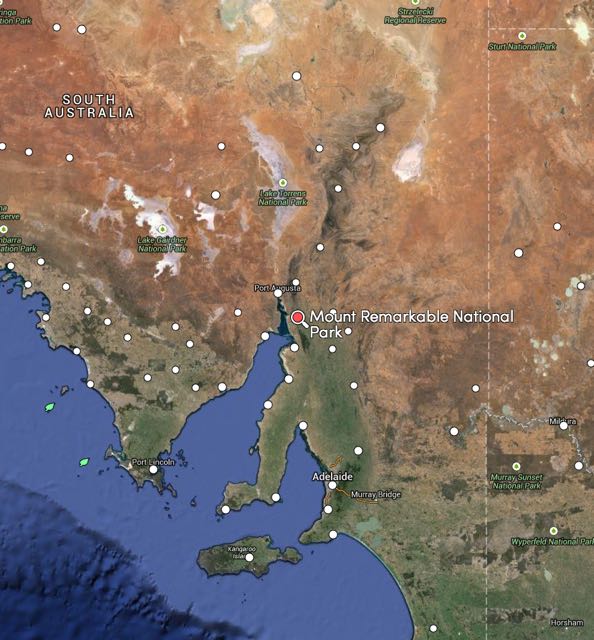
After leaving the Winninowie Conservation Park, I travelled south along the Augusta Highway and then travelled east along the Mambray Creek into the Mount Remarkable National Park.  The park is located about 60 km south of Port Augusta, and about 260 km north of Adelaide, in the southern Flinders Ranges.

Screenshot 2015-02-07 15.53.22

I have activated this 16,000 hectare park previously, and have climbed the Mount Remarkable summit, but I had never activated the park at the Mambray Creek section.  The park entry fee was paid online, and I entered the Mambray Creek section and found a quiet parking spot on the northern side of road, amongst the scrub.

Screenshot 2015-02-07 15.52.29Prior to activating I walked over to the old Baroota Homestead ruins.  This area was once part of the might ‘Baroota Run’ which was established in 1851, and flourished for 12 years.  South Australia then suffered devastating droughts for a number of years.  Following the break in the drought, flooding rains and extreme cold followed.  This resulted in the death of thousands of sheep, and with them, the owners livelihoods.

This slideshow requires JavaScript.

I ran the Yaesu FT-857d for this activation, with 40 watts output and the 40m/20m linked dipole.  I had the entire campround  area all to myself.  It was a beautiful mild night, with an almost full moon.  And no mosquitos.

I started off on 20m first and I was hoping to work some European DX and give the Europeans the opportunity of working a new park for the World Wide Flora Fauna (WWFF) program.  But I was to be sadly disapointed.  I called and called CQ  on 14.250 with no takers, until finally, Jim VK2QA responded (5/9 both ways).  But I was not spotted and called CQ numerous times after this with no takers.  So rather dejected, I tuned across the band and spoke with Franc F5PAU (5/8 sent and 5/5 received).  I then found Paul VK2HTM calling CQ with a booming signal from Sydney.  Paul also gave me a 5/9 signal report in return.  It was nearly 0900 UTC (7.30 p.m. SA local time), so I had probably left my run for 20m a little too late.

So it was off to 40m that I headed.  And my first contact there on 7.142 was with the same station I had first made contact with on 20m, Jim VK2QA in Lane Cove.   I worked a further 14 stations in VK2, VK3, VK4, & VK5, until a very strong CW signal came up on frequency calling me.  Wow, was this going to put me to the test.  It was Jack, VK5CJC.  I managed to stumble my way through and exchanged signal reports with Jack.  This was the first time I had ever had a CW-SSB contact whilst in a park.

Following my contact with Jack, I worked a further 3 stations on 7.142 until callers dried up.  I tuned across the 40m band and heard WWFF park activator and hunter, Rob VK4FFAB in QSO with Shaun VK4NSP and Glen VK2FQSL/p, so I called in to say hello.  After working Rob, Shaun, and Glen, I went up to 7.167 and called CQ.  The first responder was regular park hunter, Ron VK3JP with his usual very strong signal.  About 8 QSO’s later, after being placed on the DX Cluster by John, VK5NJ, I was called by Bill W1OW in Massachusetts in the USA.  Bill and I had a successful contact (5/7 sent and 5/5 received).  And then to my surprise, ten QSO’s later I was called byTom K2WCT in New Jersey in the USA (5/8 sent and 5/3 received).

This slideshow requires JavaScript.

I went on to work a number of other VK’s including my good mate Greg VK8GM in Alice Springs, and a handful of VK6 stations including my buddy Ted VK6NTE with his normal very strong signal.  My last contact on 40m was with Damien VK2XDL.

I had a quick listen on 20m for Jack W1FDY on the Southern Cross DX Net, but all I heard were some of the local VK’s talking about how the band had not yet opened to the States.  So I decided to ‘pull stumps’ and head back to Crystal Brook.  I had a total of 50 contacts in the log, which I was very happy with.  Although I was a little disapointed that I did not work the expected DX on the 20m band.

The following stations were worked on 20m SSB:-

  1. Jim VK2QA
  2. Franc F5PAU
  3. Paul VK2HTM

The following stations were worked on 40m SSB:-

  1. Jim VK2QA
  2. David VK5KC
  3. Brian VK5FMID
  4. Roger VK4YB
  5. Jim VK5JW
  6. John VK3HJD
  7. Doug VK2FMIA
  8. Ian VK5CZ
  9. Tom VK5EE
  10. Peter VK3ZPF
  11. John VK5BJE
  12. Richard VK5ZRY
  13. Nev VK5WG
  14. Chris VK2SR
  15. Peter VK3TKK
  16. Trevor VK5ATQ
  17. Arthur VK5AAR
  18. Peter Vk5FLEX
  19. Sg\haun VK4NSP
  20. Rob VK4FFAB
  21. Glen VK2FQSL/p
  22. Ron VK3JP
  23. Colin VK3ZZS/m
  24. Tom VK5FTRG/m
  25. Gavin VK3MLU
  26. Tony VK2RI
  27. Ray VK3NBL
  28. Chris VK5FCHM
  29. John VK5NJ
  30. Bill W1OW
  31. Ian VK3VIN
  32. James VK1DR
  33. Steven VK7PSJ
  34. Tony VK3AAT
  35. Mark VK3YYR
  36. Tony VK5TT
  37. Geoff VK5HEL
  38. John VK5FTCT
  39. John VK5FABC/m
  40. Tom K2WCT
  41. Nill VK5MBD
  42. Tom VK5FTRG
  43. Doug VK2FMIA
  44. Phil VK5NPP
  45. Greg VK8GM
  46. Owen VK5HOS
  47. Larry VK6NOL
  48. Charles Vk5FBAC
  49. Mick VK4GMH
  50. Adrian VK5FANA/qrp
  51. David VK5ADO
  52. Peter VK6DC
  53. Doug VK3YQS
  54. Ted VK6NTE
  55. Ian VK3VIG/5
  56. Damien VK2XDL

The following station was worked on 40m CW:-

  1. Jack, VK5CJC

The Battery VK5/ NE-055 and Mt Remarkable National Park

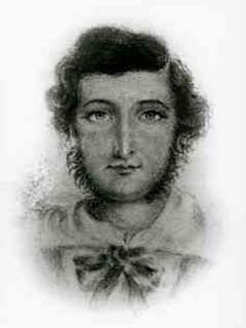
Following our activation of the Whyalla Conservation Park, Marija and I continued on to the little town of Melrose, which is nestled below the impressive Mount Remarkable summit, in the southern Flinders Ranges.  From Whyalla we travelled north to Port Augusta and then travelled south along Highway A1 (Augusta Highway).  We then turned left onto Horrocks Pass Road/Main North Road, and travelled towards Wilmington.

IMG_0147

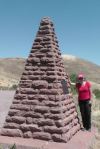
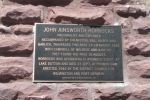
On the way to Wilmington we passed through Horrocks Pass, and we stopped off at the monument for John Horrocks, after which the pass was named.  This is well worth a look.  The story of Horrocks is a very interesting one.  John Ainsworth Horrocks (1818-1846) was a pastoralist and explorer.  In 1846, Horrocks led an expedition of 6, for a planned 4 month expedition to search for new agricultural lands near Lake Torrens.  Between the 16th-19th August 1846, the expedition crossed the Flinders Ranges via Horrocks Pass.  Horrocks and his team travelled with a camel, two carts, six horses, and twelve goats.  Horrocks noted that the camel was very temperamental, often biting the humans and goats.

AS10231_246x550

Image courtesy of images.slsa.sa.gov.au

However, the camel was able to carry up to 350 pounds (158.7 kg), which was vital for the anticipated trek across some very arid land.  On September 1st, Horrocks was preparing to shoot a bird on the shores of Lake Dutton.  While Horrocks was reloading his gun, the kneeling camel moved, which resulted in Horrocks catching the cock of the gun.  The gun discharged, resulting in Horrocks loosing the middle fingers of his right hand and a row of teeth.  Horrocks subsequently died of his wounds , about 3 weeks later, on September 23rd.  And what of the naughty camel?  Horrocks had ordered that it be shot.

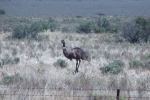
After leaving the Horrocks monument, we continued east and detoured to Hancock’s lookout.  This is well worth taking the 7 km drive on the dirt road from the bitumen.  On the way we saw numerous emus feeding in the farmer’s paddocks.  Fortunately, none of them ventured out in front of the vehicle.  Hancock’s lookout offers spectacular views of Spencer Gulf and the Port Augusta area.

This slideshow requires JavaScript.

After Hancock’s lookout, we continued on to Wilmington and then travelled south on Horrocks Highway/Main North Road to Melrose.  We had booked in to stay for one night at the Melrose cabins which are run by the Melrose Hotel.  This is the second time we have stayed here, and we highly recommend the cabins.  They are well priced, clean and comfortable.

This slideshow requires JavaScript.

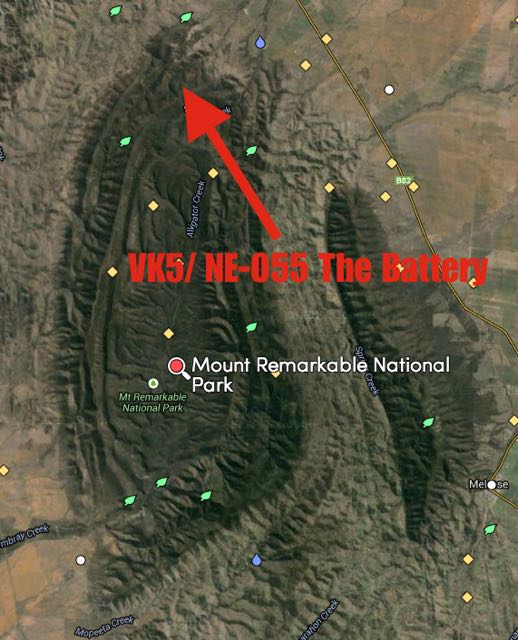
After lunch at the cabin, which consisted of schnitzel, roast potatoes, pumpkin, roast carrots, and salad, courtesy of my loving mother in law, we headed back out for our second activation for Saturday 27th December, 2014, which was The Battery, VK5/ NE-055, which is located within the Mount Remarkable National Park.  So a triple whammy.  A SOTA summit, a WWFF (VKFF) park, and a VK5 Parks award park.

Screenshot 2014-12-29 20.18.39

Map courtesy of mapcarta.com

Marija and I travelled north along Horrocks Highway/Main North Road and then turned left onto Alligator Gorge Road and travelled south west until we reached the entrance to the Mount Remarkable National Park.  We continued south west through the park until we reached Alligator Lodge which was on our left.  Directly opposite is a campground, which is blocked off for vehicles.  Look for Gate 5.  There is also a sign here indicating that The Battery is 4.5 km away (the summit is a bit further).  We parked the car on the south eastern side of the road and commenced the walk down the 4WD track towards the summit.

Screenshot 2014-12-29 20.18.29

map courtesy of mapcarta.com

I would describe the walk as moderate but still quite taxing.  The first 4 km involves a few inclines.  However it is the last 1 km that is the hardest.  There are some steep inclines and lots of rocks.  The ground is very unsteady under foot.  In many parts, the authorities have placed mesh to prevent slipping.  But there are some spectacular views along the way, and once you reach the top, you are rewarded with a magnificent view of the surrounding countryside and Spencer Gulf.   The track is quite well signposted.

Mount Remarkable National Park is located about 45 km north of Port Pirie.  Access to the park is either via the Augusta Highway via Mambray Creek, via Melrose, or via Alligator Gorge (our route).  A fee of $10.00 is charged for vehicular entry, which we paid the night before online.  Please note, that park entry fees now need to be paid online prior to visiting the park.  Cash payments are no longer an option in this park.

The park is 16,000 hectares in size and stretches from the coastal plain adjacent to Spencer Gulf, across the ranges, to Mount Remarkable on the edge of the Willochra Plain in the east.  The park is full of kangaroos, Euros, Emus, and other wildlife.

The summit, Mount Remarkable, was named by explorer, Edward John Eyre in June 1840.  The local aboriginal Nukunu people, refer to it was ‘Wangyarra’.  The word ‘aara’ meaning running water.  Alligator Groge and Mambray Creek were dedicated as National Pleasure Resports in 1952.  These areas were added to and became managed by the National Parks Commission during the 1960’s.  Following the enactment of the National Parks and Wildlife Act, 1972, Alligator Gorge, Mambray Creek and Mount Remarkable were proclaimed as the Mount Remarkable National Park.  Additional portions of land have been added to the park since that time.

This slideshow requires JavaScript.

The Battery is 765 metres above sea level and is worth 4 points.  This was the first time I had activated this summit.  It had only been activated previously by Ian VK5CZ in June 2013 and April 2014.

For this activation I ran my little Yaesu FT-817nd, 5 watts and my 40m/20m linked dipole, supported on a 7 metre squid pole.  Marija and I improvised and used a fallen tree branch to secure the squid pole to, with the assistance of some octopus straps.

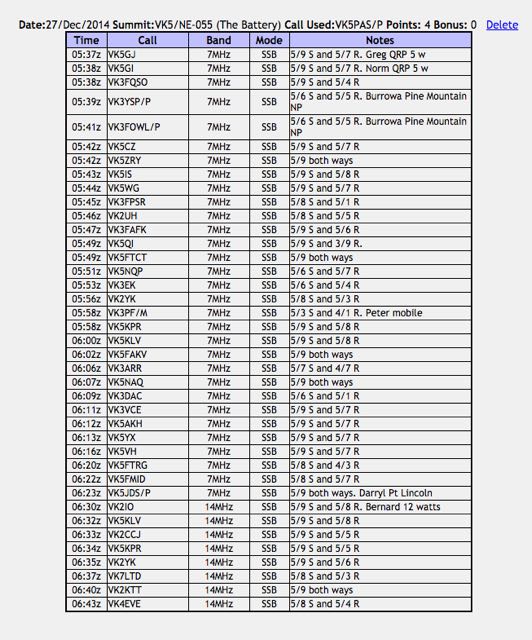
My first contact was with Greg VK5GJ who responded to my ‘is the frequency in use’ call on 7.095.  Greg was running QRP 5 watts but was a lovely 5/9 to the Flinders Ranges.  In the shack with Greg was Norm VK5GI, also running QRP.  This was followed by Amanda VK3FQSO, and then Joe VK3YSP and wife Julie VK3FOWL who were portable in the Burrowa Pine Mountain National Park.  I always get a bit of a kick when I work a National Park activator, so it was great to get Joe and Julie in the log.

A steady flow of callers then followed from Vk2, VK3, & VK5.  Conditions appeared to be reasonable, however there was a little bit of QSB on the 40m band.  After working a total of 31 stations on 40m, I lowered the squid pole and removed the links for operation on the 20m band.  My first contact on 20m ssb was with Gerard VK2IO who was portable at Gosford, running 12 watts from his Elecraft KX3.  This was followed by Peter VK5KLV at nearby Port Augusta and then Cliff VK2CCJ.  Cliff was pleased to get me in the log, as he told me that he was unable to hear me on 40m.

After a little over an hour on the summit, I had a total of 39 contacts in the log from VK2, VK3, VK4, VK5, & VK7 on both 40m ssb and 20m ssb.

The following stations were worked:-

Screenshot 2014-12-28 21.20.44

Below is a quick video of the activation…..

References.

Australian Dictionary of Biography, <http://adb.anu.edu.au/biography/horrocks-john-ainsworth-12989&gt;, viewed 29th December 2014

Mount Remarkable National Park brochure, Department for Environment and Heritage, 2006.

Wikipedia, <http://en.wikipedia.org/wiki/Mount_Remarkable_National_Park&gt;, viewed 29th December 2014

Belair National Park, VKFF-022

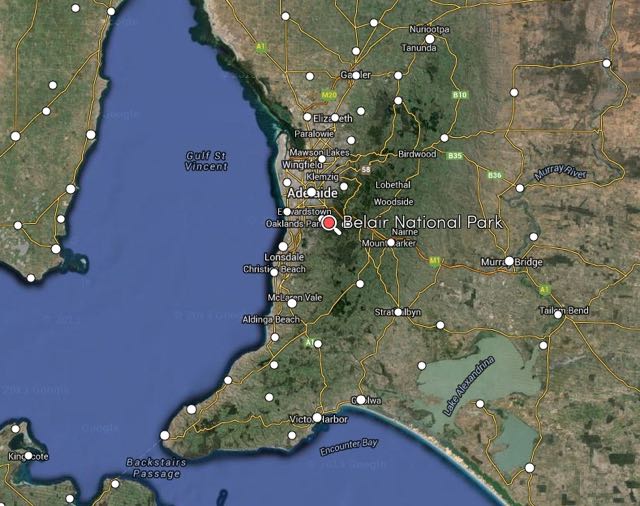
Yesterday (Saturday 20th December, 2014) I activated the Belair National Park (NP), VKFF-022, in the Mount Lofty Ranges ‘Adelaide Hills’.  I had already activated Belair NP earlier in the year, so there were no VK5 Park Award points up for grabs.  And I had already passed the 44 QSO threshold for Belair NP in the World Wide Flora and Fauna (WWFF) program.  But my real motivation, was to try out my new radio.  My beautiful wife Marija (and yes I am constantly reminded I am ‘boxing above my weight’) and my lovely daughter Olivia, purchased a Yaesu FT-857d for me, and gave it to me as an early Christmas present and early 50th birthday present.  I turn 50 on the 5th January.  So it was off to Belair for me, just a 15 minute drive to the west from home.

I set up just inside Gate 1 off Sheaok Road, at Crafers.  This is on the northern side of the park.  This gate was locked, however there is no restriction to access to the park at this point.  There is a walking track here, Wilyawa Track.  But to gain access to it, you need to either jump the fence, which has barbed wire, or jump the padlocked gate.  Why DEWNR do not have a pedestrian access point here I do not know?  Anyway, I got all the gear from the 4WD and then jumped the fence and walked a short distance down the track, where I set up my station, under the shade of some gum trees, as it was a warm 30 deg C day.

Screenshot 2014-12-20 22.16.38

Map courtesy of mapcarta.com

I started off on my nominated frequency of 7.095.  I had posted on the VK5 Parks Yahoo group and the WWFF Australia Yahoo group that I would be on air at 0600 UTC on 7.095.  I was about 15 minutes late, but still did not have to call CQ.  I asked if the frequency was in use and this was responded to by Les VK5KLV at Port Augusta with a beautiful 5/9 signal.  Les gave me a 5/9 in return, and it seemed the band was in very good shape.  It was certainly very quiet.  There was no man made noise on the band due to the remote location of the park, and the QRN (static crashes) that have been present over the past few weeks were noticably absent.  My second caller of the day was Adam VK2YK who was a good 5/8.  Adam was struggling with me a little bit due to QSB, but gave me a 5/4 signal report.  This was followed by Mal VK5MJ in The Riverland in South Australia, who was 5/9 plus.  David VK5KC then called me, using just 1 watt, and was a very nice 5/8 signal.  I had already caught up with David earlier in the day for a coffee.

I went on to work a further 20 stations in VK1, VK3, and VK5.  A few of those stations were operating QRP.  The first QRP caller was Peter VK3TKK who was running just 5 watts.  Peter’s signal was only signal strength 3, but due to the low noise floor, I was able to receive him perfectly.  This was followed by Andrew VK1NAM mobile in VK3, in the outer eastern suburbs of Melbourne.  Andrew was running just 2.5 watts from his FT-817 in the car, but nether less had a great 5/7 signal.  Tom VK5FTRG then called in from the South East of South Australia, running just 5 watts, with a nice 5/9 signal.  My final QRP caller was regular QRP operator, Ian VK5IS, again running 5 watts.  Ian had a beautiful 5/9 signal coming in from the Mid North of South Australia.

I also worked a few mobile stations.  Other than Andrew mentioned above, I also spoke with Greg VK5ZGY who was mobile in the South East of South Australia, with a good strong 5/7 signal.  Greg had co pilot and wife, Gabbie, alongside of him.  I then spoke with Ian VK6PXF who was mobile in VK5 at Lonsdale, south of Adelaide.  Ian has started activating National Parks, and has sent me quite a few of his logs for upload to the WWFF Log Search facility.  And lastly I was called by Robin VK5TN who was mobile at Hahndorf in the Adelaide Hills.

But to make my day, I was called by Richard VK5ZRY, who had decided to head out to the Ramsay Way Conservation Park.  The park is/was located on Richard’s property on the Yorke Peninsula.  Richard was trying out his new Yaesu FT-817 and had a magnificent 5/9 signal coming across the Gulf St Vincent to Belair.

This slideshow requires JavaScript.

I left the frequency to Richard, and lowered the squid pole and removed the links in the dipole, so I could operate on 20m.  However, I was disapointed when I tuned across 20m, to hear only very weak signals coming in from Europe.  I found that my nominated frequency of 14.244 was clear, so I put out about 8 CQ calls but had no takers.  Rather disapointed, I tuned across the 20m band and could hear three stations coming in from Spain.  However, their signals were well down compared to normal conditions.  I also heard Jason ZL3JAS, working long path into Europe.  However, all the European stations he was making contact with, were very weak to me.

So I headed back to 40m.  Prior to calling CQ again, I tuned across the 40m band and I could hear quite a few Europeans & stations from the United Kingdom coming through, including Javier, EA7GAK on 7.178 who was working into the USA.  I gave Javier a few calls, but sadly he could not hear me.  I also heard W1AW/3 on 7.161 working into Europe.  I also called him, but again my 40 watts just wasn’t making the grade.   So I went back to 7.095 and called CQ again, and this was responded to by Nic VK5ZAT who was portable at Carrackalinga on the Fleurieu Peninsula.  I had worked Nic a little earlier, prior to QSYing to 20m.  He had been having problems with a high VSWR on his dipole.  And this time, his signal had dropped down a good 2 S points.  I was then called by Mick VK3FAFK in Stawell in western Victoria, with a beautiful 5/9 signal.  And this was followed by Andrew VK5UR mobile in VK2, about 100 km south of Parkes.  I had a lengthy chat with Andrew and his signal always remained around the S9.  Andrew was running an IC7100 and a roof mounted whip antenna.  My last contact on 40m was with Adam VK2YK who had called in again, as conditions had improved.  I was now 5/9 with Adam, and he was 5/9 plus.  I worked a further 13 stations from VK2, VK3, VK4, & VK5.

My curiosity had got the better of me, so I again lowered the squid pole and removed the links in the dipole, and again tuned to 20m.  I was hoping that the band had improved.  But it was getting a little late, approaching 8.00 p.m.  Again, I could hear some weak Europeans, who were certainly not strong enough for me to try to make contact with.  I managed just 1 DX contact and that was with Michio, 7L4LKK, who was a strong 5/9 to Belair.

So after a number of hours in the park, I had a total of 41 contacts in the log.

The following stations were worked:-

  1.  Les VK5KLV
  2. Adam VK2YK
  3. Mal VK5MJ
  4. David VK5KC/qrp
  5. David VK5HYZ
  6. Peter VK3TKK/qrp
  7. Nev VK5WG
  8. Ian VK5KKT
  9. Matt VK1MA
  10. Andrew VK1NAM mobile VK3/qrp
  11. Tom VK5FTRG/qrp
  12. Greg VK5ZGY/m
  13. Ian VK6PXF mobile VK5
  14.  Amanda VK3FQSO
  15. Marshall VK3MRG
  16. Ian VK5IS/qrp
  17. Stuart VK5STU
  18. Peter VK5KPR
  19. Keith VK5FEKH
  20. Steve VK3MEG
  21. Nic VK5ZAT/p
  22. Tom VK5EE
  23. Richard VK5ZRY/p (park to park contact)
  24. Robin VKTN/p
  25. Nic VK5ZRY/p
  26. Mick VK3FAFK
  27. Andrew VK5UR mobile VK2
  28. Gary VK4MDZ
  29. Ian VK3VIN
  30. Rob VK4FFAB
  31. Bruce VK3FBNG
  32. Darren VK2NNN
  33. Kevin VK2VKB
  34. Peter VK3ZPF
  35. Andrew VK2UH
  36. Jim VK5JW
  37. Tony VK3AN
  38. Nick VK3ANL/qrp
  39. Tom VK5FTRG
  40. Adam VK2YK
  41. Michio 7L4LKK