A few days ago the latest Summits on the Air (SOTA) Challenge was announced. The previous challenge period 2013/2014 was the 12 m band. In 2015/2016, the official SOTA challenge will be to make contacts on 6m and 10m.
See below for the rules which are similar for chasers and activators……
Chasers:
For every unique summit you chase on 10m or 6m you get a multiplier.
For every unique activator chased you get 1 chaser challenge point.
Your final score is chaser challenge points * multipliers.
Activators:
For every unique summit you activate on 10m or 6m you get a multiplier.
For every unique chaser worked you get 1 activator challenge point.
Your final score is activator challenge points * multipliers.
Duration: The challenge runs for 6months in total split into two separate 3 month periods. Each period coincides with the Sporadic E season in either the Northern or Southern Hemispheres. The first period runs from 15th May 2015 to 14th August 2015. The second period runs from 15th November 2015 to 14th February 2016. No matter where you live, you can operate in both periods but during 1 period your chances of make contacts are massively improved.
Certificates: There will be certificates for the top chaser and activator. There will be certificates for best chaser and activator on an association by association basis as well. The final number of certificates awarded will be based on the activity levels.
Note:
1. The dates for the Southern SpE window are subject to adjustment. It will be 3 months but the start and stop date may move to ensure we align with the peak SpE period.
2. We are aware that 6m may not be generally available in some countries. In that case you only need activate on 10m and your score will only be compared against other’s10m scores.
More information can be found on the SOTA reflector at…..
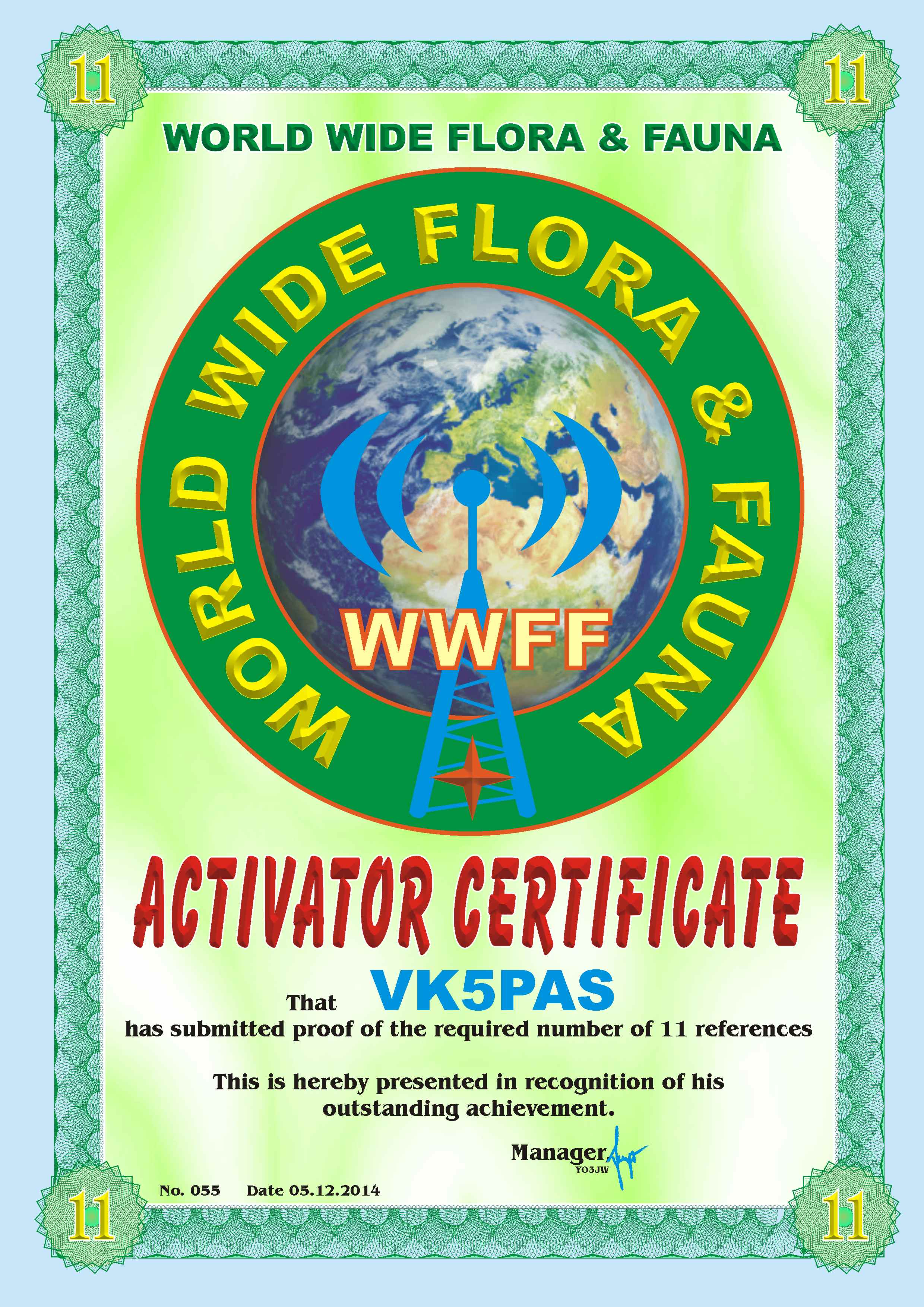
Thanks to Pit, YO3JW, I received the following World Wide Flora Fauna (WWFF) program certificates yesterday via e-mail…..
WWFF Activator certificate
This certificate verifies that I have activated at least 11 x WWFF reference areas (and obtained the required 44 contacts in each).
WWFF DXFF Activator certificate
This certificate verifies that I have activated 3 x references in 3 x different DXCC countries: Australia, Germany, & Belgium (from my recent trip to Europe). When I go overseas again, I will try to activate some more WWFF parks in some different countries.
I love getting out to the parks as most know. I enjoy the fresh air, and the bushwalking aspect, as well as the radio. One of my other interests whilst in the parks is birdwatching. Of the feathered kind! In any event, most of the parks I visit, aren’t frequented by the other type of ‘bird’. Other than my wife occasionally.
When I was a little fella, my father bred finches and parrots, and that is where my interest started. My first ever bird book was called Australian Birds, written by Robin Hill, that was released in 1967. Mum and Dad bought me this book when I was about 5 years old, and I still have it to this day.
Anyway, back on track. I joined the birdlife AUSTRALIA supporter network, and I now receive an electronic newsletter from birdlife AUSTRALIA. It is well worth subscribing to.
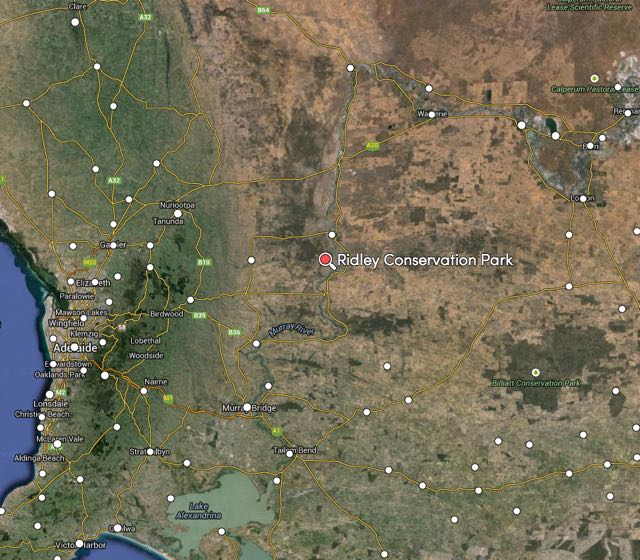
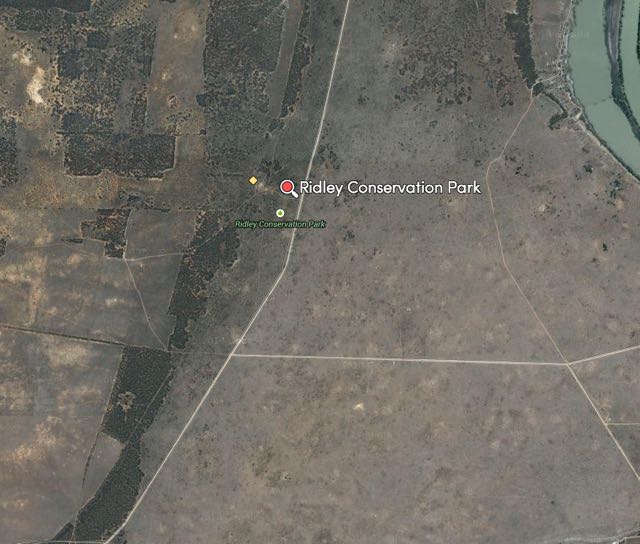
Following my activation at the Swan Reach Conservation Park, I headed towards Swan Reach township, and then travelled down to the Ridley Conservation Park (CP), which is located about 124 km north east of Adelaide, and about 13 km south of the town of Swan Reach on the River Murray.
Map courtesy of mapcarta.com
The Ridley CP is located on the western side of the Mannum-Swan Reach Road (Murraylands Road). It is a long narrow park, 10 km x 0.4 km, and covers an area of about 414.3 hectares. The southern boundary of the park is on the edge of the valley of the River Marne. This is the location of Hayward’s Hill, which is the highest point in the park. About 35 % of the park comprises an open scrub of Red Mallee and Yorrell. There are also some stands of Murray Pine and associated areas of shrubland dominated by Hop Bush and Cassias. The remaining 65 % of the park comprises low open woodland of Native Apricot and False Sandalwood. The understorey consists of Spear-grass and ephemeral herbs.
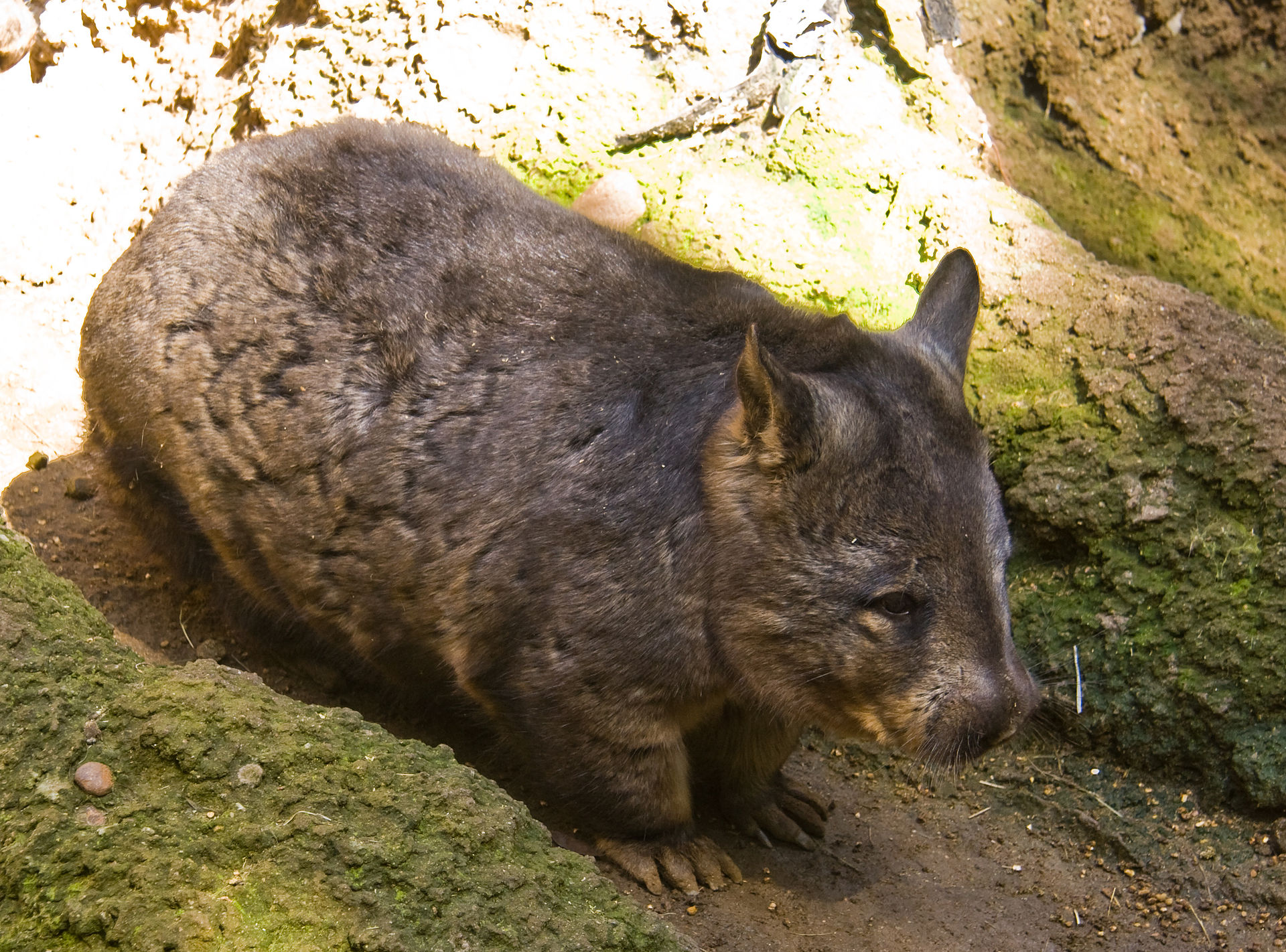
The park was originally set aside to conserve native vegetation and bird habitats. Also, the open areas of the park include a number of warrens of the Southern Hairy-nosed Wombat. Other native animals found in the park include echidnas, and Western Grey kangaroos.
Southern Hairy-nosed wombat. Image courtesy of wikipedia.
I last activated this park in May, 2013. For more information on that activation, please have a look at my previous post at…..
I set up just off the eastern side of Murraylands Road. I had arrived at the park a little later than planned. I was meant to be on air at 0700 UTC (5.30 p.m.), but it wasn’t until 0750 UTC that I was set up and ready to go. It was still warm (I was in a t-shirt), but it was very dark and very windy.
As often happens, I asked if the frequency was in (I was on 7.095) and I was answered by the ever reliable John VK5BJE who advised the frequency was all mine. This was followed by a call from John VK5FTCT in the southern suburbs of Adelaide, with a beautiful 5/9 signal.
Again, for this activation, I worked a handful of QRP operators. The first of those was Nev VK5WG, at Crustal Brook running 5 watts from his X1M, and then Greg VK5GJ at Meadows, also running 5 watts. And then Peter VK5NAQ at Balaklava in the Mid North, who was also running just 5 watts.
The strongest station worked was Paul VK7CC on the north coast of Tasmania, who had a great 5/9 plus signal (nearly 30/9). Paul’s signal report for me was 10/9.
This slideshow requires JavaScript.
I had been on 7.095 for 35 minutes, chatting to stations in VK2, VK3, and VK5, when a couple of VK2 fellas decided they would come up on 7.093. So that was pretty much the end of that. They were causing just too much splatter and I was forced to wrap up my activity on 7.095. I think it was a planned ‘sked’ frequency and they were not going to move for anyone, despite me hearing a station I had worked, asking them to QSY. I lowered the squid pole and removed the links in the 40m/20m linked dipole, and had a listen on 20m. I worked just 2 stations there. They being JD1BOX on Ogaswara, and then Rich G0OWU at Wrens Nest in England.
It was starting to get a bit cool, and the wind was certainly not abating. This combined with the fact that the sun was starting to set, meant that the wombats and kangaroos would now be getting active. So I packed up the gear and headed home. I had a total of 20 contacts in the log.
The following stations were worked:-
John VK5BJE
John VK5FTCT
Nev VK5WG
Greg VK5GJ
Terry VK3UP
Brian VK5FMID
Arno VK5ZAR
Ian VK5CZ
John VK2AWJ
Jeff VK5HEL
Greg VK2QE
Tom VK5FTRG
Bruce VK2FBJM
Ron VK2NZL
Rob VK2DRB/m
Damien VK5FDEC
Paul VK7CC
Peter VK5NAQ
The following stations were worked on 20m SSB:-
JD1BOX
Rich G0OWU
References.
National Pakrs and Wildlife Service, 1984, ‘Conservation Parks of the Murraylands (Western Plains) Management Plans’
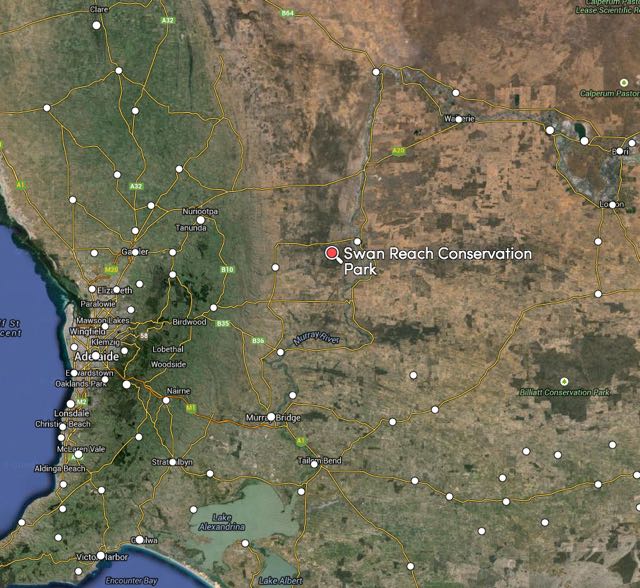
Yesterday (Saturday 6th December, 2014) I headed to the Swan Reach Conservation Park (CP), which is located about 167 km north east of Adelaide, and about 10 km west of the town of Swan Reach.
Map courtesy of mapcarta.com
The park covers an area of about 2,017 hectares and encompasses an area of gently undulating country. It consists of typical mallee vegetation. The park is home to a large variety of birdlife including Wedge tailed Eagle, Purple-crowned Lorikett, Mallee Ringneck, Australian Owlet-nightjar, and Singing Honeyeater. A large number of native mammals can also be found including the Southern Hairy-nosed Wombat, Western Grey Kangaroos, and Red Kangaroos. A large number of native reptiles are also found here including Central Bearded Dragons and Gould’s Goannas. I did not see any wombats but certainly saw quite a few kangaroos.
I last activated the Swan Reach CP on the 11th May 2013. Please have a look at my previous post for information on that activation…..
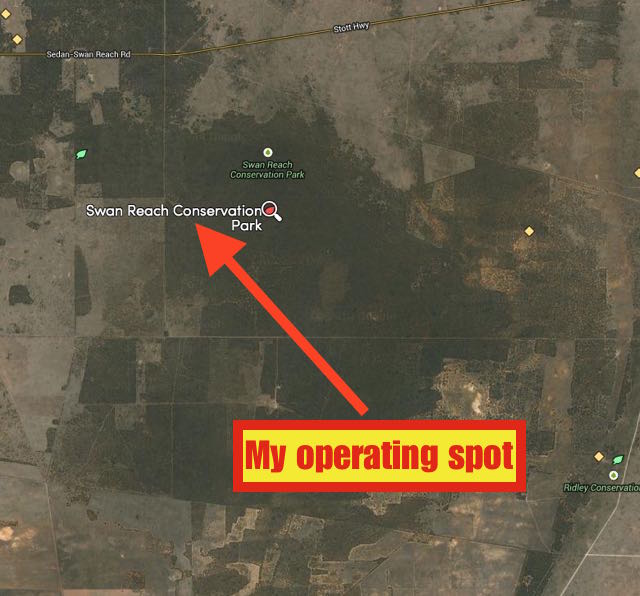
I turned right onto a dirt road, off the Sedan-Swan Reach Road, and travelled south. After travelling south for a km or so, I then found a small track running off to the east, and drove down the track until I found a small clearing, where I set up my gear. Again for this activation, I used my Yaesu FT-450, 40 watts, and a 40m/20m linked dipole, supported on a 7m squid pole.
Map courtesy of mapcarta.com
My CQ call was responded to by Stuart VK5STU with a strong 5/9 signal from the north eastern suburbs of Adelaide. This was followed by Arno VK5ZAR and then Steve VK3SRB mobile at Mitcham in Melbourne. Steve had a terrific 5/9 signal from his mobile.
I had a few good QRP contacts whilst in the park. The first was with Ian VK3VIN who was running his little Argonaut transceiver on just 3 watts. Ian was a good 5/7 signal. We tried out ‘how low can we go?’. Ian dropped his power down to just 1 watt and I was able to receive his signal 5/5, without any problems. I lowered my power down from 40 watts where I was 5/9, to 10 watts and received a 5/8 signal report. I then lowered the power output down to 5 watts and received a 5/6-7 signal report from Ian.
I then worked Greg VK5GJ in Meadows, in the southern Mount Lofty Ranges. Greg was running just 5 watts and was 5/5. And my last QRP contact was with Peter VK5NAQ, who despite running just 5 watts, was 5/9 plus to Swan Reach. Peter always has a terrific signal.
This slideshow requires JavaScript.
After an hour in the park, I had a total of 17 contacts in the log from VK2, VK3, & VK5.
The following stations were worked:-
Stuart VK5STU
Arno VK5ZAR
Steve VK3SRB/m
Ian VK5KKT
Ian VK3VIN
Peter VK3PF
Steve VK3FSWB
Col VK5FCDL
Mike VK3ZMD
Andy VK2FBAC
Nev VK5WG
Barry VK3MBW
Ron VK5VH
Greg VK5GJ
John VK5FTCT
Peter VK5NAQ
Bruce VK2FBJM
References.
National Parks and Wildlife Service, 1983, ‘Conservation Parks of the Murraylands (western Plains) Management Plans
Last night (Wednesday 3rd December, 2014) I headed up the Elizabeth Amateur Radio Club to deliver a presentation on the Summits on the Air (SOTA) program. The talk was attended by about 15 members of the club who showed a keen interest in the SOTA program. The presentation including all aspects of SOTA, including its history, how summits qualify for SOTA, some operating tips, and favoured equipment used. I also brought along my Yaesu FT-817, linked dipole, some SOTA awards, and my Shack Sloth trophy.
There were a few park activators present, who hopefully now will give SOTA a crack here in VK5. One fella is travelling to Europe soon, and showed a keen interest in activating some summits whilst there on holidays.
Thanks to Allen VK5MAK for asking me to talk to the group.
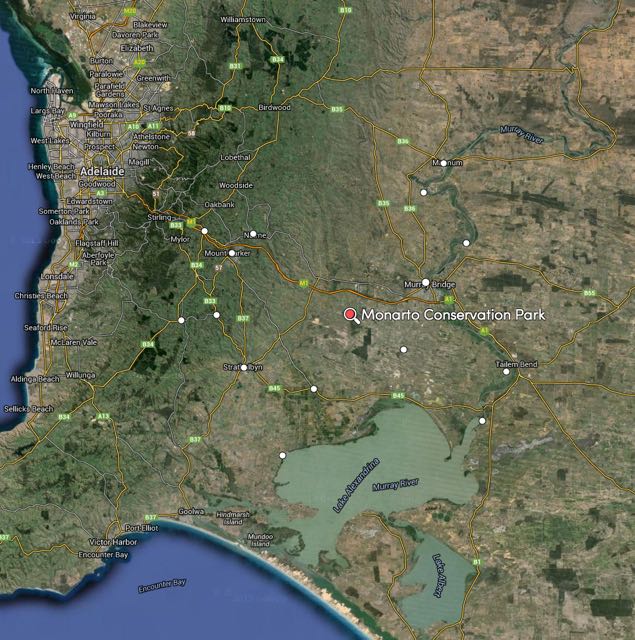
On Tuesday night (2nd December 2014) I arrived home from work to find no internet coverage from my ISP and then no power. So I packed up the radio gear and headed for the Monarto Conservation Park, which is about 65 km east of Adelaide.
Map courtesy of mapcarta.com
I have activated the Monarto Conservation Park previously (on 2 occasions). Please have a look at my previous posts for more information on those activations, and also for information on the park itself.
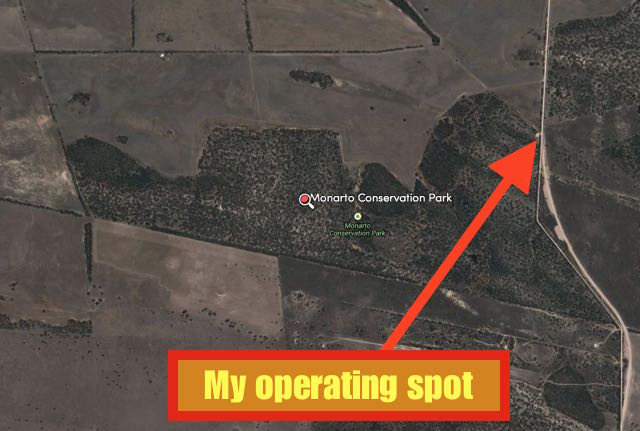
I set up in the same spot as the last 2 occasions, which was the carpark on the eastern side of the park. There is plenty of room here to string out a dipole, and stay out of the bush and of course all of the associated nasties that like living in the bush and come out on hot evenings (which this was). I set up my fold up table and deck chair, and the Yaesu FT450, 40 watts and the 40m/20m linked dipole.
Map courtesy of mapcarta.com
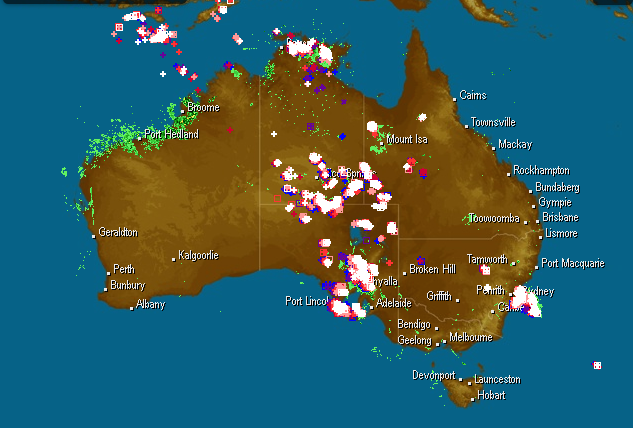
It was a warm evening, but there were showers coming in from the west and there was lots of storm activity. So the static crashes on 40m were S9 plus at times. I placed a CQ call on 7.095 and was immediately greeted by Andrew VK2UH who had a great 5/9 signal coming in from New South Wales. Andrew was defeating the static crashes without any problems. After a bit of a chinwag with Andrew I was called by regular park hunter, Tom VK5EE in Mount Gambier, and then Damien VK5FDEC running 10 watts from his new Yaesu FT857. My fourth contact was Rob VK4FFAB. It was a struggle to get Rob’s call but we got there in the end. Rob was a 3/4, simply because of the static crashes. If they were not there, I would have received Rob perfectly, as there was certainly no man made noise in the park. Thanks for your perseverance Rob.
I had a steady flow of callers during the 90 minutes that I was set up in the park. The band was in very good condition and it was a real shame about the static crashes. I had callers from VK1, VK2, VK3, VK4, VK5, VK6, and VK7. Almost all of the States and Territories were represented.
And here is where all the noise was coming from…..
Fortunately the rain stayed away. I had a few light sprinkles, but it remained a very warm evening. By the time I packed up at about 8.15 p.m. the sun was setting and I was rewarded with a spectacular sunset. And I was still in a t-shirt.
The signals coming in from VK5 during this activation were outstanding. Peter VK5NAQ, Charlie VK5KDK, Hans VK5YX, Nev VK5WG, John VK5FMJC, Ian VK5IS, Arno VK5ZAR, and Roger VK5NWE were all 20/9 to 30/9 in signal strength.
A few QRP callers gave me a shout. They were Kevin VK7HKN running 5 watts from his Yaesu FT-817, and Eric VK3FMSC also running 5 watts. And Ken VK3TKQ who was mobile at Mount Evelyn, had a beautiful 5/9 signal into Monarto.
But the strongest signal of the activation was reserved for Roger VK4YB near Caboolture in Queensland. Roger was 40/9 to me, and his 2 element beam was working an absolute treat. What a signal!
This slideshow requires JavaScript.
This was a very enjoyable activation despite the QRN. It is very evident from this activation and other evening activations that I have done, that the 40m band opens up beautifully to all parts of Australia at this time. So why not try an evening park activation and work all of Australia.
I had a total of 28 contacts during this activation.
On Sunday, 23rd November, 2014, with my wife Marija, I headed down to the Coorong National Park, VKFF-115. It was a beautiful warm day, and we had just bought ourselves a new Toyota Hi Lux, so it was a a couple of great reasons to go for a drive.
Map courtesy of mapcarta.com
I have activated the Coorong National Park a number of times previously. This is a spectacular part of South Australia which stretched for more than 130 km and protects a string of salt water lagoons which are sheltered from the Southern Ocean by the sweeping sand dunes of the Younghusband Peninsula. The Coorong is a wetland of international signficance. For more information on the Coorong National Park, please have a look at…..
Rather than travelling along the South Eastern Freeway and the Dukes Highway, we headed out along the Wellington Road from home, and down through the beautiful wine growing region of Langhorne Creek, and then on to the little town of Wellington on the River Murray. There, we put the 4WD onto the ferry and travelled over the Murray and then on to Meningie on the banks of Lake Albert. From Meningie we continued south east along the Princes Highway.
Initially, we drove along 400 Mile Road and down to the Coorong. However, as it was a warm day and there was no immediate shade at that location, we decided to turn around and head for Parnka Point, where I have operated from a number of times before. I knew that there were shelters at Parnka Point, where I could set up out of the sun.
Map courtesy of mapcarta.com
My first contact was with Rod VK5VRB at Meadows in the Adelaide Hills with a very strong 5/9 signal. This was followed by SOTA guru (and recently converted parks hunter) Andrew VK1NAM, Hans VK5YX running 5 watts from his home brew MFJ transceiver, and Ian VK3AXH. I went on to work a number of stations in VK3 & VK5.
After working a total of 15 stations on 40m, I ventured over to 20m, where I put out a number of CQ calls on the nominated World Wide Flora Fauna (WWFF) frequency of 14.244, but had no takers. It was still only 3.00 p.m. and a little too early for the 20m band to be open long path to Europe. A quick tune around the 20m band confirmed this, with very little activity heard. I did hear Anatoly RZ3ZM calling CQ on 14.228 and gave him a call and received a 5/5 signal report from Russia with my 40 watts.
I then went up to 14.310 and asked if the frequency was in use, and was advised by Adam VK2YK that Bob VK5FO was on the frequency on a SOTA summit. I could not hear a peep out of Bob, despite the fact that he was just 150 km away. So I went down to 14.305 and was soon called by Adam VK2YK with a very strong 5/9 signal. This was followed by VK7EB/p. I started calling CQ again, but sadly some stations came up on 14.303 speaking German, and that was the end of that. I was forced to QSY due to the bleedover. So I tuned across the band and found John EA7BA in QSO with some of my mates including Brian ZL2ASH. I gave John a call in Almeria in Spain and he gave me a 5/9 signal report. Brian ZL2ASH in Wellington gave me a 5/6 signal report and Tony F5VBY gave me a 5/8 signal report from France.
I then tuned across the band and found 14.252 clear so I called CQ and this was responded to my Allan VK6APP. Allan was struggling with me and I was certainly struggling with Allan. Sadly his modulation was very distorted, and it was a difficult QSO. A number of subsequent CQ calls went unanswered.
This slideshow requires JavaScript.
I then worked a special event call YO555BU. I then went to 14.252 and called CQ again, and this time I had a steady flow of callers from Europe. My first contact was with Max IK1GPG, followed by Zenek SP5INQ, and then UA9LT. I went on to work a total of 15 stations from Europe, but the Yaesu FT-450 kept cutting out as the 44 amp hour power pack was getting low. I am sorry to the European stations that were still calling when I went QRT.
After a total time of 2 hours in the park, I had 38 contacts in the log. We packed up the gear and headed for us. This time taking the Princes Highway to Tailem Bend and then back along the South Eastern Freeway.
My final activation for Monday 17th November, 2014, and my final activation for the four days away, was the Little Desert National Park, VKFF-291, which is located about 375 km north west of Melbourne, in western Victoria.
Map courtesy of mapcarta.com
I activated the Little Desert National Park in September, 2013. For more information on that activation, and details on the park, please have a look at my previous post…..
This is a vast park, covering an area of about. The park has slowly evolved and grown in size over the years. The Kiata Lowan Sanctuary, consisting of 217 hectares, was created in 1955 and was set aside for the preservation of the Malleefowl. The Malleefowl is an endangered bird, and is also known as the Lowan.
image courtesy of wikipedia.org
For more information on the Mallee Fowl, have a look at the following wikipedia article…..
The park was increased in size in 1968 to 945 hectares and was declared as the Little Desert National Park. It was also at this time that the Government ammounced that about 80,000 hectares of desert in the area would be sub divided and cleared for agriculture. Great debate commenced and it was argued that in the long term the land would be more valuable in its natural state. As a result the sub division plan was abandoned, and in December 1969, the park was increased to 35,300 hectares. And then in 1986, the Land Conservation Council which had been created by the Government to advise on the use of public land, recommended an increase in size of the park. The Central and Western Blocks were created and added to the existing Eastern Block. This increased the park in size to 132,000 hectares. In May 1988, the park was declared as a National Park, and it now extends all the way from the Wimmera River in the east, to the South Australian border.
map courtesy of parkweb.vic.gov.au
I headed out to the park from Dimboola via Wimmera Street and then Horse Shoe Bend Road. I set up in the same vicinity as last year, which was near a spot in the Wimmera River called Horseshoe Bend. There is a campground here with wooden benches and seats, and it is beautifully shaded with large River Red gum trees. It is a very pretty spot close to the Wimmera River on the eastern boundary of the park. It is a much prettier and cooler option than some of the more remote and baron parts of the park.
map courtesy of parkweb.vic.gov.au
The Little Desert National Park contains more than 670 species of native plants. Over 220 bird species have been recorded in the park. A variety of native animals are also found in the park including Brush-tailed Possums, kangaroos, bats, and many different kinds of reptiles including Stumpy-tailed lizards and Bearded Dragons.
map courtesy of mapcarta.com
I was set up and ready to go by 4.07 p.m. Victorian time. I started calling CQ on 7.095 on 40m. My first contact was with Larry VK5LY who was running QRP, but still had a terrific 5/9 signal. This was followed by Brian VK5FMID who was also 5/9 from Mount Gambier, and then Fred VK3DAC who was 5/9. Mick VK3FAFK was next with a nice 5/9 signal from nearby Stawell. Mick is recently licenced and was one of my regular callers over the 4 days of park and SOTA activations. After working 8 stations from VK2, VK3, & VK5, on 7.095, I was forced to QSY up to 7.097 as the Kandos Net came up on 7.093 and I was getting a lot of ‘bleedover’.
After I QSYd to 7.097 I worked a further 15 stations in VK3 & VK5. This included Marco VK2YES who was portable in the Olney State Forest near Lake Macquarie, and Norm VK5GI who was running QRP 5 watts on his home brew transceiver from Willunga south of Adelaide.
This slideshow requires JavaScript.
After working a total of 23 stations on 40m, I headed over to 20m, where I worked a total of 9 stations in New Zealand, VK2, Russia, and VK6. I started calling CQ on 14.244 and my CQ was responded to by Don ZL1AQ and then Noel ZL1DAI. Mike VK2ABT then called in, and this was followed by Sergey RA3PCI, Jeff VK3HJA, Jason Vk6YTS, and Paul VK2DNL. I put out a few more CQ calls but there were no takers, so I tuned around the 20m band and found T32TV working weak Europeans. I also heard 4X6TT on 14.200 but he was just a little too weak to try to work. I then worked Franc (ZL1SLO) operating as ZL1PPY, a special event call commemorating the centenary of the First World War 1914-1918.
So after about 1 hour 15 minutes in the park, I had a total of 32 QSOs in the log. That combined with the 10 QSOs from my activation in September, 2013, saw me fall just 2 QSOs short of the required 44 QSO’s for the World Wide Flora Fauna (WWFF) global awards. Oh well, I will have to revist the park at some stage.
The following stations were worked:-
Larry VK5LY
Brian VK5FMID
Fred VK3DAC
Mick VK3FAFK
Tom VK5EE
Nev VK5WG
Kieran VK2QK
Tim VK5AV
Marco VK2YES/p
Bernard VK3AV
Greg VK5GJ
Robin VK5TN
John VK5FMJC
Brett VK3FLCS
Allen VK5FD
Daniel VK5DF
Ian VK5CZ
Norm VK5GI/qrp
Ewen VK3OW
Colin VK3NGC/m
Rob VK3FKL
Ron VK3JP
Allen VK3HRA
Don ZL1AQ
Noel ZL1DAI
Mike VK2ABT
Sergey RA3PCI
Jeff VK3HJA
Jason VK6YTS
Paul VK2DNL
Franc ZL1PPY
Franc ZL1SLO
After getting mobile I worked Rick VK3EQ who was portable on SOTA peak, Mount Beenak, VK3/ VC-016 (5/5 sent and 5/8 received).
Below is a video of the activation…..
References.
Parks Victoria, June 2014, ‘Little Desert National Park Visitor Guide’.
My second to last activation for Monday 17th November, 2014 was the Grampians National Park, VKFF-213, which is located about 260 km north west of Melbourne.
map courtesy of mapcarta.com
I have really fond memories of the Grampians, as many of my Dad’s relatives live/d in the Wimmera region, particularly Horsham, not far from the park. As a young boy we would often visit my Uncles and Aunties, and my Nana & Papa who lived at Horsham. My Nana would regularly take us for a drive out to the Grampians, where my little sister and I would feed the kangaroos at Zumsteins.
The Grampians is a vast park, and is 167,219 hectares in size, and was proclaimed as a National Park on the 1st July 1984. The park was listed on the Australian National Heritage List in 2006, for its outstanding natural beauty and being one of the richest indeigeneous rock art sites in south-eastern Australia. The Grampians is referred to as Gariwerd in the local aboriginal language. In 1991, after a 2 year consultation process, the park was renamed Grampians Gariwerd National Park. However, this controversial formality was reversed after a change of State Government in 1992.
I entered the park via a dirt track which ran off the eastern side of the Henty Highway, near Tea Tree Creek. I drove down the track for about 500 metres and set up my gear just off the track. I again used the Yaesu FT-450, 40 watts, and the 40m/20m linked dipole for this activation.
map courtesy of mapcarta.com
I had reached the and park and set up 6 minutes ahead of my scheduled time. So I was on track to get home at a respectable hour. I started calling CQ on my nominated frequency of 7.095. My first contact was with Mr. Reliable John VK5BJE at 1.04 p.m. Victorian time. John’s signal was down a little from normal. He was just a 5/5 and I received a 5/1 signal report from John. However, we both had very low, if not non-existant noise floors at our respective locations, so we were able to receive each other without any problems. This was followed by John VK2AWJ/3 who was portable in the Burrowa Pine Mountain National Park. John had been very active over the 4 days, operating portable from a number of Victorian parks. Congratulations John. My third contact was with Peter VK3RV and soon after his partner Jenny VK3WQ. Peter and Jenny had been chasing me over the 4 days during my activations. Thanks Peter and Jenny.
During this activation, I had a steady flow of callers from VK2, VK3 & VK5, with some very good signals. Many were regular park hunters, but there were some new callers in there as well, which is always pleasing. Daniel VK5DF had become a regular caller. Daniel is from the South Coast Radio Club, where I recently gave a talk on the VK5 Parks Award. So perhaps my encouragement had rubbed off on Daniel.
Unfortunately, I was pushed off the frequency by a couple of VK2 stations speaking Italian. This was despite the fact that I had been on the frequency for one hour. I was in the middle of a QSO with Tony VK5ZAI, when these 2 fellas came up and just took over the frequency without asking if it was in use. I often hear these same two gentlemen, on or around this frequency, so obviously they believe they ‘own it’. Perhaps they could not hear me, but surely they could hear the other stations working me. Probably, but I think they just didn’t care.
This slideshow requires JavaScript.
So after an abrupt end, I had a total of 32 contacts in the log. This was enough to combine with my previous activation of The Grampians, to surpass the 44 required QSOs for the World Wide Flora Fauna (WWFF) program.







 VK5PAS