
Our final activation for Monday, the 20th day of October 2025, was the Murrumbidgee Valley Regional Park VKFF-1786. We headed there after our dinner at the Riverina Hotel in Hay.

Above: Map showing the Murrumbidgee River. Image c/o Wikipedia
The Murrumbidgee River is the second-longest river in Australia. It flows through New South Wales and the Australian Capital Territory. Murrumbidgee is an Aboriginal word meaning ‘big water.’ The river flows for a length of 1,485 km, with its source being the Snowy Mountains. Its mouth is the confluence with the Murray River. (Wikipedia 2025)
The Murrumbidgee River runs through the traditional lands of the Ngarigo, Ngunnawal, Wiradjuri, Nari Nari and Muthi Muthi Aboriginal peoples. (Wikipedia 2025)
In 1820, the New South Wales Government was advised that a river had been discovered by settlers who had travelled south from the Goulburn Plains and Lake George. This river was referred to by the Aboriginal people as ‘Morumbidge’. (Commonwealth of Australia 1931) (Trove 2025)
In December 1820, Governor Lachlan Macquarie organised an expedition party with provisions for one month to set out to locate the Murrumbidgee River. The party consisted of Joseph Wild, James Vaughan, and Charles Throsby Smith. Smith’s uncle, Charles Throsby, was under instruction from the Governor to launch the expedition. He had been advised of the existence of the Murrumbidgee River by the Aboriginal people. (Commonwealth of Australia 1931) (National Trust 2021)
Charles Throsby was born in 1777 in Leicester, England. In June 1802, he arrived in Australia aboard the Coromandel as the naval surgeon. (Commonwealth of Australia 1931) (Parsons n.d.)

Above: Charles Throsby. Image c/o ACT Heritage
Joseph Wild was born in c. 1759 in England. In August 1793, he was convicted of burglary and received 50 lashes and spent several years in prison. In 1797, he was transported for life to the colony of Australia. In August 1810, he received a ticket-of-leave, and in January 1813, he was granted a conditional pardon. He went on to take part in several expeditions of the continent of Australia. (Commonwealth of Australia 1931) (Parsons n.d.)
James Vaughan @ Vaughn, was born in c. 1770 in England. In 1790, at the age of 20, he was sentenced to transportation for life in a Dublin court. He arrived in Australia in 1791 aboard the Third Fleet. After being granted a pardon, he became a Constable. (National Trust 2021)
Charles Throsby Smith was born in March 1798 in Cambridgeshire, England. He emigrated to Australia in 1819. He resided for periods of time with his uncle, Charles Throsby. (ancestry 2016) (Wikipedia 2025)

Above: Charles Throsby Smith. Image c/o WIkipedia
On the 8th day of December 1820, Vaughan and Smith climbed Black Mountain. Having done so, they made the decision not to continue further and to return home. (National Trust 2021)
Smith would later write the following:
“I was sent by my uncle by order of the Governor in charge of half a dozen men and pack horses to explore the country to the south of Lake George, and to trace down a river an imaginary one so I found and to my great vexation, being so led astray by my uncle’s report, and on my return we had a serious quarrel and I left him and rented a farm at Appin.” (National Trust 2021)
In March 1821, Charles Throsby embarked on an expedition in search of the Murrumbidgee River, in company with Joseph Wild. In c. April 1821, he discovered the Murrumbidgee at its junction with the Molonglo River. Throsby died just 7 years later in 1828. (Commonwealth of Australia 1931) (Parsons n.d.)
Two years later, in 1823, an expedition team consisting of Mark Currie, John Ovens, and Joseph Wild set off from Throsby Park in Moss Vale, New South Wales. On the 31st day of May 1823, they arrived at the Murrumbidgee River. They were able to cross the river and camped near Tharwa, south of current-day Canberra. Over the following 5 days, they travelled in a southerly direction parallel with the Murrumbidgee. (Commonwealth of Australia 1931)
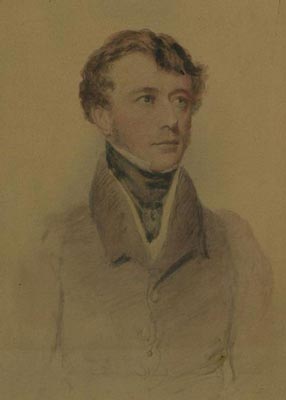
Above: Captain Mark Currie. Image c/o WIkipedia
In November 1829, Captain Charles Napier Sturt led an expedition party to solve the mystery of where the western-flowing rivers of New South Wales went. On the 7th day of January 1830, Sturt and his party travelled down the Murrumbidgee River in a whale boat. They reached the confluence of a larger river, which Sturt named the Murray River. They continued along the Murray until reaching the confluence with the Darling River and on to Lake Alexandrina by 9th February 1830. They then rowed back upriver during the Australian summer until their supplies ran out near current-day Narrandera in April 1829. (Commonwealth of Australia 1931) (Gutenberg.net.au, 2025)

The year 1838 saw one of the most severe droughts in Australian history, which continued until 1842. The Murrumbidgee River ceased to run for 2 years. As a result, all of the crops failed, and the price of wool fell from 36d in 1833 to 18d in 1841. (Commonwealth of Australia 1931)

Above: article from The Sydney Monitor & Commercial Advertiser, Wed 10 Oct 1838. Image c/o Trove
The Murrumbidgee Valley Regional Park comprises several distinct areas along the Murrumbidgee River from Hay to west of Wagga Wagga. The Murrumbidgee Regional Park, the Murrumbidgee National Park, and the Murrumbidgee Nature Reserve were reserved on the 1st day of July 2010. The regional park is 1,180 hectares in size. The Murrumbidgee Valley River Parks protect part of the longest continuous tract of River Red Gum forest in the world. (NSW NPWS 2014)


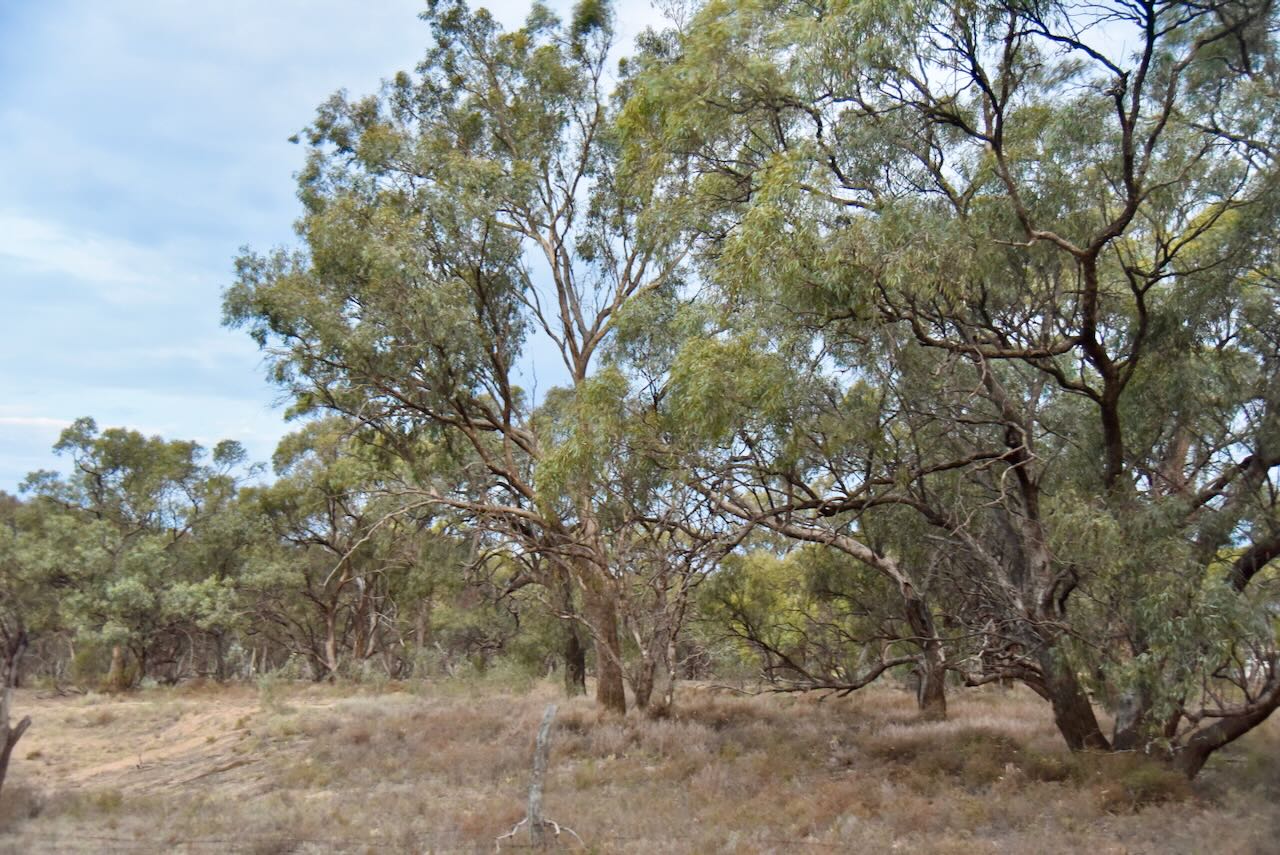
We activated the park just outside of Hay.
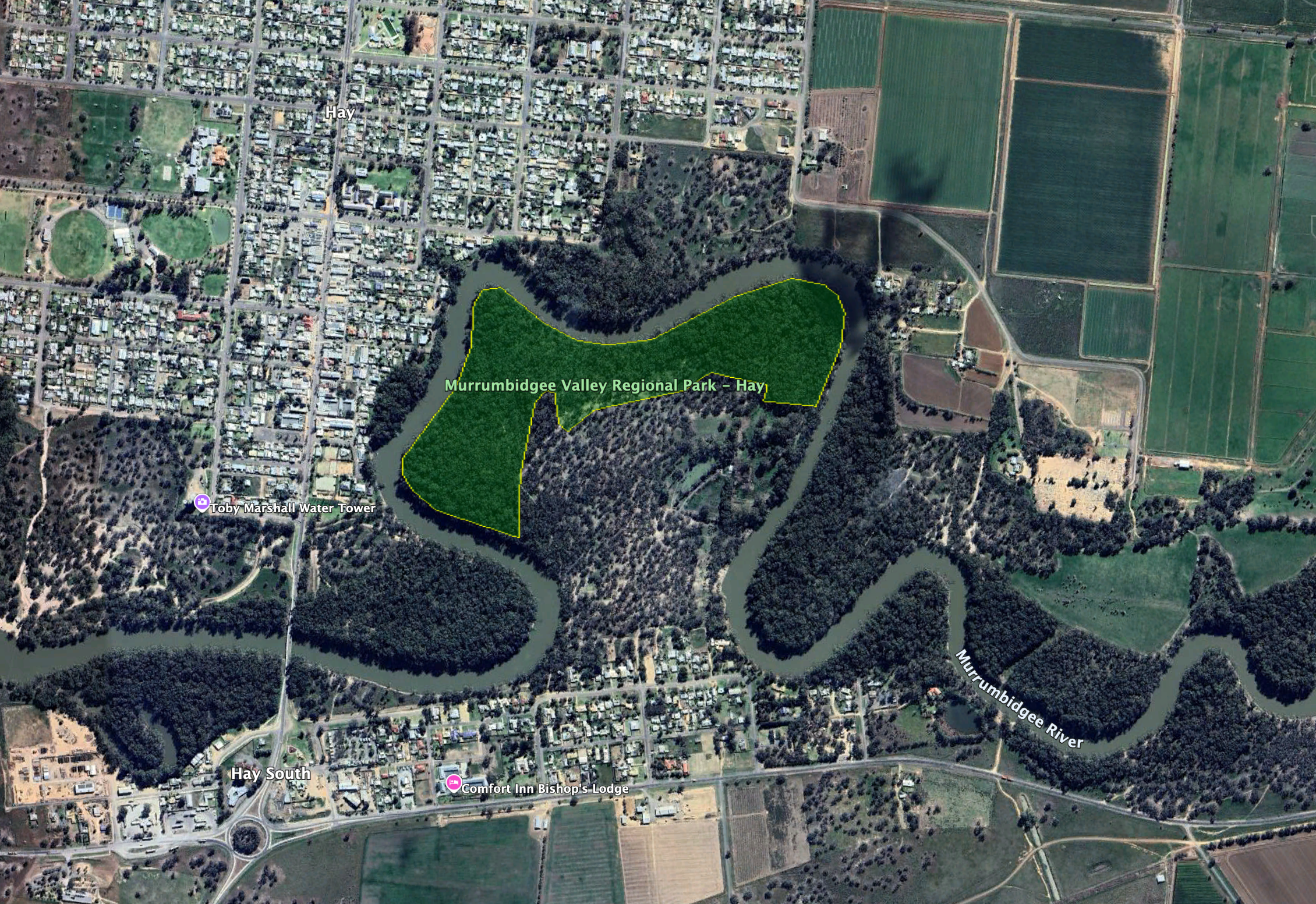
Above: An aerial view of Hay and the section of the Murrumbidgee Valley Regional Park that we activated. Image c/o Google Earth
We ran the Yaesu FT857, 40 watts, and the 20/40/80m linked dipole.
Marija worked the following stations on 40m SSB:-
- VK3FS
- VK3ATT
- VK5LA
- VK5KAW
- VK2IO
- VK2GEZ
- VK1AO
- VK2MET
- VK5ACC
- VK3MAW
I worked the following stations on 40m SSB:-
- VK3FS
- VK3ATT
- VK5LA
- VK5KAW
- VK2IO
- VK2GEZ
- VK1AO
- VK2MET
- VK5ACC
- VK3MAW
- VK4EMP
- VK4TI
- VK4GKO
- VK7PJM
- VK6ASK/m
- VK5LSB
- VK2LWK
- VK3LF
- VK2OT/p
- VK5NJ
- VK2JAB/m
- VK3AXK
- VK6ADM
- VK2FALL
- VK2KEV/4
- VK3VRU
- VK5FANA
- VK2XWB
- VK4BR
- VK3AMO
- VK3DAU
- VK5DW
- VK5UV
- VK2MFW
- VK3PF
- VK3KAI
- VK4GAP
- VK4BWL
- VK2XLY
- VK3JP
- VK4WP
- VK4DWS
- VK3UH
- VK3DEM
- VK2DNI
- VK3XEM
- VK5HS
- VK5PY
- VK4SMA
References.
- ancestry (2016). Ancestry® | Genealogy, Family Trees & Family History Records. [online] Ancestry.com.au. Available at: https://www.ancestry.com.au/. [Accessed 19 Dec. 2025].
- Gutenberg.net.au. (2025). Dictionary of Australian Biography St-Sy. [online] Available at: https://gutenberg.net.au/ebooks15/1500721h/0-dict-biogSt-Sy.html#sturt1 [Accessed 19 Dec. 2025].
- National Trust of Australia (ACT), 2021, ‘Heritage in Trust’
- NSW National Parks & Wildlife Service, 2014, Statement of Management Intent – Murrumbidgee Valley River Parks
- Parsons, V. (n.d.). Charles Throsby (1777–1828). [online] Australian Dictionary of Biography. Available at: https://adb.anu.edu.au/biography/throsby-charles-2735 [Accessed 19 Dec. 2025]
- Parsons, V. (n.d.). Wild, Joseph (1773–1847). [online] Australian Dictionary of Biography. Available at: https://adb.anu.edu.au/biography/wild-joseph-2791. [Accessed 19 Dec. 2025].
- Trove. (2025). EARLY PIONEERS. – DISCOVERY OF THE MURRUMBIDGEE RIVER. – The Gundagai Independent and Pastoral, Agricultural and Mining Advocate (NSW : 1898 – 1928) – 3 Apr 1916. [online] Available at: https://trove.nla.gov.au/newspaper/article/122202868?searchTerm=charles%20throsby%20%2B%20murrumbidgee [Accessed 19 Dec. 2025].
- Wikipedia. (2020). Murrumbidgee River. [online] Available at: https://en.wikipedia.org/wiki/Murrumbidgee_River. [Accessed 19 Dec. 2025].
- Wikipedia Contributors (2025). Charles Throsby Smith. Wikipedia.
 VK5PAS