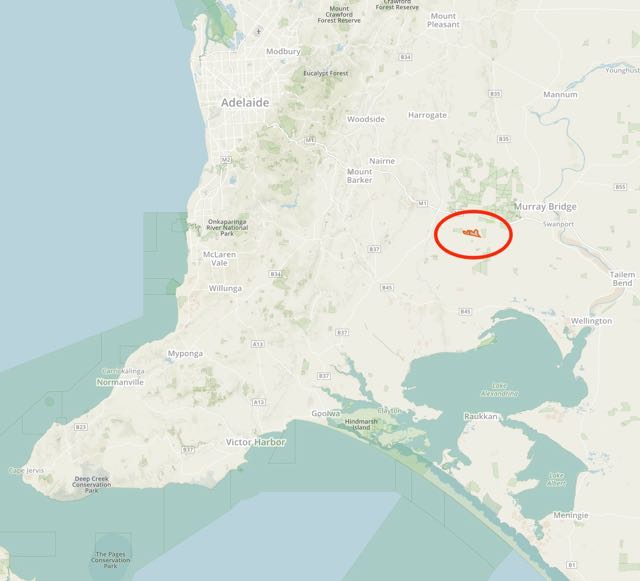
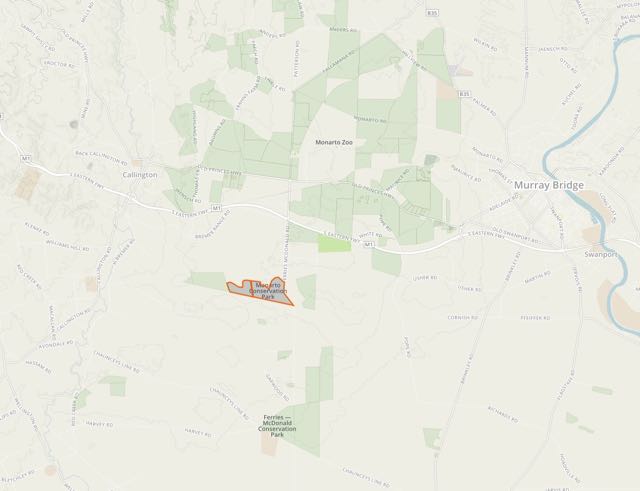
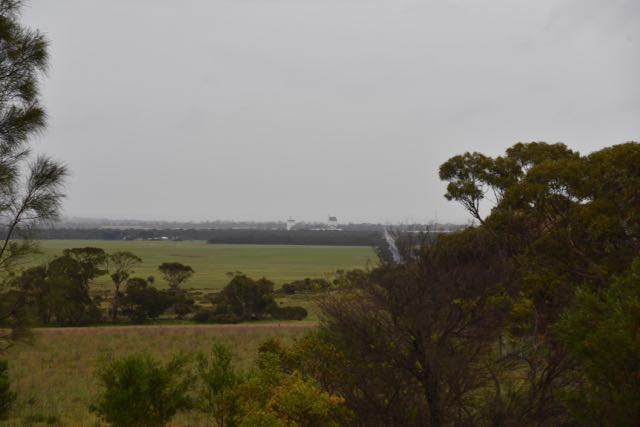
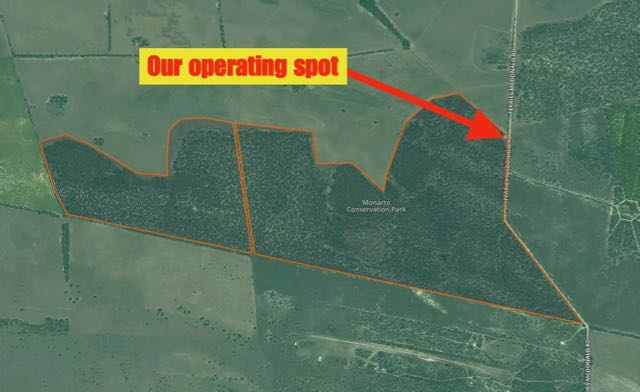
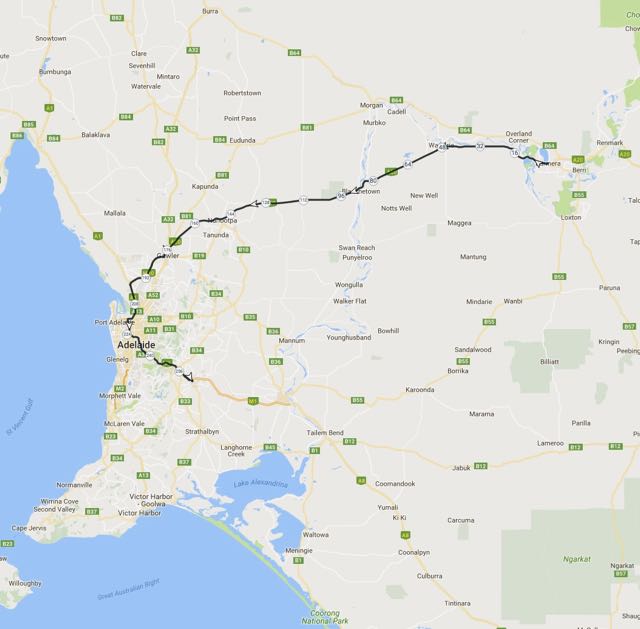
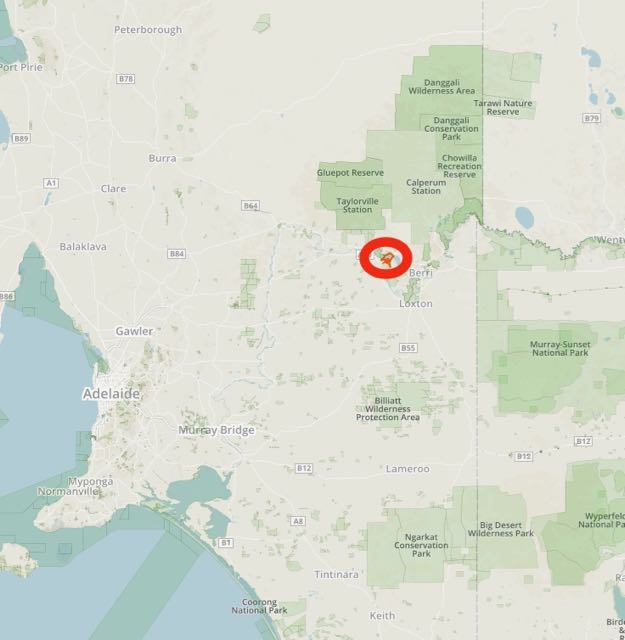
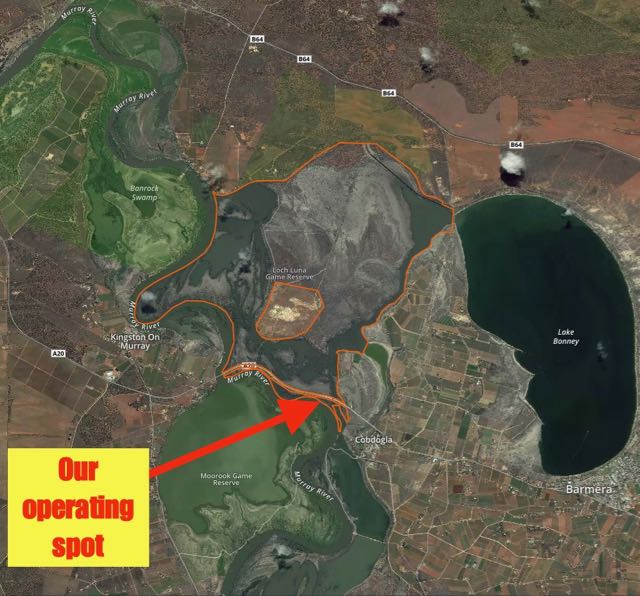
Black Bullock Hill, VK5/ SE-016

On Sunday 7th August 2016, the ACT Summits on the Air (SOTA) enthusiasts held their annual VK1 SOTA Winter QSO Party.  My wife Marija VK5FMAZ and I headed down the Fleurieu Peninsula to the little one point summit of Black Bullock Hill VK5/ SE-016 to take part in the event.  The summit is situated about 100 km south of Adelaide.

Screen Shot 2016-08-04 at 3.42.48 PM

Above:- Map showing the location of Black Bullock Hill.  Map courtesy of Location SA Map Viewer.

The summit is around a 90 km drive from our home and took Marija and I through the little Adelaide Hills towns of Echunga and Meadows and then on to Willunga.  From there we travelled to Myponga and then Yankalilla and Normanville.  The impressive cliffs at Lady Bay soon came into view.  I must check the topography to see if any qualify for SOTA as they certainly do tower above the ocean.  Lady Bay is home to the Links Lady Bay Resort, and a gold course that was designed by golfing identifies, Jack Newton, Graeme Grant, and the late John Spencer.

We stopped briefly for a stretch of our legs and to view the HMAS Hobart (D 39) interpretive sign at Lady Bay.  The HMAS Hobart (D 39) was a Perth class guided missile destroyer of the Royal Australian Navy, built in the USA.  She was commissioned into the Royal Australian Navy in 1965.  She was gifted to the South Australian government in August 2000 and she was sunk as a dive wreck in November 2002.  The wreck site is officially known as the Fleurieu Artificial Reef.

We continued on through the beautiful Fleurieu Peninsula to the little town of Delamere, where we turned on to Range Road, and travelled for a few km until turning onto Dog Trap Road.  Along the way we called the owner of the land just to confirm that we could access the property.  You can activate the summit from the roadway as you are well and truly within the activation zone, but I have previously operated from the trig point which is located just off the road on private property.  Peter, the land owner kindly allowed us access.

Screen Shot 2016-08-04 at 3.42.28 PM

Black Bullock Hill is a very easy summit to reach.  In fact it is a strange summit in that climbing is not required, and it is a summit for SOTA due to it being the highest point on this part of the Fleurieu Peninsula.  It is situated near the intersection of Dog Trap Road, Three Bridges Road and Tent Rock Road.  The summit is 365 metres above sea level and is worth 1 SOTA point.

Many years ago I suspected that the summit was probably named after a black bullock.  But I enquiried with the Yankalilla and District Historical Society and confirmed that the summit’s name actually comes from a plant, not an animal, as some of us presumed.  And that plant is ‘bull-oak’  Allocasuarina Luchnannii, which is part of the Casuarinaceae family.  The plant is also sometimes referred to as ‘buloke’.  It is reputed to the the hardest wood in the world, with a Janka Hardness of 5,060 lbf.  The Janka hardness test measures the resistance of a sample of wood to denting and wear.

http://en.wikipedia.org/wiki/Janka_hardness_test

Screen Shot 2016-08-04 at 3.42.18 PM

Above:- Aerial showing the location of the summit, just on the eastern side of Tent Rock Road.  Image courtesy of Location SA Map Viewer.

The first thing that Marija and I noticed was that the trig point was lying on its side.  No doubt as a result of the terrible weather that many parts of South Australia had experienced during July.

DSC_1623 (1).jpg

We decided to set up from the side of the road, as the fence to Peter’s property is electrified and I wasn’t feeling in a particularly energetic mood to scale fences.  Marija also had a previous unpleasant experience with an electric fence, so we took the easier option.  The surrounding countryside was lush green and despite it not being a summit in the true sense of the word, there are some great views of the surrounding Fleurieu Peninsula.  The Fleurieu was named after Charles Pierre Claret de Fleurieu,  the French explorer and hydrographer, by the French explorer Nicolas Baudin, as he explored the south coast of Australia in 1802.

The views include some sensational views across Backstairs Passage to Kangaroo Island which is Australia’s third largest island after Tasmania and Melville Island.  I’ll be there in a few weeks time for the International Lighthouse and Lightship Weekend (ILLW).  The Backstairs Passage is the strait between the South Australian mainland and Kangaroo Island.  It was named by Matthew Flinders whilst he and his crew on HMS Investigator were exploring and mapping the South Australian coastline in 1802.

For this activation I ran the Yaesu FT-857d, 40 watts and the 40m/20m/80m linked dipole supported by the 7 metre heavy duty squid pole.  There was a small wooden post near the fenceline which I used to secure the squid pole with the assistance of an octopus strap.

We were at Black Bullock Hill and all set up to go by around 2320 UTC (8.50 a.m. South Australian local time) so there was plenty of time to work some SOTA chasers on either side of the UTC rollover.  It was a pretty brosk morning, with the temperature being about 4 degrees C.  The wind was blowing in off the nearby South Ocean.  Prior to calling CQ I had a quick tune across the band and came across Paul VK3HN on SOTA peak Mount St Leonards VK3/ VC-006 working Paul VK2HV.  So Paul became my first contact for the morning with a nice 5/9 signal.

I then headed to 7.090 and commenced calling CQ and this was answered by Dave VK2JDS mobile, followed by two more S2S contacts with Tony VK7LTD and Angela VK7FAMP who were both portable on Mount Phipps, VK7/ SC-027 (5/5 both ways).  Marija also jumped on the mic at this stage and logged the two S2S contacts with Angela and Tony.

The band was completely devoid of man made noise at Black Bullock Hill, and there was only a slight frying pan noise on the band, along with a little bit of Indonesian or Malaysian QRM.  Signals were quite good into the eastern States but it was clear that close in propagation was no existant.

Marija and I had a slow but steady flow of callers from the eastern States including a number of S2S contacts.  We shared the mic until Marija had 9 contacts in the log and then started waving her arms at me when I tried to hand the mic to her.  She had qualified the summit and had endured the cold for long enough and was heading back to the vehicle.

I worked 25 stations on 40m before the UTC rollover from VK1, VK2, VK3, VK7 and VK8, including 15 S2S contacts.  And I worked a further 19 stations on 40m after the UTC rollover.  I then moved to 14.310 on 20m and worked 6 stations.  First taker there was Fred VK4FE.  What was really pleasing about 20m was I logged three New Zealand S2S contacts.  Two of those with Wynne ZL2ATH and Warren ZL2AJ were a bit of a struggle, with signals quite low.  But Kyle ZL2KGF was an excellent 5/5 signal.  This was Kyle’s first ever SOTA activation and he was also in ZLFF-0003 which was a bonus.  See the photos below to see the view that Kyle was enjoying.  My S2S contact with Wynne ZL2ATH over  a distance of 3227km made it Wynne’s longest S2S so far. Not bad considering that Wynne was running a Yaesu FT-817 and just 5 watts. 

Above:- ZL1/ TN-006.  Courtesy of ZL2KGF

I then  moved back to 40m and worked a further 10 stations, but callers were few and far between, so it was off to 80m.  I thought it might have been a little too late in the day, but I was surprised to log a total of 6 stations on 80m including a S2S contact with Ian VK5CZ on The Dutchmans Stern VK5/ NE-028, about 450 km to the north of my location.  I couldn’t believe it when Ian came back to me.  We both exchanged 4/1 signal reports.

I worked the following Summit to Summit (S2S) contacts prior to the UTC rollover……

40m

  1. Paul VK3HN/p VK3/ VC-006 (6 points)
  2. Tony VK7LTD, VK7/ SC-027 (2 points)
  3. Angela VK7FAMP/p, VK7/ SC-027
  4. Matt VK1MA, VK1/ AC-042 (1 point)
  5. Andrew VK1AD/p, VK1/ AC-032 (2 points)
  6. Peter VK3PF/p, VK3/ VT-040 (4 points)
  7. Gerard VK2IO/p, VK2/ ST-006 (8 points)
  8. Andrew VK1DA/p, VK1/ AC-040 (1 point)
  9. Andrew VK1MBE/2, VK2/ ST-001 (8 points)
  10. Paul VK1ATP/2, VK2/ ST-008 (8 points)
  11. Nick VK3ANL/p, VK3/ VC-030 (1 point)
  12. Tony VK3CAT/p, VK3/ VN-012 (6 points)
  13. Ron VK3AFW/p, VK3/ VN-027 (4 points)
  14. Ken VK3KIM/p, VK3/ VN-027
  15. Ian VK1DI/p, VK1/ AC-039 (1 point)

And the following Summit to Summit contacts after the UTC rollover…..

40m

  1. Andrew VK1MBE/2, VK2/ ST-001 8 points)
  2. Peter VK3PF/p VK3/ VT-040 (4 points)
  3. Paul VK1ATP/2,VK2/ ST-008 (8 points)
  4. Andrew VK1DA/p, VK1 AC-040 (1 point)
  5. Tony VK3CAT/p, VK3/ VN-012 (6 points)
  6. Nick VK3ANL/p, VK3/ VC-030 (1 point)
  7. Col VK3LED/p, VK3/ VN-024 (2 points)
  8. Gerard VK2IO/p, VK2/ ST-006 (8 points)
  9. Andrew VK1AD/p, VK1/ AC-032 (2 points)
  10. Tony VK1VIC/p, VK1/ AC-032
  11. Matt VK1MA/p, VK1/ AC-042 (1 point)
  12. Ron VK3AFW/p, VK3/ VN-027 (4 points)
  13. Ken VK3KIM/p, VK3/ VN-027
  14. Paul VK3HN/p, VK3/ VC-006 (6 points)
  15. Phil VK3BHR/p, VK3/ VU-007 (1 point)
  16. Bernard VK2IB/3, VK3/ VE-165 (4 points)

20m

  1. ZL1ATH/p, ZL1/ WL-153 (1 point)
  2. ZL2AJ/p, ZL1/ WK-153 (1 point)
  3. ZL2KGF/p, ZL1/ TN-006 (2 points) and ZLFF-0003

80m

  1. Ian VK5CZ/p, VK5/ NE-028 (6 points)

It was time to pack up, as it was approaching midday.  I had a total of 65 contacts in the log, including 35 Summit to Summit contacts (113 S2S points).  Marija had also qualified the summit with a total of 9 contacts and 8 Summit to Summit contacts (19 S2S points).  It had been a very enjoyable morning.  Thanks to Andrew VK1AD for organising the event.

I worked the following stations:-

Screen Shot 2016-08-08 at 8.47.25 AM.png


References.

Wikipedia, 2016, <https://en.wikipedia.org/wiki/Fleurieu_Peninsula&gt;, viewed 9th August 2016

2016 Freeze Your Butt Off (FYBO) results

Ian VK5CZ has finalised the results for the 2016 Freeze your Butt Off (FYBO) Contest.  The FYBO Contest was held on 26th June 2016.  I won the  FYBO section after making a total of 151 QSOs with a score of 22,550 points, whilst operating from the Ettrick Conservation Park.

I have designed some certificates for Ian for the contest.

Screen Shot 2016-08-05 at 9.59.26 AM.png

Nev VK5WG was the winner of the home section.

Screen Shot 2016-08-05 at 9.59.30 AM.png

Tolderol Game Reserve VKFF-1752

Another fine day here (Friday 5th August 2016) in the Adelaide Hills and I was sick of going through emails, so it was in the 4WD and down to the Tolderol Game Reserve, VKFF-1752 for me.  Tolderol has just been added to the World Wide Flora Fauna (WWFF) program, so this was to be a unique park activation.

Tolderol is situated about 80 km south east of Adelaide, and about 11 km south east of Langhorne Creek.  The park is around 45 km south east of my home qth.

Screen Shot 2016-08-05 at 11.43.53 AM

Above:- Map showing the location of the Tolderol Game Reserve with respect to my home QTH, the Murray Mouth, and The Coorong.  Image courtesy of protected planet.

Tolderol which is located on the shores of Lake Alexandrina, was proclaimed in 1970 as an experimental area for growing of a variety of waterfowl food crops, in particular three-cornered bulrush.  The total area of the park is around 428 hectares.  A total of 226 hectares was proclaimed in 1870, with an additional 202 hectares added on 10th January 1980.

The Ngarrindjeri aboriginals are the traditional people of the area.  The Ngarrindjeri name for  Tolderol is Thultharrung (pronounced Thul-thar-rung).

The area is a mecca for bird watchers.  it is reputed that Tolderol and the adjoining Boggy Lake are some of the best waterbird observation locations in South Australia.  Just some of the species to be found here include Black Swan, Pacific Black Duck, Whiskered Tern, Straw-necked Ibis, Spur-winged Polver, Golden-headed Cisticola, and Australian Reed Warbler.  Sadly, duck shooting is permitted in the park during restricted open seasons.

I headed out of Mount Barker along Wellington Road, and into the little town of Woodchester and the Bletchley.  As I came down from the hills, there were some nice views out towards the park and Langhorne Creek.  I also made contact from the mobile with Rob VK4AAC/3 in the Errinundra National Park VKFF-0158 (5/7 both ways).

DSC_1532

I continued on to Langhorne Creek, passing through this famous wine growing region which has w wine history dating back to 1850.  Langhorne Creek is traditionally a red wine growing district and is well known for production of outstanding Cabernet Sauvignon and Shiraz.  In fact these two red wine grape varieties constitute about 70% of the total vineyard plantings in the Langhorne Creek region.  One of the big wineries that you pass is Bleasdale Wines which was established in April 1850 by Frank Potts.  I have enjoyed many a bottle of Bleasdale over the years.

After leaving Langhorne Creek I drove out along the Langhorne Creek Road towards Wellington.  I turned right onto Dog Lake Road.  There is a sign here indicating Tolderol.

DSC_1613.jpg

I soon reached the first of 2 gates on Dog Lake Road.  The gate is unlocked, but please leave the gate as you find it.

DSC_1539

I continued on a further few km until I reached a Y junction.  There is a sign here indicating that Tolderol is to the left.  A little further on and I reached the second gate.  Again, the gate is not locked, but please leave it as you find it.

There is a park sign just inside the second gate and a little further on there are some interpretive/information signs.

It didn’t take long for me to start spotting a lot of birdlife in the park.  That included Intermediate Egrets, Yellow Billed Spoonbills, and lots of Welcome Swallows.

I continued along a small track and caught my first glimpse of Lake Alexandrina from Tolderol.  Lake Alexandrina is a freshwater lake which was named after Princess Alexandrina, the niece and successor of King William IV of Great Britain and Ireland.  When the princess ascended the throne and took the name Queen Victoria there was some talk of changing the name of the lake to Lake Victoria, but the idea was dropped.

I set up in a cleared area about 20 feet away from the edge of the lake.  The area is infested with Tiger snakes, so I made as much noise as I could.  Prior to heading to Tolderol I head read on a number of websites that these snakes can even be seen in Tolderol on cool days.  Tiger snakes are a venomous snake with symptoms of a bite including localised pain in the foot and neck region, tingling, numbness, and sweating, followed by a fairly rapid onset of breathing difficulties and paralysis.   The untreated mortality rate from a Tiger snake bite is reported to be between 40 and 60%.  They are a protected species, and you can incur a fine up to $7,500 for killing or injuring a Tiger snake, as well as the potential of up to 18 months imprisonment.

1280px-Eastern_Tiger_Snake

There was plenty of room to stretch out the 20m/40m/80m linked dipole which I supported on the 7m heavy duty squid pole.  As there were no trees, the ends of the dipole were very low to the ground (about 1 foot off the ground).  I used some tent pegs to secure the legs into the ground.  There was even a concrete table and benches at this location, although the concrete was a bit cold on the backside.  I ran the Yaesu FT-857d and 40 watts for this activation, and powered the radio with the 44 amp hour power pack.

Screen Shot 2016-08-05 at 11.42.37 AM

Above:- Map showing my operating spot in the park.  Image courtesy of protected planet.

I was ready to go by around 0400 UTC (1.30 p.m. South Australian local time).  After setting up I headed to 7.144 on 40m and asked if the frequency was in use.  This was answered by Dennis VK2HHA in Albury who had been waiting on the frequency for me.  Dennis was a beautiful 5/9 plus signal and was the first in my log from Tolderol.  I was then called by Rob VK4AAC/3 in the Errinundra National Park VKFF-0158 who was also 5/9.  I was very pleased to get the Park to Park contact with Rob.  Next up was Roscoe VK3KRH who almost lifted the transceiver off the table with a very strong signal as wlways.

Despite it being a weekday I was very pleased to have a good flow of callers from all across Australia including VK2, VK3, VK4, VK5, VK6, and VK7.  Signals were quite good, but local propagation was nowhere near as good as when I was out portable on Wednesday in the Totness Recreation Park.  In the first hour at Tolderol I only worked two South Australian stations.  They being Les VK5KLV, and John VK5BJE.  Les VK5KLV is at Port Augusta about 400 km to the north of Tolderol and was 5/8 (3/6 received).  Normally Les and I hear each 5/9 both ways.  John VK5BJE is located at Scott Creek, about 55 km north west of Tolderol.  John  was only a 5/3 and gave me a 5/1, but as we both had no man made noise, we were able to hear each other perfectly.

The band did open up to the South East of South Australia (about 400 km south east of Tolderol) at around 0530 UTC  when I was able to make contact with Brian VK5FMID. Tom VK5EE, Col VK5HCF, and Robin VK5TN, all in Mount Gambier.  All had 5/9 signals.

I was pleased to be able to get a further 3 Park to Park (P2P) contacts from Tolderol after working Rob VK4AAC/3.  The first was with Neil VK4HNS who was portable in the Main Range National Park VKFF-0300 (5/3 sent and 5/5 received).  The next P2P was with Brett VK2VW in the Kwiambal National Park VKFF-0274 (5/5 sent and 5/8 received), and finally a nice P2P with David VK5PL in the Para Wirra Recreation Park VKFF-1739.  My contact with David was quite a challenge but we did manage to exchange signal reports.

Band conditions on 40m to Western Australia were a real surprise, especially considering the time of the day.  I made contact with Mike VK6MB (5/7 sent and 4/5 received), Peter VK6APZ (5/9 both ways), Craig VK6VCK mobile at Leeman around 270 km north of Perth (5/3 sent and 5/1 received), and Jarred VK6FFAR who was operating portable on the beach with 10 watts (3/4 sent and 5/1 received).

I logged a handful of QRP operators including Peter VK3PF running 5 watts (5/8 sent and 5/9 received), Ron VK3MRH running 8 watts (5/9 both ways), and Chris VK3PAT mobile running 5 watts (5/7 sent and 5/9 received).

Mobile signals were also very good with the following movile stations logged on 40m: Jonathan VK6JON/7, Brett VK2VW, Chris VK3PAT, Craig VK6VCK, Ian VK3IAN, and David VK3GP.

The strongest signal of the afternoon on 40m was Ron VK3IO at Cockatoo, who was 5/9 plus plus.  Closely followed by Roscoe VK3KRH.

After working a total of 57 stations on 40m I headed over to 14.310 on 20m and asked if the frequency was in use.  This was answered by Phil VK6ADF mobile who told me he had been waiting for me as my signal was a little too weak on 40m for him to work me.  This was followed by a contact with Paul VK2KTT.  Sadly, these were my only 2 contacts on 20m.  Phil had kindly posted me on Facebook and advised me that Danny ON4T in Belgium had posted that there was no propagation to Europe.  I tuned across the 20m band and the only signal I could hear was John EA7BA on 14.156 who was very weak.

Whilst operating during the afternoon I had a constant stream of waterbirds flying overhead.

I then moved to 3.610 on 80m where I worked Greg VK5GJ at Meadows.  Greg advised that my audio was intermittent so I checked the battery voltage and that appeared okay, although the VSWR was up a little high.  I checked all the connections and they appeared all good, so I lowered the squid pole and adjusted the 4 links in the dipole.  I went back to Greg and thankfully he advised that my audio was now 100%.  Signals on 80m were excellent and I logged Mick VK3GGG/VK3PMG, Rick VK4RF/VK4HA, Nev VK5WG, John VK5BJE, Peter VK2NEO, and Col VK5HCF.

It was starting to get a bit late in the afternoon so I started to pull down the antenna when I heard Tony VK5MRT calling me on 80m.  I had some of the links out and the antenna was lying on the ground, so it was a quick effort to re-erect the antenna.  Once back up I gave Tony a call and fortunately he was still there and made the log (just).  I was then called by Brian Vk3BBB, and Don VK3MCK before I went QRT.

At the end of the activation I went for a bit of a drive through the labyrinth of tracks through the park.  I encountered a number of local kangaroos.

I was very happy, with a total of 71 contacts in the log and a unique park activated.  Driving back home through Langhorne Creek I enjoyed a beautitful sunset.

DSC_1612.jpg

The following stations were worked on 40m SSB:-

  1. VK2HHA
  2. VK4AAC/3 (VKFF-0158)
  3. VK3KRH
  4. VK3OHM
  5. VK2MOR
  6. VK5KLV
  7. VK7CW
  8. VK3EDH
  9. VK3AN/p
  10. VK4RF
  11. VK4HA
  12. VK2XXM
  13. VK3GGG
  14. VK3PMG
  15. VK2KYO
  16. VK3SQ
  17. VK6JON/7
  18. VK2IO
  19. VK2VW/m
  20. VK3PF
  21. VK3MRH
  22. VK2JAZ
  23. VK2NP
  24. VK7BC
  25. VK3IO
  26. VK3PH
  27. VK3PAT/m
  28. VK2PG
  29. VK6MB
  30. VK3GH
  31. VK6APZ
  32. VK6VCK/m
  33. VK3IAN/m
  34. VK5BJE
  35. VK3GP/m
  36. VK6FFAR/p
  37. VK4HNS/p (VKFF-0300)
  38. VK3AXH
  39. VK3UH
  40. VK3DBP
  41. VK7CC
  42. VK3STU
  43. VK3HSB
  44. VK3ELH
  45. VK3BBB
  46. VK4FAAS
  47. VK2VW/p (VKFF-0274)
  48. VK5FMID
  49. VK5EE
  50. VK5HCF
  51. VK5PL/p (VKFF-1739)
  52. VK5GJ
  53. VK7JJ
  54. VK2NEO
  55. VK5TN
  56. VK4DD
  57. VK7DW

The following stations were worked on 20m SSB:-

  1. VK6ADF/m
  2. VK2KTT

The following stations were worked on 80m SSB:-

  1. VK5GJ
  2. VK3GGG
  3. VK3PMG
  4. VK4RF
  5. VK4HA
  6. VK5WG
  7. VK5BJE
  8. VK2NEO
  9. VK5HCF
  10. VK5NRT
  11. VK3BBB
  12. VK3MCK


References.

Wikipedia, 2016, <https://en.wikipedia.org/wiki/Langhorne_Creek,_South_Australia&gt;, viewed 6th August 2016

Wikipedia, 2016, <https://en.wikipedia.org/wiki/Lake_Alexandrina_(South_Australia)&gt;, viewed 6th August 2016

Wikipedia, 2016, <https://en.wikipedia.org/wiki/Tiger_snake&gt;, viewed 6th August 2016

Totness Recreation Park, VKFF-1754

I have been very busy in the past couple of weeks adding new Australian parks to the World Wide Flora (WWFF) program.  And a few days ago a number of the South Australian parks that I added were approved by the WWFF Reference Managers.  One of those being the Totness Recreation Park, VKFF-1754, which  is located in the Central Mount Lofty Ranges ‘Adelaide Hills’, about 35 km south east of Adelaide, and just a few minutes drive from my home (just 2.5 km from the centre of Mount Barker).  The weather was not flash, with intermittent showers, but I decided to head out to activate the park this afternoon (Wednesday 3rd August 2016).

Screen Shot 2016-08-02 at 7.20.40 PM

Above:- Map showing the location of the Totness Conservation Park in the Adelaide Hills.  Map courtesy of protected planet.

The land that is now Totness Recreation Park was formerly the property of the South Australian Railways and the Department of Transport.  In 1970 the land was transferred to the (former) National Parks Commission and dedicated for reserve purposes, under the National Parks Act 1966.  Totness Recreation Park was constituted on 22nd January 1972 under the new National Parks and Wildlife Act 1972 to protect natural habitat and provide recreational opportunities for the local community. The park comprises section 124, Hundred of Macclesfield. It was constituted free of access under State mining legislation.

In 2006, the Minister for Environment and Conservation released a discussion paper on a review of the reserve classification system in South Australia.  Under the model proposed, Totness would become a Conservation Park.  However, it appears that this paper has not progressed very far.

During the construction of the South Eastern Freeway, the park was dissected into two uneven portions totalling 41 hectares.  The northern section comprises about 9 hecatares whilst the southern section comprises around 32 hectares.  The dam in the northern section of the park was constructed in 1884 and was used to supply the steam locomotives travelling to and from Victor Harbour until 1955.  The southern section was totally burnt out during the 1983 Ash Wednesday bushfires.

A variety of native plants and animals can be found in the park.  More than 180 native plants species have been recorded within the park.  Plant species of conservation significance recorded within the park include the state rare Manna Gum and Bassian Thrush, and the regionally rare Spider Orchid.  Western Grey kangaroos, Common Ringtail Possums, Echidnas, Koalas, and various bat species can be found in the park.  A total of 26 species of native bird have been recorded in the park, including the rare Shining Bronze cuckoo and declining woodland birds including the white-throated treecreeper, scarlet robin and Bassian thrush.

To access the northern section of the park you take Totness Road, which runs off the Old Mount Barker Road (Frank Walsh Drilling is located on the corner).  But I headed to the southern section of the park.  I headed out from home along Hawthorn Road, and then turned right onto Liebelt Summer Track.  I then reached the intersection with Darby Road and Haines Fire Track and turned right onto Haines Fire Track.

Haines Fire Track is a dirt road and after all the recent heavy rain, had quite a bit of water across it and a number of potholes, but it is easily passable in a conventional vehicle.  The park soon came in to view on my right.  Don’t get confused with all of the other scrub that you pass before reaching the park.  That is all private property.

For this activation I ran the Yaesu FT-857d, 40 watts and a selection of dipoles which u supported on the 7 metre heavy duty extendable squid pole.  I used a fence post to support the radio.

There is a nice cleared area between the park boundary and the commencement of the scrub, so there was plenty of room to string out the dipoles.  Although there was a locked gate, there was a pedestrian entry point into the park, which saved the issue to having to jump barbed wire fences.

DSC_1508.jpg

I was set up and ready to go about 15 minutes earlier than my planned activation time.  Just before 0400 UTC (1.30 p.m. South Australian local time) I headed to 7.144 and asked if the frequency was in use and Peter VK3PF replied to let me know that the frequency was clear.  Peter was the first in my log for this brand new park.  Peter had a very strong 5/9 plus signal and reciprocated with a 5/9 signal for me.  This was followed by Steve VK7CW who was also 5/9 plus, then Geoff VK3SQ, and then Rick VK4RF/VK4HA.  The band was fairly quiet with just a slight frying pan noise in the far background, and certainly no man made noise on the band.

Screen Shot 2016-08-02 at 7.20.15 PM

Above:- Aerial shot showing my operating position in the  north western corner of the park.  Image courtesy of protected planet.

Roscoe VK3KRH called in running just 3 watts and with his beam was still 5/9 plus.  What a signal.  Soon after Rob VK4AAC/3 called me from the Snowy River National Park VKFF-0455 with a 5/9 signal.  It was nice to get my first Park to Park contact from Totness.  Despite it being a week day I had a steady flow of callers from all across Australia (VK2, VK3, VK4, VK5, VK6, and VK7).  Mike VK6MB called in from Perth but sadly we were unable to make a valid contact as Mike was having difficulty in hearing me.  Greg VK5GJ called in from Meadows, running his normal 4 watts, and had a solid 5/8 signal.  Soon after Mike VK6MB called back in again, and this time we were able to exchange signal reports and make a valid contact.  Another QRP caller was Nev VK5WG, running just 5 watts from the Mid North of South Australia.  Nev had a solid 5/9 signal.

It was a real pleasure to be able to log a number of VK5 callers, with local propagation working very well.  The same cannot be said during the past couple of months.  But today was the exception.  Sadly this only lasted for around 50 minutes into the activation.  Errol VK5FEKH/p called me and it was a bit of a struggle to initially pick him up but was eventually logged at 5/1.  Ian VK5IS/p then called in from Punyalaroo near Swan Reach.  Ian was also low down at 5/1.  The band had changed!

About 20-25 minutes later I was chatting to Fred VK3JM about propagation and the fact that I was initially working VK5’s but the band had now dropped out.  I soon had ‘foot in mouth’ as Ian VK5KKT from Two Wells called in with a 5/9 plus signal.  The band was back in again for the local stations.

There were some good strong signals from mobiles logged.  They included VK5FANA mobile near Moonta (5/9), Wayne VK2PDW mobile at Wagga Wagga (5/8), Toby VK3PNF mobile near Sehhparton (5/9), David VK3NGD mobile/QRP (5/3); Mark VK3FOTO mobile (5/9)

I worked a total of 54 stations on 40m, before headed off to 20m.  Despite being spotted on parksnpeaks by Peter VK3PF, numerous CQ calls on 14.310 went unanswered until I was called by Peter VK5PET and then Phil VK6ADF.  Unfortunately there were no further takers, so I headed down to the ANZA DX Net on 14.183 and found that the net was just wrapping up so I didn’t have the opportunity of booking in.  I then had a listen across the band and found Lesley VK5LOL/4 signing with a VK2 station on 14.220.  At the end of the QSO I asked Lesley to QSY up 5, where I had a bit of a chat with Lesley who is on holidays with her hubby Hans VK5YX in Queensland.  They are now at Charters Towers.  I then headed back to 14.310 and called CQ and worked Rick VK4RF/VK4HA.  But Rick was my only taker.  I tuned across the 20m band and all I heard was the Over the Horizon Radar.

John VK3PZ sent me a screen shot from our contact and some audio, using his newly acquired Icom IC-7300.  See below….

20160803_043816 VK5PAS


I then lowered the squid pole and put up the 15m dipole and called CQ on 21.244 for around 5 minutes with no takers.  So I self spotted on parks and peaks and soon after I was called by a  JA8 whose signal was very low down.  Unfortunately we were not able to make contact.  A quick tune across the 15m band revealed no activity at all.  So it was back to 40m for me.

Once back on 40m I worked John VK5BJE with a good 5/9 signal, followed by Robert VK2XXM, and then Gary VK1ZZ/4 in the Forty Mile Scrub National Park VKFF-0181. Unfortunately I soon started to experience some QRM from stations on a net on 7.146, but was able to make a handful of further contacts, including a QSO with Ian VK7IF who was maritime mobile in Twofold Bay near Eden in New South Wales.

After working 8 stations on 7.144 I took down the 20m/40m linked dipole and put up the bigger 80m/40m/20m linked dipole and started calling CQ on 3.610 on 80m.  My first station logged on 80m was Greg VK5GJ running QRP, followed by Brian VK3BBB and then John VK5BJE.  Signals were extremely good on 80m and I worked into VK1, VK2, VK3 and VK5.  My last contact was with Mick VK3GGG/VK3PMG.

The sun was just starting to set and it was getting extremely cold, so it was time to pack up and think about heading back home.  I was very happy with a total of 77 contacts in the log and a unique park having been activated.

DSC_1531.jpg

At the end of the activation I went for a walk along a track which leads to a nice high point in the park, with some nice views out towards Mount Barker and Littlehampton, including the Mount Barker summit.

The following stations were worked on 40m SSB:-

  1. VK3PF
  2. VK7CW
  3. VK3SQ
  4. VK4RF
  5. VK4HA
  6. VK5KIK
  7. VK3KRH
  8. VK2KYO
  9. VK5FMLO
  10. VK5EE
  11. VK3OHM
  12. VK5PET
  13. VK4AAC/3 (Snowy River National Park VKFF-0455)
  14. VK5FANA/m
  15. VK4ARW
  16. VK5KLV
  17. VK3MRH
  18. VK3BBB
  19. VK5GJ
  20. VK3MCK
  21. VK5ND
  22. VK3ELH
  23. VK3FAPH
  24. VK7BC
  25. VK6MB
  26. VK4GSF
  27. VK4ZD
  28. VK3PZ
  29. VK5WG
  30. VK2JAZ
  31. VK4OK
  32. VK4HNS
  33. VK7FPRN
  34. VK2IO
  35. VK5FEKH/p
  36. VK5IS/p
  37. VK7LTD
  38. VK2PDW/m
  39. VK3PAT
  40. VK7FAMP
  41. VK3ZMD
  42. VK3PNF/m
  43. VK3GGG
  44. VK3PMG
  45. VK2QM
  46. VK3JM
  47. VK5KKT
  48. VK4FAAS
  49. VK3NGD/m
  50. VK1HW
  51. VK2FARL
  52. VK2HPN
  53. VK7LCW
  54. VK3FOTO/m
  55. VK5BJE
  56. VK2XXM
  57. VK1ZZ/p (Forty Mile Scrub National Park VKFF-0181)
  58. VK3SFG
  59. VK6JON/7
  60. VK4FFAB
  61. VK2MOR/m
  62. VK7IF/mm

The following stations were worked on 20m SSB:-

  1. VK5PET
  2. VK6ADF
  3. VK5LOL/4
  4. VK4RF
  5. VK4HA

The following stations were worked on 80m SSB:-

  1. VK5GJ
  2. VK3BBB
  3. VK5BJE
  4. VK5HCF
  5. VK5FANA
  6. VK3SIM
  7. VK2XXM
  8. VK1DI
  9. VK3GGG
  10. VK3PMG

It was a slow drive home with a number of fury friends, Western Grey kangaroos, out and about for their evening stroll.  I even encountered some wild deer, but I wasn’t quick enough with the camera.


References.

Government of South Australia, 2007, ‘Management Plan Totness Recreation Park’.

Kyeema Conservation Park VKFF-0826 and 5CP-107

Some very wild and wet weather here in Adelaide has prevented a lot of portable activity.  Already this year Adelaide has well and truly exceeded its annual average rainfall.  And up here in the Mount Lofty Ranges ‘Adelaide Hills’ where I live it has been incredibly wet and windy, with lots of flooding.  But yesterday (Friday 29th July 2016) was a nice sunny afternoon, so I packed up the portable gear and headed down to the Kyeema Conservation Park VKFF-0826 and 5CP-107.

I have activated and qualified Kyeema previously, but my main reason for heading there was to book in to the newly formed VK Shires Net and hopefully hand out a new VK shire number to some of the participants.

Kyeema is about 35 km south of my home, and around 62 km south of Adelaide.  It is situated on the Fleurieu Peninsula, south west of Meadows, and east of Willunga.

Screen Shot 2016-07-30 at 10.21.53 AM

Above:- Map showing the location of the Kyeema Conservation Park, south of Adelaide.  Image courtesy of Protected Planet.

Previously I had activated the park from the southern side off Woodgate Hill Road, so this time after reviewing maps, I decided to try to access the park from the north.  It appeared after looking at maps, that there was a track which ran off Brookman Road and traversed through the northern section of Kyeema.

I travelled from home out through Echunga and on to Meadows.  I then took the Brookman Road, heading south towards Willunga.  I normally continue on to Woodgate Hill Road, but this time I kept an eye out for the track leading off to the east.  But sadly it appeared that the tracks I was viewing on maps, were tracks leading through Kuipto Forest which had locked gates from Brookman Road.  I reached Woodgate Hill Road and decided to turn around and head back to Brookman-Connor Road, hoping that somewhere from there I might find a track leading off to Kyeema.  Unfortunately I could not access the park from this side, as all the gates to the adjoining Kuipto pine forest were locked.

DSC_1480.jpg

So I contined on until I reached Blackfellows Creek Road, and commenced heading south.  It wasn’t long until I was able to see the north eastern corner of the park, across the cleared farming land.

I then turned right onto Woodgate Hill Road and started travelling west towards the carpark, from where I normally set up.  This south eastern corner of the park is quite steep in terrain and it was very pleasing to see a lot of regrowth in the park after recent bushfires.

As I drove along Woodgate Hill Road, the Mount Magnificent Conservation Park and the summit soon come into view.  Sadly, the summit does not qualify for the Summits on the Air (SOTA) program, despite offering some amazing views from the top of the surrounding Fleurieu Peninsula.

DSC_1487

I soon reached the carpark on the northern side of the road.  There is plenty of room here for vehicles, and just to the west of the carpark is a cleared area, and this is where I set up.

DSC_1488.jpg

There is a cleared area between the western side of the carpark and the scrub and the far western boundary of the park.  It is an ideal spot to string out a dipole.  And as I had the larger 80/40/20m linked dipole with me today, this location was perfect.

Screen Shot 2016-07-30 at 10.21.16 AM

Above:- Aerial shot of the Kyeema Conservation Park, showing my operating spot in the south western corner of the park.  Image courtesy of Protected Planet.

Kyeema Conservation Park, which was first proclaimed on 1st January 1964,  is about 360 hectares in size.  An additional 25 hectares of land were added in 1974.  The park consists of thick scrub including messmate stringybark, pink gum, cup gum and canlebark gum.  The name Kyeema is believed to be local Kaurna aboriginal language meaning ‘dawn’.

The park contains a large amount of native fauna including Western Grey kangaroos and the Southern Brown Bandicoot.  Around 88 species of birds can be found in the park.  Whilst I was there I spotted a number of Scarlet Robins.

This slideshow requires JavaScript.

The park was devastated during the 1983 Ash Wednesday bushfires, and a number of the eucalypt trees located in the south western part of the park were planted by school students during the 1980’s as part of a long-term revegetation program.  About 20,000 seedlings were planted in the first three years.  The area is known as the ‘Childrens Forest’ to recognise the many children who helped to re-create the valuable habitat.

Screen Shot 2016-07-30 at 1.03.14 PM.png

Above:- Article from the Victor Habour Times newspaper, Wednesday Sept 28 1983.  Courtesy of trove.nla.gov.au.

The park continues to have an active Friends of Kyeema Conservation Park group.

Kyeema Conservation Park has an extremely interesting history.  The area surrounding the park was mined for alluvial gold back in the 1880’s and was abandoned in 1890 due to a low yield.  A few years later, some the scrub was cleared for pine plantations and in 1932 a labour prison reserve was established here.  The camp which opened on 22nd March 1932 was South Australia’s first prison camp.  It was originally known as the Kyeema Afforestation Camp, and was later known as the Kyeema Prison Camp.  It was used by low security risk prisoners and on average, around 13 prisoners worked in the area at any one time, guarded by only 2 prison guards.  The prisoners cut a road through the stringybark forest to the camp, and sank wells, grew their own vegetables, carted water from the creek when the wells failed, showered from buckets, cut firewood, planted trees, put up fences and built bridges.   

The camp soon developed the reputation of being the most humane’ development in the history of the South Australian penal system’.  As was the case with other inmates a prison camps, the prisoners were called by name, not number, and were paid at a higher rate for their labours than other prisoners.  Upon completion of their work, the prisoners were allowed to yarn, read or play dominoes.  The prison camp was closed during the mid 1950’s.

I found some very interesting articles on Trove relating to the Camp.

I was on air by 0625 UTC, 5 minutes ahead of my posted activation time on parksnpeaks and Facebook.  I headed to 7.144 and asked if the frequency was in use and this was answered by Rick VK4RF/VK4HA who had a booming signal.  This was followed by Ken VK3UH, Mike VK6MB with a good 5/8 signal, and then Michael VK5FVSV.  The 40m band appeared to be in quite good shape, with good signals coming in from VK2, VK3, VK4, VK5, VK6, and VK7.  I also had a bit of QRM on the frequency with two other QSOs taking place.  I could hear a strong EA5 in Spain chatting away, and there was also a LU2 in Argentina.

About 18 contacts into the activation I was called by Rob VK4FFAB/p who was activating the Great Sandy National Park VKFF-0126.  Rob had an excellent 5/9 signal and reciprocated with a 5/9 for me.  A Park to Park contact is always a nice bonus during an activation.

I continued to work a steady flow of callers with good signals.  Hauke VK1HW almost blew me out of my chair with a huge 5/9 plus plus signal from Canberra.  It was nice to work Glenn VK2LDN who has recently upgraded from his Foundation call, and Eric VK7EV who has also upgraded from his F call.

I soon started to experience some very strong QRM from 7.146 and headed up there to find out who was there.  I politely asked if the 2 stations would mind QSYing a little higher up and they kindly obliged.  I then headed back to 7.144 and worked Les VK5KLV/p who was activating the Mount Brown Conservation Park VKFF-0914 and 5CP-145.  Les was extremely strong.  My last contact on 40m at this time was with Peter VK3PF and I left the frequency with Les VK5KLV.

I headed up to the VK Shires Net on 14.240, which was just starting to wrap up.  Sadly I just worked Lyn VK4SWE and Scott W5/MM0LID.  When the net wrapped up I headed off to 7.185 and the 40m version of the VK Shires Net which was being run by Bill VK4FW.  I logged Bill, Glen VK2FQSL, and Chris VK3QB.  Sadly there weren’t too many participants in the net.

I then went back to 7.144 and called CQ and worked William VK2NWB, Gerard VK2IO, Russell VK4ARW, Phil VK6ADF mobile and finally Roald VK1MTS mobile.  Both Phil and Roald had beautiful strong signals.

To conclude the activation I went to 80m and worked 5 stations on 3.610.  Michael VK5FVSV was first, followed by Mick VK3PMG/VK3GGG, followed by William VK2NWB and finally Gary VK5FGAZ.  Despite the signals being extremely good, I had very few callers.

The following stations were worked on 40m SSB:-

  1. VK4RF
  2. VK4HA
  3. VK3UH
  4. VK6MB
  5. VK5FVSV
  6. VK3OHM
  7. VK5BJE
  8. VK7CW
  9. VK7HT
  10. VK4AAC/3
  11. VK3BBB
  12. VK3GGG
  13. VK3PMG
  14. VK1MA
  15. VK2NNN
  16. VK3FSPG
  17. VK3MCK
  18. VK4FFAB/p (Great Sandy National Park VKFF-0126)
  19. VK5FANA
  20. VK6JON/7
  21. VK3FLCS
  22. VK5GJ
  23. VK7DW
  24. VK1HW
  25. VK4HNS
  26. VK2LDB
  27. VK3DBP
  28. VK2FSAV
  29. VK7EV
  30. VK5KLV/p (Mount Brown Conservation Park VKFF-0914 and 5CP-145)
  31. VK3PF
  32. VK4FW
  33. VK2FQSL
  34. VK3QB
  35. VK2NWB
  36. VK2IO
  37. VK4ARW
  38. VK6ADF/m
  39. VK1MTS/m

The following stations were worked on 20m SSB:-

  1. VK4SWE
  2. W5/MM0LID

The following stations were worked on 80m SSB:-

  1. VK5FVSV
  2. VK3PMG
  3. VK3GGG
  4. VK2NWB
  5. VK5FGAZ


References.

Birds SA, 2016, <http://www.birdssa.asn.au/location/kyeema-conservation-park/&gt;, viewed 30th July 2016.

Government of South Australia, 2016, ‘Thirty years for Friends of Kyeema’.

National Parks South Australia, 2016, <http://www.environment.sa.gov.au/parks/Find_a_Park/Browse_by_region/Fleurieu_Peninsula/kyeema-conservation-park&gt;, viewed 30th July 2016

Taylor; B, 2010, ‘Prisons without Walls: Prison Camps and Penal Change in Australia, c. 1013-c. 1975’.

Weekend Notes, 2016, <http://www.weekendnotes.com/hidden-secrets-battunga-country/?wns=2&gt;, viewed 30th July 2016


Cudlee Creek Conservation Park VKFF-1023 and 5CP-050

We had been forecast some very average weather today (Saturday 23rd July 2016), but fortunately it held off nicely for me to head out to the Cudlee Creek Conservation Park VKFF-1023 and 5CP-050.  The last time I had been to this park was way back in July 2013, so this was to be a unique park activation for me for the World Wide Flora Fauna (WWFF) program.
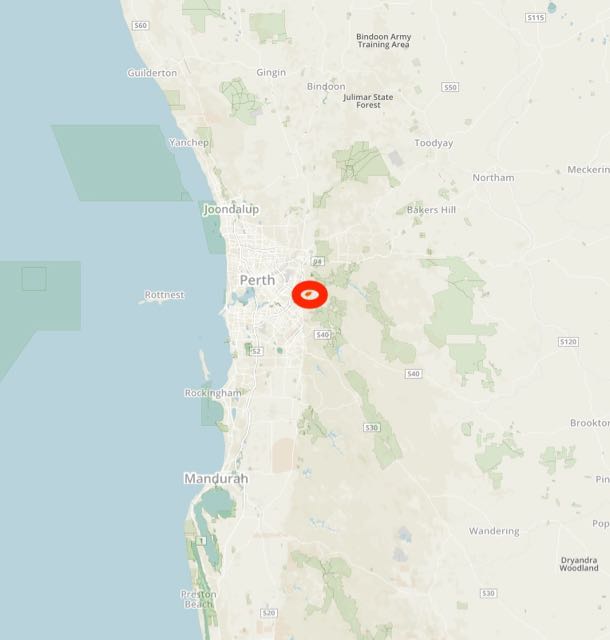
Screen Shot 2016-07-23 at 5.03.48 PM.png

Above:- Map showing the location of the Cudlee Creek Conservation Park.  Image courtesy of Protected Planet.

The park is situated just to the east of the little town of Cudlee Creek in the Mount Lofty Ranges ‘Adelaide Hills’, about 33 km north east of Adelaide.  The name Cudlee Creek is believed to be local aboriginal for Dingo’s Creek or wild dog crossing.  The first European inhabitants of Cudlee Creek settled in the area in 1838, just 2 years after the settlement of the State of South Australia.  William Kelly, from the Isle of Man, settled in the area and established the Sulby Glen Estate which was well know for its cheese making.  Cudlee Creek also became an exporter of fruit, in particular apples and pears.  A coldstore and packing shed was built in the town in 1922.

Today the population of Cudlee Creek is around 450 people.  The Gorge Wildlife Park, one of the largest privately owned animal parks in Australia is located at Cudlee Creek.  The old icecreamery in Cudlee Creek has now been converted into a cafe/restaurant and this was very busy as I passed through the town.

The River Torrens passes through the town.  The Torrens is the most significant river of the Adelaide Plains and was one of the reasons Adelaide was sited where it is today.  It flows about 85 km through the Adelaide Hills to its mouth between Henley Beach and West Beach.  The historic Union bridge crosses the Torrens at Cudlee Creek.  The original timber bridge was built in 1871 and was known as ‘Ledgards Bridge, and in 1917 was replaced with the current steel and concrete arched bridge.


The Cudlee Creek Conservation Park was proclaimed in 1971 and is home to a variety of native birds and animals who live in the woodlands on the steep hillsides.  Native animals that are found in the park include Western Grey kangaroos, and echidnas.  The River Torrens passes through the park on its southern border and after the recent rain was flowing very well.

Access to the park is limited.  There is no access to the north of the park.  I first approached the park from its western side (from Cudlee Creek township).  There is a small parking area near the park’s sign, so you can get your vehicle off Gorge Road.

DSC_1460

But I decided to continue east on Gorge Road towards North East Road, hoping that I would find another possible operating spot.  At the north eastern corner of the park I saw a small cleared area with a track leading down towards the river.  I was a bit confused as my GPS was showing that this was inside of the park, but there was a ‘Keep Out’ sign here.  I saw a 4WD ute parked down near the river so I drove down the track and found a fella down on the banks of the river.  As it turned out he was panning/screening for gold.  I asked him if he was the owner or if he knew that this area was private property.  He replied that he wasn’t the owner but that he believed it was private property as the owner had told him and his friends to leave on previous occasions.  I decided it wasn’t worth staying in this spot, and headed back towards the parking area further back along Gorge Road.

DSC_1466

The Cudlee Creek Conservation Park was devastated during the Sampson Flat bushfire in January 2015.  The fire destroyed 27 houses and burnt more than 20,000 hectares (49,000 acres) of land.  The park was closed for a significant period of time following the fire.  I was very pleased to see that although there were still visible signs of the fire, much of the bush had started to regenerate.

I set up in the south western corner of the park just off Gorge Road.  This was a picturesque spot and overlooked the River Torrens.  I used the park sign to secure the 7 metre squid pole, with the assistance of the always handy octopus straps.  I set up and deck chair, fold up table and Yaesu FT-857d and got to work.

Screen Shot 2016-07-23 at 5.02.18 PM.png

Above:- Map showing the location of my operating spot in the Cudlee Creek Conservation Park.  Image courtesy of Protected Planet.

I was set and up and ready to go by just after 0400 UTC (1.30 p.m.) which was the time I had posted on parksnpeaks and Facebook as my starting time in the park.  I headed to 7.144 and asked if the frequency was in use and the familiar voice of Dennis VK2HHA came back to let me know it was clear.  So Dennis was my first contact, followed by Marc VK3OHM, Greg VK5GJ at Meadows running just 4 watts, and then Damien VK5FDEC at Elizabeth running 5 watts.

Band conditions on 40m appeared to be quite good but it was noticeable that there were not as many callers as I’ve experienced during recent activations.  Conditions must have been good as I made contact again with Mike VK6MB in the middle of the day on 40m.  Although the busy Gorge Road was in close proximity to my operating spot, traffic was fairly light and it was fairly quiet.  All except for the occasional ‘weekend warrior’ on their motorcycle.  The Gorge Road is notorious for motorcycle riders and there have been a number of fatalities on Gorge Road over the years.  Not surprising when you see how some of these guys ride along that section of road.

After working a total of 43 stations on 40m from VK1, VK2, VK3, VK5, VK6, and VK7, I headed over to 20m.  This included a Park to Park contact with Neil VK4HNS who was operating portable in theBorder Ranges National Park VKFF-0047.  I first checked out the ANZA DX Net on 14.183 and was very concerned to hear signals very low down.  John VK4LJ who normally pounds in was extremely low.  So I headed up to 14.310 and started calling CQ and this was answered by Rick VK4RF/VK4HA, followed by Mike VK6MB.  But that was it for callers on 20m.  So it was down with the 40m/20m linked dipole and up with the 15m dipole.

I called CQ on 15m on 21.244 and this was answered by Mike VK6MB.  Despite the fact that signals were quite good (5/7 both ways), Mike was my only contact on 15m despite numerous CQ calls and a self spot on parksnpeaks.

The weather was moving in rapidly from the west and I was getting a few drops of rain, so it was an opportune time to pack up and head home.  I was content with 47 contacts in the log and another unique park qualified.

The following stations were worked on 40m SSB:-

  1. VK2HHA
  2. VK3OHM
  3. VK5GJ (QRP)
  4. VK5FDEC (QRP)
  5. VK3GGG
  6. VK3PMG
  7. VK3SIM
  8. VK3TKK
  9. VK5BJE
  10. VK3IO
  11. VK3GYH
  12. VK4AAC/3
  13. VK5KLV
  14. VK7CW
  15. VK6MB
  16. VK5TN
  17. VK3MCK
  18. VK5FMID
  19. VK2IO
  20. VK5ZEA
  21. VK2IF
  22. VK3BL
  23. VK3ZPF
  24. VK5FANA/m
  25. VK2YK
  26. VK3ANL
  27. VK3ELH
  28. VK5FD
  29. VK3FIRM
  30. VK2KYO
  31. VK4CPS
  32. VK5FAKV
  33. VK3PF
  34. VK1DI
  35. VK2PKT
  36. VK4HNS/2 (Border Ranges National Park VKFF-0047)
  37. VK2EXA
  38. VK3MRH
  39. VK6JON/7
  40. VK4FAAS
  41. VK3FPSR
  42. VK3KRH
  43. VK3NE

The following stations were worked on 20m SSB:-

  1. VK4RF
  2. VK4HA
  3. VK6MB

The following stations were worked on 15m SSB:-

  1. VK6MB


References.

Wikipedia, 2016, <https://en.wikipedia.org/wiki/Cudlee_Creek&gt;, viewed 17th July 2016

Wikipedia, 2016, <https://en.wikipedia.org/wiki/2015_Sampson_Flat_bushfires&gt;, viewed 17th July 2016

Weekend Notes, 2016, <http://www.weekendnotes.com/cudlee-creek-walk/&gt;, viewed 17th July 2016

The Gummeracha & District History Centre Inc, <http://www.gumeracha.com.au/otherPages/history/&gt;, viewed 17th July 2016


Talk at Elizabeth ARC

Last Wednesday night (2oth July 2016) I headed out to the Elizabeth Amateur Radio Club and delivered a presentation on operating portable, with specific content relating to the World Wide Flora Fauna (WWFF) program and the VK5 National & Conservation Parks Award.

Other than ‘death by powerpoint’, I had a number of transceivers, antennas, power sources, and other gear on display.

I will be heading back there in coming months to deliver a presentation on the WIA.

Thanks to the Elizabeth ARC for the invite.