New VKFF Worked All Australia certificate

Other than the recent VKFF DX Hunter award, I have also introduced the following VKFF award…..

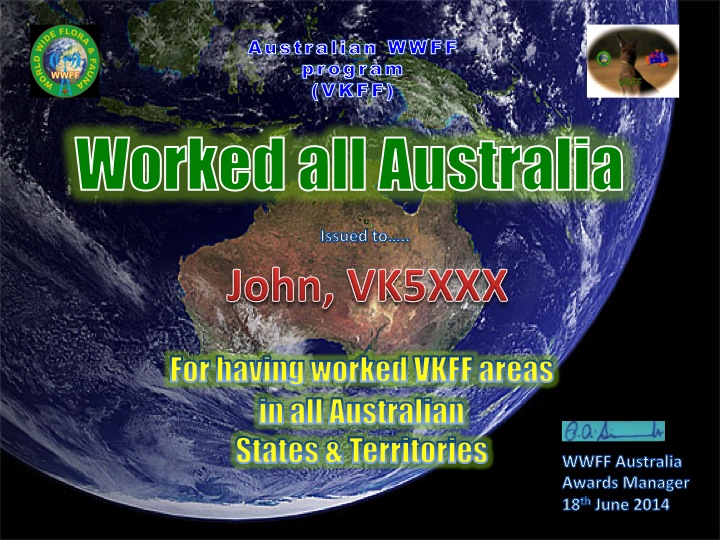
VKFF Worked All Australia.

The certificate is issued to amateurs around the world who make contact with VKFF areas in all Australian States and Territories.

There will also be an equivalent VKFF Activated All Australia certificate on offer.

Worked All Australia example

The qualifying Australian States and Territories and the minimum number of contacts required by VK operators are as follows…..

  • VK0 (Australian Antarctica, Heard Island, MacQuarie Island) – 2 VKFF areas
  • VK1 (Australian Capital Territory) – 1 VKFF area 
  • VK2 (New South Wales) – 5 VKFF areas
  • VK3 (Victoria) – 5 VKFF areas
  • VK4 (Queensland) – 5 VKFF areas
  • VK5 (South Australia) – 5 VKFF areas
  • VK6 (Western Australia) – 5 VKFF areas
  • VK7 (Tasmania) – 5 VKFF areas
  • VK8 (Northern territory) – 3 VKFF areas
  • VK9 (Christmas Island, Cocos Keeling Islands (includes Pulu Keeling National Park), Rowley Shoals, Lord Howe Island, Willis Islands, Mellish Reef, Norfolk Island) – 2 VKFF areas

That equates to a total of 37 different VKFF areas.  Hard, some of you are saying?  Well maybe not.  Check out the WWFF LogSearch facility and you might be surprised whose log is uploaded there.  I have been chasing down a lot of the DX petitions that have activated VK0 & VK9 locations over the years, and there are many logs recorded there.  So you may be closer than you think.


The qualifying Australian States and territories and the minimum number of contacts required by overseas operators are as follows…..

  • VK0 (Australian Antarctica, Heard Island, MacQuarie Island) – 1 VKFF area.
  • VK1 (Australian Capital Territory) – 1 VKFF area 
  • VK2 (New South Wales) – 2 VKFF areas
  • VK3 (Victoria) – 2 VKFF areas
  • VK4 (Queensland) – 2 VKFF areas
  • VK5 (South Australia) – 2 VKFF areas
  • VK6 (Western Australia) – 2 VKFF areas 
  • VK7 (Tasmania) – 2 VKFF areas
  • VK8 (Northern territory) – 1 VKFF area
  • VK9 (Christmas Island, Cocos Keeling Island, Lord Howe Island, Willis Islands, Mellish Reef, Norfolk Island) – 1 VKFF area

That is 16 different VKFF references for the overseas operators.

New WWFF global award now available.

The World Wide Flora Fauna program (WWFF) are pleased to announce a new WWFF award aimed at activators working from different DXCC entities.  It is the DXFF Activator Award.

The certificates have been designed by Pit YO3JW and has been coded into the WWFF LogSearch award application module by Andrew 2E0GFF.

The certificates are issued in increments of 3.  In other words, activate a WWFF reference area in 3 DXCC entities, 6 DXCC entities, 9 DXCC entities, etc.

This slideshow requires JavaScript.


There are a number of other new WWFF global award certificates under development for both Activators and Hunters.

Keep updated via the WWFF global website at…..

http://www.wwff.co

These new awards will be on top of the WWFF global award certificates already issued, namely the WWFF Activator and WWFF Hunter certificates.

Remember, that these awards are issued by the WWFF global Committee.  They are separate to the National awards on offer by many participating countries in the WWFF program, which includes Australia (VKFF).

New VKFF DX Hunter certificate

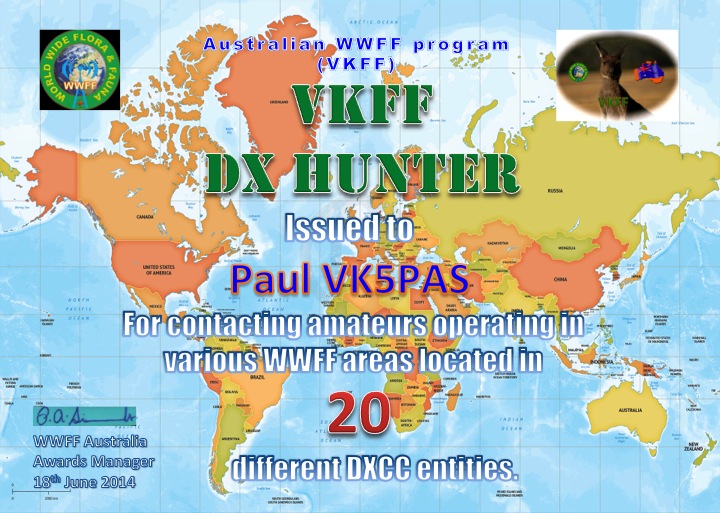
I have started initiating some more certificates for the VKFF program of the World Wide Flora Fauna (WWFF) program.  One of those is the VKFF DX Hunter certificate.

The VKFF DX Hunter certificates will soon be available on-line via the WWFF LogSearch.  As such it will be available for free via a PDF, or I can print it out for you for $5.00 and mail it.  The certificate will be printed on high quality gloss photo paper.

It is issued to Australian amateurs only, for making contact with amateurs operating in various WWFF areas located in different DXCC entities.  The certificates will be issued in increments of 5 DXCC entities.

It is hoped that this award will encourage more Australian operators to make contact with overseas WWFF activators.

VK5PAS VKFF DX Hunter 20

Latest WWFF certificate

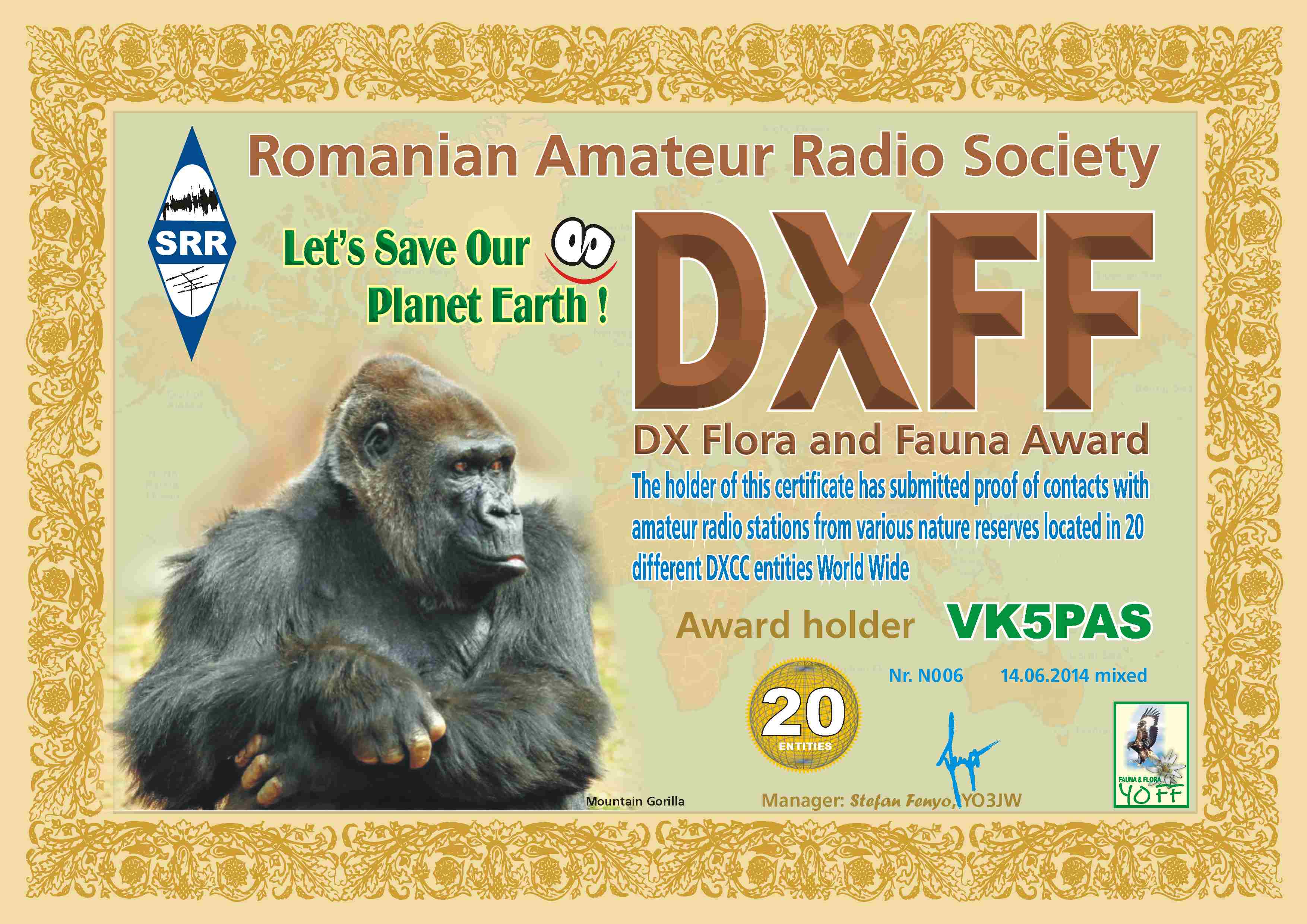
Here is my latest certificate for the World Wide Flora Fauna (WWFF) program.  And no that’s not me on the certificate!

This certificate comes from The Romanian Amateur Radio Society and is DXFF.  It is issued for making contact with amateur radio stations from various nature reserves located in 20 different DXCC entities World Wide.

It is an excellent example of how the WWFF system works.  WWFF offers global awards, and then on top of that, many of the National representative countries offer their own awards.  The Romanian Amateur Radio Society being one.

More information on WWFF can be found on the global website at…..

http://www.wwff.co

Or on the Australian (VKFF) website at…..

http://www.wwffaustralia.com

Should you more information on the Romanian DXFF award certificates, here is the link…..

http://wff-yo.blogspot.com.au/2010/06/o-noua-diploma-oferita-de-yoff.html

DXFF 20 VK5PAS 2014 N006 M

Weekend summary

Hi all,

Here is a breakdown of my activities from Friday – Monday…..


Friday 6th June

Coorong NP – 20 QSOs
Martin Washpool CP – 20 QSOs
Messent CP – 21 QSOs
Tilley Swamp CP – 26 QSOs
Mount Scott CP – 20 QSOs

Saturday 7th June

Dingley Dell CP – 18 QSOs
Nene Valley CP – 31 QSOs
Canunda NP – 33 QSOs

Sunday 8th June

Mount Burr summit VK5/ SE-019 – 66 QSOs
Tantanoola Caves CP – 25 QSOs

Monday 9th June

Telford Scrub CP – 30 QSOs
Glen Roy CP – 29 QSOs
Narracoorte Caves NP – 46 QSOs
Grass Tree CP – 51 QSOs
Padthaway CP – 36 QSOs

 
Total of 472 QSOs.
11 x Conservation Parks
3 x National Parks
1 x SOTA summit

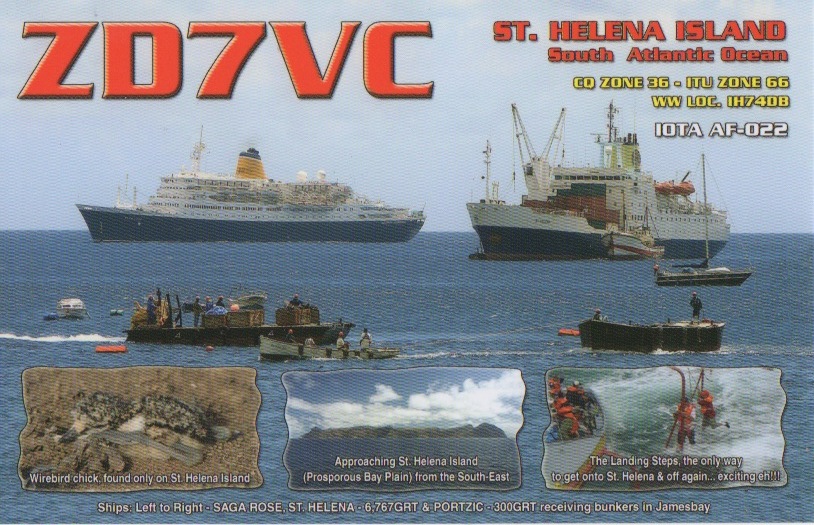
I ran out of time on Monday to do Desert Camp CP. That can wait til another day. There were a few highlights. They included being called by Bruce ZD7VC from St Helena Island in the Atlantic Ocean (very rare DX) whilst I was in Canunda NP. And working many VK6’s including Mike VK6MB on 40m.

ZD7VC (2)

Sorry about the voice over the weekend. Turns out I have a chest infection and the Dr has given me some time off work.

I want to congratulate the South East Radio Group for running a terrific convention and congratulate them on their 50th year. I had an enjoyable time there on Saturday afternoon. And then late on the Sunday afternoon, I delivered a presentation (on the VK5 Parks award) to about 80 people at the Scout Hall, and then enjoyed a beautiful 3 course meal. It was also great to catch up with a lot of hams that I have spoken to many times on the radio but never met in person…..both VK5s and VK3s. I came home with some wire to build a linked dipole, a few tubes for Doc VK5BUG, and even convinced young Patrick to buy a FT-817nd from Ross from Strictly Ham who was at the convention.

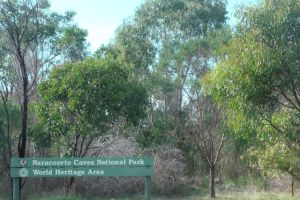
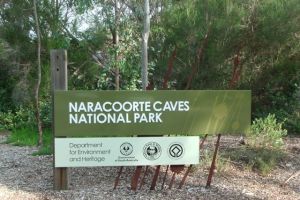
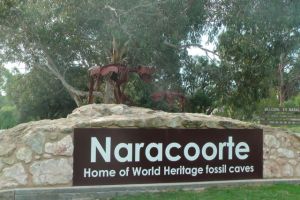
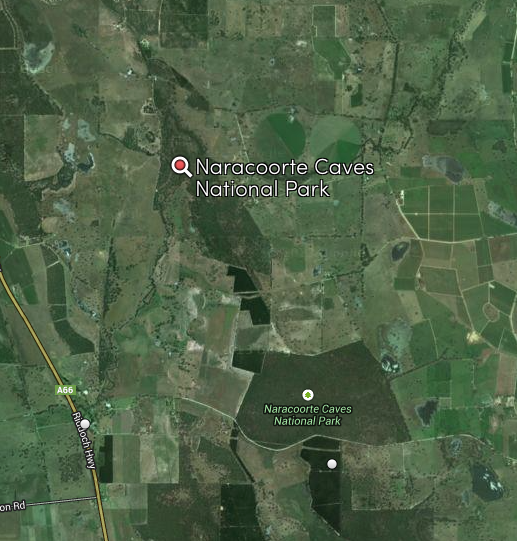
Naracoorte Caves National Park VKFF-380

From Glen Roy Conservation Park, I headed off to the Naracoorte Caves National Park, which qualifies for both the VK5 Parks award and also the World Wide Flora Fauna program (WWFF).

I continued north on the Riddoch Highway and then turned right onto New Caves Road to travel east.  A few km up New Caves Road you will see Victoria Caves Road.  Turn right here and this will take you to the visitor centre for the park.

Naracoorte Caves, which is about 600 hectares in size, is recognised as one of the world’s most important fossil sites, with about 26 caves at the Park, though not all are open to the public.  Some are set aside for scientific research or for protection of the caves and their contents.  Naracoorte Caves offers self-guided, guided and adventure caving tours year-round.  There are also a number of walking trails.

IMGA0043_2

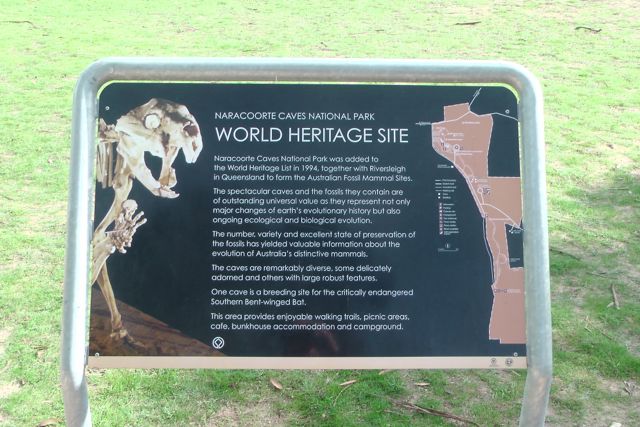
Naracoorte Caves National Park is South Australia’s only World Heritage site.  The site was officially recognised in 1994 because of the importance of the fossils in the caves.

The park is home to a large amount of wildlife including Western grey kangaroos, echidnas, wombats, brush tailed possums, and sugar gliders.  The park also contains a variety of birdlife including thornbills, eastern yellow robins, eastern spine bills, rosellas and honeyeaters in large numbers.

The Naracoorte Caves are part of the 800,000 year old Naracoorte East Range. There are 26 known caves in the park, many of them containing spectacular stalactites and stalagmites.  The caves generally stay at a constant 17 degrees centigrade.

IMGA0047_2

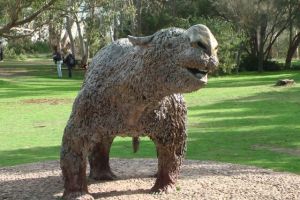
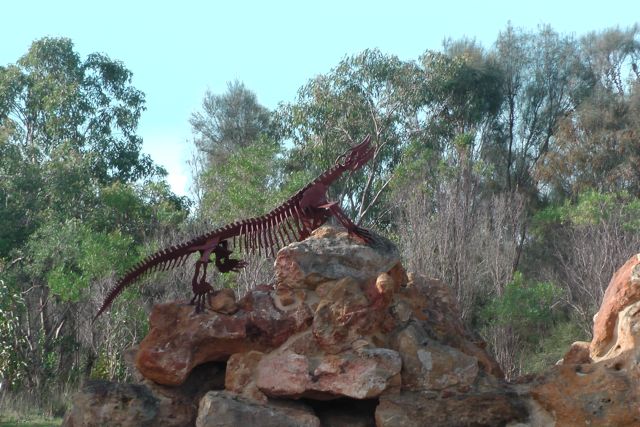
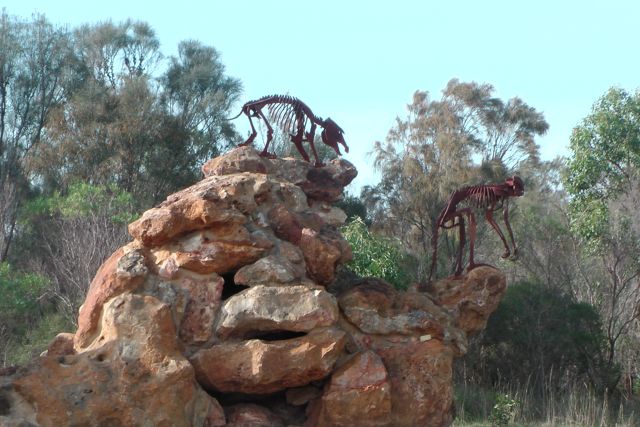
Because the caves have acted as pitfall traps and predator dens for over 500,000 years, a rich fossil record of ancient animals that once roamed the area, can be found at the Naracoorte Caves.  The fossil record covers several ice ages and the arrival of humans in the area.  The park is home to over 100 known fossil deposits, preserving the bones of megafauna that became extinct roughly 60,000 years ago.

IMGA0054_2

The bones of Megafauna species such as Thylacoleo carnifex Marsupial Lion, Thylacine, Zygomaturus and sthenurine kangaroos are found within the 100 fossil deposits found to date.  Naracoorte Caves contain clues to help interpret the geological and evolutionary history of Australia.

IMGA0049_2

For more information on the Naracoorte Caves, please click on the link below…..

http://www.environment.sa.gov.au/naracoorte/Home

Screenshot 2014-06-10 14.30.30

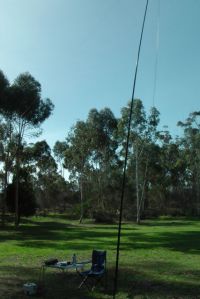
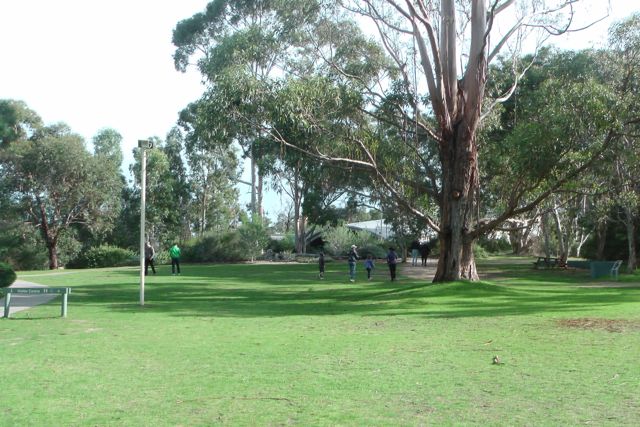
I set up on the oval near the visitor centre.  The carpark was a hive of activity with dozens of visitors to the caves.  But the oval was quiet and there was obviously plenty of room to erect the dipole.

IMGA0046_2

My first contact within the park was with Nick VK3ANL who was portable on SOTA peak One Tree Hill VK3/ VS-036.  I just caught Nick on 7.090 as he was about to go QRT.  Conditions on 40m appeared to be holding up extremely well with 5/9 signal reports being exchanged with Nick, who is an active parks hunter for both the VK5 Parks award and also WWFF.

 IMGA0044_2 IMGA0045_2

I then chose a clear frequency, 7.105 and put our a CQ call, which was responded to be Clayton VK7ZCR.  This was followed by Peter VK3YE who was now at home, and then Tom VK5FTRG running just 1 watts (5/9 both ways).

A little further along and I worked Brian VK3MCD who was portable in the Alpine National Park, which qualifies for both the Keith Roget Memorial National Parks award and WWFF.

IMGA0048_2

A little later in the activation, I was called by Gordon VK5GY who was portable in the Mount Brown Conservation Park in the Flinders Ranges.  Gordon was running just 20 watts into a linked dipole.  I couldn’t persuade Gordon to climb Mount Brown for a SOTA activation (it is 2 hours to the top).  Maybe next time.

IMGA0050_2

I had a steady flow of callers for this activation from VK2, VK3, VK5, & VK7.  This included a number of QRP contacts including the following: Tom VK5FTRG on 1 watt (5/9 both ways); Greg VK5GJ (5/9 both ways); Peter VK3PF (5/9 both ways); Brian VK3MCD (5/9 sent & 5/6 received); Brian VK5FMID on 5 watts (5/9 both ways); and Ian VK5IS (5/9 both ways).  It is always enjoyable getting QRP contacts in the log.

IMGA0051_2

After an hour in the park I had a total of 46 QSOs in the log, which mean that I had qualified the park for the WWFF global award which requires 44 contacts.

The following stations were worked:

Nick VK3ANL/p; Clayton VK7ZCR; Peter VK3YE; Tom VK5FTRG; John VK5BJE; Greg VK5GJ; Peter VK3PF; Bob VK5FPAC; Brian VK3MCD/p; Nigel VK5NIG; Vin VK3FMOL; Rick VK5FIVE; Brian VK5FMID; Adam VK7VAZ; John VK5NJ; Paul VK7CC; David VK3DMX; Mike VK3FMAA/m; Bob VK3BWZ/p; David VK5NQP; Amanda VK3FQSO; Stefan VK3WF; Leo VK2LJM; Tim VK5AV; Andrew VK2UH; Patrick VK5MPJ; Gordon VK5GY/p; Claude VK3FCAS; Nev VK5WG; VK7LCW; Phil VK3BHR; Mike VK3XL/m; Chris VK4FR/5; Keith VK2PKT; John VK5MG; Allen VK3HRA; Geoff VK3SQ; Greg VK5LG; Greg VK7FGGT; Greg VK5ZGY/m; Jamie VK3TZE; Steve VK2FISN; Col VK5HCF; ZDerek VK3FAFC; Ian VK5IS; and Kim VK5FJ.


References

Government of South Australia, Department of Environment, Water and Natural Resources, ]http://www.environment.sa.gov.au/naracoorte/Home


Canunda National Park

After activating the Nene Valley Conservation Park, I headed back into Mount Gambier and to my motel room, where I enjoyed a very welcome hot shower.  My sandshoes were speaking wet after the Nene Valley activation.  I then headed off to the South East Radio Group’s 50 year convention at the scout hall in Mount Gambier.  I spent an enjoyable couple of hours at the convention, and caught up with a number of amateurs who I had spoken to many times on the air, but had never met in person.  I also had one of the best steak sandwiches I’ve ever had.  Well done to the ladies in the kitchen.

The weather was very inclement outside, with isolated showers, but I still decided to head off to activate the Canunda National Park.  I had promised Pit YO3JW that I would participate in the Green Party contest.

I had activated Canunda National Park previously, and was hoping to get a few contacts under my belt so I could get across the 44 QSO threshold for the World Wide Flora Fauna (WWFF) program.  For more information on my previous activation, please click on the link below…..

https://vk5pas.wordpress.com/2013/09/12/canunda-national-park/
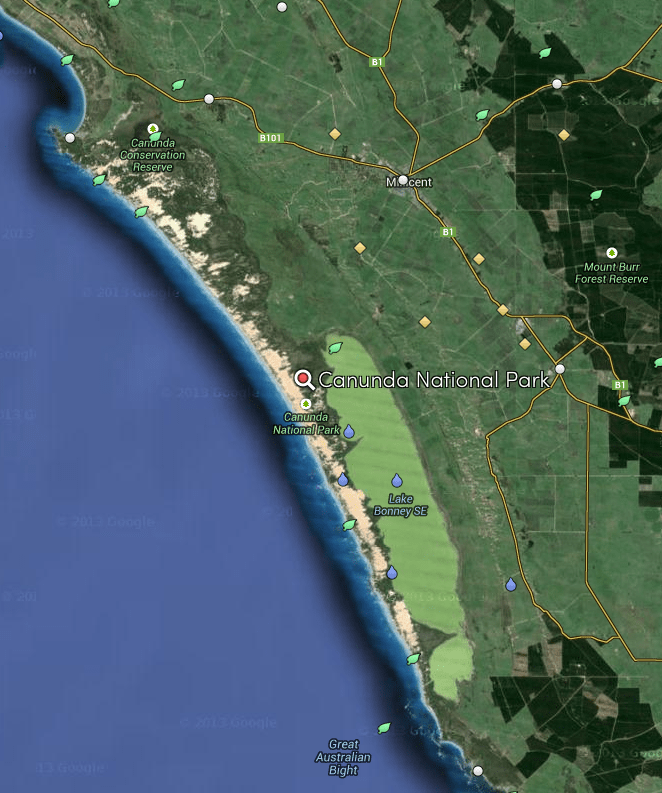
Screenshot 2014-06-10 14.47.35

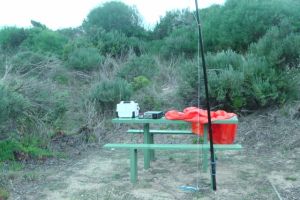
I drove from Mount Gambier, the 50 km to Millicent, and from there, headed out along Lossie Road, and then the Canunda Causeway.  I set up in exactly the same spot as last year, which was in the camping area at the end of Canunda Causeway, a little bit further on from Oil Rig Square.  No need for my fold up table and chair, as there are a number of wooden tables and benches in the camp ground.
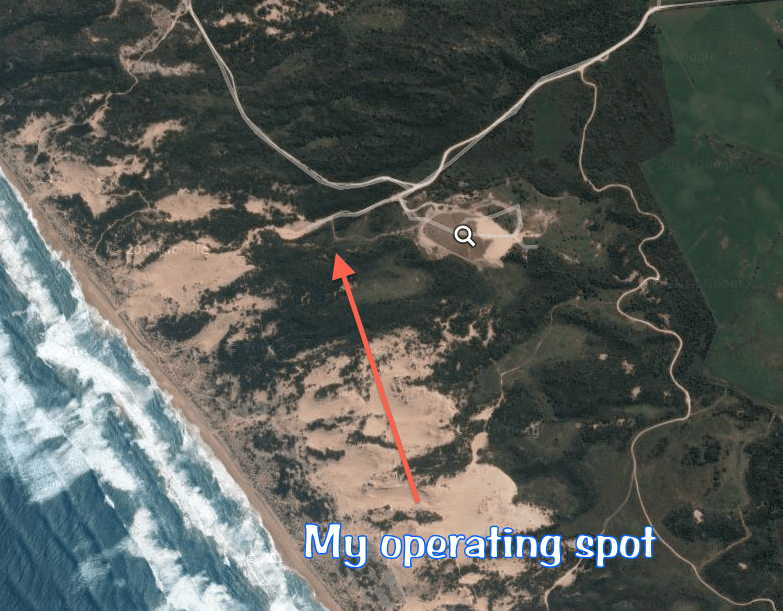
Screenshot 2014-06-10 14.50.39

For detailed information on the Canunda National Park, please have a read of my blog re my previous activation.  But very briefly, Canunda National Park is about 18 km north west of Millicent or 428 km south east of Adelaide.  It is 9,358 hectares in size, and has 40 km of coastline.  The park is dominated by huge sand dunes and a spectacular coastline.
IMGA0036

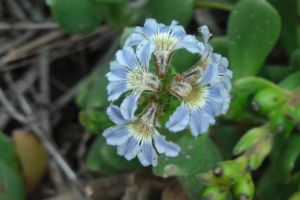
Prior to operating I went for a walk from the campground, through the sand dunes to the beach.  There is access to the beach for vehicles, but only 4WD or trail bikes.  The track is way too sandy for a conventional vehicle.  The walking trail is easy to negotiate, and has timber planking to assist.  There is also a bench along the way where you can rest and admire the view.  There were many coastal flowers out in bloom that I saw along the way.
IMGA0047

IMGA0056

Once I got to the top of the sand dunes, I saw that there were a number of 4WD enthusiasts and trail bike riders on the beach.  There were also a number of fishermen trying their luck for mulloway and salmon.

This slideshow requires JavaScript.

Again I set up my Yaesu FT-450 and the 20m/40m linked dipole, which I supported on the 7 metre telescopic squid police.  I ran 40 watts, and powered the transceiver with my 44 amp hour power pack, which my wife Marija kindly bought for me at Christmas time.

This slideshow requires JavaScript.

I decided to give some VKs an opportunity to get Canunda National Park in the log before having a look up on 20 metres.  My first contact was with Rod VK2TTL, followed by Larry VK5LY, Steve VK3JY who was operating QRP, and then Phil VK3BHR.  Band conditions were very good.  However, the same cannot be said for the weather.  Bands of showers regularly passed overhead which forced me to operate from underneath my bothy bag.  With a severe cold (now a chest infection), my wife would have killed me if she was there !  Every now and again there was a break in the weather, and the moon was visible.

IMGA0061

I worked a few QRP stations whilst in the park.  This included Steve VK3JY who had a very strong 5/8 signal.  Tony VK7AU who was running 5 watts from a kit radio also had a very strong 5/9 signal coming into Canunda.  Marshall VK3MRG also called in whilst running just 5 watts and was 5/9.

A bonus was a QSO with Brian VK3MCD who was operating from the Alpine National Park, which qualifies for the WWFF program.
IMGA0059

After working a total of 26 stations on 40m, I lowered the squid pole and took the links out of the dipole and then raised the 7 metre squid pole.  I tuned across the 20 m band and could not hear a lot of European signals coming through on the long path.  But I did find that 14.244 was clear which is the adopted WWFF frequency.  I put out a CQ call and this was responded to by Martin VK6ZMS.  Tony VK3VTH/5 then called in from the Coorong National Park.  My first DX station followed and this was Lenny K7KDX in Arizona (5/9 sent and 5/7 received).  I then spoke with Ogiru JJ2CYL in Japan, who was a good strong 5/9 signal (5/6 received).  But progress on the DX front was poor.  I put out a number of CQ DX calls with no takers.

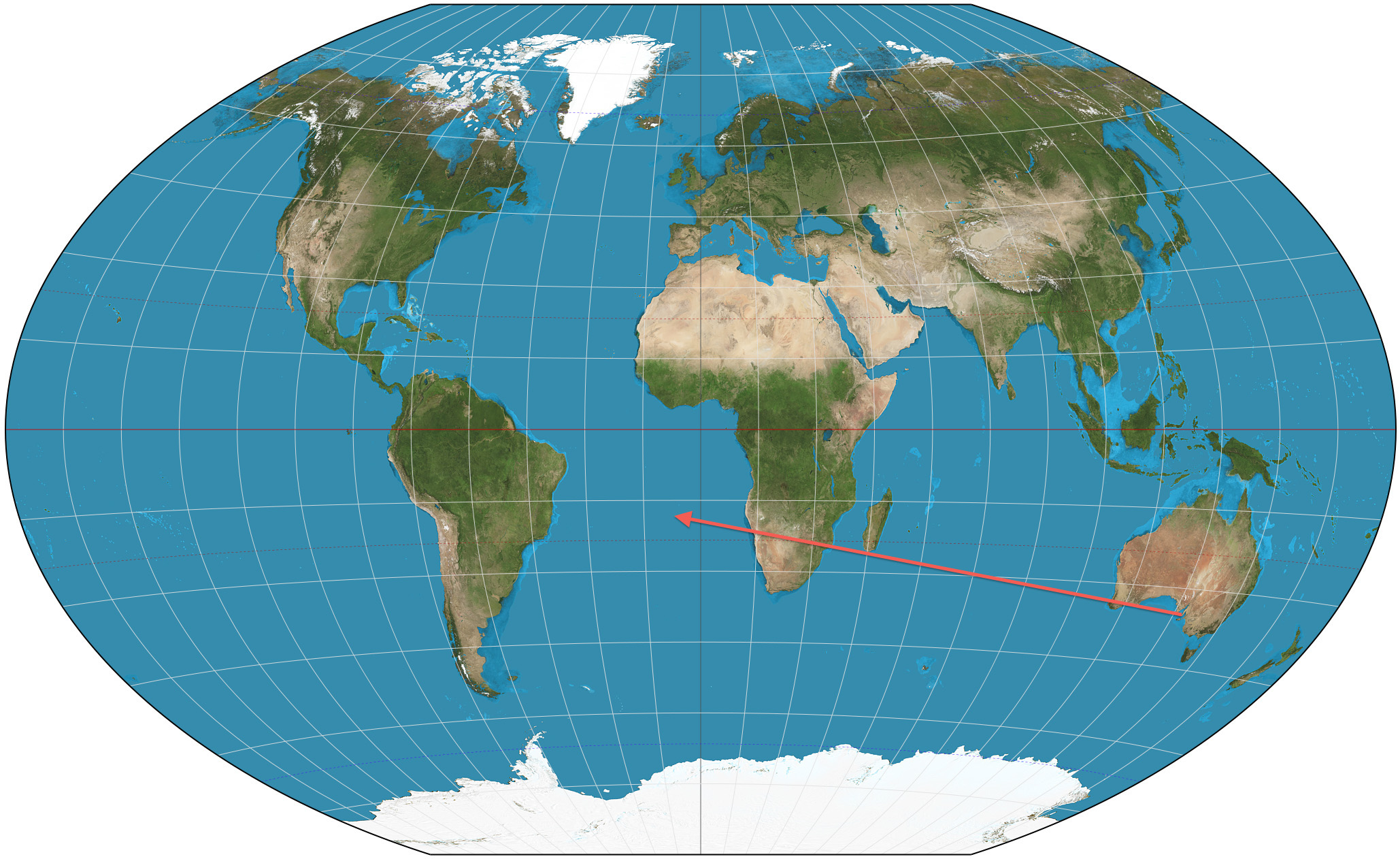
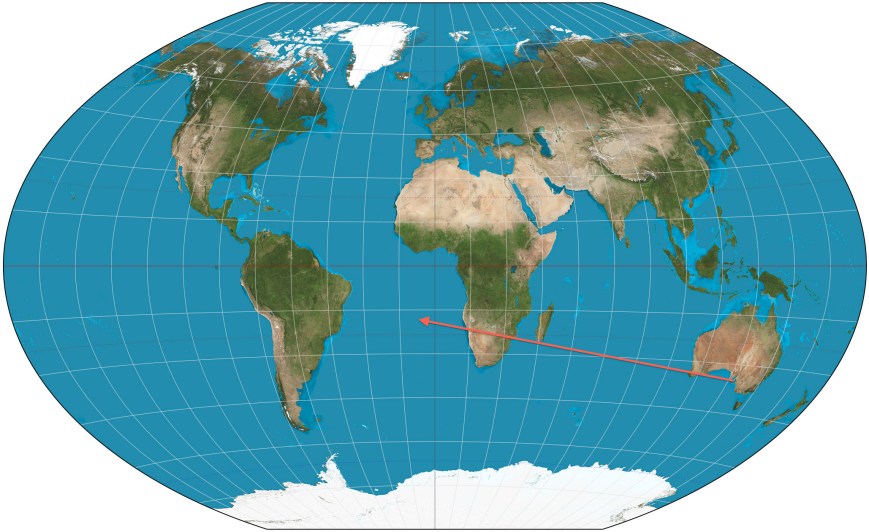
Steve VK4KUS then called in and was kind enough to place me on the DX cluster.  I then had a quick chat to Ted VK6NTE with his normal very strong signal.  Ted has an amazing antenna system.  Then to my great surprise I was called by Bruce ZD7VC on St Helena Island out in the South Atlantic Ocean.  I was really amazed when Bruce called in and wasn’t really sure if he was calling me.  But he was and we exchanged a 5/5 both ways.  I have spoken to Bruce before at home, but this was the first time whilst I was out in a park.  St Helena is rare DX and many an amateur would be extremely excited to get ZD7 in the log, yet alone if they were running low power in a park.
Winkel_triple_projection_SW

Whilst speaking with Bruce on St Helena, I was approached by a young lad in his 20’s. He had seen the squid pole in the area and recognised that there was an amateur radio antenna attached to it.  After speaking with him, he advised that his Uncle was an amateur radio operator in Whyalla.

Just after finishing my QSO with Bruce, W1RAA came up on frequency and started calling CQ, so that was pretty much the end of that.  In any event, it was starting to get dark and very cold.  The temperature gauge showed that it was 3 degrees C.  It was time to pack up and head back to the warmth of the motel room.  I had a total of 33 contacts in the log.

The following stations were worked:

Rod VK2TTL; Larry VK5LY; Steve VK3JY; Phil VK3BHR; Mike VK3XL; Max VK3MCX; Jim VK5TR; Dennis VK5HH; Andrew VK1NAM; David VK5NQP; Tony VK7AU; Bill VK5MBD; Alan VK4WIL; Roy VK5NRG; Vin VK3FMOL; Marshall VK3MRG; Tom VK3EO/p; Brian VK3MCD; Alan VK2PGB; Trevor VK5TW/p; Arno VK5ZAR; Shaun VK3MSD; Paul VK2HV; Matt VK1MA; Peter VK3TKK; Merv VK4EM/p; Martin VK6ZMS; Tony VK3VTH/5; Lenny K7KDX; JJ2CYL; Steve VK4KUS; Ted VK6NTE; and Bruce ZD7VC.


References.

National Parks South Australia, Canunda National Park, http://www.environment.sa.gov.au/parks/Find_a_park/Browse_by_region/Limestone_Coast/Canunda_National_Park

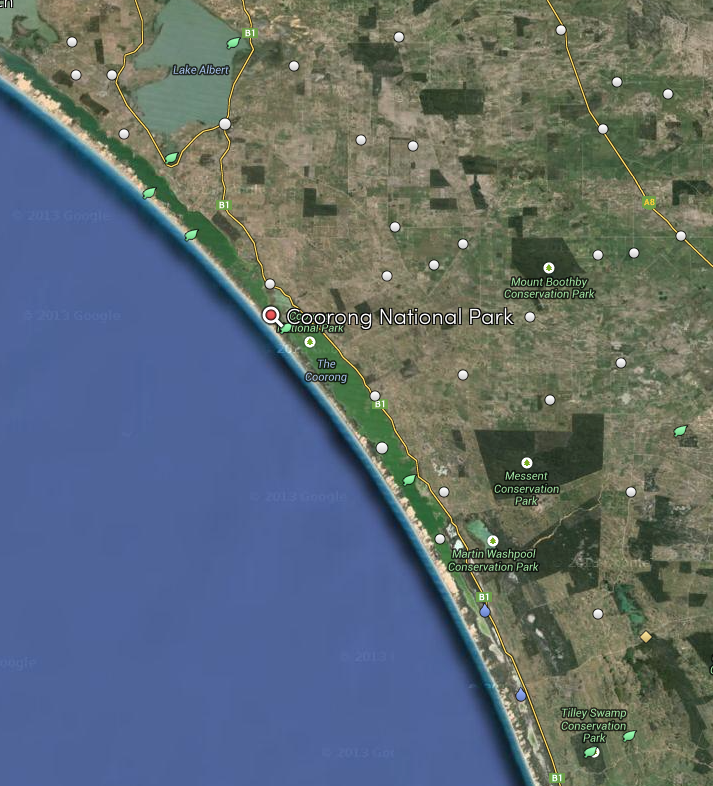
Coorong National Park VKFF-115

The weekend of Saturday 7th June 2014 and Sunday 8th June 2014 was the 50 year celebration of the South East Radio Group in Mount Gambier.  They were holding their annual convention and had kindly asked me to attend to deliver a presentation on the VK5 National and Conservation Parks Award.  So bright and early on Friday morning (6th June 2014) I headed off from home in the Adelaide Hills towards Mount Gambier in the south east of South Australia.  This being a journey of around 400 km.  I decided to head to Tailem Bend and then travel south east along the Princes Highway.

My plans were to activate 5 parks along the way.  Some of which I had activated previously, but there were two new ones on my activation list: Tilley Swamp, and Mount Scott.  My first stop was the Coorong National Park.  This park qualifies for both the VK5 Parks Award and also the World Wide Flora and Fauna (WWFF) program.  The Coorong is VKFF-115

Screenshot 2014-06-10 15.07.59

Map courtesy of mapcarta

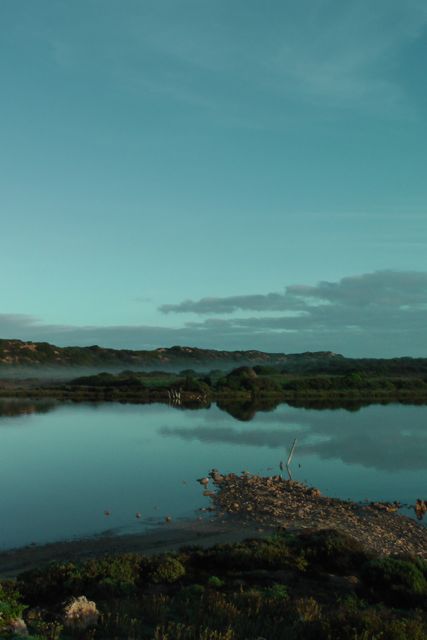
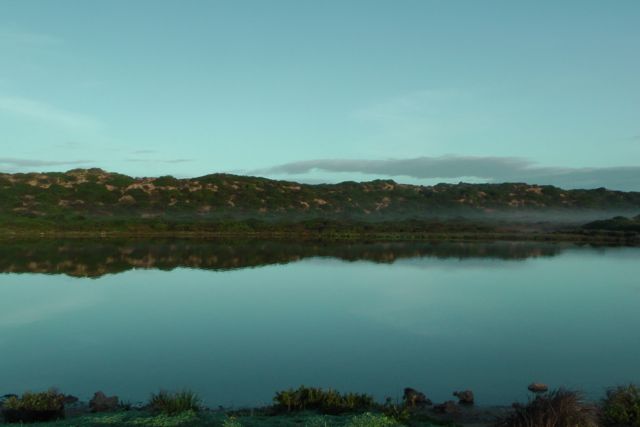
It was a very crisp morning.  When I left home the temperature was only about 2 degrees C.  However I was greeted by a spectacular sunrise as I travelled towards the Coorong.

IMGA0169

I had previously activated the Coorong National Park, however I needed to accrue some more QSOs to get me over the 44 QSO mark to qualify the park for the WWFF global award.  Previously I had operated from Seven Mile.  This time I decided to operate from Parnka Point.

Information about my previous activation can be located at…..

https://vk5pas.wordpress.com/2013/06/03/coorong-national-park/

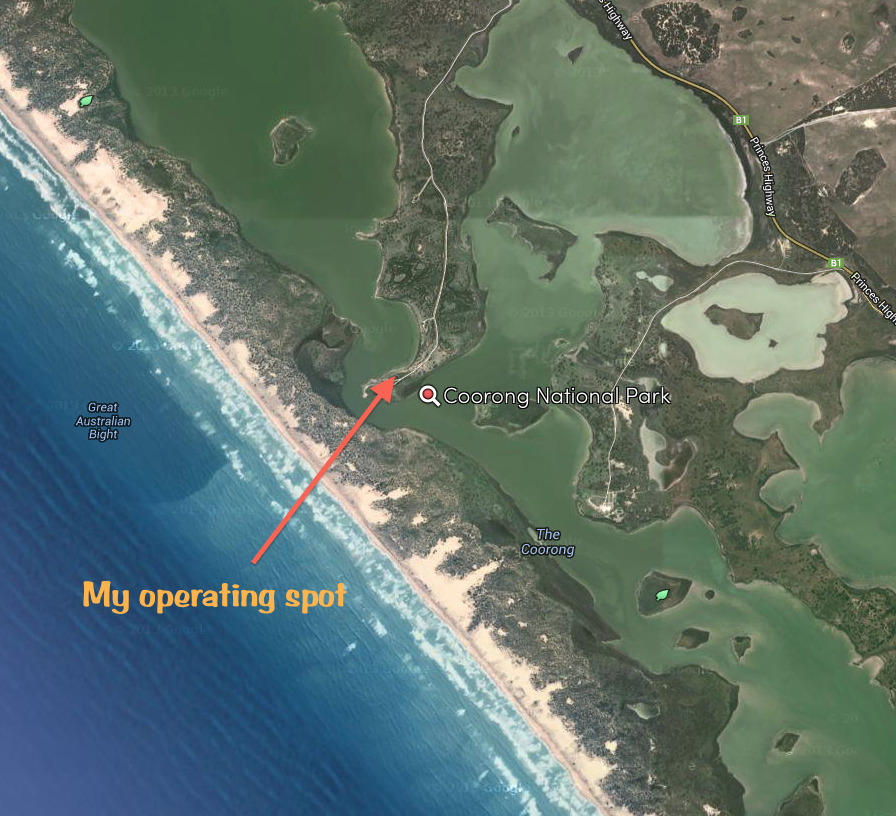
Parnka Point is located at the end of a narrow strip of land.  This is the narrowest part of The Coorong as the water is less than 100 metres wide.  Parnka Point is where the northern and southern lagoons of The Coorong meet each other.  The water at this point is often referred to as Hells Gate.

The northern lagoon is partly fed by the waters of the River Murray, and varies in salinity from brackish to hyper saline.  In contrast the southern lagoon is always hyper saline.  While this narrow channel often appears calm, a change in wind direction or water levels can create treacherous currents through this narrow but deep channel.

Screenshot 2014-06-10 15.15.56

Map courtesy of mapcarta

Parnka Point was a significant meeting site for the five aboriginal tribes that formed the Ngarrindjeri clan.  Parnka is a Ngarrindjeri word meaning ‘sandy beach’.  As you look out across the lagoon, you can see wooden poles in the seater.  These are the remains of a ferry built last century to access the Younghusband Peninsula.  I ha previously camped here at Parnka Point, many years ago with my children when they were young.

IMGA0175

The Coorong is located about 160 km south east of Adelaide.  Its name is thought to be a corruption of the local aboriginal word kurangh, meaning ‘long neck’, which is a reference to the shape of the lagoon system.  The name is also thought to be from the Aboriginal word Coorang, “sand dune”, a reference to the sand dunes that can be seen between the park and the Southern OceanMore information on the Coorong National Park can be found at…..

http://www.environment.sa.gov.au/parks/Find_a_park/Browse_by_region/Limestone_Coast/Coorong_National_Park
IMGA0170     IMGA0174

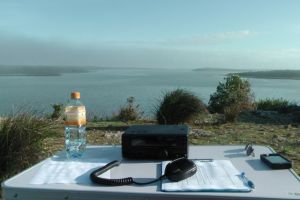
I drove down to end of Parnka Point and set up my little fold up table and deck chair, looking out towards the southern lagoon.  It was a spectacular morning, with some fog over Younghusband Peninsula and the water.  And it was cold!  In fact, it was 2 degrees C.  The same temperature as when I had left home.

This morning I used my Yaesu FT-450, running 40 watts into the 40 m / 20 m linked dipole supported on the 7 metre telescopic squid pole.  I powered the radio with my 44 amp hour power pack.

IMGA0188

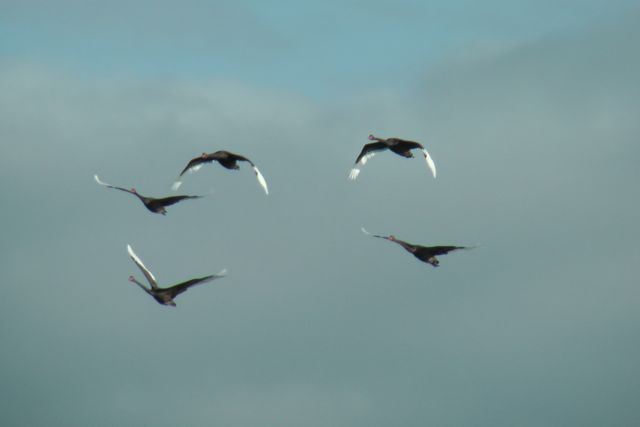
There was lots of bird activity, of the feathered kind.  This included black swans and cormorants (see photos below), and various other water and wading birds.

IMGA0179      IMGA0181

There were lots of very strong Europeans coming in on 40m so it was a bit difficult to find a clear frequency.  Finally I found that 7.105 was clear and I put out a CQ call to be answered by parks stalwart, John VK5BJE.  This was followed by Larry VK5LY in the Riverland and Brian VK5FMID down in Mount Gambier.  Greg VK5GJ then called in from Meadows.  Greg attended the SOTA & Parks symposium and since that time has been a regular parks hunter.

My first interstate caller was Paul VK7CC who I regularly talk to on the 7.130 DX Net.  Paul always calls in to say hi when he hears me in a park.  He had a beautiful 5/9 plus signal into The Coorong.  Then to my surprise, a few QSOs later I was called by Barry VK6WF who was a genuine 5/9 signal.  Barry gave me a 5/5 signal report from Kellerberrin, about 200 km east of Perth.  Next up was Col VK5HCF from Mount Gambier.  I also worked Col under the special call of VI50CONV for the SERG 50th year anniversary.

Some stations came up very close to me after operating for about 40 minutes, and one in particular was extremely wide and splattering badly.  This made things a little difficult at times.  However I did manage to work Craig VK3NCR/2 who was portable in the Warrumbungle National Park.  The QRM was so bad I QSYd up to 7.110 but was still being clobbered.  So it is with thanks to Ken VK3YXC, who was my final contact.  Ken was mobile and was very low down and was being killed off by the splatter.  But we perservered and I was finally able to get his call in totality.  Thanks Ken.  They were very trying conditions.

I read a blog tonight put out by Marshall VK3MRG who experienced the same over the weekend, with wide and over driving stations.  It makes it very difficult for everyone else.

http://vk3mrg.weebly.com

After an hour of operating at this beautiful location, it was time to pack up.  I was already behind schedule.  But it was very hard to go QRT as I sat back in the deck chair and looked across the beautiful Coorong.  It is certainly a treasure of South Australia.

The following stations were worked:-

John VK5BJE; Larry VK5LY; Brian VK5FMID; Greg VK5GJ; Paul VK7CC; Tony VK5ZAI; Greg VK5ZGY; Craig VK5LI; Greg VK7FGGT; Charles VK5FBAC; Dave VK3DSB; Barry VK6WF; Col VK5HCF; Col VI5CONV; Nick VK3FNCE; Craig VK3NCR/2; Keith VK5ND; Nigel VK5NIG; Dennis VK5LDM; Don VK5NFB; and Ken VK3YXC mobile.

New WWFF Award

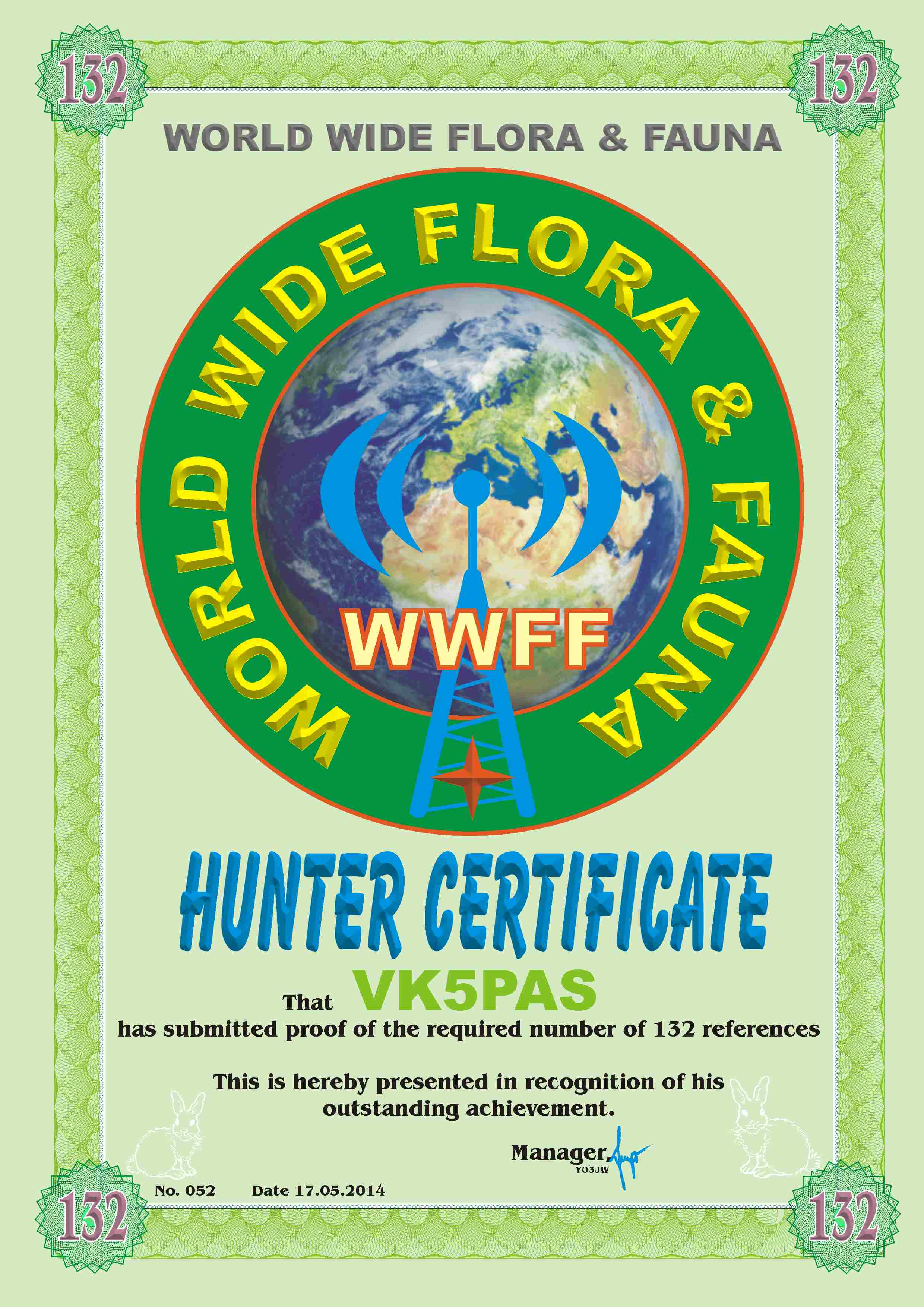
Yesterday I received via e-mail my latest World Wide Flora and Fauna (WWFF) global award.  The certificate is for making contact with 132 different WWFF references.

These certificates are available for free by applying on line via the WWFF LogSearch facility.  As such, it is heavily weighted on Activators submitting their activation logs.

H 132 VK5PAS 2014 532

WWFF becoming more popular in Australia

The World Wide Flora and Fauna program (WWFF) is increasing in popularity here in Australia.  Tony VK3VTH and Peter VK3ZPF have been very active on the bands including 20 m, working large amounts of stations in Europe during our afternoon (long path).  I have received a number of very favourable e-mails from mates in Europe wanting me to pass on my thanks to Tony & Peter for their efforts.

4312296


And in the past week, SOTA guru Andrew VK1NAM, has provided me with all his logs in ADIF format which have been uploaded to the WWFF LogSearch facility.  It appears Andrew has now also been hooked on WWFF.

Andrew VK1NAM has a great blog about his SOTA and parks activities.  Here is a link to what he wrote recently about the WWFF program…..

http://vk1nam.wordpress.com/2014/05/07/wwff-and-vkff-national-parks-awards/

Activators forward me as the VK representative, their activator log, and I upload these to the WWFF LogSearch.  Hunters do not need to upload anything.  Activators and Hunters can track their progress on LogSearch, and also apply for awards.  There are also Honour boards on the LogSearch page.  Here is where you can find LogSearch…..

http://logsearch.wwff.co/index.php

Basically, there are 2 award systems in WWFF…..

  • Global awards
  • National awards

The WWFF global awards system requires activators to have 44 contacts over a 2 hour period (this can be done over multiple activations).

The Australian (VKFF) award requires only 10 QSO’s over a 30 minute period.  In Australia, the qualifying parks are National Parks.

Other National awards are on offer from other participating countries.

There is also an Australian (VKFF) Yahoo group which can be found at…..

https://au.groups.yahoo.com/neo/groups/wwffaustralia/info

Ian VK1DI has just started compiling KML files which can be uploaded to Google Earth, so you can view.  At this stage, the following States have been completed: VK5, VK7, VK8.

So why not activate a WWFF park, or combine a SOTA/WWFF activation, for twice the fun.  There are plenty of very nice certificates on offer to wallpaper the shack walls.

More information on the WWFF program can be found at the WWFF global website at…..

http://www.wwff.co

Or at the Australian (VKFF) website at…..

http://www.wwffaustralia.com

3988679

Should you have any queries, do not hesitate to contact me.