Gnarr Flora and Fauna Reserve VKFF-2324

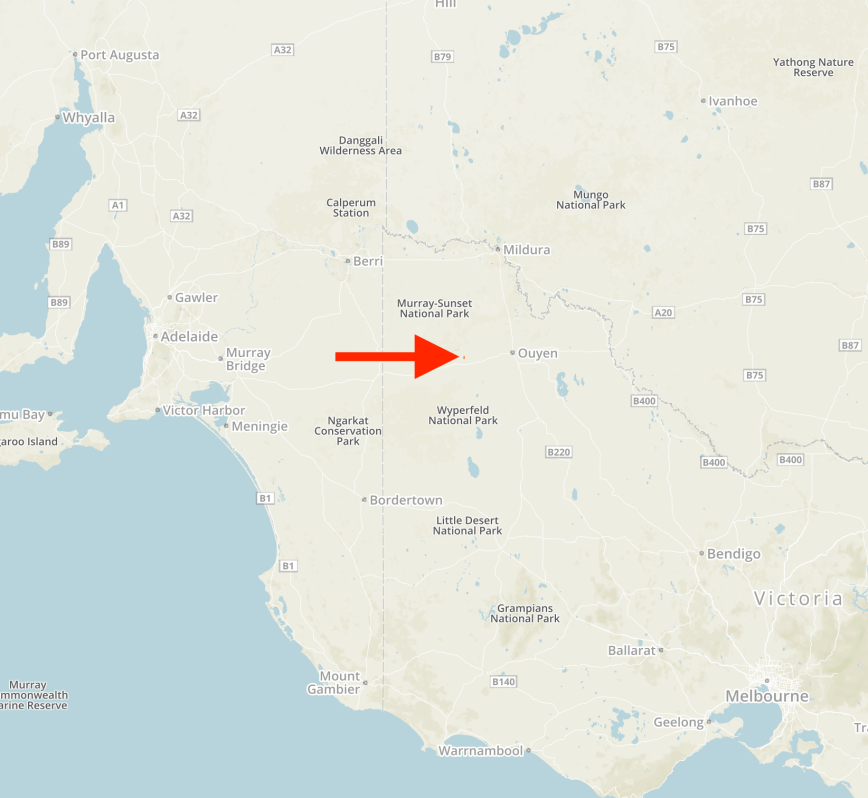
Our second park for Saturday (9th November 2019) was the Gnarr Flora and Fauna Reserve VKFF-2324.  The park is located about 8 km north of the town of Underbool in north-western Victoria.

This would be a first-time activation of this park for the World Wide Flora Fauna (WWFF) program.

Screen Shot 2019-11-12 at 2.04.04 pm.png

Above:- Map showing the location of the Gnarr Flora & Fauna Reserve in western Victoria.  Map courtesy of Protected Planet.

To access the park we travelled north out of Underbool on Mamengorook Road.  We then turned right onto Rowan Road and then turned left onto an un-named road which headed north to the park.  The road travels through farming properties until you reach the south-eastern corner of the park.

DSC_5974

Above:- the track which follows the eastern boundary of the park.

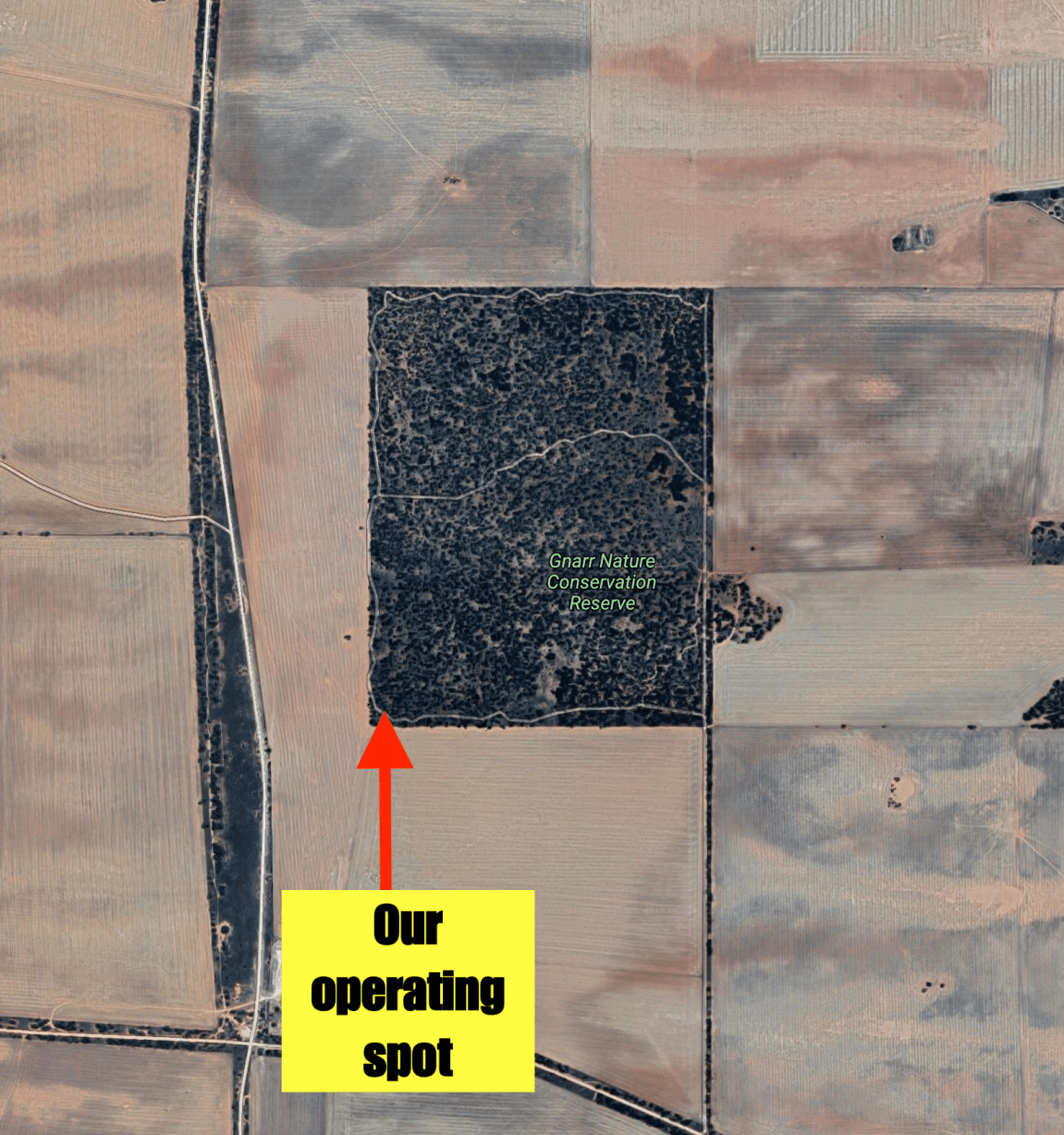
The Gnarr Flora and Fauna Reserve is shown on some maps as the Gnarr Nature Conservation Reserve.  It is a piece of remnant mallee scrub which is surrounded by cleared farming land.

Screen Shot 2019-11-12 at 2.08.14 pm.png

Above:- An aerial shot of the Gnarr Flora & Fauna Reserve showing our operating spot.  Image courtesy of Google maps

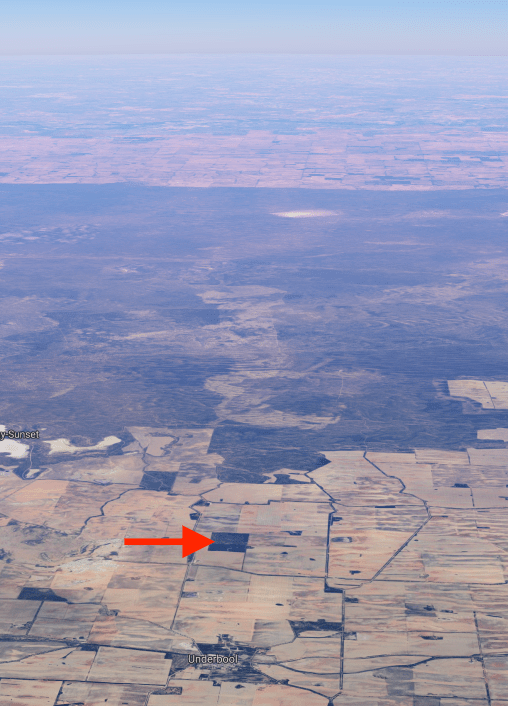
The park is located just to the south of the very large Murray Mallee National Park.

Screen Shot 2019-11-12 at 2.13.17 pm

Above:- Aerial shot of the Gnarr Flora & Fauna Reserve, looking north.  The very large Murray Sunset National Park is also visible.  Image courtesy of Google maps

The park was established in 1990 and is 301 acres in size.

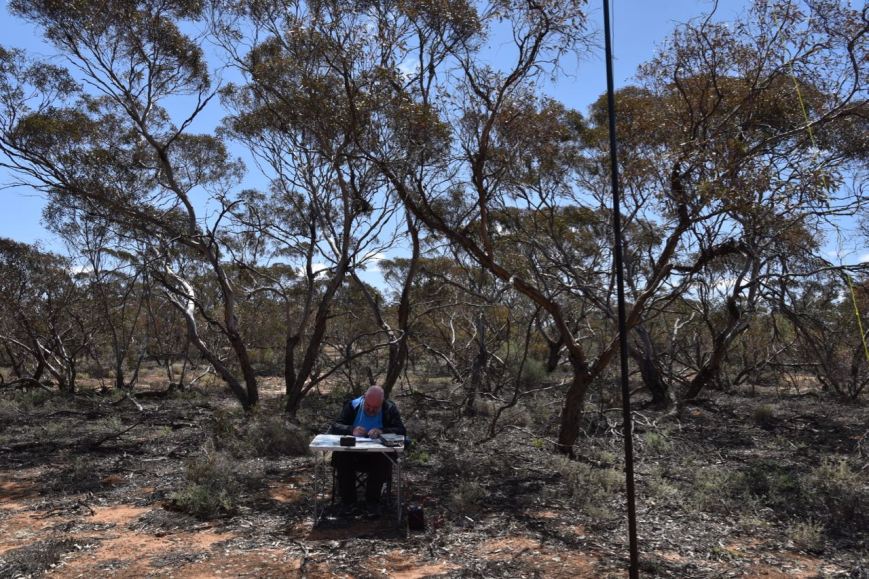
After setting up I commenced calling CQ on 7.144.  First in the log was Liz VK2XSE, followed by Geoff VK3SQ, and then Mark VK3PI.  This was followed by Peter VK3ZPF/p who was activating the Morwell National Park VKFF-0626.  This was followed by another Park to Park with Rob VK4AAC/3 who was in the Warby Ovens National Park VKFF-0742.

I worked a total of 17 stations from VK2, VK3, VK4, VK5 and VK7.  This included a further Park to Park contact with Peter VK3TKK/p who was activating the Organ Pipes National Park VKFF-0627.

DSC_5965

I had qualified the park for VKFF so it was time to swap operating spots with Marija.  Marija commenced calling CQ on 7.144. First in the log was Peter VK3TKK/p in the Organ Pipes National Park VKFF-0627.  This was followed by Dennis VK2HHA and then David VK5DG/3 who was in the Lind National Park VKFF-0287.  A few contacts later Marija spoke with Peter VK3PF/p who was activating SOTA peak VK3/ VE-138 in the Mitta Mitta Flora Reserve VKFF-2400.

Marija logged a total of 18 stations on 40m from VK1, VK2, VK3, VK4, VK5, and VK7.

IMG_3342

I then took charge of the mic again in the hope that I could get to my 44 QSOs, required to qualify the park for the global WWFF program.  I logged a further 24 stations including the following Park to Park QSOs:-

  • Nik VK3ZK – Dandenong National Park VKFF-0132
  • Gerard VK2IO/p – Cattai National Park VKFF-0092
  • David VK5DG/3 – Lind National Park VKFF-0287
  • Peter VK3PF/p – Mitta Mitta Flora Reserve VKFF-2400)

I was now just 2 QSOs short of 44, but callers had dried up on 40m, so I headed to the 20m band.

First in the log was Gerard VK2IO/p who was activating the Cattai National Park VKFF-0092.  I then moved up to 14.315 and started calling CQ.  Scott VK4CZ came back to my call with a strong 5/9 signal, followed by Ray VK4NH and then Paul VK2PAA.  I had now qualified the park for WWFF.

I logged a total of 12 stations on 20m from VK2, VK4, VK5 and New Zealand.  To conclude the activation I moved to the 80m band and called CQ on 3.610.  Adrian VK5FANA was first in the log on that band, followed by Peter VK3TKK/p in the Organ Pipes National Park VKFF-0627, followed by John VK5BJE, and finally Geoff VK3SQ.

Marija worked the following stations on 40m SSB:-

  1. VK3TKK/p (Organ Pipes National Park VKFF-0627)
  2. VK2HHA
  3. VK5DG/3 (Lind National Park VKFF-0287)
  4. VK2PKT
  5. VK5FANA
  6. VK7QP
  7. VK3PF/p (SOTA VK3/ VE-138 & Mitta Mitta Flora Reserve VKFF-2400)
  8. VK3UCD
  9. VK5BJE
  10. VK1DI
  11. VK4NH
  12. VK4DXA
  13. ZL4TY/VK4
  14. VK5QD
  15. VK5FSAM
  16. VK5PL
  17. VK4SYD
  18. VK3VIN

I worked the following stations on 40m SSB:-

  1. VK2XSE
  2. VK3SQ
  3. VK3PI
  4. VK3ZPF/p (Morwell National Park VKFF-0626)
  5. VK4AAC/3 (Warby Ovens National Park VKFF-0742)
  6. VK2VH/3 (Warby Ovens National Park VKFF-0742)
  7. VK5FANA
  8. VK4NH
  9. VK4DXA
  10. ZL4TY/VK4
  11. VK4HNS
  12. VK3UCD
  13. VK3MCK
  14. VK3MPR
  15. VK7JON
  16. VK2VW
  17. VK3TKK/p (Organ Pipes National Park VKFF-0627)
  18. VK3VIN
  19. VK3BSA/m
  20. VK3ZK/p (Dandenong National Park VKFF-0132)
  21. VK5KLV
  22. VK3UH
  23. VK3HK
  24. VK7QP
  25. VK2IO/p (Cattai National Park VKFF-0092)
  26. VK2MOP
  27. VK7FRJG
  28. VK4CZ
  29. VK5DG/3 (Lind National Park VKFF-0287)
  30. VK5HS
  31. VK2LEE
  32. VK3FGFG
  33. VK3BCM
  34. VK3PF/p (SOTA VK3/ VE-138 & Mitta Mitta Flora Reserve VKFF-2400)
  35. VK2EXA
  36. VK2PKT
  37. VK5HDW
  38. VK3KRH
  39. VK7LTD
  40. VK5KLD
  41. VK3ARH

I worked the following stations on 20m SSB:-

  1. VK2IO/p (Cattai National Park VKFF-0092)
  2. VK4CZ
  3. VK4NH
  4. VK4DXA
  5. ZL4TY/VK4
  6. VK2PAA
  7. VK2LEE
  8. VK4HNS
  9. VK5KLV
  10. ZL1TM
  11. VK4SMA
  12. VK4PHD

I worked the following stations on 80m SSB:-

  1. VK5FANA
  2. VK3TKK/p (Organ Pipes National Park VKFF-0627)
  3. VK5BJE
  4. VK3SQ


References.

Protected Planet, 2019, <https://www.protectedplanet.net/gnarr-f-r-nature-conservation-reserve>, viewed 12th November 2019

Dunstans Flora and Fauna Reserve VKFF-2310

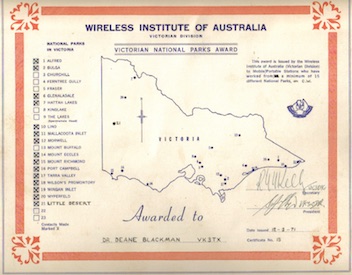
Each year in November, a special activation weekend is held for the Keith Roget Memorial National Parks Award (KRMNPA).  The KRMNPA has existed since the 1970s and was originally known as the Victorian National Parks Award.  A driving force behind the park’s award was the late Keith Vidmore Roget, VK3YQ, who had served on the WIA Victorian Division Council as the President, Secretary and Treasurer.   Roget died in 1981 and following his death, his widow Jean agreed that it was fitting that the park’s award be renamed in his memory and to honour his contribution.

npa275.jpg

Above:- One of the original Victorian National Parks Award certificates.  Image c/o Amateur Radio Victoria.

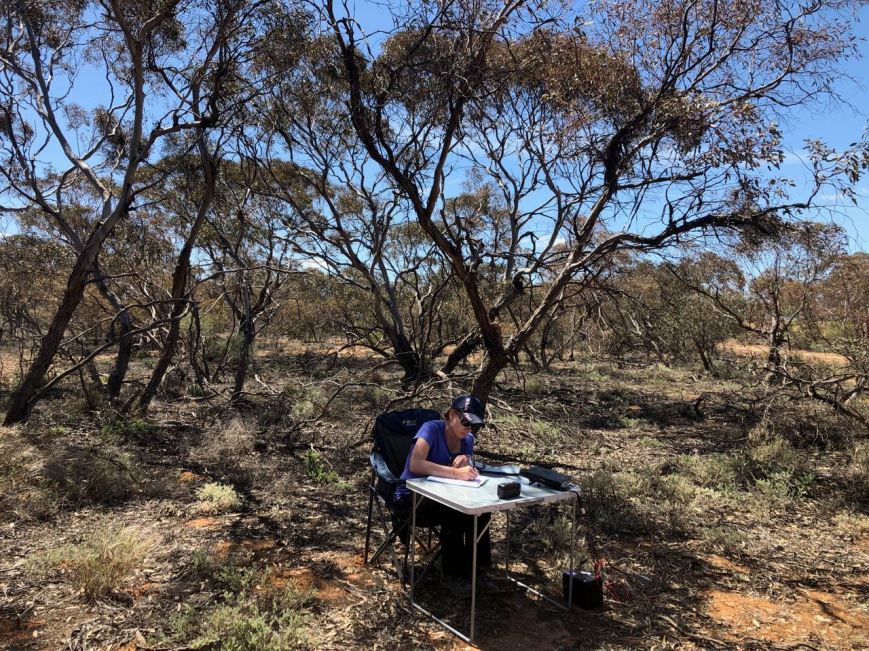
Marija and I had planned to support the 2019 KRMNPA event, which we do each year.  We headed to north-western Victoria to activate the Murray Sunset National Park and the Wyperfeld National Park.  Whilst away we also planned to activate a number of Flora Reserves for the World Wide Flora Fauna (WWFF) program.  Many of these would be first-time activations for VKFF/WWFF.  We had booked to stay at the Murrayville Caravan Park for 2 nights.

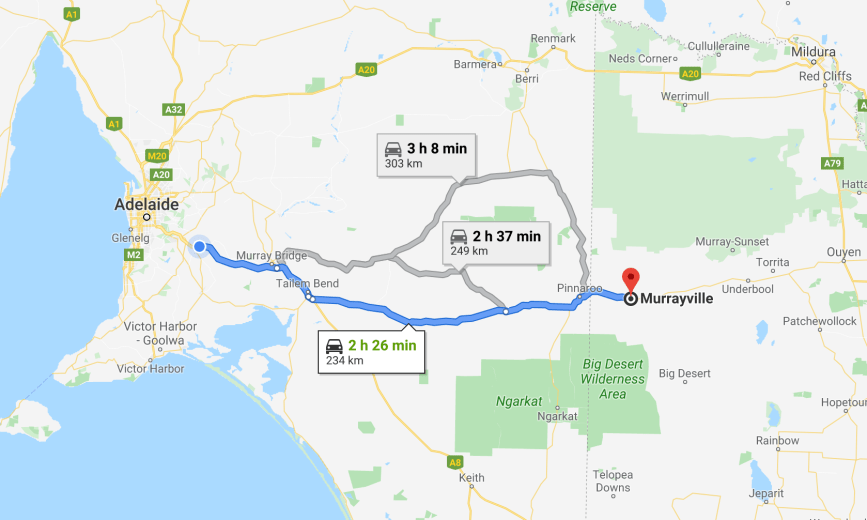
We left home at about 6.30 a.m. local time on Saturday morning (9th November 2019) and headed east along the South Eastern Freeway to Murray Bridge.  Along the way we joined the Mid South Coast Amateur Radio Net which was run by John VK2NJP.  Marija and I then travelled east along the Dukes Highway to Tailem Bend where we stopped briefly for a coffee and an egg & bacon roll.  We then drove east along the Mallee Highway joining the BRL Riverland Net on 7.115.

Screen Shot 2019-11-12 at 11.20.49 am.png

Above:- Map showing our route to Murrayville.  Map courtesy of Google maps.

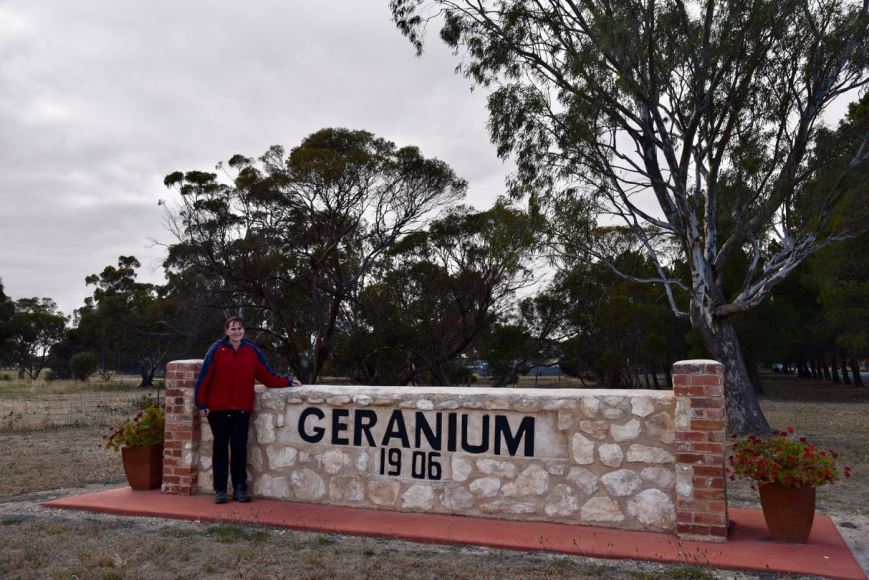
Our next stop was the little town of Geranium on the Mallee Highway.  Geranium’s history dates back to 1906 when the State Government sank a bore in the locality.  The town takes its name from the wild geraniums which grow in abundance in the area.

DSC_5911

Sadly this is another town which has suffered as a result of the closure of the railway.   The railway was the lifeline of Geranium and other towns in the Mallee area of South Australia.  Everything came or went via the railway.  Incoming were the supplies for the local businesses, farm machinery and fertiliser.  Outgoing was cream, eggs, grain, and stock.  The line opened in 1906 and was closed in 2015.  Passenger service to Geranium was closed in 1964.  In later years the line was only used to transport grain.  You can view some history of the railway down by the silos along the old line.

Whilst in Geranium we also had a look at the old Geranium Bore.  The windmill commemorates the original bore which was constructed in the 2-acre site of the 10 acre ‘Water Reserve’ in March 1906.  A short walk away from the windmill is an old Table Top Trolley which dates back to 1921.

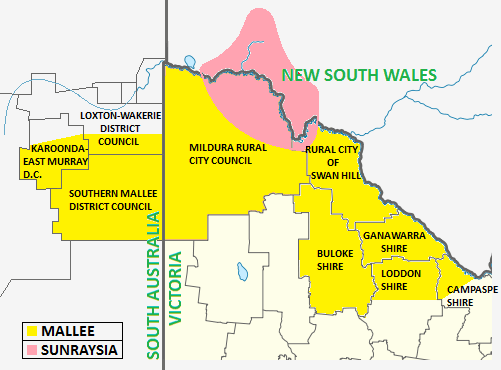
I mentioned above, ‘the Mallee’.  The Mallee is an area in the semi-arid areas of north-western Victoria and north-eastern South Australia.  It takes its name from the Mallee, a growth habitat of certain eucalypt species that grow with multiple stems spring from an underground lignotuber.

Outline_map_of_the_Mallee_and_Sunraysia_regions.png

Above:- The Mallee region highlighted in yellow.  Image courtesy of Wikipedia.

We continued east and stopped briefly in Pinnaroo to top up some diesel in the Toyota Hil Lux and to have a quick look at the Pinnaroo Animal Park & Bird Aviary.  The park contains Red Kangaroos, Western Grey kangaroos, emus, and numerous other parrots and cockatoos and is well worth a visit.

This slideshow requires JavaScript.

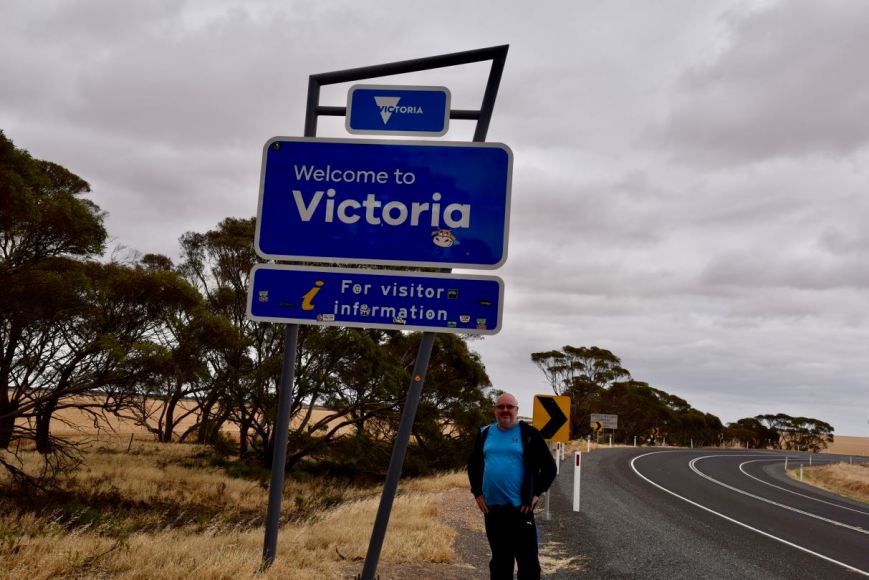
After leaving Pinnaroo we soon reached the South Australian-Victorian State Border.  We stopped briefly for a photograph and continued east into Victoria.

DSC_5952

We arrived in Murrayville and booked into the Murrayville Caravan Park in a self-contained cabin.  We have stayed here before and can highly recommend it.

After offloading some gear we headed east on the Mallee Highway to our first park of the day, the Dunstans Flora Reserve VKFF-2310.

This would be a first-time activation of this park for the World Wide Flora Fauna (WWFF) program.

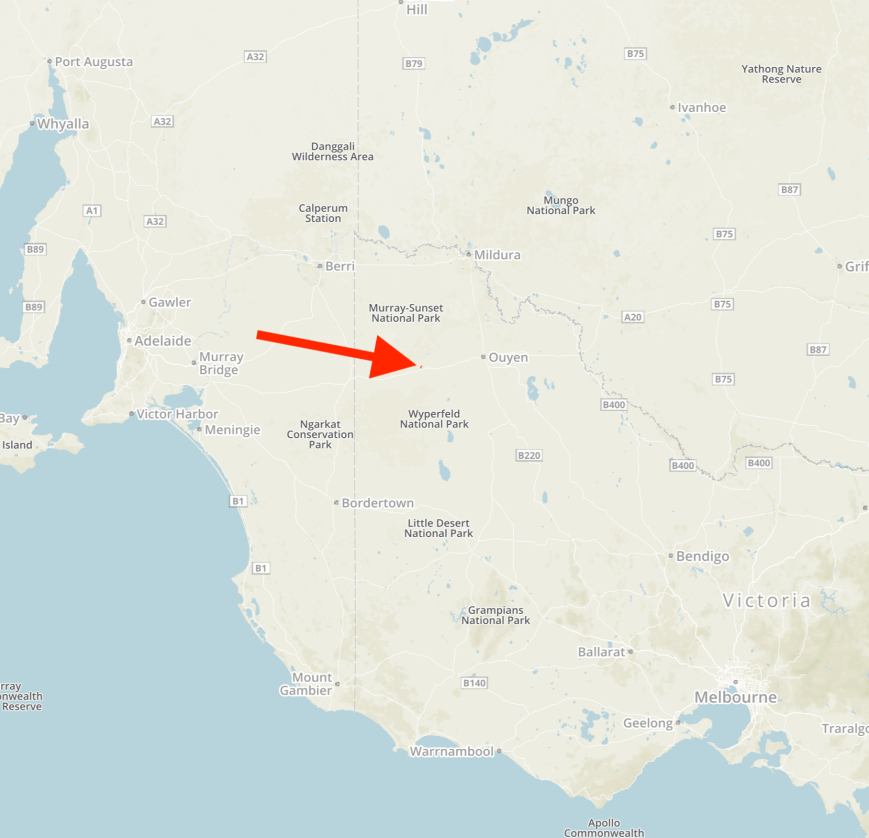
Screen Shot 2019-11-12 at 10.37.46 am.png

Above:- Map showing the location of the Dunstans Flora Reserve in north-western Victoria.  Map courtesy of Protected Planet.

The maps we were in possession of, including Google maps, show that this park is called Dunstans Nature Conservation Reserve or the Dunstans Flora and Fauna Reserve.  But this was thrown into confusion when we visited the park as Marija found a park sign which read ‘Bunstans Flora and Fauna Reserve’.  To confuse matters more, the park is located on Bunstun Road.  The Parks Victoria website and Protected Planet shows that the park is called Dunstans Flora and Fauna Reserve.

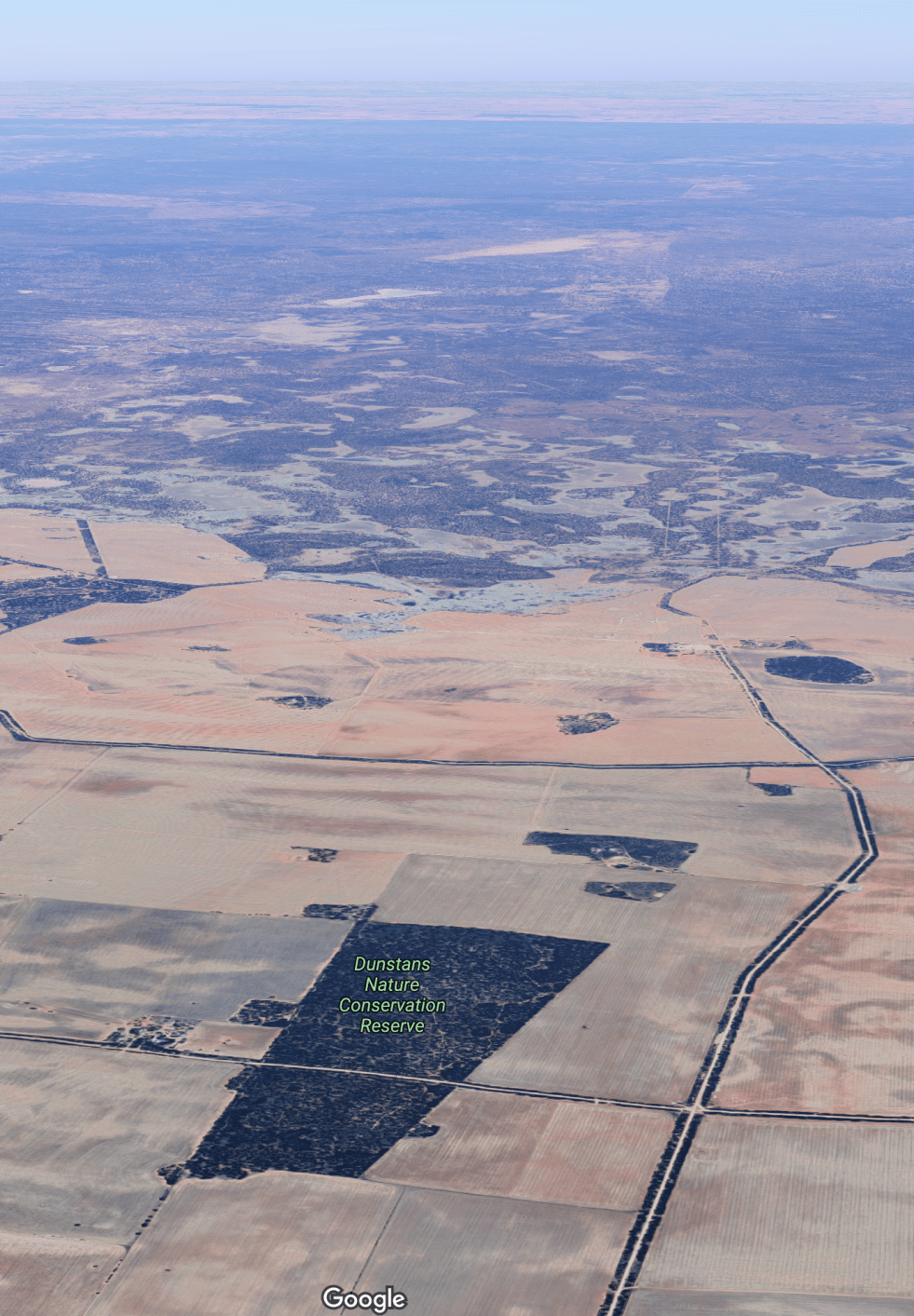
Screen Shot 2019-11-12 at 11.18.12 am.png

Above:- An aerial shot of the Dunstans Flora and Fauna Reserve.  Image courtesy of Google maps.

Unfortunately, I have not been able to find out much information about this park on the internet.  The Parks Victoria website link is ‘dead’ as are most of their links.

Protected Planet shows that the park was established in 1985 and is 313 acres in size.  It is typical dry mallee countryside.

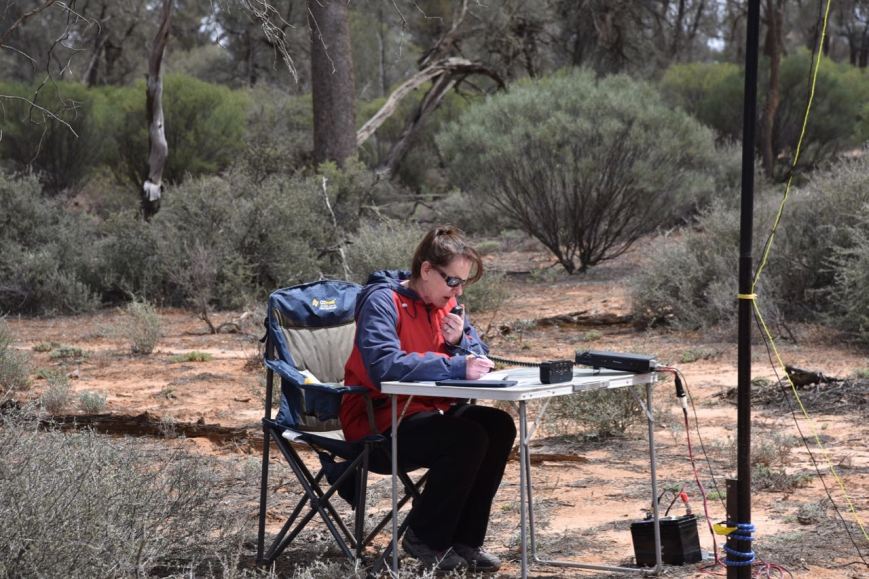
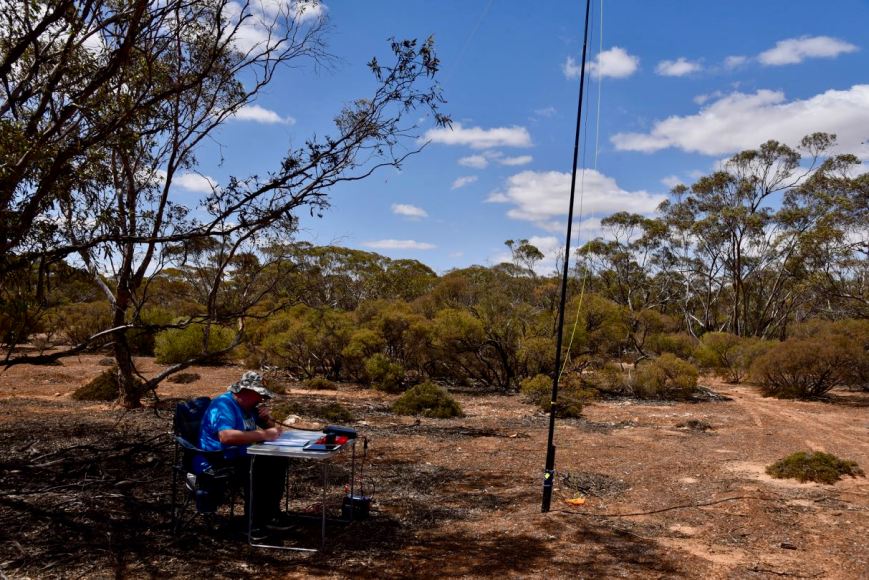
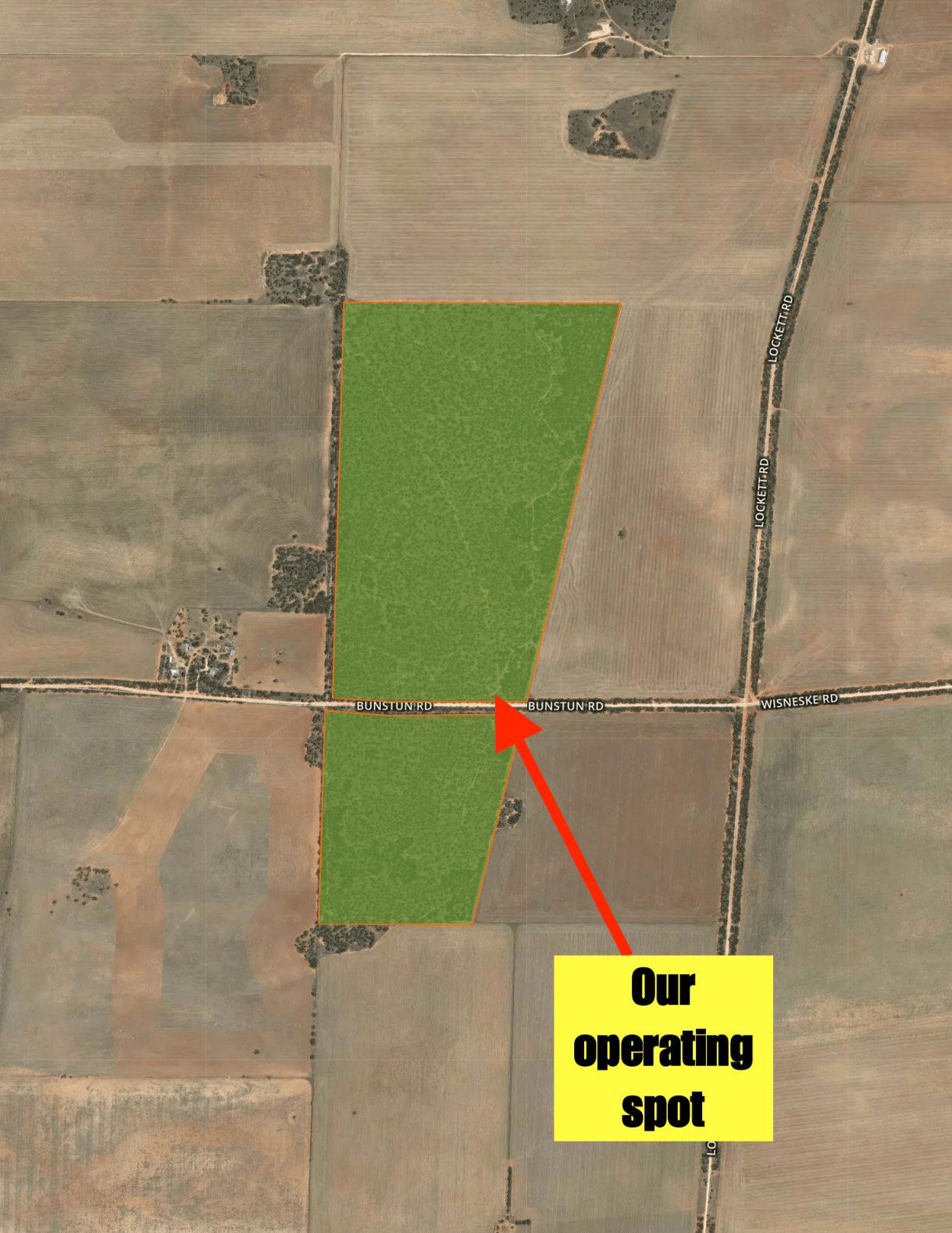
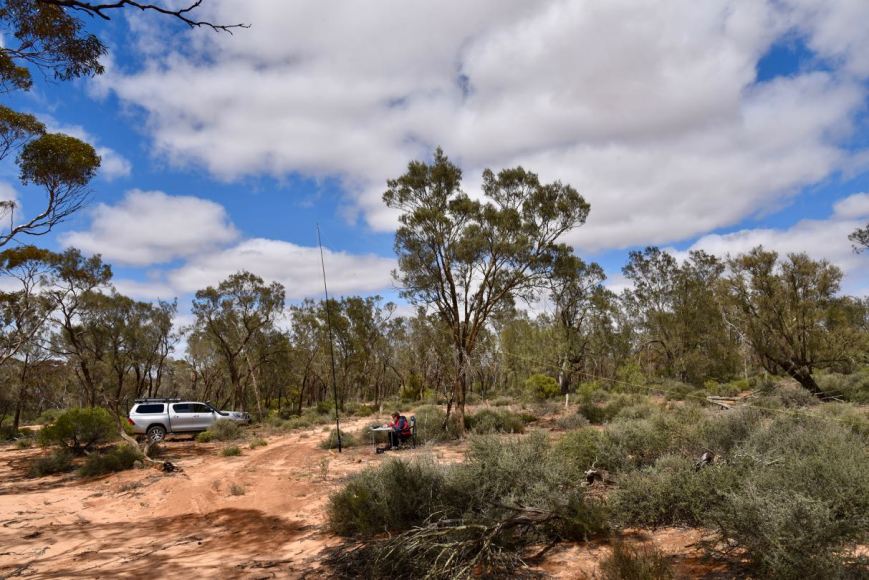
Just before reaching the little town of Linga, we turned off the Mallee Highway onto Lockett Road and travelled north.  We then turned left on Bunstun Road.  We found a small clearing in amongst the scrub on Bunstun Road and set up our station which comprised the Yaesu FT-857d and the 20/40/80m linked dipole.

Screen Shot 2019-11-12 at 10.37.23 am.png

Above:- An aerial shot of the park showing our opeating spot.  Image courtesy of Protected Planet.

I kicked off the activation by making contact with Rob VK4AAC/3 who was activating the Warby Ovens National Park VKFF-0742 in north-eastern Victoria.  Rob had a strong 5/9 signal.  I then tuned down the band and made contact with Brett VK3FLCS/p who was in the Barmah National Park VKFF-0739.

With two Park to Park contacts to commence the activation, I moved down to 7.130 and started calling CQ while Marija placed a spot up for me on parksnpeaks.  Ray VK4NH in Queensland was first to call in with a good 5/6 signal.  This was followed by Adrian VK5FANA, and then Shane VK2LUV/p in the Werekata State Conservation Area VKFF-1391.  Peter VK3PF/p then gave me a shout from SOTA peak VK3/ VE-093 & Burrowa Pine Mountain National Park VKFF-0069.  This was followed by Mike VK6MB/p in the Powalup Nature Reserve VKFF-2840, Andrew VK1DA/p at SOTA peak Black Mountain VK1/ AC-042 & Black Mountain Nature Reserve VKFF-0834, and then Alan VK3ALN/p who was activating the Point Nepean National Park VKFF-0628.

I had ten contacts in the log (including seven Park to Park contacts) and had qualified the park for VKFF, so I swapped the mic with Marija.

DSC_5959

Marija’s first contact was with Alan VK3ALN/p in the Point Nepean National Park VKFF-0628.  Next was Geoff VK3SQ, followed by Steve VK3MPR and Neil VK4HNS.  Just 6 minutes into the activation and Marija had her 10 contacts in the log and had qualified the park for VKFF.

Marija logged a total of 29 stations from VK2, VK3, VK4 and VK5.  Other than her Park to Park contact with Alan, Marija also logged Peter VK3PF/p Park to Park from the Burrowa Pine Mountain National Park VKFF-0069.

I then jumped back into the operator’s chair and logged a further 33 stations on 40m including the following Park to Park contacts:-

  • Ian VK5CZ/p – Charleston Conservation Park VKFF-0777
  • Norm VK3XCI/p – Hattah Kulkyne National Park VKFF-0231
  • Gerard VK2IO/p – Scheyville National Park VKFF-0444
  • Rob VK2VH/3 – Warby Ovens National Park VKFF-0742

Contact number 44, qualifying the park for me for WWFF, was with Craig VK2FFLL.

DSC_5962

We were hopeful that Marija might be able to get her 44 QSOs and qualify the park for the global WWFF program, so Marija jumped back into the hot seat and called CQ on 7.130.

Marija logged a further 7 stations and now had 36 contacts in the log.  We lowered the squid pole and inserted the links for the 80m band and then headed to 3.610.  First, in the log, there was Norm VK3XCI/p who was in the Hattah Kulkyne National Park VKFF-0231, followed by John VK5BJE, Ivan VK5HS, and then Rob VK4AAC/3 who was activating the Warby Ovens National Park VKFF-0742.

With callers having completely dried up and Marija just 1 short of her 44, I took a drive a km or so down the road and gave Marija her 44th contact from my mobile.  Adrian VK5FANA then called in to make it number 45.

DSC_5955

Before heading off to our next park I decided to try the 20m band.  I had seen a post on Facebook from Stuie VK8NSB in Darwin to say that he would be waiting on 14.310.  I headed there and logged Stuie who was a good 5/6 signal.  This was followed by Jason VK6YTS, Rob VK4SYD, Murray VK4MWB, and Scott VK4CZ with a very strong 5/9 signal.

We were in the throws of packing up when we saw on parksnpeaks that Alan VK2MG/p was in a park on 7.150.  So we re-hoisted the squid pole and logged Alan Park to Park from Bunyaville Conservation Park VKFF-1493.

It was time to pack up and head off to our next park.  Between us, we had 94 QSOs in the log, including 21 Park to Park contacts

Marija worked the following stations on 40m SSB:-

  1. VK3ALN/p (Point Nepean National Park VKFF-0628)
  2. VK3SQ
  3. VK3MPR
  4. VK4HNS
  5. VK2KYO
  6. VK2EXA
  7. VK5FANA
  8. VK4NH
  9. VK4DXA
  10. ZL4TY/VK4
  11. VK2LX
  12. VK2YK
  13. VK3VIN
  14. VK5KC
  15. VK3PF/p (SOTA VK3/ VE-093 & Burrowa Pine Mountain National Park VKFF-0069)
  16. VK2LEF
  17. VK5TR
  18. VK5BAR
  19. VK6BW
  20. VK5TW
  21. VK5BJE
  22. VK5TBC
  23. VK5KLD
  24. VK5TAW
  25. VK5NRG
  26. VK5VCR
  27. VK5PL
  28. VK5KLV
  29. VK2IO/p (Scheyville National Park VKFF-0444)
  30. VK3WAC/m
  31. VK5BMC
  32. VK3SX
  33. VK3FLCS
  34. VK2PKT
  35. VK3MCK
  36. VK5CZ/p (Charleston Conservation Park VKFF-0777)
  37. VK2MG/p (Bunyaville Conservation Park VKFF-1493)

Marija worked the following stations on 80m SSB:-

  1. VK3XCI/p (Hattah Kulkyne National Park VKFF-0231)
  2. VK5BJE
  3. VK5HS
  4. VK4AAC/3 (Warby Ovens National Park VKFF-0742)
  5. VK2VH/3 (Warby Ovens National Park VKFF-0742)
  6. VK5PAS/3
  7. VK5FANA

I worked the following stations on 40m SSB:-

  1.  VK4AAC/3 (Warby Ovens National Park VKFF-0742)
  2. VK3FLCS/p (Barmah National Park VKFF-0739)
  3. VK4NH
  4. VK4DXA
  5. ZL4TY/VK4
  6. VK5FANA
  7. VK2LUV/p (Werekata State Conservation Area VKFF-1391)
  8. VK3PF/p (SOTA VK3/ VE-093 & Burrowa Pine Mountain National Park VKFF-0069)
  9. VK6MB/p (Powalup Nature Reserve VKFF-2840)
  10. VK1DA/p (SOTA Black Mountain VK1/ AC-042 & Black Mountain Nature Reserve VKFF-0834)
  11. VK3ALN/p (Point Nepean National Park VKFF-0628)
  12. VK5KLD
  13. VK5KLV
  14. VK2EXA
  15. VK3XPT
  16. VK3JAP
  17. VK5CZ/p (Charleston Conservation Park VKFF-0777)
  18. VK3VIN
  19. VK3XCI/p (Hattah Kulkyne National Park VKFF-0231)
  20. VK5BJE
  21. VK2KYO
  22. VK3PI
  23. VK3ZSJ
  24. VK2VW
  25. VK3SQ
  26. VK2FSDU
  27. VK7EI
  28. VK4HNS
  29. VK4SYD
  30. VK2IO/p (Scheyville National Park VKFF-0444)
  31. VK2AWS
  32. VK3VKT/m
  33. VK3WAC/m
  34. VK5LTD/p
  35. VK5WG
  36. VK4CZ
  37. VK3SX
  38. VK3IC
  39. VK2VH/3 (Warby Ovens National Park VKFF-0742)
  40. VK5VBR
  41. VK3GMC
  42. VK3PGK
  43. VK5BMC
  44. VK2FFLL
  45. VK2MG/p (Bunyaville Conservation Park VKFF-1493)

I logged the following stations on 20m SSB:-

  1. VK8NSB
  2. VK6YTS
  3. VK4SYD
  4. VK4MWB
  5. VK4CZ


References.

Amateur Radio Victoria, 2019, <https://www.amateurradio.com.au/awards>, viewed 12th November 2019.

Discover Murray Mallee, 2019, <http://www.malleehighway.com.au/html/geranium.html>, viewed 12th November 2019

Protected Planet, 2019, <https://www.protectedplanet.net/dunstans-f-f-r-nature-conservation-reserve>, viewed 12th November 2019

Wikipedia, 2019, <https://en.wikipedia.org/wiki/Mallee_(Victoria)>, viewed 12th November 2019

Wikipedia, 2019, <https://en.wikipedia.org/wiki/Mallee_(habit)>, viewed 12th November 2019

Trip to Victoria for 2019 KRMNPA weekend

Many thanks to everyone who called Marija VK5FMAZ and me during our 3 days over in Victoria.

We stayed overnight at Murrayville in western Victoria and activated a total of 11 parks.

Two of those, the Murray Sunset National Park and the Wyperfeld National Park were for the Keith Roget Memorial National Parks Award activation weekend. Thanks to Tony VK3XV and others for organising another great weekend.

We made a total of 635 QSOs which included 78 Park to Park contacts. Bands – 20, 40, & 80m SSB. We worked VK1, VK2, VK3, VK4, VK5, VK6, VK7, VK8, New Zealand, Belgium and France.

This slideshow requires JavaScript.

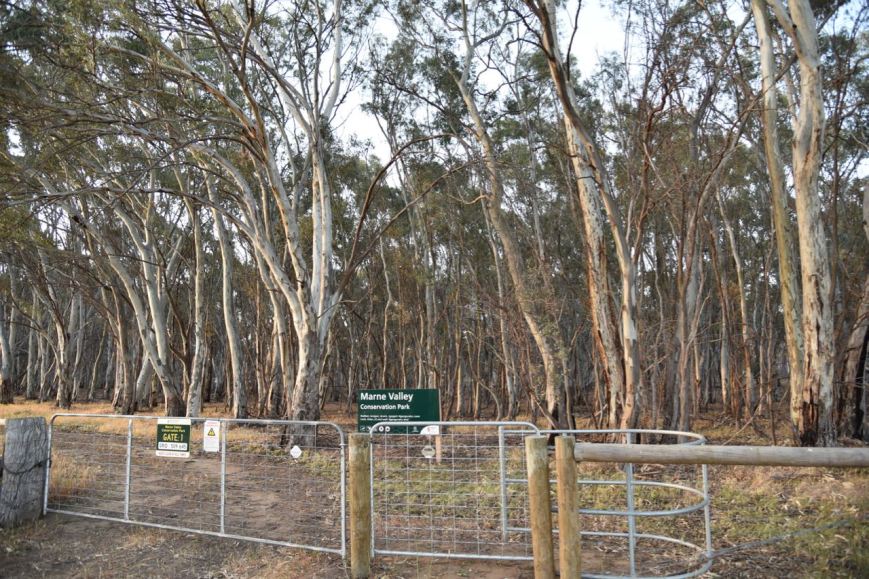
Marne Valley Conservation Park VKFF-0906

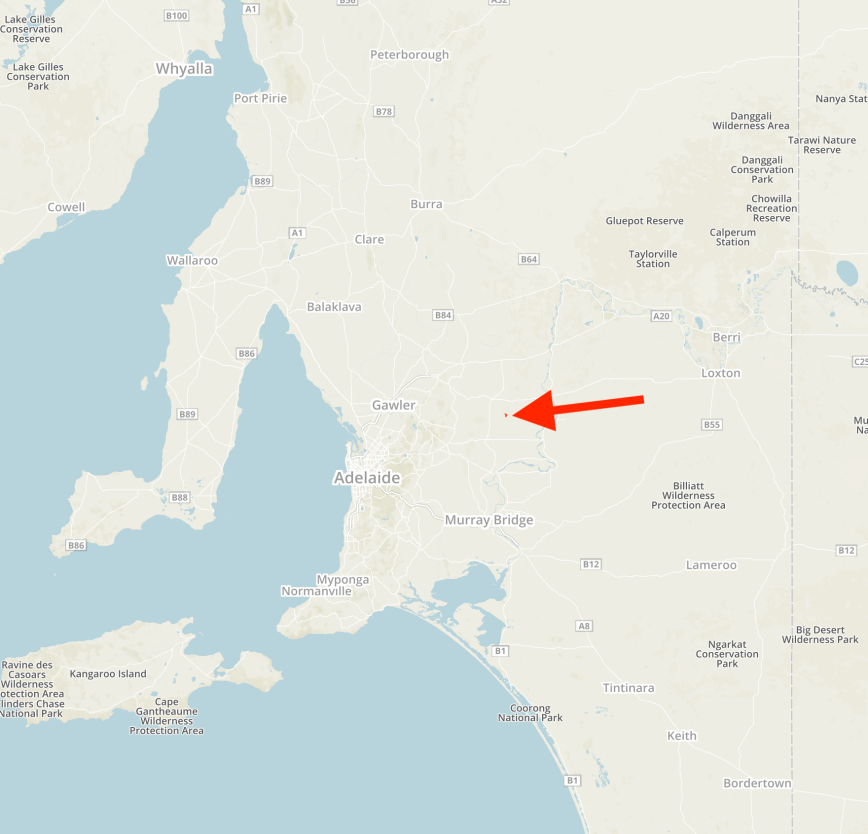
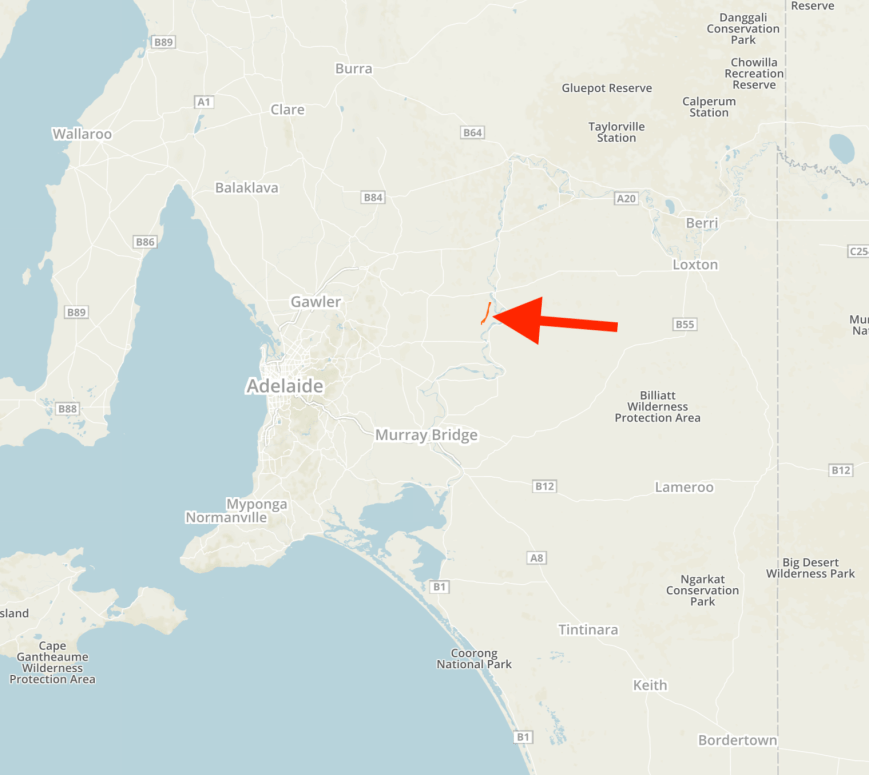
Our third and final park for the day was the Marne Valley Conservation Park VKFF-0906.  This was another park that Marija and I had previously activated from and qualified.  The park is located about 106 km northeast of the city of Adelaide.

Screen Shot 2019-10-29 at 6.25.38 pm

Above:- Map showing the location of the Marne Valley Conservation Park northeast of Adelaide.  Map courtesy of Protected Planet.

Marne Valley Conservation Park is about 94 hectares in size and was first proclaimed on the 11th day of March 1976.  The major vegetation association being River Red Gum open forest.  The southwestern corner, along the eastern central boundary, and along the northern boundary the native vegetation has been largely cleared.  The park is bisected by the Marne River.

Prior to the establishment of the park, the land was part of the main Adelaide to Sydney stock route.

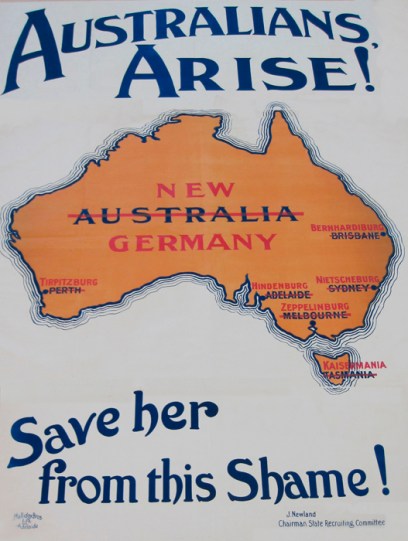
The Marne River was originally known as the ‘South Rhine River’ until 1918 when it was renamed due to anti-German sentiment.  It was named the Marne due to a 1914 German advance of troops was checked at the Marne River in France.  Anti-German feeling ran high during World War One and a Nomenclature Committee was set up to make recommendations for changes from names of “foreign enemy origin” to British or South Australian native names.   The Committee suggested ‘Pongaree River’ meaning ‘shade reflection in water’ but it was rejected by the government.

New-Australia-Map-3.jpg

Above:- An anti-German poster.  Image c/o NSW Migration heritage Centre

In pre-European times, the Ngarrindjeri aboriginal people used the Marne Valley as a route up into the hills to trade with the Peramangk people in the Barossa Valley and to cut bark canoes from the River Red Gums in the hills which had thicker bark than those near the Murray. The original name of the Marne River was Taingappa, meaning “footrack-trading road”.

Birds SA have recorded about 68 species of bird in the park including Galah, Adelaide Rosella, Mallee Ringneck, Brown Treecreeper, Noisy Miner, White-plumed Honeyeater, Striated Pardalote, Common Bronzewing, Purple-backed Fairywren, Red-capped Robin, and Magpielark.

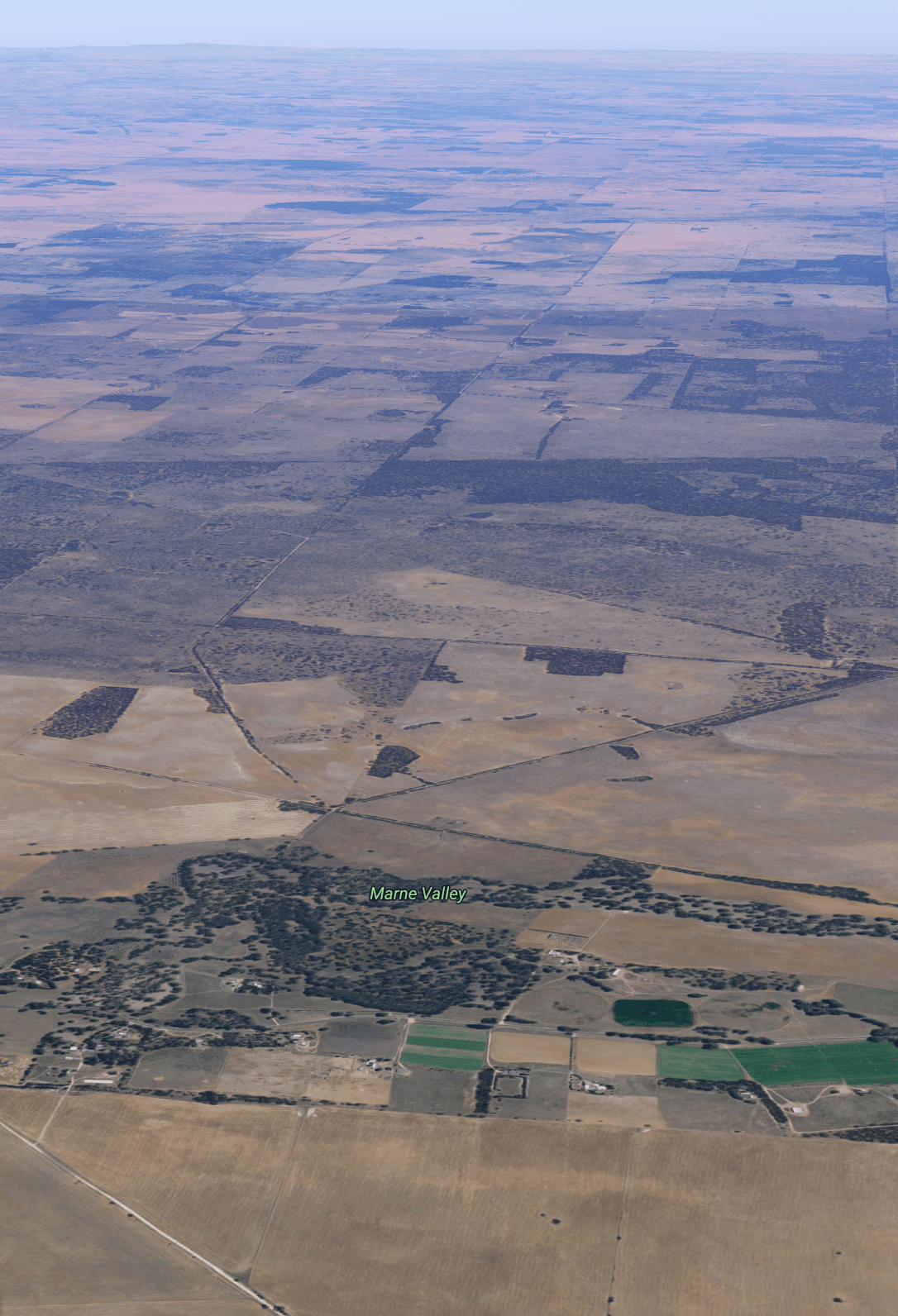
Screen Shot 2019-10-29 at 7.20.04 pm.png

Above:- An aerial view of the Marne Valley Conservation Park.  The nearby turf farms can be seen.  Image courtesy of Google maps.

I have been to the park many times before and have always access it via Black Hill Road.  This time Marija and I decided to see if we could get into the park a different way.  We travelled down Muellers Road hoping to access the park via Havelberh Road.  However, the road had a locked gate and access was not possible.

We continued north along Muellers Road and turned left onto Sleep Track and headed west.  We then reached an un-named dirt road and travelled south down to the north-western corner of the park at Havelberg Road and Tamkes Road.  We travelled down Tamkes Road but could not find a suitable spot.  We also travelled east on Havelberg Road following the northern boundary of the park.  There was no shade so we decided to head back around to Black Rock Road.

DSC_5872

Above:- The northern side of the park on Havelberg Road.

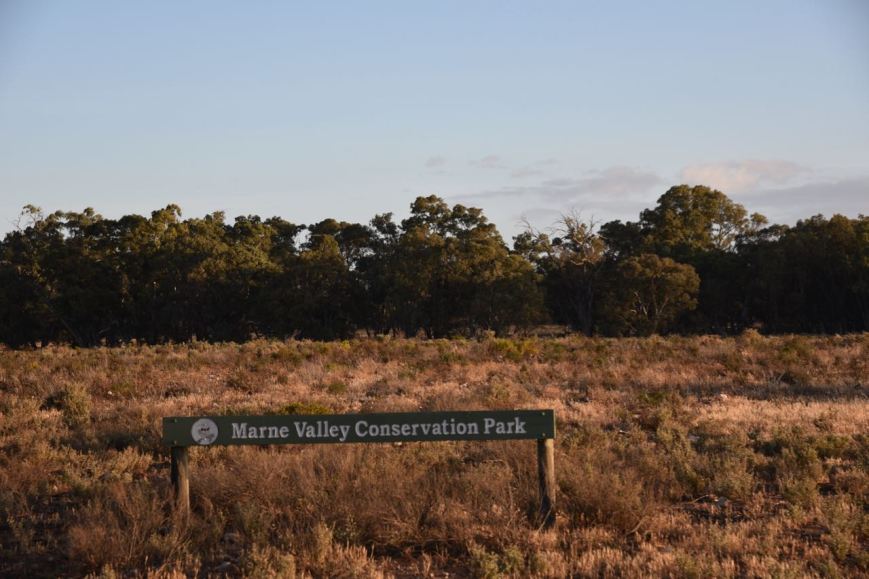
Once we got to the Black Rock Road entrance to the park I noticed that a pedestrian gate and new park sign had been installed since my last visit.

DSC_5873

Above:- The Black Rock Road entrance on the southern side of the park.

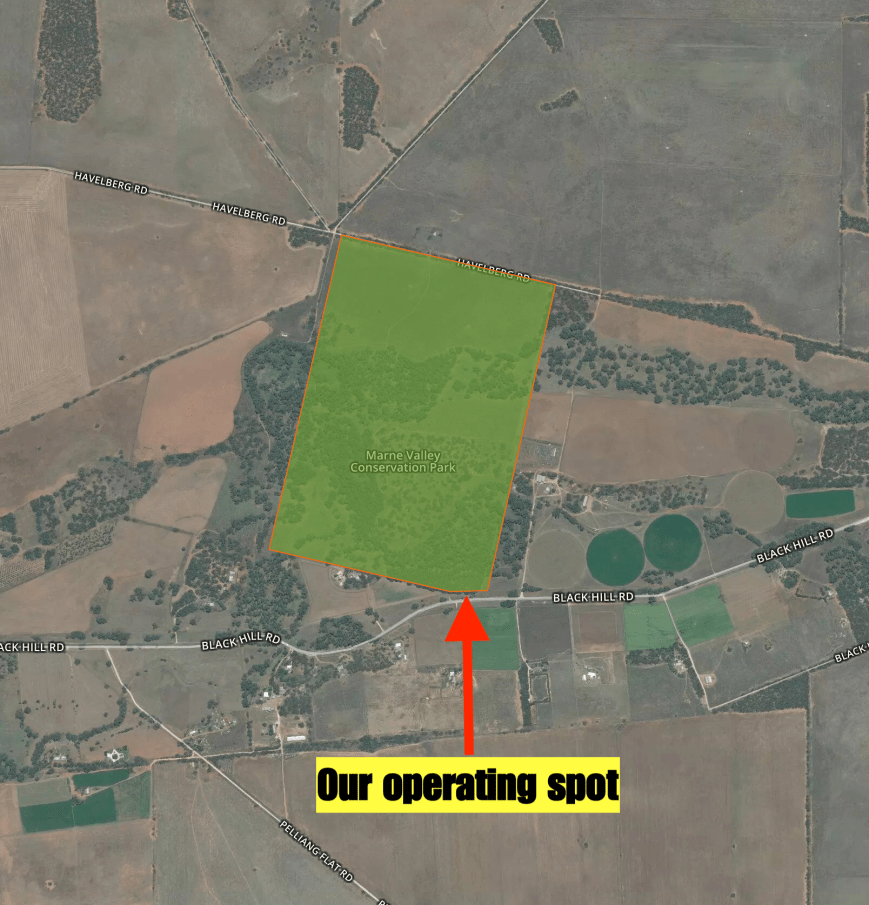
There was plenty of room here to string out the 20/40/80m linked dipole.  We used one of the fence posts as a securing point for the telescopic squid pole, with the help of an octopus strap.

Screen Shot 2019-10-29 at 6.25.28 pm.png

Above:- An aerial view of the Marne Valley Conservation Park showing our operating spot in the southern part of the park.  Image courtesy of Protected Planet.

Unfortunately, the static crashes had not subsided, nor had the contest traffic.  As a result, it was very hard to find a clear spot on the 40m band.  I called CQ on 7.142 and Mark VK4HYD called soon after, to be number one in the log.  Lee VK2LEE followed, then Wayne VK7NET, and then Mark VK4SMA.

But it was really tough going, and with just 9 contacts in the log, callers dried up.  It was at this time that I swapped the mic with Marija.

Marija’s first contact was with park regular John VK4TJ, followed by Lee VK2LEE, Andrei ZL1TM, and then Peter VK3PF.  Marija logged just one further contact, with Brett VK2WWV, before her callers also dried up.

We decided to tune across the band to see if I could work some of the ‘big guns’ in the CQ World Wide Contest.  The first DX station to be logged was Dan W7WA in Washington state.  Next was VK9NC on Norfolk Island, followed by KL7RA in Alaska.

KL7RA was so strong that I decided to get Marija to give him a call.  And with a legitimate 10 watts, Marija logged Alaska (after a few repeats of her call sign).  This was Marija’s first-ever contact into Alaska.

I then logged VK6LLL, K3EST in California, and VK4SDD.  I tried calling some of the other DX stations, but my 40 watts and little bit of wire just weren’t cutting through.

We then headed down to the 80m band where we logged a total of 16 contacts between the two of us, into VK2, VK3, VK4, VK5, and VK7.

To complete the activation I went back to 40m.  I again tried calling some of the contest stations, but I just wasn’t getting through all the interference.  The band was extremely busy.  I logged just the one station K7RL in Washington.

It was now 8.30 p.m. local time and it was almost dark.  It was time to pack up and head for home.  We had activated three parks and made a total of 157 QSOs on 40 & 80m SSB. This included 43 Park to Park contacts.

Marija worked the following stations on 40m SSB:-

  1. VK4TJ
  2. VK4/AC8WN
  3. VK4/VE6XT
  4. VK4SSN
  5. VK2LEE
  6. ZL1TM
  7. VK3PF
  8. VK2WWV
  9. KL7RA

Marija worked the following stations on 80m SSB:-

  1. VK3PF
  2. VK3KAI
  3. VK5BJE

I worked the following stations on 40m SSB:-

  1. VK4HDY
  2. VK2LEE
  3. VK7NET
  4. VK4SMA
  5. VK4TJ
  6. VK4/AC8WN
  7. VK4/VE6XT
  8. VK4SSN
  9. W7WA
  10. VK9NC
  11. KL7RA
  12. VK6LLL
  13. K3EST
  14. VK4SDD
  15. K7RL

I worked the following stations on 80m SSB:-

  1. VK2LEE
  2. VK3PF
  3. VK5KLV
  4. VK3MCK
  5. VK5ZTS
  6. VK5BJE
  7. VK3HP
  8. VK4SWR
  9. VK4CZ
  10. VK3HQZ
  11. VK7NET
  12. VK5WG
  13. VK2FAAY


References.

Birds SA, 2019, <https://birdssa.asn.au/location/marne-valley-conservation-park/>, viewed 29th October 2019

Family History SA, 2019, <https://www.familyhistorysa.org/sahistory/germanplacenames.html>, viewed 29th October 2019

National Parks and Wildlife Service South Australia, 2019, <https://www.parks.sa.gov.au/find-a-park/Browse_by_region/Murray_River/marne-valley-conservation-park>, viewed 29th October 2019.

State Library South Australia, 2019, <http://www.slsa.ha.sa.gov.au/digitalpubs/placenamesofsouthaustralia/M.pdf>, viewed 29th October 2019

Wikipedia, 2019, <https://en.wikipedia.org/wiki/Marne_River_(South_Australia)>, viewed 29th October 2019

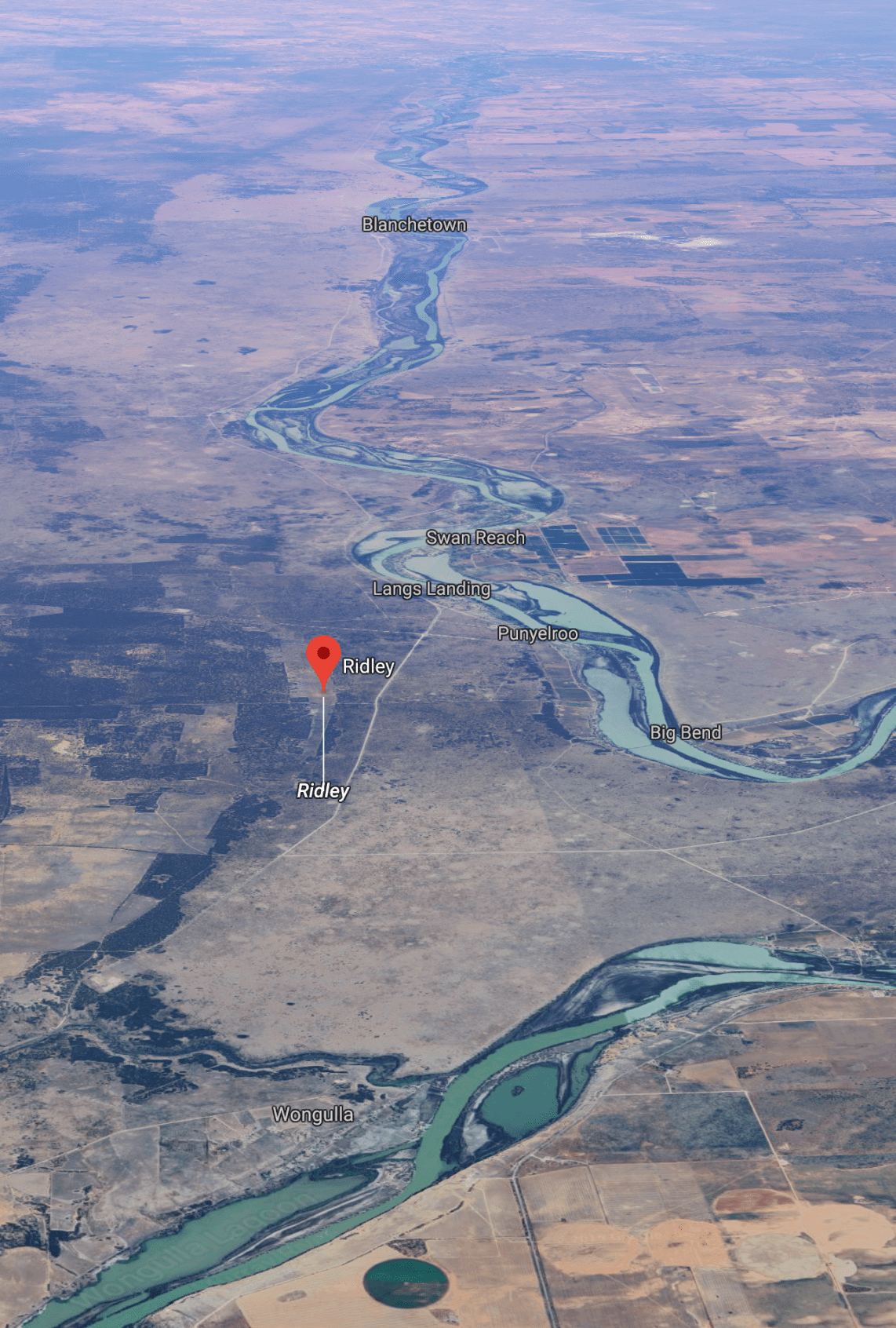
Ridley Conservation Park VKFF-0932

Our second park for the 2019 VKFF Team Championship was the Ridley Conservation Park VKFF-0932.  The park is located about 121 km (by road) north-east of the city of Adelaide.

Screen Shot 2019-10-29 at 6.23.21 pm.png

Above:- Map showing the location of the Ridley Conservation Park northeast of Adelaide.  Map courtesy of Protected Planet.

After packing up at Swan Reach we travelled east back along the Stott Highway and then turned right onto Murraylands Road and headed south.  We stopped off briefly at the Marks Landing lookout.  There are some great views here of the Murray River across to the town of Swan Reach.

The Ridley Conservation Park is about 414 hectares in size.  It is a long narrow park measuring 10 km in length and 400 metres in width.  The park consists of two major vegetation formations:

  • 35% – Open scrub of Red Mallee and yorell with Murray Pine and areas of shrubland dominated by Hop bush.
  • 65% – Low open woodland of Native Apricot and false sandalwood, with an understorey of spear-grass and ephemeral herbs.

The park was part of the Travelling Stock Reserve which ran for about 5-10 km parallel to the Murray River.  This part of the reserve linked the stock market of Burra in the north of South Australia, with Murray Bridge to the south.

During 1966 when the land was being resumed and purchased for the purpose of national parks, the Land Board proposed that portions of the Travelling Stock Reserve be retained and dedicated as a Wildlife Reserve.  The park was first proclaimed as the Ridley National Parks Reserve on the 30th day of May 1968.  It was re-proclaimed on the 27th day of April 1972, as the Ridley Conservation Park.

Screen Shot 2019-10-29 at 6.29.02 pm.png

Above:- An aerial view of the Ridley Conservation Park.  Image courtesy of Google maps.

Birds SA have recorded about 109 species of bird in the park includingWhite-winged Chough, Galah, Spiny-cheeked Honeyeater, Grey Shrike-thrush, Chestnut-rumped Thornbill, Brown Treecreeper, Southern Whiteface, Little Eagle, White-winged Fairywren, Regent Parrot, Striped Honeyeater, and Yellow Thornbill.

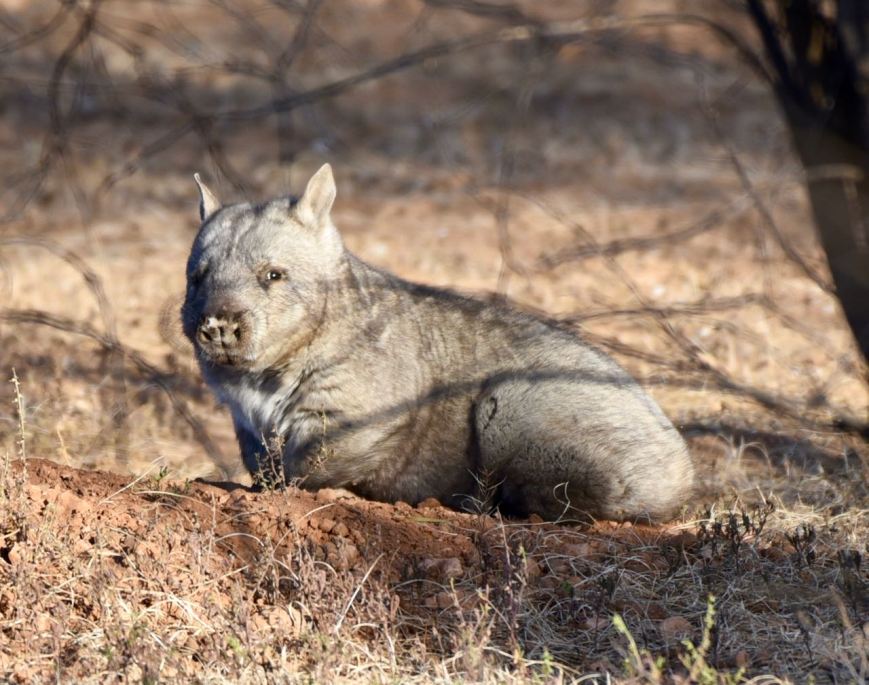
The park was originally set aside to conserve native vegetation and bird habitats, but in addition, the open areas of the park include a number of warrens of the Southern Hairy-nosed Wombat.  Other native animals found in the park include echidna and Western Grey kangaroos.

During our visit to the park, we observed one wombat, who was very quick on his/her feet but did stay still long enough for me to get some photographs (see below).

DSC_5857

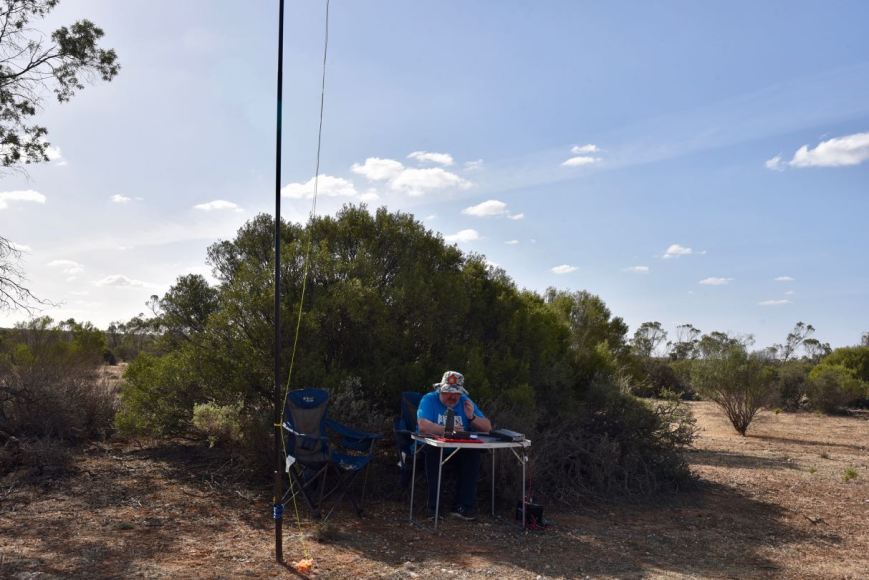
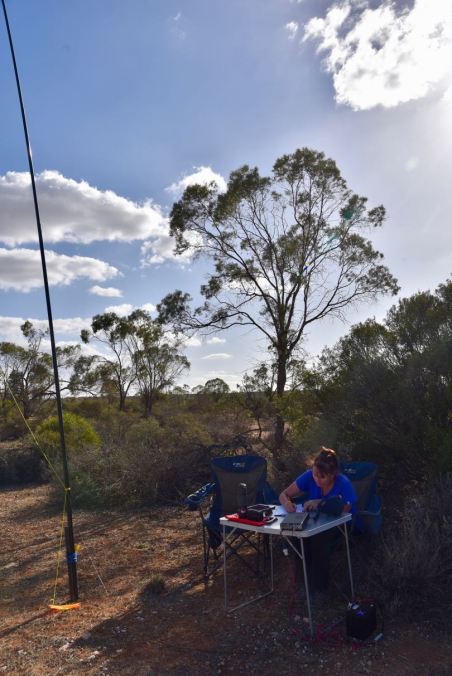
We drove a short distance off the road into the park off Murraylands Road and set up under the shade of some vegetation.  We ran the Yaesu FT-857d and the 20/40/80m linked dipole for this activation.

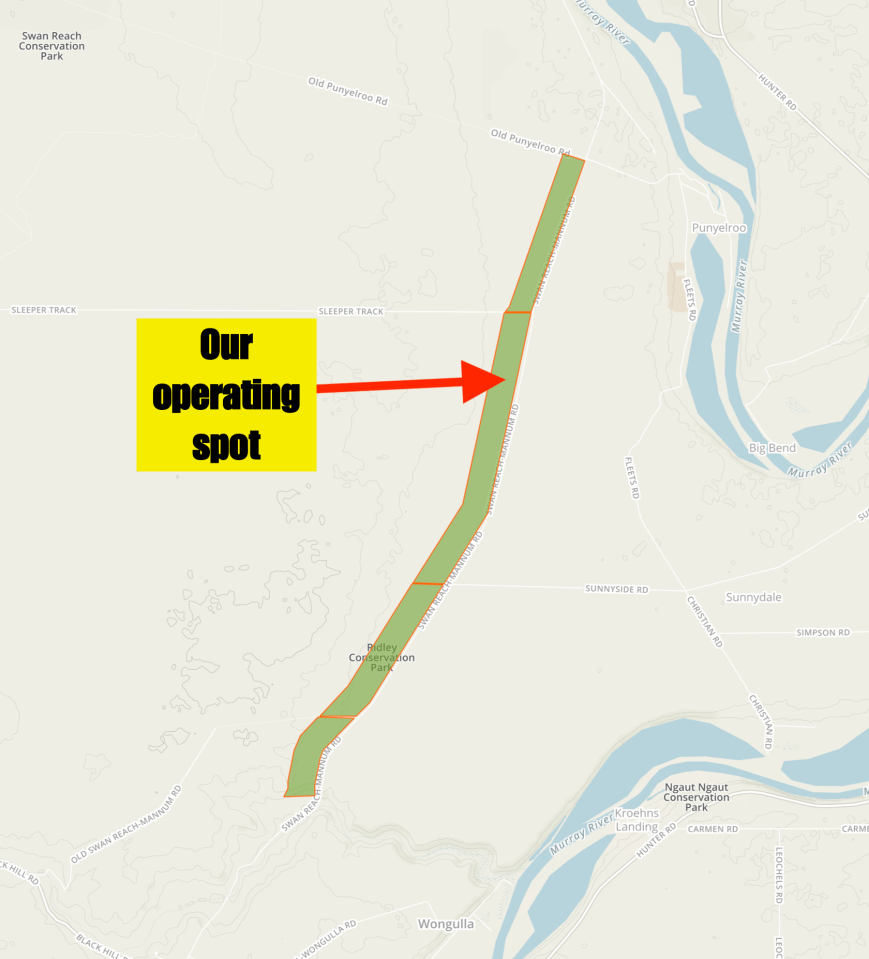
Screen Shot 2019-10-29 at 6.19.37 pm.png

Above:- Map of the Ridley Conservation Park showing our operating spot.  Map courtesy of Protected Planet.

The 40m band was very busy due to the CQ WW Contest and it was very hard to find a clear frequency.  Compounding issues was the 5/9 plus static crashes due to storm activity around Australia.  I found 7.115 clear and started calling CQ.  First in the log was Ron VK3APP, followed by park regular Rob VK2VH, and then Peter VK3ZPF who is another VKFF devotee.

This was followed by Gerard VK2IO/p who was activating the Munmorah State Conservation Area VKFF-1361.  Marija also logged Gerard for a Park to Park contact.  Five contacts later and we were called by Alan VK2MG/p who was also in the Munmorah State Conservation Area.

I logged a total of 12 stations on 40m, with conditions being quite poor.  I then swapped the mic with Marija.

DSC_5835

Marija called CQ and this was answered by Rob VK2VH, followed by Adam VK2YK, and then Peter VK3PF.  Marija had quite a steady flow of callers which was very pleasing.  We also logged further Park to Park contacts with Rob VK4SYD/p and Scott VK4CZ/p who were activating the Samford Conservation Park VKFF-1639, and Deryck VK4FDJL/6 who was in the Frankland (South) National Park VKFF-0653.

Marija logged a total of 18 stations on 40m, before handing the mic back to me,  I called CQ on 7.115, but only managed 2 further callers, Steve VK3YW and Craig VK2KDP.  The contest interference became so bad that we decided to head down to 80m.

DSC_5838

Together, we logged a total of 10 contacts on 80m into VK3 and VK5.  This included a Park to Park contact with Mike VK6MB/5 who was activating the Franklin Harbor Marine Park VKFF-1709 on the Eyre Peninsula.

I decided to have one last go on 40m.  But I was to be very disappointed, with just one contact logged, that being with Lee VK2LEE.  The contest QRM and the static crashes proved to be the winner.

We then packed up and headed off to our final park for the day, the Marne Valley Conservation Park.

Marija worked the following stations on 40m SSB:-

  1. VK2IO/p (Munmorah State Conservation Area VKFF-1361)
  2. VK2MG/p (Munmorah State Conservation Area VKFF-1361)
  3. VK2VH
  4. VK4AAC/2
  5. VK2YK
  6. VK3PF
  7. VK3PR
  8. VK1JH
  9. VK2LX
  10. VK4NH
  11. VK4DXA
  12. ZL4TY/VK4
  13. VK4SYD/p (Samford Conservation ParkVKFF-1639)
  14. VK4CZ/p (Samford Conservation ParkVKFF-1639)
  15. VK2LUV
  16. VK4FDJL/6 (Frankland (South) National Park VKFF-0653)
  17. VK2FAAY
  18. VK3MAB

Marija worked the following stations on 80m SSB:-

  1. VK6MB/5 (Franklin Harbor Marine Park VKFF-1709)
  2. VK3BBB
  3. VK5FANA
  4. VK3NBL

I worked the following stations on 40m SSB:-

  1. VK3APP
  2. VK2VH
  3. VK4AAC/2
  4. VK3ZPF
  5. VK2IO/p (Munmorah State Conservation Area VKFF-1361)
  6. VK3CQC
  7. VK7PSJ
  8. VK3PF
  9. VK7JON
  10. VK2MG/p (Munmorah State Conservation Area VKFF-1361)
  11. VK3MCK
  12. VK2YK
  13. VK4CZ/p (Samford Conservation ParkVKFF-1639)
  14. VK4SYD/p (Samford Conservation ParkVKFF-1639)
  15. VK4FDJL/6 (Frankland (South) National Park VKFF-0653)
  16. VK3YW
  17. VK2KDP
  18. VK2LEE

I worked the following stations on 80m SSB:-

  1. VK5PL
  2. VK5BJE
  3. VK6MB/5 (Franklin Harbor Marine Park VKFF-1709)
  4. VK2DJH/4
  5. VK3BBB
  6. VK5FANA

We drove west on the Black Hill Road and took a short detour into Shell Hill Reserve.  We have been here before, but it is a very interesting place.  Shell Hill is a deposit of oyster shells believed to be the only shell deposit of its type in the Southern Hemisphere.  It was originally part of a shallow sea which occupied the Murray River Basin millions of years ago.

During the early 1930s, a company called Ellis & Clarke realised the value of the shell as a fertiliser and work commenced on a crushing plant in the gully below the deposit.  A 50-metre long chute fed the plant from the shell deposit.  The crushed shell contained a high percentage of lime and was used in agricultural pursuits.  Sir  Thomas Playford, the South Australian Premier used a significant quantity for his orchards in the Adelaide Hills.  The plant ceased operation in 1946.


References.

Birds SA, 2019, <https://birdssa.asn.au/location/ridley-conservation-park/>, viewed 29th October 2019

Discover Mrray Mallee, 2019, <http://www.murrayriver.com.au/swan-reach/shell-hill/>, viewed 29th October 2019

Swan Reach Conservation Park VKFF-0832

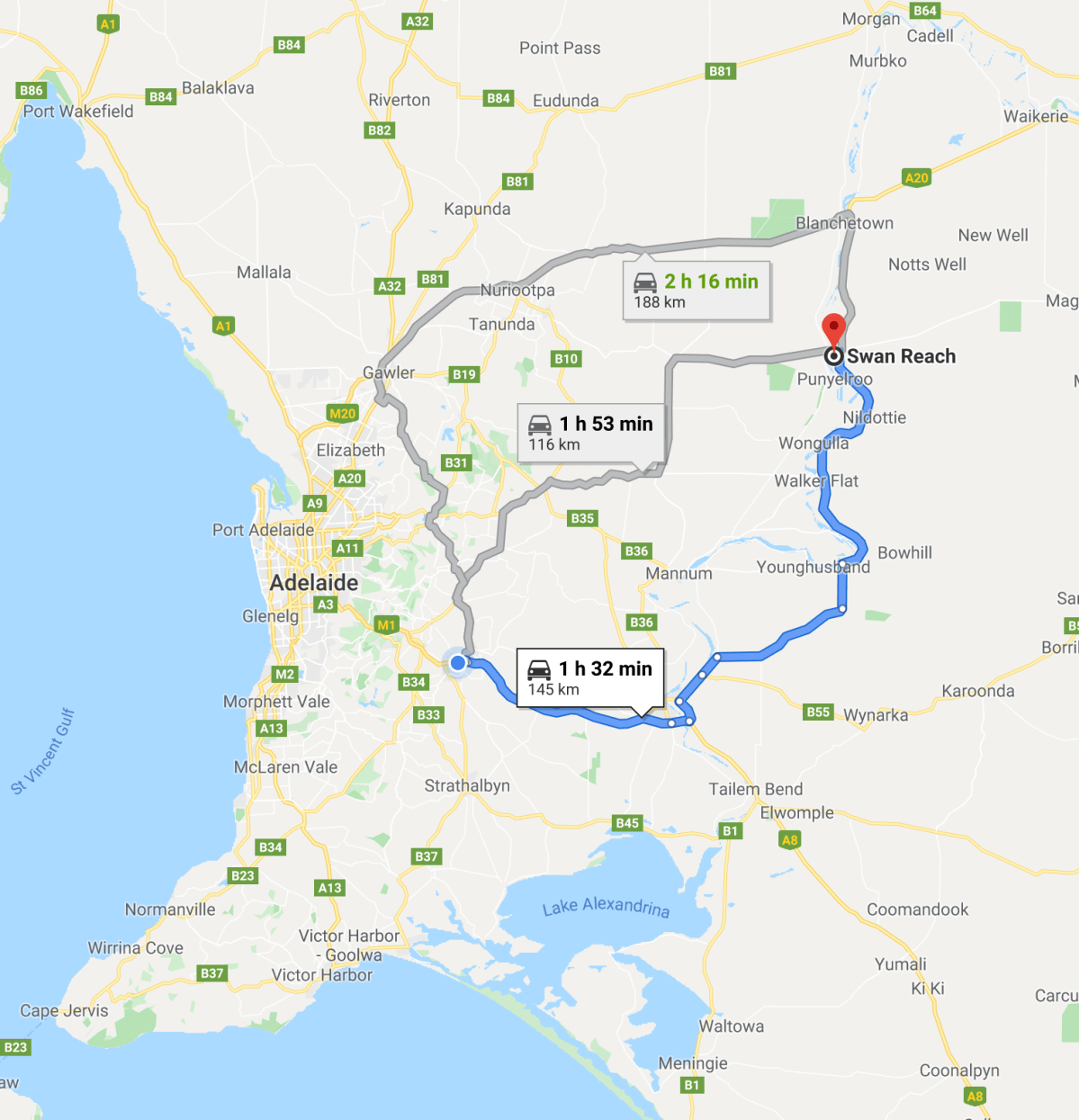
Yesterday (Saturday 26th October 2019) Marija and I travelled up to the Swan Reach area to take part in the 2019 VKFF Team Championship.  We left home at about 10.00 a.m. local time and travelled the 145 km to Swan Reach which is located on the Murray River between Blanchetown and Mannum.

Our plans were to activate three parks: Swan Reach Conservation Park, Ridley Conservation Park, and Marne Valley Conservation Park.  We had activated and qualified all three parks previously.

Our team name was ‘The Walky Talkies’.

Screen Shot 2019-10-27 at 4.02.38 pm.png

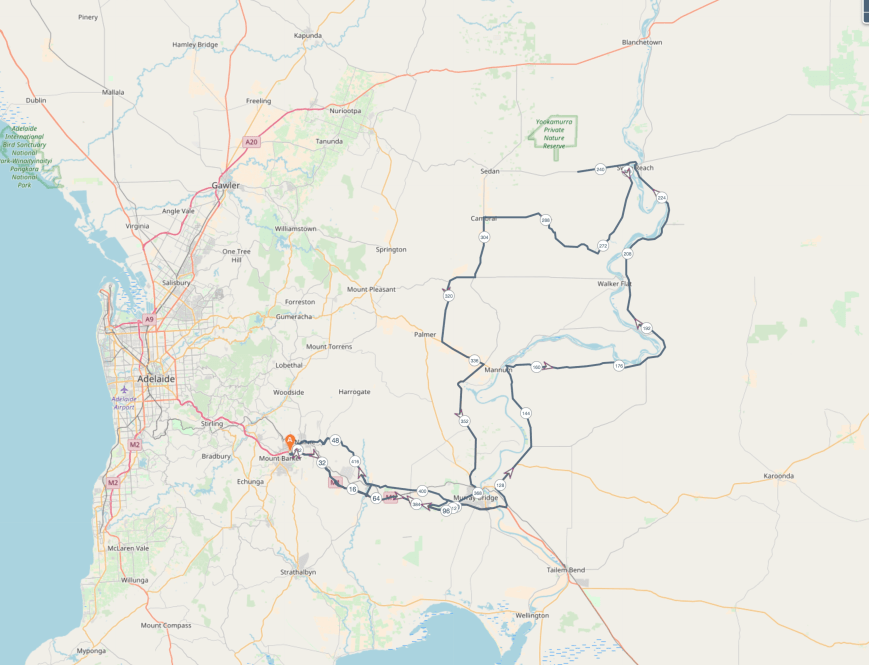
Above:- Map showing our route to Swan Reach, via Murray Bridge, Bowill, Nildottie.  Map courtesy of Google Maps.

We travelled to Murray Bridge via the South Eastern Freeway and crossed the mighty Murray River on the Swanport Bridge.  We then took the Burdett Road, north out of Murray Bridge. We then took Hunter Road and headed east into the Murray Mallee region of South Australia.  Originally the Mallee region was covered in thick mallee scrub.  From as early as the 1880s, large expanses of the mallee were cleared for agricultural development.  It is estimated that about 80% of the land was cleared.

Our first stop for the morning was at Bow Hill, a little settlement located on the Murray River.  It was named after the Hundred of Bow Hill which was proclaimed on the 4th day of May 1893 and named by Governor Kintore after a town in Scotland.  Between 1911-1913 the town of Bow Hill had two blacksmith shops, a painter’s shop, a store, boarding house, a branch office of the Bank of Adelaide, and a wharf.  The town’s population was 181.

Today, Bow Hill is a collection of shacks, a general store, a community club, and is a popular water skiing spot along the Murray River.

We continued along Hunter Road and then detoured into the little town of Purnong.  The town was surveyed in 1911 and is named after an aboriginal word meaning ‘at the wide place’.  We had a look at the original bell which was used to summon the ferry.  This is the narrowest crossing on the Murray River.  Potato and onion production is widespread in the Purnong area.  Onions from Purnong are exported around the world.

We also travelled up to the lookout which affords magnificent views of the Murray River and the surrounding countryside.

We then drove a little further along to Len Kroeehn’s Lookout which has some terrific views of the Murray River, the third-longest navigable river in the world.  The lookout is named in honour of Leonhard Erwin Artjir ‘Len’ Kroehn.

Our next stop was the little town of Nildottie which is located on the eastern side of the Murray River.  The name is derived from an aboriginal word ‘ngurltartang’ which means ‘smoke signal hill’.  There is a general store here and an old English wagon on display.  The wagon was used by a local farmer, Alfred Gierke between 1909 and 1936.

Next was Big Bend Lookout which is located between Nildottie and Swan Reach.  Here you can view some of the amazing cliffs along the Murray River.  This is a popular nesting area for cockatoos and has the tallest cliffs and the longest single bend along the entire length of the Murray.

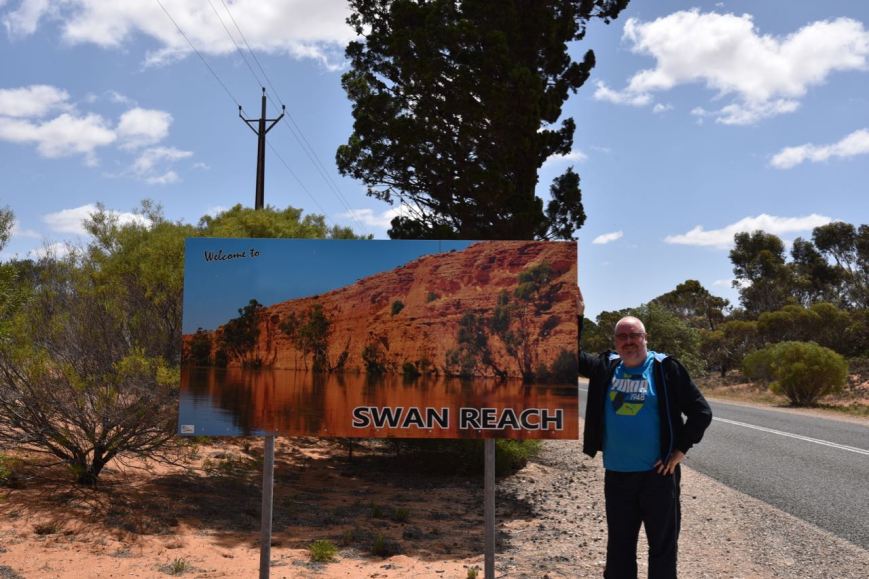
We soon reached the town of Swan Reach which was first settled in the 1850s and was originally the largest of five sheep and cattle stations in the area.  In its heyday, Swan Reach was one of the first riverboat ports in South Australia and was a loading port for grain and wool.  The town gained its name from the large number of black swans that once thrived in the area.
DSC_5805

It was about 12.30 p.m. local time and our tummies were rumbling, so we stopped at the Swan Reach Hotel for a meal.  Marija enjoyed her meal of salmon, whilst I had Kangaroo fillet.  The hotel has a very interesting history.  It was not a purpose-built hotel but was formed around the original Swan Reach homestead which was built in c. 1865.  There are numerous historic photos and stories on display in the hotel.

After leaving the hotel we took a quick drive up to Graetz lookout which overlooks the Murray River and the area opposite known as Tenbury-Hunter Reserve.

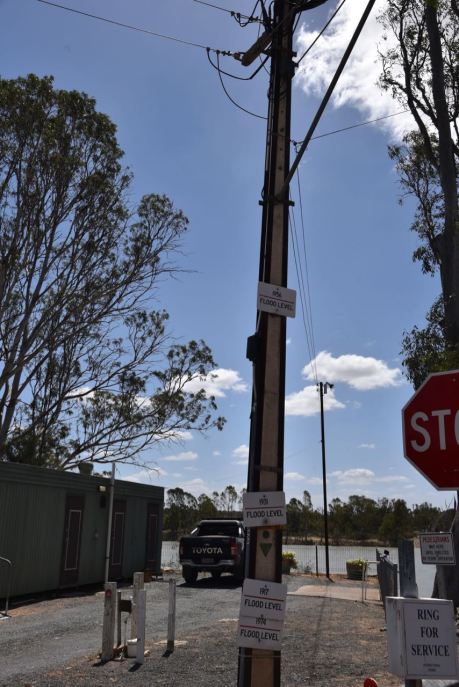
We then drove down to the ferry.  Whilst waiting for the ferry to return from the other side of the river we had a look at a stobie pole which shows the various flood levels.  What is a stobie pole?  It is a power line pole made of two steel joists held apart by a slab of concrete.  It was invented by Adelaide Electric Supply Company engineer James Cyril Stobie.

The 1956 flood is considered the biggest flood in the recorded history of the Murray and described as “the greatest catastrophe in South Australia’s history, despite there being no lives lost.  The flood involved the rising of waters in the Murray River and flooding of many towns in South Australia, New South Wales, and Victoria. The flood occurred due to higher than average rainfalls in Western Queensland and heavy rains in the proceeding three months in the Murray-Darling Basin.  Some areas were flooded up to 100 km from the natural flow of the river.  In South Australia, the flood water peaked in South Australia at Morgan at a height of 12.3 metres (40 feet)
DSC_5820

Above:- Stobie pole at Swan Reach showing the flood levels.

We boarded the ferry at Swan Reach and crossed over the Murray River, heading towards our first park of the day, the Swan Reach Conservation Park VKFF-0832.

We then drove west along the Stott Highway (Angaston-Swan Reach Road) towards Sedan.  The highway was named in 2008 in honour of Tom Cleave Stott, a long-time farmer and member of the South Australian State parliament.

After travelling about 13 km along the Stott Highway we reached the Swan Reach Conservation Park.
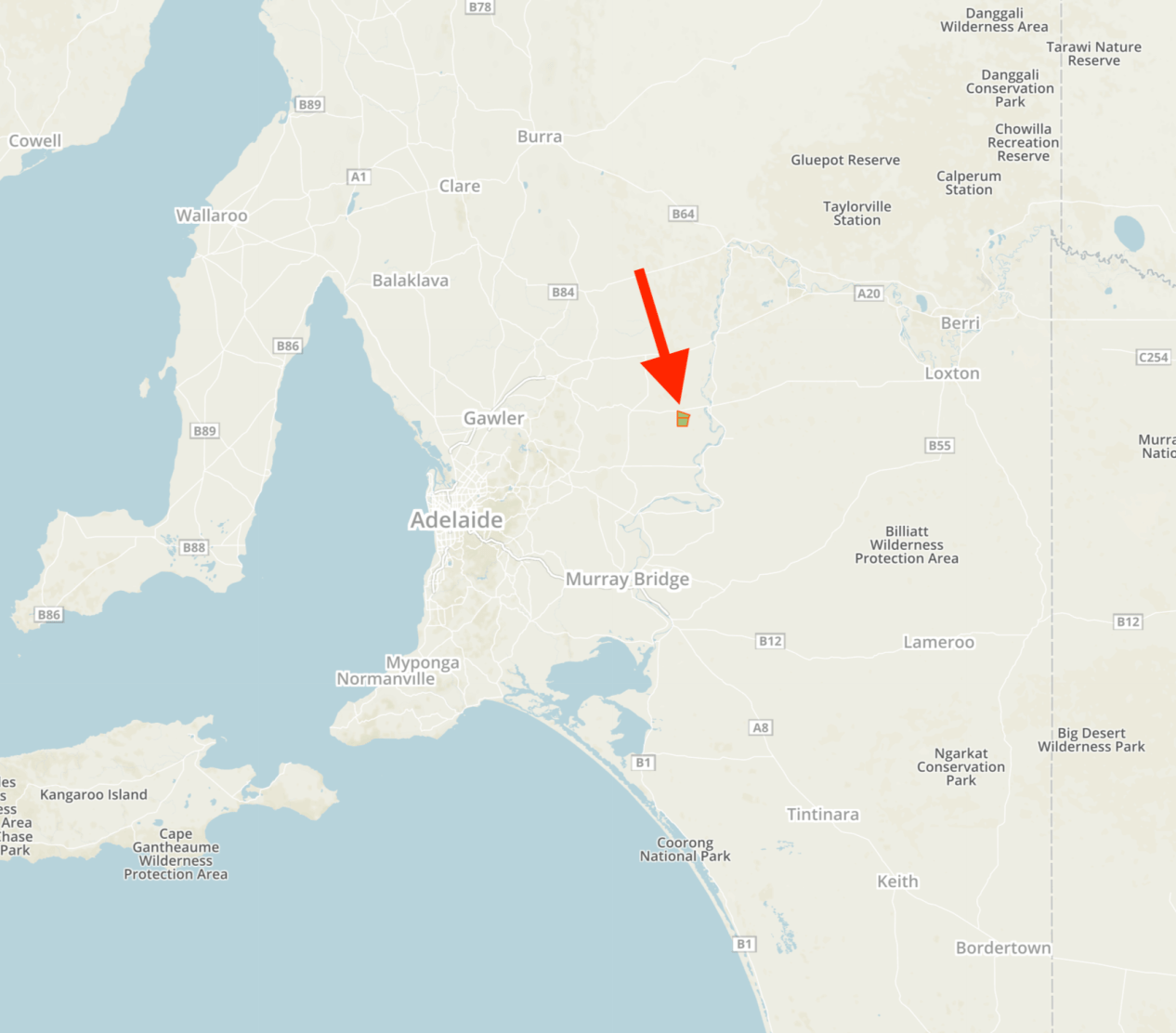
Screen Shot 2019-10-27 at 8.23.33 pm.png

Above:- Map showing the location of the Swan Reach Conservation Park, northeast of Adelaide.  Map courtesy of Protected Planet.

The Swan Reach Conservation Park is about 2,017 hectares in size, with the majority of the area being an open area of scrub of mallee box, red mallee, and yorrell.  The remaining area comprises low woodland with false sandalwood and bullock bush over an understorey of spear-grass and ephemeral herbs.

A majority of the mallee scrub in the region has been cut for firewood, with the present vegetation being predominantly regrowth.  Some areas were completely cleared and now exist as grassland.

On the 28th day of May 1970, an area of 874 hectares was proclaimed as the Swan Reach National Park.  On the 27th day of April 1972, it was re-proclaimed as a Conservation Park.  A further 1,021 hectares of land was added on the 16th day of May 1974.  A further 122 hectares was added on the 25th day of January 1979.

Various native animals can be found in the park including Western Grey kangaroo, Red kangaroo and the Southern hairy-nosed wombat.  The elusive wombat was the primary reason for the proclamation of the park.

About 97 species of bird have been recorded in the park including Chestnut-rumped Thornbill, Southern Whiteface, Spiny-cheeked Honeyeater, Grey Shrike-thrush, Australian Magpie, Malleefowl, Little Eagle, Crested Pigeon, and Inland Thornbill.
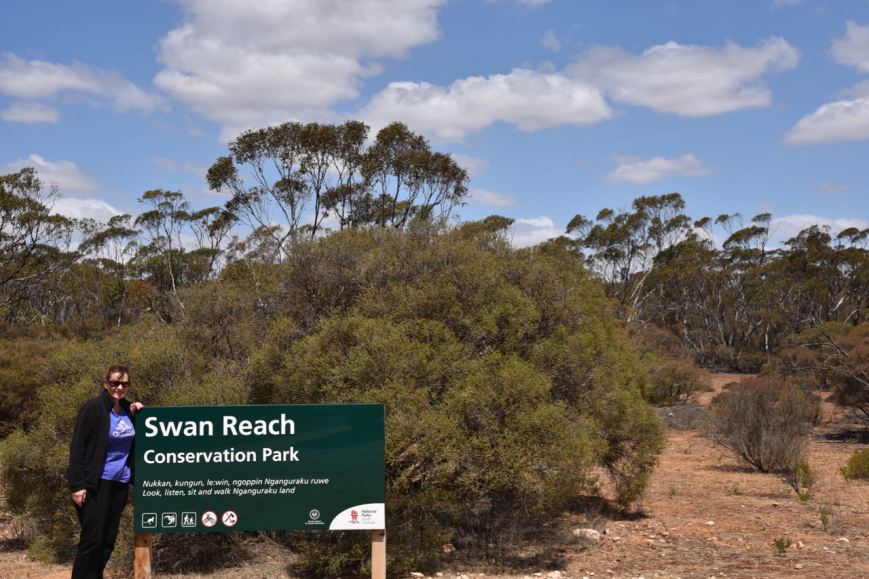
DSC_5824

We entered the park via the Old Punyelroo Road which runs off the Stott Highway.  It was a warm day, with the temperature being about 26-28 deg C, so we chose an operating spot underneath a tree.  For this activation, we ran the Yaesu FT-857d and the 20/40/80m linked dipole supported on the 7-metre telescopic squid pole.
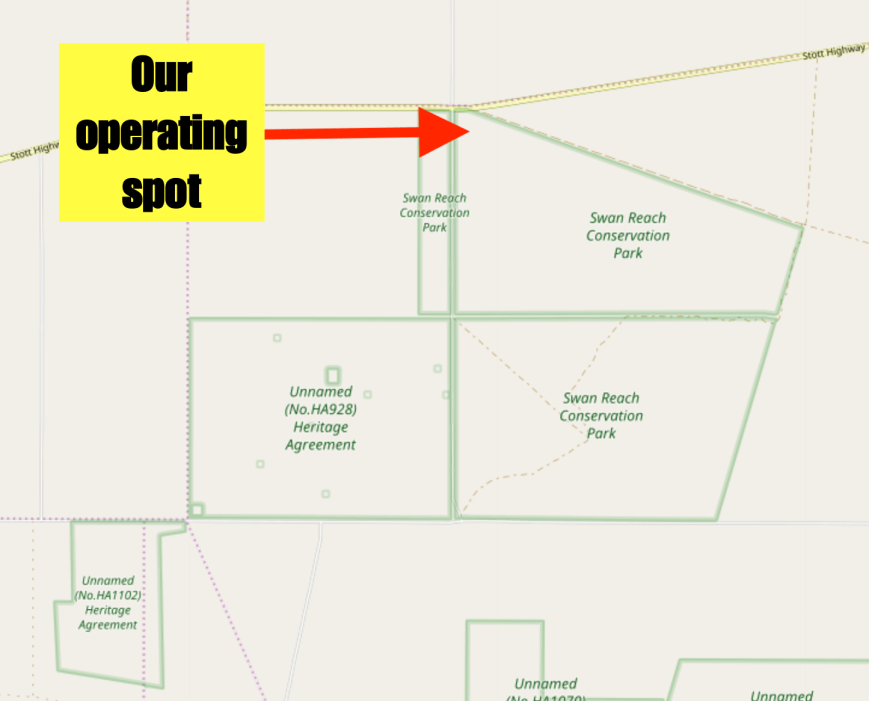
Screen Shot 2019-10-27 at 10.01.48 pm.png

Above:- Map of the Swan Reach Conservation Park showing our operating spot.  Map courtesy of Plot a route.

It was about 2.15 p.m. local time.  I called CQ on 7.144 and this was answered by David VK3HAQ in Portland in south-western Victoria.  This was followed by Nick VK3ZK, and then David VK5PL/p and Ian VK5CZ who were activating the Little Mount Crawford Native Forest Reserve VKFF-2884.  David and Ian were taking part in the Team event.  Their team name was ‘QRS Dot Dash’.  Marija also logged David and Ian.

I logged a total of 15 stations before swapping the mic with Marija.  This included two further Park to Park contacts with Mark VK4SMA/p and Murray VK4MWB/p who were activating the Moogerah Peaks National Park VKFF-0326.  Mark and Murray were taking part in the Team Championship as ‘The VK4 WIPeouts'”.  Marija also logged Mark and Murray.
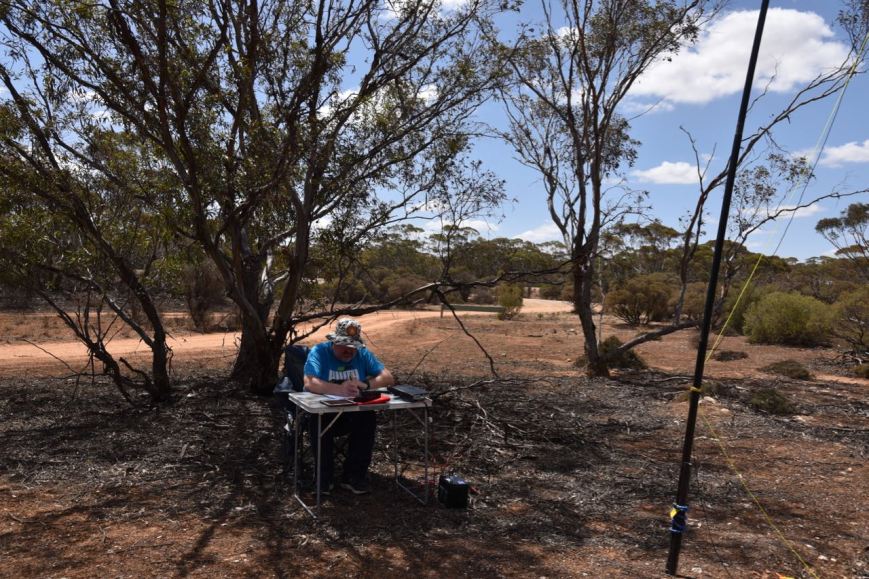
DSC_5826

Marija then called CQ and this was answered by Rob VK2VH, followed by David VK3HAQ, and Mark VK3PI.  Mike VK6MB/5 then called in who was activating the Franklin Harbor Conservation Park VKFF-0807.  Next was Gerard VK2IO/p who was in the Munmorah State Conservation Area VKFF-1361, and soon after Alan VK2MG who was also in the Munmorah State Conservation Area.   Gerard and Alan were taking part in the Team Championship as the ‘QRParktivators”.

Marija had her eighth Park to Park contact in the log a few QSOs later.  This time with Ade VK4SOE/p who was activating the Sundown National Park VKFF-0471.  Marija now had 16 contacts in the log and callers had slowed, so we again swapped operating spots.

I called CQ on 7.144 and this was answered by Perrin VK3XPT/p who was mobile, followed by Jeff VK3PT who was also mobile.  Deryck VK4FDJL/6 then called in from the Mount Frankland South National Park VKFF-0653.  A few QSOs later I was called by Neil VK4HNS/2 who was in the Nightcap National Park VKFF-0389.  This was followed by Rob VK4SYD/p and Scott VK4CZ/p who were in the Bunyaville Conservation Park VKFF-1493.  Rob and Scott were competing in the Team Championship.  Their team name was ‘The VK4midables”.

I logged a total of 32 stations on 40m before heading to the 80m band.  First in the log there was Mike VK6MB/5 who was activating the Franklin Harbor Conservation Park VKFF-0807.  Nev VK5WG then called in from the Mid North with a big signal, followed by Adrian VK5FANA.  John VK5FLEA/p, Ian VK5CZ/p and David VK5PL/p then gave us a call from the Cromer Conservation Park VKFF-0779.

With 8 contacts in the log on 80m and callers having dried up, I moved back to 40m for some final CQ calls on 40m.  I logged a further 8 stations on 40m from VK2 and VK3.  Last in the log was Darrin VK2FAAY.
DSC_5825.jpg

Between us, we had 71 contacts in the log from Swan Reach, including 31 Park to Park contacts.  It was a good start to the 2019 VKFF Team Championship for us.

Marija worked the following stations on 80m SSB:-

  1. VK5CZ/p (Little Mount Crawford Native Forest Reserve VKFF-2884)
  2. VK5PL/p (Little Mount Crawford Native Forest Reserve VKFF-2884)
  3. VK4MWB/p (Moogerah Peaks National Park VKFF-0326)
  4. VK4SMA/p (Moogerah Peaks National Park VKFF-0326)
  5. VK2VH
  6. VK4AAC/2
  7. VK3HAQ
  8. VK3PI
  9. VK6MB/5 (Franklin Harbor Conservation Park VKFF-0807)
  10. VK2IO/p (Munmorah State Conservation Area VKFF-1361)
  11. VK3PT/m
  12. VK3MPR
  13. VK2MG/p (Munmorah State Conservation Area VKFF-1361)
  14. VK2XXM
  15. VK2PKT
  16. VK4SOE/p (Sundown National Park VKFF-0471)
  17. VK4HNS/2 (Nightcap National Park VKFF-0389)
  18. VK4SYD/p (Bunyaville Conservation Park VKFF-1493)
  19. VK4CZ/p (Bunyaville Conservation Park VKFF-1493)

Marija worked the following stations on 80m SSB:-

  1. VK6MB/5 (Franklin Harbor Conservation Park VKFF-0807)
  2. VK5FLEA/p (Cromer Conservation Park VKFF-0779)
  3. VK5PL/p (Cromer Conservation Park VKFF-0779)
  4. VK5CZ/p (Cromer Conservation Park VKFF-0779)

I worked the following stations on 40m SSB:-

  1. VK3HAQ
  2. VK3ZK
  3. VK5PL/p (Little Mount Crawford Native Forest Reserve VKFF-2884)
  4. VK5CZ/p (Little Mount Crawford Native Forest Reserve VKFF-2884)
  5. VK2VH
  6. VK4AAC/2
  7. VK7NWT
  8. VK3PF
  9. VK2LUV
  10. VK4SMA/p (Moogerah Peaks National Park VKFF-0326)
  11. VK4MWB/p (Moogerah Peaks National Park VKFF-0326)
  12. VK3SQ
  13. VK2PR
  14. VK3PI
  15. VK4JAZ
  16. VK6MB/5 (Franklin Harbor Conservation Park VKFF-0807)
  17. VK2IO/p (Munmorah State Conservation Area VKFF-1361)
  18. VK2MG/p (Munmorah State Conservation Area VKFF-1361)
  19. VK4SOE/p (Sundown National Park VKFF-0471)
  20. VK3XPT/m
  21. VK3PT/m
  22. VK4FDJL/6 (Mount Frankland South National Park VKFF-0653)
  23. VK3ZMD
  24. VK4HNS/2 (Nightcap National Park VKFF-0389)
  25. VK4SYD/p (Bunyaville Conservation Park VKFF-1493)
  26. VK4CZ/p (Bunyaville Conservation Park VKFF-1493)
  27. VK3CRG
  28. VK2PKT
  29. VK3NBL
  30. VK3FT
  31. VK7HCK
  32. VK7FJFD
  33. VK3ZLT
  34. VK3FCCK
  35. VK2LEE
  36. VK3FCMC
  37. VK2LX
  38. VK3MAB
  39. VK3ZPF
  40. VK2FAAY

I worked the following stations on 80m SSB:-

  1. VK6MB/5 (Franklin Harbor Conservation Park VKFF-0807)
  2. VK5WG
  3. VK5FANA
  4. VK5FLEA/p (Cromer Conservation Park VKFF-0779)
  5. VK5CZ/p (Cromer Conservation Park VKFF-0779)
  6. VK5PL/p (Cromer Conservation Park VKFF-0779)
  7. VK3HAQ
  8. VK5BJF


References.

Birds SA, 2019, <https://birdssa.asn.au/location/swan-reach-conservation-park/>, viewed 27th October 2019

Flinders Ranges Research, 2019, <https://www.southaustralianhistory.com.au/bowhill.htm>, viewed 27th October 2019.

Mid Murray Council, 2019, <https://www.mid-murray.sa.gov.au/page.aspx?u=927>, viewed 27th October 2019

Mid Murray Council, 2019, <https://www.mid-murray.sa.gov.au/page.aspx?u=925>, viewed 27th October 2019

National Parks and Wildlife Service South Australia, 2019, <https://www.parks.sa.gov.au/find-a-park/Browse_by_region/Murray_River/swan-reach-conservation-park>, viewed 27th October 2019

Wikipedia, 2019, <https://en.wikipedia.org/wiki/Murray_Mallee>, viewed 27th October 2019

Wikipedia, 2019, <https://en.wikipedia.org/wiki/Stobie_pole>, viewed 27th October 2019

Wikipedia, 2019, <https://en.wikipedia.org/wiki/Purnong,_South_Australia>, viewed 27th October 2019

Wikipedia, 2019, <https://en.wikipedia.org/wiki/Nildottie,_South_Australia>, viewed 27th October 2019

Wikipedia, 2019, <https://en.wikipedia.org/wiki/Swan_Reach,_South_Australia>, viewed 27th October 2019

Wikipedia, 2019, <https://en.wikipedia.org/wiki/1956_Murray_River_flood>, viewed 27th October 2019

Wikipedia, 2019, <https://en.wikipedia.org/wiki/Stott_Highway>, viewed 27th October 2019

2019 VKFF Team Championship

THANK YOU to everyone who took part in yesterdays VKFF Team Championship.

Marija VK5FMAZ and I entered into the “2 ops/single tx/40 & 80m/wire antenna/100w or less” category.  Our team name was ‘The Walky Talkies’.

We travelled to the Swan Reach area (about 145 km from home) and activated three parks:-

  1. Swan Reach Conservation Park VKFF-0832
  2. Ridley Conservation Park VKFF-0932
  3. Marne Valley Conservation Park VKFF-0906

Screen Shot 2019-10-27 at 12.43.59 pm.png

We had a late start (2.15 p.m. local time on-air), as we did a lot of ‘touristy’ stops on the way up, and had a great meal for lunch at the Swan Reach Hotel.

We found band conditions to be very challenging.  There were long periods of calling CQ with no takers, huge QSB issues, very loud static crashes, and of course the contest traffic from the CQ WW Contest.

In the end, we made a total of 157 QSOs on 40m & 80m SSB.  This included 43 Park to Park contacts.

I will finalise the results in the next week or two.

Again, thanks to everyone who took part.  I hope you had fun.

This slideshow requires JavaScript.


Cox Scrub Conservation Reserve VKFF-1701

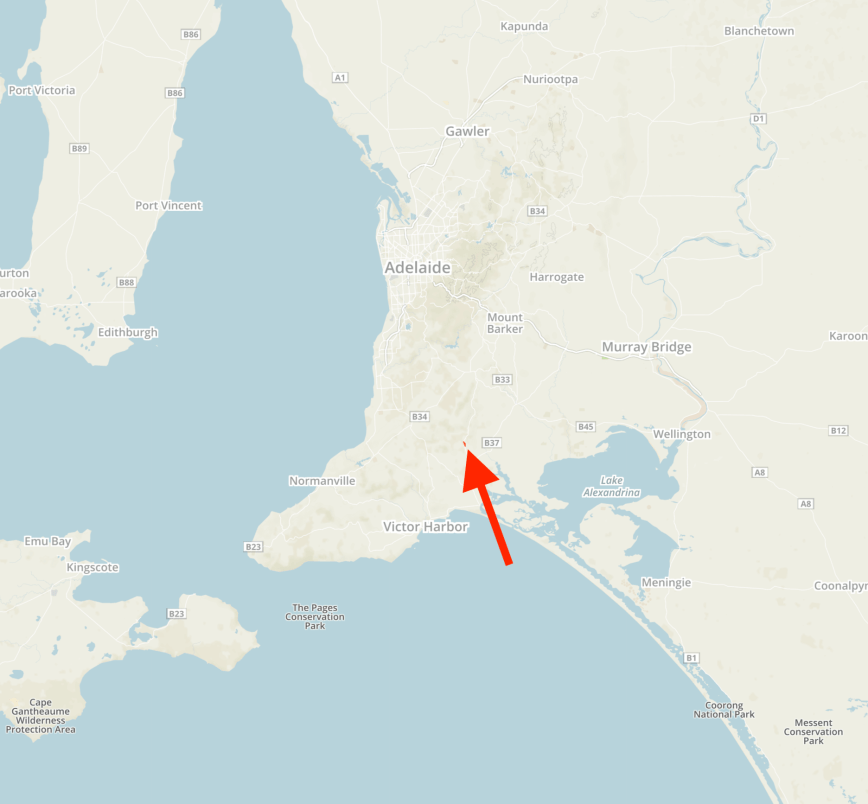
On the Sunday afternoon of the Oceania DX Contest (Sunday 6th October 2019) I decided the noise floor at home was that horrible, that I would head out to activate a park.  I chose the Cox Scrub Conservation Reserve VKFF-1701 which is located about 65 km south of Adelaide and about 8 km south of the town of Ashbourne.

Screen Shot 2019-10-27 at 11.26.24 am.png

Above:- Map showing the location of the Cox Scrub Conservation Reserve south of Adelaide.  Map courtesy of Protected Planet.

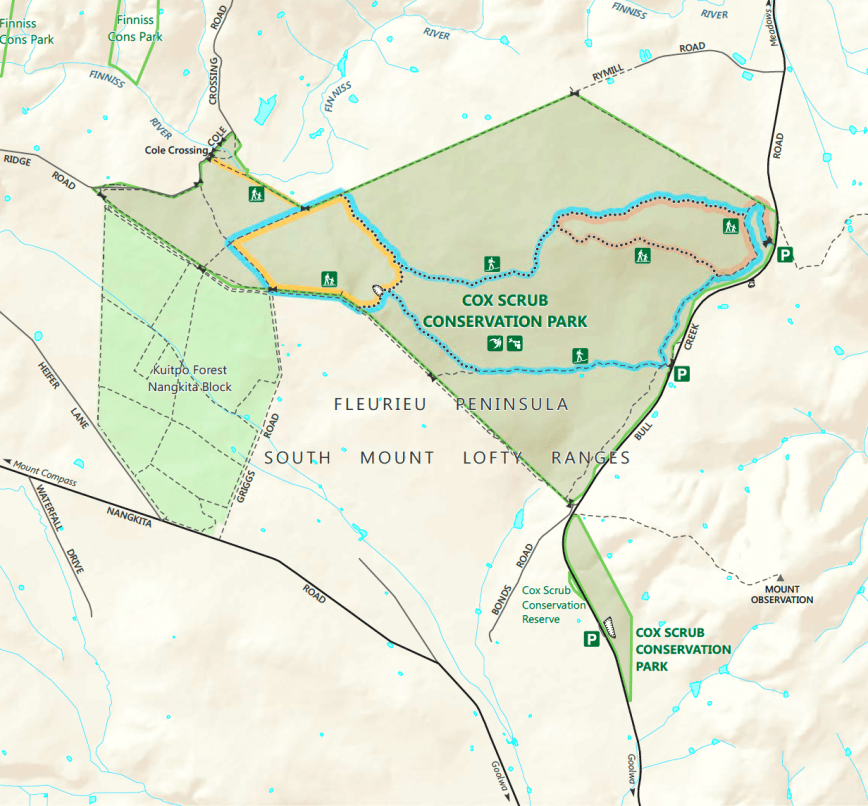
The Cox Scrub Conservation Reserve is not to be confused with its ‘bigger brother’, the Cox Scrub Conservation Park (which was formerly a National Park).  The Reserve is located a little further to the south on the Goolwa Road and is much smaller than the Conservation Park which is about 563 hectares in size.

Screen Shot 2019-10-27 at 11.35.33 am.png

Above:- Map showing the Cox Scrub Conservation Reserve, and the much larger Cox Scrub Conservation Park.  Map courtesy of National Parks SA

I have been unable to find any information on the Reserve on the internet.  The majority of the adjacent Conservation Park was previously owned by the late Mr. V. COX of Ashbourne, who preserved the area in a natural state for overwintering his honey bees.  In 1969 the land was purchased from Mr. COX on the condition that he was allowed to keep bees in the park.  This agreement was upheld until he passed away.

The Cox Scrub Conservation Park has an active Friends group who have a good website.  It can be located at…….

http://www.communitywebs.org/FriendsCoxScrub/history.php

During my visit to the Reserve, many of the native plants had started to come out in flower.  I only had my i-phone on this visit, and not the Nikon, so I apologise about the quality of the photos.

I drove down a narrow track running off the Goolwa Road and set up in a small clearing in amongst the scrub.  With a little bit of ‘bush bashing’ there was just enough room to string out the 20/40/80m linked dipole.

Screen Shot 2019-10-27 at 11.29.09 am.png

Above:- An aerial view of the Cox Scrub Conservation Reserve showing my operating spot.  Image courtesy of Google maps.

I headed to 7.144 and found Ian VK1DI/3 calling CQ from the Lake Tyers State Park VKFF-0761.  I logged Ian who had a great signal, and Ian then kindly handed the frequency over to me.  Next in the log was Geoff VK3SQ, followed by Garry VK3VLA, and then Deryck VK4FDJL/6.

As this was a contest I was unable to self spot on parksnpeaks, and as a result, it was very slow going.   I logged 28 stations on 40m from VK2, VK3, VK4, VK5, VK6, and VK7, before moving to the 80m band.

Just three stations made it into my log on 80m.  The first being John VK5BJE, followed by Adrian VK5AW in the Riverland, and finally Adrian VK5FANA on the Yorke Peninsula.

I went back to 40m and had a tune across the band, but heard very few DX stations.  Somewhat disappointed I packed up and headed home.

I worked the following stations on 40m SSB:-

  1. VK1DI/3 (Lake Tyers State Park VKFF-0761)
  2. VK3SQ
  3. VK3VLA
  4. VK4FDJL/6
  5. VK3PI
  6. VK2HHA
  7. VK7HCK
  8. VK3TNL
  9. VK3XPT
  10. VK3PT/m
  11. VK3NBL
  12. VK3AUQ
  13. VK3PF
  14. VK3RU
  15. VK2NSS
  16. VK2VH
  17. VK3MB
  18. VK7OT
  19. VK3MET
  20. VK3AVV
  21. VK3YAR
  22. VK5FMAZ
  23. VK2DWP
  24. VK5QD
  25. VK3FWDS
  26. VK2UXO
  27. VK3AQZ
  28. VK4FOMP/p
  29. VK3CLR
  30. VK3QA
  31. VK4PDX
  32. VK2KNV
  33. VK3ZM
  34. FK4QX
  35. VK2AU
  36. VK3KJ

I worked the following stations on 80m SSB:-

  1. VK5BJE
  2. VK5AW
  3. VK5FANA


References.

National Parks and Wildlife Service South Australia, 2019, ‘Cox Scrub Conservation Park PDF brochure’.

Wikipedia, 2019, <https://en.wikipedia.org/wiki/Cox_Scrub_Conservation_Park>, viewed 27th October 2019
2019 Oceania DX Contest

The 2019 Oceania DX Contest has been and gone for another year.  And this year I found band conditions really difficult.
download-1.png

The Oceania DX Contest is one of the longest-running contests in the amateur radio calendar.  It is an annual competition between radio amateurs to make contacts on the HF (shortwave) bands, specifically DX (long distance) contacts with stations in Oceania.

The contest ran for 24 hours from 0800 UTC Sat 5th – 0800 UTC Sun 6th October 2019.

Fighting off some bronchitis after my overseas trip, I had a very early night on Saturday night and as a result, I missed out on a lot of contacts.

I still haven’t done anything about a dedicated 80m antenna at home, so my handful of 80m contacts were made on my 40m dipole.

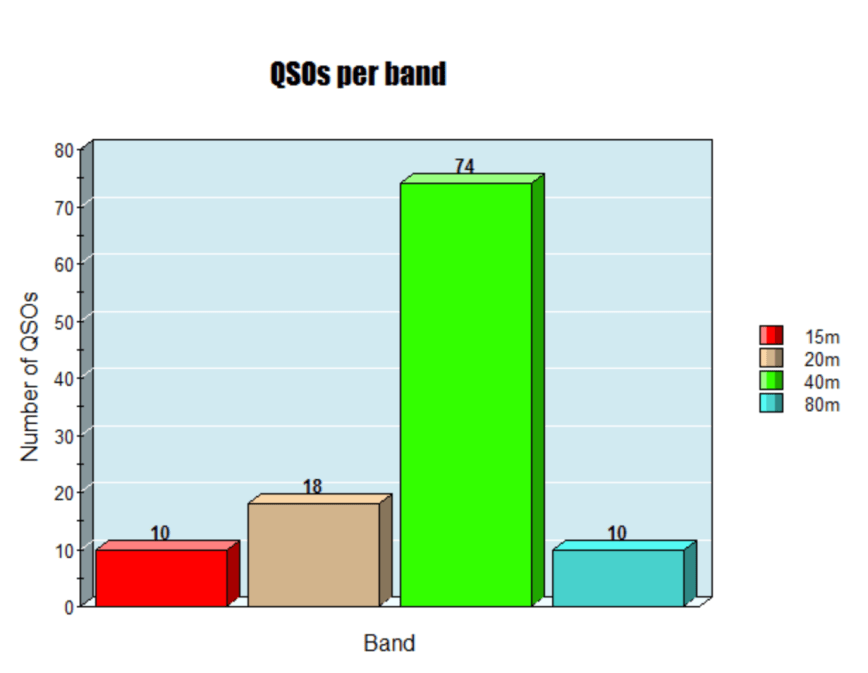
In the end, I made a total of 112 contacts on 15, 20, 40 & 80m SSB.  This was way down on my efforts in previous years:-

  • 2018 – 279 QSOs
  • 2017 – 497 QSOs
  • 2016 – 273 QSOs
  • 2015 – 400 QSOs
Screen Shot 2019-10-07 at 12.31.10 pm.png

Above:- Bar graph showing my QSOs per band during the contest.  Graph courtesy of https://nces.ed.gov

I worked the following DX entities:-

  1. Asiatic Russia
  2. Australia
  3. China
  4. European Russia
  5. Hawaii
  6. Hong Kong
  7. Indonesia
  8. Japan
  9. New Caledonia
  10. New Zealand
  11. Taiwan
  12. Thailand
  13. Tokelau Islands
  14. Tonga
  15. Ukraine
  16. United States of America

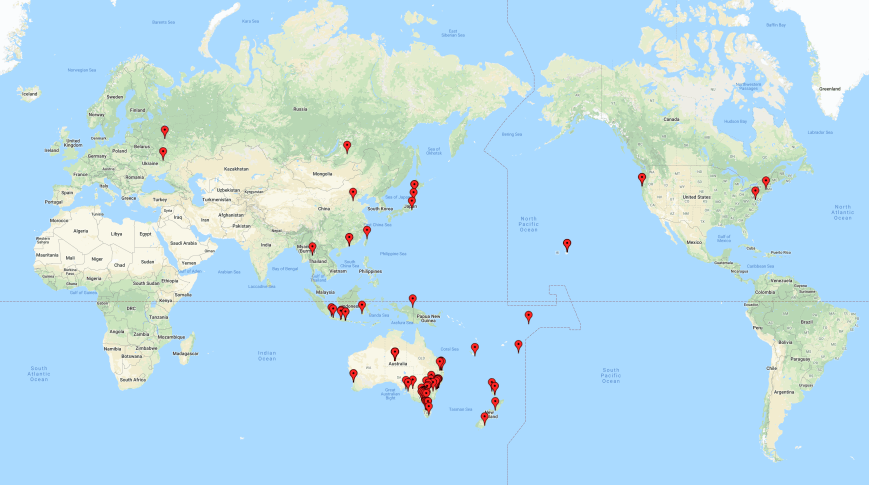
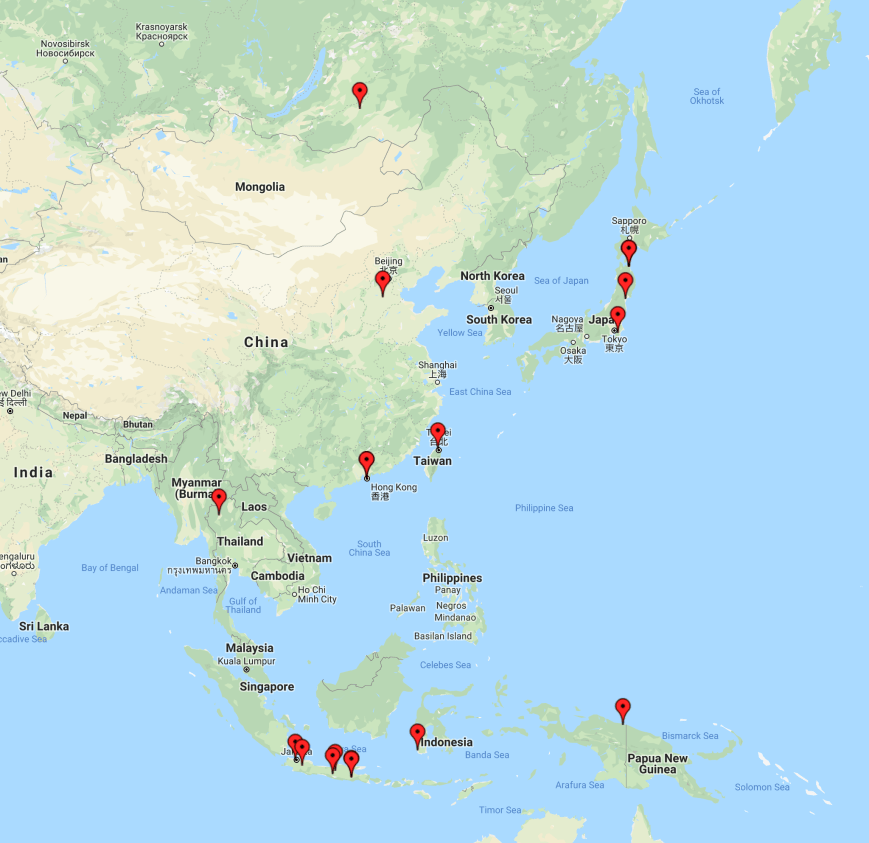
The map below shows my contacts around the world during the contest.

Screen Shot 2019-10-07 at 12.40.56 pm.png

Above:- Map showing my contacts around the world during the contest.

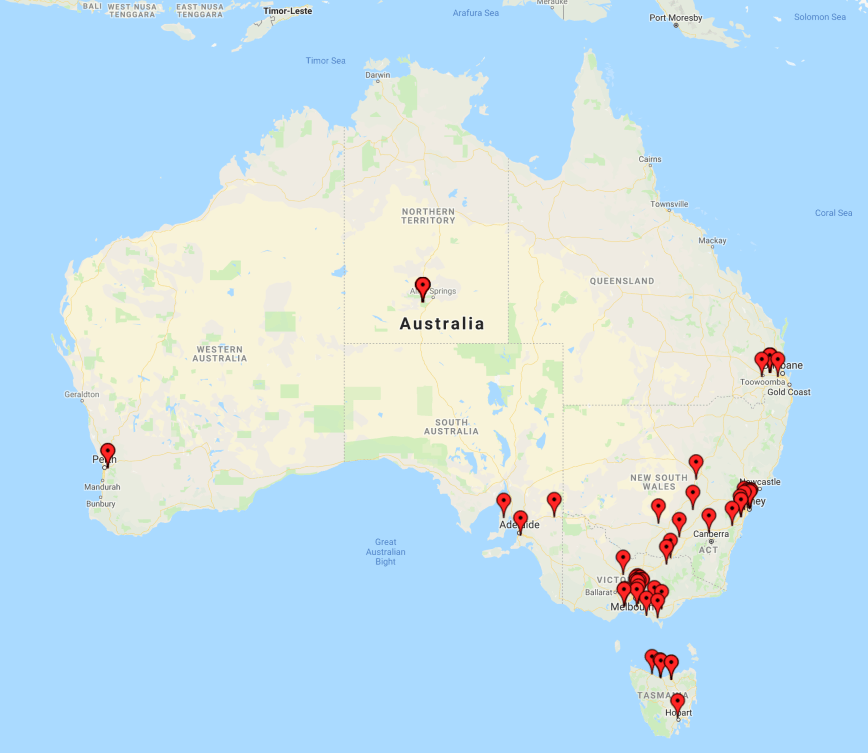
The vast majority of my contacts were around Australia on the 40m band.

Screen Shot 2019-10-07 at 12.41.13 pm

Above:- Map showing my contacts around Australia during the contest.

I worked very little in the way of Europe during the contest other than European Russia and Ukraine.  Those contacts were made during the early evening on 20m on the shortpath and on 15m short path.  I did not hear any opening to Europe on 20m long path.

Indonesian stations were very well represented during the contest.  I heard numerous Indonesian stations on 40m during Saturday evening, but my 100 watts and wire antenna just weren’t cutting it with most of those stations.

Sadly there was no major opening to Japan on 15m, with just a handful of Japanese stations worked on that band.

Screen Shot 2019-10-07 at 12.41.50 pm.png

Above:- Map showing my contacts into Asia during the contest.

The highlight for me this year was working A35JT on Tonga and ZK3A on Tokelau Islands, both on the 40m band.

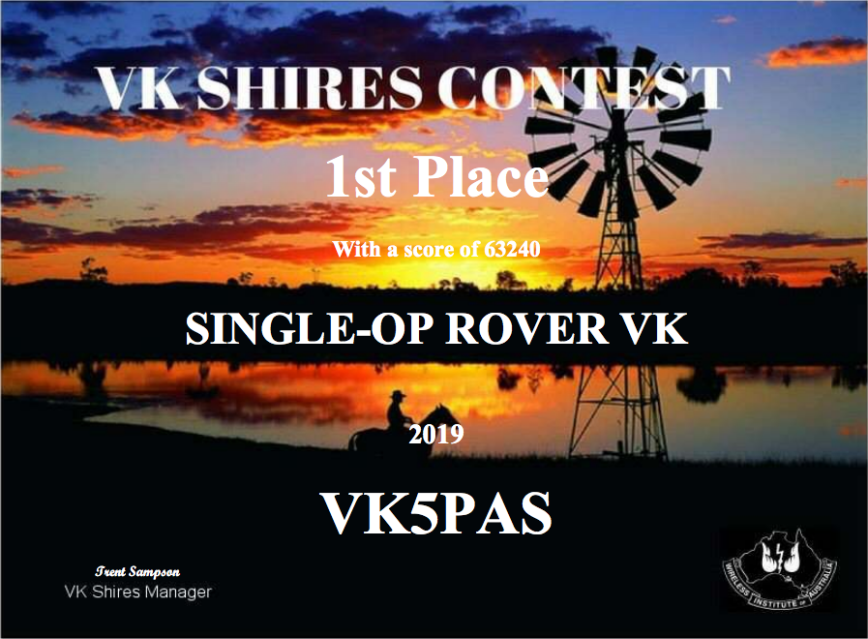
2019 VK Shires certificate
Hi all,
 
I checked the WIA website tonight and saw that I won the 2019 VK Shires Contest in the Single Op – Rover category.
 
I activated 6 parks in the Barossa Valley, Adelaide Hills, and the Fleurieu Peninsula in 6 different Shires.
 
Thanks to everyone who called and many thanks to the organisers.
 
Screen Shot 2019-10-04 at 7.58.55 pm.png