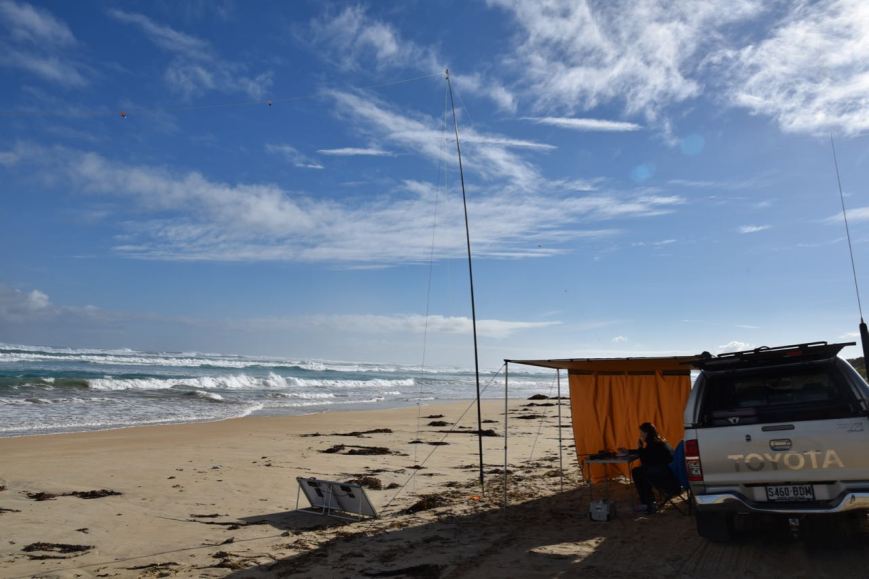
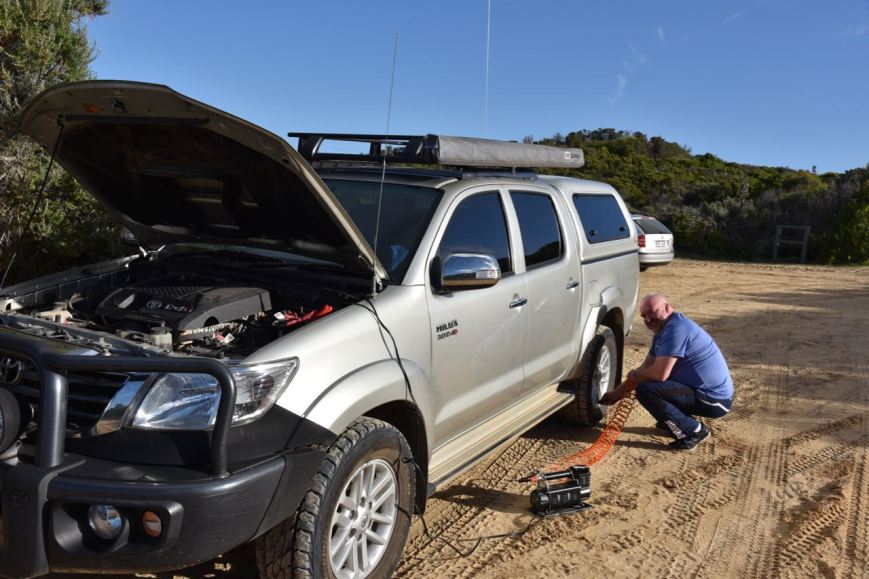
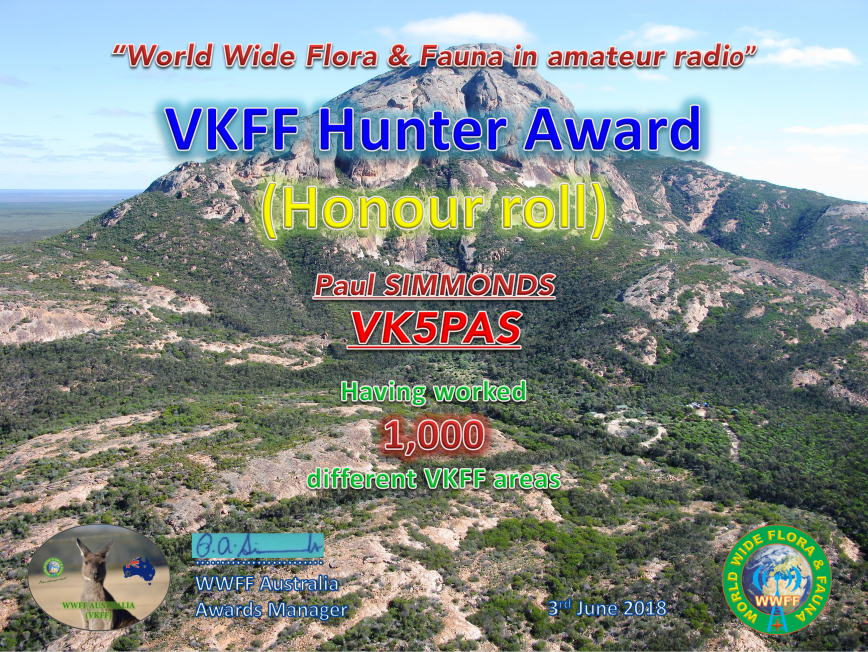
Tonight I applied for and received my latest certificate in the World Wide Flora Fauna program. It is the VKFF Hunter Honour Roll 900 certificate, issued for having worked 900 different VKFF references.
Many thanks to all of the VKFF activators.

Tonight I applied for and received my latest certificate in the World Wide Flora Fauna program. It is the VKFF Hunter Honour Roll 900 certificate, issued for having worked 900 different VKFF references.
Many thanks to all of the VKFF activators.

After leaving the Little Dip Conservation Park and reinflating our tyres, we headed back towards Robe to refuel, before continuing on our way home.
As we travelled north on the Nora Creina Road we stopped briefly to have a look at ‘Dingley Dell’, a little freestone cottage which was built by George Kendle in 1861. It was named after Mr. Wardle’s home in Charles Dickens’ novel, ‘The Pickwick Papers’. Alexander Tolmer, previously Robe’s Superintendent of Police, moved here in 1865 when he became Crown Lands Ranger for the Guichen Bay district. The poet Adam Lindsay Gordon, was a frequent visitor. From the mid 1870’s Dingley Dell was the home of William and Anna Maria Dawson and their eleven children. Their great grand daughter Helen, and her husbamd Ray Fulbohm have restored the old homestead.

A little further up the road we stopped to have a look at the old CSIRO Field Station and Research Farm which operated between 1935 and 1976, was the site of research on pasture trace minerals deficiency in the diet of local sheep.

We headed back into Robe and refuelled. As we left Rove we stopped to have a look at the old Bush Inn, which was built in 1852 and licensed in 1855. It was also known as Mac’s Hotel and Carrier’s Arms to 1871.

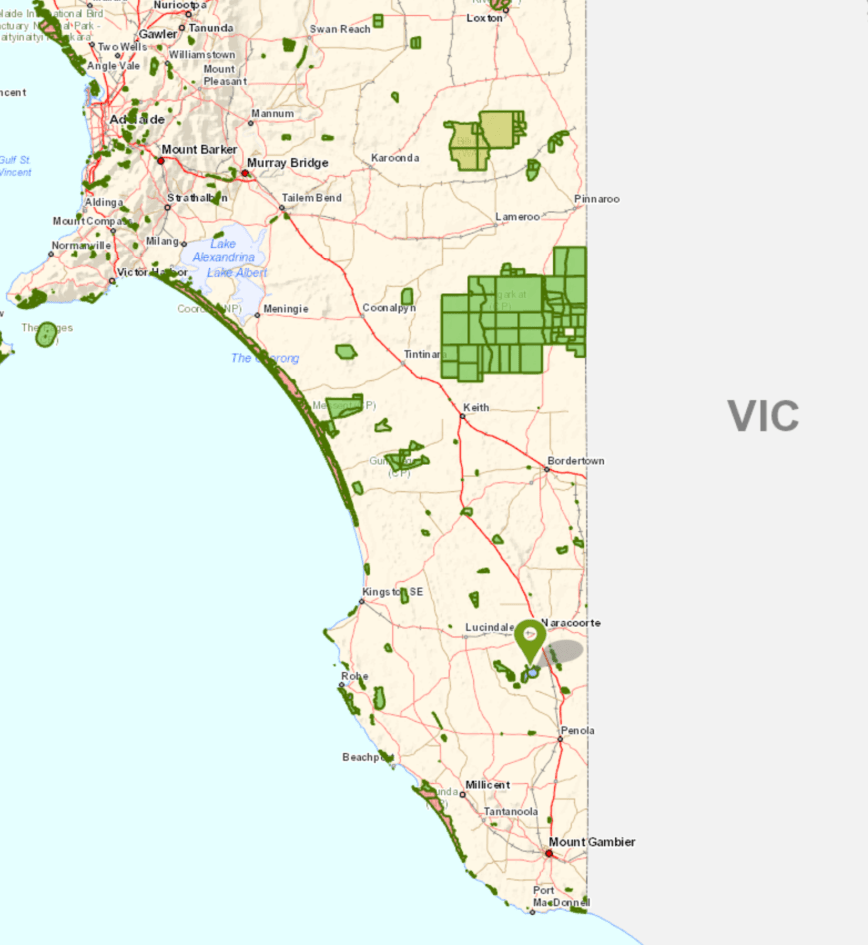
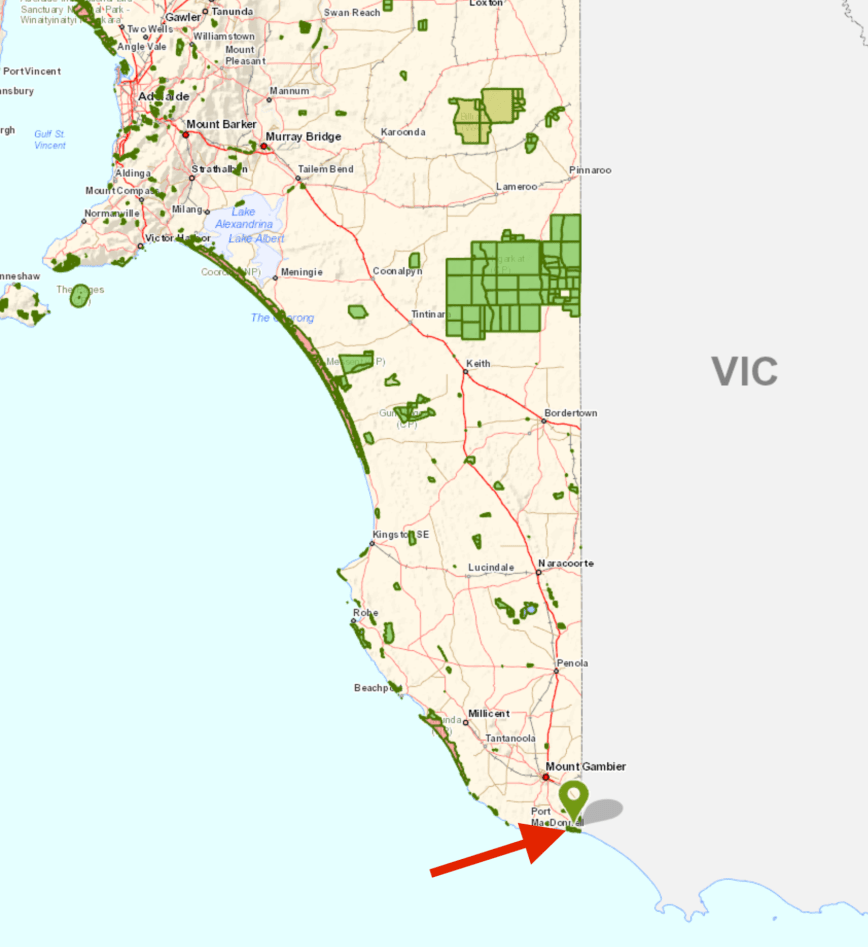
We left Robe, travelling north on the Southern Ports Highway, and took a detour to Cape Jaffa to have a look at the new marina which is in development. Whilst there we decided to do a quick activation of the Bernouilli Conservation Reserve VKFF-1684, from the vehicle.

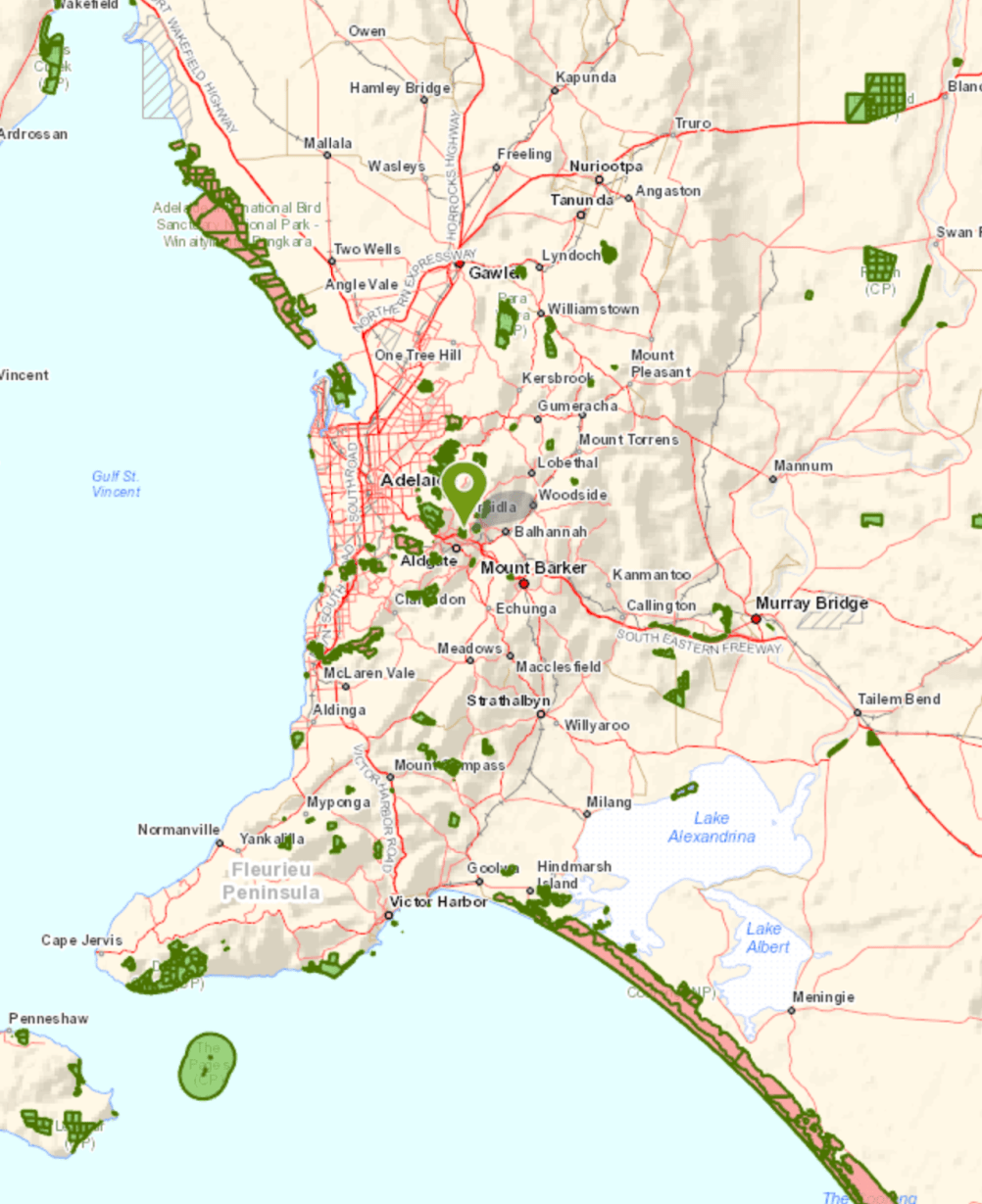
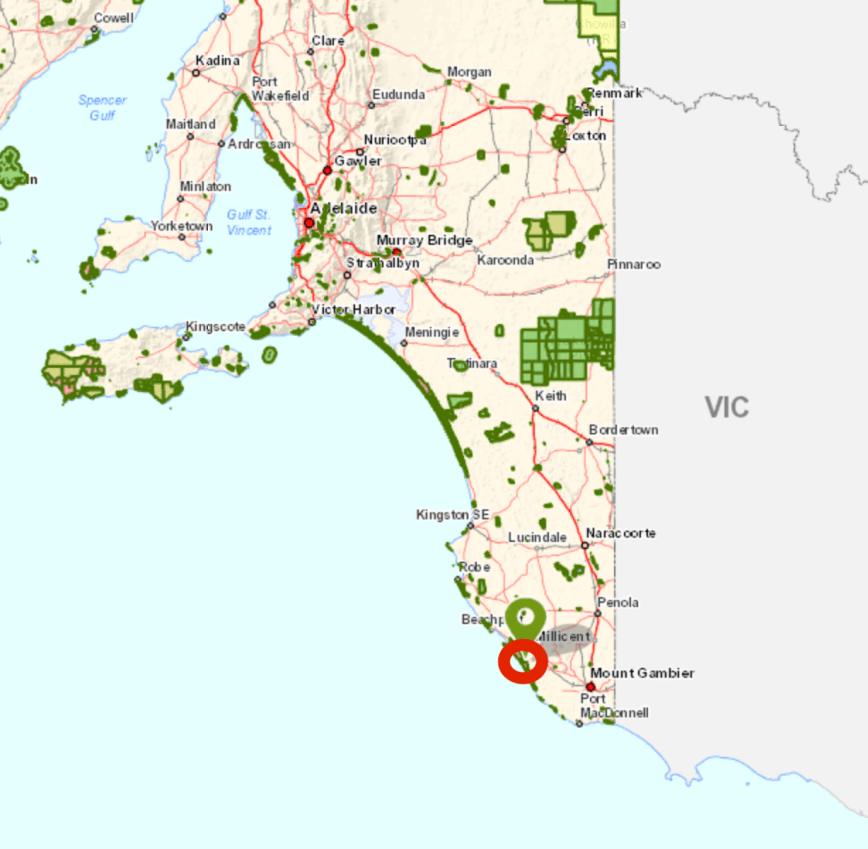
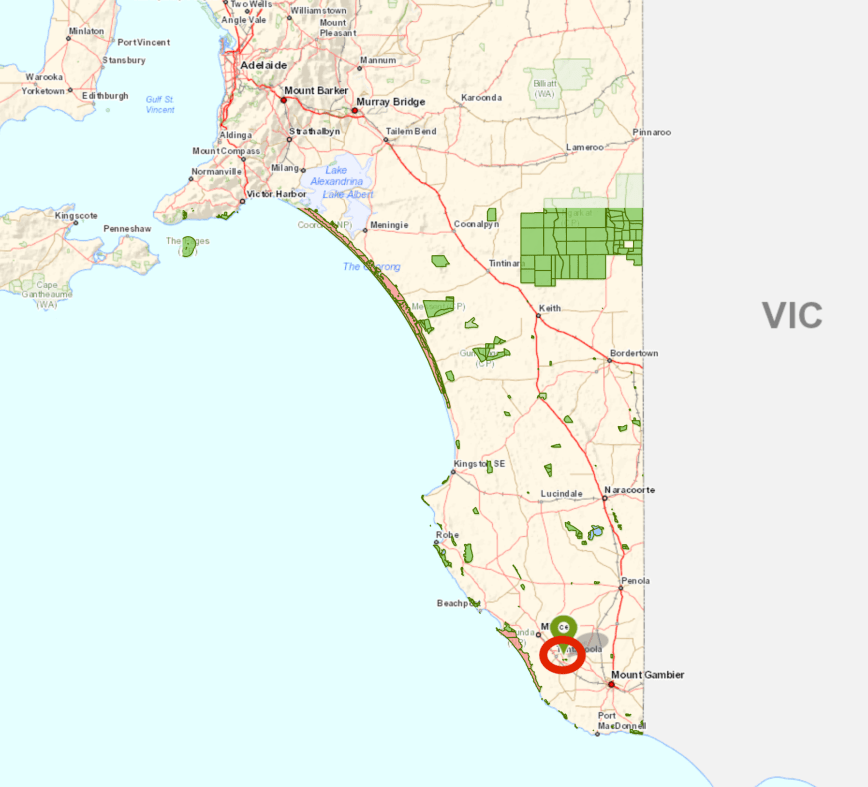
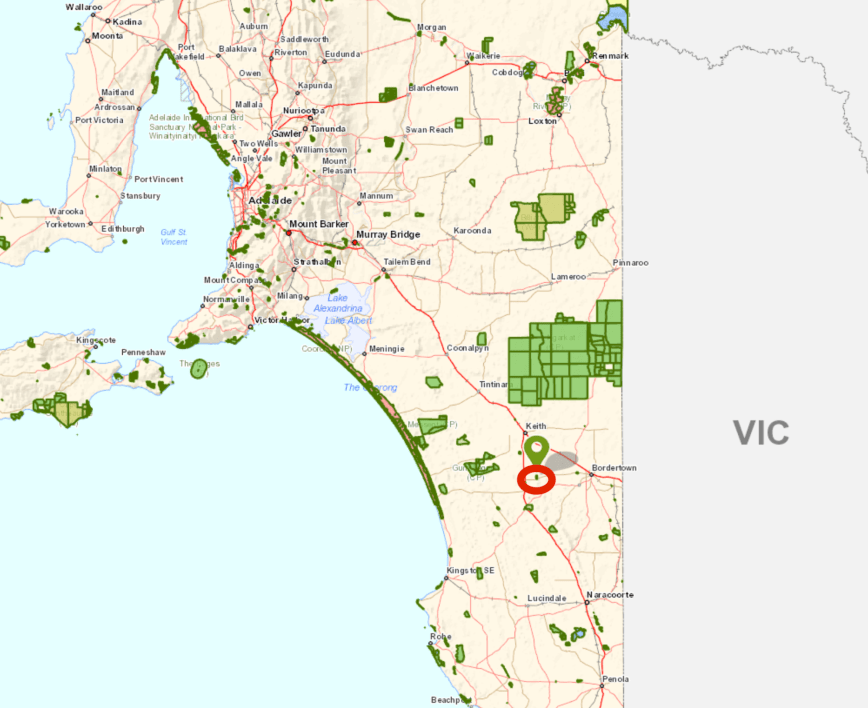
Above:- Map showing the location of the Bernouilli Conservation Park. Map courtesy of Location SA Map Viewer.
Bernouilli Conservation Park is located just south of Cape Jaffa and extends south and south-east for just over 7km. The park is about 266 hectares in size and was proclaimed on the 11th November 1993. The park consists of a coastal dune system. It is dominated by Tall Shrubland with Coast Beard-heath), Coast Wattle and Coast Daisy-bush.
The name of the park is derived from Cape Bernouilli, the former name of the headland of Cape Jaffa.
Over 40 species of bird have been recorded in the park including Musk Duck, Hooded Plover, Superb Fairywren, Singing Honeyeater, Rufous Bristlebird, Orange-bellied Parrot, Red-capped Plover, Spiny-cheeked Honeyeater, Striated Fieldwren, and White-browed Babbler.

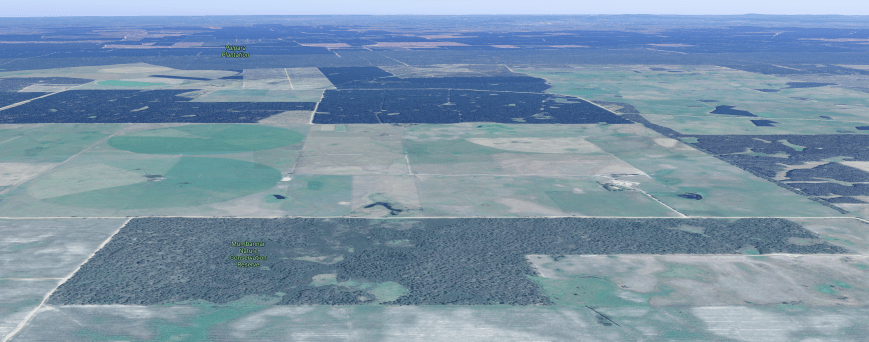
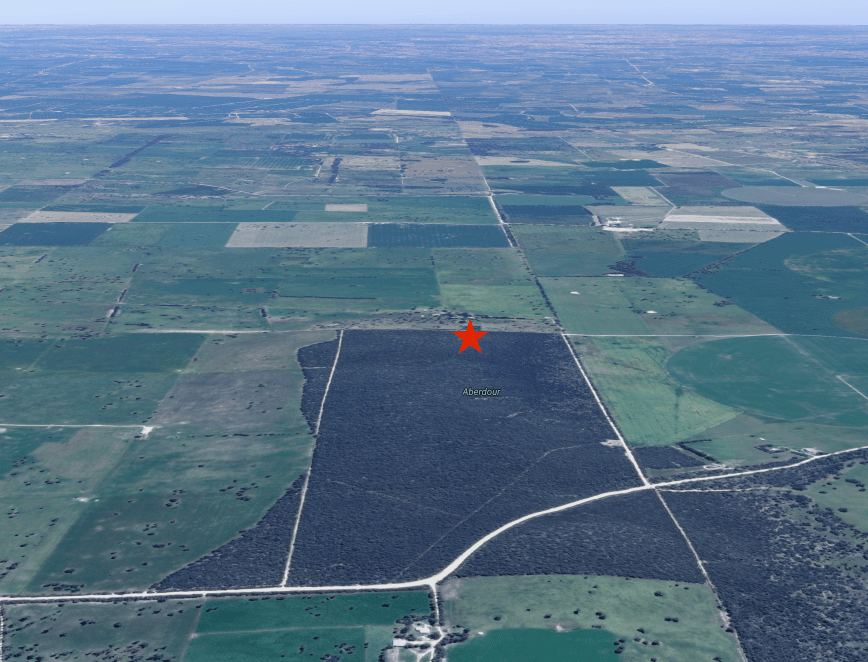
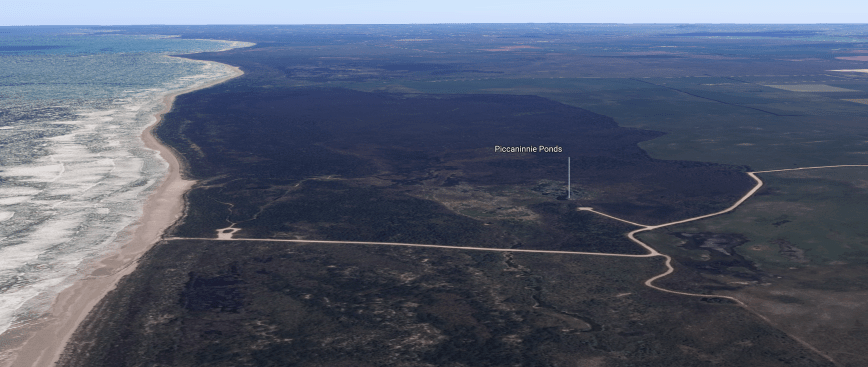
Above:- Aerial shot of the Bernouilli Conservation Park. Image courtesy of google maps.
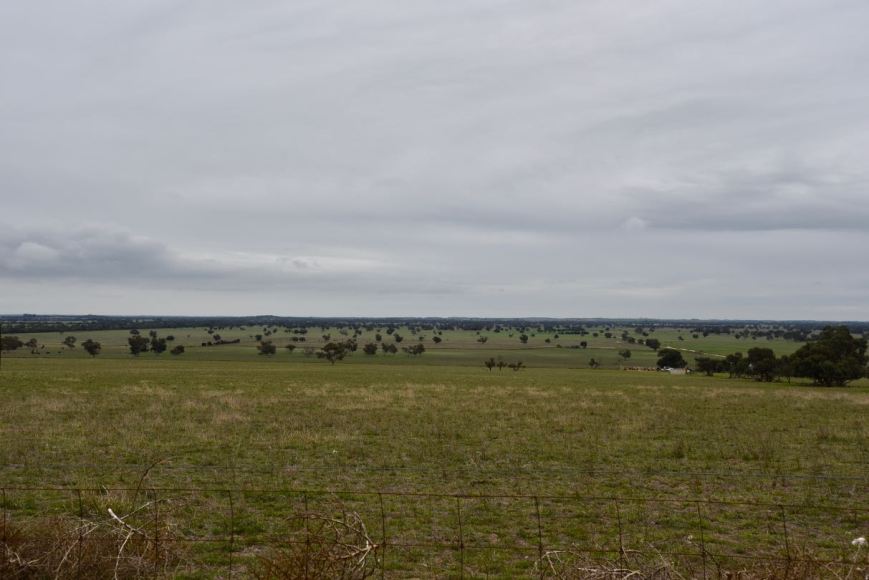
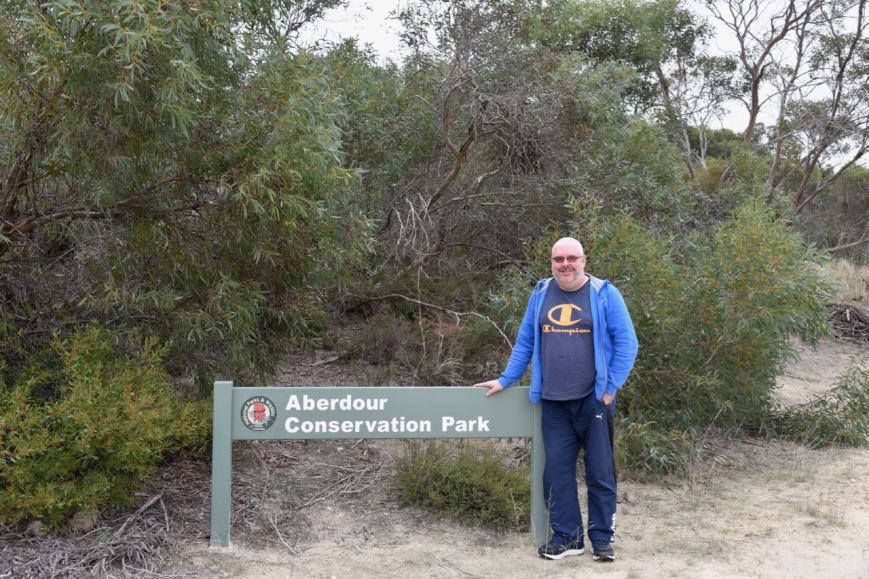
We travelled to the end of Rothalls Road and soon found a park sign at the north eastern corner of the park.
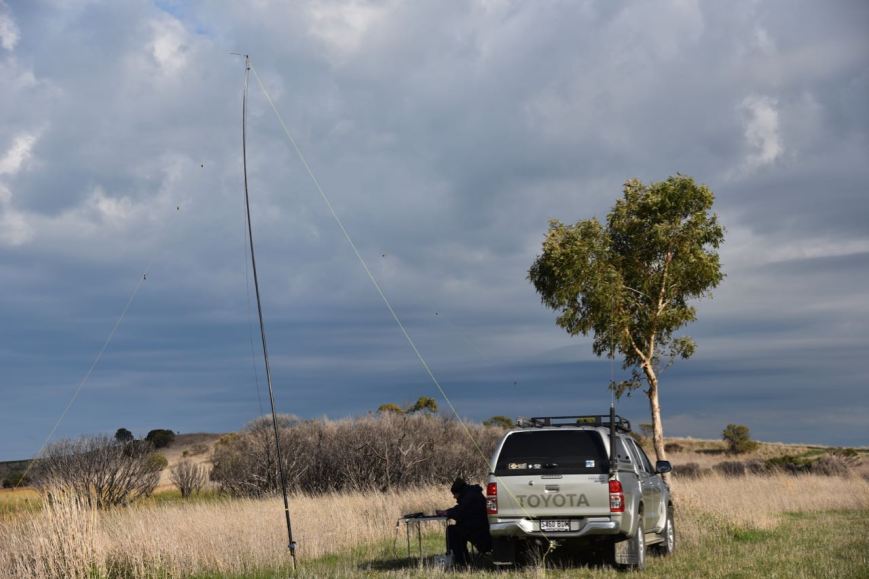
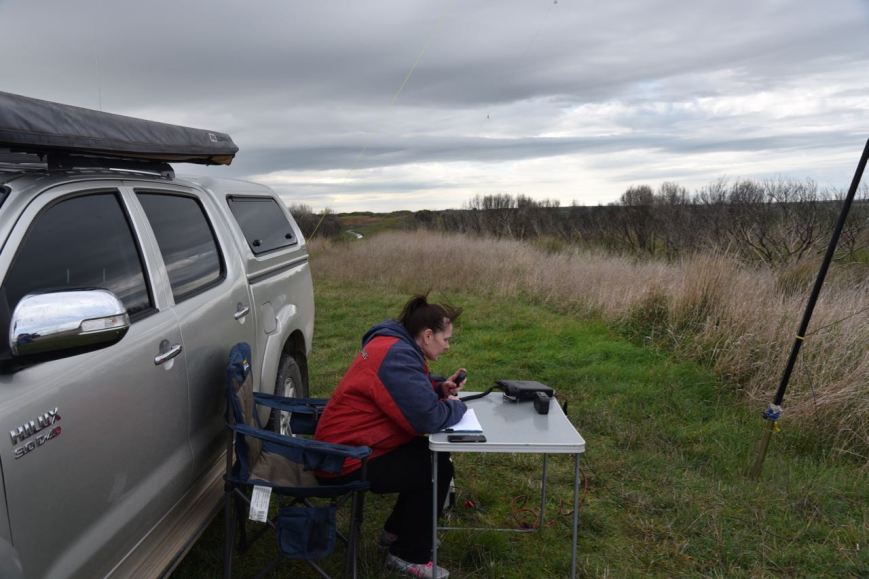
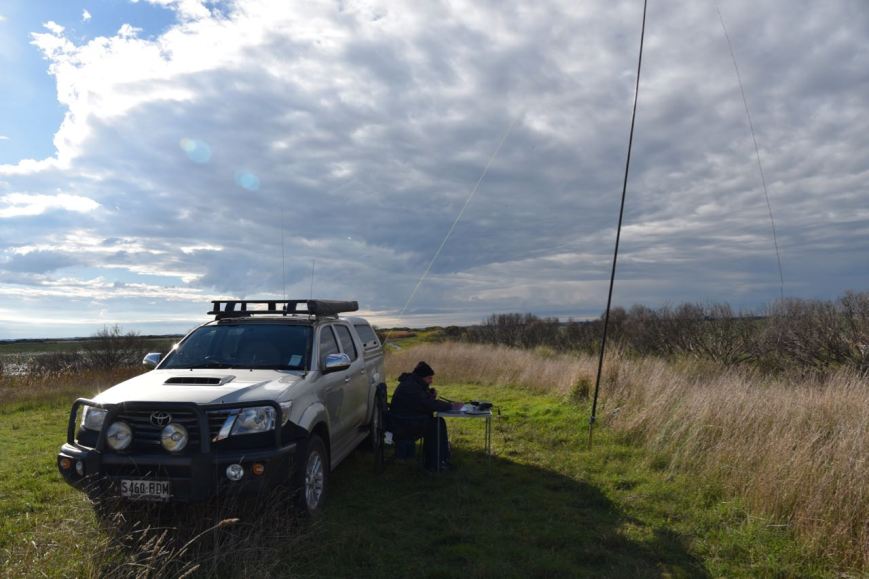
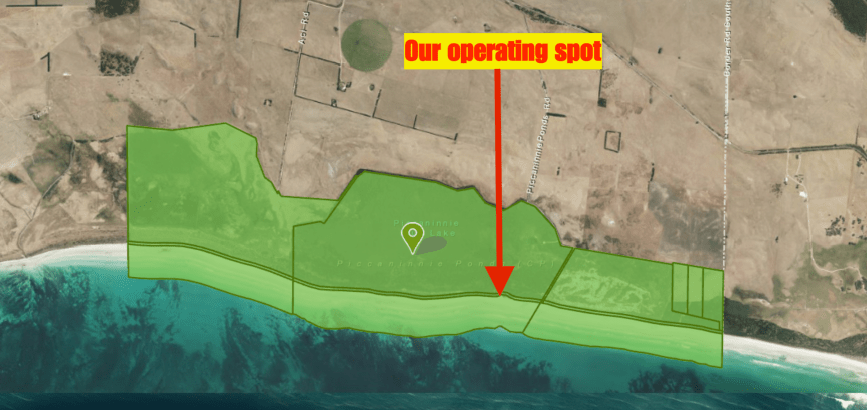
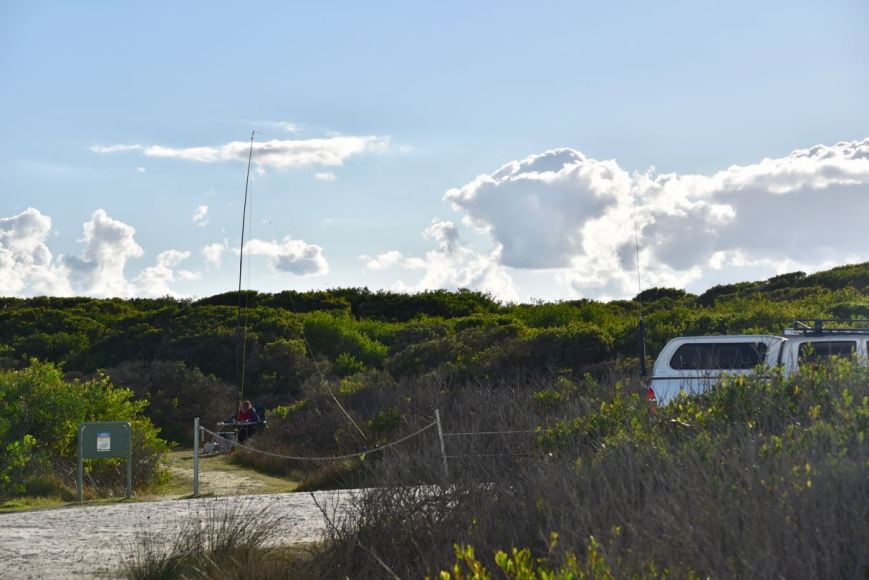
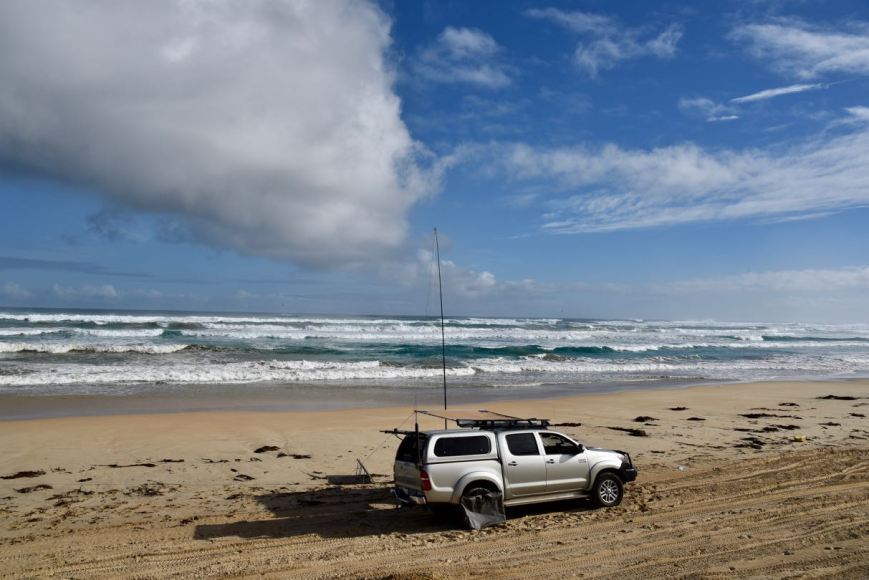
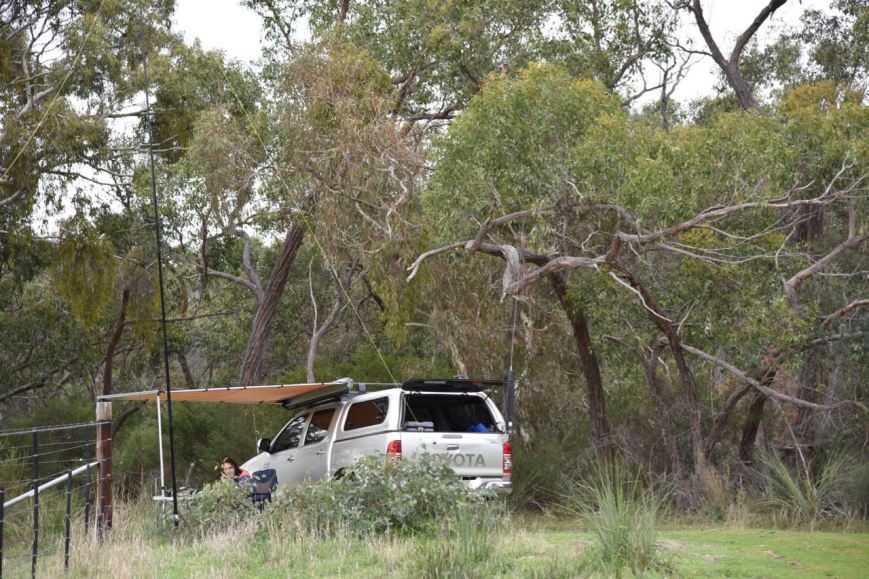
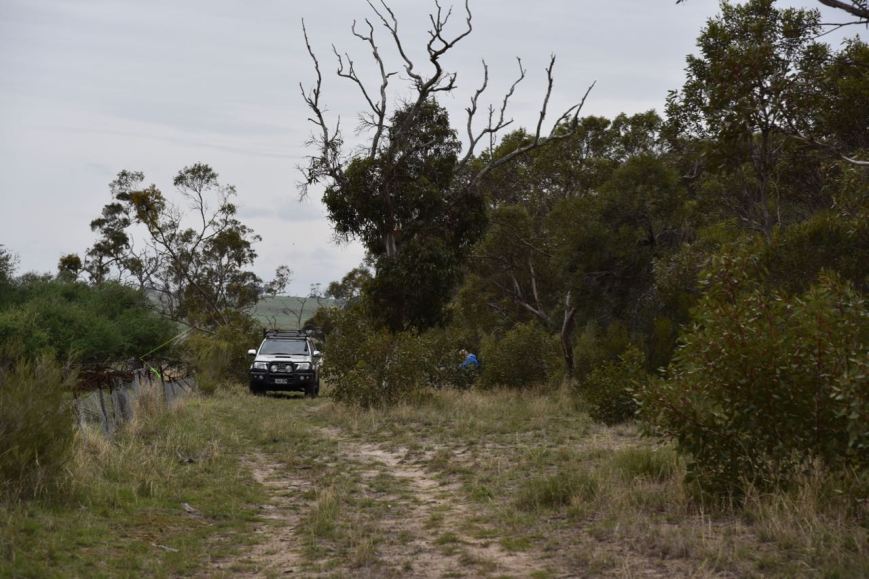
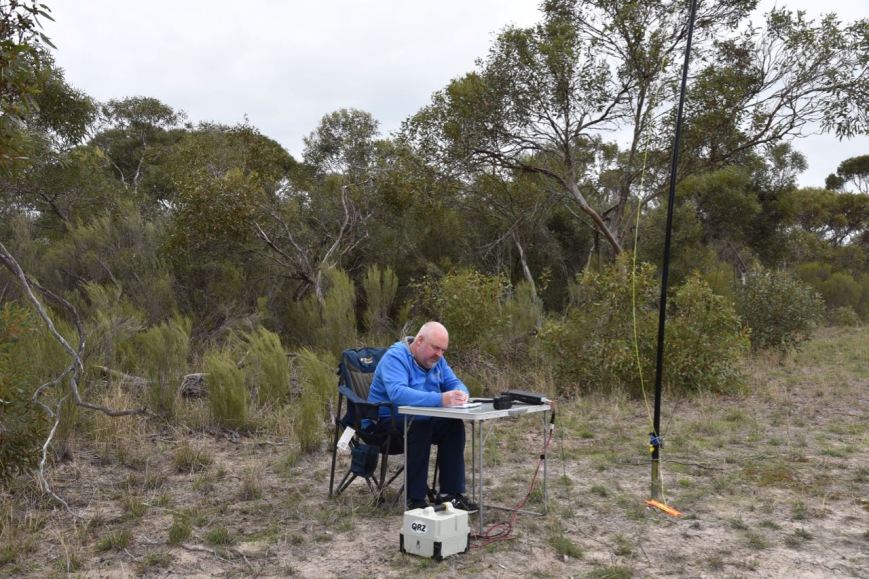
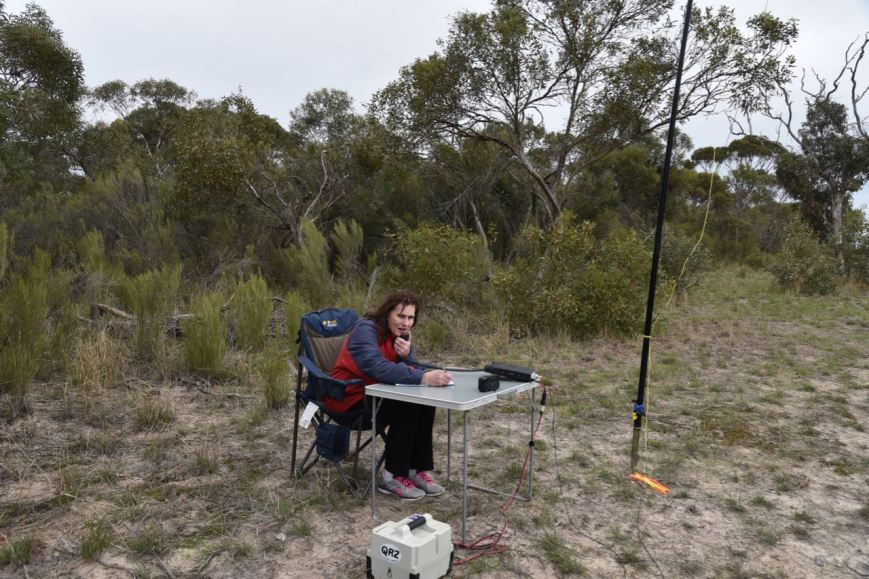
Depending on what maps you look at, you may or may not see a road which follows the eastern boundary of the park. We followed that road until we found a gap in the scrub and pulled the vehicle into the clearing. We operated from the vehicle using the Icom IC-7000 and the Codan 9350 self tuning antenna mounted on the rear of the Toyota Hi Lux.

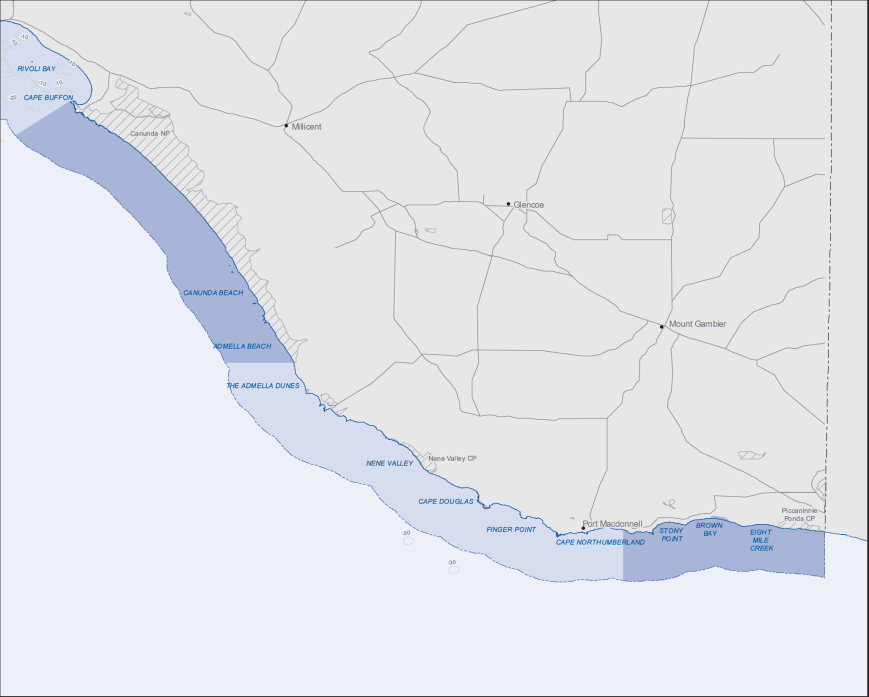
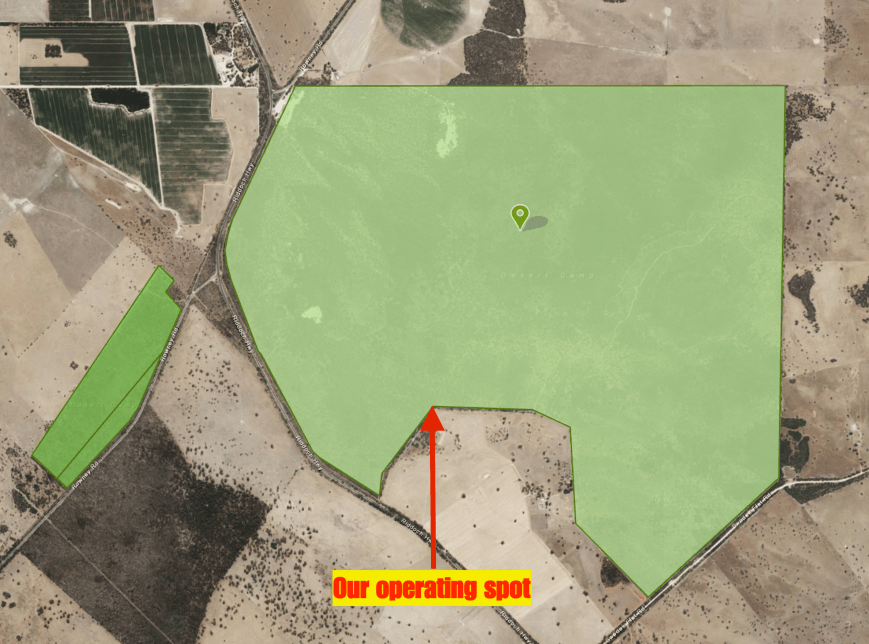
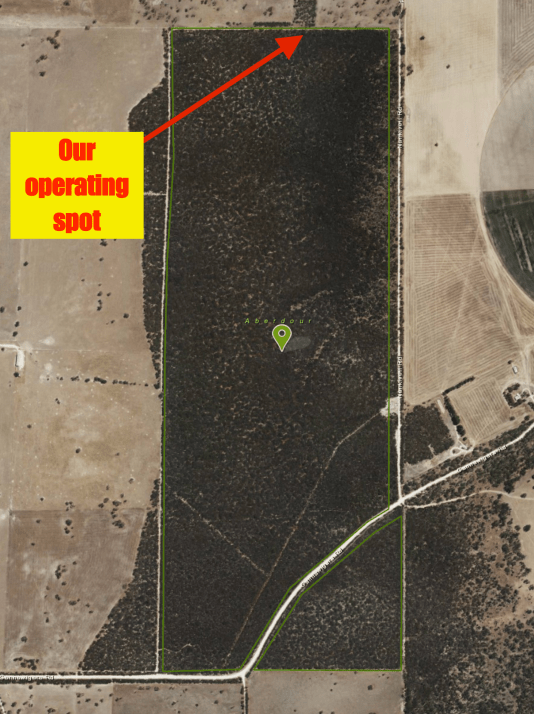
Above:- Map of the park showing our operating spot. Map courtesy of Location SA Map Viewer.
Upon turning on the transceiver we found Liz VK2XSE/p on 7.144 calling CQ from Barren Grounds Nature Reserve VKFF-1885. Both Marija and I logged Liz, Park to Park.
We then moved down to 7.139 and I started calling CQ whilst Marija spotted me on parksnpeaks. My first caller was Ron VK3AHR, followed by Peter VK3PF, and then Brian VK3BBB. Contact number 10, qualifying the park for VKFF, was with Allen VK3ARH, about 10 minutes into the activation. I logged just one more station, Geoff VK3SQ, before we decided we had better pack up and hit the road again.

This is a park that Marija and I will need to go back to, so that Marija can qualify the park, and I can get my remaining contacts towards the 44 required to qualify the park for the WWFF global award.
Marija worked the following station on 40m SSB:-
I worked the following stations on 40m SSB:-
After leaving the park we drove down to the foreshore area of Cape Jaffa. We stopped briefly to have a look at the seafarers memorial. This recognises lighthouse keepers, seafarers, and fisherman who have lost their lives in the Cape Jaffa area.
We took the Cape Jaffa Road out of town and soon reached the Southern Ports Highway and headed north. At Reedy Creek we stopped to have a look at the police memorial re the murder of Trooper Harry Edmonds Pearce way back in 1881.
In 1881 Trooper Pearce who was stationed at Kingston was ordered to escort a Robert Johnson alias William Nugent to court to appear on charges of having sold liquor to aborigines, and also for having been in possession of a stolen horse. Trooper Pearce had escorted his prisoner for about 2 miles when Johnson dismounted from his horse and refused to go any further. Johnson then tackled the trooper with a long knife and during the struggle Pearce’s hands were cut and he was unable to use his revolver. Johnson proceeded to strike Pearce a number of times and attempted to cut his throat as the two wrestled together. Upon being slashed to the abodomen Pearce became faint and then collapsed. Johnson then turned the trooper’s horse adrift and left him to die. Pearce was found the next morning but died from his wounds on the 18th May 1881. Many years ago I worked in the Police Force with the gt gt gt grand daughter of Pearce.

We continued on to Kingston, where we stopped for a bite to eat and then continued on the Princes Highway, passing the Coorong. Our next stop was at Jack Point where there is a Pelican Observatory Walk. The bird hide overlooks a cluster of small islands where pelicans, terns, seagulls have established large permanent breeding colonies. Sadly we didn’t see any pelicans. We did observe some other waterbirds.
We had noticed during our trip that the Coorong was incredibly dry. We have only had 10mm of rain this Summer and no doubt that has had a big impact.
But we did see dozens of Singing Honeyeaters. And they were not easy to photograph. They were very quick and just as I was about to take a shot, they would dart off to another shrub. But I did manage to capture a few shots.
Once we got back onto the Princes Highway we did see a large flock of pelicans soaring in the breeze. Perhaps they were heading to Jack Point?

We arrived home around tea time on Monday night and commenced unpacking. It had been a terrific 4 days away. We had activated 8 South Australian parks and had made 531 contacts, which included about 124 Park to Park contacts.
THANKYOU to everyone who called us during our activations.
References.
Birds SA, 2018, <https://birdssa.asn.au/location/bernouilli-conservation-reserve/>, viewed 16th March 2018
Coorong Country, 2018, <https://coorongcountry.com.au/coorong-walking-trails/>, viewed 16th March 2018
National Trust, 2018, <https://www.nationaltrust.org.au/places/robe-csiro-research-station/>, viewed 16th March 2018
Wikipedia, 2018, <https://en.wikipedia.org/wiki/Bernouilli_Conservation_Reserve>, viewed 16th March 2018
It was now Monday 12th March 2018 and time for us to head home. After a relatively early start Marija and I headed down to the main street of Robe for a bite to eat. We went to the Union Cafe and enjoyed a very nice cooked breakfast. We then decided to head back to the Little Dip Conservation Park to do some 4WDing. We had toyed with the idea of getting down onto the beach in the Coorong National Park, but decided on Little Dip instead. And I’m pleased we did. We were to have a great time.
We accessed the park via the Douglas Dawson Track which is at the end of Beacon Hill Road. We took the short detour first to the top of Beacon Hill where there is a lookout which offers some great views of Robe and the surrounding countryside.
It was then into Little Dip. We deflated the tyre pressure down to about 15 psi and headed off down the track, which initially started off quite rocky, but soon became sandy.
We decided whilst we were travelling through the park that Marija would put out a few calls on 40m to log a few stations from the mobile. Marija was only on air for a short time, as the track became very bumpy and we decided 4 eyes on the track were better than 2.
Marija worked the following stations on 40m SSB:-
A short distance along the track we came to a junction and sat there for a while pondering on which direction to go. It was at that time that another 4WD pulled up. It was a couple from Victoria, Phil and Bianca, and their son Mitchell. They told us they had got bogged the day before, and we decided to team up and do the track together.
The track from Robe to Nora Creina is about 21 km. We found it a little challenging in 2 parts, both of these being dune climbs. The beach is also quite soft and boggy in parts. The track takes you through sand dunes, rocky trails, and down onto the beach on a number of occasions.
We would highly recommend this 4WD trip if you are in the Robe area. If you do decide to do the trip, remember:-

After leaving the Lake Hawdon South Conservation Park, Marija and I headed down to the town of Beachport, about 47 km south of Robe. As we travelled along Clay Wells Road on our way to the Southern Ports Highway we spoke to Ian VK1DI/p from the mobile. Ian was activating the Cuumbeun Nature Reserve VKFF-1920 and had a strong 5/8 signal into the mobile.
We travelled south on the Southern Ports Highway and then took a short detour off the highway to have a look at the Woakwine Cutting. This said to be Australia’s largest one man engineering feat. The cutting was excavated to drain land behind the Woakwine Range. During the 1880’s the McCourt family moved into the Woakwine area. It was soon realised that without richer land to compliment the rocky high country, making a living on the land would be difficult. In 1957 Murray McCourt commenced the construction of a channel from the swamp through the range to Lake George with a view fo draining a large swamp on his property.
There is a display of machines used to make the cutting and a viewing platform, but this was closed. I had to drive down the road and then make my way through the scrub to get a view of the cutting. It is an amazing piece of engineering.
Below is a video which gives you a good idea of this amazing feat.
We soon reached Beachport, a small town of around 880 people. The town was named on 23 May 1878 for the then British Secretary of State for the Colonies, Michael Hicks Beach, 1st Earl St Aldwyn. Beachport has a large crayfishing fleet, and is known for its 772-metre (2,533 ft)-long jetty.
We stopped off first to have a look at the Beachport Customs House which was used between 1879-1900. It was originally located at the railway yards and was used to record incoming and outgoing goods. Following Federation, the buidling was used as a railway office for goods and for men who travelled down in front of the train on a trolley to ensure that the tracks were clear. Men would sleep overnight in the buidling and return back ahead of the train the following day.
We then drove along the Scenic Road in Beachport taking in some of the great views of the lighthouse, the town itself and the surrounding coastline.
There was plenty of activity down on the beach by 4WD enthusiasts.

We decided to do a very quick activation of the Beachport Conservation Park 5CP-014 & VKFF-0791, but from the vehicle.

Above:- Map showing the location of the Beachport Conservation Park. Map courtesy of Location SA Map Viewer.
Beachport Conservation park is about 875 hectares (1.160 acres) in size and was established on 1st January 1959. The conservation park was originally created as a reserve in 1959, declared as a National Park in 1959 and was re-proclaimed as a conservation park under the National Parks and Wildlife Act 1972 for the purpose of setting ‘aside to preserve and protect a representative sample of the coastal environment of south east South Australia.’

We travelled along a sandy track at the end of Scenic Way and found a small clearing off the side of the track. We didn’t want to venture too far, as the sand was very boggy and I didn’t plan on spending an hour or two digging our way out.

Above:- Map of the Beachport Conservation Park showing our operating spot. Map courtesy of Location SA Map Viewer.
I called CQ on 7.135 and this was answered by Hans VK5YX/2 who was in the Kosciuszko National Park VKFF-0269. It was relatively slow going from the vehicle, with signals being a bit down with my mobile antenna compared to the linked dipole. But within about 13 minutes I had contact number 10 in the log, with a QSO with Bill VK4FW/p who was activating the Reinke Scrub Conservation Park VKFF-1634. Marija also logged Bill.
I worked a further 4 stations before heading down to 80m very quickly where I logged my good mate Ivan VK5HS, who was booming in from the Riverland region of South Australia. Marija also logged Ivan.
Marija worked the following station on 40m SSB:-
Marija worked the following station on 80m SSB:-
I worked the following stations on 40m SSB:-
I worked the following station on 80m SSB:-
We then drove back into Robe and out along the Lake George Road and back into the Beachport Conservation Park. This part of the park is suitable for conventional vehicles.
We stopped briefly to have a look at Wooley Waterhole. Native birds including Superb Fairy Wrens, Red-browned finches and Yellow-rumped Thornbills depend on this waterhole for fresh water. It is beieved the waterhole was dug during the late 1800’s. I captured a shot of a Grey Fantail at the waterhole.
I also caught these two Silvereyes heading down for a drink.

We then stopped to have a look at the memorial plaque in the park which recognises the old Robe to Beachport track, which was once used by mail coaches and travelleres passing through what is now known as Wooley Lake. The waters of the lake often quenched the thirst of horses and travelleres, but today only the waterhole remains fresh.
We then took a short detour off road to have a look at Lake George. It was bone dry during our visit, but each year high tides and fresh water run off into drains that fill the lake. During these periods you can often see windsurfers on the lake and people swimming. But not during our visit.

We headed back in to Beachport and headed to the local hotel for a feed and a few cold beverages. It was a great meal.

On our way back to Robe we stopped off to have a look at the memorial for two Able Seaman, W.L.E. Danswan and T.W. Todd who lost their lives on the beach at Beachport when a German mine they were destroying exploded on 14th July 1941. These men were the first casualties due to enemy action on Australian soil during World War Two. There is also a memorial here to all fishermen who have died in the Beachport area.
It was the end of another great day, with an amazing sunset. This is certainly a very beautiful part of South Australia.

References.
Wattle Range Council, 2018, <http://www.wattlerange.sa.gov.au/page.aspx?u=2341>, viewed 15th March 2018
Wikipedia, 2018, <https://en.wikipedia.org/wiki/Beachport>, viewed 15th March 2018
Wikipedia, 2018, <https://en.wikipedia.org/wiki/Beachport_Conservation_Park>, viewed 15th March 2018
Our second park for Sunday 11th March 2018 was the Lake Hawdon South Conservation Park 5CP-110 & VKFF-1045. The park is located about 12 km east of the town of Robe and about 388 km south east of the city of Adelaide.

Above:- Map showing the location of the Lake Hawdon South Conservation Park. Map courtesy of Location SA Map Viewer.
The Lake Hawdon Conservation Park was gazetted in February 2010 and is about 3,190 hectares in size. The park is part of the Lake Hawdon System Important Bird Area, which comprises an area of 374 square kilometres covering a series of five coastal lakes: Lake Hawdon, Lake Robe, Lake Eliza, Lae St Clair, and Lake George.

Above:- An aerial shot of the Lake Hawdon South Conservation Park. Image courtesy of google maps.
The wetland system was identified by BirdLife International as an IBA because it regularly supports over 1% of the world populations of red-necked stint, and often of sharp-tailed sandpipers, double-banded plovers and banded stilts. It also provides habitat for orange-bellied parrots, Australasian bitterns, rufous bristlebirds and striated fieldwrens.

Above:- Orange-bellied parrot. Image courtesy of eikipedia
Lake Hawdon is an ephemeral wetland, meaning it lasts for a very short time. It is typified by seasonal brackish swamps surrounded by cleared grazing land. It contains large expanses of sedgelands which are of high conservation value as there are no comparable areas of sedgeland remaining in the South East of South Australia.
The park is home to a number of native animals including the Western Grey Kangaroo, the Swamp Rat, and the Swamp Antechinus. The now extinct Toolache Wallaby is believed to have previously been found at Lake Hawdon South. They were once widespread through south eastern South Australia and south western Victoria. A combination of numerous threats caused the decline and eventual extinction of the toolache wallaby. One of the largest factors was the destruction of its habitat. Very sad indeed.

Above:- the now extinct Toolache Wallaby. Image courtesy of wikipedia.
On our way to the park we worked Peter VK3TKK/p who was portable in the Timor Nature Conservation Reserve VKFF-2211. Peter was an excellent 5/9 into the mobile.
Lake Hawdon South was one park that we were concerned about access. A study of maps the previous night had not shown any obvious access points, except perhaps off the Old Narracoorte Road. Peter VK3PF had previously activated this park and had activate the park from the point we were looking at, off the Old Narracoorte Road.
So after leaving the Woakwine Conservation Park, Marija and I drove east on the Old Narracoorte Road and within a few km we reached the northern boundary of the park. There were no signs for the park, but we were relying on mapping in the vehicle. Maps show a road in the north western corner of the park, but that did not exist in reality. So we continued east, passed the Lake Hawdon Connecting Drain, and on to the north eastern corner of the park.
In amongst the scrub we found a little clearing which lead to an unlocked farmers gate. Just to the right of this was another set of gates which lead to the park. The second set of gates were old and rickety and were tied together with some old rope.
We parked the vehicle and climbed over the second set of gates into the park. There is a fenceline following the road side of the park and an area between the fence and the road, and some breaks in the fence. But, the grass here was very long and as it was a hot day we weren’t keen to walk through the long grass. So climbing the fence appeared to be the best option.

Above:- A map showing the Law Hawdon Conservation Park, and our operating spot in the northern section of the park. Map courtesy of Protected Planet.
We walked about 50 metres down a cleared area along the fenceline and set up the fold up table and deck chair hard up against a small shrub, hoping to get some shade from the hot afternoon sun.

I kicked off the activation by calling CQ on 7.155. This was answered by Peter VK5ZPG at Quorn in the north of South Australia. Peter was running QRP 5 watts and was an excellent 5/8 to Lake Hawdon. This was followed by Karl VK2GKA, Ken VK3UH, and then Gerard VK2IO. Contact number 10 came ten minutes into the activation with a contact with Colin VK3LO.

After logging 11 contacts and qualifying the park for the VKFF program, I lowered the power on the Yaesu FT-857d down to 10 watts, and Marija jumped into the operators chair. Her first contact was with Peter VK3PF/p who was activating the Wonthaggi Heathlands Nature Conservation Reserve VKFF-2235, followed by Peter VK3ZPF, and then Stef VK5HSX/3 in the Mount Alexander Regional Park VKFF-0973. Dennis VK2HHA also called, and this was followed by another two Park to Park contacts with Nick VK3ANL/p who was in the Ironbark Road Nature Conservation Reserve VKFF-2113, and then Les VK5KLV/p in the The Dutchmans Stern Conservation Park 5CP-228 & VKFF-0817.
Marija logged a total of 14 stations and had the park under her belt for the VKFF program. I then jumped back on the mic hoping to get my 44 contacts to qualify the park for the WWFF global program. First in the log was Peter VK5KPR/p in the The Dutchmans Stern Conservation Park 5CP-228 & VKFF-0817, followed by Stef VK5HSX/3 in the Mount Alexander Regional Park VKFF-0973.

I logged a further 34 stations on 40m from VK1, VK2, VK3, VK4, VK5, VK6, and VK7. This included 5 further Park to Park contacts:
Contact number 44 was a QSO with John VK4TJ in Queensland.
I then put out a few calls on 80m and I was really pleased to get John VK5BJE and Mick VK3GGG/VK3PMG in the log. Conditions were quite good on 80m but sadly as is often the case there weren’t too many callers.
To finish off the activation I called CQ on 14.310 on the 20m band and logged Mike VK6MB/p in the Midgergoroo National Park VKFF-0650 who had a strong 5/9 signal. And then Hans VK6XN who was 5/9 plus. But sadly they were my only takers on that band.

It was now just after 3.30 p.m. local time and we decided to pack up and go for a drive to Beachport for a look around. Between us, Marija and I had 73 contact in the log from Lake Hawdon South, including 19 Park to Park contacts.
Marija worked the following stations on 40m SSB:-
I worked the following stations on 40m SSB:-
I worked the following stations on 80m SSB:-
I worked the following stations on 20m SSB:-
References.
Wikipedia, 2018, <https://en.wikipedia.org/wiki/Lake_Hawdon_System_Important_Bird_Area>, viewed 15th March 2018.
Wikipedia, 2018, <https://en.wikipedia.org/wiki/Toolache_wallaby>, viewed 15th March 2018
Our first activation for Sunday 11th March 2018 for day two of the 5th year anniversary activation weekend for the VK5 Parks Award was the Woakwine Conservation Park 5CP-257 & VKFF-1124. The park is located about 8 km east of the town of Robe and about 343 km south east of Adelaide.

Above:- Map showing the location of the Woakwine Conservation Park. Map courtesy of Location SA Map Viewer.
The Woakwine Conservation Park is about 424 hectares in size and was proclaimed in 2010. It was formally known as the Woakwine Conservation Reserve (the old sign is still there). In the mid 1980’s moves commenced to establish the park following applications for vegetation clearance through the Native Vegetation Branch. Fortunately the applications were refused and the Minister for Environment and Planning purchased the land. In 1993 two allotments were gazetted as the Woakwine Conservation Reserve to ‘conserve a remnant area of mallee vegetation’. Some 17 years later it became a Conservation Park.
Woakwine is an aboriginal word meaning ‘elbow’ or ‘bent arm’. and refers to the shape of the large watercourse near the Woakwine Homestead. In fact, Woakwine is the only Aboriginal place name still used along the lower South East’s coastal region.
The park is a remnant area of mallee on the Woakwine Range that varies from coastal mallee, to Blue Gum, and Pink Gum woodlands from north to south. The park forms an integral part of the Woakwine Range which is an area almost completely cleared of natural vegetation. Woakwine is bisected by Drain L which moves surface waters south-westerly from Lake Hawdon North, to the ocean at Robe.

Above:- Aerial shot of the Woakwine Conservation Park. The red arrow shows our operating position. Image courtesy of google maps
The Woakwine Conservation Park is an important habitat for the vulnerable Painted Button-Quail and Rufous Bristlebird, and the rare Red-necked Wallaby, Common Wombat, Beautiful Firetail and Peregrine Falcon. The nationally endangered Orange-bellied Parrot can also be found in the park.
After breakfast Marija and I headed out of Robe on the Southern Ports Highway and then turned left onto Boomaroo Park Road and then right onto the Old Naracoorte Road. After a few km we reached the south western corner of the park, which still has the old Conservation Reserve sign. Google maps showed a track at this location which headed north following the western boundary of the park. But reality was that the track was completely overgrown and access was not possible.

We drove a little further along the old Narracoorte Road until we reached the south eastern corner of the park. There was another fire track here which followed the eastern boundary of the park. This track was accessible. But only in a 4WD. Don’t try it in a conventional vehicle as the track is very rocky and you will bottom out. We drove about 500 metres along the track until we encountered a fallen tree, preventing us from going any further. A small chainsaw is our next investment.

Above: the blocked track with the fallen tree
As we drove along the track we disturbed some emus who quickly took off. I managed to get the camera just as they were pushing their way through a fence in an adjacent vineyard.

The photo below shows the damage caused to fences on the edge of the park by emus and kangaroos. This is why farmers are not fond of them.

We found a small clearing in the scrub just off the track and set up there. We ran the Yaesu FT-857d and the 20/40/80m linked dipole for this activation, and also the 15m 1/2 wave dipole. Marija ran 10 watts PEP whilst on air, while I ran 40 watts output power.

Above:- Aerial shot of the Woakwine Conservation Park, showing our operating spot towards the south eastern corner of the park. Image courtesy of Location SA Map Viewer.
It was a nice spot to active from, with thick scrub on one side of the track and a vineyard on the other side.

Above:- the vineyard opposite our operating position.
It initially started off as quite an overcast morning, but the cloud cover burnt off quite quickly and the sun had a fair degree of sting, so we rolled out the awning on the Toyota Hi Lux. I kicked off the activation with the first station in the log being Rod VK7FRJG, followed by Gerard VK2IO, Rob VK4FFAB and then Geoff VK3SQ. Band conditions were poor, with huge amounts of fading (QSB) noted on signals, with a whooshing sound on the band. Apparently there had been a solar flare in the preceding 24 hours which accounted for the poor band conditions.
Within about 12 minutes I had contact number 10 in the log, thus qualifying the park for the VKFF program. That being a QSO with Ray VK4DXA. It was very slow going on the band, and after logging 13 stations it went quiet. This was good timing as I had seen a spot on 20m for Warren ZL2AJ on a SOTA summit in New Zealand. I headed off to 14.310 after removing the links in the dipole and logged Warren who was on SOTA peak ZL1/ WK-151. We exchanged 5/5 signal reports.
We reinserted the links and headed back to 40m. It was time for Marija to qualify the park. Marija’s first contact was with Ray VK4NH. Contact number 10 came 11 minutes later, that being with John VK4TJ using his call of VK4/AC8WN. Marija logged a total of 19 contacts from VK1, VK2, VK3, and VK4, including two Park to Park contacts, with Peter VK3PF/p in the Kilcunda Nature Conservation Reserve VKFF-2125, and Liz VK2XSE/p operating in the Ingalba Nature Reserve VKFF-1940. Marija took a break and I jumped back into the operators chair.
I logged a further 16 stations on 40m including the following Park to Park contacts:
Band conditions proved to be very challenging with very severe fading on most signals. It had now just passed the UTC rollover and callers had slowed down, so I took the opportunity of tuning across the band. We found Tony VK3XV/5 who was activating the Penola Conservation Park 5CP-177 & VKFF-0803. Tony had a good 5/5 signal despite being close by, and Marija and I were very happy to get Tony in the log Park to Park.
Whilst on air I head what I thought was Marija hammering a peg into the ground. I looked up as the sound got louder, only to see a large sheaok tree about 7 metres away crashing to the ground. Fortunately it fell in the opposite direction. It is a timely reminder to be vigilant on where you set up your station. Fortunately it only partially blocked the track, and we were able to get out of the park later that morning.
We then headed to the 80m band where we called CQ on 3.610. First in the log was Ivan VK5HS in the Riverland region of South Australia, with an excellent 5/9 signal. We then quickly headed up to 3.620 to log Peter VK3PF/p Park to Park in the Kilcunda Nature Conservation Reserve VKFF-2125. We then moved back down to 3.610 and logged a number of stations in VK3 and VK5 including the following Park to Park contacts:
I now had 41 contacts in the log and needed just 3 more to qualify the park for the global WWFF program. Marija was also rapidly approaching her 44, with 35 contacts in the log.
I called CQ on 7.155 and this was answered by Stef VK5HSX/3 in the Hepburn Regional Park VKFF-0968, followed by Chris VK5FR/p (Cleland Conservation Park 5CP-042 & VKFF-0778. Jim VK5KOB was next, being the magical 44th contact.
Marija then took control of the mic and soon had 44 contacts in the log, with a QSO with Allen VK3ARH. We logged a few further Park to Park contacts:

I then tuned across the band and made two further Park to Park contacts on 40m:
I then headed to 20m where I logged 3 stations on 14.310 from VK2 and VK3. Marija and I then had one final listen on 40m and picked up a few more Park to Park contacts:
To finish off the activation I put out a few quick CQ calls on 15m and logged Cliff VK2NP.
Marija worked the following stations on 40m SSB before the UTC rollover:-
Marija worked the following stations on 40m SSB after the UTC rollover:-
Marija worked the following stations on 80m SSB:-
I worked the following stations on 40m SSB before the UTC rollover:-
I worked the following station on 20m SSB:-
I worked the following stations on 80m SSB:-
I worked the following station on 15m SSB:-
As we were leaving the park we worked Mark VK4SMA on 40m, Park to Park. Mark was activating the Tamborine National Park VKFF-0475. We also logged Tony VK5MRT/op in the Bullock Hill Conservation Park 5CP-265 & VKFF-0873. Tony was down quite low at the start and it was quite a challenge to break through the pile up.
We then drove out of the park and headed off the our second park of the day, the Lake Hawdon South Conservation Park.
References.
Department for Environment and Heritage, 2000, ‘Woakwine Conservation Reserve Management Plan’.
Wattle Range Council, 2018, <http://www.wattlerange.sa.gov.au/page.aspx?u=2341>, viewed 14th March 2018
Our second park for Saturday 10th March 2018 was the Lake St Clair Conservation Park 5CP-112 & VKFF-1047. The park is located about 20 km south of the town of Robe and about 350 km south east of Adelaide.

Above:- Map showing the location of the Lake St Clair Conservation Park. Map courtesy of Location SA Map Viewer.
Lake St Clair Conservation Park is about 189 hectares in size and was proclaimed on the 29th June 2006. The park was established to protect remnant Swamp Antechinus habitat of Silky Tea-Tree/Cutting Grass that fringes the lake. The park protects the largest remaining example of intact native vegetation around the Lake St Clair wetland and lagoon, providing an important habitat for many rare and threatened native wildlife species.
Lake St Clair, a shallow, saline lake below sea level, forms the middle lake in a series of three large coastal salt lakes between Robe and Beachport. It contained water during our visit, although we did not get close to the water’s edge.

Above;- Aerial shot of Lake St Clair, showing the park to the north east of the lake. Image courtesy of National Parks SA.
The park is a haven for bird species, with the swamp providing habitat for many waders. Two nationally significant birds can be found in the park, the Orange-bellied parrot and the Hooded plover. Nationally significant numbers of the migratory Golden Plover have been recorded at Lake St Clair. During our visit we spotted a number of Wedge Tailed Eagles soaring high in the breeze. Unfortunately they weren’t quite close enough for great photos.

The park is also frequented by Eastern grey kangaroos, Red-necked wallabies, Common wombats, Swamp Wallabies, and echidnas.
After leaving the Little Dip Conservation Park, Marija and I travelled south on the Nora Creina Road and then turned left onto Powells Road. Lake St Clair soon came into view on the right of the vehicle.
We continued along Powells Road and finally found a gate, which of course was locked. The only way in to the park was to scramble over a rickety barbed wire fence. We stopped briefly to check this location out but found no real shade, and as it was such a hot afternoon (in the mid 30 deg C), we decided to continue on to see if we could find an alternative operating spot.
We turned right onto the Southern Ports Highway and travelled south, keeping an eye out for possible spots to set up. But they appeared to be non existant, and we soon reached the southern boundary of the park. We continued on to Bog Land and drove all the way back around the lake again. We decided to head back to the gate we had come across and try to find some shade.

Above:- Aerial shot of the Lake St Clair Conservation Park. Image courtesy of google maps
The Department of Environment Water & Natural Resources (DEWNR) website has very limited detail on the park, and actually states “Go bushwalking and experience the park’s diverse range of flora species….“. Sadly, the reality is that access to the park is not easy. Okay if you are prepared to scramble over the barbed wire fence, but if you were elderly or disabled, there is no chance of accessing this park. There were also no apparent walking trails.
In any event, we set up the fold up table and deck chair, hard up against some shrubs, trying to get a little shade from the very hot afternoon sun. We ran the Yaesu FT-857d and the 80/40/20m linked dipole for this activation. There was a nice cleared area here to stretch out the antenna.
Prior to propping on a frequency we tuned across the 40m band and made two Park to Park contacts. The first being with Ian VK1DI/p in the Old Naas Travelling Stock Route (TSR) Nature Reserve VKFF-0992, and then Gerard VK2IO/p who was activating the Heathcote National Park VKFF-0232.
I then called CQ on 7.155. This was answered by Fred VK3DAC/p who was in the Lerderderg State Park VKFF-0763, and then Peter VK3PF/p who was activating the Glenmaggie Nature Conservation Reserve VKFF-2094. I made my 10 contacts, qualifying the park for the VKFF program, and then swapped the mic with Marija who soon also had 10 contacts in the log. Contact number 10 being with Peter VK5ZPG at Quorn in the north of South Australia. Marija made a total of 18 contacts, before we again swapped operating positions. I was hoping to get my 44 to qualify the park for the global WWFF program.

The band conditions were okay and there was a welcomed steady flow of callers. We were keen to get out of the park asap, as it was a hot afternoon. Contact number 44 for me was a QSO with Malcolm VK3OAK. I logged a total of 58 contacts on 40m including some further Park to Park contacts (Marija also logged the P2P contacts):
Callers then dried up, so I tuned across the band and logged Wade VK1MIC/p who was activating SOTA peak Mount Ainslie VK1/ AC-040 in the Mount Ainslee Nature Reserve VKFFF-0850. Wade was activating the summit as part of a regular VK/ZL/EU/JA SOTA event.
I then headed over to the 20m band where I logged a total of 5 stations, including John VK6NU/p who was on the top of SOTA peak Mount Randall VK6/ SW-039. I also logged two Japanese stations, Tadashi JA1VRY and Etsuro JH1IED. The strongest station worked was Hans VK6XN in Perth who was 5/9 +. I saw 2 spots on parksnpeaks for Jonathan VK7JON and Wynne ZL2ATH, both on SOTA summits, but sadly they were not readable.
To finish off the activation for me I put a few calls out on 80m and logged Tony VK5MRT and Nik VK3NLK.

Marija had 22 contacts in the log and I talked her into getting back on air to get another 22 to qualify the park for the global WWFF program. And that was done quite quickly, within about 25 minutes. Contact number 44 being with Peter VK2KNV.
So with a total of 113 contacts in the log between us, including 17 Park to Park contacts, it was time to pack up and head back into Robe to freshen up and get some dinner.
Marija worked the following stations on 40m SSB:-
I worked the following stations on 40m SSB:-
I worked the following stations on 20m SSB:-
I worked the following stations on 80m SSB:-
As we drove back into Robe I spoke with John VK6NU/p who was activating SOTA peak VK6/ SW-039. John was a good 5/5 into the mobile.
After getting back into Robe we decided to get some Chinese take away and head back to the motel. Whilst waiting for the order I took a stroll down Smillie Street which contains a number of very historic buidlings.
We then headed back to our accomodation at the Robe Harbour View Motel, which we would recommend for anyone visiting Robe. Very friendly staff and clean and tidy rooms.

There is also a nice view of the Lake Butler Marina across from the motel.

References.
Department of Environment and Natural Resources, 2011, ‘Lake St Clair Conservation Park Supplementary Document to Management Plan 2011’.
National Parks South Australia, 2018, <https://www.environment.sa.gov.au/parks/find-a-park/Browse_by_region/Limestone_Coast/lake-st-clair-conservation-park>, viewed 13th March 2018
It was now day two of our trip (Saturday 10th March 2018). We had two planned activations for the day, with the first being the Little Dip Conservation Park 5CP-120 & VKFF-0904. The park is located about 5 km south of Robe.

Above:- Map showing the location of the Little Dip Conservation Park. Map courtesy of Location SA Map Viewer.
Little Dip Conservation Park is 21.5 km2 in size and was established on the 21st August 1975. The park comprises two distinct landscapes. Firstly a coastal strip containing sand dunes, cliffs, shore platforms, reefs and islets. The coastal strip is about 11 km long. The park also conserves a number of small lakes, with each lake having its own unique character, ranging from the open, marshy and shallow Lake Eliza to the very salty Big Dip Lake, and the deep Fresh Water Lake.
The area features a ruggedly beautiful coastline including a large area of coastal sand dunes. The coastal scrub that gives way to thick groves of melaleuca, dense rushes and samphire flats surrounding the lakes is a haven for birdwatchers. The beaches provide good opportunities for beachcombing and surf fishing.
The foreshore of Lake Eliza was home to the Boandik aboriginal people some 10,000 years ago. Large numbers of middens (shellfish remains) can still be seen in the park today.
Several species of native animals can be found in the park, which were once wide spread in the South East area. They include the Swamp Antechinus and the Swamp Rat. The rare and endangered Orange-bellied Parrot frequents the park as it migrates along the Victorian and South Australian coast during winter. The vulnerable Rufous Bristlebird can also be found in the park.

Above:- Rufous Bristlebird. Image courtesy of wikipedia.
We travelled south out or Robe along the Nora Creina Road and soon came across the park sign.

We tried a number of tracks but there didn’t appear to be too much opportunity of stretching out the dipole. This included the track down to Little Dip Beach.
We ended up going to the Long Gully campground area and this was ideal. There was only one caravan in the campground, and plenty of room for us to set up.

Above:- Map of the Little Dip Conservation Park, showing our operating spot at Long Gully campground. Image courtesy of National Parks SA.
Long Gully is essentially a paddock in amongst the scrub and the sand dunes. The camp ground has toilet facilities, but very little shade.

Above:- Aerial shot of the park showing our operating spot. Image courtesy of google maps.
As there wasn’t much shade we rolled out the awning on the Toyota Hi Lux and made ourselves comfortable in the deck chairs. It was already a warm morning, with the top temperature expected to be around 34 deg C.

After setting up we tuned across the 40m band hoping to get some Park to Park contacts in the log. It didn’t take us long, finding the Riverland Radio Club boys on 7.150 activating an island on the Murray River. We logged Peter VK5PE/p, Danny VK5DW/p, Ivan VK5HS/p, and Andy VK5LA/p on Media Island Conservation Park 5CP-132 & VKFF-1058. They were booming in to Little Dip with S9 plus signals.
We then found Tony VK3XV/5 on 7.139 portable in the Grass Tree Conservation Park 5CP-080 & VKFF-0885. As Tony was quite close to us, signals were low down, but we made it comfortably exchanging 5/1 signal reports.
I then found a clear frequency and started calling CQ on 7.155. This was answered by Eric VK7EV mobile, with an excellent 5/7 signal. This was followed by Les VK5KLV/p who was activating the Clements Gap Conservation Park 5CP-043 & VKFF-0812. Each time a park activator popped up, Marija and I would swap the mic so she could log the Park to Park contact.
I had a steady flow of callers from across Australia, but it was noticeable that there were not as many VK5 park activators out this year. I’m not sure of the definitive reason why? However it was pleasing to see a number of interstate park activators out and about taking advantage of the Park to Park opportunities.

I logged a total of 39 stations on 40m including the following further Park to Park contacts:
We then lowered the squid pole and inserted the links for the 80m section of the dipole. Marija had seen quite a few spots pop up on parksnpeaks for VK5 activators who we were unable to hear on the 40m band. We were hopeful they would see our spot on 80m on parksnpeaks and follow us down for a contact. But sadly that didn’t happen, except for Adrian VK5FANA/p who was in the Bird Islands Conservation Park 5CP-021 & VKFF-0871. Our only other contacts on 80m were with Peter VK3PF with a good 5/6 signal, and John VK5BJE who was a strong 5/8.
I now needed just 2 more contacts to get my 44 QSOs, required to qualify the park for the global WWFF program. So I headed back to 40m where I (we) logged the Riverland boys again, who this time were in the Rilli Island Conservation Park 5CP-198 & VKFF-1087. This time around the signal of Andy VK5LA, Peter VK5PE, Ivan VK5HS, and Danny VK5DW was down quite low. But we were able to comfortably exchange signal reports, and it was great to get another brand new park in the log. Even better, Park to Park.
After working the boys I headed to 7.135 and called CQ where I logged Adrian VK5FANA/p in the Bird Islands Conservation Park 5CP-021 & VKFF-0871, followed by Bob VK3SX.

Marija had already qualified the park for the VKFF program, but I encouraged her to get back on air and see if she could get 44 contacts to qualify the park for the global WWFF program. So it was back into the menu and lowering the power back down to 10 watts PEP. Marija quickly had a little pile up going and within 30 minutes had 44 contacts in the log. Contact number 44 was with Martin VK7GN, the husband of Linda VK7QP, who has become a keen park activator and hunter in recent times.
Whilst Marija was on air we were visited by two of the local DEWNR rangers, who were very friendly and talkative and were aware of the parks program.
We then had a tune across the 40m band and logged Tony VK3XV/5 who was activating the Mullinger Swamp Conservation Park 5CP-153 & VKFF-1065. This was another new park for both Marija and I.
I then tried my luck on the 20m band, but the only caller there was Gerard VK2JNG/p, who was not in a park on this occasion. A very rare event indeed, as Gerard has become a very very active park activator.
I then moved back to 40m where I logged a further 29 stations from VK2, VK3, VK4, VK5, and VK7, including another Park to Park contact, this time with Gerard VK2IO/p who was in the Heathcote National Park VKFF-0232.

It was now 1.45 p.m. and time to pack up and head off to our second park, the Lake St Clair Conservation Park. Together we had 128 contacts in the log, and 44 Park to Park contacts.
Marija worked the following stations on 40m SSB:-
Marija worked the following stations on 80m SSB:-
I worked the following stations on 40m SSB:-
I worked the following stations on 80m SSB:-
I worked the following stations on 20m SSB:-
References.
National Parks and Wildlife Service, Department of Environment and Planning, ‘Little Dip Conservation Park Management Plan’.
National Parks South Australia, 2018, <https://www.environment.sa.gov.au/parks/find-a-park/Browse_by_region/Limestone_Coast/little-dip-conservation-park>, viewed 13th March 2018
Wikipedia, 2018, <https://en.wikipedia.org/wiki/Little_Dip_Conservation_Park>, viewed 13th March 2018
The weekend just gone (Saturday 10th & Sunday 11th March 2018) saw the special activation weekend for the 5th anniversary of the VK5 National & Conservation Parks Award. The Award which commenced in April, 2013, promotes portable activity from South Australia’s National & Conservation Parks. And every year in March or April a special activation weekend is held to celebrate the anniversary of the award.
On Friday 9th March 2018, my wife Marija VK5FMAZ and I headed down to the South East region of South Australia to activate some parks, and spend 3 nights in the beautiful seaside town of Robe. It is about a 300 km drive from our home in the Adelaide Hills to Robe. We decided to take the Princes Highway from Tailem Bend down to Meningie, and then onwards to Robe following the coastline and the Coorong National Park.

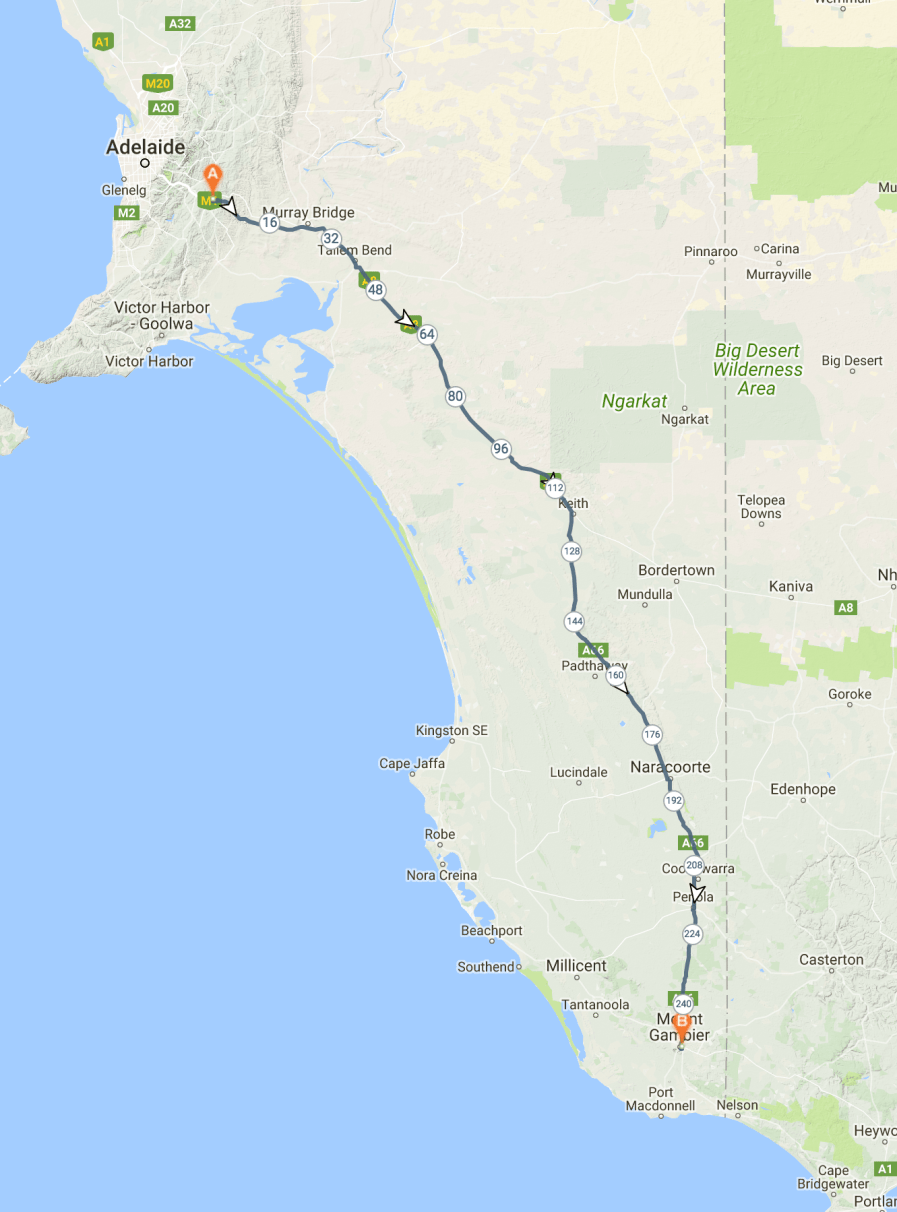
Above:- Our journey from the Adelaide Hills to Robe in the South East of South Australia. Map courtesy of plotaroute.com.
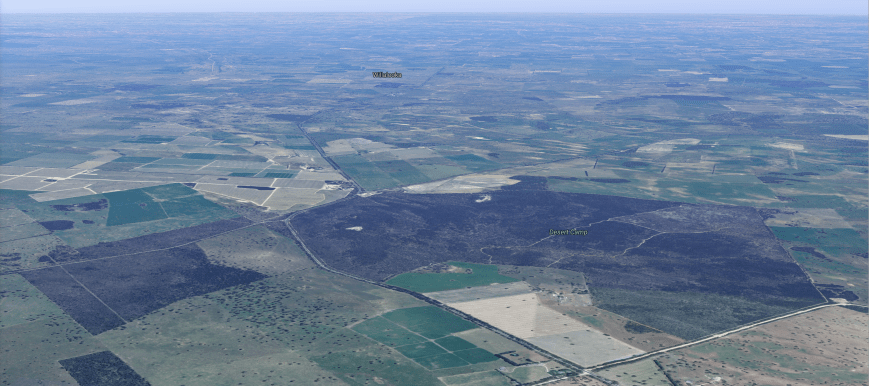
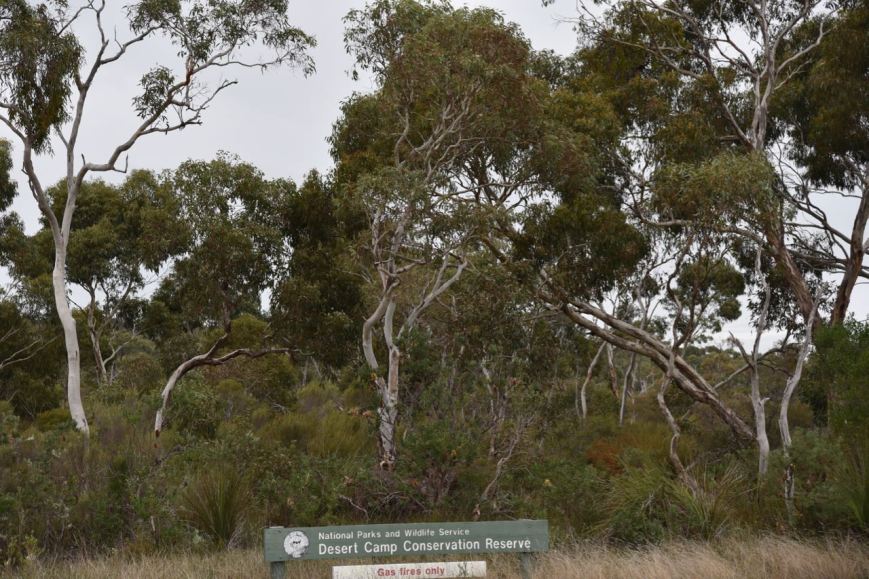
Between Tailem Bend and Meningie we had a tune across the band and found Rob VK4AAC/2 calling CQ from the Bungonia National Park VKFF-1163. Rob had a good 5/7 signal and gave us a 5/5 signal report from the mobile. Soon after we worked Tony VK3XV/5 who was activating the Desert Camp Conservation Reserve VKFF-1705. Tony had come over with his wife Sheryl from Victoria to take part in the 5th year anniversary event. Many thanks Tony and Sheryl.
Our first stop of the morning was at Salt Creek, a small settlement about 61 km south east of Meningie. We stopped briefly to have a look at the Oil rig monument. In 1892, a group of entrepreneurs, who believed there was oil located in the Coorong, drilled Australia’s first oil well. They were unsuccessful, as it was later discovered that the ‘oil’ was in fact a flammable, compacted vegetable substance known as ‘coorongite’.

Above:- Marija at the Oil rig monument at Salt Creek.
Marija and I decided to venture off the Princes Highway and take the Coorong Loop Road through the Coorong National Park 5NP-005 & VKFF-0115. The loop road commences at Salt Creek and travels about 13 km through the park before joining up again with the Princes Highway. Whilst on the Loop Road we stopped briefly to make a Park to Park contact with Tony VK3XV/5 in the Desert Camp Conservation Reserve.

Above:- Our view of the Coorong during our contact with Tony VK3XV.
Our next stop was just a little further down the road at Chinaman’s Well which is located in the Coorong National Park. The area is so named due to a freshwater well which was constructed in the 1850’s.
During the 1850’s thousands of Chinese people landed in South Australia with the prospect of making their wealth on the Victorian goldfields at Ballarat, Bendigo, Castlemaine, and Beechworth. Those that did arrive in South Australia walked the 800 km to the goldfields across wetlands, desert, hills and plains.
Why walk from South Australia? Why not land in the Port of Melbourne? In an attempt to limit the number of Chinese on the Victorian goldfields, a law was passed which stated that any Chinese person entering the Colony of Victoria would pay a ten pound tax and one pound protection fee, for the right to mine and live in the colony. As a result ships arriving from overseas would drop the Chinese arrivals off in Sydney or Adelaide.

Above:- A Chinese emigrant on the journey to the Victorian Goldfields.. Image courtesy of http://www.kidcyber.com.au/gold-rush-in-australia/
Between 1857 and 1863 it is estimated that over 17,000 Chinese walked from South Australia to the Victorian goldfields. In 1859, at the peak of the Victorian gold rush, the Chinese population in Victoria reached 46,000. The Chinese made up about 1/5th of the total male population in the mining towns in Victoria in this period.
You can do a 45 minutes walk here and view the sandstone and limestone quarries and the well itself. Although there are interpretive signs, sadly the walk is not well signposted. But it is well worth doing and gives you a very good impression of the oppressive journey that the Chinese undertook in the hope of finding gold.
Marija and I continued south on the Princes Highway towards Kingston SE. Along the way we logged Tony VK3XV/5 who was now in the Padthaway Conservation Park 5CP-169 & VKFF-0924.
We stopped briefly at the town of Kingston SE. The town was named after Sir George Strickland Kingston, a South Australian politician, surveyor and architect. The town was established in 1861 and was originally known as Kingston. The extension on its name is to distinguish Kingston in the South East (of South Australia) from another ‘Kingston’ in the state which is now officially named “Kingston On Murray” was added in July 1940.
One of the famous attractions in the town is the Big Lobster, known as ‘Larry’ by the people of Kingston. ‘Larry’ is a sculpture of a spiny lobster, and stands around 17 metres tall. It can be located outside of a former visitor centre and restaurant, which sadly is no longer in operation.

‘Larry’ the Lobster
Another attraction in the town is the Cape Jaffa Lighthouse, which is a decommissioned lighthouse formerly located on Margaret Brock Reef near Cape Jaffa on the south east coast of South Australia. The tower has been located in the town of Kingston SE since 1976.
We stopped off at a local cafe and picked up some lunch and headed down to the foreshore and enjoyed lunch whilst watching the ocean.
It was around 2.30 in the afternoon and we were quite close to Robe, so we decided to do a quick park activation at the Butcher Gap Conservation Park 5CP-027 & VKFF-0793. This was to be a new park for both Marija and I, for both the VK5 Parks Award and the World Wide Flora Fauna (WWFF) program.
The park is located about 6 km south of the town of Kingston and about 294 km (by road) south east of Adelaide.

Above:- Map showing the location of the Butcher Gap Conservation Park in the South East region of South Australia. Map courtesy of Location SA Map Viewer.
Butcher Gap Conservation Park is 180 hectares in size and was first proclaimed on 29th March 1990. It is one of the last remaining significant coastal scrubs between the Coorong and Robe. The park encompasses Salt Lake and Butcher Lake, and is separated by the Butcher Gap Drain which brings large amounts of fresh water from the farmlands, through the park and out to sea.
The park’s wetland area supports an association of dense South Australian Swamp Paperbark over marine meadow, while the remainder of the Park is a coastal scrub association. Salt Lake usually holds water between June and January.
The park attracts an array of wildlife throughout the year. Seasonal waterbirds such as swans and white-faced herons frequent the lakes, while small bush birds may be seen along the park’s scenic walking trails. During the months of spring and summer, the area is visited by Japanese snipe and other wading birds. In winter the park provides an important refuge for the endangered orange-bellied parrot.
The following birds have been recorded in the park: Superb Fairywren, Spiny-cheeked Honeyeater, Singing Honeyeater, Brown Thornbill, Silvereye, Beautiful Firetail, Latham’s Snipe, Common Bronzewing, Rufous Bristlebird, Yellow-rumped Thornbill, White-browed Babbler, Orange bellied parrot, and Red-browed Finch.

Above: Orange bellied parrot. Image courtesy of wikipedia
To get to the park we travelled along Pinks Beach Road which runs off the Southern Ports Highway. As you enter the 50 kph area of Pinks Beach you will see a small brown sign on the southern side of the road which reads ‘Butchers Gap Conservation Park’. There is a driveway here which leads to a small parking area.
We parked the vehicle and then walked about 50 metres down the wide track and set up our station which consisted of the Yaesu FT-897 and the 20/40/80m linked dipole.

Map showing our operating spot in the park. Map courtesy of Location SA Map Viewer.
Our intention was just to get 10 contacts and qualify the park for the VKFF program, so Marija and I decided to swap the mic during the activation. This meant that we could only run 10 watts PEP due to Marija’s Foundation licence conditions.
Prior to calling CQ we tuned across the 40m band and worked Tony VK3XV/5 who was activating the Padthaway Conservation Park 5CP-169 & VKFF-0924. Padthaway was only about 96 km away by road, so due to us being close to each other, signals were well down. However due to the lack of man made noise on the band from each park, we were able to easily log each other.
We then moved down to 7.139 and started calling CQ. This was answered by Peter VK3PF, followed by Peter VK5ZPG, and then Deryck VK4FDJL. But it was really hard going, with very few takers. Peter VK3PF came back to us and kindly gave us another one of his calls VK3KAI. We were quite concerned that we weren’t going to get our 10 contacts to qualify the park for VKFF.
With 8 contacts in the log, I decided to take a few photos, and Marija kept persevering. Finally, after 23 minutes, Marija had contact number 10 in the log, a QSO with Ross VK7ALH.
Marija logged a total of 24 stations and we then swapped the mic. Marija took a break and I jumped into the ‘drivers seat’. I logged a total of 24 stations on 40m from VK1, VK2, VK3, VK4, VK5 and VK7, before deciding to try the 20m band.
I headed to 14.310 and started calling CQ, but soon had to put up with the Over the Horizon Radar. Ross VK7ALH was my first caller, who had followed me up from 40m. This was followed by Dale VK4NBX and then Ray VK4NH.
I was now just 5 short of the required 44 QSOs to qualify the park for WWFF. As I hadn’t logged many South Australian stations I decided to try the 80m band. Greg VK5GJ was first in the log there, followed by Ivan VK5HS and then Norm VK5GI. Marija also logged Greg, Ivan, and Norm. Sadly, they were our only takers on 80m.
So with just 2 QSOs needed, I headed back to 40m and called CQ again on 7.139. Ivan VK5HS had followed me back to 40m and he was my 43rd contact, followed by Mick VK3DDZ who was the magical 44th contact.

It was now around 4.30 p.m. and time to pack up, with a 40km trip ahead of us down to Robe. Marija and I had both qualified the park for the VK5 Parks Award, and VKFF. And despite hard work, I had also qualified the park for the global WWFF program.
Marija worked the following stations on 40m SSB:-
I worked the following stations on 40m SSB:-
I worked the following stations on 20m SSB:-
I worked the following stations on 80m SSB:-
Once we had pack up Marija and I drove to the end of Pinks Beach Road to have a look at the beach on the Lacapede Bay. There were plenty of fishermen there enjoying the late afternoon sun.
We soon reached the town of Robe, where we had booked in for 3 nights at the Robe Harbour View Motel. After checking in and offloading some of our bags, we ventured out to explore Robe. The town was named in 1846 after Governor Frederick Holt Robe who was apparently one of South Australia’s most unpopular Governors. An editor of a particular newspaper at the time wrote of Robe: ‘never a man who worked so hard to make himself unpopular‘. Whatever the origins of the town, this is a truly beautiful spot.
Our first stop was the Lake Butler Marina at Robe which was very busy. A total of 32 commercial fishing boats and about 30 recreational boats moor in the marina.
We then had a look at the remains of the old Robe Gaol. It was operational between 1860 to 1870 when it was closed. It reopened in 1872 but was again closed in 1881. The walls were reinforced with steel boiler plates from the wreck of the SS Admella in an effort to contain potential escapes.
We continued down Obelisk Road and checked out the Robe obelisk which is located on Cape Combey. It was built in 1855 by local builder George Shivas at the cost of about 230 pounds. It is 40 feet high and stands about 100 feet above sea level. It was carried to its site by a 32 bullock wagon team. There is also a nice walk here to the top of a hill which offers some great views of Robe.
Robe is full of historic buildings, and one of the most iconic is the Robe Customs House which was built in 1863 and used for about 25 years as a Customs House and office of Harbour Master & Receiver of Wrecks. It later became a local council office. It is now a National Trust Museum and sits on the top of a hill on Royal Circus, Robe.

Just across the road is the monument for explorers Matthew Flinders and Nicolas Baudin. It features portrait busts of the explorers. In 1801 Matthew Flinders set out from England aboard the Investigator. A few months earlier Nicholas Baudin set sail from France aboard the Le Geographe. Both men were charged with the tasks of scientific and geographical exploration and had intentions to map the Southern Contintent. As it would happen, their voyages overlapped and they met in South Australia.
Another interesting memorial to have a look at is the Chinese Memorial. During the years 1856-1858 around 16,500 Chinese landed at Robe and walked the 321 km (200 miles) to the Victorian Goldfields in search of gold.

We then headed off to the Robe Hotel for a meal and some nice cold beverages. The meal was very nice and the service was good. This was reflected by the number of people that were there – it was a struggle to get a table.
Following our meal we drove down to the cliffs at Adam Lindsay Drive and enjoyed the sunset. We then headed back to the motel room where Marija called it a night earlier, whilst I sat back in bed and watched Arnie Schwarzenegger in Predator.

References.
Birds SA, 2018, <https://birdssa.asn.au/location/butcher-gap-conservation-park/>, viewed 13th March 2018
Culture Victoria, 2018, <https://cv.vic.gov.au/stories/immigrants-and-emigrants/many-roads-chinese-on-the-goldfields/walking-to-the-diggings/different-routes/>, viewed 13th March 2018
Department of Environment and Natural Resources, 1994, ‘Small Coastal Parks of the South East Management Plan’.
District Council of Robe, 2018, <http://www.council.robe.sa.gov.au/>, viewed 13th March 2018
kidcyber, 2018, <http://www.kidcyber.com.au/gold-rush-in-australia/>, viewed 13th March 2018
Monuments Australia, 2018, <http://monumentaustralia.org.au/themes/landscape/exploration/display/102986-matthew-flinders-and-nicholas-baudin->, viewed 13th March 2018
National Parks SA, 2018, <https://www.environment.sa.gov.au/parks/find-a-park/Browse_by_region/Limestone_Coast/butcher-gap-conservation-park>, viewed 13th March 2018
Wikipedia, 2018, <https://en.wikipedia.org/wiki/Salt_Creek,_South_Australia>, viewed 13th March 2018
Wikipedia, 2018, <https://en.wikipedia.org/wiki/Kingston_SE>, viewed 13th March 2018
Yesterday afternoon (Saturday 3rd March 2018), Marija VK5FMAZ and I went for a drive down to the Fleurieu Peninsula to undertake a beach activation from the Encounter Marine Park VKFF-1707. It was a beautiful 26 degree C day so we decided sitting on the beach playing a bit of radio was a nice way to spend the afternoon.
The Encounter Marine Park is a large marine park which extends from near Port Noarlunga south of Adelaide, down to the north eastern coast of Kangaroo Island, and around to the Coorong National Park. We decided on activating the park from Goolwa Beach, not far from the mouth of the Murray River.

Map showing the location of the Encounter Marine Park. Map courtesy of National Parks SA.
Marija and I left home early afternoon and drove down to the historic town of Strathalbyn and then down through the wine growing region of Currency Creek and on to the historic port town of Goolwa which is located on the Fleurieu Peninsula.
The Fleurieu was named after Charles Pierre Claret de Fleurieu, the French explorer and hydrographer, by the French explorer Nicolas Baudin as he explored the south coast of Australia in 1802. It is a great part of South Australia, where I lived and worked back in the mid 1980’s. The video below gives you a great snapshot of the Fleurieu….
After reaching the town of Goolwa, we drove to the end of Beach Road. There is beach access here, but don’t attempt it in a conventional vehicle. Unlike some other beaches which permit vehicular access in South Australia, Goolwa is only suitable for 4WD vehicles. I’d recommend that if you do intend driving down onto the beach, that you lower your tyre pressure. Once on the beach it is generally ok, but there is deep sand at the entry point. And if you intend to go all the way to the mouth of the Murray River, you will definitely need low pressure in your tyres and will probably need to use low 4WD.

Above:- Map of the park showing our operating spot. Map courtesy of Location SA Map Viewer.
The Encounter Marine Park encompasses the waters off southern metropolitan Adelaide and the Fleurieu Peninsula. It extends past the Murray Mouth to the Coorong coast. At its western boundary, the park includes all waters of Backstairs Passage and the eastern shores of Kangaroo Island. The park is 3,119 km2 in size and represents 12% of the marine park network in South Australia.
The park contains some of Australia’s best preserved ocean wilderness, including amazing dive sites and spectacular reefs which provide refuge for vitally important fish breeding and shelter areas. Fishing is very popular within the park, along with diving, and surfing. Leafy Sea Dragons are found in the park, along with Sea Lions, and Southern Right Whales.
As it was a nice sunny day, there was quite a bit of activity on the beach. There were lots of swimmers to the west of the Beach Road entrance where I suspect there were Surf Lifesavers on duty. The waters here can be quite treacherous. This is one of the most hazardous beaches in South Australia for swimming.

The beach is part of Encounter Bay, which was named by explorer Matthew Flinders after his encounter on 8 April 1802 with Nicolas Baudin, the commander of the French Baudin expedition of 1800-03.
As we drove along the beach we saw a large amount of birdlife including Sooty Oystercatchers and Gulls. Sooty Oystercatchers eat molluscs, and invertebrates such as crustaceans and worms and are common on Goolwa Beach.

Marija and I travelled a few km along the beach and found a nice quite spot and started setting up our station. We rolled out the awning on the 4WD and set up the fold up table and deck chairs. For this activation we used the Yaesu FT-857d and the 80/40/20m linked dipole supported on the 7m squid pole, and the 15m 1/2 wave dipole. Whilst Marija was on air we ran 10 watts as Marija is limited to that amount of power with her Foundation licence. Whilst I was on air, I ramped up the output power to 40 watts.
As I have activated and qualified this park previously, Marija kicked off the activation, seeking 10 contacts to qualify the park for the VKFF program. Marija’s first contact was Gerard VK2JNG/p who was activating the Werakata State Conservation Area VKFF-1391. I also wrestled the mic from Marija and also logged Gerard Park to Park. Within 12 minutes of being on air, Marija had 10 contacts in the log. Her 10th contact was with Chris VK3PAT.
Marija continued on and logged a total of 20 stations from VK2 and VK3, including one further Park to Park contact, with Stef VK5HSX/3 in the Cobboboonee National Park VKFF-0728 in the south west of Victoria.

Marija then handed over the mic to me and I logged a total of 34 stations on 40m from VK2, VK3, VK5, and VK7. It was interesting that no VK4 (Queensland) stations were logged on 40m, and just two VK5’s: Les at Port Augusta some 350 km to the north, and Ron VK5MRE in the Riverland, about 250 km to the north east.
I then tuned across the band and found Liz VK2XSE/p on 7.155 who was in the Murrumbidgee Valley Regional Park VKFF-1786. Liz sounded like she had an idealic spot as well, sitting on the banks of the Murrumbidgee River near Hay. Marija also logged Liz Park to Park.
I then headed off to the 80m band hoping to log some more South Australian stations, but sadly, despite band conditions being quite good there, I only logged 2 stations: the ever reliable Adrian VK5FANA on the Yorke Peninsula, and Michael VK5FMLO in the southern suburbs of Adelaide.
I then moved to the 20m band and called CQ on 14.310 where I logged 7 stations including Hans VK6XN in Western Australia, Stuie VK8NSB in Darwin, and Greg VK8GM in Alice Springs. Although no overseas DX appeared in my log on 20m, it is always nice to work the VK6 and VK8 ops.
In some parts of the world those contacts would be classed as DX, across multiple countries. Here in Oz, they are ‘local’ contacts.
To wrap up the activation I put a few calls out on 15m on 21.244. Sadly just after starting to call CQ, the Over the Horizon Radar started, and made it hard to pick up a few weak stations that were calling. I logged Cliff VK2NP and then Greg VK8GM, and decided to move down the band to 21.220 where my only taker was John VK4TJ.

With a total of 68 stations in the log between the 2 of us, and 7 Park to Park contacts, it was time to pack up and make the 45 minute drive back home to the Adelaide Hills.
Marija worked the following stations on 40m SSB:-
I worked the following stations on 40m SSB:-
I worked the following stations on 80m SSB:-
I worked the following stations on 20m SSB:-
I worked the following stations on 15m SSB:-
At the end of the activation Marija and I took a drive down to the mouth of the Murray. It was a few km further down the beach from where we had been activating. This is definitely low 4WD country. Marija and I regularly see people bogged here, and this time was no different, with a vehicle bogged near the mouth. Fortunately they had good help, with people digging them out with spades, and snatch straps at hand.

The mouth of the Murray River is an opening in the coastal dune system which separates the river system from the Southern Ocean and which extends from near in a south-easterly direction along the continental coastline for about 145 kilometres. This is known as the Coorong, which is a National Park.
The Murray mouth divides the dune system into two peninsulas. The peninsula on the west side is known as Sir Richard Peninsula, which terminates at the mouth with a point named Pullen Spit. While the peninsula on the east side is known as Younghusband Peninsula, which terminates at the mouth with a point known in some sources as Sleepy Hollow.
Water flows throughout the mouth from two directions. Firstly, the flow from the west passes along a passage known as the Goolwa Channel which is bounded by Hindmarsh Island to its north side and secondly, the flow from the east passes along a passage known as the Coorong Channel.
The Murray Mouth is influenced by the flow of River Murray water through the barrages and tidal movement from the Southern Ocean. When river flows to South Australia are low, barrage releases are low and sand deposits occur inside the mouth causing restrictions and increasing the risk of closure. As a result, dredging machines are stationed at the Murray Mouth.
The camping area at the mouth was very busy, with lots of 4WDers and fishermen.
References.
Birdlife Australia, 2017, <http://birdlife.org.au/bird-profile/sooty-oystercatcher>, viewed 16th January 2017
National Parks South Australia, 2016, ‘Marine Park 15 Encounter Marine Park’
Wikipedia, 2017, <https://en.wikipedia.org/wiki/Murray_Mouth>, viewed 16th January 2017
Wikipedia, 2018, <https://en.wikipedia.org/wiki/Fleurieu_Peninsula>, viewed 4th March 2018
Amateur Radio, Short Wave Listening, travel and history
Amateur radio experiences with VK1DA
Brisbane - Australia
german amateur radio station
Summits On The Air
SOTA on the peaks, wilderness QRP and some bushwalking
A fine WordPress.com site
Amateur Radio Adventures
Summits on the Ai
Amateur radio station from Belgium
Radio craft, homebrew, QRP/SOTA, AM
Ego loqui ad viros super montes
My adventures with Amateur Radio and Geocaching!
The rantings of VK2GAZ on his SOTA experiences in Australia
A survivor, with minor cuts and abrasions.
The Art and Craft of Blogging
The latest news on WordPress.com and the WordPress community.
Blog of Justin Giles-Clark VK7TW's SOTA and amateur radio adventures.
Occasional SOTA & Microwave operation