
It was my final day in the South East (Tuesday 9th June) and I had planned to activate three parks: Gower Conservation Park, Calectasia Conservation Park, and the Penola Conservation Park. All three were to be unique parks for me, for both the VK5 National and Conservation Parks Award and also World Wide Flora Fauna (WWFF).
My first park was the Gower Conservation Park which is situated about 25 km north west of Mount Gambier.
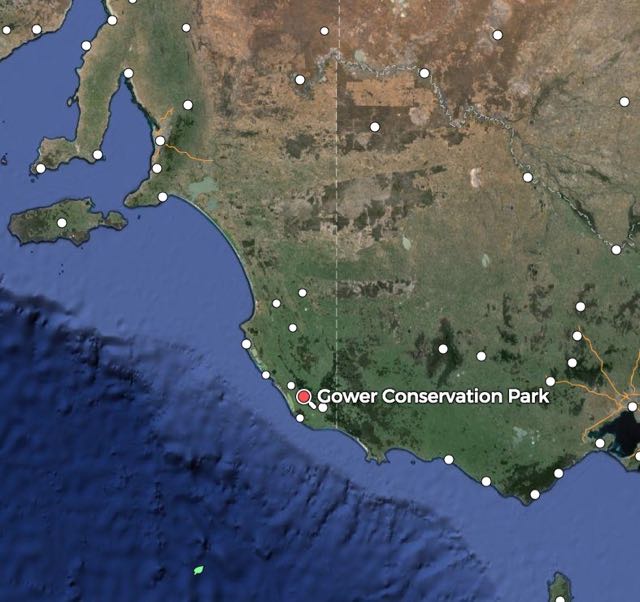
Gower Conservation Park was gazetted on the 21st day of January 1971 and covers an area of around 39.5 hectares. The vegetation in the park mostly consists of an open forest of messmate stringybark and brown stringybark with a shrub understorey of austral bracken and some spike wattle, grass tree, and silverleaved banksia. In the south of the park you can find barked manna gum and large black wattle.
I headed out of Mount Gambier, heading north west on the Princes Highway, heading back towards Adelaide. Just after the Tantanoola Caves Conservation Park, is a road to your right called McPherson Road. This takes you direct to the park, passed an old quarry on your right and the pine forest on your left.

I set up in a little clearing just to the east of the north western corner of the park. There was plenty of room here to string out the dipole and because I had two convenient gum trees, I was able to get the ends of the legs quite high off the ground. It was a much more pleasant day than Monday, The sun was out, although it was still a typical cold June day down in the South East.
I called CQ on 7.095 and this was immediately answered by Col VK5HCF from Mount Gambier, who has previously activated Gower. This was followed by Jeff VK5JK at Encounter Bay on the South Coast, Jim VK3AT/3, and then Tony VK5FTVR at Strathalbyn on the Fleurieu Peninsula. All signals were 5/9 and above. The band was in great shape.
I worked a steady flow of VK’s from VK2, VK3, VK5, & VK6, until there was a call ‘out of the box’. I knew it was a Russian station or a Ukrainian station but struggled a bit with getting his call. I penned in UA6IDX into my log who gave me a 5/3 report, but before I could confirm his call, he had gone. A few calls later I spoke with Mike VK6MB who was with Michael VK6MMB in VKFF-161. They confirmed that the call was in fact UA6IDX that had called me.
I worked numerous mobile stations during this activation. They included Peter VK3TKK, Gerard VK2IO mobile on his way to a SOTA peak, Bob VK2AOR mobile on the M1 Freeway coming into Sydney, Gerard VK2JNG, Peter VK3PRF, Craig VK3NCR/5 mobile 160 km north of Port Augusta, Terry VK3UP, David VK5KC mobile at Orroroo in the Mid North, and Doug VK3FDES. During most of my activations, I always ask for QRP, mobile, portable and outside of VK callers. It is amazing how many of these stations come back to you, who would ordinarily be competing with many home stations running amps.
After working a total of 45 stations on 40m I headed over to 20m where I called CQ on 14.310. Gerard VK2JNG had followed me over and was my first contact on 20. This was followed by contacts with Cliff VK2NP, Bill VK5BMD, Neil VK4HNS and my final contact was with Stath VK4AEP who called just as I was packing up gear into the 4WD.
Another successful activation under my belt with a total of 50 contacts. The park had been qualified for WWFF.
The following stations were worked on 40m SSB:-
- VK5HCF
- VK5JK
- VK1AT/3
- VK5FTVR
- VK5FANG
- VK5BJE
- VK3TKK/m
- VK5FANA
- VK3ZZS/4
- VK3NBV
- VK3PMG
- VK3FQSO
- VK2GKA
- VK5ZAR
- VK2IO/m
- VK6RZ
- VK5IS
- VK3HQ
- VK2NP
- VK2AOR/m
- VK3OF
- VK2HV
- VK5ZGY
- VK5NPP/3
- VK3AV
- UA6IDX
- VK3FOWL/p
- VK2JNG/m
- VK3PRF/m
- VK6MMB/p (VKFF-161)
- VK6MB/p (VKFF-161)
- VK3NCR/5
- VK3TJK
- VK7FGGT
- VK3UP/m
- VK3ZLD
- VK5KC/m
- VK3FGMO
- VK5RU
- VK3FDES/m
- VK5WG
- VK5TD
- VK5FIVE
- VK5MBD
- VK2YW
The following stations were worked on 20m SSB:-
- VK2JNG/m
- VK2NP
- VK5MBD
- VK4HNS
- VK4AEP
References.
National Parks and Wildlife Service-Department of Environment and Planning, 1990, Small Parks of the Lower South East Management Plans
 VK5PAS