Mobile activity around the Blue Lake & a nice feed

After leaving the SERG Convention on Sunday afternoon (7th June 2015) I drove up to the Blue Lake at Mount Gambier for some mobile action.  My mobile set up is an Icom IC-7000 and a Codan 9350 self tuning antenna mounted on the read of my Toyota Hi Lux.

As I was driving around the edge of the lake, I heard Tony VK3VTH on 14.311.  Tony was portable in the Dergholm State ParkVKFF-756 in the far west of Victoria, about 390 km west of Melbourne.  Tony was working into Europe, and was a little weak, but as this was a unique park for me, I thought it was worth giving him a call.  It took a little while to get through the European pileup, but eventually we made it (5/3 sent and 4/1 received).
DSC_0225

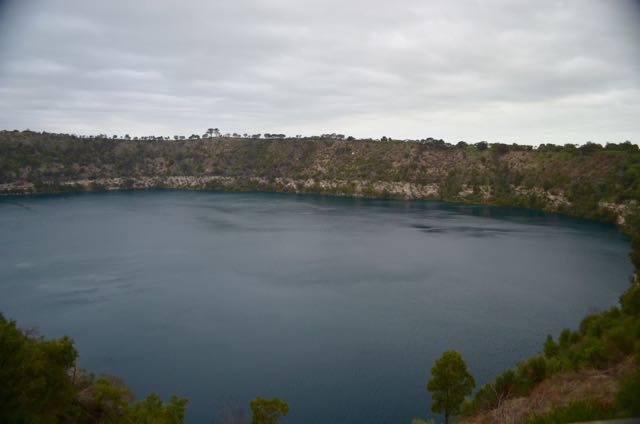
Above:- The Blue Lake at Mount Gambier.

I then changed bands to 40m and worked Paul VK3HN who was portable on SOTA peak, Mount Gordon, VK3/ VN-027 (5/7 sent and 5/5 received).  I then spoke with Peter VK3ZPF who was calling CQ for the VK Shires Contest.  Peter had a beautiful 5/9 signal.

I then pulled up at the Valley Lake lookout, and I had a further two SOTA contacts.  The first was with Rod VK2TWR who was portable on Wullwye Hill VK2/ SM-085, east of Jindabyne.  And the next was with Allen VK3HRA who was portable on VK3/ VW-017 North Burranj Range, in the Black Range State Park VKFF-751.

This slideshow requires JavaScript.

I then tuned up the band and found Ian VK1DI calling CQ from another unique VKFF reference area for me, the Dunlop Grassland Nature Reserve, VKFF-839.  This is one of the newly added VKFF areas to the WWFF program.  Ian had a nice strong 5/8 signal and he reciprocated with a 5/8 signal report for me.

I then changed over to 20m and started calling CQ on 14.275.  Almost immediately my CQ call was answered by Jos ON4ATK in Belgium (5/7 sent and 5/5 received).  This was followed by Ted VK4AVG (5/9 sent and 5/8 received).  But things dried up after this with no further takers.

So I tuned across the band and spoke with Theo OT4A in Belgium (5/9 sent and 5/7 received), Dan S59N in Slovenia (5/8 sent & 5/6 received), Jose EA3NG in Spain (5/9 both ways), and Tom DJ7ZZ in Germany (5/9 both ways).

I finished off the afternoon with another SOTA contact.  This time with Matt VK2DAG who was portable on SOTA peak, Bakers Downfall Hill VK2/ NW-006, not far from the famous Hanging Rock.

It was time to head back to Mount Gambier and a quick shower and off to the SERG Convention Dinner held at the Scout hall.  It was nice to try out the new antenna on the vehicle and get a bit of DX in the log.

After trying to make myself beautiful I headed back to the scout hall in Margaret Street at Mount Gambier, and listened to a sum up of the weekend by the SERG President, Tim VK5AV, followed by a very interesting talk on Surface mounted components, and then the presentation of certificates for the National Fox Hunting Championships.  I then enjoyed  avery nice meal in the adjacent hall consisting of soup, Roast Chicken, and Apple crumble.  I even won a bottle of nice red in the raffle, which was quickly consumed over dinner.
This slideshow requires JavaScript.

Piccaninnie Ponds Conservation Park

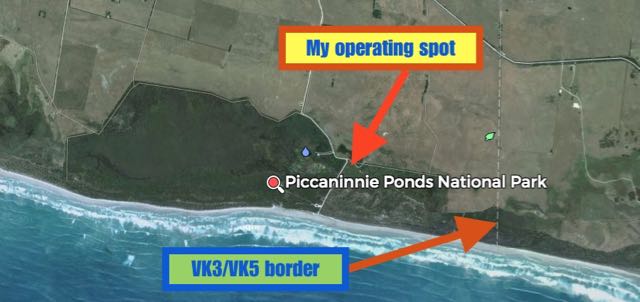
After leaving Ewens Ponds Conservation Park I headed off to the Piccaninnnie Ponds Conservation Park (CP), which was to be another unique park for me for the VK5 National and Conservation Parks Award.

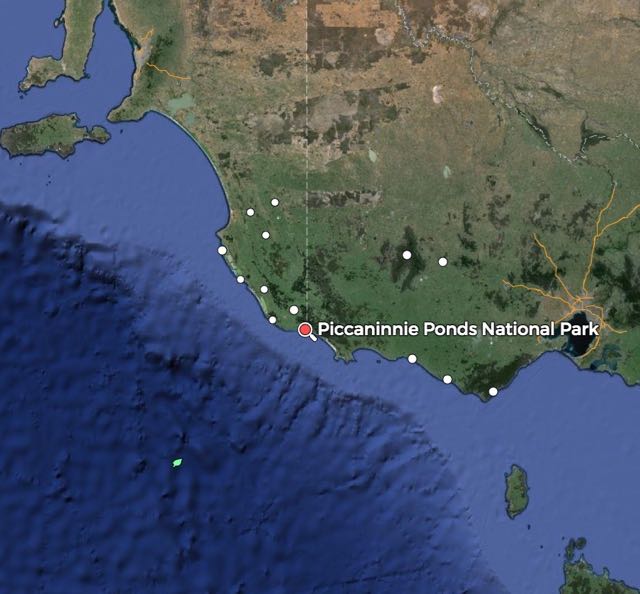
Piccaninnine Ponds CP is located about 32 km south east of Mount Gambier, and about 480 km south east of Adelaide.  It is very close to the South Australian/Victorian border.

Screenshot 2015-06-12 09.49.20

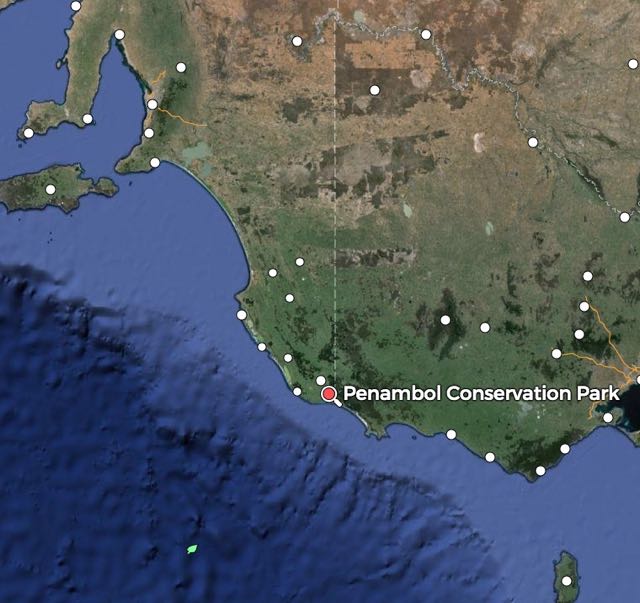
Above:- Map showing the location of the park.  Map courtesy of mapcarta.com

Piccaninnie Ponds has been recognised as a wetland of international importance.  The park is very popular with scuba divers and snorkellers.  The crystal clear waters have been slowly filtering through the limestone and forming the Pond’s features over thousands of years. The freshwater rising to the surface under pressure has eroded a weakness in the limestone to form The Chasm.  This same process has formed the large underwater cavern known as The Cathedral creating its majestic white walls of sculptured and scalloped limestone.

The park also incorporates the beachOn land, take a walk along the beach and see the freshwater springs bubbling up onto the sand. These springs are used by birds for freshwater and are also a favourite spot for shellfish.

There is also a walking trail through coastal wattle and beard heath to the ponds outlet. The walk then leads inland via boardwalks into silky tea-tree and cutting grass to a lookout where views of the wetland and bamboo reed and bulrush can be seen.

I drove down the Glenelg River Road and then turned into Piccaninnie Ponds Road.  The park is very well signposted.

I drove into the main ponds carpark, which was absolutely chocker block full of cars and activity.  There was a young lad with a generator running, filling up oxygen tanks for the divers that were about to head off for a dive.  There was no room to set up here and it was definitely too noisy.  But I did take the opportunity of walking down the track a short distance to the ponds, which were alive with activity.  A number of scuba divers had just entered the water.  There was also a large amount of birdlife including Geese and Herons.

I then drove down to the carpark at the end of the road near the beach.  I would have liked to have set up on the beach itself, but it was extremely windy and operation from there would have been too oppressive.  So I turned back around and headed back along Piccaninnie Ponds Road and found a track leading off into the scrub.  That is where I set up.   And with some difficulty.  It was exceedingly windy.

Screenshot 2015-06-12 09.49.06

Above:- Map showing my operating spot.  Map courtesy of mapcarta.com

Prior to calling CQ I had a tune around the band and found Rod VK2TWR calling CQ on 7.090 from SOTA peak Pine Hill, VK2/ SM-083.  Rod was QRP 5 watts and had a good strong 5/8 signal.  Not a bad way to start the park activation, with a SOTA QSO.  I then moved down to 7.085 and started calling CQ and this was answered by Adam VK2YK who was portable in the Worimi National Park VKFF-614, running just 5 watts (5/3 both ways).

A steady flow of callers followed from VK3, VK5 & VK7.  And then amongst the VK’s, I heard Ken again, ZL4KD with a good 5/5 signal.  Not bad considering this was just before 12.30 p.m. on 40 metres.  Ken gave me a 5/5 into Christchurch.  A few calls later, I had a SOTA trifecta.  Bernard VK2IB/3 was first to call, on SOTA peak VK3/ VE-241, south east of Wodonga.  Next was Andrew VK1NAM portable on SOTA peak Bullen Range VK1/ AC-035, and then Allen VK3HRA portable on SOTA peak Mount Byron VK3/ VW-015 which is located in the Black Range State Park VKFF-751.

A few calls later, I received a call from Gordon VK5GY who was portable in the Morgan Conservation Park.  It was a pleasant surprise to get a VK5 Park to Park contact with Gordon.

My last contact on 40m was with Jeff VK5JK at Encounter Bay, who always has a strong signal.  I then lowered the squid pole and removed the links in the dipole, and started calling CQ on 14.307.  First taker there was Adam VK2YK mobile, followed by Daniel VK6LCK and then Ian VK6DW.

This slideshow requires JavaScript.

It was approaching 1.00 p.m. and I still needed to get back to Mount Gambier for the SERG Convention, so it was time to pack up and hit the road.  I had a total of 35 contacts in the log, including four SOTA contacts, one VK5 Parks contact, and two VKFF park contacts.

The following stations were worked on 40m SSB:-

  1. VK2TWR/p (SOTA VK2/ SM-083)
  2. VK2YK/p (VKFF-814)
  3. VK3ZPF/p
  4. VK5WF
  5. VK3PH
  6. VK1AT/3
  7. VK3PF/m
  8. VK3OF
  9. VK5KKT
  10. VK3FKFK
  11. VK7BO
  12. VK5ZAR
  13. VK7KZ
  14. VK5FBFB
  15. VK5BJE
  16. VK3KLB
  17. VK5GJ
  18. ZL4KD
  19. VK5FCHM
  20. VK5KKS
  21. VK2IB/3 (SOTA VK3/ VE-241)
  22. VK1NAM/p (SOTA VK1/ AC-033)
  23. VK3HRA/p (SOTA VK3/ VW-015)
  24. VK3OHM
  25. VK3FMRC
  26. VK5GY/p (Morgan Conservation Park)
  27. VK2LEE
  28. VK3SFG/p
  29. VK3NUT
  30. VK3BHR
  31. VK4FFAB
  32. VK5JK
  33. VK2YK/m
  34. VK6LCK
  35. VK6DW

The following stations were worked on 20m SSB:-

  1. Adam VK2YK/m
  2. VK6LCK
  3. VK6DW

References.

National Parks South Australia, 2015, <http://www.environment.sa.gov.au/parks/Find_a_Park/Browse_by_region/Limestone_Coast/Piccaninnie_Ponds_Conservation_Park&gt;, viewed 12th June 2015

Ewens Ponds Conservation Park VKFF-796

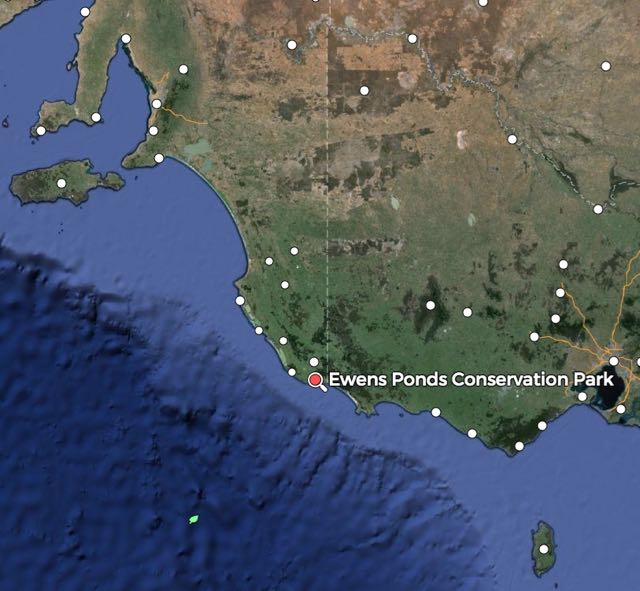
My first park for Sunday morning, 7th June 2015 was the Ewens Ponds Conservation Park which is situated about 36 km south east of Mount Gambier.  This was my only planned park activation for the day, but as it turned out, I also ventured over to Piccaninnie Ponds Conservation Park after this activation.  Ewen Ponds was another unique park for me for both the VK5 National & Conservation Parks Award, and the World Wide Flora Fauna (WWFF) program.Screenshot 2015-06-12 00.06.17

Above:- Map showing the location of the park.  Map courtesy of mapcarta.com

Ewens Ponds Conservation Park was constituted in 1976 and covers a small area of about 24 hectares.  The park contains spring fed limestone ponds which are linked by shallow channels.  The channels actually connect three basin shaped ponds which are about 10 metres deep.  The clarity of the water enables water plants to grow underwater to a depth of about 6 metres.  Many of these plants are not found growing fully submerged underwater anywhere else in the world.

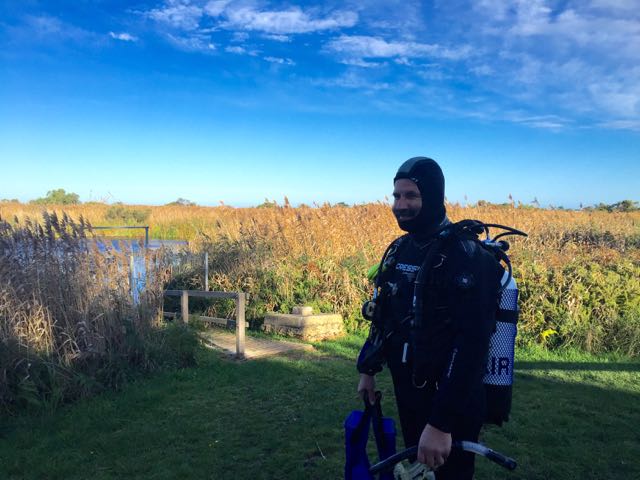
The ponds are very popular with scuba divers and snorkellers.  The minimum qualification for divers is ‘open water’.  In fact whilst I was set up, a couple arrived to go scuba diving in the ponds.  Due to the cold water and the potential for damage to the aquatic environment, swimming is not allowed.

The ponds have a large fish population including the endangered Gold Pygmy Perch.  In fact the ponds are one of only three recorded locations for the Gold Pygmy Perch.  The ponds are also home to populations of flatworms, freshwater crayfish, and mussels, and the larva of the carnivorous caddis fly.

The history behind the discovery of the ponds is extremely interesting.  The first European associated with the area was Thoms Ewens.  His dog chased a kangaroo into one of the ponds.  The land surrounding the ponds was gradually cleared for agricultural purposes and dairy farming.  A drainage system was constructed to draw water from the ponds for land sold for soldier settlement programs after the Second World War.  In 1978 a trout farm was established utilising the waters flowing through Ewens Ponds.

Screenshot 2015-06-12 00.07.32 (1)

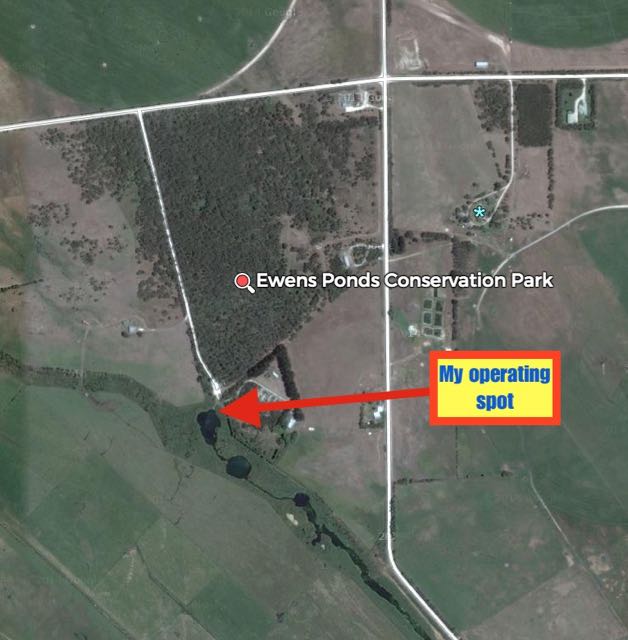
Above:- My operating spot.  Image courtesy of mapcarta.com

After setting up, I decided to head up to the WWFF calling frequency of 7.144.  It was only 8.20 a.m. and there was still quite a bit of DX on the band.  It was quite difficult to find a clear frequency below 7.100.  I called CQ on 7.144 and this was answered by Andy VK5AKH who was mobile at Kingston on Murray with a very strong 5/9 signal.  This was followed by Tony VK5FTVR, and then Mark VK5QI who was also mobile up in the Riverland for the Canoe Marathon.

Conditions on 40m were exceptionally good and I had a nice little park pile up going for quite a while with callers from VK2, VK3, VK5, VK6 & ZL.  I was quite surprised when I head Ken ZL4KD amongst all the park hunters calling me.  Ken had a very good 5/7 signal coming into Ewens Ponds from Christchurch.

It was also nice to get a couple of the regular QRP hunters in the log.  They were Adrian VK5FANA running his typical 5 watts from the Yorke Peninsula (5/9 both ways), and Amanda VK3FQSO running 500 milliwatts (5/8 sent and 5/9 received).

At about 2335 UTC I took a break to have a chat to the diver and his wife who had arrived at Ewens Ponds.  It was interesting to hear their comments about how the water within the ponds had become cloudier over the years, possibly due to run off from the surrounding farms.

IMG_1421

By the time I had got back to the radio, the WIA broadcast had commenced on 7.140, so I headed back down the band and found Nigel VK5NIG calling CQ for the VK Shires Contest.  I gave Nigel a signal report and my Shire code which was GD5, and then headed for 7.100 and started calling CQ.  Most of the European DX had disappeared at this time.  My CQ call was answered by Brian VK5FMID at nearby Mount Gambier, and this was followed by Joe VK3YSP.  After the UTC rollover I was called by Mark VK1EM, Dave VK2BDR, John VK5FMJC and Julie VK3FOWL who was mobile.

I went on to work a further 25 stations on 7.100 in VK1, VK2, VK3, VK4, VK5, and VK6.  The band was working perfectly, with great signals coming in from across Australia.  I had a few interesting contacts including Rob VK4AAB/5 on Kangaroo Island OC-139, and Ian VK5CZ who was portable on SOTA peak, Hallett Hill VK5-SE-003.

I also tried 20m and called CQ on 14.310 and this was answered by Paul VK2KKT, Peter VK6RZ, and David VK4DPM, all of whom were 5/9 to the South East of South AUstralia.

This slideshow requires JavaScript.

After a little over 90 minutes operating, I had a total of 66 contacts in the log.  I had qualified another park for the WWFF program.  It was time to pack up and head off to Piccaninnie Ponds Conservation Park.  I wanted to sneak in that activation prior to getting back to Mount Gambier for the SERG Convention.

The following stations were worked on 40m SSB:-

  1. VK5AKH/m
  2. VK5FTVR
  3. VK5QI/m
  4. VK5FANA
  5. VK3FONZ
  6. VK3YE/p
  7. VK6DW
  8. VK3VH
  9. VK5KLV
  10. VK3OF
  11. VK3FAAJ/p
  12. VK3DBP
  13. VK3TKK/m
  14. VK5BJE
  15. VK3PMG
  16. VK5FTCT
  17. VK5ZAR
  18. VK2NP
  19. VK3MCX
  20. ZL4KD
  21. VK5LSB
  22. VK5FAJS/m
  23. VK3PF
  24. VK5KFB/m
  25. VK2DEK
  26. VK2YK
  27. VK3FQSO
  28. VK5NQP
  29. VK6FLAB
  30. VK5NJ
  31. VK3HK
  32. VK5HS/m
  33. VK5FLEX/m
  34. VK5ZRY
  35. VK5NIG
  36. VK5FMID
  37. VK3YSP/m
  38. VK1EM
  39. VK2BDR
  40. VK5FMJC
  41. VK3FOWL/m
  42. VK3TST/p
  43. VK5WG
  44. VK5IY
  45. VK4AAC/5
  46. VK2PAW
  47. VK5FTRG
  48. VK1DR
  49. VK2MT/p
  50. VK5IS
  51. VK7FGGT
  52. VK3VTH/m
  53. VK1AT/3
  54. VK2MCB
  55. VK5CZ/p
  56. VK5LY
  57. VK5BGN
  58. VK3FACI/p
  59. VK5ND
  60. VK5NRG
  61. VK5JK
  62. VK3AFW
  63. VK3WMM

The following stations were worked on 20m SSB:-

  1. VK2KTT
  2. VK6RZ
  3. VK4DPM


References

National Parks South Australia, 2015, <http://www.environment.sa.gov.au/parks/Find_a_Park/Browse_by_region/Limestone_Coast/Ewens_Ponds_Conservation_Park&gt;, viewed 12th June 2015

Natural Resources Group, Department of Environment and Natural Resources, 1994, Small Inland Parks of the South East Management Plan.

Wikipedia, 2015, <http://en.wikipedia.org/wiki/Ewens_Ponds&gt;, viewed 12th June 2015

Some mobile activity and the VK Shires Contest

Following the Convention wrapping up at about 5.00 p.m. on Saturday 6th June, 2015, I decided it was a bit too early to head back to the motel.  Plus I knew that the VK Shires Contest had commended at 0600 UTC.

So I travelled west out of Mount Gambier, hoping to get a few mobile contacts with my Icom IC7000 and Codan 930 self tuning antenna on the back of the Toyota Hi Lux.

My first contact was with Nigel VK5NIG who was calling CQ Contest on 7.098 with a very fine 5/9 signal.  I then spoke with VK6DW, followed by Rob VK4FFAB, and then Tony VK3VTH who was operating portable in VKFF-046.

I then pulled in to Stony Flat Road from the Riddoch Highway, and had a tune around the 40m band which was alive with contesters.  I found 7.075 clear and called CQ.  First taker was John VK4BZ portable at Lake Broadwater Conservation Park, followed by Cliff VK2NP.

This slideshow requires JavaScript.

I worked a total of 23 stations in VK2, VK3, VK4, VK5, and VK6 in the contest from the vehicle.  I then had a chat with my old mate Ted VK6NTE and Jess VK6JES.  During that QSO, Owen ZL2OPB called in from New Zealand with a lovely 5/7 signal (5/9 received).

And to finish off the night I spoke with Koh JI1ICF in Japan who had a very strong 5/9 signal (5/7 received).

South East Radio Group Convention

After my activation at Penambol Conservation Park I headed back into Mount Gambier and attended the South East Radio Group (SERG) Convention at the scout hall at Margaret Street.

I met up with a number of the SERG guys including Col VK5HCF, Tony VK5ZAI, Tim VK5AV, and John VK5DJ.

I set up a display relating to the VK5 National and Conservation Parks Award and the World Wide Flora Fauna (WWFF) program.  On display I had a number of award certificates, my Yaesu FT-817nd, my Yaesu FT-857d, 44 amp hour power pack, LiFePo batteries, SLAB batteries, bothy bag, handheld GPS devices, solar panels, & antennas.  I also had a number of promotional handouts.

DSC_0147

There were a number of hams in attendance from VK5 and VK3.  This included a number of traders, including Ross from Strictly Ham.

This is the 51st year of the SERG Convention and the National Fox Hunting Championships.  For more information, have a look at…..

http://serg.mountgambier.org/

This slideshow requires JavaScript.

Penambol Conservation Park VKFF-802

My one and only park activation for Saturday 6th June, 2015, was the Penambol Conservation Park, which is situated about 22 km south east of Mount Gambier, and 450 km south east of Adelaide.  This was another early start from the motel, and after a detour to the ‘Golden Arches’ McDonalds for a quick breakfast, I headed out of Mount Gambier along the Glenelg River Road, towards the Victorian border.

This was to be another unique park for me for both the VK5 National & Conservation Parks Award and the World Wide Flora Fauna (WWFF) program.

Screenshot 2015-06-11 22.44.51

Above:- Map showing the location of the park.  Map courtesy of mapcarta.com

I continued south east along the Glenelg River Road, through the areas of Square Mile and Caveton.  I turned left into Carba Road, which is a narrow little dirt road.  I passed a number of farmhouses and then pine forest on both my right and left.  I located the park on the corner of Carba Road and Honeysuckle Road.  The park sign was quite visible amongst the scrub.

Penambol Conservation Park adjoins the Warrenga Native Forest Reserve and is 179 hectares in size.  The park was acquired for conservation purposes in 1984 and was constituted in December 1993.  It conserves an important area of remnant vegetation, formerly known as Herpst’s Scrub.  It contains several unique geological features, including Caroline SInkhole, which has archaeological significance.

The park has a Wombat Walk, which provides numerous opportunities to view wombats, with dozen of wombat burrows evident in the area.  I didn’t even know that wombats were found in this area.  I thought it was too cold.

The park also contains South Australia’s first butterfly monitoring sites, enabling visitors to the park to experience and learn about local butterflies, such as the Ochre Butterfly and Orange species Butterfly.

The park contains a large amount of native wildlife including the Eastern Grey Kangaroo, Red-necked Wallaby, Ringtail Possum, Echidna, Wombat, Yellow Bellied gliders, and Bush Rat.  The threatened Gang Gang Cockatoo and Red Tailed Black Cockatoo have also been sighted in the park.

Screenshot 2015-06-11 22.54.12

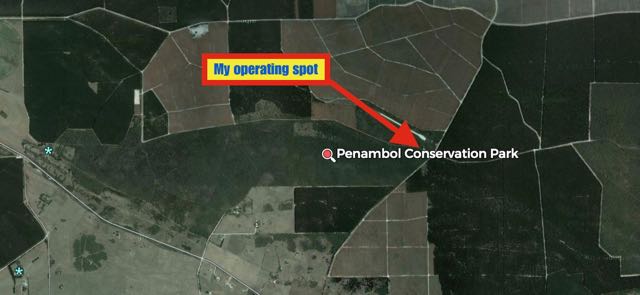
Above:- Map showing my operating spot.  Map courtesy of mapcarta.com

I was set up and ready to go by 2250 UTC (8.20 a.m.) and started calling CQ on 7.095.  David VK5NQP was my first caller with a great 5/9 signal.  This was followed by Mick VK3PMG in Stawell who was also 5/9, and then Barry VK5KBJ.

I worked a number of QRP stations including Adrian VK5FANA running 5 watts, Paul VK3DBP running 5 watts, Amanda running 500 milliwatts (5/8 sent and 5/9 received), Mark VK7MK running 2.5 watts (5/8 sent and 5/5 received), Ian VK5IS running 5 watts, Mike VK3XL also running 5 watts, and Trevor VK3FPY/5 running 5 watts with his home made vertical.

I also spoke with Mark VK5LO and and Paul VK1AT/3, both of whom were operating with home brew transceivers.

Tony VK3VTH also called in from the Cape Nelson State Park VKFF-754.  It was great to get another new VKFF reference in the log.

My final contact on 40m was with Peter VK3YE who was portable on the beach at Chelsea, running an FT817 on 5 watts and a home brew antenna (5/9 both ways).

I did call CQ numerous times on 14.310, but unfortunately there were no takers.  Sadly I couldn’t alert anyone that I was there via parksnpeaks, as there was no mobile coverage in the park.

This slideshow requires JavaScript.

After 90 minutes in the park, I had a total of 51 contacts in the log.  I was very pleased.  I needed 44 contacts to qualify the park for the WWFF program.  This was another unique VKFF activation to add to my list.

The following stations were worked:-

  1. VK5NQP
  2. VK3PMG
  3. VK5KBJ
  4. VK5JK
  5. VK3PF
  6. VK5FANA
  7. VK5ZAR
  8. VK3OF
  9. VK5PJ/m
  10. VK3DBP
  11. VK5KLV
  12. VK6RZ
  13. VK5LO
  14. VK5TW
  15. VK5FTVR
  16. VK3FQSO
  17. VK3NBL
  18. VK3TKK/m
  19. VK7MK
  20. VK5IS
  21. VK3HRA
  22. VK2BBQ/p
  23. VK3BFR
  24. VK2IO/m
  25. VK7NWT
  26. VK5FMID
  27. VK2YW
  28. VK5HEL
  29. VK3FSPG
  30. VK3FDES/m
  31. VK2NP
  32. VK3XL
  33. VK4AAC/5 (Kangaroo Island)
  34. VK3FPY/5
  35. VK5AKH/m
  36. VK1AT/3
  37. VK3AV
  38. VK5BJE (on either side of the UTC rollover)
  39. VK5ZGY/m
  40. VK3VTH/p (Cape Nelson State Park VKFF-754)
  41. VK4RZ
  42. VK5GM
  43. VK6FN
  44. VK2ATZ
  45. VK5KC
  46. VK3FPBI
  47. VK3KKP
  48. VK3HAK
  49. VK7LTD
  50. VK2SRT
  51. VK3YE/p (Chelsea Beach)

References.

Department of Environment and Natural Resources, 1994, Small Inland Parks of the South East Management Plan.

Department of Environment and Natural Resources, 2010, Penambol Conservation Park.

Hacks Lagoon Conservation Park

My final activation for Friday 5th June, 2015 was the Hacks Lagoon Conservation Park, which is situated midway between Adelaide and Melbourne.

Screenshot 2015-06-11 22.12.40

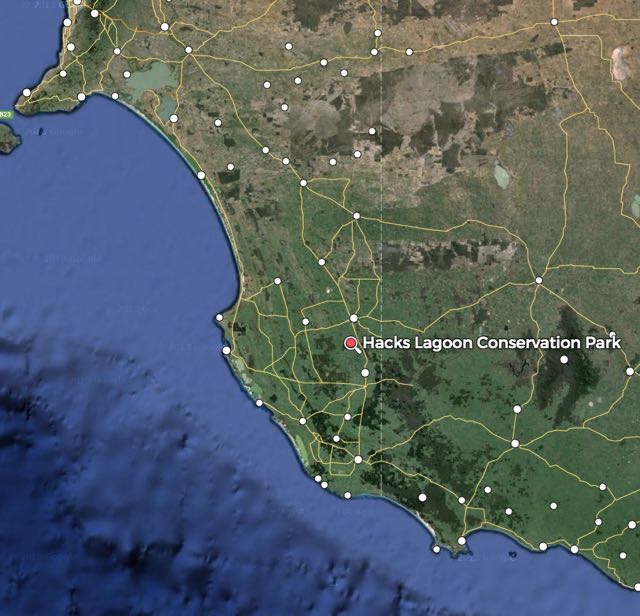
Above:- Map showing the location of the park.  Map courtesy of mapcarta.com

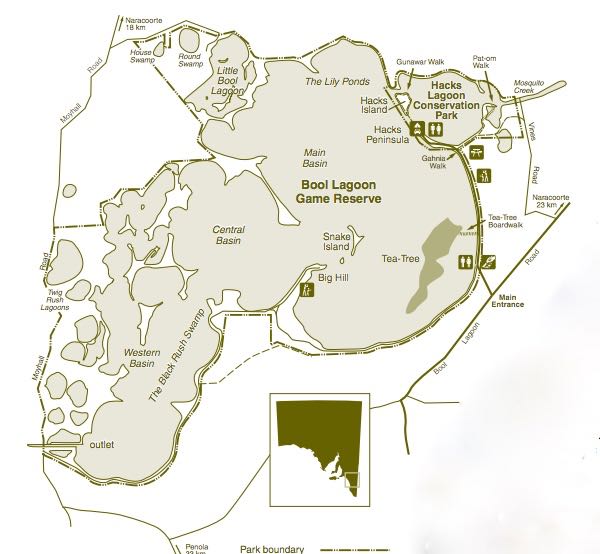
Hacks Lagoon Conservation Park adjoins the basin of the adjacent Bool Lagoon Game Reserve, which is one of the largest and most diverse freshwater lagoon systems in southern Australia.  The seasonal wetland areas of Bool Lagoon and Hacks Lagoon are home to a wide range of wildlife and provides essential drought refuge for numerous rare and endangered bird species.  In fact, over 150 species of birds visit the area.  A number of birds visit the park during Summer, including Sharp-tailed Sandpipers, who fly thousands of kms to be at Bool and Hacks Lagoons.  Brolgas are perhaps the most spectacular of all of the birds that can be found here.

Screenshot 2015-06-11 22.37.38

Above:- Map showing Bool and Hacks Lagoons.  Image courtesy of DEWNR

The area is recognised under the Ramsar Convention on Wetlands as a Wetland of International Importance.  It is protected under the Japan/Australia and China/Australia Migratory Bird Agreement due to the importance of the area as a summer refuge for migratory wading birds.

Screenshot 2015-06-11 22.13.20

Above:- Map showing my operating spot.  Map courtesy of mapcarta.com

The 40m band was very busy below 7.100 so I found 7.115 clear and started calling CQ.  My first taker was John VK5BJE, followed by Col VK5HCF in Mount Gambier, and then Jim VK5TR.  The band started off very good, with great signals from eastern Australia.  But this didn’t last long.  The band dropped out very quickly to VK3.  However, the band remained open to southern Australia and the remainder of eastern Australia.

I worked a number of QRP stations including Gerard VK2JNG who was portable, Greg VK5GJ again running just 4 watts, Peter VK3PF running 5 watts, Mark VK7MK running 2.5 watts, Andrew VK1NAM running 5 watts, Alan VK2AJG running 5 watts, Nev VK5WG running 5 watts, and Adrian on the Yorke Peninsula running 5 watts.

This slideshow requires JavaScript.

I remained in the park until just before 0800 UTC (5.30 p.m.) and watched a magnificent sunset.  I managed a total of 32 contacts on 40m SSB into VK1, VK2, VK3, VK4, VK5, and VK7,

The following stations were worked:-

  1. VK5BJE
  2. VK5HCF
  3. VK5TR
  4. VK3AXF
  5. VK3FEUG
  6. VK3AV
  7. VK4AAC/5 (Kangaroo Island)
  8. VK5JK
  9. VK5LSB
  10. VK2JNG/p
  11. VK5GJ
  12. VK3PF
  13. VK3DBP
  14. VK7MK
  15. VK1NAM
  16. VK2AJG
  17. VK3OHM
  18. VK5ZAR
  19. VK5NQP
  20. VK2NP
  21. VK3FBI
  22. VK5KLV
  23. VK3FQSO
  24. VK3OF
  25. VK5KPR
  26. VK5WG
  27. VK7LTD
  28. VK4FBMW
  29. VK4FAAS
  30. VK5FANA
  31. VK7VEK
  32. VK4RZ


References.

Department of Environment and Natural Resources, 2010, Bool Lagoon Game Reserve and Hacks Lagoon Conservation Park brochure.

National Parks South Australia, 2015, <http://www.environment.sa.gov.au/parks/Find_a_Park/Browse_by_region/Limestone_Coast/Bool_Lagoon_Hacks_Lagoon&gt;, viewed 11th June 105.

Big Heath Conservation Park VKFF-792

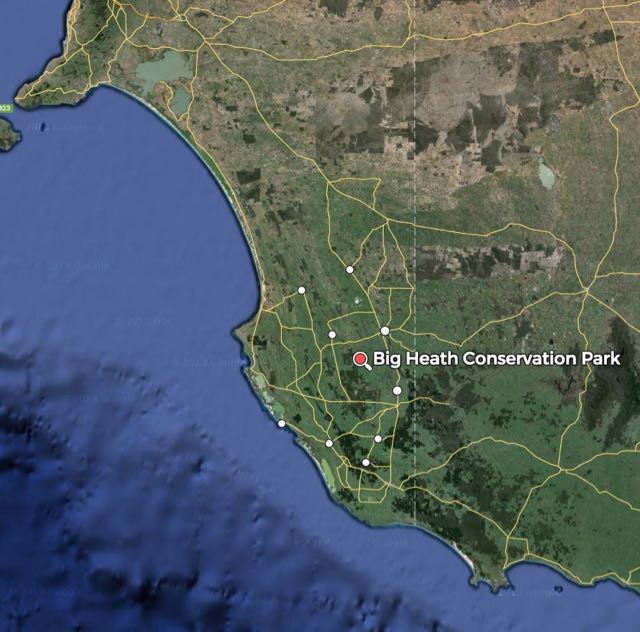
After leaving Mary Seymour Conservation Park, I travelled a short distance to my next park activation location at the Big Heath Conservation Park, which is situated about 20 km south of Naracoorte.  This was another unique park for me for the VK5 National & Conservation Parks Award and a unique park for the World Wide Flora Fauna (WWFF) program, so I was hoping to get my 44 contacts.  Big Heath was only just recently added to the WWFF program.

Screenshot 2015-06-11 21.22.34

Above:- Map showing the location of the park.  Map courtesy of mapcarta.com

Big Heath Conservation Park was constituted back in 1964 and covers an area of 2,351 hectares.  In an extra 100 hectares of land was added to the park.  When this land was added, Department of Environment Water and Natural Resources (DEWNR) CEO stated:-

‘Big Heath Conservation Park is situated in an area of high national and state priority for conservation, and protects remnant wet heath land vegetation in a regionally threatened plant community’.

The park contains a diversity of vegetation types.  It is certainly a very attractive park.  In the higher areas of the north eastern corner of the park, there is a Eucalypt woodland with a sparse understorey.  In the north western end of the park you can find a low woodland of Brown Stringybark, Pink Gum, and Desert Banksia.  A number of limestone outcrops located throughout the park, support Manna Gum, South Australian Blue Gum and Pink Gum woodlands.  In the south eastern corner of the park, River Red Gums of varying age and densisty proudly stand.  A dense heath of Mallee Honey Myrtle, Yellow Hakea, and Prickly Tea Tree is also found.  As elevation increases in the park, there are corresponding changes to the heath vegetation associations, with Broombrush, Grass Tree and Dwarf Sheaok occurring.

A large amount of native wildlife can be found in the park including the threatened species, Little Pygmy Possum.

Screenshot 2015-06-11 21.26.39

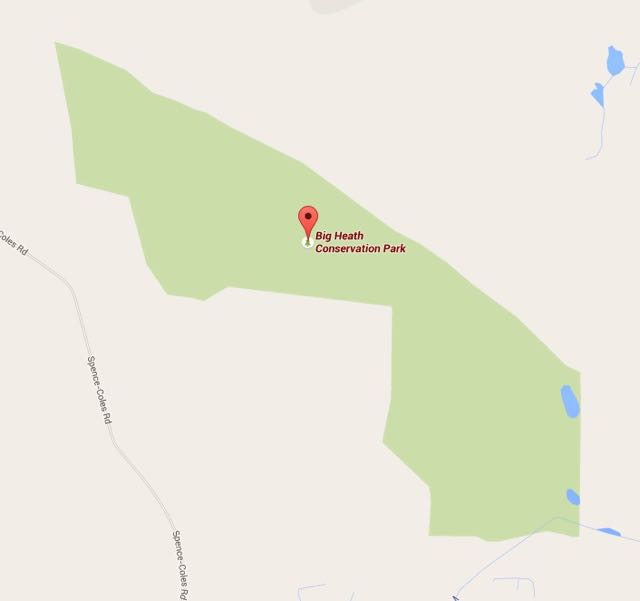
Above: Map showing the borders of the park.  Map courtesy of google maps.

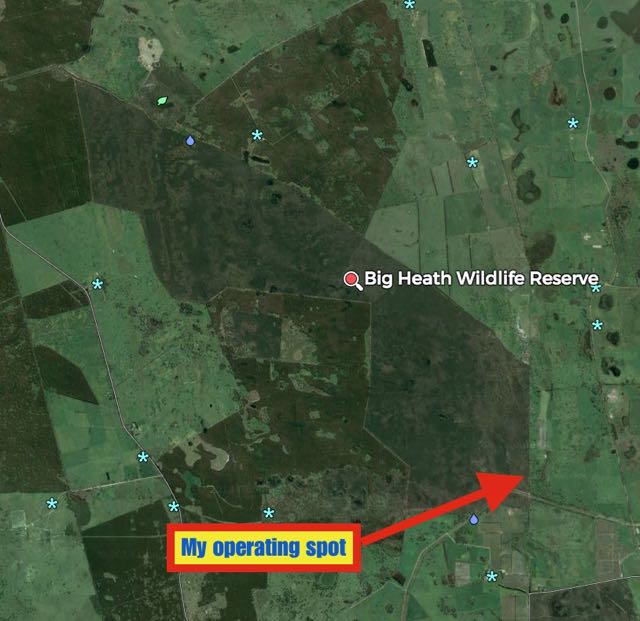
I set up in the south eastern corner of the park, after following Coles-Kilanoola Road into the park, passed the vineyards.  There was a nice cleared area at this location with plenty of room for me to run out the linked dipole.

Screenshot 2015-06-11 21.28.12

Above:- My operating spot.  Map courtesy of mapcarta.com

Again, I started off calling CQ on 7.095 and first cab off the rank was Greg VK5GJ at Meadows, running his normal QRP 4 watts with a nice 5/7 signal.  This was followed by Jim VK1AT/3 who is being a regular park hunter.  Next up was Rob VK4AAC/5 portable on Kangaroo Island, and then two regular park hunters, Arno VK5ZAR and Mick VK3PMG.

Things were travelling along well, and I was on my way to 44 contacts.  I had a steady flow of callers from all over Australia.  As I normally do, I took a break from the hunters from home, to listen out for mobiles and portables.  This resulted in a large number of mobile stations calling in, including husband and wife team Joe VK3YSP and Julie VK3FOWL, Eugene VK5ZA mobile at Auburn in the Clare Valley, Greg VK5ZGY, Mark VK5QI mobile at Blanchetown in the Riverland, Simon VK3SMC mobile in the Toolangi State Forest (4WDing), Peter VK5KX mobile at Blanchetown, Matt VK5ZM, Peter VK3TBN mobile at Bundoora, Chris VK2SR mobile in the ACT, and Tom VK5FTRG.  I was also called by Kerry VK4FKDP portable near the Condamine River .

This slideshow requires JavaScript.

At 0550 UTC (3.20 p.m. SA local time) I QSYd from 7.095 up to 7.105, so that I did not cause any QRM to the Kandos Net which operates at 0600 UTC on 7.093.  I worked a further 9 stations in VK3, VK4, & VK5 on 7.105.

After an hour in the park, I had 45 contacts in the log, thus qualifying the park for WWFF.  I was tempted to have a go on 20m but it was getting a little late (4.40 p.m. SA local time) and I still wanted to get to Hacks Lagoon.  I was cognisant that if I called CQ on 20m from a VKFF park, and the Europeans found me, it would be very hard to get out of Big Heath.  So I packed up my gear and headed off for another unique park, Hacks Lagoon.

The following stations were worked:-

  1. VK5GJ
  2. VK1AT/3
  3. VK4AAC/5 (Kangaroo Island)
  4. VK5ZAR
  5. VK3PMG
  6. VK3OHM
  7. VK3NBV
  8. VK3NBL
  9. VK3DBP
  10. VK3FQSO
  11. VK5JK
  12. VK3BHR
  13. VK3PF
  14. VK5HCF
  15. VK4RZ
  16. VK2NP
  17. VK3YSP/m
  18. VK5FANA
  19. VK5NRG
  20. VK3FOWL/m
  21. VK5ZA/m
  22. VK5ZGY/m
  23. VK5QI/m
  24. VK3SMC/m
  25. VK5KX/m
  26. VK5ZMm
  27. VK4FKDB/p
  28. VK3TBN/m
  29. VK2SR/mobile1
  30. VK5AW
  31. VK5FMID
  32. VK5NIG
  33. VK3OF
  34. VK3MEK
  35. VK5FCHM
  36. VK5BJE
  37. VK3TJK
  38. VK5KLV
  39. VK4GSF
  40. VK3AIG
  41. VK5FTRG/m
  42. VK7CC
  43. VK3MCK
  44. VK3FEUG
  45. VK5NQP

References.

Natural Resources Group, Department of Environment and Natural Resources, 1994, Small Inland Parks of the South East Management Plan.

Department of Environment Water and Natural Resources, 2015, <http://www.environment.sa.gov.au/Home/Full_newsevents_listing/News_Events_Listing/110113-Three_new_parks&gt;, viewed 11th June 2015

Mary Seymour Conservation Park

My next planned activation of the day was the Big Heath Conservation Park.  However after leaving Vivigani Ardune, the GPS took me on a merry drive around the South East and I was not able to access Big Heath.  So I headed for one of my other planned activations, the Mary Seymour Conservation Park.  Another unique park for me.

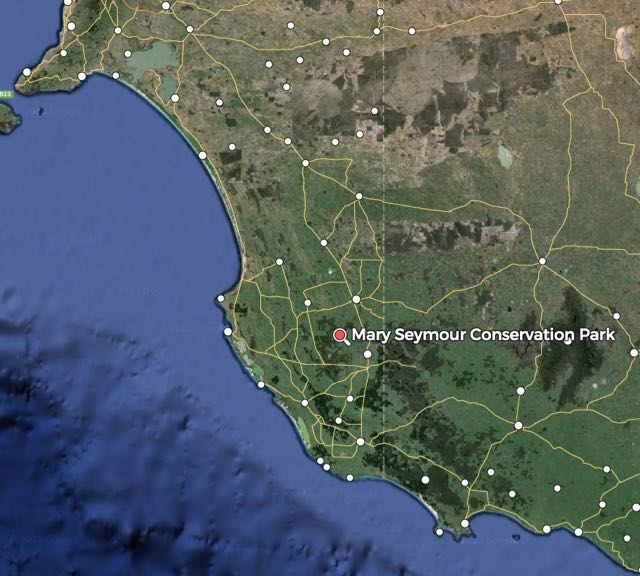
Mary Seymour Conservation Park is situated about 25 km south of Naracoorte in the South East of South Australia.

Screenshot 2015-06-11 20.18.34

Above: Map showing the location of the park.  Map courtesy of mapcarta.com

The park was constituted in 1980 and covers an area of around 264 hectares.  The western quarter of Mary Seymour consists of a limestone ridge which supports a low open forest of Brown Stringybark and Pink Gum.  The remainder of the park is a complex wetland system with limestone outcrops.

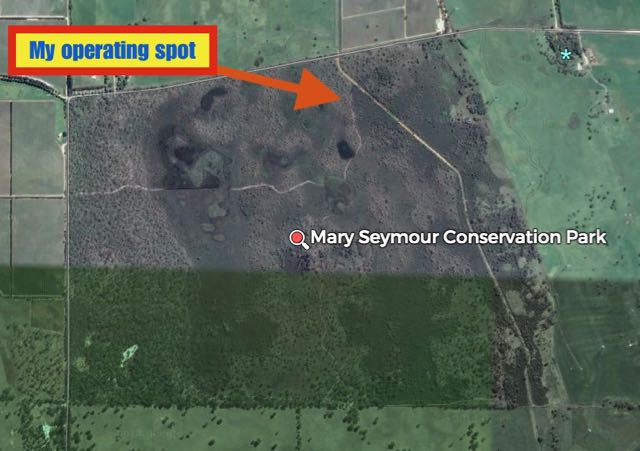
I accessed the park via Bool Lagoon West Road.  I found a clearing amongst the scrub, and I set up my equipment.

Screenshot 2015-06-11 20.18.48

Above:- Map showing my operating spot.  Map courtesy of mapcarta.com

I started calling CQ on 7.093 as Adam VK2YK was operating on 7.098.  My first taker was Amanda VK3FQSO with a lovely 5/9 signal.  This was followed by Marc VK3OHM  and then Rob VK4AAC/5 on Kangaroo Island.  It was 1.30 p.m. SA local time and the 40m band was holding up very well, with nice signals.  I worked a total of 27 stations in the park from VK2, VK3, and VK5.

That included a handful of QRP operators, including Greg VK5GJ running 4 watts (5/7 sent and 5/9 received), and Paul VK3DBP running 5 watts (5/9 both ways).  I also worked a number of mobile stations including Greg VK5ZGY, Peter VK3TKK, Terry VK3BMX using a Famparc whip, Mark VK5QI mobile at Truro, and Peter VK3PF.

I was also fortunate that Adam VK2YK had tracked me down and gave me a call from Hunter Wetlands National Park, VKFF-595.

This slideshow requires JavaScript.

I only remained in the park for 30 minutes, as I still had 2 planned park activations for the day.  But I was very happy, I had 27 contacts in the log.

The following stations were worked on 40m SSB:-

  1. VK3FQSO
  2. VK3OHM
  3. VK4AAC/5 (Kangaroo Island)
  4. VK3PMG
  5. VK5WG/p
  6. VK5HCF
  7. VK5ZAR
  8. VK5KLV
  9. VK5GJ
  10. VK5ZGY/m
  11. VK3TKK/m
  12. VK1AT/3
  13. VK3BMX/m
  14. VK2YK/p (Hunter Wetlands National Park VKFF-595)
  15. VK5QI/m
  16. VK3DBP
  17. VK3PF/m
  18. VK3OF
  19. VK2UH
  20. VK3BHR
  21. VK5JK
  22. VK5BJE
  23. VK5FMID
  24. VK3LPG
  25. VK3FTAD
  26. VK3FARO
  27. VK3FLSS

Vivigani Ardune Conservation Park

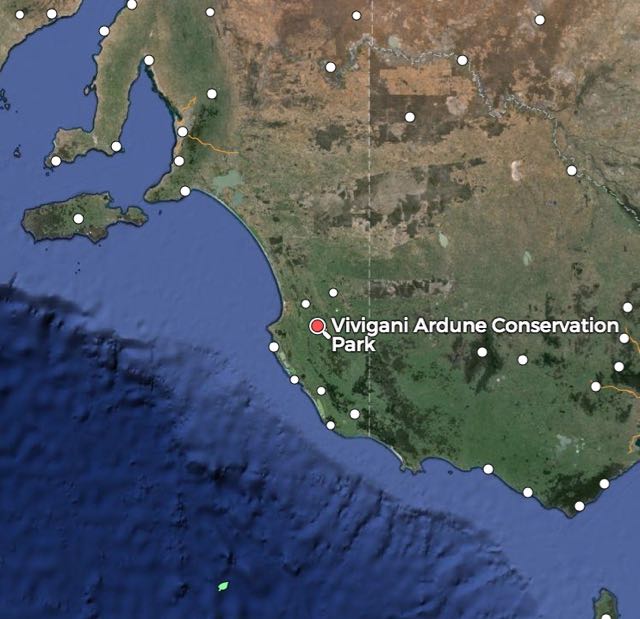
After leaving the Fairview Conservation Park, I headed to my next activation, the Vivigani Ardune Conservation Park, situated just north west of the little town of Lucindale.  This was another unique park for me for the VK5 National and Conservation Parks Award.

Screenshot 2015-06-11 19.29.58

After leaving Fairview I travelled back into Lucindale along Fairview Road.  Lucindale is a little town of about 400 people and is situated about 345 km south east of Adelaide.  It is best known for hosting the annual South East Field Days, which attracts over 25,000 visitors each March.

After leaving Lucindale I headed out along the Reedy Cfreek-Lucindale Road, and then turned right into Conricks Road.  The park is about 4 km up Conricks Road on the left hand side (on the western side of the road).  Keep a careful eye out for the park sign with can be located in a paddock which forms part of the park.

On the way to the park I spoke from my mobile, with Alan VK7BO who was on a SOTA peak, The Tump, VK7/ NC-018 (5/9 both ways).  I also spoke with Nigel VK5NIG who was portable on SOTA peak Mount Gawler VK5/ SE-013 in the Mount Lofty Ranges (5/9 both ways).

I was unable to find out a lot about this park, which was proclaimed in 2008.  John VK5BJE and I spoke about the origins of the name on air.  John was my 2nd contact.  We believe it may have Latin ties and means something similar to ‘toil hard’.  But more research will need to go into that.  There is a property called Vivigani just to the south of the park.

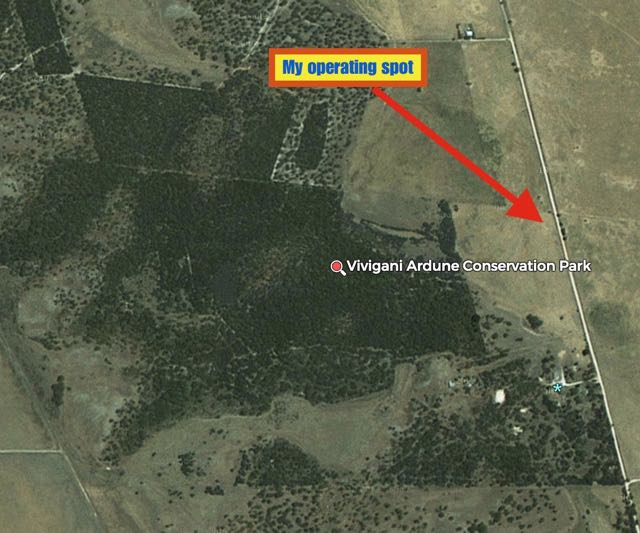
Screenshot 2015-06-11 19.30.36

Unfortunately this is another park which required some fence jumping.  So many South Australian parks are locked up by padlocked gates.  This one didn’t have a padlock, but there was a gate which appeared to have not been opened since the medieval times.  On the gate was a sign which read ‘Sanctuary’ which appeared to have been there in time immeorial.  So I jumped the fence to gain access to park.  Be careful of the electric fence!

My first contact in the park was with Nigel VK5NIG who I tracked down after setting up.  Nigel was still on Mount Gawler and was calling CQ on 7.105.  Nigel was a good 5/9 and I’m pleased he was.  I was very saddened to find that I had an S9 noise floor on 40m when I turned on the radio.  I’m suspecting that this was a combination of the electric fence and the power lines which run through the paddock.

After speaking with Nigel I headed down to 7.095 and called CQ and this was answered by a number of the park regulars including John VK5BJE, followed by Les VK5KLV, Tony VK5FTVR and Mick VK3PMG.  Fortunately all of their signals were above the noise floor.  I went on to work a total of 34 stations on 40m in VK2, VK3, VK4, VK5, and VK7.  That included a number of QRP stations including Greg VK5GJ running 5 watts (5/9 both ways), and Peter VK3PF also running just 5 watts (5/7 sent and 5/9 received).

I also worked a few mobile stations which included Rod VK5KFB mobile in the South East, Eugene VK5ZA mobile at Burra in the Mid North, and Dave VK2BDR.

This slideshow requires JavaScript.

When things slowed down on 40m I headed up to 20m.  I called CQ on 14.310 and this was answered by Adam VK2YK who was operating portable in the Hunter Wetlands National Park, VKFF-595 (5/9 both ways).  A nice little bonus.

I would have stayed around a bit longer on 20m, but the rain had hit again, and once again it was a hasty retreat from this park.

The following stations were worked on 40m SSB:-

  1. VK5NIG/p (SOTA Mt Gawler VK5/ SE-013)
  2. VK5BJE
  3. VK5KLV
  4. VK5FTVR
  5. VK3PMG
  6. VK5ZGY
  7. VK5NQP
  8. VK3FQSO
  9. VK3OHM
  10. VK5ZAR
  11. VK5GJ
  12. VK3OF
  13. VK3BHR
  14. VK5KFB/m
  15. VK3UP
  16. VK1AT/3
  17. VK5IS
  18. VK2VEX
  19. VK5ZA/m
  20. VK3PF
  21. VK2BDR/m
  22. VK2NP
  23. VK7RM
  24. VK5VGC
  25. VK5BW
  26. VK3NBL
  27. VK3BWZ
  28. VK5FUZZ
  29. VK4CPS
  30. VK5FADS
  31. VK5FO/p
  32. VK3PRF
  33. VK3TKK
  34. VK7MK

The following station was worked on 20m SSB:-

  1. VK2YK (Hunter Wetlands National Park VKFF-595)


References.

Wikipedia, 2015, <http://en.wikipedia.org/wiki/Lucindale,_South_Australia&gt; viewed 11th June 2015