Lake Torrens National Park VKFF-278

On Sunday morning, 21st June, 2015, we all awoke to a beautiful sunny, but crisp morning.  And we were all hoping that we would get the okay from the owners of Merna Mora, for us to travel out along one of their 4WD tracks to the Lake Torrens National Park, VKFF-278.  We had planned to activate Lake Torrens on Saturday, but there had been a lot of rain here in the north, so the 4WD tracks on Merna Mora property had been closed.

So we patiently waited and were then given the thumbs up by Philip and Sonya, the owners of Merna Mora.  To say I was excited was an understatement.  The rain had affected our trip quite a lot, and I was very keen to do a bit of 4WDing out to Lake Torrens, and of course activate a unique park.

Lake Torrens National Park is a very remote park, situated about 350 km north of Adelaide.  It consists of stark wilderness and the salt lake that stretches 250km in length.  Lake Torrens is normally a dry salt flat and has only been filled with water once in the past 150 years.  Thunderstorms occasionally provide a small amount of water in the lake and when this occurs, a variety of birdlife is attracted to the area.

Screenshot 2015-06-29 13.13.34

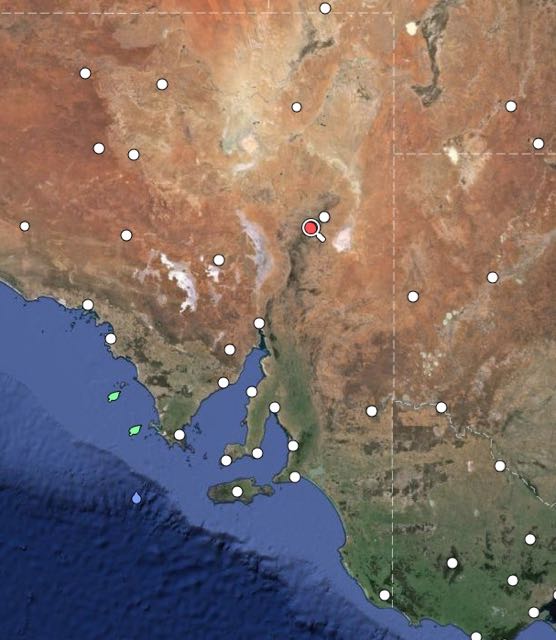
Above:- Map showing the location of the park.  Map courtesy of mapcarta.com

By 10.15 a.m. we were on the road.  The 4WD track out to the lake is about a 110km round trip, taking you through some amazing country.

On our way out to the park I spoke with Mick VK3PMG on 7.105.  Mick was kind enough to post a message on the WWFF Australia Yahoo group and the VK5 Parks Yahoo group that we were enroute to the park, and also put up an alert on parksnpeaks for us.  Many thanks Mick

This slideshow requires JavaScript.

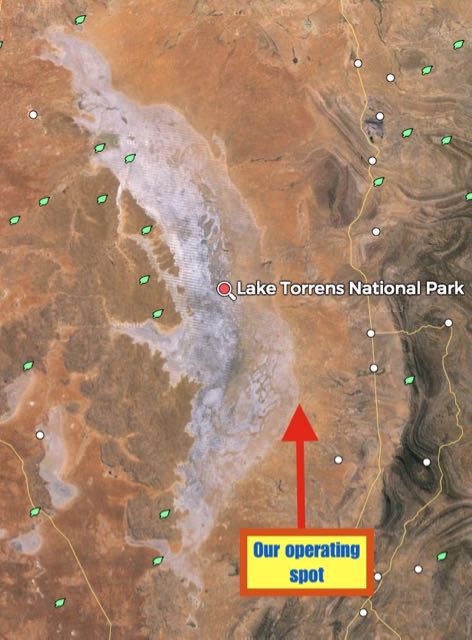
We activated the park from very close to the shore of the lake itself, just off the 4WD track.
Screenshot 2015-06-29 13.20.49

Above:- Map showing our operating spot.  Map courtesy of mapcarta.com

After arriving at the lake, John VK5BJE and I were quick to set up our stations.  John wanted to give 30m a crack again, so I started out on 40m, calling CQ on 7.095.  Quite appropriately, after his earlier help, my first contact was with Mick VK3PMG.  This was followed by Les VK5KLB, David VK5HYZ, and then Peter VK5FLEX.  Band conditions on 40m appeared to be very good.  It was very pleasing to have a steady flow of callers from VK2, VK3, VK5, and VK7, all with good signals.

After working a total of 22 stations I took a break, as I was getting a bit of interference from John VK5BJE.  We had set up a little bit too close to each other.  I had some lunch and enjoyed the sunshine, and admired the amazing view of Lake Torrens.

After lunch I put out a few calls on 15m, but sadly there were no takers.  And because we had no mobile phone coverage in this remote part of South Australia, we were not able to spot ourselves on parksnpeaks.  So I put a few CQ calls out on 14.310 and spoke with VK2ID portable on the beach, Alan VK4ALA, Fred VK4FE, Craig VK2PAW, and then Marc operating a military transceiver and running just 25 watts.

This slideshow requires JavaScript.

I then called CQ on 40m and my first contact there was with Cliff VK2NP, followed by Gerard VK2IO who was operating from SOTA summit, Mount Canobolas, VK2/ CT-001, near Orange.  This was followed by a call from Karl VK2GKA activating STA peak, Mount Alexandra VK2/ IL-005 near Mittagong.  A few contacts later, Peter VK3YE gave me a shout, whilst operating portable from Chelsea Beach in Melbourne, with a home brew transceiver.  I also had a contact with Ian VK1DI who was activating O’Connor Ridge Nature Reserve VKFF-857.  For more info on Ian’s activation, have a look at Ian’s blog at…..

http://vk1di.blogspot.com.au/2015/06/oconnor-ridge-vkff-857.html

I managed to push on and go past the required 44 contacts for the World Wide Flora Fauna (WWFF) program.  After 2 hours in the park I had a total of 47 contacts in the log.  We headed back to Merna Mora along the 4WD track, admiring the views of the Flinders Ranges and viewed a large amount of wildlife, including Western Grey kangaroos, Red Kangaroos, Emus, and Wedge Tailed eagles.  Also avoiding the occasional stock that we encountered along the way.

I worked the following stations on 40m SSB:-

  1. VK3PMG
  2. VK5KLV
  3. VK5HYZ
  4. VK5FLEX
  5. VK3VTH
  6. VK5NQP
  7. VK5WG
  8. VK5KFB
  9. VK3ZPF
  10. VK2YK
  11. VK5FANA
  12. VK7AN/p
  13. VK4AAC/5
  14. VK5ZAR
  15. VK3TKK
  16. VK3CRG
  17. VK3OF
  18. VK3TJK
  19. VK5KAT
  20. VK5VBR
  21. VK3FTWO
  22. VK3ANL
  23. VK2NP
  24. VK2IO/p (SOTA VK2/ CT-001)
  25. VK2GKA/p (SOTA VK2/ IL-005)
  26. VK5SFA
  27. VK5FO/m
  28. VK3IO
  29. VK3YE/p
  30. VK5KKS
  31. VK5FMID
  32. VK3AWG
  33. VK1DI/p )VKFF-857)
  34. VK5ALZ
  35. VK2RD
  36. VK5ZRY
  37. VK2NEO
  38. VK4FTWO
  39. VK4IL
  40. VK1AT
  41. VK7NWT
  42. VK3XBC

I worked the following stations on 20m SSB:-

  1. VK2ID/p
  2. VK4ALA
  3. VK4FE
  4. VK2PAW
  5. VK6HAO

After returning to Merna Mora, we stoked up the outdoor fire and cooked some potatos in jackets in alfoil, as part of our tea, which we all enjoyed together again in the indoor kitchen area.
DSC_0100

Flinders Ranges National Park VKFF-176 Wilpena Pound

After leaving the Aroona ruins, we headed a bit further east on the Brachina Gorge Road and stopped for lunch.  Whilst there I spoke with Joe VK3YSP and Julie VK3YSP who were operating portable at the Melbourne Museum as part of Museums Weekend.  Both Joe and Julie had a terrific 5/9 signal into my mobile station.

After lunch we continued east on the Brachina Gorge Road through the park until we hit the bitumen of the Flinders Ranges Way.  We travelled a bit further south and went to the top of the Stokes Hill lookout, which offers some amazing views of the Flinders Ranges.  Sadly, the summit does not qualify for the Summits on the Air program.

After leaving Stokes Hill lookout we continued south on the Flinders Ranges Way and then turned right into Wilpena Pound Road and on to the Wilpena Pound resort.  It was here that we refueled and grabbed a cup of coffee.

I headed over to a cleared area on the northern side of the main carpark and set up my station, the Yaesu FT-857d, and the 40m/20m linked dipole.  John VK5BJE headed a bit further over to the south and operated from a spot where he had activated from previously.  John was going to call on 40m and I decided to stick to 20m.

Screenshot 2015-06-29 12.35.13

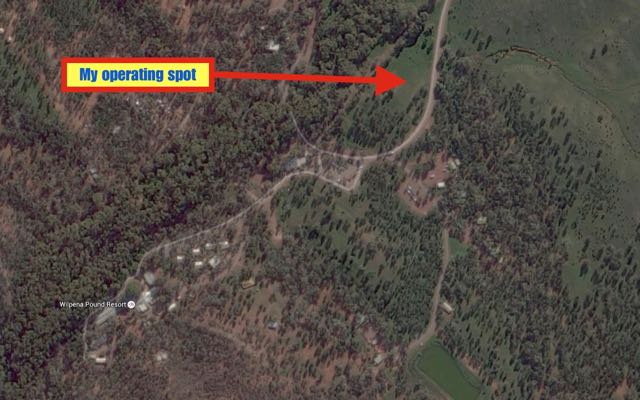
Above:- Map showing my operating spot.  Map courtesy of mapcarta.com

I started calling CQ on 14.244, which is the nominated calling frequency for the WWFF program.  My first taker there was Jim VK2QA, followed by David VK4HAX (I was David’s first ever 20m contact), and then Caleb ZL2ML.  Unfortunately there was a lot of QRM from a nearby Italian station, so I QSY’d down to 14.200 and called CQ again.  This time my CQ call was answered by Karl VK2GKA, followed by James VK1DR and Bruce VK4YS.   My first DX contact was 6 calls later and it was no less than my very good friend, Marnix, OP7M in Belgium.  Marnix was 5/7 and he gave me a 5/5.  It was great to get Marnix in the log.  I went on to work a further 12 stations in VK2, Italy, Poland, Germany, England, Canada, and Switzerland, until I was called away from the radio.

It was one of the DEWNR ranges who was a little bit stand offish.  Fortunately in over 200 activations, I have only had one previous ‘bad’ contact with a DEWNR ranger who told me off for tying off one of the ends of my dipole to a gum tree.  And this fella, also did not have a lot of personal skills, I am sorry to say.  I was advised to seek permission first in future as people would ask questions about what I was doing?????  Secondly I should seek permission before driving the squid pole holder into the ground.  I bit my tongue for a while and when I questioned him about this, and asked how was it any different to a tent peg or a totem tennis pole.  I never got a sensible reply.  Oh well, it was bound to happen again, a poor interaction with somebody from DEWNR.

In any event, ‘permission’ was granted for me to continue, but by this time everyone had given up on waiting for me on 14.200.  I worked Lee, AK4QA in Alabama in the USA, Albert S58AL in Slovenia and then Gyula in Hungary.

This slideshow requires JavaScript.

My last contact for this activation was with Rob VK4FFAB who was portable in the Conondale National Park VKFF-109, which is located south west of Noosa Heads in Queensland.  Rob had a nice 5/7 signal and he reciprocated with a 5/4 for me.

It was time to pack up and head back home to Merna Mora.  David and Joy had already headed off, which left just radio die hards John and myself, and our patient wives Marija and Jenny.  We had a very enjoyable drive back to Merna Mora along the 30km long Moralana Track through Arkaba Station and Merna Mora Station.  We enjoyed the most amazing sunset and as Marija said, the most number of kangaroos we had ever seen.

And along Moralana Track I fired up the IC-7000 in the car and spoke with Rob VK4FFAB portable, Peter Vk2NEO, Jim VK5TR, Colin VK4FAAS, Perrin Vk3XPT, and Ivan VK5HS.

I worked the following stations on 20m SSB:-

  1. VK2QA
  2. VK4HAX
  3. ZL2ML
  4. VK2GKA
  5. VK1DR
  6. VK4YS
  7. VK2JF/m
  8. VK6NTE
  9. VK2HOT
  10. VK4WJW/6
  11. VK2LX
  12. OP7M
  13. VK2MI
  14. VK4OZI
  15. VK2IO/m
  16. I5FLN
  17. Sp5INQ
  18. DL7UXG
  19. G0TSQ
  20. VE7CV
  21. DJ7ZZ
  22. DL2ND
  23. M0BKV
  24. HB9FBG
  25. AK4QA
  26. S58AL
  27. HA6OB

I worked the following stations on 40m SSB:-

  1. VK5BJE/p
  2. VK4FFAB/p (Conondale National Park VKFF-109)

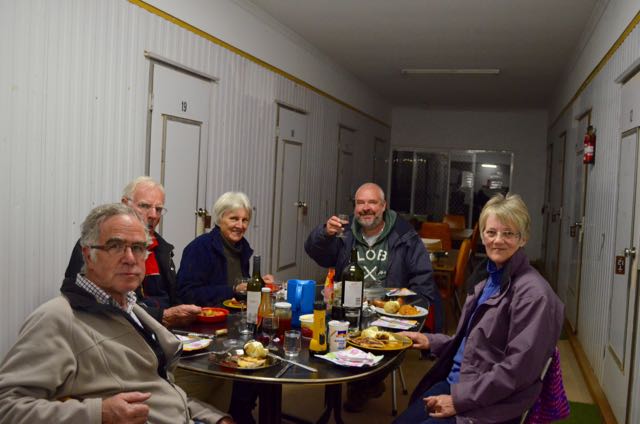
After gettng back to Merna Mora, and freshening up a bit, we had a very enjoyable dinner together and the obligatory few bottles of red wine.  That guy John VK5BJE is a very bad influence!

DSC_1386

Flinders Ranges National Park VKFF-176 Aroona ruins

We all enjoyed a good feed and a few more bottles of red on Friday evening at Merna Mora Station, where we stayed for 3 nights (Fri-Sun).  Merna Mora is part of a 230 sq mile sheep and cattle station located about 425 km north of Adelaide, and about 46 km north of Hawker.  About 2,500 sheep and 800 cattle are run on the property.  Merna Mora has facilities to accomodate up to 50 people.  For more information on Merna Mora, please visit their website at…..

http://www.mernamora.com.au/

Saturday morning, 20th June 2015, was a beautiful sunny morning.  After a cooked breakfast an enjoying a coffee in the sunshine watching the Miner birds and Honeyeaters in the flowering native plants out the front of our accomodation, we hit the road for the Flinders Ranges National Park, VKFF-176. 

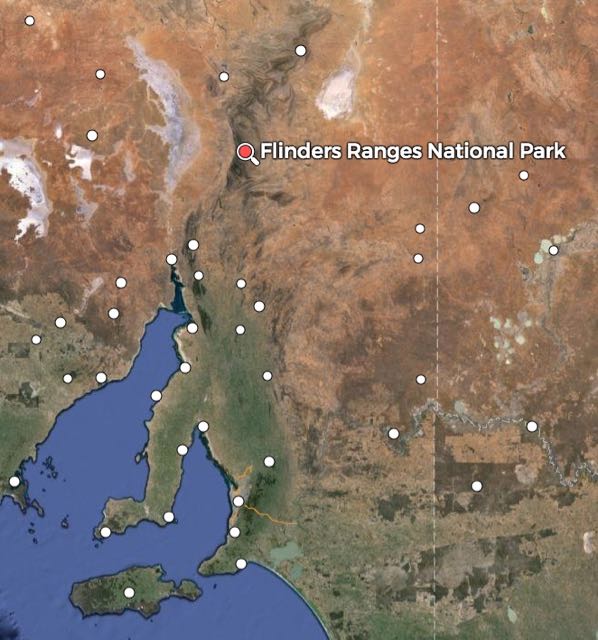
The Flinders Ranges National Park is situated about 450 km north of Adelaide and is located in the central Flinders Ranges.  The park is about 95,000 hectares and includes the Heysen Range, Brachina and Bunyeroo Gorges and the amazing Wilpena Pound.  The Adnyamathanha people (meaning hills or rock people) are the traditional custodians of the Flinders Ranges.
Screenshot 2015-06-29 09.42.08

Above:- Map showing the location of the Flinders Ranges National Park.  Map courtesy of mapcarta.com

We drove north along The Outback Highway and turned right on the Brachina Gorge Road and headed east towards the park.  We briefly stopped at the interpretive signs and lookout, before venturing into the park through Brachina Gorge. Rocks exposed along the gorge are between 500 and 650 million years old and were deposited as sediments in an elongate depression known as the Adelaide Geosyncine.  This area was flooded by the sea for much of the 150 million year period, during which the sea level rose and fell many times.  Sediments were transported by rivers, and at times by glaciers, and deposited on the sea floor.  Rock strata along the gorge provide one of the most complete sedimentary records in the world for this time period.  It is truly and amazing and very spectacular drive through Brachina Gorge, with many interpretayive signs along the way.

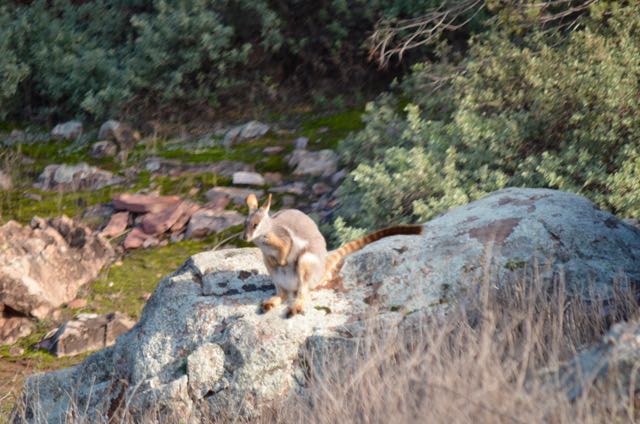
We were fortunate enough to encounter a handful of the rare Yellow Footed Rock Wallabies as we drove through the gorge.  Sadly this little wallaby was once killed in large numbers for its pelt.  They scale cliffs and climb rocks with superb agility and can leap sizable chasms.  It was a real treat to be able to see them up close.

DSC_1277

We continued on to the Aroona Valley, where we set up at the end of the Aroona Valley Road, at the Aroona Ruins.  The Arrona hut was built in 1925, as an outstation for Eddie Pumps.  It consisted of a four roomed dwelling with a stone fire place and a verandah running along three sides.  The house is a typical pug and pine construction.  Slabs of native pine from this area were cut and erected vertically side by side.  Chicken wire was nailed to the framework and mud or pug was flushed to fill the gaps.  The floor was rammed earth and the roof was corrugated galvanized iron sheets.  The famous Australian artists, Sir Hans Heysen stayed here in 1927 and started the first of many sketches and paintings of the Flinders Ranges.

Screenshot 2015-06-29 09.49.28

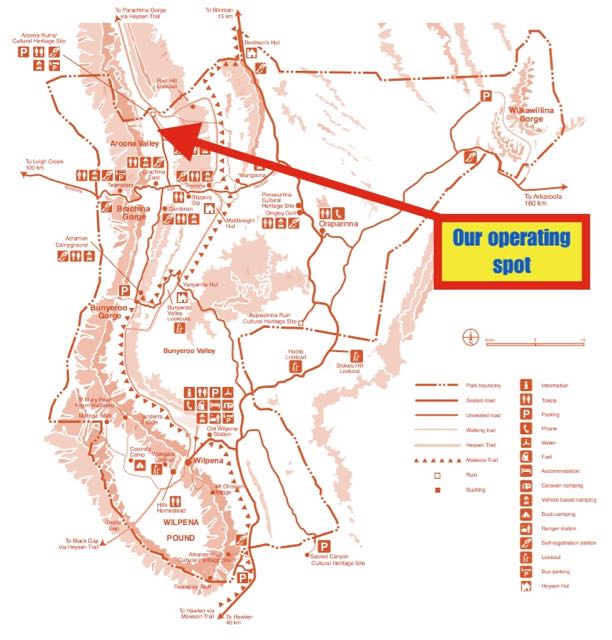
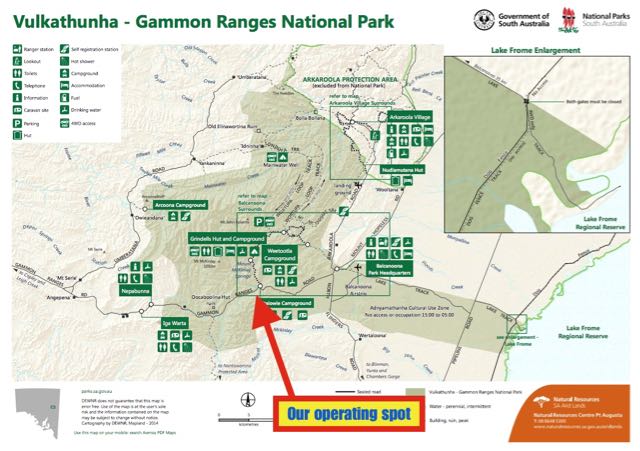
Above:- Map showing our operating spot in the park.  Map courtesy of DEWNR

John VK5BJE was keen to try his luck again on 30m and set up near the carpark.  I set up in close proximity, a little further up the hill and started off on 20m.  David VK5KC headed a bit further to the east and worked 40m.

My first contact on 20m was with Fred VK4FE who was operating from Mowbray National Park, VKFF-367 in Queensland.  Fred was calling CQ on 14.310 and was a good 5/7 signal.  I then headed down to 14.305 and called CQ and this was answered by Michael VK6MMB who was portable in Goongarrie National Park, VKFF-209.  Michael and his off side Mike VK6MB were half way through a marathon parks trip in Western Australia.  This was followed by a call from Gerard VK2IO who was mobile on his way to a SOTA summit in the Blue Mountains.  I was then called by Adam VK2YK with a strong 5/9 signal and then Mark VK4MON with a 5/8 signal, operating portable from his back yard.

I then moved up to 40m and called CQ on 7.095 and this was answered by Larry VK5LY in the Riverland with his typical strong 5/9 plus signal.  I went on to work a total of 34 stations on 40, including Fred VK4FE in Mowbray National Park and Dale VK5DC mobile near the Northern Territory/Queensland/South Australian border.

This slideshow requires JavaScript.

I then decided to give 15m a go, and managed to work Cliff VK2NP, Fred VK4FAAP and Ian VK1DI.  Prior to packing up, I worked Rob VK4AAC who was portable in the Vivonne Bay Conservation Park, VKFF-811, on Kangaroo Island.

After 90 minutes at Arrona Ruins, it was time to pack up and head off a bit further up the Brachina Gorge Road for a bite to eat.  I had a total of 43 contacts in the log.  We were planning on activating the Flinders Ranges National Park again, later in the afternoon, so I was assured of picking up 1 more QSO to qualify the park for the World Wide Flora Fauna (WWFF) program.

I worked the following stations on 20m SSB:-

  1. VK4FE/p (Mowbray National Park VKFF-367)
  2. VK6MMB/p (Goongarrie National Park VKFF-209)
  3. VK2IO/m
  4. VK2YK
  5. VK4MON

I worked the following stations on 40m SSB:-

  1. VK5LY
  2. VK3CWM
  3. VK5FANA
  4. VK5DC/m
  5. VK5FAJS
  6. VK3PMG
  7. VK5NQP
  8. VK5FMID
  9. VK5ZAI
  10. VK3NBV
  11. VK5ZGY
  12. VK3APC
  13. VK3FLCS
  14. VK1AT
  15. VK5IS
  16. VK5NWE
  17. VK3FEUG
  18. VK5NIG/p
  19. VK3DBP
  20. VK3PRF
  21. VK5STU/p
  22. VK2GKA
  23. VK5TW
  24. VK5FTRG
  25. VK1DI
  26. VK4FE/p (VKFF-367)
  27. VK5WG
  28. VK2NP
  29. VK5JP
  30. VK5ZX/m
  31. VK5FLEX
  32. VK2IAN
  33. VK2SL
  34. VK3TKK
  35. VK4AAC/5 (Vivonne Bay Conservation Park VKFF-811)

I worked the following stations on 15m SSB:-

  1. VK2NP
  2. VK4FAAP
  3. VK1DI


References.

Department of Environment and Natural Resources, 2011, Flinders Ranges National Park

Gammon Ranges National Park VKFF-189

Friday the 19th June 2015 was ‘take two’ for the Gammon Ranges National Park, VKFF-189.  This was to be a unique park for me for both the World Wide Flora Fauna (WWFF) program and the VK5 National and Conservation Parks Award.

Screenshot 2015-06-28 19.44.40

Above:- Map showing the location of the park.  Map courtesy of mapcarta.com

Marija and I travelled south along The Outback Highway towards Copley.  On the way south I had a chat with Mark VK6BSA who was mobile on his way in to work again (5/9 both ways) and Steve VK3HK who was also mobile.  I also spoke with Bill VK5MBD at Red Hill.

The Vulkathunha-Gammon Ranges National Park, which is about 660 km north of Adelaide, was proclaimed in 1970, and forms part of the traditional country of the Adnyamathanha people.  The park is rich with cultural significance.  The park is 1,257.23 km2 (485.4 sq mi) in size.  Over 900 plant and 200 fauna species have been recorded in the park, including some rare and endangered species.  The park is remote and has many contrasts, including deep gorges and chasms, towering mountains, tree-lined creeks and freshwater springs.  The park encompasses some of the most rugged and spectacular country in South Australia.

Marija and I drove out from Copley through magnificent countryside.  The road out to the park is dirt but is in good condition and is a distance of about 70 km.

We stopped briefly at Nepabunna, a small aboriginal community on the doorstep of the Gammons.  Originally established as a mission in the 1930’s, the community became a council in 1998 and has a population of about 50 people.

We continued east along the Copley Road, into the park, until we reach Italowie Gorge.  We found a nice little area close to the McKinlay Creek and set up here.  Interestingly, the bushman, R.M. Williams is reputed to have learnt everything he knew about boot-making and leather from another man he met while camping in Italalowie Gap.  R.m. Williams later became a millionaire and a renowned clothing brand carries his name.

Again, for this activation I ran my Yaesu FT-857d, 40 watts and the 40m/20m linked dipole.  For 15m I used a simple 1/2 wave 15m dipole.

Screenshot 2015-06-28 19.49.29

Above:- Map showing our operating spot.  Map courtesy of National Parks SA.

I started calling CQ on 7.095 and it wasn’t long before I had my first taker.  It was Bill VK5MBD at Red Hill with a very strong 5/9 plus signal, followed by Jess VK6JES, Brian VK5FMID at Mount Gambier, and Jim VK1AT.  I had a good steady flow of callers on 40m from around Australia: VK1, VK2, VK3, VK4, VK5, VK6 and VK7 worked.  This included some of the usual QRP suspects including Greg VK5GJ running just 4 watts (5/8 sent and 5/9 received).  Both David VK5KC and John VK5BJE called me from Farina in the throws of packing up and hitting the road.

After working 26 stations on 20m, I lowered the squid pole and put up the 1/2 wave 15m dipole and called CQ on 21.250.  My call was answered by Bill VK5MBD, who despite being very weak (5/1) was very workable.  This was followed by John VK6NU, Grant VK5VGC and Albert S58AL.  Yes Slovenia.  I couldn’t believe it.  I did not expect to work into Europe at 10.10 a.m.  And Albert and I heard each other perfectly.  In fact I was stronger to Albert than he was to me (5/3 sent and 5/7 received).

It was at this time that Marija and I were visited by two of the local rangers.  We explained to them what we were doing and assured them that we were not crazy, trying to catch squid in the creek with the squid pole.  They were quite interested in what we were doing and the hobby in general.

I then put up the 40m/20m linked dipole again and called CQ on 14.310.  But I only had the solitary caller there, and that was Bill VK5MBD, who again was weak (5/1), but again very workable.  There was no man made noise at all out here in the middle of nowhere.  I just wish it was like that at home.

This slideshow requires JavaScript.

I returned to 40m for a short time, calling CQ on 7.098, which was answered by park stalwart Mick VK3PMG, followed by Adrian VK5FANA, David VK5HYZ and then Ian VK5IS.  I worked a further 17 Australian stations in VK2, VK4, & VK4.  This included John VK2KJO who called in from nearby Arkaroola.  John and Sue had travelled through earlier.

After 2 hours in the park I had a total of 52 contacts in the log.  We packed up and headed back in to Copley.

The following stations were worked on 40m SSB:-

  1. VK5MBD
  2. VK6JES
  3. VK5FMID
  4. VK1AT
  5. VK5GJ
  6. VK5HS
  7. VK5HCF
  8. VK3PF
  9. VK7ALH
  10. VK5RM
  11. VK5DC/m
  12. VK5KC/p
  13. VK3FQSO
  14. VK5BJE/p
  15. VK2FJPR
  16. VK3FLCS
  17. VK5LY
  18. VK4FFAB
  19. VK3TKK
  20. VK5WG
  21. VK3DBP
  22. VK3YAR
  23. VK5TN
  24. VK5GJ
  25. VK5VGC
  26. VK7MK
  27. VK3PMG
  28. VK5FANA
  29. VK5HYZ
  30. VK5IS
  31. VK3FMAA/m
  32. VK5FAJS
  33. VK5KAF
  34. VK5NRG
  35. VK2KJO
  36. VK5ZA/m
  37. VK5JK
  38. VK5ZK
  39. VK2IO
  40. VK4CPS
  41. VK2MJB
  42. VK3BHR
  43. VK3OHM
  44. VK5LDM
  45. VK3PR
  46. VK3HP
  47. VK5GI

The following stations were worked on 20m SSB:-

  1. VK5MBD

The following stations were worked on 15m SSB:-

  1. VK5MBD
  2. VK6NU
  3. VK5VGC
  4. S58AL

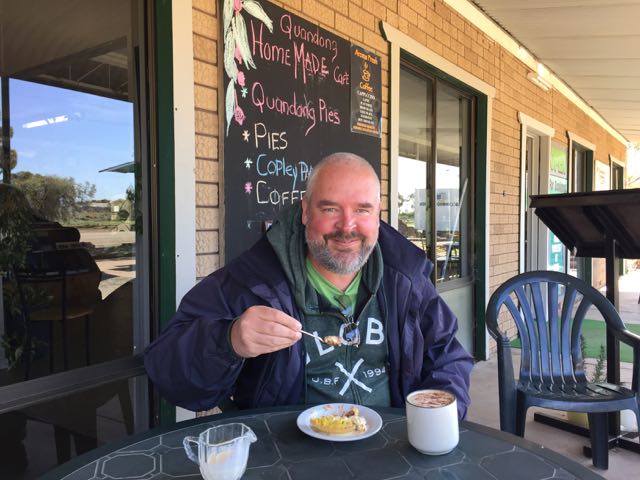
After returning to Copley we called in to the Copley Bush Bakery and Quandong Cafe, where Marija and I caught up with John and Jenny.  We enjoyed a nice cappucinno and a warm home backed Quandong pie with cream (each that is).  We then continued south to Leigh Creek, for a quick stop and then on to our next activation, Mount Scott, VK5/ NE-111.

IMG_1477


References.

National Parks South AUstralia, 2015, Vulkathunha Gammon Ranges National Park.

Wikipedia, 2015, <https://en.wikipedia.org/wiki/Nepabunna,_South_Australia&gt;, viewed 28th June 2015

The Dutchmans Stern Conservation Park VKFF-817

After packing up at Mount Brown, John VK5BJE decided that it was a bit cold to continue activating, and he and Jenny headed back to Argadells with David VK5KC and his wife Joy.  And they were right, it was getting very chilly.  But I was very keen to qualify The Dutchmans Stern Conservation Park, VKFF-817, which was recently added to the World Wide Flora Fauna (WWFF) program.

The Dutchmans Stern Conservation Park, which is about 3,532 hectares in size, is situated about 10 km north east of Quorn and about 340 km north of Adelaide.

Screenshot 2015-06-24 17.49.49

Above:- Map showing the location of the park.  Map courtesy of mapcarta.com

I have activated the park once before.  That was back in May 2013, when my wife Marija and I climbed The Dutchmans Stern summit, located in the park.  For more information on that activation and detailed information on the park, please see my previous post at…..

https://vk5pas.org/2013/05/04/the-dutchmans-stern/

The park is accessed off Arden Vale Road and is well signposted.  The summit itself cannot be missed as it has a very striking shape.  The park gets its name from the bluff’s similarity to Dutch sailing ships of the 18th century.  The rocky outcrops and slopes appear to resemble the reverse stern of these ships.  The bluff was named by Captain Matthew Flinders who chartered the nearby Spencer Gulf in 1802.

As we entered the park, we were struck by the number of kangaroos, both Red Kangaroos and Western Greys.

We set up just on the southern side of the carpark.  Fortunately, there was a wooden table and benches there waiting for me, which made a perfect shack.  For this activation I ran the Yaesu Ft-857d, 40 watts and the 40m/20m linked dipole supported on a 7 metre squid pole.

Screenshot 2015-06-24 17.49.35

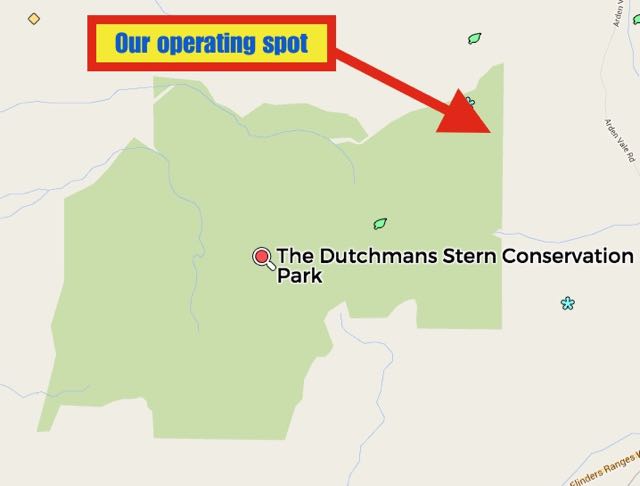
Above:- Map showing our operating spot in the park.  Map courtesy of mapcarta.com

I started off on 20m as it was getting a little late.  It was 4.20 p.m. South Australian local time and it was starting to get dark, which meant that my window into Europe via the long path was quite limited.  I called CQ on 14.244 and this was answered by Erol VK2YB with a strong 5/9 signal, and then Marco VK2YES also 5/9.  My third contact was another station from New South Wales, Dave VK2DML who was also 5/9.

I worked a further 6 stations from Australia, in VK1, VK2, VK3, and VK4, before my first DX contact, IZ5JMZ in Italy.  This was followed by JA8RJE in Japan, and Ken ZL4KD in Christchurch in New Zealand.  The European attention had been generated as Erol VK2YB and Adam VK2YK had spotted me on the DX Cluster.  This really does help.

I went on to work 23 stations on 20m in Australia, New Zealand, Italy, Japan, Sloevnia, Belgium, Germany, and Russia.  But I had left my run a bit late…the 20m band was almost shut on the long path.

This slideshow requires JavaScript.

So with a further 21 contacts required I headed down to 40m and called CQ on 7.098.  My first taker there was John VK4JWT on Bribie Island who had followed me down from 20m.  This was followed by David VK5HYZ in Adelaide, and Nev VK5WG in Cyrstal Brook.  It was quite slow going, but I finally managed my 44th contact, with thanks to Ian VK5ZGG.  I worked 3 more stations, making my total 47 for the activation.  But with no further takers and an ever lowering temperature (now 5 degrees C), it was time to pack up and head back to Argadells.

The following stations were worked on 20m SSB:-

  1. VK2YB
  2. VK2YES
  3. VK2DML
  4. VK4MON
  5. VK2YK
  6. VK3BY
  7. VK1XP
  8. VK3PMG
  9. VK3EY
  10. IZ5JMZ
  11. JA8RJE
  12. ZL4KD
  13. VK6HSB/p
  14. VK3FD/6
  15. VK6JON/p
  16. S58AL
  17. ON4BB
  18. DL2ND
  19. DK0EE
  20. RA3PCI
  21. DK4RM
  22. VK4JWT

The following stations were worked on 40m SSB:-

  1. VK4JWT
  2. VK5HYZ
  3. VK5WG
  4. VK2PH
  5. VK5PZ
  6. VK5FANA
  7. VK3FPBI
  8. VK5FMID
  9. VK2FALL
  10. VK3PF
  11. VK2IO
  12. VK5HEL
  13. VK5FD
  14. VK2SOL
  15. VK2BJK
  16. VK5KAF
  17. VK3FONZ
  18. VK6NU
  19. VK3DBP
  20. VK1AT
  21. VK5ZGG
  22. VK4AJR
  23. VK4MAD
  24. VK5KKT

After reaching Argadells, I lit the open fire at the back of our accomodation, the Overseer’s cottage, and we were soon joined by David and Joy, & John and Jenny for a BBQ dinner.  And the obligatory few bottles of red.  It was a great end to a great day.

Winninowie Conservation Park VKFF-820

After leaving the Clinton Conservation Park, Marija and I continued north on the Augusta Highway up into the Mid North of South Australia.  Our next park activation was the Winninowie Conservation Park, VKFF-820.

But prior to activating the park, we took a short detour into the little town on RedHill.  I had arranged to call in and say ‘g’day’ to Bill VK5MBD and his partner Hayley.  When we arrived at Bill’s place, which is the old school house, I was pleasantly surprised to find that there was an unexpected visitor there, John VK5FMJC from Crystal Brook.  Bill, John, and I enjoyed a beer, while going on a tour of Bill’s antenna farm.  He certainly has a collection.

After leaving Bill’s place we continued north on the Augusta Highway towards Winninowie Conservation Park, which is about 20 km south of Port Augusta, and about 300 km north of Adelaide.

Screenshot 2015-06-24 08.05.00

Above:- Map showing the location of the park.  Map courtesy of mapcarta.com

We drove down Miranda Road into the Yatala Harbour section of the park and found a bit of a clearing in the scrub and set up the fold up table and deck chair.  Again for this activation, I ran the Yaesu FT-857d, 40 watts, and the 40m/200m linked dipole, supported on the 7 metre squid pole.

Screenshot 2015-06-24 08.04.41

Above:- Map showing my operating spot in the park.  Map courtesy of mapcarta.com

Much to my pleasant surprise, my first contact in the log was with Larry VK5LY at Renmark in the Riverland region of South Australia.  Larry was meant to have accompanied us on the trip with his wife Di, but due to illness, could not come along.  So it was great to get Larry in the log.  Next up was John VK5BJE, another one of our travelling colleagues, who was already at Argadells near Quorn (our accomodation for the next 3 nights).

A few QSOs later I was called by Amanda VK3FQSO running her 500 milliwatts again.  Amanda had  a nice 5/7 signal coming in to the Winninowie.  It is truly amazing what you can do on real QRP when the conditions are favourable.

And then a few contacts later I spoke with Johnno VK3FMPB who was operating portable from the Kinglake National Park, VKFF-264.  Soon after I had a few more park contacts in the log.  This time it was Col VK5HCF and Alan VK5FAJS who were portable in the Telford Scrub Conservation Park, VKFF-805 near Mount Gambier in the South East.  For more information on their activation, please have a look at Col’s WordPress site at…..

https://vk5hcf.wordpress.com/2015/06/17/telford-scrub-conservation-park-vkff-805-13th-june-2015/

After speaking with Col and Alan, Tony VK3CAT gave me a shout from his backyard, running a small magnetic loop and just 4 watts.

And my park contacts continued about 12 contacts later, with Ian VK1DI calling in from the Bruce Ridge Nature Reserve, VKFF-835 with a good 5/7 signal.  For more information on Ian’s activation, have a look at Ian’s WordPress site at…..

http://vk1di.blogspot.com.au/2015/06/bruce-ridge-vkff-835.html

I moved through the constant stream of callers from all around Australia….VK1, VK2, VK3, VK4, VK5, and VK7.  I was then called by Rob VK4AAC/5 in the Flinders Chase National Park VKFF-173 on Kangaroo Island OC-139.  Another park contact…I was very pleased.

This slideshow requires JavaScript.

And then a few QSO’s later I was called by Ken ZL4KD in Christchurch with a good 5/7 signal.  Ken reciprocated with a 5/6 signal report for me.  Steve VK5SFA then called in from the Morialta Conservation Park, VKFF-783, in the Adelaide Hills.  Steve was running just 5 watts and had a very strong 5/9 signal.

After working a total of 51 stations on 40m I headed over to 20m, hoping to get some Europeans in the log.  And I wasn’t to be disappointed.  Band conditions on 20m, long path into Europe were excellent.  My first contact after calling CQ on 20m was with Fred VK4FE.  Next up was Danny ON4VT in Belgium who is a regular park activator and hunter, Luc ON4BB in Belgium, Xaver DK4RM in Germany, and then Swa ON5SWA in Belgium.

During the pile up I heard ‘portable’ in amongst the callers.  It was Ian VK1DI in Bruce Ridge Nature Reserve VKFF-835, calling in.  Ian was a nice strong 5/9.

I went on to work a total of 79 stations on 20m in Australia, Belgium, Germany, Italy, Spain, Hungary, France, Austria, Russia, Slovenia, Switzerland, Romania, Sweden, Slovak Republic, Poland, England, Wales, Czech Republic, Ukraine, Netherlands, Croatia, and Japan.

Thankyou to I5FLN, IZ1JLG, OO2T and ON3EA for spotting me on the DX Cluster.

This was a very successful activation with a total of 128 contacts in the log.

The following stations were worked on 40m SSB:-

  1. VK5LY
  2. VK5BJE/p (Argadells)
  3. VK5FD
  4. VK2FALL
  5. VK3FQSO
  6. VK4FFAB
  7. VK5FTRG
  8. VK3FMPB/p (Kinglake National Park VKFF-264)
  9. VK5IS
  10. VK5HCF/p (Telford Scrub CP VKFF-805)
  11. VK5FAJS/p (Telford Scrub CP VKFF-805)
  12. VK3CAT/p
  13. VK7LTD/p
  14. VK3TKK/p
  15. VK4QC/2
  16. VK5QI/m
  17. VK5HS/m
  18. VK3OF
  19. VK5HYZ
  20. VK5GJ
  21. VK3PF
  22. VK3BHR
  23. VK1DI/p
  24. VK5BW
  25. VK3NBV
  26. VK3DBP
  27. VK3NBL
  28. VK5JW
  29. VK5FMID
  30. VK3ANL
  31. VK7EK
  32. VK2NP
  33. VK5FMJC
  34. VK3ZZS/4
  35. VK4HNS
  36. VK3YAR
  37. VK2SR/m
  38. VK3VIN
  39. VK4AAC/5 (Flinders Chase National Park VKFF-173)
  40. VK5MBD
  41. VK5RR
  42. VK3KYF
  43. VK3FLAK
  44. ZL4KD
  45. VK2SL/p
  46. VK5FANA
  47. VK5SFA/p (Morialta CP VKFF)
  48. VK3HRA
  49. VK5FAJH
  50. VK5KFB
  51. VK2HPN/m

The following stations were worked on 20m SSB:-

  1. VK4FE
  2. ON4VT
  3. ON4BB
  4. DK4RM
  5. ON5SWA
  6. DL1EBR
  7. VK2IO
  8. I5FLN
  9. VK4FR
  10. VK2GKA/m
  11. VK2NP
  12. EA4DTV
  13. HA5LV
  14. VK1DI
  15. HA6NF
  16. F4HJO
  17. IK1GPG
  18. HA6OB
  19. OH6IU
  20. RA3PCI
  21. S58AL
  22. HB9ELE
  23. DM5EE
  24. F1BLL
  25. YO3JW
  26. DL5WW
  27. IZ0PAD
  28. S52KM
  29. SA5ACR
  30. OM7OM
  31. DL2ND
  32. SP5INQ
  33. HA0LG
  34. IK8FIQ
  35. DL3APO
  36. OK7WA
  37. Dl2NOM
  38. IK8NSR
  39. DL1MDU
  40. IZ1CJZ
  41. DL1EKO
  42. ON1JU
  43. IZ1JLG
  44. IN3RTB
  45. EA3MP
  46. M6KVT/p
  47. ON7AB
  48. HB9LCZ
  49. MW0RLJ
  50. OE3QGA
  51. I3QDK
  52. IZ0OTV
  53. DF1YQ
  54. OK2BUT
  55. HA5HY
  56. HB9/DK2WC
  57. DL1ASA
  58. SP1MVG
  59. SP6KEP
  60. IW2NXI
  61. UX1AA
  62. PB1TT
  63. VK7VDL
  64. 9A2AA
  65. SP8GEY
  66. IZ1GRH
  67. S51ZZ
  68. ON4ATK
  69. IK2LQT
  70. OP7M
  71. JA8RJE
  72. F2YT
  73. IZ1JMN
  74. ON3EA
  75. YO6KNE
  76. VK6MAC
  77. VK6NU

After packing up at Winninowie, we continued north on the Augusta Highway and then took the turn off to Quorn.  We then travelled out along Arden Vale Road to ‘Argadells’.  What an amazing place.  Marija and I highly recommend Argadells to anyone who would like a beautiful stay in the north.  Argadells is a historic working sheep property set amongst 32 square kilometres of spectacular scenery, just 28 kilometres north of Quorn.  It is nestled between Warren Gorge and Buckaringa Gorge.  For more information on Argadells, please have a look at their website at…..

http://www.argadells.com.au/

After dinner, which was prepared in the amazing camp kitchen, and a few bottles of red, John, David and I fired up the Yaesu FT-857d and made a few contacts on 40m, before retiring for the night.  We even managed a contact into Panama on 40m (5/9 sent and 4/8 received).

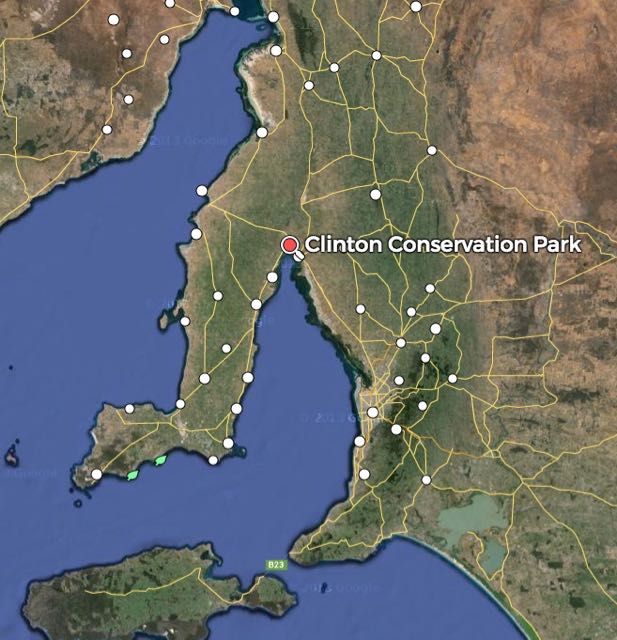
Clinton Conservation Park VKFF-813

Our first activation for the trip to the north of South Australia, was the Clinton Conservation Park, VKFF-813, which is located about 100 km north of Adelaide.

Screenshot 2015-06-23 21.43.05

Above:- Map showing the location of the park.  Map courtesy of mapcarta.com

I have activated Clinton Conservation Park previously…..back in February 2015, and June 2013.  However, the park was recently added to the World Wide Flora Fauna (WWFF) program, so I was seeking 44 contacts to qualify the park.

https://vk5pas.org/2015/02/08/clinton-conservation-park-2/

https://vk5pas.org/2013/06/09/clinton-conservation-park/

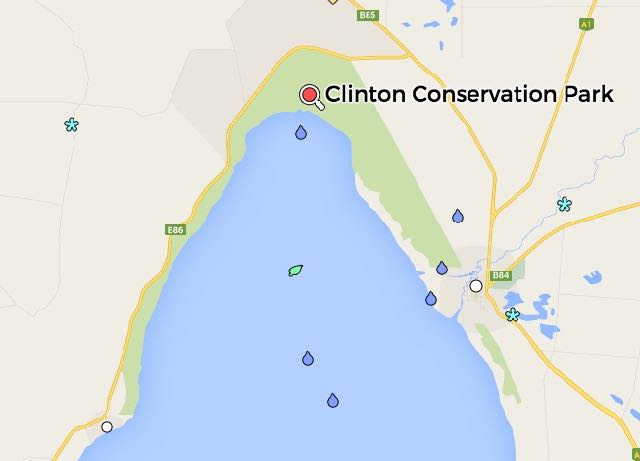
The Clinton Conservation Park was established in 1972, and is 1,923 hectares in size.  It is a boomerang shaped park, which is situated at the northern extremity of Gulf St Vincent.  It stretches around the top of the Gulf from just north of Port Wakefield, around to the little town of Port Clinton on the Yorke Peninsula.  The park comprises an expanse of mainly low-lying, coastal-fringe habitats, with mangroves and samphire communities, and extensive tracts of intertidal mudflats.  It is an important refuge as a fish nursery and a significant site for migratory wading birds.

Screenshot 2015-06-23 21.45.03

Above:- Map showing the park boundaries.  Map courtesy of mapcarta.com

I set up in the same spot as my activation earlier in the year, which is at the end of a dirt track on the western side of the Yorke Highway.  The track continues on from a parking bay off the Highway.

This was a typical park activation for me….I ran the Yaesu FT-857d, 40 watts and the 40m/20m linked dipole supported on the 7 metre squid pole.  The weather was a little inclement.  It was quite chilly and there was the occasional shower.

Prior to calling CQ I tuned around the 40m band and found Julie VK3FOWL and Joe VK3YSP operating on 7.100 from SOTA peak, Mount Hickey, VK3/ VN-015.  Julie and Joe were my first contacts from Clinton and had terrific 5/9 signals coming into the Yorke Peninsula.  I then headed down to 7.095 where I started calling CQ.  Greg VK5GJ at Meadows in the Adelaide Hills was the first responder.  This was followed by Adrian VK5FANA running QRP 5 watts from Arthurton on the Yorke Peninsula, just 50km south of my operating location.  Not surprising that Adrian was a very strong 5/9.  My next caller was from another part of South Australia.  This time the South East, about 600 km away.  It was Alan VK5FAJS with a nice 5/9 signal.

My 10th caller was from the other end of Australia.  It was Rob VK4FFAB north west of Brisbane in Queensland.  Rob was not all that strong (5/3), but he was perfectly readable as there was no man made noise at all on the frequency.

Again, for this activation, it was great to get some QRP callers in the log.  Amanda VK3FQSO called in quite early in the activation running just 500 milliwatts and was a genuine 5/7 signal.  I also spoke with Col VK5HCF at Mount Gambier (5/9 both ways), Ian VK5IS in the Mid North (5/9 both ways), Nick VK3ANL running 5 watts (5/8 sent and 5/9 received), and Bill VK5MBD at Red Hill also running 5 watts (5/9 both ways).

And a number of mobile stations also called me.  They included Terry VK3UP mobile at Buninyong (5/9 both ways), Mark VK5QI mobile on his way to Aztronics to spend some money, Greg VK5ZGY mobile in the South East (5/8 both ways), Tony VK3AN/mobile 5 at Burra in the Mid North, Ron VK3VBI, and Theo VK5MTM.

It was also nice to get Barry VK5BW in the log, operating VK5BAR from the Adelaide Hills Amateur Radio Society (AHARS) shack at Blackwood.  Barry was using the club’s new Anan SDR transceiver.

This slideshow requires JavaScript.

During our activation, we had a car towing a trailer drive down towards us.  A gentleman hopped out and had a close look.  We soon realised that the pidgeon contained pidgeons.  After a short time the fella then hopped in his car and drove off into the nearby parking bay and released dozens of homing pidgeons.  The man then drove off.  Not sure where the pidgeons were headed to?

After working a total of 53 stations on 40m, I lowered the squid pole and removed the links in the dipole, so I could operate on 20m.  I headed up to 14.310 and started calling CQ and this was soon answered by Andrew VK2UH who had a lovely 5/9 signal.  This was followed by Cliff VK2NP, Peter VK3PRF and then Max VK6FN in Manjimup (5/9 sent and 5/7 received).  Chris VK4FR then gave me a shout from Townsville, running just 10 watts (5/6 sent and 5/7 received).  I went on to work a further 9 stations on 20m from VK1, VK2, VK5, VK6, VK7, and VK8.  Great representation from all across Australia, including Greg VK8GM in Alice Springs who was very strong.  I was also competing with a YV5 from Venezuela who was also on the frequency.

Unfortunately time and the weather were conspiring against me, and it was time for Marija and I to get back on the road and continue our journey north.  After an hour and twenty minutes in the park, I had a total of 67 contacts in the log.  I was happy man…I had qualified the park for WWFF.

The following stations were worked on 40m SSB:-

  1. VK3FOWL/p (SOTA VK3/ VN-015)
  2. VK3YSP/p (SOTA VK3/ VN-015)
  3. VK5GJ
  4. VK5FANA
  5. VK5FAJS
  6. VK5JK
  7. VK5FMID
  8. VK3FQSO
  9. VK5HCF
  10. VK4FFAB
  11. VK5IS
  12. VK3ANL
  13. VK5MBD
  14. VK3UP/m
  15. VK5FMJC
  16. VK5NQP
  17. VK3NBV
  18. VK5FD
  19. VK3OF
  20. VK4AAC/5
  21. VK5QI/m
  22. VK2XXM
  23. VK3XPT
  24. VK3CAB
  25. VK5KFB
  26. VK5ZGY/m
  27. VK1NAM
  28. VK3MEG
  29. VK2HV
  30. VK5BAR
  31. VK3PRF
  32. VK3HRA
  33. VK1DI
  34. VK3AN/5
  35. VK1AT
  36. VK5LDM
  37. VK5FLEX
  38. VK5FTRG
  39. VK6FN
  40. VK3VKT
  41. VK5ZAI
  42. VK2NP
  43. VK5TD
  44. VK5LY
  45. VK2IO
  46. VK7MK
  47. VK3VBI/m
  48. VK3VIN
  49. VK2GKA
  50. VK3MAT
  51. VK3PI
  52. VK2NEO
  53. VK5MTM/m

The following stations were worked on 20m SSB:-

  1. VK2UH
  2. VK2NP
  3. VK3PRF
  4. VK6FN
  5. VK4FR
  6. VK2GKA
  7. VK1DI
  8. VK7MK
  9. VK5LG
  10. VK2KTT
  11. VK8GM
  12. VK6BSA
  13. VK1NAM
  14. VK2IO

References.

Department for Environment and Heritage, 2009, ‘Mainland Conservation Parks of Yorke Peninsula’.

Penola Conservation Park, VKFF-803

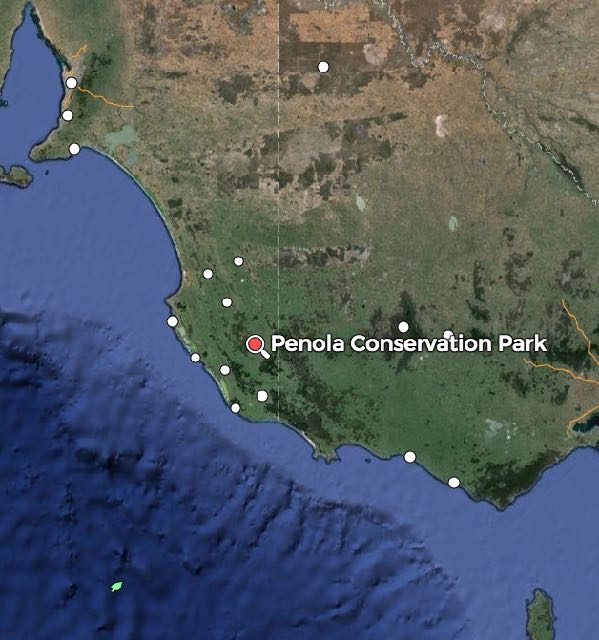
My final park for the 6 days was the Penola Conservation Park which is located about 12 km west of Penola on the northern side of the Robe-Penola Road.  This was another unique park for me for both the VK5 National and Conservation Parks Award and the World Wide Flora Fauna (WWFF) program.

Screenshot 2015-06-12 20.28.54

Above:- Map showing the location of the park.  Map courtesy of mapcarta.com

The park was gazetted on the 10th day of September 1970 and covers an area of around 226 hectares.  Vegetation within the park consists of woodland of brown stringybark, river red gums, swamp gum, and rough barked manna gums.  The park contains two large wetland areas including Green Swamp.

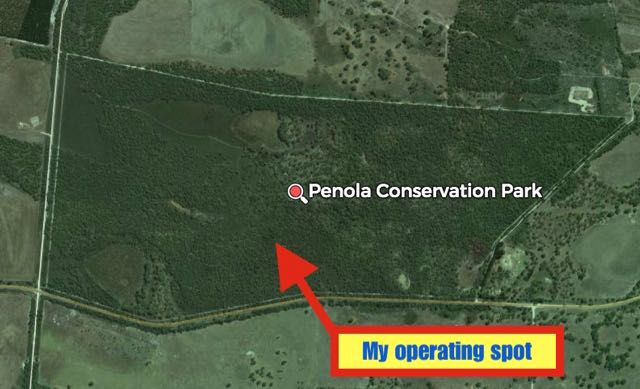
I drove into the park along the main track which leads to a beautiful little campground area.  There was a wooden table and benches here which made a perfect shack.  Again for this activation I ran the Yaesu FT-857d, 40 watts and my 40m/20m linked dipole supported on a 7m telescopic squid pole.

Screenshot 2015-06-12 20.28.19

Above:- Map showing my operating spot.  Map courtesy of mapcarta.com

This time around I started off on 20m.  And I actually found 14.244 free which is quite a rarity.  I started calling CQ and it wasn’t long before this was answered by Brian VK4HBB (5/9 both ways).  Ron VK7VDL from Tasmania followed (again 5/9 both ways), and Tom VK2KF from Kandos then gave me a shout (and again 5/9 both ways).  My next caller was my first DX station for the activation, Al S58AL from Slovenia.  Al spotted me on the DX Cluster and this resulted in quite a few callers from Europe and a handful of VK’s.  Countries worked were VK, Slovenia, Russia, Germany, Italy, Hungary, Germany, Serbia, France, Czech Republic, and Spain.
After working 24 stations on 20m, I decided to check out 40m.  I called CQ on 7.095 and first taker there was Mick Vk3PMG who is a big follower of WWFF as both a Hunter and Activator.  This was followed by another active park Activator & Hunter, Col VK5HCF.  And as per normal, it wasn’t long before a mini pile up commenced.  I went on to work a total of 29 stations here from VK2, VK3, VK4, and VK5.

I then moved back to 20m, and I’m pleased I did.  Because I stumbled across Gerard Vk2IO calling CQ on 14.290 from SOTA peak VK2/ NT-021.  Once I finished working Gerard, Adam VK2YK came up and asked if I could QSY up to 14.310 which I did.  I worked Adam who was a ncie 5/9 signal, and Adam was also kind enough to place me on the DX cluster.  This resulted in a number of calls from both VK and Europe again.  Countries worked this time around were VK, Belgium, Germany, Italy, Spain, Czech Republic, Ukraine, Hungary, and Canada.

This slideshow requires JavaScript.

I was very pleased with the results of this activation with a total of 73 contacts in the log.  This was another unique WWFF park that I had qualified.

The following stations were worked on 20m SSB:-

  1. VK4HBB
  2. VK7VDL
  3. VK2KF
  4. S58AL
  5. RW6AEW
  6. VK2GKA
  7. DF8WZ
  8. I5FLN
  9. DL2ND
  10. IZ2IHO
  11. HA8TI
  12. DF2RR
  13. VK5BJE
  14. HA5MA
  15. YU1AB
  16. F5OUD
  17. S52KM
  18. OK1XP
  19. RA3PCI
  20. F1BLL
  21. DK0EE
  22. EA7TR
  23. VK7ZGK
  24. VK4MJA
  25. VK2IO/p (SOTA VK2/ NT-021)
  26. VK2YK
  27. ON4BB
  28. DL4MDO
  29. VK6HAD
  30. VK4HNS
  31. IK2SAV
  32. EA4DTV
  33. IZ5JMZ
  34. IW2NXI
  35. OK2TS
  36. IK1GPG
  37. UT5PI
  38. I8OCA
  39. VE7CV
  40. DL3NDD
  41. HA6OB
  42. DL5MPO
  43. UR7ET
  44. HA0LG

The following stations were worked on 40m SSB:-

  1. VK3PMG
  2. VK5HCF
  3. VK5GK
  4. VK5HEL
  5. VK5JK
  6. VK2LX
  7. VK3OF
  8. VK5FANA
  9. VK1AT/3
  10. VK3PF/m
  11. VK5FAJS
  12. VK5BJE
  13. VK5MBD
  14. VK3FSMT/2
  15. VK3DBP
  16. VK3AV
  17. VK3ANL
  18. VK4CPS
  19. VK3CAB
  20. VK3TKK
  21. VK5WG
  22. VK2NP
  23. VK2NNN
  24. VK3FJAE
  25. VK3NBL
  26. VK2SK
  27. VK2QS
  28. VK4GSF
  29. VK5FTVR

References.

National Parks and Wildlife Service-Department of Environment and Planning, 1990, Small Parks of the Lower South East Management Plans

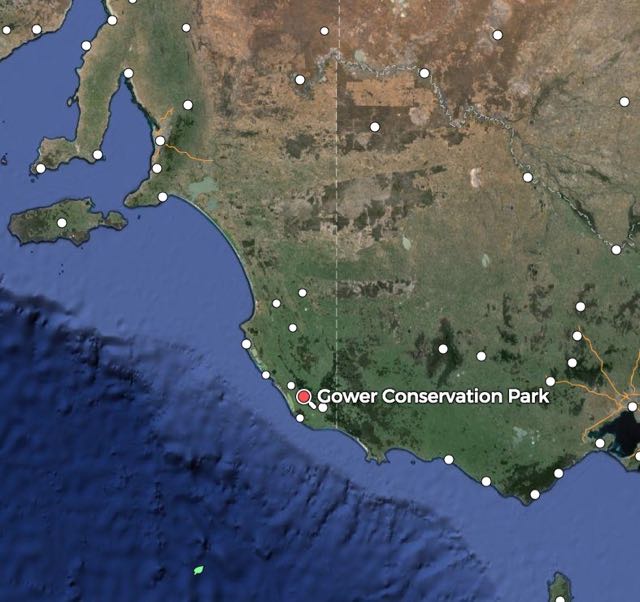
Gower Conservation Park VKFF-798

It was my final day in the South East (Tuesday 9th June) and I had planned to activate three parks: Gower Conservation Park, Calectasia Conservation Park, and the Penola Conservation Park.  All three were to be unique parks for me, for both the VK5 National and Conservation Parks Award and also World Wide Flora Fauna (WWFF).

My first park was the Gower Conservation Park which is situated about 25 km north west of Mount Gambier.

Screenshot 2015-06-12 18.03.17

Gower Conservation Park was gazetted on the 21st day of January 1971 and covers an area of around 39.5 hectares.   The vegetation in the park mostly consists of an open forest of messmate stringybark and brown stringybark with a shrub understorey of austral bracken and some spike wattle, grass tree, and silverleaved banksia.  In the south of the park you can find barked manna gum and large black wattle.

I headed out of Mount Gambier, heading north west on the Princes Highway, heading back towards Adelaide.  Just after the Tantanoola Caves Conservation Park, is a road to your right called McPherson Road.  This takes you direct to the park, passed an old quarry on your right and the pine forest on your left.

Screenshot 2015-06-12 18.03.07

I set up in a little clearing just to the east of the north western corner of the park.  There was plenty of room here to string out the dipole and because I had two convenient gum trees, I was able to get the ends of the legs quite high off the ground.  It was a much more pleasant day than Monday,  The sun was out, although it was still a typical cold June day down in the South East.

I called CQ on 7.095 and this was immediately answered by Col VK5HCF from Mount Gambier, who has previously activated Gower.  This was followed by Jeff VK5JK at Encounter Bay on the South Coast, Jim VK3AT/3, and then Tony VK5FTVR at Strathalbyn on the Fleurieu Peninsula.  All signals were 5/9 and above.  The band was in great shape.

I worked a steady flow of VK’s from VK2, VK3, VK5, & VK6, until there was a call ‘out of the box’.  I knew it was a Russian station or a Ukrainian station but struggled a bit with getting his call.  I penned in UA6IDX into my log who gave me a 5/3 report, but before I could confirm his call, he had gone.  A few calls later I spoke with Mike VK6MB who was with Michael VK6MMB in VKFF-161.  They confirmed that the call was in fact UA6IDX that had called me.

I worked numerous mobile stations during this activation.  They included Peter VK3TKK, Gerard VK2IO mobile on his way to a SOTA peak, Bob VK2AOR mobile on the M1 Freeway coming into Sydney, Gerard VK2JNG, Peter VK3PRF, Craig VK3NCR/5 mobile 160 km north of Port Augusta, Terry VK3UP, David VK5KC mobile at Orroroo in the Mid North, and Doug VK3FDES.  During most of my activations, I always ask for QRP, mobile, portable and outside of VK callers.  It is amazing how many of these stations come back to you, who would ordinarily be competing with many home stations running amps.

After working a total of 45 stations on 40m I headed over to 20m where I called CQ on 14.310.  Gerard VK2JNG had followed me over and was my first contact on 20.  This was followed by contacts with Cliff VK2NP, Bill VK5BMD, Neil VK4HNS and my final contact was with Stath VK4AEP who called just as I was packing up gear into the 4WD.

This slideshow requires JavaScript.

Another successful activation under my belt with a total of 50 contacts.  The park had been qualified for WWFF.

The following stations were worked on 40m SSB:-

  1. VK5HCF
  2. VK5JK
  3. VK1AT/3
  4. VK5FTVR
  5. VK5FANG
  6. VK5BJE
  7. VK3TKK/m
  8. VK5FANA
  9. VK3ZZS/4
  10. VK3NBV
  11. VK3PMG
  12. VK3FQSO
  13. VK2GKA
  14. VK5ZAR
  15. VK2IO/m
  16. VK6RZ
  17. VK5IS
  18. VK3HQ
  19. VK2NP
  20. VK2AOR/m
  21. VK3OF
  22. VK2HV
  23. VK5ZGY
  24. VK5NPP/3
  25. VK3AV
  26. UA6IDX
  27. VK3FOWL/p
  28. VK2JNG/m
  29. VK3PRF/m
  30. VK6MMB/p (VKFF-161)
  31. VK6MB/p (VKFF-161)
  32. VK3NCR/5
  33. VK3TJK
  34. VK7FGGT
  35. VK3UP/m
  36. VK3ZLD
  37. VK5KC/m
  38. VK3FGMO
  39. VK5RU
  40. VK3FDES/m
  41. VK5WG
  42. VK5TD
  43. VK5FIVE
  44. VK5MBD
  45. VK2YW

The following stations were worked on 20m SSB:-

  1. VK2JNG/m
  2. VK2NP
  3. VK5MBD
  4. VK4HNS
  5. VK4AEP

References.

National Parks and Wildlife Service-Department of Environment and Planning, 1990, Small Parks of the Lower South East Management Plans

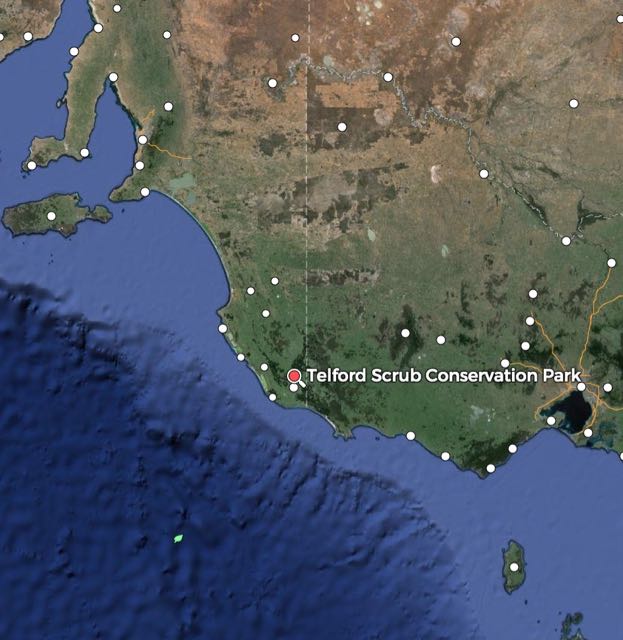
Telford Scrub Conservation Park VKFF -805

My first park activation for Monday 8th June 2015 was the Telford Scrub Conservation Park, which is located just 14 km north of Mount Gambier, via the Riddoch Highway.  Although I had activated this park previously, Telford Scrub was recently added to the World Wide Flora Fauna (WWFF) program, so I was looking for 44 contacts.

Screenshot 2015-06-12 12.17.12

Above:- Map showing the location of the park.  Map courtesy of mapcarta.com

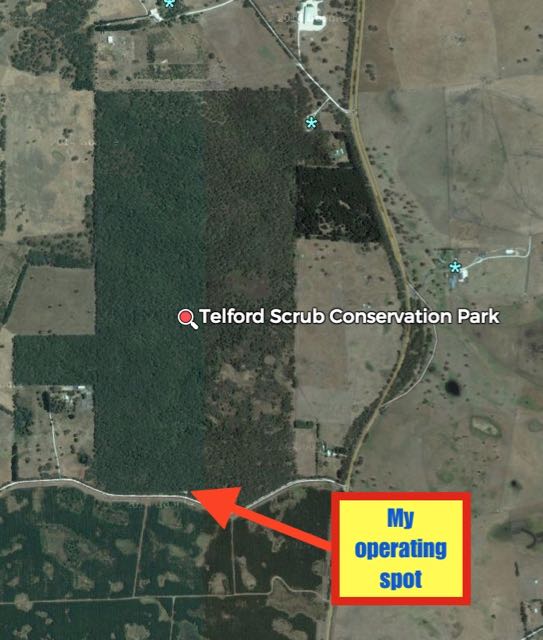
It was another quick stopover at McDonalds for a Bacon & Egg McMuffin and an orange juice, and I then headed out along the Riddoch Highway.  Sadly, as is the case with numerous South Australian Conservation Parks, there are no signs on the Highway alerting you to the presence of a park.  I used the GPS to get there and turned off the Riddoch Highway into Grundys Lane.  The park is just a short distance up on the right, on the northern side of Grundys Lane.

As it was early morning (8.00 a.m.), there were plenty of kangaroos out grazing in the clearing between the roadway and the pine forest which is situated opposite the park.  As per my last activation, I set up in the north eastern corner of the carpark.

Screenshot 2015-06-12 12.17.42

Above:- Map showing my operating location in the park.  Map courtesy of mapcarta.com

This is a magnificent park consiting of amazing Eucalyptus forest and bracken understorey.  But sadly this activation summed up the mess that South Australian Parks and the ‘system’ is in.  As I pulled in to the carpark, the first thing I saw was a television set which had been dumped in the carpark.  Who knows how long it had been there.  And half way through operating I had an interesting encounter with an elderly lady and her Golden Retriever.  Other than having a go at me for being in ‘her park’ (despite the fact that there were numerous other parks available), her dog was running around off the lead and kept jumping up on me and at one stage almost knocked over my table.  Without any apology, off she started to walk into the park with her do.  Despite the very clear sign that showed dogs were not allowed in the park.  I pointed this out to her, and after some complaining under her breath, off she walked along Grundy’s Lane.  In all probability, she has been walking her dog off the leash in the park for a long time, completely unfettered by DEWNR.

After packing up I went for a walk through the park and along the boardwalk (I’ll talk about this more later) and tried to read the interpretive signs which were totally covered in muck.  They clearly had not been cleaned in a long time.

For me, this highlighted the big problem we have here in South Australia with our beautiful parks.  I can only presume that DEWNR is sadly understaffed and under funded.  If it wasn’t for the dedication of the Friends of the Parks groups, I can only imagine what state the parks would be in.

Anyway, onto more positive thoughts.  The Telford Scrub Conservation Park is about 175 hectares in size and was once farmed by the Telford Brothers who subsequently sold the land to the Government.  The park contains at least 11 species of plants considered to be of conservation value.  Numerous native orchids can be found.  In fact, over 20 species have been recorded including Pink Fingers, Common Donkey orchid, Tiger orchid, and Purple Cockatoo.

The park is home to a wide range of native fauna including Western Grey kangaroos and echidnas.  Several koalas were reintroduced into the park in 1997 from Kangaroo Island.  The vulnerable Southern Brown Bandicoot and endangered Sugar Glider are also found in the park.

This slideshow requires JavaScript.

My first contact in the park was with Craig VK2PAW who came back to my CQ call on 7.098.  This was followed by Scott VK7NWT, Steve VK3FSPG and John VK5FMJC.  Not long after setting up, I had 2 visitors.  It was Rod VK5KFB and his dad, Murray VK5BWA.  They had a quick look at my operating gear and then headed off enroute to Adelaide.

Conditions on 40m were very good, and a nice little flow of callers came back to my CQ calls, from all around Australia.  There were a number of the regular park hunters, but also a few new calls as well, which is always pleasing.  I worked 53 stations before the UTC rollover.  I even got to work a station in my own home town of Mount Barker, Kev VK5KS.  I managed one park contact and that was with Mike VK6MB who was portable in Frank Hann National Park, VKFF-183.

After the UTC rollover I worked a further 10 stations including Mike VK6MB again, and also Michael VK6MMB who was with Mike in the Frank Hann National Park.  I also spoke with Julie VK3FOWL who was portable on SOTA peak Mount Disapointment VK3/ VC-014.

After working a total of 60 stations on 40m I headed over to 20m and called CQ on 14.310.  My CQ call was answered by Adrian VK5AW/p who was extremely weak.  In fact almost totally unreadable.  This was followed by Jim VK2QA, who kindly helped me out with Adrian.  And my final contact was with Peter VK6RZ with a nice 5/8 signal from Western Australia.

At the end of the activation and packing up my gear, I went for a walk into the park along the track from the carpark.  This leads to a  beautiful picnic area with a bench and table.  There are some interpretive signs along the way telling you about the forest.  A 100 metre long and 4.2 metre high ‘Forest Canopy Walk’ boardwalk provides visitors to the park a unique ‘bird’s eye view’ of the forest.  There are also some extended trails that can be followed as well.  Unfortunately I didn’t have time to try those out, but I will be back.

This slideshow requires JavaScript.

This was another successful activation.  I had reached the 44 QSO threshold for WWFF, with a total of 63 contacts in the log.

The following stations were worked on 40m SSB:-

  1. VK2PAW
  2. VK7NWT
  3. VK3FSPG
  4. VK5FMJC
  5. VK3PMG
  6. VK5KLV
  7. VK6RZ
  8. VK5TRM/m
  9. VK3FQSO
  10. VK5HEL
  11. VK3DQ/p
  12. VK5MBD
  13. VK5HS/p
  14. VK5FTVR
  15. VK5ZAR
  16. VK3OF
  17. VK5BJE
  18. VK1AT/3
  19. VK5JK
  20. VK4HNS/m
  21. VK3NML/p
  22. VK5AW/m
  23. VK3KTO/2
  24. VK3FBNG
  25. VK2YK
  26. VK3HKV
  27. VK5ATQ
  28. VK5KS
  29. VK3FSMT/2
  30. VK6MB/p (VKFF-183)
  31. VK5TW
  32. VK5FLEX/p
  33. VK5FMID
  34. VK7BO
  35. VK3DBP
  36. VK5ZK
  37. VK3YE
  38. VK4FFAB
  39. VK3VIN
  40. VK5FD
  41. VK5ZGY/m
  42. VK5NQP
  43. VK3MEG
  44. VK5KFB/m
  45. VK3TKK
  46. VK6MMB/p
  47. VK3NCR/5
  48. VK3PF
  49. VK5FAJS
  50. VK2NP
  51. VK2HV
  52. VK3FCCC
  53. VK5FANA
  54. VK5BGN
  55. VK3MIJ
  56. VK5QI/m
  57. VK6MB/p (VKFF-183)
  58. VK6MMB/p (VKFF-183)
  59. VK5LDM
  60. VK3FOWL/p (SOTA Mt Disapointment)

The following stations were worked on 20m SSB:-

  1. VK5AW/p
  2. VK2QA
  3. VK6RZ


References.

Department of Environment and Natural Resources, 2010, Telford Scrub Conservation Park brochure.

Postcards, 2009, <http://www.postcards-sa.com.au/features2009/telford_scrub_park.html&gt;,viewed 12th June 2015