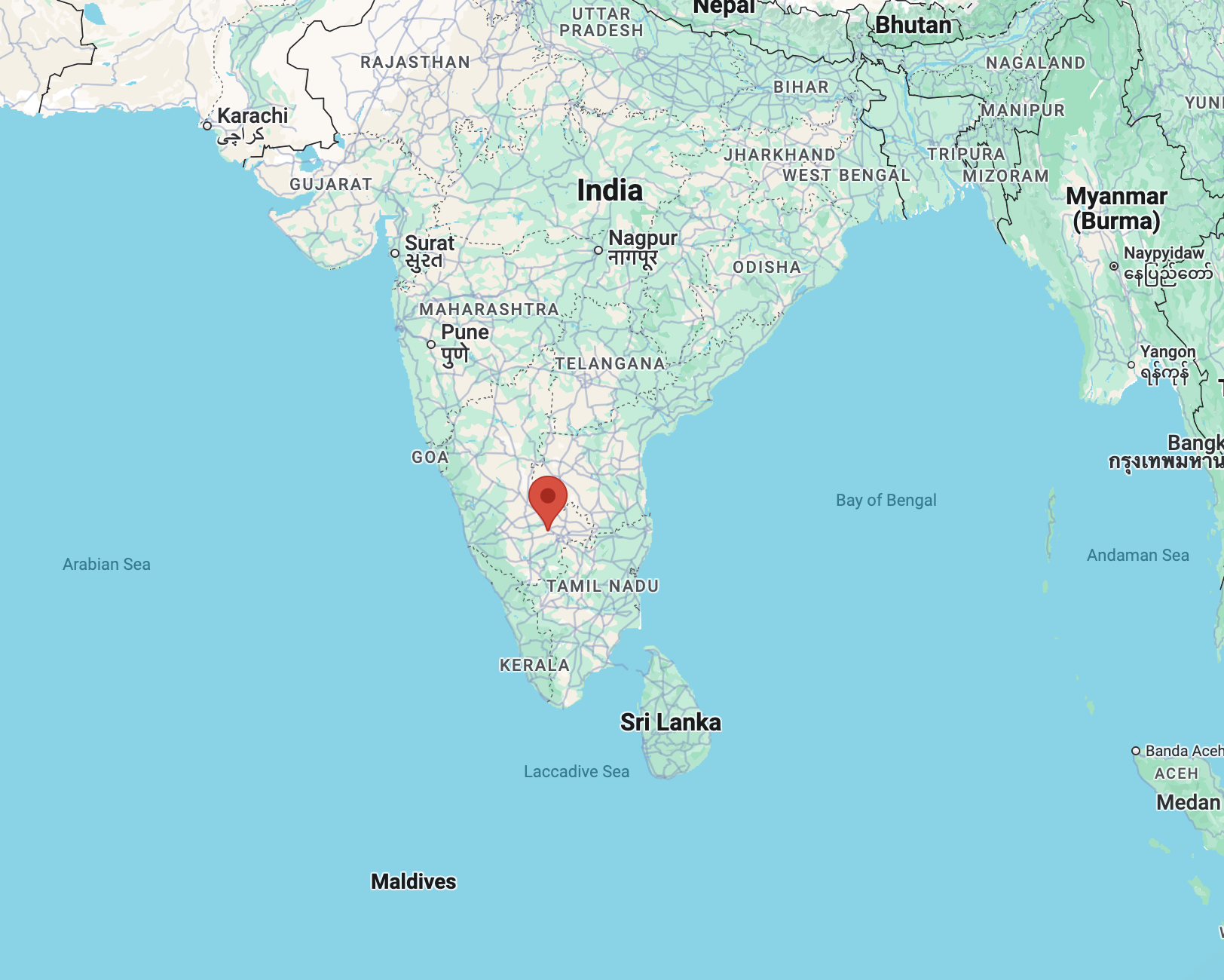
Our next park for Friday, 1st November 2024, was the Jallakin I17 Bushland Reserve VKFF-5166. The reserve is located about 8 km north of Edenhope in southwest Victoria.
Above:- Map showing the location of the Jallakin I17 Bushland Reserve. Map c/o Google Maps.
The Jallakin I17 Bushland Reserve is located on the western side of Patyah Road.
Above:- An aerial view of the Jallakin I17 Bushland Reserve. Map c/o Google Maps.
Jallakin is an Aboriginal word meaning kangaroo rat. (Blake 1978)
The reserve is about 7 hectares in size and was established on the 22nd day of November 1983. (CAPAD 2022)
We arrived at the park just before the UTC rollover, which we decided to take advantage of. Contacts made on either side of the UTC rollover would count towards our 10 QSOs and 44 QSOs required to qualify the park. We called CQ from the 4WD before setting up our normal portable station outside of the vehicle and logged 14 stations.
We then set up the fold-up table, deck chair, the Yaesu FT857, 40 watts, and the 20/40/80m linked dipole.
Marija worked the following stations on 40m SSB before the UTC rollover:-
VK3PF
VK3KAI
VK3CEO
VK2SLB
VK2BRN
VK2KBT
VK3DL
VK5DW
Marija worked the following stations on 40m SSB after the UTC rollover:-
VK5DW
VK2HRX/P (SOTA VK1/ AC-023 & VKFF-0054)
VK3PF
VK3KAI
VK1AD/P (SOTA VK2/ ST-001)
VK1NAM/P (SOTA VK2/ ST-001)
I worked the following stations on 40m SSB before the UTC rollover:-
VK3PF
VK3KAI
VK3CEO
VK2SLB
VK2BRN
VK2KBT
VK3DL
VK5DW
I worked the following stations on 40m SSB after the UTC rollover:-
Our second park for Friday, 1st November 2024, was the Lumeah Swamp Wildlife Reserve VKFF-5401. The reserve is located just to the north of Edenhope in southwest Victoria.
Above:- Map showing the location of Lumeah Swamp Wildlife Reserve. Map c/o Google Maps
The Lumeah Swamp Wildlife Reserve is located on the corner of Kaniva-Edenhope Road and Patyah Road.
Above:- An aerial view of the Lumeah Swamp Wildlife Reserve. Image c/o Google Earth
The reserve is about 19 hectares in size and was established on the 22nd day of November 1983. (CAPAD 2022)
Our first park activation for Friday, 1st November 2024, was Sheepwash Wildlife Reserve VKFF-2437, located just to the north of Edenhope in southwest Victoria.
Above:- Map showing the location of Sheepwash Wildlife Reserve. Map c/o Google Maps.
The Sheepwash Wildlife Reserve is situated on the eastern side of the Kaniva-Edenhope Road.
Above:- an aerial view of the reserve. Image c/o Google Earth.
The reserve is about 12 hectares in size and was established on the 22nd day of November 1983. (CAPAD 2022)
The swamp was full of water during our visit and alive with birdlife.
We ran the Yaesu FT857, 40 watts, and the 20/40/80m linked dipole for this activation.
Our final activation for Thursday, 31st October 2024, was the Murrandarra Bushland Reserve VKFF-5603.
Above:- Map showing the location of the Murrandarra Bushland Reserve. Map c/o Google Maps.
Murrundarra is an Aboriginal word meaning thunder and lightning. The area was first settled by George Armytage (b. 1795. d. 1862), who ran a pastoral run in the area. (Blake 1978)
Above:- George Armytage. Image c/o Wikipedia.
The Murrandarra Bushland Reserve is located on the southern side of the Wimmera Highway between Apsley and Edenhope.
The reserve is about 7 hectares in size and was established on the 22nd day of November 1983. (CAPAD)
Above:- The Murrandarra Bushland Reserve, looking east towards Edenhope. Image c/o Google Maps.
Unfortunately, it was completely dark by the time we reached the park, so I did not take any photographs.
We found a small area to pull the 4WD into amongst the scrub, and we operated from the vehicle. We ran the Icom IC-7000, 100 watts, and the Codan 9350 antenna with the 1.5 metre stainless steel whip.
Our sixth park for Thursday, 31st October 2024, was the Leah Swamp Wildlife Reserve VKFF-5353. It is located about 7 km (by road) west of Apsley in southwest Victoria.
The Leah Swamp Wildlife Reserve is located on the eastern side of Newslands Settlement Road, south of the Wimmera Highway.
The reserve is about 225 hectares in size and was established on the 22nd day of November 1983. (CAPAD 2022)
When we arrived at the park, we found that the sign said Leah Swamp State Game Reserve. I believe ‘State Game Reserve’ is the old name for what is now known as a ‘Wildlife Reserve’.
We ran the Yaesu FT857, 40 watts, and the 20/40/80m linked diepole for this activation.
On Thursday, 31st October 2024, Marija and I left the Dergholm State Park and headed back to Apsley to get an evening meal.
Along the way, we stopped at the little town of Poolaijelo. Don’t blink, you will miss this little place. Poolaijelo is an Aboriginal word meaning two swamps. Sadly, the tennis courts are overgrown with weeds, with the only substantial building being the Poolaijelo Memorial Hall. (Blake 1978)
There is a monument outside the hall that commemorates six soldier families who settled in the district in 1952. The monument was officially unveiled in May 2016 with a ceremony of about 60 people in attendance. (Poolaijelo 2016)
This area was devastated by fire in 1955
Above:- part of an article from The Daily News, Tues 4 Jan 1955. Image c/o Trove.
We continued on to Langkoop. Its name comes from the German words lang meaning long and kop meaning hill. Not much remains of this once-thriving little town. The Langkoop tennis club sign still stands, but the tennis courts are overrun with weeds. (Blake 1978)
In Langkoop, you can find a monument that commemorates the former WWI soldiers who obtained blocks on Elderslie Station, in the area south of Apsley now named Langkoop. (Elderslie 2025)
We continued north along the Casterton-Narracourte Road towards Apsley and encountered a distinct Australian scene…..sheep being herded by a farmer across the road.
We soon reached the town of Apsley, located about 10 km east of the State border of Victoria and South Australia.
Apsley was named by Surveyor Lindsay Clark in October 1851 after Apsley House, built for Lord Apsley, Earl of Bathurst, by Adams Brothers in Piccadilly, London. Apsley is from the words aspen and lea, meaning meadow. (Blake 1978)
The Apsley district was occupied in the late 1840s with pastoral runs. A settlement commenced that was known as Lake Wallace, named after one of the pastoral runs. The settlement was situated at the junction of two roads leading to Adelaide, one from Casteron and the other from Cavendish. The town of Apsley was surveyed in 1851 and proclaimed in 1852. On the 1st day of January 1854, the Apsley Post Office opened, replacing the Lake Wallace Post Office that had opened in 1849. (Phoenix 2022) (Victorian Places 2025)
Following the proclamation of the town, the Border Inn and a store were established, and these were patronised by those travelling to the Victorian goldfields. (Victorian Places 2025)
In 1855, a racing club was established. It is reported that the club hosted poet and writer Adam Lindsay Gordon.
Above:- Adam Lindsay Gordon. Image c/o Wikipedia.
During the 1850s, a customs house was established for trade between the two colonies of South Australia and Victoria. In 1861, the Apsley agricultural and pastoral society was established. The Apsley Common School opened in 1870. A mechanics institute was built in the 1880s. (Victorian Places 2025)
Several historic buildings remain in Apsley. This includes the old Church of England structure, which was built by W.T. Hoare in 1906 at a cost of 355 pounds. Prior to the construction of the church, services were held in a room in Mr Hoare’s home. St Johns Church close in 2019 and is now a private residence.
Apsley’s second bakery was built as a shop for Mrs. Botterill. It was converted to a bakery in 1937 by Mr. Alf Thomas. It was reported that on cold mornings, children on their way home from school, would warm themselves against the front wall which backed onto the oven.
The Apsley Store was part of the hotel until 1878, when W.T. Hoare purchased the store business. In 1880, he engaged Robert Taylor to build another store. In 1930 the building was partically burnt and it was rebuilt around the old walls.
The present Apsley Post Office was built in 1883 when the Apsley to Harrow telegraph line was opened. Mr. J. Arlett was the postmaster. Part of his duties were the maintenance of the telegraph lines.
Near the Post Office is a sign that marks the site of a well and trough that was used by mail coaches travelling along the Apsley-Hamilton and Apsley-Narracoorte runs. From the late 1850s until 1866, Cobb and Co. were the contractors on the Hamilton route.
Near the Post Office is a monument to commemorate the men and women of the district who served in WWII.
Adjacent to the Post Office is a toilet block which has been very colorfully painted with a mural.
You can also find a plaque which is in recognition of the 100-year commemoration of WWI.
The Apsley War Memorial was erected by the residents of Apsley to honour those who served during WWI.
We also visited the Apsley Finishing Post monument. The Apsley Racecourse commenced in 1855 and boasted prizes second only to the Melbourne Cup. The racecourse was originally situated opposite the Border Inn Hotel, with the finishing post being adjacent to the front door.
The Apsley Racing Club is the oldest surviving racing club in Victoria and predates the Melbourne Cup. (Racing.com, 2025)
At Federation Corner, you can find an information Bay that contains a large amount of information about Apsley and the surrounding district.
We then visited the Apsley Historic Cemetery, which was established in 1868. The cemetery contains numerous historic headstones of the pioneers of the district.
The cemetery contains a monument for Murrumgunerrimin ‘Jimmy Tarpot’, who was a member of ‘The First Eleven’, an Aboriginal cricket team that toured England in 1866.
We then had an excellent meal at the Border Inn Hotel. The meal was superb and brought out to us very promptly, despite the hotel being very busy. We were so happy the hotel was open, as during our last visit to the area, the hotel was closed for repairs as a result of a car crashing through it.
The original Apsley Hotel was built in 1850, with the first licence being issued by the Licensing Board of New South Wales. (The Border Inn Hotel, 2020)
Above:- The Apsley Hotel. Image c/o Apsley District Action Society.
In 1887, the hotel was extensively damaged by fire. Following the fire, the Art Deco-style hotel was rebuilt on its current site. (The Border Inn Hotel, 2020)
Above:- Article from the Hamilton Spectator, Thu 17 Mar 1887. Image c/o Trove
Below is a link to ABC Melbourne with a very interesting conversation on hotels, including the Apsley Hotel.
After dinner, we headed out to activate the Apsley Bushland Reserve VKFF-4495.
Above:- Map showing the location of the Apsley Bushland Reserve. Map c/o Google Maps.
The Apsley Bushland Reserve consists of 4 separate sections of land surrounding the town of Apsley.
Above:- An aerial view of the Apsley Bushland Reserve. Image c/o Google Earth.
The reserve is about 259 hectares in size and was established on the 22nd day of November 1983. (CAPAD 2022)
We operated from the vehicle and ran the Icom IC7000, 100 watts, and the Codan 9350 antenna with the 1.5 metre stainless steel whip. It was incredibly noisy on the 40m band with very loud static crashes.
After leaving the Dergholm Streamside Reserve on Thursday, 31st October 2024, we drove to the monument for Brimbunyah ‘Red Cap’, who was one of the First Eleven Aboriginal cricket team that toured England in 1868.
The date of birth of Brimbunyah ‘Red Cap’ is not known. He represented Australia in every one of the 47 matches. His highest score was 56, with his strike rate with the ball second only to Twopenny. On his return to Australia, Red Cap obtained a grant of 40 acres of land near the Dergholm River where he built a hut. He was employed on standard European wages as a shearer. He died between 1891 and 1894.
We left Red Cap’s monument and crossed the Glenelg River on the Dergholm-Chtewynd Road.
We soon reached our fourth park for the day, the Dergholm State Park VKFF-0756.
Above:- Map showing the location of the Dergolm State Park. Map c/o Google Maps.
The Dergholm State Park is separated into two sections. The park is about 10,882 hectares in size and was established on the 23rd day of September 1992. (CAPAD 2022)
Above:- An aerial view of the Dergholm State Park. Image c/o Google Earth.
The park contains woodlands, open forests, heaths, and dry swamps. The park is traversed by the Glenelg River. The park is home to echidnas, koalas, eastern grey kangaroos, and sugar gliders. You can also find marbled geckos, eastern blue-tongued lizards and tiger snakes. Birdlife includes the red-tailed black cockatoo, swift parrot and powerful owl. (Wikipedia 2023)
Prior to activating, Marija and I visited Bailey’s Rocks, a series of large 500 million-year-old granite rocks.
Marija and I operated from the Bailey’s Rocks camping area. We ran the Yaesu FT857, 40 watts, and the 20/40/80m linked dipole.
After leaving Powers Creek, we headed for our third park activation for Thursday, 31st October 2024, the Dergholm Streamside Reserve VKFF-3670. The reserve is located in southwest Victoria, about 395 km west of Melbourne.
Above:- Map showing the location of the Dergholm Streamside Reserve. Map c/o Google Maps.
The park is located on the edge of the little town of Dergholm, the home of the Dergholm Guinea flower.
The reserve is located at the end of Quinn Road. The northern boundary of the reserve is the Glenelg River.
Above:- An aerial view of the reserve. Image c/o Google Earth.
The Glenelg River rises in the Grampian Mountains and flows generally north, then west, then south, for over 350 km. It is the longest river in southwest Victoria and the third longest in Victoria. The river was named by Major Thomas Mitchell in 1836 after Colonial Secretary Baron Glenelg, Charles Grant. (Wikipedia, 2019)
Above:- Charles Grant, 1st Baron Glenelg. Image c/o Wikipedia
We accessed the park via Quinn Road, off Casterton-Apsley Road.
The reserve is about 7 hectares in size and was established on the 26th day of June 1984. (CAPAD 2022)
There were numerous small native flowers in bloom in the park during our visit.
Sadly, the band conditions were still very poor. We ran the Yaesu FT857, 40 watts, and the 20/40/80m linked dipole.
After leaving Hurleys Bank Wildlife Reserve on Thursday, 31st October 2024, we headed back into Edenhope and visited the Edenhope Visitor Information Centre. The lady who was volunteering for at the centre for the day was very friendly and incredibly informative.
The centre is located in the former Edenhope Courthouse, which was built in 1878. You can also view the old wooden prison lockup that was built between 1860 and 1870. (Visit Wimmera Mallee, 2025)
The museum has a good collection of cricket memorabilia, particularly related to the Aboriginal cricket team that toured England in 1868.
We then headed to our second park activation for the day, the Powers Creek School Bushland Reserve VKFF-5744. The reserve is about 20 km south of Edenhope.
Above:- Map showing the location of Powers Creek School Bushland Reserve. Map c/o Google Maps.
I have been unable to find out any information on this particular Powers Creek. There is another Powers Creek in the Gippsland region of Victoria.
The reserve is located at the intersection of Powers Creek-Bourke Bridge Road, Dergholm-Edenhope Road, and Kadnook Track.
Above:- An aerial view of Powers Creek School Bushland Reserve. Image c/o Google Earth.
The reserve is about 3 hectares in size and was established on the 22nd day of November 1983. (CAPAD 2022)
The reserve contains a monument for the Powers Creek State School, which opened on the 1st day of April 1880 and closed on the 22nd day of October 1911.
Marija and I were hoping to spot some Red-tailed Black Cockatoos. Unfortunately, we were not so lucky, but we did see several Yellow-tailed Black Cockatoos and Long-billed Corellas.
The park had an unlocked gate. We set up just inside the gate and ran the Yaesu FT857, 40 watts, and the 20/40/80m linked dipole.
Sadly, the band conditions were very poor, and it started raining during the activation, so we packed up and headed off to activate another park.
It was now Thursday, 31st October 2024, and getting towards the end of our Bendigo trip. We had breakfast at the cabin and enjoyed the view of Lake Wallace from our front verandah. The lake was teeming with birdlife, but they were very squittish and it was difficult to get close for some good photographs.
After breakfast, we headed to our first park activation for the day, the Hurleys Bank Wildlife Reserve VKFF-5152. The park is just 2.5 km east of Edenhope in southwest Victoria.
Above:- Map showing the location of Hurleys Bank Wildlife Reserve. Map c/o Google Maps.
The reserve is located on the southern side of Scrubby Lake Road.
Above:- An aerial view of Hurleys Bank Wildlife Reserve. Image c/o Google Earth.
The reserve is about 22 hectares in size and was established on the 22nd day of November 1983. (CAPAD 2022)
There was a fence surrounding the park, so we sought permission from the farmer to access the reserve. We ran the Yaesu FT857, 40 watts, and the 20/40/80m linked dipole.