Clements Gap CP with Les VK5KLV and Peter VK5KPR

Late on the Wednesday afternoon (4th February 2015), after things had wrapped up at John VK5FMJC’s home, myself, Les VK5KLV and Peter VK5KPR, headed out to the Clements Gap Conservation Park.

Screenshot 2015-02-07 15.32.28

Map courtesy of mapcarta.com

We set up near the old Methodist church, which is the only surviving building in the area.  Les used his SOTA Beams linked dipole, and his Yaesu FT-817.  Peter and I enjoyed sitting back, listening to Les weave his magic on the bands.

As we sat at this rather remote location, we had some inquisitive visitors, in the form of an English couple.  They were in a motorhome in a parking area across from where we were operating.  As it turned out, the gentleman concerned was G0JDP, who was on holiday in Australia.  Amazing.  Here we were in the bush, really in the middle of nowhere.  And a holidaying English ham had stumbled across us.

This slideshow requires JavaScript.

After a few hours in the park, I headed off to Port Broughton, where I enjoyed a steak sandwich on the foreshore, before returning back to activate Clements Gap Conservation Park myself.

An afternoon with the boyz from the Mid North

After my activation of New Campbell Hill I headed into Jamestown and stopped off at the Jamestown Bakery, which I can highly recommend.

I then travelled back to Crystal Brook and went to the home of John VK5FMJC.  We had planned a gathering of some of the Mid North amateurs and for me to deliver a quick powerpoint presentation on the VK5 National and Conservation parks Award and the World Wide Flora Fauna (WWFF) program.

The following attended:

  1. John VK5FMJC
  2. Les VK5KLV
  3. Peter VK5KPR
  4. Nev Vk5WG
  5. Ian VK5CZ
  6. Roger VK5NWE
  7. Bill VK5MBD
  8. Ian VK5IS.

We all enjoyed about 3 hours of general chit chat and shared quite a few laughs and a few war stories.

I also gave the 45 minute presentation on the two parks programs.

It was a very enjoyable afternoon.  And it was great to catch up with a number of hams that I had spoken to many times on the radio, but had never met in person.

This slideshow requires JavaScript.


New Campbell Hill VK5/ SE-007

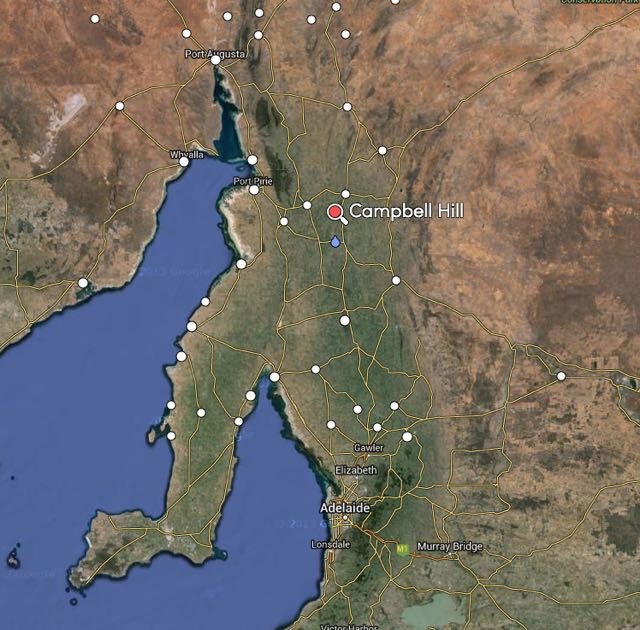
My first activation for Wednesday 4th February 2015, was New Campbell Hill, VK5/ SE-007, which is situated about 11km south of Jamestown, and about 206 km north of Adelaide.

Screenshot 2015-02-07 15.28.56

image courtesy of mapcarta.com

New Campbell Hill is 714 metres above sea level and is worth 4 SOTA points.  It is located in the ‘South East’ Region of the South Australian SOTA Association, and is located in the Bundaleer Forest Reserve.

I have activated this summit once before, with Ian VK5CZ.  For information on that activation please have a look at my previous post at…..

https://vk5pas.org/2013/07/27/new-campbell-hill-vk5-se-007/

Screenshot 2015-02-07 15.28.06

New Campbell Hill is part of the Campbell Range.  It is not to be confused with Campbell Hill which is located further to the south.

This slideshow requires JavaScript.

I had an early start from Crystal Brook and I headed north along RM Williams Way towards Jamestown.  I turned left onto Bundaleer Gardens Road, and stopped briefly to have a look at the memorial for Pioneers of the Bundaleer District.  I continued on up Bundaleer Gardens Road, and parked the car at Neindorf Road, where I packed my backpack, and commenced the @5 km walk to the summit.

This slideshow requires JavaScript.

Bundaleer is regarded as the birthplace of forestry in Australia.  It covers an area of about 3,200 hectares.  It is still home to Curnow’s Hut, the original residence built for the district’s first nursery worker, William Curnow (see below).  The name Bundaleer is derived from an aboriginal word, meaning ‘stony place’.

Screenshot 2015-02-08 16.51.54

Map courtesy of Forestry SA.

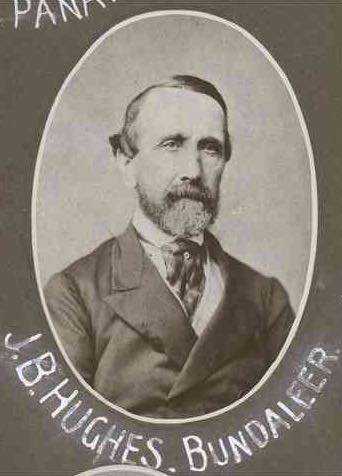
Bundaleer Forest was originally part of the Bundaleer Run, which was a vast pastoral station established in 1844 by John Bristow Hughes (b. 1871 – d. 1881).  Hughes was born in England in 1817 and arrived in South Australia in 1841 aboard the Porter, following his arrival in Tasmania in 1840.  He was married in 1847 in Adelaide, and established Bundaleer shortly after arriving in South Australia, with sheep he had brought across from Tasmania.

Screenshot 2015-02-08 16.36.21

Above: J.B. Hughes.  Image courtesy of http://www.samemory.sa.gov.au

In 1875, a Forest Board was appointed by the South Australian Government, and Forest Reserves were created, mainly in the South East.  However, some sections were created in the north of South Australia.  In c. 1876 the Forest Board commenced work at Bundaleer Springs when a nurseryman, William Curnow was sent to establish a nursery and prepare 400 hectares for lanting.   Curnow commenced planting asmanian Blue gums, local Red gums and Sugar Gums adjacent to the Jamestown to Spalding Road (RM Williams Way).

I followed the Bore Track up to the summit.  The walk starts off very easy, but don’t get too excited.  Worse is to come.  The initial walk took me passed beautiful pine forest, along a very easy access track.  There were quite a few Western Grey kangaroos out, enjoying the morning sunshine.  But unlike last time I activated the summit, I did not see any native deer.

The Bundaleer Forest Reserve was devastated by fire in early 2013.  Around 23,000 hectares of forest and scrubland were destroyed.  Over 30 % of the pine plantations were wiped out.  Leith Cooper, who is a local farmer stated: ‘It was one of the worst fires I’ve ever seen, there were reports that the flames were 100 feet above 50 foot pine trees, it was pretty intense’.  For more information on the fire, including some audio, please have a look at…..

http://www.abc.net.au/news/2013-05-14/charred-bundaleer-forest/4687770

There are some excellent views once you reach the top of the summit.  And the amazing dry stone walls which follow the ridgeline, are really quite a sight.  They are mentioned in a book called ‘those dry-stone walls’ written by Bruce Munday, which I have a copy of.  Many of these old walls were created by Patrick O’Grady (1838-1906), who was a ‘waller’ on Bundaleer Station.  Munday is remembered as bing ‘a little old man with long ringlets who always wore green ribbon in his coat’.  He is buried with his wife Annie at the Jamestown cemetery.  Local photographer, Mary-Anne Young made the following comment: ‘For someone who created such magnificent stone work, it is a disapointing grave’.

This was not one of my most memorable SOTA activations.  After setting up the linked dipole, I discovered that I had a very high VSWR.  Numerous checks were undertaken on the antenna, and this revealed that the likely source of the problem was the coax crimping on the BNC connector.  Not much I could do about it, as I didn’t have the required tools, and I had left the spare antennas back in the car.

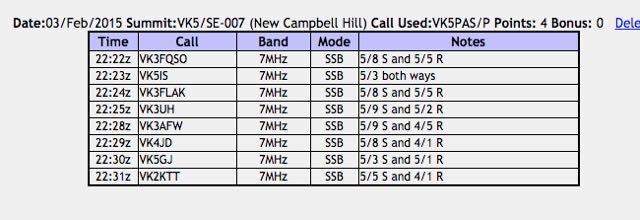
Anyway I pressed on and called CQ on 7.090.  My first contact was with Amanda VK3FQSO (5/8 sent and 5/5 received), followed by Ian VK5IS (5/3 both ways), Bob Vk5FLAK (5/8 sent and 5/5 received), and my fourth and qualifying contact was with VK3UH (5/9 sent and 5/2 received).

Much to my surprise I was called by VK4JD who have me a 4/1 signal report, and Paul VK2KTT who also gave me a 4/1 signal report.

This slideshow requires JavaScript.

So felling very frustrated, I packed the gear up and headed down the hill back to the car.  Just 8 contacts in the log, but thankfully the summit had been qualified.

I think the next time I active this summit I will try parking near Curnows Hut and walking north along the Heysen Trail to the summit.  Easier?  I’m not sure.  At the current time this section of the forest is closed due to restoration work after the 2013 bushfire.

After the activation I headed in to Jamestown, where I went to the Jamestown bakery for a pastie.  Jamestown is a beautiful little town and certainly worth a look.  There is an interpretice centre for RM Williams, who was an Australian bushman and entrepreneur who rose from a swagman, to a millionaire.  Fore more information on RM Williams, please have a look at the following…..

http://en.wikipedia.org/wiki/R._M._Williams

This slideshow requires JavaScript.

For more information on Jamestown, have a look at the following…..

http://www.visitjamestown.com.au/

The following stations were worked:-

Screenshot 2015-02-08 11.34.02


References.

ABC, 2015, <http://www.abc.net.au/news/2013-05-14/charred-bundaleer-forest/4687770&gt;, viewed 8th February 2015.

Government of South Australia, Forestry SA, 2015, Bundaleer Visitor Information brochure, <https://www.forestry.sa.gov.au/Portals/0/Publications/InfoLeaflets/Bundaleer%20Forest.pdf&gt;, viewed 8th February 2015

Government of South Australia, State Libarary, 2015, <http://www.samemory.sa.gov.au/site/page.cfm?u=77&c=5232&gt;, viewed 8th February 2015

Munday; B, 2012, ‘those dry-stone walls’, Wakefield Press.

Illawarra Hill VK5/ SE-014

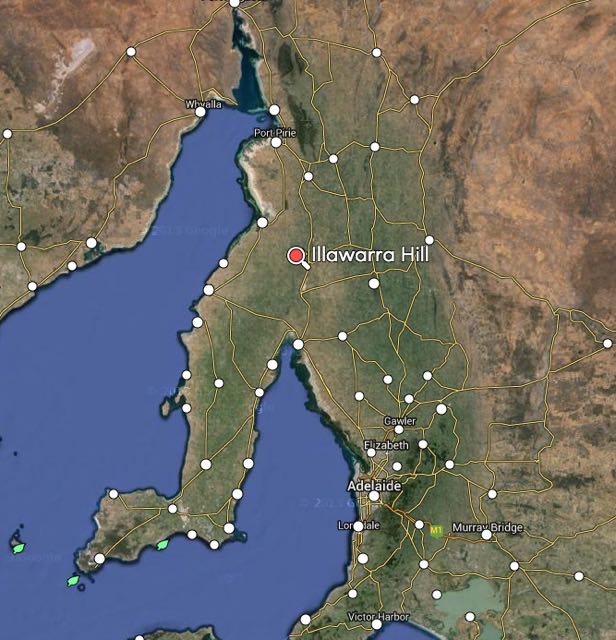
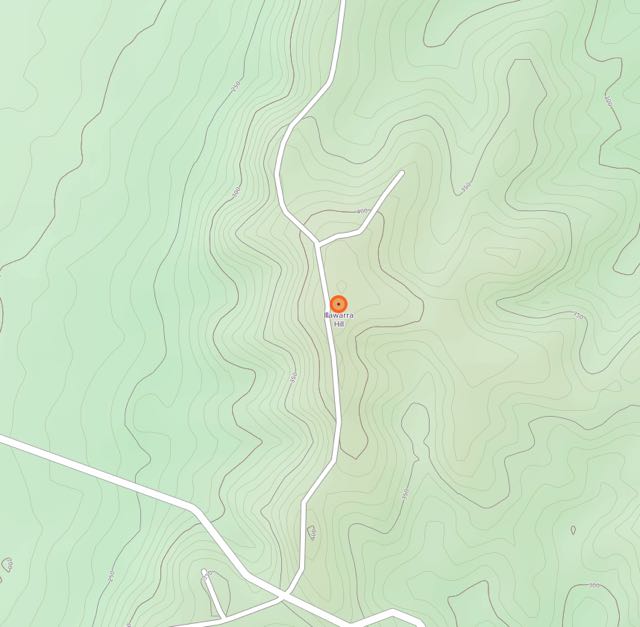
My third and final activation for Tuesday 3rd February, 2015, was Illawarra Hill, VK5/ SE-014, which is located about 11 km by road from the town of Snowtown, and about 155 km north of Adelaide.

Screenshot 2015-02-07 15.24.18

image courtesy of mapcarta.com

Illawarra Hill is 434 metres above sea level, and is worth 1 SOTA point.  It is located in the Barunga Range, west of Snowtown.  The town of Snowtown became infamously known for the Snowtown murders.  This is rather sad, because the vast majority of the murders were not even committed in the town.  However the bodies of many of the victims were stored in barrels in an old bank in the main street.  Snowtown is located in the wheat belt area of the Mid North of South Australia, and has a population of about 500 people.

In 2008, a monument called ‘The Big Blade’ in the form of a 44 metre wind turbine was installed in Snowtown.  There are a number of interpretive signs there, telling you all about the nearby Snowtown wind farm which is situated on the Hummock and Barunga Ranges to the west of the town.  It is well worth a look.

This slideshow requires JavaScript.

The first stage of the Snowtown wind farm was commissioned in September, 2008 with 47 Suzlon S88 2.1 MW turbines.  In 2011, an additional prototype Suzlon S95 2.1 MW turbine was installed and commissioned.  Since 2008, Stage 1 of the Snowtown wind farm has provided reliable electricity into the South Australian electricity network delivering a long term capacity factor of 43%, one of the highest wind farm outputs in Australia.  Final approvals for Stage 2 of the Snowtown Wind Farm were secured in August 2012 to install a further 90 Siemens 3.0 MW turbines, with a combination of 101 metre and 108 metre blade diameters, with an output of up to 270 MW.  With the completion of Snowtown 2, the total output of the combined Snowtown wind farm will be 370.8 MW, making it the biggest single wind farm in South Australia.  Over 230,000 homes can be powered by the Snowtown Wind Farm.

After leaving Snowtown, I headed west along Shadwells Gap Road.  About 5 km along this road, you will reach a gate on your right.  There are a number of signs here including ‘Snowtown Wind Farm Stage II” and ‘Private Property.  Trustpower Windfarm.  Tresspassers Prosecuted’.

This slideshow requires JavaScript.

The summit is located on private property and is situated amongst the windfarm.  I had spoken with the landowner a few days prior, and had sought approval to access the summit.  PLEASE do NOT access the summit without the approval of the land owner.

Screenshot 2015-02-07 15.25.05

image courtesy of http://www.openstreetmap.org/

I drove along the dirt road after entering via the gate and headed north up towards the telecommunications tower and the trig point.  It was a very warm afternoon, so I set up underneath a small sheoak tree and an adjacent dead tree stump.  It was not the most comfortable of ‘shacks’, but it did provide a little bit of shelter from the very hot afternoon sun.  As you would expect, it was extremely windy on the top of the summit.  There aren’t too many other options on a hot day on this summit.  The only over cover are the two rainwater tanks a little closer to the trig point.

For this activation, I used the Yaesu FT-857d and ran 20 watts.  My antenna was the SOTA Beams 40m/20m linked dipole, which I supported on a 7 metre telescopic squid pole.  I secured the squid pole to the squid pole holder with an octopus strap.  Because it was so windy, I used the guying rope which I tied off to a fallen tree limb.

My first contact was with Peter VK3TKK who was mobile, followed by Ian VK5IS at Beetaloo Valley, Col VK5HCF in Mount Gambier, and then Tom VK5EE, also in Mount Gambier. Signals were very good, and there was no man made noise on the summit.

After working 13 stations on 40m, I headed up to 20m hoping to work some DX.  But I was to be sadly disapointed.  I did work a total of 7 Australian stations in VK1, VK2, VK3, VK4, and VK6, but did not have a single European caller.  I have mentioned it before, but I guess we take distances for granted here in Australia.  My contact with Peter VK4JD was over a distance of about 1,900 km.  My contact with John Vk6NU was over a distance of about 2,500 km.  In some parts of the world, this is a DX contact.  But here in Australia we call it a ‘local’ QSO.

I moved back to 40m and placed another CQ call on 7.090, and this was answered by Ray VK3NBL, and then Tony VK3CAT, followed by Ian VK3VIN, and then Andrew VK1NAM.  All had excellent signals.  I went on to work a further 8 VK stations.

This slideshow requires JavaScript.

I decided to try my luck again on 20m, so I again lowered the squid pole and removed the links and tuned across the 20m band.  But sadly, the European signals I was hearing, were low down.  I headed up to 14.156 where I made contact with John EA7BA in Almeria in Spain, Brian VK2JE, and Brian ZL2ASH in Wellington in New Zealand.

I had a total of 35 contacts in the log.  It was time to pack up and get back on the road and head back to Crystal Brook, about 60 km away.

Upon arriving in Crystal Brook I headed to the Crystal Brook Hotel, where I enjoyed a very nice Schnitzel, chips and salad, and a few cold Bundies and coke.  I then returned to the Crystal Brook Caravan Park, where I enjoyed the sunset and the almost full moon.

This slideshow requires JavaScript.

I highly recommend the Crystal Brook Caravan Park.  The caretaker was very friendly and the cabin which I stayed in was very clean & tidy.

This slideshow requires JavaScript.

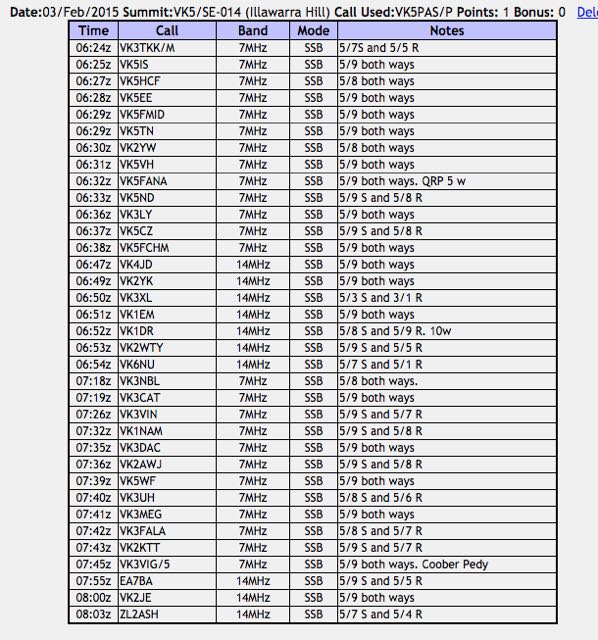
The following stations were worked on Illawarra Hill:-

Screenshot 2015-02-08 11.27.56


References.

Wikipedia, 2015, <http://en.wikipedia.org/wiki/Snowtown,_South_Australia&gt;, viewed 8th February 2015.


Bumbunga Hill VK5/ SE-015

My second activation for Tuesday 3rd February, 2015, was Bumbunga Hill, VK5/ SE-015, which is located about 8 km by road from the little town of Lochiel, and about 141 km north of Adelaide.
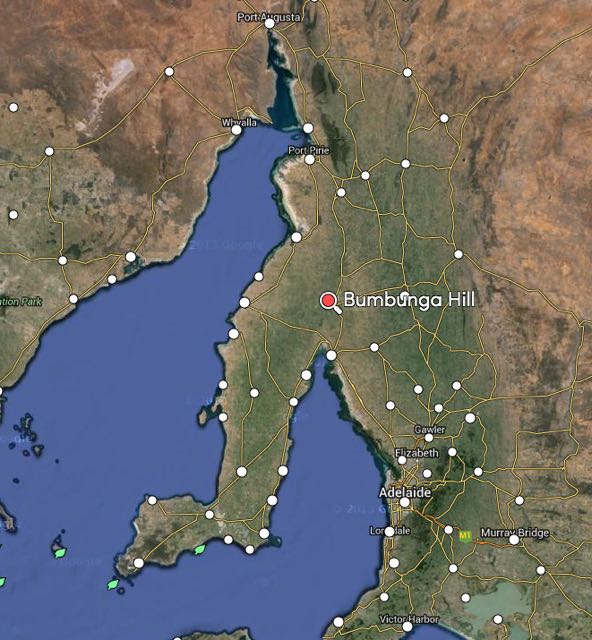
Screenshot 2015-02-07 15.20.08

Image courtesy of mapcarta.com

Bumbunga Hill is 413 metres ASL and is worth just 1 SOTA point.  The summit is located on private property.  I had sought permission from the land owner a few days before (contact details can be found on the SOTA database).  Access to the summit is via Landslide Road.

If you are on the A1, take Robert Street at the northern end of the town of Lochiel and travel west.  You will then reach Landslide Road.  Turn right here and travel a few km up Landslide Road.   On your right, you will see some double gates which have numerous locks on them.  Alongside, on both the left and right of these gates, are some ‘cocky’s gates’.  This is where you enter the private property.  PLEASE ensure you have permission prior to entry.  And please close the gates behind you.  You will know that you are in the right spot, because there is a large shed on the right of the main dirt track behind the gates, and a house ruin on the left of the track.

But for me, after leaving South Hummocks, I continued north along Pump Station Road, V. Taylors Road, and then Lochiel Road, until I reached Landslide Road.  It saved me having to travel back to the bitumen.

This slideshow requires JavaScript.

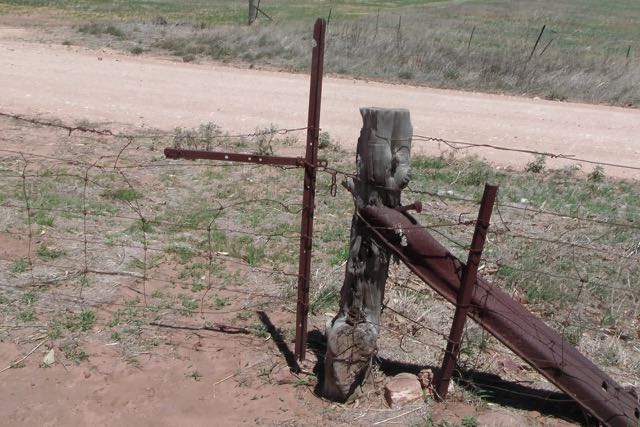
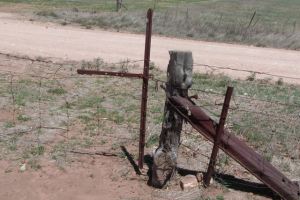
The main double gates were locked.  There is a plethora of padlocks on the gates.  Each stakeholder of the communications tower at the top has a padlock on the gates.  I entered via the ‘cocky’s gate’ on the left, which consisted of a rusty star dropper and some mesh.  The links were quite rusty, and in the end one of them snapped on me.
IMGA0100

I followed the fenceline up passed the dam and stopped for a short time to have a chat to one of the farmhands.  He then pointed out a gate on the other side of the dam, which in turn leads to the track which takes you up to the summit.  Don’t attempt this track in a conventional vehicle.  You will make it to the ridgeline above the shed and ruin, but from there the track is definitely 4WD territory.  It is very rough with lots of washaways and large rocks.

Once you have negotiated the rockiest part of the track, you will reach another gate.  Today, it was closed.  Please leave all of the gates as you find them.  Even before you reach the very top of Bumbunga Hill, you will be rewarded with some excellent views of the surrounding countryside, the little town of Lochiel, and Bumbunga Lake.

This slideshow requires JavaScript.

The dirt track from the top gate to the summit is good from here.  Follow the fenceline until you reach another gate.  On the other side of this gate you will find the telecommunications tower, the Lochiel repeater, and what is left of the trig point.  When I first activated this summit back in April, 2013, the trig point was lying on its side on the ground.  Nowadays it has gone, and the trig is marked with three upright poles, which are painted blue.  They make an excellent anchor point for a squid pole.
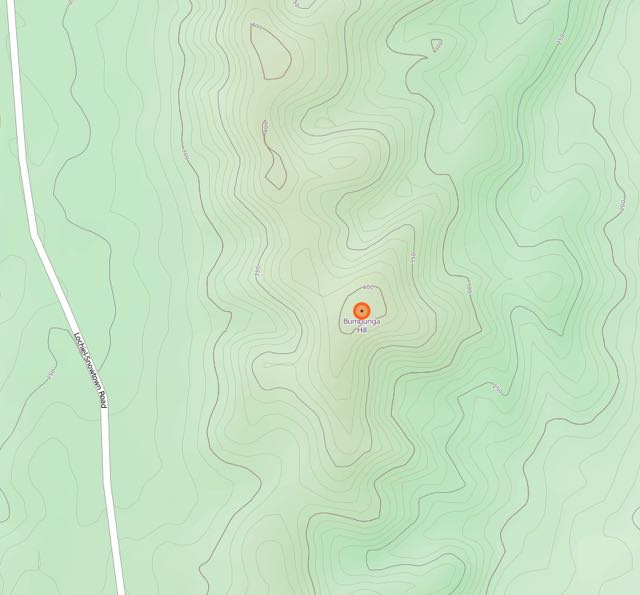
Screenshot 2015-02-07 15.22.22

image courtesy of http://www.openstreetmap.org/

The town of Lochiel lies below the summit, just to the south east.  Governor Fergusson named it Lochiel after Lochiel Forest, near Inverness in Scotland.  Lochiel is also the name of one of the titles of the chief of the Cameron Clan, while the Scottish ‘Lochiel’ comes from the Gaelic ial – ‘gleam of sunshine’.  Salt has been mined at nearby Bumbunga Lake since 1912.  A coal mine was also in operation, a few km east of the lake, between the 1980s and 1990s.

The earliest reference to Lake Bumbunga is to be found in a little book entitled ‘Reminicences of a Sojourn in South Australia’ by ‘A Squatter’, published in 1849.  The author talks about a chance meeting with two tired travellers at a camp fire, at the head of St Vincents Gulf, not far from the Lake.  One of the travellers told the squatter that he had come from Lake ‘Bambunga’, which he claimed to have discovered.  The traveller went on to say, ‘The name is one that the natives formerly gave it and, as being the discoverer and licenced occupier, I conceived I had a right to apply what name I pleased to it’.   It appears that name has since elapsed over time into Bumbunga.

According to anthropologist Norman Tindale, the name was derived from the local Parnpangka aboriginal people and means ‘rain water lake’.  However, in 1967, H.M. Cooper of the SA Museum stated that the word Bumbunga meant ‘by, near or at the lake’.

The squatter goes on to say “the ‘Bambunga country’ was carrying 10,000 sheep and eighteen perpetural springs”.  The area was part of Hummocks Run.  Bumbunga was one of two substations for this very large sheep and cattle station, which by 1864 had 70,000 sheep, 200 bullocks and horses.  The Bumbunga station consisted of a pine house, store, men’s kitchen, sleeping rooms, woolshed, yards, sweating shed, fenced paddocks, three wells troughs, and one pump.

I found the following from the Adelaide Observer, dated Saturday 1st October 1864.
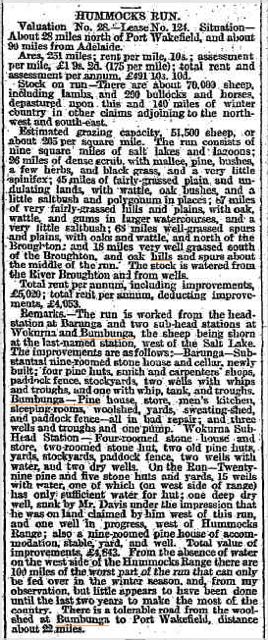
Screenshot 2015-02-07 22.15.10

And also the following from the Northern Argus, Clare, dated Friday the 13th October, 1871.
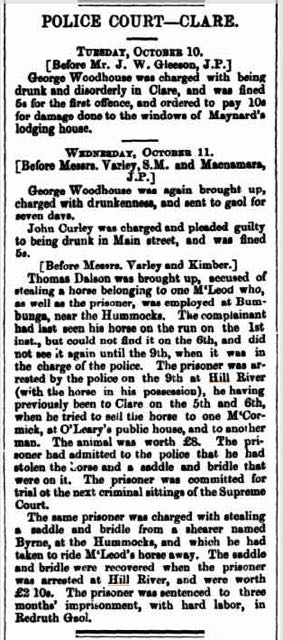
Screenshot 2015-02-07 22.30.21

I set up at the trig point, and secured the 7 metre squid pole to one of the trig point poles, with two octopus straps.  It was a warm day, but it was also incredibly windy.  And the flies were out in force.  The Aerogard did not seem to be having any affect.  For this activation I ran the Yaesu FT-817 and 5 watts output.

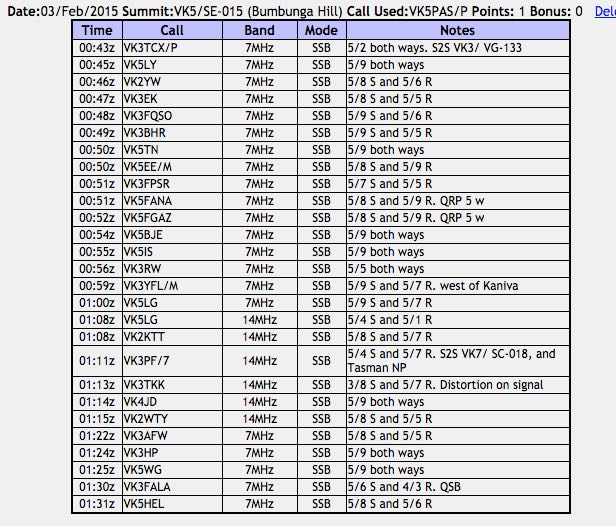
Before calling CQ, I tuned across the 40m band and found  Ian VK3TCX on 7.095 calling CQ from SOTA summit, Mount Cann, VK3/ VG-133, which is located in the East Gippsland area of Victoria.  Ian’s signal was pretty weak, but very readable (5/2).  So I waited a little while for the multitude of callers to slow down, and then gave Ian a call.  We exchanged 5/2 signal reports with each other.  A good start to the activation at Bumbunga Hill….a Summit to Summit contact.

I then went down to 7.090 and put out a CQ call and this was answered by Larry VK5LY in The Riverland, followed by John VK2YW in Wagga Wagga, and Rob VK3EK.  As it was a weekday, I had a steady flow of callers, but certainly not the ‘pile ups’ that can be expected on weekends.

Whilst on Bumbunga Hill, I worked a few QRP stations.  They included Adrian VK5FANA, who was running just 5 watts from the Yorke Peninsula (5/8 sent and 5/9 received).  Thanks to Adrian for spotting me.  Also, Gary VK5FGAZ, running 5 watts, from north of Adelaide (5/8 sent and 5/9 received).

And I also worked a few mobile stations.  The first being Tom VK5EE who was mobile in Mount Gambier, followed by Brian VK3YFL mobile near Kaniva in Western Victoria.

This slideshow requires JavaScript.

After working a total of 16 stations on 40m I lowered the squid pole and removed the links and headed up to 14.310 where I put out a CQ call.  This was immediately answered by Greg VK5LG in the Adelaide Hills, who had been my last contact on 40m and had followed me up here to 20m.  I worked a total of 6 stations on 20m SSB, including another Summit to Summit.  This time with Peter VK3PF/7 who was on Macgregor Peak, VK7/ SC-018, which is also located within the Tasman National Park (5/4 sent and 5/7 received).

I then returned to 40m for a short time where I worked another 5 stations in VK3 & VK5.

Once I got down off the summit, I drove down to Lochiel and found a shady spot under a tree alongside of Bumbunga Lake and had some morning tea.  I then jumped back into the 4WD, and headed north to Crystal Brook.

This slideshow requires JavaScript.

The following stations were worked:-
Screenshot 2015-02-08 11.10.18


References.

Cockburn, S, 1908, ‘South Australia.  What’s in a Name?’

Government of South Australia, State Library, 2015,<http://www.slsa.sa.gov.au/manning/pn/b/b30.htm&gt;, viewed 7th February 2015

Wikipedia, 2015, <http://en.wikipedia.org/wiki/Lake_Bumbunga&gt;, viewed 7th February 2015

Wikipedia, 2015, <http://en.wikipedia.org/wiki/Lochiel,_South_Australia&gt;, viewed 8th February 2015

South Hummocks VK5/ SE-017

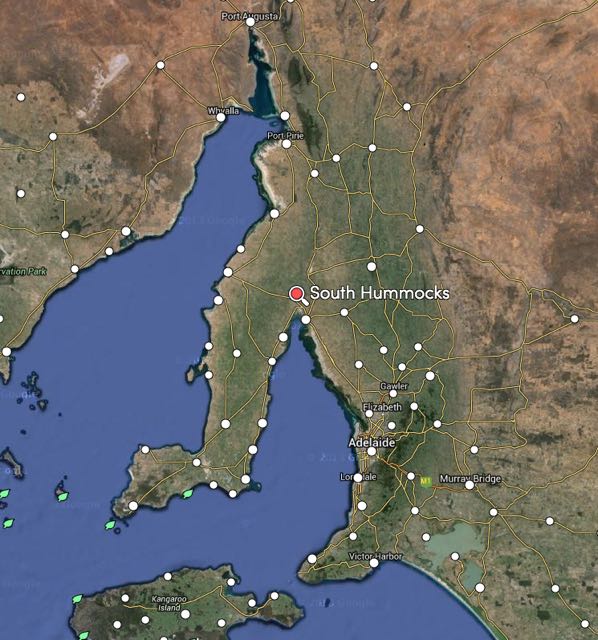
Early on Tuesday morning (3rd February 2015) I headed north towards Crystal Brook, which is about 200 km north of Adelaide.  I had booked in to stay for 3 nights at the Crystal Brook Caravan Park.  My main reason for heading there was to meet up with a number of the amateurs from the Mid North of South Australia, and deliver a presentation on the VK5 National and Conservation Parks Award and also the World Wide Fora Fauna (WWFF) program.  Along the way on the first day, I had planned to activate three summits for the Summits on the Air (SOTA) program.  The first was South Hummocks, VK5/ SE-017, which is located about 29 km by road from Port Wakefield, and about 126 km north of Adelaide.

Screenshot 2015-02-07 15.12.04

image courtesy of mapcarta.com

South Hummocks is 330 metres above sea level and is worth 1 SOTA point.  The summit is located on private property, so a few days before heading there, I sought approval from the land owner, Colwyn Millard (his contact details can be found in the SOTA database).  The summit is clearly visible as you travel towards Port Wakefield along the Port Wakefield Road (A1).  It may not be the tallest of summits, but it is certainly very prominent after travelling the vast flat plains north of Adelaide, as you head towards Port Wakefield.

This was to be my second activation of South Hummocks.  I first activated the hill back in April, 2013 with Andy VK5AKH.  In fact, South Hummocks was one of my first ever SOTA activations.  For more information on that activation, please have a look at my previous post at…..

https://vk5pas.org/2013/04/14/south-hummocks/

This slideshow requires JavaScript.

The summit is located in the Hummocks Range, which is a range of hills which commence just north of the apex of Gulf St Vincent, near the little settlements of South Hummocks and Kulpara.  The Hummocks Range stretches to its northern end where it merges with the Barunga Range at Barunga Gap, about 10 km west of Snowtown.  The Hummocks and Barunga Ranges form part of a number of low lying ridgelines occurring in the Mid North region of South Australia.

This southern part of the Hummocks Range has not yet been impacted by windfarms.  The Hummocks Range is the primary source of water catchment for Lake Bumbunga, which is located a little further north, near the town of Lochiel.  The primary land use for the surrounding area is stock grazing and cereal cropping.

Although much of the surrounding area has been cleared for grazing and cereal production, there are still patches of scrub to be found.  In fact, quite a bit of remnant scrub remains on the summit itself.  A variety of native animals, birds, and reptiles can be found including Western grey kangaroos, the Flinders Worm lizard, and the Peregrine Falcon.  Whilst I was on the summit I observed a number of Euros, but they were just too quick to catch on camera.  I also observed a Wedge Tailed eagle sailing along the ridgeline, obviously in search of breakfast.

Screenshot 2015-02-07 15.16.16

image courtesy of http://www.openstreetmap.org/

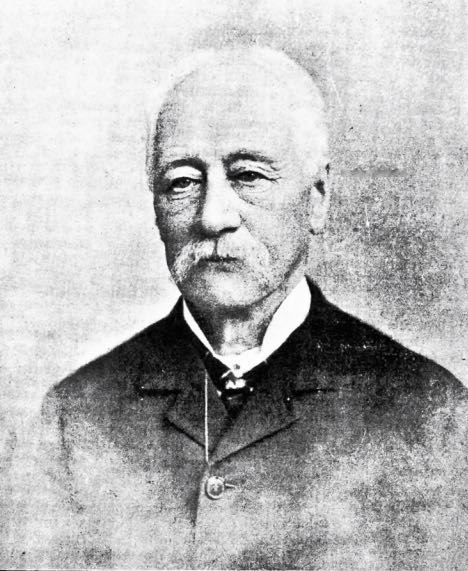
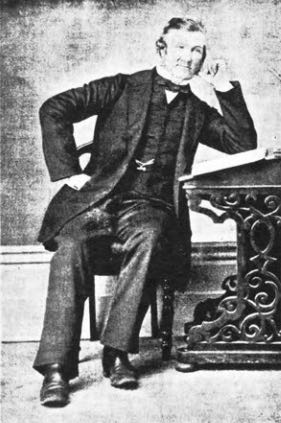
The South Hummocks region has a rich agricultural history, and at one stage had a large population.  Some of the early pastoralists included Charles Burney Young and Edmund Bowman.  South Hummocks had a railway station, and even had its own football team back in the early 20th century.

Screenshot 2015-02-07 21.15.35

above:- Charles Burney Young.  Image courtesy of Pastoral Pioneers of South Australia

Screenshot 2015-02-07 21.14.25

above:-Edmund Bowman.  Image courtesy of Pastoral Pioneers of South Australia

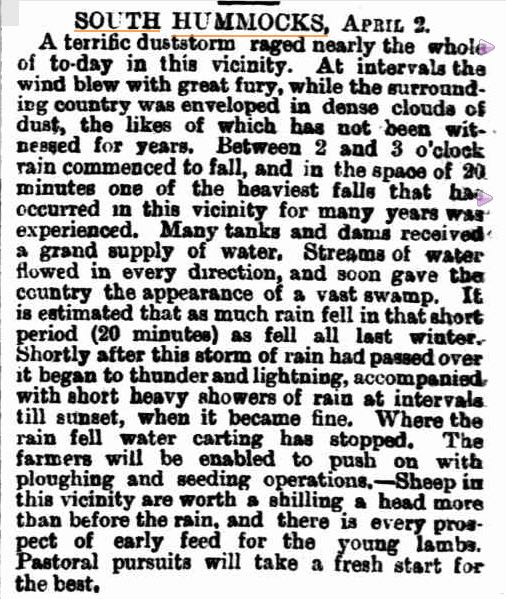
I found the following from the South Australian Weekly Chronicle, dated the 9th April, 1887.

Screenshot 2015-02-07 21.22.46

image courtesy of trove.nla.gov.au

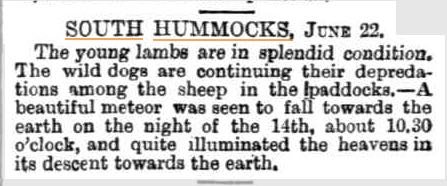
And this one from the South Australian Weekly Chronicle, dated the 2nd day of July 1887.

Screenshot 2015-02-07 21.26.12

How do you get to the summit?  If you are travelling north, enter Port Wakefield, and then after leaving the town, take the turnoff to the Yorke Peninsula just out of town.  This is the Copper Coast Highway.  Continue along the Copper Coast Highway for a number of km, and then turn right onto Balaklava Road.  A short distance up you will reach Pump Station Road.  Turn left here and continue for a number of km north on Pump Station Road.  Before you reach Millards Road (on your left), you will see some double gates on your right.  The gate has ‘Private Sanctuary’ written on it.  This is where you enter the private property.  PLEASE ensure you have permission prior to entry.  And please close the gates behind you if you find them closed.

I followed the fenceline up through the paddock.  The first part of the drive through the paddock can be undertaken using a conventional vehicle.  But you will then reach a sign which says ‘Engaged 4WD only’.  Please take notice of the sign, and engage 4WD if you have it.  You will never make it up the track if you don’t, as it becomes very rocky and slippery.  If you don’t have a 4WD, leave your car here at this point and walk the rest of the way.  It is about a 20 minute walk up the track from here to the trig point.  I continued on up the track and went all the way to the communications tower at the end of the track, where I had a photo stop.  I then drove back down the track and parked the 4WD, and then walked uphill again, over the fenceline and into the scrub to the trig point.

This slideshow requires JavaScript.

You will need to keep a good eye out for the trig point for South Hummocks, as it is not easy to spot.  As you travel north along the track, keep an eye out for a star dropper which is painted blue at the top.  There is also a piece of yellow tape attached to the top strand of barbed wire on the fence at this point, and another piece of yellow tape tied around a nearby tree.

The original trig is no longer at the site.  It was there when I last activated the summit in April 2013, but sadly, as is the case with many trigs around South Australia, it is no longer in existence.  All that remains of the trig are some of the pieces of rusty metal, lying amongst the scrub.  There are two blue poles at the trig site.  There is also a small pile of rocks, no doubt attributed to visitors to the summit.

IMGA0036

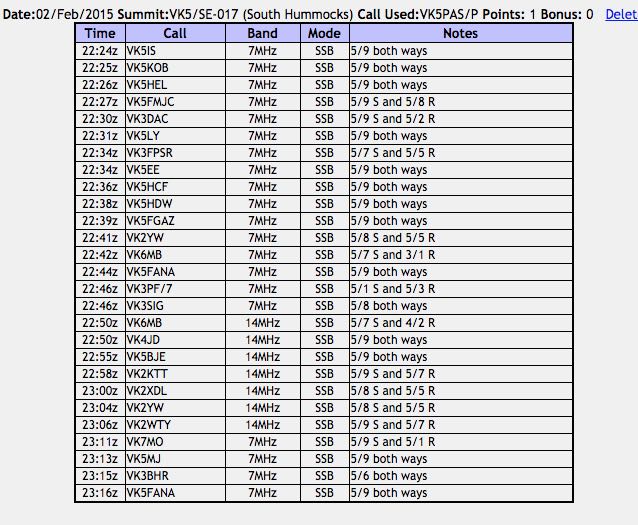
I ran the Yaesu FT-817 and 5 watts for this activation, and the SOTA Beams 40m/20m linked dipole.  By the time I had set up the gear, I was just 20 minutes later than my estimated time of activation of 2200 hours UTC (8.30 a.m.).  I tuned to 7.090, which was my nominated starting point, and called CQ and this was immediately answered by Ian VK5IS in Beetaloo Valley (5/9 both ways), then Jim VK5KOB in Elizabeth (5/9 both ways), and then Geoff VK5HEL in Murray Bridge (5/9 both ways).  My fourth and qualifying contact for the summit, was with John VK5FMJC in Crystal Brook (5/9 sent and 5/8 received).  Propagation locally seemed to be very good.

My next contact, was my first interstate contact for the summit.  It was Fred VK3DAC, north east of Melbourne, who was a good 5/9 signal to South Hummocks.  Fred reciprocated with a 5/2 signal report for me.  I went on to work 16 stations on 40m SSB before heading off to 20m.  Those stations worked were in VK3, VK5, VK6 & VK7.   It was very pleasing to get Mike VK6MB from Perth in the log on 40m (5/7 sent and 4/2 received).  And also John VK2YW in Wagga Wagga (5/8 sent and 5/5 received).  I often struggle with Mike and John on 40m at this time of the day.  But this day we made it easily.  And to top it off, I made contact with Peter VK3PF/7, on holidays down in Tasmania.  Peter was on his way to activate a summit.  Peter was very weak, 5/1, but very readable, due to the non existant man made noise floor on the summit.

I then lowered the squid pole and removed the links in the 40m/20m linked dipole, and called CQ on 14.310.  Larry VK5LY was kind enough to spot me on SOTA Watch before I QSY’d, so by the time I had got to 20m, there were a few stations there waiting for me.  It highlights the benefit of spotting!  My first contact on 20m was with Mike VK6MB.  He was the same signal strength here on 20m (5/7) as he was on the 40m band.  My signal report had also remained the same (4/2), but Mike reported that the 20m band was a lot quieter for him than 40m.  My next caller was Peter VK4JD in Jimboomba with a very strong 5/9 signal, and then to my surprise, John VK5BJE in the Adelaide Hills, who was 5/9.  John gave me a 5/8-9 signal report.  This contact surprised me a bit, as we were only @ 120 km apart, and normally this is far too close for good propagation on 20m.

This slideshow requires JavaScript.

After working 7 stations on 20m SSB in VK2, VK4, VK5, & VK6, I moved back to 40m where I put out a few final CQ calls.  My first taker upon returning to 40m was Rex VK7MO, with a very nice 5/9 signal from near Hobart in Tasmania.  This was followed by Mal VK5MJ in The Riverland, Phil VK3BHR and finally Adrian VK5FANA on the lower Yorke Peninsula, running QRP 5 watts (5/9 both ways).

After activating the summit for about 45 minutes, I had a total of 27 contacts in the log on 40m SSB and 20m SSB.  It was time to pack up and head off to my next summit, Bumbunga Hill.

Although South Hummocks is worth just 1 SOTA point, for me the summit highlights the fun that SOTA is.  South Hummocks is an easy summit to access, and despite being only 330m ASL, it offers sensational views of the surrounding countryside.  The wildlife is also well worth the trip.

The following stations were worked:-

Screenshot 2015-02-07 18.37.25


References.

Aldersley, D, 1923, ‘Pastoral Pioneers of South Australia’.

Wikipedia, 2015, <http://en.wikipedia.org/wiki/Hummocks_Range&gt;, viewed 7th February 2015
Wind Prospect Pty Ltd, 2003, ‘Environmental Statement, Proposed Barunga Wind Farm Hummocks & Barunga Ranges’.