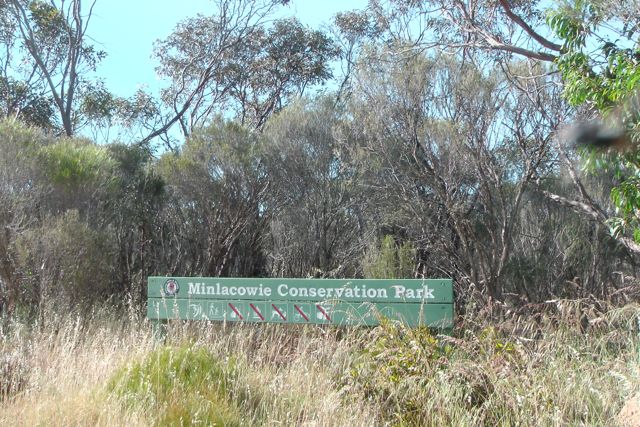
Minlacowie Conservation Park

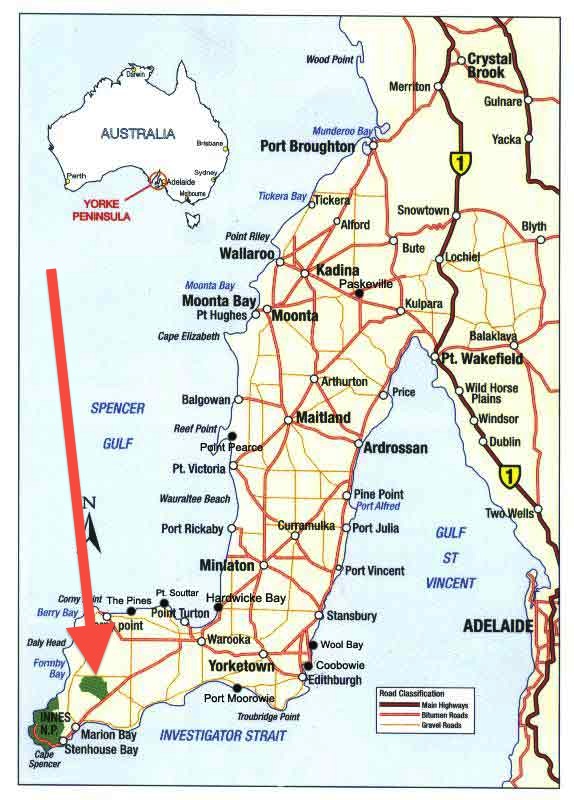
My first of 4 activations for Sunday 20th October, was the Minlacowie Conservation Park, which is located on the Yorke Peninsula, about 13 km west of Stansbury, and about 218 km from Adelaide.  So bright and early Marija and I got up, and enjoyed a coffee and breakfast on the porch of the cabin at the Corny Point Caravan Park.  It was a beautiful morning.  Already very warm, with an expected top temperature of 35 deg C.  Following breakfast we headed off after 2 enjoyable nights in Corny Point.  Marija and I highly recommend the caravan park here.  It was clean and tidy, and the owners were very friendly.

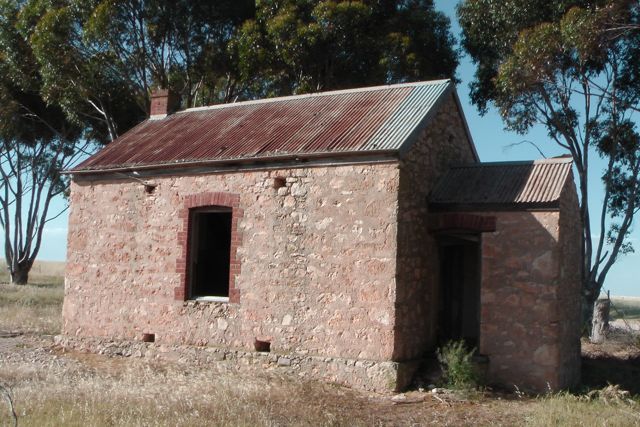
Before heading off to the park, we detoured to the local general store and purchased some fly nets to cover our faces.  The bush flies on Saturday had been intolerable.  We then headed out onto the Yorke Highway and into the little town of Warooka, and then on to Hardwicke Bay.  We continued north on the Yorke Highway and passed through the little settlement of Brentwood. Not far out of Brentwood, we then turned right onto Rogers Road (a dirt road), and followed this through to the old Minlacowie South school, which is now a ruin.  After a brief stop to have a look at the old school, we continued west on Rogers Road until we saw the Park on her right hand side.
IMGA0003_2     IMGA0007_3

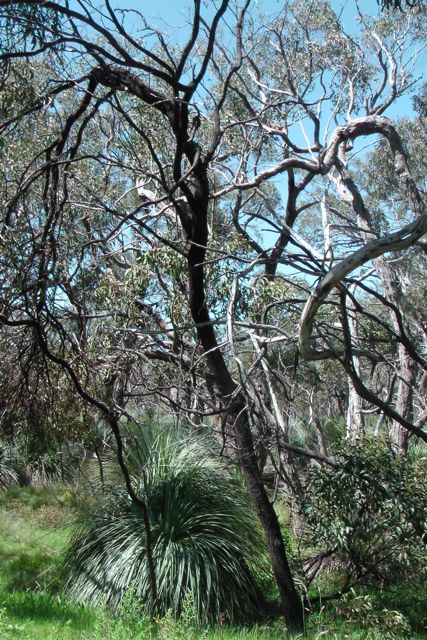
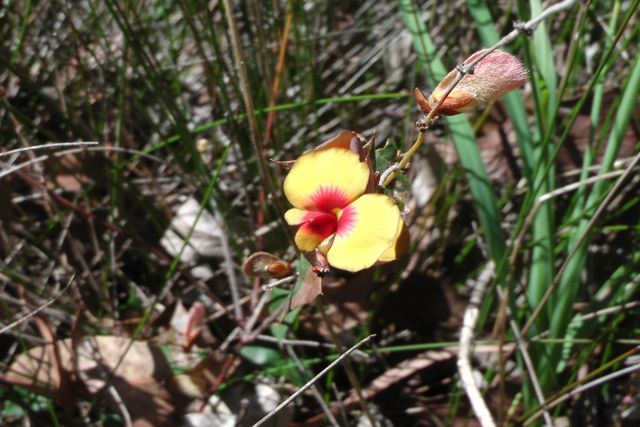
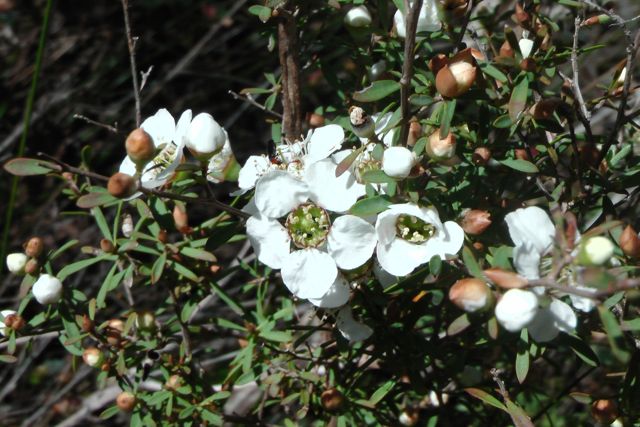
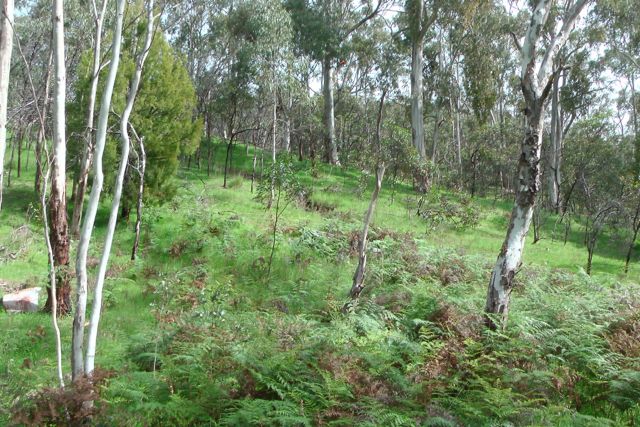
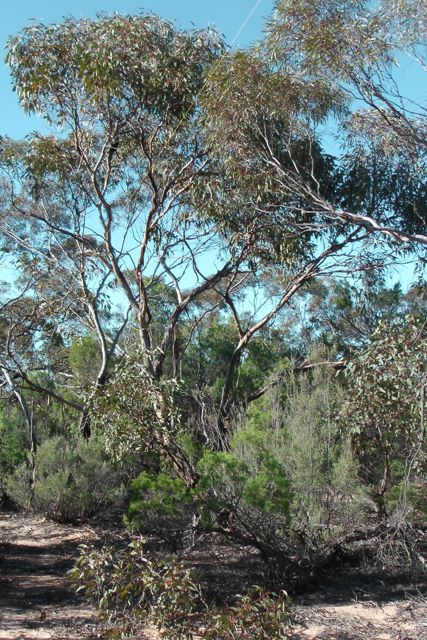
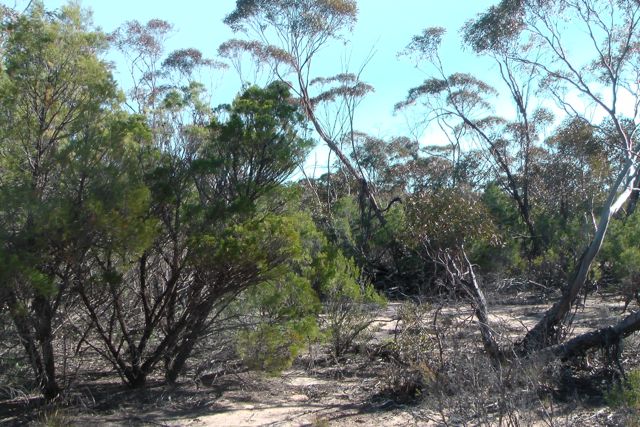
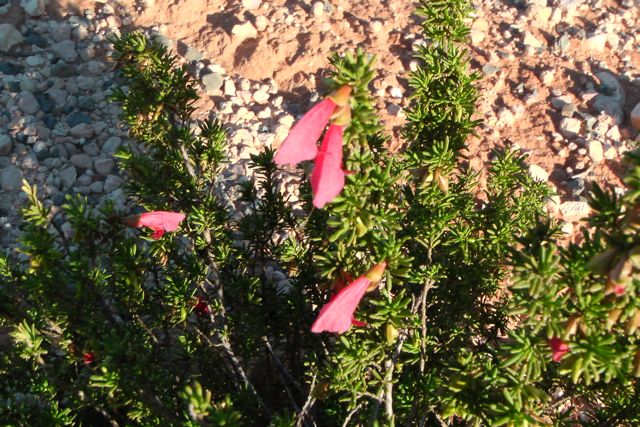
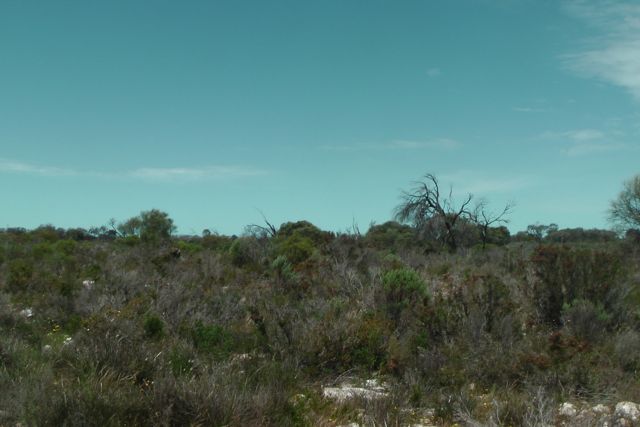
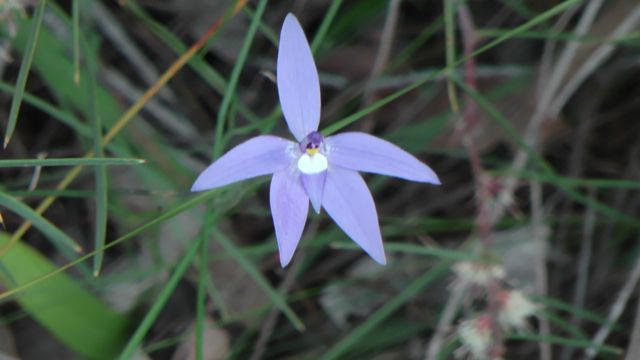
Minlacowie Conservation Park, which was proclaimed in 2008, consists of 28.5 hectares of native bush which is now rather rare on Yorke Peninsula.  The park is an area of high biodiversity, with at least 87 native plant species observed.  The park comprises a small patch of remnant mallee / broombush vegetation in very good condition, and conserves a number of significant plant species including the nationally and state vulnerable Winter Spider-orchid.  The park is dominated by Ridge-fruited Mallee together with Narrow-leaf Red Mallee and Beaked Red Mallee and Dryland Tea-Tree and Broom-bush.  There is a good ground cover including Mallee Bitter-pea, Rosemary Damperia  and Common Stylewort.

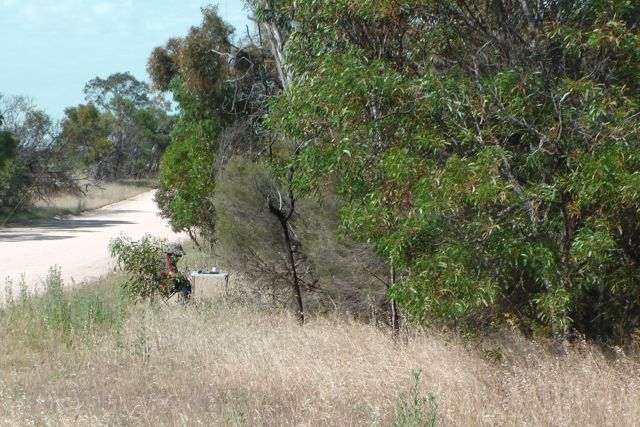
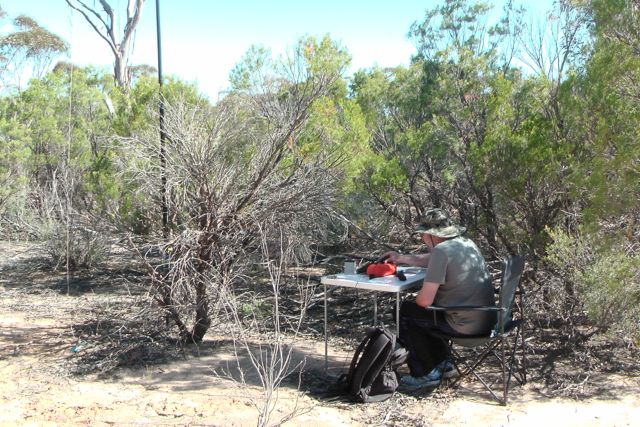
We could not find any access to the park on the northern side, so we turned right onto Savage Hut Road (a dirt road) which followed the western boundary of the park.  Again there was no visible access point to the park.  So Marija and I stopped on the side of the road, and set up just of the roadway, not far from the intersection.

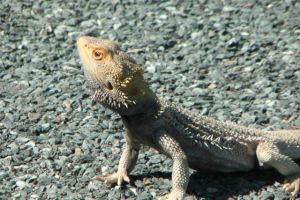
Sunday was shaping up to be a very hot day and it was already stifling with a very stiff breeze.  The mallee scrub of the park is very thick and I didn’t fancy walking to far in through fear of snakes and goannas.  And it would have been physically impossible to set up the dipole.

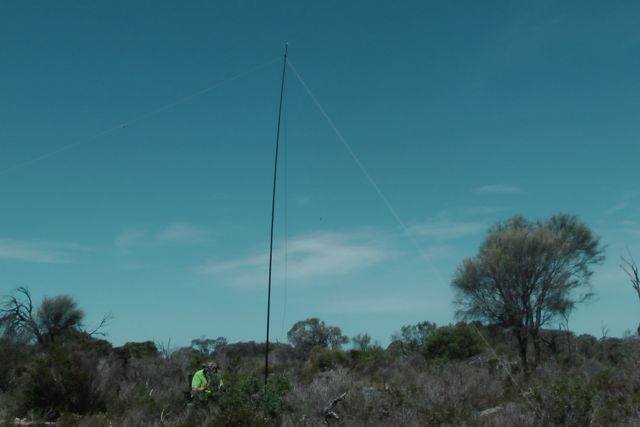
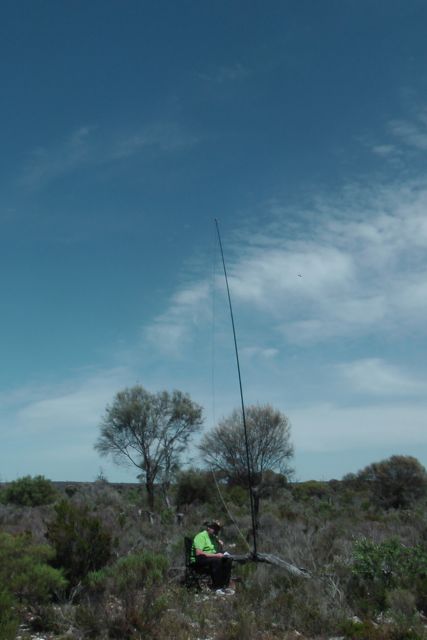
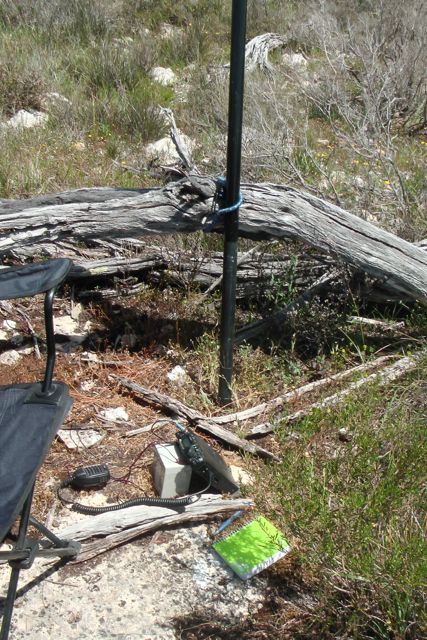
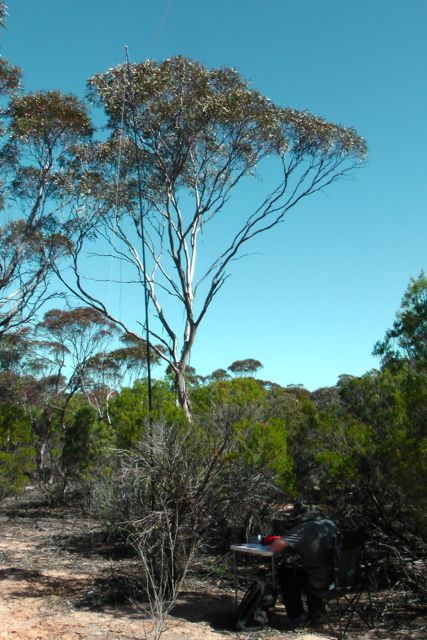
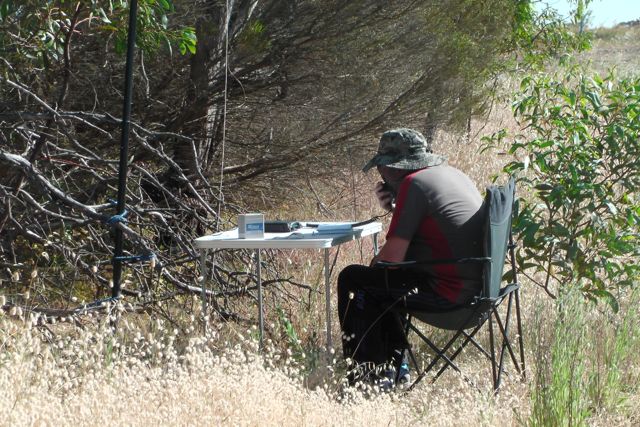
So I attached the 7 m squid pole to the dead branches of a tree, utilising some octopus straps.  I set up my little fold up table and deck chair, and I checked the antenna with the antenna analyser.  And to my surprise, the VSWR was through the roof.  The linked dipole can be a little.  But despite, the VSWR was still really high.
IMGA0009_3     IMGA0012_3

I put a few calls out on 40m but got no answer so I hunted around the band and found Larry VK5LY who was portable in the Spring Gully Conservation Park, near Clare.  Larry was a good strong 5/9 signal and was using his new Wouxon X1M transceiver. I breathed a sigh of relief.  I ahd one contact.  I had qualified the park.   Larry told me that John VK5BJE was up 5 kc, so I headed up to 7.110 and found John calling CQ from the Hallet Cove Conservation Park with a good strong 5/8 signal.

At the conclusion of the QSO with John, Graham VK5KGP asked me to QSY up 5.  So I obliged and had a chat with Graham, before I decided that the heat, the flies, and the antenna issues, were not worth sitting in the sun for.  So I packed up hoping that Barker Rocks Conservation Park, which was on the coast, would be a little bit more pleasant, and that I might be able to solve the antenna issues.

During the activation I had a local farmer drive by and ask me what I was researching.  So I explained to him that I was a silly amateur radio operator sitting in the heat with the flies talking to other hams.  He was quite interested, but warned me not to venture too far into the scrub because of all the snakes.

After just 15 minutes in the park, I had 3 QSO’s in the log.  This is the lowest number of contacts I have ever had from a park.

The following stations were worked:-

Larry VK5LY/p (Park to Park); John VK5BJE/p (Park to Park); and Graham VK5KGP.

I have posted a video on You Tube of the activation…..
Warrenben Conservation Park

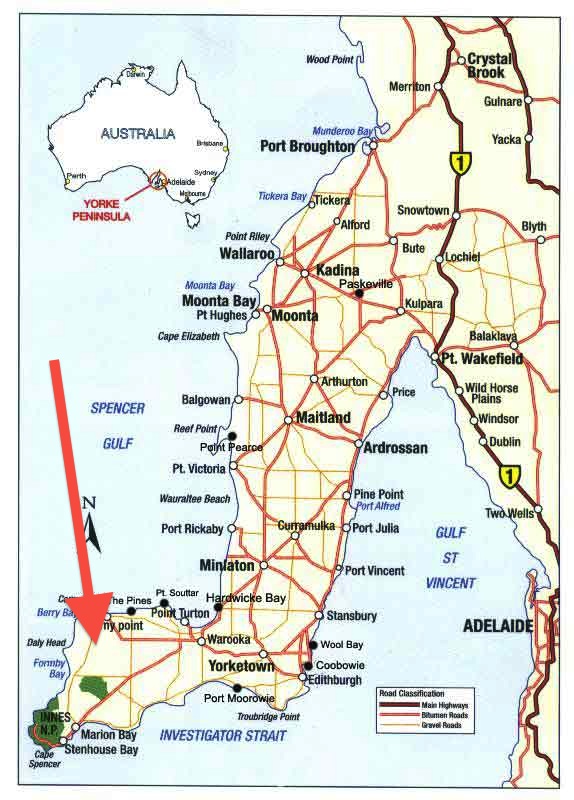
My 3rd planned activation for Saturday 19th October, 2013, was the Warrenben Conservation Park, which is situated on the Yorke Peninsula, north east of Marion Bay.

Fishing-Trips-South-Australia copy

Warrenben Conservation Park is a large park consisting of  4,065 hectares.  It was constituted by statute in 1972. Together with nearby Innes National Park, it conserves a substantial proportion of the natural habitat remaining on southern Yorke Peninsula.  The park comprises an area of undulating limestone plains and low, stabilised dunes that remain well vegetated with mallee and tea-tree scrub and some sheoak woodlands.

The Park provides habitat for a number of threatened species including the nationally and state vulnerable Annual Candles, state rare Goldsack’s Leek-orchid, and the nationally and state vulnerable Malleefowl and Western Whipbird.  A large population of Western Grey kangaroos call the park home, and Marija and I saw quite a few of these.

Warrenben CP constitutes a major proportion of the only large remnant area of native vegetation left on southern Yorke Peninsula. The understorey has high biodiversity with 233 native plant species recorded, although a number of introduced species are also found on the park.   Mallee plant community covers the north-eastern and southern sections of the park and includes species such as Coastal White Mallee, Red Mallee, Mallee Box and Sessile-fruit White Mallee .  The understorey includes species of Calytrix, Acacia, Correa and Templetonia.  The north-western section of the park includes tracts of low open woodland dominated by Drooping Sheoak and Dryland Tea-tree as well as stands of Scrubby Cypress Pine.  The central section is a mix of the two habitat types.

IMGA0066


Annual Candles and numerous other species of conservation significance occur in this park.  Annual Candles ‘Stackhousiaceae’ is a small, upright herb with conspicuous, cylindrical groups of white-cream flowers at the top of the stems.  The name ‘v\candles’ refers to the resemblance from a distance, of these flower heads to candlelight in the night.

Sadly the park is also home to several feral special including Goats, foxes, and rabbits.

Warrenben Conservation Park also supports stands of Sour-bush, the larval food plant for the Small Brown Azure Butterfly.  This butterfly is now only found within or near large, pristine Mallee areas and evidently has been targeted by collectors.

The park was ravaged by fire in April this year.  The Department of Environment, Water and Natural Resources (DEWNR) intended to burn around 100 to 300 hectares when it lit up a prescribed burn in the northern part of the Park.  But a wind change saw the fire break containment lines and burn around 500 to 600 hectares, double the intended amount.

As Marija and I later left the park, in what were very hot and windy conditions we wondered how anything would survive in the park.  But we learnt that Warrenben Conservation Park is located over a known groundwater basin. Groundwater is sourced on the park for fire-fighting purposes and a water-bore, windmill and tank are located there.

We accessed the northern side of the park via Ilfracombe Road, a dirt rack off the Marion Bay Road.  The road was in good condition and follows the northern boundary of the park.  There is no public access roads leading into the park.  All of the access gates are locked for use by emergency service vehicles and DEWNR vehicles only.  So we parked the car on Ilfracombe Road, and climbed the fence that forms the park boundary.  I found a fallen tree limb and I used it to secure the squid pole.

    IMGA0062

I didn’t want to venture into the park too far because it was extremely hot.  The temperature had already reached 35 deg C, and it was also extremely windy.  The bush flies were almost intolerable, and I was forever concerned by snakes.  The park is home to a number of snake species including the deadly Brown snake and Tiger snake.

But I did remain in the park for a short time and my saviour, John VK5BJE, was my first contact, as had been the case in the previous 2 parks.  John is an active Parks Activator, and I think that John must have a sense of just how oppressive activations can sometimes be.  So there he was, patiently waiting for me again with a strong 5/8 signal. This was followed by staunch Parks award Hunters Tim VK5AV, Colin VK3UBY and his wife Sandra VK3LSC, and then Peter VK3PF.  My last contact was with Robin VK5TN down in Mount Gambier (5/8 both ways).

IMGA0057     IMGA0067

The band conditions on 40m SSB were quite poor.  This was combined with very hot weather (35 deg C) and very strong winds.  So I only spent about 15 minutes in the park, and ended up with a total of 6 contacts on 40m SSB.

I worked the following stations:-

John VK5BJE; Tim VK5AV; Colin VK3UBY; Sandra VK3LSC; Peter VK3PF; and Robin VK5TN.

I have posted a video on You Tube of the activation…..
Carribie Conservation Park

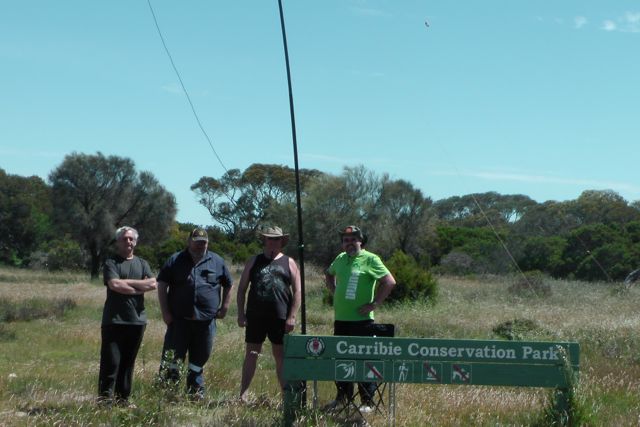
My second activation for Saturday 19th October, 2013 was the Carribie Conservation Park which is situated on the Yorke Peninsula, about 281 km from Adelaide, and just north of the little settlement of White Hut.

Fishing-Trips-South-Australia copy

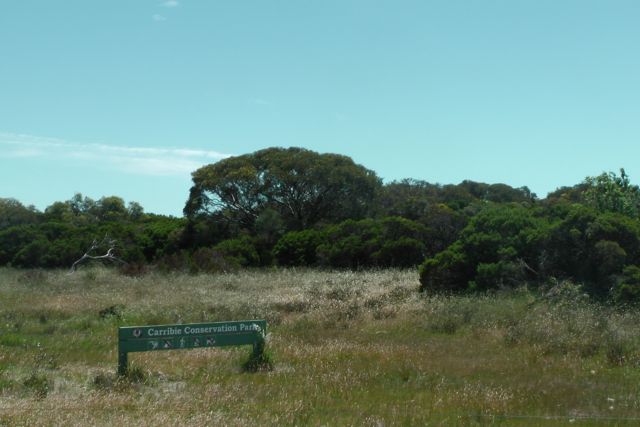
I accessed the Park via Gleesons Road, which runs off the eastern side of the Marion Bay Road. There is no public access road for vehicles into the park itself, so I simply climbed the fence to get into the park.  Carribie CP is a small park, with no visitor facilities.  It consists of 19.5 hectares of remnant sheoak and mallee, and is surrounded by farm land.  The Park was constituted by statue in 1972.

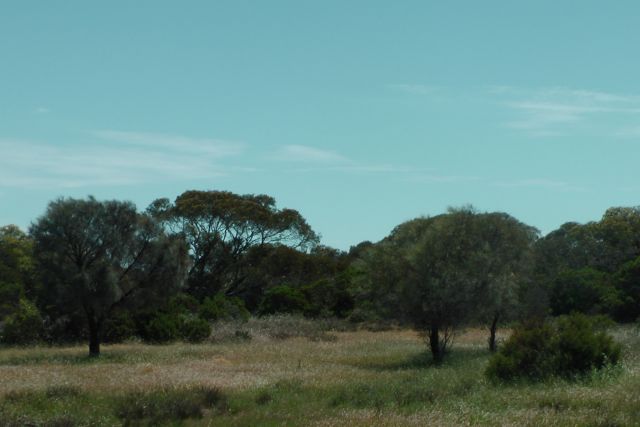
The vegetation of Carribie Conservation Park comprises open scrub dominated by Coastal White Mallee and Red Mallee with an understorey that includes species of Calytrix, Acacia and Correa.   Some sections of the park contain Drooping Sheoak woodland. There are 81 native plant species recorded from this park, though the only known species of conservation significance is the Western Daddy-long-legs.

   IMGA0053     IMGA0054

Because the park is located about 7 km inland from the ocean, it was much hotter here than at Leven Beach Conservation Park on the coast.  And to make things worse there was no shade, and the bush flies were absolutely out in force. I could have gone deeper into the park to possibly get some shade, but I wasnt keen to do this as it was a hot day and I figured the goannas and snakes would have been enjoying the sunshine.  And they would probably have enjoyed even more, having a chomp on my lilly white legs.

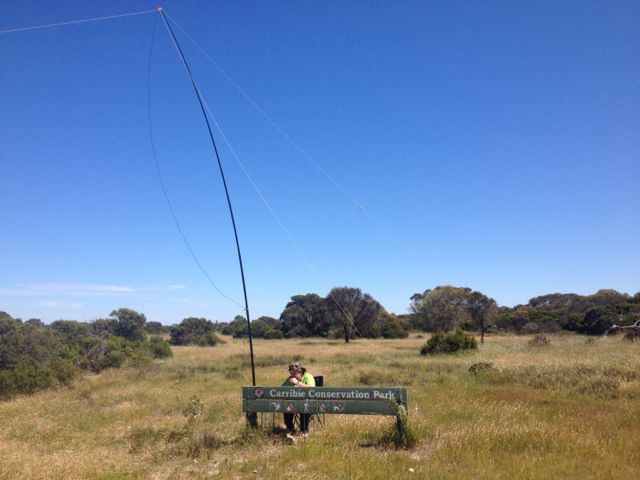
So I set up my deck chair and foldable table in a cleared area on the southern side of the park.  I used the wooden permapine post park sign to secure the 7 m squid pole, and then ran out the legs of the dipole, using some rocks to hold them down in place

IMG_0615

As was the case at Leven Beach CP, my first contact in Carribie CP, was John VK5BJE who had a beautiful strong signal.  This was followed by John VK5FTCT, and then dedicated Park Hunters Colin VK3UBY and his wife Sandra VK3LSC.

I managed one Park to Park contact whilst in Carribie, and that was with Larry VK5LY, who was portable in the Caroona Creek Conservation Park, in the mid north of S.A. with his dedicated wife Di.  Larry and I exchanged 5/9 signal reports.

Another enjoyable QSO was with Tom, VK5FTRG.  I had met Tom in September, when I travelled down to Mount Gambier to deliver a presentation to the South East Radio Group on SOTA & the VK5 Parks Award.  At that time Tom was patiently awaiting his Foundation call yo come through.  So ti was a pleasure to speak with Tom with his new call of VK5FTRG.  Congratulations Tom.

Sadly conditions on 40m SSB were quite poor, and there was quite a bit of activity from the Jamboree on the Air (JOTA) stations, so finding a clear frequency with a little QRP signal was a little difficult.

Whilst I was operating in the Park, I was visited by one of the locals, Colin, VK5FCJM, and also two other fellas who were staying on an adjacent property.  They were not all that familiar with amateur radio, so I showed them the set up and explained all about the hobby.

IMGA0052

I worked the following stations on 40m SSB, in about 45 minutes in the park:-

John VK5BJE; John VK5FTCT; Colin VK3UBY; Sandra VK3LSC; Peter VK3PF; Larry VK5LY/p (Park to Park); Tim VK5AV; Tom VK5FTRG; David VK5KC; and Ian VK5CZ.

Here is a short video of the activation which I have placed on You Tube…..
Leven Beach Conservation Park

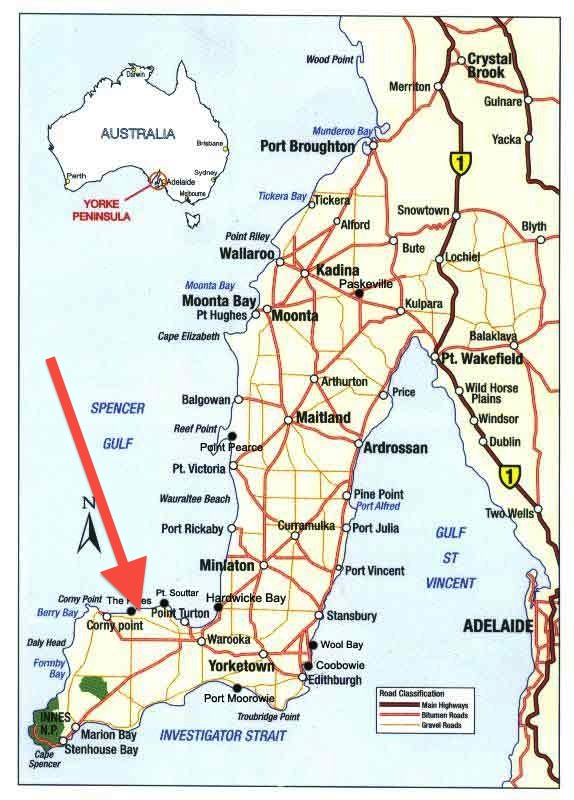
On Saturday 19th & Sunday 20th October, we celebrated the 6 month anniversary of the VK5 National and Conservation Parks Award.  In its short history the award has proved to be very popular with both Activators and Hunters.  To celebrate the special activity weekend, I headed over to the Yorke Peninsula, with my wife Marija.  We stayed at the Corny Point Caravan Park on Friday and Saturday night, and activated 8 parks over the weekend

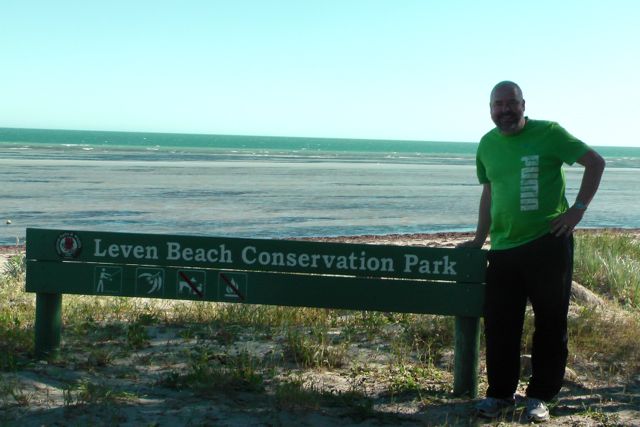
My first activation was on Saturday morning, and was the Leven Beach Conservation Park, which is located close to the little coastal town of Corny Point, on the Yorke Peninsula, about 265 km by road from Adelaide.

Yorke Peninsula comprises a total area of approximately 4,265 square kilometres, which is contained within about 560 kilometres of coastline extending 240 kilometres from north to south. The surface topography is gently undulating, with an average elevation about 90 metres above sea level.  Yorke Peninsula was named by Captain Matthew Flinders after the Right Honourable Charles Philip Yorke, narrowly beating French navigator Captain Nicholas Baudin who preferred the name ‘Cambaceres Peninsula’.

It is interesting how Corny Point was named.  It was named this by Matthew Flinders in March 1802 because it appeared to be a growth on the toe of Yorke Peninsula.

Fishing-Trips-South-Australia copy

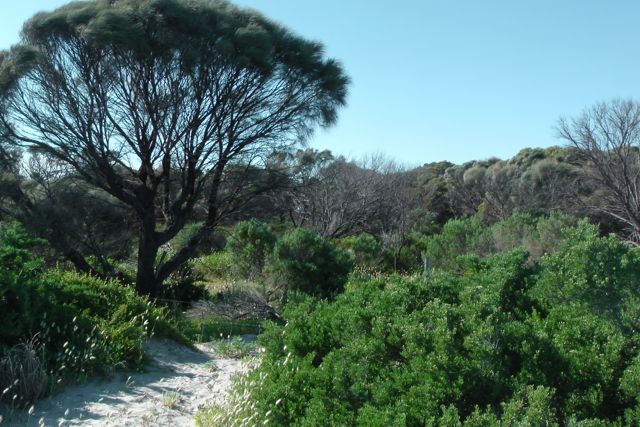
Leven Beach Conservation Park was proclaimed in 1988, and consists of 502 hectares of coastal dune system vegetation.  Over 127 native species of plants have been recorded in park.  There are various plants on the foredune aea including Coast Saltbush and Rolling Spinifex.  Behind the foredune area is a diversity of species which form a low scrubland community with Coast Daisy-bush, Common Boobialla and Sea Box prominent.  Further inland from the coast there are Drooping Sheoak, and Dryland Tea-tree woodlands with an understorey including Coast Daisy-bush and Coast Salt Bush.  The Park has a 6 km beach frontage backed by low cliffs and a hinterland of undulating, vegetated dunes.

    IMGA0035     IMGA0039

The Park provides habitat for a nationally endangered species of butterfly, the Yelow Sedge-skipper Butterfly, which feed on stands of Smooth Cutting-grass.  This grass is required by the larva that feed only on this species of grass.  There are a number of threats to the survivial of butterfly due to issues with the grass including overgrazing by Western Grey kangaroos, chemical drift spray from farming, and the removal of nectar plants.

IMGA0017_2     IMGA0033_2

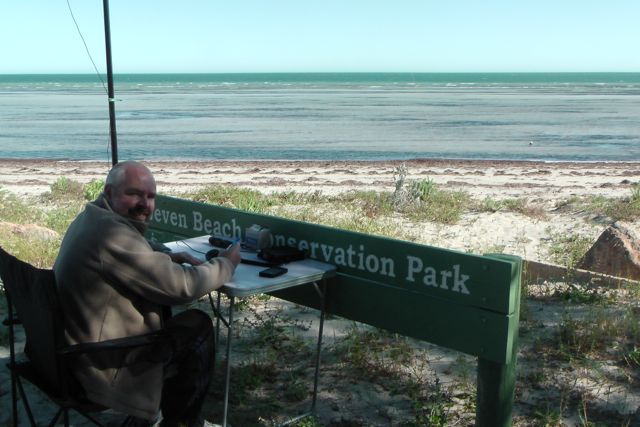
I set up up at the end of Roe Road, near Couch Beach, on the western end of the Park.  There was a convenient car park at the end of Roe Road, and an even more convenient park sign, which I used to secure my 7m squid pole to with some octopus straps.  It was a warm morning (already 28 deg C) with a stiff breeze coming off the ocean, but I managed to get some shade out of the hot sun.  I set up my deck chair and fold up table, and put a call out on 7.095 on 40m, to be greeted by John VK5BJE, my first contact in the park.  This was followed by a good signal from Allen VK3HRA who was setting up for JOTA, Tim VK5AV with a very strong signal from the SE of S.A., and Colin VK3UBY and his wife Sandra VK3LSC from Mildura.  They always have a booming signal coming in from the Sunraysia district.

My 6th contact of the morning was my first Park to Park QSO for the weekend, and this was with Larry VK5LY who was with his wiffe Di, portable in the Red Banks Conservation Park, near Burra in the mid north of S.A.  Larry had a genuine 5/9 signal with 5/9 being returned to me by Larry.  Hats off to you Di, for being another dedicated XYL like Marija.

I then tuned around the band and was really pleased to make contact with David VK5NQP who was portable in the Hale Conservation Park.  This was David’s second attempt at this park, and it was a pleasure to get David in the log with a Park to Park contact.  Although a bit low (5/3), David was perfectly readable, and was using a Yaesu FT-707 and a squid pole.

IMGA0040

Conditions on 40m seemed to be very poor, particularly into the eastern states.  Even the interstatge Jamboree on the Air (JOTA) stations were well down.  But it is certainly all about antenna, even if conditions are down.  Colin VK3UBY was his normal very strong 5/9 plus signal coming in from Mildura, with 5/9 being returned.  After 45 minutes in the park I had worked a total of ‘unlucky 13’ on 40m SSB.  It was time to move on to Carribie Conservation Park.

I worked the following stations:-

John VK5BJE; Allen VK3HRA; Tim VK5AV; Colin VK3UBY; Sandra VK3LSC; Larry VK5LY/p (Park to Park); VK3SAW (JOTA station in the Grampians NP); David VK5NQP/p (Park to Park); Graham VK5KGP; Peter VK3PF; Ian VK5CZ; Shaun VK5FAKV; and Brian VK5FMID.

Marija took some video of the activation.  I have added a short video to You Tube which can be found at…..
Yulti Conservation Park

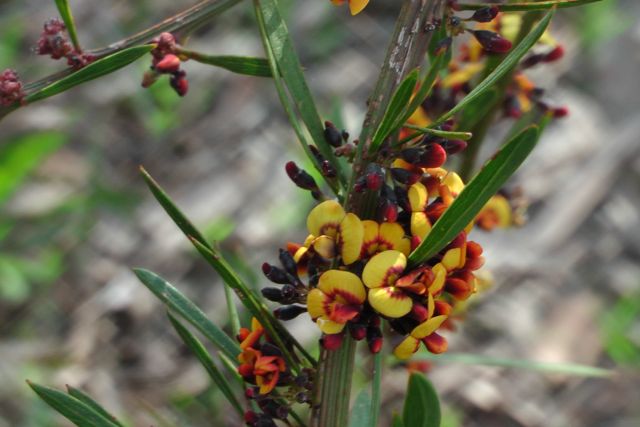
My last activation of the day was the Yulti Conservation Park, which is located about 3 km south east of the town of Myponga.
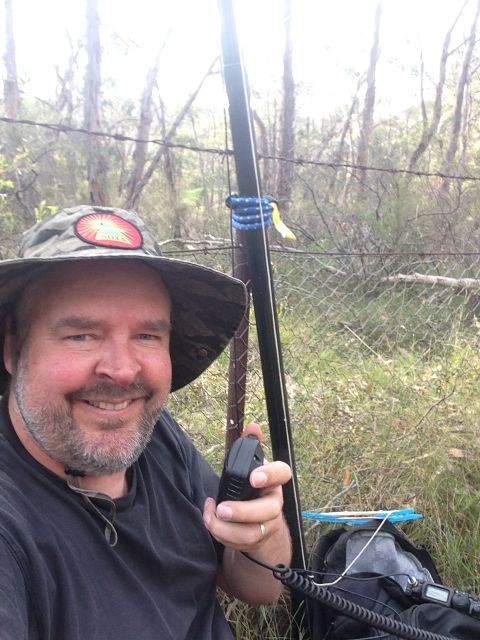
After my activation at Nixon Skinner CP, I drove back into Myponga, and then along James Track and onto Springmount Road, and then onto Trigg Point Road.  But I was really struggling to find access to the park.  My maps showed Cooper Road leading to the southern side of the park.  But in reality, the spot where Cooper Road was showing on the GPS was a farmer’s paddock.  Fortunately when I doubled back to that location, a farmer came along in his tractor, and I had a chat with him.  He was a sharefarmer with not much local knowledge, so I obtained his boss’s phone number and I called him.  After some friendly help and directions, I travelled back towards Myponga along James Track, and I then turned right into Yulte Road.  Yulte Road will take you up to the park entrance which is part of the Heysen trail.

IMGA0087

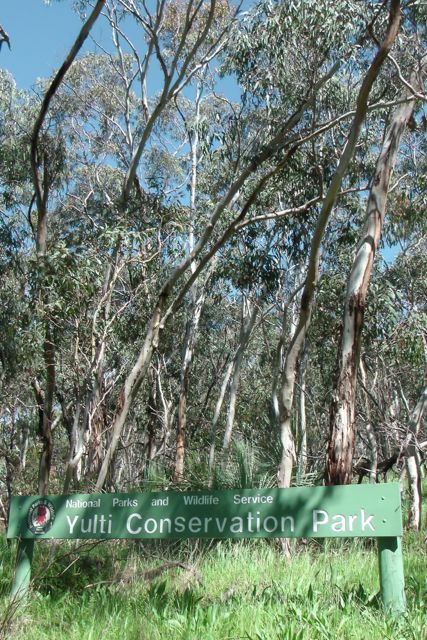
Yulti Conservation Park is 41 hectares in size and is a small preserve of habitat representative of the central Fleurieu Peninsula.  The park consists of steep, hilly terrain vegetated with open forest of Eucalyptus Baxteri and other vegetation in the valleys.  There is also scrub / heath on the ridges and the understorey is typically a dense heath dominated by various plants including the Casuarina species, with Banksia Ornata confined to the ridges.  Panoramic views of the surrounding valley and range country can be seen from the high sections of the walk following a section of the Heysen Trail.

Yulti Conservation Park is recorded in various sources with various spellings.  Even the Government authorities seem unsure of the spelling.  The DEWNR website records the spelling as Yulte, and yet the sign in the park shows the spelling to be Yulti.  The road leading to the park is spelt as Yulte.  Unfortunately I have not been able to find out the meaning of Yulte or Yulti.

IMGA0091     IMGA0100

The track leading up to the park was quite rough with plenty of large rocks and numerous washaways, so I drove as far as I could, and then I walked the remainder of the way.  Fortunately only a short distance of about 100 metres.

Numerous bird species are found in the park including the Beautiful Firetail finch which has a rump of bright red.  My father used to breed these when I was a child.  Western Grey Kangaroos are also common in the park.

I strapped the 7 metre squid pole to a Heysen trail sign and ran out the legs of the 40m/20m linked dipole.  I made myself comfortable and tuned to 7.100 and there was my faithful ‘Hunter’, Col VK5HCF waiting for me.  This was followed by another staunch VK5 Parks supporter, Larry VK5LY.  My third contact was with Tim VK5AV, who has also become a recent active Parks Hunter.  Colin VK3UBY and his wife Sandra who are also big supporters of the VK5 Parks Award, also called in to say hello.

IMGA0092

Conditions on 40m were very variable.  And sadly I wasn’t getting a lot of takers, so I tuned across the band and came across Grant VK3HP and a group of gents on 7.095.  This included Peter VK3YE who was operating QRP 2 watts, on a beach in Melbourne (5/3 both ways).

After 45 minutes of operating, I had managed 14 QSO’s on 40m SSB into VK2, VK3, & VK5.

The following stations were worked:-

Col VK5HCF; Larry VK5LY; Tim VK5AV; Allen VK3HRA; Peter VK3PF; Grant VK3HP; Ian VK3VIN; Peter VK3YE/p; Scott VK7NWT; Greg VK2FGJW/p; Colin VK3UBY; Sandra VK3LSC; Frank VK3GFS; and Ron VK5MRE.

Nixon Skinner Conservation Park

My next activation of the day was the Nixon Skinner Conservation Park, which is situated about 5 km south of Myponga, on the Fleurieu Peninsula, and about 60 km south of Adelaide.

From Stipiturus CP, I travelled along Pages Flat Road, and into the beautiful little town of Myponga which is the hub of lush grazing and dairy country.  The name derived from the Aboriginal word maippunga meaning locality of high cliffs.  Myponga was the venue for the first Australian performance by leading British heavy rock group Black Sabbath during the Myponga Music festival in 1971.  Prior to this festival the town’s leading claim to fame was the 1953 discovery of a uranium ore deposit at Wild Dog Hill.  Myponga is also the home of the Smiling Samoyed Brewery which is a small unique brewery.  As I drove passed the brewery it was very tempting to drop in.  The day was warm, about 30 deg C, so a schooner of ale would have been nice.  But I travelled south out of Myponga along Main South Road for about 5 km until I reached Nixon Skinner CP, which is on the western side of the road.

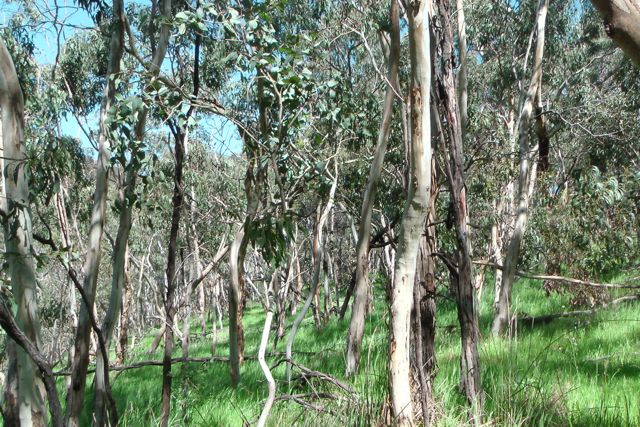
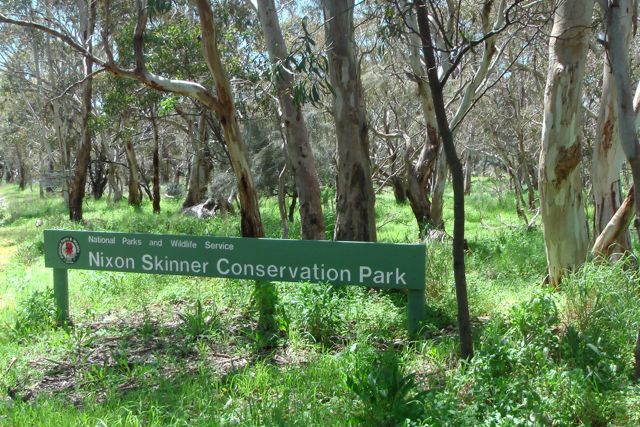
The Nixon Skinner CP comprises of 8 hectares of native vegetation, and is situated towards the southern end of the Myponga Reservoir.  The park is set off the road, so the sign is only visible once you take a small access road off the western side of Main South Road.

IMGA0052     IMGA0064

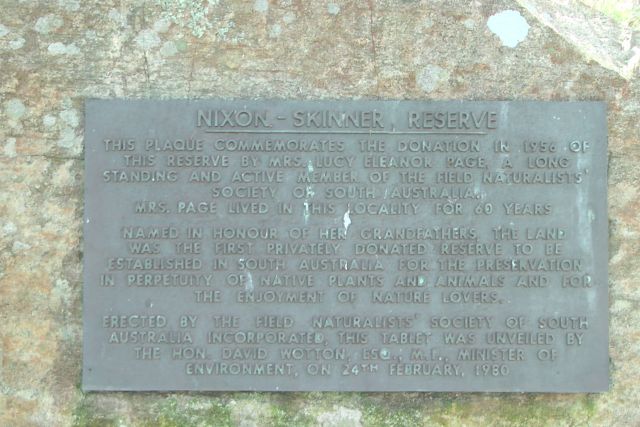
In 1956 Mrs. Lucy Eleanor Page, a long standing and active member of the Field Naturalists Society of South Australia, donated the land.  The park was named in honour of her grandfathers and was the first privately donated reserve to be established in South Australia for the preservation in perpetuity of native plants and animals and for the enjoyment of nature lovers.

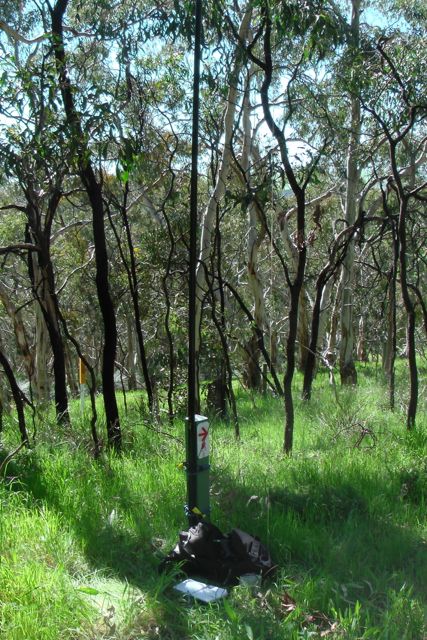
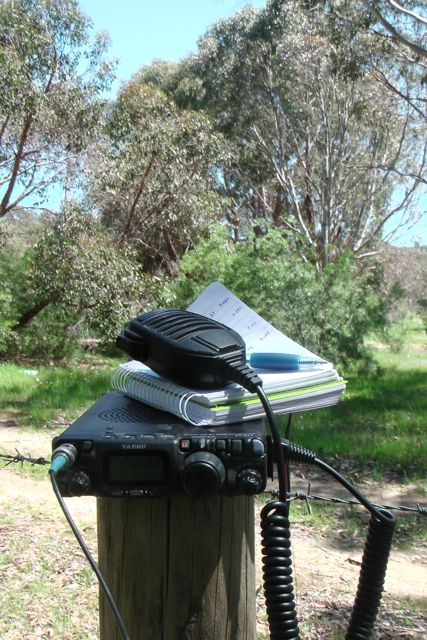
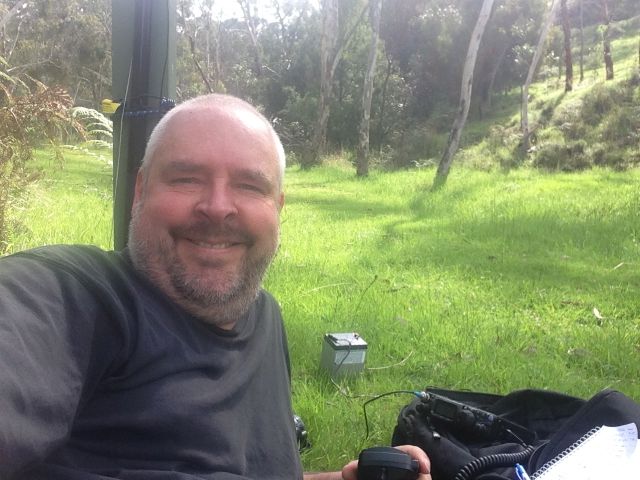
I set up about 20 metres inside the park boundary, and used the western boundary fence to secure the squid pole.  I placed the Yaesu FT-817nd up on top of a nearby permapine post and tuned to 40m.  My first contact was with Col VK5HCF who is a staunch supporter of the VK5 Parks Award.

IMGA0056      IMGA0061

During my time in the park I worked two more SOTA stations.  The first was Tony VK3CAT who was portable on Talbot Peak, VK3/ VT-010.  And my second QSO was with Glenn VK3YY who was portable on Mount Useful, VK3/ VT-016.

After the activation, I went for a walk through the park and enjoyed the picturesque views of the Myponga Reservoir, which is fed by the Myponga River and other rivers in the Myponga Catchment Area.  It provides about 5 % of Adelaide’s water supply and is the main source of filtered water for southern metropolitan Adelaide and the south coast area.  There is a nice bitumised track to walk along from Main South Road, down to the reservoir.

  IMGA0059        IMGA0068

IMGA0069         IMGA0078

After an hour in the park I had 16 contacts in the log from VK1, VK3 & VK5 on 40m SSB.

The following stations were worked:-

Col VK5HCF; Tony VK3CAT/p (SOTA); Glenn VK3YY/p (SOTA); Larry VK5LY; Tim VK5AV; ALlen VK3HRA; Peter VK3PF; David VK5NQP; Ian VK5IS; Bernard VK3AMB; Greg VK3HBM; Peter VK3TKK; Duncan VK3XBC/1; Ben VK3FTRC; Barry VK3BJM/m; and Barry VK5BW.

Stipiturus Conservation Park

On Saturday morning 13th October, 2013, I headed out to activate 3 parks on the Fleurieu Peninsula, south of Adelaide.  The next day on Sunday I had a commitment at the Port Elliot show with an amateur radio display, so I booked in overnight at the Middleton Caravan Park so I didn’t have to journey back home to the Adelaide Hills.

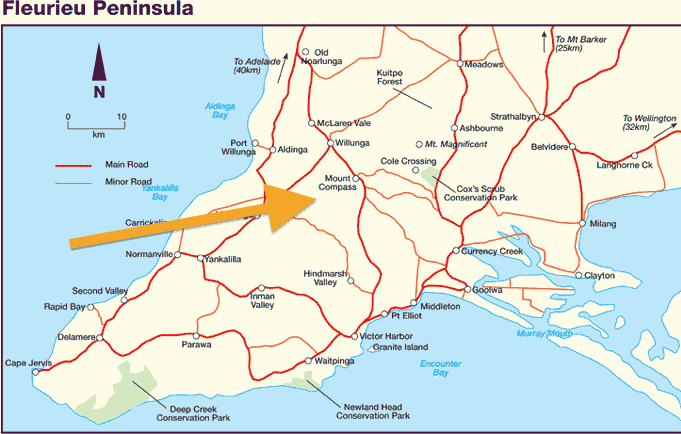
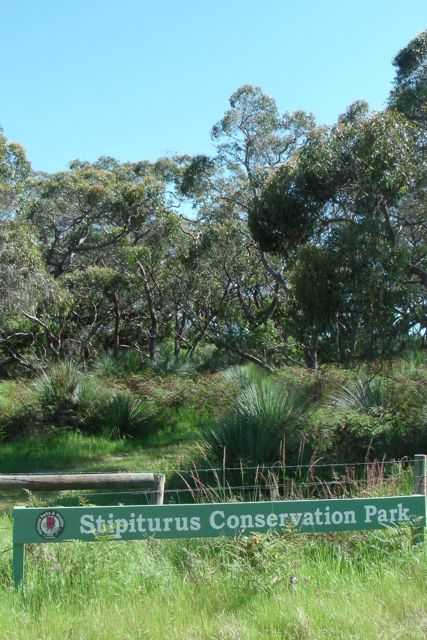
My first activation was the Stipiturus Conservation Park which consists of 68.13 hectares and is situated about 50 kilometres south of Adelaide and six kilometres west-south-west of the nearest town, Mount Compass.

Stipiturus

Purchased with support funding from the Natural Heritage Trust and Nature Foundation Inc, the park was proclaimed on 14 December 2006 under the National Parks and Wildlife Act 1972, without access under State mining legislation.

IMGA0019

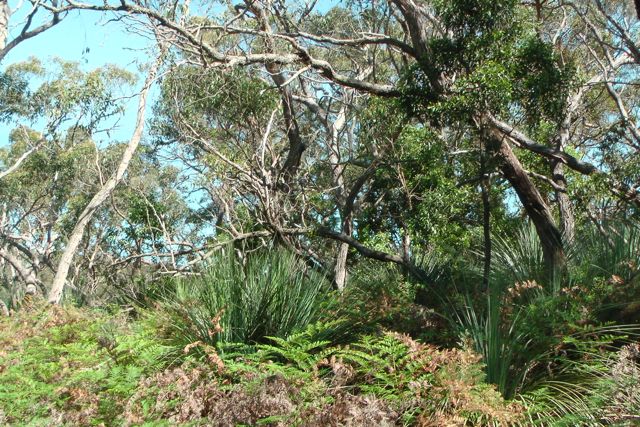
Stipiturus Conservation Park protects a high conservation value wet heath/sedgeland peat bog ecosystem, known as Glenshera Swamp (the largest remaining peat swamp on the Fleurieu Peninsula), with over 64% of native plants in and around the swamp having regional and/or state conservation ratings.  The park contributes to the conservation of the first registered nationally threatened ecosystem found solely in South Australia, the ‘Swamps of the Fleurieu Peninsula’, and is home to one of the largest known swamp-based population of the nationally endangered Mount Lofty Ranges Southern Emu-wren (Stipiturus malachurus intermedius), after which the park was named.

  IMGA0029     IMGA0022

Less than one percent of the permanent wetlands of the Mount Lofty Ranges still remain.  These wetlands once covered much of the Myponga and Mt Compass area, but are now cleared and drained for grazing.  Hence, in 2003 the swamps of the Fleurieu Peninsula were listed by the Australian Government as a critically endangered ecological community under the Environment Protection and Biodiversity Conservation Act 1999.

Stipiturus Conservation Park protects the largest remaining intact peat swamp ecosystem on the Fleurieu Peninsula, which provides habitat for the largest swamp-based population of the nationally endangered Mount Lofty Ranges Southern Emu-wren (Stipiturus malachurus intermedius).

Over 65 species of birds have been recorded in the park, four of which are of conservation significance, including the Mount Lofty Ranges Southern Emu-wren.  These are a little insectivorous bird which are relatively poor fliers that tend to hop, flutter, and scramble their way through their habitat.  At least two native mammals inhabit the park including the Southern Brown Bandicoot and the Western Grey Kangaroo.

I drove from home out through Echunga and Meadows and then along the Brookman Road towards Willunga.  I then took Pages Flat Road heading towards Myponga, and turned left into Apple Grove Road and then Saffrons Road.  I accessed the park on its southern side, off Saffrons Road.  The park is well sign posted with a locked gate.

IMGA0023

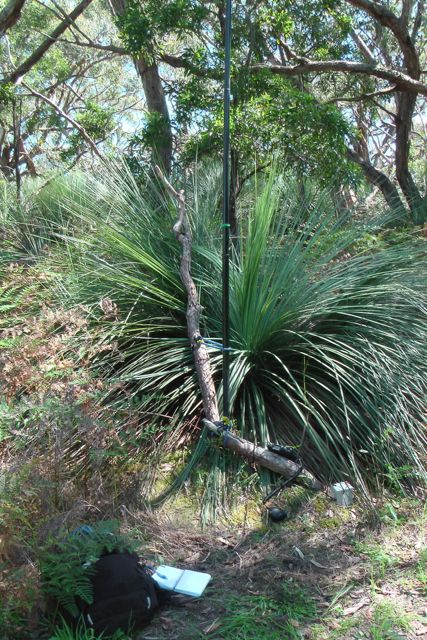
There is a track leading through the scrub down to the swamp area.  The track in parts conveniently runs north – south, so I decided that was the spot where I would set up.  Certainly the scrub was way too thick to extend the squid pole and it was a warm day and I did not fancy sitting in amongst the scrub with the ‘Joe Blakes’ (snakes).  During the morning my only unwelcome visitors fortunately were some very big ants.  I used a fallen gum tree limb to secure the squid pole with some octopus straps.

IMGA0033

Although I didn’t see any of the little Southern Emu wrens, I did see a variety of other birds including Superb Blue Wrens, Red Wattlebirds, and Adelaide Rosellas.

My first QSO in the park was with Ben VK3FTRV who was running just 5 watts (5/4 both ways).  This was followed by Terry VK3UP who was portable at Lorne and running just 4.5 watts (5/3 both ways).  I managed three Summits on the Air (SOTA) contacts whilst in the park.  The first SOTA contact was with Glenn VK3YY who was portable on Mount Selma, VK3/ VT-013.  I then spoke with Ed VK2JI who was portable on Mount Elliot VK2/ HU-093.  And my third SOTA contact was with Mark VK3PI who was portable on Mount St Leonard, VK3/ VC-006.

Conditions on 40m SSB were not all that great, but after an hour of sitting in the park I had 15 contacts in the notebook from VK2, VK3, & VK5.

The following stations were worked:-

Ben VK3FTRV/qrp; Terry VK3UP/qrp; Ron VK3AFW; Tim VK5AV; Nick VK3ANL; Glenn VK3YY/p (SOTA); Peter VK3PF/qrp; Ed VK2JI/p (SOTA); Fred VK3JM; Col VK5HCF; Peter VK3ZPF; Allen VK3HRA; Shaun VK5FAKV; Larry VK5LY; Mark VK3PI/p (SOTA).

Mylor Conservation Park

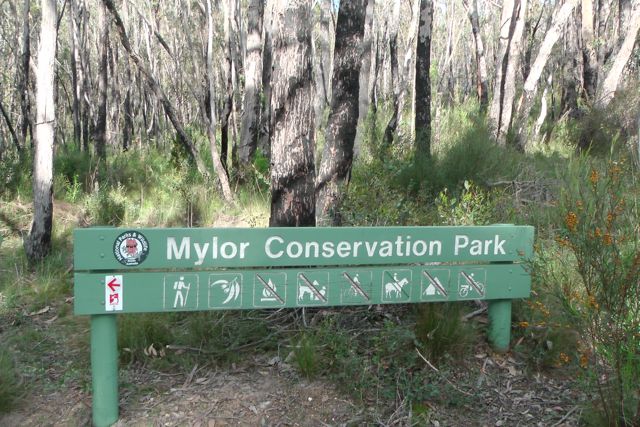
My 2nd activation on Sunday 29th September, 2013, was the Mylor Conservation Park, which was just a short 10 minute drive from Scott Creek.

Mylor Conservation Park is situated in the Southern Mount Lofty Ranges ‘Adelaide Hills’, about 15 km south east of Adelaide.  The park consists of 49 hectares of remnant bushland.  Much of the region surrounding Mylor Conservation Park has been largely cleared for residential and agricultural purposes.  The park forms part of a mosaic of remnant bushland areas in the district which are linked by vegetation corridors on both public and private land.

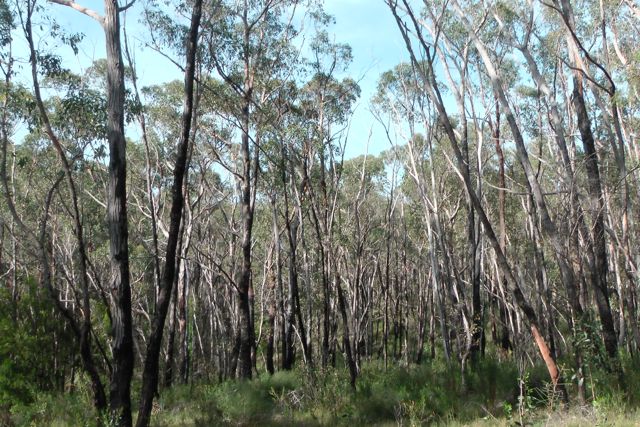
The park is covered by open forest with a canopy dominated by Messmate Stringybark and Brown Stringybark, associated with a shrubby under storey.  The park has abundant wildflowers in spring and many of the native plants were also out in flower.  The Onkaparinga River flows just to the east of the park boundary.

IMGA0032      IMGA0034

The park is used for a number of outdoor recreational activities, such as bushwalking or horse riding through the open woodland.  A section of the Heysen Trail runs through the park.

Numerous bird species inhabit the area, including the endangered Yellow tailed Black Cockatoo, Purple-crowned Lorikeet, Superb Fairy-wren, and Red-browned finch.  A large number of native animals call the park home including Western Grey kangaroos, echidnas, and the deadly Eastern brown snake.  Because it was such a warm day, I was ever vigilant of snakes.  Fortunately none were encountered !

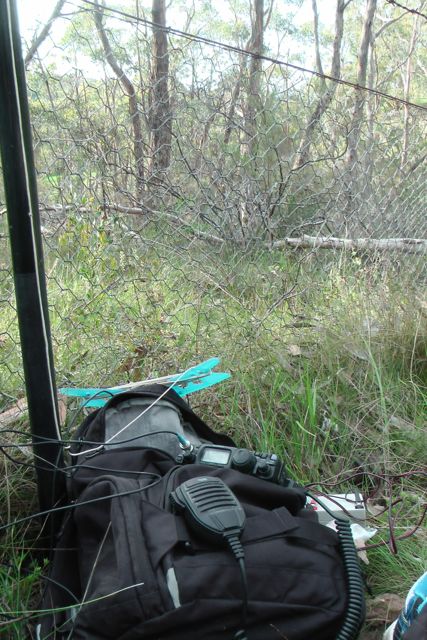
I accessed the park via Whitehead Road, just off Strathalbyn Road (the main street of the quaint little town of Mylor).  The town was proclaimed in 1891 by Acting Governor of South Australia, Sir James Boucaut, who named it after his Cornish birthplace.  Towards the end of the Whitehead Road there is a small parking area.  From here I walked into the park and set up my gear, using the north western park boundary fence to secure my squid pole with some octopus straps.  The chickenwire fence also made a nice back rest.  Fortunately the track heading north at this point made a good clearing for me to string out the legs of the dipole so the antenna was radiating east-west.  I found a comfy spot up against the fence, in the shade from the hot sun (it was about 28 deg C).

IMGA0038      IMGA0041

After turning the radio on I was pleasantly surprised to hear that the noise floor was nice and low.  A lot better than Scott Creek Conservation Park.  However there was a lot of RTTY QRM due to the RTTY contest.  Again I tuned to 7.100 and again there was Brian VK5FMID, patiently waiting for me.  This was followed by Peter VK3PF, Dale VK5FSCK, and John VK5FTCT.  And to my pleasure, what followed was a steady flow of callers from VK2, VK3, & VK5.  All with great signals.  I worked a few QRP stations including Andy VK5LA on 5 watts, Ben VK3FTRV on 5 watts, Shaun VK3VLY on 5 watts, Simon VK5TE on 5 watts, and Andrew VK2UH also using 5 watts.

IMG_3512     IMGA0036

When things slowed down a little, I tuned down to 7.095 and worked Ian VK1DI/2 who was on top of Mt Gillamatong, VK2/ ST-034 in the Southern Tabelands of NSW (5/5 both ways).

I then tuned around the bands and on 7.105 I heard Steve VK2FISN just finishing up a QSO with another VK2.  Steve had tried calling me numerous times on 7.100 but unfortunately he just couldn’t quite hear me well enough.  I called Steve and we were finally able to make a contact.  Perseverance counts !

In a little over an hour, I had 31 stations on 40m SSB in the log.  Time to head home & ‘beer o’clock’ !

The following stations were worked on 40m SSB:-

Brian VK5FMID; Peter VK3PF; Dale VK5FSCK; John VK5FTCT; Allen VK3HRA; Colin VK3UBY; Mal VK3AZZ; Greg VK3HBM; Sandra VK3LSC; ANdy VK5LA/qrp; Tim VK5AV; Nick VK3ANL; Ron VK3AFW; Peter VK2NEO; Ian VK5CZ; Ben VK3FTRV; Bernard VK3AMB; Fred VK3JM; Shaun VK3VLY/qrp; Graham VK5KGP; Shaun VK5FAKV; Rick VK5FGFK; Colin VK5HT; Simon VK5TE; Roy VK5NRG; David VK5KC; Ian VK1DI/2 (SOTA); Steve VK2FISN; Jim VK3AIX; Nev VK5WG; and Andrew VK2UH/qrp.

Thanks everyone.  A fun afternoon in the sun.

Scott Creek Conservation Park

Sunday morning, 29th September, 2013, started off as quite a gloomy morning, but by lunchtime, after a morning of gardening, the weather had warmed up and it had turned into a beautiful day.  So after some sweet talking the wife, I decided to head out and activate a couple of parks.  My first activation was the Scott Creek Conservation Park.

Adelaide-map

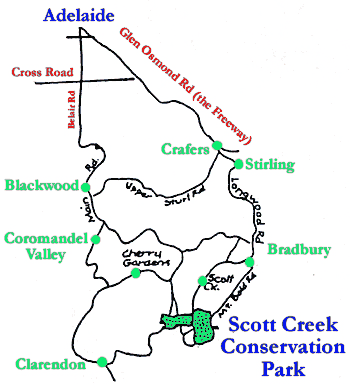
Scott Creek CP is situated about 30 km south of Adelaide, in the Mount Lofty Ranges ‘Adelaide Hills’.  It is about a 30km drive from my house in the Adelaide Hills or only 15 km as the crow flies.  The Park consists of an area of 750 hectares with much of the terrain being hilly and rugged, with steep slopes falling into a number of small creeks, eventually leading into Scott Creek, which flows out of the park and into the Onkaparinga River.  At its highest, which is on its eastern side, the park has an altitude of a little over 400 metres. This drops down to the lowest spot, near where Scott Creek crosses under Dorset Vale Road, which is about 230 metres above sea level.  The land was privately owned until the early 1970s when land was purchased by the South Australian Government, with the park being officially declared in 1985.

 IMGA0030     IMGA0031

The Park is home to many threatened species of the Mount Lofty Ranges.  A large variety of native marsupials inhabit the park including the Southern Brown Bandicoot, Western Grey kangaroo, Koala, Yellow footed Antechinus, Common Ringtail Possum, Common Brush tailed possum, and Short-beaked echidna.  Over 132 species of bird have been recorded in the park, including Wedge Tailed eagles, Rainbow Lorikeets, Crimson Rosellas, Rainbow Bee Eaters, Superb Fairywrens, and the endangered Beautiful Firetail and Chestnut-rumped Heathwren.  There are 6 known species of amphibian in the park including the Brown Tree frog and Eastern Banjo frog.  Six species of bat have also been recorded in the park.

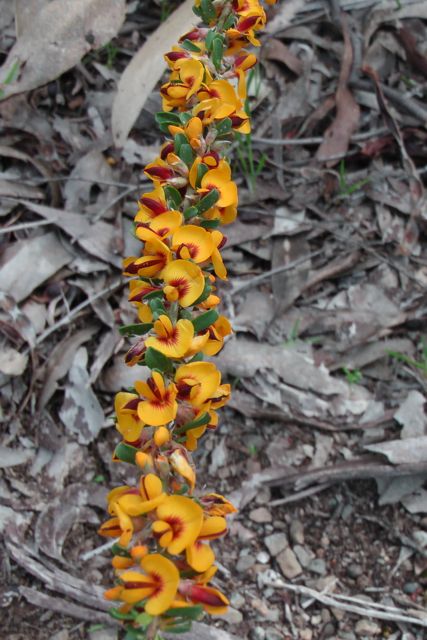
The Park has a large variety of native plants and contains more than 60 species of orchids.  In fact over 465 different indigenous plants have been recorded in the park.  A large number of the natives were flowering during my visit.

IMGA0015      IMGA0016

The Park was once part of a major travelling route for the Peramangk Aboriginal people, through the hills and down to the plains of Adelaide.  In c. 1847, a Mr. Scott brought his flock of sheep into the area, and he pitched a camp near the bottom of the creek, near the Onkaparinga.  Settlers in nearby Cherry Gardens referred to that locality as Scott’s Bottom, and the little stream as Scotts Creek.

It is claimed that in 1850, the wheels of a bullock dray broke off rock fragments which people recognised as copper.  Subsequently, a mine, Wheal Maria, was established and attempts made to mine for copper.  A 30 foot shaft was sunk but it was not immediately productive with quantities of ore being small, so it was abandoned within a few short years.  However, in 1866, some Kapunda shareholders established a company to develop the lode at Scott Creek, and sent ore to the Port Adelaide Smelting Works.  By 1868, the Almanda Silver Mining Association was formed.  At the Almanda Mine at Scott Creek a treatment plant was established, along with boiler houses, and underground flue and Ey’s Tunnel a 60 metre long tunnel named after William Ey.

A ‘SIlver rush’ resulted in a number of mines including the Esmeralda, the Colorado, the Potosi, all of which were short lived.  These three mines were just outside the present day Scott Creek CP boundary.  However, the fourth mine, the Almanda, which was the most significant, was entirely within the current day Park boundaries.

But by 1870 – 1871, mining activtities by the companies had ceased and the population in the Scott Creek area had rapidly declined.  In 1876, a devastating bushfire ripped through the entire area, from Coromandel Valley all the way through to Echunga, and this destroyed anything that remained.

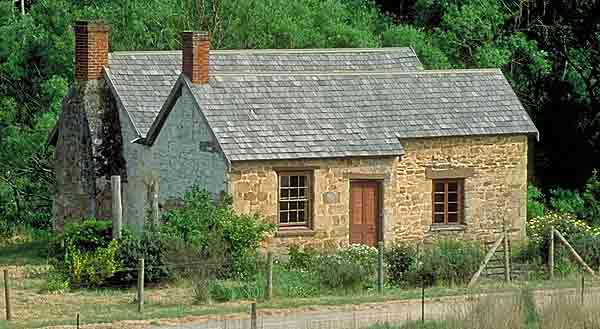
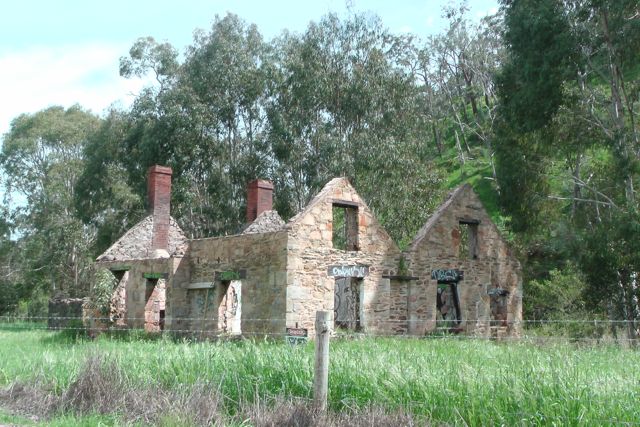
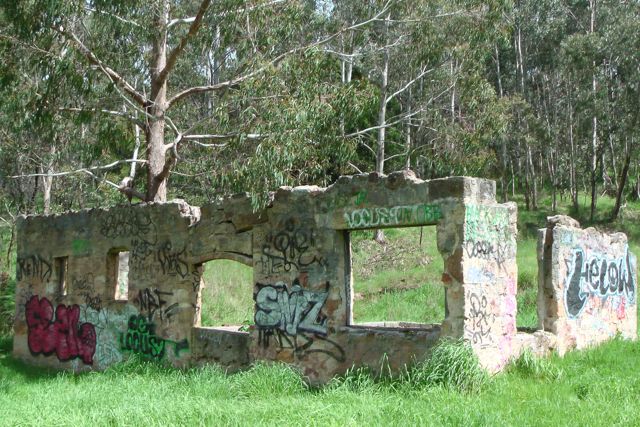
As I drove towards the park, I stopped at Mackereth Cottage which is situated alongside Scott Creek.  The cottage was built in 1839/1840 by George Mackereth, a farmer from Westmoreland in England, who settled in the area with his wife Sarah.  The cottage was continually lived in from 1840 until 1976, when the National Trust took custody of the property from the Engineering & Water Supply (E & WS) and implemented much needed conservation works. For many years it housed a museum and on occasions provided Devonshire Teas on weekend openings to visitors, especially to local hikers and bushwalkers.  In 1984, the National Trust relinquished its interests and the cottage was closed.  It was reverted to the then E & WS Department now known as SA Water.  Sadly it is in a state of disrepair and has been vandalised and is covered in graffiti.  An indictment on our love of history !  Below is a photo of what the cottage did look like, and the terrible condition it is now in.

Cottage

Image c/o http://friendsofscottcreekcp.org.au/

IMGA0004

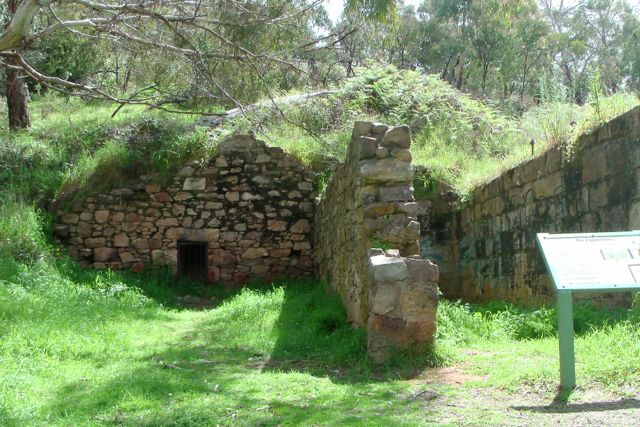
I accessed the park via Scott Creek Road, and set up at the old Almanda Mine area.  There are interesting ruins from the old silver mine here to explore with interpretive signs.  It is quite interesting to stroll around.  There is an old engine house, stone chimney, the mine office, a dairy and several mining shafts.  Sadly, the old buildings have been vandalised with graffiti.  This was not here when I last visited the park a number of years ago, and it is a real shame that people resort to this type of behaviour.  There is a ‘Friends of Scott Creek’ group, but I am not sure how active they are.  And maybe they have previously removed the graffiti, but the vandals keep coming back ?  Either way, it is a real shame.

IMGA0010      IMGA0012

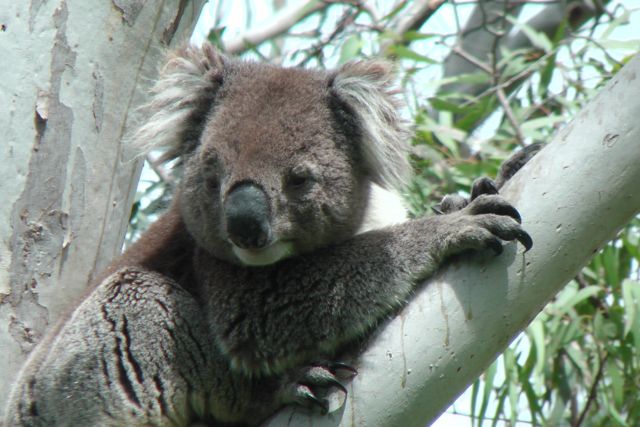
The old mining area was the perfect spot to set up.  It consisted of a large cleared grassy area with a large number of trees offering shade, and importantly a way to tie off the ends of the dipole.  So I started to set up my equipment, under the watchful eye of a koala who was in one of the gum trees just above me.

I secured the squid pole to a walking trail sign and turned on the FT-817nd, eagerly wanting to activate the park.  But to my horror when switching on the radio there was a noise floor of S8 noise.  It pays to look up…..not far away were power lines !  So I pulled down the antenna and walked about 100 metres further to the south and set up the gear again.  This time the noise floor had dropped dramatically but was still there at S2-3.

IMGA0021      IMGA0025

I was a bit hesitant as to how I was going to go with contacts.  The noise floor was a bit high for my liking, and conditions earlier in the day at home into VK3 had been very poor.  Prior to leaving I had heard a lot of the interstate SOTA activators, and their signals were way down compared to normal.  So with some degree of uncertainty, I put a call out on 7.100 and was immediately greeted by the first keen ‘Hunter’, Brian VK5FMID, who is a staunch supporter of the Award.  Ian VK5CZ followed with a very strong signal, Peter VK5PET, and Tim VK5AV.  This was followed by a steady flow of callers which was really pleasing.

IMG_3511

In a little less than 60 minutes, I worked a total of 17 stations on 40m SSB in VK2, VK3, & VK5.  It was time to pack up and head off to Mylor Conservation Park.

The following stations were worked:-

Brian, VK5FMID; Ian VK5CZ; Peter VK5PET; Tim VK5AV; Colin VK3UBY; Andy VK5AKH; Sandra VK3LSC; Fred VK3JM; John VK5FTCT; Roy VK5NRG; Bill VK3HGW; Nick VK3ANL; Ivan VK5QV; Shaun VK5FAKV; Peter VK3PF; Peter VKNEO; & Dale VK5FSCK.

Billiatt Conservation Park

After a very enjoyable 2 nights in Renmark it was time to head home.  I had ‘strict instructions’ that I was allowed to operate from one park on the way home.  So we headed south out through Berri, and on to Loxton.  And then along the Karoona Highway to the little town of Alawoona.  We continued south from Alawoona on the Alawoona-Lameroo Road, which disects the Billiatt Conservation Park.

The park, which is about 18 km south of Alawoona, is 593 km 2 in size and consists of sand dunes and mallee scrub.  The ecological value of the area was first formally recognised in 1940, when the Billiatt and Peebinga flora and fauna reserves were dedicated.  Following the acquisition of additional land in 1979, Billiatt Conservation Park was formally proclaimed under the National Parks and Wildlife Act, 1972.

More recently, the majority of Billiatt Conservation Park was recommended for protection under the Wilderness Protection Act,1992, following formal assessment by the South Australian Wilderness Advisory Committee.  The Billiatt Wilderness Protection Area was subsequently proclaimed in 2008, with a small area remaining as Billiatt Conservation Park.

Although left largely uncleared, some attempts at farming the land within the reserves were made between the 1870s and 1930s.  Some relics of earlier pastoral activity still exist, including old wells, bores and ruins.  The Pankina Well and ruins in Billiatt Wilderness Protection Area are remnants of Pankina Station, a pastoral lease which existed over the land until 1979.  A small area of vegetation was cleared as part of this development for sheep grazing, but is now naturally regenerating.  A trigonometric point also exists in the southern section of the wilderness protection area.

IMGA0108     IMGA0097

The Park is home to a total of 93 different native mammals including the Common Dunnart, Mitchell’s Hopping Mouse, Western Grey kangaroo, and the rare Western Pygmy possum.  About 18 species of reptile are also found in the Park.  The Park has been identified by BirdLife International as an Important Bird Area due to the fact that it contains small but globally important populations of Malleefowl, Mallee Emu-wren, and Purple-gaped Honeyeaters, as well as the rare Western Whipbird and Red-lored Whistler.

IMGA0107     IMGA0095

My wife Marija and I set up in a little clearing on the western side of the bitumen road, amongst the mallee scrub.  I used the normal equipment…the Yaesu FT-817nd and the 40m/20m linked dipole.  There was no shortage of trees and shrubs here to secure squid poles and the ends of the dipole.  It was a warm day, so I set up the fold up table and deck chair as close as I could to some shade.

     IMGA0096     IMGA0111

My first contact was with Larry VK5LY, and this was followed by Marshall VK3MRG who was operating portable from Yarra Park in Melbourne.  Marshall had a terrific 5/8 signal with his qrp 2.5 watt signal.  My 3rd contact was with David VK5KC who was portable in the Brookfield Conservation Park near Blanchetown.  David and his wife Joy were also on their way home from the Riverland.  It was great to work David, and bag another ‘Park to Park’ QSO.  Ivan, VK5HS was my fourth contact with a booming signal.

I was then called by Andrew VK2ONZ who was operating from the top of Mount Lambie, VK2/ CT-007, in the Central Tablelands of New South Wales.  Andrew’s signal was up and down dramatically.  He sometimes peaked at 5/6 but then totally disappeared on me, despite the noise floor being virtually non existant.

I also managed another SOTA contact, and that was with Kevin VK3KAB who was portable on Bill Head, VK3/ VN-004.

Again it was good to hear from a number of stations operating QRP.  They included Marshall VK3MRG/p, David VK5KC/p, Andrew VK2ONZ/p, Peter VK3PF, Ron VK3AFW, and Col VK5HCF.  All had great signals and were very readable despite the fact that they were running with low power.

I decided to have a quick listen on 20m and I was glad I did.  There were some excellent signals coming in from Europe.  I managed 3 DX contacts into Austria, Russia and Italy, with good signal reports given for my little 5 watt signal.

The afternoon was getting on, and we still had a 2 hour drive to get home, so it was time to pack up.  It was the end of a great weekend.  I had a total of 22 QSO’s in the notebook from Billiatt CP, including 1 VK5 Park, 2 SOTA contacts, and 3 DX stations, so I was very happy.

The following stations were worked:-

Larry VK5LY; Marshall VK3MRG/p; David VK5KC/p; Ivan VK5HS; Andrew VK2ONZ/p; Kas VK5ZKT; Tim VK5AV; Andy VK5LA; Graham VK5KGP; Nick VK3ANL; Kevin VK3KAB/p; Matt VK1MA; Roy VK5NRG; Peter VK3PF/qrp; Ron VK3AFW/qrp; Jim VK2TWY; Col VK5HCF/qrp; Rod VK5FTTC; Shaun VK5FAKV; Ivan OE3DIA; Oleg RY3D; Diego and IW2MZX.

I have posted a video of this activation on You Tube.