Clinton Conservation Park VKFF-813

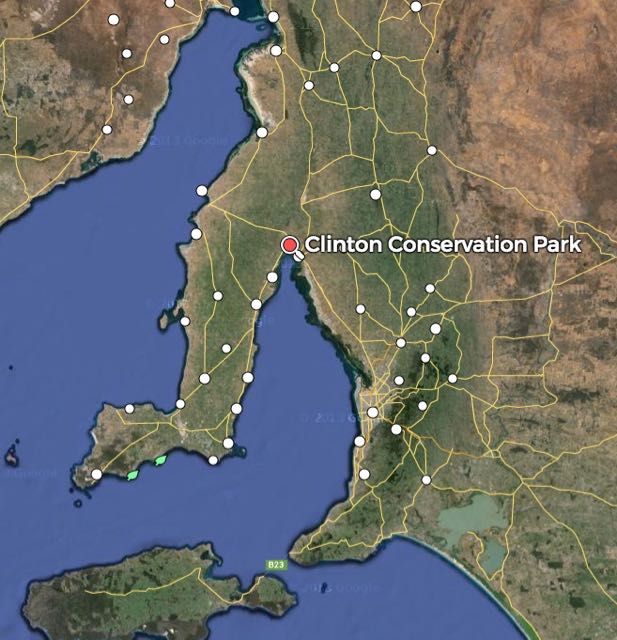
Our first activation for the trip to the north of South Australia, was the Clinton Conservation Park, VKFF-813, which is located about 100 km north of Adelaide.
Screenshot 2015-06-23 21.43.05

Above:- Map showing the location of the park.  Map courtesy of mapcarta.com

I have activated Clinton Conservation Park previously…..back in February 2015, and June 2013.  However, the park was recently added to the World Wide Flora Fauna (WWFF) program, so I was seeking 44 contacts to qualify the park.

https://vk5pas.org/2015/02/08/clinton-conservation-park-2/

https://vk5pas.org/2013/06/09/clinton-conservation-park/

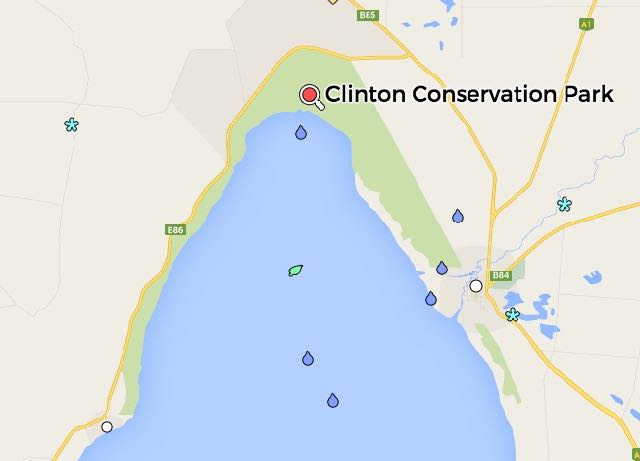
The Clinton Conservation Park was established in 1972, and is 1,923 hectares in size.  It is a boomerang shaped park, which is situated at the northern extremity of Gulf St Vincent.  It stretches around the top of the Gulf from just north of Port Wakefield, around to the little town of Port Clinton on the Yorke Peninsula.  The park comprises an expanse of mainly low-lying, coastal-fringe habitats, with mangroves and samphire communities, and extensive tracts of intertidal mudflats.  It is an important refuge as a fish nursery and a significant site for migratory wading birds.
Screenshot 2015-06-23 21.45.03

Above:- Map showing the park boundaries.  Map courtesy of mapcarta.com

I set up in the same spot as my activation earlier in the year, which is at the end of a dirt track on the western side of the Yorke Highway.  The track continues on from a parking bay off the Highway.

This was a typical park activation for me….I ran the Yaesu FT-857d, 40 watts and the 40m/20m linked dipole supported on the 7 metre squid pole.  The weather was a little inclement.  It was quite chilly and there was the occasional shower.

Prior to calling CQ I tuned around the 40m band and found Julie VK3FOWL and Joe VK3YSP operating on 7.100 from SOTA peak, Mount Hickey, VK3/ VN-015.  Julie and Joe were my first contacts from Clinton and had terrific 5/9 signals coming into the Yorke Peninsula.  I then headed down to 7.095 where I started calling CQ.  Greg VK5GJ at Meadows in the Adelaide Hills was the first responder.  This was followed by Adrian VK5FANA running QRP 5 watts from Arthurton on the Yorke Peninsula, just 50km south of my operating location.  Not surprising that Adrian was a very strong 5/9.  My next caller was from another part of South Australia.  This time the South East, about 600 km away.  It was Alan VK5FAJS with a nice 5/9 signal.

My 10th caller was from the other end of Australia.  It was Rob VK4FFAB north west of Brisbane in Queensland.  Rob was not all that strong (5/3), but he was perfectly readable as there was no man made noise at all on the frequency.

Again, for this activation, it was great to get some QRP callers in the log.  Amanda VK3FQSO called in quite early in the activation running just 500 milliwatts and was a genuine 5/7 signal.  I also spoke with Col VK5HCF at Mount Gambier (5/9 both ways), Ian VK5IS in the Mid North (5/9 both ways), Nick VK3ANL running 5 watts (5/8 sent and 5/9 received), and Bill VK5MBD at Red Hill also running 5 watts (5/9 both ways).

And a number of mobile stations also called me.  They included Terry VK3UP mobile at Buninyong (5/9 both ways), Mark VK5QI mobile on his way to Aztronics to spend some money, Greg VK5ZGY mobile in the South East (5/8 both ways), Tony VK3AN/mobile 5 at Burra in the Mid North, Ron VK3VBI, and Theo VK5MTM.

It was also nice to get Barry VK5BW in the log, operating VK5BAR from the Adelaide Hills Amateur Radio Society (AHARS) shack at Blackwood.  Barry was using the club’s new Anan SDR transceiver.

This slideshow requires JavaScript.

During our activation, we had a car towing a trailer drive down towards us.  A gentleman hopped out and had a close look.  We soon realised that the pidgeon contained pidgeons.  After a short time the fella then hopped in his car and drove off into the nearby parking bay and released dozens of homing pidgeons.  The man then drove off.  Not sure where the pidgeons were headed to?

After working a total of 53 stations on 40m, I lowered the squid pole and removed the links in the dipole, so I could operate on 20m.  I headed up to 14.310 and started calling CQ and this was soon answered by Andrew VK2UH who had a lovely 5/9 signal.  This was followed by Cliff VK2NP, Peter VK3PRF and then Max VK6FN in Manjimup (5/9 sent and 5/7 received).  Chris VK4FR then gave me a shout from Townsville, running just 10 watts (5/6 sent and 5/7 received).  I went on to work a further 9 stations on 20m from VK1, VK2, VK5, VK6, VK7, and VK8.  Great representation from all across Australia, including Greg VK8GM in Alice Springs who was very strong.  I was also competing with a YV5 from Venezuela who was also on the frequency.

Unfortunately time and the weather were conspiring against me, and it was time for Marija and I to get back on the road and continue our journey north.  After an hour and twenty minutes in the park, I had a total of 67 contacts in the log.  I was happy man…I had qualified the park for WWFF.

The following stations were worked on 40m SSB:-

  1. VK3FOWL/p (SOTA VK3/ VN-015)
  2. VK3YSP/p (SOTA VK3/ VN-015)
  3. VK5GJ
  4. VK5FANA
  5. VK5FAJS
  6. VK5JK
  7. VK5FMID
  8. VK3FQSO
  9. VK5HCF
  10. VK4FFAB
  11. VK5IS
  12. VK3ANL
  13. VK5MBD
  14. VK3UP/m
  15. VK5FMJC
  16. VK5NQP
  17. VK3NBV
  18. VK5FD
  19. VK3OF
  20. VK4AAC/5
  21. VK5QI/m
  22. VK2XXM
  23. VK3XPT
  24. VK3CAB
  25. VK5KFB
  26. VK5ZGY/m
  27. VK1NAM
  28. VK3MEG
  29. VK2HV
  30. VK5BAR
  31. VK3PRF
  32. VK3HRA
  33. VK1DI
  34. VK3AN/5
  35. VK1AT
  36. VK5LDM
  37. VK5FLEX
  38. VK5FTRG
  39. VK6FN
  40. VK3VKT
  41. VK5ZAI
  42. VK2NP
  43. VK5TD
  44. VK5LY
  45. VK2IO
  46. VK7MK
  47. VK3VBI/m
  48. VK3VIN
  49. VK2GKA
  50. VK3MAT
  51. VK3PI
  52. VK2NEO
  53. VK5MTM/m

The following stations were worked on 20m SSB:-

  1. VK2UH
  2. VK2NP
  3. VK3PRF
  4. VK6FN
  5. VK4FR
  6. VK2GKA
  7. VK1DI
  8. VK7MK
  9. VK5LG
  10. VK2KTT
  11. VK8GM
  12. VK6BSA
  13. VK1NAM
  14. VK2IO

References.

Department for Environment and Heritage, 2009, ‘Mainland Conservation Parks of Yorke Peninsula’.

Results from our travels to the north of SA

Arrived back home last night from my trip away with Marija, John VK5BJE & Jenny, and David VK5KC & Joy.

Marija and I travelled nearly 2,500 km in 11 days.  We activated 4 Conservation Parks, 3 SOTA summits, and 3 National Parks.  And we also operated as VK100ANZAC at Farina in the Far North on Wednesday & Thursday.  Total of 666 QSO’s (scary hey, the devil’s number).

I also squeezed in a bit of operating from the Argadells property near Quorn, and in the mobile as well.

John and David are still currently away, and I am sure that John will post his results & info on his WordPress site when he returns.

Thanks to everyone that called, and thanks to those who took the time to spot us on parksnpeaks, the DX cluster, here on the group, etc.  For most of the time away we had no phone coverage.

Here are the parks and summits I activated and the total number of QSO’s from each.

Saturday 13th June

Clinton Conservation Park VKFF-813

67 contacts

Winninowie Conservation Park VKFF-820

128 contacts

Monday 15th June

The Devils Peak VK5/ NE-080

18 contacts

Mount Brown Conservation Park

31 contacts

The Dutchmans Stern Conservation Park VKFF-817

47 contacts

Wednesday 17th June

VK100ANZAC at Farina

108 contacts

Thursday 18th June

VK100ANZAC at Farina

57 contacts

Friday 19th June

Gammon Ranges National Park VKFF-189

52 contacts

Mount Scott VK5/ NE-111

28 contacts

Saturday 20th June

Flinders Ranges National Park VKFF-176 (at Aroona Ruins)

43 contacts

Flinders Ranges National Park VKFF-176 (at Wilpena Pound)

29 contacts

Sunday 21st June

Lake Torrens National Park VKFF-278

47 contacts

Monday 22nd June

Mount Arden VK5/ NE-034

11 contacts

He is some quick audio from the WIA Broadcast re our trip…..

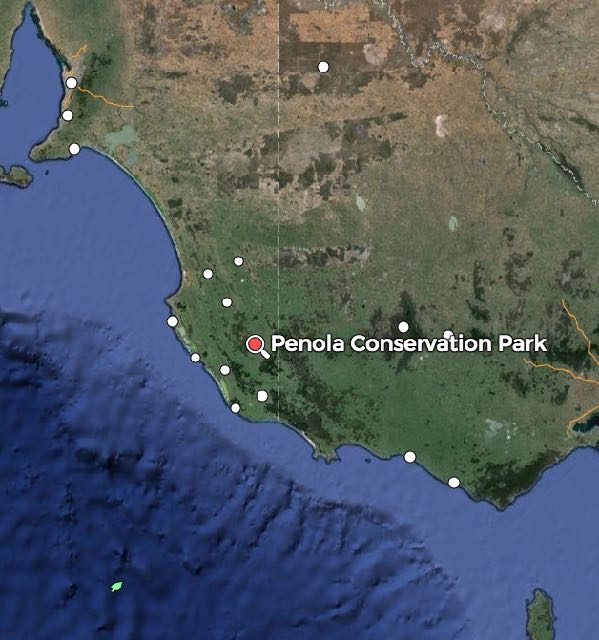
Penola Conservation Park, VKFF-803

My final park for the 6 days was the Penola Conservation Park which is located about 12 km west of Penola on the northern side of the Robe-Penola Road.  This was another unique park for me for both the VK5 National and Conservation Parks Award and the World Wide Flora Fauna (WWFF) program.

Screenshot 2015-06-12 20.28.54

Above:- Map showing the location of the park.  Map courtesy of mapcarta.com

The park was gazetted on the 10th day of September 1970 and covers an area of around 226 hectares.  Vegetation within the park consists of woodland of brown stringybark, river red gums, swamp gum, and rough barked manna gums.  The park contains two large wetland areas including Green Swamp.

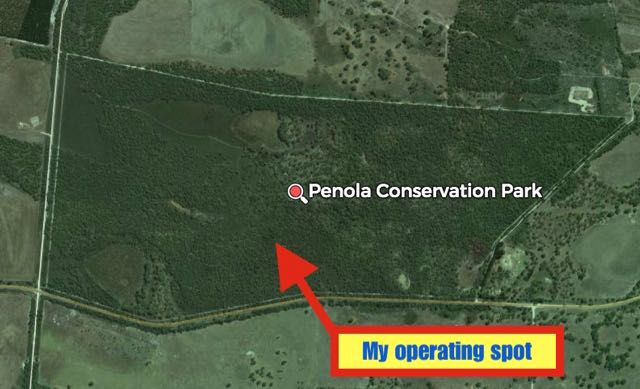
I drove into the park along the main track which leads to a beautiful little campground area.  There was a wooden table and benches here which made a perfect shack.  Again for this activation I ran the Yaesu FT-857d, 40 watts and my 40m/20m linked dipole supported on a 7m telescopic squid pole.

Screenshot 2015-06-12 20.28.19

Above:- Map showing my operating spot.  Map courtesy of mapcarta.com

This time around I started off on 20m.  And I actually found 14.244 free which is quite a rarity.  I started calling CQ and it wasn’t long before this was answered by Brian VK4HBB (5/9 both ways).  Ron VK7VDL from Tasmania followed (again 5/9 both ways), and Tom VK2KF from Kandos then gave me a shout (and again 5/9 both ways).  My next caller was my first DX station for the activation, Al S58AL from Slovenia.  Al spotted me on the DX Cluster and this resulted in quite a few callers from Europe and a handful of VK’s.  Countries worked were VK, Slovenia, Russia, Germany, Italy, Hungary, Germany, Serbia, France, Czech Republic, and Spain.

After working 24 stations on 20m, I decided to check out 40m.  I called CQ on 7.095 and first taker there was Mick Vk3PMG who is a big follower of WWFF as both a Hunter and Activator.  This was followed by another active park Activator & Hunter, Col VK5HCF.  And as per normal, it wasn’t long before a mini pile up commenced.  I went on to work a total of 29 stations here from VK2, VK3, VK4, and VK5.

I then moved back to 20m, and I’m pleased I did.  Because I stumbled across Gerard Vk2IO calling CQ on 14.290 from SOTA peak VK2/ NT-021.  Once I finished working Gerard, Adam VK2YK came up and asked if I could QSY up to 14.310 which I did.  I worked Adam who was a ncie 5/9 signal, and Adam was also kind enough to place me on the DX cluster.  This resulted in a number of calls from both VK and Europe again.  Countries worked this time around were VK, Belgium, Germany, Italy, Spain, Czech Republic, Ukraine, Hungary, and Canada.

This slideshow requires JavaScript.

I was very pleased with the results of this activation with a total of 73 contacts in the log.  This was another unique WWFF park that I had qualified.

The following stations were worked on 20m SSB:-

  1. VK4HBB
  2. VK7VDL
  3. VK2KF
  4. S58AL
  5. RW6AEW
  6. VK2GKA
  7. DF8WZ
  8. I5FLN
  9. DL2ND
  10. IZ2IHO
  11. HA8TI
  12. DF2RR
  13. VK5BJE
  14. HA5MA
  15. YU1AB
  16. F5OUD
  17. S52KM
  18. OK1XP
  19. RA3PCI
  20. F1BLL
  21. DK0EE
  22. EA7TR
  23. VK7ZGK
  24. VK4MJA
  25. VK2IO/p (SOTA VK2/ NT-021)
  26. VK2YK
  27. ON4BB
  28. DL4MDO
  29. VK6HAD
  30. VK4HNS
  31. IK2SAV
  32. EA4DTV
  33. IZ5JMZ
  34. IW2NXI
  35. OK2TS
  36. IK1GPG
  37. UT5PI
  38. I8OCA
  39. VE7CV
  40. DL3NDD
  41. HA6OB
  42. DL5MPO
  43. UR7ET
  44. HA0LG

The following stations were worked on 40m SSB:-

  1. VK3PMG
  2. VK5HCF
  3. VK5GK
  4. VK5HEL
  5. VK5JK
  6. VK2LX
  7. VK3OF
  8. VK5FANA
  9. VK1AT/3
  10. VK3PF/m
  11. VK5FAJS
  12. VK5BJE
  13. VK5MBD
  14. VK3FSMT/2
  15. VK3DBP
  16. VK3AV
  17. VK3ANL
  18. VK4CPS
  19. VK3CAB
  20. VK3TKK
  21. VK5WG
  22. VK2NP
  23. VK2NNN
  24. VK3FJAE
  25. VK3NBL
  26. VK2SK
  27. VK2QS
  28. VK4GSF
  29. VK5FTVR

References.

National Parks and Wildlife Service-Department of Environment and Planning, 1990, Small Parks of the Lower South East Management Plans

Calectasia Conservation Park

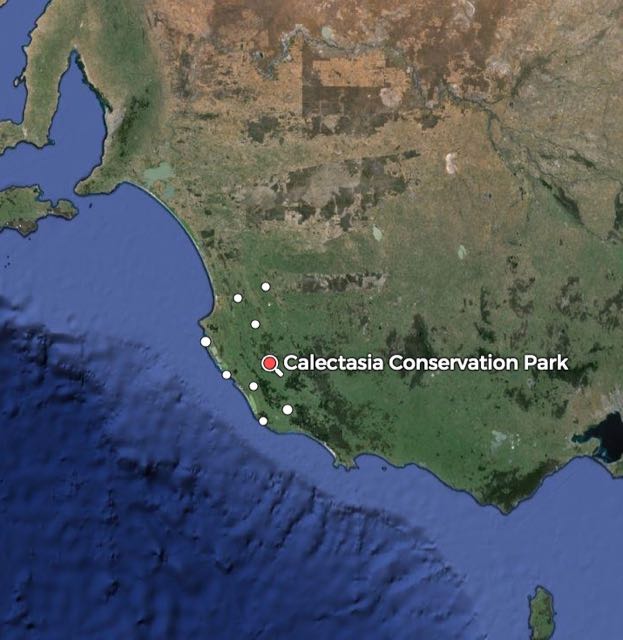
My second park for Tuesday (9th June 2015) was to be another unique VK5 park for me, Calectasia Conservation Park, which is located about 27km west of Penola.

Screenshot 2015-06-12 20.13.42

Above:- Map showing the location of the park.  Map courtesy of mapcarta.com

The park covers an area of just 14 hectares.  It is quite a small park.  The northern and southern sections of the park form part of a stranded dune system and have sandy soils.  Separating these two areas is a low lying area which comprises about 70% of the park.  This area is subject to inundation during the wet months of the year.  The park consists of brown stringybark, austral grass tree and a large amount of banksias.  The park was named after the endangered blue tinsel lilly Calectasia cyanea which can be found in the park.  Calectasia was totally devastated during the Ah Wednesday bushfires of 1983.

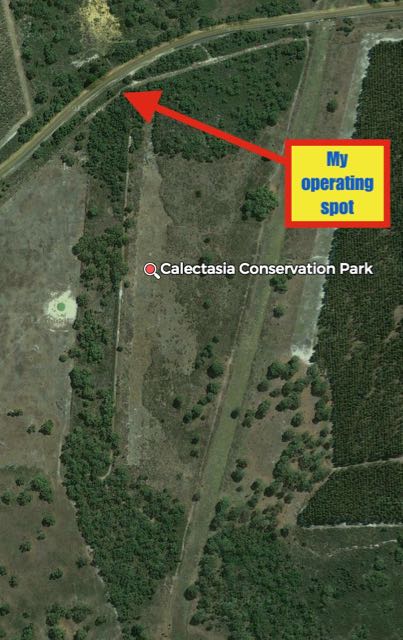
Again, I encountered a locked gat at this park, so I jumped the fence with my gear and set up in a little clearing just off the Claywells Road.

Screenshot 2015-06-12 20.13.29

Above:- Map showing my operating spot.  Map courtesy of mapcarta.com

Despite the fact that there were power lines close bay, the 40m band was very very quiet.  I called CQ on 7.095 and this was answered by Amanda VK3FQSO, following by Adrian VK5FANA, Paul VK5FUZZ, and Jeff VK5HK.  A number of the usual suspects followed including Mike VK6MB and Michael VK6MMB who were operating from a National Park in Western Australia.  Although they were very weak (5/1) they were perfectly readable.  I worked a total of 23 stations on 40m from VK3, VK5, and VK6.

I then tried my luck on 20m and after calling CQ on 14.310 a few times, I was greeted by Gerard VK2JNG/p.  This was followed by a contact with Gerard VK2IO mobile who was just about to activate a SOTA summit.  Gerard advised that he would be up on air at the summit in about 15 minutes.  So I decided to have a quick walk around the park and also a tune around the 20m band.  Whilst waiting for Gerard I spoke with Al EV1R in Belarus and Nelu YO2LEA in Romania.  I then returned to 14.310 and by pure luck I heard Gerard VK2IO calling me.  So I gave Gerard a 5/7 and he reciprocated with a 5/7 from SOTA peak, VK2/ NT-019.

My last contact in the park was another DX contact.  This time with Genna, UA7D in Russia (5/9 sent and 5/6-7 received).  Not bad with my little dipole and 40 watts.

This slideshow requires JavaScript.

The following stations were worked on 40m SSB:-

  1. VK3FQSO
  2. VK5FANA
  3. VK5FUZZ
  4. VK5JK
  5. VK5HCF
  6. VK6MB/p (VKFF)
  7. VK3FOWL/p
  8. VK3OF
  9. VK3NBV
  10. VK5FAJS
  11. VK6MMB/p (VKFF)
  12. VK5FTVR
  13. VK3AV
  14. VK5MBD
  15. VK3FALE
  16. VK3FARO
  17. VK3PMG
  18. VK5GJ
  19. VK1AT/3
  20. VK3HQ
  21. VK2JNG/p
  22. VK3FAPH
  23. VK3LZE

The following stations were worked on 20m SSB:-

  1. VK2JNG/p
  2. VK2IO/m
  3. VK5MBD
  4. EV1R
  5. YO2LEA
  6. VK2IO/p (SOTA VK2/ NT-019)
  7. UA7D


References.

National Parks and Wildlife Service-Department of Environment and Planning, 1990, Small Parks of the Lower South East Management Plans


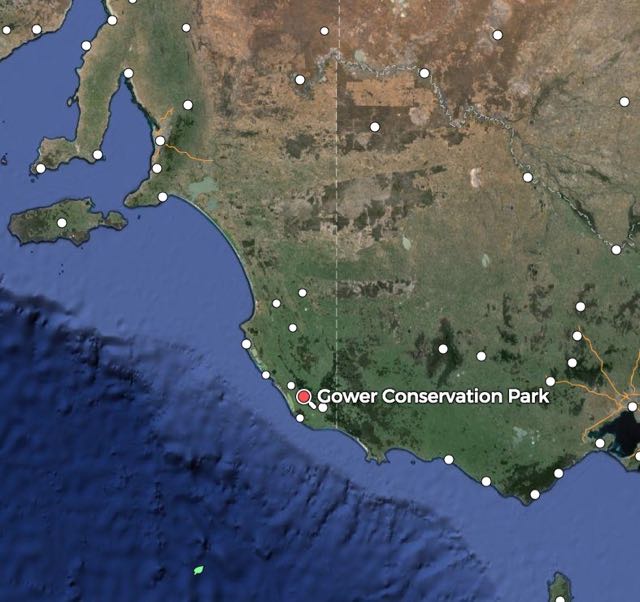
Gower Conservation Park VKFF-798

It was my final day in the South East (Tuesday 9th June) and I had planned to activate three parks: Gower Conservation Park, Calectasia Conservation Park, and the Penola Conservation Park.  All three were to be unique parks for me, for both the VK5 National and Conservation Parks Award and also World Wide Flora Fauna (WWFF).

My first park was the Gower Conservation Park which is situated about 25 km north west of Mount Gambier.

Screenshot 2015-06-12 18.03.17

Gower Conservation Park was gazetted on the 21st day of January 1971 and covers an area of around 39.5 hectares.   The vegetation in the park mostly consists of an open forest of messmate stringybark and brown stringybark with a shrub understorey of austral bracken and some spike wattle, grass tree, and silverleaved banksia.  In the south of the park you can find barked manna gum and large black wattle.

I headed out of Mount Gambier, heading north west on the Princes Highway, heading back towards Adelaide.  Just after the Tantanoola Caves Conservation Park, is a road to your right called McPherson Road.  This takes you direct to the park, passed an old quarry on your right and the pine forest on your left.

Screenshot 2015-06-12 18.03.07

I set up in a little clearing just to the east of the north western corner of the park.  There was plenty of room here to string out the dipole and because I had two convenient gum trees, I was able to get the ends of the legs quite high off the ground.  It was a much more pleasant day than Monday,  The sun was out, although it was still a typical cold June day down in the South East.

I called CQ on 7.095 and this was immediately answered by Col VK5HCF from Mount Gambier, who has previously activated Gower.  This was followed by Jeff VK5JK at Encounter Bay on the South Coast, Jim VK3AT/3, and then Tony VK5FTVR at Strathalbyn on the Fleurieu Peninsula.  All signals were 5/9 and above.  The band was in great shape.

I worked a steady flow of VK’s from VK2, VK3, VK5, & VK6, until there was a call ‘out of the box’.  I knew it was a Russian station or a Ukrainian station but struggled a bit with getting his call.  I penned in UA6IDX into my log who gave me a 5/3 report, but before I could confirm his call, he had gone.  A few calls later I spoke with Mike VK6MB who was with Michael VK6MMB in VKFF-161.  They confirmed that the call was in fact UA6IDX that had called me.

I worked numerous mobile stations during this activation.  They included Peter VK3TKK, Gerard VK2IO mobile on his way to a SOTA peak, Bob VK2AOR mobile on the M1 Freeway coming into Sydney, Gerard VK2JNG, Peter VK3PRF, Craig VK3NCR/5 mobile 160 km north of Port Augusta, Terry VK3UP, David VK5KC mobile at Orroroo in the Mid North, and Doug VK3FDES.  During most of my activations, I always ask for QRP, mobile, portable and outside of VK callers.  It is amazing how many of these stations come back to you, who would ordinarily be competing with many home stations running amps.

After working a total of 45 stations on 40m I headed over to 20m where I called CQ on 14.310.  Gerard VK2JNG had followed me over and was my first contact on 20.  This was followed by contacts with Cliff VK2NP, Bill VK5BMD, Neil VK4HNS and my final contact was with Stath VK4AEP who called just as I was packing up gear into the 4WD.

This slideshow requires JavaScript.

Another successful activation under my belt with a total of 50 contacts.  The park had been qualified for WWFF.

The following stations were worked on 40m SSB:-

  1. VK5HCF
  2. VK5JK
  3. VK1AT/3
  4. VK5FTVR
  5. VK5FANG
  6. VK5BJE
  7. VK3TKK/m
  8. VK5FANA
  9. VK3ZZS/4
  10. VK3NBV
  11. VK3PMG
  12. VK3FQSO
  13. VK2GKA
  14. VK5ZAR
  15. VK2IO/m
  16. VK6RZ
  17. VK5IS
  18. VK3HQ
  19. VK2NP
  20. VK2AOR/m
  21. VK3OF
  22. VK2HV
  23. VK5ZGY
  24. VK5NPP/3
  25. VK3AV
  26. UA6IDX
  27. VK3FOWL/p
  28. VK2JNG/m
  29. VK3PRF/m
  30. VK6MMB/p (VKFF-161)
  31. VK6MB/p (VKFF-161)
  32. VK3NCR/5
  33. VK3TJK
  34. VK7FGGT
  35. VK3UP/m
  36. VK3ZLD
  37. VK5KC/m
  38. VK3FGMO
  39. VK5RU
  40. VK3FDES/m
  41. VK5WG
  42. VK5TD
  43. VK5FIVE
  44. VK5MBD
  45. VK2YW

The following stations were worked on 20m SSB:-

  1. VK2JNG/m
  2. VK2NP
  3. VK5MBD
  4. VK4HNS
  5. VK4AEP

References.

National Parks and Wildlife Service-Department of Environment and Planning, 1990, Small Parks of the Lower South East Management Plans

Telford Scrub Conservation Park VKFF -805

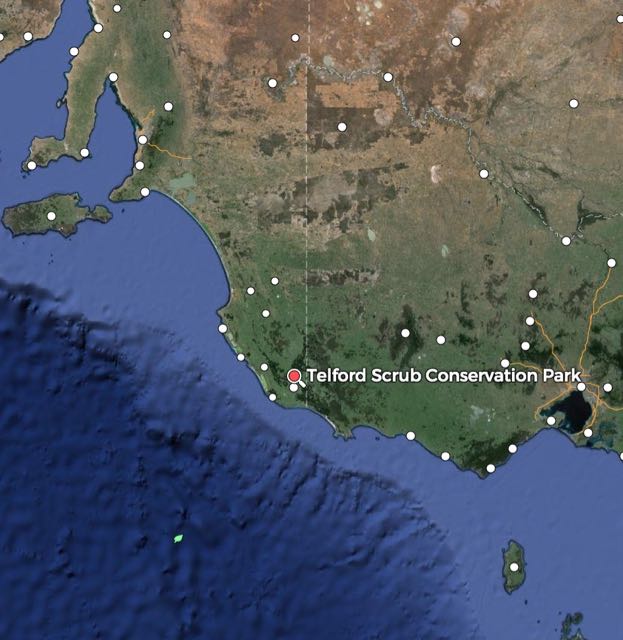
My first park activation for Monday 8th June 2015 was the Telford Scrub Conservation Park, which is located just 14 km north of Mount Gambier, via the Riddoch Highway.  Although I had activated this park previously, Telford Scrub was recently added to the World Wide Flora Fauna (WWFF) program, so I was looking for 44 contacts.

Screenshot 2015-06-12 12.17.12

Above:- Map showing the location of the park.  Map courtesy of mapcarta.com

It was another quick stopover at McDonalds for a Bacon & Egg McMuffin and an orange juice, and I then headed out along the Riddoch Highway.  Sadly, as is the case with numerous South Australian Conservation Parks, there are no signs on the Highway alerting you to the presence of a park.  I used the GPS to get there and turned off the Riddoch Highway into Grundys Lane.  The park is just a short distance up on the right, on the northern side of Grundys Lane.

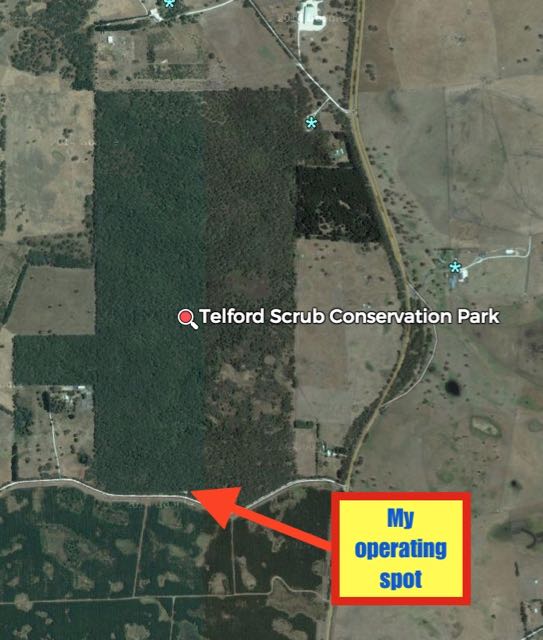
As it was early morning (8.00 a.m.), there were plenty of kangaroos out grazing in the clearing between the roadway and the pine forest which is situated opposite the park.  As per my last activation, I set up in the north eastern corner of the carpark.

Screenshot 2015-06-12 12.17.42

Above:- Map showing my operating location in the park.  Map courtesy of mapcarta.com

This is a magnificent park consiting of amazing Eucalyptus forest and bracken understorey.  But sadly this activation summed up the mess that South Australian Parks and the ‘system’ is in.  As I pulled in to the carpark, the first thing I saw was a television set which had been dumped in the carpark.  Who knows how long it had been there.  And half way through operating I had an interesting encounter with an elderly lady and her Golden Retriever.  Other than having a go at me for being in ‘her park’ (despite the fact that there were numerous other parks available), her dog was running around off the lead and kept jumping up on me and at one stage almost knocked over my table.  Without any apology, off she started to walk into the park with her do.  Despite the very clear sign that showed dogs were not allowed in the park.  I pointed this out to her, and after some complaining under her breath, off she walked along Grundy’s Lane.  In all probability, she has been walking her dog off the leash in the park for a long time, completely unfettered by DEWNR.

After packing up I went for a walk through the park and along the boardwalk (I’ll talk about this more later) and tried to read the interpretive signs which were totally covered in muck.  They clearly had not been cleaned in a long time.

For me, this highlighted the big problem we have here in South Australia with our beautiful parks.  I can only presume that DEWNR is sadly understaffed and under funded.  If it wasn’t for the dedication of the Friends of the Parks groups, I can only imagine what state the parks would be in.

Anyway, onto more positive thoughts.  The Telford Scrub Conservation Park is about 175 hectares in size and was once farmed by the Telford Brothers who subsequently sold the land to the Government.  The park contains at least 11 species of plants considered to be of conservation value.  Numerous native orchids can be found.  In fact, over 20 species have been recorded including Pink Fingers, Common Donkey orchid, Tiger orchid, and Purple Cockatoo.

The park is home to a wide range of native fauna including Western Grey kangaroos and echidnas.  Several koalas were reintroduced into the park in 1997 from Kangaroo Island.  The vulnerable Southern Brown Bandicoot and endangered Sugar Glider are also found in the park.

This slideshow requires JavaScript.

My first contact in the park was with Craig VK2PAW who came back to my CQ call on 7.098.  This was followed by Scott VK7NWT, Steve VK3FSPG and John VK5FMJC.  Not long after setting up, I had 2 visitors.  It was Rod VK5KFB and his dad, Murray VK5BWA.  They had a quick look at my operating gear and then headed off enroute to Adelaide.

Conditions on 40m were very good, and a nice little flow of callers came back to my CQ calls, from all around Australia.  There were a number of the regular park hunters, but also a few new calls as well, which is always pleasing.  I worked 53 stations before the UTC rollover.  I even got to work a station in my own home town of Mount Barker, Kev VK5KS.  I managed one park contact and that was with Mike VK6MB who was portable in Frank Hann National Park, VKFF-183.

After the UTC rollover I worked a further 10 stations including Mike VK6MB again, and also Michael VK6MMB who was with Mike in the Frank Hann National Park.  I also spoke with Julie VK3FOWL who was portable on SOTA peak Mount Disapointment VK3/ VC-014.

After working a total of 60 stations on 40m I headed over to 20m and called CQ on 14.310.  My CQ call was answered by Adrian VK5AW/p who was extremely weak.  In fact almost totally unreadable.  This was followed by Jim VK2QA, who kindly helped me out with Adrian.  And my final contact was with Peter VK6RZ with a nice 5/8 signal from Western Australia.

At the end of the activation and packing up my gear, I went for a walk into the park along the track from the carpark.  This leads to a  beautiful picnic area with a bench and table.  There are some interpretive signs along the way telling you about the forest.  A 100 metre long and 4.2 metre high ‘Forest Canopy Walk’ boardwalk provides visitors to the park a unique ‘bird’s eye view’ of the forest.  There are also some extended trails that can be followed as well.  Unfortunately I didn’t have time to try those out, but I will be back.

This slideshow requires JavaScript.

This was another successful activation.  I had reached the 44 QSO threshold for WWFF, with a total of 63 contacts in the log.

The following stations were worked on 40m SSB:-

  1. VK2PAW
  2. VK7NWT
  3. VK3FSPG
  4. VK5FMJC
  5. VK3PMG
  6. VK5KLV
  7. VK6RZ
  8. VK5TRM/m
  9. VK3FQSO
  10. VK5HEL
  11. VK3DQ/p
  12. VK5MBD
  13. VK5HS/p
  14. VK5FTVR
  15. VK5ZAR
  16. VK3OF
  17. VK5BJE
  18. VK1AT/3
  19. VK5JK
  20. VK4HNS/m
  21. VK3NML/p
  22. VK5AW/m
  23. VK3KTO/2
  24. VK3FBNG
  25. VK2YK
  26. VK3HKV
  27. VK5ATQ
  28. VK5KS
  29. VK3FSMT/2
  30. VK6MB/p (VKFF-183)
  31. VK5TW
  32. VK5FLEX/p
  33. VK5FMID
  34. VK7BO
  35. VK3DBP
  36. VK5ZK
  37. VK3YE
  38. VK4FFAB
  39. VK3VIN
  40. VK5FD
  41. VK5ZGY/m
  42. VK5NQP
  43. VK3MEG
  44. VK5KFB/m
  45. VK3TKK
  46. VK6MMB/p
  47. VK3NCR/5
  48. VK3PF
  49. VK5FAJS
  50. VK2NP
  51. VK2HV
  52. VK3FCCC
  53. VK5FANA
  54. VK5BGN
  55. VK3MIJ
  56. VK5QI/m
  57. VK6MB/p (VKFF-183)
  58. VK6MMB/p (VKFF-183)
  59. VK5LDM
  60. VK3FOWL/p (SOTA Mt Disapointment)

The following stations were worked on 20m SSB:-

  1. VK5AW/p
  2. VK2QA
  3. VK6RZ


References.

Department of Environment and Natural Resources, 2010, Telford Scrub Conservation Park brochure.

Postcards, 2009, <http://www.postcards-sa.com.au/features2009/telford_scrub_park.html&gt;,viewed 12th June 2015

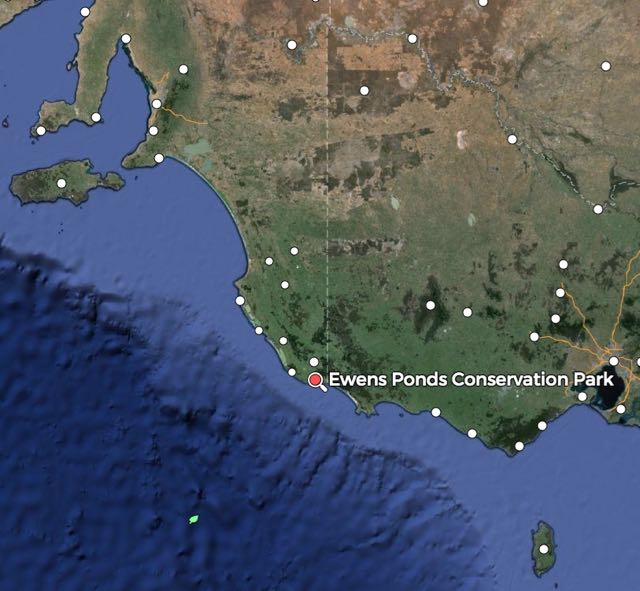
Ewens Ponds Conservation Park VKFF-796

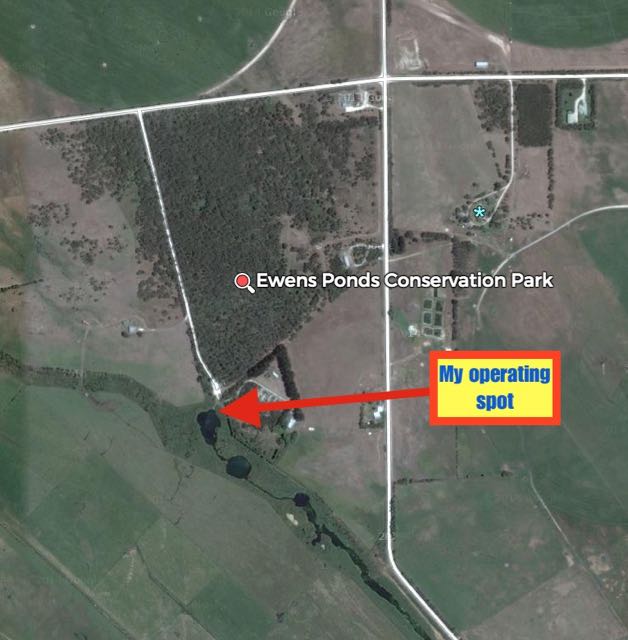
My first park for Sunday morning, 7th June 2015 was the Ewens Ponds Conservation Park which is situated about 36 km south east of Mount Gambier.  This was my only planned park activation for the day, but as it turned out, I also ventured over to Piccaninnie Ponds Conservation Park after this activation.  Ewen Ponds was another unique park for me for both the VK5 National & Conservation Parks Award, and the World Wide Flora Fauna (WWFF) program.Screenshot 2015-06-12 00.06.17

Above:- Map showing the location of the park.  Map courtesy of mapcarta.com

Ewens Ponds Conservation Park was constituted in 1976 and covers a small area of about 24 hectares.  The park contains spring fed limestone ponds which are linked by shallow channels.  The channels actually connect three basin shaped ponds which are about 10 metres deep.  The clarity of the water enables water plants to grow underwater to a depth of about 6 metres.  Many of these plants are not found growing fully submerged underwater anywhere else in the world.

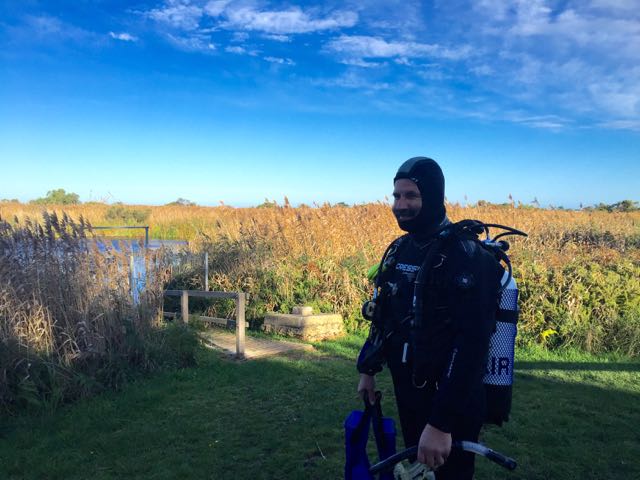
The ponds are very popular with scuba divers and snorkellers.  The minimum qualification for divers is ‘open water’.  In fact whilst I was set up, a couple arrived to go scuba diving in the ponds.  Due to the cold water and the potential for damage to the aquatic environment, swimming is not allowed.

The ponds have a large fish population including the endangered Gold Pygmy Perch.  In fact the ponds are one of only three recorded locations for the Gold Pygmy Perch.  The ponds are also home to populations of flatworms, freshwater crayfish, and mussels, and the larva of the carnivorous caddis fly.

The history behind the discovery of the ponds is extremely interesting.  The first European associated with the area was Thoms Ewens.  His dog chased a kangaroo into one of the ponds.  The land surrounding the ponds was gradually cleared for agricultural purposes and dairy farming.  A drainage system was constructed to draw water from the ponds for land sold for soldier settlement programs after the Second World War.  In 1978 a trout farm was established utilising the waters flowing through Ewens Ponds.

Screenshot 2015-06-12 00.07.32 (1)

Above:- My operating spot.  Image courtesy of mapcarta.com

After setting up, I decided to head up to the WWFF calling frequency of 7.144.  It was only 8.20 a.m. and there was still quite a bit of DX on the band.  It was quite difficult to find a clear frequency below 7.100.  I called CQ on 7.144 and this was answered by Andy VK5AKH who was mobile at Kingston on Murray with a very strong 5/9 signal.  This was followed by Tony VK5FTVR, and then Mark VK5QI who was also mobile up in the Riverland for the Canoe Marathon.

Conditions on 40m were exceptionally good and I had a nice little park pile up going for quite a while with callers from VK2, VK3, VK5, VK6 & ZL.  I was quite surprised when I head Ken ZL4KD amongst all the park hunters calling me.  Ken had a very good 5/7 signal coming into Ewens Ponds from Christchurch.

It was also nice to get a couple of the regular QRP hunters in the log.  They were Adrian VK5FANA running his typical 5 watts from the Yorke Peninsula (5/9 both ways), and Amanda VK3FQSO running 500 milliwatts (5/8 sent and 5/9 received).

At about 2335 UTC I took a break to have a chat to the diver and his wife who had arrived at Ewens Ponds.  It was interesting to hear their comments about how the water within the ponds had become cloudier over the years, possibly due to run off from the surrounding farms.

IMG_1421

By the time I had got back to the radio, the WIA broadcast had commenced on 7.140, so I headed back down the band and found Nigel VK5NIG calling CQ for the VK Shires Contest.  I gave Nigel a signal report and my Shire code which was GD5, and then headed for 7.100 and started calling CQ.  Most of the European DX had disappeared at this time.  My CQ call was answered by Brian VK5FMID at nearby Mount Gambier, and this was followed by Joe VK3YSP.  After the UTC rollover I was called by Mark VK1EM, Dave VK2BDR, John VK5FMJC and Julie VK3FOWL who was mobile.

I went on to work a further 25 stations on 7.100 in VK1, VK2, VK3, VK4, VK5, and VK6.  The band was working perfectly, with great signals coming in from across Australia.  I had a few interesting contacts including Rob VK4AAB/5 on Kangaroo Island OC-139, and Ian VK5CZ who was portable on SOTA peak, Hallett Hill VK5-SE-003.

I also tried 20m and called CQ on 14.310 and this was answered by Paul VK2KKT, Peter VK6RZ, and David VK4DPM, all of whom were 5/9 to the South East of South AUstralia.

This slideshow requires JavaScript.

After a little over 90 minutes operating, I had a total of 66 contacts in the log.  I had qualified another park for the WWFF program.  It was time to pack up and head off to Piccaninnie Ponds Conservation Park.  I wanted to sneak in that activation prior to getting back to Mount Gambier for the SERG Convention.

The following stations were worked on 40m SSB:-

  1. VK5AKH/m
  2. VK5FTVR
  3. VK5QI/m
  4. VK5FANA
  5. VK3FONZ
  6. VK3YE/p
  7. VK6DW
  8. VK3VH
  9. VK5KLV
  10. VK3OF
  11. VK3FAAJ/p
  12. VK3DBP
  13. VK3TKK/m
  14. VK5BJE
  15. VK3PMG
  16. VK5FTCT
  17. VK5ZAR
  18. VK2NP
  19. VK3MCX
  20. ZL4KD
  21. VK5LSB
  22. VK5FAJS/m
  23. VK3PF
  24. VK5KFB/m
  25. VK2DEK
  26. VK2YK
  27. VK3FQSO
  28. VK5NQP
  29. VK6FLAB
  30. VK5NJ
  31. VK3HK
  32. VK5HS/m
  33. VK5FLEX/m
  34. VK5ZRY
  35. VK5NIG
  36. VK5FMID
  37. VK3YSP/m
  38. VK1EM
  39. VK2BDR
  40. VK5FMJC
  41. VK3FOWL/m
  42. VK3TST/p
  43. VK5WG
  44. VK5IY
  45. VK4AAC/5
  46. VK2PAW
  47. VK5FTRG
  48. VK1DR
  49. VK2MT/p
  50. VK5IS
  51. VK7FGGT
  52. VK3VTH/m
  53. VK1AT/3
  54. VK2MCB
  55. VK5CZ/p
  56. VK5LY
  57. VK5BGN
  58. VK3FACI/p
  59. VK5ND
  60. VK5NRG
  61. VK5JK
  62. VK3AFW
  63. VK3WMM

The following stations were worked on 20m SSB:-

  1. VK2KTT
  2. VK6RZ
  3. VK4DPM


References

National Parks South Australia, 2015, <http://www.environment.sa.gov.au/parks/Find_a_Park/Browse_by_region/Limestone_Coast/Ewens_Ponds_Conservation_Park&gt;, viewed 12th June 2015

Natural Resources Group, Department of Environment and Natural Resources, 1994, Small Inland Parks of the South East Management Plan.

Wikipedia, 2015, <http://en.wikipedia.org/wiki/Ewens_Ponds&gt;, viewed 12th June 2015

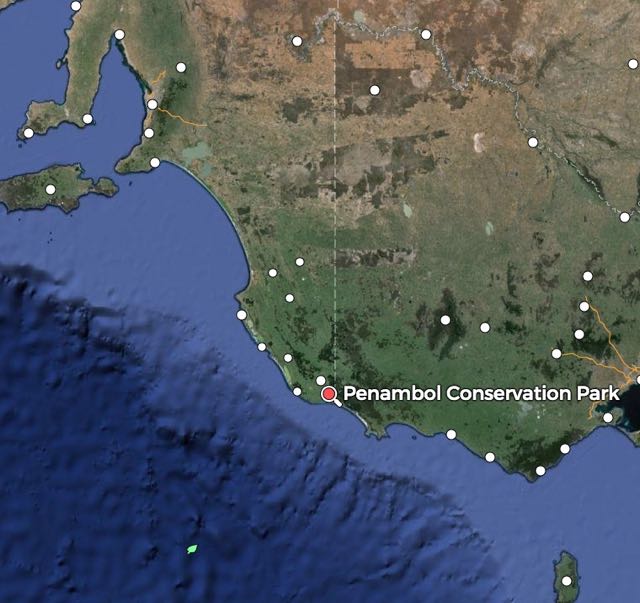
Penambol Conservation Park VKFF-802

My one and only park activation for Saturday 6th June, 2015, was the Penambol Conservation Park, which is situated about 22 km south east of Mount Gambier, and 450 km south east of Adelaide.  This was another early start from the motel, and after a detour to the ‘Golden Arches’ McDonalds for a quick breakfast, I headed out of Mount Gambier along the Glenelg River Road, towards the Victorian border.

This was to be another unique park for me for both the VK5 National & Conservation Parks Award and the World Wide Flora Fauna (WWFF) program.

Screenshot 2015-06-11 22.44.51

Above:- Map showing the location of the park.  Map courtesy of mapcarta.com

I continued south east along the Glenelg River Road, through the areas of Square Mile and Caveton.  I turned left into Carba Road, which is a narrow little dirt road.  I passed a number of farmhouses and then pine forest on both my right and left.  I located the park on the corner of Carba Road and Honeysuckle Road.  The park sign was quite visible amongst the scrub.

Penambol Conservation Park adjoins the Warrenga Native Forest Reserve and is 179 hectares in size.  The park was acquired for conservation purposes in 1984 and was constituted in December 1993.  It conserves an important area of remnant vegetation, formerly known as Herpst’s Scrub.  It contains several unique geological features, including Caroline SInkhole, which has archaeological significance.

The park has a Wombat Walk, which provides numerous opportunities to view wombats, with dozen of wombat burrows evident in the area.  I didn’t even know that wombats were found in this area.  I thought it was too cold.

The park also contains South Australia’s first butterfly monitoring sites, enabling visitors to the park to experience and learn about local butterflies, such as the Ochre Butterfly and Orange species Butterfly.

The park contains a large amount of native wildlife including the Eastern Grey Kangaroo, Red-necked Wallaby, Ringtail Possum, Echidna, Wombat, Yellow Bellied gliders, and Bush Rat.  The threatened Gang Gang Cockatoo and Red Tailed Black Cockatoo have also been sighted in the park.

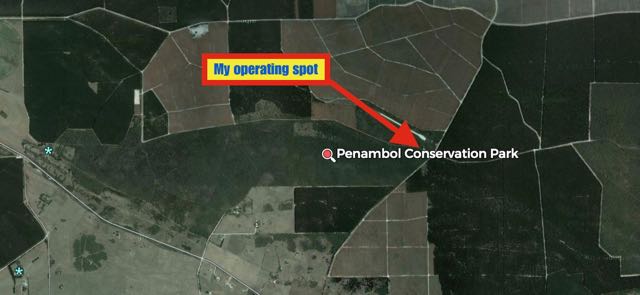
Screenshot 2015-06-11 22.54.12

Above:- Map showing my operating spot.  Map courtesy of mapcarta.com

I was set up and ready to go by 2250 UTC (8.20 a.m.) and started calling CQ on 7.095.  David VK5NQP was my first caller with a great 5/9 signal.  This was followed by Mick VK3PMG in Stawell who was also 5/9, and then Barry VK5KBJ.

I worked a number of QRP stations including Adrian VK5FANA running 5 watts, Paul VK3DBP running 5 watts, Amanda running 500 milliwatts (5/8 sent and 5/9 received), Mark VK7MK running 2.5 watts (5/8 sent and 5/5 received), Ian VK5IS running 5 watts, Mike VK3XL also running 5 watts, and Trevor VK3FPY/5 running 5 watts with his home made vertical.

I also spoke with Mark VK5LO and and Paul VK1AT/3, both of whom were operating with home brew transceivers.

Tony VK3VTH also called in from the Cape Nelson State Park VKFF-754.  It was great to get another new VKFF reference in the log.

My final contact on 40m was with Peter VK3YE who was portable on the beach at Chelsea, running an FT817 on 5 watts and a home brew antenna (5/9 both ways).

I did call CQ numerous times on 14.310, but unfortunately there were no takers.  Sadly I couldn’t alert anyone that I was there via parksnpeaks, as there was no mobile coverage in the park.

This slideshow requires JavaScript.

After 90 minutes in the park, I had a total of 51 contacts in the log.  I was very pleased.  I needed 44 contacts to qualify the park for the WWFF program.  This was another unique VKFF activation to add to my list.

The following stations were worked:-

  1. VK5NQP
  2. VK3PMG
  3. VK5KBJ
  4. VK5JK
  5. VK3PF
  6. VK5FANA
  7. VK5ZAR
  8. VK3OF
  9. VK5PJ/m
  10. VK3DBP
  11. VK5KLV
  12. VK6RZ
  13. VK5LO
  14. VK5TW
  15. VK5FTVR
  16. VK3FQSO
  17. VK3NBL
  18. VK3TKK/m
  19. VK7MK
  20. VK5IS
  21. VK3HRA
  22. VK2BBQ/p
  23. VK3BFR
  24. VK2IO/m
  25. VK7NWT
  26. VK5FMID
  27. VK2YW
  28. VK5HEL
  29. VK3FSPG
  30. VK3FDES/m
  31. VK2NP
  32. VK3XL
  33. VK4AAC/5 (Kangaroo Island)
  34. VK3FPY/5
  35. VK5AKH/m
  36. VK1AT/3
  37. VK3AV
  38. VK5BJE (on either side of the UTC rollover)
  39. VK5ZGY/m
  40. VK3VTH/p (Cape Nelson State Park VKFF-754)
  41. VK4RZ
  42. VK5GM
  43. VK6FN
  44. VK2ATZ
  45. VK5KC
  46. VK3FPBI
  47. VK3KKP
  48. VK3HAK
  49. VK7LTD
  50. VK2SRT
  51. VK3YE/p (Chelsea Beach)

References.

Department of Environment and Natural Resources, 1994, Small Inland Parks of the South East Management Plan.

Department of Environment and Natural Resources, 2010, Penambol Conservation Park.

Hacks Lagoon Conservation Park

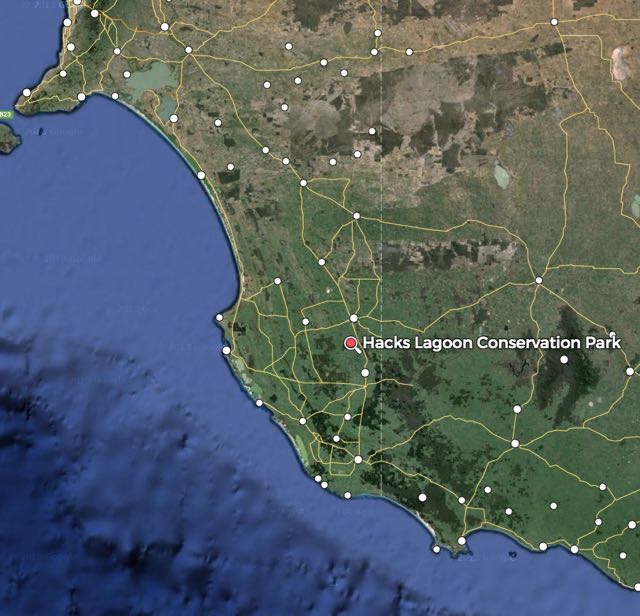
My final activation for Friday 5th June, 2015 was the Hacks Lagoon Conservation Park, which is situated midway between Adelaide and Melbourne.

Screenshot 2015-06-11 22.12.40

Above:- Map showing the location of the park.  Map courtesy of mapcarta.com

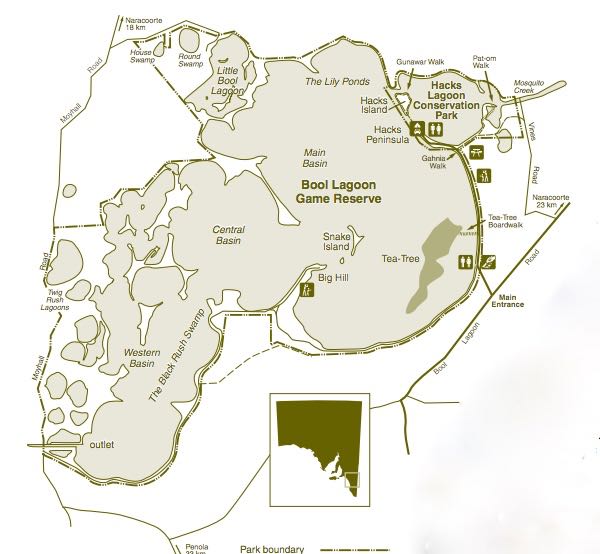
Hacks Lagoon Conservation Park adjoins the basin of the adjacent Bool Lagoon Game Reserve, which is one of the largest and most diverse freshwater lagoon systems in southern Australia.  The seasonal wetland areas of Bool Lagoon and Hacks Lagoon are home to a wide range of wildlife and provides essential drought refuge for numerous rare and endangered bird species.  In fact, over 150 species of birds visit the area.  A number of birds visit the park during Summer, including Sharp-tailed Sandpipers, who fly thousands of kms to be at Bool and Hacks Lagoons.  Brolgas are perhaps the most spectacular of all of the birds that can be found here.

Screenshot 2015-06-11 22.37.38

Above:- Map showing Bool and Hacks Lagoons.  Image courtesy of DEWNR

The area is recognised under the Ramsar Convention on Wetlands as a Wetland of International Importance.  It is protected under the Japan/Australia and China/Australia Migratory Bird Agreement due to the importance of the area as a summer refuge for migratory wading birds.

Screenshot 2015-06-11 22.13.20

Above:- Map showing my operating spot.  Map courtesy of mapcarta.com

The 40m band was very busy below 7.100 so I found 7.115 clear and started calling CQ.  My first taker was John VK5BJE, followed by Col VK5HCF in Mount Gambier, and then Jim VK5TR.  The band started off very good, with great signals from eastern Australia.  But this didn’t last long.  The band dropped out very quickly to VK3.  However, the band remained open to southern Australia and the remainder of eastern Australia.

I worked a number of QRP stations including Gerard VK2JNG who was portable, Greg VK5GJ again running just 4 watts, Peter VK3PF running 5 watts, Mark VK7MK running 2.5 watts, Andrew VK1NAM running 5 watts, Alan VK2AJG running 5 watts, Nev VK5WG running 5 watts, and Adrian on the Yorke Peninsula running 5 watts.

This slideshow requires JavaScript.

I remained in the park until just before 0800 UTC (5.30 p.m.) and watched a magnificent sunset.  I managed a total of 32 contacts on 40m SSB into VK1, VK2, VK3, VK4, VK5, and VK7,

The following stations were worked:-

  1. VK5BJE
  2. VK5HCF
  3. VK5TR
  4. VK3AXF
  5. VK3FEUG
  6. VK3AV
  7. VK4AAC/5 (Kangaroo Island)
  8. VK5JK
  9. VK5LSB
  10. VK2JNG/p
  11. VK5GJ
  12. VK3PF
  13. VK3DBP
  14. VK7MK
  15. VK1NAM
  16. VK2AJG
  17. VK3OHM
  18. VK5ZAR
  19. VK5NQP
  20. VK2NP
  21. VK3FBI
  22. VK5KLV
  23. VK3FQSO
  24. VK3OF
  25. VK5KPR
  26. VK5WG
  27. VK7LTD
  28. VK4FBMW
  29. VK4FAAS
  30. VK5FANA
  31. VK7VEK
  32. VK4RZ


References.

Department of Environment and Natural Resources, 2010, Bool Lagoon Game Reserve and Hacks Lagoon Conservation Park brochure.

National Parks South Australia, 2015, <http://www.environment.sa.gov.au/parks/Find_a_Park/Browse_by_region/Limestone_Coast/Bool_Lagoon_Hacks_Lagoon&gt;, viewed 11th June 105.

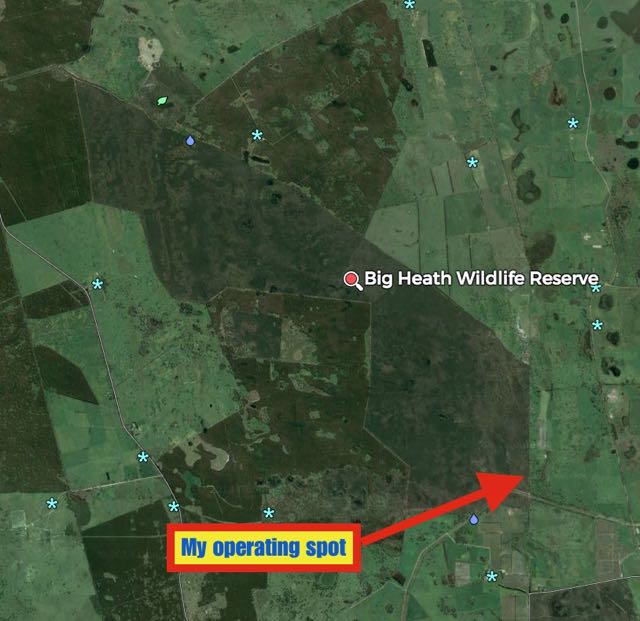
Big Heath Conservation Park VKFF-792

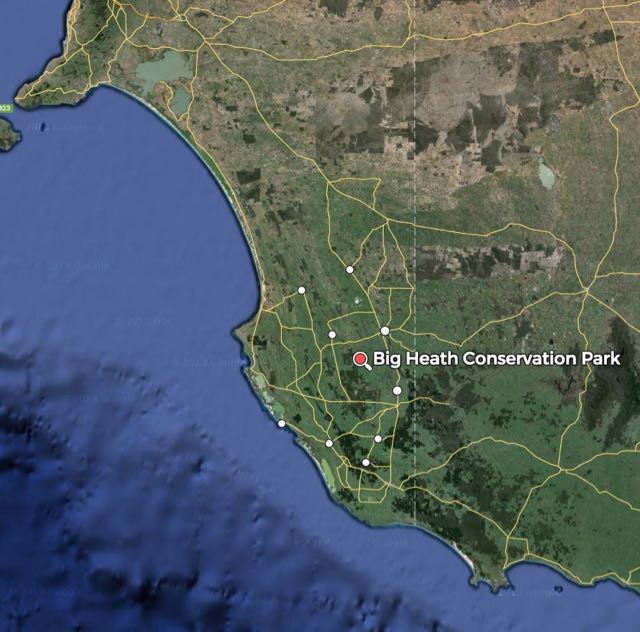
After leaving Mary Seymour Conservation Park, I travelled a short distance to my next park activation location at the Big Heath Conservation Park, which is situated about 20 km south of Naracoorte.  This was another unique park for me for the VK5 National & Conservation Parks Award and a unique park for the World Wide Flora Fauna (WWFF) program, so I was hoping to get my 44 contacts.  Big Heath was only just recently added to the WWFF program.

Screenshot 2015-06-11 21.22.34

Above:- Map showing the location of the park.  Map courtesy of mapcarta.com

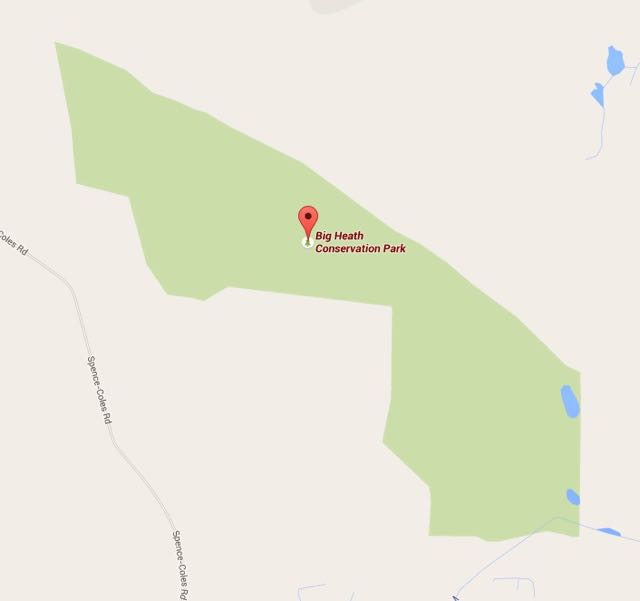
Big Heath Conservation Park was constituted back in 1964 and covers an area of 2,351 hectares.  In an extra 100 hectares of land was added to the park.  When this land was added, Department of Environment Water and Natural Resources (DEWNR) CEO stated:-

‘Big Heath Conservation Park is situated in an area of high national and state priority for conservation, and protects remnant wet heath land vegetation in a regionally threatened plant community’.

The park contains a diversity of vegetation types.  It is certainly a very attractive park.  In the higher areas of the north eastern corner of the park, there is a Eucalypt woodland with a sparse understorey.  In the north western end of the park you can find a low woodland of Brown Stringybark, Pink Gum, and Desert Banksia.  A number of limestone outcrops located throughout the park, support Manna Gum, South Australian Blue Gum and Pink Gum woodlands.  In the south eastern corner of the park, River Red Gums of varying age and densisty proudly stand.  A dense heath of Mallee Honey Myrtle, Yellow Hakea, and Prickly Tea Tree is also found.  As elevation increases in the park, there are corresponding changes to the heath vegetation associations, with Broombrush, Grass Tree and Dwarf Sheaok occurring.

A large amount of native wildlife can be found in the park including the threatened species, Little Pygmy Possum.

Screenshot 2015-06-11 21.26.39

Above: Map showing the borders of the park.  Map courtesy of google maps.

I set up in the south eastern corner of the park, after following Coles-Kilanoola Road into the park, passed the vineyards.  There was a nice cleared area at this location with plenty of room for me to run out the linked dipole.

Screenshot 2015-06-11 21.28.12

Above:- My operating spot.  Map courtesy of mapcarta.com

Again, I started off calling CQ on 7.095 and first cab off the rank was Greg VK5GJ at Meadows, running his normal QRP 4 watts with a nice 5/7 signal.  This was followed by Jim VK1AT/3 who is being a regular park hunter.  Next up was Rob VK4AAC/5 portable on Kangaroo Island, and then two regular park hunters, Arno VK5ZAR and Mick VK3PMG.

Things were travelling along well, and I was on my way to 44 contacts.  I had a steady flow of callers from all over Australia.  As I normally do, I took a break from the hunters from home, to listen out for mobiles and portables.  This resulted in a large number of mobile stations calling in, including husband and wife team Joe VK3YSP and Julie VK3FOWL, Eugene VK5ZA mobile at Auburn in the Clare Valley, Greg VK5ZGY, Mark VK5QI mobile at Blanchetown in the Riverland, Simon VK3SMC mobile in the Toolangi State Forest (4WDing), Peter VK5KX mobile at Blanchetown, Matt VK5ZM, Peter VK3TBN mobile at Bundoora, Chris VK2SR mobile in the ACT, and Tom VK5FTRG.  I was also called by Kerry VK4FKDP portable near the Condamine River .

This slideshow requires JavaScript.

At 0550 UTC (3.20 p.m. SA local time) I QSYd from 7.095 up to 7.105, so that I did not cause any QRM to the Kandos Net which operates at 0600 UTC on 7.093.  I worked a further 9 stations in VK3, VK4, & VK5 on 7.105.

After an hour in the park, I had 45 contacts in the log, thus qualifying the park for WWFF.  I was tempted to have a go on 20m but it was getting a little late (4.40 p.m. SA local time) and I still wanted to get to Hacks Lagoon.  I was cognisant that if I called CQ on 20m from a VKFF park, and the Europeans found me, it would be very hard to get out of Big Heath.  So I packed up my gear and headed off for another unique park, Hacks Lagoon.

The following stations were worked:-

  1. VK5GJ
  2. VK1AT/3
  3. VK4AAC/5 (Kangaroo Island)
  4. VK5ZAR
  5. VK3PMG
  6. VK3OHM
  7. VK3NBV
  8. VK3NBL
  9. VK3DBP
  10. VK3FQSO
  11. VK5JK
  12. VK3BHR
  13. VK3PF
  14. VK5HCF
  15. VK4RZ
  16. VK2NP
  17. VK3YSP/m
  18. VK5FANA
  19. VK5NRG
  20. VK3FOWL/m
  21. VK5ZA/m
  22. VK5ZGY/m
  23. VK5QI/m
  24. VK3SMC/m
  25. VK5KX/m
  26. VK5ZMm
  27. VK4FKDB/p
  28. VK3TBN/m
  29. VK2SR/mobile1
  30. VK5AW
  31. VK5FMID
  32. VK5NIG
  33. VK3OF
  34. VK3MEK
  35. VK5FCHM
  36. VK5BJE
  37. VK3TJK
  38. VK5KLV
  39. VK4GSF
  40. VK3AIG
  41. VK5FTRG/m
  42. VK7CC
  43. VK3MCK
  44. VK3FEUG
  45. VK5NQP

References.

Natural Resources Group, Department of Environment and Natural Resources, 1994, Small Inland Parks of the South East Management Plan.

Department of Environment Water and Natural Resources, 2015, <http://www.environment.sa.gov.au/Home/Full_newsevents_listing/News_Events_Listing/110113-Three_new_parks&gt;, viewed 11th June 2015