My next planned activation of the day was the Big Heath Conservation Park. However after leaving Vivigani Ardune, the GPS took me on a merry drive around the South East and I was not able to access Big Heath. So I headed for one of my other planned activations, the Mary Seymour Conservation Park. Another unique park for me.
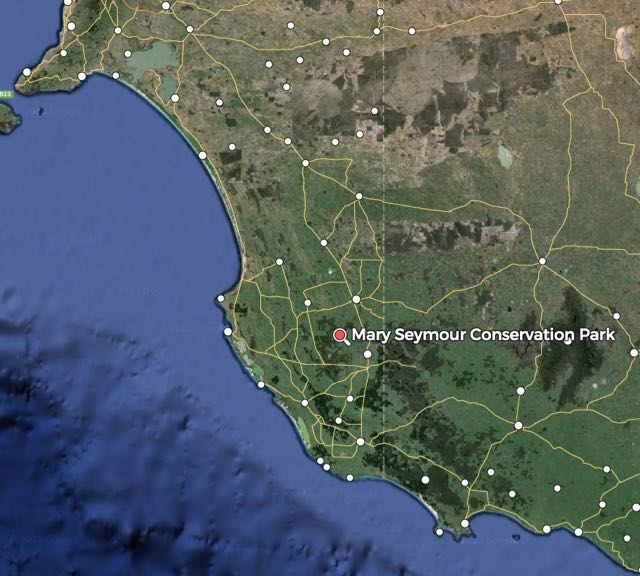
Mary Seymour Conservation Park is situated about 25 km south of Naracoorte in the South East of South Australia.
Above: Map showing the location of the park. Map courtesy of mapcarta.com
The park was constituted in 1980 and covers an area of around 264 hectares. The western quarter of Mary Seymour consists of a limestone ridge which supports a low open forest of Brown Stringybark and Pink Gum. The remainder of the park is a complex wetland system with limestone outcrops.
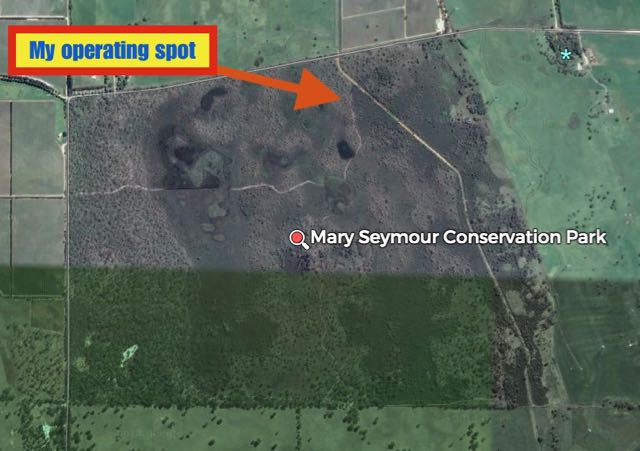
I accessed the park via Bool Lagoon West Road. I found a clearing amongst the scrub, and I set up my equipment.
Above:- Map showing my operating spot. Map courtesy of mapcarta.com
I started calling CQ on 7.093 as Adam VK2YK was operating on 7.098. My first taker was Amanda VK3FQSO with a lovely 5/9 signal. This was followed by Marc VK3OHM and then Rob VK4AAC/5 on Kangaroo Island. It was 1.30 p.m. SA local time and the 40m band was holding up very well, with nice signals. I worked a total of 27 stations in the park from VK2, VK3, and VK5.
That included a handful of QRP operators, including Greg VK5GJ running 4 watts (5/7 sent and 5/9 received), and Paul VK3DBP running 5 watts (5/9 both ways). I also worked a number of mobile stations including Greg VK5ZGY, Peter VK3TKK, Terry VK3BMX using a Famparc whip, Mark VK5QI mobile at Truro, and Peter VK3PF.
I was also fortunate that Adam VK2YK had tracked me down and gave me a call from Hunter Wetlands National Park, VKFF-595.
This slideshow requires JavaScript.
I only remained in the park for 30 minutes, as I still had 2 planned park activations for the day. But I was very happy, I had 27 contacts in the log.
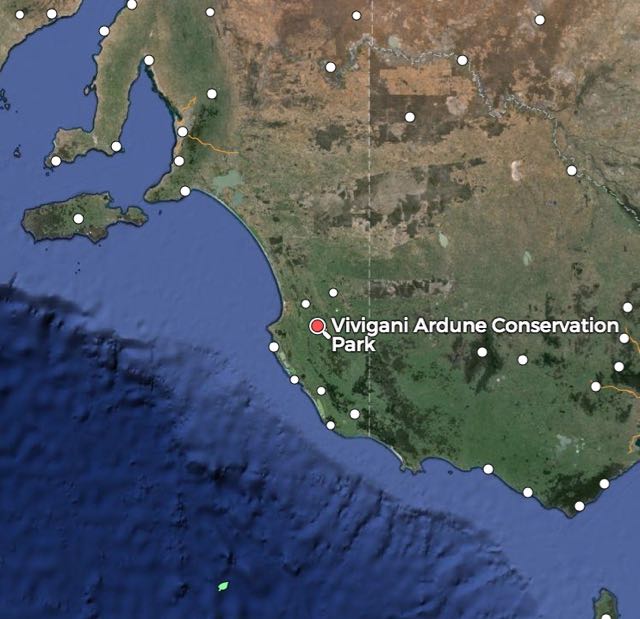
After leaving the Fairview Conservation Park, I headed to my next activation, the Vivigani Ardune Conservation Park, situated just north west of the little town of Lucindale. This was another unique park for me for the VK5 National and Conservation Parks Award.
After leaving Fairview I travelled back into Lucindale along Fairview Road. Lucindale is a little town of about 400 people and is situated about 345 km south east of Adelaide. It is best known for hosting the annual South East Field Days, which attracts over 25,000 visitors each March.
Main street of Lucindale
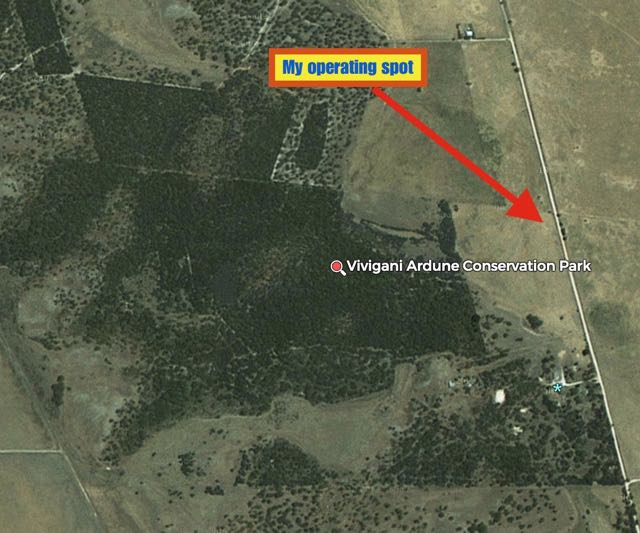
After leaving Lucindale I headed out along the Reedy Cfreek-Lucindale Road, and then turned right into Conricks Road. The park is about 4 km up Conricks Road on the left hand side (on the western side of the road). Keep a careful eye out for the park sign with can be located in a paddock which forms part of the park.
On the way to the park I spoke from my mobile, with Alan VK7BO who was on a SOTA peak, The Tump, VK7/ NC-018 (5/9 both ways). I also spoke with Nigel VK5NIG who was portable on SOTA peak Mount Gawler VK5/ SE-013 in the Mount Lofty Ranges (5/9 both ways).
I was unable to find out a lot about this park, which was proclaimed in 2008. John VK5BJE and I spoke about the origins of the name on air. John was my 2nd contact. We believe it may have Latin ties and means something similar to ‘toil hard’. But more research will need to go into that. There is a property called Vivigani just to the south of the park.
Unfortunately this is another park which required some fence jumping. So many South Australian parks are locked up by padlocked gates. This one didn’t have a padlock, but there was a gate which appeared to have not been opened since the medieval times. On the gate was a sign which read ‘Sanctuary’ which appeared to have been there in time immeorial. So I jumped the fence to gain access to park. Be careful of the electric fence!
My first contact in the park was with Nigel VK5NIG who I tracked down after setting up. Nigel was still on Mount Gawler and was calling CQ on 7.105. Nigel was a good 5/9 and I’m pleased he was. I was very saddened to find that I had an S9 noise floor on 40m when I turned on the radio. I’m suspecting that this was a combination of the electric fence and the power lines which run through the paddock.
After speaking with Nigel I headed down to 7.095 and called CQ and this was answered by a number of the park regulars including John VK5BJE, followed by Les VK5KLV, Tony VK5FTVR and Mick VK3PMG. Fortunately all of their signals were above the noise floor. I went on to work a total of 34 stations on 40m in VK2, VK3, VK4, VK5, and VK7. That included a number of QRP stations including Greg VK5GJ running 5 watts (5/9 both ways), and Peter VK3PF also running just 5 watts (5/7 sent and 5/9 received).
I also worked a few mobile stations which included Rod VK5KFB mobile in the South East, Eugene VK5ZA mobile at Burra in the Mid North, and Dave VK2BDR.
This slideshow requires JavaScript.
When things slowed down on 40m I headed up to 20m. I called CQ on 14.310 and this was answered by Adam VK2YK who was operating portable in the Hunter Wetlands National Park, VKFF-595 (5/9 both ways). A nice little bonus.
I would have stayed around a bit longer on 20m, but the rain had hit again, and once again it was a hasty retreat from this park.
My first planned park activation for Friday morning (5th June 2015) was the Fairview Conservation Park (CP). This was to be a unique VK5 Park for me for the VK5 National & Conservation Parks Award. Fairview was the first of 5 planned park activations for the day. It was an early start from the motel. I was on the road by 7.00 a.m.
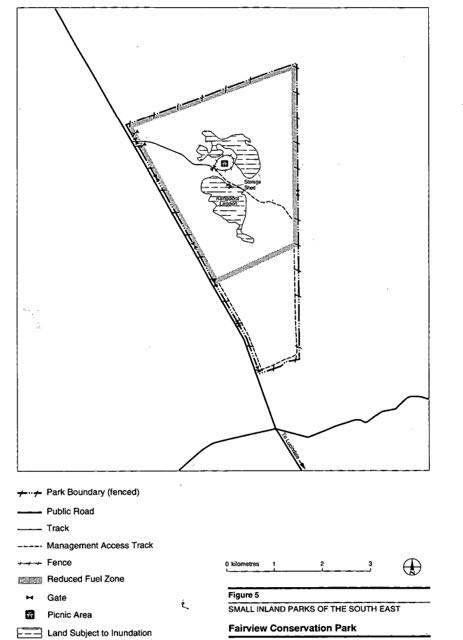
Fairview CP is situated about 17 km north of Lucindale and about 345 km south east of Adelaide. The park was constituted in 1960 and covers an area of around 1,398 hectares (3,440 acres) so it is quite a large park. The park contains two semi permanent lagoons which I did not visit. But I would like to get back to this park and explore it in my 4WD. According to the park Management Plan there is a picnic area situated between the lagoons which can be reached by a track leading from the north west corner of the park. But due to the date of this publication, I’m not sure if that still exists.
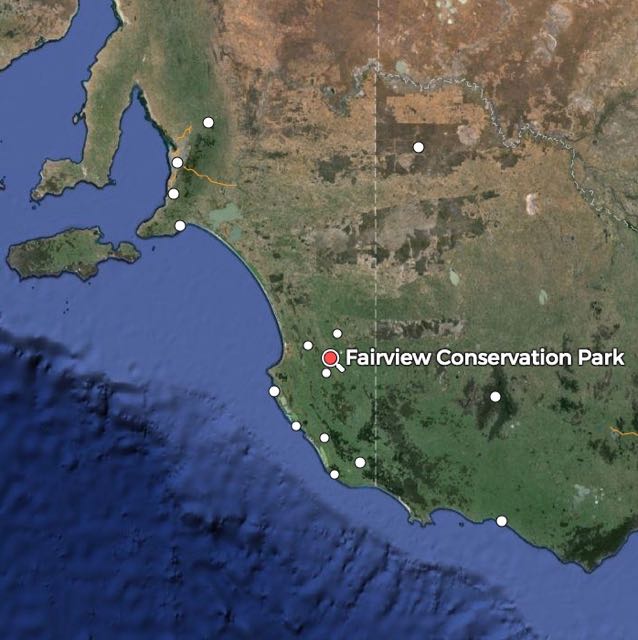
Above:- Map showing the location of the park. Image courtesy of mapcarta.com
The park also has extensive areas of seasonally inundated flats, sandy flats and ridges, and limestone ridges. The park contains large gums, Stringy Barks, various native grasses, and Banksias. Other than the native wildlife, deer can also be found in the park. The rare Red Tailed Black Cockatoo can be found in the park.
Above: Map from the Management Plan showing the track leading to the picnic area. Map courtesy of Dept Env Natural Resources (now DEWNR)
I travelled north west out of Mount Gambier along the Riddoch Highway and passed through Naracoorte. About 5 km out of Naracoorte is Lochaber Lane. There is a sign here for the park. I turned left here and continued west on Lochaber Lane for a number of kms, until I reached Woolumbool Road. A few km up Woolumbool Road, you will see the park on your right on the eastern side of the road.
I found an open gate off Woolumbool Road and pulled into the park. It was quite a bleak and cold morning, so I hurriedly set up my fold up table, deck chair, and antenna, in the hope to beat any rain. For this activation I ran my normal portable set up which consists of a Yaesu FT-857d, 40 watts and a 40m/20m linked dipole supported on a 7 metre squid pole.
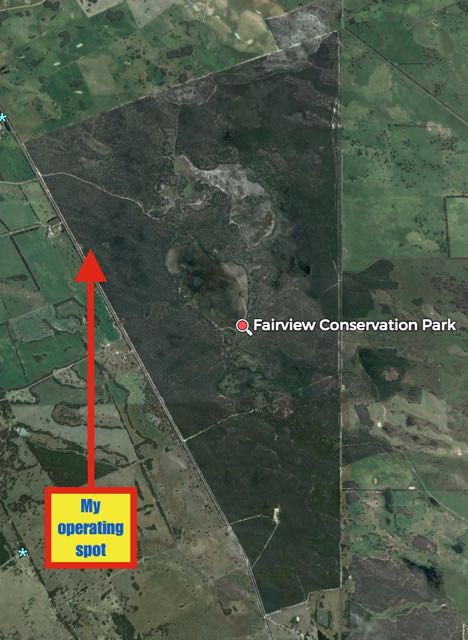
Above: Map showing my operating location in the park. Map courtesy of mapcarta.com
I found that there was a strong Asian station on 7.095 so I headed down a little lower to 7.090 and started calling CQ. My first taker of the morning was Amanda VK3FQSO and this was followed by Peter VK3TKK who was mobile, then Mark VK7MK, and then Les VK5KLD. Signals were excellent from all four stations.
I worked a total of 11 stations, until a VK5 planted himself on 7.088 and started calling CQ. My last contact there was with Gerard VK2IO who was mobile. So due to the QRM I QSYd up to 7.095 and was followed up by Scott VK7NWT. I worked a total of 13 stations here before the UTC rollover at 9.30 a.m. This included a contact with Al VK7AN who was on Flinders Island OC-195 in the Strzelecki National Park, VKFF-469. A new park for me. And man, was Al’s signal strong.
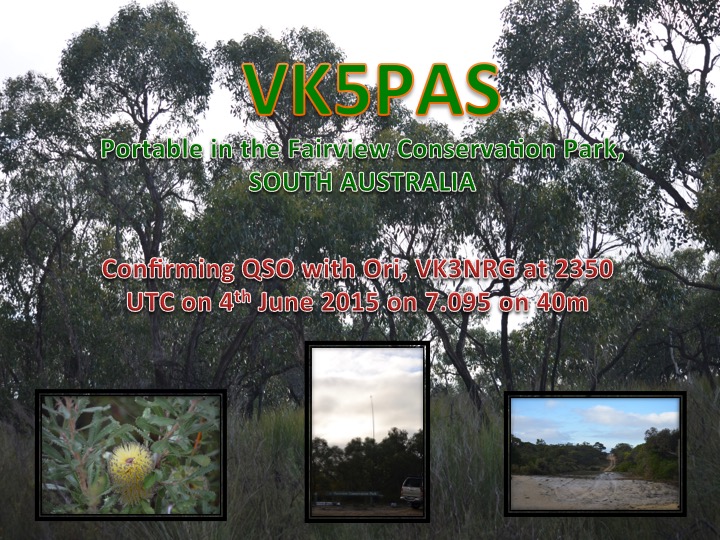
I also spoke with Ori who was kind enough to send me some photos via email (see below).
In turn I sent off Ori one of my unique QSL cards for this activation at Fairview (see below).
My first taker after the UTC rollover was Mr. Reliable, John VK5BJE in the Adelaide Hills with a very nice 5/9 signal. And this was followed by another park devotee, Les VK5KLV in Port Augusta. Les always has a 5/9 plus signal. My next contact was with Bryce VK3NBI. I was his first ever contact on 40m (5/9 both ways).
Just one QSO later I spoke with Rod VK5KFB who was mobile at nearby Willalooka, on his way down to Mount Gambier for the South East Radio Group Convention. I also worked Dave VK2BDR (Dodgey Bodgey Radio) who was also mobile (5/8 sent and 5/7 received). My last contact on 40m was with Cliff VK2NP.
This slideshow requires JavaScript.
So after working a total of 35 stations on 40m, I lowered the squid pole and removed the links in the antenna and headed off to 20m. I went to my normal calling frequency of 14.310 and asked if the frequency was in use, and this was answered by Dave VK4DD who told me that he had just started calling CQ from SOTA summit Springbrook Mountain VK4/ SE-011 in the Springbrook National Park VKFF-463. Now that was very fortuitous to stumble across Dave.
After working Dave I headed down to 14.305 and put out half a dozen CQ calls but had no takers. Unfortunately I had no mobile phone coverage in the park so I was not able to spot myself on parksnpeaks. And anyway, it had started to drizzle with rain. So I hastily packed up the gear and hit the road for my next park, Vivigani Ardune Conservation Park.
I would like to thank Greg VK5ZGY mobile who I worked during this activation, and gave me some good directions on how to get to Vivigani Ardune.
The following stations were worked on 40m SSB:-
VK3FQSO
VK3TKK/m
VK7MK
VK5KLD
VK5FMID
VK3PF
VK3FMLMR/m
VK5FTVR
VK3JW
VK3TJK
VK2IO/m
VK7NWT
VK5FAJH
VK1AT/3
VK3PRF/m
VK5NIG
VK5HEL
VK5JK
VK3NRG
VK7FLI
VK7AN
VK3DBP
VK5ZGY/m
VK1MCK
VK5BJE
VK5KLV
VK3NBI
VK3FACE
VK5KFB/m
VK2SK
VK3OF
VK5FANG
VK2BDR/m
VK2HHA
VK2NP
The following station was worked on 20m SSB:-
VK4DD/p (SOTA VK4/ SE-011 and VKFF-463)
References.
Natural Resources Group, Deaprtment of Environment and Natural Resources, 1994, Small Inland Parks of the South East Management Plan
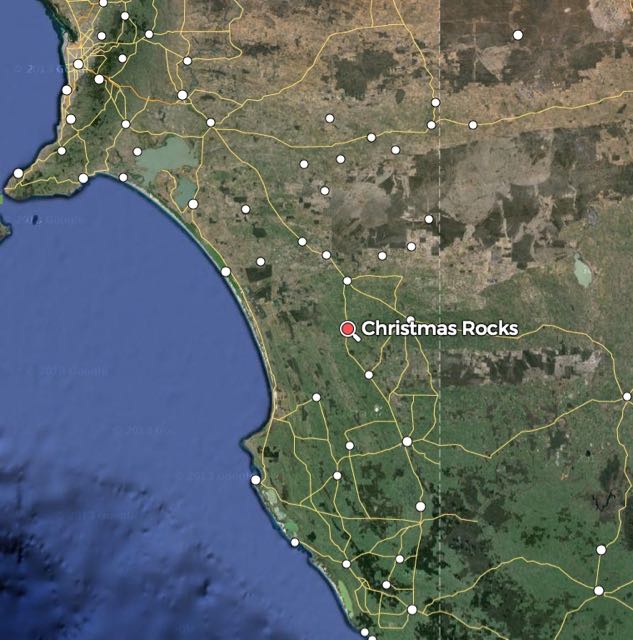
After packing up at Aberdour Conservation Park, I headed back to the Riddoch Highway and travelled south towards my next activation which was the Christmas Rocks Conservation Park, which was to be another unique park for me as an activator. It was just a very short drive from Aberdour CP.
The Christmas Rocks Conservation Park was proclaimed in 2014 and is just to the north of the little town of Willalooka. Don’t blink, because you will miss the park. There is just one small brown sign on the western side of the Riddoch Highway, with a camera sign and the words Christmas Rocks. If you’ve reached Willalooka when travelling south, you have come too far.
The sign indicating the park
The small town of Willalooka
The park itself consists of some fairly dense scrub and a series of granite rocks which were once part of the archipelago of granite rocks in the shallow sea that covered the Limestone Coast some 25 million years ago. I recommend taking the time to walk to the top and admire the views of the surround countryside. It is a very easy 10 minute walk from the carpark. Sadly, there is no real defined park. It is another example of the poor state our parks are in South Australia.
Prior to activating, I did exactly that. I took a walk up to the top of the granite rocks while the showers had disappeared. Although not high above sea level, there are some very good views of the district.
This slideshow requires JavaScript.
I set up in the scrub about 10 metres in from the carpark. The weather was still terrible, so I didn’t want to be too far from the vehicle. I had hoped to take the Yaesu FT-817nd up onto the top of the rocks, but it was just too wet. So I quickly set up the equipment, my Yaesu FT-757d (set on 40 watts) and a 40m/20m linked dipole supported on a 7 metre squid pole.
This slideshow requires JavaScript.
I called CQ again on 7.095 and this was answered by Tony VK5FTVR at Strathalbyn, followed by Scott VK5FSKS mobile at Swan Reach with a nice 5/8 signal, and then park stalwart, Mick VK53PMG in Stawell in western Victoria. Eugene VK5ZA mobile at Auburn in the Clare Valley was next, followed by another park devotee, Adrian VK5FANA on the Yorke Peninsula.
Whilst I was operating, the area was alive with birds. Of the feathered variety! The gum trees were in flower so that attracted the New Holland Honeyeaters. There was also a large number of Superb Blue Wrens and Fantails.
After the callers had slowed down, I had a quick tune around the band and found Phil VK2JDL calling CQ from a SOTA peak, Mount Coryah VK2/ NW-004 in the Mount Kaputar National Park VKFF-353. Phil was my last contact (5/7 both ways), just as the rain started to come down again. It was a quick pack up and back to the vehicle.
After 40 minutes in the park, I had a total of 22 contacts in the log from VK2, VK3 & VK5.
Aberdour Conservation Park was my first park activation for the week away in the South East. I left home early on Thursday morning (4th June 2015), and journeyed down the Dukes Highway to Keith, where I turned off onto the Riddoch Highway. About 10 km from the park I had a QSO on 40m with Gary VK5ZK, Rick VK5BGN, and a few other VK5 locals. It was good to try out the new Codan 9350 antenna on the Toyota Hi Lux.
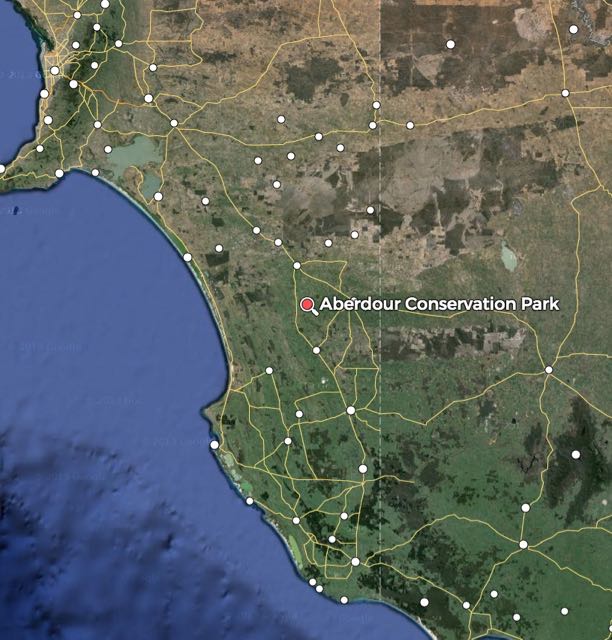
Aberdour Conservation Park is about 35 km south of Keith on the eastern side of the Riddoch Highway (Naracoorte-Keith Road), and about 260 km by road from Adelaide. It is quite a large park, being 133 hectares in size. It was dedicated as a Conservation Park in February 1991, and was a gift from the Nankivell family. In fact Nankivells Road runs on the eastern side of the park. The park preserves an area of remnant vegetation which is very typical of undulating dune and limestone country of the South East.
Above:- Map showing the location of the park in SE South Australia. Map courtesy of mapcarta.com
There has been extensive clearing of the surrounding countryside and the park provides an important habitat for a large amount of native wildlife. The park contains the Nationally endangered Jumping Jack wattle Acacia enterocarpa.
I haven’t been able to find out an origin of the name of the park. Unfortunately there is not a lot of information on the internet about this park and DEWNR were unable to assist. There is a town called Aberdour on the south coast of Fife in Scotland. Perhaps it has some association.
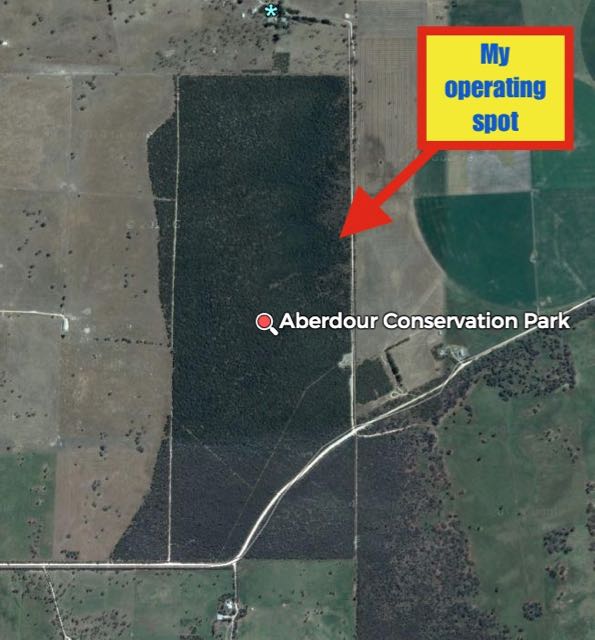
I turned off the Riddoch Highway onto Cannawigara Road and travelled east. A few km down the road (which is a dirt road), I saw the park sign on my left on the northern side of the road. There was an access track at the south western corner of the park on Cannawigara Road, but it was extremely wet and sandy and I didn’t feel like getting out and lowering the tyre pressure in the Toyota Hi Lux. So I continued down Cannawigara Road and turned left into Nankivells Road and travelled north along the eastern boundary of the park. At the end of Nankivells Road, which becomes a dead end road, there is another sandy 4WD track which follows the northern boundary of the park. But I turned back around and found a clearing in the scrub, and parked the car on Nankivells Road.
Above:- Map showing my operating location. Image courtesy of mapcarta.com
The scrub in the park is very thick, but I had found a nice clearing and quickly set up my fold up table, deck chair, and antenna, trying to beat the rain. It was not the best of days for park activating, with quite a lot of shower activity and it was very cold.
My first contact after calling CQ on 7.095 was with Adrian VK5FAJH in Port Pirie with a nice 5/9 signal. This was followed by Tony VK5FTVR in Strathalbyn, and then Rick VK5BGN who I had spoken to from the mobile. Thanks for coming up to say g’day Rick. The showers were starting to set in, so I deployed the bothy bag to try to stay dry. It was pleasing to hear a steady flow of callers from lots of the regular park hunters, but also a number of new callers, from all around Australia.
In fact, during my 45 minutes in the park I had contacts on 40m into VK2, VK3, VK5, VK6, and VK7. The band seemed to be in quite good condition with 5/7-8 signals coming in from Western Australia.
After a total of 23 contacts, I lowered down the squid pole in the rain, and took out the links in the dipole and started calling CQ on 14.310. This was answered by Peter VK6RZ firstly with a beautiful 5/9 signal, followed by Max VK6FN who was also 5/9. But the rain had got the better of me. It was that heavy and steady that water was seaping through the bothy bag, so it was time to pack up and head for the warmth of the vehicle. I had a total of 25 contacts in the log and this was a unique park for me as an activator.
Thanks to Paul VK2HV and Peter VK6RZ for spotting me on the DX Cluster and to those that spotted me on parksnpeaks.
This slideshow requires JavaScript.
The following stations were worked on 40m SSB:-
Adrian VK5FAJH
Tony VK5FTVR
Rick VK5BGN
Ivan VK5HS
David VK5KC
Ian VK5IS
Adrian VK5FANA
Allen VK5FD
Paul VK2HV
Jeff VK5JK
Les VK5KLD
Jim VK1AT/3
Greg VK5ZGY
John VK5FANG
Peter VK3PF/m
Andy VK2VOO/m
Geoff VK5HEL
Peter VK6RZ
Tony VK7LTD
Max VK6FN
Mark VK7MK
Ian VK5CZ
Rich VK6HRC
The following stations were worked on 20m SSB:-
Peter VK6RZ
Max VK6FN
References.
Department of Environment and Natural Resources, 1997, Aberdour and Mount Monster Conservation Parks Management Plans
On Thursday 4th June 2015 I headed down to the South East of South Australia, and returned home on Tuesday 9th June, 2015. My destination was Mount Gambier where I attended the South East Radio Group (SERG) Convention and National Fox Hunting Championships. This is the 51st year that the event has been held.
Whilst there I activated a number of South Australian National Parks and Conservation Parks as part of the VK5 National and Conservation Parks Award, and World Wide Flora Fauna (WWFF). See below for more info. I had a great time at the SERG Convention. On Saturday morning after my first park activation, I attended the Scout Hall in Margaret Street Mount Gambier, where I set up a display table promoting the VK5 National and Conservation Parks Award and the WWFF. On display I had a number of award certificates, my Yaesu FT-817nd, my Yaesu FT-857d, 44 amp hour power pack, LiFePo batteries, SLAB batteries, bothy bag, handheld GPS devices, solar panels, & antennas. I also had a number of promotional handouts. I occasionally snuck away to see if I could pick up a bargain from some of the traders. Both private and commercial sellers were in attendance, including Ross from Strictly Ham. There was plenty of good food on offer, with the kitchen always busy. Foxhunting events were held all day on Saturday and Sunday. And late on Sunday afternoon there was a very interesting presentation on Surface board mounting of components. This was followed by the award presentations for the fox hunting events. And finally, a dinner was held in the adjacent hall with soup, a choice of roast beef or roast chicken, followed by apple crumble. I highly recommend the SERG Convention to anyone who hasn’t attended. Congrats to the SERG team for putting it all together. I’ll mention a bit more about the Convention in other posts to follow.
And of course as I mentioned earlier, I also activated a few parks (17 in total) whilst in the area, including a joint activation with Alan VK5FAJS at the Tantanoola Caves Conservation Park on Monday. It was very pleasing to pick a number of new ‘regular’ park hunters who have gained an interest in the VK5 Parks Award & WWFF. And also some regular calls on 40m from Ken ZL4KD (even during the middle of the day).
Not all the activations went to plan. There were a couple of parks I did not get to…Talapar and Mullinger Swamp. This was due to a combination of the terrible weather (it was June in the South East after all) & not being able to access Talapar. But I did sneak in some others.
Here are some stats from my activations………..
Total of 17 parks activated
11 unique VK5 parks for me
8 unique WWFF parks for me
Total of 751 contacts
about 1700 km driven over the 6 days
countries worked: VK, ZL, USA, Belgium, Italy, Germany, France, Poland, Spain, Israel, Hungary, England, Belarus, Russia, Romania, Serbia, Czech Republic, Ukraine, Canada.
Thursday 4th
Aberdour Conservation Park……….25 contacts
Christmas Rocks Conservation Park……….21 contacts
Naracoorte Caves National Park VKFF-380……….63 contacts
Friday 5th
Fairview Conservation Park……….36 contacts
Vivigani Ardune Conseervation Park……….35 contacts
Mary Seymour Conservation Park……….27 contacts
Big Heath Conservation Park VKFF-792……….45 contacts
Hacks Lagoon Conservation Park……….32 contacts
Saturday 6th
Penambol Conservation Park VKFF-802……….52 contacts
Telford Scrub Conservation Park VKFF-805……….63 contacts
Tantanoola Caves Conservation Park VKFF-804……….49 contacts
Nene Valley Conservation Park VKFF-801……….49 contacts
Tuesday 9th
Gower Conservation Park VKFF-798……….50 contacts
Calectasia Conservation Park……….30 contacts
Penola Conservation Park VKFF-803……….73 contacts
I will put some more info & photos up here over the coming weeks about each activation. Thankyou to everyone that called, and thanks to those who took the time to spot me on either parksnpeaks and/or the DX Cluster. It really does help.
On Saturday afternoon after the AHARS meeting I travelled to the Mark Oliphant Conservation Park, VKFF-782, for another unique activation for the World Wide Flora Fauna (WWFF) program. The park was recently added to the WWFF program.
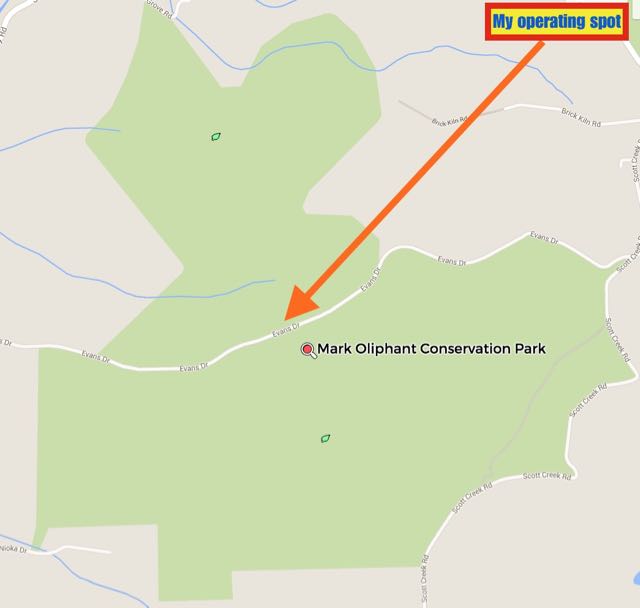
I set up at gate 11 off Evans Drive which runs through the middle of the park. There is a nice cleared area here to string out a dipole.
Above:- My operating spot. Image courtesy of mapcarta.com
I had spoken with Larry VK5LY on the way to Mark Oliphant. Larry was operating portable with Ivan VK5HS and Peter Vk5FLEX, in the Pike River Conservation Park. Larry had agree to hang around to get a ‘park to park’ contact. So after setting up I quickly tuned to 7.105 and heard Larry calling with a very strong 5/9 signal. I got Larry in the log and this was followed by Peter VK5FLEX.
I then headed up to 7.144 and started calling CQ. My first taker there was Alan VK4AL (5/7 both ways), followed by Andrew VK1NAM mobile 3 (5/8 both ways), and then Andrew VK5NPP operating portable from near Mannum in the Riverland region of South Australia (5/9 both ways).
Whilst operating I had a local fella walk by on nearby Evans Drive and he waved to me and had obviously heard me on the radio. He shouted out “I am QSYing”. I took a quick break from the radio and had a chat with him and found out that he was not an amateur, but had studied radio back in his cadet days. I think he said with the Army or the Air Force.
I went back to chatting on 7.144 and worked a few more VK’s and another local then walked by, with her dogs. Again I stopped for a short time to have a quick chat. She said she was on the way to the shops but would stop off for a look at me operating on her way back. By the time I got back to the radio, a VK2 had moved in on 7.145. So I QSYd down to 7.141 and called CQ and this was answered by David VK5KC. I worked a further 15 stations in VK2, VK3, VK4, VK5 & VK6, before deciding to have a try on 20m.
This slideshow requires JavaScript.
Unfortunately I could not get on to my nominated operating frequency of 14.244 as the band was very busy. So I headed up to 14.310 and started calling CQ. To my surprise, my first taker was Swa, ON5SWA in Belgium followed by Luciano I5FLN and then Max IK1GPG. I later worked out why the Europeans had found me. Allen VK3HRA had spotted me on the DX cluster. And this was followed by two more spots by ON5SWA and I5FLN. Thanks for spotting me gentlemen. It certainly helps enormously to drag in the park hunters.
Conditions on 20m were not great. It was quite a struggle at times. But I did manage to get a total of 30 stations in the log on 20m. Countries worked were Belgium, Italy, Spain, Ireland, Germany, Hungary, Switzerland, Slovak Republic, and Slovenia. VK’s worked on 20m were Greg VK8GM with a booming signal, and Daniel VK6LCK. And again I managed a contact with my great mate, Marnix OP7M.
I headed back to 40m where I intended to stay for just a short while as it was getting extremely cold. But pleasingly, I had a lot of callers, so I was there for a little longer than planned. First taker upon returning to 40m was Rob VK4FFAB who is a very keen park activator and hunter. This was followed by another eager activator and hunter, Mick Vk3PMG. A few calls later, perrin VK3XPT gave me a shout whilst he was mobile, using his Codan 9350 antenna, minus the whip. Considering that, Perrin had a great 5/7 signal and Perrin gave me a 5/9 signal report.
A few calls later, Brian ZL2ASH gave me a call from Wellington. Although not as strong as normal, Brian was still 5/9 and also gave me a 5/9 signal report. A few QSOs later I was very pleased to receive 4 calls in a row from VK6 Foundation operators. They being Simon VK6FSYM, Ahmed VK6FHAM, Chris VK6FDKR, and George VK6FADD. It was a little difficult at times with Simon and Ahmed, as some VK3’s and some USA stations had moved in on 7.140 and were bleeding over onto 7.138.
My last contact for the activation was Darren, VK2NNN in Bondi in New South Wales. I then hurriedly packed up, as it was now extremely cold. It was down to just 4 degrees celsius and was almost completely dark. I had a total of 77 contacts in the log.
On Friday afternoon (22nd May 2015) I headed over to the Mylor Conservation Park (CP). I had activated the park twice before, but this would be my first activation under the World Wide Flora Fauna (WWFF) program. The Mylor CP was recently added to the WWFF program.
For information on my previous activations, have a look at…..
I set up in my normal spot, just inside the gate off Whitehead Road, which runs off the Strathalbyn Road. The park is very well signposted on the Strathalbyn Road so there are no problems in locating the park.
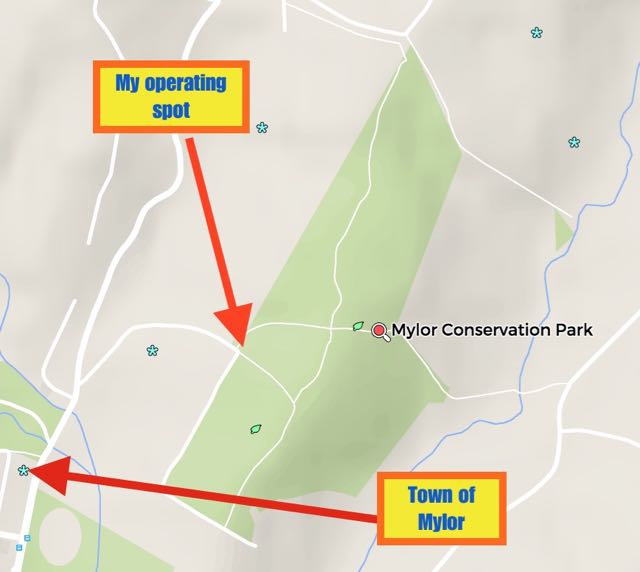
Above:- My operating spot. Image courtesy of mapcarta.com
I started off on 40m and called CQ on 7.144. It took a few minutes before some of the regulars found me. First up was Mick VK3PMG in western Victoria (5/9 both ways), followed by Paul VK3DBP (5/9 both ways), Peter VK3PF (5/9 both ways), and then Amanda VK3FQSO running just 500 milliwatts (5/8 sent and 5/9 received).
I worked a total of 16 stations on 40m from VK1, VK2, VK3, and VK5, before QSYing to 20m. I could not get on my nominated operating frequency of 14.244 as there were stations either side from Europe. So I headed up to 14.310 and called CQ. After a few calls, I was called by Baden VK7BRY, followed by John VK2EJP and then Adam VK2YK. My fourth contact on 20m was John VK5BJE.
Thanks to Adam VK2YK who spotted me on the DX cluster, as this resulted in the European park hunters finding me. After working John, I was called by a number of European and UK callers. First taker was Danny ON4VT, followed by Axel DL1EBR and then Luciano I5FLN.
This slideshow requires JavaScript.
After working a total of 36 stations, things slowed down. So I took the opportunity of tuning around the band. I found a very rare DXCC working a pile up on 14.225. It was Bruce ZD7VC on St Helena Island. I had worked Bruce before, from home and also whilst out portable, but I was determined to get Bruce in the log from another park. I persevered for about 20 minutes and finally made contact (5/8 sent and 5/6 received).
Below is a video of how well Bruce was coming in to Mylor CP…..
After working Bruce I quickly went back to 40m to hopefully get Adrian VK5FANA in the log. Adrian had sent me an SMS message asking me if I was going to go back to 40m. I could not get back onto 7.144 as it was occupied by some other stations, so I called CQ a few times on 7.140 and I was very pleasantly surprised to receive a call from the man himself, Adrian. This was followed by another park stalwart, Rob VK4FFAB. Peter VK2NEO who was mobile then called me, followed by another dedicated park hunter, Doug VK2FMIA. My last caller was Leo VK3FLMR mobile.
At 5.30 p.m. (0800 UTC) I packed up my gear and headed home. My son was coming up for tea and to watch the Aussie Rules football with me. This was another successful activation with a total of 58 stations in my log.
Most of Saturday (2nd May 2015) I spent around the home of Ivan VK5HS at Renmark, having my new Codan 9350 antenna installed on my Toyota Hi Lux. During the morning Peter VK5FLEX called in, as did John VK5FANG. It was a long day. In fact we didn’t finish until late in the afternoon, and after a few beers I headed back to my motel room.
This slideshow requires JavaScript.
But there wasn’t a lot on the television, so I decided to head out to activate the Pike River Conservation Park, which was to be another new unique park for me as an activator. The park is just a short drive out of Renmark along the Sturt Highway towards the Victorian/South Australian border.
To get to the park, you need to cross the historic Paringa lifting bridge which I took the opportunity of stopping here for some photographs. The Paringa Bridge, which was constructed in 1927, is one of only two opening bridges in South Australia. The other is at Port Adelaide. The Paringa Bridge is technically a ‘lift span’ bridge as it has a section that lifts up to allow large vessels through.
This slideshow requires JavaScript.
The Pike River CP is about 296 hectares in size and consists of a major floodplain and a branch system of the River Murray. The park has a number of species of national significance including the Southern Bell Frog, Murray Cod, and the Regent Parrot. It also contained an additional 18 species with State Conservation significance.
Again, this park is not at all signposted. So you will need to rely upon your GPS. There is an open and unlocked gate on the western side of the Sturt Highway which takes you into the park. The track is okay, but in 2WD, you will only be able to reach a certain point. I drove all the way down to the water’s edge and set up on the edge of the track.
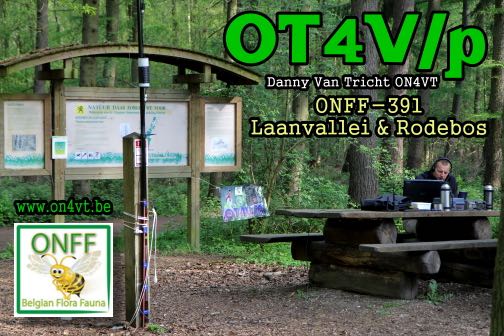
As it was quite late (4.45 p.m.) I headed straight to 20m. For this activation I ran the Yaesu Ft-857d, 70 watts and the 40m/20m linked dipole supported on the 7 metre telescopic squid pole. I called CQ only once, on 14.310, and to my surprise, my CQ call was immediately answered by ON6PV in Belgium. And I was even more surprised when my second caller was Danny OT6V who was portable in a park in Belgium, Rodebos en Laanvallei, ONFF-391 (5/3 sent and 5/5 received). Here is a link to Danny’s page about that activation…..
I was then called by Rod VK4NUM, followed by Ray VK4NH portable near Bourketown, and then Aaron AL4Y in Alaska. Aaron was a very nice 5/8 signal and he gave me a 5/6 signal report. Aaron was also kind enough to spot me on the DX cluster and this resulted in a large pile up. In fact I worked a total of 60 stations in Belgium, VK4, Alaska, Italy, VK6, Denmark, Hungary, Germany, France, Switzerland, Slovenia, Lithuania, Sweden, Azores Islands, Russia, Slovak Republic, Spain, Estonia, Portugal, Canary Islands, Ireland, Netherlands, USA, and England. And again, I spoke to my good friend Marnix, OP7M in Belgium.
Thanks to everyone that spotted me on the DX cluster.
I then moved over to 40m. It was now totally dark and the local time was 6.00 p.m. I called CQ on 7.110 and this was answered by Adam VK2YK in Newcastle, followed by John VK5NJ in Mount Gambier, and then Rex VK3OF.
I had some excellent QRP contacts on 40m whilst in the park. This included Amanda VK3FQSO running 500 milliwatts (5/7 both ways), Roald VK1FIVE running 5 watts (5/6 sent and 5/9 received), Tony VK3VTH running 500 millwatts (5/8 sent and 5/9 received), Adrian VK5FANA running 5 watts (5/9 both ways), Peter VK3PF running 5 watts (5/9 both ways), Dave VK2BDR rnning 5 watts (5/9 both ways), Steve VK2FAJF also running 5 watts (5/9 both ways), Alan VK2AJG running 5 watts (5/8 both ways); Doug VK2FMIA running 5 watts (5/8 sent and 5/9 received), and Rob VK3EY running 1.5 watts (5/7 sent and 5/9 received). Band conditions on 40m were excellent.
This slideshow requires JavaScript.
I also managed a park to park contact with newly licenced amateur, Brendon VK5FFCC who was operating portable from the Morialta Conservation Park. Brendon had a nice sounding station with his Elecraft KX3, 10 watts and end fed antenna. Not a bad effort at all Brendon. Licenced for one week, and already out in a park, and sounding like a pro. Congratulations. Below is a quick video of what Brendon sounded like to me……
I also worked Ken ZL4KD in new Zealand, who has now become a familiar caller and is a member of the VK5 Parks Yahoo group.
There was an annoying noise on 7.110 though. I am not sure what it was. I’ve attached a video below, so if anyone knows what the noise is, I would be pleased to hear from you…..
When things slowed down a little I had a tune around the band and heard NP4A calling CQ on 7.129. I patiently waited my turn and gave Pedro a call and got through on the first go. I have worked Pedro a few times before whilst I’ve been out in a park, and he always puts a great signal into Australia.
This was a very successful activation, with a total of 118 contacts in the log, including some nice DX contacts.
On Friday night (1st May 2015) after checking in to my motel I drove east out of Renmark along the Sturt Highway and headed into the Cooltong Conservation Park, via Santos Road. This was to be another unique park for me as an activator for both the VK5 National & Conservation Parks Award and the World Wide Flora Fauna (WWFF) program.
Cooltong Conservation Park is situated about 250 km north east of Adelaide, and is located between Renmark and Berri. Cooltong is a large park. It is 3,681 hectares in size and was dedicated to preserve quality males vegetation and habitat for the mallee bird species that frequent the area, in particular the Malleefowl. The park is a typical mallee park, with undulating dunes and shales. The park is accessible to conventional vehicles, however some sections of the park are only accessible by 4WD.
Above:- Map showing the location of Cooltong CP. Image courtesy of mapcarta.com
I drove a few km into the park and found a little track off to the east and in turn a nice clearing in the scrub. It was an ideal spot to set up. It was slow going into the park as it was fully dark (6.30 p.m.) and the local wildlife was out in force, including the kangaroos.
Above:- My operating spot. Image courtesy of mapcarta.com
The entire 40m band above 7.135 was decimated by the Over the Horizon Radar (OTHR). This made it totally impossible to operate in that portion of the band. The OTHR radar was still audible on 7.135, but I couldn’t go any lower on the band, as the 7.130 DX Net would kick off at 0930 UTC, and everything below 7.130 was taken up by stations from South East Asia.
Below is a video of the radar…..
So I called CQ on 7.135 and it wasn’t long, before the hungry park hunters started to respond. First up was Theo VK3AP with a nice 5/9 plus signal, followed by three regular park hunters: Andrew VK1NAM, Dave VK3VCE and John VK5BJE. Local Renmark resident and mate of mine, Ivan VK5HS then called in. Interestingly Ivan said he could not hear the radar and thought the noise I was hearing might be something generated out of my vehicle. I assured him that it was definitely the OTHR.
Some of the usual QRP suspects called in for this activation. They were Adrian VK5FANA on 5 watts from the Yorke Peninsula (4/6 sent and 5/7 received), and also Peter VK3PF running 5 watts (5/9 both ways). I was also called by Adrian VK4FBMW running 5 watts. Unfortunately the JA QRM was also quite heavy on the frequency, but still, I was able to copy Adrian well with his QRP signal (4/7 sent and 5/8 received).
I also worked some stations outside of VK. They were John Zl2BH in Blenheim in New Zealand, and Ken ZL4KD in Christchurch. Ken informed me that he had seen me spotted on parksnpeaks and had decided to give me a call, and that I was his first ever VK5 Conservation Park contact. I was very pleased to have Ken in the log.
This slideshow requires JavaScript.
It was a beautiful mild evening in the park. The moon was out and due to the cloud cover, it had a very distinctive ring around it. There were quite a few bumps and crashes in the scrub whilst I was operating and I had the occasional fleeting glimpse of some of the local kangaroos.
Within the park I did see some signs that surveillance cameras were in operation. I thought this may have been due to bird trapping, but as I later found out, it is due to the dumping of rubbish. It never ceases to amaze me how poorly some people treat our environment.
I worked 38 stations on 7.135 and then at 8.10 p.m. I decided to head down to the 7.130 DX Net which is held on 7.130 every Monday, Wednesday and Friday. I worked a total of 6 stations on the net, bringing me to my required 44 contacts for the global WWFF program. I was very pleased to work the special New Zealand ANZAC call, ZL100ANZAC on the net, and also Brian ZL2ASH in Wellington.
The following stations were worked on 40m SSB:-
VK3AP
VK1NAM
VK3VCE
VK5BJE
VK5HS
VK5AKH
VK5FANA
VK2IO
VK3PF
VK1AT/3
VK3DAC
VK3JAP
VK3FSPG
VK2FMIA
ZL2BH
VK5HCF
VK5ZGY
VK3ANL
VK2QM
ZL4KD
VK3YW/m
VK4FFAB
VK5KLV
VK2GKA
VK2MRX
VK3HRA
VK2PKT
VK5EE/m
VK3BBB
VK3AN
VK3FIRM
VK3NSC
VK2BDR
VK4FBMW
VK2FAAA
VK7LCW
VK3TKK
VK3EY
ZL100ANZAC
ZL2ASH
VK5MJ
VK2FROX
VK7ROY
VK6FBMW
References.
Department of Environment and Heritage, 2011. Parks of the Riverland.















 VK5PAS