Caroona Creek Conservation Park VKFF-0875 and 5CP-037

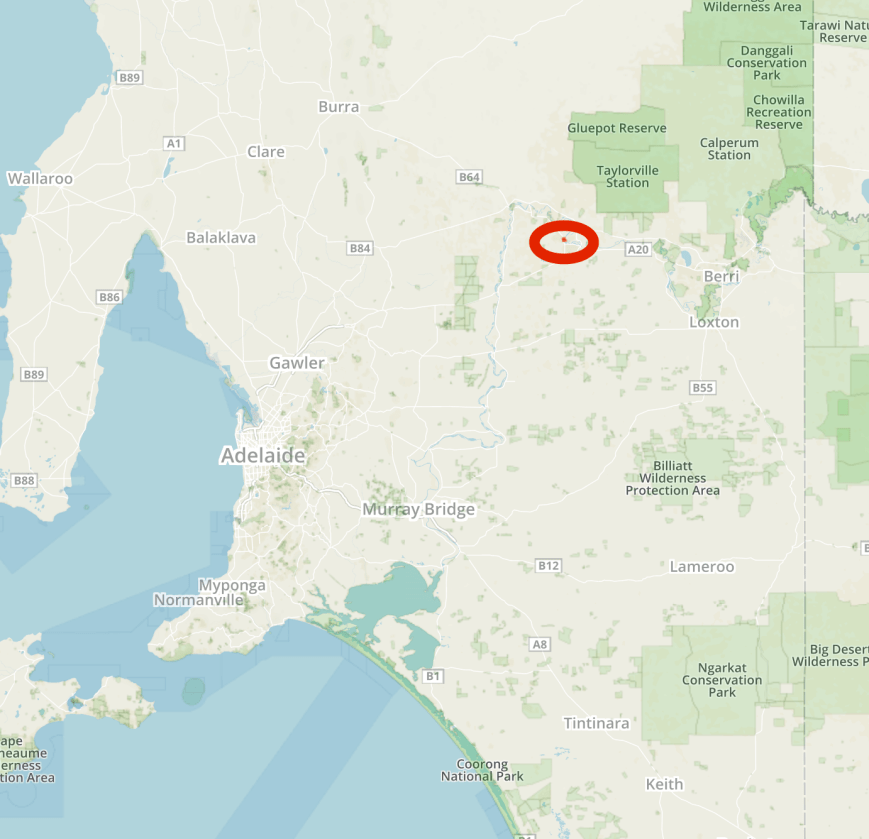
After leaving Mount Bryan, Marija and I continued on the Dares Hill Tourist drive.  Our next planned stop was the Caroona Creek Conservation Park VKFF-0875 and 5CP-037.  The park is situated about 200 km north of Adelaide and around 35 km north east of Burra.  This was to be a unique park for both Marija and I for both the World Wide Flora Fauna (WWFF) program, and the VK5 National and Conservation Parks Award.

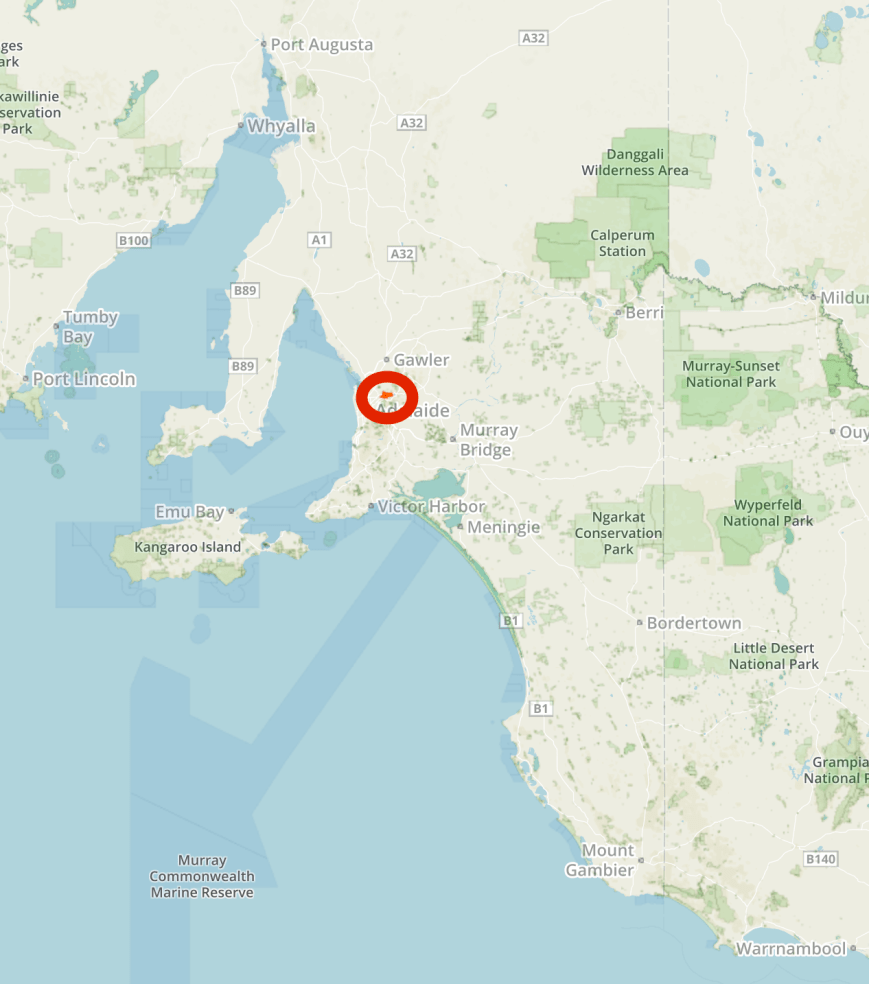
Screen Shot 2017-01-03 at 9.05.05 pm.png

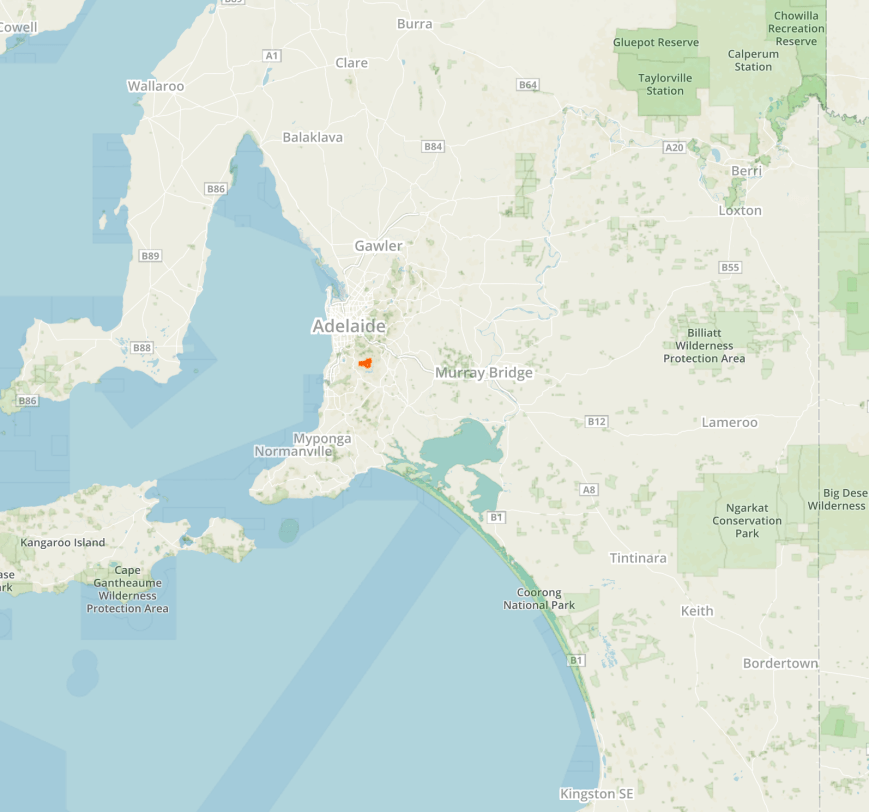
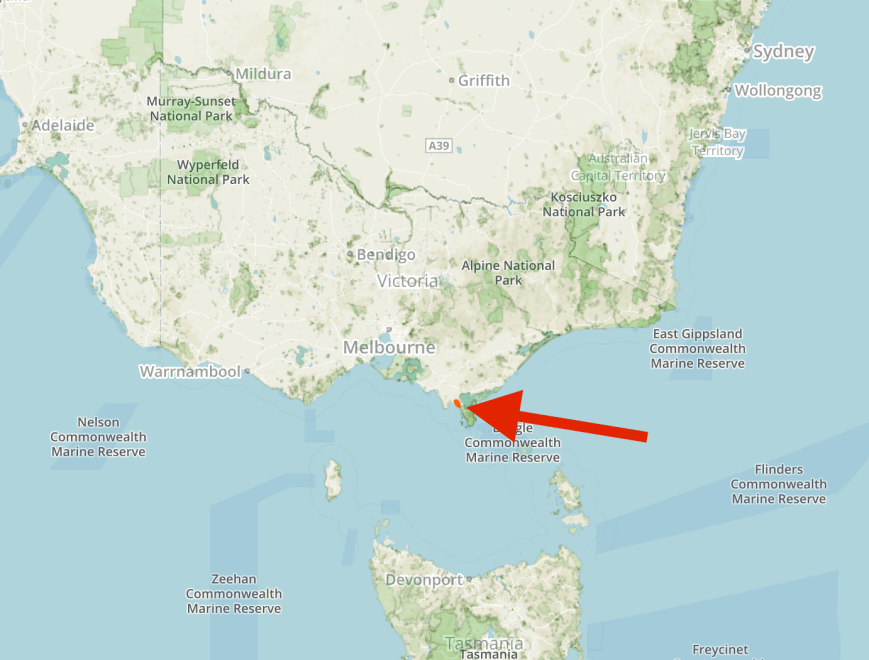
Above:- Map showing the location of the Caroona Creek Conservation Park in the Mid North of South Australia.  Map courtesy of Protected Planet.

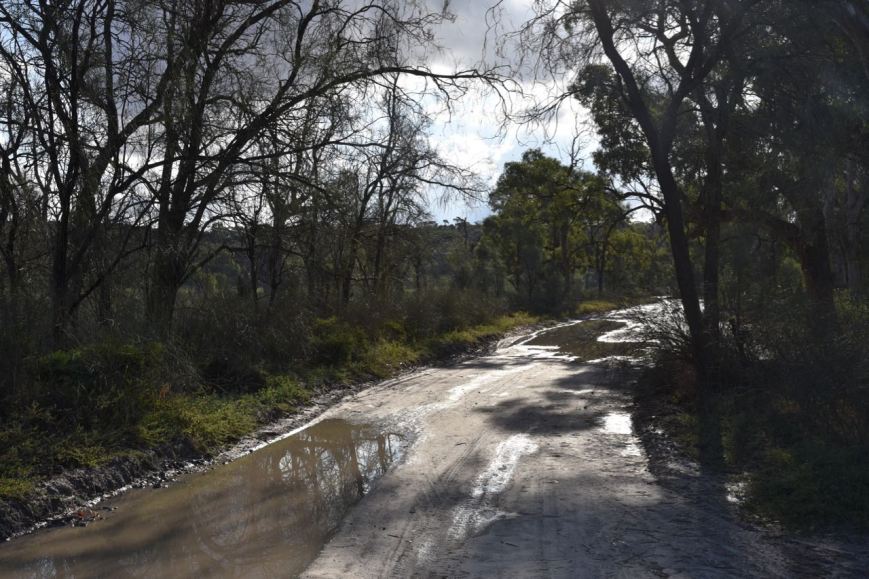
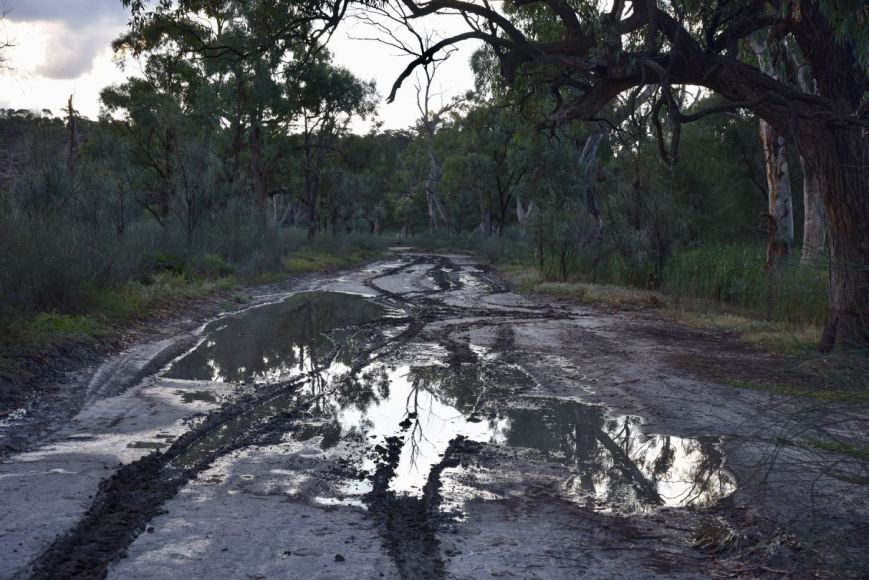
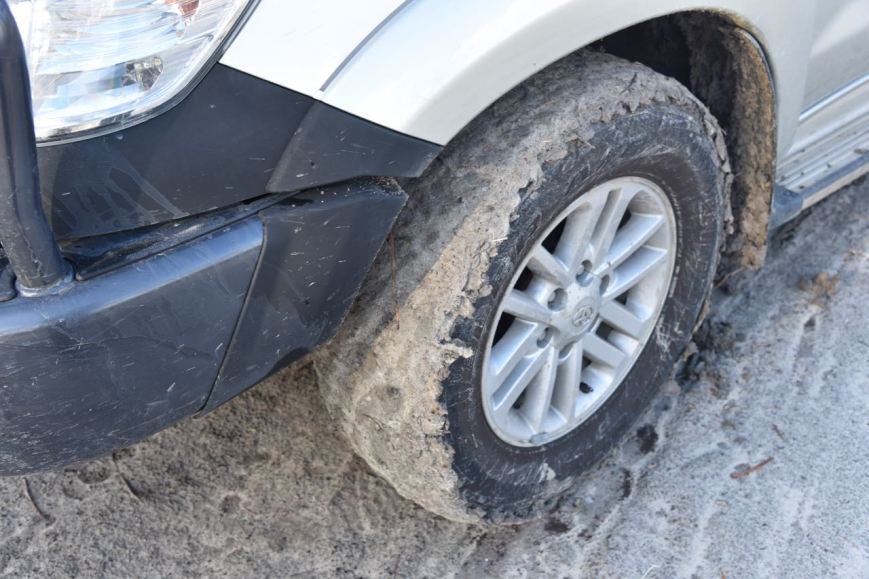
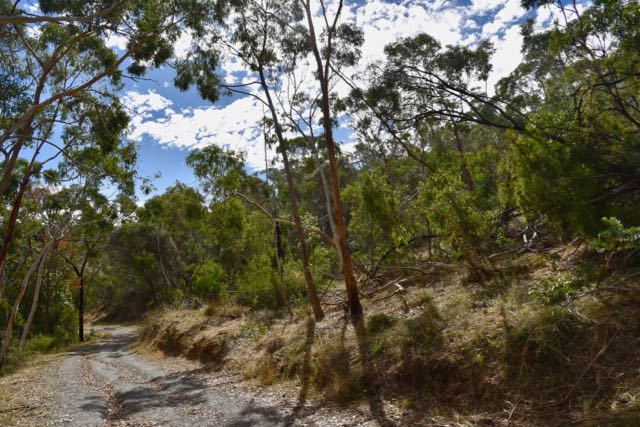
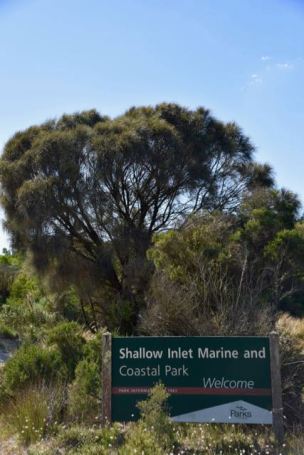
We access the park via Dare Road which runs off Mount Bryan Road East.  The park is well signposted.  Please note that access to the park is via 4WD only.  The signs indicate this, and we soon found out why.

DSC_4566.jpg

To reach the park you need to cross a handful of small creek crossings.  Depending on what time of the year you are travelling to the park, they can be flowing extremely well.  The track is also very rocky and I would definitely not recommend trying this in a conventional vehicle.  From what I have read on the internet it appears that access could be made via car from the eastern side of the park.

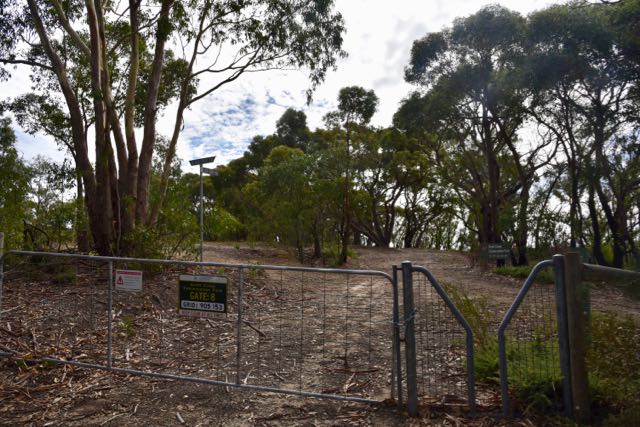
We soon reached the gate at the park boundary.

Caroona Creek Conservation Park is 4,630 hectares in size and is situated on the western edge of the Olary Plain.  It was gazetted on the 16th October 2014.  The park contains a range of landforms from steep rocky ridges and calcrete hills extending to alluvial plains.  Caroona Creek conserves a representative sample of the transitional zone between the rounded hills of the Mid North to the beginning of the rocky gorge country of the Flinders Ranges.  The northern area of the park contains the beautiful Tourilie Gorge and its surrounding rugged hilly terrain.

Although the park appears remote and desolate, there is a lot of life here.  Kangaroos, emus, Euros, and a large amount of birdlife can be found in the park.  A number of the plants were in flower during our visit.

There are no major facilities in the park.  Touralie Gorge hut can be found towards the northern side of the park.  There is a small shelter in the southern section of the park, and in the south eastern corner there is the main camp ground which contains an old shed.

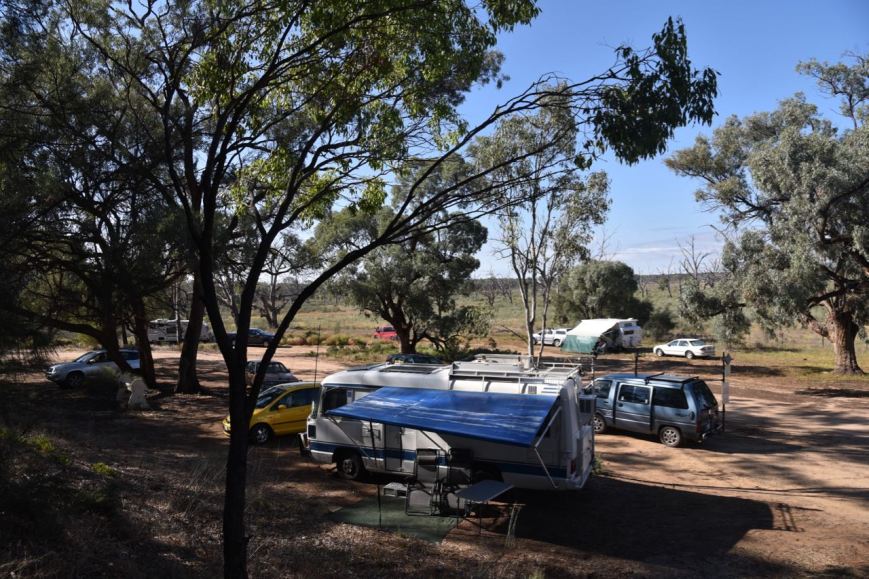
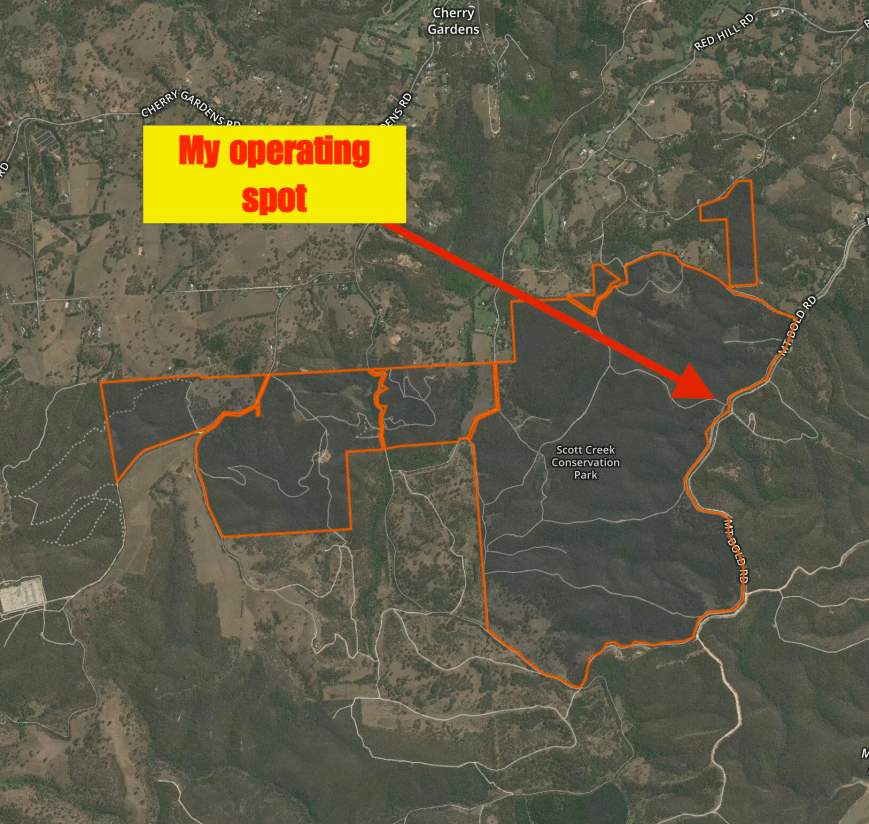
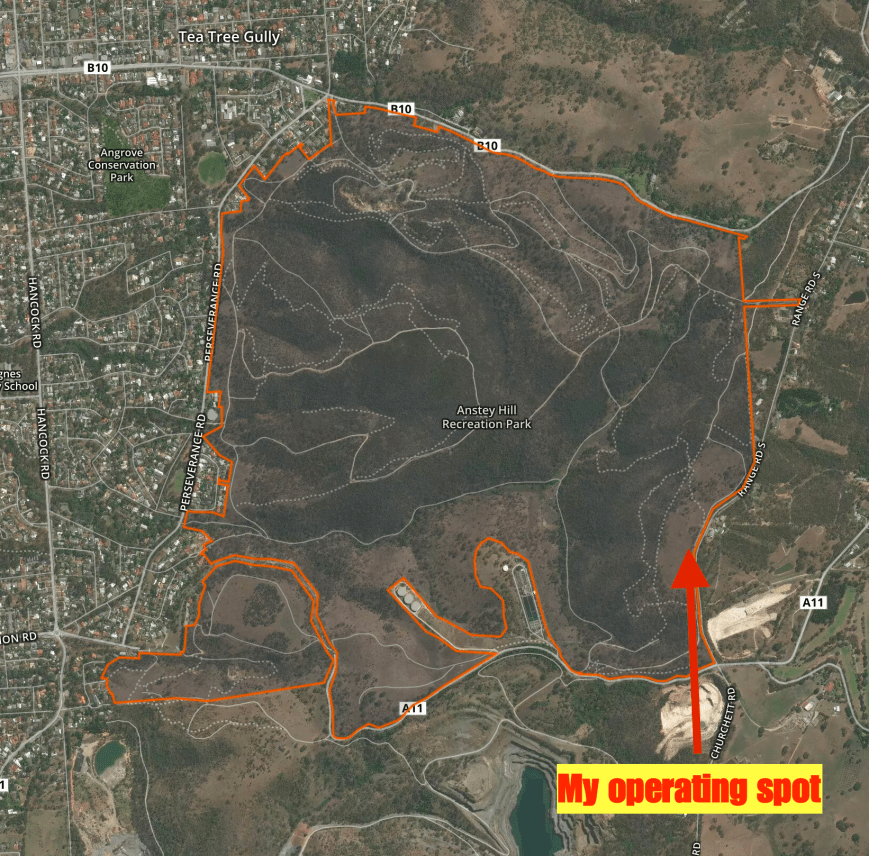
As we were a bit short of time we set up a few hundred metres inside the park boundary from the gate we entered.

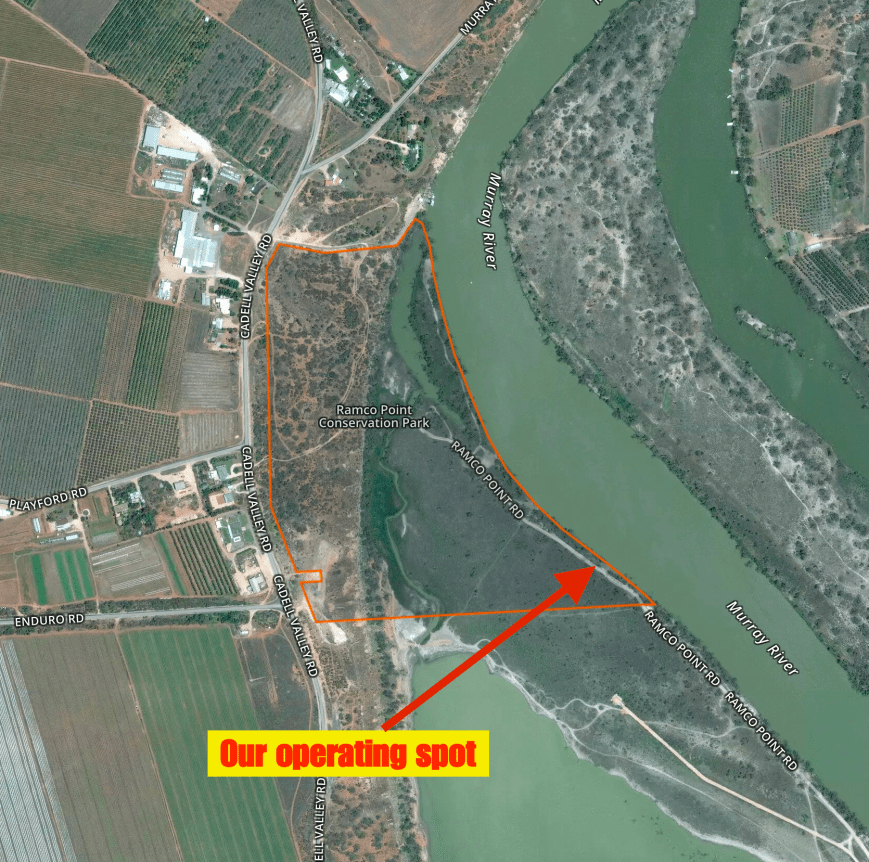
Screen Shot 2016-12-30 at 7.54.34 pm.png

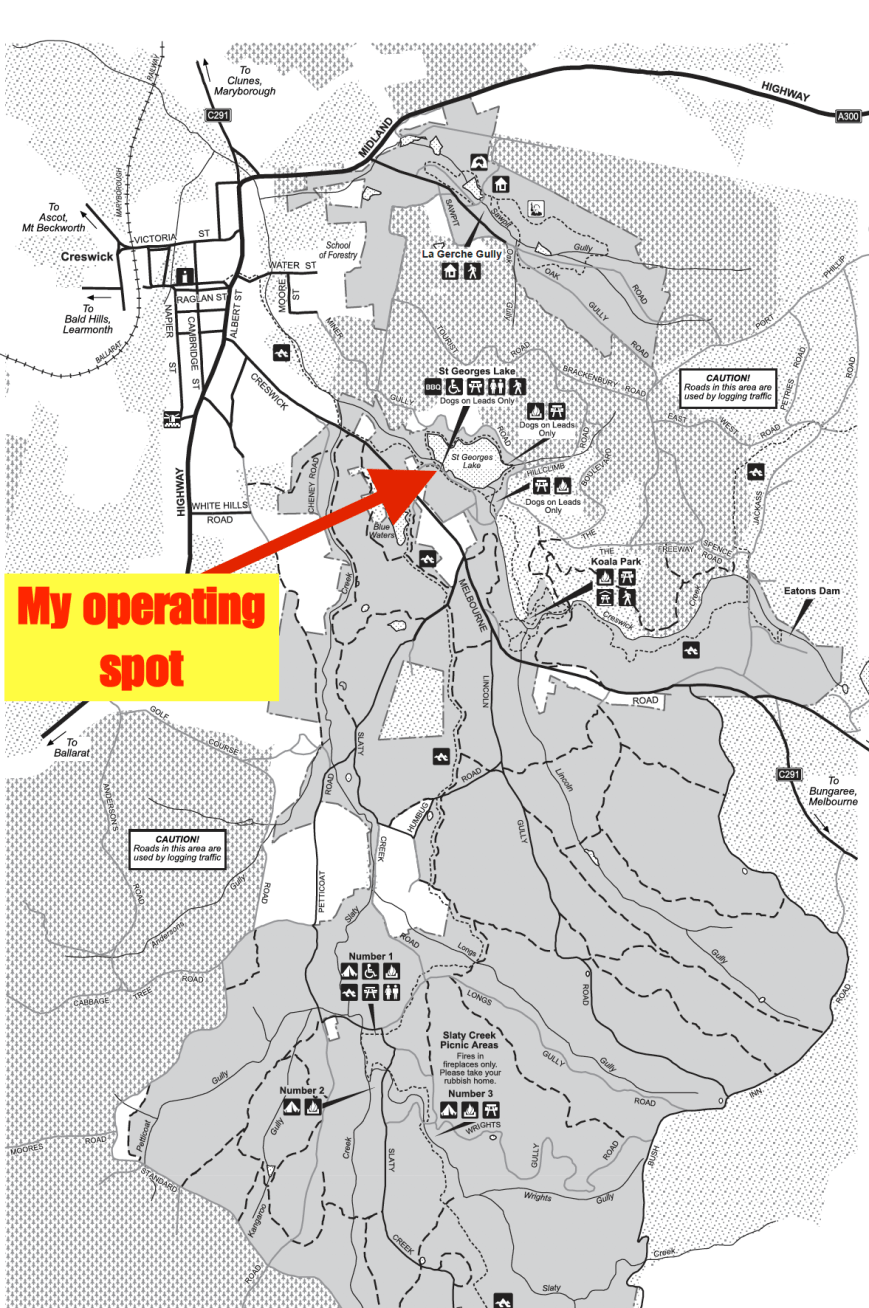
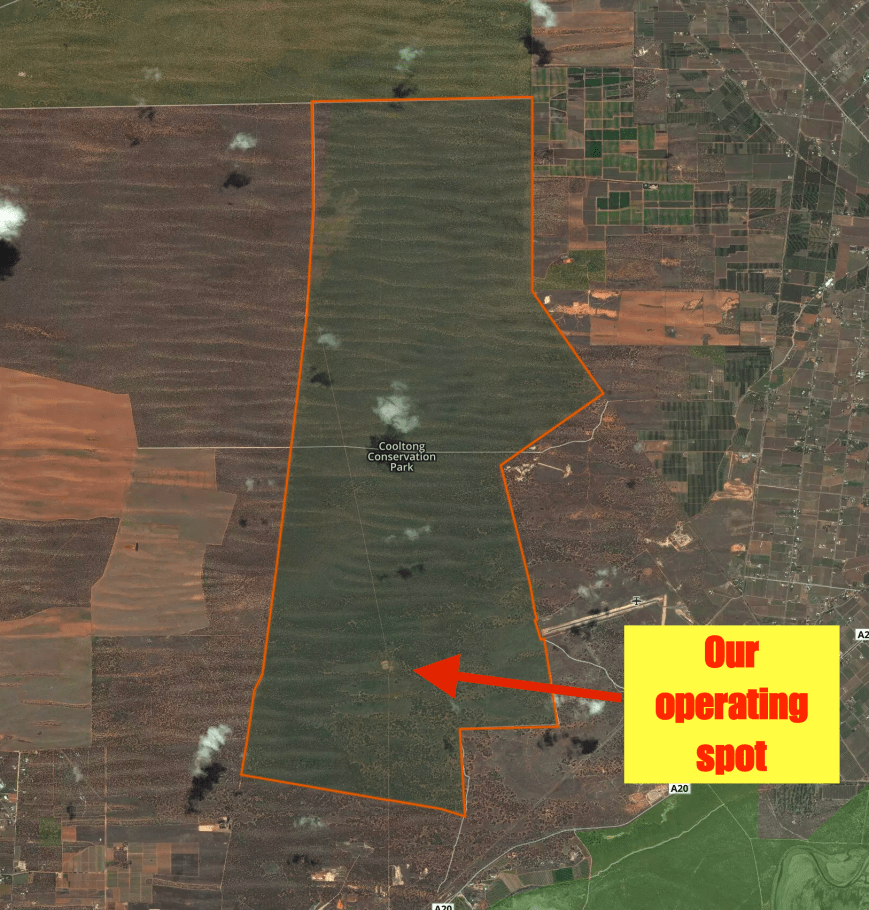
Above: Map showing our operating spot in the park.  Image courtesy of Location SA Map Viewer.

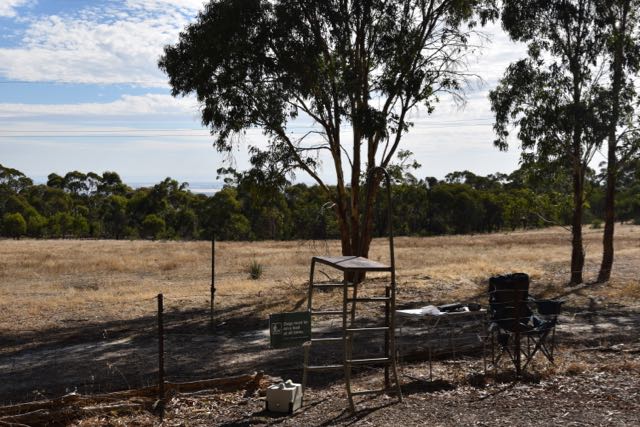
It was a warm day and there were no trees to afford any shade, so we rolled out the awning on the Toyota Hi Lux and operated from underneath the shade of the awning.  For this activation Marija and I ran the Yaesu FT-857d, and the 80/40/20m linked dipole, supported on the 7m telescopic squid pole.  I ran 40 watts and Marija ran her 10 watts.
I was not optomistic about getting my 44 contacts to qualify the park for WWFF program, but Marija kept encouraging me to be positive.  I started off first on the mic and called CQ on 7.144.  This was answered by Adrian VK5FANA on the Yorke Peninsula, with a beautiful 5/9 signal.  Brett VK3FLCS followed, along with Ivan VK5HS and Les VK5KLV.  It wasn’t long before I had my 10 contacts and I had qualified the park for the Australian chapter (VKFF) of WWFF.

It was now Marija’s turn to qualify the park.  Marija’s first contact was with David VK5HYZ, followed by Greg VK5ZGY, Les VK5KLV, and Ivan VK5HS.  Marija also racked up her 10 contacts quite quickly, which included a contact with Matt VK1MA who was on Mount Ginini VK1/ AC-008 in the Namadgi National Park VKFF-0377, and Gerard VK2IO who was on the top of Mount Elliot VK2/ HU-093.

I then took over the reigns of the mic again and slowly worked towards my 44 contacts.  And it was slow going!  The band conditions seemed to be quite good, with good signals from VK2, VK3, VK5 and VK7.  But there wasn’t a consistent flow of callers.  The 40m band was even open down to Adelaide, with a number of VK5’s logged, including Damien VK5FDEC who was running just 2.5 watts.   I worked a total of 33 stations on 40m, before deciding to try my luck on 20m.

But I was to be sadly let down.  I only worked two stations on 14.310 and they being Barry VK3LBW and Adam VK2YK mobile.  We really needed to pack up and hit the road, and I had fallen short of the 44 required QSOs, by just 9 contacts.  Oh well, a good excuse to come back to this park for the final contacts and further exploring in the 4WD.

I worked the following stations on 40m SSB:-

  1. VK5FANA
  2. VK3FLCS
  3. VK5HS
  4. VK5KLV
  5. VK5FDEC
  6. VK5PL
  7. VK5BB
  8. VK5AFZ
  9. VK3GGG
  10. VK3PMG
  11. VK2IO/p (SOTA VK2/ HU-093)
  12. VK5KHZ/p
  13. VK3SQ
  14. VK2IG
  15. VK5JK
  16. VK5ST
  17. VK3SFG
  18. VK2HHA
  19. VK7CW
  20. VK2PKT
  21. VK5ZRY
  22. VK3UH
  23. VK5MBD
  24. VK3DAZ
  25. VK2YK/p
  26. VK5ZZ/m
  27. VK3PAT
  28. VK3FSPG
  29. VK3MPR
  30. VK5DC
  31. VK5FLEX
  32. VK7ALB
  33. VK5KDK

I worked the following stations on 20m SSB:-

  1. VK3LBW
  2. VK2YK/m

Marija worked the following stations on 40m SSB:-

  1. VK5HYZ
  2. VK5ZGY
  3. VK5KLV
  4. VK5HS
  5. VK1MA/p (SOTA VK1/ AC-008 & VKFF-0377)
  6. VK4RF
  7. VK4HA
  8. VK5FANA
  9. VK5BB
  10. VK5FDEC
  11. VK3SQ
  12. VK2IO/p (SOTA VK2/ HU-093)

After leaving Caroona Creek we continued our trip along the Dare Hill circuit, travelling north east on Mount Bryan Road East and then along Wilkins Drive to the now restored Wilkins Homestead.

Sir George Hubert Wilkins was born at Mount Bryan East in 1888, the youngest of 13 children.  He went to the local school and then continued his studies at the School of Mines in Adelaide where he studied electrical engineering.  In 1909 he travelled to England where he became interested in aviation.  Wilkins spent 3 years with an Arctic expedition as a photographer, and in 1916 he joined the Great War.  He was awarded the Military Cross for his efforts in rescuing wounded soldiers during the Third Battle of Ypres.

Following the war, he took part in the famous England to Australia air race.  This won fame for Sir Charles Kingsford Smith, but unfortunately Wilkins crashed his aircraft named ‘Kangaroo’ at Crete and was unable to complete the race.

In 1927 he made several unsuccessful attempts to fly over the Arctic and was stranded on an ice pack, having to walk for 13 days to reach habitation.  He was later successful, and made several flights over the Arctic, receiving a Knighthood for his efforts.

Wilkins died in the USA in 1958.  The US Navy later took his ashes to the North Pole aboard the submarine USS Skate on 17 March 1959 and his ashes were scattered at the North Pole in accordance with his wishes.  The Wilkins Sound, WIlkins Coast and Wilkins Ice Shelf in Antractica are named after him, as are the airport at Jamestown in the Mid North of South Australia, and a road at the Adelaide Airport.

Australian entrepeneur Dick Smith provided financial support and inspiration for the restoration of the Wilkins homestead.  Smith stated:

“In practically any other country other than Australia, his birthplace would be a national shrine.  But here, many people don’t even know that it exists.  Well, we’re going to change that”.

More information on Wilkins can be found at……

http://adb.anu.edu.au/biography/wilkins-sir-george-hubert-9099

Above: Sir George Hubert Wilkins (left) and the Detroit Arctic Expedition (right).  Images courtesy of wikipedia.

We then stopped at the old Mount Bryan East township, which is now desterted.  The old school which operated between 1885 to 1919, and the church are all that is now left.

We then reached the Dare’s Hill summit which offers amazing views.  Dares Hill is named after William Dare, a Mid North pastoralist.  He was born in 1824 in London and migrated to Australia at age 14.  After working at grubbing trees in Adelaide, he was employed as a shepherd in the Barossa Valley.  In 1852 he went to the Victorian goldfields and made good.  On returning to South Australia, he secured a lease on 50 square miles of country known as Pilitimitappa which, with the help of the local aborigines, he fences and stocked with sheep.  He ran this property for 35 years.  The ruins of the Dare homestead are located in the valley below the lookout.  Dare died in 1892, having survived three wives.

We then entered into the Collinsville Station property, over the stock grid.  Out next stop was the Pilitmitiappa homestead ruins, which were established by William Dare in the 1850′.  It was one of the earliest homesteads in the area.

Coillinsville Station was established by John Collins in 1889.  The Collinsville property is world renowned for its stud rams and excellent wool.  The stud wasresponsible for about one third of the genetics in the Australian sheep flock.   In 2011, following floods in a nearby creek, the bones of a Diprotdon were found on the property.  A team from the South Australian Museum subsequently found a full adult skeleton nearby.   More information on Collinsville can be found at…..

http://collinsville.com.au/about/our-history

We then stopped at the old Ketchowla Station which was established in 1852 by Christopher Giles, father of explorers Ernest and Alfred.  Christopher Giles had only arrived in the colony of South Australia in 1849.   The old shearing shed was extremely interesting with the names and dates of various shearers painted on the wall of the shed.

As we continued along the circuit, the old wooden telegraph poles came into view.  It was also quite slow going, as there were plently of kangaroos out and about.  We also briefly stopped to have a look at Dave’s Hut ruins.  This little hut was built by David Dearlove if Ketchowla in the 1930’s and it became a popular stopover for travellers.  Sadly all that remains now is the fireplace and chimney.


References.

Department of Environment and Natural Resources, 2011, ‘Parks of the Mid North’

Wikipedia, 2017, <https://en.wikipedia.org/wiki/Collinsville_Station&gt;, viewed 4th January 2017

Wikipedia, 2017, <https://en.wikipedia&gt;, viewed 4th January 2017
Mount Bryan, VK5/ SE-001

HAPPY NEW YEAR!!!

It was nice to wake up on New Years Day without a hangover.  Our New Years Eve had been very quiet.  A meal at one of the local pubs in Burra and then me crashing on the sofa in the cottage watching the end of the Big Bash cricket on TV.  Today (Sunday 1st January 2017), Marija and I had one planned SOTA activation and two planned park activations.  We had also intended on completing the Dare Hill 4WD circuit (Tourist drive 21), a 128 km drive north of Burra.

After breakfast Marija and I headed to our first planned activation of the day, Mount Bryan, VK5/ SE-001.  This is about 50 km by road, north of Burra, and about 209 km north of Adelaide.

screen-shot-2017-01-03-at-4-35-31-pm

Above:- Map showing the location of Mount Bryan VK5/ SE-001 in the Mid North of South Australia.  Map courtesy of google maps.

It was quite a cool morning, with light drizzle and lots of cloud cover.  It did not look particularly great for the activation, and both Marija and I commented that we hoped it would clear up by the time we reached Mount Bryan.

Just outside of Burra (about 3 km) on the Barrier Highway, we made a brief stop to take a photo of a little farmhouse which is rather famous.  The 1920’s cottage featured on the cover of Midnight Oil’s ‘Diesel and Dust’ chart topping album released in 1987.  The cottage itself was voted number 2 in the 100 Best Views in Australia by Australian Traveller magazine.

In 2013 the locals realised the importance of saving this little house, and commenced a preservation fund to restore and repair the house.  Click on the link below to listen to a very interesting article from ABC Radio about the restoration process…..

http://www.abc.net.au/local/videos/2013/04/16/3737929.htm

We continued north along the Barrier Highway and it wasn’t long before Mount Bryan came into view.

dsc_4511

We then entered Mount Bryan township, about 18 km north of Burra.  The town itself was named after the nearby peak.  Mount Bryan was once a busy hub of rail transport where 44 trains per week rolled to a halt.  Shunting lines to the cattle and shee yars,  cream and egg shed, a cloakroom, good sheds, the Station Master’s Office and wheat stack yard all previously existed.  In addition to the daily passenger train services to Adelaide, the train line provided fresh fruit and vegetables, mail and health services to the district.  Passenger services departed from 1880 to 1968.  Sadly that is all long gone, and there is not much in Mount Bryan, other than a few houses and the historic pub.

We did stop briefly to have a look at one of the wind turbine blades and the associated interpretive signs.

Marija and I then drove north east out of Mount Bryan along the Mount Bryan East Road, which is the commencement point of the Dare Hill circuit.  We stopped to have a look at the Mount Bryan Bible Christian Chapel ruins.  The chapel was built in 1871 and was the place of worship of Henry Collins (1832-1929, a pastoral pioneer of the district who established the Lucerndale sheep stud.  Collins arrived here in 1859 and too up 80 acres of land on which he built a single room pine and daub cottage.  He engaged in carting wood to the Burra mine.  In 1879 as an experiment, he was the first to plant lucerne on his property which flourished.  As a result of this valueable crop, in 1884 he was able to buy a stud ram and quality ewes, on which he based the development of his successful sheep breeding venture.

The following is an extract from The Advertiser, Saturday 19th October 1929 re his death

Screen Shot 2017-01-03 at 6.11.31 pm.png

We continued along Mount Bryan Road East, with the weather still looking very ominous.  This area is dotted by various ruins, a reminder of the very difficult and remote life that the pastoralists led during the 1800’s and early 1900’s.

dsc_4523

Marija and I detoured from the Dare Hill route, and turned left onto Glen View Road and then on to Banbury Road and headed north west towards the summit.  About 3 km up the road we reached the gate which we needed to go through to get up to Mount Bryan.  This is private property, so please DO NOT enter the property unless you have the specific permission of the landowner, which Marija and I had.  I had received some information from Ian VK5CZ and Hugh VK5NHG that the gates may have been locked and they gave me some clues on where to find the key.  But fortunately the gates were not locked on this occasion.

We followed the dirt track right up to the summit, passing through a number of closed gates, ensuring we closed the gates and left them as we found them.  I would not recommend this track in a conventional vehicle as there are some very rocky spots and a number of washaways.

There were some great views to be had through the mist of the surrounding countryside and the paddocks were alive with kangaroos.

dsc_4528

We reached the top of the summit and parked the Toyota Hi Lux and walked a short distance to the trig point.  Mount Bryan is 933 metres above sea level and is the highest point on the Razorback Range.  It is worth 8 points for the Summits on the Air (SOTA) program.  All that is left of the trig point now are three 1.5 metre pole painted in bright blue.   There is also a stone chair which I am sure would be a welcome site for those climbing up the summit along the famous Heysen Trail.

There is quite a bit of communications equipment on top of Mount Bryan, but I have found that it has never caused any interference during my previous activations of the summit.

There are some fantastic views to be had of the surrounding countryside from the top of Mount Bryan.

Mount Bryan was first sighted by explored Edward John Eyre (1815-1901), who explored the area in July 1839.

Above:- Edward John Eyre.  Courtesy of wikipedia.

The area was next explored in December 1839, by Lieutenant-Colonel George Gawler (1795-1869) the second Governor of S.A. & Captain Charles Sturt (1795-1869), and their party.  This included a young man called Henry Bryan, in whose honour, Gawler named the summit.

Above:- Captain Charles Sturt (left) & Governor Gawler (right).  Images courtesy of wikipedia

In 1842, the Colonial Surveyor, Lieutenant Edward Frome (1802-1890) , further explored the area and he erected a cairn on the summit.  He is reported to have been the first European to have climbed the summit.   Frome later visited the area, at which time he climbed the summit and made a number of sketches.  He also erected a stone cairn.  Sadly in 1970, when Mount Bryan summit became a Government Water Reserve, the S.A. Water Authority demolished Frome’s historic cairn, to make way for other engineering works.  I am sure this would not happen nowadys!

Above:- Edward Frome and one of his sketches.  Images courtesy of wikipedia

In December 1839, Governor Gawler and Captain Charles Sturt set out ‘to examine the land along the Murray river, with the hope of finding fertile country; and also to determine the capabilities of river and lake for inland navigation’.  We know a lot about this expedition due to the efforts of Sturt’s biographer, Beatrix Sturt, who was also Sturt’s daughter in law.  Sturt informed her directly re the expedition, and she also had access to all of his private papers.

The expedition was first discussed by Gawler and Sturt in November 1839.  They proposed to cross Lake Alexandrina from Currency Creek, near the present town of Goolwa.  They were to proceed up the Murray to the Great Bend, and then return overland to Adelaide.  The expedition party consisted of Governor Gawler, his 15 year old daughter Julia, Captain Charles Sturt and his wife Charlotte, Eliza Arbuckle who was Charlotte Sturt’s maid servant, Henry Inman Superintendent of Police, Henry Bryan a house guest of Gawler, WIlliam Pullen the Colonial Marine Surveyor, Arthur Gell who was Gawler’s Personal Secretary, John Craig Aide to Gawler, Isaac Hearnshaw Aide to Gawler, and local aboriginal interpreters.

screenshot-2015-01-03-08-09-21

Above:- Map of Gov Gawler’s expedition to Mount Bryan in 1839.  Courtesy of http://www.charlesturtmuseum.com

The Party set off from near present day Goolwa, and sailed in 4 little boats across Lake Alexandrina from Currency Creek, and proceeded up the Murray River to current day Morgan.  After their arrival on Tuesday, the 10th December, at what was described as the ‘Great bend’ in the river at Morgan, they set up camp at the entrance of Bryan (Burra) Creek.  The following day on Wednesday the 11th December, Gawler, Sturt, Inman, Craig, and Bryan, set off on horseback with a week’s provisions and 2 barrels of water to explore the country.

It was at approximately 12 noon on the 11th December, 1839, on a small hill to the north east of the campsite, that Gawler saw a mountain in the distance and immediately named it Mount Bryan after his young friend, Henry Bryan.

However by the first night, when about ’32 miles’ from the river, it was discovered that the barrels had leaked and much of the water had evaporated in the extreme heat.

A second day of extreme weather left barely a trace of water in the barrels and the situation was critical.  Smoke was seen in the vicinity of Mount Bryan and the Party assumed that this indicated the presence of aboriginals, and thus water.  Gawler later stated:-

“While contemplating the scene about us, smokes were observed to arise on Mount Bryan.  Smokes indicate Natives, and Natives indicate the neighbourhood of water.  Our casks had leaked, the bung had escaped from one of them, and the consequence was that our stock of water was just exhausted…..On the following morning, leaving Captain Sturt and Mr H Bryan in charge of our provisions and packhorses, I and Mr Inman set out in search of the Natives and water, but after toiling over the spurs and through the gullies during the morning of another hot day we could not find either.  We found an extinguished Native fire and a ruined Native hut, but that was all, and we returned to the party to say that no alternative remained but to press through the night for our station on the Murray….”

It was at this time that Sturt bled one of the remaining three horses and all partook in this desperate attempt at survival.

On Friday the 13th of December, with all of their water gone and the temperatures rising, Sturt recommended that Gawler and Bryan set off on the strongest horses to seek help.  They were about ’65 miles’ (110 kms) from the camp on the river.  It was organised that Sturt, Inman, and Craig would follow a short time later.

On Saturday the 14th of December, Gawler and his horse could not proceed any further due to the heat and lack of water.  Gawler and Bryan then swapped horses so that Bryan could ride the Governor’s horse slowly for the remaining ’12 miles’ to the camp, and Gawler would ride ahead.

By Sunday the 15th December, Gawler had reached the camp, however he had lost sight of Bryan at this time.  He was followed soon after by Sturt, Inman and Craig.  But there was no sign of Byran.

On Monday the 16th with the assistance of a local aboriginal, the group tracked the hoof prints of Bryan’s horse, about ‘five miles’ through the bush.  They located Bryan’s blankets, coat, and stockings, and Gawler’s saddle, bridle, and telescope.  On a scrap piece of paper, dated 9 p.m. Sunday 15th, Bryan had written that he ‘had been detained by exhaustion‘ but was going to the south-southeast.

screenshot-2015-01-03-12-35-22-1.jpg

Above – Henry Bryan’s letter.  Courtesy of http://www.murrayriver.com.au

Beatrice Sturt wrote:-

A second careful search at this spot disclosed the tree to which he had tethered his horse.  The animal on escaping had taken a course due west to the hills with his rope trailing after him, and he eventually found his way back to Adelaide.  But not search could disclose even to a native’s piercing eye any footprint or other mark in the direction indicated.  Repeated efforts were made; they examined every bush, fired at intervals, constantly shouted; but to no purpose, nor was any further trace of ‘Bryan’ ever found”.

Bryan’s horse amazing eventually made its way back to Adelaide, with its hoofs grown to enormous lengths.  And as for Bryan, he was never seen again, and has not been declared missing or presumed dead, nor has a death certificate been issued.

Gawler later wrote:-

“I never had so deep a regard for any young man that I had known for the same length of time, his character, looking at it with the severity of a Christian eye, was more faultless that that of any other individual of the same age”.

Marija and I were running about 30 minutes behind schedule and our advertised operating time of 2300 UTC.  It was extremely windy and I was very concerned that if I set up near the trig point, the squid pole would snap.  So we walked a few metres down hill from the trig point, trying to get out of the wind.  We chose a spot behind some moss rocks and some small shrubs, which afforded some protection from the wind.  But as you can see from the photographs below, the wind was extremely strong and the squid pole certainly had some flex in it.

screen-shot-2016-12-30-at-7-26-05-pmAbove: Aerial shot of the summit, showing our operating spot.  Image courtesy of google maps.

For this activation Marija and I ran the Yaesu FT-857d and the 80/40/20 m linked dipole on the top of the 7 m heavy duty telescopic squid pole.  We decided to run the transceiver at 10 watts, rather than going in and out of the menu and increasing the power for me.  As a Foundation licence holder, Marija is only permittted to run 10 watts PEP.

Prior to lobbing on a frequency and calling CQ we scouted around the 40m band and worked a few of the SOTA activators.  The first in the log was Andrew VK1AD, running QRP 5 watts from SOTA peak Mount Stromlo VK1/ AC-043.  Andrew was an excellent 5/8 to us and he reciprocated with a 5/9 signal report for Marija and I.  We then worked Rik VK3EQ on Mount Strickland VK3/ VN-030, followed by  Mitch VK7XDM/p on Mount Field West VK7/ WC-003, and then Tony VK3CAT/p, VK3/ VC-037.  As we were signing with Tony Haucke VK1HW called me and we arranged to QSY down the band.

Marija and I had soon very quickly qualified the summit, exchanging the microphone for contacts.  After getting her 4 contacts to qualify the summit, Marija predominantly just worked the SOTA activators, racking up a significant number of Summit to Summit points.

The 40m band was in excellent condition and there was virtually no atmospheric noise on the band, and certainly no man made noise from Mount Bryan.  Contacts were made into VK1, VK2, VK3, VK4, VK5 and VK7.  The pile ups at times were quite significant, so I apologise to anyone who was calling and who was not logged by Marija and I.

I made a total of 70 contacts on 40m before heading over to the 20m band where I worked 6 stations, including 4 Summit to Summit contacts.  I was pleased to be able to get John VK6NU in the log, who was on the top of Mount Randall VK6/ SW-039 (5/3 both ways).

S2S contacts for me before the UTC rollover:-

  • Andrew VK1AD/p, Mount Stromlo VK1/ AC-043 (1 point)
  • Rik VK3EQ/p, Mount Strickland VK3/ VN-030 (6 points)
  • Mitch VK7XDM/p, Mount Field West VK7/ WC-003 (10 points)
  • Tony VK3CAT/p, VK3/ VC-037 (1 point)
  • Andrew VK3ARR/p, Mount Buller VK3/ VE-008 (8 points)
  • Peter VK3PF/p, Mount Cope VK3/ VG-001 (10 points)
  • Allen VK3ARH/p, Ben More VK3/ VS-027 (2 points)
  • Nick VK3ANL/p, Arthurs Seat VK3/ VC-031 (1 point)
  • Andrew VK1MBE/2, Mount Cowangerong VK2/ ST-001 (8 points)
  • Paul VK3HN/p, Mount Disappointment VK3/ VC-014 (4 points)
  • Adam VK3AGD/p, Mount Donna Buang VK3/ VC-002 (8 points)
  • Adam VK2YK/p, Berrico VK2/ MN-132 (6 points)
  • Matt VK1MA/p, Mount Ginini VK1/ AC-008 (8 points)
  • Ian VK5CZ/p, Black Rock VK5/ NE-035 (8 points)
  • Hugh VK5NHG/p, Black Rock VK5/ NE-035

A total of 81 points Summit to Summit points.

S2S contacts for me after the UTC rollover:-

  • Adam VK3AGD/p, Mount Donna Buang VK3/ VC-002 (8 points)
  • Tony VK1VIC/2, Mount Tumanang VK2/ SM-049 (8 points)
  • Mitch VK7XDM/p, Mount Field West VK7/ WC-003 (10 points)
  • Peter VK3PF/p, Mount Cope VK3/ VG-001 (10 points)
  • Nick VK3ANL/p, Arthurs Seat VK3/ VC-031 (1 point)
  • Peter VK3ZPF/p, Mount Vinegar VK3/ VC-005 (6 points)
  • Paul VK3HN/p, Mount Disappointment VK3/ VC-014 (4 points)
  • Ian VK1DI/2, The Cascades VK2/ SM-014 (10 points)
  • Nick VK2AOH/p, VK2/ CT-012 (6 points)
  • Bernard VK2IB/p, Wagra Mountain VK2/ RI-003 (6 points)
  • Andrew VK1MBE/2, Mount Cowangerong VK2/ ST-001 (8 points)
  • Ian VK5CZ/p, Black Rock VK5/ NE-035 (8 points)
  • Hugh VK5NHG/p, VK5/ NE-035
  • Andrew VK3ARR/p, Mount Buller VK3/ VE-008 (8 points)
  • Adam VK2YK/p, Berrico VK2/ MN-132 (6 points)
  • Matt VK1MA/p, Mount Ginini VK1/ AC-008 (8 points)
  • Allen VK3ARH/p, Ben More VK3/ VS-027 (2 points)
  • VK1ATP/p, Yellow Rabbit Hill VK1/ AC-039 (1 point)
  • Andrew VK1AD/p, Mount Stromlo VK1/ AC-043 (1 point)
  • Gerard VK2IO/p, Mount Elliott VK2/ HU-093 (1 point)
  • Marcus VK3TST/p, Mount Mcleod VK3/ VE-034 (10 points)
  • Tony VK3CAT/p, VK3/ VC-037 (1 point)
  • Adam VK2YK/p, Berrico VK2/ MN-132 (20m)
  • Matt VK1MA/p, Mount Ginini VK1/ AC-008 (20m)
  • John VK6NU/p, Mount Randall VK6/ SW-039 (2 points)
  • Tony VK1VIC/2, Mount Tumanang VK2/ SM-049 (20m)

A total of 125 Summit to Summit points

Marija made a total of 15 Summit to Summit contacts before the UTC rollover (81 points) and a total of 22 S2S contacts after the UTC rollover (114 points).

After 2 hours on the summit it was time for us to pack up.  It was now midday local time, and we had quite a drive ahead of us on the Dare Hill drive, and also two planned park activations.  I had a total of 76 QSOs in the log including 41 S2S contacts.  Marija had a total of 39 QSOs in the log including 37 S2S contacts.

As a result of this activation, Marija has now qualified for the following SOTA certificates:

  • SOTA Chaser 100 points
  • SOTA Chaser 250 points
  • SOTA Summit to Summit 250 points

I worked the following stations:-

screen-shot-2017-01-04-at-11-48-13-am

screen-shot-2017-01-04-at-12-07-11-pm


Marija worked the following stations:-

screen-shot-2017-01-04-at-12-24-22-pm

screen-shot-2017-01-04-at-12-32-53-pm

After getting down off the summit we took a short detour before leaving the property to have a look at an old ruin.  Hugh VK5NHG had told us it was worth a look as there was an old mural inside the cottage.  We soon found the old stone cottage amongst the gum trees.  Above the fire place there are the words which read “God Save the King’.  I have spoken with Tony Brooks, the owner of the property and he has advised he does not know a lot about the history of this little cottage.  He did advise it was a shepherds cottage and that it was referred to as ‘Angels Rest’.

Marija and I then left the property and drove back down along Banbury Road and on to Mount Bryan Road East.  The drizzle and cloud had cleared and there were now some very nice views to be had of the summit.

We continued on to our next activation of the day, the Caroona Creek Conservation Park.

References.

<http://www.charlessturtmuseum.com.au/&gt;, viewed 4th January 2017

Discover Murray, <http://www.murrayriver.com.au/morgan/mt-bryan-expedition/&gt;, viewed 4th January 2017.

Wikipedia, <http://en.wikipedia.org/wiki/Burra,_South_Australia&gt;, viewed 4th January 2017

Brown Hill Range VK5/ SE-004

My wife Marija VK5FMAZ and I decided that for 2016/2017, we would have a quiet New Years Eve and head up to Burra in the Mid North of South Australia.  Whilst there we would activate Mount Bryan on New Years Day, and a few other summits and parks during our stay.  We did this a few years ago and had a lot of fun.  New Years Day activations for the Summits on the Air (SOTA) program down here in Australia have become very popular in the last few years and there are plenty of Summit to Summit opportunities up for grabs.

We were on the road by 7.00 a.m. local time and headed north towards Burra, a pastoral centre and historic tourist town, about 160 km north of Adelaide.  We live in the Adelaide Hills, so the first part of our journey was through Woodside and Lobethal and then on to Cudlee Creek and Kersbrook.  We decided to take the scenic route, rather than travel down to Adelaide and through the suburbs.  We then reached Gawler, north of Adelaide, and continued our journey north on the Horrocks Highway.

We stopped briefly near Tarlee for me to stretch my legs and to view the trig point and information sign for the Tarlee baseline and the National Australian Mapping Programme of 1934.  Not a SOTA summit, but a nice view of the surrounding countryside.

We continued on to the little town of Tarlee and saw this great sign for the Sir James Ferguson Hotel at Tarlee.

dsc_4302

We soon reacheed Giles Corner, the intersection of the Horrocks Highway and the Barrier Highway.  The name is in honour of Thomas Giles, one of the 15 sons (and 6 daughters) of Williams Giles, Colonial Manager of the South Australian Company.  He was a buy man!  The Barrier Highway branches off from Horrocks Highway at this location, and heads north towards Riverton, Burr and eventually Broken Hill.  Horrocks Highway continues north to the towns of Rhynie, Auburn and Clare.  We turned right onto the Barrier Highway and headed north towards Riverton where we stopped briefly for a coffee.

Riverton is a small town which was first settled in  1856, as a settlement along the bullock track between Burra and Adelaide.  I have fond memories of attending an annual model fair in Riverton many years ago with my son, who is now nearly 24.  For whatever reason, these are no longer held.

Marija and I briefly had a look at the buildings in Scholz Park.  August Scholz established a wheelwright business here in 1872.  In 1886 he purchased the blacksmith shop next door.  These buildings remained in the Scholz family until 1966, and are now run as a museum by the local council.

I wanted to show Marija the grand old railway station at Riverton, and along the way I saw this old FJ Holden shell, rusting away in a paddock.

dsc_4313

The old Riverton Railway Station was completed in 1875.  It is now privately owned and access is obviously restricted, but you can get some nice views of this majestic old buidling from the creekline on Bruce Road.

The building gained notoriety when in 1921, a passenger who was travelling on the Broken Hill Express from Adelaide fired a number of shots into the dining room.  Percy Brookfield, the Member of Parliament for Broken Hill, was shot and killed when he tried to disarm the gunman.

dsc_4314

We continued on towards Burra, reaching this little historic copper mining town, about 45 minutes later.

dsc_4321

Marija and I stopped off at the Burra Information Centre and collected the key for the Burra Passport, which allowed us access to nine locked sites, including the Monster Mine area, Redruth Gaol, the underground Unicorn Brewery and the Dugouts.

We then headed north out of Burra on the Barrier Highway towards our first activation of the trip, Brownhill Range VK5/ SE-004.  Brown Hill Range is 755 metres above sea level and is worth 4 points for SOTA program.

screen-shot-2017-01-03-at-12-10-25-pm

Above:- Map showing the location of Brownhill Range VK5/ SE-004 in the Mid North of South Australia.  Map courtesy of google maps.

It was a short drive out of Burra until we reached the Goyder Highway intersection.  We turned left here onto the Goyder Highway and headed west until we reached North Booborowie Road.  We soon reached the little town of Booborowie, which is named after the nearby waterhole.  Booborowie means ’round waterhole’ in the local Ngadjuri aboriginal language.

The Brownhill Range dotted with wind turbines was very evident from here.  This is one of four windfarms in the area.  The windfarm on the Brownhill Range is known as the Hallet 1 Wind Farm.  It has a capacity of 95 MW and has been operational since June 2008.

We continued north on Booborowie Road until we reached The Willows Road.  The substation for the adjacent windfarm is located here.  Adjacent to the substation on Sven Trees Road is a set of double gates which have various signs on them including ‘Unauthorised access.  Tresspassers will be prosecuted”.  The land is privately owned, but I had sough permission from the landowner before heading up to the summit.

After passing through a number of open gates we reached the ridgeline on the top of the Range, and turned left and headed south on the dirt road towards the trig point.  We then reached a closed gate and a beautiful dry stone wall.  We passed through the gate and parked the Hi Lux just off the track.  The trig point is a short walk up hill from this point.

dsc_4327

For this activation Marija and I ran the Yaesu FT-857d, powered by the 44 amp hour power pack.  Yes, a bit heavy, but it is an easy climb up to the trig point. With the help of an octopus strap, we secured the 7 metre telescopic squid pole to one of the trig point poles and ran out the 80/40/20 metre linked dipole.  Both ends were weighted down by moss rocks.

screen-shot-2017-01-03-at-9-44-36-am

Above:- Aerial view of the summit.  Courtesy of google maps.

As is the case with many other hills in South Australia, the summit no longer has its original trig point.  It is however marked with three 1.5 metre poles painted in bright blue.  The survey mark can be seen in the centre.

Brownhill Range also contains a magnificent dry stone wall which was once continuos from Farrell Flat in the south, to Old Canowie in the north.  The 65 km wall runs along the Camel’s Hump and then along the Brown Hill Ranges, making it the longest stone wall in South Australia.  The first section of the wall marks the boundary of what was Hill River Station, once the largest pastoral run in South Australia, and Claremont.  It also delineates Clare-Gilbert and Goyder District Councils.

We were about half an hour ahead of schedule and we were all set up and ready to go by just before 0130 UTC (12.00 midday South Australian local time).  I called CQ on 7.090 and it didn’t take long for my first contact to be logged.  That was with Mike VK2IG in Gundaroo, just north of Canberra.  Mike had a strong 5/8 signal and gave me a 5/2 signal report.  This was followed by Col VK3LED, Ian VK5IS, and Nev VK5WG.  Both Ian and Nev are also located in the Mid North of South Australia, and not surprisingly were strong 5/9 signals to Brown Hill Range.  I had my four contacts and had qualified the summit.

I went on to make a total of 16 contacts on 40m into VK2, VK3, VK4, VK5 and VK7.  This included a Summit to Summit contact with Peter VK3PF who was activating SOTA peak The Hump VK3/ VE-019.

It was Marija’s turn to take the mic and qualify the summit.  Marija’s first contact was with Helen VK2FENG (5/3 both ways).  This was followed by Adrian VK5FANA on the Yorke Peninsula with a beautiful 5/9 signal, Allen VK3ARH, and then Peter VK3ZPF.  Marija had a smile on her face as she had also qualified the summit.  Marija worked a total of 22 stations on 40m into VK2, VK3, VK4, and VK5.  This included a Summit to Summit contact with Peter VK3PF/p, and Simon VK3ELH who was portable in the Greater Bendigo National Park VKFF-0623.

Once Marija’s callers had slowed down I got back on to 40m and worjed Peter VK3ZPF, Nick VK3ANL, and Geoff VK3SQ.  I then headed over to 14.310 on 20m where I worked a total of 22 stations.  First up was Allen VK6XL with a good 5/7 signal, followed by Gerard VK2IO who was 5/9 and then John ZL1BYZ in Pukekohe on the North Island of New Zealand.  Not long after Jacky ZL1TZW also called in.  Band conditions on 20m were very good.  This included some very strong signals from VK3.  It was also nice to be able to work into Western Australia, logging Allen VK6XL, Hans VK6XN, and John VK6NU.

I then put a few CQ calls out on 3.610 on 80m, but it was very difficult as the noise floor was strength 8.  I suspect the noise eminating from the wind turbines.  So we lowered the linked dipole and put up the 15m dipole.  I called CQ on 21.244 and this was answered by Paul VK2KTT which a beautiful 5/9 signal.  This was followed by Allen VK6XL (5/6 sent and 5/2 received), John VK4TJ and then Matt VK6QS/p on SOTA peak Mount Trio VK6/ SW-005 in south western Western Australia.  Matt was booming in at 5/9 and also gave me a 5/9 signal report.

I went on to work a total of 15 stations on 15m from VK2, VK3, VK4, and VK6.  Band conditions on 15m were excellent.  A number of QRP stations running just 5 watts were worked.  They included Rick VK4RF, Robert VK3FRRR, and Adam VK3SFG.

dsc_4335

After around 90 minutes on Brown Hill Ranges it was time to head down and back into Burra for some sightseeing.  On the way down we encountered some of the locals, Western Grey kangaroos.

As we travelled back towards Booborowie we passed the Old Bungaree Station and the historic and heritage shearing shed and wool room.

dsc_4366

It was now quite a warm day and we stopped briefly to watch a group of Welcome Swallows hovering around a puddle of water for an afternoon drink.

dsc_4369

Prior to heading back into Burra we decided to stop off for a drink at the Booborowie Hotel.  It was now about 11.20 a.m..  Sadly the sign said the pub opened at 11.30, and just as we were about to drove off, the licencee came out to say he was now open.  This is a great little pub.

I worked the following stations:-

screen-shot-2017-01-03-at-8-48-24-am

Marija worked the following stations:-

screen-shot-2017-01-03-at-12-08-29-pm

We headed back into Burra where we booked in to our accomodation, one of the Paxton Square cottages which date back to 1849.  These two, three, and four roomed cottages wgere constructed by Cornish masons for the South Australian Mining Association to encourage mining families to leave their dugouts along Burra Creek.

We then spent the remainder of the afternoon sightseeing around Burra.

That evening, for New Years Eve, we headed to the Royal Exchange Hotel at Burra for a meal and a few drinks.  It was a very quiet but enjoyable New Years Eve.


References.

Munday; B, 2013, ‘those dry-stone walls’

Wikipedia, 2017, <https://en.wikipedia.org/wiki/Burra,_South_Australia&gt;. viewed 4th January 2017
Wikipedia, 2017, <https://en.wikipedia.org/wiki/Giles_Corner,_South_Australia&gt;, viewed 4th January 2017

Wikipedia, 2017, <https://en.wikipedia.org/wiki/Riverton,_South_Australia&gt;, viewed 4th January 2017

Christmas present under the tree in Belgium

Over Christmas I received a Facebook message from Yves ON8ON in Belgium.

Yves stated:

Received just b4 Christmas the nice QSL from VK5PAS vs ON8ON/P.  Paul made my day ! Long Path QSO on my Flora Fauna activation ONFF 0186 Près Rosières.  SSB 20m band with my pocket size ( 3m high ) vertical dipole I-Pro Traveller. Amazing sigs real 59 via Long Path 24.000 Km.  Merry Christmas Paul. 73 Yves ON8ON/P”.

2016 VKFF Activation Weekend stats

I have finally been able to put together the statistics for the 2016 VKFF Activation Weekend.  I had been waiting on a log.  

This was the second year of the VKFF Activation Weekend, which is all about having fun and promoting the World Wide Flora Fauna (WWFF) program in Australia.

3988679.jpg

A total of 2,655 QSOs were made over the weekend of Saturday 26th November 2016 and Sunday 27th November 2016.

Of those, a total of 1,373 QSOs were made on the Saturday, whilst a further 1,282 were made on the Sunday.

There were an amazing number of Park to Park (P2P) contacts over the weekend.  In fact, a total of 1,010 P2P QSOs (490 on the Saturday and 520 on Sunday).

A total of 43 activators took part in the weekend.  They were…….  

  1. Andrew VK1AD
  2. Jim VK1AT
  3. Ian VK1DI
  4. Gerard VK2IO
  5. Rob VK2QR
  6. Liz VK2XSE
  7. Adam VK2YK/4
  8. Allen VK3ARH
  9. Warren VK3BYD
  10. Brett VK3FLCS
  11. Julie VK3FOWL
  12. Tim VK3MTB
  13. Peter VK3PF
  14. Mick VK3PMG
  15. Leigh VK3SG
  16. Peter VK3TKK
  17. Norm VK3XCI
  18. Tony VK3XV
  19. Joe VK3YSP
  20. Peter VK3ZPF
  21. Rob VK4AAC/3
  22. Neil VK4HNS
  23. Bob VK5AFZ
  24. Tom VK5EE
  25. Adrian VK5FANA
  26. Marija VK5FMAZ
  27. Norm VK5GI
  28. Greg VK5GJ
  29. Gordon VK5GY
  30. Col VK5HCF
  31. Les VK5KLV
  32. Peter VK5KPR
  33. Nigel VK5NIG
  34. Paul VK5PAS
  35. Peter VK5PET
  36. David VK5PL
  37. Greg VK5ZGY
  38. Phil VK6ADF
  39. Lewis VK6LDX
  40. Hans VK6XN
  41. Andrew VK7DW
  42. Helen VK7FOLK
  43. Jonathan VK7JON

Each activator will receive a participation certificate.

Screen Shot 2016-12-27 at 1.19.51 pm.png

A total of 28 activators headed out on the Saturday and activated a total of 37 unique parks in VK1, VK2, VK3, VK4, VK5, VK6, and VK7.

On Sunday, a total of 29 activators headed out and activated a total of 33 unique parks in VK1, VK2, VK3, VK4, VK5, VK6, and VK7.

I would like to thank everyone who took part in the weekend as either a park Activator or a park Hunter.  I hope that everyone enjoyed themselves.  Marija and I certainly did.

Adelaide International Bird Sanctuary National Park Winaityinaityi Pangkara, VKFF-1766

Late yesterday afternoon (Friday 16th December 2016) I activated the Adelaide International Bird Sanctuary National Park Winaityinaityi Pangkara, VKFF-1766 (not yet allocated a 5NP number).  This is a newly gazetted park (established 27th October 2016) and as such this was a first time activation of the park.  The activation was as part of the Summer Friday afternoon/evening events for the VK5 National & Conservation Parks Award.

screen-shot-2016-12-13-at-9-14-41-pmAbove:- Map showing the location of the park north of Adelaide.  Map courtesy of Location SA Map Viewer.

The Adelaide International Bird Sanctuary is a unique safe haven for shorebirds, with the northern section of the bird sanctuary recently being proclaimed as a National Park.  It is South Australia’s first new national park in a decade.

I had quite a bit of expectation leading up the activation of this park as the National Parks South Australia website stated: “If you love bird watching the Adelaide International Bird Sanctuary and new national park present an exciting new opportunity to explore and appreciate birds in their natural habitat‘.  Sadly I was to be very disappointed as I did not see to many birds at all.

The Bird Sanctuary encompasses over 60km of coastline north of Adelaide, adjacent to Gulf St Vincent, Adelaide’s northern suburbs and spans across four local council areas. Within the bird sanctuary sits the Adelaide International Bird Sanctuary National Park – Winaityinaityi Pangkara.

The park is home to numerous resident shorebirds, several of which are listed as endangered including Curlew sandpiper, Ruddy turnstone, Red knot and Eastern Curlew.

Above:- Photos courtesy of Wikipedia.

The park is visited by more than 23 migratory shorebirds, who leave their breeding grounds in the northern hemisphere on a journey that spans thousands of km across the East Asian-Australasian Flyway (EAAF).  The EAAF extends from within the Arctic Circle, through East and South-east Asia, to Australia and New Zealand, stretching across 22 countries.  It is used by more than 5 million birds a year, 27,000 of which call the Adelaide International Bird Sanctuary home.  Birds fly from as far as Siberia and Alaska, passing through 22 countries.

flayway_9_total_small

Above:- Map showing the East Asian-Australasian Flyway.  Courtesy of eaaflyway.net

The Bird Sanctuary currently encompasses about 60 km of coastline to the north of Adelaide, adjacent to Gulf St Vincent, Gulf St Vincent Marine Park and the Adelaide Dolphin Sanctuary, and Adelaide’s northern suburbs.  The mangroves, samphire communities, wetlands, dunes and creeks support about 263 fauna and flora species.  The National Park itself is located in the northern section of the sanctuary.  However over the next 12 months the park will be further expanded.

Screen Shot 2016-12-13 at 9.29.37 pm.png

Above:- Map showing the Adelaide International Bird Sanctuary National Park, also indicated the areas for inclusion in the future.  Courtesy of National Parks SA

Here is a very interesting video about the Adelaide International Bird Sanctuary……..

Prior to leaving home I had checked maps to find the best way into the park.  I wrote down three possible routes.  The first was via Light Beach Road.

I turned left onto Light Beach Road from the Port Wakefield Road and travelled west towards the park.  The road is dirt and is easily passed using a conventional vehicle if you drive slowly.  After about 4 km I reached the Lower Light rifle range and a short distance on from there I found a gate.  There was a 4WD track beyond the gate, which was unlocked, and there was no sign on the gate.  But I made the cautious decision not to proceed any further just in case it was private property.

It was at this time that I worked Rob VK4AAC/3 who was portable in the Dergholme State Park VKFF-0756 (5/9 both ways).

Option number two was via Ruskin Road.  As there was no access to the north from Light Beach Road, I had to drive all the way back to Port Wakefield Road and travelled north until I reach Thompson Road.  I drove a short distance along Thompson Road until I reached a T junction.  I turned right here onto Thompson Beach Road and travelled north until I reached Ruskin Road.  I then travelled west on Ruskin Road towards the beach.  The maps at home had shown that the park commenced west of Beach Road, where there is a sharp left hand bend on Ruskin Road.  However as I drove along Ruskin Road there were signs either side of the road stating ‘Cheetham Salt Limited.  Private Property. Tresspassers Prosecuted’.  Now I was really confused.

I drove to the end of Ruskin Road and into the little town of Thompson Beach.  I had not been out here for years, but I have very fond memories of coming out here regularly with my grandfather when I was a boy, dabbing for Blue Swimmer Crabs.

There are some interesting interpretive signs here at Thompsons Beach which explain about the conservation importance of the area.

Maps indicated that I would be able to travel south of Thompson Beach along The Esplanade and onto Thompson Beach Road.  But this wasn’t the case.  I again reached a dead end.

dsc_4213

Above:- The no though road on The Esplanade

So I decided for option number three which was the northern approach along Thompson Beach Road and then Port Prime Road.  I drove back along Ruskin Road, onto Thompson Road, and then south along Thompson Beach Road.  I then reached the intersection with Port Prime Road and drove south west along Port Prime Road.  Although not directly signposted, the park was now either side of the road.  I did find a gate which had a sign on it which read ‘Conservation Area.  Please keep out’ and on the other side of the road a much larger ‘Conservation Area’ sign.

I found a cleared area and set up, running the Yaseu FT-857 at 40 watts, and the 80/40/20m linked dipole.  I was on air a little later than planned (about 45 minutes late).  I headed to 7.144 and called CQ and this was answered by Geoff VK3SQ who has become a regular park hunter.  This was followed by Trevor VK5TW with a nice 5/9 signal.  This was a promising sign, with close in propagation back to Adelaide being very good.

Eight contacts into the activation, I had my first Park to Park contact in the log.  It was with Les VK5KLV who was in the Munyaroo Conservation Park VKFF-0920 on the Eyre Peninsula.  Les wasn’t overly strong (5/7), but was there was absolutely no man made noise in the park, I was able to receive him very well.

As is often the case during activations, there was a flurry of activity at the start, with a mini pile up.  But this soon slowed down and callers started to taper off.  I made a further Park to Park contact with Adrian VK5FANA who was in the Upper Gulf St Vincent Marine Park VKFF-1755.  Adrian was on the oppostie side of the Gulf to me, and was 5/9 +++.  A very strong signal across the water.  I also worked Adam VK2YK who was activating the Glenrock State Conservation Area VKFF-1319 (5/8 sent and 5/9 received).

Screen Shot 2016-12-17 at 1.48.49 pm.png
Above:- Map showing my operating spot in the park.  Map courtesy of Location SA Map Viewer.

I worked a total of 36 stations on 40m, before heading over to 14.310 on the 20m band.  There I worked Gerard VK2IO who was quite low down (4/1 sent and 3/3 received).  Followed by Allen VK6XL and John VK6NU, who both had good signals from Western Australia.  Unfortunately I only logged 3 stations on 20m.  John VK6NU had told me that Mike 2E0YYY had been spotted on a SOTA peak on 14.280, but that he was not hearing Mike.  So as I had no further callers I headed down to 14.280 but was unable to hear Mike.  I tuned across the 20m band and could hear no European long path activity.  I did hear DU2US in the Philippines working T88MZ in Palau.  DU2US was strong but T88MZ was very low.  I waited until the end of their conversation, hoping that it was DU2US frequency, but unfortunately it was T88MZ’s.  As he was quite low down I did not bother calling.

I then lowered the squid pole and inserted the links in the dipole and headed to 3.610 on 80m where I logged four stations: David VK3BY, Tony VK5MRT, Rob VK4AAC/3 in the Dergholme State Park Park VKFF-0756, and Adrian VK5FANA in the Upper Spencer Gulf Marine Park VKFF-1755.

I then headed back to 40m where I logged a further 13 stations from VK2, VK3, VK5, VK7, and New Zealand.  This included a Park to Park with Rob VK4AAC/3 in the Dergholme State Park VKFF-0756.

Time was marching on and I had an 8.00 p.m. Skype hook up re WIA issues, so I had to go QRT.  I headed down to the beach at Port Prime, where there were quite a few people out dabbing for Blue Swimmer Crabs.

dsc_4215

Sadly this is also a favoured car dumping ground for car thieves as it is quite remote.

dsc_4216

Although disappointed with the bird watching aspect of this activation, I was happy in that I had qualified the park and had given a few park hunters a brand new park.  It was topped off by a beautiful sunset.

On the way home (about a 120 km drive), I stopped off briefly to take some photographs of the Port Wakefield Road protest sculptures at Lower Light.  Back in the 1990’s the area was earmarked to have a large waste dump installed, and a number of protest sculptures were erected over a period of time protesting the dump.  Sadly the dump went ahead anyway.

On the way home I booked in to the 7130 DX Net and I made contact with a number of VK & ZL stations from the mobile.

So a total of 56 stations were logged at the Adelaide International Bird Sanctuary National Park, including six Park to Park contacts.

I worked the following stations on 40m SSB:-

  1. VK3SQ
  2. VK5TW
  3. VK2IO
  4. VK3PF
  5. VK3BY
  6. VK3PMG
  7. VK3GGG
  8. VK5KLV/p (Munyaroo Conservation Park VKFF-0920)
  9. VK1AD
  10. VK2XXM
  11. VK4RF
  12. VK4HA
  13. VK3FLCS
  14. VK3IP
  15. VK4GSF
  16. VK3SFG
  17. VK5SFA
  18. VK7FRJG
  19. VK4PDX
  20. VK4HNS/p
  21. VK7LTD
  22. VK4FFAB
  23. VK3FOTO/m
  24. VK2UH
  25. VK7JON
  26. VK5FANA/p (Upper Spencer Gulf Marine Park VKFF-1755)
  27. VK1DI
  28. VK4KUS
  29. VK2YK/p (Glenrock State Conservation Area VKFF-1319)
  30. VK7FAMP
  31. VK2FPRM
  32. VK3FPHG
  33. VK3MRH
  34. VK3WAR
  35. VK5VBR
  36. VK5EMI
  37. ZL2ALK
  38. ZL4KD
  39. VK7CW
  40. VK4AAC/3 (Dergholm State Park VKFF-0756)
  41. VK3KRH
  42. VK3TKK/m
  43. VK3CBP
  44. VK3UH
  45. VK2LAX
  46. VK3YE
  47. VK4SMA
  48. VK5FAKV

I worked the following stations on 20m SSB:-

  1. VK2IO
  2. VK6XL
  3. VK6NU

I worked the following stations on 80m SSB:-

  1. VK3BY
  2. VK5MRT
  3. VK4AAC/3 (Dergholm State Park VKFF-0756)
  4. VK5FANA/p (Upper Spencer Gulf Marine Park VKFF-1755)

References.

East Asian-Australasian Flyway Partnership, 2016, <http://www.eaaflyway.net/about/the-flyway/&gt;, viewed 17th December 2016

National Parks South Australia, 2016, <http://www.environment.sa.gov.au/parks/Find_a_Park/Browse_by_region/Adelaide/adelaide-international-bird-sanctuary-national-park&gt;, viewed 17th December 2016

National Parks South Australia, 2016, ‘Adelaide International Bird Sanctuary Interim Management Statement’.

DX WWFF contacts

This evening (Monday 12th December 2016) I worked Nadika 4S7RS who was activating the Hiyare Forest Reserve 4SFF-0019. I would like to say thanks to Hans VK6XN for posting an alert on the WWFF Facebook page which alerted me to 4S7RS being on the band.  Nadir was using 200w and a 4 element yogi and was 5/9 +++ into my QTH.

This was my very first World Wide Flora Fauna (WWFF) activator I had worked from Sri Lanka.

The Hiyare Forest Reserve is located in southern Sri Lanka near the town of Galle.  It is a lowland rain forest, comprising about 600 acres, with a high diversity and an amazing amount of wildlife.

Screen Shot 2016-12-12 at 10.08.27 PM.pngAbove:- Hiyare Forest Reserve.  Courtesy of Amazing Lanka.

Over 150 species of fresh water fish, reptiles, amphibians, land snails birds, and mammals can be found in the Reserve.  Of those, 60 are endemic to Hiyare.  There are 55 species of dragonflies, of which 12 are found only in the Hiyare area.  A total of 78 butterfly species have been identified with three endemic to this area.  Hiyare is one of the highest concentrations of unique species found in one small rainforest anywhere in the world! And more undiscovered species are being found each year.

hiyare.jpgAbove:- Hiyare Forest Reserve. Courtesy of Amazing Lanka.

More information can be found on the 4S7RS QRZ.com page.

I then lucky enough to work Polish station SP5ZIM/p who were in Witnicko-Dębiańska, SPFF-0551.

The park is 46,993.1 hectares in size and is located in western Poland near the German border. It is part of Natura 2000 network of nature protection areas in the European Union.  Numerous birds call this park home including the White-tailed Eagle, Osprey, Honey buzzard, Spotted Crake.


References.

Amazing Lanka, 2016, <http://amazinglanka.com/wp/hiyare-forest/&gt;, viewed 12th December 2015

Wikipedia, 2016, <http://obszary.natura2000.org.pl/index.php?s=obszar&id=638>, viewed 12th December 2016

Monarto Woodlands Conservation Park 5CP-276 and VKFF-1763

Last night (Friday 9th December 2016) I activated the Monarto Woodlands Conservation Park 5CP-276 and VKFF-1763, for the very first Friday afternoon/evening activation event in 2016 for the VK5 National and Conservation Parks Award.  The Friday afternoon/evening events have proven to be very popular in previous years, so it was decided during the week that I would kick off these events again.  Sadly I had quite a few e-mails from a lot of the regular park activators advising they could not get out this Friday due to Christmas functions.

This was the second time that I had activated Monarto Woodlands Conservation Park.  I had qualified the park previously, so I was hoping to give some park hunters a new park during this particular activation.  More information on the park and my previous activation can be found at…..

https://vk5pas.org/2016/10/19/monarto-woodlands-conservation-park-vkff-1763/

screen-shot-2016-10-18-at-10-10-57-pm

Above:- Map showing the location of the Monarto Woodlands Conservation Park.  Map courtesy of Location SA Map Viewer.

The Monarto Woodlands Conservation Park was gazetted on the 22nd September 2016 and was previously set aside as Crown land.  The park extends about 15 km along the South Eastern Freeway from near Callington to Murray Bridge.  The park is 426 hectares in size, and provides important habitat for more than 60 bird species, five of which are of State conservation significance.

The scrub located within the park is a mixture of plant species from across Australia.  This is due to the extensive planting in the area due to the proposed satellite city of Monarto back in the 1970’s.  The then South Australian Premier, Don Dunstan had proposed that Monarto, or ‘New Murray Town’ would become the site of a satellite city of Adelaide.  However this concept was eventually abandoned.

The park is in close proximity to the newly gazetted Kincina Conservation Park, and also the Monarto Conservation Park and the Ferries McDonald Conservation Park.

Screen Shot 2016-12-10 at 9.02.11 am.png

Above: Aerial shot showing my operating spot in the park, and other nearby parks and towns.  Image courtesy of Location SA Map Viewer.

Monarto Woodlands is a short drive from home.  I took the Mount Barker exit onto the South Eastern Freeway and headed east to the Monarto turnoff.  From there I drove north for a short distance towards Monarto South and then turned right onto White Road.  Last time I was out at the park, White Road was under construction.  They have now laid bitumen the length of the road.  A short drive of about 1.5 km up White Road and I came to the entrance to the park.  It is not marked at all, but is a break on the fenceline.

It was a beautiful late sunny afternoon with a temperature of 21 deg C.  So I found some shade underneath a gum tree and set up the fold up table and deck chair.  I used the Yaesu FT-857d set at 40 watts, the 80/40/20m linked dipole and the 15m dipole for the activation.  As it was a suny day I also set up the solar panels to top up the battery.

I was all set and ready to go by 0630 UTC (5.00 p.m. South Australian local time).  I headed to 7.144 on 40m and started calling CQ and this was answered by Nick VK3ANL.  Nick was  a strong 5/9 and was receiving me at 4/9.  Nick was experiencing a bit of local noise at his location.  As is the case with most portable activations, there was no man made noise at all in Monarto Woodlands.

Nick kindly spotted me on parksnpeaks and this resulted in a handful of the regular park hunters giving me a call, including Peter VK3PF and Rick VK4RF.  But it was very very slow going.  My seventh QSO was a Park to Park contact, with Neil VK4HNS who was portable in the D’Aguillar National Park VKFF-0129.  Neil was camping overnight in the park, and I was his first contact for his activation (5/8 both ways).

Next up was John VK5BJE in the Adelaide Hills who was very very low down but perfectly readable.  We exchanged 5/1 signal reports, and just in time.  I started to receive QRM from some VK2 stations on 7.146.  It was also at this time that my good mate Danny ON4VT in Belgium sent me a message on Messenger to advise that he was just hearing me on 40m.  I called Danny and could just hear him in there, but not enough to make a valid contact.  I worked a further 3 stations, Jonathan VK7JON, Ian VK1DI, and ANdrew VK7DW, before heading to to the 20m band.

Unfortunately it was not much better there.  I was only able to log Rick VK4RF/VK4HA.  Despite numerous CQ calls I had no further takers.  Danny ON4VT sent me another message to advise that I was not being heard in Europe.  I tuned across the 20m band and only heard Steve VK4KUS working PY6RT on 14.200.  I then lowered the squid pole and erected the 15m antenna and called CQ on 21.244.   But despite 5 minutes of calling I had no response from anyone.

I then re-erected the 80/40/20m linked dipole and started claling CQ on 3.610 n the 80m band.  This was answered by John VK5BJE who was a good 5/9, followed by David VK5PL and then Tony VK5MRT.  I logged a further 5 stations on 80m: Mike VK5FMWW/VK5FVSV, Mick VK3PMG/VK3GGG, and Adrian VK5FANA.

I decided to try 20m again and had a little bit more success this time, logging 4 stations: Clive ZL/GM4FZH running QRP 5 watts from his Yaesu FT-817 and linked dipole, Adam VK2YK, John VK6NU, and Ken ZL4KD who is the ZLFF co-ordinator in New Zealand.

I headed back to 40m and had a tune across the band.  I heard Max IK1GPG, who is a regular park hunter, chatting to another European station.  Max was a good 5/8 and this was a great sign that I may have been able to work into Europe on 40m.  I headed up the band found a ZL calling CQ on 7.145 so I moved down to 7.137 and asked if the frequency was in use.  Hauke VK1HW came back to my query, with a booming 5/9 plus signal.  I went on to work a total of 21 stations from VK1, VK2, VK3, VK4, VK5, and VK7.   I’m sorry to the weaker stations that were calling, but I was experiencing a lot of splatter from a very strong VK3 station on 7.140, and it made it very very difficult.

As the time approached 8.00 p.m. local time I headed to the 7130 DX Net, which was being held on 7.127 due to QRM.  I booked in to the net where I worked a total of 5 stations including Brian ZL2ASH in Wellington and Ian VK3IRS running QRP 5 watts.  The net was running very very slow so I booked out and moved uo to 7.140 and started calling CQ.  Darryl VK5JDS called in, followed by Damien VK5FDEC running QRP 5 watts.  Brian VK5FMID also called running just 5 watts from Mount Gambier and was a nice 5/9 signal.  I was also called by Perrin VK3XPT operating remote from Newell Beach in Queensland.  Perrin was a very nice 5/9 signal but was experiencing some QRM at his end from South East Asia.

We both QSYd up to 7.142 where Perrin called me from his QRP set up in Queensland.  There was a signficant drop in his signal from 5/9 down to 3/3.  It was quite a difficult copy with nearby QRM and the static crashes.  I worked a further 9 stations on 40m before QSYing to 3.610 on 80m where I logged 6 stations from VK3, VK5, and VK7.

I was famished and it was down to 11 deg C, so with 73 contacts in the log it was time to pack up and head back home.

I worked the following stations on 40m SSB:-

  1. VK3ANL
  2. VK3PF
  3. VK4RF
  4. VK4HA
  5. VK2KJJ
  6. VK3FSPG
  7. VK4HNS/p (VKFF-0129)
  8. VK5BJE
  9. VK7JON
  10. VK1DI
  11. VK7DW
  12. VK1HW
  13. VK7VZ/2
  14. VK4PDX
  15. VK3FRAB
  16. VK2FLEZ
  17. VK3SFG
  18. VK5UK/p
  19. VK3ARH
  20. VK4FFAB
  21. VK2YW
  22. VK2FOUZ
  23. VK7CW
  24. VK4AAC/3
  25. VK5WG
  26. VK3BKT
  27. VK1EM
  28. VK3SQ
  29. VK5FD
  30. VK6ANC
  31. VK2STO
  32. VK2FPRM
  33. VK7VEK
  34. VK3TJS
  35. VK2NED
  36. ZL2ASH
  37. VK3IRS
  38. VK5JDS
  39. VK5FDEC
  40. VK5FMLO
  41. VK5FMID
  42. VK1MTS
  43. VK3XPT/4
  44. VK3AB/p
  45. VK7CC
  46. VK7FRJG
  47. VK6RC/m
  48. VK2FARL
  49. VK7FPRN
  50. VK2QK
  51. VK3FCMC
  52. VK3FPSR

I worked the following stations on 20m SSB:-

  1. VK4RF
  2. VK4HA
  3. VK6XN
  4. ZL/GM4FZH
  5. VK2YK
  6. VK6NU
  7. ZL4KD

I worked the following stations on 80m SSB:-

  1. VK5BJE
  2. VK5PL
  3. VK5MRT
  4. VK5FMWW
  5. VK5FVSV
  6. VK3PMG
  7. VK3GGG
  8. VK5FANA
  9. VK5FMID
  10. VK5FMLO
  11. VK7FPRN
  12. VK3AB/p
  13. VK3FPSR
  14. VK5LB