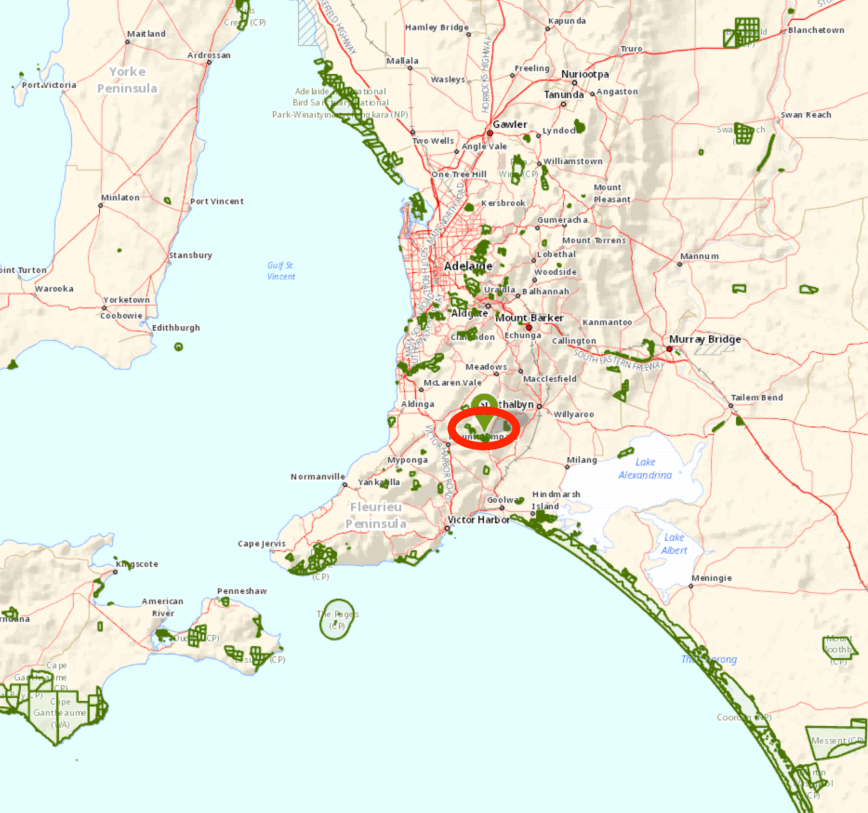
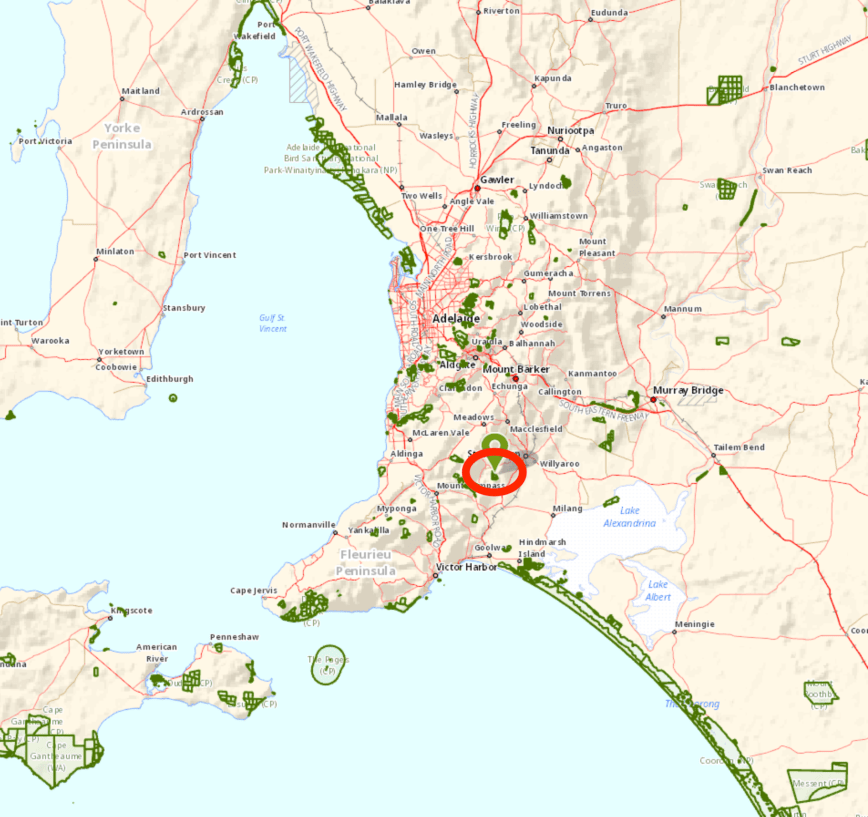
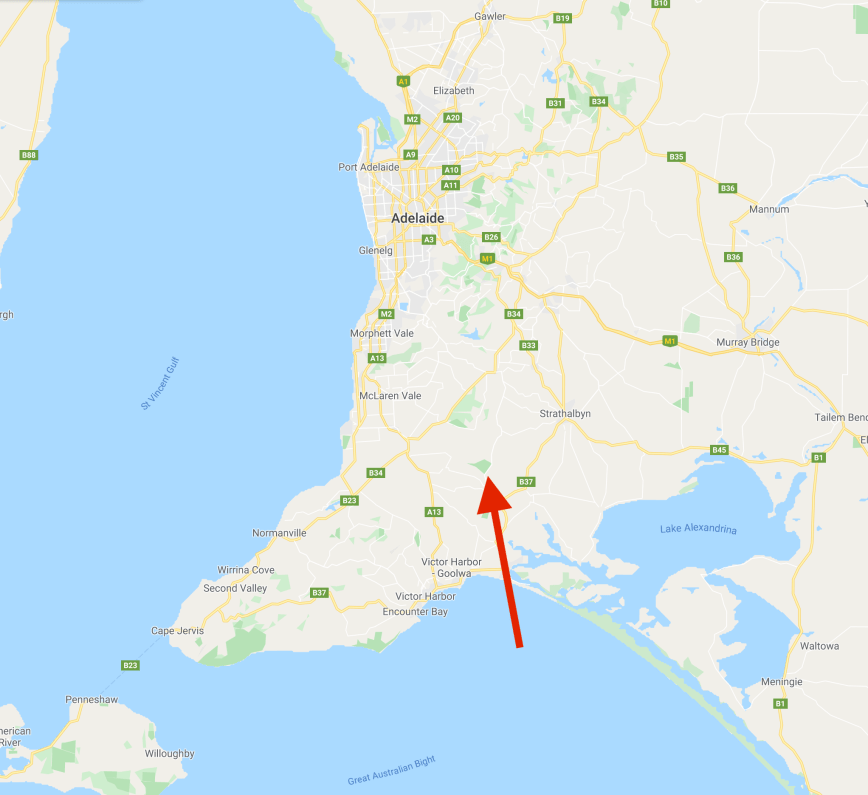
Our second park for National Tree Day on Sunday 2nd August 2020, was the Cox Scrub Conservation Park 5CP-048 and VKFF-0824. The park is located about 70 km south-south-east of the city of Adelaide and about 8 km south of the town of Ashbourne where I live.
Above:- Map showing the location of the Cox Scrub Conservation Park south of Adelaide. Map courtesy of Location SA Map Viewer.
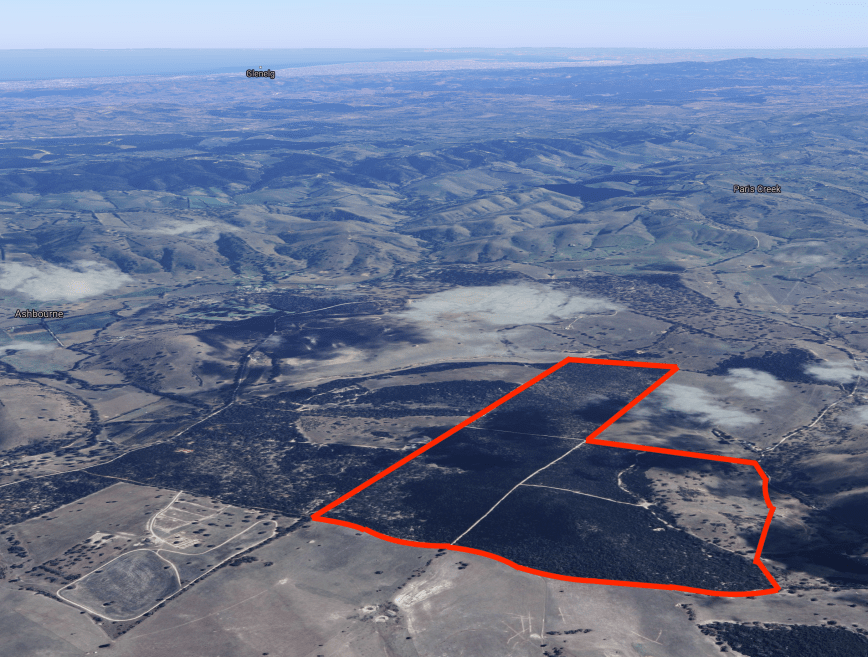
Cox Scrub Conservation Park is about 563 hectares in size and was established on. A short section of the Finniss River can be found in the park, while in the southeastern corner you can find a spring-fed creek.
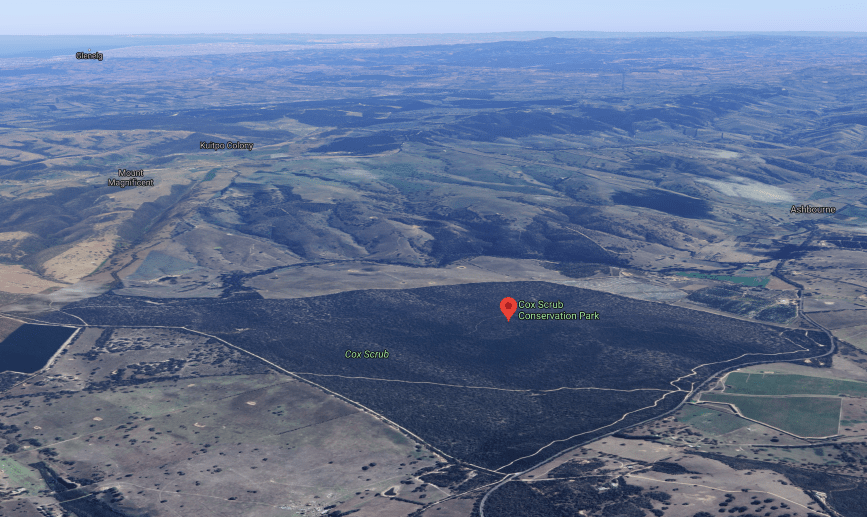
Above:- An aerial view of the park looking north. Image courtesy of Google maps
The park includes beautiful stands of stringybark and banksia understorey. Over 350 plant species have been recorded in the park. The Ash Wednesday bushfires of 1983 burnt out all except for a small 5-hectare section in the southwestern corner of the park.
The late Mr V. Cox of Ashbourne previously owned the majority of the park. It was preserved in its natural state for overwintering his honey bees. In 1969 the land was purchased from Mr Cox on the condition that he keep his bees in the park. This agreement was upheld until his passing. The park was dedicated as Cox’s Scrub National Park on the 5th day of March 1970. It was re-proclaimed as the Cox Scrub Conservation Park on the 27th day of April 1972. In 1977, 1982, 1984, 1986, & 2018, further sections of land were added to the park.
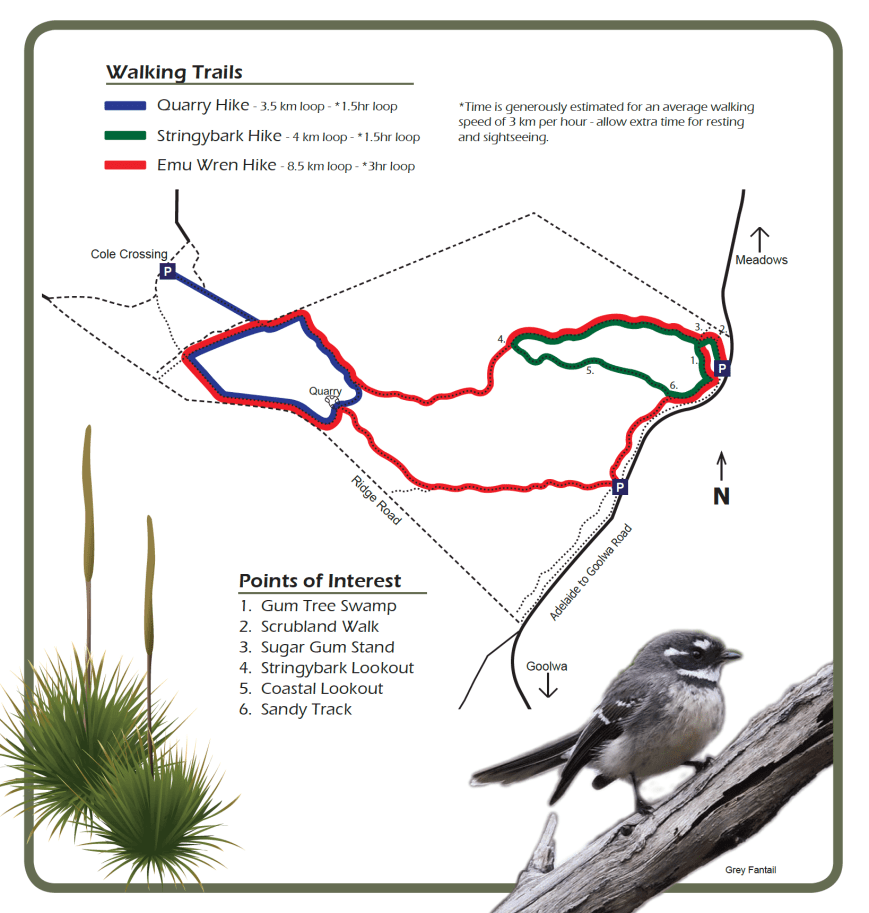
There are three walks in the park:
Quarry Hike – 3.5 km loop (1.5 hours)
Stringybark Hike – 4 km loop (1.5 hours)
Emu Wren Hike – 8.5 km loop (3 hours)
Above:- the three walks in the park, courtesy of the Friends of Cox Scrub Conservation Park.
Over 80 species of native birds can be found in the park including the Southern Emu-wren, 15 species of mammals including the Southern Brown Bandicoot, 11 species of reptiles including Rosenberg’s Goanna, and 6 species of frogs.
The Friends of Cox Scrub Conservation Park have an excellent website which can be found at…..
Marija and I took a small clearing in the scrub off the Bull Creek (Meadows-Goolwa Road) which took us to a narrow dirt track which runs parallel to the main road. There is a pedestrian gate here to get into the park. Be aware though that the parking facilities here are poor, and you will need to pull your vehicle well and truly onto the verge to allow other vehicles to get along the track. If you prefer, there is a car-park further to the north, off the Bull Creek Road.
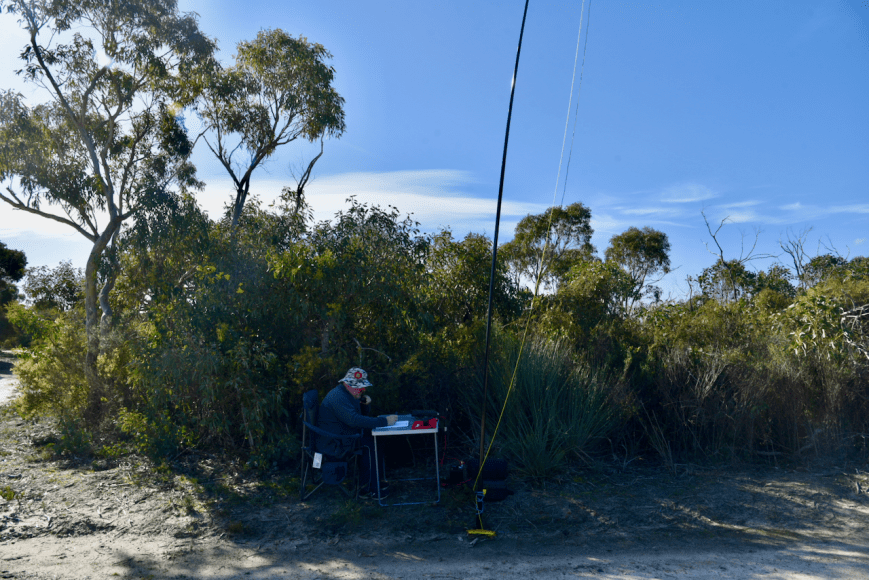
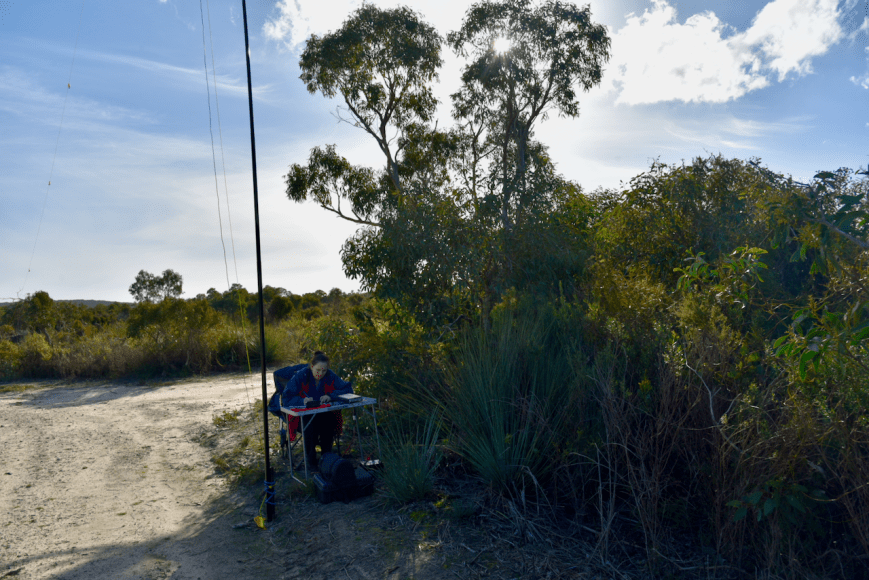
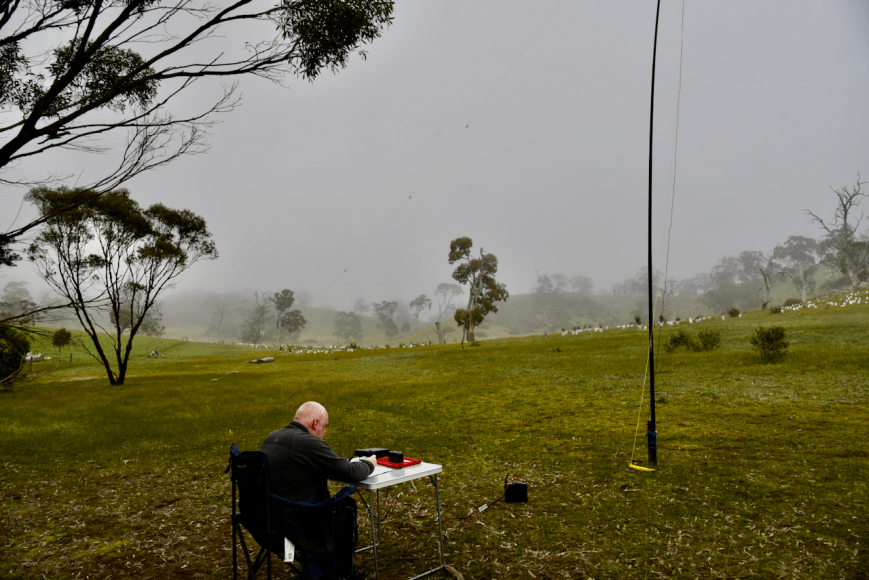
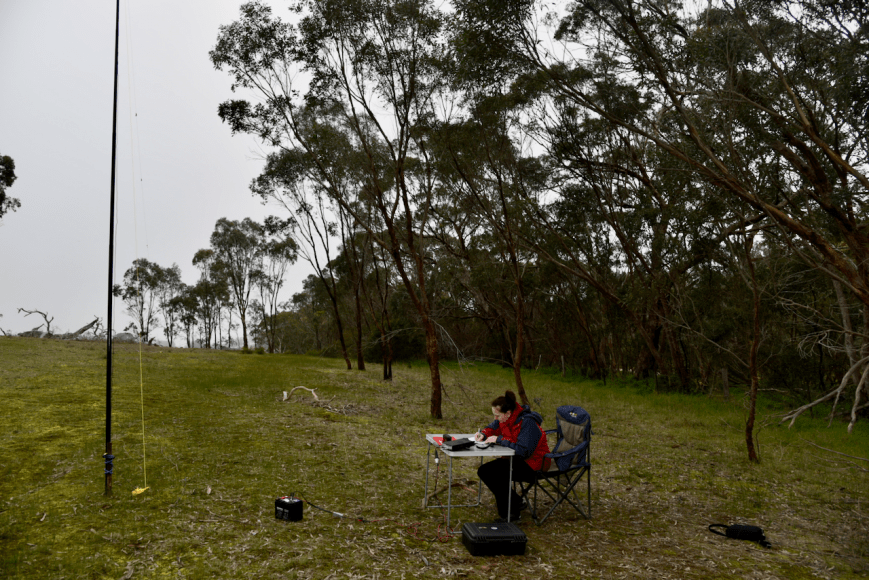
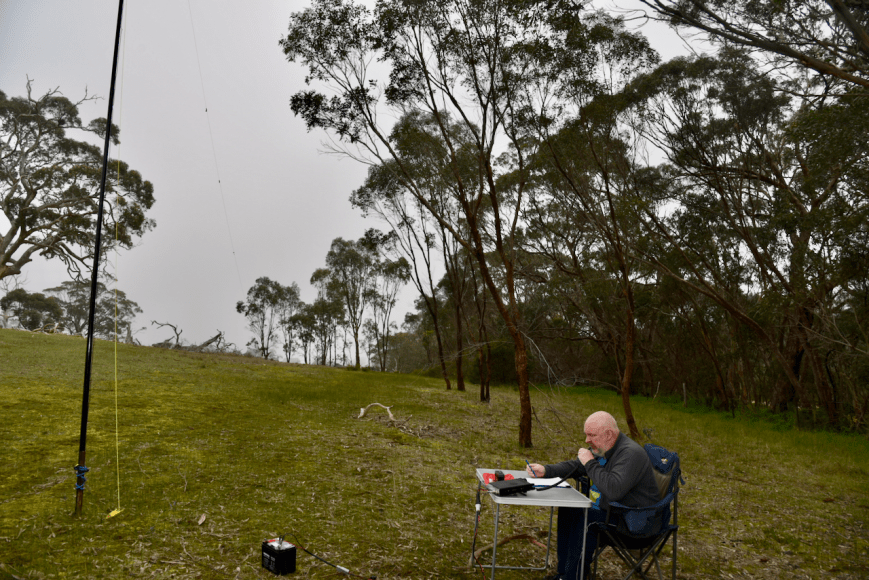
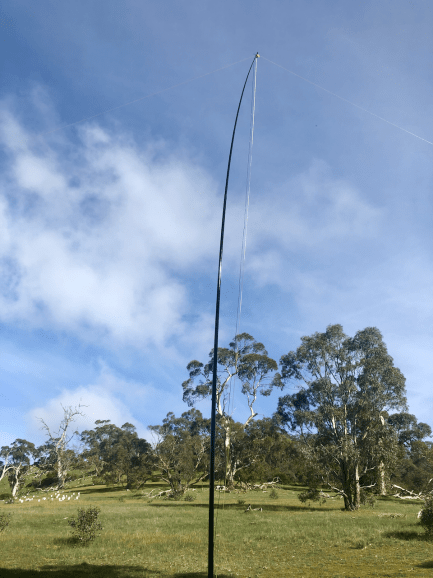
We set up on the side of the walking trail and ran the Yaesu FT-857d, and the 20/40/80m linked dipole for this activation.
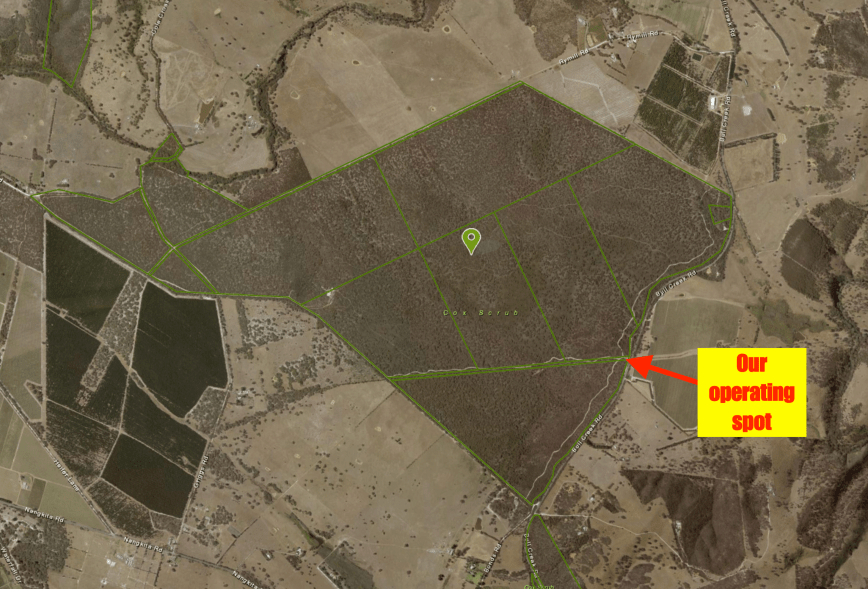
Above:- An aerial view of Cox Scrub showing our operating spot. Image courtesy of Location SA Map Viewer.
Prior to calling CQ, I tuned across the band hoping to log some other park activators. I found Gerald VK2HBG/p calling CQ on 7.135 from the Worigee Nature Reserve VKFF-2769.
I then moved to 7.130 and started calling CQ. My first taker was Deryck VK4FDJL/p who was activating the Millstream Falls National Park VKFF-0315, followed by Rob VK2VH-VK4AAC/2, and then Peter VK5PET.
I soon had a small pile-up and I logged further Park to Park contacts with Gerard VK2IO/p in the Bungonia National Park VKFF-1163, Ian VK1DI/2 in the Kangaroo River Nature Reserve VKFF-1945, Liz VK2XSE/p in the Pulletop Nature Reserve VKFF-2706, Chris VK1CT/p in the Gungaderra Grassland Nature Reserve VKFF-0843, and Geoff VK3SQ/p in the Wangaratta Common Nature Conservation Reserve VKFF-2223.
Sadly the pile-up came to a sudden grinding halt, as a park ranger arrived on the scene, and I could tell from the body language with Marija that things were not going well. I won’t air any dirty laundry here, only to say that the encounter was not a good one which was a huge disappointment.
Fortunately, after 30 minutes of debate, Marija and I were ‘allowed’ to continue the activation. To be quite honest, I was so upset by the conversation with the ranger, that I almost packed up and headed home.
I pushed on and logged a total of 27 stations on 40m. I apologise to all of those stations who were calling me prior to me going off-air for half an hour.
I then moved to the 20m band where I logged a total of 10 from VK4 and VK5. Signals from Queensland were exceptionally good.
I only had a handful of contacts to go before reaching 44 QSOs to qualify the park, so I moved to the 80m band where I logged 8 stations from VK2, VK3, and VK5, including a Park to Park with Gerard VK2IO/p in the Bungonia National Park VKFF-1163.
Marija then jumped back on the mic to get her remaining 8 contacts to qualify the park for the VKFF program with 10 QSOs. She logged the 8 stations in quick fashion, and we decided to pack up.
Marija worked the following stations on 40m SSB:-
VK2HBG/p (Worigee Nature Reserve VKFF-2769)
VK4FDJL/p (Millstream Falls National Park VKFF-0315)
Marija worked the following stations on 80m SSB:-
VK5PET
VK5FANA
VK2VH
VK4AAC/2
VK3UBY
VK3MCL
VK5BJE
VK2IO/p (Bungonia National Park VKFF-1163)
I worked the following stations on 40m SSB:-
VK2HBG/p (Worigee Nature Reserve VKFF-2769)
VK4FDJL/p (Millstream Falls National Park VKFF-0315)
Yesterday (Sunday 2nd August 2020) was National Tree Day here in Australia. National Tree Day is proudly sponsored by Toyota Australia and was co-founded in 1996 by Planet Ark and Olivia Newton-John. It has now grown into Australia’s largest community tree-planting and nature protection event. To help celebrate this special day, the VKFF Team decided to hold a special activation day for the World Wide Flora Fauna (WWFF) program.
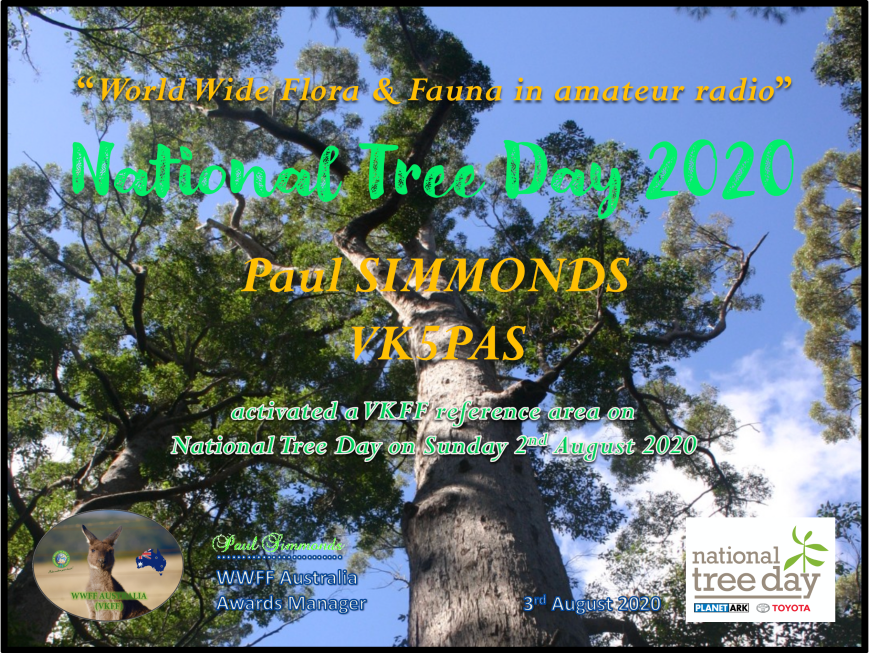
Each VKFF activator who headed out to activate a park on National Tree Day 2020 will be issued with a special activator certificate by the VKFF program.
Above:- the special 2020 National Tree Day certificate.
I had a bit of a sleep in on Sunday and by the time I got up at 8.30 a.m. local time, the weather was not looking good. A glance out of the living room window and it appeared to be raining. Fortunately, it turned out not to be rain, but heavy fog.
Marija VK5FMAZ and I loaded the 4WD and we headed to the Bullock Hill Conservation Park 5CP-265 & VKFF-0873, which is our ‘local park’ being just a few km from home. Bullock Hill is about 60 km south-south-east of Adelaide.
Above:- Map showing the location of the Bullock Hill Conservation Park. Map courtesy of Location SA Map Viewer.
The Bullock Hill Conservation Park is an undulating park with tall stands of eucalyptus including pink gum and cup gum. It is about 221 hectares in size and was proclaimed in January 2014. Access to the park is either via Haines Road to the south of the park, or via Wattle Flat Road to the east of the park. At its highest points, the park overlooks Lake Alexandrina and Lake Albert.
The park takes its name from the small summit of Bullock Hill which rises to about 188 metres and is located in the park.
Above:- An aerial view of the park looking north. Image courtesy of google maps.
Various native birds call the park home including Brown-headed honeyeater, Red wattle bird, grey shrike-thrush, Rainbow bee-eater, and black-faced cuckoo-shrike. Birds SA have recorded about 95 species of native bird in the park. Numerous Western grey kangaroos can generally be seen in the park.
Since our last visit, thousands of trees have been planted in the eastern section of the park, so it was very appropriate that we were activating this part of the park for National Tre Day.
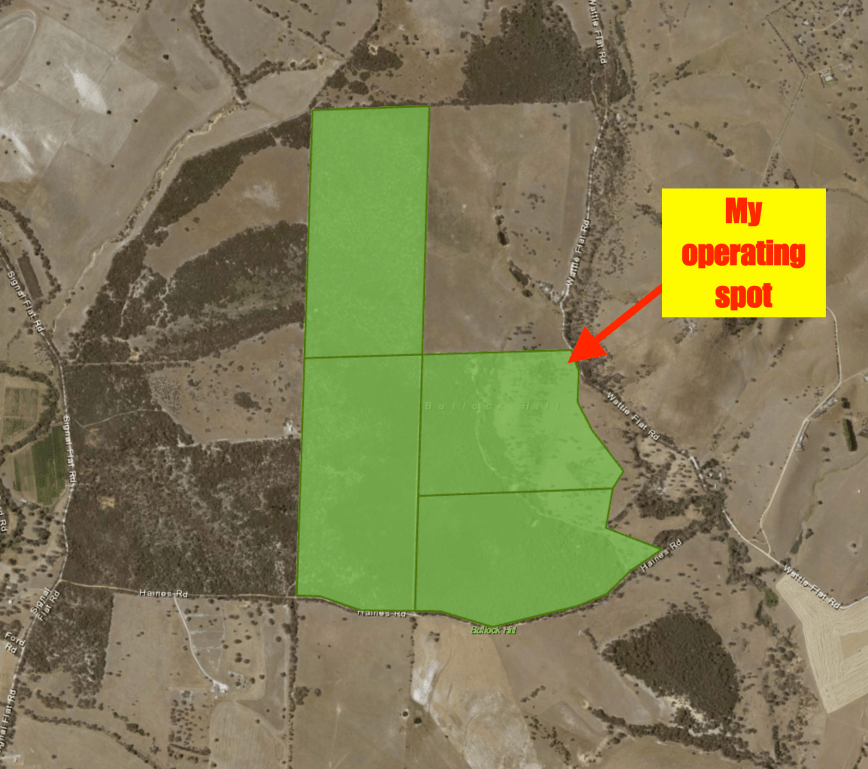
Marija and I set up on the eastern side of the park off Wattle Flat Road. We ran the Yaesu FT-857d and the 20/40/80m linked dipole for this activation. Marija ran 10 watts PEP while I ran about 40 watts.
Above:- AN aerial view of the Bullock Hill Conservation Park showing our operating spot. Image courtesy of Location SA Map Viewer.
We were set up by about 9.25 a.m. which was just before the UTC day rollover. I started calling CQ on 7.144, and this was almost immediately answered by Ron VK3AFW. Unfortunately the Wireless Institute of Australia broadcast commenced on 7.146 and the signal from VK2 as very strong. So I QSYd down the band to 7.110. Ron VK3AFW followed me down and was first in the log for this activation.
This was followed by Peter VK3ZPF and then my first Park to Park contact for the day, a QSO with Marty VK4KC/p who was in the Bribie Island National Park VKFF-0053. Marty has put together a very good video of his activation which can be found below.
I qualified the park for VKFF by getting 10 contacts in the log, and then handed over the microphone to Marija so that she could qualify the park. This would be Marija’s first park activation for 2020.
First in the log for Marija was Sue VK5AYL, followed by Marco VK2FMPC, and then Nick VK3ANL. Marija’s first Park to Park contact was with Marty VK4KC/p in the Bribie Island National Park VKFF-0053.
It didn’t take long and Marija had a mini pile-up happening. Contact number 10 for Marija was a QSO with Murray VK4MWB. Marija ended up logging a total of 26 contacts on 40m, including another Park to Park with Compton VK2HRX/p in the Blue Mountains National Park VKFF-0041.
Whilst Marija was on air she received a message from our 21-year-old daughter asking if she could be picked up from Mount Barker, so Marija headed off on her ‘taxi duties’ leaving me in the park.
I called CQ again and this was answered by Leigh VK3SG, followed by Peter VK5PET, and then Compton VK2HRX in the Blue Mountains National Park VKFF-0041.
I worked a further 18 stations including the following Park to Park contacts:-
Adam VK2YK/5 – Cudlee Creek Conservation Park VKFF-1023
Deryck VK4FDJL/p – Millstream Falls National Park VKFF-0315
Mark VK4SMA/p – Acol Bushland Nature Refuge VKFF-2879
Ian VK1DI/2 – Cecil Hoskins Nature Reserve VKFF-1906
John Vk5BJE/p – Mark Oliphant Conservation Park VKFF-0782.
Tait VK1HAB/p – Mount Taylor Nature Reserve VKFF-0854
As callers had slowed down a bit, I took the opportunity of moving to the 80m band as I had seen a spot on parksnpeaks for Ian VK5CZ/p who was in a park on the Yorke Peninsula.
I logged Ian VK5CZ/p on 3.680 who was activating the Bird Islands Conservation Park VKFF-0871 and had a 5/9 plus signal.
I then moved down to 3.610 where I logged a total of 6 stations, all VK5’s. This included a Park to Park with John VK5BJE/p who was in the Mark Oliphant Conservation Park VKFF-0782, and Adam VK2YK/5 who was in the Cudlee Creek Conservation park VKFF-1023. Despite conditions on 80m being exceptionally good around South Australia, sadly I could only manage the 6 contacts on 3.610.
I then moved to the 20m band and started calling CQ on 14.310. This was answered by park regular John VK4TJ. I logged a total of 9 stations from VK4 and one New Zealand station ZL3RIK.
I then had a tune across the band and found Mark VK4SMA/p calling CQ from Wacol Bushland Nature Refuge VKFF-2879. I then moved back to 14.310 and logged Ralph VK2TRK and Hans VK6XN. Before heading back to 40m I had one final tune across the 20m band and found Di VK4DI operating on 14.263 with the special callsign of VI110WIA.
I lowered the squid pole and reinserted the links for the 40m band, and started calling CQ on 7.144. This was answered by Dennis VK2HHA, followed by Ade VK4SOE/p on his cattle farm, and then Peter VK3PF/p on SOTA summit VK3/ VT-088 in the Alpine National Park VKFF-0619. I logged another 2 stations before Marija arrived back at the park, and jumped back into the operator’s chair.
First in the log on Marija’s second round was Dennis VK2HHA, followed by David VK5PL/p in the Little Mount Crawford Native Forest Reserve VKFF-2884. I also logged David.
Marija logged a further 18 stations and had soon qualified the park for the global WWFF program with 44 contacts. The lucky 44th contact was Deryck VK4FDJL/p who was in the Millstream Falls National Park VKFF-0315. Other Park to Park contacts in this session for Marija was with Tait VK1HAB/p in the Mount Taylor Nature Reserve VKFF-0854, and John VK5BJE/p in the Mark Oliphant Conservation Park VKFF-0782.
During my visit to the park I did my normal little stint of bird watching. I took the photos below of a very active Striated Pardalote who was busy collecting pieces of dried grass.
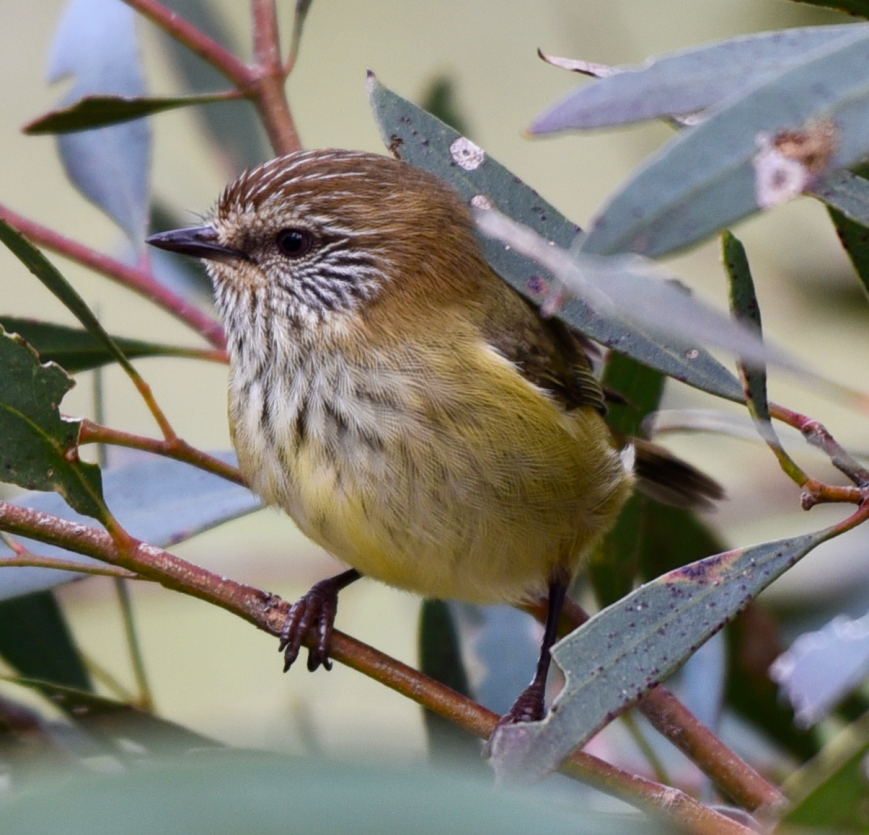
I also captured this little one, I think a Striated Thornbill.
And there were also quite a few Silvereyes who were active in the park as well.
Marija and I ended up with a total of 105 contacts during this activation. This included 20 Park to Park contacts.
Marija worked the following stations on 40m SSB:-
VK5AYL
VK2FMPC
VK3ANL
VK3ZPF
VK4KC/p (Bribie Island National Park VKFF-0053)
VK3ARH
VK3BWM
VK2VH
VK4AAC/2
VK4MWB
VK3JX
VK3FCMC
VK2HRX/p (Blue Mountains National Park VKFF-0041)
VK4TJ
VK4/AC8WN
VK4/VE6XT
VK4SSN
VK5HAA
VK5PET
VK3AFW
VK6MMB
VK3NBL
VK4CZ
VK3SG
VK2ZVG
VK1TX
VK2HHA
VK5PL/p (Little Mount Crawford Native Forest Reserve VKFF-2884)
VK3SG
VK3UH
VK3PI
VK2XSE/m
VK3TOT
VK3SQ
VK1HAB/p (SOTA VK1/ AC-037 & Mount Taylor Nature Reserve VKFF-0854)
VK3AQZ
VK1DA
VK2HEY/p
VK5BJE/p (Mark Oliphant Conservation Park VKFF-0782)
VK7AN
VK3NRB/m
VK3FREB/m
VK3AJA/p
VK4FDJL/p (Millstream Falls National Park -0315)
VK2KJJ
VK4FARR
I worked the following stations on 40m SSB:-
VK3AFW
VK3ZPF
VK4KC/p (Bribie Island National Park VKFF-0053)
VK3JX
VK6MMB
VK4TJ
VK4/AC8WN
VK4/VE6XT
VK4SSN
VK3NBL
VK3BWM
VK5AYL
VK3SG
VK5PET
VK2HRX/p (Blue Mountains National Park VKFF-0041)
VK2VH
VK4AAC/2
VK3PI
VK2YK/5 (Cudlee Creek Conservation Park VKFF-1023)
VK4FDJL/p (Millstream Falls National Park VKFF-0315)
VK2IO/p (SOTA VK2/ ST-039)
VK4SMA/p (Wacol Bushland Nature Refuge VKFF-2879)
VK3PWG
VK1DI/2 (Cecil Hoskins Nature Reserve VKFF-1906)
VK3FCMC
VK3YV
VK3FRJA
VK2HV
VK3MKE
VK3KRH
VK5BJE/p (Mark Oliphant Conservation Park VKFF-0782)
VK5HAA
VK1HAB/p (SOTA VK1/ AC-037 & Mount Taylor Nature Reserve VKFF-0854)
VK2HHA
VK4SOE/p
VK3PF/p (SOTA VK3/ VT-088 & Alpine National Park VKFF-0619)
VK3YU/m
VK2FBBG/m
VK5PL/p (Little Mount Crawford Native Forest Reserve VKFF-2884)
I worked the following stations on 80m SSB:-
VK5CZ/p (Bird Islands Conservation Park VKFF-0871)
VK5GY
VK5BJE/p (Mark Oliphant Conservation Park VKFF-0782)
VK5IS/m
VK5HAA
VK5PET
VK2YK/5 (Cudlee Creek Conservation Park VKFF-1023)
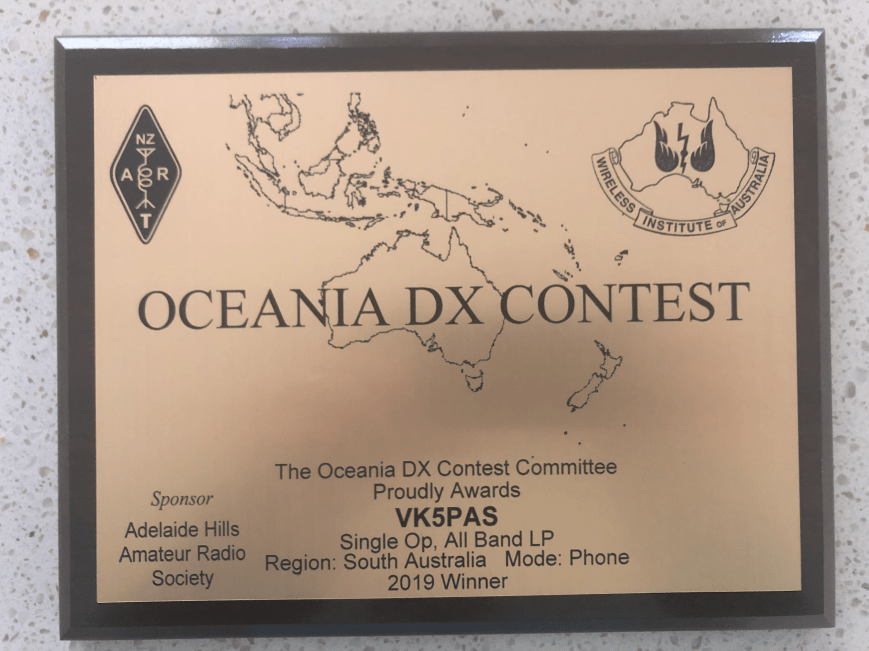
Yesterday in the mail I received the plaque below, issued for first place in the ‘Single Op All Band Low Power’ category of the 2019 Oceania DX Contest.
Many thanks to the Oceania DX Contest Committee and also the AHARS Committee for their sponsorship of the plaque.
Late this afternoon (Sunday 19th July 2020) I activated the Cox Scrub Conservation Reserve VKFF-1701 which is located about 65 km south of Adelaide and about 8 km south of my home QTH, the town of Ashbourne.
Above:- Map showing the location of the Cox Scrub Conservation Reserve, south of Adelaide. Map courtesy of Google maps.
I have activated the Reserve on three previous occasions and have well and truly qualified it. However, I decided to revisit the park as it is just a short distance from home. It was to be only my fifth park activation for 2020. A variety of reasons have conspired against me getting out into the field including the bushfires, COVID-19, work commitments, and moving QTH.
The Cox Scrub Conservation Reserve is located on the eastern side of Bull Creek Road (Meadows-to Goolwa Road). It is not to be confused with the Cox Scrub Conservation Park which is much larger in size.
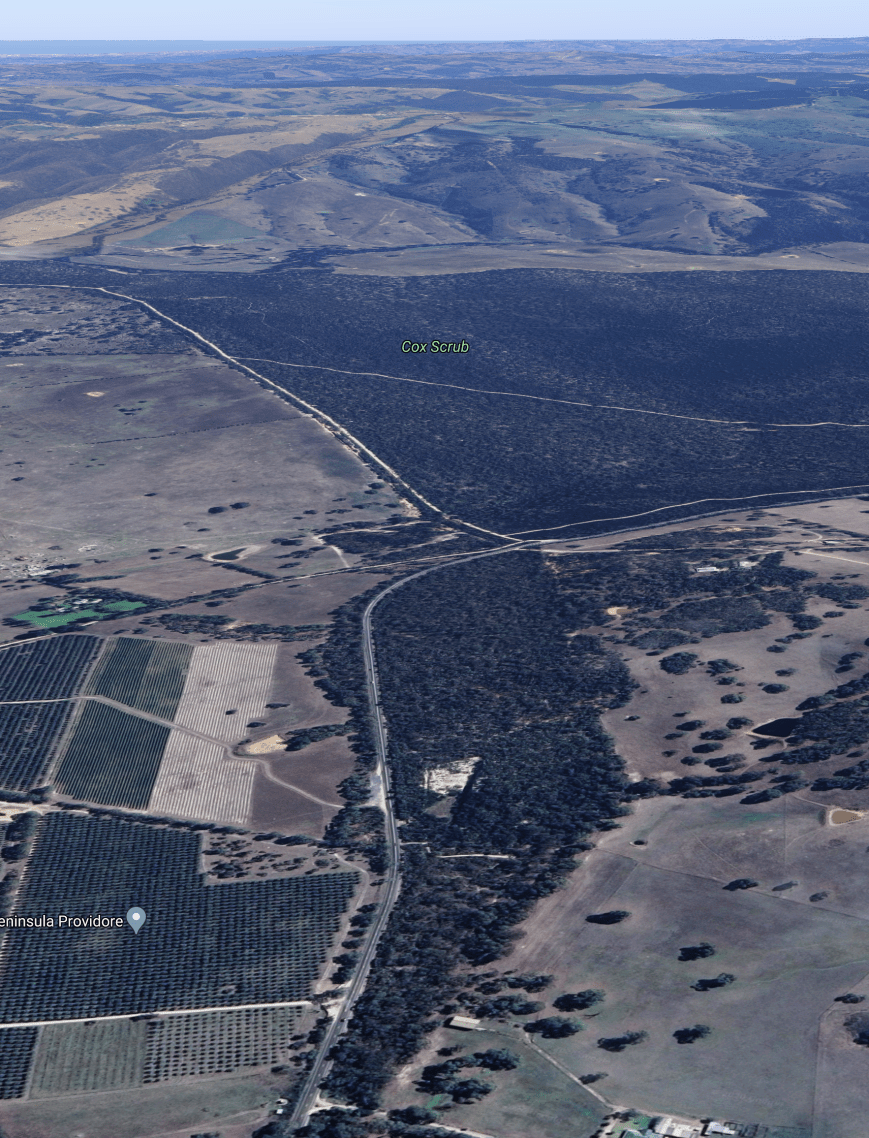
Above:- An aerial shot of the Cox Scrub Conservation Reserve in the foreground, and the much larger Cox Scrub Conservation Park to the north. Image courtesy of Google maps
The majority of the adjacent Conservation Park was previously owned by the late Mr. V. COX of Ashbourne, who preserved the area in a natural state for overwintering his honey bees. In 1969 the land was purchased from Mr. COX on the condition that he was allowed to keep bees in the park. This agreement was upheld until he passed away.
The Cox Scrub Conservation Park has an active Friends group who have a good website. It can be located at…….
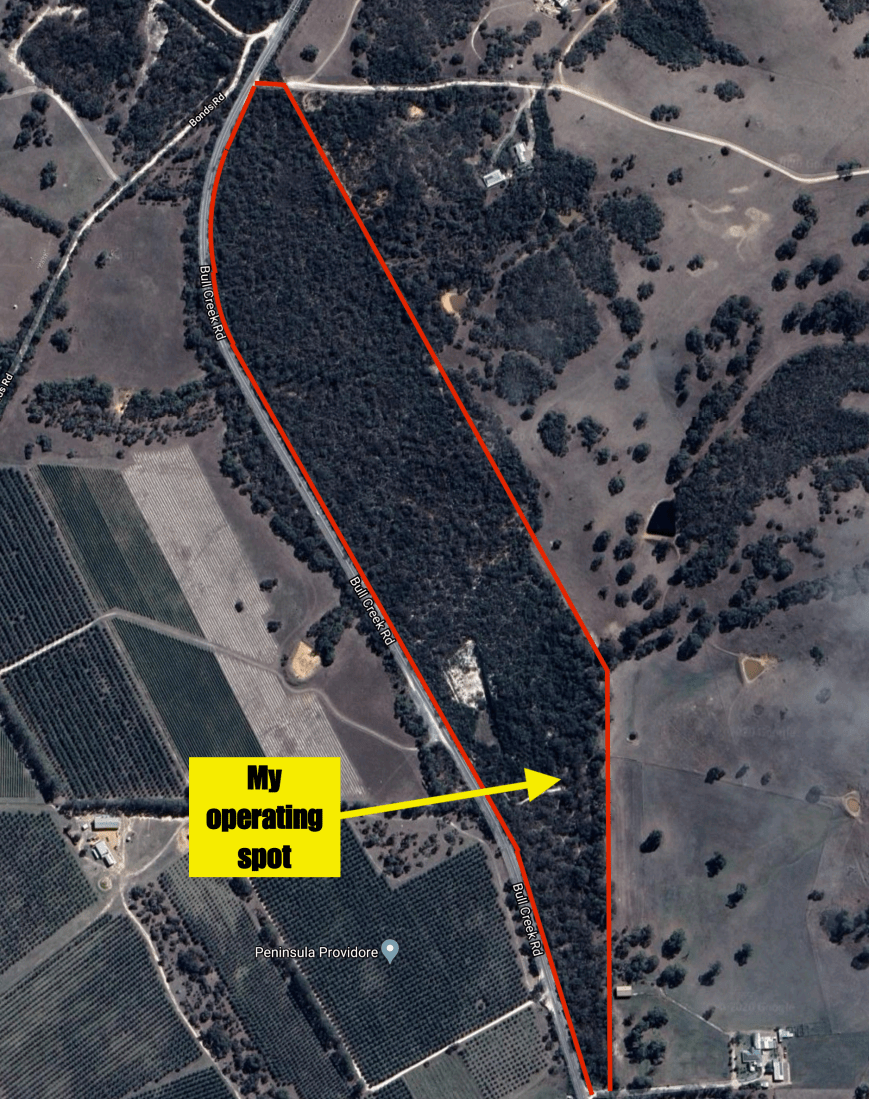
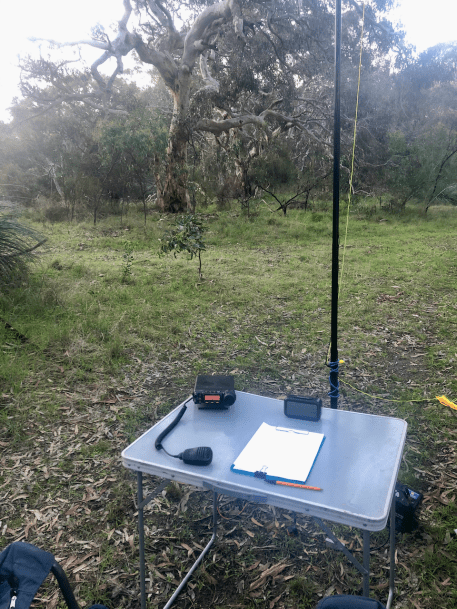
I set up in my normal operating spot, which was at the end of a 4WD track which runs off Bull Creek Road. I ran the Yaesu FT-857d, 30 watts output, and 20/40/80m linked dipole for this activation.
Above:- Aerial shot of the reserve showing my operating spot. Image courtesy of Google maps
I kicked off the activation by asking if the frequency, 7.144, was in use. I didn’t even get to start calling CQ, as Peter VK3ZPF came back to advise the frequency was clear. So Peter was first in the log for this activation. This was followed by Tony VK3YV, and then a Park to Park contact with Chris VK1CT/2 in the Mulligans Flat Nature Reserve VKFF-0855.
Contact number eleven was another Park to Park, this time with Gerard VK2IO/p who was in the Worimi Regional Park VKFF-1788.
I was about 20 contacts into the activation when I realised that I was transmitting with 10 watts PEP, as my wife Marija VK5FMAZ had previously been using the transceiver at home.
I logged a total of 39 stations on 40m from VK1, VK2, VK3, VK4, VK5, VK6, VK7, and New Zealand. I was very pleased to speak with Peter VK6APZ who was mobile, and also Graham VK6ATS who had a 5/9 plus signal.
I then moved to the 80m band where I logged a total of 10 stations from VK2, VK3, VK4, and VK5. Thanks to Allen VK3ARH and Peter VK3PF for their second call signs which helped me get over the line with 44 QSOs.
In the end, I logged a total of 49 stations in about 70 minutes. Thanks to everyone who called.
Last night (Saturday 18th July 2020) I took part in the 2020 Trans Tasman Low Band Contest. The aim of the contest is to encourage Low Band activity Trans-Tasman that is between VK and ZL. Only contest bands 160, 80, and 40M are allowed with
SSB, CW and Digital (RTTY OR PSK).
More information can be found on the WIA website at……
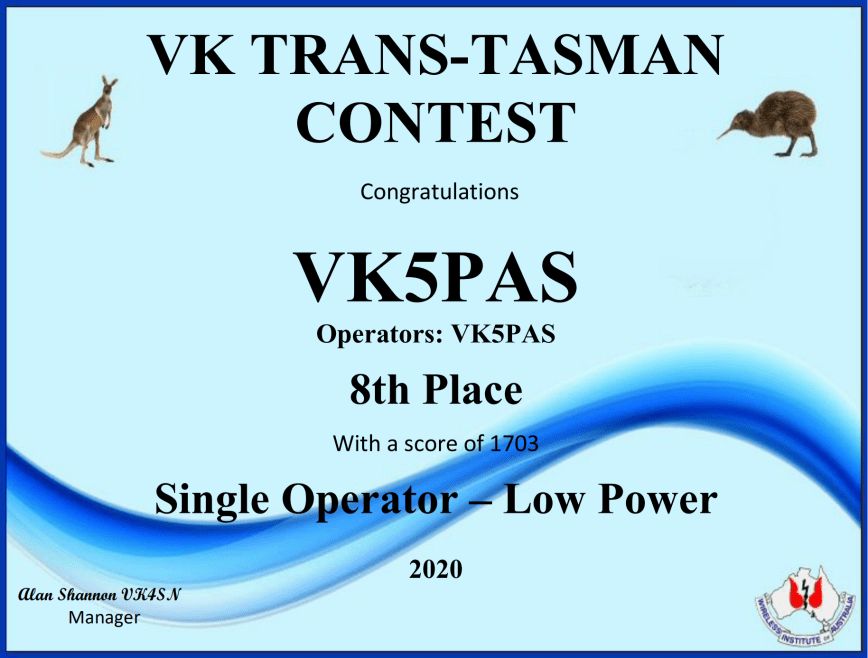
I made a total of 166 contacts with a claimed score of 1,712 points.
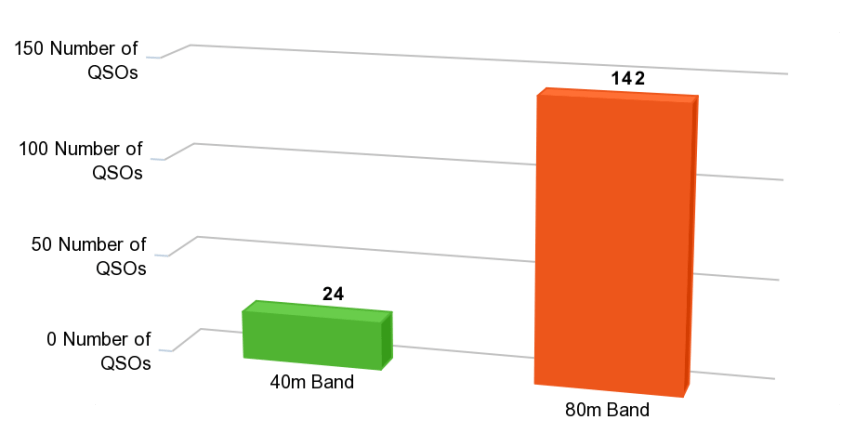
The contest kicked off at 0800 UTC (5.30 p.m. South Australian local time). I started off on the 40m band, with my first contact being with Jess VK6JES. Unfortunately, the 40m band had closed to a lot of VK by this time of the day. I made a total of 17 contacts on 40m into VK2, VK4, VK6 and New Zealand.
I then moved to 80m and this is where I remained for the majority of the evening, except for one other quick look on 40m. The 80m band was in quite good condition, except for the Over the Horizon Radar which took up a good portion of the band and was strength 8.
I was running just 30 watts from my Yaesu FT-857d, with my antenna being a 20/40/80m linked dipole which is inverted vee, just 7 metres at the apex. I have absolutely no man-made noise at my new QTH at Ashbourne, but my signal was not making it through the noise at the homes of some amateurs. They were very clear to me, but I just wasn’t making it.
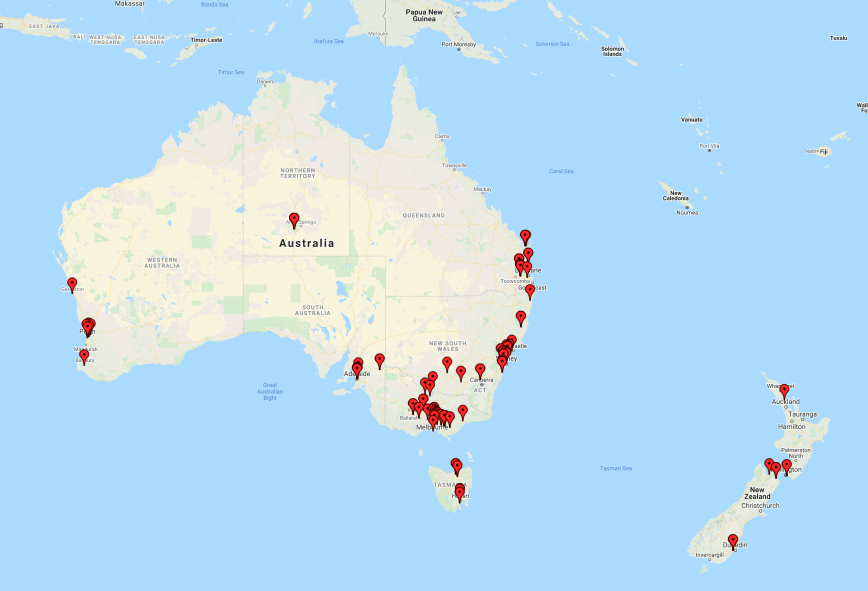
The map below shows my contacts during the contest. I was very pleased to make a number of contacts into New Zealand on 80m (also 40m).
All up I was quite happy with the 166 contacts. I cannot wait for my shack to be completed, and some substantial antennas to go up into the air.
The graph below shows my contacts on the 40m & 80m bands.
THANKS to everyone who called and GOOD LUCK to all those who took part.
Last Wednesday (15th July 2020) I joined the OZ DX Net on 7.175 on the 40m band. The OZ DX Net is the successor to the very successful 7130 DX Net which ran for many years.
As I have just moved to a new QTH, I don’t have a permanent shack or permanent antennas up in the air at the moment. I have set up a temporary station on my back verandah which comprises the Yaesu FT-857d, 30 watts output, and my 20/40/80m linked dipole. The dipole is inverted vee configuration, supported by a 7-metre telescopic squid pole.
Conditions on the net were average. But I did manage one DX contact to Chuck K9RM in Indiana, USA and a number of Australian stations. Below is a short video of some of those contacts.
My noise floor was a little high, and I have since worked out where the noise originated, and that was the downlights on the back verandah.
The OZ DX Net is held every Monday, Wednesday and Friday at 1000 UTC, usually on 7.175 or thereabouts.
About 2 weeks ago I was surfing the web and became aware that the Wireless Institute of Australia (WIA) had a special event callsign for the current COVID-19 restrictions. Over the past few months, I have worked many of the European COVID-19 special event calls, but I had not heard the VK special callsign on air, so I decided to apply for its use and give it a workout.
I headed to the WIA website and to the callsign roster and booked the use of the callsign of VK20HOME for a three day period – Saturday 4th July 2020 – Monday 6th July 2020.
More than 30 countries have activated HOME or STAYHOME suffixes this year. The WIA applied for the VK20HOME callsign after an official request from Martti Lane OH2BH who asked if the WIA would like to participate in the global stay home event endorsed by the IARU.
I had the weekend of the 4th & 5th July off work, but I had to work on Monday. This left me with 2 and a bit days to have some fun on-air and hopefully remind a few people of the dangers of this disease which in recent days has really flared up in Victoria in Australia.
I have just moved QTH to Ashbourne, about 63 km SSE of Adelaide and have been here just 5 weeks. As a result, I have no dedicated shack and no substantial antennas up at this stage. My station for this event was my normal portable set up, consisting of the Yaesu FT-857d, 30 watts output, and my 20/40/80m linked dipole, which was in an inverted vee configuration, just 7 metres at the apex (supported on a 7-metre heavy duty squid pole). My gear was set up underneath my back verandah overlooking the paddocks. So I was a definite STAY AT HOME station.
I started off on Saturday morning by booking into the BRL Net, the Riverland Radio Club’s Net on 7.115 on the 40m band. First in the log was Dennis VK2HHA in Albury.
After logging a number of stations on the Net I moved up the band and found Gerald VK2HBG calling CQ using the special event call of VI110WIA in commemoration and celebration of the WIA’s 110 years of operation.
For the remainder of the day, I moved between 40m, 80m and 20m, calling CQ. All up on my first day with the call I logged a total of 101 stations from VK1, VK2, VK3, VK4, VK5, VK6, VK7, and New Zealand.
This included a couple of park activators: Tony VK3TNL/2 at Cameron Corner in the Sturt National Park VKFF-0470, and Pete VK2FPAR/p in the Thirlmere Lakes National Park VKFF-0486.
The best contact of the day was on 40m with Noel ZL3AHW who was mobile in New Zealand. I often work Noel on the 10m band. Noel was a good 5/4 signal and he gave me a 5/6. I was able to copy Noel perfectly as my new QTH at Ashbourne has absolutely no man-made noise. It is an absolute pleasure to operate on air from this new location.
I also worked a handful of New Zealand stations on 80m during the evening who were taking part in their Memorial Day Contest.
I had a bit of a sleep in on Sunday, but after breakfast, I headed outside for some more action as VK20HOME. First up, I checked in to the Australian Ham Radio Net on 7.097 and logged Ron VK3AHR from Wodonga with a big signal, along with a number of other stations on the Net.
I then moved up the band and called CQ logging a steady flow of callers. I then took a break for lunch and also about 2 & 1/2 hours of cleaning up my shed. I then headed back to the radio and logged a number of stations on 40m before heading to the 20m band where I booked into the ANZA DX Net.
I then moved back to 40m and after dinner headed to the 80m bad. All up on Sunday I logged a total of 108 stations from VK1, VK2, VK3, VK4, VK5, VK6, VK7, New Zealand, and the USA. This included speaking with Gerard again, VI110WIA, Greg NR6Q in California USA, Glenn VK3YY/p on the top of a SOTA peak, Tony VK3TNL/2 in the Kinchega National Park VKFF-0263, Woody WW1WW in New Hampshire USA, and a number of New Zealand stations.
I was also very pleased to work a number of QRP stations: Trevor VK3DCQ on 2 watts; Peter VK3PWG/p on 2.5 watts, Steven VK2ZVG/p on 5 watts; and Steve VK1FSWB on 5 watts.
I had to work on Monday, but on arriving home from work I headed straight outside and started calling CQ on 40m. I logged 14 stations before heading over to 80m where I worked 9 stations, and it was then back to 40m for the OZ DX Net. I logged 8 stations on the Net from VK1, VK2, VK4, VK5, New Zealand, and the USA.
To conclude my time with VK20HOME I moved back to 80m where I logged just 4 more stations. Conditions were quite difficult due to very loud static crashes.
I logged a total of 35 stations on Monday evening.
So after a and a bit days as VK20HOME, I logged a total of 244 contacts.
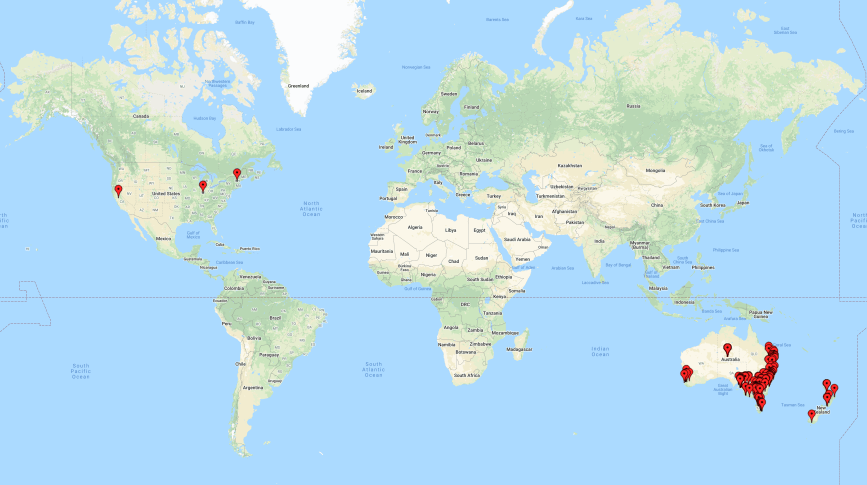
Most of my contacts were around VK and into New Zealand as can be seen from the map below. My current set up is less than ideal for DX contacts.
But I did manage a few contacts into the USA, which considering my station, I was very happy about.
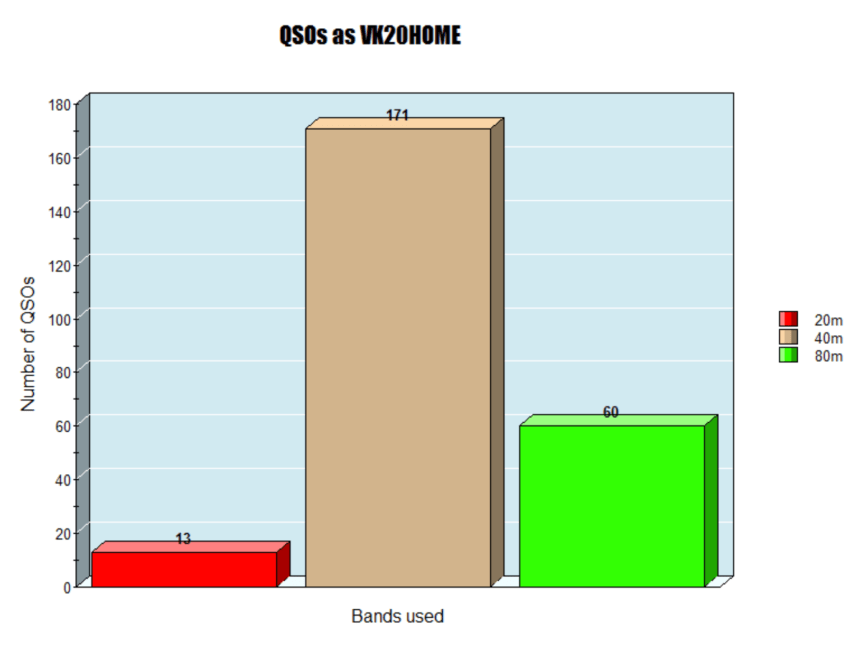
The majority of my contacts were on the 40m band with 171 contacts, followed by 80m with 60 contacts. I found the 20m band to be very poor with just 13 contacts logged on that band to VK2, VK3, VK4, VK6, VK7, New Zealand, and the USA. There was no long path propagation to Europe.
Victorian (VK3) stations featured the most in my log, with a total of 90 QSOs, followed by VK2 with 59 QSOs. I worked 10 stations in New Zealand and just 3 stations in the USA.
THANK YOU to everyone who called. I had a lot of fun.



















 VK5PAS