2019 VK Shires Contest

Today (Sunday 9th June 2019) and yesterday (Saturday 8th June 2019) I took part in the 2019 VK Shires Contest.  This is an official contest of the Wireless Institute of Australia and counts towards the Peter Brown Contest Champion Awards.  The objectives of this contest are for amateurs around the world to contact as many VK shires as possible in the contest period.

I activated the following parks in the following Shires:-

  1. Wiljani Conservation Park VKFF-1159 –  Barossa Council (BA5 )
  2. Charleston Conservation Park VKFF-0777 – Adelaide Hills Council (AH5)
  3. Totness Recreation Park VKFF -1754 – Mount Barker District Council (MB5)
  4. Scott Conservation Park VKFF-0934 – Alexandrina Council (AX5)
  5. Mount Billy Conservation Park VKFF-0912 – City of Victor Harbor (VH5)
  6. Myponga Conservation Park VKFF-0921 – Yankalilla District Council (YD5)

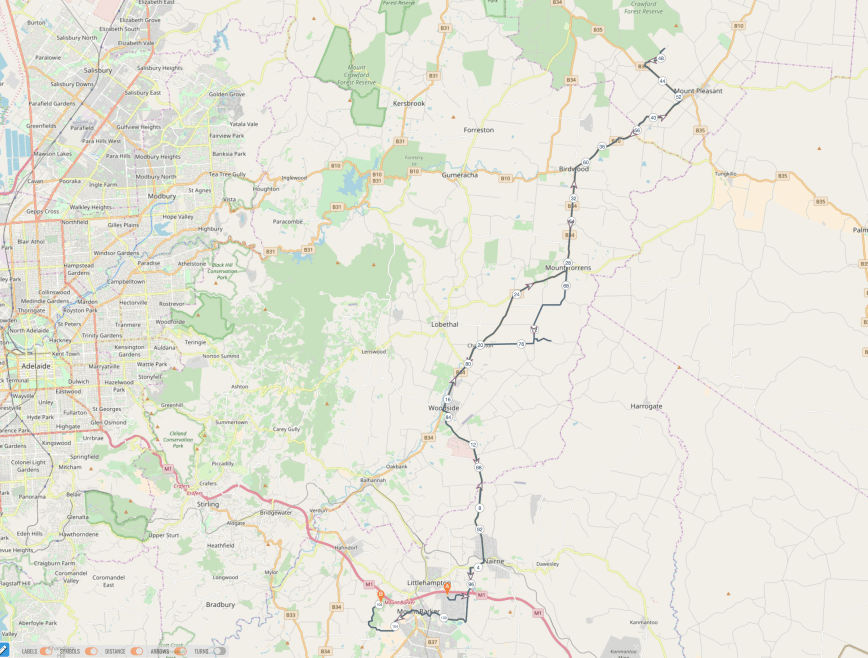
The map below shows my day one travels on Saturday.  It was a trip north into the southern part of the Barossa Valley, and then back into the Adelaide Hills.  I was fortunate in that the weather was fine.
Screen Shot 2019-06-09 at 8.54.23 pm.png

Above:- Map showing my travels on day one on Saturday.  Map courtesy of Plotaroute.

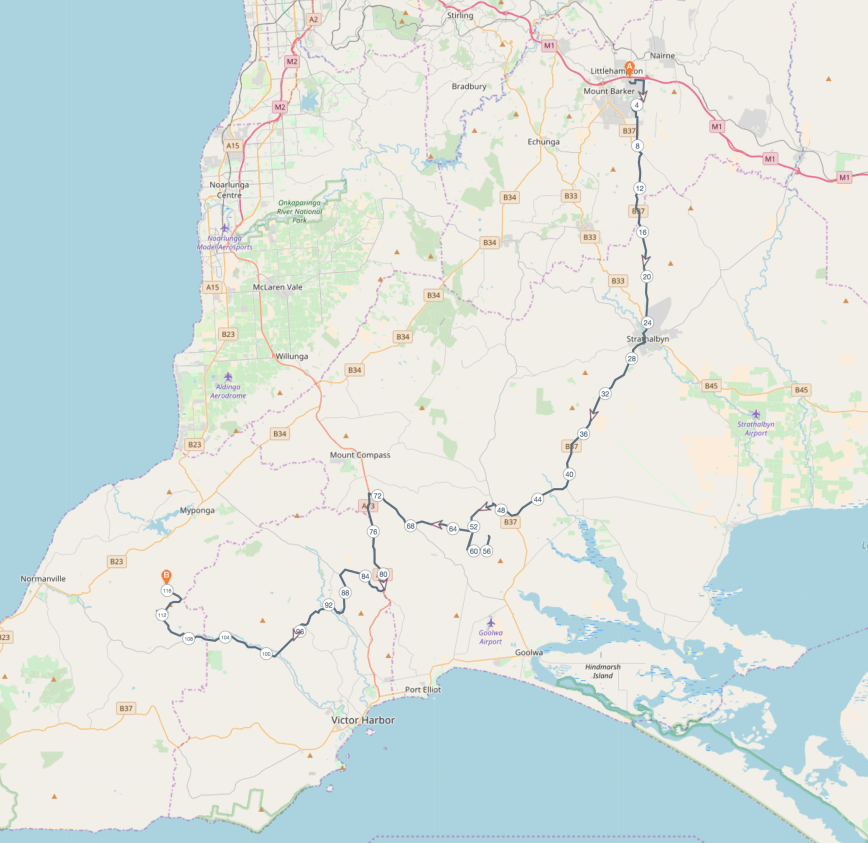
And the map below shows my travels on day two on Sunday.  This was a trip down south to the Fleurieu Peninsula.  Sadly, the weather was poor, and a lot of time was spent under the bothy bag to get out of the rain.
Screen Shot 2019-06-09 at 8.57.18 pm.png

Above:- my travels on day two on Sunday.  Map courtesy of Plotaroute.

I used the following equipment during each activation:-

  • Yaesu FT-857d
  • 40 watts output
  • 20/40/80m linked dipole, inverted vee, 7m at the apex.

I ran VK Contest Log for the contest.

I entered into the Rover category.  A Rover station is a VK station who goes either portable or mobile for the entirety of the contest and activates more than one shire.  To be considered as a roving station you must activate a minimum of 2 shires.

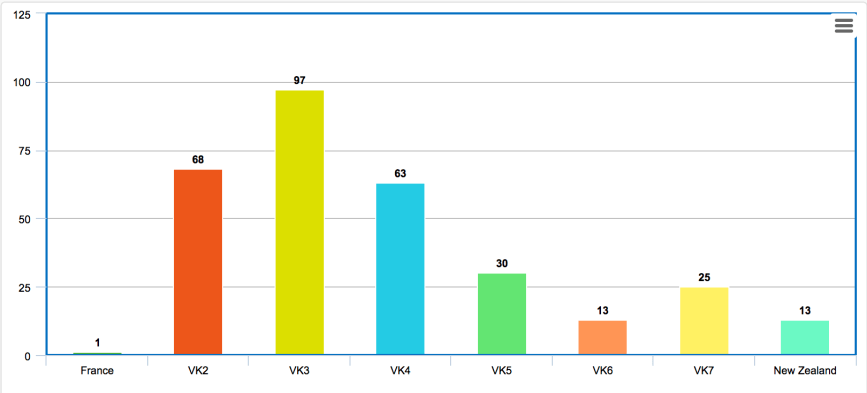
All up I made a total of 310 contacts and worked a total of 258 different shiresI have a claimed score of 84,320 points.

The vast majority of those contacts were from VK, but I did work one French station on 40m, and made 13 New Zealand contacts.

  • France – 1
  • VK2 – 68
  • VK3 -97
  • VK4 – 63
  • VK5 – 30
  • VK6 – 13
  • VK7 – 25
  • New Zealand – 13
Screen Shot 2019-06-09 at 7.47.59 pm.png

Above:- Graph showing my contacts during the contest.  Courtesy of meta-chart.com

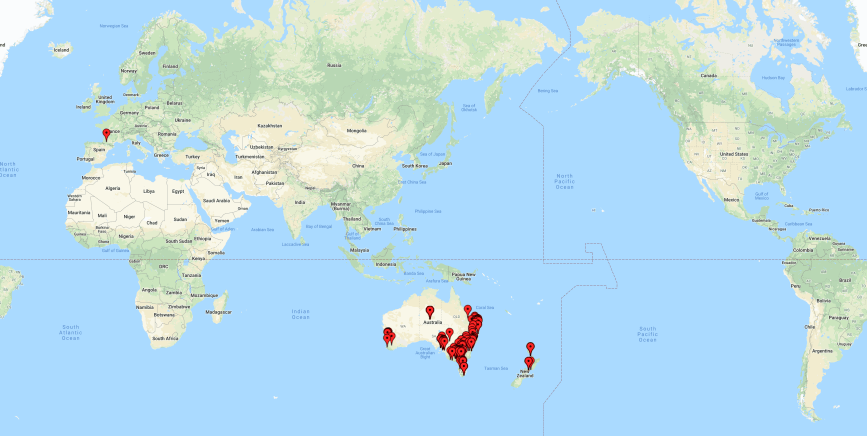
The map below shows my QSOs during the contest.  As you can see, the one single European contact into France.
Screen Shot 2019-06-09 at 8.07.03 pm.png

Above:- Map of the world showing my contacts during the VK Shires Contest.  Courtesy of QSOMap.org

I found the bands to be in reasonably good shape, all except for 20m which yielded very little contacts.
Screen Shot 2019-06-09 at 8.07.24 pm.png

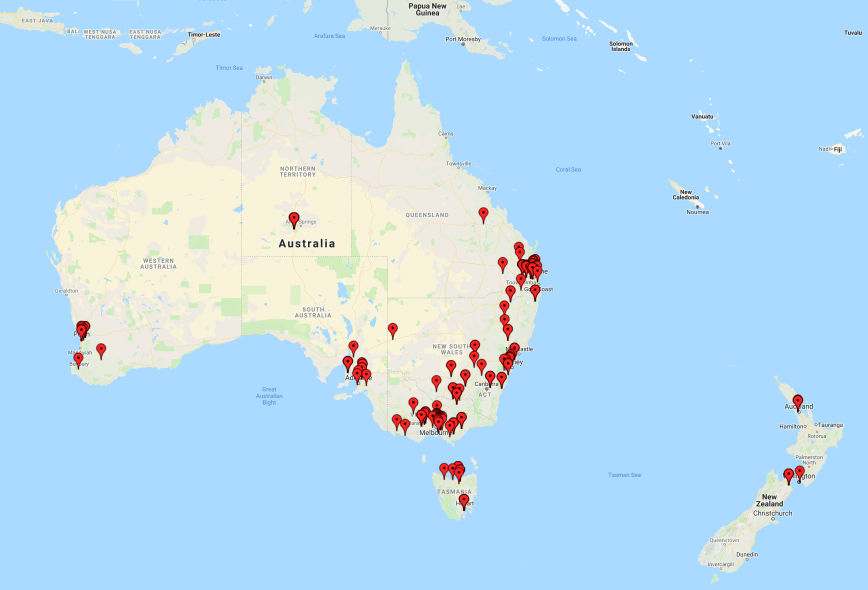
Above:- My VK & ZL contacts during the contest.  Courtesy of QSOMap.org

As this was a contest I was unable to self spot.  Us park & SOTA activators probably take the parksnpeaks website for granted.  Because there is no doubt, that when you are not spotted, the number of callers dramatically decreases.  I spent long periods calling CQ on the 80m band and the 20m band without many callers.  The ‘regular’ park hunters didn’t appear as there was no spot on parksnpeaks.

It is permissible though for others to spot people they work during the contest.  However, as a contest participant I cannot ‘Arranging or confirming any contacts during or after the contest by use of ANY non-amateur radio means such as telephones, Internet, instant messaging, chat rooms, VoIP, email, social media or web sites.‘  For those who did spot me, I say a BIG thankyou.

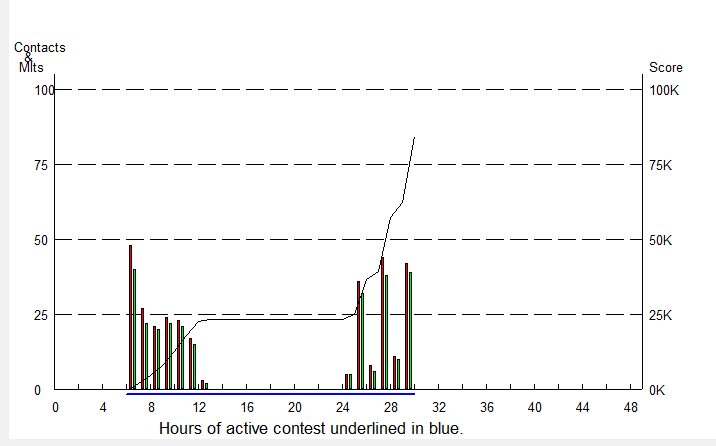
The chart below shows my activity during the contest.  I kicked off at 0600 UTC (3.30 p.m. South Australian local time on Saturday and wound up my activities at around 1212 UTC (9.42 p.m. local time).  I got back into it again on Sunday at around 0047 UTC (10.17 a.m. local time) and finished when the contest concluded at 0600 UTC on Sunday.
All bands

Above:- Graph showing my hours active during the contest.  Graph courtesy of VK Contest Log.

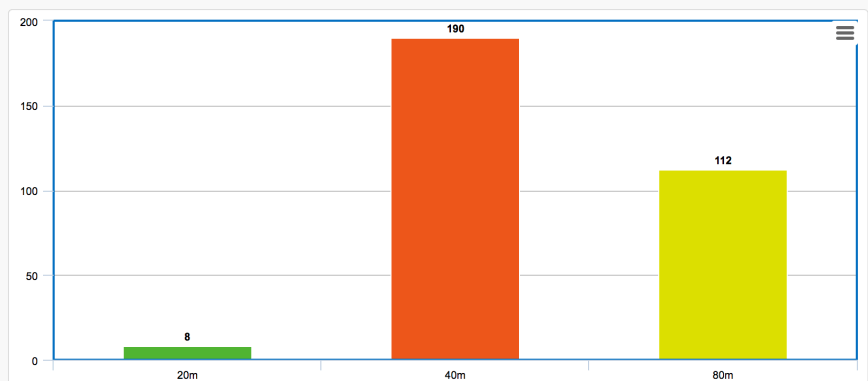
The vast majority of my contacts were on the ever-reliable 40m band.  I made a total of 190 contacts there, followed by 112 on 80m, and just 8 on the 20m band.

  • 80m – 112
  • 40m – 190
  • 20m – 8
Screen Shot 2019-06-09 at 8.27.47 pm

Above:- Graph showing the number of contacts per band during the contest.  Courtesy of meta-chart.com

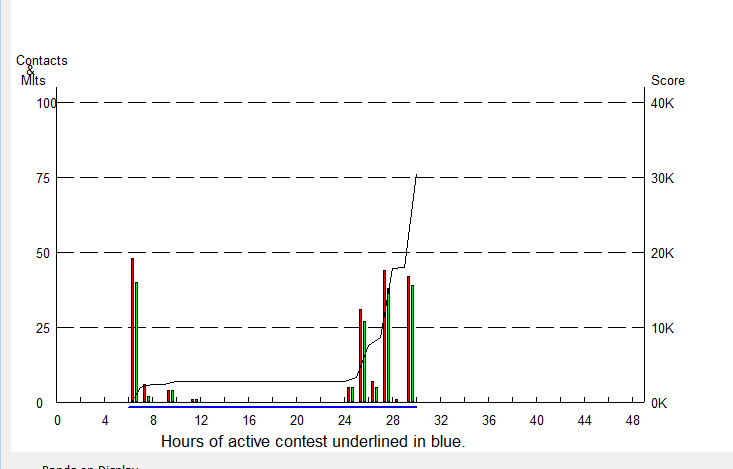
The 40m band proved reliable as always.  As there was no man-made noise in any of the parks I was able to hear a pin drop.  It was evident though that some of the home stations were suffering from noise which is an ever-increasing problem in the hobby.
40m.PNG

Above:- Graph showing my contacts on the 40m band.  Graph courtesy of VK Contest Log.

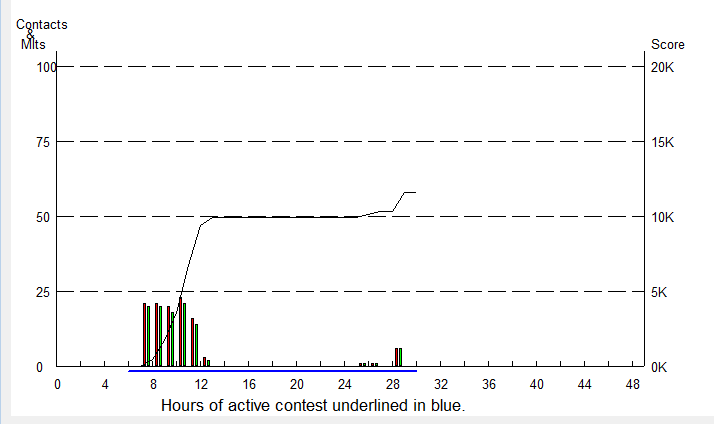
Most of my activity on 80m was on Saturday night as the graph below shows.  But I did make some good contacts on 80m during the day as well.
80m

Above:- Graph showing my contacts on the 80m band.  Graph courtesy of VK Contest Log.

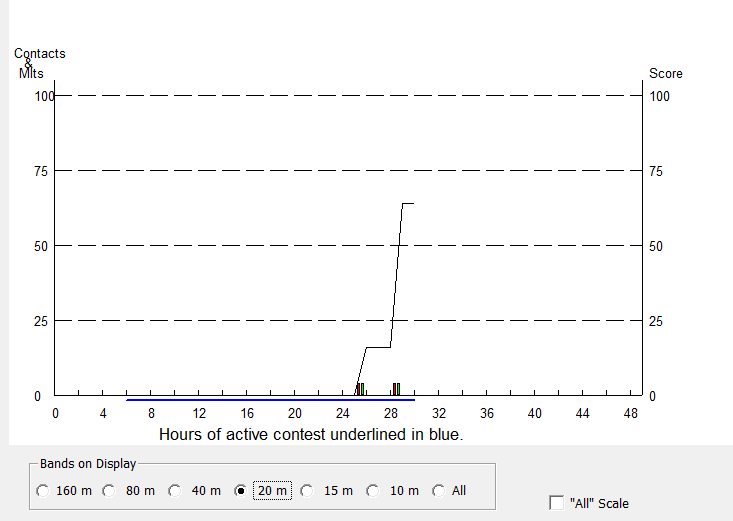
The 20m band proved a real flop for me.  I only worked a handful of VK4 & VK6 stations on that band.
20m.PNG

ABove:- Graph showing my contacts on the 20m band.  Graph courtesy of VK Contest Log.

I made a total of 14 Park to Park contacts during the contest.

I worked the following Park to Park from Wiljani Conservation Park:-

  • Peter VK3PF – VKFF-2488

I worked the following SOTA station from Scott Conservation Park:-

  • Andrew VK1DA/2 – VK2/ ST-039

I worked the following Park to Park from Scott Conservation Park:-

  • Rob VK4SYD – VKFF-1639 (40m)
  • Angela VK7FAMP – VKFF-2930
  • Rob VK4SYD – VKFF-1639 (20m)
  • Linda VK7QP/2 – VKFF-2009
  • Alan VK2MG/4 – VKFF-2868

I worked the following Park to Park from Mount Billy Conservation Park:-

  • Alan VK2MG/4 – VKFF-2658
  • Greg VK4VXX/2 – VKFF-0204
  • Mark VK4SMA – VKFF-2873 (40m)
  • Mark VK4SMA – VKFF-2873 (20m)
  • Peter VK3TKK – VKFF-2096

I worked the following Park to Park from Mount Billy Conservation Park:-

  • Alan VK2MG/4 – VKFF-2876
  • Peter VK3TKK – VKFF-2241
  • Greg VK4VXX/2 – VKFF-0204

Many thanks to everyone who called me, and thanks to those who spotted me.
Congeratinga Native Forest Reserve VKFF-2896

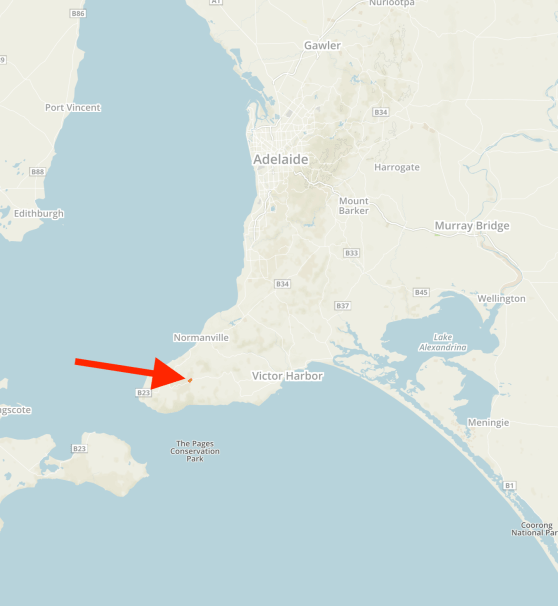
Today (Monday 3rd June 2019) was my first of 2 days off after working 7 straight shifts at work.  Sadly the weather was less than ideal, with shower activity all morning and a very chilly temperature of around 10 deg C.  I had an itchy PTT finger and was keen to get out to do an activation.  I waited until after lunch when the weather cleared a little, and packed the 4WD and headed down to the Congeratinga Native Forest Reserve VKFF-2896 on the Fleurieu Peninsula.

Screen Shot 2019-06-03 at 9.58.17 pm.png

Above:- Map showing the location of the Congeratinga Native Forest Reserve.  Map courtesy of Protected Planet.

I travelled to the town Meadows and then through Mount Compass, and headed south on the Victor Harbor Road.  Upon reaching Victor Harbor, I stopped briefly to admire the view from Range Road.

I headed west out of Victor Harbor on the Range Road and soon reached the area of Parawa.  This is beautiful countryside, and there are some great views to be enjoyed from Range Road of the surrounding countryside.

After about an hour and twenty minutes on the road, I reached the Reserve.  It was well signposted.

Congeratinga Native Forest Reserve forms part of the Second Valley Forest Reserve.  Nearby Native Forest Reserves are Kalamunda and Springs Road.  Together they comprise 250 hectares of native vegetation.

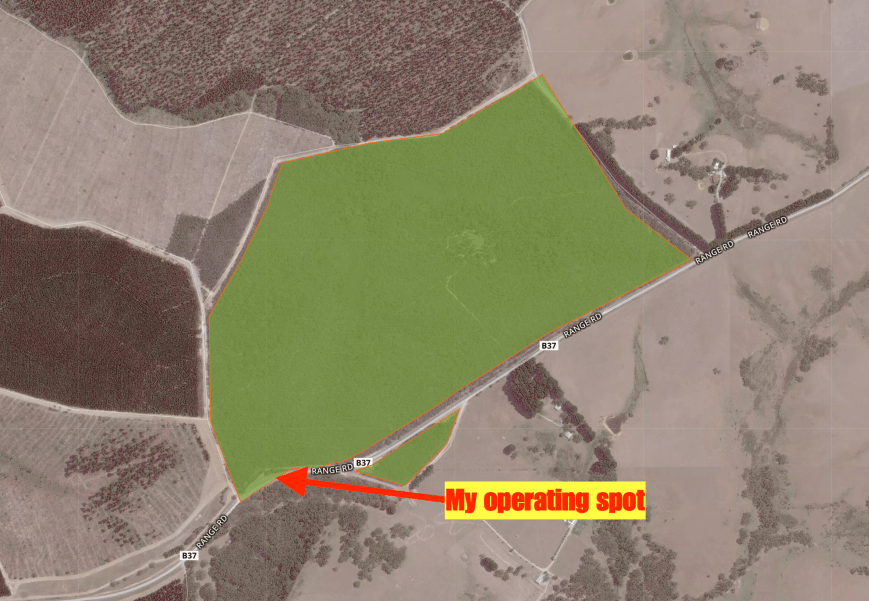
Congeratinga is located on the northern side of Range Road, with a small section also located on the southern side of Range Road.  The reserve is about 77.3 hectares in size.  Commercial pine plantations are located to the west of the reserve, with cleared farming land located on the other boundaries of the reserve.  The Congeratinga River flows through the reserve.

Native mammals found in the reserve include the Western Grey Kangaroo, Short-beaked Echidna, Yellow-footed Antechinus, Bush Rat, and the Southern-brown Bandicoot.  It is believed that the endangered Southern Emu-wren is located in the reserve.

I found a small 4WD track which ran adjacent to Range Road.  I drove down the boggy track which followed the southern boundary of the reserve.  There was plenty of room here to stretch out the 20/40/80m linked dipole.  I ran the Yaesu FT-857d and 40 watts output for this activation.

Screen Shot 2019-06-03 at 9.59.37 pm.png

Above:- An aerial shot of the Congeratinga Native Forest Reserve, showing my operating spot.  Image courtesy of Protected Planet.

I was set up and ready to go by about 2.30 p.m. local time.  I found Rob VK4HAT/p on 7.144 calling CQ from Kurwongbah Park Nature Refuge VKFF-2868.  After logging Rob Park to Park I moved up the band to 7.150 an asked if the frequency was in use.  Dennis VK2HHA came back to let me know the frequency was clear.  I logged Dennis, followed by Peter VK3PF, and then Ron VK3AHR.

It was a weekday, but I was very pleased to have a steady flow of callers.  Contact number 10, qualifying the park for me for VKFF, was with Tom VK3ATO.  I logged a total of 35 stations on 40m before callers slowed down.  So it was down with the squid pole, and I inserted the links for the 80m band.

Unfortunately, I had no mobile phone coverage.  But thanks to some very kind hams I was spotted on parksnpeaks.  I logged a total of 6 stations on 80m.  Two of those were from VK5, and four from VK3.

I then moved to the 20m band where I logged a total of 8 stations from VK3, VK4, and VK6.  To conclude the activation I moved back to 40m where I logged a further 5 stations, before packing up and heading home.

I had qualified the park, with a total of 54 contacts in the log.

DSC_7462

Above:- My operating spot for the afternoon.

I worked the following stations on 40m SSB:-

  1. VK4HAT/p (Kurwongbah Park Nature Refuge VKFF-2868)
  2. VK2HHA
  3. VK3PF
  4. VK3AHR
  5. VK4FDJL
  6. VK2NP
  7. VK3MIJ
  8. VK2YW
  9. VK7JON
  10. VK3ATO
  11. VK7FOLK
  12. VK2LEE
  13. ZL1TM
  14. VK2MG
  15. VK3FPSR
  16. VK5LG
  17. VK4TJ
  18. VK4/AC8WN
  19. VK4/VE6XT
  20. VK3UH
  21. VK2DWP/m
  22. VK2IO/m
  23. VK4VXX/2
  24. VK2UPR/p
  25. VK3FT
  26. VK4PDX
  27. VK4RF
  28. VK4HA
  29. VK3MKE
  30. VK2BHO
  31. VK4SMA
  32. VK7KT
  33. VK2DXM/m
  34. VK2ARL
  35. VK3MCK
  36. VK2UH
  37. VK3FKL
  38. VK2VW
  39. VK2MOP
  40. VK7QP/2

I worked the following stations on 80m SSB:-

  1. VK3PF
  2. VK5WU
  3. VK3NBL
  4. VK3RW
  5. VK3SQ
  6. VK5AYL

I worked the following stations on 20m SSB:-

  1. VK4LMB
  2. VK4HAT
  3. KH7AVC/VK4
  4. VK4SMA
  5. VK4PHD
  6. VK3PF
  7. VK3SQ
  8. VK6QS

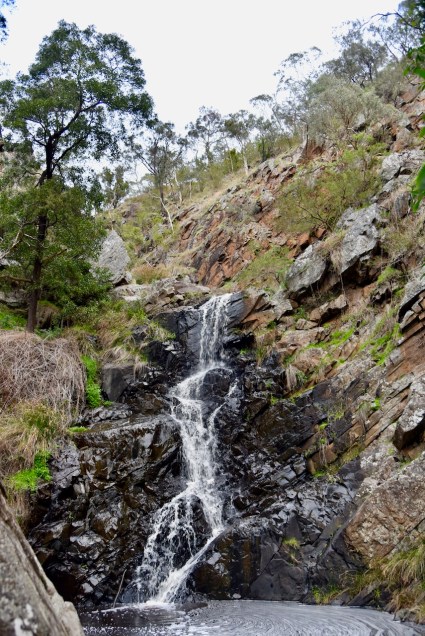
I headed north along Hay Flat Road, stopping briefly to have a look at Ingala Falls.  It is just a short 250-metre walk from the carpark to the falls.

DSC_7476

Above:- Ingala Falls.

I headed back home through Yankalilla, Myponga, and Meadows.  It was slow going home as it was starting to get dark and the kangaroos were out in force.

DSC_7484


References.

Forestry SA, 2016, ‘Kalamunda, Springs Road & Congeratinga Native Forest Reserves Management Plan’

SOTA summits activated

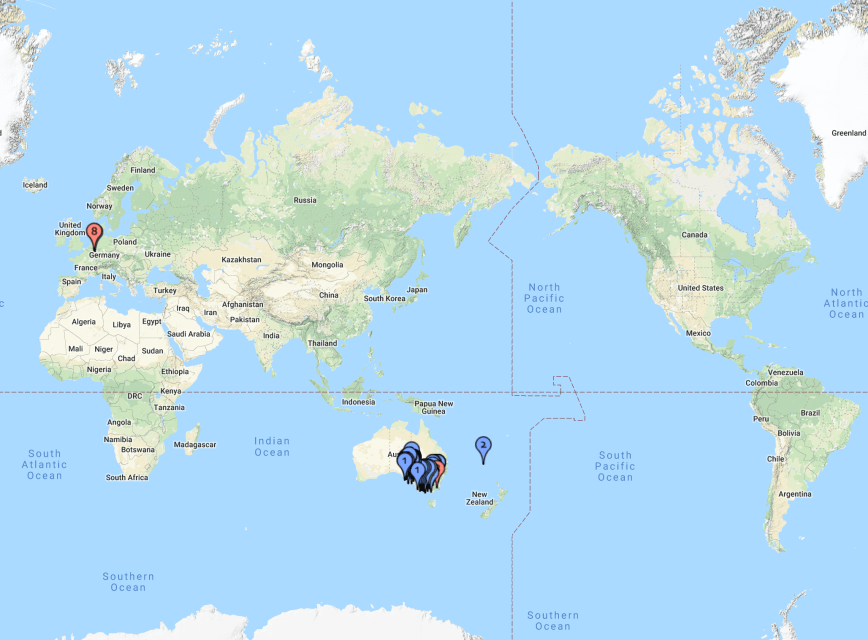
On the webpage for the German Mountain Activity Group, you can click on GMA Map View.  There are a number of different options that you can view on the map.

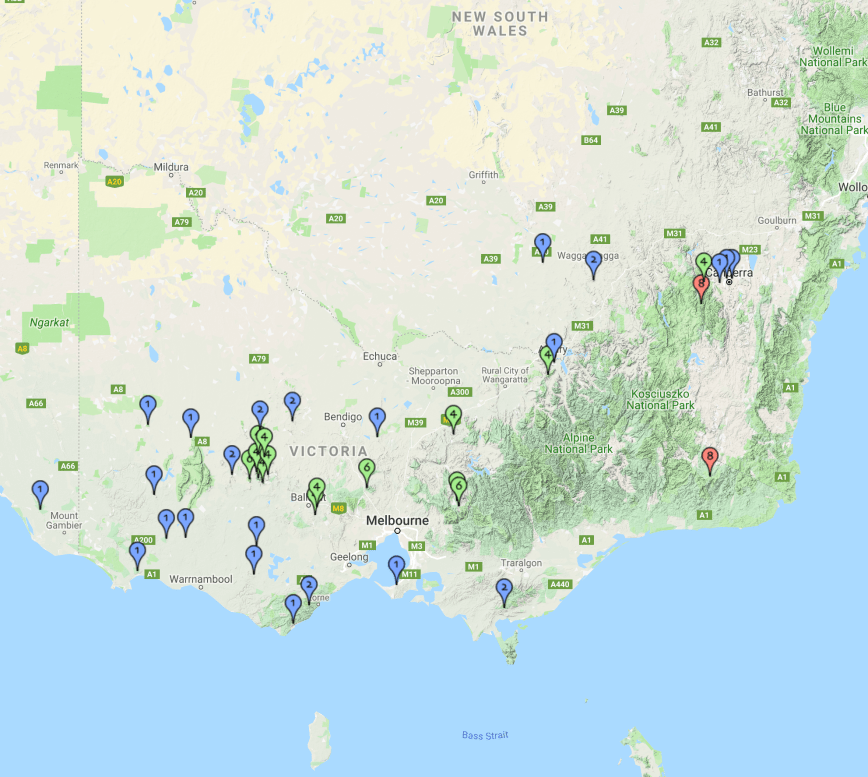
Below are my activations for the Summits on the Air (SOTA) program.  I have activated a total of 82 unique summits around the world.

Screen Shot 2019-05-26 at 12.04.11 pm.png

Above:- World map showing my SOTA activations in Europe, the Australian mainland, and on Norfolk Island.  Image courtesy of cqgma.org

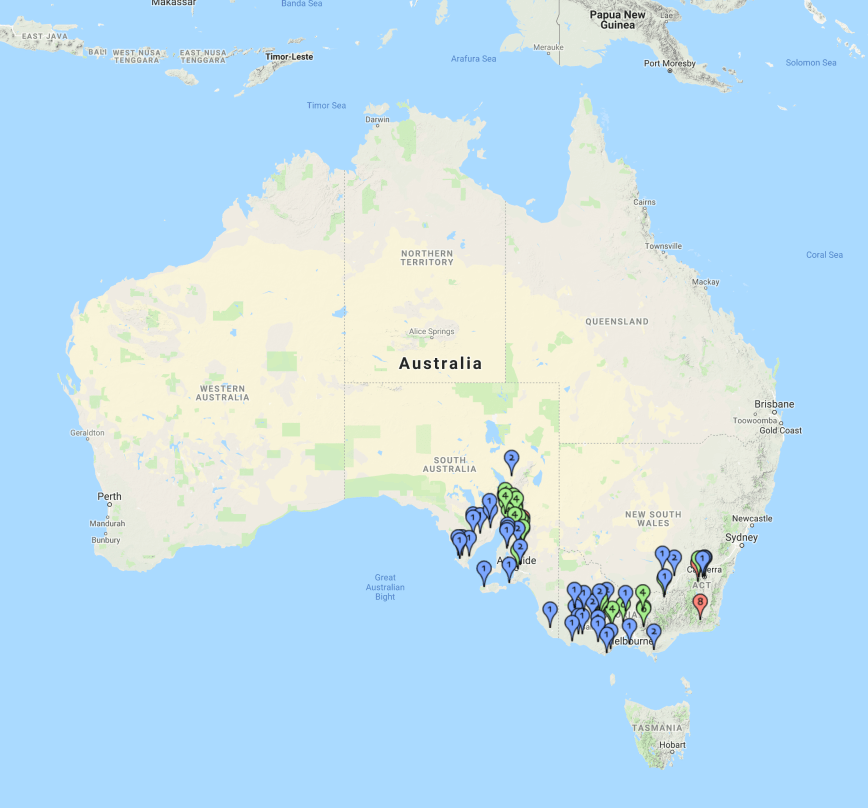
I have activated SOTA summits in VK1, VK2, VK3, & VK5.

Screen Shot 2019-05-26 at 12.06.16 pm.png

Above:- My SOTA activations in VK.  Image courtesy of cqgma.org

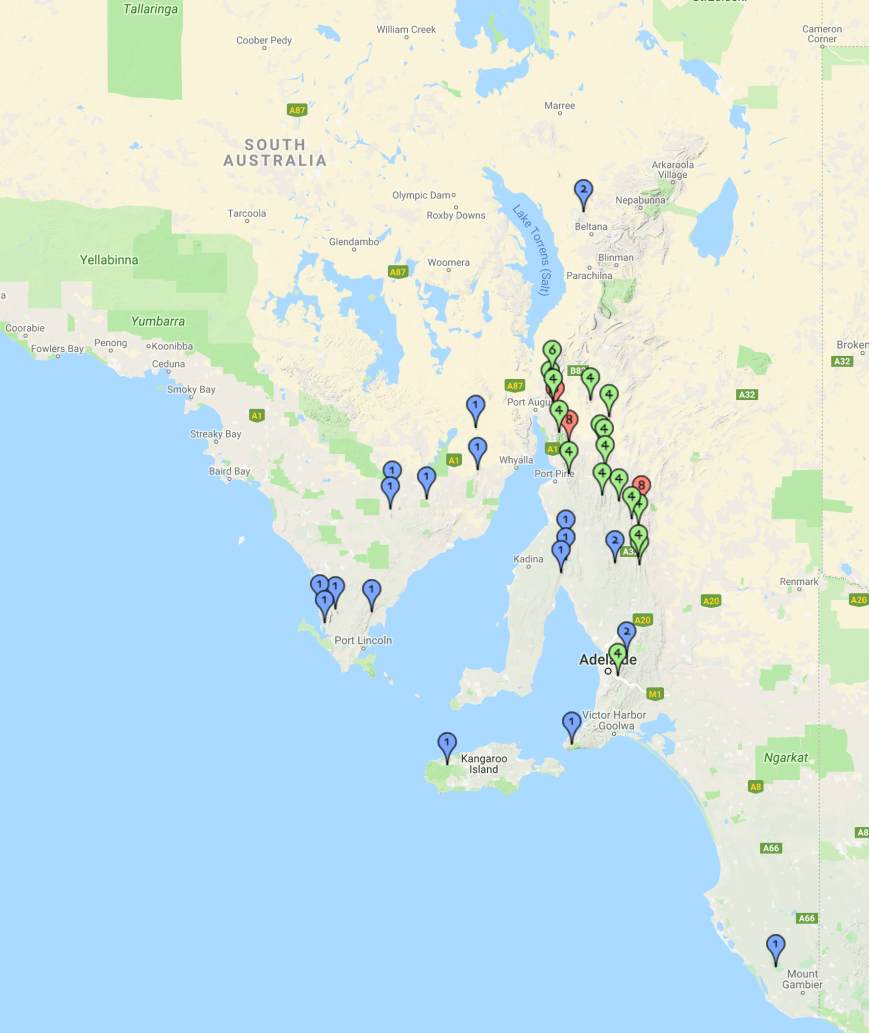
The majority of my activations have been in my home State of South Australia (VK5).

Screen Shot 2019-05-26 at 11.56.59 am.png

Above:- Map of South Australia showing my SOTA activations.  Image courtesy of cqgma.org

I have also activated a number of SOTA summits in Victoria (VK3), New South Wales (VK2) and in the Australian Capital Territory (VK1).

Screen Shot 2019-05-26 at 11.57.08 am.png

Above:- My interstate SOTA activations.  Image courtesy of cqgma.org

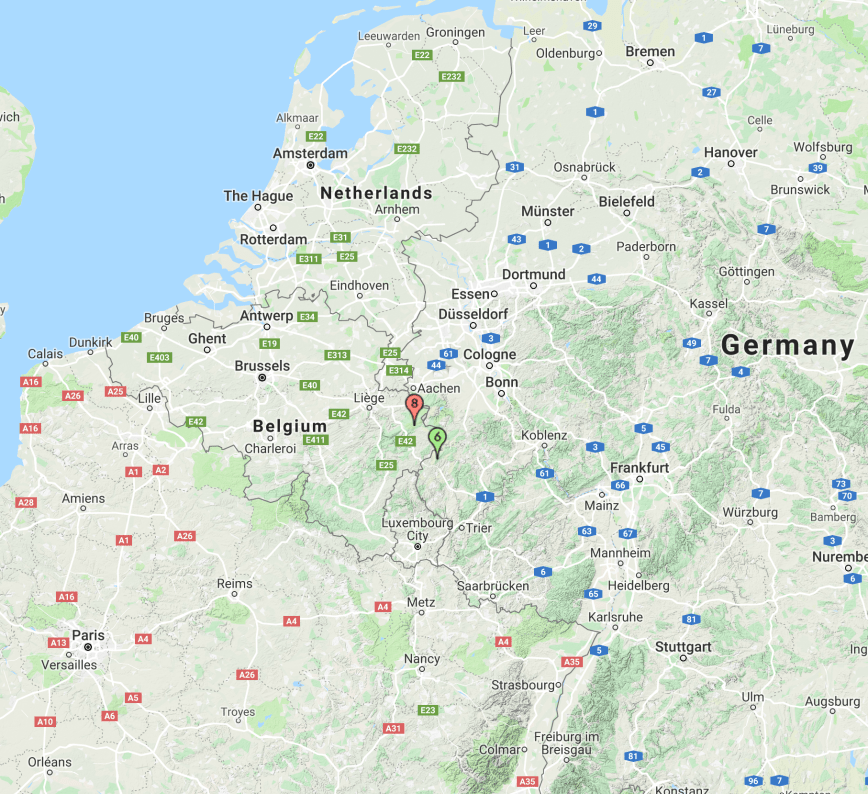
During my 2014 visit to Europe, I was fortunate to activate two SOTA summits.  One in Belgium, and one in Germany.

Screen Shot 2019-05-26 at 12.02.19 pm.png

Above:- Map showing my two SOTA activations in Europe.  Image courtesy of cqgma.org


Springs Road Native Forest Reserve VKFF-2895

Today (Monday 20th May 2019) is my first of two days off, after working seven straight at work.  Despite the weather forecast not being great, I decided to head down to the Fleurieu Peninsula to activate the Springs Road Native Forest Reserve VKFF-2895.  This is one of the newly added parks to the World Wide Flora Fauna (WWFF) program, and this would be a first-time activation of the park.

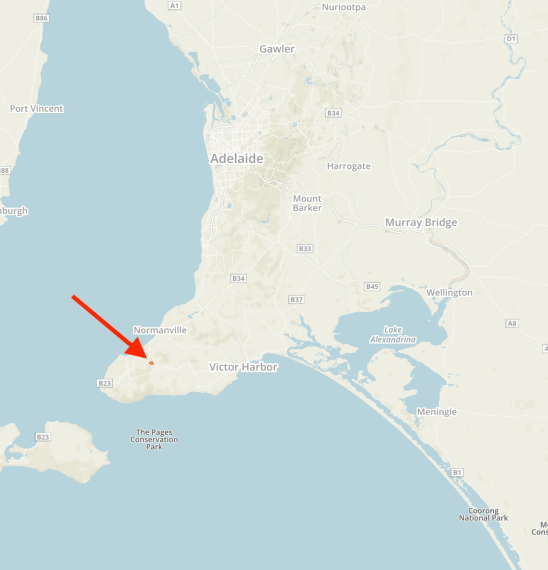
Screen Shot 2019-05-20 at 5.35.55 pm.png

Above:- Map showing the location of the Springs Road Native Forest Reserve.  Map courtesy of Protected Planet.

I left home at around 11.30 a.m. local time.  This was about a 90 km drive for me down through the southern Adelaide Hills and onto the Fleurieu.  My first stop was at the town of Myponga where I grabbed a bite to eat.  It is believed the name Myponga comes from the aboriginal word ‘maitpangga’ meaning ‘place of animal food’.  There are however other versions of how the town was named.

After picking up a pie and a drink at one of the local bakeries, I stopped a short distance down the road at the Myponga Reservoir which provides about 5% of the city of Adelaide’s water supply.  The area where I stopped is known as Lovely Valley.  There is a small information board here showing Lovely Valley before it was flooded by the waters of the Myponga Reservoir.  The valley was named by Governor Hindmarsh on his way through the district in 1838.

I continued along Main South Road, with the next town reached being Yankalilla.  I worked here back in the mid to late 1980s.  There are a number of opinions on how Yankalilla obtained its name.  It is suggested that it takes its name from the aboriginal word ‘jankalan’ meaning ‘falling’.  This is from an incident in the myth of Tjibrke, whose sister’s mummified body began to fall into pieces here, as he was carrying it from Brighton to Cape Jervis for burial.

I then took Inman Valley Road, stopping briefly at the Torrens Vale lookout.  This is well worth a stop.  The view here extends from Mount Hayfield in the west where the legendary aboriginal figure ‘Tjilbruke’ rose from the ground to Mount Robinson in the southeast.  The area in between these two landmarks is known as Torrens Vale, formerly called Dairy Flat.

Torrens Vale was an important early settlement from the 1850s.  In its heyday, there were six churches, four cemeteries, a butter factory, post office, blacksmiths shop, store, and a school.   Lieutenant William George Field R.N. first mate of Colonel William Light’s ship the ‘Rapid’, built is homestead ‘Hillside’ near the foot of Mount Hayfield.

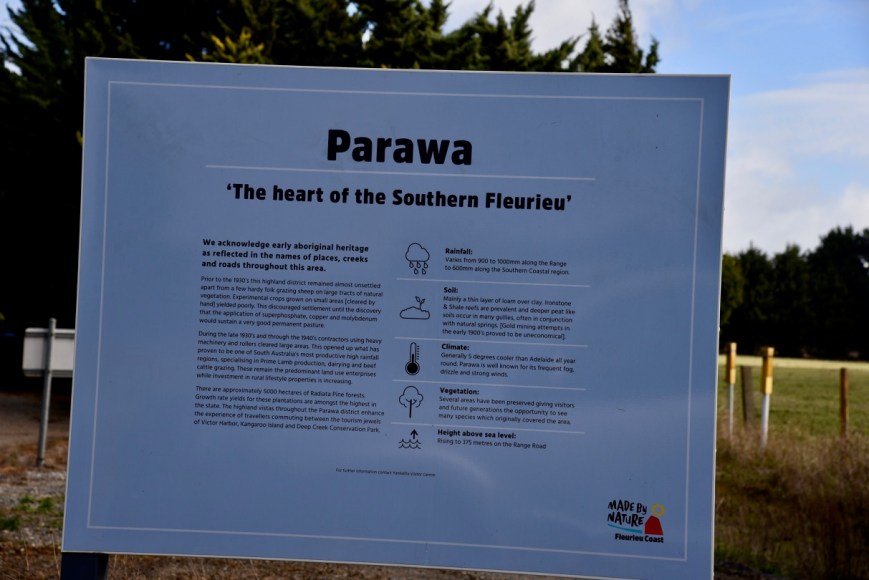
From Torrens Vale Road, I took Parawa Road, stopping briefly at the Parawa information board near the Range Road junction.  Prior to the 1930s, the Parawa area remained almost unsettled, except a few hardy folks who grazed sheep.  During the late 1930s and through the 1940s, contractors using heavy machinery and rollers cleared large areas of land for farming.  Today Parawa is of South Australia’s most productive high rainfall regions, supporting Prime Lamb production, dairying and beef cattle grazing.

DSC_7403.jpg

Above:- Parawa information board

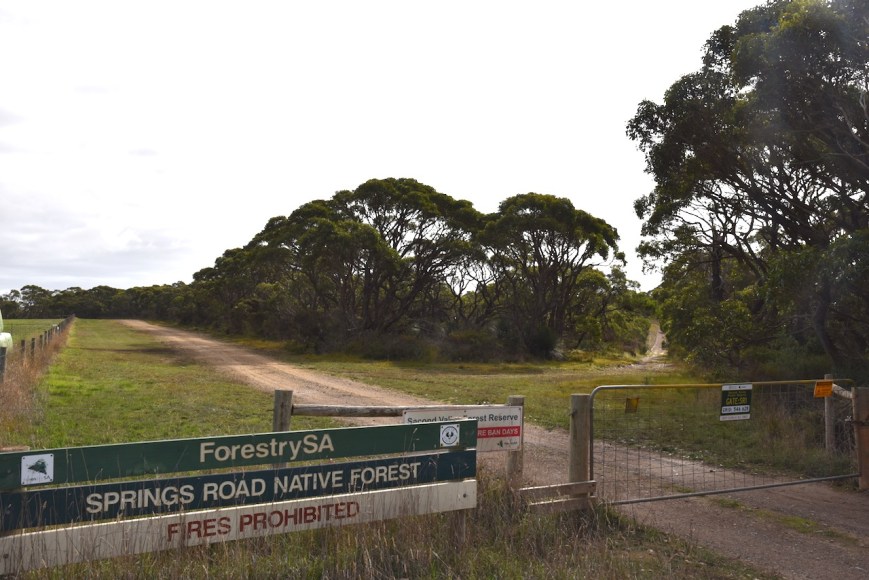
I travelled west along Range Road and then turned right into Springs Road.  I soon reached the park which was well signposted.

DSC_7404

The Springs Road Native Forest Reserve is about 89.6 hectares in size and forms part of the Second Valley Forest Reserve on the Fleurieu Peninsula, south of Adelaide.  The park is surrounded by cleared farming land and pine forest.

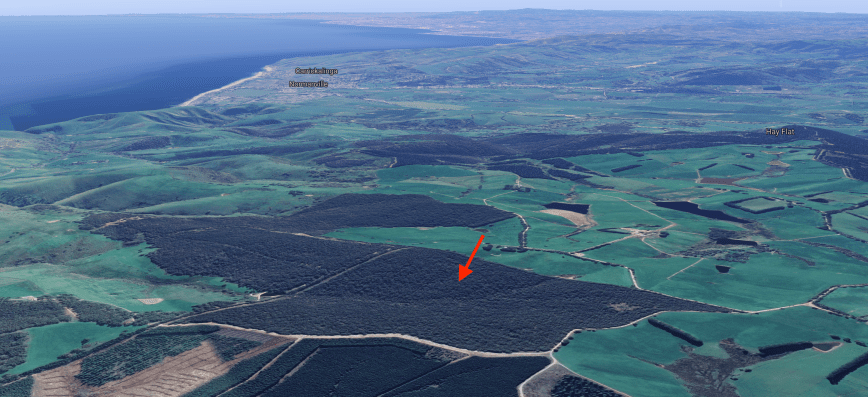
Screen Shot 2019-05-20 at 5.30.44 pm.png

Above:- An aerial shot of the park looking north back towards the towns of Normanville & Yankalilla.  Image courtesy of Google maps

The park protects native scrub on the Fleurieu Peninsula which has suffered in the past by activities such as grazing and timber felling.  Less than 15% of the original native scrub remains.

Native animals that call the park home include the Western Grey kangaroo, Short-beaked Echidna, and the nationally endangered Southern Brown Bandicoot.

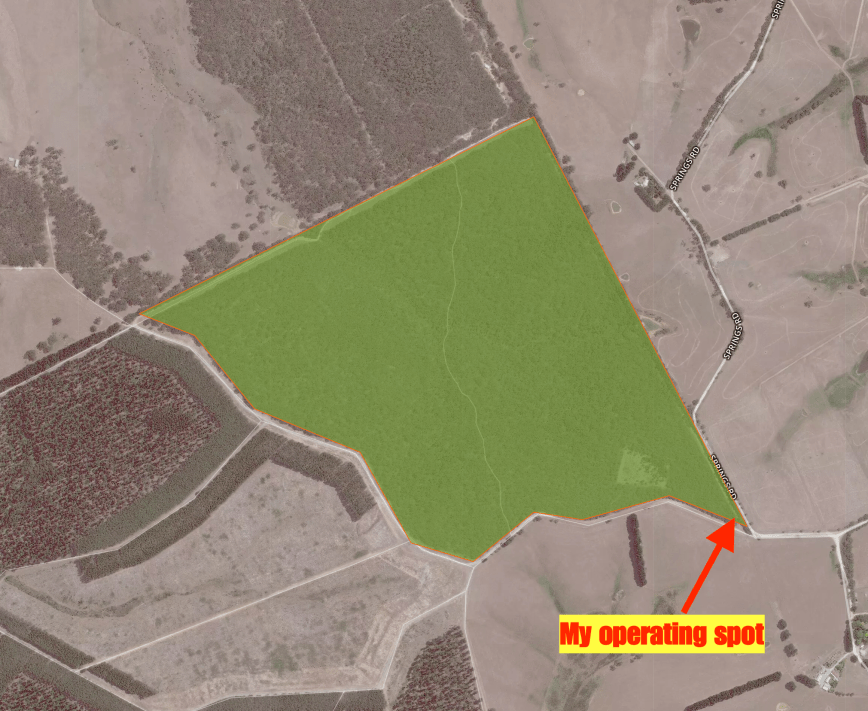
I set up in the southeastern corner of the park off Springs Road, a short distance from Mount Hayfield Road.  There was an area here where I could pull off the road and park at the locked gate.  I walked about 30 metres in along a fire track and set up, running the Yaesu FT-857d, 40 watts and my 20/40/80m linked dipole.

Screen Shot 2019-05-20 at 5.35.42 pm.png

Above:- An aerial shot of the park showing my operating spot in the southeastern corner.  Image courtesy of Protected Planet.

After setting up I headed to 7.144 and asked if the frequency was in use.  Peter VK3PF came back to my call to advise that the frequency was clear.  After logging Peter I was called by Mark VK4SMA, then Geoff VK3SQ and John VK4TJ.  It took me just 6 minutes to qualify the park for the VKFF program, with contact number ten being with Ray VK4NH.

Despite it being a weekday, it was pleasing to see a steady flow of callers.  I logged a total of 24 stations on 40m before callers dried up.  I had not logged any local South Australian stations on 40m and it appeared there was no close in propagation on that band.  So I headed down to 80m and called CQ on 3.610.  First in the log was David VK5PL with a strong 5/9 plus signal.  David had posted on Facebook that he was unable to hear me on 40m so it was good to be able to get David in the log on 80m.

Unfortunately, I only logged 3 stations on 80m, all VK5’s, despite the band being in very good shape.  I then headed off to the 20m band.  I called CQ on 14.310 and logged Mark VK4SMA, followed by Kevin VK6AB/p.  To my surprise, my tenth contact on 20m was with Karl VE6KDX in Albert Canada.  This was followed by Bobby AJ4EN in South Carolina in the USA.  I also logged Paul ZL2CQ and Ken ZL4KD in New Zealand.

With 15 stations in the log on 20m and small drops of rain, it was time to head back to the 40m band to pick up 2 more contacts for my 44 QSOs required to qualify the park for the global WWFF program.

I called CQ on 7.144.  Joseph VK5WU came back to my call, followed by Brett VK2VW, and then Peter VK3KAI/VK3GV.  The rain was starting to get heavier.  I put out a last quick call and logged Ken VK3UH and then Alan VK2MG.  Sadly I had to go QRT, as the rain was really starting to come down heavy now.  I’m sorry to anyone else who was there waiting to work me.  I will return to the park.

I had qualified the park, got wet in the process, and it was time to head home, having qualified the park with 48 contacts in a little over one hour.

Thank you to everyone who called and a big THANKYOU to those who took the time to spot me.  Sadly it continues to be the same people over and over again who spot on parksnpeaks.  Many use it to their advantage, but never spot, which is rather disappointing.

I worked the following stations on 40m SSB:-

  1. VK3PF
  2. VK4SMA
  3. VK3SQ
  4. VK4TJ
  5. VK4/AC8WN
  6. VK4/VE6XT
  7. VK4FDJL
  8. VK7JON
  9. VK3TKK/m
  10. VK4NH
  11. VK4DXA
  12. ZL4TY/VK4
  13. VK4FARR
  14. VK2NP
  15. VK2KNV/m
  16. VK4HNS
  17. VK3PNG
  18. VK2IO
  19. VK3DEK
  20. VK2WQ
  21. VK3ZZS
  22. VK3AHR
  23. VK3PAT
  24. VK3MCK
  25. VK5WU
  26. VK2VW
  27. VK3KAI
  28. VK3GV
  29. VK3UH
  30. VK2MG

I worked the following stations on 80m SSB:-

  1. VK5PL
  2. VK5WU
  3. VK5KGP

I worked the following stations on 20m SSB:-

  1. VK4SMA
  2. VK6AB/p
  3. VK6ALF
  4. VK3MCK
  5. VK2NP
  6. VK4TJ
  7. VK4/AC8WN
  8. VK4/VE6XT
  9. ZL2CQ
  10. VE6KDX
  11. AJ4EN
  12. ZL4KD
  13. VK3SQ
  14. VK2MG
  15. VK4PDX


References.

Forestry SA, 2016, ‘Kalamunda, Springs Road, & Congeratinga Native Forest Reserves Management Plan’

State Library of South Australia, 2019, <http://www.slsa.ha.sa.gov.au/digitalpubs/placenamesofsouthaustralia/>, viewed 20th May 2019

Wikipedia, 2019, <https://en.wikipedia.org/wiki/Myponga_Reservoir>, viewed 20th May 2019

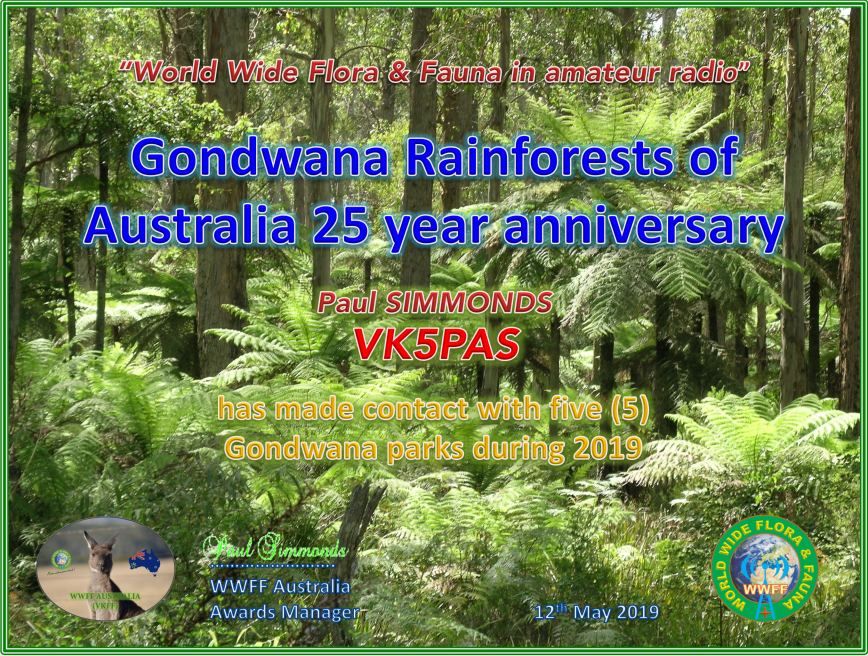
Gondwana Rainforests Award

The Gondwana Rainforests of Australia include the most extensive areas of subtropical rainforest in the world, extending past Newcastle to the south-east of Queensland.  The Gondwana Rainforests of Australia are World Heritage listed, thriving with plants and wildlife, and an outstanding example of the major stages of Earth’s evolution.

To celebrate the 25th anniversary of the Gondwana Rainforests of Australia, the VKFF program is offering the Gondwana Rainforests Award.

The award is issued to activators and hunters who during 209, activate/work:-

  • 5 Gondwana parks
  • 10 Gondwana parks
  • 15 Gondwana parks
  • 20 Gondwana parks
  • 25 Gondwana parks
  • 30 Gondwana parks
  • All 34 Gondwana parks

More information can be found at……

https://www.wwffaustralia.com/gondwana-parks-award.html

VK5PAS Gondwana Hunter 5.png

Nixon’s Windmill, Hahndorf – 2019 Mills on the Air Weekend

On Sunday (12th May 2019) Marija and I had booked a tour of the old Government Treasury building in Adelaide.  This was as part of History Month being held in South Australia.

The building was built in stages between 1839 to 1907.  During the Victorian gold rush of the 1850s, about 17,000 South Australian’s travelled to Victoria to make their fortune.  A gold escort route was established and 327,000 ounces of gold was brought to Adelaide and stored in the Treasury building.

The old Treasury building was the centre of South Australia’s administrative and government affairs for around 130 years, and up until 1968 housed the Government Cabinet Room.

This was a very interesting tour.  And importantly, the building is now the Adina Hotel and home of the Treasury Bar, Kitchen and Courtyard. Why important?  This is where I met my lovely wife Marija.

After leaving Adelaide, we headed back up into the Adelaide Hills to Nixons Mill at Hahndorf, for a quick activation for the Mills on the Air Weekend.

The Mills on the Air Weekend is held each year in May and is a great way to promote the hobby of amateur radio, whilst also highlighting the preservation of these very historic structures.  The Mills on the Air Weekend is timed to coincide with National Mills Weekend.  The event is organised in conjunction with the Society for the Protection of Ancient Buildings (SPAB).

The Mills on the Air Weekend commenced about 9 years ago when Jasmine G4KFP, a member of the Denby Dale Amateur Radio Society, submitted an item in the RSGB news asking if any amateur was willing to put on a station at a windmill or watermill.  Jasmine also contacted SPAB and initially agreed for 6 groups of amateurs to establish stations at 6 mills.  The word soon spread, and participants increased to 30.

The Mills on the Air Weekend is NOT a contest.  It is just a great opportunity of promoting the hobby of amateur radio and promoting heritage.

mota-logo1.jpg

The Mount Barker district developed as a milling centre with the establishment of early flour mills during the 1840s.  This was just a few years after the proclamation of South Australia in December 1836.  In 1842, John Dunn constructed the first wind-powered mill for grinding wheat at Hay Valley near Nairne.  The first steam-powered flour mill outside Adelaide was established in 1844 at Mount Barker, also by John Dunn, which ceased operations in 1894.

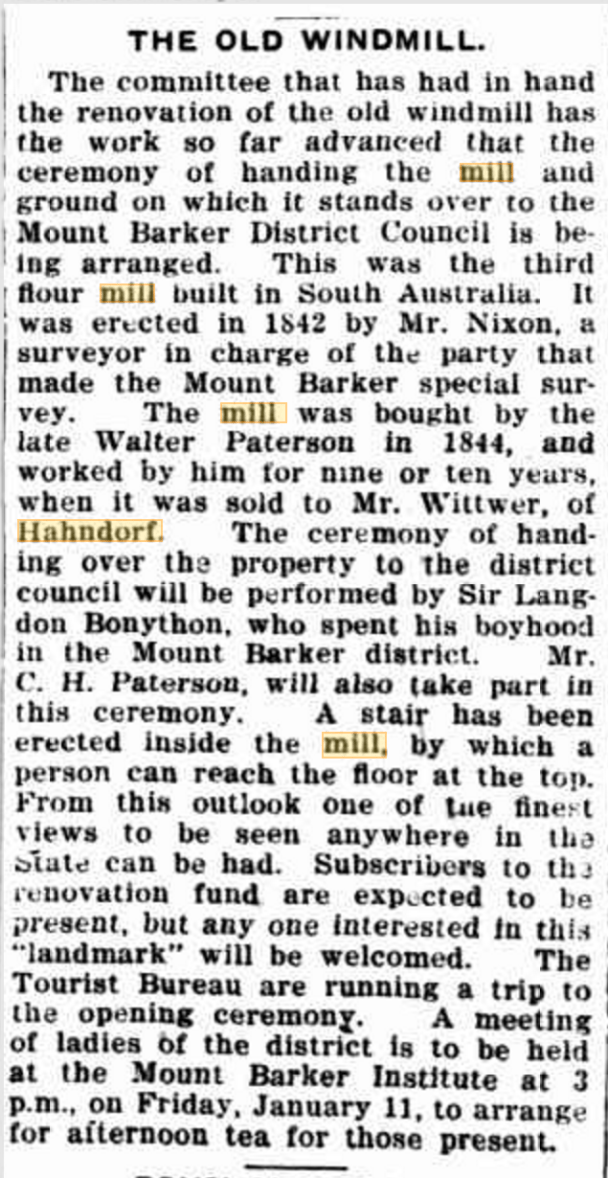
Between 1841-1842, construction was undertaken of a wind-powered mill at Hahndorf for Frederick Robert Nixon (1817-1860), who was part of Colonel William Light’s team or surveyors.  The mill was located on a small hill overlooking the road between Hahndorf and Mount Barker, referred to as West Hill, and subsequently known as “Windmill Hill”.  Nixon had purchased the land on the 6th of May 1841.  Nixon’s mill opened up an important agricultural area of the State, grinding over half a million bushels of wheat in one season.  It was the second wind-driven flour mill in the Mount Barker district.

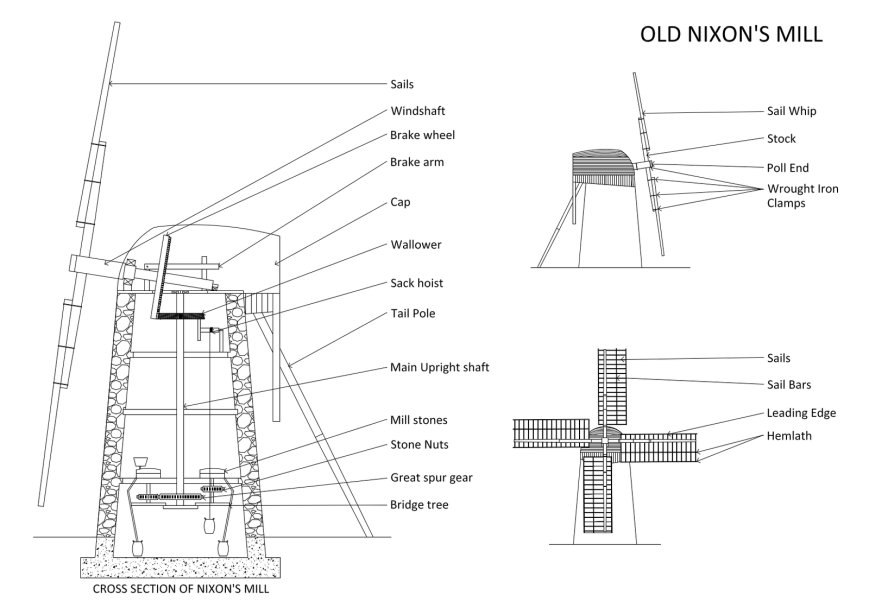
The tower structure of the mill, which is 9.05 metres high,  is constructed of random coursed stone rubble and is about 75cm thick.  There were four working levels in the mill, with one window at the second level and two windows at the third level.  Two doors existed at ground level, with one of those having been bricked up.  A circular cap structure was located at the top of the tower which sat on a base of two large horizontal beams called sheer tress.  A movable boat-shaped cap rested on a track that rotated around the top of the tower on a well-greased metal curb.

The sail frames were constructed of hardwood and canvas sheets were furled like a curtain to cover different areas of the frames dependant on wind velocity.  The sails had a sweep of 17 metres in diameter.  The mill contained a large wooden brake wheel which was connected to the wind shaft that was driven by the wind in the sails.  A wallower was fixed to the main shaft and this was driven by wooden teeth on the brake wheel.  The millstones were rotated as a result of the great spur gear which was connected to the lower end of the main shaft which drove the smaller wooden gears.

130c133894494465a05fba7d1fe6ad262x

During 1844, Walter Paterson, a farmer from Mount Barker purchased the property.  Then in 1853, Johann Friedrich Wittwer purchased the windmill for £320.  He and his son Friedrich Wilhelm Wittwer operated the mill along with other mills in the area.

Milling at Nixon’s site ceased in 1864 as it was no longer able to compete with steam mills.  Friedrich Wittwer closed the mill following the death of his father and moved the millstones and machinery to a steam mill that he had built in Hahndorf.  The mill was subsequently purchased by the Braendler family in 1880.

Since this time the mill has been subjected to bushfires, storm damage and sadly vandalism and neglect.  Various attempts at repair and restoration have been carried out over the years.

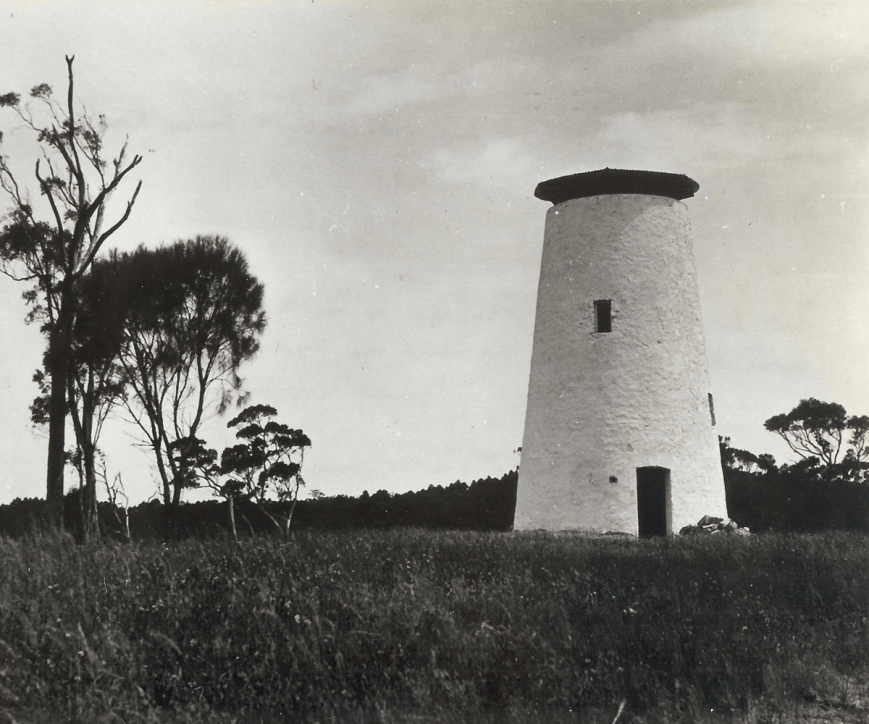
During a large bushfire in 1912, the Sheaok timbers and working parts of the windmill were destroyed.  It remained in a derelict state until 1928, when the mill was converted into a lookout tower as a result of the efforts of a group of prominent businessmen, funded by public subscription.

screen-shot-2017-05-14-at-10-03-56-pm.png

Article from The Mount Barker Courier, Fri 11 Jan 1929

At this time A.E. Braendler donated the windmill and some surrounding land to the Mount Barker District Council.   A bushfire destroyed the staircase and the upper portion of the windmill during 1939.

c2vqw6fsdoxgp9y6.png

Nixon’s Mill, 1929, as a lookout.  Image courtesy of localwiki.org

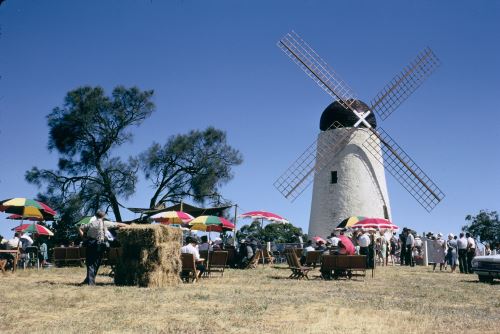
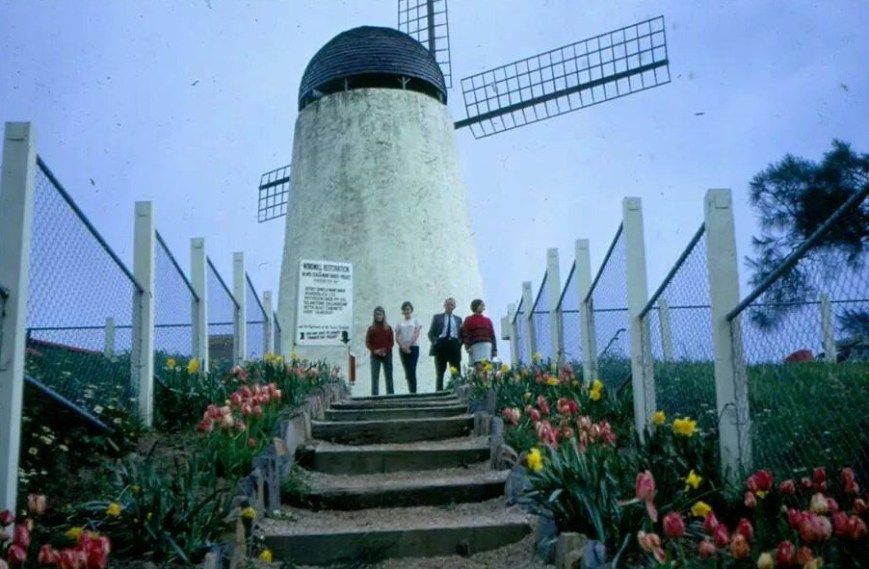
Between 1961 and 1966, a major restoration was carried out by the Mount Barker Apex Club, which included the installation of a dome roof and four dummy sail-spars.  The Honourable Steele Hall opened the restored windmill to the public on the 20th November 1966.

hq42nmgfudj5szxa-1.jpg

Opening ceremony in 1966 of Nixon’s Windmill.

a501dyxn47c8gnjl-1.jpg

Nixons Mill, c. 1960’s, prior to storm damage and vandalism attacks.  Image courtesy of localwiki.org

In 1975 a severe storm resulted in one of the sail arms being torn off.  This was followed by a number of vandalism attacks.   In 1980 an $80,000 appeal to restore the mill was officially launched at a fundraising dinner where Mr David Wotton, the Minister for Environment and Planning was the guest speaker.  A Windmill Restoration Committee was established at this time, but unfortunately, the required funds were not obtained.

vqnt10iyzdhaw5gf.jpg

The windmill in 1975 showing the sheared off sail arm.  Image courtesy of localwiki.org

During 1983 stabilisation of the windmill structure, masonry repair, waterproofing and repairs to the doors and windows were carried out.  In 1988, requests for a grant of $100,000 from the South Australian State Government were sought.  The proposal included the replacement of the mill sails and restoration of the interior of the mill to working order.  Additionally, it was suggested that a cottage, shop and historic display centre could be built.  Sadly, funding did not eventuate.

In 2016, painting, signage and major site upgrading was conducted by the Mount Barker District Council in collaboration with the Apex Club of Mount Barker.

htg2ti6k0xzsu0a7.jpg

Steam cleaning of the tower prior to repainting, 2016.  Image courtesy of localwiki.org

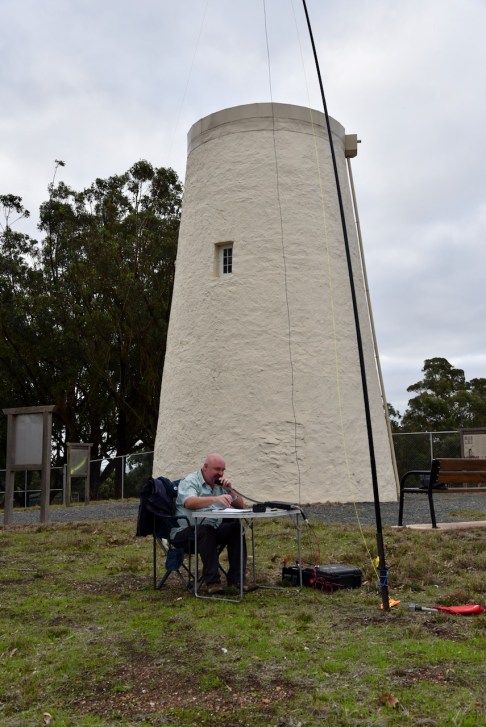
Marija and I set up only a few metres away from the structure.  We had plenty of onlookers during the activation, but not those who asked us questions.  The Hahndorf Farm barn is right next door to the mill.

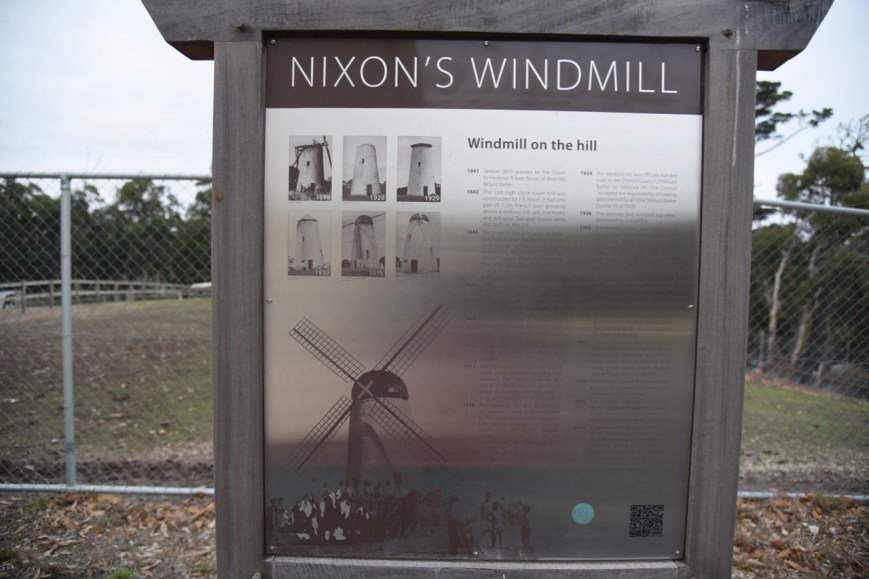
There are a number of information boards at the site, which tells the interesting history of Nixon’s Windmill.

DSC_7367

I kicked off the activation by calling CQ on 7.150.  Chris VK2SR was first in the log, followed by Keith VK3MKE, John VK2JON, and then Rick VK4RF.  The 40m band seemed to be in pretty good shape and a small pile up soon ensued.  Sadly a lot of people didn’t hang around to break the pile up.  Folks, please be patient.   It might take a few minutes, but I will get to you.

During the activation, Paul VK5PH turned up to have a look at out portable set up.  Whilst Marija chatted to Paul I continued to work the callers, logging a total of 36 stations before swapping the mic with Marija.  This included a contact with Jonathan VK7JON who was activating the Don Heads Conservation Area VKFF-2903.

DSC_7360

Marija’s first contact was with Brodie VK3FMGI/4, followed by Rick VK4RF, and then Peter VK2KNV/m.  Marija logged a total of 11 stations before I jumped back into the ‘driver’s seat’.  Marija’s contacts were made with her 10 watts PEP into VK2, VK3, and VK4.

DSC_7365

I logged a further 6 stations on 40m, including Gary ZL3SV in New Zealand who was a big signal.  It was getting very cold, with the temperature down to 10 deg C and I was pushing my luck on Mothers Day.  So it was down with the squid pole and in with the 80m band links.

I called CQ on 3.610 where I logged 10 stations, including Gary ZL3SV who was strong on 80m just as he was on 40m.  I also spoke with Scott VK3FSPN/p who was initially running 1 watt and then dropped his power down to 100 milliwatts.  The video below shows the contacts with ZL3SV on 40m and 80m and the contact with VK3FSPN.

Marija and I then packed up and headed off to the supermarket and then home for dinner.  Many thanks to everyone who called.  We had logged 63 stations from VK2, VK3, VK4, VK5, VK7, and New Zealand, in around 90 minutes.  Hopefully next year we don’t have as much on our social calendar, and I can devote some more time at the Mill.

DSC_7388

I worked the following stations on 40m SSB:-

  1. VK2SR
  2. VK3MKE
  3. VK2JON
  4. VK4RF
  5. VK4HA
  6. VK2VH
  7. VK3SQ
  8. VK4FAAT
  9. VK7JON/p (Don Heads Conservation Area VKFF-2903)
  10. VK2QK
  11. VK2HHA
  12. VK2JXA
  13. VK4HNS
  14. VK2PKT
  15. VK4FDJL
  16. VK5FANA
  17. VK2FAAA
  18. VK3YW
  19. VK7DIK
  20. ZL1TM
  21. VK2KNV/m
  22. VK4SMA
  23. VK6MB/3
  24. VK3PF
  25. VK2JDR
  26. VK3AHR
  27. VK4PDX
  28. VK2HTM
  29. VK3ATO
  30. VK3GB
  31. VK3PI
  32. VK5FCRO/2
  33. VK5KLV
  34. VK3PDC
  35. VK7HCK
  36. VK3IO
  37. VK4MRP
  38. ZL3SV
  39. VK2HMV
  40. VK2UXO
  41. VK3UH
  42. VK4SYD

I worked the following stations on 80m SSB:-

  1. VK2UXO
  2. VK3UH
  3. VK3FSPN/p (QRP)
  4. ZL3SV
  5. VK5VCR
  6. VK7DIK
  7. VK3KTT
  8. VK5QD
  9. VK5AJR
  10. VK5YX

Marija worked the following stations on 40m SSB:-

  1. VK3FMGI/4
  2. VK4RF
  3. VK4HA
  4. VK2KNV/m
  5. VK2UXO
  6. VK2IWU
  7. VK3ATO
  8. VK2FSAV
  9. VK3UH
  10. VK4SMA
  11. VK4MRP


References.

Adelaide City Heritage, 2019, <http://www.adelaideheritage.net.au/all-site-profiles/treasury-building/>, viewed 14th May 2019

localwiki, 2019, <https://localwiki.org/adelaide-hills/Nixon%27s_Windmill&gt;, viewed 14th May 2019

South Bristol Amateur Radio Club, 2019, <https://www.sbarc.co.uk/club-activities/mills-on-the-air/&gt;, viewed 14th May 2019