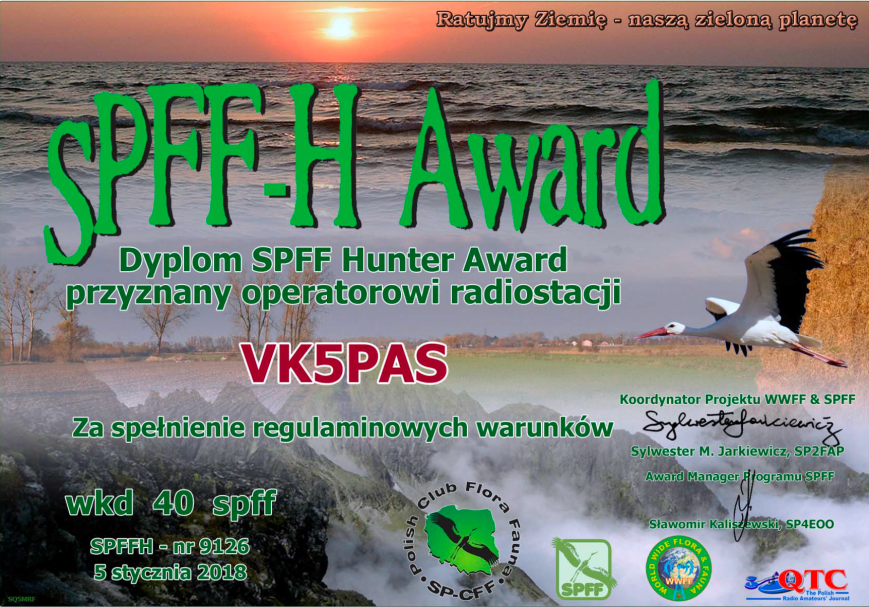
Today I received my latest award in the World Wide Flora Fauna (WWFF) program. It is a National Award, issued by the Poland Flora & Fauna program (SPFF). It is issued for having worked 40 different Polish (SPFF) references.
The SPFF award certificates are obtained through WWFF Logsearch and by clicking on ‘National Awards’ on your Summary Statistics page. The scroll down to SPFF.
They are issued for having worked levels of 20 different SPFF reference areas. The basic diploma is issued for ‘communication with 20 different SPFF areas‘. The next level is SPFF-H-40, then SPFF-H-60, SPFF-H-80, etc.
The threshold was previously much lower with the SPFF awards, but at some stage (I believe around April 2016), the theshold was lifted.
Many thanks to the SPFF team for the award certificate.
More information on the SPFF certificates (diplomas) can be found on the SPFF website at…..
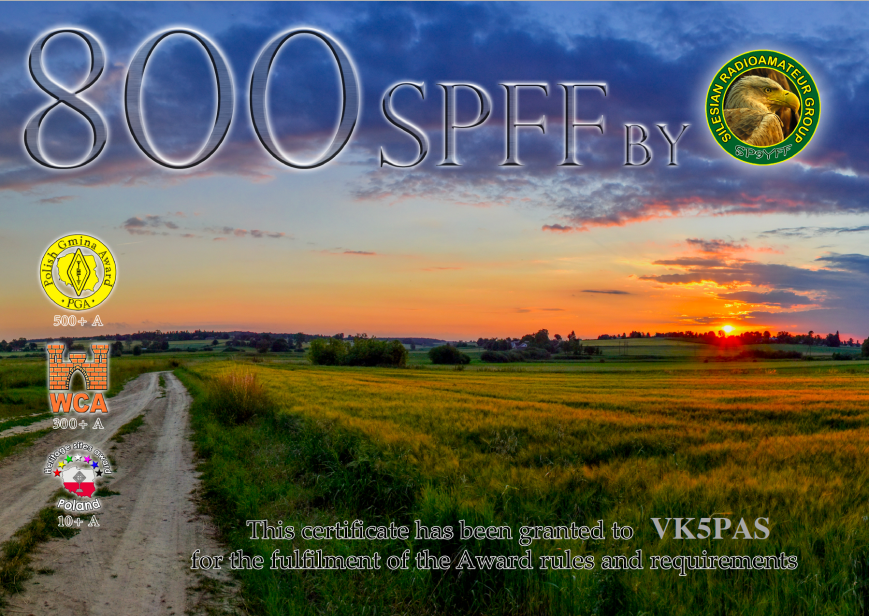
This evening I received this commemorative certificate from the Silesian Radio Amateur Group (SP9YFF) in POLAND. It is issued for having worked SP9YFF whilst they were activating their 800th SPFF reference area.
It has become an Australian amateur tradition now…..the SOTA New Years Day activation event. Each year on New Years Day, Aussie amateurs head out into the field to activate summits for the Summits on the Air (SOTA) program. New Years Day is a unique day, in that activators can claim points for an activation either side of the ‘UTC rollover’ in a new calendar year.
Coordinated Universal Time, abbreviated as UTC is the primary standard time by which the world regulates clocks and time. It is within about 1 second of mean solar time at 0° longitude. The UTC rollover is am amateur radio term, describing when it turns midnight. In Australia (well in most parts – considering daylight saving time), that is in our mornings. In South Australia it is 10.30 a.m. (Summer time).
I had worked on New Years Eve, and didn’t finish work until 3.30 a.m. (and into bed by 4.00 a.m.) so I didn’t plan on going far on New Years Day. The closest summit to me is Mount Lofty, just 15km down the road, but that had already been taken by 2 other VK5 activators, so I decided to activate Mount Gawler, VK5/ SE-013. Although I had activated Mount Gawler during 2017, I would still pick up the points for 2018.
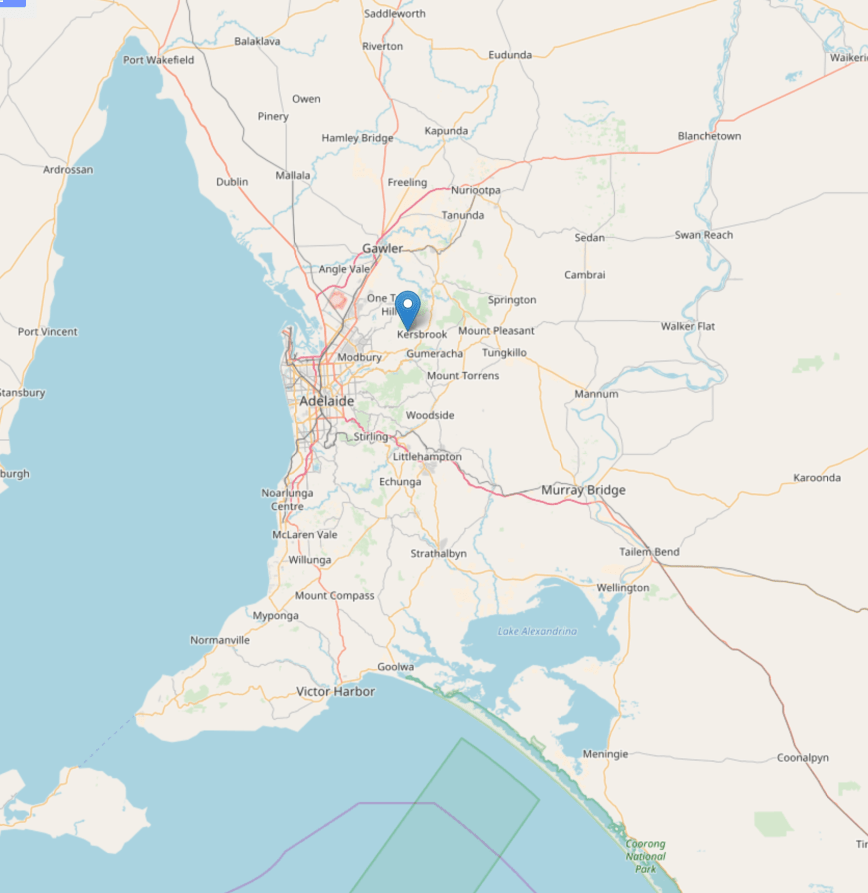
Mount Gawler is located about 35 km nort east of the city of Adelaide, and about 39 km north from my home.
Above:- Map showing the location of Mount Gawler. Map courtesy of Open Street Map.
Mount Gawler is located in the Mount Lofty Ranges ‘Adelaide Hills’. The Mount Lofty Ranges stretch from the southernmost point of the Fleurieu Peninsula at Cape Jervis northwards for over 300 kilometres (190 mi) before petering out north of Peterborough. The part of the ranges nearest Adelaide is also called the Adelaide Hills.
Above:- Aerial shot of Mount Gawler, with the city of Adelaide in the background. Image courtesy of google maps
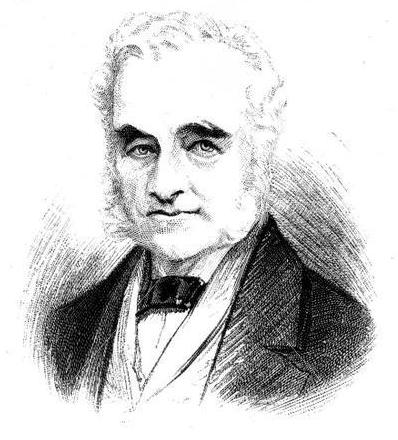
The summit is located after Lieutenant-Colonel George Gawler (1795-1869), the second Governor of South Australia.
Above:- Lt-Col Gawler. Image courtesy of wikipedia
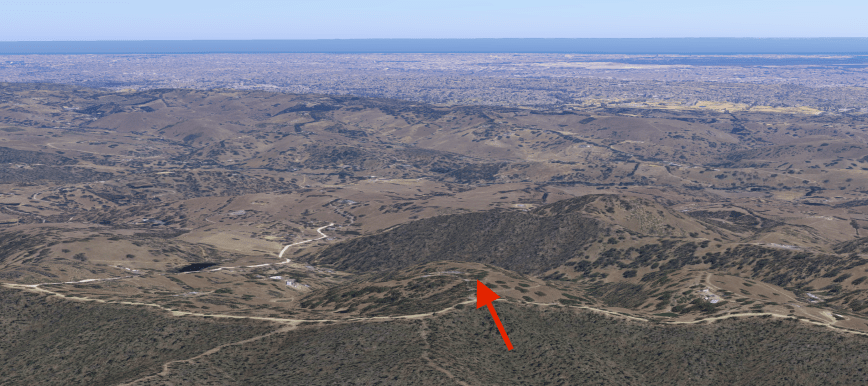
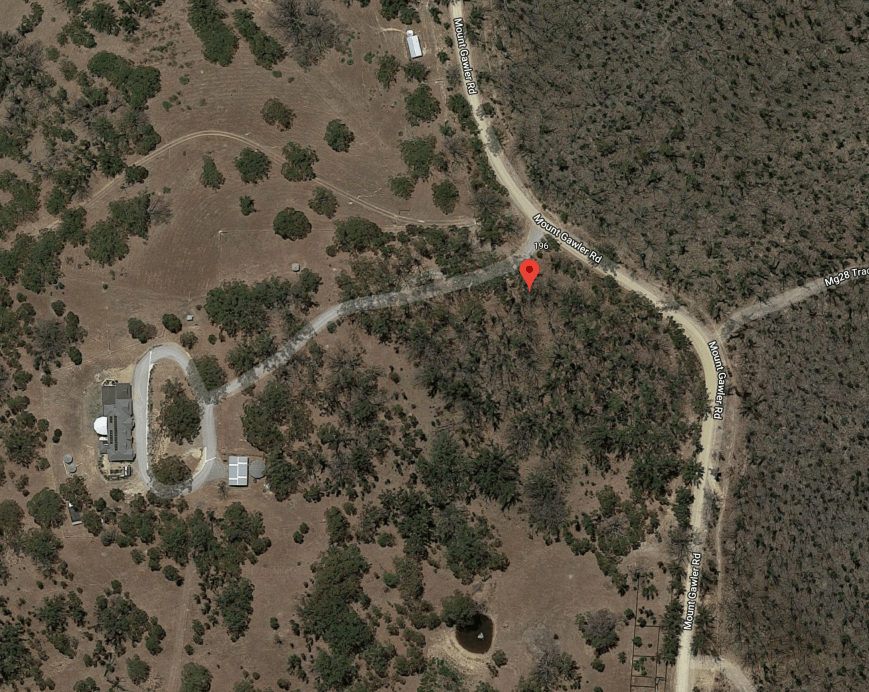
Mount Gawler is 541 metres above sea level and is worth 2 points for the SOTA program. It is easily accessible. There is a trig point at the summit, but it is located on private property. The landowners, Noel and Anne, are a very friendly couple and are happy for amateurs to access their property (with prior permision). However, the activation zone includes the Mount Gawler Road, so you can operate from there.
Above:- Aerial shot showing the summit. Image courtesy of google maps
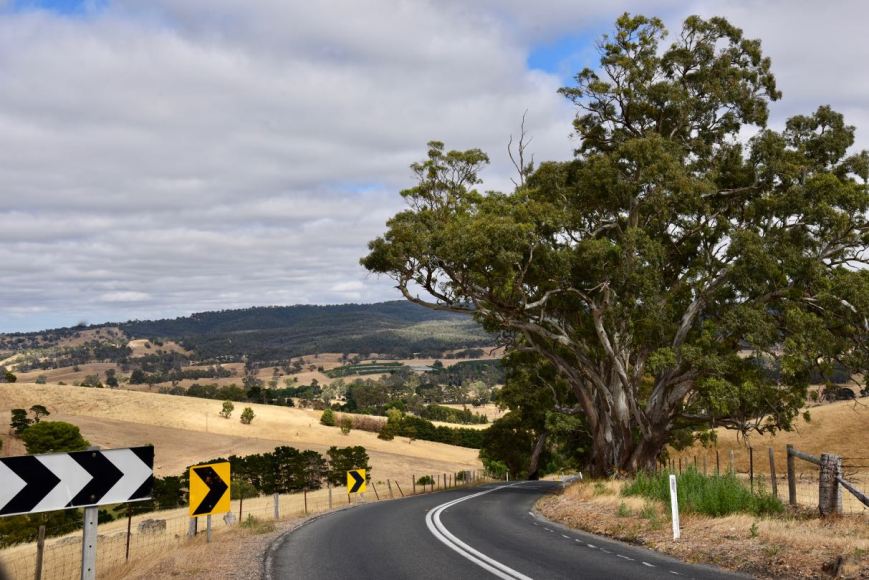
It is about a 40km from my home in the central Adelaide Hills to the summit. The drive took me out through Nairne, Woodside, Lobethal, Gummeracha, and on to Kersbrook. As I travelled down Checker Hill Road, the summit came into view. The drive down Checker Hill Road towards Kersbrook is very steep, and this hill has featured in the world famous Tour Down Under Cycling event. The Union Cycliste Internationale (UCI) categories Checker Hill as a category 2 climb (the second hardest).
Above:- Looking down Checker Hill Road.
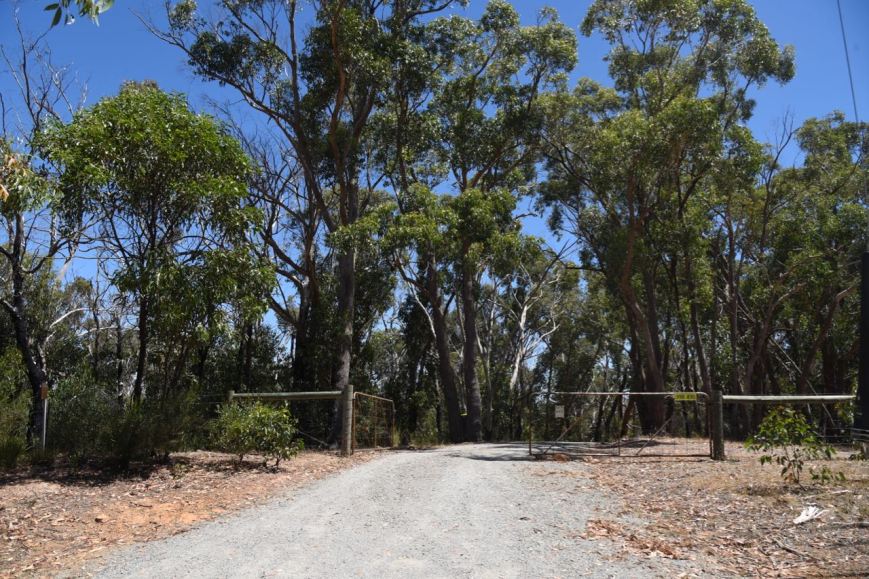
I then turned left onto Mount Gawler Road and soon reached the summit. Noel and Anne had kindly unlocked the gate for me as I had telephoned them prior to my visit.
Above:- Entry to Noel and Anne’s property.
This area was ravaged by an extremely devastating bushfire back in early 2015, known as the Sampson Flat fire. A total of 38 homes and 125 outbuildings were destroyed. The total cost was estimated to be more than A$13 million. Fortunately there was no loss of life, although a total of 134 injuries were reported. The size of the area burnt was more than 12,500 hectares (31,000 acres).
Above:- The Sampson Flat fire as seen from space. Image c/o http://www.aerometrex.com.au/
The video below will give you a good idea on just how big this fire was and the devastation it caused.
There is a trig point at the summit, installed by the former Department of Lands.
There are also some fine views to be enjoyed of the northern and north eastern suburbs of Adelaide, and out north towards the Barossa Valley. Gulf St Vincent is also clearly visible, and on a fine day you can see across to the Yorke Peninsula.
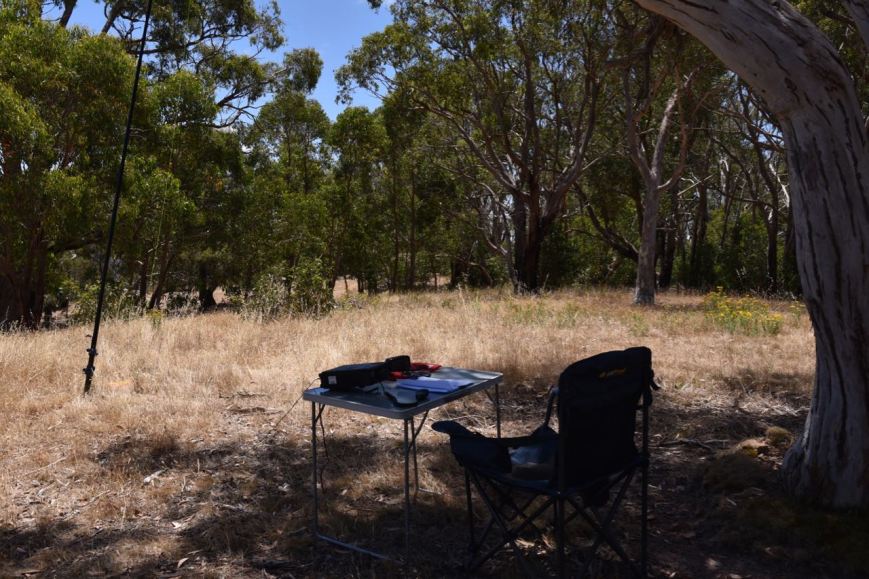
It was a beautiful sunny morning. I setup underneath a gum tree alongside of the trig point. As this is an easy drive up summit, I had the comfort and luxury of the fold up table and a deck chair. For this activation I ran the Yaesu FY-897, at 20 watts, and the 20/40/80m linked dipole, and my 1/2 wave 15m dipole. I supported the antennas on a 7 metre heavy duty squid pole.
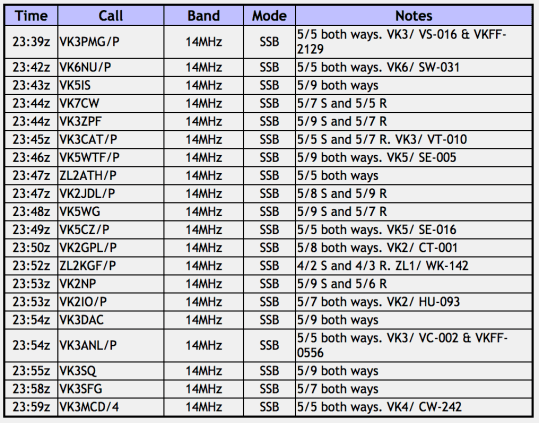
I was set up and ready to go by just after 2330 UTC (10.00 a.m. local time). I decided to leave the links out on the dipole, from my last activation, and try the 20m band first. I normally use 40m first during my activations. And I’m pleased I did try 20m first as there was a lot of activity there. First in the log was Mick VK3PMG/VK3GGG, who was calling CQ on 14.310 and activating SOTA peak Blue Mountain VK3/ VS-015 which is located in the Landsborough Nature Conservation Reserve VKFF-2129.
I then moved down to 14.305 and called CQ. I logged 19 stations from VK2, VK3, VK5, VK6, VK7 and New Zealand before the UTC rollover. This included 9 more Summit to Summit (S2S) contacts:-
John VK6NU, Mount Cooke VK6/ SW-031
Tony VK3CAT/p, Talbot Peak VK3/ VT-010
Marcus VK5WTF/p, Mount Lofty VK5/ SE-005
Ian VK5CZ/p, Black Bullock Hill VK5/ SE-016
Sam VK2GPL/p, Mount Canobolas VK2. CT-001
Kyle ZL2KGF/p, ZL1/ WK-142
Gerard VK2IO/p, Mount Elliot VK2/ HU-093
Nick VK3ANL/p, Mount Donna Buang VK3/ VC-002 & Yarra Ranges National Park VKFF-0556
Brian VK3MCD/4, Passage Peak VK4/ CW-242 (Hamilton Island)
Kyle ZL2KGF was a real bonus, a nice S2S into New Zealand. Unfortunately he was the only New Zealand SOTA activator in the log during the morning.
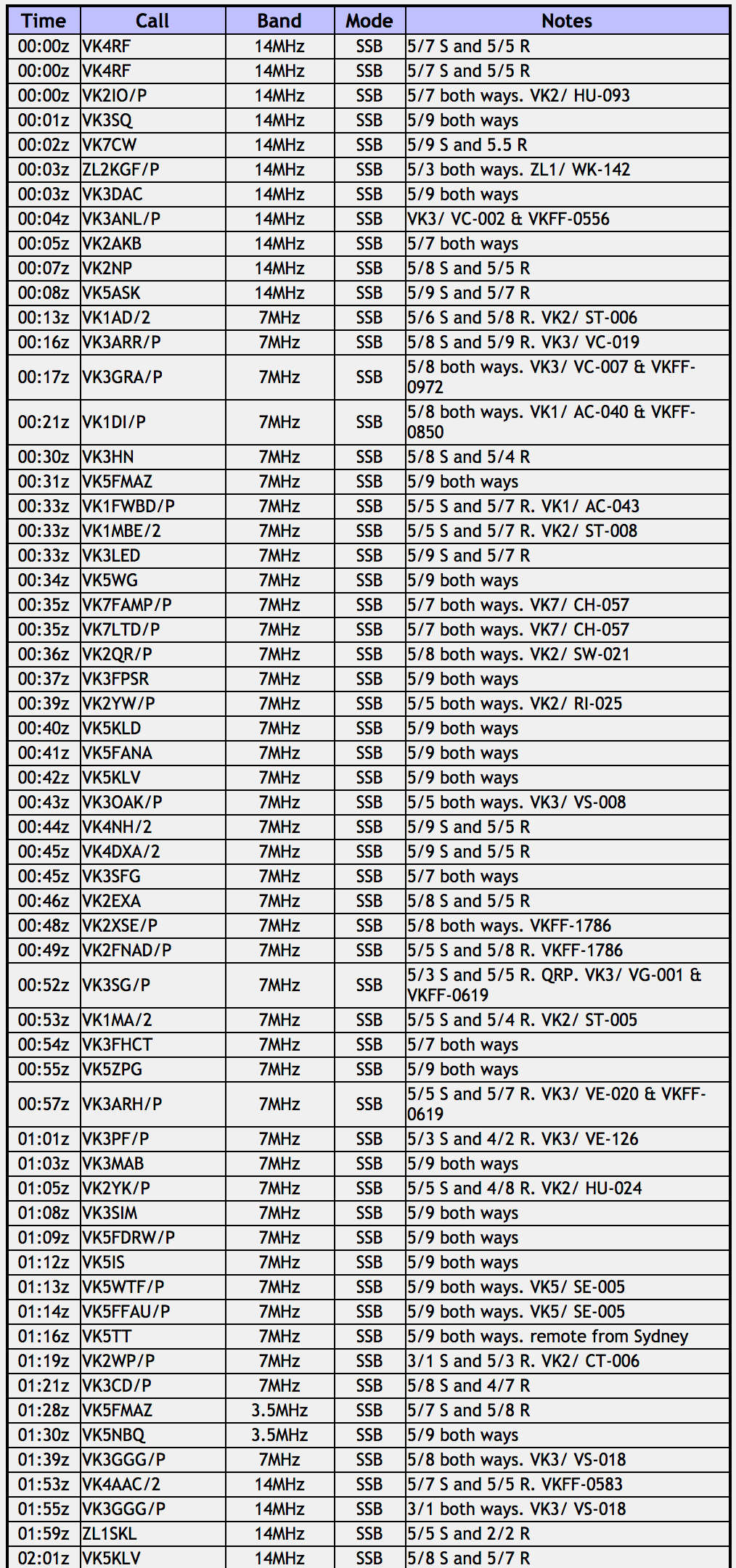
After the UTC rollover I worked a further 11 stations from VK2, VK3, VK4, VK5, and New Zealand. This included 3 more S2S contacts:-
Gerard VK2IO/p, Mount Eliot VK2/ HU-093
Kyle ZL2KGF/p, ZL1/ WK-142
Nick VK3ANL/p,Mount Donna Buang VK3/ VC-002 & Yarra Ranges National Park VKFF-0556
But callers soon dried up, so it was down with the squid pole, in with the links, and off to the 40m band. First in the log there was Andrew VK1AD/2 on SOTA peak South Black Range VK2/ ST-006 who was calling CQ on 7.100, followed by Andrew VK3ARR/p on 7.100 activating Mount Warrenheip VK3/ VC-019. I then worked Graeme VK3GRA/p who was activating Mount Macedon VK3/ VC-007 in the Macedon Regional Park VKFF-0972. I kept tuning across the band and then found Ian VK1DI/p on Mount Ainslie VK1/ AC-040 in the Mount Ainslee Nature Reserve VKFF-0850.
As I was finishing my QSO with Ian, Noel drove down the driveway and I took some time out to have a chat.
I then propped on 7.130 and called CQ. I logged 26 stations including the following S2S contacts:-
Wade VK1FWBD/p, Mount Stromlo VK1/ AC-043
Andrew VK1MBE/2, Baldy Range VK2/ ST-008
Angela VK7FAMP/p, Mount Dromedary VK7/ CH-057
Tony VK7LTD/p, Mount Dromedary VK7/ CH-057
Rob VK2QR/p, Pilot Reef Mountain VK2/ SW-021
John VK2YW/p, Mount Flakney VK2/ RI-025
Malcolm VK3OAK/p, Mount Cole VK3/ VS-008
Leigh VK3SG, Mount Cope VK3/ VG-001, in the Alpine National Park VKFF-0619
Matt VK1MA/2, Webbs Ridge VK2/ ST-005
Allen VK3ARH/p, Mount Lovick VK3/ VE-020 in the Alpine National Park VKFF-0619
I also spoke with Liz VK2XSE/p and her son Adrian who were activating the Murrumbidgee Valley Regional Park VKFF-1786.
When things slowed down I tuned across the band and found Peter VK3PF/p calling CQ from Mount Stanley VK3/ VE-126. But Peter was the only new SOTA and/or Park activator that I could find, so I headed down to 7.090 and called CQ once again. I logged 10 stations including
Adam VK2YK/p, VK2/ HU-024
Marcus VK5WTF/p, Mount Lofty VK5/ SE-005
Dave VK5FFAU/p, Mount Lofty VK5/ SE-005
Mike VK2WP/p, Bonfire Hill VK2/ CT-006
Surprisingly there was little activity on 40m, so I decided to give the 80m band a go. I called CQ on 3.610 and self spotted on SOTAWatch and logged Marija VK5FMAZ and Brian VK5NBQ who was at nearby Lobethal with a huge signal. But sadly they were my only 2 callers on 80m.
I saw a spot come up for Mick VK3GGG/p on Point 756 Pyrenees VK3/ VS-018 on 7.090, so it was down with the squid pole again and out with the 80m links. After logging Mick I gave the 20m band a go, with my first contact there being with Rob VK4AAC/2 who was activating the Crawney Pass National Park VKFF-0583. I then saw that Mick VK3GGG had moved from 40m to 14.315. Mick was quite light, but we successfully made a contact (3/1 both ways), due to the low noise floors on both summits.
I then moved to 14.305 and called CQ which was answered by Soren ZL1SKL in Auckland in New Zealand. I logged a further 8 stations, including Stuart VK8NSB up in Darwin, and also Matt VK1MA/2 activating Webbs Ridge VK2/ ST-005.
I decided to give the 15m band a try and I am very pleased I did, as conditions there were quite good, with a total of 31 stations logged there from VK2, VK3, VK4, VK5, VK6, VK7, VK8, USA, and Japan. I was very pleased to work Mike NW7E in Oregon in the USA who had a nice 5/7 signal. And also JH1XMV in Japan. Other good contacts on 15m included Stuart VK8NSB in Darwin, who was a little weaker on 15m compared to 20m. Also Allen VK6XL in Western Australia. Having activated portable in VK6 I know how hard it is over there on the other other side of Australia, so it’s always nice to log the Western Australian hams.
To finish off the activation I headed back to 40m where I spoke with Peter VK3TKK who was activating the Ironbark Road Nature Conservation Reserve VKFF-2113, and then Gordon VK5GY/p who was in the Ferries McDonald Conservation Park VKFF-0881.
Time to pack up and head home, with a total of 119 contacts in the log, including 34 Summit to Summit contacts and 12 parks.
Yesterday (Tuesday 26th December 2017) was Boxing Day, and a day of recovery here after a busy Christmas Day. My wife’s mum had been staying with us for 2 days and in the afternoon Marija drove her down to the airport to fly back home. As I had seen a few park activators spotted on parksnpeaks I decided to take the opportunity of heading out to activate the Mount Magnificent Conservation Park 5CP-148 & VKFF-0916.
I have activated and qualified the Mount Magnificent Conservation Park previously. So this was another park to go towards my Boomerang Activator tally for World Wide Flora Fauna (WWFF). I also dusted off my Buddipole and took that along with me, hoping to make some contacts on that antenna, after having it in storage for about 6 years.
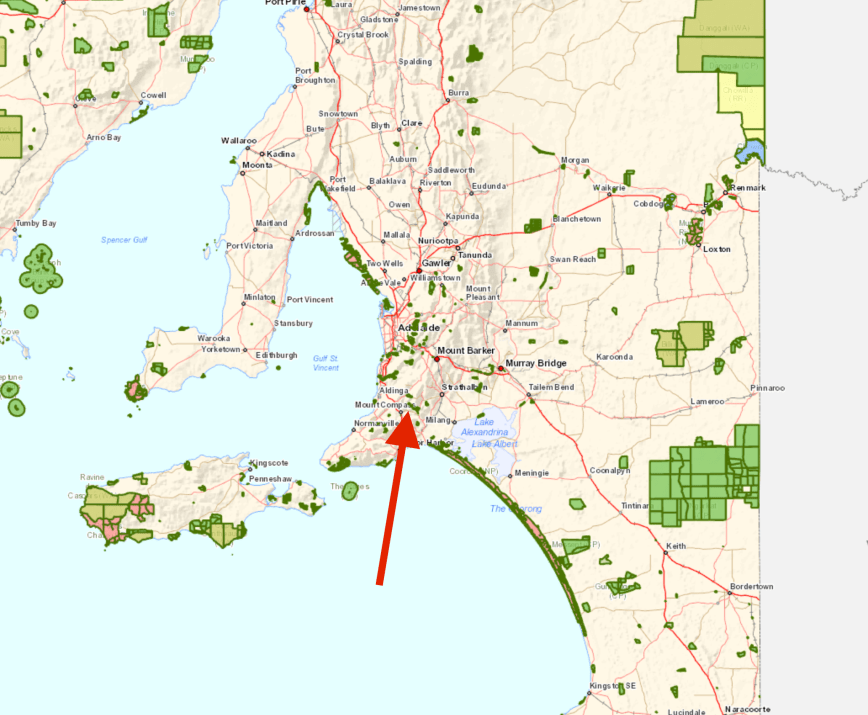
The park is situated about 40 km south west of my home, and about 63 km south of Adelaide.
Above:- Map showing the location of the Mount Magnificent Conservation Park. Map courtesy of Location SA Map Viewer.
To get to the park I travelled to Echunga and then on to Meadows. I then took the Brookman Road towards Willunga, turning off at Connor Road, and then travelling south on Blackfellows Creek Road.
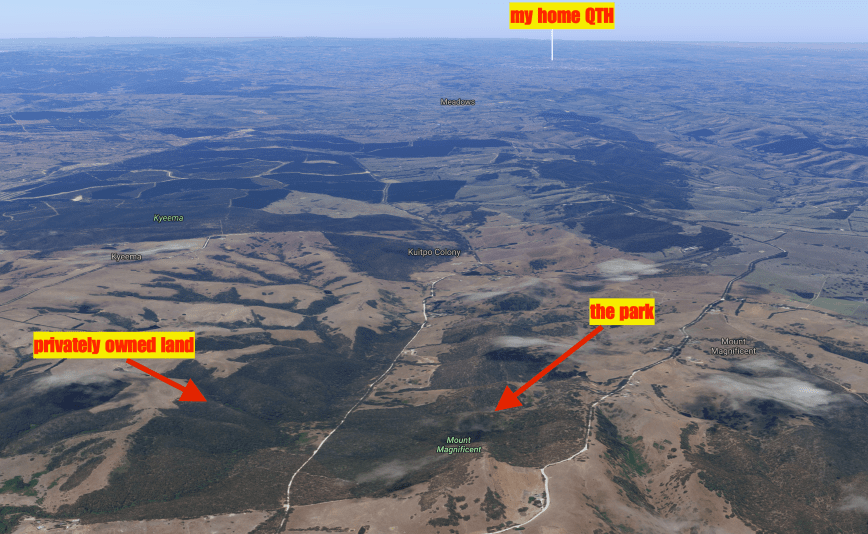
Above:- Aerial shot of the park. Image courtesy of google maps
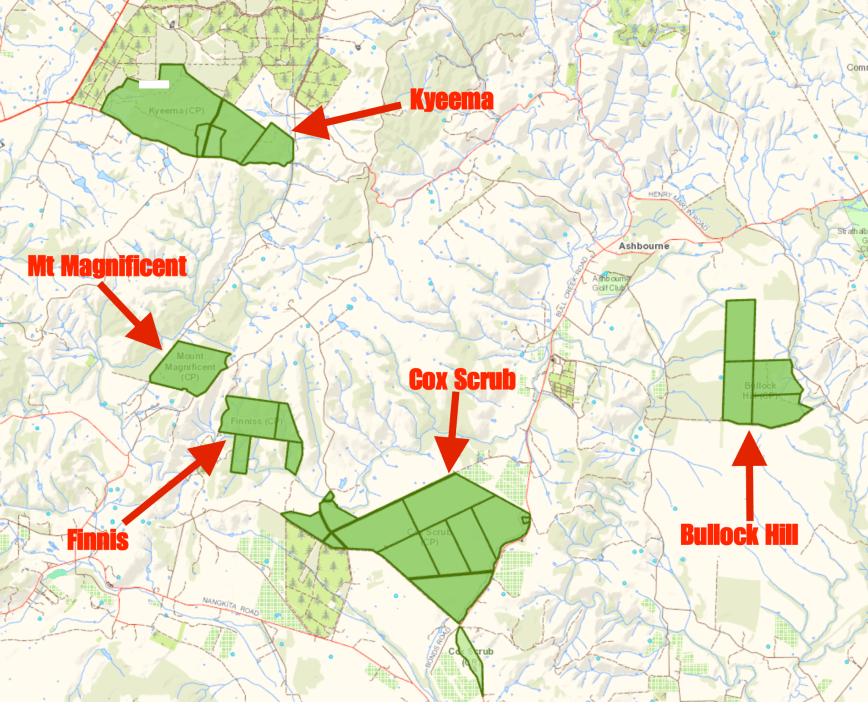
The park is located in close proximity to a number of other parks, including Kyeema, Finnis, Cox Scrub and Bullock Hill.
Above:- Map showing the location of the Mount Magnificent Conservation Park, in close proximity to a number of other parks. Map courtesy of Location SA Map Viewer.
The Mount Magnificent Conservation Park is 90 hectares (222 acres) in size and was established on the 1st January 1967. The park contains the Mount Magnificent summit which is 380 metres above sea level, but sadly does not qualify for the Summits on the Air (SOTA) program as it does not have the required prominence. The summit does however reward those who climb to to the top, with some amazing views of the surrounding countryside.
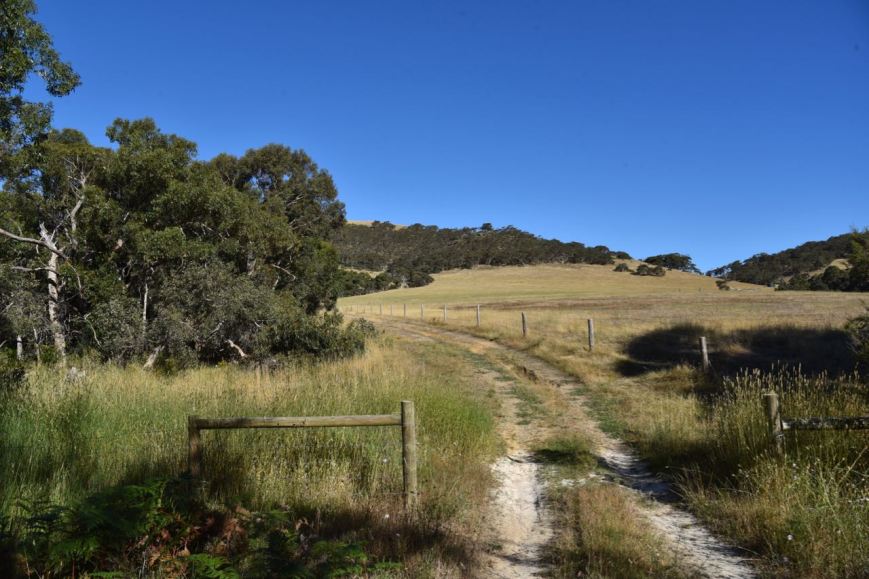
I accessed the park via a track off Blackfellows Creek Road in the south western corner of the park.
Above:- the track off Blackfellows Creek Road.
The track follows a fenceline and comes to an abrupt end. However there is plenty of room here to set up.
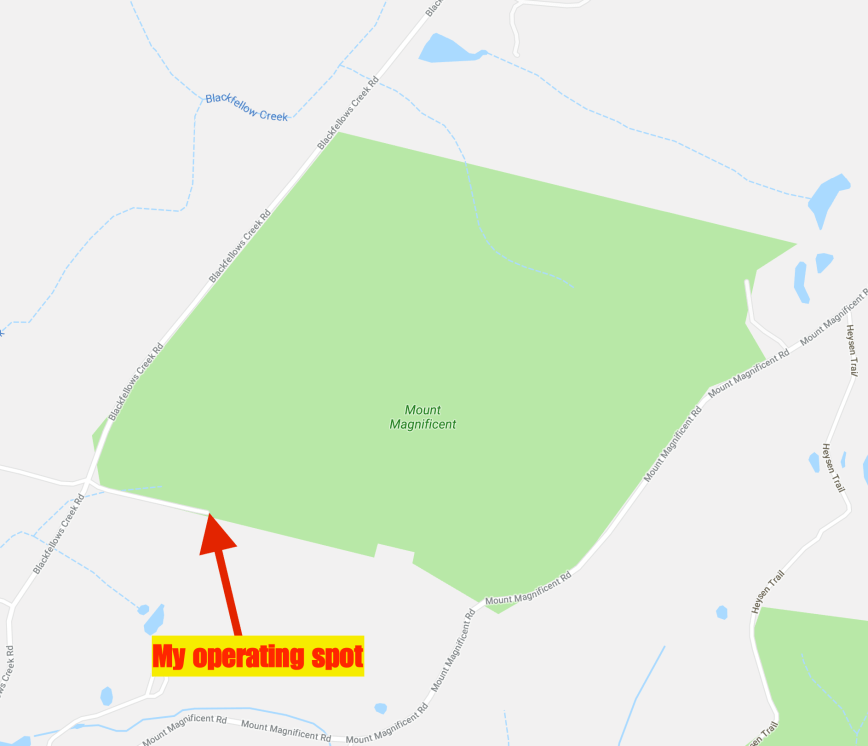
Above:- Map showing my operating spot. Map courtesy of google maps
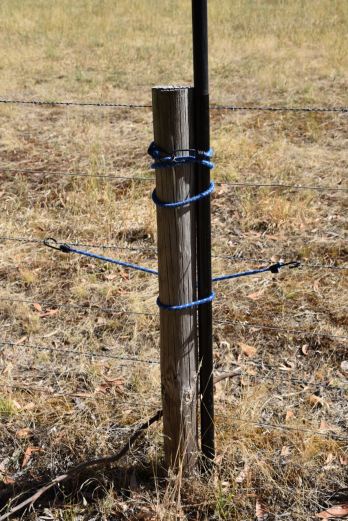
I ran the Yaesu FT-897 at 40 watts for this activation. I used one of the fenceposts to secure my 7 m telescopic squid pole, with the help of a couple of octopus straps. I initially used the 80/40/20m linked dipole.
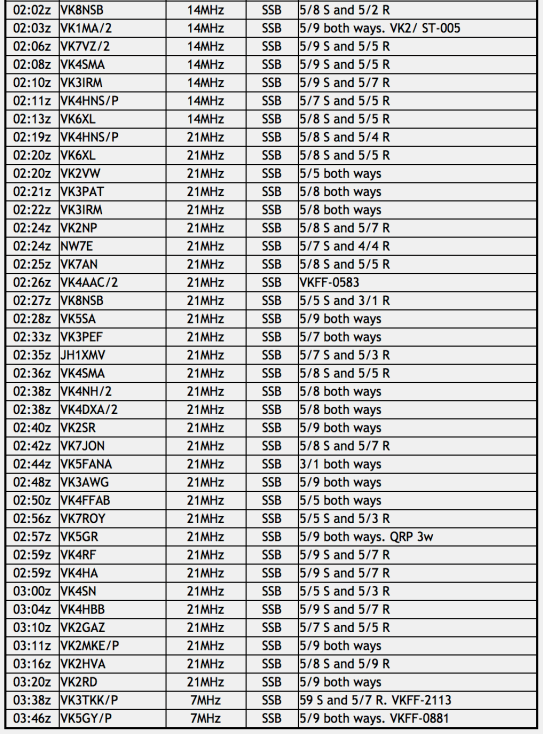
My first station in the log was a Park to Park contact with Mark VK4SMA/p who was in the Plunkett Conservation Park VKFF-1631. Mark had a good 5/6 signal. I then moved down the band and started calling CQ on 7.139. His was answered by Peter Vk5ZPG at Quorn in the north of South Australia, followed by Ray VK4NH/2 and then Keith VK3FMKE. The band conditions on 40m seemed to be quite good.
Contact number 9 was another Park to Park, this time with Gerard VK2IO/p in the Wamberal Lagoon Nature Reserve VKFF-2013. I went on to work a total of 30 stations on 40m from VK1, VK2, VK3, VK4, and VK5. This included Mark VK5QI who was mobile in the Mid North of South Australia with a very nice 5/8 signal, Peter VK3PF mobile, Larry VK5BWA using a remote station in Mount Gambier, and Glenn VK2VX/p who was operating portable in his back yard. I also logged Matt VK1MA/2 who was operating portable in the Kosciuszko National Park VKFF-0269.
I then tuned across the band and soon had my 4th Park to Park contact in the log for this activation, with a QSO with Ian VK1DI/2 who was activating the Mimosa Rocks National Park VKFF-0317.
I then set up the Buddipole and after a lot of mucking around I eventually had the VSWR down fine for 40m. I had not used the Buddipole in about 6 years, and I suspect it is easier to set up than what I experienced. After setting up the Buddipole I called CQ on 7.139 which was answered by Kevin VK3VEK with a strong 5/9 signal from western Victoria. This was followed by Kevin VK3HKK in Morwell, and then another Park to Park, this time with Peter VK3TKK/p who was activating the Lerderderg State Park VKFF-0763.
I then saw a spot for Adam VK2YK and moved back to the linked dipole. I logged Adam who was activating the Worimi State Conservation Area VKFF-1399. After speaking with Adam I headed up to 7.150 and started calling CQ. Simon VK3ELH/p gave me a shout from the Greater Bendigo National Park VKFF-0623, using his home brew Bitx40 transceiver. I logged 2 further stations, John VK3YW and then Ron VK3IO, before deciding to give the 80m band a go. My wife Marija had arrived home from the airport and had sent me a text to advise that there was no reception of my signal on 40m back home.
I called CQ on 3.610 and found the VSWR was through the roof. So after checking the BNC connection and lowering the squid pole a number of times to check the links, I eventually found that my spare crocodile clip at the end of the antenna had got caught up on the barbed wire on the fence. Once removed the VSW immediately dropped. I logged Marija VK5FMAZ, John VK5NJ in Mount Gambier, and then Mick VK3GGG/VK3PMG in western Victoria.
It was starting to get hot, and I had run out of shade. It was now 32 deg C. I decided to have one last quick tune across the 40m band, and fortunately found David VK3IL/p activating SOTA peak VK3/ VT-006 in the Baw Baw National Park VKFF-0020.
To complete the activation I moved up to the 20m band where I logged 6 stations on 14.310, from VK2, VK4, VK6 and VK7.
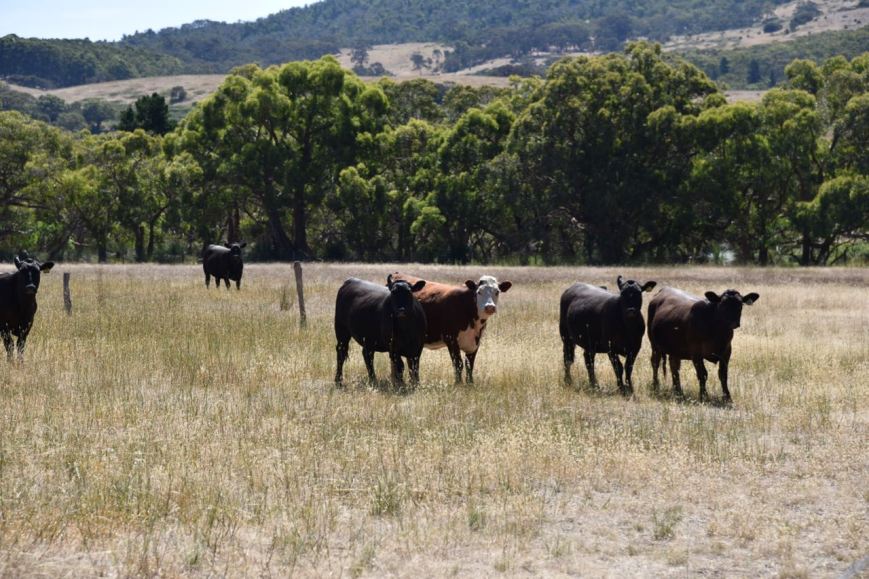
Above:- Some interested onlookers, in the adjacent paddock
VK2YK/p (Worimi State Conservation Area VKFF-1399)
VK3ELH/p (Greater Bendigo National Park VKFF-0623)
VK2YW
VK3IO
VK3IL/p (SOTA VK3/ VT-006 & Baw Baw National Park VKFF-0020)
I worked the following stations on 80m SSB:-
VK5FMAZ
VK5NJ
VK3GGG
VK3PMG
I worked the following stations on 20m SSB:-
VK7JON
VK2MKE
VK4AAC/2
VK4SYD
VK6HRC
VK4TJ
With 49 contacts in the log I packed up and headed home, taking a different route. I travelled through the little town of Prospect Hill. This area was originally called McHargs Hills by early European settlers, in honour of pioneers John and Elizabeth McHarg. If you are ever in the area, the little Prospect Hill Museum is well worth a visit.
One of the interesting things to have a look at in Prospect Hill is the Flag Tree. Flags were raised to signal the sighting of a ship carruing emigrants, mail or goods. In this way, a message could be passed from tree to tree. Various coloured flags were used to signal en emergency. The site of Prospect Hill’s original flag tree is located alongside the museum.
This is very beautiful country through this part of the Mount Lofty Ranges.
Above:- typical countryside in the Prospect Hill area
I continued along Milligans Road and then Morris Road and on to the town of Meadows, and then home. It had been an enjoyable later afternoon out in the park, and proved that I need a lot more practice in setting up the Buddipole.
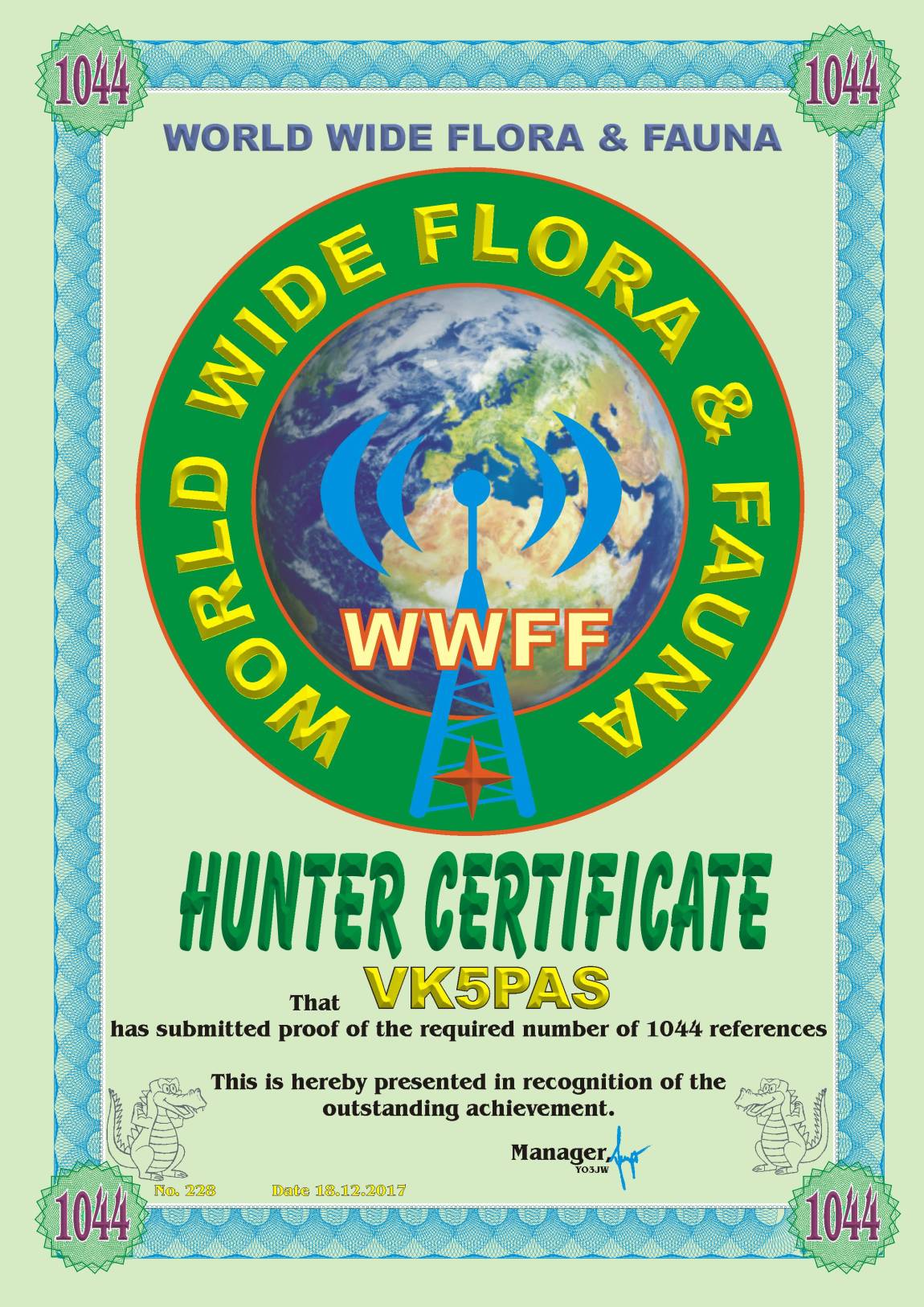
Also received today, a WWFF certificate for having activated 187 different WWFF references (and having made 44 contacts in each for the WWFF global program).
Thanks to all of the hunters and thankyou to Pit YO3JW, the Awards Manager.
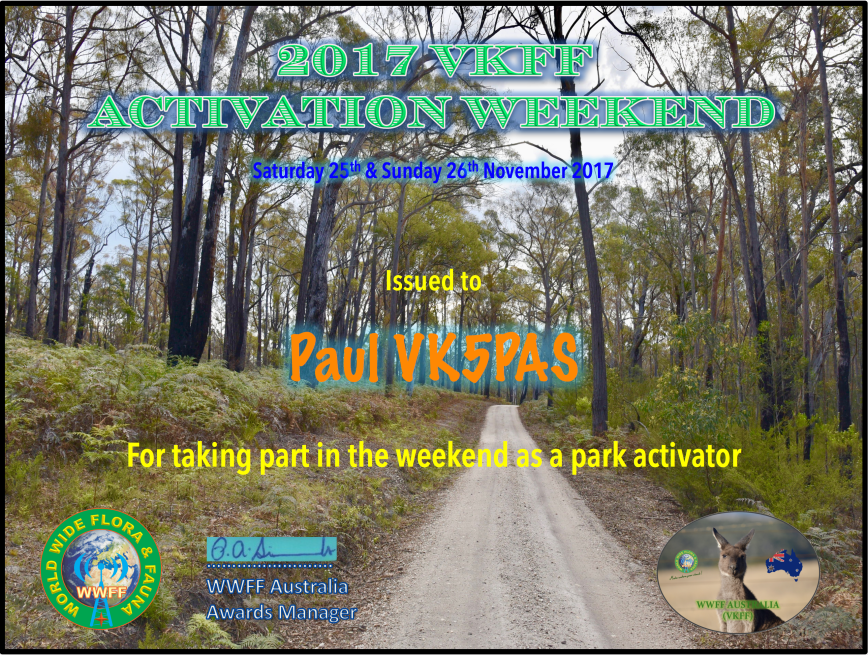
Tonight I emailed out a participation certificate to all of the activators who took part in the 2017 VKFF Activation Weekend. The photo features a track in the Colquhoun Regional Park (taken by VK5PAS).
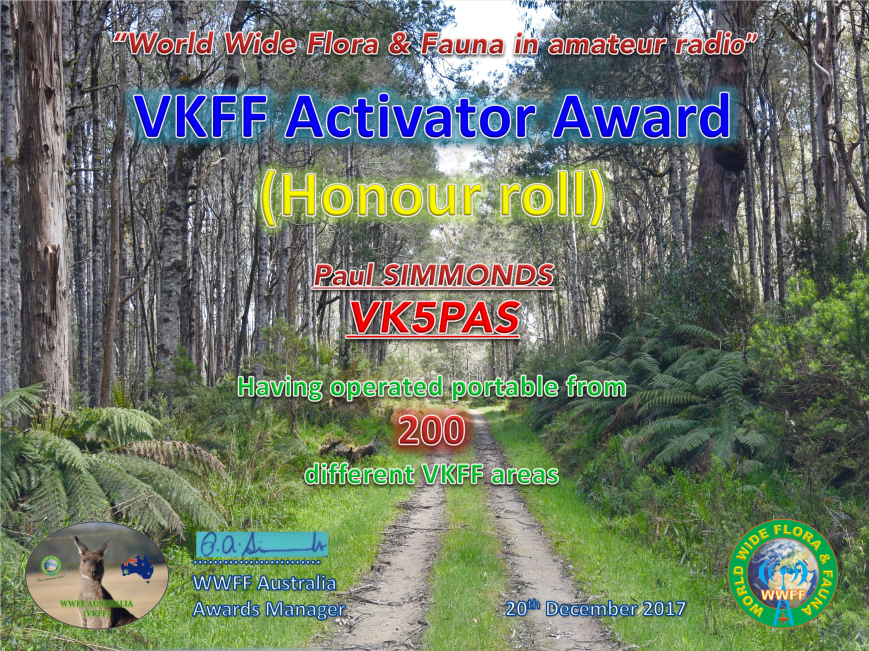
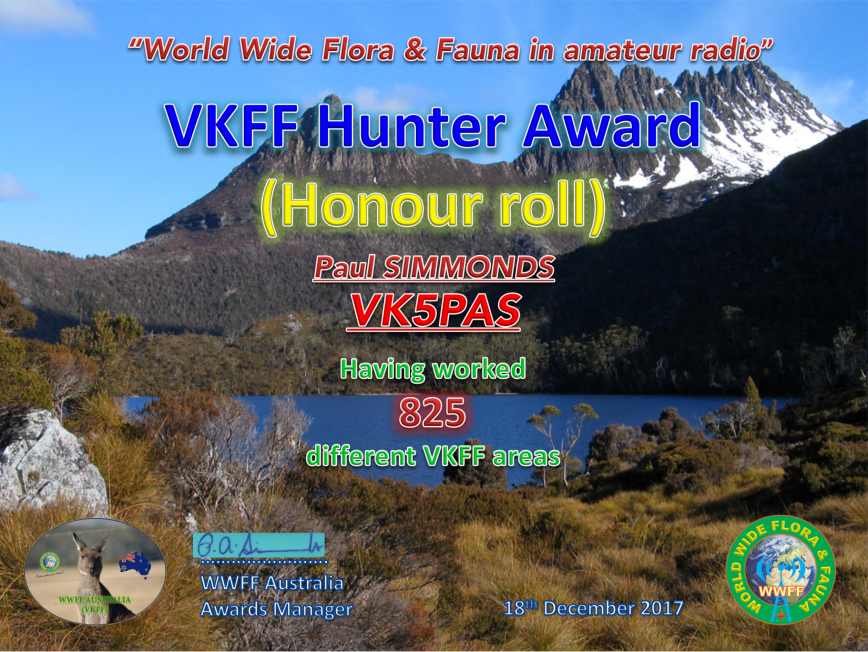
Tonight I received my latest certificate for the World Wide Flora Fauna (WWFF) program. It is the VKFF Activator Honour Roll 200 certificate, which is issued for having activated a total of 200 or more VKFF reference areas.
I would like to thank all of the hunters who have called me during my activations in VK1, VK2, VK3, VK5, VK6 and VK9. I’ve had a lot of fun along the way and have seen some great spots around Australia.


















 VK5PAS