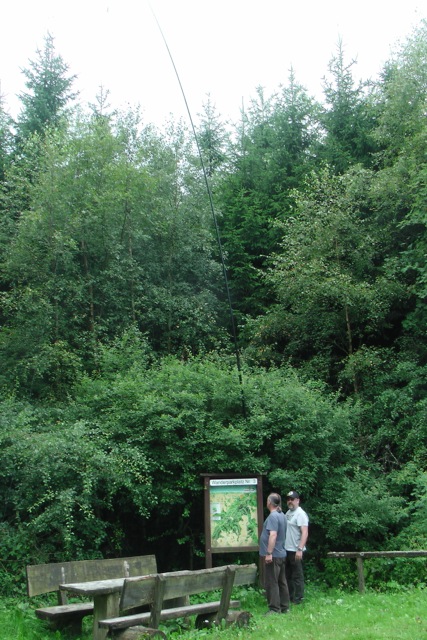
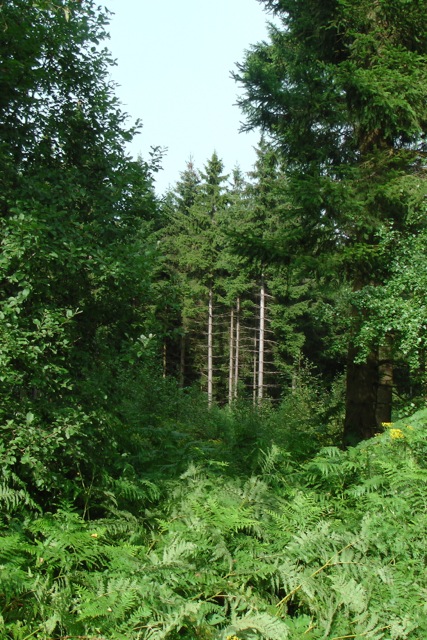
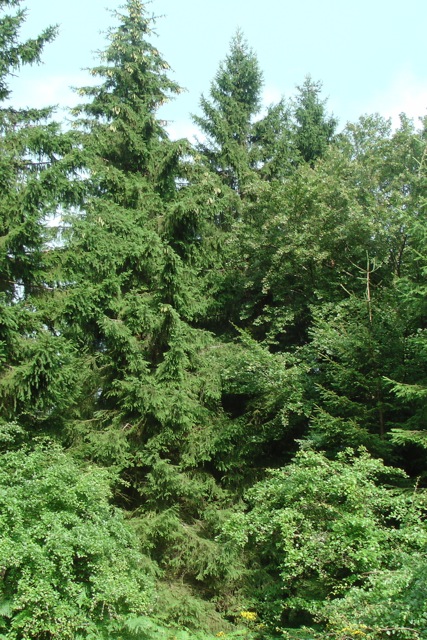
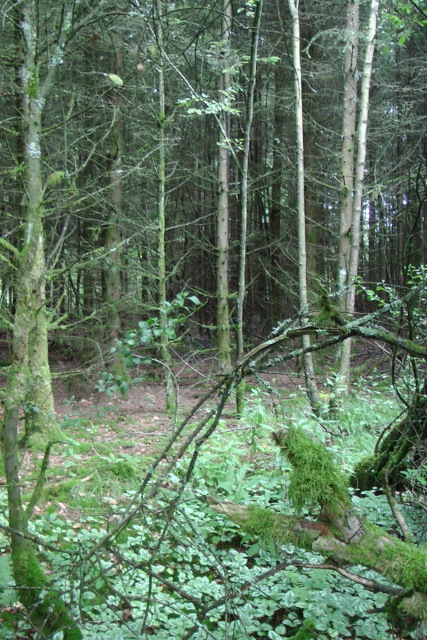
Signal de Botrange ON/ON-001 and ONFF-001

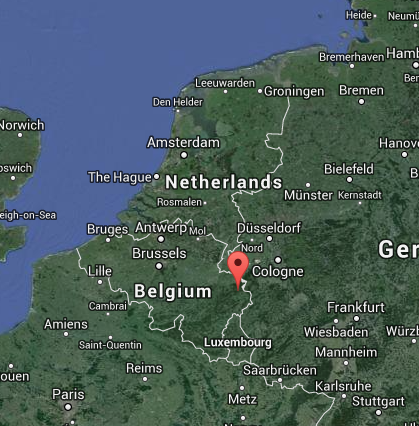
On Wednesday 30th July, we headed back over the German/Belgium border, into Belgium and activated Summits on the Air (SOTA) peak Signal de Botrange ON/ON-001 and World Wide Flora and Fauna (WWFF) area Hautes Fagnes-Eifel ONFF-001.

It was about a 90 minute drive from Prum through the mountains back into Belgium.  The countryside was spectacular as we passed through a number of small villages.  It was hard to believe that this was summer, as the landscape was so green.

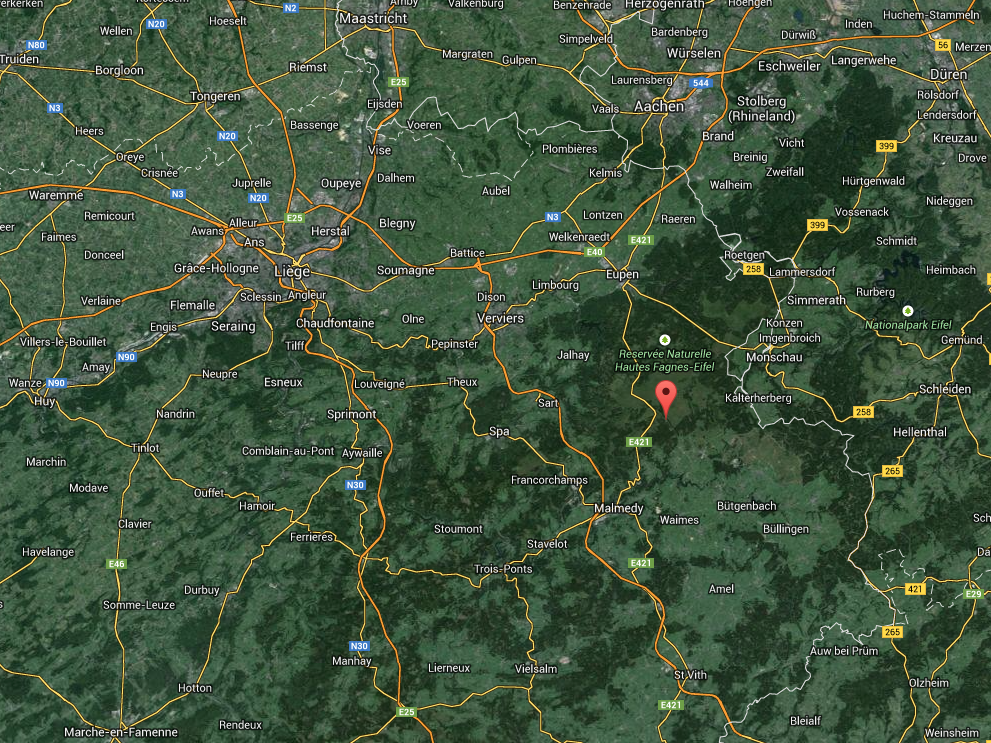
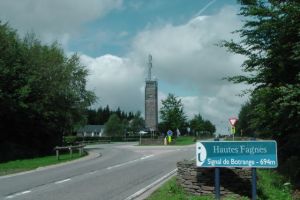
Signal de Botrange is the highest point in Belgium, climbing to 694 metres (2,277 feet).  It is worth a total of 8 SOTA points and is located at the top of a broad plateau, and a road crosses the summit, passing an adjacent cafe.

Screenshot 2014-09-09 13.41.34

Map courtesy of googlemaps.com

Screenshot 2014-09-09 13.44.26

Map courtesy of googlemaps.com

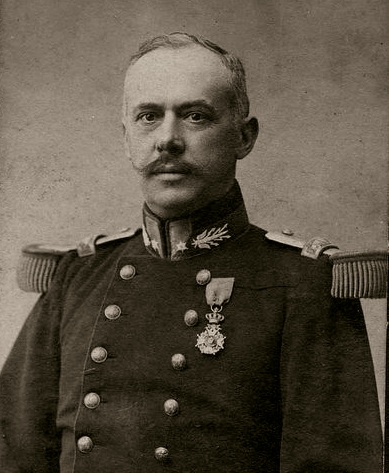
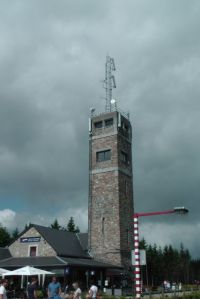
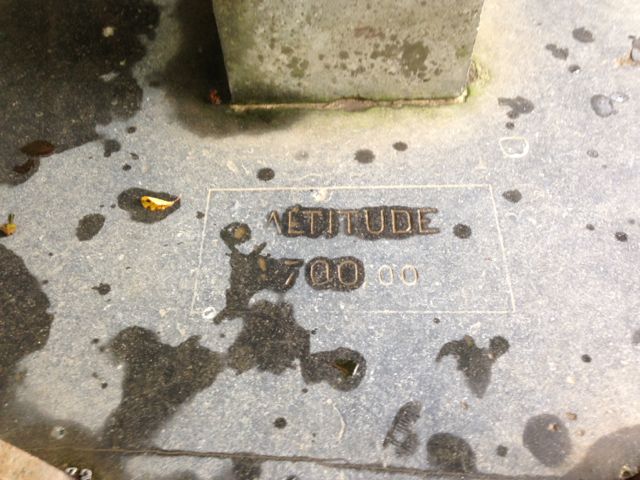
In 1923 a six metre high Baltia tower was built on the summit to allow visitors to reach an altitude of 700 metres.  The tower was named after Baron Herman Baltia, a Belgian military officer (1863-1938).  A stone tower was built in 1934 and this reaches 718 metres.

General_Baltia_Herman

Above: – Baron Herman Baltia.  Photo courtesy of wikipedia.

A meteorological station was located at the summit for many years, but in 1999, it was replaced by a nearby automatic station of the Royal Meteorological Institute of Belgium.  The summit experiences extreme temperatures and these are usually lower than at any other place in Belgium.  Fortunately on the day of our activation, the weather was overcast but fine.

IMGA0048_4

The summit is located within the Hautes Fagnes (High Fens) covers 12 municipalities of Belgium and was established in 1957.  It is the largest nature reserve in Belgium, with an area of 4,501.2 hectares (11,123 acres).  In winter, the area becomes Belgium’s premier cross country ski resorts.

IMGA0050_2

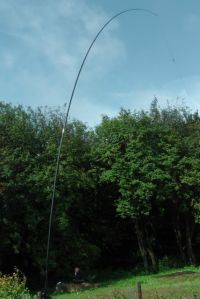
We operated from the edge of the carpark and attached Eddy’s end fed antenna to the 9 metre squid pole which in turn was attached to a nearby post.  Again for this activation we used the Kenwood TS-50.

IMGA0043_4

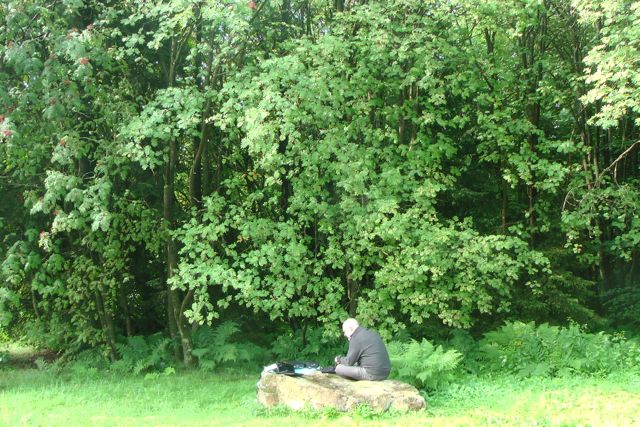
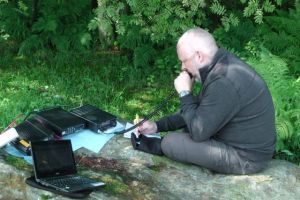
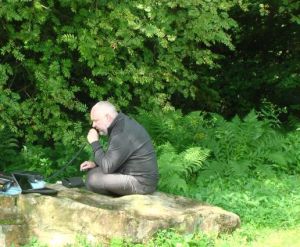
There was a nice large flat rock nearby which served well as an operating location.  As we were close by to the main carpark for the nature park, there was a lot of traffic.  I was surprised at how many visitors there were to the park, considering that it was a week day.  We certainly did attract some odd looks as people arrived and prepared to head off for a walk into the park.

IMGA0040_3

IMGA0047_4

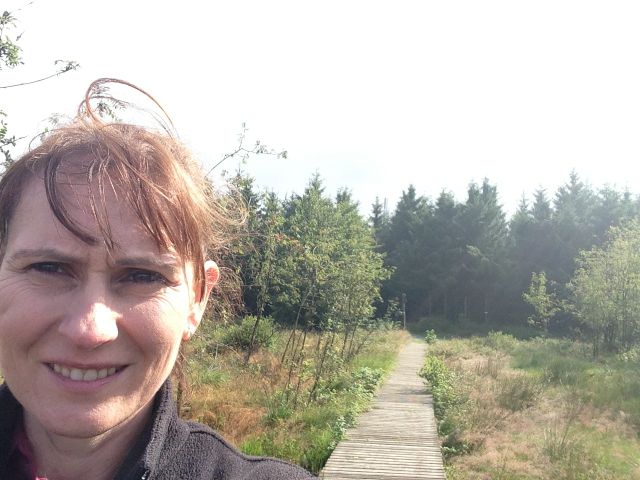
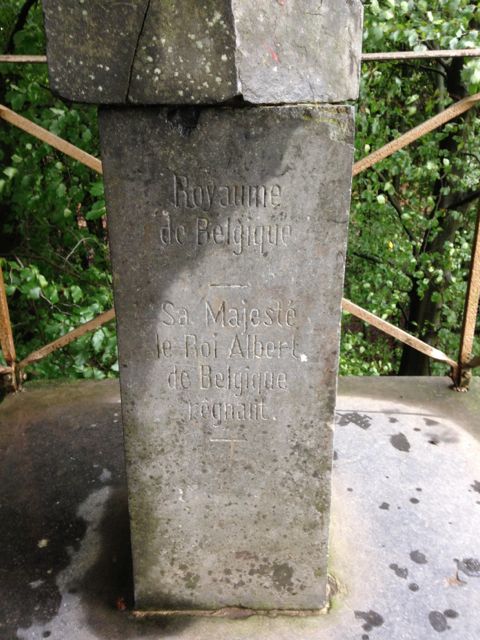
Whilst I was operating my tolerant wife Marija went for a walk along the boardwalk at the rear of the cafe, and took some photos of the 700 m marker.  The actual trig point is a short distance from here.

IMG_0435 IMG_0437 IMG_0438

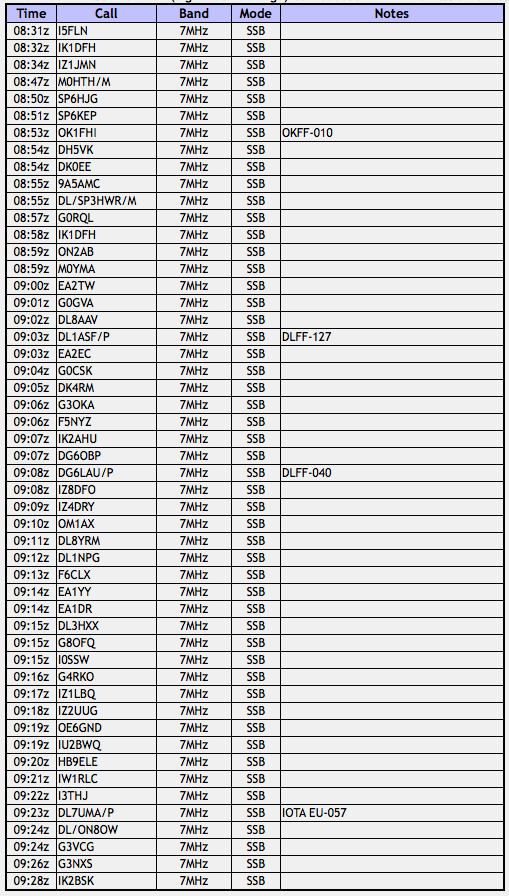
I commenced on 40 metres and remained there for the duration of the activation.  My first contact was with Luciano I5FLN, and this was followed by a steady flow of callers from Europe and the United Kingdom.

Again, it was a little too late for propagation to Australia on 20 m.  We had enjoyed a bit of a sleep in at the hotel and a nice breakfast, so we had just missed the window for long path propagation into Australia on 20 metres.

IMGA0042_4

I managed three WWFF park to park contacts during the activation:

  • OK1FHI, OKFF-010
  • DL1ASF, DLFF-127
  • DG6LAU, DLFF-040

Fortunately there were no equipment issues during this activation.  Everything went very smooth.  After an hour of operating I ended up with 51 contacts.  All on 40m SSB.  The following countries were worked:-

  • Austria
  • Belgium
  • Croatia
  • Czech Republic
  • England
  • France
  • Germany
  • Italy
  • Poland
  • Slovakia
  • Spain

Screenshot 2014-09-09 14.52.22

Another very enjoyable activation.  My second in Europe.  It was time to hit the road again, and journey north through Belgium back home to Ghent in northern Belgium.

I would like to thank Marnix and Eddy for their time and effort in allowing me to activate the 2 summit/WWFF areas in Germany and Belgium.  It was a hug he amount of fun.

Schwarzer Mann, DM/ RP-003 and DLFF-047

I have just returned from 7 very enjoyable weeks in Europe.  Whilst there I had the honour to stay for a week with Marnix OP7M, his wife Martine, and their 16 year old son Goan.  I have spoken with Marnix many times on the radio, and also on Skype, but this was the first time we had met in person.  My wife Marija and I had a very enjoyable time at Marnix and Martine’s home, with plenty of laughs, good food, lots of stories, and our fair share of Belgium beer.  Whilst staying with Marnix, we also met Eddy ON6ZV and his wife Carine and their son.

Marnix knew I was a keen SOTA & parks activator, so the day after arriving, on 29th July, Marnix, Eddy , myself and Marija headed over the border into Germany for a SOTA and WWFF activation.  It wasn’t a short drive to get there.  In fact it was about a 3 hour drive to our destination near Prüm.  However, Marnix had told me that this was a beautiful area, and was well worth the drive and an opportunity to see the Belgium countryside.  Indeed it was.  He and Eddy also had plans to activate another summit / WWFF area on the way home the following day, in Belgium.

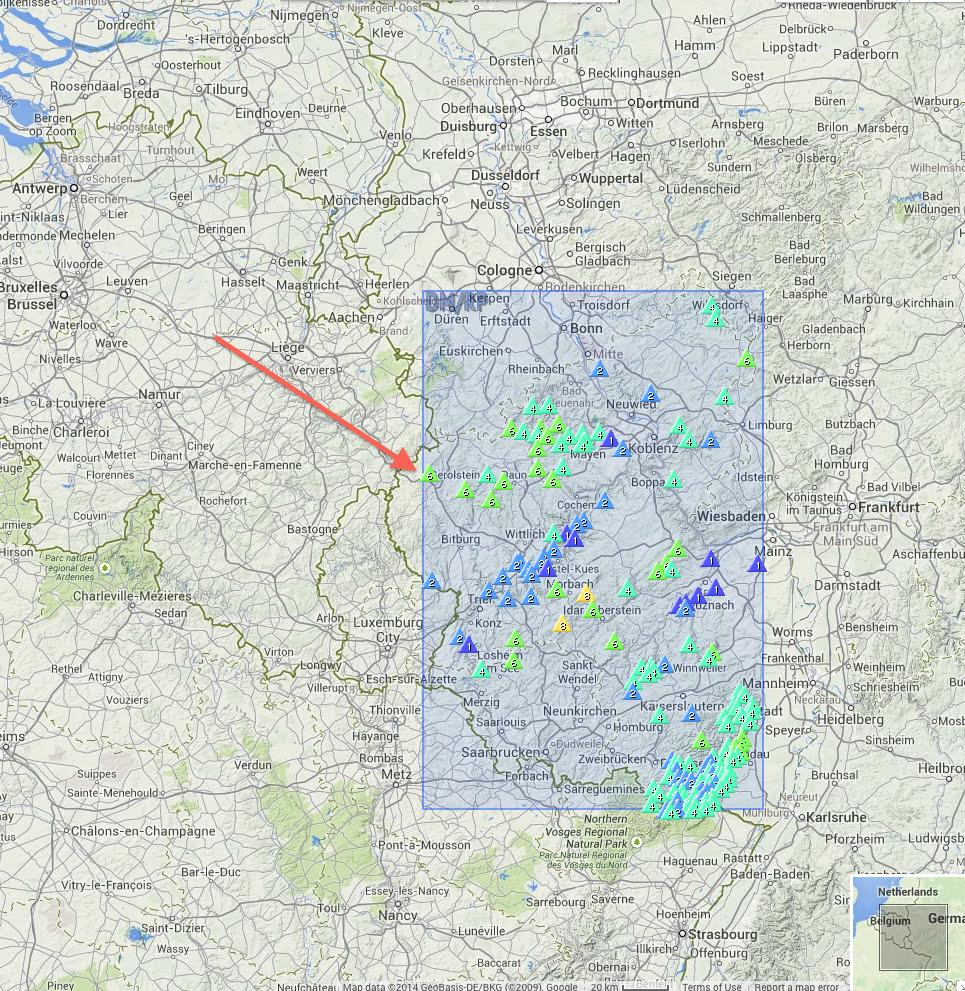
The chosen summit in Germany was Schwarzer Mann, DM/ RP-003, which is 697 metres (2,286 feet) above sea level and is worth 6 SOTA points.  Its grid square locator is JO30eg.  The summit is located in the German (Low Mountains) Association in the Rhineland-Palatinate Region.  It is located in the western part of the Eifel mountain range, which is known as Schnee Eifel (Snowy Eifel) and  is about 14 km from the little village of Prüm.  Schwarzer Mann means ‘Black Man”.  It is the highest peak in the Schnee Eifel and the third highest in the Eifel.  The summit was first activated by DL/ON6DSL/p on 24th December 2007, and has been activated a total of 42 times since.

Screenshot 2014-06-26 17.54.53

Map courtesy of sota.org.uk

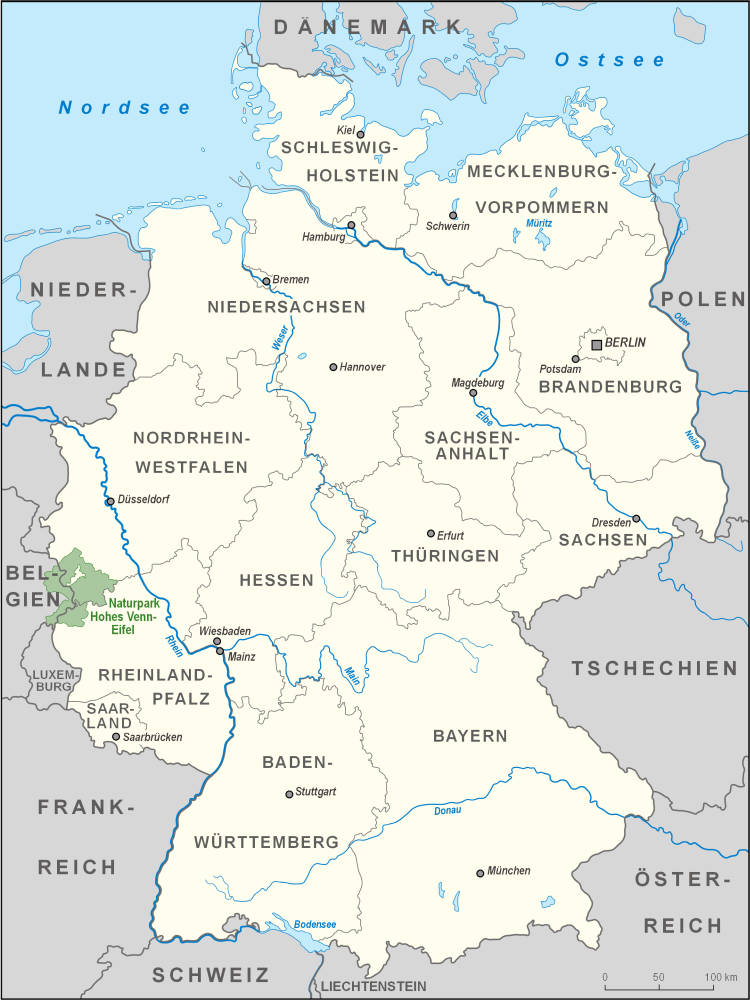
The summit is also located in World Wide Flora and Fauna area, DLFF-047, German-Belgian High Fens-Eifel Nature Park.  The area is known as Naturpark Hohes Venn-Eifel in German and is often called the North Eifel Nature Park (Naturpark Nord Eifel).  It is a cross border nature park with the German federal states of North Rhine-Westphalia and Rhineland-Palatinate, as well as the Belgian province of Liege.  The park comprises a total area of 2,485 km2.

Karte_Naturpark_Hohes_Venn-Eifel

Map courtesy of wikipedia.com

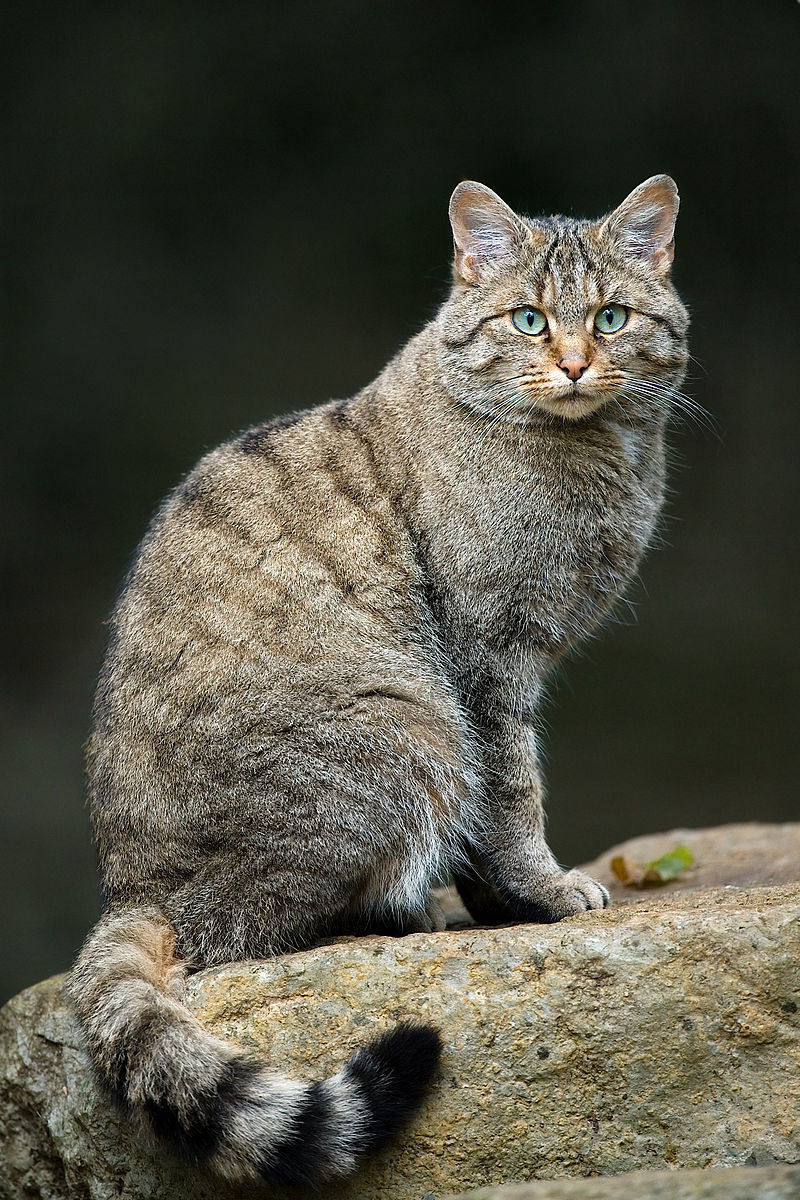
The areas surrounding Schwarzer Mann is a well developed hiking area and the largest skiing area in Rhineland-Palatinate.  The heavily wooded mountain side is covered mainly with spruce trees and is host to some rare wild animals including the wildcat, which sadly I didn’t see.  Or maybe that isn’t so bad!

Felis_silvestris_silvestris_Luc_Viatour

Image courtesy of wikipedia.com

We set up just north of the summit off the L20 road which passes through the park.

IMGA0095_3

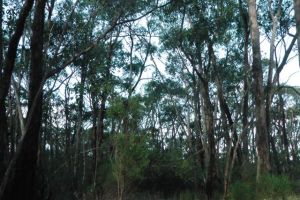
The vegetation here was very different to home.  Despite it being summer time, he forest was lush and green and very thick.  A stark contrast to the parks in South Australia during summer.  And not a single gum tree or kangaroo in sight!

IMGA0005_4 IMGA0006_4 IMGA0011_5

Because of reciprocal licensing issues, I was not able to operate under my own call sign.  Germany did offer the option of a 3 month temporary licence, so prior to leaving for Europe I applied for a German temporary operating licence, which would have allowed me restricted operating rights.  However, I had left my run a bit too late, and did not receive the documentation from DARC until I had left Australia.  But there was another option.  As I am a police officer, and Eddy is a police officer, we used the call sign of ON4IPA, which belongs to the International Police Association (IPA).  In fact, Eddy is the caretaker of that special call sign and the Chairman of the IPA in Belgium.  As I am a Detective here in South Australia, this was a really neat call sign to use.

on4ipa

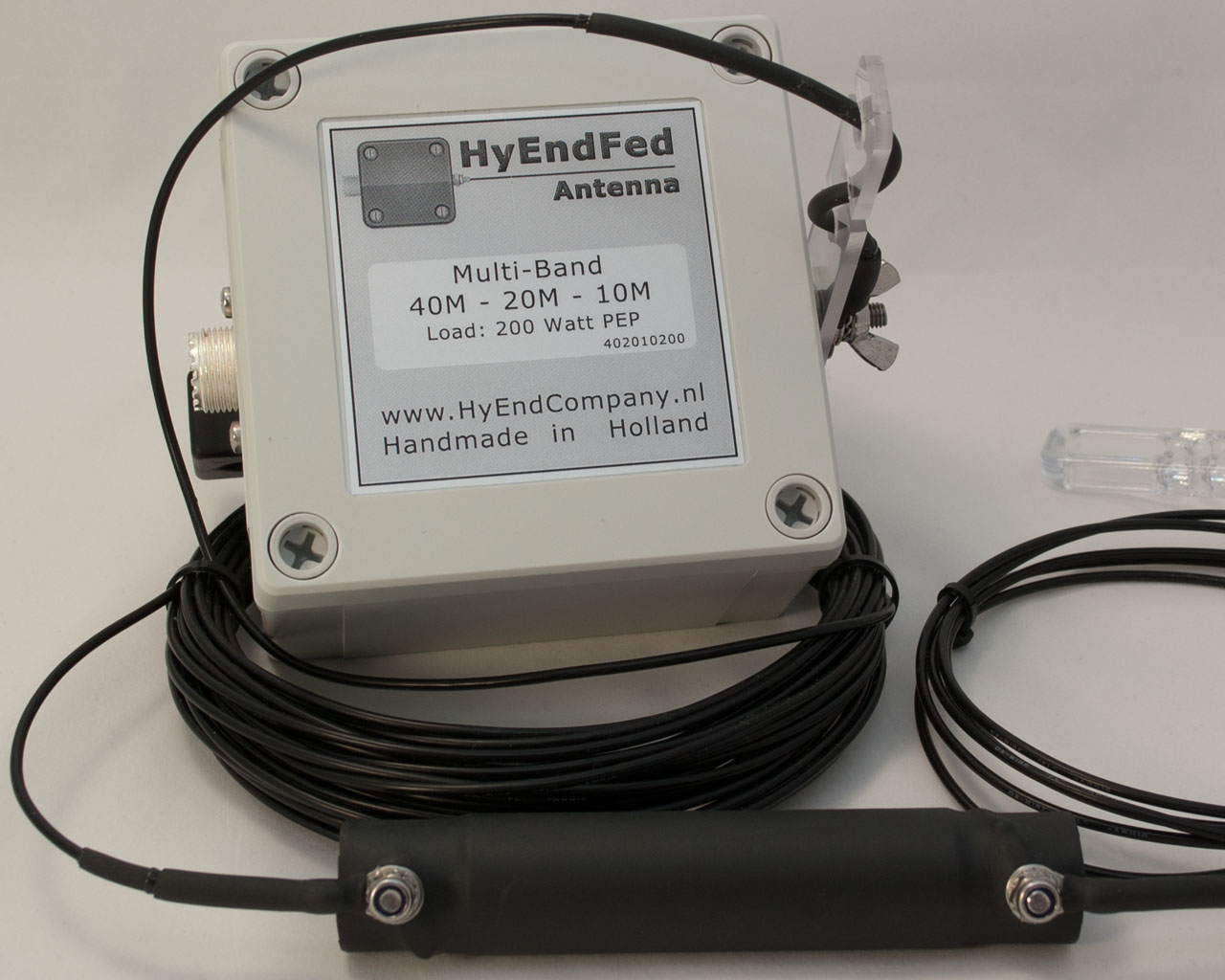
Our equipment was Eddy’s Kenwood TS50, and his ‘Hy End Fed’ half wave end fed antenna which we attached to the top of a 9 metre squid pole.  A very easy antenna to erect.  More information on this antenna can be found at…..

http://www.hyendcompany.nl/home

3b200pc

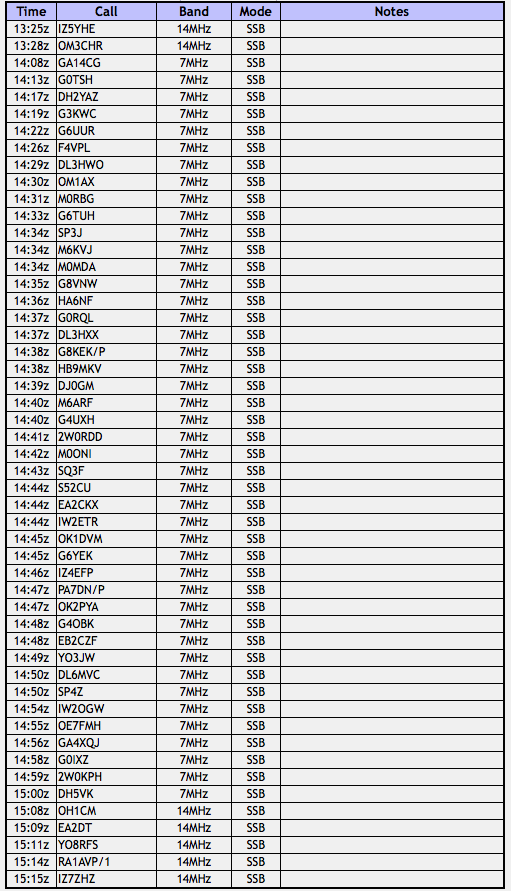
I initially started off on 20 metres on 14.244 and called CQ a number of times, with Eddy at my side doing the logging on the laptop.  But there were no takers.  I kept calling CQ for about 5 minutes, before being called by Vincenzo IZ5YHE and then Rudolf OM3CHR.  However their signals were extremely low and it was a struggle to make the contacts.  With a degree of frustration, we checked the antenna and it appeared ok.

I kept calling CQ for a few more minutes, but sadly there were no takers.  Now I was starting to get disappointed.  Perhaps band conditions on 20 m were not good?  So we QSY’d over to 40 metres where we tuned across the band and found the Commonwealth Games special event station, GA14CG.   Signals were still down despite being able to make the contact.  Something was clearly wrong.  Again we checked the antenna and it appeared all okay.

Again, I put out some CQ calls and no takers.  So this time we hooked up an LDG auto tuner, and found the VSWR to be very high.  After further checking we found an issue with one of the patch leads and replaced it. This solved the problem and we were back in business.  I breathed a sigh of relief.

IMGA0101_2

I then moved up the band a little to 7.144 and called CQ and this time I was greeted by a number of callers.  My first caller here was Keith G0TSH.  A steady flow of European and UK callers followed.  I worked a total of 43 stations before moving back to 20 m where I worked another 5 stations before handing the mic over to Eddy.

A number of the stations that I worked during the afternoon, recognised that I did not have a Belgian accent.  They must have been wondering why is an Aussie operating a Belgium call sign in Germany?  This included Manuel, EA2DT, who I have worked many times before whilst I’ve either been in a park or on a summit in Australia.  During the QSO Manual said; “One question.  Is you Paul, Victor Kilo 5 Papa Alpha Sierra.  Is you Paul, roger?'” Once I told Manuel that it was in fact me at the mic, he was very excited, as was I.

I ended up with a total of 51 contacts.  The majority of those being on 40 metres, and all from Europe and the United Kingdom.  The following countries were worked:-

  • Austria
  • Czech Republic
  • England
  • France
  • Germany
  • Hungary
  • Italy
  • Poland
  • Romania
  • Russia
  • Slovak Republic
  • Slovenia
  • Spain
  • Switzerland
  • Wales

Sadly it was the wrong time of the day for good propagation to Australia.

Screenshot 2014-09-09 14.54.18

As a result of this activation, I found that World Wide Flora and Fauna (WWFF) is extremely popular in Europe.  Many of the stations I worked were very keen on the WWFF reference number.  Who knows, maybe WWFF will kick off and become popular in Australia too.  It hasn’t been for the lack of trying!

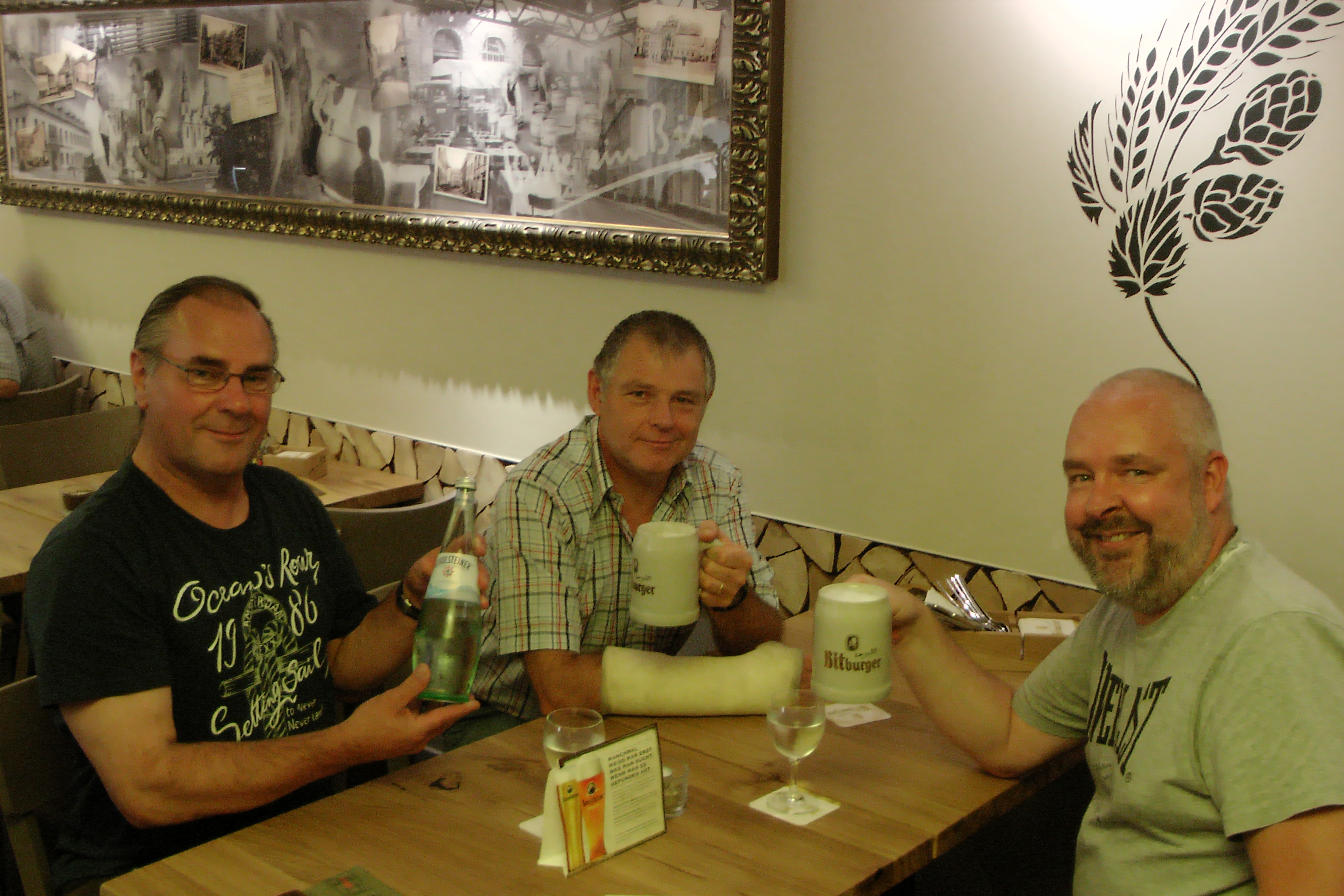
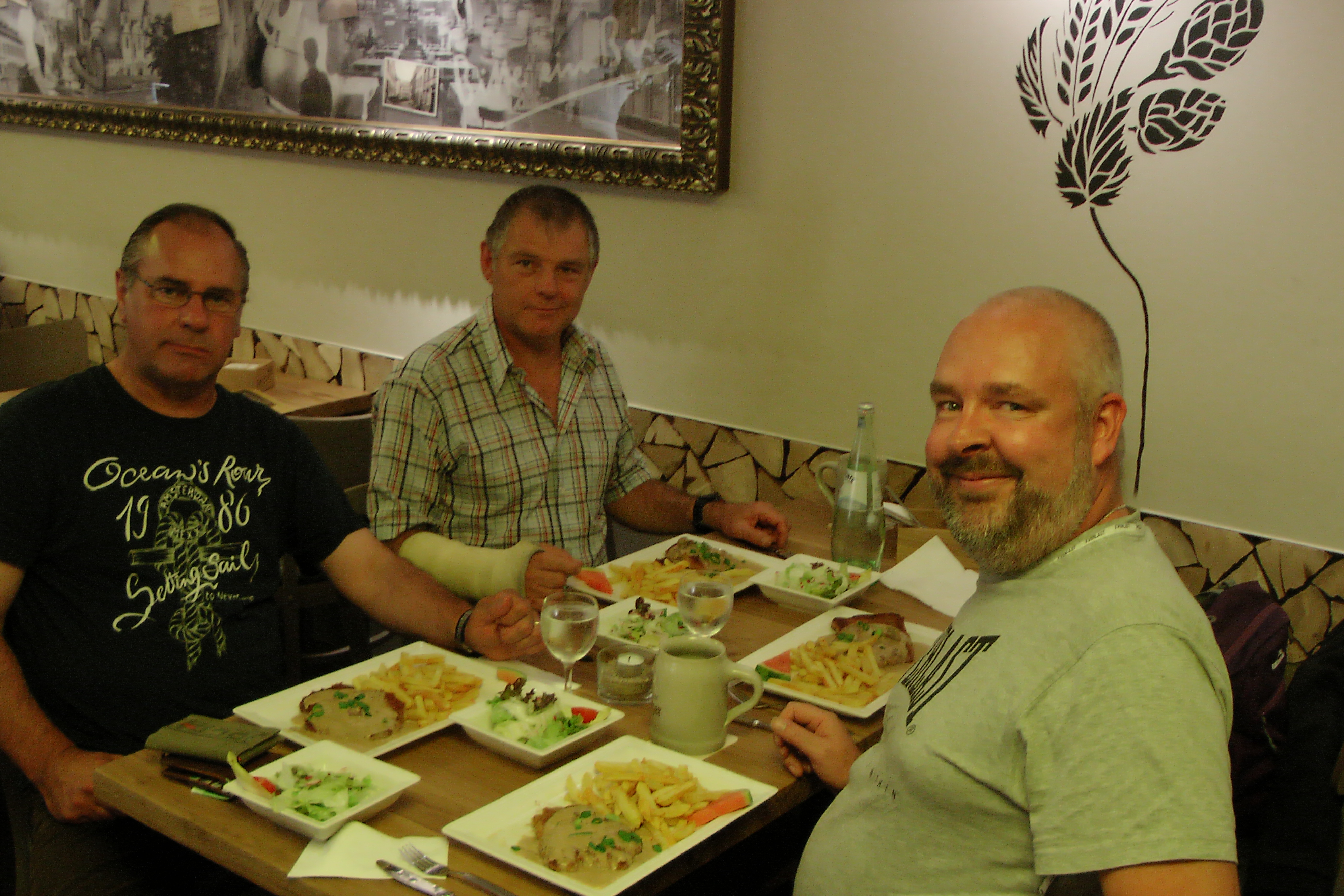
After the activation we retired to our accommodation, which was the Hotel Zum Goldenen Stern in Prüm.  That night we enjoyed a very nice meal and a few good German beers.IMGA0018_4IMGA0019_5

IMGA0024_5IMGA0022_5

References.

Wikipedia, 2014, ‘Schwarzer Mann’, accessed 9th September 2014, <http://en.wikipedia.org/wiki/Schwarzer_Mann&gt;

Wikipedia, 2014, “High Fens-Eifel Nature Park’, accessed 9th September 2014, <http://en.wikipedia.org/wiki/High_Fens_–_Eifel_Nature_Park&gt;

parksnpeaks

Currently there are no phone apps similar to SOTA Goat or Rucksack radio, for park activations.  So park activators are relying on the goodwill of park hunters to let other people know that they are in a park.  As a result, activators and hunters are relying on other methods, such as setting up an SMS group (which I have done).  This is a great way to let fellow park hunters know that you have just worked a park activator.  I see that many park hunters have also been using the VK5 Parks Yahoo group or the WWFF Australia Yahoo group, and this is another good option.  The DX cluster can also be utilised.

However, a terrific tool that many people still do not appear to be using is the parksnpeaks site which has been developed by Allen VK3HRA.

parksnpeaks can be located at…..

http://www.parksnpeaks.org

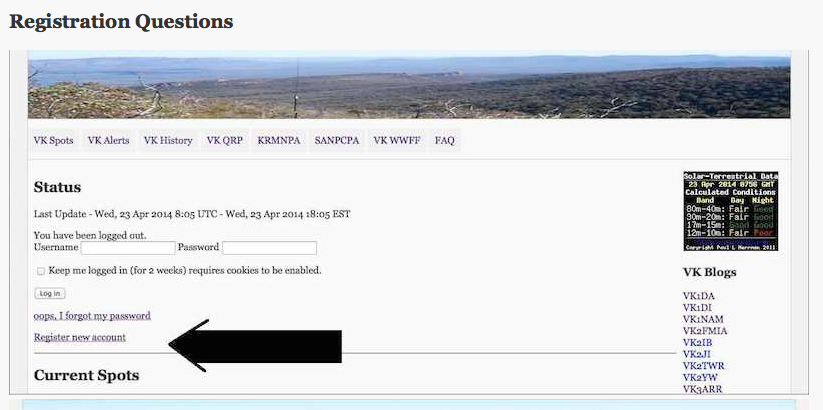
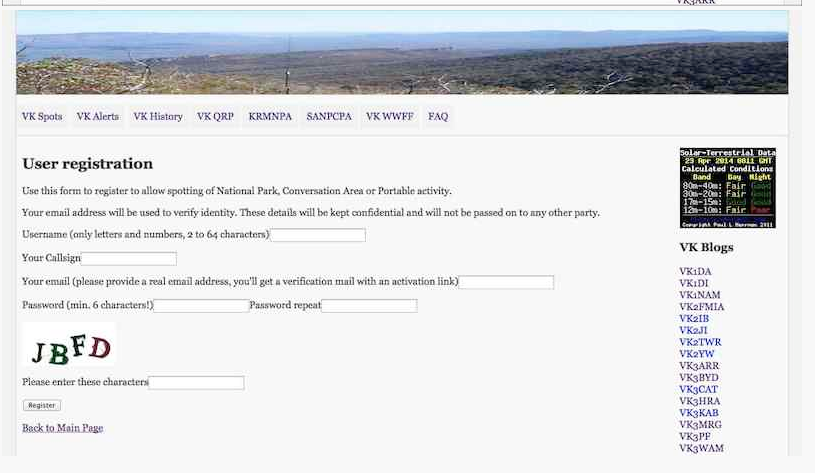
The parksnpeaks site is FREE to join.  Just simply register a new account.

Screenshot 2014-07-18 15.24.54

The required information includes:

  • username (your call sign is a good choice)
  • call sign (used to record alerts)
  • emial address
  • password (6 characters)

The ‘captcha’ feature is used to ensure that you are a ‘real’ person.

Screenshot 2014-07-18 15.25.55

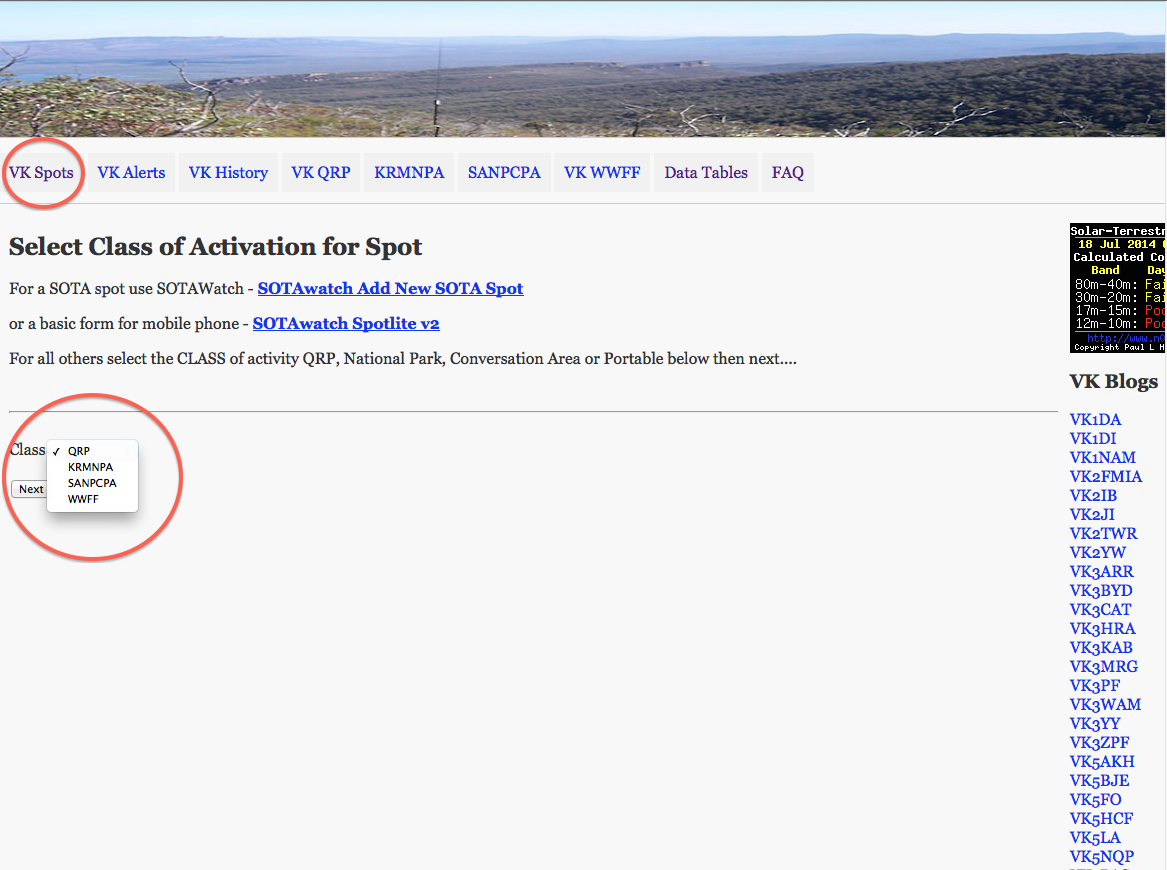
The parksnpeaks site has some excellent features.  It can be used to add VK activity including QRP operation, National Parks, Conservation Parks, or portable operation in general, whilst SOTA spots are added directly via SOTAWatch.

The parksnpeaks site offers:-

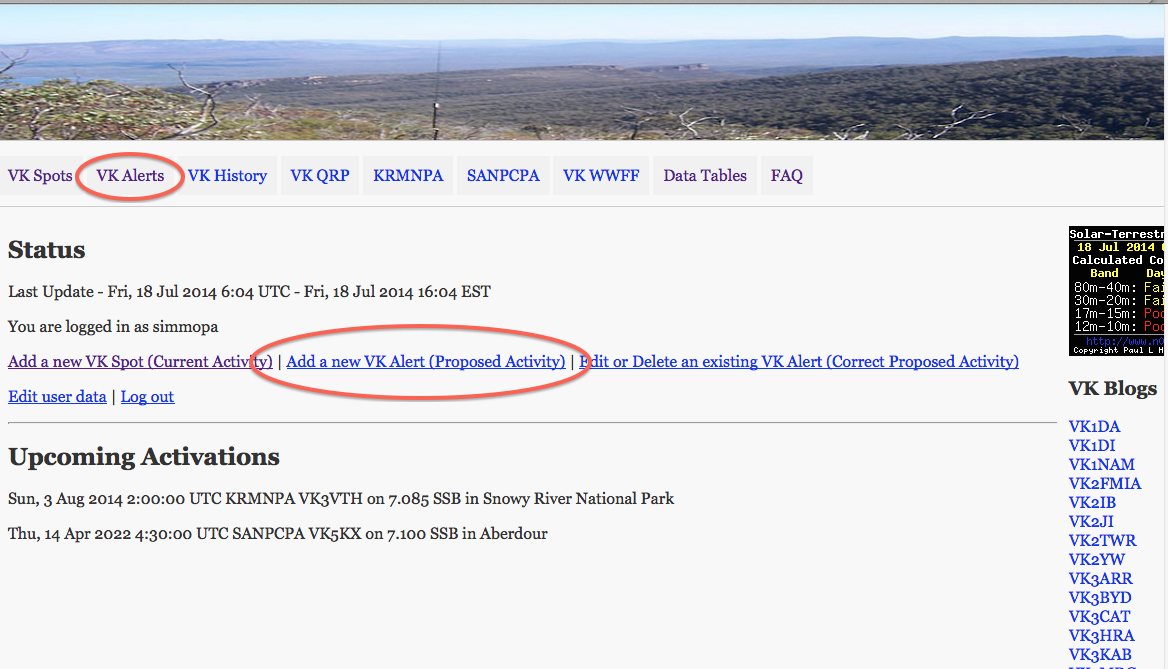
  • ‘spotting’ facilities

and

  • ‘alert’ facilities.

‘Spotting’ is where you can add details of stations you have worked or heard.  This allows you to share information with other amateurs.

Screenshot 2014-07-18 15.31.09

‘Alerting’ is where you can add details of your proposed activations, so people can see what your future plans are.

Screenshot 2014-07-18 15.34.30

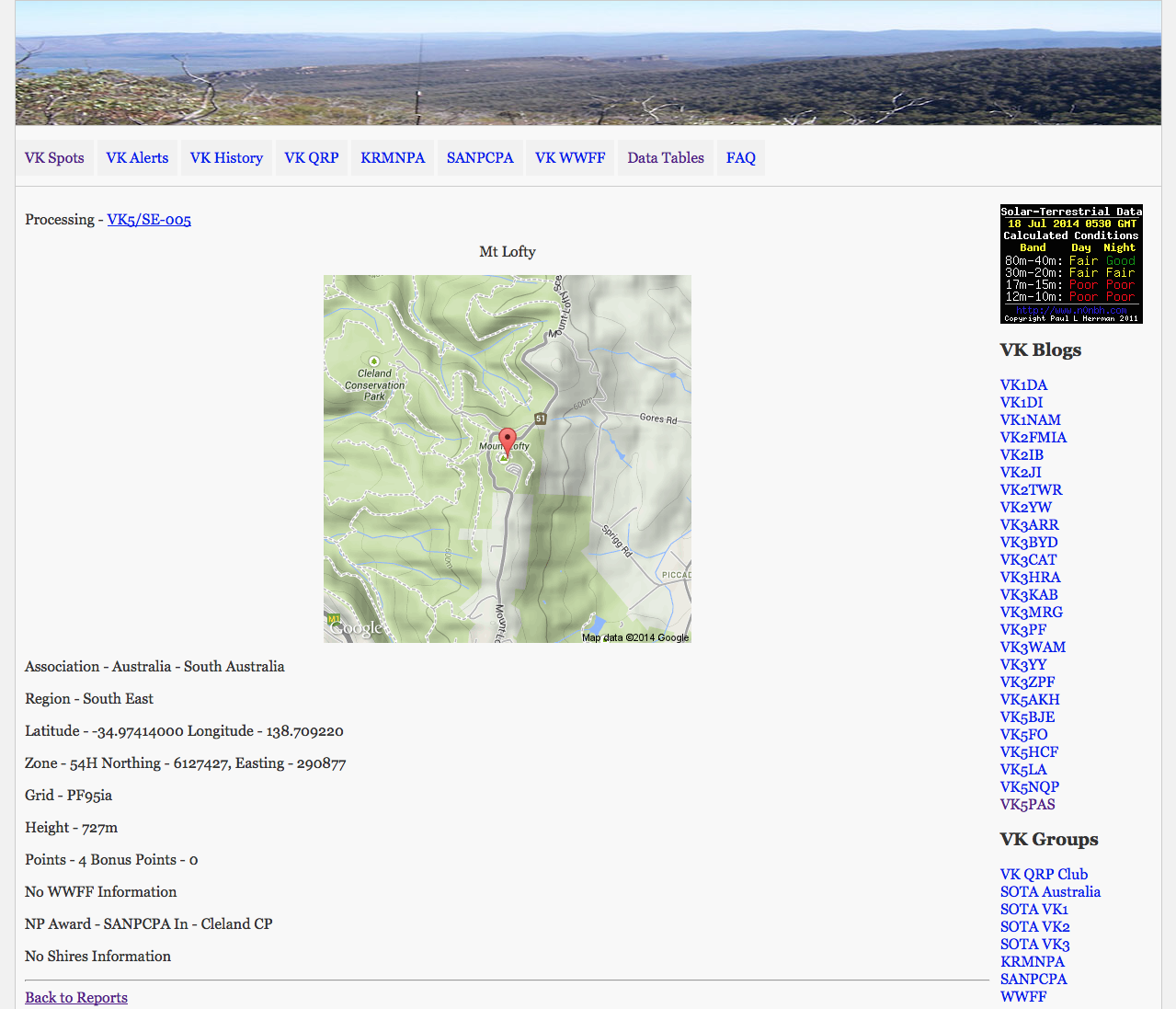
The ‘Data tables’ area offers some excellent information.  Allen, with the assistance of many others, has added a search facilty by summit ID to the parksnpeaks website.  If you look under the ‘data tables’ tab you will find a search box.  This search will provide you with:

  • basic SOTA peak information
  • grid location
  • VKFF id
  • relevant KRMNPA and/or SANPCPA National Park/Conservation Park information
  • Shire information (only VK3 at this stage).

Screenshot 2014-07-18 15.15.16

Also under the Data Tables tab you will find:-

  • WWFF list (a full list of all qualifying WWFF parks)
  • KRMNPA list (a full list of all qualifying KRMNPA parks)
  • SANPCPA list (a full list of all qualifying SANPCPA parks)
  • SOTA list
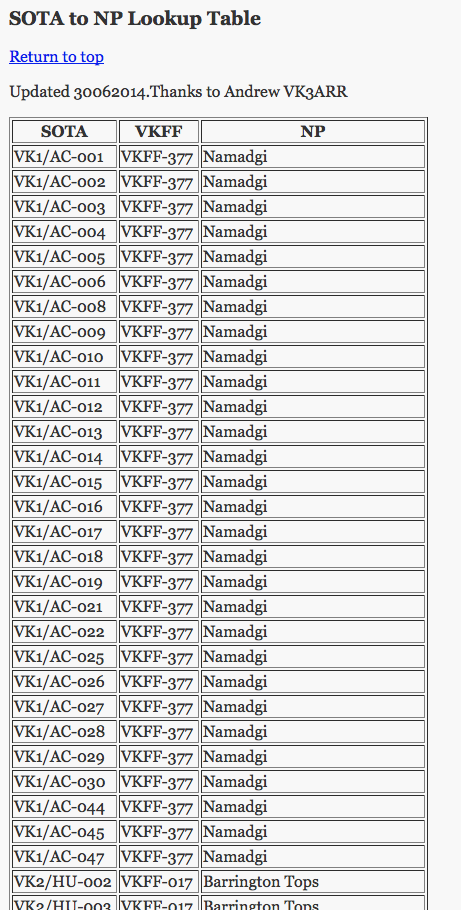
  • SOTA to NP Awards Lookup
  • SOTA to NP WWFF lookup
  • SOTA to Victorian LGA lookup.

The SOTA to National Park lookup lists, marry up those SOTA summits which are located within a qualifying WWFF or KRMNPA National Park.  This is an excellent resource.

Screenshot 2014-07-18 15.45.58

So, PLEASE…..start using the parksnpeaks site.  A lot of work has gone into it.  I know that many park activators and hunters do use the site, and find it to be a terrific resource.


Kenneth Stirling Conservation Park

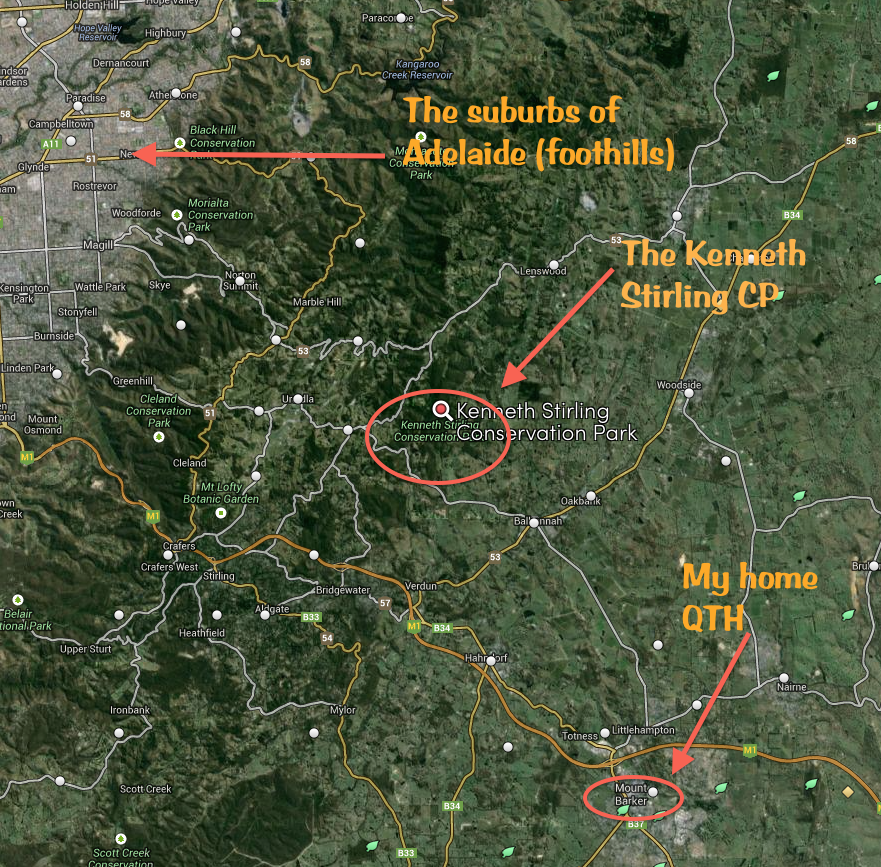
Last Sunday (6th July 2014), I headed out to activate the Kenneth Stirling Conservation Park, which is located near Carey Gully in the Mount Lofty Ranges ‘Adelaide Hills’.  It is just a short 19 km journey from home.  I last activated this park in May last year when I stayed til just after sunset, and worked some very interesting DX on 40m including New Zealand and Norfolk Island.

This park has a very interesting history and was named after Kenneth George Stirling.  For more information, please see my previous blog at…..

https://vk5pas.wordpress.com/2013/05/10/kenneth-stirling-conservation-park/

And the Australian Dictionary of Biography at…..

http://adb.anu.edu.au/biography/stirling-kenneth-george-11773

 Screenshot 2014-07-11 10.44.27

Map courtesy of mapcarta

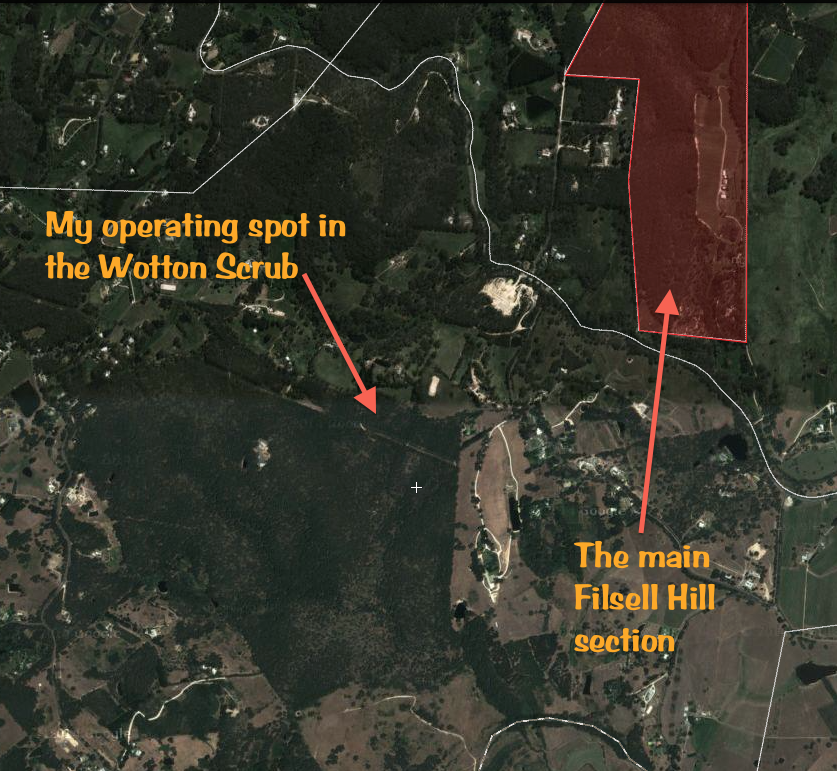
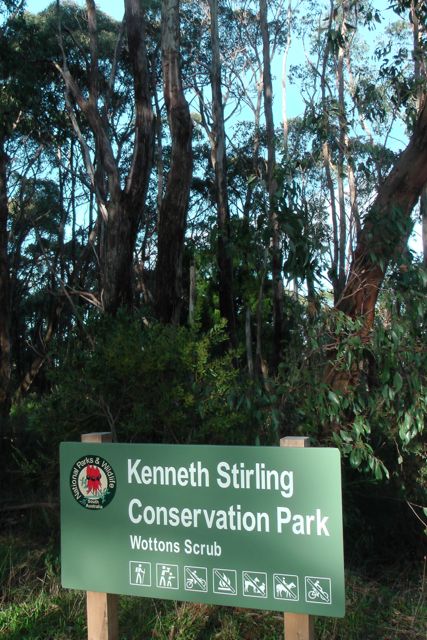
As per last year I activated the Wotton Scrub section of the park, just off Gum Flat Road.  This park consists of 4 separate pieces of scrub.  Some of the others seem a little more difficult to get to, so I played it safe, and activated Wotton Scrub.  Next time I’m going to try the other sections.  Filsell Hill, which is the largest of the four sections has limited access passing through private land to the park entrance.  Access into White Scrub and Burdett Scrub is limited, as there are no walking trails or vehicle tracks within the reserves.

Screenshot 2014-07-11 11.59.55

Map courtesy of wikimapia

There is a carpark off Gum Flat Road with plenty of room for a number of vehicles.  From there it is just a matter of walking through the gate into the park.  There is a 4WD track at this location, but is is only accessible to official vehicular traffic such as DEWNR, CFS, etc.  In an event, the large gate is locked which prevents vehicle entry.

IMGA0005

I set up about 20 metres in from the gate.  There is plenty of room here to stretch out the legs of the dipole, following the 4WD track.  I tied the ends of the dipole off to some of the nearby gum trees and set up my fold up table and deck chair.  As per recent activations, I again used the Yaesu FT-450, and my linked dipole, and ran 40 watts.

IMGA0002

I started off on 40m on my promised frequency of 7.095 and my first contact was with Peter VK3PF who was running QRP 5 watts.  Peter had a very nice 5/9 signal coming into the park.  This was followed by Matt VK1MA/3 who was on SOTA peak Mount Dandenong VK3/ VC-025, which is also located in the Dandenong Ranges National Park.  So that was a bonus: a SOTA, KRMNPA, & WWFF contact.

Peter had told me that Rob VK2QR was on a summit and was up on 7.118, so I quickly QSYd up the band and worked Rob who was a beautiful 5/9 signal, as always!  Rob always has a great signal from his SOTA activations.  This time Rob was sitting on the top of Yanky Ned Hill, VK2/ SW-026 in the Bondo State Forest.

IMGA0001

After speaking with Rob, I QSYd back down to 7.095 but in that short period of time, the frequency had become busy, so I moved up slightly to 7.105, where my first taker was dedicated parks hunter, Tim VK5AV in Mount Gambier, with a beautiful 5/9 signal.  This was followed by a steady flow of callers from VK1, VK2, VK3, VK4, VK5, and VK7.  I was very surprised to be called by George VK4GSF at Toowoomba.  George runs low power and was a good 5/5 copy into Kenneth Stirling, and I received a 5/7 signal report back.  I also worked a handful of QRP operators including Peter VK3PF on 5 watts, Peter VK3TKK, and Col VK5HCF.  It was also good to get Nigel in the log, VK2PHA who was mobile, crossing the Hawkesbury River.

After operating on 40m for just a little over an hour, I headed up to 20m and managed to find a clear spot on 14.237.  After just a few CQ calls, I heard KJ6PNF come back to me.  But sadly, another very strong USA station came up just 1 kc away.  There is a group of VKs and USA fellas that come up on 20m every day on or around 14.240 and it was evident they were not going to move for anyone.  So that was the end of that.

I moved up to 14.245 and started calling CQ again and was greeted by Paul VK2HDX in Sydney, who was using a Magentic loop antenna, with a terrific 5/9 signal.  Paul was kind enough to spot me on the DX cluster, and as a result I worked a few Europeans: Slovenia, Italy, Switzerland, Belgium, Poland, Spain, Sweden, and Russia.  This included my old mate Marnix OP7M, who I will be staying with in a few weeks time during my trip to Europe.

The sun was starting to go down and it was getting a little chilly, so it was time to pack up and head for home.  Again, this was a very enjoyable afternoon in the Kenneth Stirling Conservation Park.  I and a total of 43 contacts in the log.

The following stations were worked on 40m SSB:-

Peter VK3PF; Matt VK1MA/3 (SOTA); Rob VK2QR/p (SOTA); Tim VK5AV; Rod VK5VRB; Les VK5KLV; Bernard VK3AMB; Brian VK5FMID; Richard VK5ZRY; Peter VK2MDZ; Peter VK3TKK; Ian VK5IS; George VK4GSF; Paul VK7CC; Arno VK5ZAR; Col VK5HCF; Tom VK5EE; Phil VK3BHR; Andrew VK1NAM; Tony VK3VTH/p; Albert VK3KLB; Ton y VK3CAT; Barry VK5BW; Hans VK5YX; Steve VK3JY/p; Nigel VK2PHA/m; Ron VK3VBC; and John VK5NJ.

The following stations were worked on 20m SSB:-

Paul VK2HDX; Albert S58AL; Max IK1GPG; IK7CMY; Vince HB9EVJ; Marnix OP7M; S52KM; SP5INQ; John ON7ZM; EA4DTV; SM7LPY; Alan VK4NAI; UA9LT; Ted VK6NTE; and Paul EA5/GM0OPK.

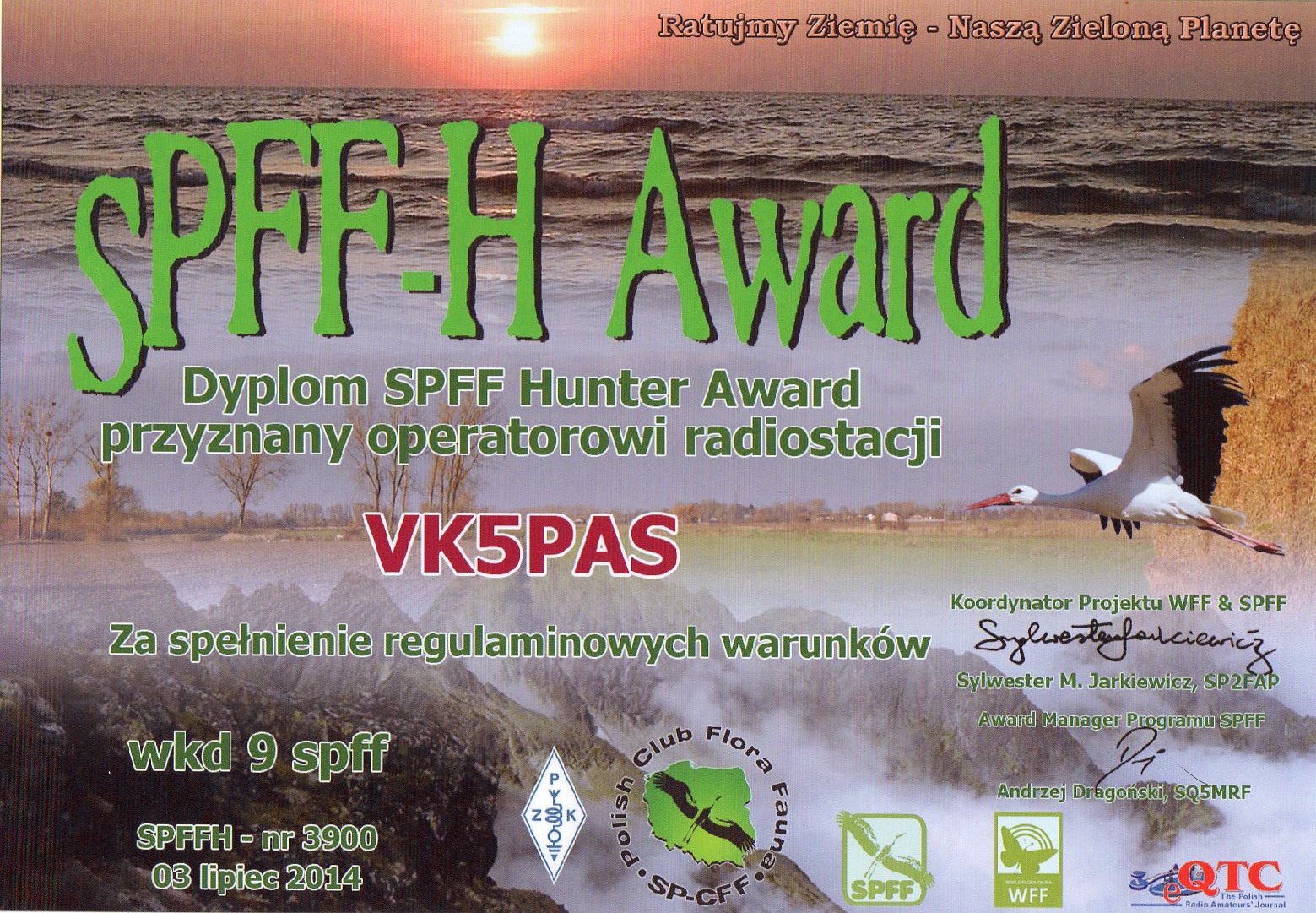
SPFF-H award

I received the following certificate today via e-mail after applying on line, on the WWFF LogSearch facility.  It is the SPFF-H Award, issued by the SPPFF-Polska Flora Fauna program.  It is another of the many National awards available in the World Wide Flora Fauna program.

The basic SPFF-H award is issued for communications with 3 different SPFF areas.  For each subsequent three SPFF areas, yields a higher class of award.

More information on the SPFF awards can be found at…..

http://spff.eham.pl/articles.php?article_id=13

SPFF-H Award305

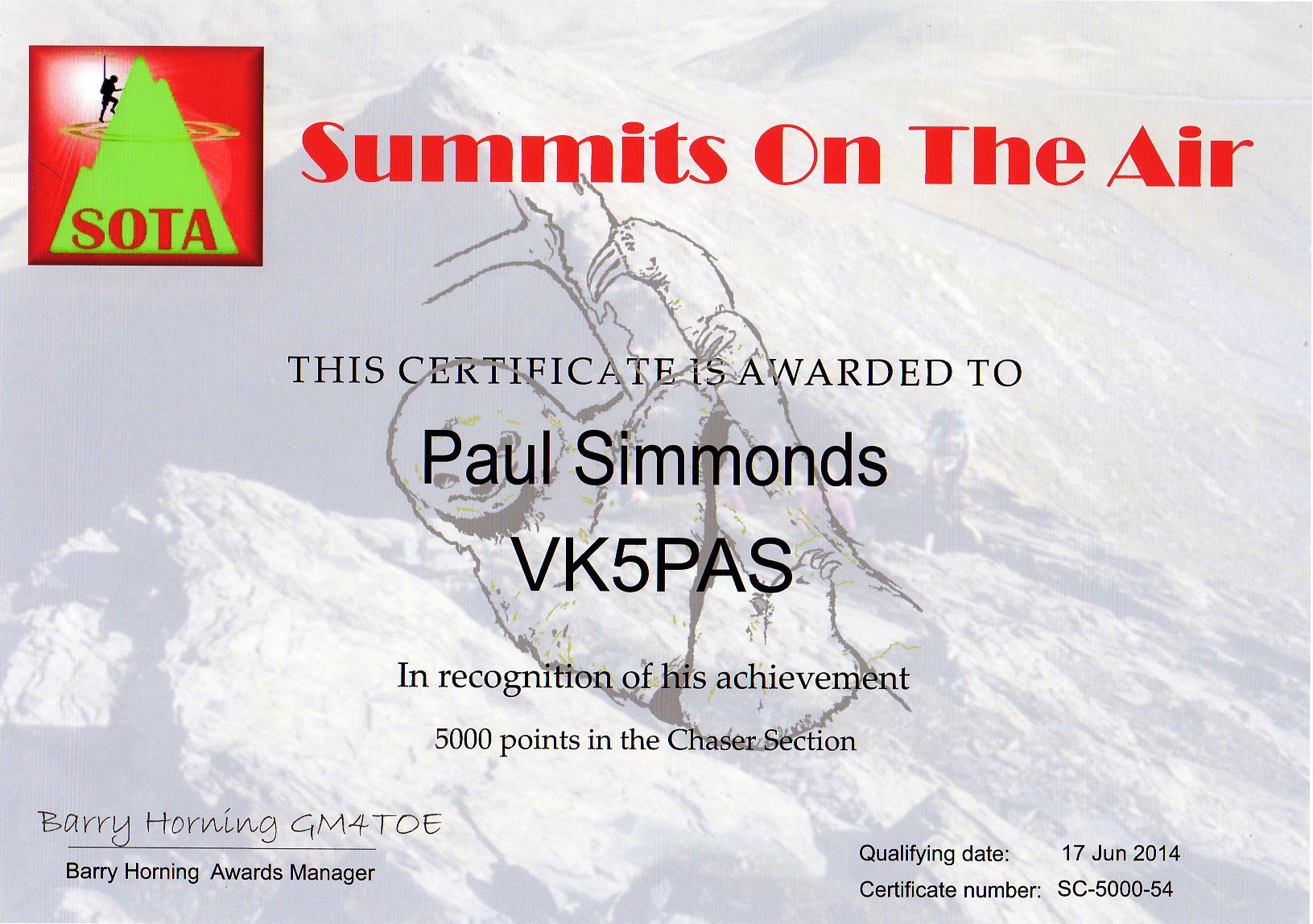
5000 point SOTA Chaser certificate

Thanks to some devoted Summits on the Air (SOTA) activators, back in June I went over the 5,000 point mark as a SOTA chaser.  I applied for my certificate a few weeks ago and it was sent through via email from the United Kingdom today.

SOTA 5000 Chaser304


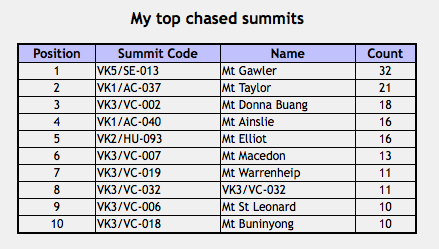
It was interesting to check some of my statistics on the SOTA database.

My top chased summit was nearby Mount Gawler, VK5/ SE-013, mostly thanks to Mr. Mount Gawler himself, Nigel VK5NIG.

Screenshot 2014-07-03 18.15.44

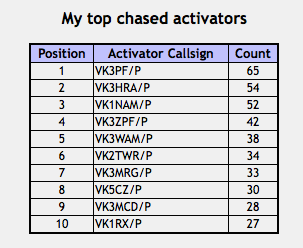
My top chased activator was Peter VK3PF, followed by Allen VK3HRA, and then Andrew VK1NAM.  Not too many VK5s in there!

Screenshot 2014-07-03 18.16.18

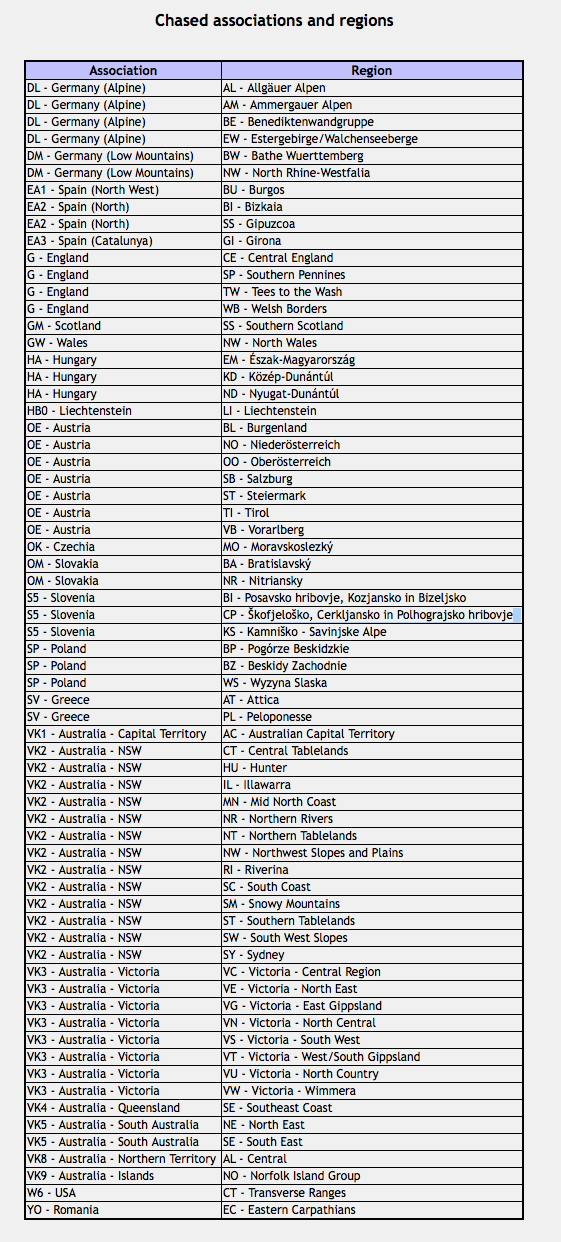
And I have worked a total of 25 different associations and a total of 67 regions.  With many of those being in Europe.  I’ve just managed the one contact into the United States of America.

Screenshot 2014-07-03 18.17.19


Peakery

Just wanted to bring an interesting website to everyone’s attention.  It’s called ‘peakery’.  It can be located at…..

http://peakery.com

logo

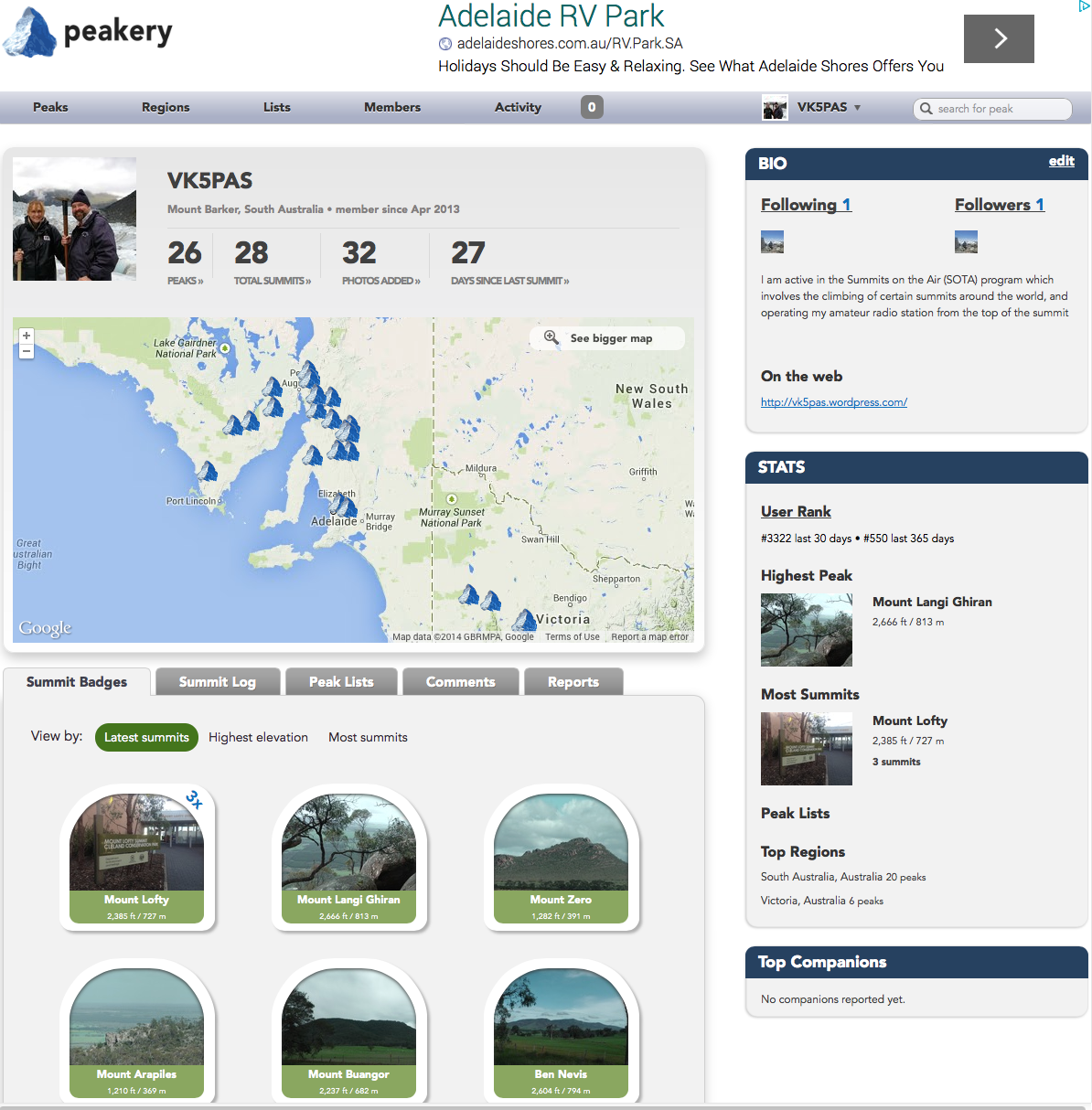
The peakery website features over 330,000 peaks from around the globe.  You are able to find peaks by browsing lists, maps, and photos.  You can also use peakery to envision your next peak objective with photos, trip reports, statistics, 3D fly-arounds, and maps.  The 3D fly around feature is extremely good.

There are currently 10,820 peaks in Australia, that are recorded on peakery

On the site you can also log all of your summits.  Once you’ve returned safely from your summit, you can share your summit experience, by adding trip details, photos, route info, and information on who you went with.

Every peak that you summit earns you its summit badge.  As you climb more peaks, you rise up the ranks as shown on the Members page.

Screenshot 2014-06-28 20.40.01

Just as with WordPress, you can follow someone’s progress.

Your page will also show you some interesting facts such as your user rank, the highest peak that you have activated, and the top regions that you have climbed peaks in.

Peakery can also be found on Facebook…..

https://www.facebook.com/peakery

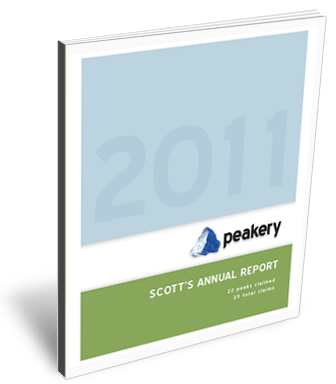
You can even download your own peakery Annual Report which documents your year in the mountains.  The Annual Report is a comprehensive summary including all of your claimed peaks and summit logs for a specific year.

annual_report

If a summit does not appear on the peakery list, you can add it to peakery.  Your addition will first go to the peakery moderator/s for their approval.  I should warn you, that not all will be included, even if they have the 150 metres of prominence as required with SOTA.  A total of 19 of the SOTA summits I have activated are not recorded on peakery, and at this stage have not been approved to be added?  This is about 40 % of my SOTA activations.

However, despite this, peakery is another tool that can be used when considering activating a peak as part of the Summits on the Air (SOTA) program.


Going overseas to activate

I am heading off to Europe in July for 7 weeks and I was hoping to activate a few Summits on the Air (SOTA) peaks and World Wide Flora Fauna (WWFF) parks whilst there.  So I commenced making enquiries re operating whilst over there.  What I found was information, here, there and everywhere.  Unfortunately the ACMA’s website contained very little information and even after telephoning them and corresponding via email, I was confused.  So here is a little bit of information, should you be in the same position as me with holding an Australian Standard class licence.

Sadly, as a Standard licence class holder, it is not easy getting on air overseas.  You are not covered by the CEPT agreements which I will talk about in more detail below.  The CEPT agreements are relevant if you are the holder of an Advanced licence.  However, I did find that as a Standard licence holder, you can apply for a 3 month visitor’s licence to operate in the Federal Republic of Germany.

CEPT.

The European Conference of Postal and Telecommunications Administrations (CEPT) was instituted by an intergovernmental arrangement on the 26th June, 1959 at Montreux, Switzerland.  It was established as a co-ordinating body for European state telecommunications and postal organisations.  The CEPT acronym comes from the French version of its name, Conférence européenne des administrations des postes et des télécommunications.  It was originally established by 19 countries, which expanded to 26 during its first ten years.  There are now 48 member countries in the CEPT.


logo_70px_cept.jpg

CEPT is organised into three main components:

  • Electronic Communications Committee (ECC) – responsible for radiocommunications and telecommunications matters and formed by the merger of ECTRA and ERC (European Radiocommunications Committee) in September 2001.  The permanent secretariat of the ECC is the European Communications Office (ECO)
  • European Committee for Postal Regulation (CERP, after the French “Comité européen des régulateurs postaux”) – responsible for postal matters
  • The Committee for ITU Policy (Com-ITU) is responsible for organising the co-ordination of CEPT actions for the preparation for and during the course of the ITU activities meetings of the Council, Plenipotentiary Conferences, World Telecommunication Development Conferences, World Telecommunication Standardisation Assemblies

Recommendation T/R 61-01 

In 1985 in Nice, France, the CEPT met and Recommendation T/R 61-01 was approved.  This Recommendation makes it possible for radio amateurs from CEPT countries to operate during short visits in other CEPT countries, without obtaining an individual temporary licence from the visited CEPT country.  The following is a list of CEPT member countries:

Albania, Andorra, Austria, Azerbaijan, Belarus, Belgium, Bosnia and Herzegovina, Bulgaria, Croatia, Cyprus, Czech Republic, Denmark, Estonia, Finland, France, Georgia, Germany, Greece, Hungary, Iceland, Ireland, Italy, Latvia, Liechtenstein, Lithuania, Luxembourg, The Former Yugoslav Republic of Macedonia, Malta, Moldova, Monaco, Montenegro, Netherlands, Norway, Poland, Portugal, Romania, Russian Federation, San Marino, Serbia, Slovak Republic, Slovenia, Spain, Sweden, Switzerland, Turkey, Ukraine, United Kingdom, Vatican.

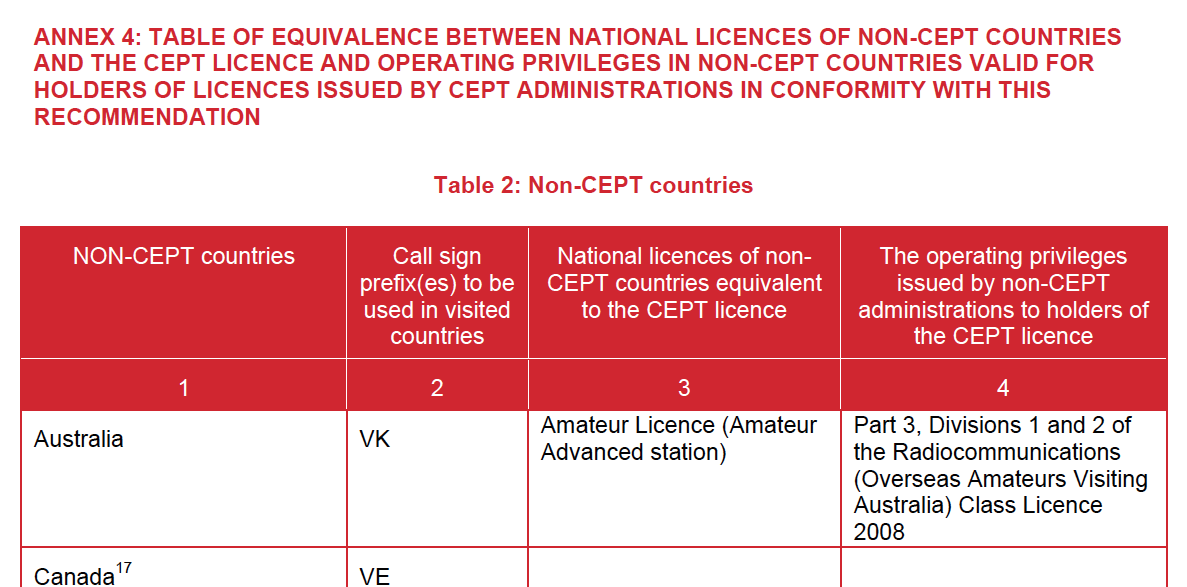
The Recommendation was revised in 1992 with the aim to make it possible for non-CEPT countries to participate in this licensing system.  Australia is recorded in the document as a non-CEPT country.  Other non-CEPT countries recorded in the document are Canda, Curacao, Israel, Netherlands Antilles, New Zealand, Peru, South Africa, and the USA.

However, you need to be the holder of an Advanced amateur radio licence to operate in CEPT countries under this Recommendation.  Annex 4, Table 2, shows the required equivalence between National licences of non-CEPT countries and the CEPT licence.

Screenshot 2014-06-28 09.25.13

So in essence under this Recommendation, if you hold an Australian Advanced licence you can operate in the European CEPT countries for up to 3 months without needing to apply for a reciprocal licence.  You obviously need to adhere to the relevant band plans, power limits, rules, etc.

The Recommendation can be downloaded in full from…..

Click to access TR6101.pdf

Recommendation (05)06

ECC Recommendation (05)06 CEPT Novice Radio Amateur Licence was  approved in October 2005 and was amended in October 2011.  This Recommendation acknowledges that in many countries, novice licences exist, none of which are included in the procedures of Recommendation T/R 61-01 mentioned above.

This Recommendation relates to both CEPT member countries, and CEPT non member countries.  However, please note, Australia is not included in this Recommendation and the Recommendation has not been implemented by Australia!  The only non CEPT country listed in the Recommendation is the United States of America (USA). It appears for whatever reason/s, the WIA and ACMA have not progressed Australia to be included in this Recommendation.  I will endeavour to find out why.

This Recommendation can be downloaded in full from…..

Click to access rec0506.pdf

Recommendation T/R 61-02

This Recommendation was approved in 1990 and makes it possible for CEPT administrations to issue a Harmonised Amateur Radio Examination Certificate (HAREC).  Initially, only CEPT countries were involved in HAREC, however the Recommendation has been modified to allow non-CEPT countries to participate.

You need to successfully pass an amateur radio examination to obtain a HAREC.  The HAREC facilitates the issuing of an individual licence to radio amateurs who stay in a country for a longer term than that mentioned in CEPT Recommendation T/R 61-01.  It also facilitates the issuing of an individual licence to a radio amateur returning to his native country showing the HAREC certificate issued by a foreign administration.  Australia is listed as a non-CEPT country in this Recommendation.

German 3 month temporary licence.

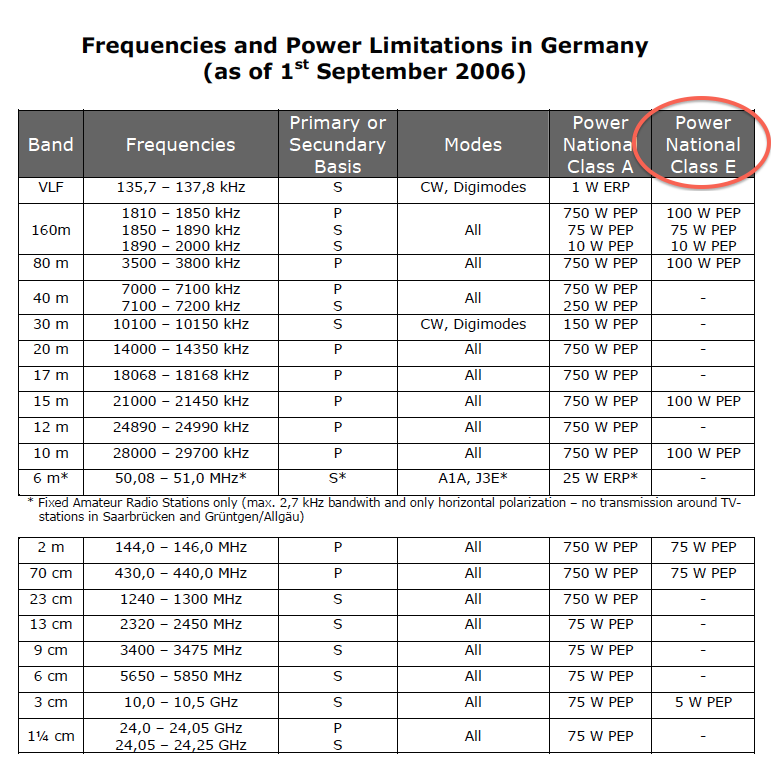
If you are visiting the Federal Republic of Germany and would like to continue your hobby of amateur radio whilst there, you can apply for a 3 month temporary admission licence.  The fee is 70 Euros (EUR).  This licence will allow you to operate under the privileges of a German National Class E licence: the 160m band, the 15m band, and the 10m band on HF, with 100 watts PEP; and 2m and 70cm with 75 watts PEP.

Radio amateurs to which one of the CEPT Recommendations T/R 61-01 or (05)06 applies, or who are resident in Germany or hold a permanent German admission to participation in the amateur service cannot be issued a temporary admission upon this application.

Screenshot 2014-06-27 17.31.23

Other possibilities.

The Belgium Amateur Radio Society (UBA) allows amateurs who are not part of the CEPT Recommendations, to apply for a special guest licence.  You need to send a letter of enquiry to the UBA, with a photocopy of your amateur licence, together with the study program relating to the radio amateur examination in your country.  The UBA website states that the entire procedure may take quite a while and there is no guarantee of success.

UBA_logo

Thankyou.

While I have the opportunity, I would like to publicly thank the following people who promptly replied to my queries and sent me a lot of helpful information…..

  1.  Rik ON7YD, Belgium Amateur Radio Society (UBA)
  2. Rainer Wilhelm , Federal Network Agency, Germany
  3. Gianni Nigita, DL7GBN, Deutscher Amateur-Radio-Club (DARC)
  4. Jan, OK1NP
  5. Ed, VK2JI (now DD5LP)

Sadly, I never received a reply from the French authorities, and I received a very limited response from ACMA.  The ACMA’s website also has out of date information, and it is difficult to interpret information on the site.  This has been pointed out on the SOTA Yahoo group previously when the issue of reciprocal licensing was discussed.

Summary

So what have I learnt?  Get my upgrade!

I am hoping to have my application for a 3 month temporary admission licence to Germany approved, so I can activate a few summits and a park in south western Germany.


References.

http://www.cept.org

http://www.astrosurf.com/luxorion/qsl-ham-history11.htm


Parks in South Australia

A number of times recently I have been asked about what parks qualify for the VK5 National and Conservation Parks award? and how parks become Conservation Parks in the first place?  So, I am hoping that this blog will be of some interest and answer some questions on South Australia’s parks system.

It has certainly shed some light on the system for me, and has also revealed that the Region and District system has changed since the inception of the VK5 Parks Award in April last year.  Yes, that means another spreadsheet to come out.  But it has helped me in the formulative stages of the proposed new award certificate ‘Worked All VK5 Park Regions’.

Firstly, just how big is South Australia?

South Australia (S.A.) has a land area of 984,221 square km, of which about 4,600 square km are located on islands.  South Australia has a coastline of 5,067 km which consists of 3,816 km of mainland coastline and 1,251 km of island coastline.  South Australia’s land area is 12.7% of Australia’s total, with the state being the fourth largest of all the Australian States and Territories.  The state’s coastal waters cover about 60,032 square km.

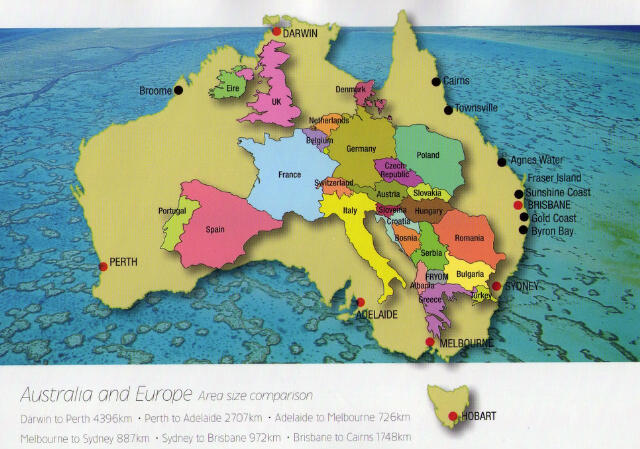
To put that into perspective, South Australia is larger than any country in Europe, excluding Russia.  Ukraine comes the closest at 603,700 km², then France 547,030 km², and then Spain at 505,992 km².  Italy could be placed into South Australia, more than three times over, whilst the whole of the United Kingdom could be placed into South Australia four times over. Although I couldn’t find an overlay map of South Australia, here is one of Australia showing how big Australia is compared to most of mainland Europe…..
Size-of-Australia-vs-Europe

Image courtesy of http://letstourengland.com

Mount Woodroofe is South Australia’s highest peak at 1,435 metres above sea level.  It is a big 10 pointer for the Summits on the Air (SOTA) program, too by the way.  South Australia is a relatively flat place, with more than 80% of South Australia being less than 300 metres above sea level.  The lowest place is Lake Eyre at 15 metres below sea level.  It is in this vicinity that South Australia receives its lowest rainfall.  About 52,786 square km is occupied by agriculture, which equates to 53.6% of the State. South Australia’s parks and reserves are managed by the Department of Environment, Water and Natural Resources (DEWNR).

DEWNR was created on 1st July 2012 to bring together environment and natural resources management in South Australia.  The new Department was created by amalgamating the Department for Water, and the Department of Environment and Natural Resources.  DEWNR are responsible for establishing and managing South Australia’s parks.  There are a total of 350 parks and reserves covering an area of 21,087,984 hectares, which equates to 21.5% of South Australia.  The map below shows the extent of South Australia’s vegetation. Screenshot 2014-06-18 19.24.41
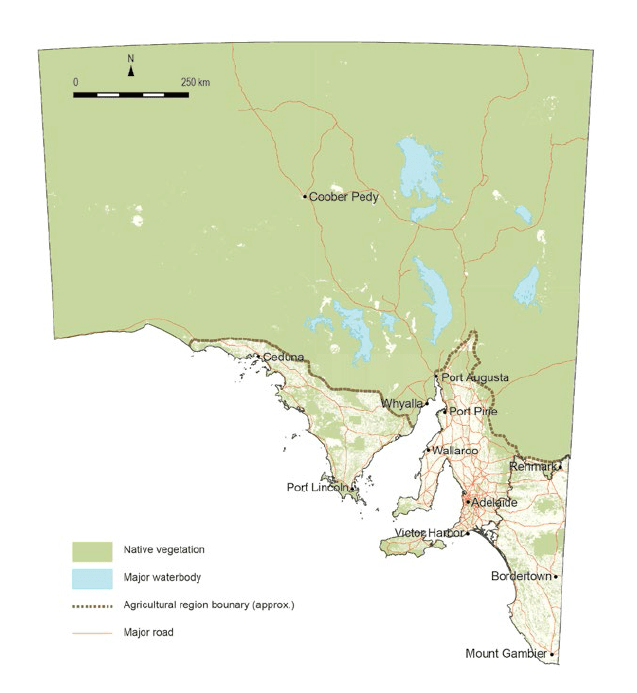
Map courtesy of http://www.epa.sa.gov.au

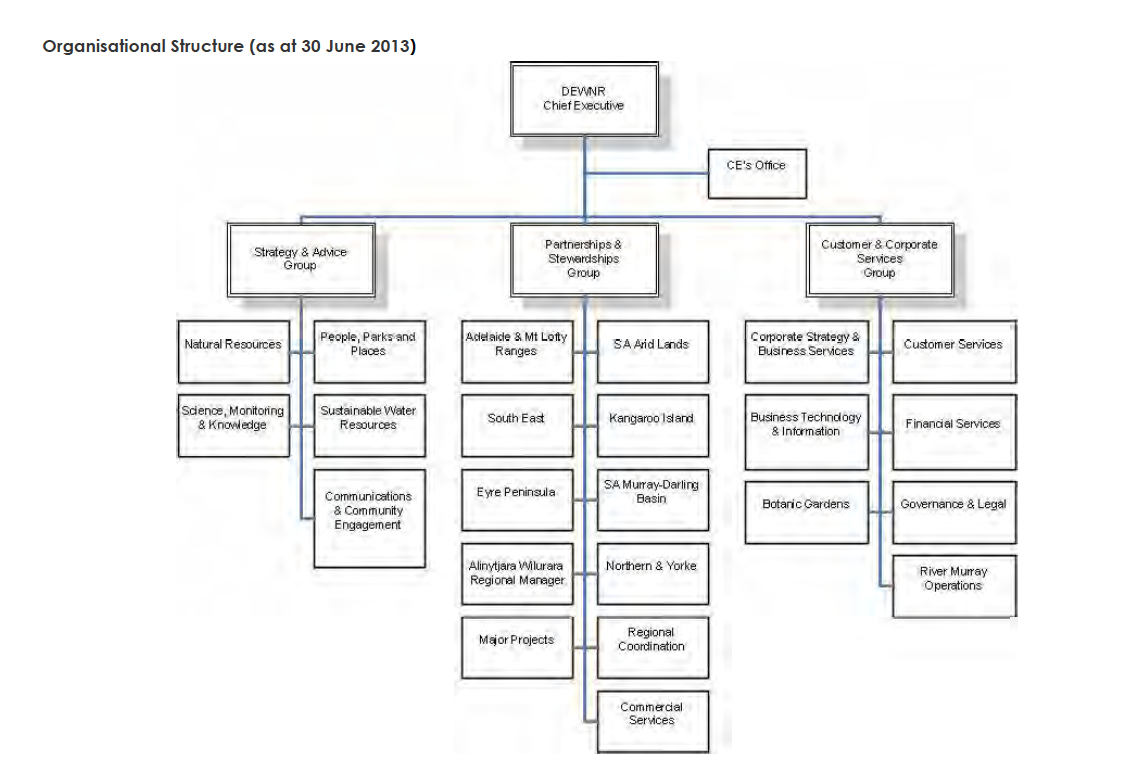
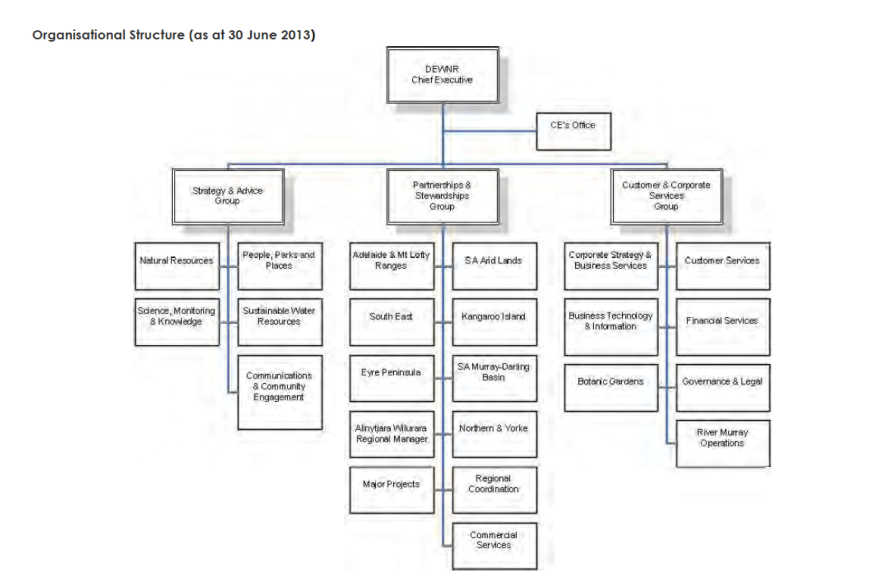
DEWNR has three groups within its structure:

  • Strategy and Advice.
  • Partnerships and Stewardship
  • Customer and Corporate Services.

Below is an organisation structure chart of DEWNR, as of 30th June, 2013.
Screenshot 2014-06-19 10.20.06 In South Australia, National Parks and Conservation Parks (protected areas) are proclaimed under the National Parks Wildlife Act 1972, and the Wilderness Protection Act 1992.  The term ‘protected area‘ is used internationally to embrace a wide variety of types of parks and reserves.  The International Union for Conservation of Nature (IUCN) describes a protected area as:

‘A clearly defined geographical space, recognised, dedicated and managed, through legal or other effective means, to achieve the long term conservation of nature with associated ecosystem services and cultural values’ (Dudley 2008).

DEWNR are in partnership with the Natural Resources Management Council (NRM) which was established in 2004.  This comes under the DEWNR’s umbrella of ‘Partnerships & Stewardships Group’. Additionally, there is the National Parks and Wildlife Council which was established in 1996 under the National Parks and Wildlife Act 1972.  One of the main items of business for this Council is reviewing park management plans.  ‘Conserving Nature 2012-2020‘ is a strategy for establishing a system of protected areas in South Australia.  It is a big document, but it is worth a read and contains some very interesting information.  The Conserving Nature document, advised that about 28.6% of the state of South Australia was under some form of ‘protected‘ status.
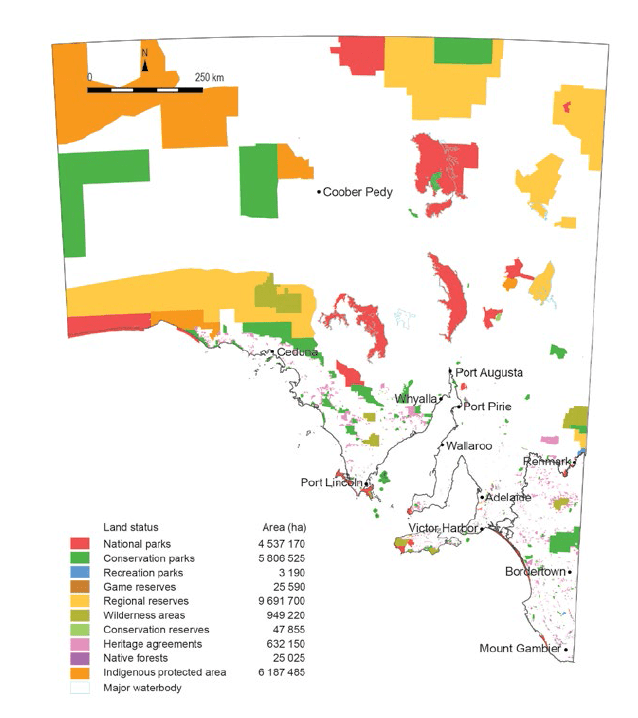
Screenshot 2014-06-18 19.25.22

Map courtesy of http://www.epa.sa.gov.au

There are eight types of parks in South Australia’s Protected Area system.  They are:

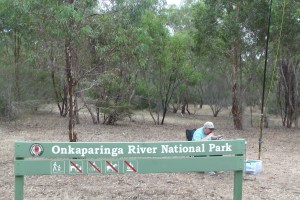
National Park

Land that is of national significance by reason of its wildlife or natural features.

There are 21 of these in S.A. that include an area of 3,995,444 hectares (4.1% of the State).
IMGA0001

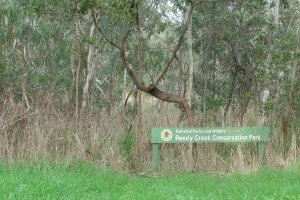
Conservation Park

Land that is protected or preserved for conserving wildlife or natural or historic features.

There are 268 of these in S.A. that cover an area of 5,859,256 hectares (6.0% of the State).
IMGA0061

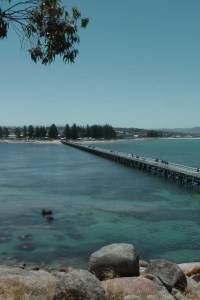
Recreation Park

Land that is conserved and managed for public recreation and enjoyment.

There are a total of 14 recreation parks, covering an area of 3,204 hectares (<0.1% of the State).  Some examples of this type of Park are the Para Wirra Recreation Park, and Granite Island Recreation Park.
IMGA0068

Game Reserve

Land that is preserved for the conservation of wildlife and management of game.

There are 10 of these covering an area of about 25,888 hectares (<0.1% of the State).  A few examples of this type of park are Tolderol Game Reserve and Currency Creek Game Reserve.  Duck open season applies to these Reserves.

For more information on Game Reserves, have a look at…..

http://www.environment.sa.gov.au/managing-natural-resources/plants-and-animals/Abundant_species/2014-duck-quail-open-season/game-reserves

Regional Reserve

Land that is protected or preserved for conserving wildlife or natural or historic features while, at the same time, permitting the utilisation of natural resources.

There are 7 of these covering an area of 9,342,641 hectares (9.5% of the State).  An example of this is the Chowilla Regional Reserve near Renmark which comprises 75,036 hectares.

For more information on Regional Reserves, please have a look at…..

http://www.environment.sa.gov.au/managing-natural-resources/Park_management/Regional_reserves

Wilderness Protection Area

Land that is protected to conserve ecosystems that have not been affected, or have been affected to only a minor extent, by modern technology; and ecosystems that have not been seriously affected by modern exotic animals or plants or other exotic organisms.

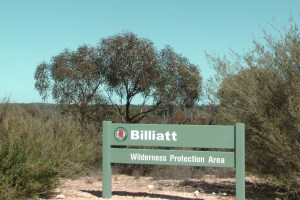
There are 14 of these, covering an area of 1,842,071 hectares (1.9 % of the State).  An example of this type of park is the Billiatt Wilderness Protection Area, which was decimated by fire last Summer.

For more information on Wilderness Protection Areas, please have a look at…..

http://www.environment.sa.gov.au/managing-natural-resources/Park_management/Wilderness_protection_in_South_Australia
IMGA0091

Conservation Reserve

Crown land that is specifically managed for conservation by the Government.

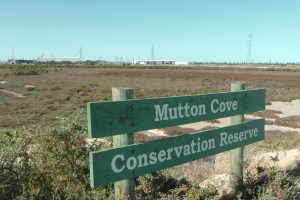
There are 16 of these covering an area of 19,480 hectares(<0.1% of the State).  An example of this type of park is the Mutton Cove Conservation Park on the Le Fevre Peninsula.  Which by the way, I activated earlier in the year, believing it was a Conservation park.  Not so!
IMGA0017 2

Native Forest Reserve

Managed for native flora and fauna conservation.

There are 61 of these, covering an area of 16,050 hectares.  Examples of this type of park are Mount Crawford Forest, Kuipto Forest and Wirrabara Forest.

Many of these parks have Adopted Management Plans, which contain relevant management issues for each specific park.  When those plans are in the preparation stage, the DEWNR provides the public and stakeholders the opportunity to become involved in the planning process.  DEWNR place advertisements in The Advertiser and in local newspapers, where they call for suggestions on issues relevant to the management of a specific park.  For more information on these plans, please have a look at…..

http://www.environment.sa.gov.au/managing-natural-resources/Park_management/Management_plans/Adopted_management_plans

Remember, that ONLY National Parks and Conservation Parks qualify for the VK5 National and Conservation parks award.

New parks

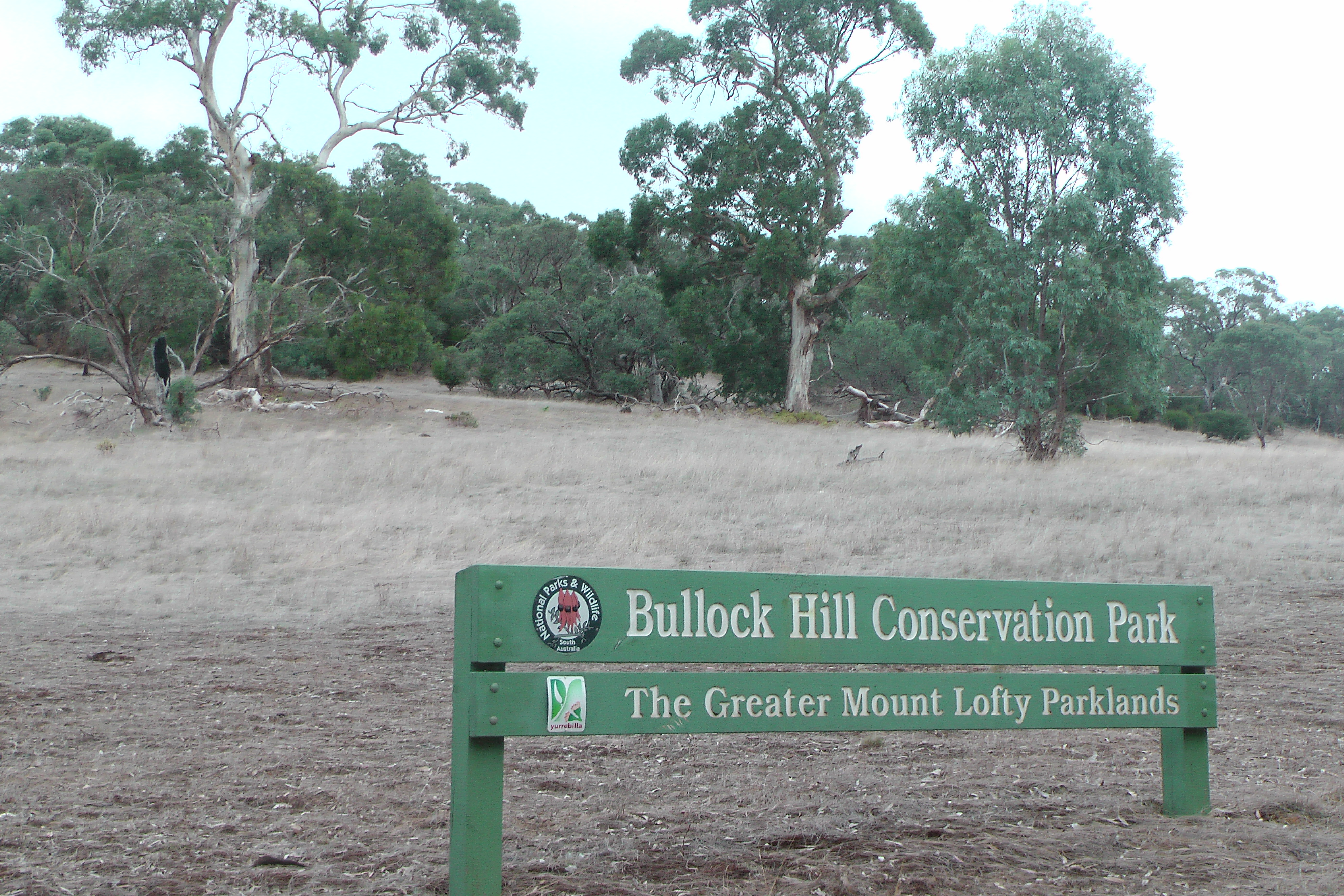
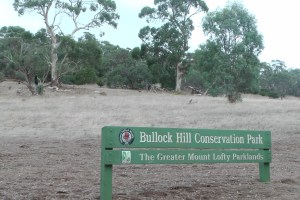
Since the inception of the VK5 National and Conservation parks Award, there has been a total of 6 Conservation Parks established/gazetted.  These have been added to the VK5 Parks award list.  Some of these have been activated including the Bullock Hill Conservation Park and the Ettrick Conservation Park.  The DEWNR website records recent additions to park boundaries which is worth having a look at…..

http://www.environment.sa.gov.au/managing-natural-resources/Park_management/Parks_boundaries
IMGA0017

Regions

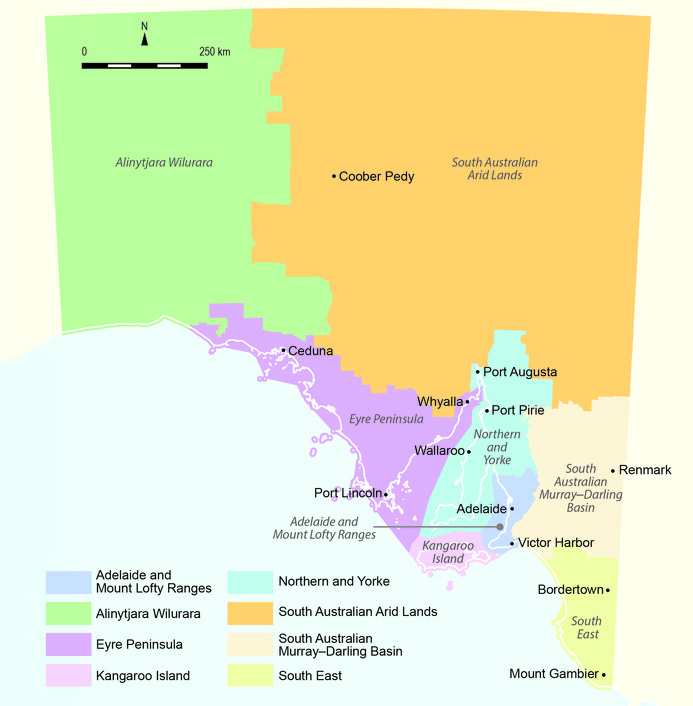
The State of South Australia is currently divided into 8 different natural resource management regions.  They are as follows:

  1. Adelaide and Mount Lofty Ranges
  2. Alinytjara Wilurara
  3. Eyre Peninusla
  4. Kangaroo Island
  5. Northern and Yorke
  6. South Australian Arid Lands
  7. South Australian Murray-Darling Basin
  8. South East

This is a new group of regions which commenced in about July, 2013, after the inception of the VK5 Parks Award.  The seven old regions were as follows:

  1. Adelaide
  2. Kangaroo Island
  3. Murraylands
  4. Northern and Yorke
  5. Outback
  6. South East
  7. West

SOESA-02-Fig2.3-04(23July)-01_fmt

Map courtesy of http://www.epa.sa.gov.au

The largest region is the SA Arid Lands region which covers over half of South Australia and encompasses the state’s north-east corner to its borders with NSW, Queensland, and the Northern Territory.  It is more than 400,000 square km in size.  This is followed by Alinytjara Wiluara (meaning ‘north west’ in Pitjantjatjara) which covers the north west third of South Australia and is more than 250,000 square km in size.

In turn those Regions are broken up into Districts. The 21 National Parks and 268 Conservation Parks in South Australia re located within those regions and Districts.

Please note that the regions referred to on the National Parks website, are totally different regions as mentioned above.

See the link below…..

http://www.environment.sa.gov.au/parks/Find_a_park/Browse_by_region The regions referred to at that link are geographical regions and not administrative regions.

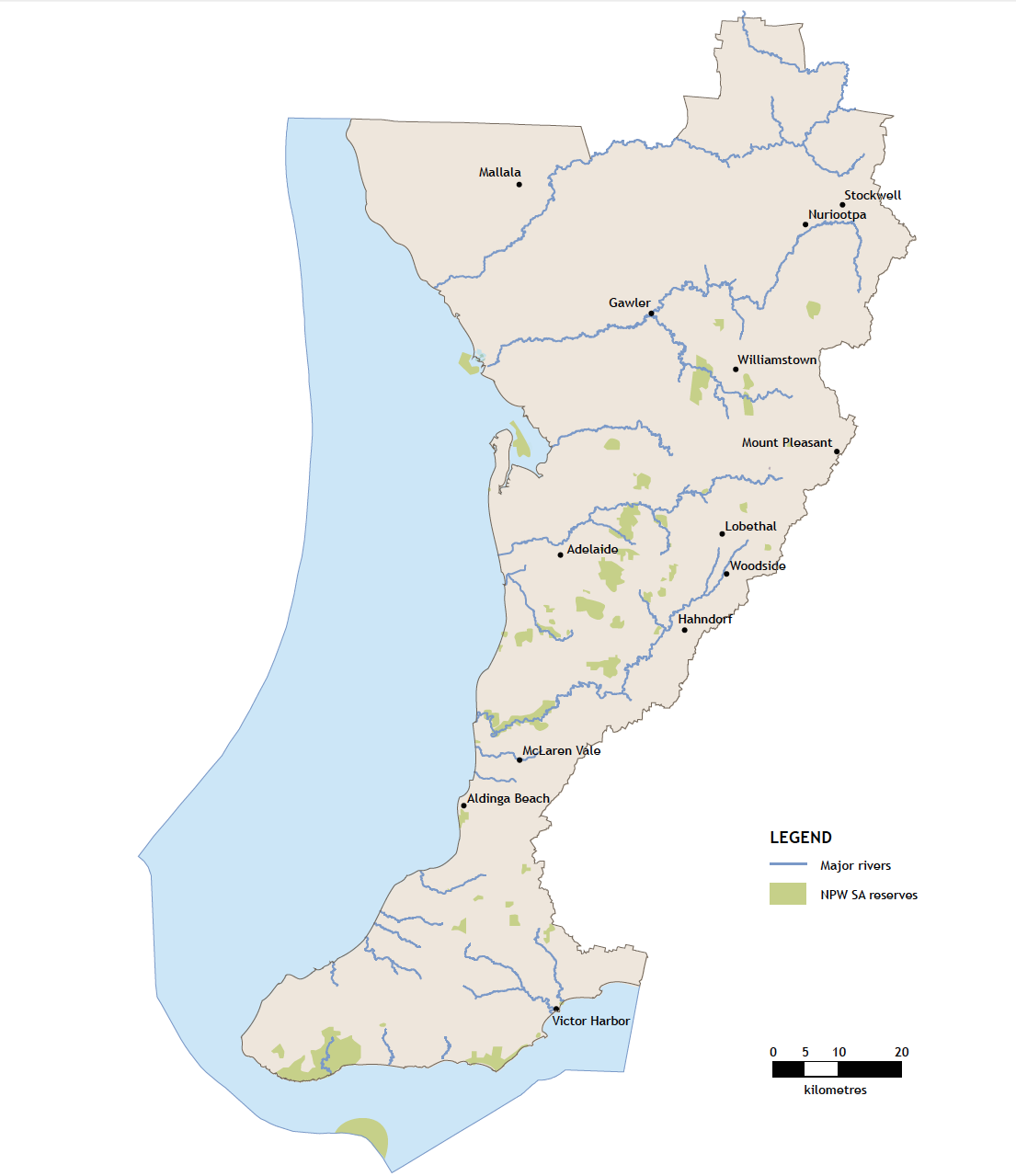
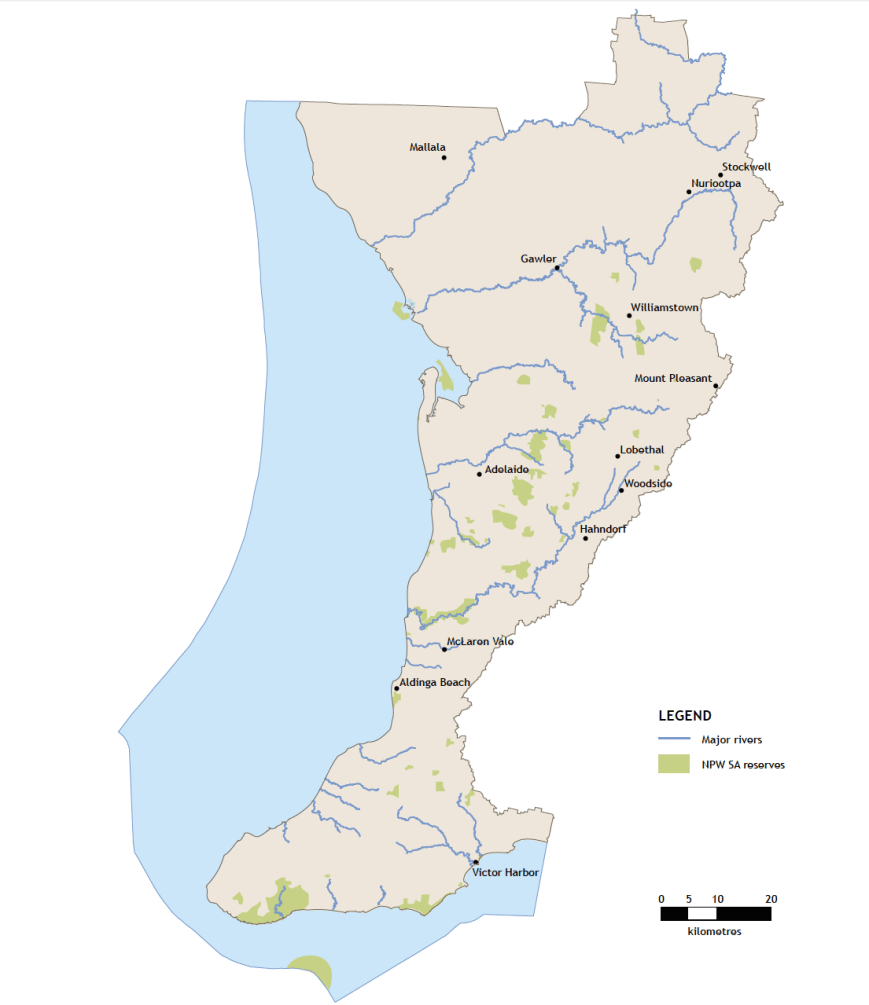
Adelaide & Mount Lofty Ranges Region.

This region covers 6,581 sq km of land, 4,627 sq km of sea, and has 364 km of coastline.  It supports 1.2 million people which equates to 80 % of South Australia’s population.  The northern boundary of this Region incorporates the whole of the Light Regional Council, the District of Mallala and the Barossa Council.  The region stretches south to Cape Jervis on the southern tip of the Fleurieu Peninusla, from the ridge of the Mount Lofty Ranges to 35 km into Gulf St Vincent.  The coastline of this region encompasses the District Council of Mallala in the north to Middleton Beach in the south in the Distrct Council of Alexandrina.

The area is divided into the following 3 districts:

  1. Adelaide & Central Hills
  2. Northern Hills Coasts & Plains
  3. Fleurieu & Willunga Basin

This region was previously known as Adelaide region, and consisted of the Fleurieu, Northern Lofty, and Southern Lofty districts.

There are a total of 46 parks in this region, comprising of 2 National Parks, and 44 Conservation Parks.  They are as follows:

  1. Aldinga Scrub CP
  2. Angove CP
  3. Belair NP.
  4. Black Hill CP
  5. Charleston CP
  6. Cleland CP
  7. Cromer CP
  8. Cudlee Creek CP
  9. Deep Creek CP
  10. Eric Bonython CP
  11. Eurilia CP
  12. Ferguson CP
  13. Fort Glanville CP
  14. Giles CP
  15. Gum Tree Gully CP
  16. Hale CP
  17. Hallett Cove CP
  18. Horsnell Gully CP
  19. Kaisterstuhl CP
  20. Kenneth Stirling CP
  21. Marino CP
  22. Mark Oliphant CP
  23. Moana Sands CP
  24. Montacute CP
  25. Morialta CP
  26. Mount Billy CP
  27. Mount George CP
  28. Mylor CP
  29. Myponga CP
  30. Newland Head CP
  31. Nixon Skinner CP
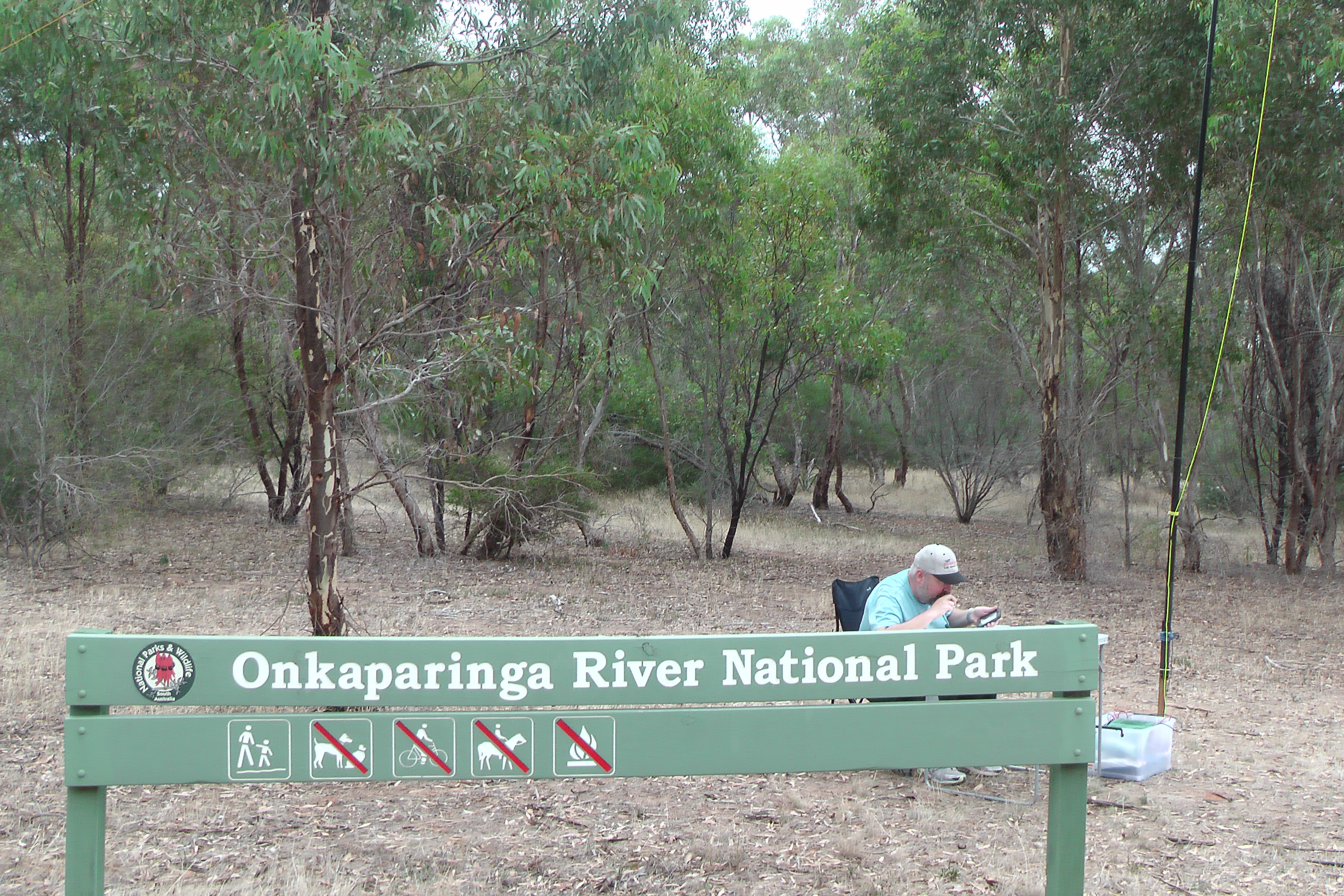
  32. Onkaparinga River NP.
  33. Port Gawler CP
  34. Porter Scrub CP
  35. Pullen Island CP
  36. Sandy Creek CP
  37. Scott Creek CP
  38. Spring Mount CP
  39. Stipturus CP
  40. Talisker CP
  41. The Knoll CP
  42. Torrens Island CP
  43. Waitpinga CP
  44. Warren CP
  45. West Island CP
  46. Yulte CP

A total of 5 parks that previously came within this Region in the old Fleurieu district, are now located in the Ranges to River District of the South Australian Murray-Darling Basin Region.  They are:

  • Bullock Hill CP
  • Finnis CP
  • Hesperilla CP
  • Mount Magnificent CP
  • Scott CP

DEWNR offices for this region exist at Eastwood, Lobethal, Gawler, Willunga, and Victor Harbour.
Screenshot 2014-06-19 10.49.53

Map courtesy of wwww.naturalresources.sa.gov.au

The map below shows the Adelaide and Mount Lofty Ranges split into its three Districts.
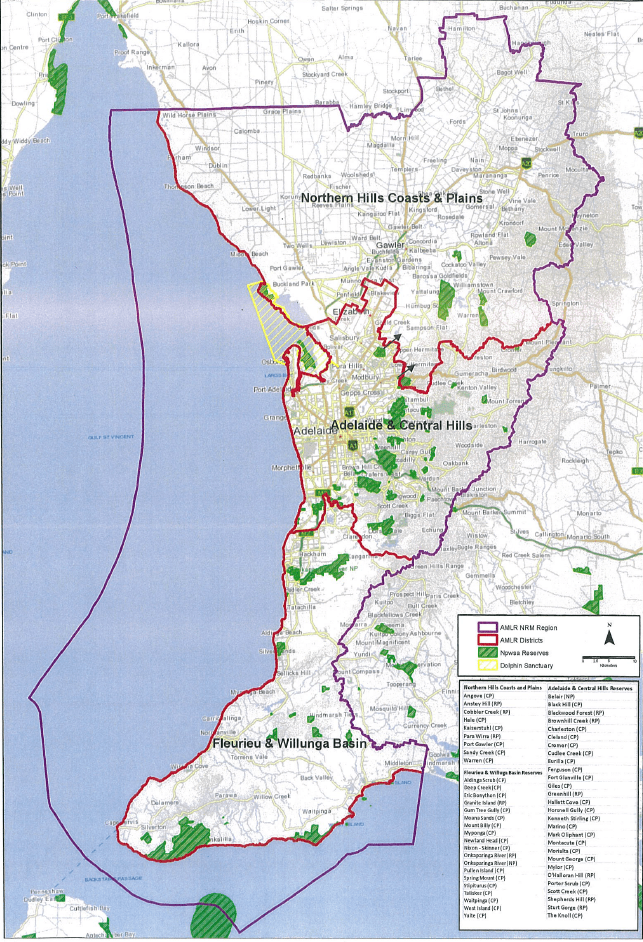
Screenshot 2014-06-19 14.35.00

Map courtesy of wwww.naturalresources.sa.gov.au

Alinytjara Wilurara

This region (meaning north west in Pitjantjatjara) covers the north west third of South Australia and is more than 250,000 square km in size.

The region is divided into the following 9 districts:

  1. Bunda Cliffs
  2. Yalata Coast
  3. Nullabor Plain
  4. Yalata Lands
  5. Yellabinna and Yumbarra
  6. Great Victoria Desert
  7. Southern APY
  8. APY Ranges
  9. Eastern APY and Tallaringa.

There iare a total of 6 parks in this region, comprising of 2 National Parks, and 4 Conservation Parks in this region. They are as follows:

  1. Great Australian Bight NP
  2. Mamungari CP
  3. Nullabor NP
  4. Pureba CP
  5. Tallaringa CP
  6. Yumbarra CP

A DEWNR office exists at Ceduna.
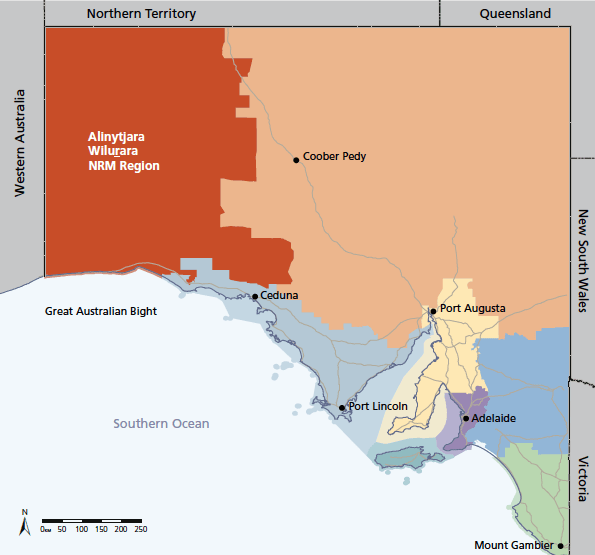
Screenshot 2014-06-19 13.14.02

Map courtesy of http://www.naturalresources.sa.gov.au

Eyre Peninsula

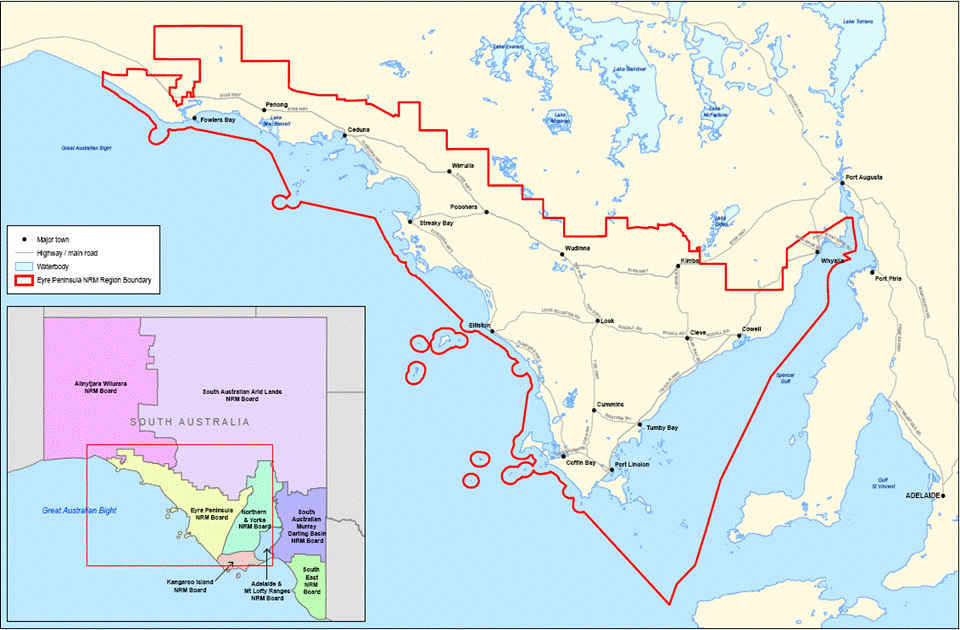
The Eyre Peninsula region covers an area of 80,000 square km or 8 million hectares.  It includes parts of the upper Spencer Gulf, the City of Whyalla, and stretches across the southern boundaries of the Gawler Ranges, beyond Ceduna to the edge of the famous Nullabor plain, and south to Port Lincoln at the southern tip of the Eyre Peninsula.

Eyre Peninsula still has 43% of natural vegetation cover intact, making it one of the highest levels of surviving native vegetation for agricultural regions in South Australia.  About 40 species of native plants are endemic to the area, with 26 plant and animal species of national conservation significance listed.

The Eyre Peninsula region includes over 1,800 km of coastline.  This represents about 33% of the entire coastline of South Australia.  The Eyre Peninsula NRM region contains over 100 different parks and reserves.

This region was previously called West region.

There are a total of 74 parks in this region, comprising of 3 National Parks, and 71 Conservation Parks.  They are as follows:

This region does not appear to be divided into Districts.

  1. Acraman Creek CP
  2. Avoid Bay Islands CP
  3. Baird Bay Islands CP
  4. Barwell CP
  5. Bascombe Well CP
  6. Boondinna CP
  7. Calpatanna Waterhole CP
  8. Cap Island CP
  9. Cape Blanche CP
  10. Caralue Bluff CP
  11. Carapee Hill CP
  12. Chadinga CP
  13. Cocata CP
  14. Coffin Bay NP
  15. Corrobinnie Hill CP
  16. Darke Range CP
  17. Eba Island CP
  18. Fowlers Bay CP
  19. Franklin Harbor CP
  20. Gambier Islands CP
  21. Gawler Ranges CP
  22. Gawler Ranges NP
  23. Greenly Island CP
  24. Heggarton CP
  25. Hincks CP
  26. Kathai CP
  27. Kellidie Bay CP
  28. Kulliparu CP
  29. Lake Gilles CP
  30. Lake Newland CP
  31. Laura Bay CP
  32. Lincoln NP
  33. Lincoln CP
  34. Lipson Island CP
  35. Malgra CP
  36. Middlecamp Hills CP
  37. Moody Tank CP
  38. Mount Dutton Bay CP
  39. Munyaroo CP
  40. Murrunatta CP
  41. Neptune Islands CP
  42. Nicholas Baudin Island CP
  43. Nuyts Archipelago CP
  44. Nuyts Reef CP
  45. Olive Island CP
  46. Peachna CP
  47. Pigface Island CP
  48. Pinkawillinie CP
  49. Point Bell CP
  50. Point Labbatt CP
  51. Rocky Island (North) CP
  52. Rocky Island (South) CP
  53. Ruddall CP
  54. Sceale Bay CP
  55. Searcy Bay CP
  56. Shannon CP
  57. Sheoak Hill CP
  58. Sinclair Island CP
  59. Sir Joseph Banks Group CP
  60. Sleaford Mere CP
  61. The Plug Range CP
  62. Tucknott Scrub CP
  63. Tumby Island CP
  64. Venus Bay CP
  65. Verran Tanks CP
  66. Wahgunyah CP
  67. Waldegrave Islands CP
  68. Wanilla CP
  69. Wanilla Land Settlement CP
  70. Wharminda CP
  71. Whidbey Isles CP
  72. Whyalla CP
  73. Wittelbee CP
  74. Yeldulknie CP

DEWNR offices for this region exist at Port Lincoln and Ceduna.
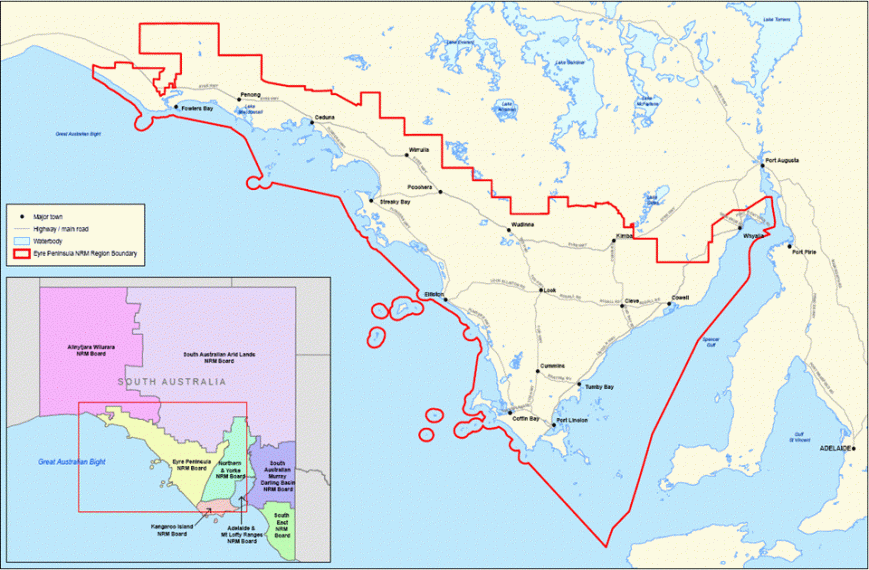
EPNRM region map

image courtesy of http://www.epnrm.sa.gov.au

Kangaroo Island

The Kangaroo Island region encompasses Kangaroo Island which is about 15 km off the coastline of the southern Fleruieu Peninsula.  The island covers an area of 4,370 square km.  Off all the South Australian agricultural regions, Kangaroo Island contains the highest proportion of remnant vegetation.  In fact, about 40% of the island is taken up by native vegetation.

The Kangaroo Island Region only contains one district.  And that is Kangaroo Island.

There is a total of 22 parks in this region, comprising 1 National Park, and 21 Conservation Parks. They are as follows:

  1. Baudin CP
  2. Beatrice Islet CP
  3. Beyeria CP
  4. Busby Islet CP
  5. Cape Gantheaume CP
  6. Cape Willoughby CP
  7. Cygnet Estuary CP
  8. Dudley CP
  9. Flinders Chase NP
  10. Kelly Hill CP
  11. Lashmar CP
  12. Lathami CP
  13. Lesueur CP
  14. Mount Taylor CP
  15. Nepean Bay CP
  16. Parndana CP
  17. Pelican Lagoon CP
  18. Seal Bay CP
  19. Seddon CP
  20. Simpson CP
  21. The Pages CP
  22. Vivonne Bay CP

A DEWNR office for this region exists at Kingscote.
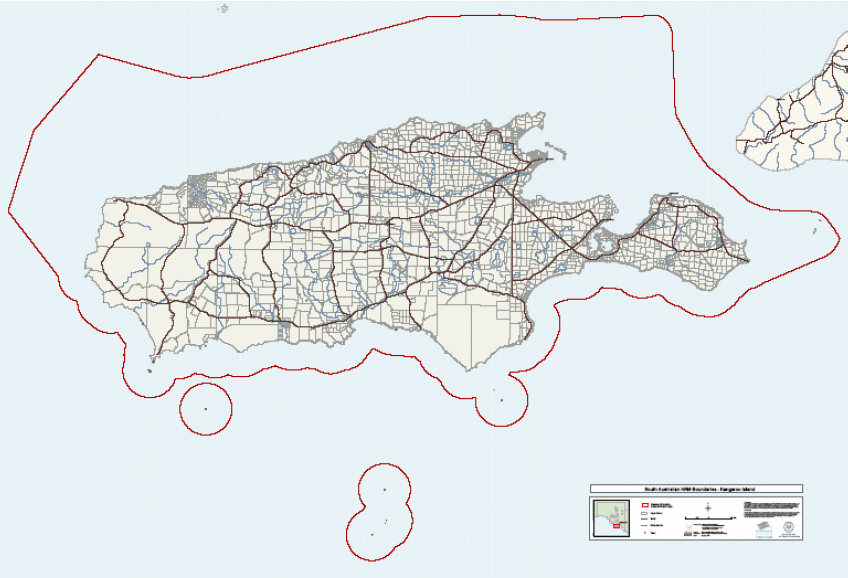
Screenshot 2014-06-18 23.05.02

Image courtesy of Kangaroo Island NRM Plan 2009 

Northern and Yorke

The Northern and Yorke region totals 34,500 square km or more than 3 million hectares.  It encompasses the Yorke Peninsula, the northern Mount Lofty Ranges, the southern Flinders Ranges, and significant areas of Spencer Gulf and Gulf St Vincent.

This region is divided into three districts as follows:

  • Upper North
  • Lower North
  • Yorke Peninsula

There are a total of 24 parks in this region, comprising of 2 National Parks, and 22 Conservation Parks. They are as follows:

  1. Althorpe Islands CP
  2. Bird Islands CP
  3. Black Rock CP
  4. Carribie CP
  5. Clements Gap CP
  6. Clinton CP
  7. Goose Island CP
  8. Innes NP.
  9. Leven Beach CP
  10. Martindale Hall CP
  11. Minlacowie CP
  12. Mount Brown CP
  13. Mount Remarkable NP.
  14. Mount Brown CP
  15. Point Davenport CP
  16. Ramsay CP
  17. Spring Gully CP
  18. Telowie Gorge CP
  19. The Dutchmans Stern CP
  20. Troubridge Island CP
  21. Warrenben CP
  22. Wills Creek CP
  23. Winninowie CP
  24. Yalpara CP

A DEWNR for this region office exists at Clare.
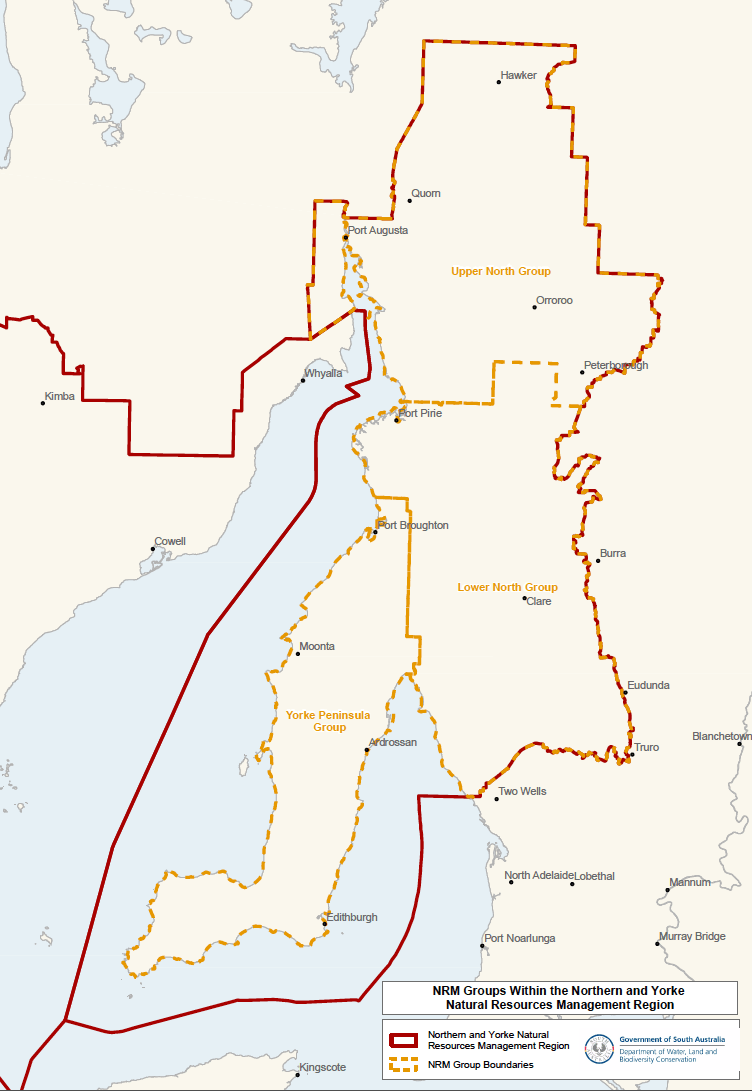
Screenshot 2014-06-18 23.08.44

Image courtesy of http://www.naturalresources.sa.gov.au

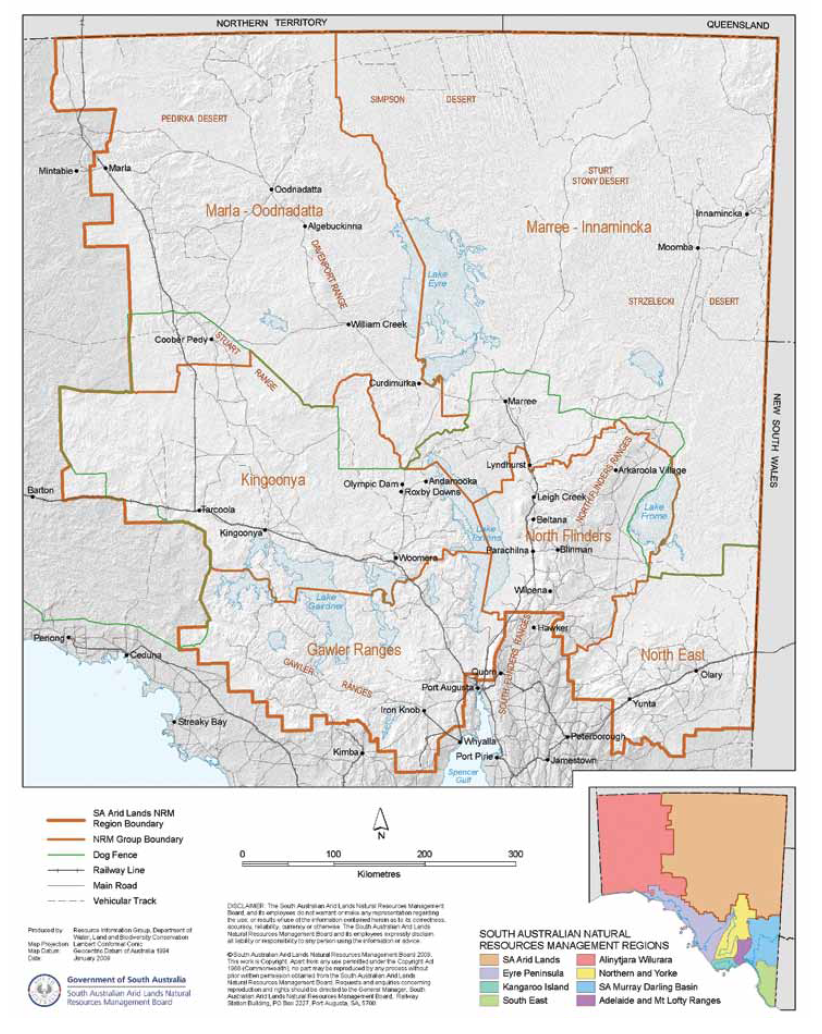
South Australian Arid Lands

This area covers over half of South Australia and takes up the state’s north east corner to its borders with New South Wales, Queensland, and the Northern Territory.  The population within this semi arid region comprises less than 2% of the State’s entire population.

This region is divided into the following 6 districts:

  • Gawler Ranges
  • Kingoonya
  • Marla-Oodnadatta
  • Marree-Innamincka
  • North Flinders
  • North East

There are a total of 15 parks in this region, comprising of 7 National Parks, and 8 Conservation Parks in this region. They are as follows:

  1. Bimbowrie CP
  2. Breakaways CP
  3. Coongie Lakes NP.
  4. Ediacara CP
  5. Elliott Price CP
  6. Flinders Ranges NP.
  7. Ironstone Hill CP
  8. Kati Thanda-Lake Eyre NP
  9. Lake Gairdner NP
  10. Lake Torrens NP
  11. Pualco Range CP
  12. Simpson Desert CP
  13. Vulkathunha-Gammon Ranges NP
  14. Wabma Kadarbu Mound Springs CP
  15. Witjira NP

A DEWNR office exists at Port Augusta.
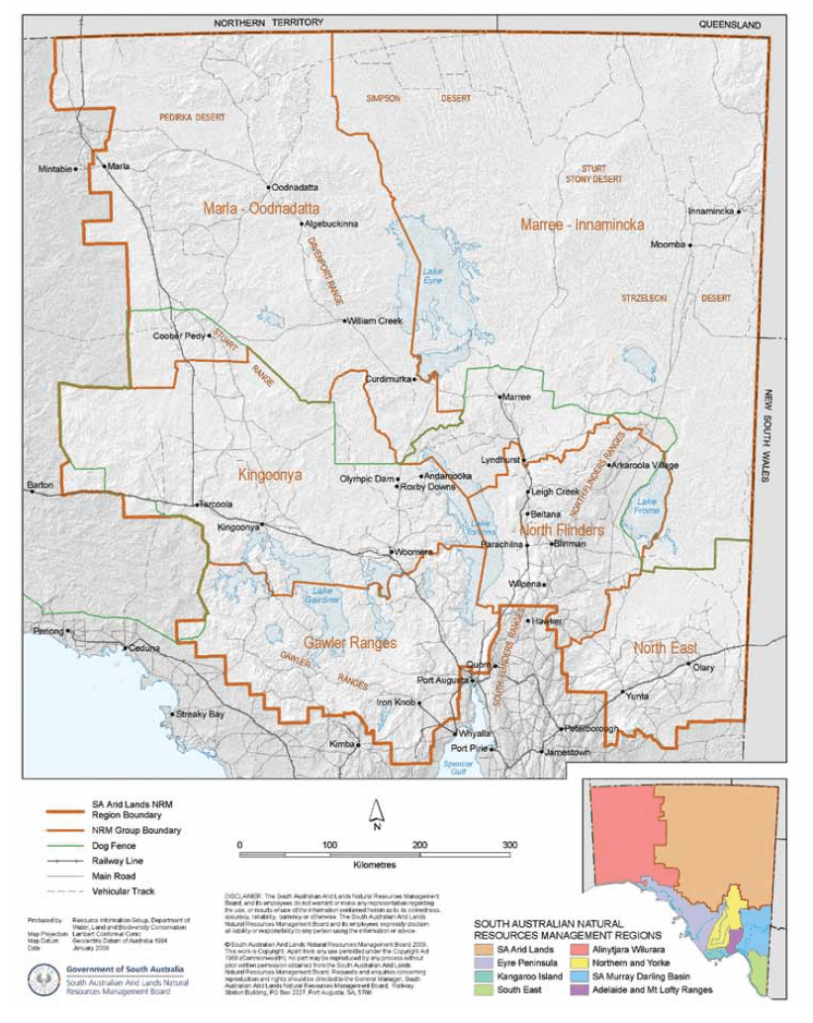
Screenshot 2014-06-19 11.37.58

Map courtesy of http://www.naturalresources.sa.gov.au

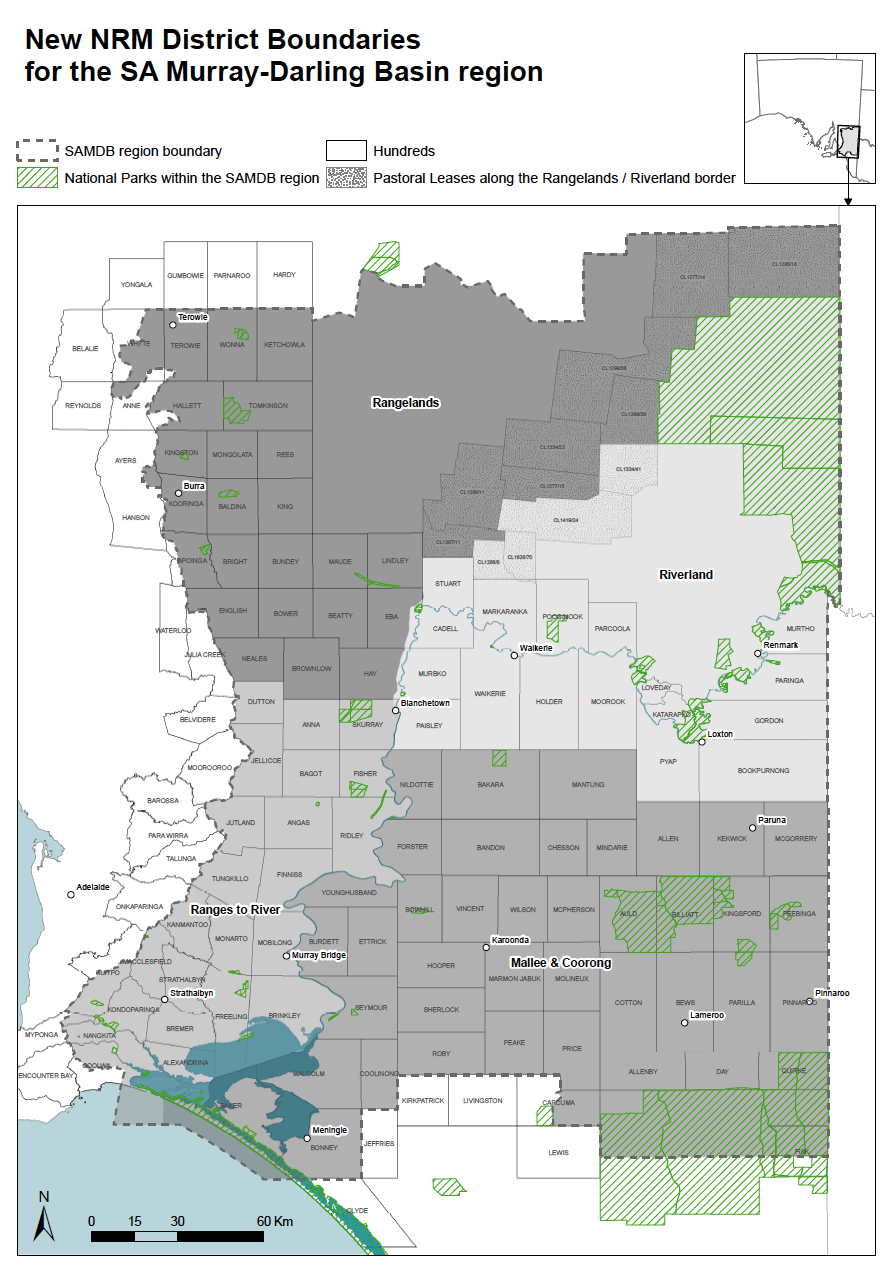
South Australian Murray-Darling Basin

The SA Murray-Darlling Basin region extends from where the mighty Murray River crosses the South Australian/Victorian border, down to where the Murray meets the sea at the Coorong.  The region covers 70,000 square km.

This region was previously known as Murraylands and contained a number of parks that were in the old Adelaide area, e.g. Kyeema Conservation Park and parks that were in the old Northern & Yorke region including Mkotoa CP and Red Banks CP.

The region is divided into the following 4 districts:

  • Rangelands
  • Ranges to River
  • Riverland
  • Mallee & Coorong

There are a total of 46 parks in this region, comprising 2 National Parks, and 44 Conservation Parks. They are as follows:

  1. Bakara CP
  2. Bandon CP
  3. Billiatt CP
  4. Brookfield CP
  5. Bullock Hill CP
  6. Carcuma CP
  7. Caroona Creek CP
  8. Cooltong CP
  9. Coorong NP
  10. Cox Scrub CP
  11. Danggali CP
  12. Ettrick CP
  13. Ferries McDonald CP
  14. Finnis CP
  15. Hesperilla CP
  16. Hogwash Bend CP
  17. Hopkins Creek CP
  18. Kapunda Island CP
  19. Karte CP
  20. Kyeema CP
  21. Lowan CP
  22. Maize Island CP
  23. Marne Valley CP
  24. Media Island CP
  25. Mokota CP
  26. Monarto CP
  27. Morgan CP
  28. Mount Magnificent CP
  29. Mowantjie Willauwar CP
  30. Murray River NP
  31. Ngarkat CP
  32. Ngaut Ngaut CP
  33. Pandappa CP
  34. Peebinga CP
  35. Pike River CP
  36. Pooginook CP
  37. Poonthie Ruwe CP
  38. Ramco Point CP
  39. Red Banks CP
  40. Ridley CP
  41. Rilli Island CP
  42. Roonka CP
  43. Salt Lagoon Islands CP
  44. Scott CP
  45. Swan Reach CP
  46. White Dam CP

DEWNR offices exist at Murray Bridge and Berri.
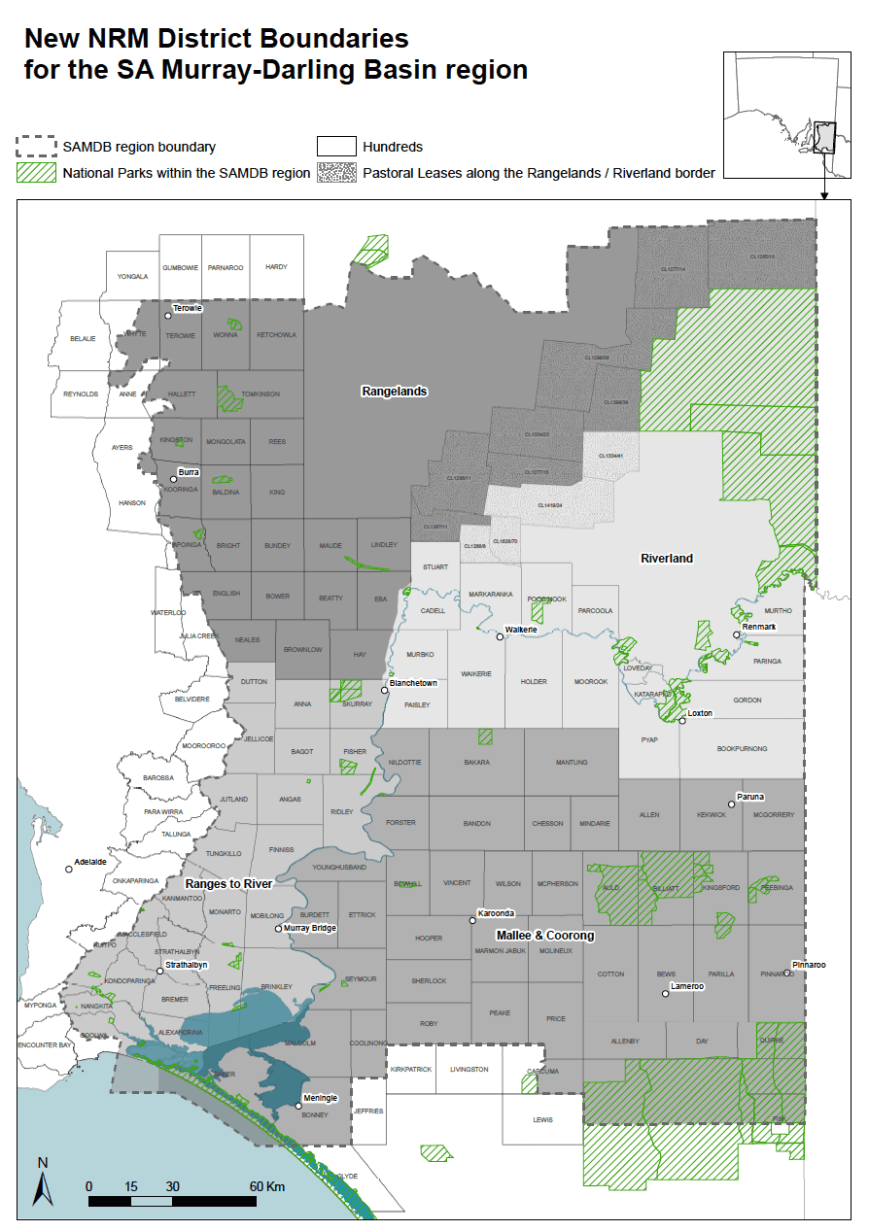
Screenshot 2014-06-18 23.18.03

South East

The South East region covers an area of about 28,000 square km.  It is bounded by the Victorian border to the east, the Southern Ocean to the south, and the Coorong to the west.

The region has three Districts:

  • Southern
  • Central
  • Northern.

Three parks in this region overlap with the SA Murray-Darlling Basin.  They are: Carcuma Conservation Park, Coorong Conservation Park, and Ngarkat Conservation Park.

There are a total of 57 parks in the South East region, comprising 2 National Parks, and 55 Conservation Parks. They are as follows:

  1. Aberdour CP
  2. Bangham
  3. Baudin Rocks
  4. Beachport
  5. Belt Hill
  6. Big Heath
  7. Butcher Gap CP
  8. Calectasia CP
  9. Canunda NP
  10. Carpenter Rocks CP
  11. Christmas Rocks CP
  12. Custon CP
  13. Desert Camp CP
  14. Dingley Dell CP
  15. Douglas Point CP
  16. Ewens Ponds CP
  17. Fairview CP
  18. Furner CP
  19. Geegeela CP
  20. Glen Roy CP
  21. Gower CP
  22. Grass Tree CP
  23. Guichen Bay CP
  24. Gum Lagoon CP
  25. Hacks Lagoon CP
  26. Hanson Scrub CP
  27. Jip Jip CP
  28. Kelvin Powrie CP
  29. Kungari CP
  30. Lake Frome CP
  31. Lake Hawdon South CP
  32. Lake St Clair CP
  33. Little Dip CP
  34. Lower Glenelg River CP
  35. Martin Washpool CP
  36. Mary Seymour CP
  37. Messent CP
  38. Mount Boothby CP
  39. Mount Monster CP
  40. Mount Scott CP
  41. Mullinger Swamp CP
  42. Narracoorte Caves NP
  43. Nene Valley CP
  44. Padthaway CP
  45. Penambol CP
  46. Penguin Island CP
  47. Penola CP
  48. Piccaninnie Ponds CP
  49. Pine Hill Soak CP
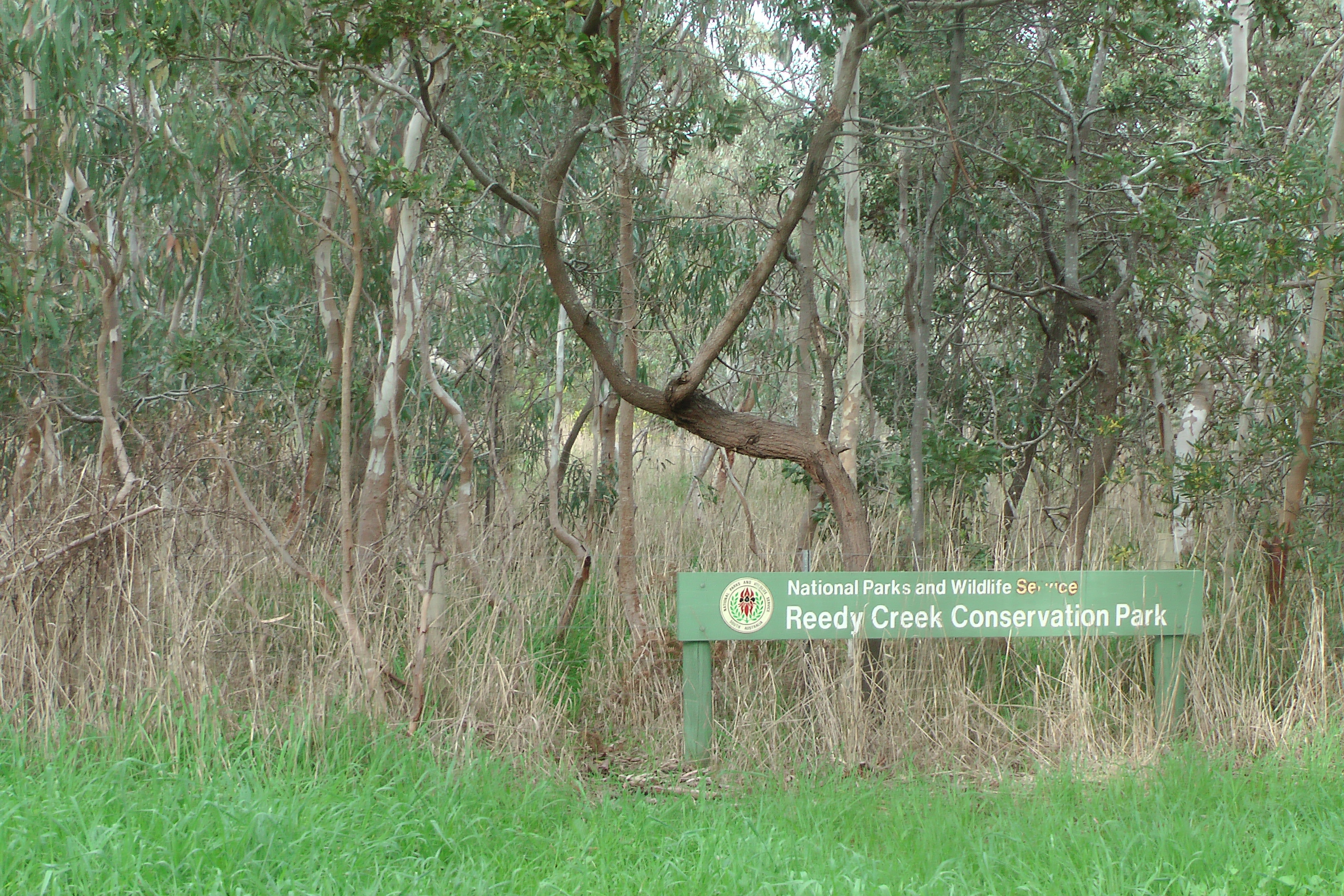
  50. Reedy Creek CP
  51. Talapar CP
  52. Tantanoola Caves CP
  53. Telford Scrub CP
  54. Tilley Swamp CP
  55. Vivigani Ardune CP
  56. Woakwine CP
  57. Wolsley Common CP

A DEWNR office exists at Mount Gambier.
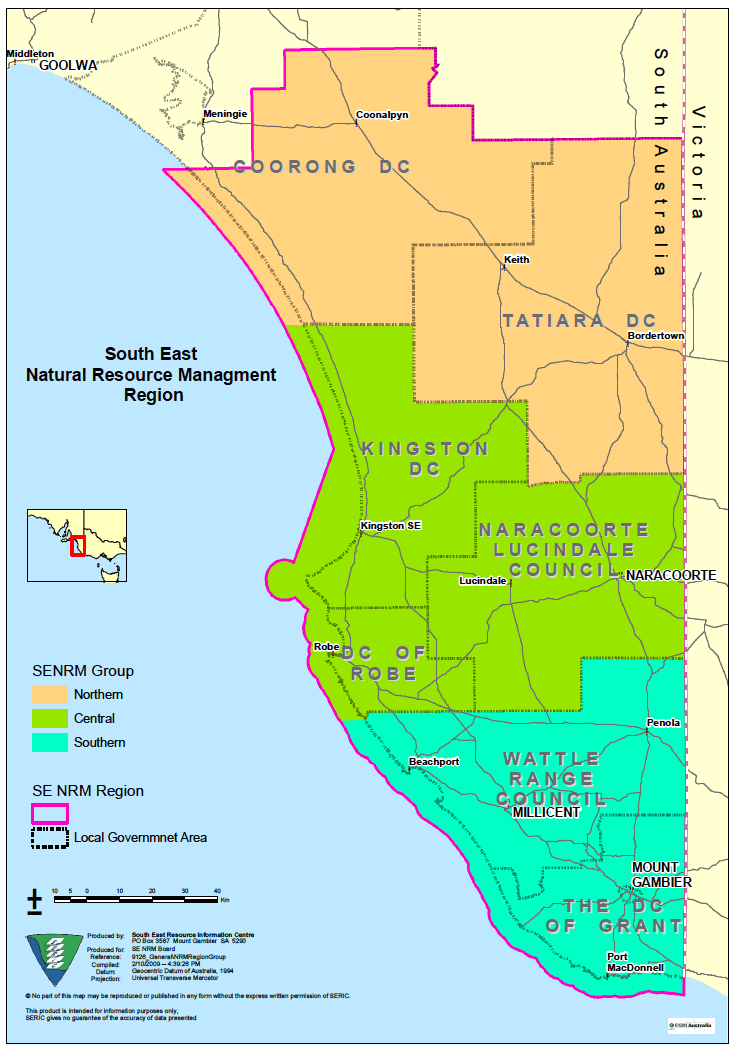
Screenshot 2014-06-18 23.24.30

Image courtesy of http://www.senrm.sa.gov.au

In summary.

So there you go.  I have probably completely confused you.  But I do hope it has shed some light on the parks system here in South Australia.

Finally, do not rely on all the information that you find on some of the ‘official’ websites on the internet.  I have found some of them to be incomplete.  For example I found a total of 20 Conservation Parks in the Adelaide & Mt Lofty Ranges District that were not recorded on the list on the NRM website for that Region.

Also, do not rely on Google maps.  It does not show up all of the Conservation Parks  Try using one of the following…..

http://mapcarta.com http://www.naturemaps.sa.gov.au

http://www.environment.sa.gov.au/haveyoursay/fire-management-assessment

For more information on parks in South Australia, please see the National Parks South Australia website at…..

http://www.environment.sa.gov.au/parks/Home

Or the Natural Resources website at…..

http://www.naturalresources.sa.gov.au/home

National Parks South Australia also has a Facebook site should you be interested…..

https://www.facebook.com/ParksSA/info

They also have an app called My Parx, which I will review in an upcoming post.

http://www.environment.sa.gov.au/marineparks/home/media/articles/130201-my-parx

Resources.

Department of Environment, Water and Natural Resources, http://www.environment.sa.gov.au/Home Natural Resources, http://www.epa.sa.gov.au/soe_2013/main/intro-overview-of-south.html

WorldWide Flora and Fauna (WWFF)

This blog is just a quick reminder to all about the…..
World Wide Flora & Fauna (WWFF) program.

The WWFF program encourages portable operation from designated nature parks and protected nature areas around the world.  There are currently 39 participating countries in the WWFF program, in Europe, North America, South America, Africa, Asia, & Oceania.

Logo WWFF 9xa1_2a copy

The WWFF program commenced in late 2012, after being re-named and ‘rebadged’.  It was previously known as World Flora Fauna (WFF).  The Australian (VKFF) program commenced in March, 2013.  I am the Australian co-ordinator.

In Australia, the qualifying areas for WWFF are National Parks.  There are currently over 730 National Parks recorded on the Australian (VKFF) list, so there is certainly no shortage of available parks here in Australia.  Over 100  parks were added to the VKFF list earlier this year.  These parks had initially been left off the original list compiled at the commencement of the WFF program.

Slide1 copy

More information on the WWFF program can be located at the WWFF global website at…..

http://www.wwff.co

And for information on the Australian (VKFF) program, please have a look at…..

http://www.wwffaustralia.com

What parks can you activate in Australia?

As mentioned, qualifying parks in Australia are National Parks.  You can view a list of all qualifying Australian National Parks on the VKFF website mentioned above.  You can also download a list from there as well.  Or you can download the entire WWFF Directory from the global WWFF website.  This will show you all qualifying parks around the world.

Please note, that only Australian National Parks established and gazetted before 2008 qualify at this stage.  As more parks are activated, I will be allowed to add the newly established parks.

What do you need to do to qualify a park?

There are two distinct areas in WWFF.  They are the global rules and awards system, and then there is the relevant National rules and awards system.

Why two systems?  Some countries do not have National representation.  However, this does not preclude amateurs from activating designated parks that appear in the WWFF Directory, that are located in those countries.  So in those instances the global WWFF rules and apply.  Basically this means that you require 44 QSOs over a 2 hour operating period.  This can be accumulative.  The WWFF global council, of which I am on, offer WWFF global awards.

However, some countries have National representation and have their own National rules and offer their own National awards.  This is the case with the Australian (VKFF) program.  To qualify an Australian National Park for the VKFF program, you only need 10 QSOs over a 30 minute activation period.  Again, this can be accumulated.

Sof if you are lucky enough to operate for 2 hours (includes establishing the station) and get your 44 + QSOs, then not only have you qualified the park under the global rules, but you have certainly well and truly activated the park under the VKFF rules.  The bonus is that you are well on your way to at least 2 different award certificates…a global one, and also a VKFF National certificate.

So once you’ve activated a qualifying National Park, what do you need to do?

You need to send me a copy of your activator log in either ADIF format or by using the csv file template (mentioned below).  The log will then be uploaded to the WWFF LogSearch.  Please send the log to my email address at…..

simmopa@iprimus.com.au

What do you need to do as a park Hunter?

The answer is nothing.  Unlike some other programs, you do not need to have anything uploaded to LogSearch if you are a Hunter.

So what is LogSearch?

A pivotal part of the WWFF program is the LogSearch facility, which enables activators to have their logs uploaded electronically by WWFF National co-ordinators.  Through LogSearch, WWFF Activators and Hunters can view their progress in the WWFF program, and apply for awards on line.

banner

There are currently 3,890,424 QSOs in the LogSearch database, from 5,255 different references in 80 DXCCs.  It is a big data base!

LogSearch can be found at…..

http://logsearch.wwff.co/index.php

For more information on LogSearch and its features, you will find a file in the FILES section of the WWFF Australia Yahoo group.  The file is called ‘What is WWFF LogSearch?’ which I compiled on 27th March, 2014.  It explains LogSearch in full and is a good reference.

How do I send a log?

I need an ADIF file of your activation.

Or you can send your activation log to me as a csv file.

Option 1.  ADIF.

ADIF stands for Amateur Data Interchange Format.  ADIF is an open standard for exchange of data between ham radio software packages available from different vendors.

If you submit an ADIF file for upload to the LogSearch facility, please see the required information below…..

Required

o DATE
o BAND
o MODE
o CALL Hunter call-sign

Optional

o TIME_ON Not used
o STATION_CALLSIGN Activator station call-sign used on the air
o OPERATOR Activator operator’s personal home-call
o MY_SIG Reference eg VKFF-xxx

Option 2.  csv file

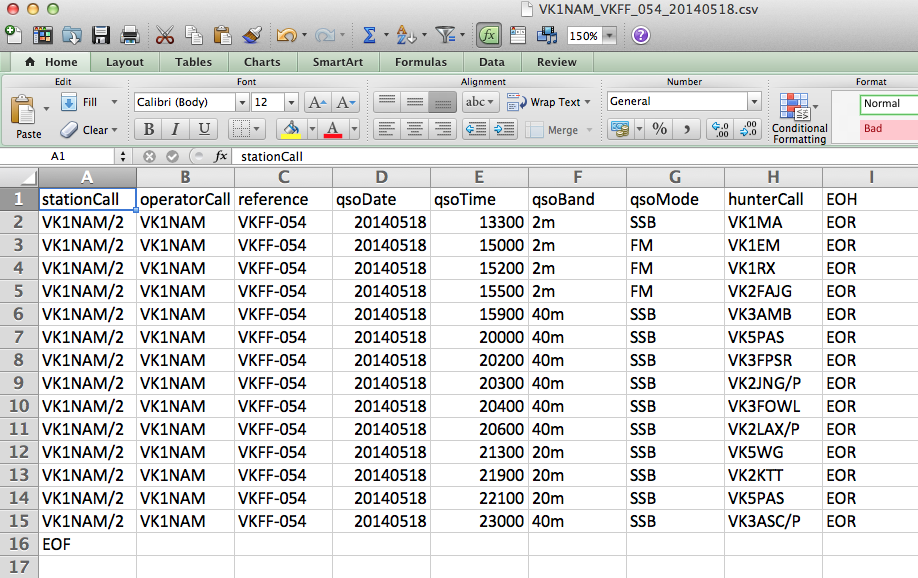
If you do not run an electronic log, then the second option is to send me a csv file (comma-separated value, or sometimes called character-separated value).  All csv files are supported by all spreadsheet programs such as Excel, OpenOffice, Google Docs spreadsheets, etc.

Andrew 2E0GFF (formerly M6ADB) has placed a template Excel file in the FILES section of the WWFF Australia Yahoo group, that can be used to submit for LogSearch.  It needs to be saved as a csv file prior to sending it to me for upload.  A single log file can be used for multiple activities/references!

You may see some abbreviations in the Excel file.

EOH = End of Header

EOR = End of Row

EOF = End of File.

Screenshot 2014-06-23 17.00.53


WWFF global awards.

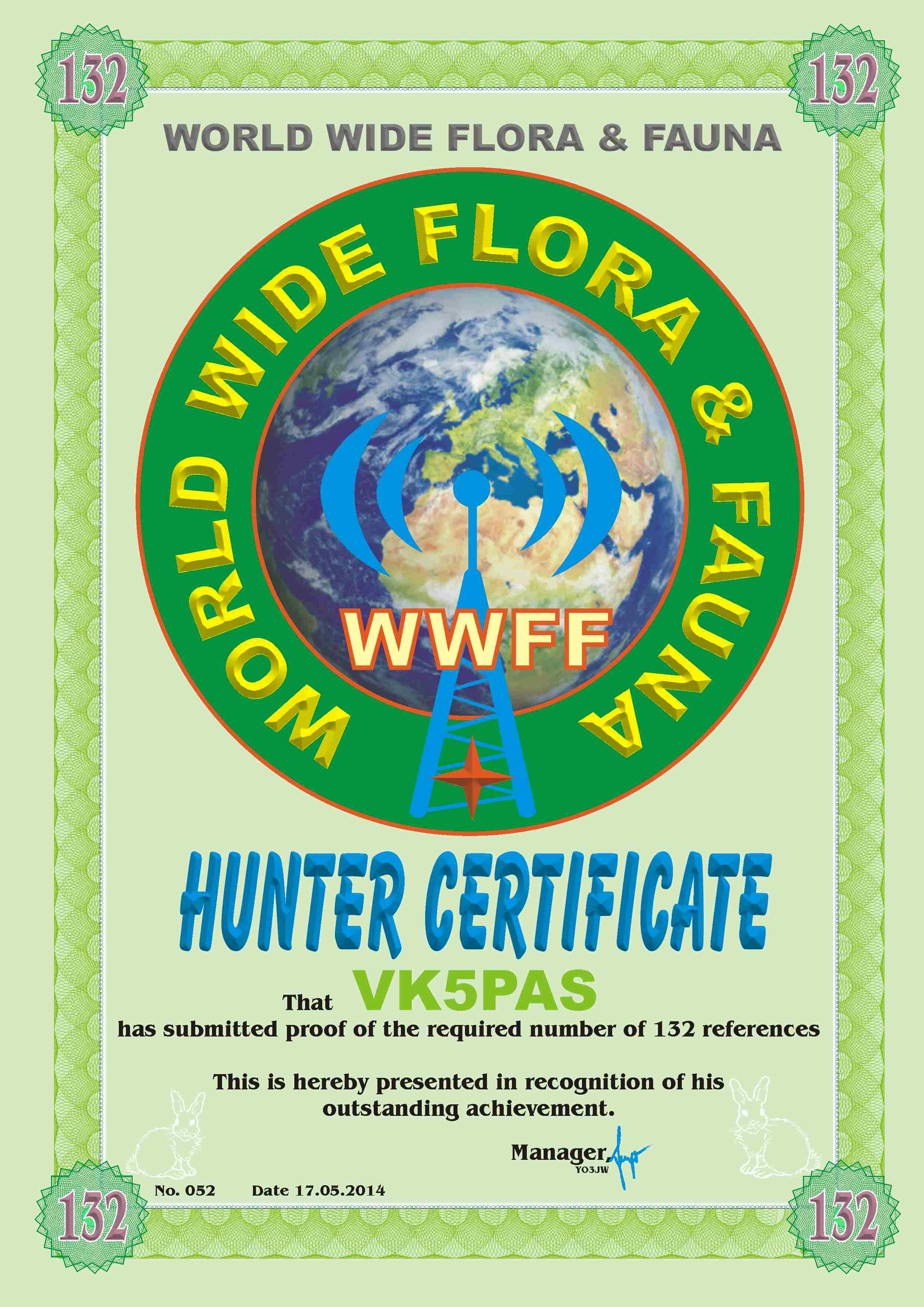
As mentioned, the WWFF global council offers ‘global’ awards.  These are available for FREE as a PDF files via the WWFF LogSearch facility.  For more information on these awards, please see the WWFF global website.

H 132 VK5PAS 2014 532

The WWFF global team have also recently initiated some new awards and there are others on the drawing board.  Again, further information on these awards can be found on the website.

Other National awards.

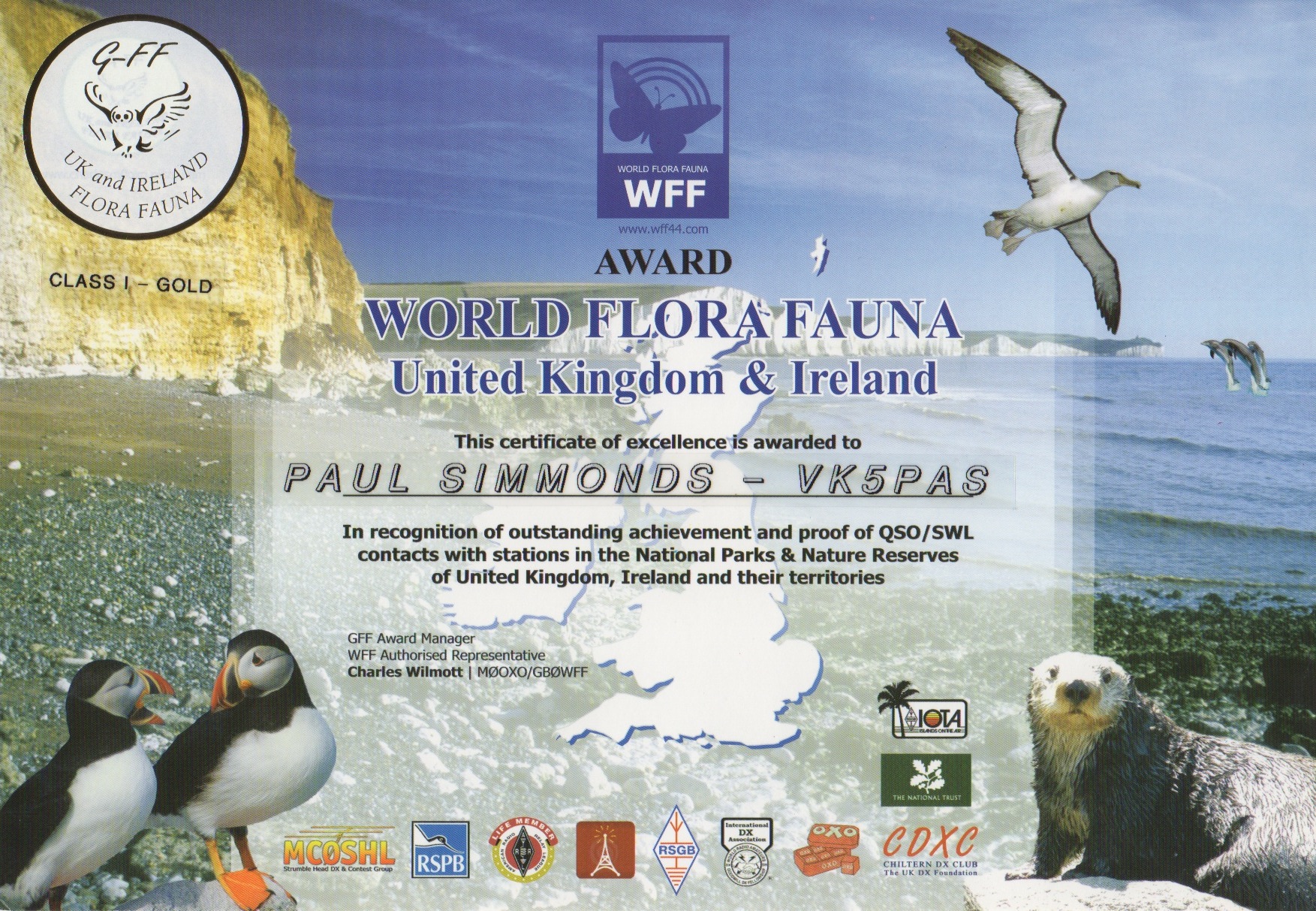
The participating National programs in WWFF also maintain various national award programs for hunters and activators.  For details on these, please check out the ‘WWFF National Awards’ page on the WWFF global website.

WFF UK Gold Award

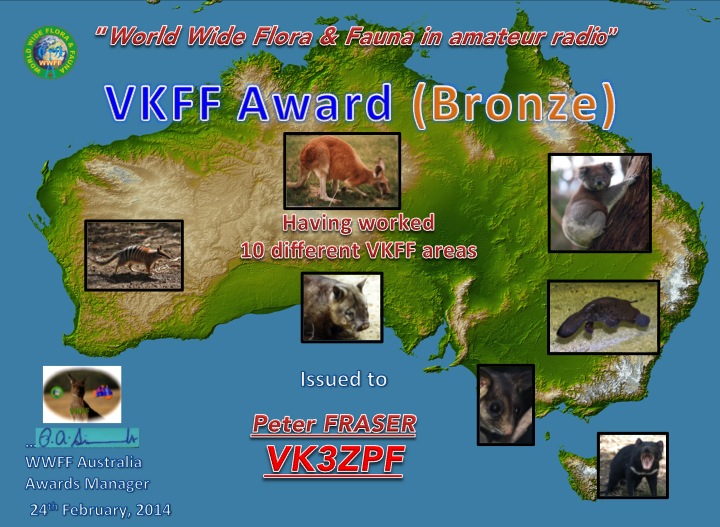
VKFF Awards

The Australian (VKFF) program also offers their own special certificates.  For Activators and Hunters there are five levels:

  1. Bronze (10 different VKFF areas)
  2. Silver (20 different VKFF areas)
  3. Gold (30 different VKFF areas)
  4. Platinum (40 different VKFF areas)
  5. Diamond (50 different VKFF areas).

The certificates can be applied for online via LogSearch and are sent for FREE as a PDF.  Or if you do not have a printer, I can print the certificate and mail it to you at a coast of $5.00.  The certificates are printed on A4 high quality photo paper on my Epson Artisan 730 printer.

Slide1

I have also just recently introduced the VKFF DX Hunter award and the VKFF Worked All Australia award.  More details on these two new awards can be found on the WWFF Australia website.

Thankyou.

I would like to say thank you to two active VK1 amateurs: Andrew VK1NAM and Ian VK1DI, for their efforts in promoting the WWFF program.

Andrew has been regularly submitting his logs to me for upload to LogSearch, and has also mentioned the WWFF / VKFF program a number of times on this WordPress site…..

http://vk1nam.wordpress.com

Ian has also been regularly submitting his logs and has also mentioned WWFF / VKFF a number of times on his blog.  Ian has also done some excellent work with mapping all of the VKFF reference areas.   These files can be downloaded from the FILES section of the WWFF Australia Yahoo group.

http://vk1di.blogspot.com.au

And also to two active VK3 amateurs: Tony VK3VTH, and Peter VK3ZPF, who have both been busy activating VKFF parks in Victoria, and working lots of DX along the way.  Both have regularly supplied their logs and their tallies on LogSearch are looking very healthy.

And there are many other Australian amateurs who have now embraced VKFF activations.  Thanks to all.

Summary.

So there you go.  If you would like to combine your love for great outdoors and enjoy travelling to beautiful locations around Australia, whilst combining the hobby of amateur radio.  Then WWFF may be for you.

Many SOTA peaks are located within National Parks.  Mapping files & spreadsheets showing a correlation between peaks and parks can be located in the Files section of the WWFF Australia Yahoo group at…..

https://au.groups.yahoo.com/neo/groups/wwffaustralia/info

Additionally, you can combine WWFF with the Keith Roget Memorial National Parks Award and the VK5 National and Conservation Parks Award.

Happy park activating and hunting!