Mount Magnificent Conservation Park

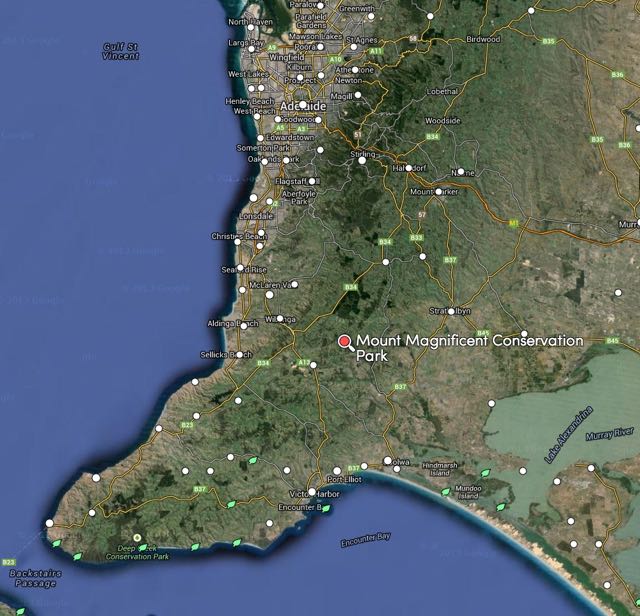
This afternoon I travelled to the Mount Magnificent Conservation Park (CP), which is about 8km north east of the town of Mount Compass, on the beautiful Fleurieu Peninsula, about 58 km south of Adelaide.  This is a veery scenic drive from my home qth at Mount Barker, through the towns of Echunga, Meadows, and then on to Prospect Hill.
Screenshot 2014-12-21 21.49.26

Map courtesy of mapcarta.com

I last activated this park in July, 2013, so today’s activation was another 1 point for me for the VK5 National and Conservation Parks Award.  Here is a link to a post re my previous activation…..

https://vk5pas.wordpress.com/2013/07/26/mount-magnificent-conservation-park/

Mount Magnificent CP was established in 1972, and is about 90 hectares in size.  It protects a small area of remnant bushland.  The major feature of the park is the 380 metre high Mount Magnificent, which sadly does not qualify for the Summits on the Air (SOTA) program), as it does not have the required ‘prominence’.  Despite this, there are excellent views from the top.  The famous Heysen trail passes through this park and links the nearby Finnis Conservation Park and the Kyeema Conservation Park to the north west.

The park is full of a variety of native wildlfie, including Western Grey kangaroos.  And there were plenty of these to be seen.

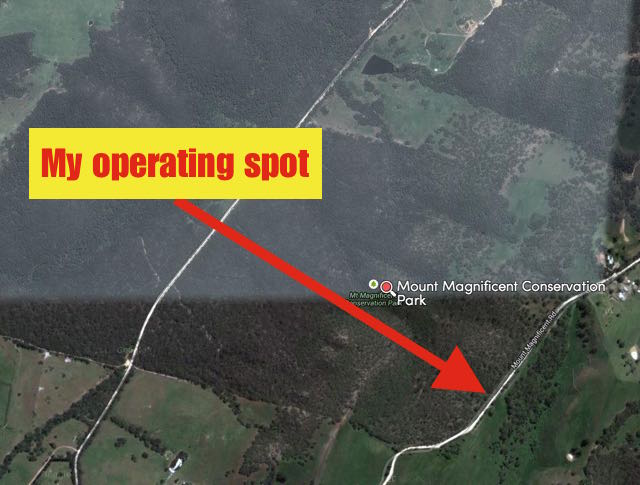
I set up on the  eastern side of the park, on the western side of Mount Magnificent Road.  I was not all that far from the south eastern corner of the park.  Part of the fenceline here had collapsed from the weight of falling branches from the gum trees, so access to the park was very easy.  I set up my fold up table and deck chair, about 5 metres in from the boundary fence.
Screenshot 2014-12-21 21.49.58

Map courtesy of mapcarta.com

Prior to calling CQ I had a quick tune around the 40m band and I found Paul VK1ATP portable on SOTA peak Mount Majura, VK1/ AC-034, calling CQ on his own on 7.090 (5/7 both ways).  That was a nice way to start the activation for me.

I then went up to 7.095 and starting calling CQ and this was immediately responded to by Arno VK5ZAR, and then Les VK5KLV in Port Augusta.  Les is becoming a real regular park hunter now, which is great to see.  I was then called by Stuart VK5STU who was portable in the Sandy Creek Conservation Park.  Stuart had a very strong 5/9 signal, and it was great to be able to get a ‘park to park’ contact.  Mick VK3FAFK from Stawell then called in and he was kind enough to place me on the parksnpeaks site.

A few QSOs later I was called by Andrew VK1NAM/3 who was portable on Arthurs Seat, VK3/ VC-031.  And then a little further down the log I was called by John VK5BJE who was portable in the Greater Bendigo National Park, which qualifies for the Keith Roget Memorial National Parks Award (KRMNPA) and also qualifies for the World Wide Flora Fauna (WWFF) program.  Greater Bendigo NP is VKFF-623.

After working a total of 22 stations on 40m SSB, I lowered the squid pole and removed the links and headed up to 20m.  I called CQ on 14.205 and this was answered by Jeremy VK4EVE, with a strong 5/9 signal.  Sadly, a Japanese station moved in on 14.206 and that was the end of that.  I tuned across the band and found Juha EA8/OH1LEG who was calling CQ.  I gave Juha a call, and to my surprise, he responded.  I only received a 5/3 signal report from Juha, but I was very pleased that I was able to make it to the Canary Islands.  I kept tuning across the band and then worked Lauro IK4GRO (5/8 sent and 5/5 received).

I headed back to 40m and tuned across the band and found W1AW/KH6 calling CQ on 7.183.  He was not busy so I gave him a call.  After a number of attempts with my call sign, we made a valid contact.  The SOTA Goat app on my iphone bleated and I saw that there was a spot for Andrew VK3JBL/6.  SO I headed back up to 20m, and although it was a bit of a struggle, I was able to make contact with Andrew (3/4 sent due to the static crashed and 4/5 received).  I haven’t worked that many VK6 summits, so I was very pleased to make contact with Andrew.

This slideshow requires JavaScript.

I went on to work Orlando, EA8CCQ, in the Canary Islands.  orlando was using a rotary dipole, and we were able to have a comfortable QSO (5/9 sent and 5/5 received).

It was starting to get a bit cool and the local time was just after 7.00 p.m. so I decided to pack up and head home.  As it was, it was a very slow drive, as the roads were covered in kangaroos.

After 2 hours in the park I had a total of 28 QSO’s in the log.

The following stations were worked:-

  1. Paul VK1ATP/p (SOTA)
  2. Arno VK5ZAR
  3. Les VK5KLV
  4. Stuart VK5STU/p (park to park)
  5. Mick VK3FAFK
  6. Nev VK5WG
  7. Peter VK3TKK
  8. Andrew VK1NAM/3 (SOTA)
  9. Matt VK1MA
  10. Hans VK5YX
  11. Tom VK5EE
  12. Nick VK3ANL
  13. Andrew VK3ARR
  14. Grant VK2LX
  15. Brian VK5FMID
  16. John VK5DJ
  17. John VK5BKE/3 (KRMNPA & WWFF)
  18. Robin VK5TN
  19. John VK5FTCT
  20. Peter VK5NAQ
  21. Richard VK5ZRY
  22. David VK5HYZ
  23. W1AW/KH6

The following stations were worked on 20m SSB:-

  1. Jeremy VK4EVE
  2. Juha EA8/OH1LEG
  3. Lauro IK4GRO
  4. VK3JBL/6 (SOTA)
  5. Orlando EA8CCQ


References.

Department of Water, Environment and Natural Resources, ‘Parks of the Fleurieu Peninusla’, 2011.

Wikipedia, <http://en.wikipedia.org/wiki/Mount_Magnificent_Conservation_Park>viewed 21st Dec 2014
Don’t become a ‘black hole’

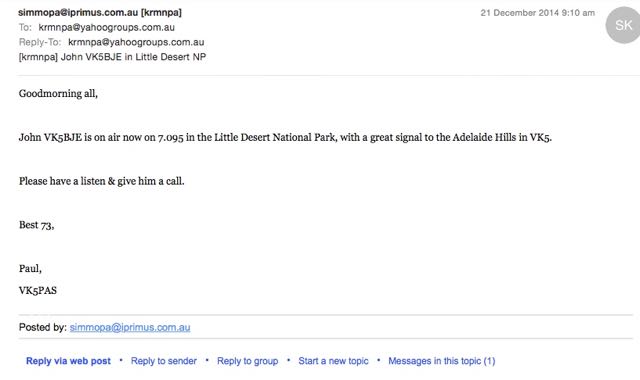
This morning, I received an SMS message from John VK5BJE advising me that he was on air in the Little Desert National Park.  So in the throws of making my coffee, I headed to the radio shack and there was John on 7.095 with a great 5/9 signal from western Victoria.

John was keen to get as many contacts as possible for the World Wide Flora Fauna (WWFF) program, so I set about trying to alert as many other amateurs as I could to John’s presence on the band.  I kept listening, and it was really pleasing to hear John end up with a large pile up, with many of the stations I had alerted either via SMS, email, etc, giving him a call.

I have mentioned it before here on my WordPress site,

https://vk5pas.wordpress.com/2013/12/24/how-to-attract-chasers-and-hunters/

and during various presentations I’ve delivered, but I thought I would mention this again.

PLEASE, don’t become a black hole, and keep the contact to yourself.

Remember, that many of the National Park activators are seeking the required 44 QSOs for the WWFF global award program.  So the more calls they get, the better.

There are currently no phone apps similar to SOTA Goat or Rucksack radio, for park activations.  So park activators are relying on the goodwill of park hunters to let other amateurs know that they are in a park.

So, what can you do to let others know that a park activator is on a particular frequency?  The answer is quite a bit.

SMS message.

Consider setting up an SMS group on your mobile telephone.  A few amateurs are doing this, and it works extremely well.  If you work a park activator, send an SMS to your group, advising your mates of your contact, so that they too, can hopefully make contact with the park activator.

DX cluster

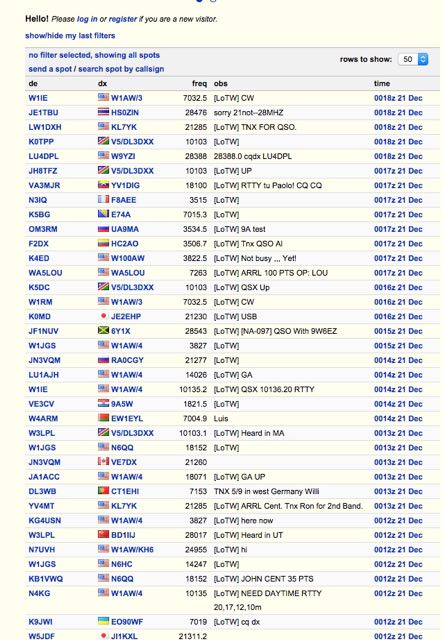
A DX Cluster is in essence a “chatroom” or node into which amateur DX hunters can post information about DX either worked or heard.  Physically, it is a central computer that collects, stores and disseminates information that hams send to it.  There are thousands of nodes around the world, connected together via the internet or radio.

Personally, I use dxwatch.com…..

http://www.dxwatch.com/

Screenshot 2014-12-21 10.48.46

Here is a link to the recent presentation given by Brian VK5BC at the Welcome to amateur radio symposium…..

parksnpeaks

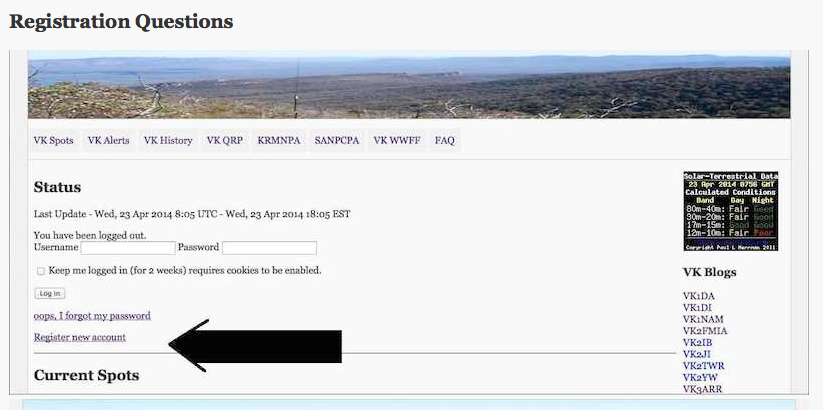
The parksnpeaks site is a terrific spotting and alert facility created by Allen VK3HRA.  The parksnpeaks site is FREE to join.  Just simply register a new account.

http://www.parksnpeaks.org/

screenshot-2014-07-18-15-24-54


The parksnpeaks site has some excellent features.  It can be used to add VK activity including QRP operation, National Parks, Conservation Parks, or portable operation in general, whilst SOTA spots are added directly via SOTAWatch.

The parksnpeaks site offers:-

  • ‘spotting’ facilities

and

  • ‘alert’ facilities.

‘Spotting’ is where you can add details of stations you have worked or heard.  This allows you to share information with other amateurs.

‘Alerting’ is where you can add details of your proposed activations, so people can see what your future plans are.

email

Send an email to your mates.  Creating an email group is easy.

If you are using Gmail…..

  1. To create a contact group:
    1. Click Gmail at the top-left corner of your Gmail page, then choose Contacts.
    2. Select contacts that you want to add to a group, click the Groups button. , then Create new.
    3. Enter the name of the group.
    4. Click OK.

If you use another email platform, there are plenty of tips on the internet regarding creating groups.

Yahoo groups

Place a post on the World Wide Flora Fauna or VK5 Parks Yahoo groups.

Screenshot 2014-12-21 10.53.47

http://au.groups.yahoo.com/neo/groups/sanpcpa/info

http://au.groups.yahoo.com/neo/groups/wwffaustralia/info

2m repeater

Send a message out to other amateurs on your local repeater.  I know that many of the amateurs in the South East of South Australia, are doing this, and it works well.

WWFF Forum

The World Wide Flora & Fauna program (WWFF) does not have a spotting & alert facility like SOTAwatch.  But Activators are encouraged to place their intended activations on the WWFF Forum.  A huge number of European amateurs read the Forum and will be able to see your intentions.

http://forum.wwff.co


So, as you can see there is a lot you can do.  So please, after working a park activator, don’t just sit back and do nothing.  Consider sharing your contact with other like minded amateurs.  You are not only benefiting the other park hunters, but also the activator themselves.

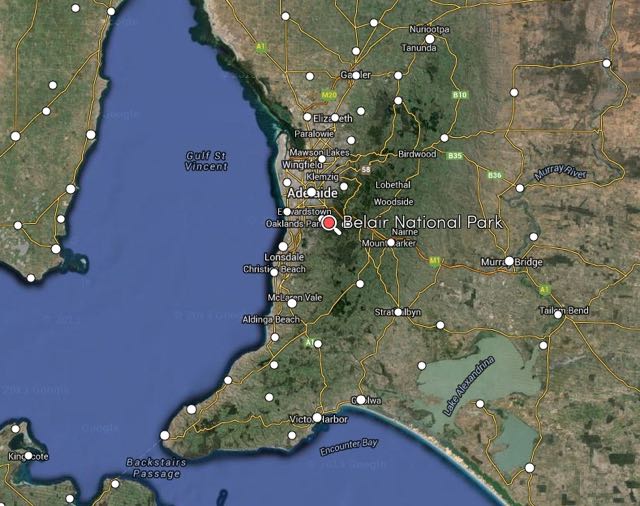
Belair National Park, VKFF-022

Yesterday (Saturday 20th December, 2014) I activated the Belair National Park (NP), VKFF-022, in the Mount Lofty Ranges ‘Adelaide Hills’.  I had already activated Belair NP earlier in the year, so there were no VK5 Park Award points up for grabs.  And I had already passed the 44 QSO threshold for Belair NP in the World Wide Flora and Fauna (WWFF) program.  But my real motivation, was to try out my new radio.  My beautiful wife Marija (and yes I am constantly reminded I am ‘boxing above my weight’) and my lovely daughter Olivia, purchased a Yaesu FT-857d for me, and gave it to me as an early Christmas present and early 50th birthday present.  I turn 50 on the 5th January.  So it was off to Belair for me, just a 15 minute drive to the west from home.

I set up just inside Gate 1 off Sheaok Road, at Crafers.  This is on the northern side of the park.  This gate was locked, however there is no restriction to access to the park at this point.  There is a walking track here, Wilyawa Track.  But to gain access to it, you need to either jump the fence, which has barbed wire, or jump the padlocked gate.  Why DEWNR do not have a pedestrian access point here I do not know?  Anyway, I got all the gear from the 4WD and then jumped the fence and walked a short distance down the track, where I set up my station, under the shade of some gum trees, as it was a warm 30 deg C day.

Screenshot 2014-12-20 22.16.38

Map courtesy of mapcarta.com

I started off on my nominated frequency of 7.095.  I had posted on the VK5 Parks Yahoo group and the WWFF Australia Yahoo group that I would be on air at 0600 UTC on 7.095.  I was about 15 minutes late, but still did not have to call CQ.  I asked if the frequency was in use and this was responded to by Les VK5KLV at Port Augusta with a beautiful 5/9 signal.  Les gave me a 5/9 in return, and it seemed the band was in very good shape.  It was certainly very quiet.  There was no man made noise on the band due to the remote location of the park, and the QRN (static crashes) that have been present over the past few weeks were noticably absent.  My second caller of the day was Adam VK2YK who was a good 5/8.  Adam was struggling with me a little bit due to QSB, but gave me a 5/4 signal report.  This was followed by Mal VK5MJ in The Riverland in South Australia, who was 5/9 plus.  David VK5KC then called me, using just 1 watt, and was a very nice 5/8 signal.  I had already caught up with David earlier in the day for a coffee.

I went on to work a further 20 stations in VK1, VK3, and VK5.  A few of those stations were operating QRP.  The first QRP caller was Peter VK3TKK who was running just 5 watts.  Peter’s signal was only signal strength 3, but due to the low noise floor, I was able to receive him perfectly.  This was followed by Andrew VK1NAM mobile in VK3, in the outer eastern suburbs of Melbourne.  Andrew was running just 2.5 watts from his FT-817 in the car, but nether less had a great 5/7 signal.  Tom VK5FTRG then called in from the South East of South Australia, running just 5 watts, with a nice 5/9 signal.  My final QRP caller was regular QRP operator, Ian VK5IS, again running 5 watts.  Ian had a beautiful 5/9 signal coming in from the Mid North of South Australia.

I also worked a few mobile stations.  Other than Andrew mentioned above, I also spoke with Greg VK5ZGY who was mobile in the South East of South Australia, with a good strong 5/7 signal.  Greg had co pilot and wife, Gabbie, alongside of him.  I then spoke with Ian VK6PXF who was mobile in VK5 at Lonsdale, south of Adelaide.  Ian has started activating National Parks, and has sent me quite a few of his logs for upload to the WWFF Log Search facility.  And lastly I was called by Robin VK5TN who was mobile at Hahndorf in the Adelaide Hills.

But to make my day, I was called by Richard VK5ZRY, who had decided to head out to the Ramsay Way Conservation Park.  The park is/was located on Richard’s property on the Yorke Peninsula.  Richard was trying out his new Yaesu FT-817 and had a magnificent 5/9 signal coming across the Gulf St Vincent to Belair.

This slideshow requires JavaScript.

I left the frequency to Richard, and lowered the squid pole and removed the links in the dipole, so I could operate on 20m.  However, I was disapointed when I tuned across 20m, to hear only very weak signals coming in from Europe.  I found that my nominated frequency of 14.244 was clear, so I put out about 8 CQ calls but had no takers.  Rather disapointed, I tuned across the 20m band and could hear three stations coming in from Spain.  However, their signals were well down compared to normal conditions.  I also heard Jason ZL3JAS, working long path into Europe.  However, all the European stations he was making contact with, were very weak to me.

So I headed back to 40m.  Prior to calling CQ again, I tuned across the 40m band and I could hear quite a few Europeans & stations from the United Kingdom coming through, including Javier, EA7GAK on 7.178 who was working into the USA.  I gave Javier a few calls, but sadly he could not hear me.  I also heard W1AW/3 on 7.161 working into Europe.  I also called him, but again my 40 watts just wasn’t making the grade.   So I went back to 7.095 and called CQ again, and this was responded to by Nic VK5ZAT who was portable at Carrackalinga on the Fleurieu Peninsula.  I had worked Nic a little earlier, prior to QSYing to 20m.  He had been having problems with a high VSWR on his dipole.  And this time, his signal had dropped down a good 2 S points.  I was then called by Mick VK3FAFK in Stawell in western Victoria, with a beautiful 5/9 signal.  And this was followed by Andrew VK5UR mobile in VK2, about 100 km south of Parkes.  I had a lengthy chat with Andrew and his signal always remained around the S9.  Andrew was running an IC7100 and a roof mounted whip antenna.  My last contact on 40m was with Adam VK2YK who had called in again, as conditions had improved.  I was now 5/9 with Adam, and he was 5/9 plus.  I worked a further 13 stations from VK2, VK3, VK4, & VK5.

My curiosity had got the better of me, so I again lowered the squid pole and removed the links in the dipole, and again tuned to 20m.  I was hoping that the band had improved.  But it was getting a little late, approaching 8.00 p.m.  Again, I could hear some weak Europeans, who were certainly not strong enough for me to try to make contact with.  I managed just 1 DX contact and that was with Michio, 7L4LKK, who was a strong 5/9 to Belair.

So after a number of hours in the park, I had a total of 41 contacts in the log.

The following stations were worked:-

  1.  Les VK5KLV
  2. Adam VK2YK
  3. Mal VK5MJ
  4. David VK5KC/qrp
  5. David VK5HYZ
  6. Peter VK3TKK/qrp
  7. Nev VK5WG
  8. Ian VK5KKT
  9. Matt VK1MA
  10. Andrew VK1NAM mobile VK3/qrp
  11. Tom VK5FTRG/qrp
  12. Greg VK5ZGY/m
  13. Ian VK6PXF mobile VK5
  14.  Amanda VK3FQSO
  15. Marshall VK3MRG
  16. Ian VK5IS/qrp
  17. Stuart VK5STU
  18. Peter VK5KPR
  19. Keith VK5FEKH
  20. Steve VK3MEG
  21. Nic VK5ZAT/p
  22. Tom VK5EE
  23. Richard VK5ZRY/p (park to park contact)
  24. Robin VKTN/p
  25. Nic VK5ZRY/p
  26. Mick VK3FAFK
  27. Andrew VK5UR mobile VK2
  28. Gary VK4MDZ
  29. Ian VK3VIN
  30. Rob VK4FFAB
  31. Bruce VK3FBNG
  32. Darren VK2NNN
  33. Kevin VK2VKB
  34. Peter VK3ZPF
  35. Andrew VK2UH
  36. Jim VK5JW
  37. Tony VK3AN
  38. Nick VK3ANL/qrp
  39. Tom VK5FTRG
  40. Adam VK2YK
  41. Michio 7L4LKK

Keith Roget Merit Award

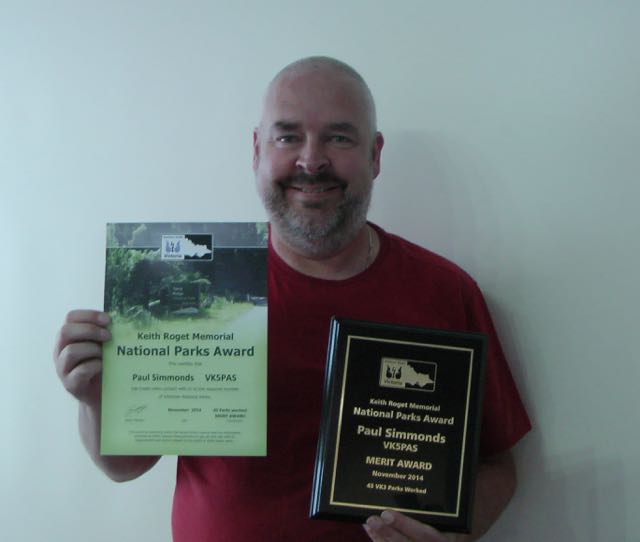
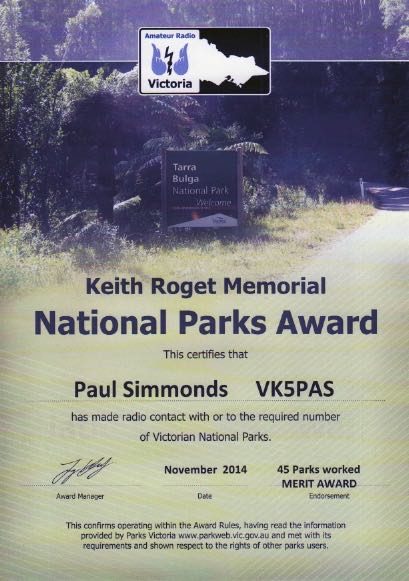
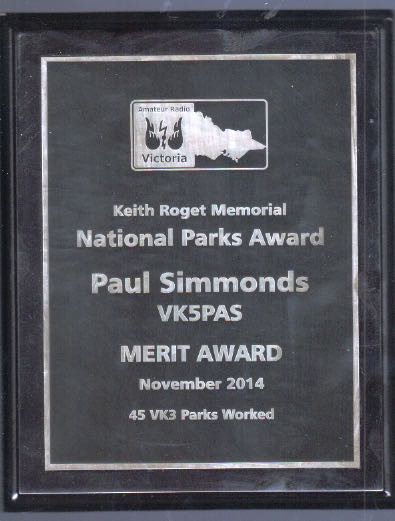
This afternoon after work, I went to the Post Office and was pleasantly surprised to find a parcel waiting there for me to collect.  It was my Merit certificate and Merit plaque for the Keith Roget Memorial National Parks Award (KRMNPA).

IMGA0001

The Merit Award is issued for either Activating all 45 Victorian National Parks, or Working all 45 Victorian National Parks.  My awards were for Working all 45 parks, which sounds easy, but is a real challenge.

Many thanks to Tony VK3VTH, who is the KRMNPA Awards Manager.

Scan


Scan

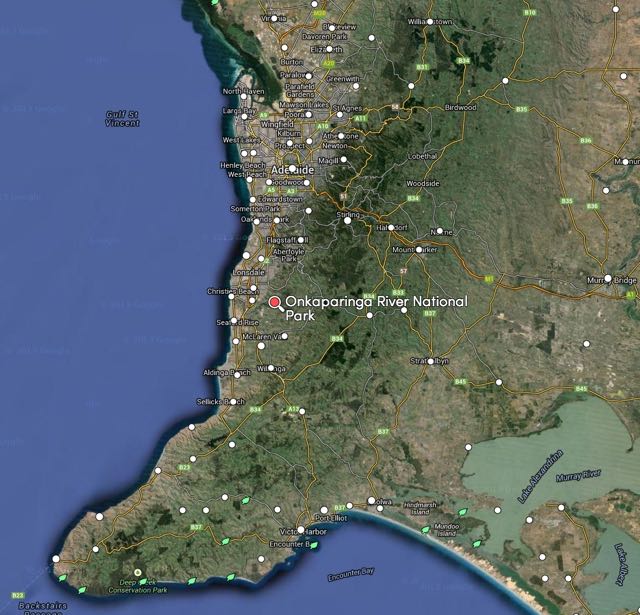
Onkaparinga River National Park, VKFF-402

Yesterday afternoon (Monday 15th December 2014) I headed over to the Onkaparinga River National Park (NP), VKFF-402, which qualifies for the VK5 National and Conservation Parks Award, and the World Wide Flora Fauna (WWFF) program.  I have activated the park a number of times previously, and it is a nice 40 minute drive from my home via Echunga, Meadows, and Kangarilla, through the southern Adelaide Hills.

Onkaparinga River NP is located about 35 km south of Adelaide, and is about 1,544 hectares in size.  It is a magnificent park in close proximity to Adelaide.  The park is disected by the Onkaparinga River, which is South Australia’s second longest river after the mighty Murray.  The river enters the park in a steep sided valley and flows into a spectacular gorge with cliffs up to 50 metres in height, with large permanent rock pools.

Screenshot 2014-12-16 17.50.27

Map courtesy of mapcarta.com

I set up on Chapel Hill Track which runs off the northern side of Chapel Hill Road.  I parked my vehicle at gate 21 and walked about 50 metres down the track.  This location is situated on the southern side of the park.  On the southern side of Chapel Hill Road was the beautiful valley containing the vineyards of McLaren Vale and McLaren Flat, and to the north was the park, leading down to the Onkaparinga River cutting its way through the gorge.

It was quite a warm day (about 28 deg C), so I found some nice shade under some large gum trees.  I kept an ever vigilent watch for some of the crawly inhabitants of the park, and fortunately did not encounter any.

I started off with the little Yaseu FT-817nd and just 5 watts.  I powered the radio with a 12 volt 4 ah sealed lead acid battery (SLAB).  My antenna was a 40m/20m linked dipole, supported on a 7 metre squid pole.

I had nominated 7.095 as my calling frequency, but the Kandos Net was still running on 7.093, so I held off for a little while until that finished, and I then called CQ on 7.095.  My CQ call was immediately responded to by Peter VK5NAQ in the Mid North of South Australia with a beautiful 5/9 signal.  This was followed by Les VK5KLV at Port Augusta who was also 5/9.  Park Hunter reliables John VK5BJE and Greg VK5GJ then called in.

After working 11 stations on 7.095, my SOTA Goat application on the i-phone bleated, so I tuned down to 7.090 where I worked Andrew VK1DA/2 who was portable on the top of Livingstone Hill VK2/ SM-093, for the Summits on the Air (SOTA) program.  Andrew was a good solid 5/6 and he gave me a 5/7 signal report.  Livingstone Hill is 932 m above seal level (asl) and is located near the New South Wales and ACT border.

I then returned to 7.095 where I spoke with Amanda VK3FQSO and Ivan VK5HS in the Riverland.  But things slowed down from that point on, and despite a few more CQ calls, I had no takers.  The static crashes were also starting to pick up on 40m.  So I lowered the squid pole and removed the links in the dipole, so that I could operate on 20m.  I was to be disapointed on 20m, as there was no long path propagation into Europe and the United Kingdom.  I could hear John EA7BA on 14.156 but John was very weak.  I could not hear the G stations at all, that he was speaking to.  John was the only European signal I could hear.  The only other activity on 20m that I could hear were some weak Japanese signals.  The band was also covered in the Over the Horizon radar.

This slideshow requires JavaScript.


So I returned back to 40m and due to the noise on the band, I started running 40 watts from the Yaesu FT-450.  I spoke with Andrew VK1NAM who was portable on SOTA peak, Mount Taylor, VK1/ AC-037 (5/7 both ways).  I then went back to 7.095 and started calling CQ but the static crashes had become louder making it difficult to pick up a couple of weak stations that were calling me.  However, I did manage to speak with George VK4GSF near Toowoomba in Queensland, Matt VK1MA, and Lee VK2LEE.  I put a few more CQ calls out but had no takers, so I tuned across the band and found Simon VK1FAAS calling CQ from SOTA peak, Mount Ainslee VK1/ AC-040 (5/6 sent and 5/8 received).

I then started calling CQ on 7.090 and worked a further 14 stations from VK1, VK3, VK4, VK6, and VK7.  My first taker here was Peter VK6YV in Perth (5/9 sent and 5/7 received).  This was followed by Wayne VK4XG, south west of Brisbane (5/9 sent and 5/4 received).  I went on to work a further 2 stations in Western Australia.  They being Mark VK6BSA mobile, on his way home from work.  And Alek VK6APK in Perth, who is on the WIA Awards Committee with me.  From past experience and confirmation during this activation, this time of the evening is very good for propagation on 40m into Western Australia.  Adelaide to Perth is a distance of about 2,500 km.  A local QSO we call that here in Australia.  In other parts of the world, it is a DX contact, working across multiple countries.

Sadly, there was a display of poor operating practice again during this activation.  I won’t mention his call sign here, but I had a VK3 come up straight over the top of Alek VK6APK, without asking if the frequency was in use, and start calling one of his mates in VK3.  He did this a number of times until he was sternly told off by a number of stations listening on the side.  No apologies, he just quietly slipped away off the frequency.

Before packing up I decided to book into the 7.130 DX Net.  And I am very pleased I did.  I went on to work William FO5JV in French Polynesia in the Pacific, Joe CU2CE in the Azores Islands off the coast of Portugal and north western Africa, Bill W1OW in Massachusetts in the USA, and four stations in New Zealand.  This included Noel ZL1DAI who was running just 5 watts from his Elecraft KX3 (4/6 sent and 5/6 received).

As the sun was setting, the kangaroos in the park had become very active.  Despite the noise from the radio, many of them came up quite close to my operating position.  The park was also alive with birds during my stay, including Yellow tailed Black Cockatoos, Blue Wrens, Eastern Rosellas, and Rainbow lorikeets.

So after a number of hours in the park, I had a total of 42 contacts in the log, to add to my other tally of contacts from previous activations from Onkaparinga River NP.  This is a great park to operate from.

For more information on the park, please have a look at…..

DEWNR website:

http://www.environment.sa.gov.au/parks/Find_a_Park/Browse_by_region/Fleurieu_Peninsula/Onkaparinga_River_National_Park_and_Recreation_Park

Friends of the Onkaparinga Park:

http://www.communitywebs.org/onkaparingaparks/

The following stations were worked on 40m SSB:-

  1. Peter VK5NAQ (qrp)
  2. Les VK5KLV
  3. John VK5BJE
  4. Greg VK5GJ
  5. Tony VK5FTVR
  6. Nev VK5WG
  7. Peter VK3PF
  8. Brian VK5FMID
  9. Trevor VK5ATQ
  10. Larry VK5LY
  11. Nick VK3ANL
  12. Andrew VK1DA/p (SOTA)
  13. Amanda VK3FQSO
  14. Ivan VK5HS
  15. Andrew VK1NAM/p (SOTA)
  16. George VK4GSF
  17. Matt VK1MA
  18. Lee VK2LEE
  19. Simon VK1FAAS/p (SOTA)
  20. Peter VK6YV
  21. Wayne VK4XG
  22. Ian VK1DI
  23. Paul VK3KLE
  24. Graham VK7ZGK
  25. Ian VK3VIN
  26. Rob VK4FFAB
  27. Mark VK6BSA/m
  28. Jim VK5JW
  29. Alek VK6APK
  30. Ron VK3JP
  31. Peter VK5FLEX
  32. Kevin VK2VKB
  33. Daniel VK3FACC
  34. William FO5JV
  35. Joe CU2CE
  36. Brian ZL2ASH
  37. Lamont ZL2ALK
  38. Noel ZL1DAI (qrp)
  39. Bill W1OW
  40. Ray ZL4WRC
  41. Mike VK3GYH (qrp)
  42. Frank VK2HFS

The history of WWFF and some stats

Recently I was queried if it was possible to have the 4 missing Victorian National Parks placed on the list for the World Wide Flora Fauna (WWFF) program.  Missing parks you say?  What am I referring to?

Well, first I need to fill you in on a bit of history on the WWFF program.  The following is direct from the WWFF global website…..

“The Flora and Fauna movement within ham radio was initiated in 2008 by the Russian Robinson Club (RRC) as World Flora and Fauna (WFF) program.  In 2012 the program relaunched as WWFF: WorldWide Flora and Fauna with a different organization using the strengths of the existing national programs that were already important pillars in WFF. WWFF uses the activity databases of the participating members (containing activities from as early as 1995) as collected in the WWFF logsearch and builds upon the rules and references of the previous program.  Note that WWFF has no ties to RW3GW who controlled the WFF organization” 

If you would like to read a full history on WFF and WWFF you can read more on the WWFF Australia website at…..

http://www.wwffaustralia.com/wff–wwff-history.html

4312296

Only parks established before 2008 are on the WWFF list throughout the world (they can be found in the WWFF Directory).

http://www.wwff.co/p/wwff-downloads.html

I became involved in WWFF in March 2013 and I established the Australian WWFF program (which is referred to as VKFF).  At that time I found that there were numerous Australian National Parks that were established and gazetted prior to 2008, which did not appear in the WWFF Directory.  I spent a number of months confirming details surrounding those parks, and I am pleased to say that in January, 2014, after extensive consultation with the WWFF Committee, I was successful in having over 100 Australian National Parks added to the WWFF Directory.

8048595

However, that left many Australian National Parks that were established and gazetted after 2008.

Section 5.2.1 of the WWFF global rules state that consideration of expanding the national list of references will be considered by the WWFF Council, only if the following conditions exist:

  • 50%, 75% , 90% activated rule

a)  When 50% of National WWFF areas have been activated, it is possible to assign up to a maximum of 50 new FF references.

b)  When 75% of National WWFF areas have been activated, it is possible to assign up to a maximum of 75 new FF references.

c)  When 90% of National WWFF areas have been activated, it is possible to assign up to a maximum of 90 new FF references.

In other words, for me to get permission to have additional National Parks added to the WWFF Directory (those parks created after 2008), we as Australian amateurs need to fulfil the activation rules mentioned above.  Not an easy task I know, considering the vast size of Australia and the number of amateurs we have down here.

But WWFF is not the only program which faces adversity for Australian hams.  The SOTA program also has its inequities.  We have to remember that these programs were created in European countries, primarily (or at least at the beginning), aimed at Europeans and based on European conditions.  But we as Aussies are all up for the challenge, aren’t we?

This is where it is extremely important that if you activate an Australian National Park, that you send me your activator log, as either an ADIF file, or by using the cvs file which you can find in the Files section of the WWFF Australia Yahoo group.

https://au.groups.yahoo.com/neo/groups/wwffaustralia/info

Why send me your log?  Because 1/ as you can see, I, as the Australian WWFF co-ordinator need to prove to the WWFF Committee that we are active to get new parks added; 2/ as an activator you can apply for awards on line and follow your progress; and 3/ park hunters are attributed with working you whilst you were in a National Park.

I have posted previously about the WWFF program, and discussed LogSearch.  Here is a link to that post with a lot of information…..

https://vk5pas.wordpress.com/2014/06/23/3912/

The WWFF LogSearch now has 4,625,333 QSOs in the database, from 6,891 different references, in 92 DXCC entities.

http://logsearch.wwff.co/index.php

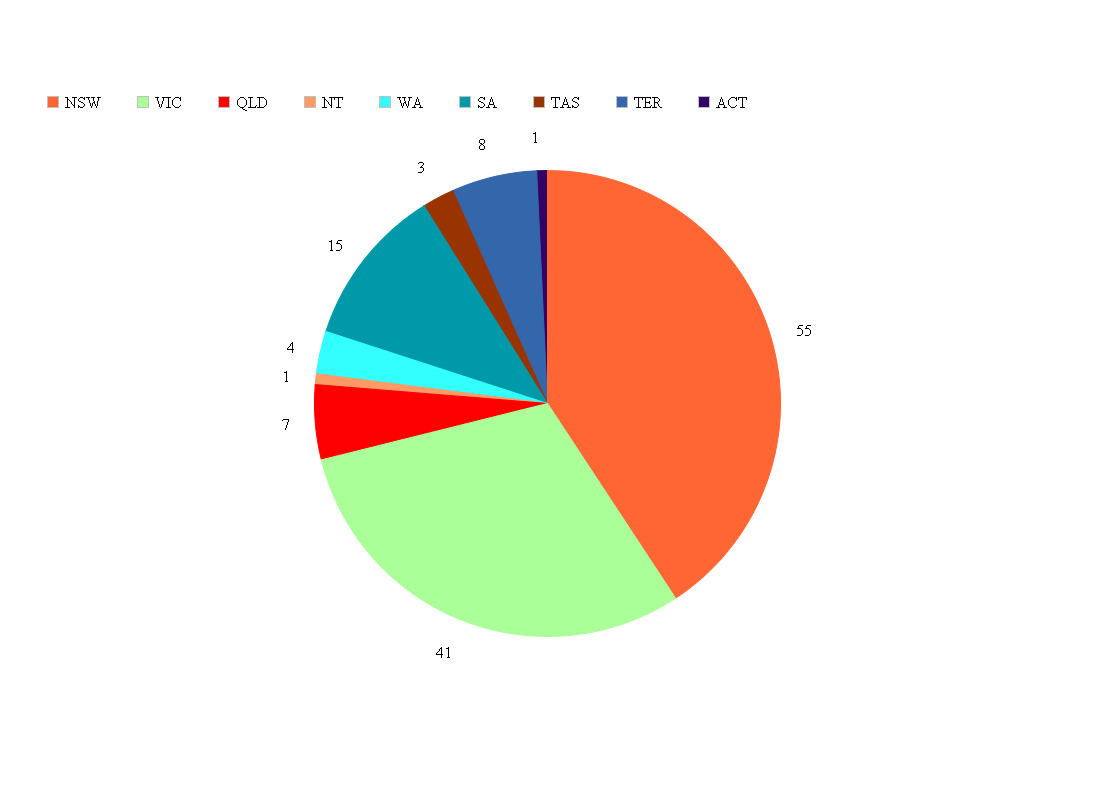
Out of interest, I checked the WWFF LogSearch facility tonight and found that 134 different VKFF references have been activated around Australia as follows…..

New South Wales – 55

Queensland – 7

Northern Territory – 1

Western Australia – 4

Tasmania – 3

South Australia – 15

Victoria – 40

Australian Territories – 8

blank

graph courtesy of http://www.onlinecharttool.com

As you would expect, with the largest number of parks, New South Wales is out in front, as far as the number of different VKFF references worked.  This is followed by Victoria on 41, and then South Australia on 15.  Of note for Victoria, is that 41 of their existing 45 National Parks qualify for WWFF, and all 41 have been activated.  I think this is a good indication of the very strong following of the Keith Roget Memorial National Parks program in Victoria.  And South Australia needs to be mentioned as well.  South Australia only has 21 National Parks, and yet 15 of those have been activated.  And some of those are in very remote locations, thousands of km away from a major capital city.

Due to the high park activity in Victoria I am going to attempt to have the other 4 Victorian National Parks added to the list.  One of my arguments is going to be focussed on the size of Australia…..

201101310820494d46c5413d107

image courtesy of http://www.celsius1414.com

The most activated VKFF references were as follows…..

Willis Island

  • 17 activations
  • Total QSOs 95,171

Norfolk Island

  • 21 activations
  • Total QSOs 61,928

Christmas Island

  • 24 activations,
  • Total QSOs 41, 958

Willis, Norfolk and Christmas Islands are rare DXCC entities and IOTA’s as well as being VKFF reference areas, so it is not surprising that they lead the way.  However, it should be noted, that the DX pedition operators did submit their logs for upload to the WWFF LogSearch, and they are to be applauded for that.

The other popular parks around Australia are as follows…..

In the Australian Capital Territory:

Namadgi National Park

  • 42 activations
  • 1,145 QSOs

In Queensland:

Magnetic Island

  • 6 activations
  • Total QSO’s 2,657

Turtle Group

  • 2 activations
  • Total QSOs 1,158

Great Barrier Reef

  • 4 activations
  • Total QSOs 1,480.

Great Sandy National Park

  • 21 activations
  • Total QSOs 1,650.

In Victoria:

Alpine National Park

  • 29 activations
  • Total QSOs 1,054

Yarra Ranges National Park

  • 32 activations
  • Total QSOs 708

Grampians

  • 43 activations
  • Total QSOs 570

In South Australia:

Canunda National Park

  • 7 activations
  • Total QSOs 408

Coorong National Park

  • 4 activations
  • Total QSOs 403.

Onkaparinga River National Park

  • 3 activations
  • Total QSOs 256

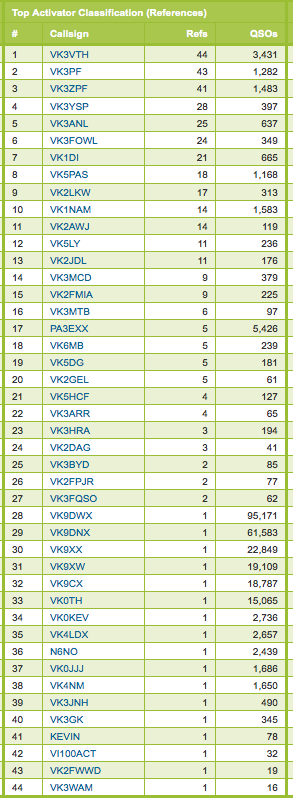
And here is a list of the top activators in the VKFF program.  Tony VK3VTH is the top activator with 44 different VKFF references, closely followed by Peter VK3PF on 43, and then Peter VK3ZPF on 41.

Screenshot 2014-12-09 21.27.59

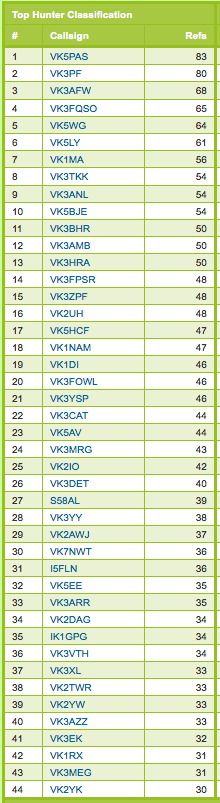
And a list of the top park hunters in the VKFF program.  Yours truly is at the top on 83 different VKFF references, but being closely followed by Peter VK3PF on 80, and then Ron VK3AFW on 68.

Screenshot 2014-12-09 21.28.04

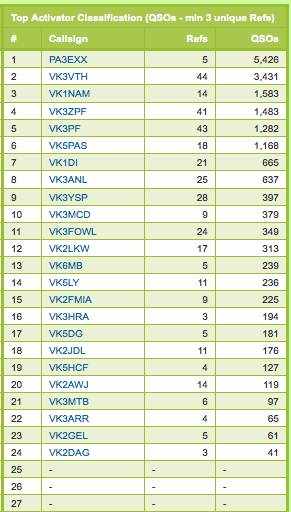
And finally, here are the top activators in the VKFF program (with reference to the number of QSOs)…..

Screenshot 2014-12-09 21.34.36

Many park activators are sending me their logs.  Sadly, many are not.

So, PLEASE, if you have activated an Australian National Park, send me your log.  Even if you are not chasing the WWFF awards, your log will benefit other amateurs.

And despite my best efforts to promote WWFF around Australia, it seems that the only active States are New South Wales, Victoria, and South Australia (the same three active States in SOTA).  So, if you are reading this from outside of those three States, why not give a park activation a go.  It is a lot of fun and very addictive, and yes, you escape from that terrible noise floor at home.  You can hear a pin drop.

NEW SOTA Challenge for 2015/2016

A few days ago the latest Summits on the Air (SOTA) Challenge was announced.  The previous challenge period 2013/2014 was the 12 m band.  In 2015/2016, the official SOTA challenge will be to make contacts on 6m and 10m.

SOTA_logo

See below for the rules which are similar for chasers and activators……

Chasers:
For every unique summit you chase on 10m or 6m you get a multiplier.
For every unique activator chased you get 1 chaser challenge point.
Your final score is chaser challenge points * multipliers.

Activators:
For every unique summit you activate on 10m or 6m you get a multiplier.
For every unique chaser worked you get 1 activator challenge point.
Your final score is activator challenge points * multipliers.

Duration: The challenge runs for 6months in total split into two separate 3 month periods. Each period coincides with the Sporadic E season in either the Northern or Southern Hemispheres. The first period runs from 15th May 2015 to 14th August 2015. The second period runs from 15th November 2015 to 14th February 2016. No matter where you live, you can operate in both periods but during 1 period your chances of make contacts are massively improved.

Certificates:  There will be certificates for the top chaser and activator.  There will be certificates for best chaser and activator on an association by association basis as well.  The final number of certificates awarded will be based on the activity levels.

Note:

1. The dates for the Southern SpE window are subject to adjustment.  It will be 3 months but the start and stop date may move to ensure we align with the peak SpE period.
2. We are aware that 6m may not be generally available in some countries. In that case you only need activate on 10m and your score will only be compared against other’s10m scores.

More information can be found on the SOTA reflector at…..

http://reflector.sota.org.uk/t/the-2015-2016-official-sota-challenge/9822

WWFF Activator certificate & DXFF Activator certificate

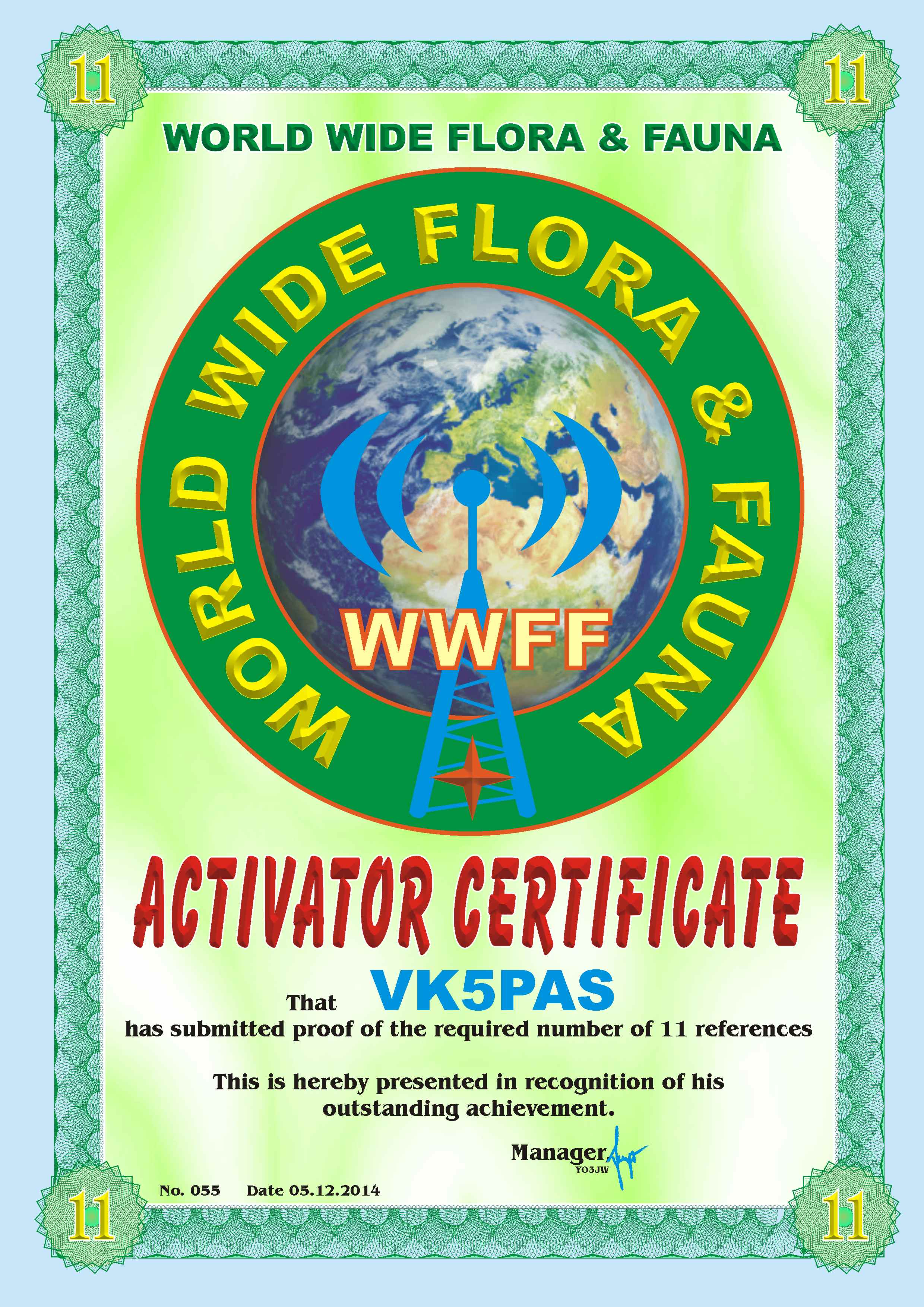
Thanks to Pit, YO3JW, I received the following World Wide Flora Fauna (WWFF) program certificates yesterday via e-mail…..

WWFF Activator certificate

This certificate verifies that I have activated at least 11 x WWFF reference areas (and obtained the required 44 contacts in each).

WWFF DXFF Activator certificate

This certificate verifies that I have activated 3 x references in 3 x different DXCC countries: Australia, Germany, & Belgium (from my recent trip to Europe).  When I go overseas again, I will try to activate some more WWFF parks in some different countries.

A 11 VK5PAS 2014 055

DXFF A3 VK5PAS 2014 025

birdlife AUSTRALIA and BIRDS IN BACKYARDS

I love getting out to the parks as most know.  I enjoy the fresh air, and the bushwalking aspect, as well as the radio.  One of my other interests whilst in the parks is birdwatching.  Of the feathered kind!  In any event, most of the parks I visit, aren’t frequented by the other type of ‘bird’.  Other than my wife occasionally.

When I was a little fella, my father bred finches and parrots, and that is where my interest started.  My first ever bird book was called Australian Birds, written by Robin Hill, that was released in 1967.  Mum and Dad bought me this book when I was about 5 years old, and I still have it to this day.

BMImg_13289_13289_Hill_Abirds_web

Anyway, back on track.  I joined the birdlife AUSTRALIA supporter network, and I now receive an electronic newsletter from birdlife AUSTRALIA.  It is well worth subscribing to.

logo

The birdlife AUSTRALIA wesbite can be found at…..

http://birdlife.org.au/

There is some fantastic information there and it is well worth a look.

I also registered at BIRDS in BACKYARDS, and I receive an electronic newsletter from them also.  Their website can be found at…..

http://www.birdsinbackyards.net/

Screenshot 2014-12-07 22.47.04

There is some terrific information on their website also.

So there you go.  If you are interested in bird watching like me, you may want to have a look at birdlife AUSTRALIA and BIRDS in BACKYARDS.


Ridley Conservation Park

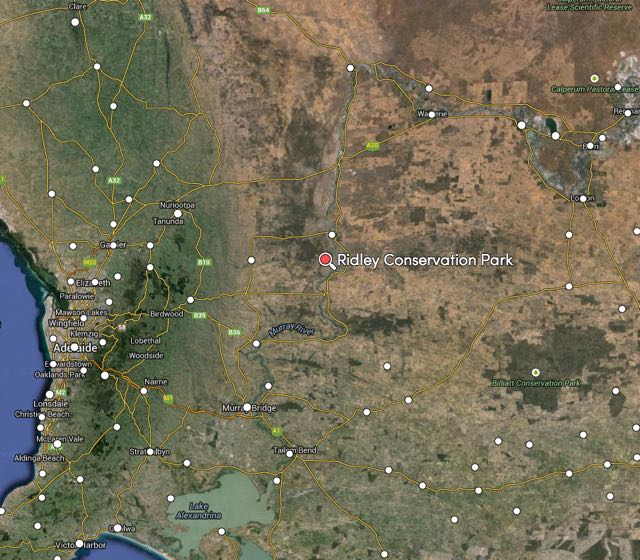
Following my activation at the Swan Reach Conservation Park, I headed towards Swan Reach township, and then travelled down to the Ridley Conservation Park (CP), which is located about 124 km north east of Adelaide, and about 13 km south of the town of Swan Reach on the River Murray.

Screenshot 2014-12-07 13.38.22

Map courtesy of mapcarta.com

The Ridley CP is located on the western side of the Mannum-Swan Reach Road (Murraylands Road).  It is a long narrow park, 10 km x 0.4 km, and covers an area of about 414.3 hectares.  The southern boundary of the park is on the edge of the valley of the River Marne.  This is the location of Hayward’s Hill, which is the highest point in the park.  About 35 % of the park comprises an open scrub of Red Mallee and Yorrell.  There are also some stands of Murray Pine and associated areas of shrubland dominated by Hop Bush and Cassias.  The remaining 65 % of the park comprises low open woodland of Native Apricot and False Sandalwood.  The understorey consists of Spear-grass and ephemeral herbs.

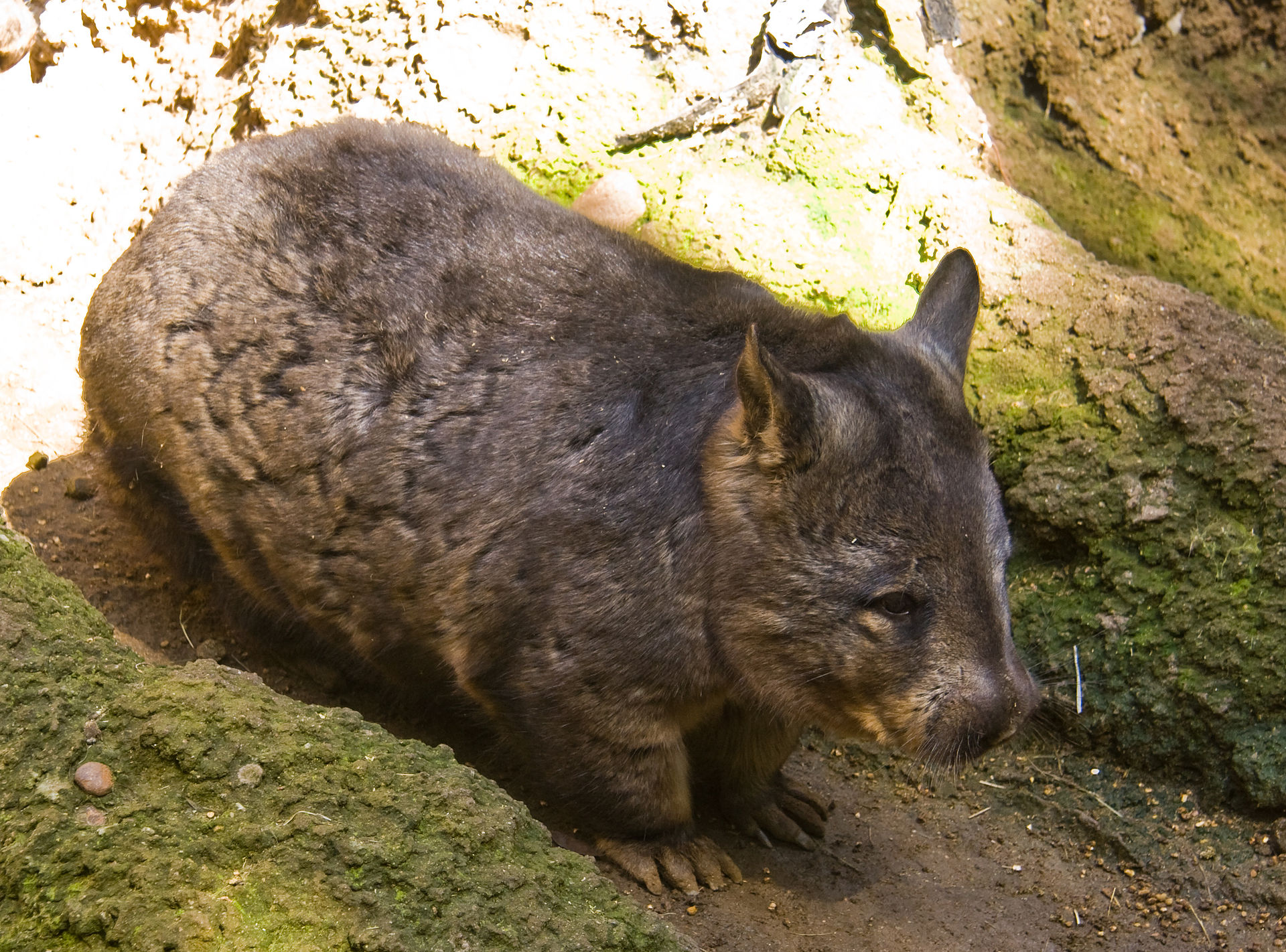
The park was originally set aside to conserve native vegetation and bird habitats.  Also, the open areas of the park include a number of warrens of the Southern Hairy-nosed Wombat.  Other native animals found in the park include echidnas, and Western Grey kangaroos.

Southern_Hairy-nosed_Wombat

Southern Hairy-nosed wombat.   Image courtesy of wikipedia.

I last activated this park in May, 2013.  For more information on that activation, please have a look at my previous post at…..

https://vk5pas.wordpress.com/2013/05/11/ridley-conservation-park/

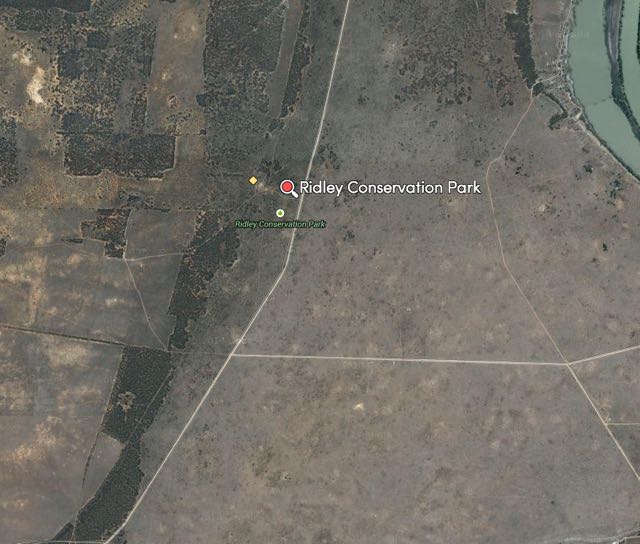
Screenshot 2014-12-07 13.38.13

Map courtesy of mapcarta.com

I set up just off the eastern side of Murraylands Road.  I had arrived at the park a little later than planned.  I was meant to be on air at 0700 UTC (5.30 p.m.), but it wasn’t until 0750 UTC that I was set up and ready to go.  It was still warm (I was in a t-shirt), but it was very dark and very windy.

As often happens, I asked if the frequency was in (I was on 7.095) and I was answered by the ever reliable John VK5BJE who advised the frequency was all mine.  This was followed by a call from John VK5FTCT in the southern suburbs of Adelaide, with a beautiful 5/9 signal.

Again, for this activation, I worked a handful of QRP operators.  The first of those was Nev VK5WG, at Crustal Brook running 5 watts from his X1M, and then Greg VK5GJ at Meadows, also running 5 watts.  And then Peter VK5NAQ at Balaklava in the Mid North, who was also running just 5 watts.

The strongest station worked was Paul VK7CC on the north coast of Tasmania, who had a great 5/9 plus signal (nearly 30/9).  Paul’s signal report for me was 10/9.

This slideshow requires JavaScript.

I had been on 7.095 for 35 minutes, chatting to stations in VK2, VK3, and VK5, when a couple of VK2 fellas decided they would come up on 7.093.  So that was pretty much the end of that.  They were causing just too much splatter and I was forced to wrap up my activity on 7.095.  I think it was a planned ‘sked’ frequency and they were not going to move for anyone, despite me hearing a station I had worked, asking them to QSY.  I lowered the squid pole and removed the links in the 40m/20m linked dipole, and had a listen on 20m.  I worked just 2 stations there.  They being JD1BOX on Ogaswara, and then Rich G0OWU at Wrens Nest in England.

It was starting to get a bit cool, and the wind was certainly not abating.  This combined with the fact that the sun was starting to set, meant that the wombats and kangaroos would now be getting active.  So I packed up the gear and headed home.  I had a total of 20 contacts in the log.

The following stations were worked:-

  1. John VK5BJE
  2. John VK5FTCT
  3. Nev VK5WG
  4. Greg VK5GJ
  5. Terry VK3UP
  6. Brian VK5FMID
  7. Arno VK5ZAR
  8. Ian VK5CZ
  9. John VK2AWJ
  10. Jeff VK5HEL
  11. Greg VK2QE
  12. Tom VK5FTRG
  13. Bruce VK2FBJM
  14. Ron VK2NZL
  15. Rob VK2DRB/m
  16. Damien VK5FDEC
  17. Paul VK7CC
  18. Peter VK5NAQ

The following stations were worked on 20m SSB:-

  1. JD1BOX
  2. Rich G0OWU


References.

National Pakrs and Wildlife Service, 1984, ‘Conservation Parks of the Murraylands (Western Plains) Management Plans’