On Friday evening (18th Oct 2013) I drove down to the beach at Corny Point and set up my gear, hoping to get some contacts on the 7130 DX Net. It was a really warm evening, so shorts & t-shirt & thongs were in order. I found a nice little parking spot on Lighthouse Road, which had some steps leading down to the beach. There were no issues with lighting, as there was a full moon. The beach was beautiful and sandy and there was just a very gentle breeze coming in off the Spencer Gulf. Everything seemed to be perfect…so what about propagation conditions ?
After setting up the 40m/20m linked dipole on the 7m squid pole, I turned the 817nd on, and the signals coming in from the 7130 DX Net were very strong. The noise floor was virtually non existent, so I decided to give the 2.5 watt setting a go. And it paid off, as people were hearing my little QRP signal.
I had a few very interesting QSO’s during the evening on the DX Net. They included Wolfgang VK2LKW who was operating portable from the Deua National Park in New South Wales (5/9 both ways); special call ZM90DX (5/9 S and 5/2 R); Brian ZL2ASH (5/9 S and 5/7 R); and Rod VK4FLYT who was running QRP 3 watts (5/8 S and 5/4 R).
Below is a photo taken during the day (the following morning) of where I operated from.
After the 7130 DX Net closed, I decided to go up to 20m and have a quick listen in on the Southern Cross DX Net. Again signals were strong so I decided to check in, bumping my power up to 5 watts. I managed to make contact with Larry W4VES (5/9 S and 5/2 R), and Bill W1OW (5/9 S and 5/3 R).
During my 2 enjoyable hours on the beach, I had managed 15 QSO’s in total on 40m SSB and 20m SSB.
I worked the following stations:-
Mal VK5MJ; Wolfgang VK2LKW/p (Deua NP); ZM90DX; Brian ZL2ASH; Andy VK4TH; Shaun VK5FAKV; Rod VK4FLYT (qrp 3 w); Roy VK7ROY; Paul VK5FUZZ; Frank VK3GFS; Iva VK4HG; Steve VK2MD; Greg VK2XE; Larry W4VES; and Bill W1OW.
On Sunday 13th October, 2013, David VK5KC and I set up an amateur radio display at the Port Elliot Show on the Fleurieu Peninsula, south of Adelaide. This was the 135th year of operation of show. The first show was held at Middleton and shows were run at various venues along the south coast for the next twenty years. In 1889 the Society purchased a plot of land near Port Elliot and annual shows have been held there ever since, with the exception of the Second World War and one other year.
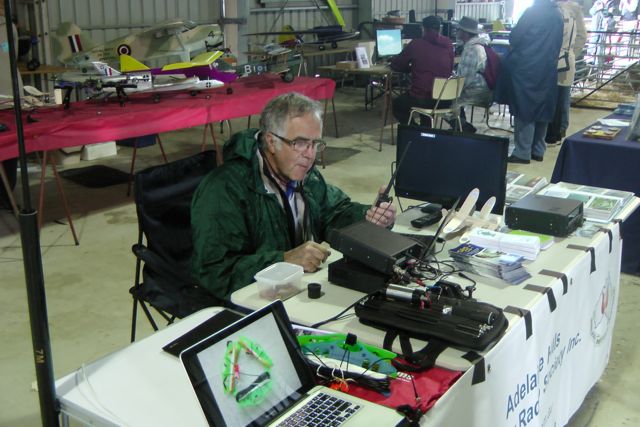
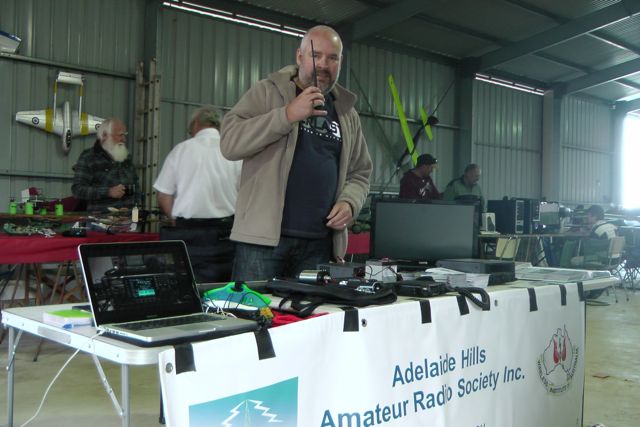
We set up a small display in the Perry Hall, which included a Yaesu FT-817nd, a Yaesu FT-450, an Icom 706, and a Yaesu VX-6R. We also had a few portable antennas on display, along with some digital modes, and a laptop showing a slideshow of amateur radio photographs. We also had the WIA’s promotion brouchures ‘Calling CQ’ and some newly printed AHARS brochures.
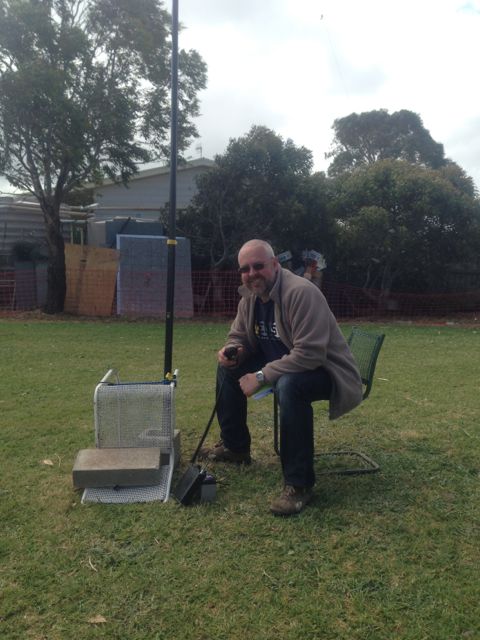
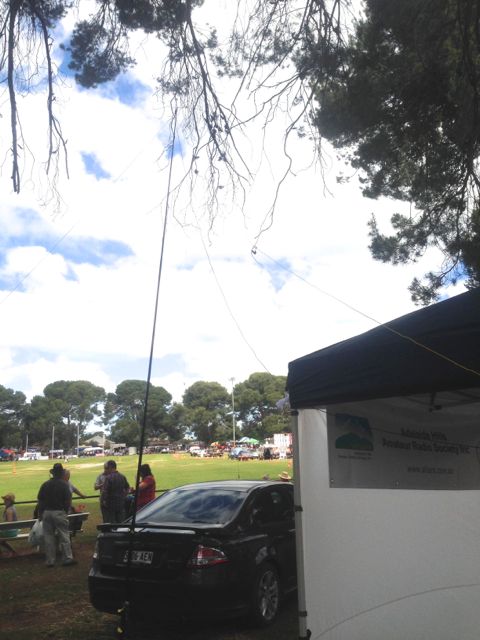
Once the weather cleared, we also improvised and set up the FT-817nd outside of the hall, alongside the dog obedience area. A nearby collection of ‘junk’ produced a heavy metal chair and some heavy pavers and besser blocks which we used to secure the 7m squid pole and the legs of a 40m/20m linked dipole.
We were joined in the afternoon by young 15 year old Andrew VK5FACE. Congratulations are in order for Andrew for volunteering some of his time. Andrew enjoyed his time making a number of contacts, on 40m SSB with some interested onlookers.
Despite some very inclement weather and a not so favourable position in the show grounds, we still managed to attract some attention, with some very interested visitors to the display.
The following stations were worked by Andrew:-
Barry, VK3LBW; Den VK3FDAS; Graham VK3GRK; Frank VK3GFS; Larry VK5LY; Craig VK3CRG; Brian VK5FMID; Kevin VK3VEK; Alan VK5AR; Grant VK3GRR; and Gordon VK3EJ.
My last activation of the day was the Yulti Conservation Park, which is located about 3 km south east of the town of Myponga.
After my activation at Nixon Skinner CP, I drove back into Myponga, and then along James Track and onto Springmount Road, and then onto Trigg Point Road. But I was really struggling to find access to the park. My maps showed Cooper Road leading to the southern side of the park. But in reality, the spot where Cooper Road was showing on the GPS was a farmer’s paddock. Fortunately when I doubled back to that location, a farmer came along in his tractor, and I had a chat with him. He was a sharefarmer with not much local knowledge, so I obtained his boss’s phone number and I called him. After some friendly help and directions, I travelled back towards Myponga along James Track, and I then turned right into Yulte Road. Yulte Road will take you up to the park entrance which is part of the Heysen trail.
Yulti Conservation Park is 41 hectares in size and is a small preserve of habitat representative of the central Fleurieu Peninsula. The park consists of steep, hilly terrain vegetated with open forest of Eucalyptus Baxteri and other vegetation in the valleys. There is also scrub / heath on the ridges and the understorey is typically a dense heath dominated by various plants including the Casuarina species, with Banksia Ornata confined to the ridges. Panoramic views of the surrounding valley and range country can be seen from the high sections of the walk following a section of the Heysen Trail.
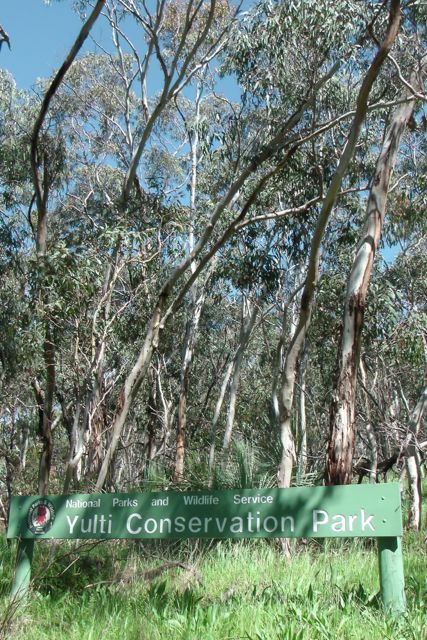
Yulti Conservation Park is recorded in various sources with various spellings. Even the Government authorities seem unsure of the spelling. The DEWNR website records the spelling as Yulte, and yet the sign in the park shows the spelling to be Yulti. The road leading to the park is spelt as Yulte. Unfortunately I have not been able to find out the meaning of Yulte or Yulti.
The track leading up to the park was quite rough with plenty of large rocks and numerous washaways, so I drove as far as I could, and then I walked the remainder of the way. Fortunately only a short distance of about 100 metres.
Numerous bird species are found in the park including the Beautiful Firetail finch which has a rump of bright red. My father used to breed these when I was a child. Western Grey Kangaroos are also common in the park.
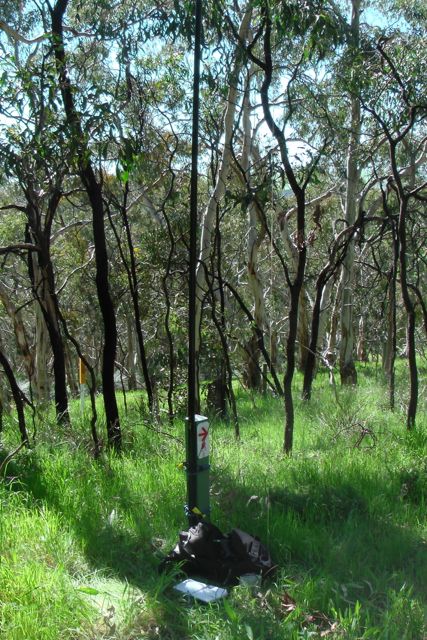
I strapped the 7 metre squid pole to a Heysen trail sign and ran out the legs of the 40m/20m linked dipole. I made myself comfortable and tuned to 7.100 and there was my faithful ‘Hunter’, Col VK5HCF waiting for me. This was followed by another staunch VK5 Parks supporter, Larry VK5LY. My third contact was with Tim VK5AV, who has also become a recent active Parks Hunter. Colin VK3UBY and his wife Sandra who are also big supporters of the VK5 Parks Award, also called in to say hello.
Conditions on 40m were very variable. And sadly I wasn’t getting a lot of takers, so I tuned across the band and came across Grant VK3HP and a group of gents on 7.095. This included Peter VK3YE who was operating QRP 2 watts, on a beach in Melbourne (5/3 both ways).
After 45 minutes of operating, I had managed 14 QSO’s on 40m SSB into VK2, VK3, & VK5.
The following stations were worked:-
Col VK5HCF; Larry VK5LY; Tim VK5AV; Allen VK3HRA; Peter VK3PF; Grant VK3HP; Ian VK3VIN; Peter VK3YE/p; Scott VK7NWT; Greg VK2FGJW/p; Colin VK3UBY; Sandra VK3LSC; Frank VK3GFS; and Ron VK5MRE.
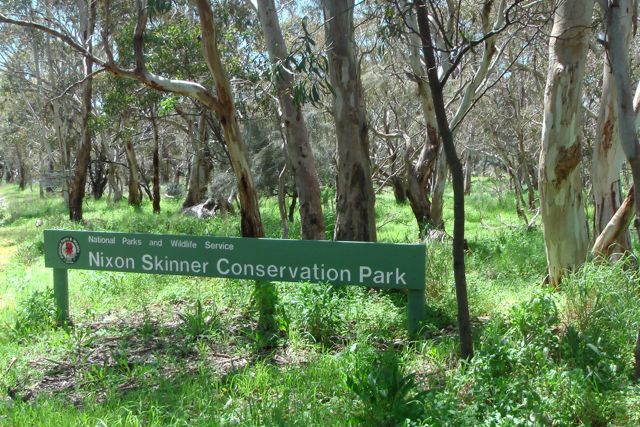
My next activation of the day was the Nixon Skinner Conservation Park, which is situated about 5 km south of Myponga, on the Fleurieu Peninsula, and about 60 km south of Adelaide.
From Stipiturus CP, I travelled along Pages Flat Road, and into the beautiful little town of Myponga which is the hub of lush grazing and dairy country. The name derived from the Aboriginal word maippunga meaning locality of high cliffs. Myponga was the venue for the first Australian performance by leading British heavy rock group Black Sabbath during the Myponga Music festival in 1971. Prior to this festival the town’s leading claim to fame was the 1953 discovery of a uranium ore deposit at Wild Dog Hill. Myponga is also the home of the Smiling Samoyed Brewery which is a small unique brewery. As I drove passed the brewery it was very tempting to drop in. The day was warm, about 30 deg C, so a schooner of ale would have been nice. But I travelled south out of Myponga along Main South Road for about 5 km until I reached Nixon Skinner CP, which is on the western side of the road.
The Nixon Skinner CP comprises of 8 hectares of native vegetation, and is situated towards the southern end of the Myponga Reservoir. The park is set off the road, so the sign is only visible once you take a small access road off the western side of Main South Road.
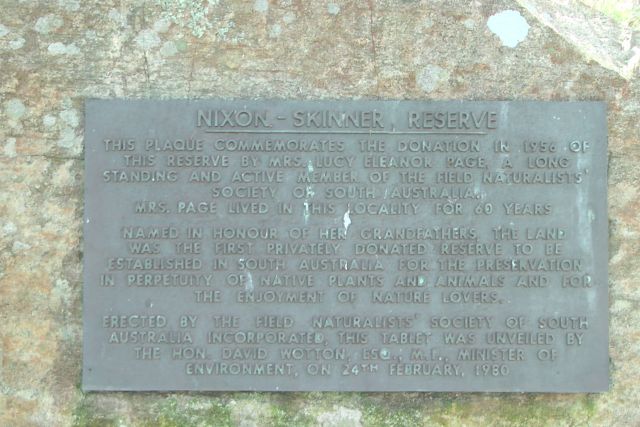
In 1956 Mrs. Lucy Eleanor Page, a long standing and active member of the Field Naturalists Society of South Australia, donated the land. The park was named in honour of her grandfathers and was the first privately donated reserve to be established in South Australia for the preservation in perpetuity of native plants and animals and for the enjoyment of nature lovers.
I set up about 20 metres inside the park boundary, and used the western boundary fence to secure the squid pole. I placed the Yaesu FT-817nd up on top of a nearby permapine post and tuned to 40m. My first contact was with Col VK5HCF who is a staunch supporter of the VK5 Parks Award.
During my time in the park I worked two more SOTA stations. The first was Tony VK3CAT who was portable on Talbot Peak, VK3/ VT-010. And my second QSO was with Glenn VK3YY who was portable on Mount Useful, VK3/ VT-016.
After the activation, I went for a walk through the park and enjoyed the picturesque views of the Myponga Reservoir, which is fed by the Myponga River and other rivers in the Myponga Catchment Area. It provides about 5 % of Adelaide’s water supply and is the main source of filtered water for southern metropolitan Adelaide and the south coast area. There is a nice bitumised track to walk along from Main South Road, down to the reservoir.
After an hour in the park I had 16 contacts in the log from VK1, VK3 & VK5 on 40m SSB.
The following stations were worked:-
Col VK5HCF; Tony VK3CAT/p (SOTA); Glenn VK3YY/p (SOTA); Larry VK5LY; Tim VK5AV; ALlen VK3HRA; Peter VK3PF; David VK5NQP; Ian VK5IS; Bernard VK3AMB; Greg VK3HBM; Peter VK3TKK; Duncan VK3XBC/1; Ben VK3FTRC; Barry VK3BJM/m; and Barry VK5BW.
On Saturday morning 13th October, 2013, I headed out to activate 3 parks on the Fleurieu Peninsula, south of Adelaide. The next day on Sunday I had a commitment at the Port Elliot show with an amateur radio display, so I booked in overnight at the Middleton Caravan Park so I didn’t have to journey back home to the Adelaide Hills.
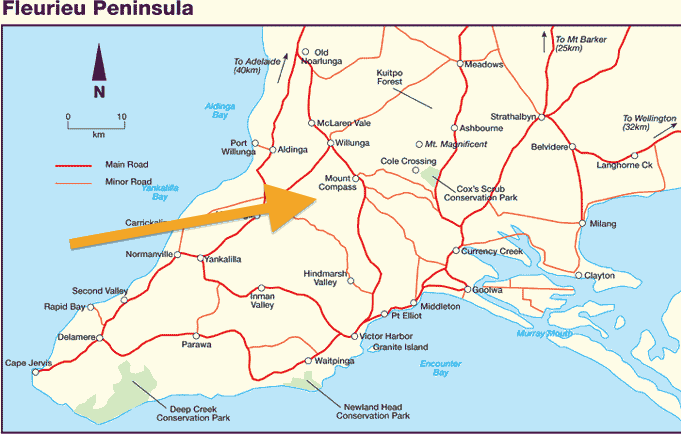
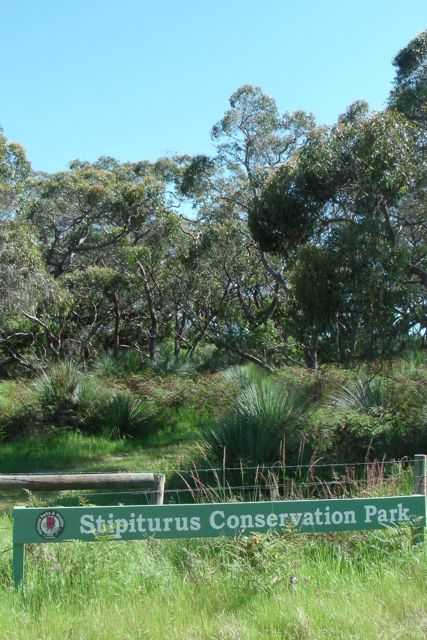
My first activation was the Stipiturus Conservation Park which consists of 68.13 hectares and is situated about 50 kilometres south of Adelaide and six kilometres west-south-west of the nearest town, Mount Compass.
Purchased with support funding from the Natural Heritage Trust and Nature Foundation Inc, the park was proclaimed on 14 December 2006 under the National Parks and Wildlife Act 1972, without access under State mining legislation.
Stipiturus Conservation Park protects a high conservation value wet heath/sedgeland peat bog ecosystem, known as Glenshera Swamp (the largest remaining peat swamp on the Fleurieu Peninsula), with over 64% of native plants in and around the swamp having regional and/or state conservation ratings. The park contributes to the conservation of the first registered nationally threatened ecosystem found solely in South Australia, the ‘Swamps of the Fleurieu Peninsula’, and is home to one of the largest known swamp-based population of the nationally endangered Mount Lofty Ranges Southern Emu-wren (Stipiturus malachurus intermedius), after which the park was named.
Less than one percent of the permanent wetlands of the Mount Lofty Ranges still remain. These wetlands once covered much of the Myponga and Mt Compass area, but are now cleared and drained for grazing. Hence, in 2003 the swamps of the Fleurieu Peninsula were listed by the Australian Government as a critically endangered ecological community under the Environment Protection and Biodiversity Conservation Act 1999.
Stipiturus Conservation Park protects the largest remaining intact peat swamp ecosystem on the Fleurieu Peninsula, which provides habitat for the largest swamp-based population of the nationally endangered Mount Lofty Ranges Southern Emu-wren (Stipiturus malachurus intermedius).
Over 65 species of birds have been recorded in the park, four of which are of conservation significance, including the Mount Lofty Ranges Southern Emu-wren. These are a little insectivorous bird which are relatively poor fliers that tend to hop, flutter, and scramble their way through their habitat. At least two native mammals inhabit the park including the Southern Brown Bandicoot and the Western Grey Kangaroo.
I drove from home out through Echunga and Meadows and then along the Brookman Road towards Willunga. I then took Pages Flat Road heading towards Myponga, and turned left into Apple Grove Road and then Saffrons Road. I accessed the park on its southern side, off Saffrons Road. The park is well sign posted with a locked gate.
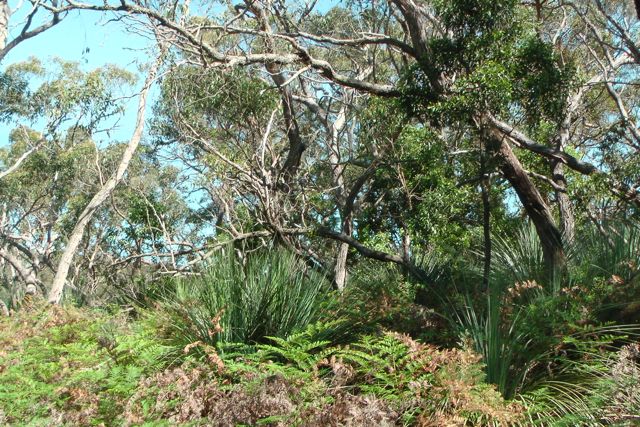
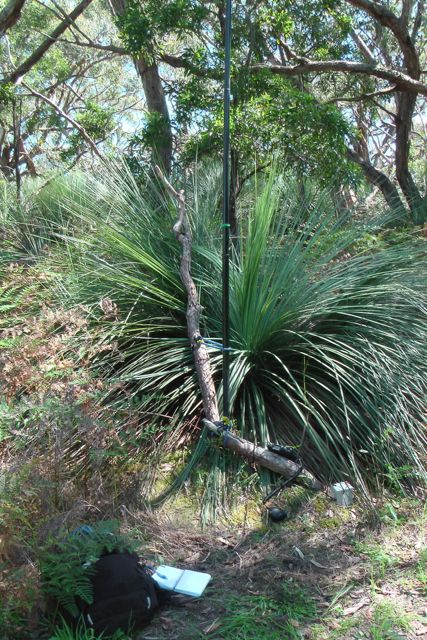
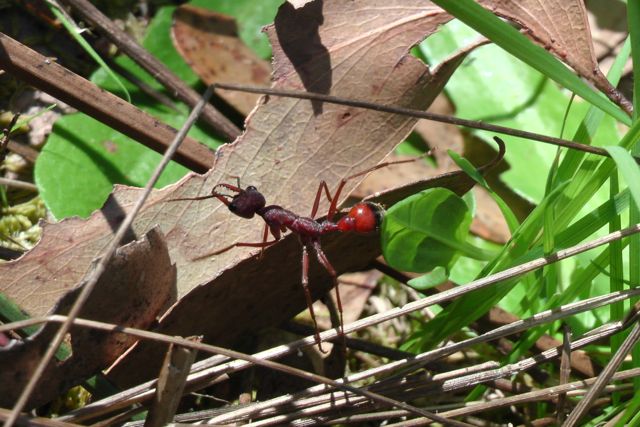
There is a track leading through the scrub down to the swamp area. The track in parts conveniently runs north – south, so I decided that was the spot where I would set up. Certainly the scrub was way too thick to extend the squid pole and it was a warm day and I did not fancy sitting in amongst the scrub with the ‘Joe Blakes’ (snakes). During the morning my only unwelcome visitors fortunately were some very big ants. I used a fallen gum tree limb to secure the squid pole with some octopus straps.
Although I didn’t see any of the little Southern Emu wrens, I did see a variety of other birds including Superb Blue Wrens, Red Wattlebirds, and Adelaide Rosellas.
My first QSO in the park was with Ben VK3FTRV who was running just 5 watts (5/4 both ways). This was followed by Terry VK3UP who was portable at Lorne and running just 4.5 watts (5/3 both ways). I managed three Summits on the Air (SOTA) contacts whilst in the park. The first SOTA contact was with Glenn VK3YY who was portable on Mount Selma, VK3/ VT-013. I then spoke with Ed VK2JI who was portable on Mount Elliot VK2/ HU-093. And my third SOTA contact was with Mark VK3PI who was portable on Mount St Leonard, VK3/ VC-006.
Conditions on 40m SSB were not all that great, but after an hour of sitting in the park I had 15 contacts in the notebook from VK2, VK3, & VK5.
The following stations were worked:-
Ben VK3FTRV/qrp; Terry VK3UP/qrp; Ron VK3AFW; Tim VK5AV; Nick VK3ANL; Glenn VK3YY/p (SOTA); Peter VK3PF/qrp; Ed VK2JI/p (SOTA); Fred VK3JM; Col VK5HCF; Peter VK3ZPF; Allen VK3HRA; Shaun VK5FAKV; Larry VK5LY; Mark VK3PI/p (SOTA).
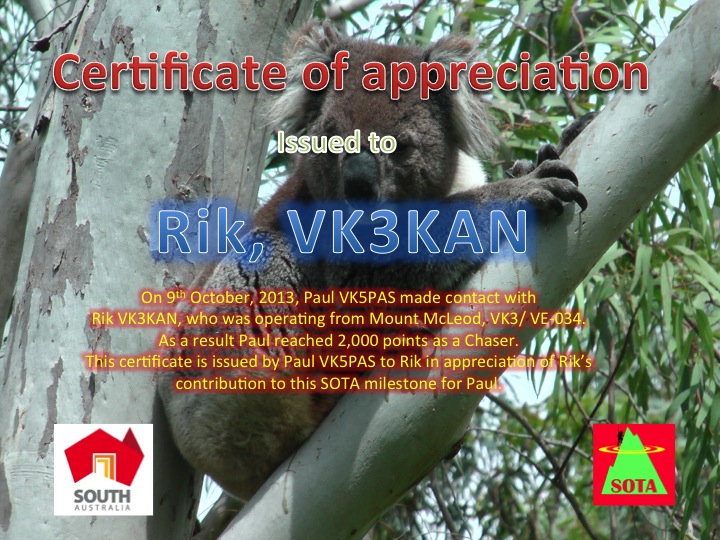
Today as a result of working Rik VK3KAN on 3 occasions, I surpassed the 2,000 point mark as a SOTA Chaser.
Unfortunately I missed Rik on his last activation. I was out the back cleaning out the shed, when the SOTA Goat bleated at me. So I was hurriedly on my way inside when the phone rang. By the time I got off the phone, and to the radio 15 minutes later I learnt that Rik had left the summit due to poor weather. But at least I worked Rik from 3 of his 4 SOTA activations today. Well done Rik on your efforts.
It seemed like only yesterday that I had reached Shack Sloth level (29th June, 2013). The last 1,000 points have certainly come very quickly in the past 4 months, with all the SOTA activations every weekend, and even during the week nowadays.
I made up the certificate below for Rik, and will mail this off to him in the next day or two. Just to say thanks for being a part of one of my SOTA milestones.
On Monday 8th October, 2013, with Rod VK5KFB and Steve VK5AIM, I attended the Strathalbyn Agricultural Show, which is a typical country show. We set up a small amateur radio display at the show on the edge of the oval under a marquee.
The display included a Yaesu FT-817nd, Steve’s portable Yaesu station, a Yaesu VX-6R hand held, a Hi Mound CW key, a selection of QSL cards, a selection of amateur radio awards, some portable antennas, and promotional material.
We did put up a 40m/20m linked dipole supported on a 7m squid pole secured to the tow bar of my car, and tried our luck on 40m, but the noise floor was S8-9, so that put a halt to any contacts. Unfortunately there were so many nearby generators running, and power lines, that it made any radio activity impossible.
During the day between about 10.00 a.m. – 4.00 p.m. we had about 25-30 people visit the marquee and collect some promotional material on the hobby of amateur radio, and chat with us. Many of these seemed genuinely interested in obtaining their amateur radio licence. So here’s hoping a few more amateurs join our ranks.
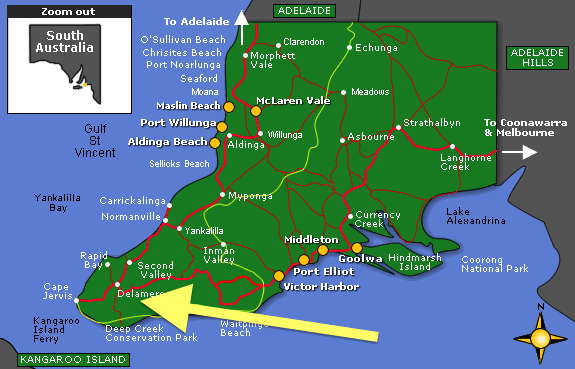
On Sunday morning, 6th October, 2013, I headed down to the Fleurieu Peninsula for the 1 year VK5 Summits on the Air (SOTA) anniversary. My wife and I had been to a wedding on Saturday, so we were both moving a bit slowly on the Sunday morning. A wholesome Maccas meal was our start of the day after leaving the motel in Adelaide where we had stayed the night. We then headed down Main South Road through the southern suburbs of Adelaide, and then down to the beautiful Fleurieu Peninsula through the towns of Myponga, Yankalilla, Normanville, and Delamare.
I was intending to activate 2 summits near Melrose in the southern Flinders Ranges, however I had overbooked with the wedding, and I did not want to do the 300 km drive north on Sunday morning with a ‘hangover’. So I settled on VK5/ SE-016 which is situated near the little town of Delamare, about 100 km south of Adelaide. It is a 1 point SOTA summit.
The Fleurieu Peninsula is located south of Adelaide and was named after the French explorer and hydrographer Charles Pierre Claret de Fleurieu by the French explorer Nicolas Baudin as he mapped the south coast of Australia in 1802.
After entering the sleepy hollow of Delamere, I turned left onto Range Road, and then right onto Dog Trap Road. About 4 km along Dog Trap Road, you reach the intersection with Three Bridges Road, and Tent Rock Road. This is the location of the summit which is the highest point on the Fleurieu Peninsula. The trig point is located in a farmer’s paddock, on the eastern side of Tent Rock Road, just slightly south of Three Bridges Road.
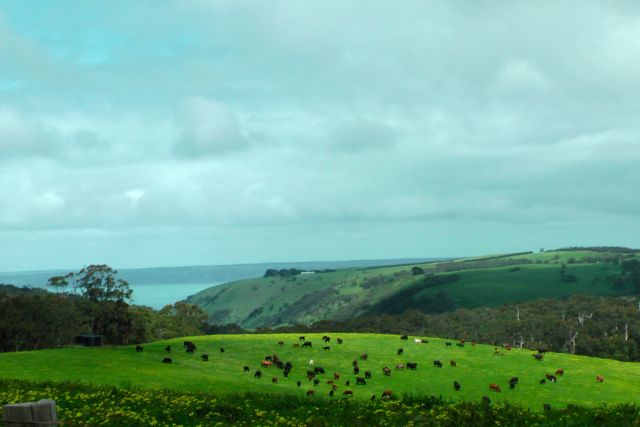
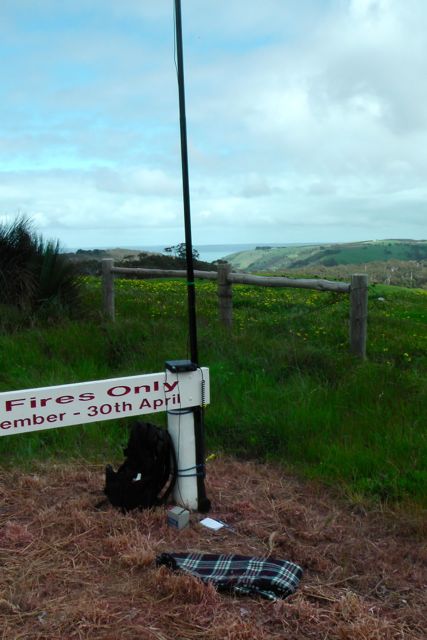
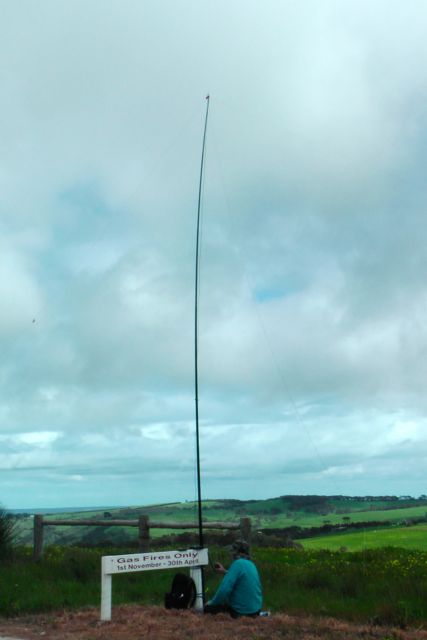
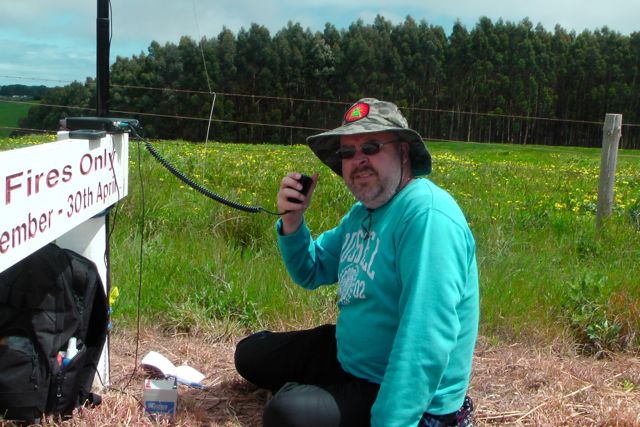
I managed to get to the summit about 20 minutes before the UTC rollover, so I quickly set up my gear, right alongside of Tent Rock Road. I strapped the squid pole to a wooden fire ban sign using a couple of octopus straps. Tent Rock Road is a dirt road which runs into the nearby Deep Creek Conservation Park, and it conveniently runs north and south, so I strapped the legs of the dipole to the farmer’s fence on the western side of the road, so the antenna was propagating east-west. There was a large amount of traffic travelling passed me on their way to Deep Creek CP, and I got quite a few strange looks as I sat on a blanket on the ground alongside the fire ban sign. Next time I activate this summit and it is a busy public holiday or weekend, I will definitely bring some headphones. It was very noisy with the passing traffic.
After setting up, I quickly turned the radio on with about 10 minutes before the UTC rollover, to find the 40m band extremely busy with lots of SOTA Activators and Chasers. So I tuned to 7.105 and put out a call to be greeted by Roy VK5NRG with a good strong signal. Ed VK2JI/5 who was portable on Mount Lofty summit VK5/ SE-005 was my 2nd contact. Well done to Ed for travelling to South Australia for the anniversary. This was followed by Tony VK3CAT with an excellent 5/9 plus signal. I continued to call for a while on 7.105, but sadly no one came back, so I tuned around the band hoping to get a 4th contact before the new UTC day. On 7.090 I heard Al VK1RX/2 who was on Livingstone Hill, VK2/ SM-093 so I gave him a shout (5/7 S and 5/5 R).
I then sat on 7.085 and worked a further 5 stations before the UTC rollover:- Ernie VK3DET, Ron VK3AFW, Peter VK3FPSR, Craig VK5LI, and Peter VK3PF.
After the UTC rollover I worked a further 33 stations on 40m SSB. This included a total of ten Summit to Summit contacts with Ian VK5CZ/p on Mount Horrocks VK5/ SE-012; Al VK1RX/2 on Livingstone Hill VK2/ SM-093; Andy VK5LA/p on Cone Hill VK5/ SE-002; Allen VK3HRA/p on Mount Sarah VK3/ VE-032; Andrew VK1DA/p on Mount Cowamgerong VK2/ ST-001; Col VK5HCF/p on Mount Burr VK5/ SE-019; VK2IB/p on Mount Jergyle VK2/ RI-004; Marshall VK3MRG/p on Mount Sarah VK3/ VE-032; and Matt VK1MA/p on Devil’s Peak VK2/ ST-003 (on both 40m & 20m).
I also spoke with Peter VK3YE who was pedestrian mobile on the beach in Melbourne. Peter had a good 5/5 signal and was a very nice copy as always with his pedestrian mobile set up. And I had a second pedestrian mobile contact, this time with Perrin VK3XPT. Although Perrin’s signal was much lower (just 5/3) he was still very readable.
And I also received a call from Terry VK3UP/p who was portable in Great Otway National Park (5/6 both ways).
I also had a few QRP callers including Peter VK3FPSR, Bernard VK3AMB, Ron VK3AFW, and Roger VK5NWE. All of whom had great signals. The noise floor was very very low so I could hear a pin drop (other than the traffic noise).
I then QSY’d to 20m and was hoping to get some contacts into VK6 & VK4. And to my pleasure, my first contact was with Mike VK6MB. This was followed by Matt VK2DAG, John VK7XX with his normal booming signal, Ian VK1DI, Mike VK4MRB, Neville VK2SF, and Matt VK1MA/p who was Devil’s Peak VK2/ ST-003.
Thanks to John VK7XX who placed me on the DX cluster. Sadly I did not receive any DX calls. Although I did hear lots of USA activity with the Oceania DX Contest.
The following stations were worked before the UTC rollover on 40m SSB:-
Roy VK5NRG; Ed VK2JI/5 (SOTA); Tony VK3CAT; Al VK1RX/p (SOTA); Ernie VK3DET; Ron VK3AFW; Peter VK3FPSR; Craig VK5LI; and Peter VK3PF.
The following stations were worked after the UTC rollover on 40m SSB & 20m SSB:-
Peter VK3PF; Peter VK3YE/pm; Andy VK5AKH/p; Andrew VK1NAM/m3; Peter VK3FPSR; Bernard VK3AMB/qrp; Ron VK3AFW/qrp; Tim VK5AV; Colin VK3UBY; Ernie VK3DET; Tony VK3CAT; Roy VK5NRG; Shaun VK5FAKV; Perrin VK3XPT/pm; Nev VK5WG; Ian VK5CZ/p (SOTA); Larry VK5LY; Al VK1RX/2 (SOTA); Andy VK5LA/p (SOTA); Scott VK7NWT; Mal VK7XS; Allen VK3HRA/p (SOTA); Terry VK3UP/p (KRMNPA); Andrew VK1DA/p (SOTA); Col VK5HCF/p (SOTA); VK2IB/p (SOTA); Brian VK5FMID; John VK5TD; Roger VK5NWE; Trevor VK5ZTJ/m; Marshall VK3MRG/p (SOTA); Matt VK1MA/2 (SOTA); Ivan VK5HS/m; Mike VK6MB; Matt VK2DAG; John VK7XX; Ian VK1DI; VK4MRB; Neville VK2SF; and Matt VK1MA/2 (SOTA).
I have added a video to You Tube of the activation…..
A recent thread on the SOTA Yahoo site regarding propagation between VK5 & VK2, prompted me in checking my SOTA stats. It was really quite interesting. Here’s what I found…..
CHASER
Total of 1,882 Chaser points.
Total of 411 SOTA QSO’s as a Chaser.
Total of 189 unique summits chased
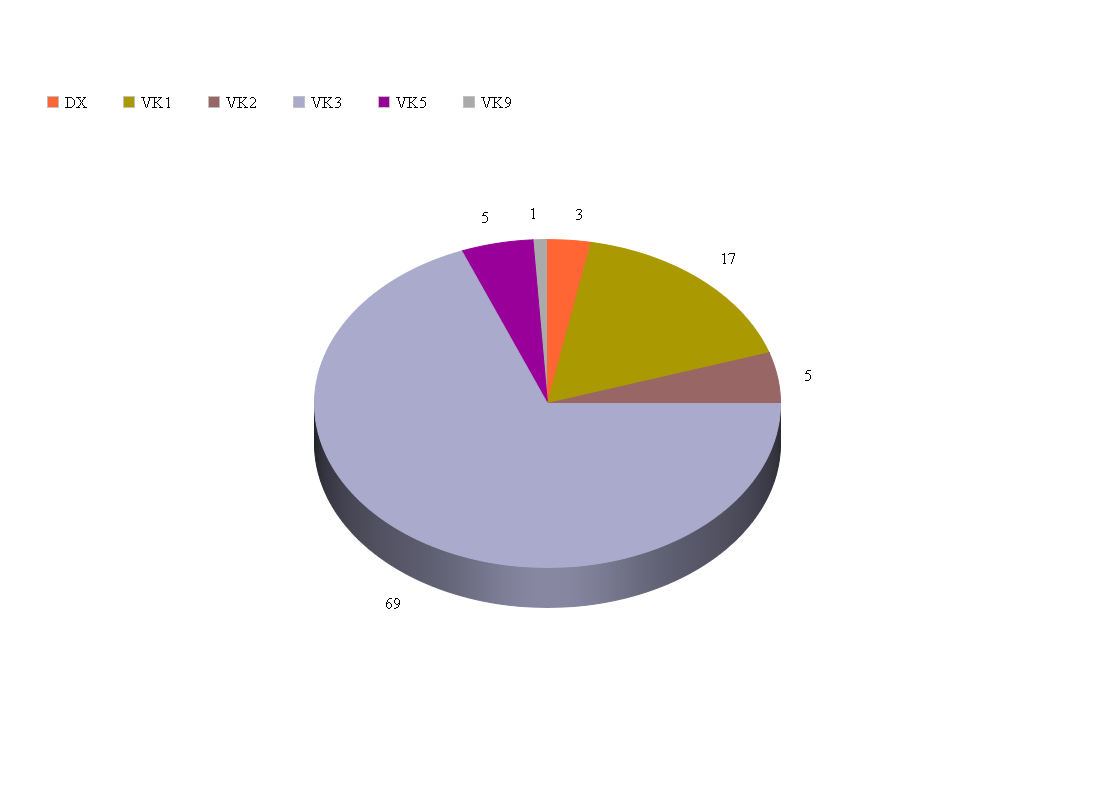
13 x DX QSO’s (UK & Europe)
71 x VK1 QSO’s
22 x VK2 QSO’s
283 x VK3 QSO’s
19 x VK5 QSO’s
2 x VK9 QSO’s
DX 3 %
VK1 17 %
VK2 5 %
VK3 69 %
VK5 5 %
VK9 1 %
My top Chased Activators
Allen VK3HRA
Wayne VK3WAM
Peter VK3PF
Andrew VK1NAM
Marshall VK3MRG
Peter VK3ZPF
Mitch VK3FMDV
Al VK1RX
Brian VK3MCD
Ron VK3AFW
Most worked VK1 Activator
Andrew VK1NAM
Most worked VK2 Activator
Ed VK2JI
Most worked VK3 Activator
Allen, VK3HRA
Most worked VK5 Activator
Ian VK5CZ
My first ever SOTA contact was with Mike, 2E0YYY, and since that time I have worked a further 12 DX activators in Europe and the United Kingdom.
The stats showed that propagation between my qth in the Adelaide Hills to VK1 & VK2 appears to be quite good. This is considering that VK1 has been an active Association for a short period of time, and VK2 even less.
Sadly there are not too many Activators in VK5 South Australia. This may have a lot to do with the fact that many of the summits here require a significant amount of travel from the major population base in Adelaide. Having said that, there are still at least 3 summits in close proximity to Adelaide. The lack of activity has not been as a result of publicity. Both myself and Ian VK5CZ have been active in promoting SOTA here in VK5.
Unfortunately, despite hearing them on a few occasions, I am yet to work any of the VK4 Queensland activators.
ACTIVATOR
Total of 147 Activator points
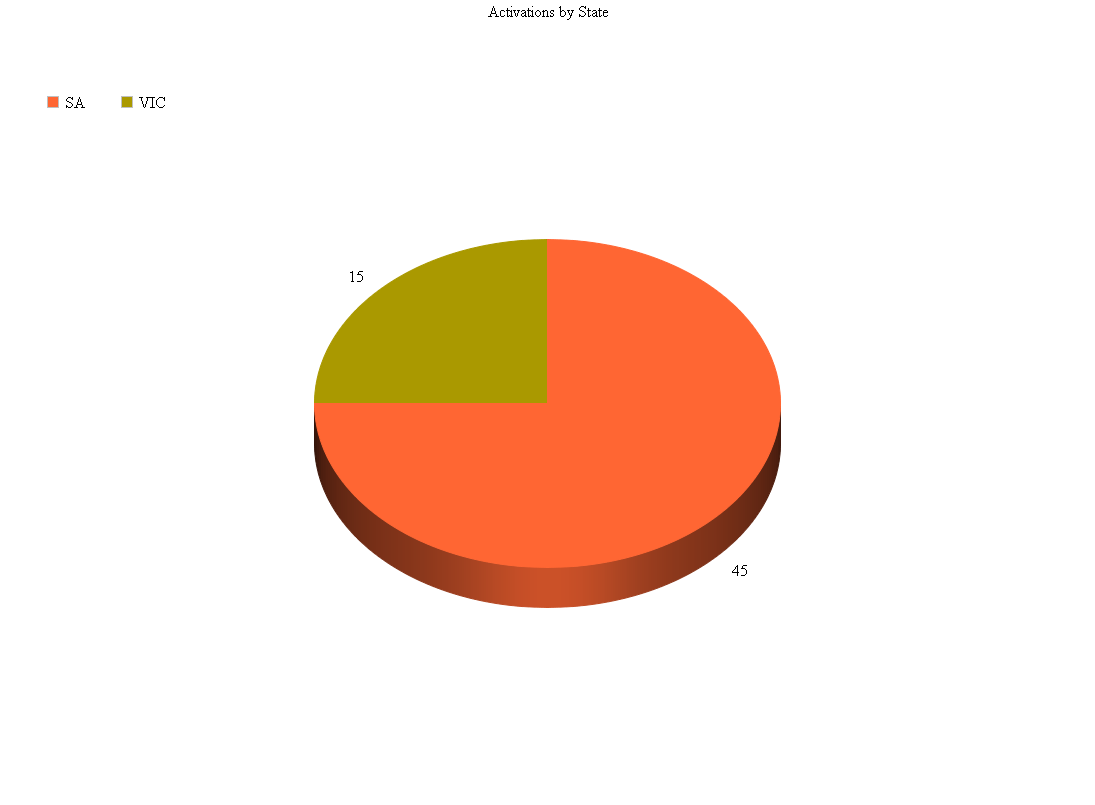
Total of 60 activations.
45 x activations in South Australia
15 x activations in Victoria
Total of 48 unique summits (in VK3 & VK5)
My top Activation Chasers.
Ernie VK3DET
Peter VK3PF
Brian VK5FMID
Peter VK3FPSR
Col VK5HCF
Ed VK2JI
Tony VK3CAT
Ron VK3AFW
Larry VK5LY
Rhett VK3GHZ
I only commenced activating SOTA peaks in March, 2013. My first ever activation was VK5/ SE-016, on the Fleurieu Peninsula, south of Adelaide. Since then I have activated a total of 48 unique summits.
The Victorian fellas have been the primary chasers when I have been on top of a hill. However there has been a core group of VK5’s including Brian VK5FMID, Col VK5HCF and Larry VK5LY.
I have been privileged to work a significant amount of DX in Europe, the United Kingdom, the USA, and the Carribean, whilst I have been on the top of a summit.









 VK5PAS