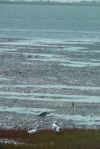
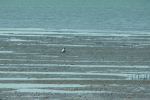
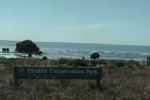
Carribie Conservation Park

On Saturday morning, 28th March, Marija and I awoke to the sounds of noisy galahs and a beautiful sunrise.  We cooked up a hot breakfast of bacon and eggs, and enjoyed a nice hot cup of coffee and sat outside on the verandah of the old Post Office at Inneston, taking in the view.  We then packed the 4WD and got on the road and headed for my first proposed activation of the day, Point Davenport Conservation Park.  However, everything went downhill from here.

This slideshow requires JavaScript.

We could not find the park.  In fact we drove around aimlessly for numerous hours trying to find our way in.  What we did find was that the GPS in the Toyota Hilux and the mapping system on our i-phones were unreliable.  Many roads were marked on the maps, but when we reached that particular location, no road existed.  Also, a number of the roads had totally different names on the actual road sign, to what appeared on the maps.  And many marked roads were obviously Government roads that were now either very poorly maintained dirt tracks that were fenced off, or totally covered in scrub.  The upshot was that we just could not get into Point Davenport.  The closest we got would have been a few kms, and we were not sure whether we would have to walk across private property, so we cancelled this activation.

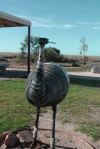
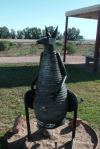
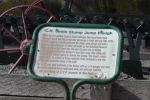
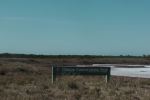
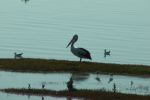
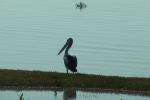
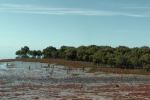
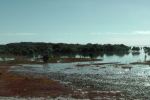
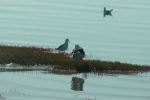
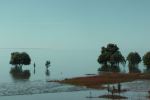
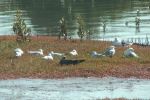
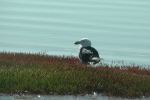
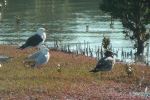
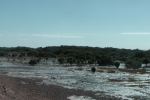
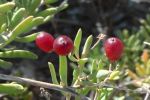
Instead we headed for my 2nd planned activation, the Caribbie Conservation Park, which is located south of Corny Point and about 266 km by road from Adelaide.  The park is 19.5 hectares in size and was gazetted in 1972.  It is located beneath the ‘toe’ of the Yorke Peninsula.  It contains a small area of remnant sheoak and mallee vegetation.  The park’s vegetation comprises of open scrub dominated by Coastal White Mallee and Red Mallee.  It has an understorey that includes Acacia and Correas.  Some sections of the park also contain Drooping Sheoak woodland.  There are 81 native plant species recorded from this park.  The only known species of conservation significance is the Western Dady-long-legs.  Carribie is native aboriginal meaning ’emu flat’.  And there are certainly plenty of emus down here at the bottom of the Yorke Peninsula.
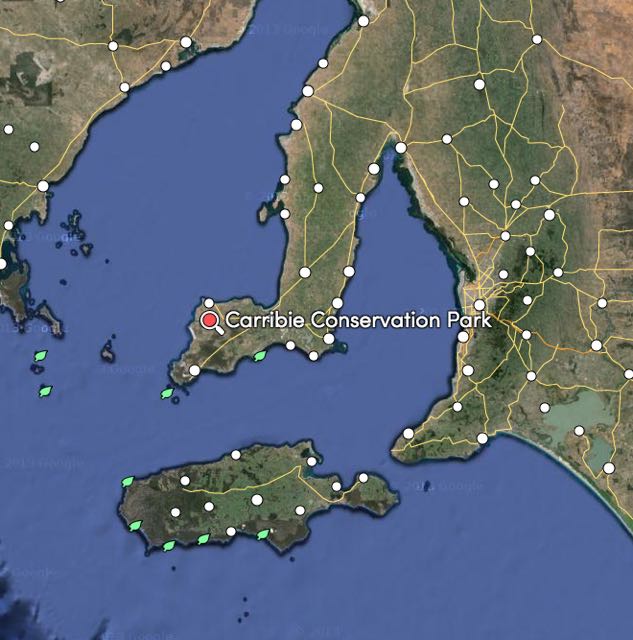
Screenshot 2015-04-07 09.45.18

Map courtesy of mapcarta.com

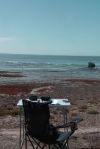
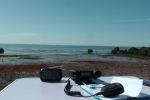
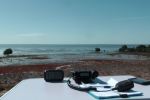
Marija and I travelled along the Marion Bay Road and then turned right onto Gleesons Road.  The park was a few kms up on our right.  We set up just over the fenceline, just to the east of Rockleigh Road.  This is in the south western corner of the park.  The last time we activated the park we were set up in the south eastern corner of the park.

For more information on my initial activation back in 2013, please see…..

https://vk5pas.org/2013/10/21/carribie-conservation-park/

Screenshot 2015-04-07 09.45.46


Map courtesy of mapcarta.com

What was very pleasing about this particular activation was the lack of flies.  When we activated this park back in 2013, the bush flies were out in force and it was almost impossible to be out in the open without a head netting.  But this time around, they were few and far between I am pleased to report.

As per usual, for this activation I ran the Yaesu FT-857d, 40 watts and the 40m/20m linked dipole, supported on the top of my 7 metre telescopic squid pole.

Unlike the previous night’s activation at the Innes National Park, there was absolutely no noise at all on the band here in Carribie.  It was dead quiet.  I called CQ on 7.095 and this was immediately answered by Adrian VK5FANA who was portable on the western side of the Yorke Peninsula in the Bird Islands Conservation Park.  Not a bad start, a park to park contact.  This was followed by Tim VK5AV at Mount Gambier, and then another park to park contact, this time with Tom VK5FTRG who was portable in the Reedy Creek Conservation Park in the South East.  Signals were very good and the 40m band seemed to be in very good condition.

My next park to park contact was with David VK5NQP who was portable in the Mid North of South Australia in the Mokota Conservation Park (5/9 both ways).  This was immediately followed by another park to park contact, with Peter VK5PET operating portable in the Bullock Hill Conservation Park on the Fleurieu Peninsula, south of Adelaide (also 5/9 both ways).  And this was followed by a call from Arno VK5FO in the Angove Conservation Park in the north eastern suburbs of Adelaide (5/9 both ways), and then David VK5AAH portable in the Cleland Conservation Park in the Adelaide Hills.  David was also doing a Summits on the Air activation from Mount Lofty, VK5/ SE-005 (5/9 both ways).

This slideshow requires JavaScript.

A few QSO’s later I was called by Richard VK5ZRY who was portable in the Ramsay Way Conservation Park on the eastern side of the Yorke Peninsula (5/9 both ways as you would expect).

I had a steady flow of callers from VK3 and VK5, and I was then called by Tim VK3MTB who was portable in the Grampians National Park in western Victoria.  Tim was on his way to South Australia to activate some VK5 Parks for the anniversay weekend.  As was the case with the VK5 activators, Tim had a lovely 5/9 signal from the Grampians.

About half a dozen QSOs later, I had my eighth VK5 Park to Park contact in the log from Carribie.  This time it was with Greg VK5ZGY who was operating portable from the Martin Washpool Conservation Park in the Mallee (5/9 both ways).  And what an interesting history that park has.  It is named after Malachi Martin, who was convicted murderer.  For more information please see…..

https://vk5pas.org/2013/09/12/martin-washpool-conservation-park/

A few QSOs later I was called by Chris VK4FR/5 who was portable on Kangaroo Island in the Beyaria Conservation Park (5/9 both ways).

When things started to slow down a little, I took the opportunity of QSYing from 7.095 and tuning around the 40m band.  I found Tony VK3CAT calling CQ on 7.100 from SOTA peak Basalt Knob, VK3/ VE-074 (5/7 both ways).

I then propped on 7.090 and called CQ and this was answered by Mike VK6MMB (5/2 sent and 4/8 received).  This was my first VK6 park hunter for Carribie.  Mark VK5QI then called in from the Coorong National Park with a very strong 5/9 signal.  Next up was Matt VK1MA, my first VK1 hunter.  I went on to work a further 3 VK5 stations, before lowering the squid pole and removing the links in the dipole, so I could operate on 20m.

I put out numerous CQ calls on 14.314 but there were no takers.  I had no phone coverage so I was unable to spot myself on parksnpeaks.  But my CQ call was finally answered by Dane VK2LDF (5/9 both ways), followed by Wayne VK3XF and then Brian VK3BBB.  But this was the end of callers on 20m, so I headed back to 40m.

First up I worked Tom VK5FTRG who was portable in the Furner Conservation Park (5/9 both ways).  Tom was calling CQ on 7.090.  I then settled on 7.095 and called CQ and this was answered by Peter VK3TKK, followed by Nick VK3ANL, and then Mick VK3PMG.  Peter, Nick and Mick are all very active park activators and hunters.  I then bagged my 13th park to park contact, this time with David VK5NQP, who had now moved to the Caroona Creek Conservation Park in the Mid North of South Australia.

Again, when things slowed down, I cruised around the band and found David VK5HDW calling CQ on 7.060 with a very very big signal, from the Lake Frome Conservation Park in the South East.  David was certainly the strongest activator signal on the band.

I then went back to 7.095 and put out a few final CQ calls and worked a further 8 stations, including another two park to park contacts.  The first was with Tony VK5ZAI who was portable in the Mount Scott Conservation Park in the South East (5/9 both ways), and then Tony VK3VTH/5 who was portable in the Far North of South Australia in the Gammon Ranges National Park (5/9 sent and 5/7 received).  My last caller was Ron VK3JP, who is a regular park hunter.

Whilst I was activating, one of the locals arrived at the scene.  He had seen our 4WD parked on the side of the road and wanted to check on our welfare.  But it was clear that this old fella also liked a chat.  Whilst I hid behind the radio, Marija spoke to this old timer for over an hour, even being introduced to his dog Molly on the back of the Ute.  And the local Constabulary also arrived.  They had a report of a crashed car a little further up the road, which we went to have a look at after we had packed up.
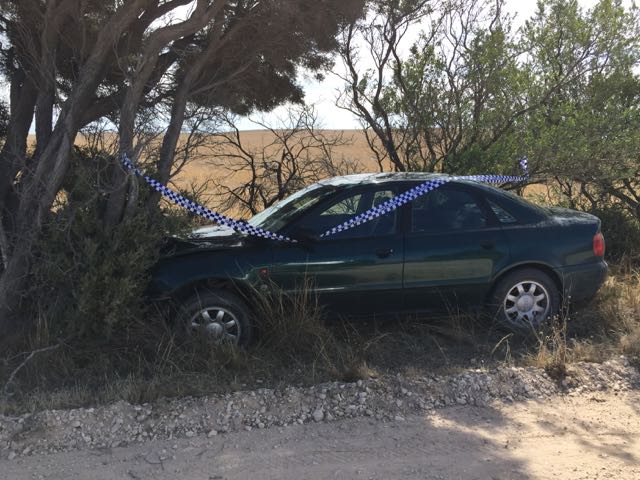
IMG_0949 So after about 2 and 1/2 hours in the park I had a total of 54 stations in the log.  It was time to pack up and head back to the Innes National Park.

The following stations were worked on 40m SSB:-

  1. VK5FANA/p (Bird Islands Conservation Park)
  2. VK5AV
  3. VK5FTRG/p (Reedy Creek Conservation Park)
  4. VK3AFW
  5. VK3FQSO
  6. VK5TN/m
  7. VK4FR/5
  8. VK5NQP/p (Mokota Conservation Park)
  9. VK5PET/p (Bullock Hill Conservation Park)
  10. VK5FO/p (Angove Conservation Park)
  11. VK5AAH/p (Cleland Conservation Park & SOTA VK5/ SE-005 Mt Lofty)
  12. VK3JAP/m
  13. VK5ZRY/p (Ramsay Way Conservation Park)
  14. VK5GJ
  15. VK3ARR
  16. VK3PF
  17. VK3OHM
  18. VK3MTB/p (Grampians National Park)
  19. VK5ZAR
  20. VK5FMID
  21. VK5JK
  22. VK5SFA
  23. VK5HEL
  24. VK5HCF
  25. VK5ZGY/p (Martin Washpool Conservation Park)
  26. VK3DAC
  27. VK3JP
  28. VK4FR/5
  29. VK3CAT/p (SOTA Basalt Knob VK3/ VE-074)
  30. VK6MMB
  31. VK5QI/p (Coorong National Park)
  32. VK1MA
  33. VK5FBFB
  34. VK5KAA
  35. VK5FMJC
  36. VK5FTRG/p (Furner Conservation Park)
  37. VK3TKK
  38. VK3ANL
  39. VK3PMG
  40. VK5NQP/p (Caroona Creek Conservation Park)
  41. VK5STU
  42. VK5TD
  43. VK5HDW/p (Lake Frome Conservation Park)
  44. VK5IS
  45. VK5MBD
  46. VK5FBUD
  47. VK5TR
  48. VK5ZAI/p (Mount Scott Conservation Park)
  49. VK5APR
  50. VK3VTH/5 (Gammon Ranges National Park)
  51. VK3JP

The following stations were worked on 20m SSB:-

  1. VK2LDF
  2. VK3XF
  3. VK3BBB


References.

Department for Environment and Heritage Management Plan, Mainland Conservation Parks of the Yorke Peninsula 2009
 

Charleston Conservation Park

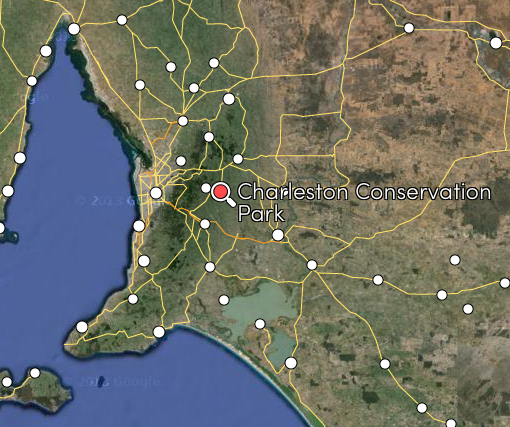
Friday the 13th March 2015 was another ‘Summer’ activation event, so I headed over to the Charleston Conservation Park (CP), which was recently added to the World Wide Flora Fauna (WWFF) program.  Charleston CP is now allocated as VKFF-777.

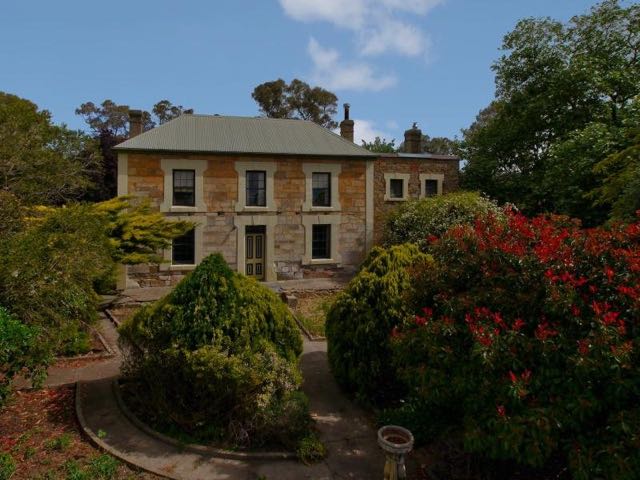
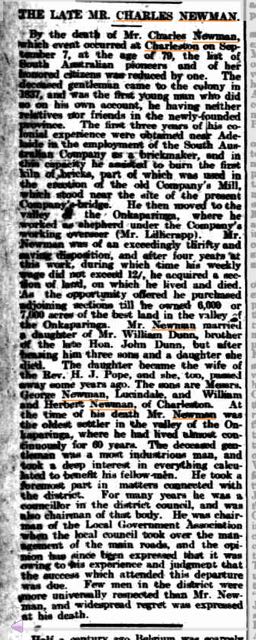
Charleston CP is located about 46 km east of Adelaide.  It is located near the little township of Charleston.  The town was named after Charles Newman, who left Sommersetshire in England in July 1837 under engagement to the South Australian Company as a shepherd.  In 1843 he took up land in the vicinity of Mount Charles and built a home there.  To this day, the Newman homestead remains on Newman Road at Charleston.

main

I managed to find a video of the homestead, from Adcock Real Estate when it was up for sale back in 2012.

And here is an extract from The Advertiser, Wednesday 3rd October 1990 re the death of Newman.

Screenshot 2015-03-23 11.37.20

I have activated Charleston CP a number of times previously, but this was the first time I had activated the park as part of WWFF, so it was quite exciting.

For more information on my previous activations, click on the links below…..

https://vk5pas.org/2015/01/12/charleston-conservation-park-3/

https://vk5pas.org/2014/04/28/charleston-conservation-park-2/

https://vk5pas.org/2013/07/24/charleston-conservation-park/

Screenshot 2015-03-20 20.32.54

Above: Map showing the location of Charleston Conservation Park in the Adelaide Hills.  Map courtesy of mapcarta.com

Charleston CP is just a short distance from my home.  It is a very pleasant drive through Nairne, and on towards Woodside.  I then travelled along Pfeiffer Road passed the Country Fire Service Air base.  Six (6) single engine AT802 ‘Air Tractors’ are based at Woodside.  These aircraft are manufactured by Air Tractor Inc in the United States and have a cpacity to carry 3,200 litres of water/fire retardant.  A number of helicopters are also based at Woodside.

This slideshow requires JavaScript.

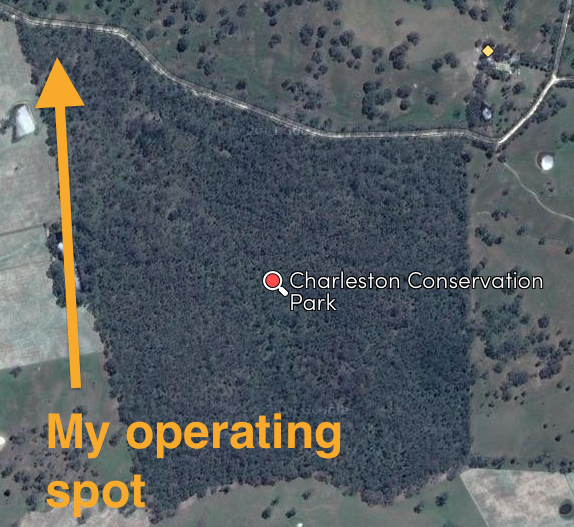
I set up just inside Gate 1 on Bell Springs Road, at the north western corner of the park.  There is another entrance to the park at the north eastern corner, however it is a little heavier wooded at that location.  So I chose to set up at Gate 1 again as per my previous activations.  This is a track here which runs along the northern boundary and another track which runs along the eastern boundary.  The scrub is quite thick, so I walked about 30 metres inside the boundary fence and found a clearing and set up the 40m/20m linked dipole, my deck chair and fold up table.  For this activation I again ran the Yaesu FT-857d at 40 watts.

Screenshot 2015-03-20 20.33.38

Above: Map showing my operating spot in the park.  Map courtesy of mapcarta.com

This slideshow requires JavaScript.

My first contact was with Andrew VK1NAM who was portable on SOTA peak Isaacs Ridge, VK1/ AC-041.  Andrew had a nice strong 5/8 signal coming in from eastern outskirts of Canberra.

After working Andrew I tuned around the 40m band and found my first VK5 Park.  It was John VK5BJE who was portable in the Scott Creek Conservation Park, another recently added park to the WWFF program.  John had a very good 5/9 signal coming in from Scott Creek CP, VKFF-788.
I then found Arno VK5ZAR on 7.105.  Arno was in the Ferguson Conservation Park in the eastern suburbs of Adelaide near the foothills of the Mount Lofty Ranges.  Arno was running QRP 5 watts and a linked dipole and had a strong 5/9 signal.  Arno is one of the regulars who always gets out on a Friday evening.

I then tuned up the band and found Peter VK5FLEX calling CQ on 7.115 from the Pike River Conservation Park near Renmark in the Riverland region along the Murray River.  Peter has recently been bitten by the ‘parks bug’ thanks to Larry VK5LY.

My next park contact was with Geoff VK5HEL who was portable in the Ettrick Conservation Park in the Murray Mallee.  Ettrick CP is a recently gazetted South Australian Conservation Park.  Geoff has also recently become a regular park activator.

I then spoke with Peter VK5PET who was operating from the Ferries McDonald Conservation Park in the Murray Mallee.  I was very pleased to make contact with Peter as this was his first ever park activation.  Well done on getting out there Peter.

I then propped on 7.110 and started calling CQ.  It wasn’t long before I had a small pile up of ever keen park hunters.  My first taker was Peter VK5KPR, followed by Doug VK2FMIA who was in the Horton Falls National Park, VKFF-594.  If you would like to see Doug’s excellent blog and read about his activation at Horton Falls, please click on the following link….

http://vk2fmia.com/2015/03/15/horton-falls-national-park-vkff-594-2/

A few QSOs later I was called by David VK5NQP who was operating portable from the Cromer Conservation Park near Birdwood in the Adelaide Hills.  And a number of QSOs later I was called by Les VK5KLV in the Mount Remarkable National Park in the north of South Australia.

When things got a little quiet, I tuned around the band and found Adrian VK5FANA operating portable from the Bird Islands Conservation Park on the Yorke Peninsula.  Adrian was running QRP, just 5 watts, but nether less had a beautiful 5/9 signal.  Adrian is another amateur who has recently renewed his interest in the hobby by activating from South Australian parks.  It is great to see the Foundation calls getting involved.

I then settled on 7.100 and started calling CQ and this was answered by Gordon VK5GY who was operating portable from the Kenneth Stirling Conservation Park in the Adelaide Hills.  Gordon was also running QRP 5 watts and was a good strong 5/8-9 signal.

I worked a further 6 stations in VK2 and VK5, but when things slowed down a little I took the time to try 20m but conditions there were not at all good.  I put out a number of CQ calls but had no takers.

So I headed back to 40m and put out a CQ call on 7.105 and this was answered by Brian VK5FMID in Mount Gambier, followed by Adam VK2YK with a very strong 5/9 signal, and then Rob VK4FFAB.  A steady flow of callers from VK3, VK4, & VK5 followed.  I spoke with Peter VK3PF who advised that there was a VK6 SOTA station a bit further up the band on 7.130.

So I headed up to 7.130 where I made contact with Phil, VK6ADF who was portable on SOTA peak Mount Desmond, VK6/ SG-011, north of Hopetoun in Western Australia.  Phil was quite a good signal, however there were some Japanese stations on frequency which caused me to loose the occasional word (4/6 sent and 5/7 received).

I then returned back down the band to 7.105 where I spoke with Colin VK4FAAS and Mike VK6MB.

This slideshow requires JavaScript.

At 0936 UTC (7.06 p.m. South Australian local time) I booked in to the 7.130 DX Net where I worked into VK3, VK5, VK7, French Polynesia, and New Zealand.

Whilst I was on the net, the sun was setting in the west, and the native bats had come out.  There were a number of them flying in very close proximity to where I was set up.  I was certainly hoping that their eyesight was good as they quickly darted through the air.

This slideshow requires JavaScript.

After a few rounds on the Net I headed up to 7.150 where I put out a few CQ calls and this was responded to by Steve VK3NSC, Steve VK3FSPG, and Shaun VK5FAKV.  But despite conditions being very good, it was very quiet on the band.  So I had one final tune around the band and found Steve VK5SFA calling CQ.  Steve’s signal was very strong and was literally lifting the FT-857d off the table.

This slideshow requires JavaScript.

I was happy.  I had reached the 44 QSO threshold for the WWFF program, and had a total of 59 contacts in the log.

The following stations were worked:-

  1. Andrew VK1NAM/p (SOTA)
  2. John VK5BJE/p (Scott Creek CP)
  3. Arno VK5ZAR/p (Ferguson CP)
  4. Peter VK5FLEX/p (Pike River CP)
  5. Geoff VK5HEL/p (Ettrick CP)
  6. Peter VK5PET/p (Ferries McDonald CP)
  7. Peter VK5KPR
  8. Doug VK2FMIA/p (Horton Falls NP)
  9. Peter VK3FPSR
  10. Fred VK3DAC
  11. Marc VK3OHM
  12. Greg VK5GJ
  13. David VK5NQP/p (Cromer CP)
  14. Peter VK5NAQ
  15. Amanda VK3FQSO
  16. Garry VK2GAZ
  17. Mick VK3PMG
  18. Peter VK3PF
  19. Nick VK3ANL
  20. Ian VK1DI
  21. Les VK5KLV/p (Mount Remarkable NP)
  22. Paul VK3DBP
  23. Andrew VK3ARR
  24. Bill VK5MBD
  25. Adrian VK5FANA/p (Bird Islands CP)
  26. Gordon VK5GY/p (Kenneth Stirling CP)
  27. Peter VK2TTP
  28. Greg VK5ZGY
  29. Tom VK5EE
  30. Hans VK5YX
  31. Col VK5FCDL
  32. Ron VK5VH
  33. Brian VK5FMID
  34. Adam VK2YK
  35. Rob VK4FFAB
  36. Ian VK3VIN
  37. Tom VK5FTRG
  38. Nev VK5WG
  39. Ian VK5CZ
  40. Jim VK5JW
  41. Chris VK5FCHM
  42. Colin VK3NCC
  43. Brendon VK5FBFB
  44. Owen VK5HOS
  45. Chris VK2UW
  46. Brian VK7ABY
  47. VK6ADF/p (SOTA)
  48. Colin VK4FAAS
  49. Mike VK6MB
  50. Roy Vk7ROY
  51. Rod VK3OB
  52. William FO5JV
  53. Brian ZL2ASH
  54. Mal VK5MJ
  55. Steve VK3NSC
  56. Steve VK3FSPG
  57. Shaun VK5FAKV
  58. Steve VK5SFA
  59. Frank VK3FADI


References.

Cockburn, R, 2002, ‘South Australia.  What’s in a Name?’

Country Fire Service, 2015, <http://www.cfs.sa.gov.au/site/about/aerial_firefighting/firefighting_aircraft.jsp&gt;, viewed 23rd March 2015

Wikipedia, 2015, <http://en.wikipedia.org/wiki/Air_Tractor_AT-802&gt;, viewed 23rd March 2015

Ridley Conservation Park

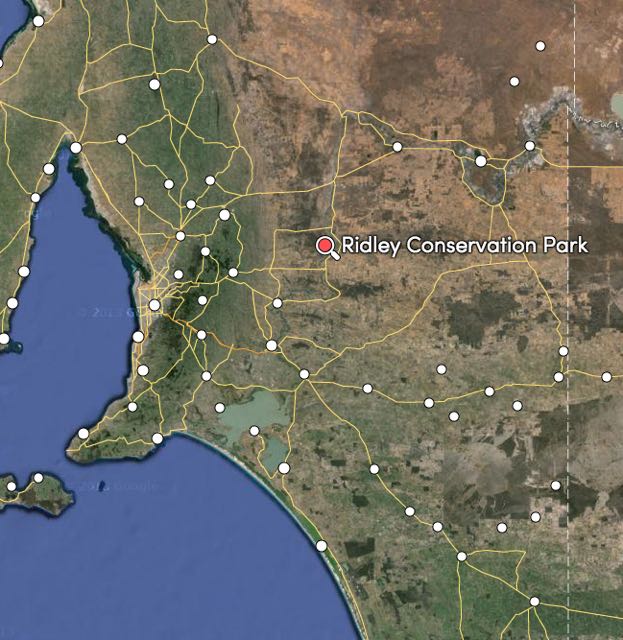
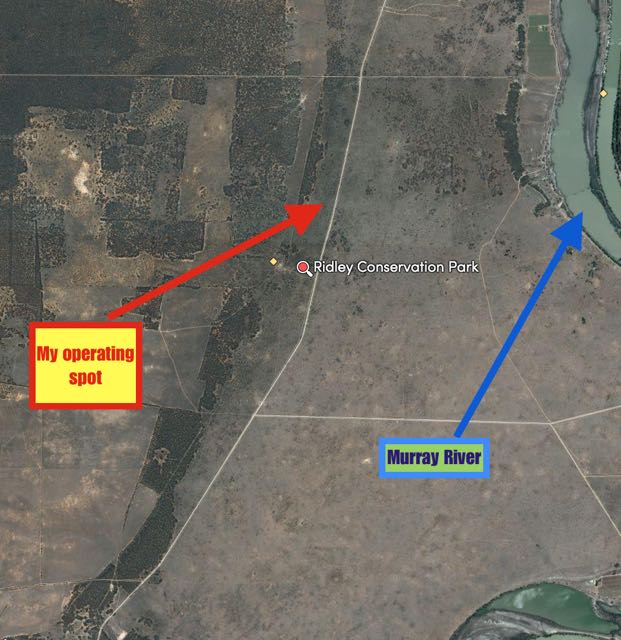
My second park for Sunday 8th March 2015 was the Ridley Conservation Park, which is situated about 120 km north east of Adelaide and 10km south of the little town of Swan Reach on the Murray River.

Screenshot 2015-03-11 20.53.52map courtesy of mapcarta.com

I had intended activating the Ngaut Ngaut Conservation Park on the Murray River, which would have been a unique park, but my request to access this park was declined by the Mannum Aboriginal Community Association.  I will be writing a letter seeking future access and I will keep everyone posted of progress.

So after leaving Marne Valley, I headed east out along the Black Hill Road, which follows the Marne River.  This is quite a pretty drive.  I encountered quite a few Western Grey kangaroos and a paddock of goats.  I couldn’t help but stop to take a photo of the SOTA mascots.

This slideshow requires JavaScript.

I have activated the Ridley Conservation Park a number of times previously.  For more information on those activations, please click on the links below…..

https://vk5pas.org/2013/05/11/ridley-conservation-park/

https://vk5pas.org/2014/12/07/ridley-conservation-park-2/

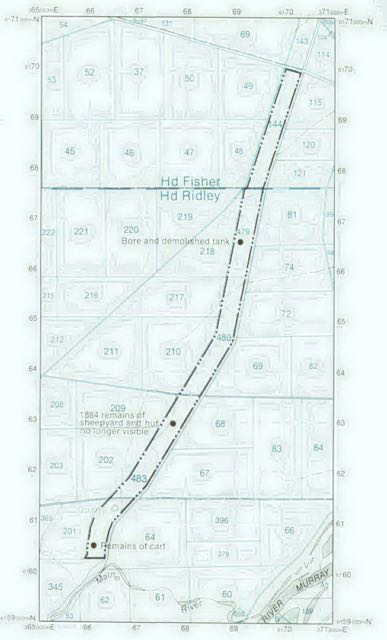
Ridley Conservation Park is a long narrow park.  It is 10 km in length and about 400 metres in width.  It covers an area of about 414 hectares and .  The southern boundary of the park is on the edge of the valley of the Marne River.  At this location is Hayward’s Hill, which is the highest point in the park.  The remainder of the park comprises flat country typical of the limestone plains of the Murray River.

Screenshot 2015-03-12 09.28.51


Image courtesy of National Parks and Wildlife.

The park is home to a large variety of native mammals and birdlife.  This includes the Southern Hairy-nosed Wombat, Western Grey kangaroos, Echidnas, Mallee Ringneck parrots and Mulga parrots.

The park was originally part of a Travelling Stock Reserve (TSR) which ran for roughly 5-10 kms parallel to the Murray River.  The reserve linked the stock market of Burra to the north with Murray Bridge to the south.  By 1878, the TSR became obsolete with the completion of the Morgan to Adelaide railway.  By 1901, an approach was made to the Department of Lands by local land owners to resume the TSR land and for it to be made open for allotment.  In 1901 and 1907, proposals to this effect went before Parliament but were declined.

In 1934, the then District Council of Caurnamont contacted the Director of Lands and requested that the TSR be resumed for allotment.  The council claimed tat the Reserve ‘harboured vermin’ and was a ‘drain on council funds’.  And then in 1937 further requests were made for the Reserve to be used for grazing.  Inspector Klau of the Crown Lands Department inspected the Reserve in 1939, and following his inspection, recommended that the area not be resumed.

Between 1938 to 1940 there were numerous requests to cut wood in the Reserve for charcoal burning.  One of these proposals was to clear 28 hectares of the Reserve, north of Haywards Hill.  The Ranger at the time, described the Reserve as ‘an asset to the State‘ and he declined these requests and stated that the land should remain in its uncleared condition.

During the mid to late 1950’s, following further requests, Annual Licences were granted for grazing purposes within the Reserve.

And then in 1966, land was being resumed and purchased for the purpose of National Parks.  It was at this time that the Land Board proposed that portions of the TSR ‘be retained and dedicated as a Wildlife Reserve under the control of the Commissioners of the National Parks and Wildlife Reserves at the expiration of the current Annual Licences’.

Mr. G.C. Cornwall, a field officer for the National Parks Commission, inspected the TSR and submitted the following very favourable report:

Although a long narrow strip of land such as this is not the ideal shape for a National Park, the idea of preserving natural vegetation and bird habitats by setting aside portions of the Travelling Stock Reserve is an excellent one and the area under investigation is suitable for this purpose‘.

The park was officially dedicated as the Ridley National Parks Reserve in May 1968.  It was later gazetted as the Ridley Conservation Park.

Although it is outdated (1984), there is an excellent description of the park and the history of the area in the publication entitled ‘Conservation Parks of the Murraylands (Western Plains) Management Plans’.  Please see below…..

PARKS_PDFS_CP_MURRAYLNDS_WP_MP (2)

I set up on the western side of the Murraylands Road, between Sunnydale Road and Sleeper Track.  I ran the Yaesu FT-857d, 40 watts and the 40m/20m linked dipole for this activation.

Screenshot 2015-03-11 20.54.57

map courtesy of mapcarta.com

After setting up I called CQ on 7.095 and this was answered by ever reliable parks hunter, Mick VK3PMG in Stawell in Western Victoria.  This was followed by another keen park hunter, Adrian VK5FANA, then Arno VK5ZAR, followed by Greg VK5ZGY.

The 40m band was in excellent condition and a steady flow of callers followed, from all across Australia: VK2, VK3, VK4, VK5, and VK7.  The local time was about 6.45 p.m. (0815 UTC).  There is no doubt that this is when the 40m band is at its very best.  I went on to work 32 stations around Australia.

At 8.00 p.m. local time (0930 UTC) I booked in to the 7130 DX Net where I worked a total of 6 stations including Andy VK4TH/8, William FO5JV, Gary ZL3SV, Brian ZL2ASH, and Adrian ZL1GBG.

At times the net can run a little slow, so I took the opportunity of having a quick look around the band, and I found Greg W8GAP calling CQ on 7.180.  I decided to give Greg a shout and surprisingly got through without much difficulty.  Greg was an excellent 59 signal to the park.  Initially my signal was 44, but it came up to a 55 and Greg was able to copy all of my information without any difficulty.

After a few rounds on the net I checked out, and went up to 7.135 and called CQ.  My CQ call was answered by Drew VK2FROX, followed by Ian VK3FIAN, and then Bob VK3FLAK running QRP from his EFE40 transceiver.

It was during this time that a tour bus came through, with the driver operating a spot light.  Obviously looking for native wildlife.  But what they found was some crazy guy sitting out in the middle of nowhere in a deck chair alongside a squid pole.  I wonder what the tourists were thinking?

I had one final tune around the band and found John K1GUN in Maine, calling CQ on 7.140.  I gave John a call and had a good QSO (5/9 sent and 5/5 received).

This slideshow requires JavaScript.

So after a very pleasant evening in the Ridley Conservation Park it was time to head home.  I still had an hours drive ahead of me.  I had a total of 48 contacts in the log, including some good DX QSOs on 40m.

The following stations were worked:-

  1. Mick VK3PMG
  2. Adrian Vk5FANA
  3. Arno VK5ZAR
  4. Greg VK5ZGY
  5. Tim VK5AV
  6. Peter VK5FLEX
  7. Greg VK7FGGT
  8. Gavin VK3MLU
  9. Bernard VK3AV
  10. Peter VK3PF
  11. Peter VK3TKK
  12. Andrew VK3ARR
  13. Chris VK4FR/5
  14. Fred VK3DAC
  15. Damien VK5FDEC
  16. Marc VK3OHM
  17. Les VK5KLV
  18. Rob VK4FFAB
  19. Richard VK5ZRY
  20. Doug VK2FMIA
  21. Jim VK5JW
  22. Bob VK3BWZ
  23. Matthew VK3FMDS
  24. Keith VK5FEKH
  25. Andrew VK2UH
  26. Tom VK5FTRG
  27. Kym VK5FKYM
  28. David VK5LSB
  29. Bob VK2OD
  30. David VK5HYZ
  31. Nev VK5WG
  32. Ron VK5VH
  33. Andy VK4TH/8 (Kakadu National Park)
  34. William FO5JV
  35. Gary ZL3SV
  36. Daniel VK6LCK
  37. Chris VK2UW
  38. Brian ZL2ASH
  39. Adrian ZL1GBG
  40. Greg W8GP
  41. Ted VK6NTE
  42. Drew VK2FROX
  43. Ian VK3FIAN
  44. Bob VK3FLAK
  45. Graham VK7ZGK
  46. Ron VK3JP
  47. Andrew VK3FADS
  48. John K1GUN


References.

National Parks and Wildlife Service, ‘Conservation Parks of the Murraylands (Western Plains) Management Plans’, 1984

Marne Valley Conservation Park

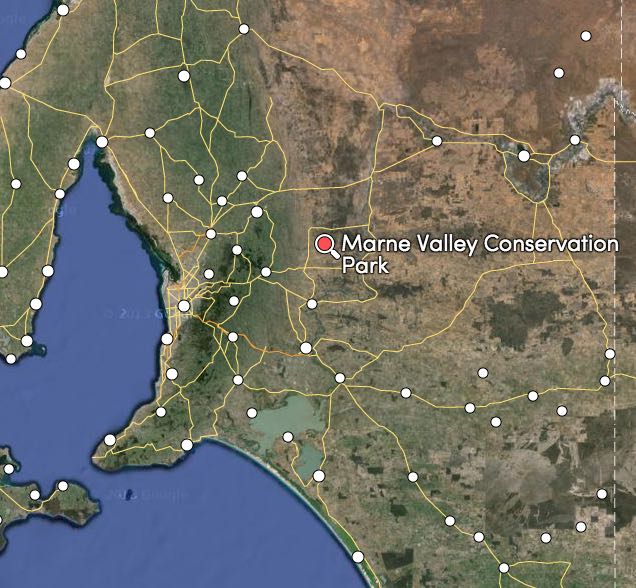
On Sunday (8th March 2015) I was left all alone.  My wife Marija and her mum left early that morning for 3 nights at Broken Hill.  So while the girls are away, the boy can play radio.  I headed to the Marne Valley Conservation Park, which is situated about 30 km north of Mannum, and about 10km south east of Sedan.

Screenshot 2015-03-11 19.34.32

map courtesy of mapcarta.com

I reached the park by travelling from home to the historic town of Mount Torrrens, and then through to Birdwood.  I then travelled to Cambrai, which is a little town just to the west of the park.

This slideshow requires JavaScript.

The Marne Valley Conservation Park covers an area of about 105 hectares and it is bisected by the Marne River.  The park was dedicated in 1976 and consists of gently undulating land, with much of the park comprising of low lying, seasonally inundated river red gum flats.  The surrounding countryside was cleared of most of its gum trees during the late 1880’s and a saw mill existed in the area.  The local red gum was considered ‘superior’ to many other varieties of gum for use as railway sleepers.

The park is home to a large amount of wildlife including Western Grey kangaroos and waterfowl.  It was certainly alive with kookaburras during my activation.

The Marne River which passes through the park was once part of the main Adelaide to Sydney stock route.  The River was previously known as the South Rhine River.  However, as was the case with many place names here in South Australia, the name was changed in 1917 as Australia was at war with Germany.  The River’s name was changed to Marne after the Marne River of France, where the German advance was halted in 1914.  The South Australian Marne River’s headwaters are centres around the Eden Valley and Springton areas, and it passes through Cambrain before flowing into the Murray River at Wongulla.

Prior to being called the South Rhine and then the Marne, the river was originally known by the local Ngarrindjeri aboriginal people as Taingappa, meaning ‘foot track-trading road’.  The Aborigines used the river as a route up into the hills to trade with the Peramangk aboriginal people in the Barossa Valley, and to cut bark canoes from the River Red Gums in the hills which had thicker bark than those near the Murray.

The nearby town of Cambrai was also known as Rhine Villa.  It is reported that there was once a house or hut with a comical villa front in the area and a person named Skinner occupied it and called it ‘The Villa’.  The little township grew up around it and got the name of Rgine Villa, due to the proximity of the Rhine River.  The name was changed to remove any connection with German place names and it was named after the Battle of Cambrai in France during WW1.

Last year, two elderly bushwalkers became lost in this park and a major search was launched.  See the article below….

http://www.adelaidenow.com.au/news/south-australia/police-find-two-hikers-missing-in-marne-valley-conservation-park-south-of-cambrai-in-mt-lofty-ranges/story-fni6uo1m-1227022552108

Prior to heading to the park I referred to the Marne Valley Conservation Park Management Plan which is dated 1994 and is horribly out of date.  It refers to a visitor access track running along the western boundary from the south to the picnic and camping area.  I was unable to locate this.  The gate which I did find on the southern side of the park, off Black Hill Road, was locked.  A familiar find at most South Australian Conservation Parks.  Locked gates.

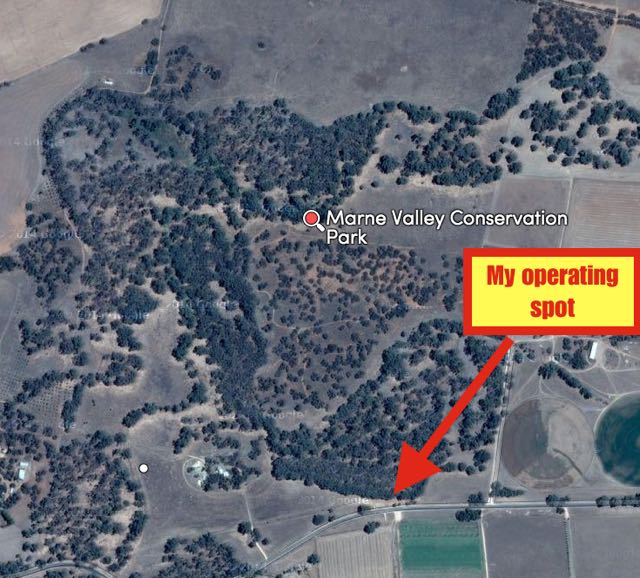
I set up on the southern side of the park.  Access here is very easy.  The boundary fence is in very poor condition and can easily be stepped over.  There is even an old National Parks and Wildlife ‘Reserve’ sign on the gate which appears to have been there since the dim dark ages.

Screenshot 2015-03-11 19.34.58

Map courtesy of mapcarta.com

I set up the fold up table and deck chair and ran the Yaesu FT-857d and 40 watts for this activation.  I used the 40m/20m linked dipole supported on the 7m squid pole.  I used a wooden fence post to secure the squid pole to, with the assistance of an octopus strap.

I could not get on to my nominated operating frequency of 7.095 due to the Kandos Net still going, so I headed up to 7.105 and called CQ.  This was immediately answered by Mick VK3PMG in Stawell, followed by Phil VK5XR, Marc VK3OHM, and then Adrian VK5FANA on the Yorke Peninsula who was running QRP 5 watts (5/8 sent and 5/9 received).  I worked 9 stations in VK3 and VK5 and it then went very quiet.  So I took the opportunity of going for a 20 minute walk through the park.

After coming back from my walk I called CQ again on 7.105 and this was answered by Arno VK5ZAR, followed by Peter VK3PF and then Gary VK5PCM who was running QRP 2 watts (5/7 both ways).  I went on to work a further 18 stations in VK2, VK3, & VK5 until it slowed down again.   I tuned around the band and found Rod VK2TWR who was portable on as part of the Summits on the Air (SOTA) program.

After working Rod, I heard a few stations asking me to QSY up the band.  So I headed back to 7.105 where I was called by Bernard VK3AV, Grant VK2LX, Phil VK5RM and then Andrew VK3ARR.  I worked a further 4 stations, before deciding it was time to pack up and head off to the Ridley Conservation Park.

This slideshow requires JavaScript.

The following stations were worked on 40m SSB:-

  1. Mick VK3PMG
  2. Phil VK5XR
  3. Phil VK3OHM
  4. Adrian VK5FANA
  5. Amanda VK3FQSO
  6. Les VK5KLV
  7. Fred VK3DAC
  8. David VK5NQP
  9. Peter VK3TKK
  10. Arno VK5ZAR
  11. Peter VK3PF
  12. Gary VK5PCM
  13. Greg VK5ZGY
  14. Graham VK3DOG
  15. Gavin VK3MLU
  16. Marshall VK3MRG
  17. Rob VK4AAC/5
  18. John VK5DJ
  19. David VK5ADO
  20. Chris VK4FR/5
  21. Tim VK5AV
  22. Jeff VK5JK
  23. Ian VK3VIN
  24. Tom VK5EE/m
  25. David VK5HYZ
  26. John VK5FTCT
  27. Michael VK2KBC/3
  28. Joe VK3YSP
  29. Peter VK5FLEX
  30. Peter VK5KPR
  31. Rod VK2TWR/p (SOTA)
  32. Bernard VK3AV
  33. Grant VK2LX
  34. Phil VK5RM
  35. Andrew VK3ARR
  36. Nev VK5WG
  37. Brett VK3FLCS
  38. Andrew VK5FADS
  39. Garry VK5RN


References

Cockburn; R, ‘South Australia.  What’s in a Name?’, 1999

National Parks and Wildlife, Marne Valley Conservation Park Management Plan, August 1994

Wikipedia, 2015, Marne River, <http://en.wikipedia.org/wiki/Marne_River_%28South_Australia%29&gt;, viewed 10th March 2015.

Cromer Conservation Park

Last night I activated the Cromer Conservation Park, about 7 km north of the little town of Birdwood in the Mount Lofty Ranges.  It is about a 25 minute drive north from my home qth.  The nearby town of Birdwood, formerly known as Blumberg, is famous as it is the home of the National Motor Museum.  The park is situated about 50 km north east of Adelaide.

Screen Shot 2015-03-07 at 1.51.17 pm

Map courtesy of mapcarta.com

I have activated this park a number of times before (2013 & 2014).  Click on the links below to read about my prior activations…..

https://vk5pas.org/2013/07/24/cromer-conservation-park/

https://vk5pas.org/2014/04/28/cromer-conservation-park-2/

Cromer Conservation Park which was proclaimed in 1976, is about 50 hectares in size and conserves a remnant parcel of vegetation.  The park represents one of the largest contiguos native remnant vegetation parcels within the Upper Torrens catchment area.  It is home to a large amount of native animals and birds.  And I saw quire a bit whilst I was in the park including Western Grey kangaroos and emus.  Wild deer are also found in the park.

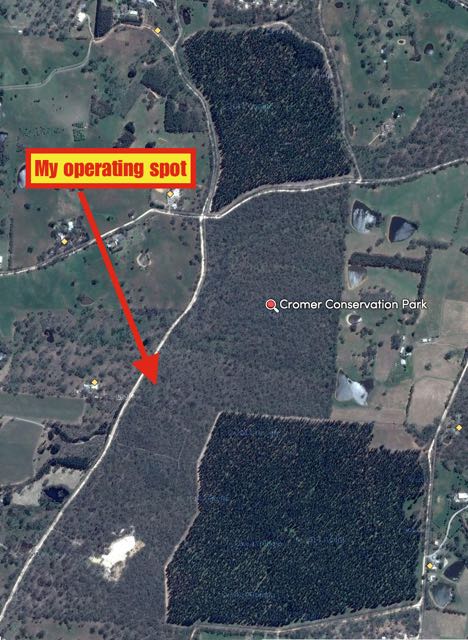
I headed for my normal operating spot which is just inside gate 1 off Cromer Road, just pass Lucky Strike Road.  Although the scrub within the park is very thick, there are some cleared areas here and a track, so there is plenty of room to stretch out a dipole.  I had inadvertantly left my squid pole holder at home, so I improvised and secured the 7 metre squid pole to the stump of a small sheoak tree with an octopus strap.

Screen Shot 2015-03-07 at 1.51.01 pm  Map courtesy of mapcarta.com

I could not get onto my nominated operating frequency of 7.095 as the Kandos Group was still running on 7.093.  So I headed up to 7.098 and called CQ.  My first contact was with Nev VK5WG at Crystal Brook, followed by Peter VK3TKK mobile (with a beautiful 59 signal), Col VK5HCF in Mount Gambier, and then  Les VK5KLV in Port Augusta.  I worked a further 6 stations from VK3 and VK5, until some VK2 stations came on on the same frequency and started having a chat.  I boxed on through the QRM and continued to work a number of stations in VK3 and VK5.  Clearly these guys could hear the other stations working me.  I know who these individuals are.  They appear to have a ‘sked’ on 7.098 on a daily basis, and they will not move for anyone and speak in Italian I believe.

After working a total of 18 stations on 40m, I lowered the squid pole and removed the links in the dipole so that I could operate on 20m.  My first contact there was with VK7FG on Flinders Island OC-195, off the coast of Tasmania, who was working split on 14.260.  Chris VK3FY was at the mic and had a very very strong signal.  This was followed by a contact with Franc F5PAU on 14.180 who was a very strong signal from France.  The band seemed to be in very good condition, so I decided to call CQ on 14.193.

My first taker there was Gerry VK7GK, and this was followed by a contact with my good friend Will ON4WDL in Belgium.  I met Will last year during my visit to Europe.  This was followed by a call from Don G0RQL who is a regular SOTA chaser and park hunter, and then Kevin VK6AB who was portable at Albany in Western Australia.

I was spotted by AK4AT and VK3PMG on the DX cluster and this resulted in quite a large pile up of stations from Europe, the United Kingdom, and Australia.  I worked stations in VK2, VK4, England, Belgium, Germany, Canary Islands, United States, France, Ireland, Wales, Netherlands, Estonia, Russia, Sweden, and New Zealand.

It was starting to get dark and the 20m band was closing.  The wildlife was also out and about.  At one stage I had a number of Western Grey kangaroos around me, along with numerous emus.  I worked a total of 50 stations on 20m and then headed back to 40m where I booked in to the 7130 DX Net.  Conditions on 40m were also very good.  I worked a total of 12 stations on the Net including William FO5JV and Bill W1OW, and a number of VK’s and ZL.

This slideshow requires JavaScript.

After the Net I headed to 7.150 and called CQ.  This was immediately answered by Joe VK3DXJ, followed by Keith VK5FEKH, and then Rob VK2XIC.  Not long after being on the frequency a JA station came up and started calling CQ.  Fortunately he had no takers and moved off the frequency.  But it wasn’t long before another JA appeared and this time their signal was very strong.  My mate from Alice Springs, VK8GM, came up and tried to get through to the JA on multiple occasions but couldn’t seem to make it.  If the Japanese station couldn’t hear Greg with his high power and good antenna, then clearly he couldn’t hear my tiny signal with my very meagre dipole.

In any event, it was getting late and very cold.  It was now down to 7 degrees C.  So I packed up the gear and headed home with a total of 99 contacts in the log.

The following stations were worked on 40m SSB:-

  1. Nev VK5WG
  2. Peter VK3TKK/m
  3. Col VK5HCF
  4. Les VK5KLV
  5. Greg VK5GJ (qrp)
  6. Peter VK5KPR
  7. Mick VK3PMG
  8. Adrian VK5FANA (qrp)
  9. Amanda VK3FQSO (qrp)
  10. Jim VK5JW
  11. Phil VK5RM
  12. John VK5BJE
  13. Tom VK5FTRG
  14. Robin VK5TN
  15. Arno VK5ZAR
  16. Brett VK3FLCS
  17. Fred VK3FTAD
  18. David VK5NQP
  19. Chris VK2UW
  20. William FO5JV
  21. Bill W1OW
  22. Rob VK4FFAB
  23. Colin VK4FAAS
  24. Geoff VK5HEL/p (Poonthie Ruwe Conservation Park)
  25. Paul VK7CC
  26. Brian ZL2ASH
  27. Mal VK5MJ
  28. Roy VK7ROY
  29. John VK6AG
  30. John VK2FALL
  31. Joe VK3DXJ
  32. Keith Vk5FEKH
  33. Rob VK2XIC
  34. Theo VK5MTM
  35. Greg VK5ZGY/m
  36. Ron VK3JP
  37. John VK5FTCT
  38. Shaun VK6PAL
  39. Tony VK3FMRC
  40. Drew VK2FROX
  41. Steve VK3MEG
  42. Andrew VK3FABE
  43. Ian VK3VIN
  44. Peter VK3FPSR
  45. Steve VK5SFA
  46. Gavin VK4FGCW
  47. Paul VK5FUZZ
  48. Greg VK8GM
  49. Stephen VK7PSJ

The following stations were worked on 20m SSB:-

  1. VK7FG Flinders Island
  2. Franc F5PAU
  3. Will ON4WDL
  4. Paul F2YT
  5. Don G0RQL
  6. Kevin VK6AB/p
  7. Peter VK2APS
  8. Des G0RBD
  9. VK6QM
  10. Peter VK2NEO
  11. Swa ON5SWA
  12. Marnix OP7M
  13. Bill VK4MWG
  14. DJ8QP
  15. Chris G0TSQ
  16. DK2BS
  17. Greg VK8GM
  18. DF1YQ
  19. DK4RM
  20. EA8TL
  21. AE7KB
  22. DL5WW
  23. F4EPR
  24. Alek VK6APK
  25. Les VK2CPC
  26. Steve MW0ZZK
  27. EC7DZZ
  28. PD0ARI
  29. Mauro IW1GGR
  30. ES5QD
  31. PE1NCP
  32. Mike G0HWK
  33. EI2KC
  34. Steve G0KIK
  35. Jeff GW3UZS
  36. Ted VK6NTE
  37. Bado DF7UB
  38. Paul VK2NHD/m
  39. Paul VK2HDX
  40. John F4FEP
  41. James VK6NJW
  42. Sergey RA3PCI
  43. Bruce ZL1BWG
  44. Jim VK2LC
  45. Dan SM6CNX
  46. Lee VK2LEE
  47. Les VK2CPC
  48. Stew VK4SC
  49. Ray VK4NH/p

Porter Scrub Conservation Park and the Jock White Memorial Field Day

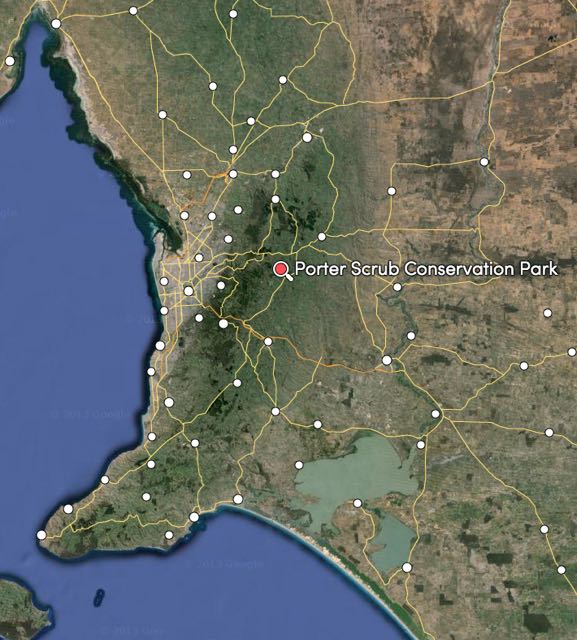
Last night I headed out to the Porter Scrub Conservation Park, which is located at Kenton Valley in the central Mount Lofty Ranges ‘Adelaide Hills’, about 30 km north east of Adelaide.  It is a relatively short drive from my home in the Adelaide Hills, though Woodside and Charleston, and then out along Maidment Road.

Screenshot 2015-02-28 22.46.42

Above: Map showing the location of Porter Scrub CP.  Map courtesy of mapcarta.com

My main reason for heading out to the park was that the Jock White Memorial Field Day was on.  This is a New Zealand contest which is aimed at portable oepration, and is named in honour of Jock White, ZL2GX, who was the NZART Contest and Awards Manager for over 40 years.

http://www.nzart.org.nz/activities/contest-rules/rules-jock-white-field-day/

The Porter Scrub Conservation Park is 104 hectares in size, and was proclaimed on the 2oth October 2005, after the purchase from the estate of the late J.J. Porter.  The park conserves areas of Candlebark Gum open forest which is considered endangered in South Australia, Pink Gum low woodland, and River Red Gum woodland.  The park is home to a large amount of flora and fauna including the nationally endangered Southern Brown Bandicoot, the nationally vulnerable Clover Glycine, and the state endangered Spotted Quail thrush.

The park was originally home to the aboriginal Peramangk people, and following European settlement in the area, the land was used for grazing cattle and sheep, and timber extraction.  The mining of talc was in operation within the park right up until 1970.  If youw alk through the park you will see a number of old mine shafts and the stumps of very large trees which are evidence of days gone by.

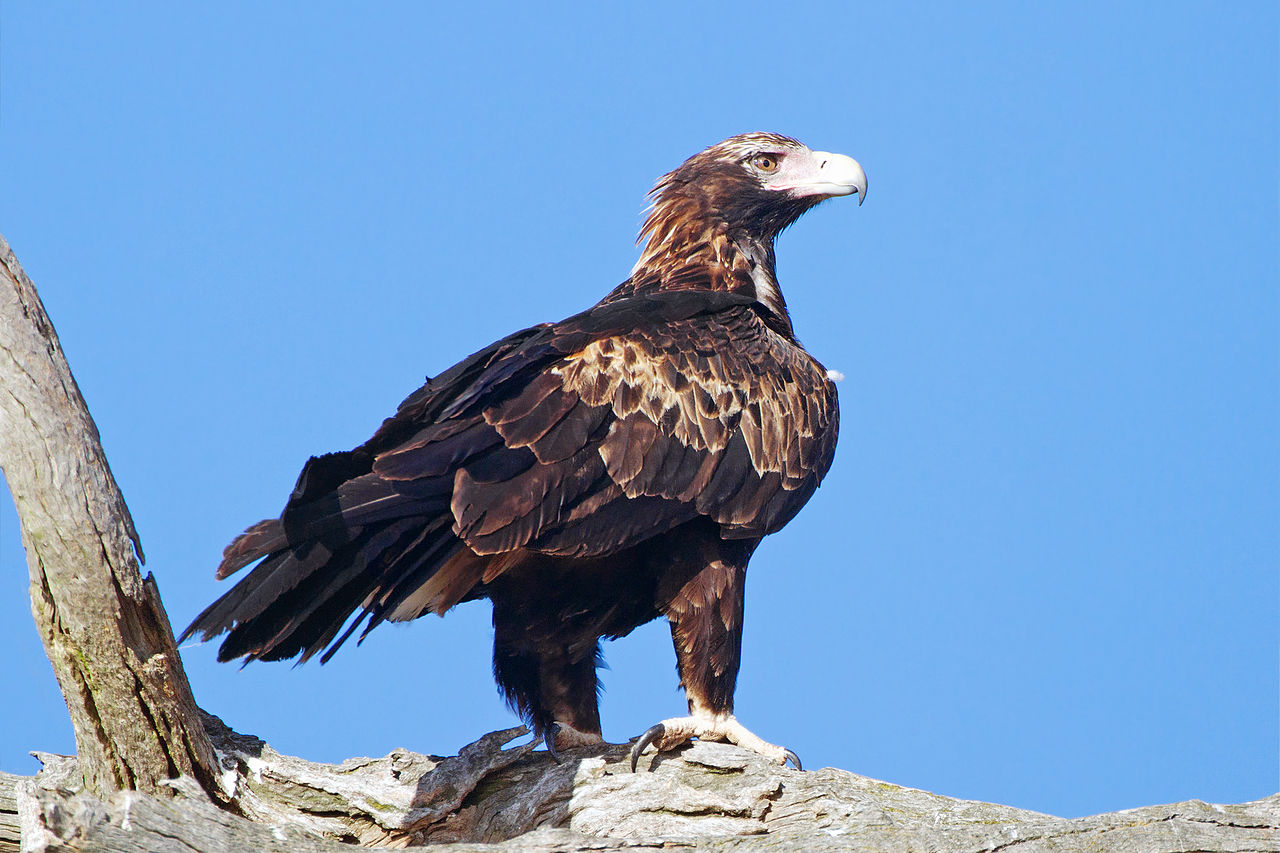
As I was driving along Maidment Road approaching the park, out the corner of my eye, I caught something very large ‘taking off’ from one of the gum trees lining the road.  In fact, it was two large Wedge Tailed eagles.  So I quickly pulled up the 4WD and grabbed the video camera, but by this stage the eagles had flown off and were soaring above a nearby paddock.  I had missed an excellent photo opportunity.  However I did manage to snap a few photos of them in flight (see below).

1280px-Aquila_audax_-_Captain's_Flat

Above: A Wedge Tailed eagle.  Photo courtesy of wikipedia

This slideshow requires JavaScript.

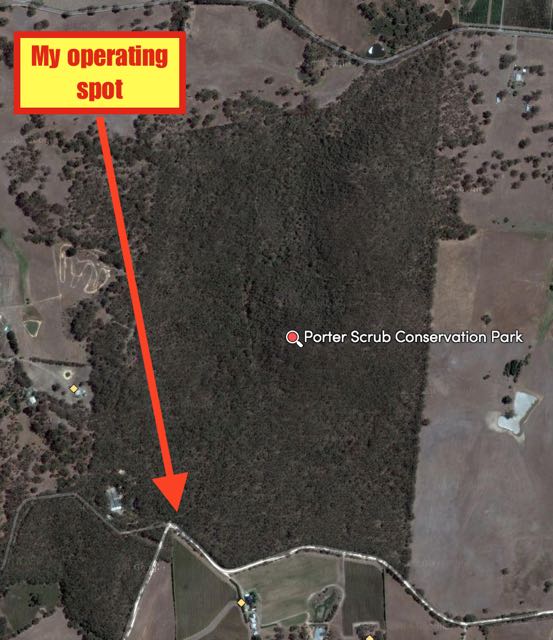
Once arriving at the park I set up in my usual spot, which is just inside gate one.  There is a nice parking spot here to pull off the road.  There is a boundary fence but this is easily scaled by either using the provided ladder, or straddling through the strains of wire.  I set up the fold up table and deck chair and strung out my 40m/20m linked dipole.  For this operation I again used the Yaesu FT-857d, and run 40 watts.  I powered the radio with my 44 amp hour power pack.

Screenshot 2015-02-28 22.47.24

Above: My operating spot.  Map courtesy of mapcarta.com

I started off having a look around the 40m band to see if I could hear any signals coming in from New Zealand.  But I did not hear a single signal coming in across the Tasman.

So I then propped on 7.095 and started calling CQ and this was immediately answered by Stuart VK5STU, followed by David VK5NQP, and then Peter VK3YE who was portable on the Pier at Seaford in Victoria.  I worked a total of 18 stations in VK2, VK3, & VK5, until things slowed down a little.  I also had to compete with the Europeans who came onto the frequency a few minutes after I started calling CQ.  The European signals were quite strong, and I am sure there were some other VK’s calling me, but unfortunately their signals were being drowned out by the DX.  Once things got quiet with takers, I took the opportunity of tuning around the band again to see if I could hear any of the New Zealand stations coming through.  But it was still a little too early.  The local time was still only 6.10 p.m.

My last caller was Jim VK5TR with a very strong 5/9 plus signal.  As there were no more takers I tuned around the band and heard the first good New Zealand signal calling CQ contest.  It was ZL1HCR, the Hibiscus Coast Radio Club in Auckland.  I worked ZL1HCR and I then continued to tune around the band, working a further 2 New Zealand stations, Zl1BCO in Taupo, and ZL3RR on Woodend.

But that was about the limit of Kiwi stations that I could hear at this stage.  However I did find Rob VK4FFAB calling CQ on 7.160 from the Moogerah Peaks National Park, VKFF-326.  Rob was set up near Mount French within the park and had a nice 5/9 signal.  Rob had worked Nick VK3ANL just before me.  Knowing that Nick is an avid parks activator and hunter, I made it clear that I was going to head down to 7.155.  Sure enough after my call, I caught up with Nick and got him in the log.  Nick was kind enough to spot me on parksnpeaks, and a number of callers followed from VK2, VK3, & VK5.

I then went on a scout around the band again.  It was now 7.00 p.m. and the signals had built up from across the Tasman.  I worked a number of New Zealand stations participating in the Jock White Memorial Field Day.  In between I was called by a few of the die hard VK5 park hunters including Greg VK5GJ.  I was also called by Tony VK5TT who had a friend, Brendon, in the shack with him, who is a budding Foundation call.  I gave Tony a rundown on my portable station and tried to enthusiastically encourage Brendon to do some portable operating when he obtained his Foundation licence.

This slideshow requires JavaScript.

I then went back to working the ZL stations, who by this time were now quite strong.  However they were competing with the static crashes which were very loud at times.  Most of the contest activity was below 7.100 so the ZL’s were also competing with some very strong signals from Indonesia and South East Asia.

The Jock White Field Day closed at 9.00 p.m. local time, so I had a quick tune around the band and heard Jim WB2REM in Florida, calling CQ on 7.163.  I gave Jim a call and much to my surprise he came back straight away with a 5/6 signal report.  Jim and a number of other USA stations gather on this frequency each evening to work some DX.  I went on to work Ed KN4KL in Virginia, Nancy K9DIG in Noth Dakota (5/9 sent and 4/4 received), and Dave N5SDO in New Mexico (5/9 sent and 5/6 received).

This was a very enjoyable activation, and I ended up with a total of 81 contacts on 40m SSB.

The following stations were worked as part of the VK5 Parks award:-

  1. Stuart VK5STU
  2. David VK5NQP
  3. Peter VK3YE/p
  4. Marc VK3OHM
  5. John VK2AWJ
  6. Les VK5KLV
  7. Peter VK5FLEX
  8. Nev VK5WG
  9. Peter VK3PF
  10. Peter VK5KPR
  11. Bob VK5FPAC
  12. Arno VK5ZAR
  13. Robin VK5TN
  14. Tim VK5AV
  15. Rod VK5UV
  16. John VK5BJE
  17. Andtrew VK3ARR
  18. Jim VK5TR
  19. Rob VK4FFAB/p (Moogerah Peaks National Park)
  20. Nick VK3ANL
  21. Peter VK3TKK
  22. Mick VK3PMG
  23. Brett VK3FLCS
  24. Ian VK3TCX/m
  25. Ray VK3NBL
  26. Adrian VK5FANA
  27. Doug VK2FMIA
  28. Colin VK4FAAS
  29. VK2PBC/4
  30. Greg VK5GJ
  31. Tony VK5TT
  32. Steve VK3FSPG
  33. Jim WB2REM
  34. KN4KL
  35. Nancy K9DIG
  36. Dave N5SDO

I had a total of 45 Jock White contacts.  I worked the following stations:-

  1. ZL1AA
  2. ZL1BCO
  3. ZL1BHD
  4. ZL1EL
  5. ZL1HCR
  6. ZL1LC
  7. ZL1REG
  8. ZL1SA
  9. ZL1UX
  10. ZL1XH
  11. ZL2ARG
  12. ZL2G
  13. ZL2HV
  14. ZL2KO
  15. ZL2KS
  16. ZL2QF
  17. ZL2RO
  18. ZL3AC
  19. ZL3ARC
  20. ZL3RR
  21. ZL4AL
  22. ZL4AU
  23. ZL4GQ


References.

Department for Environment and Heritage, 2007, ‘Porter Scrub Conservation Park Management Plan’.

Mount George Conservation Park

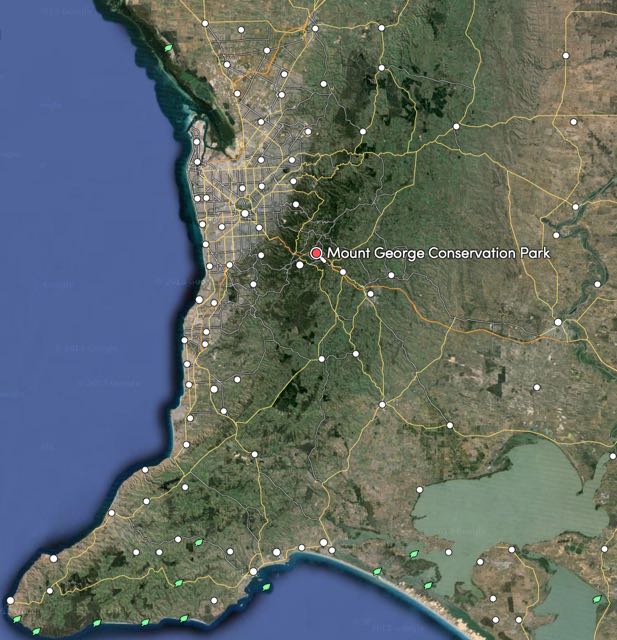
On Friday 20th February, I met up with Andy VK4TH who is on a journey from Kingaroy in Queensland, down along the Great Ocean Road and up to the Northern Territory in his camper van.  Andy, my wife Marija, and I had an enjoyable meal at a local restaurant in Mount Barker.  I then showed Andy around the local area including the nearby Mount Barker summit.  We then headed to the Mount George Conservation Park at Bridgewater, where we booked in to the 7130 DX Net and ‘played radio’.


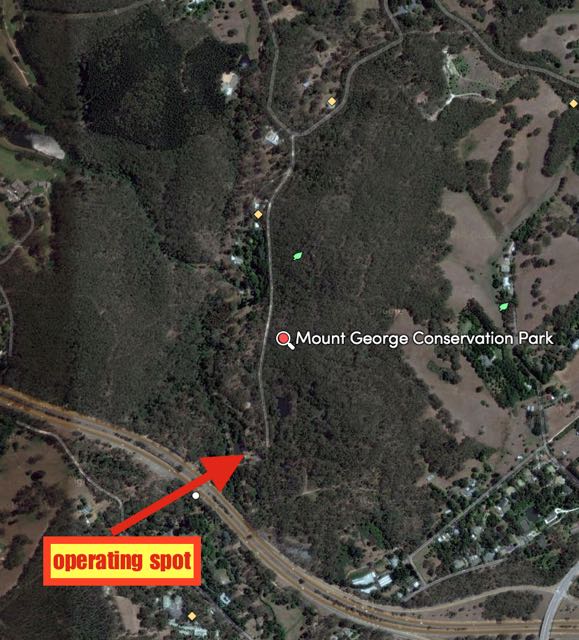
Screenshot 2015-02-28 13.21.16Above: Location of the Mount George Conservation Park.  Map courtesy of mapcarta.com

Mount George Conservation Park is located about 25 km south east of Adelaide, near the town of Bridgewater.  The park conserves an area of about 85 hectares of important native vegetation.  The park was originally 67 hectares in size, until the park boundaries were extended in 2003.  A section of the famous Heysen Trail passes through the park.  The area was once part of the tribal land of the Aboriginal people, the Peramangk.  However, by the 1840’s much of the surrounding land was cleared for farming.

Andy I set up at the end of Mount George Road in the picnic area.  This is a beautiful shaded area, with nice lawns and plenty of shade from large gum trees.  There was a nice wooden table and bench waiting there for us.  So we took advantage of that and proceeded to set up the Yaesu FT-857d and my 40m/20m linked dipole on the 7 metre squid pole.  For this activation we ran 40 watts.

Screenshot 2015-02-28 13.21.41

Above: Our operating spot in the park.  Map courtesy of mapcarta.com

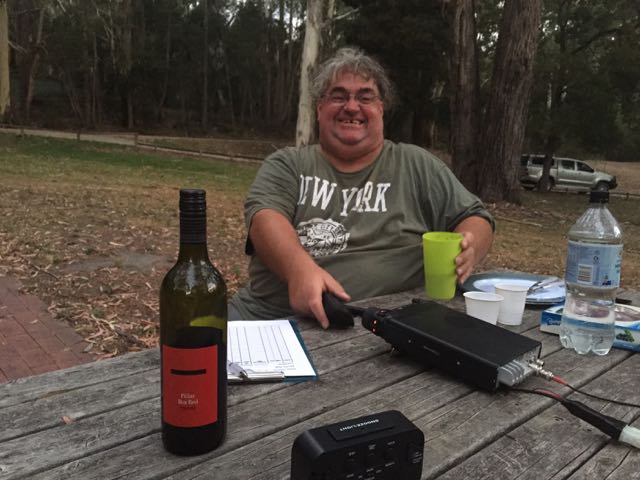
We had set up just in the nick of time for the commencement of the 7130 DX Net.  I sat back and watched Andy in action working stations on the net, whilst we enjoyed a nice bottle of South Australian red and some cheesecake.  It wasn’t real refinement, as we were drinking the red from plastic cups.  Netherless it still tasted very nice!

IMG_0726

It was great to catch up with Andy who I have spoken to many many times on air, but never met in person.  Andy is one of the Assistant Net Controllers on the 7130 DX Net.  Andy was amazed with what can be done with a simple dipole and just 40 watts.

I worked the following stations:-

  1. Mal VK5MJ
  2. Doug VK2FMIA/p (King Plains National Park)
  3. Brian ZL2ASH
  4. Caleb ZL2ML
  5. George VK4GSF
  6. Bill W1OW


References.

Department for Environment and Heritage, 2006, ‘Mount George Conservation Park Management Plan’.

National Parks South Australia, 2015, <http://www.environment.sa.gov.au/parks/Find_a_Park/Browse_by_region/Adelaide_Hills/Mount_George_Conservation_Park&gt;, viewed 28th March 2015

Kyeema Conservation Park

On Friday evening (13th February 2015) I activated the Kyeema Conservation Park, as part of the 3rd Summer afternoon/evening activation event for the VK5 National and Conservation Parks Award.  Yes, it was Friday, the 13th.  But fortunately I did not come across any scary monsters or demons in the park.  I did however, bump into another amateur, as you will read a little later.

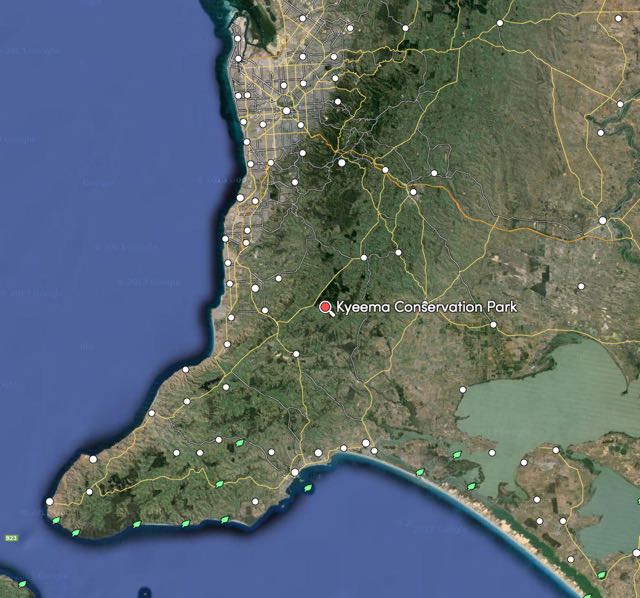
The Kyeema Conservation Park is situated about 60 km south of Adelaide, and is easily accessible via Woodgate Hill Road, which runs off Brookman Road (the main road between Willunga and Meadows).  The park has a rich history, which includes alluvial gold mining, and a labour prison reserve. The area was devastated during the 1983 Ash Wednesday fires.

Screenshot 2015-02-14 21.48.14

Image courtesy of mapcarta.com

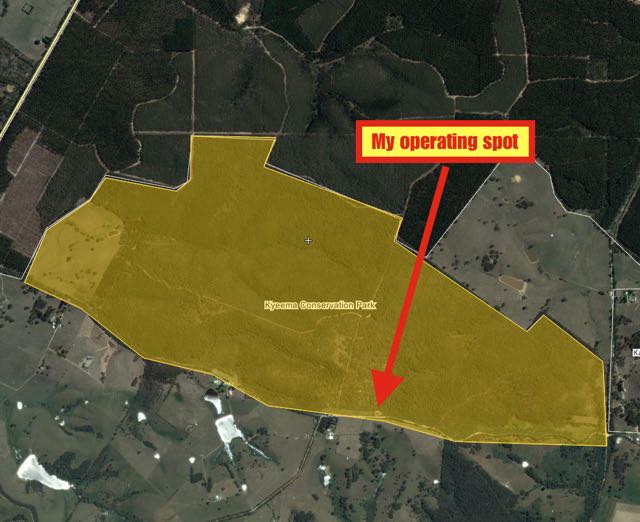
I have activated the park a number of times in the past.  It is an ideal park for a night time activation, as there is a good cleared area between the road and the scrub, alongside of the carpark off Woodgate Hill Road.  This area is on the western side of the carpark, near Gate 3.  The gate is locked, but the wire fence alongside of the gate is easily negotiated.

I set up the fold up table and deck chair and I was ready to go by 6.15 p.m. S.A. local time.  It was a beautiful evening, with the temperature being a very comfortable 25 deg C.  It was very overcast with some very threatening black clouds in the sky.  It had been a warm day in Adelaide, getting into the mid 30’s.  But not as hot as expected.  Unfortunately, the very hot weather predictions, had put off a lot of other park activators from venturing out this evening.

Screenshot 2015-02-14 21.49.11

image courtesy of wikimapia

Before calling CQ, I had my normal scout around the 40m band to see who I could find, and to gauge what propagation was like.  The 40m band seemed to be in good shape, with lots of signals coming through, but there were a lot of static crashes.  I found Bob VK5FO calling CQ on 7.090 from the Morialta Conservation Park.  Bob had a beautiful 5/9 signal coming into the Fleurieu, and it was a great way to start the activation with a ‘Park to Park’ contact.

I then moved up to 7.097.  There was some activity on 7.093, so I could not get onto my nominated operating frequency of 7.095.  My first taker after calling CQ was Hans VK5YX.  Hans had been out a little earlier in the afternoon in the Hallett Cove Conservation Park.  But unfortunately this time around, I had missed Hans whilst he was out in a park.  Another regular park hunter then called in, Arno VK5ZAR.  Arno normally heads out to activate on the Summer activation events, but this evening he had a club meeting to attend.  I was then called by Adrian VK5FANA on the Yorke Peninsula, running QRP 5 watts with a nice 5/9 signal.  Adrian seems to have been bitten by the ‘QRP bug’ and he does very well with his low power.

Unfortunately, the same ‘offenders’ that I had experienced last week whilst operating portable, came up on 7.098 whilst Adrian and I were in the middle of a QSO.  They are VK2’s who appear to have a regular sked on 7.098 and speak in Italian.  They were just too strong to compete with, and were bleeding over badly.  Despite being told by some other stations to QSY, as per last week, they appeared to ignore this and kept on going.  So again, as per last week, I QSYd.

I moved to 7.115, and my first taker there was another park regular, Les VK5KLV at Port Augusta.  This was followed by Ian VK5CZ who had a hard day in the vineyard in the Clare Valley, and had to get up again at 4.00 a.m.  Keep boxing on Ian!.  And then another regular WWFF park activator and hunter, Rob VK4FFAB, gave me a call, followed by Brett VK4FTWO in Bundaberg.

A few QSO’s later I was called by Doug VK2FMIA, who is another keen park atcivator and hunter.  And then a few calls later, Geoff VK5HEL called in from the Mowantijie Willawaur Conservation Park.  This was a real surprise.  I wasn’t aware that Geoff was heading out.  I have activated Mowantijie before, but this was the first time I had got the park as a Hunter.  Great, another ‘Park to Park’.

This slideshow requires JavaScript.

Tom VK5FTRG from Millicent gave me a shout a few contacts later.  Tom often runs QRP, and tonight was no exception.  With just 1 watt, Tom was 5/9 to Kyeema.  Although, when he was running the processor on his transceiver, his audio was pretty average.  But when it was switched off, the audio was lovely.

A few calls later I spoke with Phil VK2HPN who was mobile near Canberra on his way home from work.  Phil told me that he follows my WordPress site and had been trying to work me for a few years.  I was quite humbled by Phil’s comments, and I was very pleased to make contact with Phil.  This was followed by a call from Gary ZL3SV on the North Island of New Zealand.  Gary is always one of the strongest signals on the band.  Have a look at his antenna on QRZ.com and you will see why…..

http://www.qrz.com/db/ZL3SV

And then a few QSOs later, I was called by Mike VK6MB.  Mike was a nice 5/9 to Kyeema, and he reciprocated with a 5/7 signal report for me.  This time of the evening is ideal to work into Western Australia on 40m.

And to keep the good contacts rolling, a few QSO’s later I was called by my mate Andy VK4TH/1 who was portable near Canberra.  Andy is on a road trip and I will be catching up with him in a week or two for a meal and a few beers.  Andy was camping on the side of the Huon Highway near Canberra, and had a beautiful 5/9 signal.

I took a break from the radio and took the opportunity of taking some photos and having a drink.  The Yellow tailed black cockatoos were out in large numbers in the park, along with numerous Superb Blue Wrens.

I returned to the radio and had a bit of a tune around the 40m band and found K1N on Navassa Island, working split.  He had quite a good signal, but the pile up was unbelievable, with lots of VK’s, USA, & Japanese stations trying to get through.  It certainly would have been nice to have worked them, but I didn’t even try.

Whilst operating, I had a car arrive in the carpark.  As the male occupant got out of his car, he had a close look at the antennas on my car.  He then walked towards me, and said hello, and kept walking off into the bush.  A few times, he looked back in my direction, but kept walking.  I thought, yep another guy probably wondering what the hell I was doing.  Time passed, and the guy reappeared.  This time he said hello, and introduced himself.  It was Rafe VK5FRAF.  Unbelievable.  I’m in a Conservation Park, a fair way from anywhere, and I bump into another ham.  Rafe told me that he had been licenced for about 6 years but was not very active.  We had a good chat and exchanged phone numbers.  Hopefully, Rafe will be attending the next meeting of the Adelaide Hills Amateur Radio Society.

I then joined the 7.130 DX Net which was being run on 7.140, as K1N was working split on 7.130.  On the net I made a total of 9 contacts, including Caleb ZL2ML, Brian ZL2ASH, and ZL1CBE.  Just as the Net was about to finish, the Indonesian QRM commenced, along with the Over the Horizon Radar (OTHR).

So after a few very enjoyable hours at Kyeema, I had a total of 41 contacts in the log.  It was 9.30 p.m. and still 20 deg C.  A beautiful evening.

The following stations were worked on 40m SSB:-

  1. Bob VK5FO/p (Morialta CP)
  2. Hans VK5YX
  3. Arno VK5ZAR
  4. Adrian VK5FANA
  5. Les VK5KLV
  6. Ian VK5CZ
  7. Rob VK4FFAB
  8. Brett VK4FTWO
  9. Mick VK3FAFK
  10. Nev VK5WG
  11. Doug VK2FMIA/p (National Park)
  12. Jim VK2FADV
  13. Steve VK5ST
  14. VK4OK
  15. Geoff VK5HEL/p (Mowantijie Willawaur CP)
  16. David VK5NQP
  17. John VK5FMJC
  18. Tom VK5FTRG/qrp
  19. Rod VK2LAX
  20. Adam VK2YK
  21. Phil VK2HPN/m
  22. Gary ZL3SV
  23. Brian VK5FMID
  24. Mike VK6MB
  25. Jeff VK5JK
  26. Steve VK5AIM
  27. Tony VK5KAT
  28. Andy VK4TH/1
  29. Paul VK5FUZZ
  30. Peter VK2FKAD
  31. John VK2XUP
  32. John VK2TH
  33. Caleb ZL2ML
  34. Brian ZL2ASH
  35. Roadl VK1FIVE
  36. Andy VK4TH/1
  37. Andrew VK2MWP
  38. Roy VK7ROY
  39. Connor VK2FCAC
  40. George VK4GSF
  41. ZL1CBE


Wills Creek Conservation Park

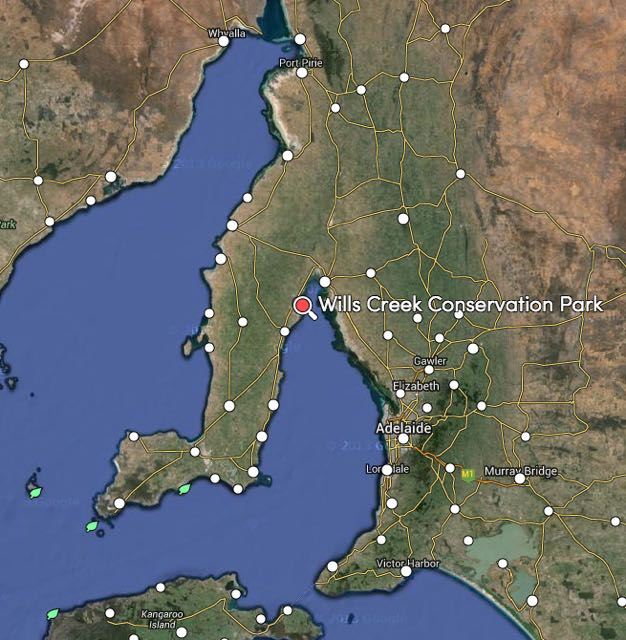
My last activation for my 4 days away was the Wills Creek Conservation Park, which is located near the little town of Price, about 132 km from Adelaide, on the Yorke Peninsula.

Screenshot 2015-02-07 14.50.25

Map courtesy of mapcarta.com

The Wills Creek Conservation Park was proclaimed in 2006 and is 1,130 hectares in size.  It is situated at Mangrove Point on the north western shores of Gulf St Vincent.  It is a significant coastal wetland and estuary area supporting mangroves and intertidal habitats.  The park extends south from the township of Port Clinton to the town of Price.

The park consists of mangrove and samphire habitats along the coastal fringe.  Wills and Shag Creeks are known fish nursery areas and as an important habitat for sea birds.

I travelled to the end of the Causeway Road, leading out of Price, and set up at the boatramp on Wills Creek.  It was now very hot.  My temperature gauge showed 38 deg C.  So I quickly set up the gear and sought refuge in a little wood and tin shelter in the carpark, near the Creek.

Screenshot 2015-02-07 15.02.06

map courtesy of mapcarta.com

I called CQ on 7.095 and this was answered by Greg VK5GJ at Meadows, running his normal QRP 5 watts.  Greg’s signal was 5/4 but extremely readable due to the very low noise floor in the park.  My second caller was Brian VK5FMID in Mount Gambier, followed by Nev VK5WG at Crystal Brook, and then Mick VK3FAFK in Stawell in western Victoria.  I went on to work a further 16 stations in VK3 and VK5.

This slideshow requires JavaScript.

This was a quick 25 minute activation.  I had a total of 20 contacts in the log.

The following stations were worked:-

  1. Greg VK5GJ (qrp)
  2. Brian VK5FMID
  3. Nev VK5WG
  4. Mick VK3FAFK
  5. Adrian VK5FANA (qrp)
  6. John VK5BJE
  7. Tom VK5EE
  8. Amanda VK3FQSO
  9. Jim VK5JW
  10. David VK5NQP
  11. Tony VK3CAT
  12. Richard VK5ZRY
  13. Fred VK3DAC
  14. Jeff VK5JK
  15. Peter VK3TKK
  16. Ian VK5IS
  17. Steve VK3NSC
  18. Rob VK3ECH
  19. Stan VK3BNJ
  20. John VK5FTCT


References.

Department for Environment and Heritage, 2009, ‘Mainland Conservation Parks of Yorke Peninsula’.

Clinton Conservation Park

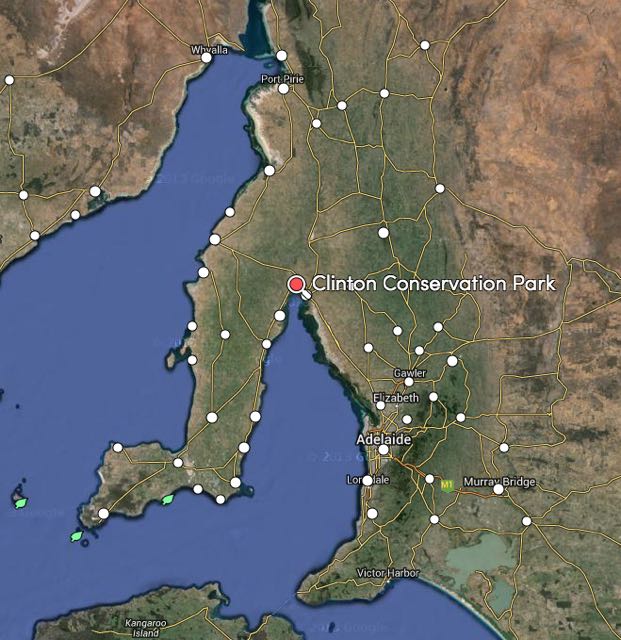
I was now on the downhill run of my 4 days away.  My first park for Friday the 6th February, 2015, was the Clinton Conservation Park, which is located about 100 km north of Adelaide, near the town of Port Wakefield.

Screenshot 2015-02-07 15.06.08

Map courtesy of mapcarta.com

The Clinton Conservation Park was established in 1972, and is 1,923 hectares in size.  It is a boomerang shaped park, which is situated at the northern extremity of Gulf St Vincent.  It stretches around the top of the Gulf from just north of Port Wakefield, around to the little town of Port Clinton on the Yorke Peninsula.  The park comprises an expanse of mainly low-lying, coastal-fringe habitats, with mangroves and samphire communities, and extensive tracts of intertidal mudflats.  It is an important refuge as a fish nursery and a significant site for migratory wading birds.

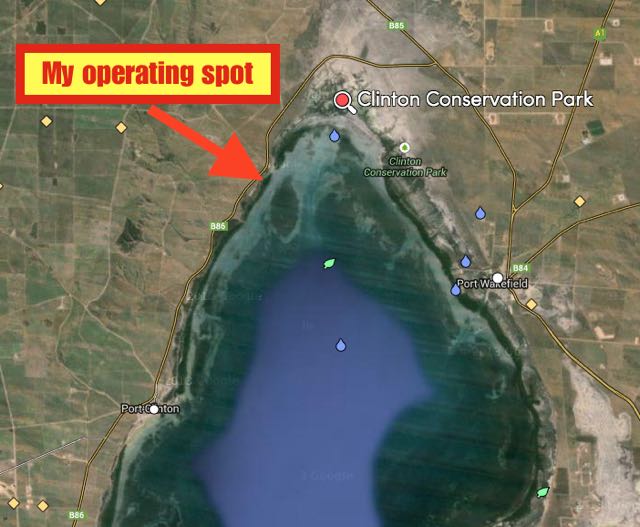
I found a nice quiet little track off the Yorke Highway, which took me right down to the water’s edge.  I set up the fold up table and deck chair and then the linked dipole.  This was going to be a quick activation, as the expected temperature today was 38 deg C.  It was already approaching the mid 30’s and it was 9.30 a.m.  There was no shade at this location, but I was facing the sea, and there was a nice cool breeze coming in off the Gulf.

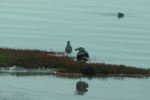
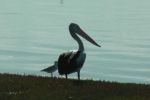
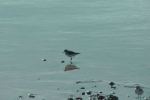
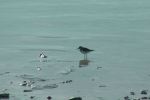
The area was alive with bird life.  Of the feathered variety!  There were Pelicans, Silver Gulls, Pacific Gulls, and Sandpipers.

Screenshot 2015-02-07 15.06.54

map courtesy of mapcarta.com

I ran the Yaesu FT-857d and 40 watts for this activation.  I started off on 40m, where my first contact was with Mick VK3FAFK in Western Victoria.  This was followed by Adrian VK5FANA operating QRP 5 watts, and then Jim VK5JW on the Eyre Peninsula.  The voice of the Mid North then called in, Nev VK5WG, also operating QRP 5 watts.  A few QSOs later, another familiar QRP caller gave me a shout, Greg VK5GJ at Meadows in the Adelaide Hills.  I also worked Robin VK5TN who was mobile at the Blue Lake in Mount Gambier.

I did try calling CQ on 14.317 but had no takers.  Whilst having a break from my CQ calls I heard a very distinct burst of noise on the 20m band.  Initially I thought there was a problem with the antenna, but not so.  It was across the entire band.  Most likely a flare or CME.  The noise settled down after a minute or so.

But it was just getting far too hot out in the sun, so I packed the gear up after getting a total of 13 QSO’s in the log, and headed further south on the Yorke Peninsula to my next park, Wills Creek Conservation Park.

The following stations were worked:-

  1. Mick VK3FAFK
  2. Adrian VK5FANA (qrp)
  3. Jim VK5JW
  4. Nev VK5WG (qrp)
  5. Trevor VK5ATQ
  6. Brian VK5FMID
  7. Greg VK5GJ (qrp)
  8. Ron VK3AFW
  9. Robin VK5TN/m
  10. Ian VK5IS
  11. Amanda VK3FQSO
  12. Tom VK5EE
  13. Greg VK2MTC


References.

Department for Environment and Heritage, 2009, ‘Mainland Conservation Parks of Yorke Peninsula’.