Pooginook Conservation Park 5CP-186 and VKFF-0929

When the BRL Gathering started to wrap up late on Saturday afternoon (16th April 2016), Marija and I headed out to the Pooginook Conservation Park, 5CP-186 and VKFF-0929, for a quick park activation.  This is exactly what Marija and I did last year.  The BRL Gathering wound up and we headed out to Pooginook, about 23 km further up the Goyder Highway.  So it was a repeat performance of last year.  We had time restrictions this year though, as we had arranged to go out for tea that night.

Pooginook Conservation Park is located about 200 km north east of Adelaide and about 70 km west of Renmark.

Screenshot 2016-04-19 16.29.21

Above:- Map showing the location of the Pooginook Conservation Park in the Riverland region of South Australia.  Image courtesy of Location SA Map Viewer.

Although I had activated Pooginook previously, this was to be a unique park for me for the World Wide Flora Fauna (WWFF) program.  The park was not on the WWFF list at the time I last activated it for the VK5 National and Conservation Parks Award.

On the way out to the park we stopped off briefly on the Goyder Highway to admire the view out to the Murray River and the Overland Corner Hotel.

We then stopped briefly at the Overland Corner cemetery.  Some of the older headstones in the cemetery belong to the Brand family, who have a long history associated with the Overland Corner Hotel.

We continued along the Goyder Highway for a number of km until we reached the sign for the park which is on the northern side of the road.  If you only have a 2WD vehicle, you can enter the park through the open gate and operate just inside the boundary.  But if you have a 4QD vehicle, there is a sandy 4WD track which follows the eastern boundary, and this is what Marija and I did.

Don’t attempt the track if you have a conventional vehicle.  You will get bogged.

DSC_0111.jpg

The Pooginook Conservation Park is a large park, comprising 2,862 hectares of gently rolling sand dunes covered by multi-stemmed mallee.  The park contains dense mallee scrub in the northern section and open mallee in the south.  This area was once used largely for wheat farming.  The park provides refuge for a large amount of native wildlife including Western grey kangaroos, Red kangaroos, echidnas, hairy-nosed wombats, fat-tailed dunnarts and the rare malleefowl.  Over 20 species of reptiles have been recorded in the park including Desert skinks, Nobbi dragons, Barred snake-lizards and Jewelled geckos.

The name Pooginook, comes from Aboriginal words meaning ‘place of good food’.  The Ngawait aboriginal tribe occupied this area.  Pooginook Station was established in 1851 by John Taylor.

DSC_0110.jpg

We drove a few km along the 4WD track and found a nice clearing and started setting up the gear.  We used the normal portable station for this activation: the Yaesu FT-857d (set on 40 watts for me, and 10 watts for Marija), and the 40m/20m linked dipole supported on the 7 metre heavy duty telescopic squid pole.

Screenshot 2016-04-19 16.30.43

Above:- Aerial shot showing our operating spot in the eastern side of the park.  Image courtesy of Location SA Map Viewer.

It was a warm aftermoon so we south the shade of some of the gum trees.  I commenced calling CQ on 7.144 and our first contact was with Ivan VK5HS who was mobile from Overland Corner back into Renmark.  Not surprising that Ivan was 5/9 plus to Pooginook.  Next up was another mobile station.  This time it was David VK3DMX with a good 5/7 signal.  This was followed by Rick VK4RF/VK4HA, Bob VK5FPAC, and then Adrian VK5FANA.  It wasn’t long before all the regular park hunters had come out of the woodwork and were calling.

But amongst all the locals I heard my good mate Danny ON4VT in Belgium.  Danny was an excellent 5/5 signal and gave me a 4/4.  It was a real pleasure to get Danny in the log on 40m, whilst running just 40 watts and a simple little dipole.

I worked a total of 45 stations on 40m from VK2, VK3, VK4, VK5, VK6, and VK7, before handing the mic over to Marija.

Marija was cognisant of our time restrictions in the park and was just seeking 10 contacts to qualify the park for the VKFF program.  Which is what she did in a very short space of time.  Marija’s first contact was with Greg VK4VXX/2, followed by Brian VK3BBB, Mick VK3GGG and then Geoff VK3SQ.  Marija worked a total of 16 stations before handing the mic back over to me.

I worked just 4 more stations on 40m including Gerard VK2IO portable on Summits on the Air (SOTA) peak Barraba Trig VK2/ HU-065.  Our time in the park was running short, so I quickly headed to 20m and started calling CQ on 14.310.  This was almost immediately answered by Don G0RQL in England, followed by Adam VK2YK, and then Danny ON4VT for a second band.  A steady flow of callers followed from Europe and Australia.  Sadly, despite the pile up I needed to go QRT.  I’m sorry to all those that were still calling.

I worked a total of 32 stations on 20m from Australia (VK2, VK4, VK6, VK7 and VK8), England, Belgium, Canary Islands, Italy, Germany, Slovak Republic, France, Hungary and Switzerland.

We had a bit of trouble during this activation to keep the squid pole in place as the ground was very hard.  We propped up a number of large rocks against the squid pole holder, but as it was quite windy, I had to stand up and hold the squid pole in place whilst Marija was on air.  Marija got quite a laugh at that: me at work whilst she was enjoying some air time!

Screenshot 2016-04-21 08.55.18

I worked the following stations on 40m SSB:-

  1. VK5HS mobile
  2. VK3DMX mobile
  3. VK4RF
  4. VK4HA
  5. VK5FPAC
  6. VK5FANA
  7. VK3NBL
  8. VK3GTS
  9. VK5HCF
  10. VK7CW
  11. VK3FTAD
  12. VK3PAT
  13. VK5PL
  14. VK3CFA
  15. VK3GGG
  16. VK3DAC
  17. VK5BJE/3
  18. VK5HEL mobile
  19. VK7ZGK
  20. VK3ZPF
  21. VK3SIM
  22. ON4VT
  23. VK4QQ
  24. VK4HNS
  25. VK3PF
  26. VK3BNJ
  27. VK3ZD
  28. VK3ZMD
  29. VK3ARH
  30. VK5ZGY mobile
  31. VK6WE/p
  32. VK2NP
  33. VK3MRH
  34. VK2SK
  35. VK4KL
  36. VK7FGGT
  37. VK3FAPH
  38. VK3AFW
  39. VK3BBB
  40. VK3SOT
  41. VK5QI mobile
  42. VK3SQ
  43. VK3FSPG
  44. VK3XAF
  45. VK4VVX/2
  46. VK3NRG
  47. VK3PMG
  48. VK2JNG/5
  49. VK2IO/p (SOTA VK2/ HU-065)

I worked the following stations on 20m SSB:-

  1. G0RQL
  2. VK2YK
  3. ON4VT
  4. ON5SWA
  5. ON4BB
  6. EA8CER
  7. IK1GPG
  8. DK0EE
  9. DH1PAL
  10. IK2JZN
  11. OM7OM
  12. VK2NP
  13. IK8FIQ
  14. VK6NU
  15. VK2LEE
  16. VK4WJW
  17. VK7VDC
  18. EA8BA
  19. F2YT
  20. DL4BBH
  21. VK4QQ
  22. DL1EBR
  23. VK4QS
  24. DJ3GG
  25. VK4NH/6
  26. VK2RM
  27. VK6NTE
  28. VK8GM
  29. F4KJR
  30. HA6OB
  31. HB9AAL
  32. VK4MWG

Marija worked the following stations on 40m SSB:-

  1. VK4VXX/2
  2. VK3BBB
  3. VK3GGG
  4. VK3SQ
  5. VK5FANA
  6. VK3SOT
  7. VK5FPAC
  8. VK3FAPH
  9. VK3PF
  10. VK5KC
  11. VK3ZMD
  12. VK4RF
  13. VK4HA
  14. VK5JK
  15. VK3ZPF
  16. VK5VRB

It was a quick pack up and off we headed to Renmark.  On the way back into Renmark I had a good chat with Paul VK3HN from the mobile.  After arriving back at the hotel, we freshened up and headed out for tea with Ivan VK5HS and his wife Sheryl, Di (the XYL of Larry VK5LY – SK), and Peter VK5FLEX.  We enjoyed a very nice meal at Ashley’s Restaurant and a few refreshing ales.  It was then back to the motel room to see the last quarter of the football and a great win by the Adelaide Crows.


References.

Department of Environment and Natural Resources, June 2011, Parks of the Riverland.

National Parks South Australia, 2016, <http://www.environment.sa.gov.au/parks/Find_a_Park/Browse_by_region/Murray_River/Pooginook_Conservation_Park&gt;, viewed 20th April 2016

2016 BRL Gathering at Overland Corner Hotel

On Saturday morning (16th April 2016) Marija and I made a bright and early start from Renmark, and headed out to the historic Overland Corner Hotel for the 2016 BRL Gathering.  The BRL Gathering is hosted by the Riverland Radio Club, and this was to be the second year for the Gathering.

We arrived at the Overland Corner Hotel at around 7.15 a.m. and found that there was already a core group of amateurs and their wives/partners, in attendance.  A number of those had stayed overnight in their caravans and campers at the rear of the pub.

brl-gathering-poster

After saying g’day to everyone and helping out setting up a linked dipole for the Riverland Radio Club Net, we enjoyed a great brekkie cooked by Ivan VK5HS and Peter VK5FLEX, consisting of toast, eggs and bacon, all cooked on the barbie.

This was followed by the Riverland Radio Group Net which was run from the Overland Corner Hotel.

A boot sale then took place with a number of bargains on offer.  I was fortunate to come away with a few bargains, including an IC751 transceiver, a Mini Palm Paddle and two antenna tuners (all previously owned by Larry VK5LY-now silent key).

This slideshow requires JavaScript.

We all then gathered together for a group photograph in front of the hotel.

DSC_0036

It was then time for some more chatting and mingling, with the pub opening its doors.  A few of the fellas, including myself took the opportunity of some nice cold beverages.  We also enjoyed a very nice meal at the pub.

This slideshow requires JavaScript.

After lunch, the more formalised part of the day took place, with a quick chat by Ron VK5MRE and then all of the amateurs introducing themselves and telling the group a little about themselves.  This was followed by the draw of the raffle, with a number of very nice prizes being awarded.  Ivan introduced me as the newly elected WIA Director and kindly asked me to draw the prizes.

This slideshow requires JavaScript.

Tony VK5FTVR was then awarded with the BRL Award which he was very chuffed with.  The Award certificate was issued for achieving the most number of points gathered during 2015 and 2016 during the Riverland Radio Group Nets.

DSC_0087

I also gave a very short talk on the WIA and the recent proposal submitted to ACMA.  I also announced details of the recently launched Murray River Parks Award and information regarding the 4th level of this award.  Ivan VK5HS, Peter VK5FLEX and I had decided that a plaque would be awarded for those amateurs who activated/worked all of the qualifying parks along the Murray, in honour of Larry VK5LY.  Larry became a silent key in late 2015 after battling an illness diagnosed earlier in the year.  Larry was one of the stalwarts of the VK5 National and Conservation Parks Award and the World Wide Flora Fauna (WWFF) program.  It is a fitting tribute then, that a plaque would be awarded in his honour.  We had one minutes silence for Larry.

This slideshow requires JavaScript.

It was then back to enjoying the company, the sunshine, and the ice cold Bundies from the hotel.

The weather for the day could not have been better, with the top temperature reaching around 28 degrees C.  The shade of the trees and the umbrellas was sought after by all.

This is always a great weekend, and I highly recommend the BRL Gathering.  Marija and I will certainly be attending again next year.

Pike River Conservation Park, 5CP-180 and VKFF-0831

Late Friday afternoon (15th April 2016), Marija and I left home in the Adelaide Hills, and made our way towards Renmark in the Riverland region of South Australia.  Our reason for heading up to that neck of the woods was to attend the Riverland Radio Group’s BRL Gathering at the historic Overland Corner on Saturday.  Fortunately I was still on holidays, but Marija had to work on Friday, so it was around 3.00 p.m. when we left home.

We had planned to activate the Pike River Conservation Park, 5CP-180 and VKFF-0831 on Friday evening, after booking in to our motel.  The park is located about 260 km north east of Adelaide, and around 10km from Renmark.

Screenshot 2016-04-19 16.40.43

Above:- Map showing the location of the Pike River Conservation Park near Renmark in the Riverland region of South Australia.  Image courtesy of Location SA Map Viewer.

I have activated Pike River previously, for the VK5 National and Conservation Parks Award, but that was prior to the park being added to the World Wide Flora Fauna (WWFF) program.  So this was to be a unique WWFF/VKFF activation for me.

It was just after 6.00 p.m. by the time we reached Renmark, and almost dark, so it was a quick check in to the motel, and then off to Pike River.  We headed south east along the Sturt Highway, through the little town of Paringa, passing over the historic Paringa Bridge, until we reached the open and unlocked gate leading into the park.  The park is not signposted, so keep an eye out for the gate which is a few hundred metres after passing the carpark/lookout on the western side of the Sturt Highway.

We drove a short distance down the dirt track towards Pike Lagoon, admiring the amazing sunset.

Pike River Conservation Park forms part of the Pike River Floodplain and is an anabranch system of the Murray River.  The park is about 296 hectares in size , and has a number of species of national significance including the Southern Bell Frog, Murray Cod, and the Regent Parrot.  It also contained an additional 18 species with State Conservation significance.

We set up the deck chair and fold up table.  I still had my thongs on but had to quickly change into socks and sandshoes as the mosquitos were biting hard and the stubble on the ground was extremely prickly.

Screenshot 2016-04-19 16.39.46

The 40m band was quite busy and I was unable to get to 7.144 due to some South East Asian stations who were in very close proximity to the frequency.  So I decided to head down to 7.130 and put out a CQ call.  My first taker was Jonathan VK2VJS who was a good 5/5 to the park, but sadly Jonathan was really struggling with me.  I received a 3/2 signal report.  Next up was Mike VK6MB who was booking in at 5/9 and Mike also reciprocated with a 5/9 signal report for me.  Rob VK4AAC/3 who was in the Mount Lawson State Park VKFF-0768 was next, with a good 5/9 signal.

Rick VK4RF/VK4HA gave me a shout and informed me that Phil VK6ADF was in a National Park on 7.144, so I ducked up there to get Phil in the log from Watheroo National Park VKFF-0524.  I then returned back to 7.130 and worked a further 4 stations just  prior to the 7.130 DX Net starting up.  I moved up to 7.135 and worked 7 stations in VK2, VK4, VK5 and VK6.  I then returned back to 7.130 and booked in to the Net where I worked into VK4, VK5, VK6, USA, Puerto Rico, and New Zealand.

Sadly for this activation, band conditions were well down, with lots of very severe QSB.  I did not reach the required 44 QSO threshold to qualify the park for the global WWFF program, but I did qualify the park for the Australian (VKFF) program, which only requires 10 QSOs from the park.

I had a total of 25 contacts in the log, including two Park to Park contacts and a handful of DX on 40m, so I was still quite happy.  It will be a trip back to Pike River to pick up the remaining 19 QSOs.

Marija also operated from the park and got her required 10 QSOs to qualify the park for VKFF, including two Park to Park contacts with Rob VK4AAC/3 and Phil VK6ADF/p.

I worked the following stations on 40m SSB:-

  1. VK2VJS
  2. VK6MB
  3. VK4AAC/3 (Mount Lawson State Park VKFF-0768)
  4. VK2IO
  5. Vk4RF
  6. VK4HA
  7. VK6ADF/p (Watheroo National Park VKFF-0524)
  8. VK3PF
  9. VK6VCK/m
  10. VK3SIM
  11. VK7ROY
  12. VK4GSF
  13. VK2WDD
  14. VK2HPN
  15. VK4FDAD
  16. VK5FAKV
  17. VK4NAI/6
  18. VK4FZZW
  19. VK5MJ
  20. VK6PCB
  21. NR6Q
  22. NP4A
  23. ZL3SV
  24. W1OW
  25. VK4TH

Marija worked the following stations on 40m SSB:-

  1. VK6MB
  2. VK4AAC/3 (Mount Lawson State Park VKFF-0768)
  3. VK2IO
  4. VK4RF
  5. VK4HA
  6. VK6ADF/p (Watheroo National Park VKFF-0524)
  7. VK6VCK/m
  8. VK3SIM
  9. VK7ROY
  10. VK3PF

Kenneth Stirling Conservation Park, 5CP-104 and VKFF-0781

On Sunday 10th April 2016, my wife Marija and I headed over to the Kenneth Stirling Conservation Park, 5CP-104 and VKFF-0781.  Marija’s Foundation amateur radio licence had been granted 5 days earlier, so this was to be Marija’s very first park activation with her new call of VK5FMAZ.

I have activated Kenneth Stirling many times previously and have touched on its very interesting history in previous posts….

https://vk5pas.org/2015/04/09/kenneth-stirling-conservation-park-vkff/

https://vk5pas.org/2015/01/24/kenneth-stirling-conservation-park-3/

https://vk5pas.org/2014/07/11/kenneth-stirling-conservation-park-2/

https://vk5pas.org/2013/05/10/kenneth-stirling-conservation-park/

Kenneth Stirling Conservation Park is located about 17 km east of Adelaide, in the Mount Lofty Ranges ‘Adelaide Hills’.

Screenshot 2016-04-19 19.19.04.jpg

Above:- Map showing the location of the Kenneth Stirling Conservation Park in the Adelaide Hills.  Map courtesy of Location SA Map Viewer.

The park is divided into four autonomous sections (Wotton Scrub; Filsell Hill, Whites Scrub; and Burdett Scrub) and we decided to play it safe and activate the Wotton Scrub Section, which is very easy to access.  It is just a short drive from our home through the Adelaide Hills.

Screenshot 2016-04-19 17.24.08

Above:- Map showing the location of the four (4) autonomous sections of the Kenneth Stirling Conservation Park.  Image courtesy of Location SA Map Viewer.

We arrived at the park at around 2.00 p.m. South Australian local time, and parked the 4WD in the small carpark out the front of the park, off Gum Flat Road.  There is a nice area here just inside the gate on Gahnia Track, allowing you to stretch out a dipole.

We set up the deck chair, the fold up table, the Yaesu FT-857d, and the 40m/20m linked dipole on the 7 metre heavy duty telescopic squid pole.  We were ready to go by about 0447 UTC.

Screenshot 2016-04-19 16.24.07

Above:- Map showing our operating spot in the Kenneth Stirling Conservation Park.  Image courtesy of Location SA Map Viewer.

Marija started calling CQ on 7.130 and her first ever park contact was with Mick VK3PMG in western Victoria with a very strong 5/9 plus signal.  This was followed by Les VK5KLV, Peter VK2NEO, Alan VK3LSD and then Adrian VK5FANA.  It wasn’t long before Marija had a little pile up going, which I thought she handled extremely well.  I assisted Marija with writing down some of the call signs heard and helping her out with the names of many of the familiar call signs.

DSC_0258

Marija ended up working a total of 69 stations in VK2, VK3, VK4, VK5, VK6, and VK7.  This included Park to Park contacts with: John VK5BJE/p in the Butcher Gap Conservation Park 5CP-027 and VKFF-0793; Peter VK5FKLR/p in the Mount Remarkable National Park 5NP-015 and VKFF-0360; Rob VK4AAC/3 in the Wodonga Regional Park VKFF-0980; and Adam VK2YK/p in the Popran National Park VKFF-0417.  Marija also made a Summits on the Air (SOTA) contact with Nick VK3ANL/p on Mount Warrenheip VK3/ VC-019.

DSC_0266

And Marija was very pleased to work Julie VK3FOWL, and Connie VK2FCON.  Marija was Connie’s first ever contact on HF.

Below is a 10 minute video of Marija at the mic for her very first park activation…..

Just after 0700 UTC it was my turn to put out a few CQ calls on 20m.  I headed for 14.210 and started calling CQ.  This was almost immediately answered by Don VK2DON, followed by Sasa 9A3NM in Croatia, Luciano I5FLN in Italy, and then Rick VK4RF/VK4HA.  I was kindly spotted on the DX Cluster by a number of stations, and this resulted in a mini pile up of European and VK park hunters.

DSC_0268

After 45 minutes on 20m I had 42 stations in the log, and it was starting to get a bit late.  Countries worked on 20m were:- Australia (VK2, VK4, VK6), Croatia, Italy, Hungary, Poland, Finland, France, Slovenia, Denmark, Belgium, Germany, Scotland, Russia, Spain, Netherlands, and Sweden.  I quickly headed over to 40m where I spoke with Adam VK2YK/p ‘Park to Park’ in the Popran National Park VKFF-0417.  And to finish things off I called CQ on 21.244 for around 5 minutes, but only managed to work John VK6NU (5/7 sent and 5/5 received).

I worked the following stations on 20m SSB:-

  1. VK2DON
  2. 9A3NM
  3. I5FLN
  4. VK4RF
  5. VK4HA
  6. VK2LEE
  7.  IK1GPG
  8. IK3SCB
  9. VK2IO
  10. IK8FIQ
  11. HA6OB
  12. VK2NP
  13. Sp5INQ
  14. IK2JZN
  15. 9A1DX
  16. 9A5M
  17. OG3MS
  18. F5PAU
  19. 9A7PPD
  20. 9A1MB
  21. F1BLL
  22. VK6JON/m
  23. S51XA
  24. VK4SMA
  25. VK4FW
  26. OZ5HP
  27. VK6WX
  28. ON4VT
  29. DL1YD
  30. 2M0EVS/m
  31. IZ1GLT
  32. 9A3AR
  33. VK6BEC
  34. VK2TCI/m
  35. ON7YZ
  36. ON5SWA
  37. 9A5RBS
  38. RC5F
  39. F4GYG
  40. DK7TX
  41. F2YT
  42. PD7DX
  43. DB6VP/p
  44. PB7Z
  45. IK2TTJ
  46. IZ5WTV
  47. EA7ANC
  48. SA5ACR
  49. F5RLW
  50. VK2RD/m
  51. EA2DT
  52. F4KJR/p

I worked the following station on 40m SSB:-

  1. VK2YK/p (Popran National Park VKFF-0417)

I worked the following station on 15m SSB:-

  1. VK6NU

Below is a short video of me operating on 20m……

Registering for WWFF Logsearch

Here is a quick rundown on how to register for Logsearch with the World Wide Flora Fauna (WWFF) program.

Logsearch is the WWFF database, where all activator logs are uploaded (by National co-ordinators), and from where activators and hunter can track their progress.  WWFF awards are also applied for on-line via WWFF Logsearch.

Please note, that until the Activator log/s are uploaded to Logsearch, then the activators cannot claim the park, nor can any of the park hunters who worked the activator.

So how do I register?

First up, click on ‘Register’.  It will bring you to the screen below.  Fill out all the options, including your Callsign, Home DXCC, Continent, Password (and ensure you confirm your password), Personal name, and your email address.  PLEASE double check the information you entered and ensure it is correct.  There have been some instances of people entering incorrect or incomplete email addresses and then blaming the Logsearch system for not being registered.

Screenshot 2016-04-11 10.12.14

Then click on ‘Create’.  Once you do, the following should appear on your screen.  You should see your callsign and acknowledgement that your member details have been created.

Screenshot 2016-04-11 10.12.43.jpg

As per the message, check your email.  You should have received an email confirmation from the Logsearch system.  It will contain a link which you will need to click on to confirm your email address.

Screenshot 2016-04-11 10.12.53

You will also see the following message on Logsearch

Screenshot 2016-04-11 10.13.22

You will then receive another email asking you to verify your email address by clicking on a link in the email.  Screenshot 2016-04-12 11.48.26

You will then receive a confirmation email from Logsearch to advise that you have confirmed your email address.  Your registration will be reviewed at this time by WWFF Administration, and your account should be activated in a few days.

Screenshot 2016-04-11 10.14.00

Finally, you will receive an email verifying that you have successfully confirmed your email address.  You now have access to all of the excellent features of Logsearch.

Screenshot 2016-04-12 12.42.05.jpg


Fast Log Entry (FLE)

A new version of Fast Log Entry (FLE) has now been released.  Version 2.4 released on the 10th April 2016 is the latest version of this magnificent program.  FLE is a text editor which allows you to easily and rapidly enter QSOs and create an Amateur Data Interchange Format (ADIF) file).

Remember, that ADIF is one of the formats accepted for Activator logs with the World Wide Flora Fauna (WWFF) program.

Activator logs MUST be uploaded to WWFF Logsearch for the Activators to claim the park, and also for all of the park hunters who worked the activator.

I have been using FLE for a long time, as I prefer to use paper out in the field.  I enter all my QSOs when I return home using FLE.  This will generate an ADIF file for me, which I can upload to WWFF Logsearch, and also upload to my own electronic logging program, MacLogger DX.

So how do you get started with FLE?

You can download the program from the following website……

http://www.df3cb.com/fle/

FLE has been created by Bernd DF3CB, and is FREEware, but please consider a donation.  Donations are not required but are welcome.  They help Bernd cover costs for development tools and to continue development on FLE.  I have donated a small amount to Bernd, and I would encourage others to do so as well.  You can make your donation by PayPal. Click on either the USD or the Euro Donate button below. You will then be directed to the PayPal page.

Next up….READ THE INSTRUCTIONS.

The instructions are only 5 pages long and are not at all difficult to follow.  But I am amazed at the number of queries I get re FLE, and when queried I find that the producer of the log had not read the instructions.

FLE now offers a WWFF logging option and supports the World Wide Flora Fauna (WWFF) program.  The following screenshots will give you a quick idea on how this new option works.  This is NOT a full tutorial on how to use FLE.  It is just a quick rundown on the new WWFF logging option.  Please read the FLE instructions on how to use FLE in all its glory.

Screenshot 2016-04-12 09.02.12

Start off by selecting the WWFF Logging option, by clicking on ‘Options’, and then clicking on ‘WWFF Logging’.

Screenshot 2016-04-12 09.08.54

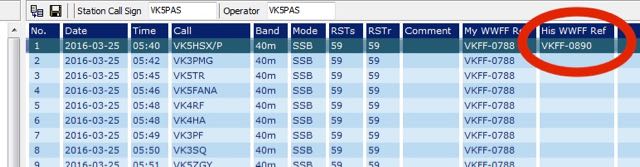
You will then see ‘My WWFF Ref’ and ‘His WWFF Ref’ columns show up.

Screenshot 2016-04-12 09.09.00

To enter YOUR WWFF reference, click on ‘Options’, and then click on ‘Edit WWFF Reference’.

Screenshot 2016-04-12 10.00.39

The following dialogue box will appear.  Enter your WWFF reference, e.g. VKFF-0781.

Screenshot 2016-04-12 09.58.18

Then start typing in your information, e.g. date, band, contact details.  Remember, please read the instructions.

Just to show you how your VKFF reference number is captured after entering it in the ‘Edit WWFF Reference’ box, I have entered just 2 contacts and then clicked on the ‘Update the log grid’ icon.  You can see that the information has been converted from the log grid (the box on the left) to the Data grid (the box on the right), and the VKFF reference is recorded in the ‘My WWFF Ref’ column.

Screenshot 2016-04-12 10.07.20

In this example I continued to add the QSOs until I reached the QSO with John VK5BJE, who was operating portable from the Butcher Gap Conservation Park.  This was a park to park contact.  After John’s callsign I typed the keyword WWFF (after a space).  It immediately highlights in yellow (which means I have typed the details correctly).

Screenshot 2016-04-12 10.16.33

I continue on by adding a space and then adding the VKFF reference for the ‘park to park’ contact.  In this case it was VKFF.  As you type, the reference will be highlighted in yellow.  When you complete the reference, the highlighting will disappear.

Screenshot 2016-04-12 10.19.41

You should continue to add your QSOs but to show you how the park to park data has been captured, I have again clicked on the ‘Update the log grid’ icon.  This has converted the date over to the Data grid on the right.

Screenshot 2016-04-12 10.21.59

So as you can see, FLE is now very user friendly for WWFF Activators.  Many thanks to Bernd, DF3CB.

Myponga Conservation Park 5CP-157 and VKFF-0921

It was Monday morning (4th April 2016) and unfortunately it was time to head home.  Marija and I had enjoyed three fantastic nights on the Fleurieu Peninsula, staying at Goondooloo Cottage which we highly recommend.

http://www.southernoceanretreats.com.au/

It was also the end of another successful anniversary weekend for the VK5 National and Conservation Parks Award.  I don’t think there was as much activity as previous years, but netherless it was still a very enjoyable and busy weekend on the airwaves.  Our one and only planned park activation for the day was the Myponga Conservation Park 5CP-157 and VKFF-0921.  The park is situated about 67 km south of Adelaide, and about 8 km south of Myponga.

Screenshot 2016-04-08 21.33.38

Above:- Map showing the location of the Myponga Conservation Park on the Fleurieu Peninsula, south of Adelaide.  Image courtesy of Location SA Map Viewer.

Prior to heading to the park, Marija and I drove south along Blowhole Creek Road, down to Blowhole Beach.  This is definitely 4WD only.  Don’t even try to attempt this in a conventional vehicle.  The drive was a lot of fun, and the views out to Kangaroo Island were quite spectacular.

We then headed back to Delamere and along the Main South Road, to Normanville and Yankalilla.  We continued north towards the town of Myponga, and turned onto Wild Dog Creek Road and then to Kemmis Hill Road.  We were about 300 metres above sea level here and there were some very nice views of the surrounding countryside and out to the ocean.

Myponga Conservation Park is 168 hectares in size and is very hilly terrain.  The name Myponga is taken from the Aboriginal word ‘maippunga’ meaning ‘high cliffs’.  The famous Heysen Trail passes through the park.

Marija and I had expected to walk into this park along the Heysen Trail, so we had prepared the Yaesu FT-817nd and the backpack.  But after talking to one of the locals as we drove along James Track, we were given directions to a 4WD track leading to the park.  The track runs off James Track and is near the property called ‘Martinga Park’.  This was to be a unique park for me.  In fact this was the first time that Myponga Conservation Park had been put on air.

DSC_0237

As we drove along the track we passed a number of bee hives.  The bees were busy at work and you could clearly smell the honey.

DSC_0238

It wasn’t long before we reached the south eastern corner of the park.

DSC_0239

This is where we set up.  Out came the deck chair and the fold up table.  It was quite a warm morning, so the shade provided by the gum trees was very welcome.

Screenshot 2016-04-08 21.32.58

Above:- Aerial view of the Myponga Conservation Park, showing the boundaries, and our operating spot in the south eastern corner.  Image courtesy of Location SA Map Viewer.

After setting up I commenced calling CQ on 7.144.  My first taker was Col VK5HCF in Mount Gambier who was a strong 5/8, followed by Mick VK3PMG in western Victoria, Charlie VK5KDK, and then Peter VK3PF.  The 40m band was in good condition again with callers from VK2, VK3, VK4, VK5, VK6, and VK7.  I worked a total of 39 stations on 40m including Phil VK2JDL on SOTA peak Mount Marulan VK2/ ST-039, and Gerard VK2IO in the Bouddi National Park VKFF-0049.

I then moved up to 20m and commenced calling CQ on 14.310.  I called and called and called and eventually Cliff VK2NP came back to my call after I had self spotted on parksnpeaks.  I was competing with the Over the Horizon Radar (OTHR) on 20m, and managed 5 contacts into VK2, VK3, and VK6, including another Park to Park contact with Gerard VK2IO.  As it was fairly quiet, it offered Gerard and I the opportunity of having a good chat.  Ray VK4NH/6 had also informed me that he had just worked a Hawaiin park activator on 14.307.  I listened there, and could hear a voice faintly in the distance, but was unable to make a successful contact.

I went back to 40m very briefly to pick up any of the stragglers, before trying my luck on 15m on 21.244.  My first taker on 15m was Rick VK4RF/VK4HA, followed by Ray VK4NH/6 who kindly spotted me on the DX Cluster.  I was then called by my good mate Phil ZL2TZE at Blenheim on the North Island of New Zealand.  A number of Japanese stations followed, along with Geoff VK6FNLW.  The signals coming out of Japan were very strong.

After around 2 hours in the park, Marija and I decided to pack up and head home.  I had a total of 57 contacts in the log and had successfully activated the park.

Prior to leaving the park, Marija and I continued along the 4WD track to the western boundary of the park.  There are some great views along the track.

DSC_0250

Out to the north is the thick scrub of the park, set amongst very hilly terrain, and to the south are the cleared hills and out to the sea.

The following stations were worked on 40m SSB:-

  1. VK5HCF
  2. VK3PMG
  3. VK5KDK
  4. VK3PF
  5. VK4RF
  6. VK4HA
  7. VK3FQSO
  8. VK3FALE
  9. VK5KLV
  10. VK4FW
  11. VK2PKT
  12. VK3VTH/m
  13. VK3PAT
  14. VK3EJS
  15. VK6MB
  16. VK3ZMD
  17. VK2NP
  18. VK2HHA
  19. VK4HNS/p
  20. VK3OHM
  21. VK2JDL/p (SOTA VK2/ ST-039)
  22. VK3FAPH/p
  23. VK2IO/p (Bouddi National Park VKFF-0049)
  24. VK1AT/3
  25. VK2JDS/m
  26. VK5ZGY/m
  27. VK5FTVR
  28. VK2LEE
  29. VK5BB
  30. VK2XXM
  31. VK5FMID
  32. VK7BC
  33. VK3FADM
  34. VK5FUZZ
  35. VK3MEG
  36. VK5HSX/m
  37. VK6FN
  38. VK3MRH
  39. VK5NP
  40. VK3MCK
  41. VK7VDL
  42. VK2EXA/p

The following stations were worked on 20m SSB:-

  1. VK2NP
  2. VK3PMG
  3. VK2IO/p (Bouddi National Park)
  4. VK4NH/6
  5. VK2XXM

The following stations were worked on 15m SSB:-

  1. VK4RF
  2. VK4HA
  3. VK4NH/6
  4. ZL2TZE
  5. VK6FNLW
  6. JG4ITR
  7. JR1BEI
  8. JM2MHQ
  9. JH7OHS
  10. JH1RFZ

Eric Bonython Conservation Park 5CP-062 and VKFF-0877

Our second park activation for Sunday 3rd April 2016 was the Eric Bonython Conservation Park 5CP-062 and VKFF-0877, which is located on the Fleurieu Peninsula, around 100 km south of Adelaide.  It is just a short drive from our previous park, Waitpinga Conservation Park.

Screenshot 2016-04-08 20.26.06

Above:- Map showing the location of the Eric Bonython Conservation Park, south of Adelaide.  Image courtesy of Location SA Map Viewer.

After leaving the Waitpinga Conservation Park we continued south on the Tunkalilla Road and then turned left onto Rymill Road.  This is quite hilly country, with some great views out to sea, including views of The Pages, and Kangaroo Island.

DSC_0168

Above:- View out towards The Pages.

The park is about 250 metres ASL.

Screenshot 2016-04-08 20.25.49

Above:- Contour map showing the terrain surrounding the Eric Bonython Conservation Park.  Image courtesy of Location SA Map Viewer.

The Eric Bonython Conservation Park takes its name from Eric Glenie Bonython (1910-1971) who was an author, explorer, and conservationist.  The park is quite small and is situated on the northern side of Rymill Road.  It is situated on a ridgeline, with great views out across farming land and the ocean to the south, and farming land to the north.  The Tunkalilla Creek flows on the northern edge of the park.

The park soon comes into view only a few hundred metres after turning onto Rymill Road.  The park sign is quite visible amongst the narrow length of scrub.

We set up in a clearing amongst the scrub in the south western section of the park.  For this activation I ran my normal park equipment, consisting of the Yaesu FT-857d, 40 watts, and the 20m/40m linked dipole and the 15m 1/2 wave dipole.

Screenshot 2016-04-08 20.25.35

Above:- Aerial view of the Eric Bonython Conservation Park, showing our operating spot in the park.  Image courtesy of Location SA Map Viewer.

Prior to propping on a frequency and calling CQ, I tuned across the band and worked the following park activators:-

  • Andrew VK5MR/p, Mokota Conservation Park
  • Tony VK5FTVR/p, Cox Scrub Conservation Park
  • Richard VK5ZRY/p, Bird Island Conservation Park
  • Col VK5HCF/p, Reedy Creek Conservation Park
  • Joe VK3YSP/p, Churchill National Park
  • VK3FOWL/p, Churchill National Park
  • Tony VK3VTH/5, Glen Roy Conservation Park.
  • Dennis VK2HHA/3, Baranduda Regional Park
  • Ron VK3MRH/p, Baranduda Regional Park
  • Norm VK5GI/p, Bakara Conservation Park
  • Greg VK5GJ/p, Bakara Conservation Park
  • Rob VK4AAC/3, Yarrawonga Regional Park

I then headed to 7.150 and commenced calling CQ and this was answered by Peter VK3PF operating portable in the Snowy River National Park.  This was followed by Steve VK5SFA operating portable in the Morialta Conservation Park.  Steve was using a 1.2 metre diameter magnetic loop antenna and had a beautiful 5/9 signal.  There was a steady flow of callers from across Australia: VK3, VK4, VK5, VK6, and VK7.  More Park to Park contacts followed, including:-

  • David VK5PL, Swan Reach Conservation Park
  • Andrew VK5MR, Mimbara Conservation Park
  • Gordon VK5GY/p, Kenneth Stirling Conservation Park
  • Adrian VK5FANA, Innes National Park
  • South Coast Amateur Radio Club VK5ARC/p, Onkapringa River National Park
  • South Coast Amateur Radio Club VK5TTY/p, Onkaparinga River National Park
  • Adam VK2YK/p, Brisbane Water National Park
  • Greg VK5ZGY/p, Monarto Conservation Park
  • Andrew VK5MR/p, Hopkins Creek Conservation Park

I also spoke with Peter VK3PF who was activating SOTA peak Mount McLeod, VK3/ VE-034.

I then moved up to 20m and called CQ on 14.310.  The ever reliable Rick VK4RF/VK4HA was there waiting for me and kindly spotted me.  I was then quite surprised when I was called by VK5ARC/p (op Barry VK5KBJ) in the Onkaparinga River National Park.  I worked a further 8 stations in VK2, VK4, and VK6.

I then lowered the squid pole and put up the 15m 1/2 wave dipole and started calling CQ on 21.244.  I was extremely pleasantly surprised to be called immediately by Joe KG6JDX in Guam.  This was a new country for me whilst operating portable.  Joe was a very strong 5/9 and gave me a 5/9 from Guam.  Rick VK4RF/VK4HA then called in, and this was followed by Alberto P29LL in Papua New Guinea.  This was another great contact.  A number of Japanese stations then followed, all of whom had strong signals.  I ended up working a total of 11 stations on 15m from VK4, Guam, Papua New Guinea, and New Zealand.

I then moved back to 20m and 14.310 and called CQ for around 10 minutes but there were no takers.  Mobile phone reception in the park was very marginal, and it took numerous attempts to eventually self spot on parksnpeaks.  But despite being spotted, I had no callers.  So I headed back to 40m briefly before going QRT, working a further 19 stations, including the following park to park contacts:-

  • VK5PL/p, Maize Island Lagoon Conservation Park
  • Garry VK1ZZ/4, Forty Mile Scrub National Park
  • Andrew VK5MR/p, Redbanks Conservation Park.

This slideshow requires JavaScript.

It was getting mightily cold, and dark, so Marija and I pack up and headed back to Goondooloo cottage.  I had a total of 100 contacts in the log.

The following stations were worked on 40m SSB:-

  1. VK5MR/p (Mokota Conservation Park)
  2. VK5FTVR/p (Cox Scrub Conservation Park)
  3. VK5ZRY/p (Bird Island Conservation Park)
  4. VK5HCF/p (Reedy Creek Conservation Park)
  5. VK3YSP/p (Churchill National Park)
  6. VK3FOWL/p (Churchill National Park)
  7. VK3VTH/5 (Glen Roy Conservation Park)
  8. VK2HHA/3 (Baranduda Regional Park)
  9. VK3MRH/p (Baranduda Regional Park)
  10. VK5GI/p (Bakara Conservation Park)
  11. VK5GJ/p (Bakara Conservation Park)
  12. VK4AAC/3 (Yarrawonga Regional Park)
  13. VK3PF/p (Snowy River National Park)
  14. VK5SFA/p (Morialta Conservation Park)
  15. VK5TR
  16. VK3AWG
  17. VK4RF
  18. VK4HA
  19. VK6MB
  20. VK5BB
  21. VK2LEE
  22. VK2NP
  23. VK3SIM
  24. VK3YB
  25. VK5PL/p (Swan Reach Conservation Park)
  26. VK2IO/m
  27. VK1AT/3
  28. VK5KLV
  29. VK7CW
  30. VK5BMC
  31. VK5FMID
  32. VK3PAT
  33. VK3PMC
  34. VK3ARH
  35. VK1DI
  36. VK3FAPH/p
  37. VK5MR/p (Mimbara Conservation Park)
  38. VK5GY/p (Kenneth Stirling Conservation Park)
  39. VK3NCC
  40. VK3TKK
  41. VK5HP
  42. VK4VXX/p
  43. VK4ATM
  44. VK3EJS
  45. VK4HNS/p
  46. VK3ZMD
  47. VK5KDK
  48. VK5FANA/p (Innes National Park)
  49. VK5ARC/p (Onkapringa River National Park)
  50. VK5TTY/p (Onkaparinga River National Park)
  51. VK3PF (SOTA Mt McLeod VK3/ VE-034)
  52. VK2YK/p (Brisbane Water National Park)
  53. VK5ZGY/p (Monarto Conservation Park)
  54. VK4QQ
  55. VK3VEF
  56. VK5LG
  57. VK5MR/p (Hopkins Creek Conservation Park)
  58. VK2NNN
  59. VK3FORD
  60. VK3KRH
  61. VK3NBL
  62. VK4FW
  63. VK5PL/p (Maize Island Lagoon Conservation Park)
  64. VK5KAF/p
  65. VK3ZD
  66. VK4MON
  67. VK1ZZ/4 (Forty Mile Scrub National Park)
  68. VK3ANL
  69. VK5MR/p (Redbanks Conservation Park)
  70. Vk2SR
  71. VK2BDR/m
  72. VK2MOR
  73. VK4KET
  74. VK4FLYT
  75. VK4FBMW
  76. VK3CM

The following stations were worked on 20m SSB:-

  1. VK4RF
  2. VK4HA
  3. VK5ARC/p (Onkaparinga River National Park)
  4. VK6YV
  5. VK4HNS/p
  6. VK4QQ
  7. VK2LEE
  8. VK2NP
  9. VK1ZZ/4 (Forty Mile Creek National Park)
  10. VK6WE
  11. VK2XXM

The following stations were worked on 15m SSB:-

  1. KG6JDX (Guam)
  2. VK4RF
  3. VK4HA
  4. P29LL
  5. JH1RFZ
  6. JN2OWE
  7. JH3JEZ
  8. ZL2GLG
  9. VK4KUS
  10. VK4QQ
  11. 7N2TNI

Marija and I spent a very quiet night in the cottage, following a nice meal and a few more beers from the Smiling Samoyd Brewery.


Waitpinga Conservation Park 5CP-243 and VKFF-0940

Our first of two planned park activations for Sunday 3rd April 2016, was the Waitpinga Conservation Park 5CP-243 and VKFF-0940.  The park is situated about 120 km (by road) south of Adelaide on the Fleurieu Peninsula, and just south of Parawa.

Screenshot 2016-04-08 18.47.38

Above:- Map showing the location of the Waitpinga Conservation Park on the Fleurieu Peninsula, south of Adelaide.  Image courtesy of Location SA Map Viewer.

The park is accessed via Illawong Road, which runs off Tunkalilla Road.  Upon arriving at the western end of Illawong Road there was a ‘Road Closed’ sign half lying on the ground.  Should we proceed?  Shouldn’t we?  Marija and I had activated the park some time ago (back in December 2013) and we were armed with the knowledge that there was quite a steep drop in the dirt track just before reaching the park, leading down to a creekline.  We suspected the sign may have been placed there some time ago when there had been rain and the creekline was impassable.  As the road was bone dry, we decided to travel through.

DSC_0134

When we got to a few hundred metres of the commencement of the park, the road drops away quite steeply down to the creek.  I was confident that the Toyota Hi Lux would easily get down there, but I thought with the road closed sign, I might be pushing my luck if something went wrong.  So we parked the Hi Lux and lugged the gear a short distance down the hill to our operating spot.

The Waitpinga Conservation Park is only a small park, and is about 3 hectares in size.  But it is quite spectacular.  The park is dedicated to the conservation of the rare Coral Fern.  The park consists of low open forest of stringy bark and Pink Gum, over an under storey of bracken, tea-tree, sedges and grasses.  The park backs on to the quite large Second Valley Forest Reserve.

This slideshow requires JavaScript.

The area to the south of the park has been totally cleared for farming purposes.  It is a stark contrast to the Waitpinga Conservation Park, which is certainly one of my favourite parks.

DSC_0164

The park was alive with native flowers during our visit, including grevillias and correas.

There are not too many options when it comes to where to operate in the park.  The scrub is pretty thick, and there are no real clearings, so we operated from the south western corner near the creekline.  The only disadvantage here is that it is down in a bit of a gully.  Netherless, it was a beautiful spot to operate from.

Screenshot 2016-04-08 18.47.01

Above:- Aerial shot showing our operating spot in the south western corner of the park.  Image courtesy of Location SA Map Viewer.

Prior to calling CQ I had a tune around the 40m band in the hope of picking up some park activators.  My first contact was with Peter VK3PF who was activating the Coopracamba National Park, VKFF-0113.  Peter’s signal was not super strong, but there was absolutely no noise so he was very readable (5/5 both ways).  This was followed by a QSO with Rob VK4AAC/3 in the Cobram Regional Park, VKFF-0961 (5/9 both ways).

I then headed for 7.090 and started calling CQ.  I couldn’t get up to my normal operating frequency of 7.144 as it was Sunday morning, and most of the broadcasts for the Wireless Institute of Australia (WIA) occupy that part of the 40m band each Sunday morning.  My first contact after calling CQ was with my good mate Max VK3MCX in Melbourne, followed by Joe VK3YSP and his wife Julie VK3FOWL who were mobile on their way to the Churchill National Park.  The flurry of park activity had encouraged Joe and Julie to head out themselves.  A steady flow of callers followed from all across Australia: VK1, VK2, VK3, VK4, and VK6.  It was very pleasing to be able to work Mike VK6MB in Western Australia (both before and after the UTC rollover).  But there was one State that was noticeably missing…..South Australia (VK5).  It was apparent that the close in propagation was non existent.

It was approaching 10.30 a.m. local time and I was starting to experience QRM on 7.090 from 7.088 and the commencement of the Western Australia (VK6) WIA broadcast.  So I decided to QSY, but not before having a Park to Park contact with Gerard VK2IO in the Belford National Park VKFF-0023.

I tuned across the 40m band and found Norm VK5GI and Greg VK5GJ on 7.115 operating from the Mantung Conservation Park, 5CP-269 and VKFF-1055 in the Murray Mallee region of South Australia.  But they were very very low down in signal strength and I wasn’t sure that I would be able to make it, yet alone break through their little pile up of callers.  But I did get through and we exchanged signal reports and park reference numbers, despite it being quite tough (a distance of around 250 km).

I then worked Tony VK3VTH in Big Heath Conservation Park VKFF-0792 in the South East of South Australia.  It was even harder going with Tony, at a distance of around 350 km.  I tuned across the 40m band and heard a number of stations from the eastern States on 7.110 working John VK5BJE in the Kenneth Stirling Conservation Park in the Adelaide Hills.  But sadly, there was absolutely no sign of John.  Not a peep!

I then moved to 7.095 and called CQ and this was answered by Tony VK3AN, followed by Chris VK3AWG, and then Mike VK3GYH.  There was no problem at all in hearing the signals coming in from Victoria.  All signals from VK3 were very strong.  But it was incredibly frustrating not to be able to hear the VK5 park activators.  I really had my fingers crossed that conditions would improve.  I continued to work a number of VK3’s on 7.095 including Peter VKYE/p and Josh VK3VWS/p both pedestrian mobile at Chelsea Beach, until all of a sudden…BANG……Les VK5KLV from Port Augusta called in with  5/9 signal, and this was soon followed by Rob VK5TRM from the Riverland who was 5/8.  Perhaps the propagation gods had turned on the switch for VK5.  Following on from Rob, I was pleasantly surprised to get a call from John VK5BJE in the Kenneth Stirling Conservation Park, with a good 5/1 signal.  Although John was quite light in signal strength, he was very readable as there was no noise in the park.  John was hearing me much better and gave me a 5/7 signal report.

I decided to take a break from the radio and went for a walk through the park.  When I returned about 15 minutes later I headed for 20m where I called CQ on 14.310.  Mike VK6MB came back to my CQ call with a good 5/5 signal, followed by Tom VK2KF and Cliff VK2NP.  There was very severe QSB noted on the signals from Tom and Cliff.  Sadly, despite about two dozen CQ calls I had no further takers on 20m.

So I returned back to 40m and was very happy to hear the VK5’s now coming through very strong to Waitpinga.  I had a number of Park to Park contacts including Peter VK5FLEX in the Pike River Conservation Park, Tony VK3VTH/5 in the Big Heath Conservation Park, Greg VK5ZGY in the Billiatt Conservation Park, Adrian VK5FANA in the Carribie Conservation Park, and Tom VK5NFT in the Lake St Clair Conservation Park.

I then moved to 7.144 where I worked a total of 26 stations, including a number of Park to Park contacts: David VK5PL in the Marne Valley Conservation Park, Col VK5HCF in the Furner Conservation Park, David VK5AAH in the Fort Glanville Conservation Park, Stef VK5HSX in the Beachport Conservation Park, Peter VK3PF in the Mount Raymond Regional Park, Chris VK5FCHM in the Clements Gap Conservation Park (this was Chris’ very first park activation…CONGRATULATIONS), Joe VK3YSP and Julie VK3FOWL in the Churchill Conservation Park, Greg VK5GJ and Norm VK5GI in the Mantung Conservation Park.  I was also called by Stuart VK5STU and Nigel VK5NIG activating Mount Gawler summit VK5/ SE-013 and Gerard VK2IO activating SOTA peak VK2/ HU-079.

I then moved back to 20m where I worked 6 stations in VK1, VK2, VK3, VK4, and New Zealand.  This included Lawrence ZL1HZ/p operating with just 10 watts from Auckland (5/5 both ways).

I then tried 21.244 on 15m before packing up and was quite successful there, working a total of 13 stations in VK2, VK4, Japan, Indonesia, and New Zealand.  It was really pleasing to be able to work a number of VK4 Foundation stations.  Band conditions on 15m were excellent.

This was a very successful and enjoyable activation with a total of 113 QSOs in the log, including 21 Park to Park contacts.

The following stations were worked on 40m SSB:-

  1. VK3PF/p (Coopracamba National Park VKFF-0113)
  2. VK4AAC/3 (Cobram Regional Park VKFF-0961)
  3. VK3MCX
  4. VK3YSP/m
  5. VK3FOWL/m
  6. VK3AV
  7. VK3FQSO
  8. VK3NCR/m
  9. VK1MA
  10. VK4FW
  11. VK3OHM
  12. VK6MB
  13. VK4RF
  14. VK4HA
  15. VK3HSB
  16. VK3ZPF
  17. VK2NP
  18. VK3BBB
  19. VK3AFW
  20. VK2XXM
  21. VK2IO/p (Belford National Park)
  22. VK3NW
  23. VK3FMAA
  24. VK3TKK
  25. VK3PMG
  26. VK6MB
  27. VK5GI/p (Mantung Conservation Park)
  28. VK5GJ/p (Mantung Conservation Park)
  29. VK3ACT
  30. VK3MCD/p
  31. VK3MCK
  32. VK3VTH/5 (Big Heath Conservation Park)
  33. VK3AN
  34. VK3AWG
  35. VK3GYH
  36. VK3NBL
  37. VK3ZMD
  38. VK3PMG
  39. VK3DBP
  40. VK1AT/3
  41. VK3VWS/p (pedestrian mobile)
  42. VK3YE/p (pedestrian mobile)
  43. VK5KLV
  44. VK4HNS/p
  45. VK5ZAI/3
  46. VK3SIM
  47. VK5TRM
  48. VK5BJE/p (Kenneth Stirling Conservation Park)
  49. VK2YW
  50. VK3FAPH/p
  51. VK5FLEX/p (Pike River Conservation Park)
  52. VK3VTH/5 (Big Heath Conservation Park)
  53. VK5ZGY/p (Billiatt Conservation Park)
  54. VK5FANA/p (Carribie Conservation Park)
  55. VK5NFT/p (Lake St Clair Conservation Park)
  56. VK5PL/p (Marne Valley Conservation Park)
  57. VK7CW
  58. VK5AV
  59. VK5HCF/p (Furner Conservation Park)
  60. VK5AAH/p (Fort Glanville Conservation Park)
  61. VK5HSX/p (Beachport Conservation Park)
  62. VK3PF/p (Mount Raymond Regional Park)
  63. VK3ANL
  64. VK5LSB
  65. VK5FTVR
  66. VK3FIRM
  67. VK3FSPG
  68. VK5DF
  69. VK5FCHM/p (Clements Gap Conservation Park)
  70. VK2PKT
  71. VK3YSP/p (Churchill National Park)
  72. VK3FOWL/p (Churchill National Park)
  73. VK5GJ/p (Mantung Conservation Park)
  74. VK5GI/p (Mantung Conservation Park)
  75. VK3NBL
  76. VK5STU/p (SOTA VK5/ SE-013)
  77. VK5NIG/p (SOTA VK5/ SE-013)
  78. VK3ARH
  79. VK7LTD
  80. VK5FSPJ/m
  81. VK5FBBJ/m
  82. VK2IO/p (SOTA VK2/ HU-079)

The following stations were worked on 20m SSB:-

  1. VK6MB
  2. VK2KF
  3. VK2NP
  4. VK4FW
  5. VK2LEE
  6. ZL1HZ/p
  7. VK2XXM
  8. VK1DI
  9. VK3SQ

The following stations were worked on 15m SSB:-

  1. VK2LEE
  2. VK2FSAV
  3. VK4FFAO
  4. VK4RF
  5. VK4HA
  6. VK1ZZ/4 (Forty Mile Scrub Conservation Park)
  7. VK4DD
  8. VK4FSCC
  9. VK4FTNA
  10. JH6RON
  11. YB7SKM
  12. JA8XOK
  13. ZL4CZ