Fast Log Entry version 2.6 now has some excellent features for the World Wide Flora Fauna (WWFF) program. Here is a short video I’ve put together describing how to put a log together and some of FLE’s features.

Fast Log Entry version 2.6 now has some excellent features for the World Wide Flora Fauna (WWFF) program. Here is a short video I’ve put together describing how to put a log together and some of FLE’s features.
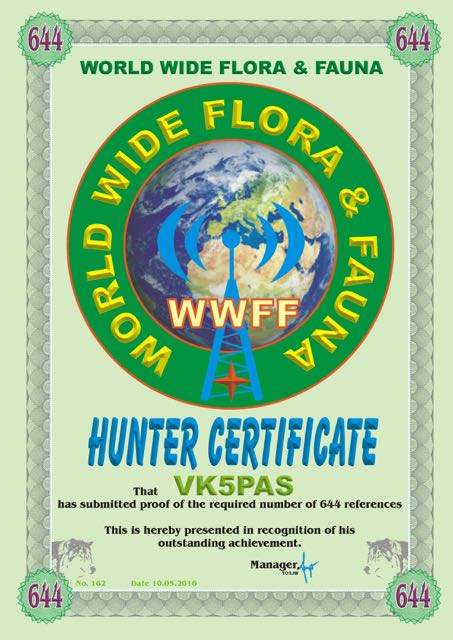
Here is my latest WWFF global Hunter certificate issued for working 644 different WWFF reference areas.
Many thanks to Pit YO3JW.
On Friday (6th May 2016) I caught up with Brian VK3MCD and his lovely wife Kathy at Stirling for a coffee. John VK5BJE and David VK5KC came along as well. We had a good chat and compared notes about SOTA & Parks activations. I had spoken many times with Brian on air, but this was the first time we had met in person.


Yesterday morning (Saturday 30th April 2016) I travelled out to the Wiljani Conservation Park 5CP-274 and VKFF-1159, which is located just a few km north west of the town of Mount Pleasant. This was to be the very first activation of Wiljani CP. Bob VK5FO had sent me an email a week or 2 ago advising that he had stumbled across this park whilst surfing the web. I checked the South Australian Government Gazette and sure enough Wiljani had been gazetted as a Conservation Park on 25th February 2016.
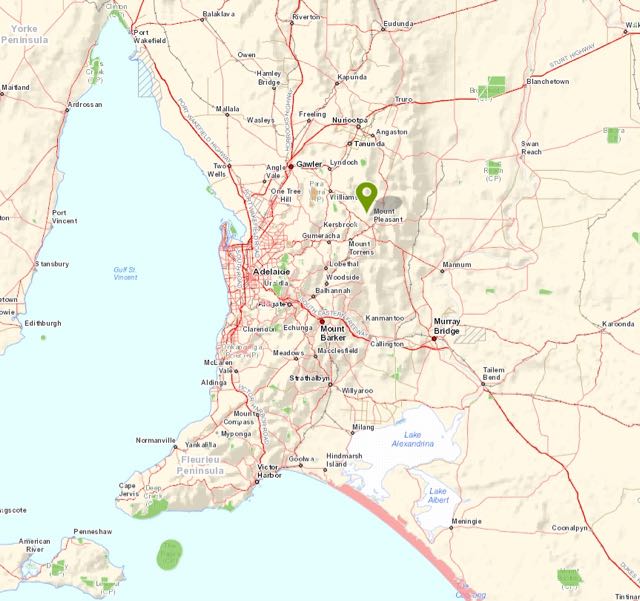
Above:- Map showing the location of the Wiljani Conservation Park, to the north west of Mount Pleasant in the Adelaide Hills. Image courtesy of Location SA Map Viewer.
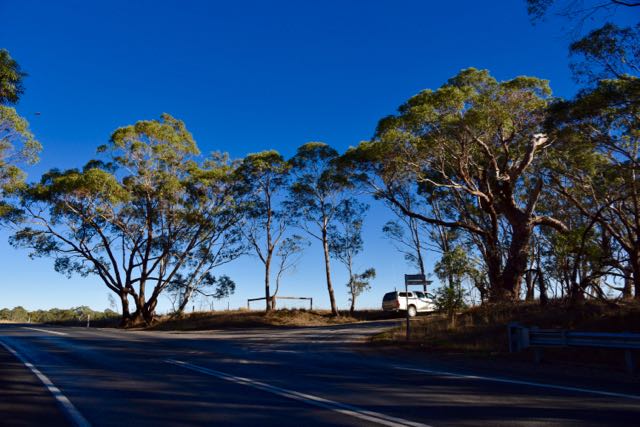
I headed out from home through Nairne and Woodside and then the little town of Charleston. I continued north east to the historic little village of Mount Torrens and then on to Birdwood, the home of the National Motor Museum. From Birdwood I took the Torrens Valley Road until I reached the town of Mount Pleasant. Just after entering the western side of Mount Pleasant I turned left onto Cricks Mill Road, and I soon reached the junction with Elliotts Boundary Road (photo below).
I then travelled north east along Elliotts Boundary Road, which is a dirt road. The road is in good condition and there are no problems for conventional vehicles. I followed the southern boundary of the Mount Crawford Pine Forest. It was quite slow going, as it was only 8.00 a.m. in the morning and there were quite a few kangaroos out and about.


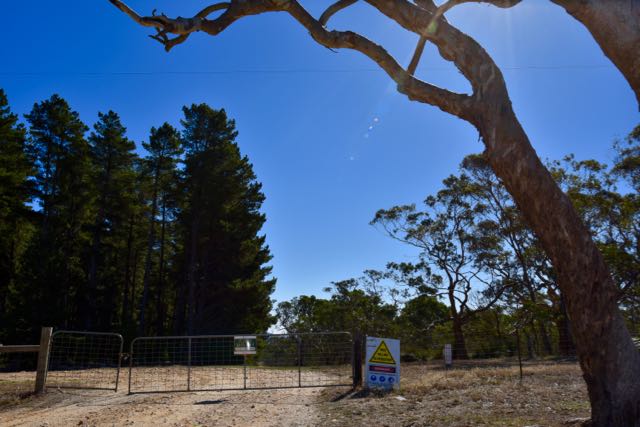
I soon came to the south western corner of the park. There is a track here which follows the western boundary of the park. However, the track was inaccessible as there was a locked gate with a large sign stating that tree felling was in process.
The park does not currently have a Conservation Park sign erected. However there is a sign which states ‘Boundary Road Conservation Reserve’.


Wiljani was a family group of the Peramangk aboriginal people whose traditional lands are primarily located in the Adelaide Hills. The lands of the Tarrawatta and Yira-Ruka (Wiljani) extended to the east down as far as Mount Torrens and Mannum.

Above:- the lands of the Permangk aboriginal people. Image courtesy of Wikipedia.
This is a beautiful little piece of surviving Mount Lofty scrub and it is not surprising that it has been declared as a Conservation park. The land was previously set aside as Crown Land and was proclaimed as a Conservation Park due to its diversity of flora and fauna. The park was alive with Kookaburras and Superb Blue Wrens whilst I was there.


I drove to the end of Elliotts Boundary Road to check out my options for an operating spot. The north eastern side of the park is not able to be accessed, as the road following that side of the park is a private road leading to private property. The western side of the park was not accessible due to the locked gate, unless you are prepared to jump the gate and walk a bit. The easy option is the southern side of the park. However, there is a power line following part of the road, so I tried to find a spot away from the power line.
For this activation I used my normal operating station consisting of the Yaesu FT-857d, set at 40 watts output, and a 40m./20m linked dipole, and a 15, dipole.
After setting up I headed to 7.144 but found that the frequency was occupied by a station from the USA. I headed up the band but struggled to find a clear frequency as there were some strong European signals coming through. So I headed down the band and found 7.135 clear and commenced calling CQ. I put out about half a dozen CQ calls but had no takers, so I self spotted on parksnpeaks. The very first hunter for Wiljani was Les VK5KLV in Port Augusta with a very strong 5/9 + signal, followed by Bob VK5FO, then Geoff VK3SQ, and Peter VK3PF. It was very pleasing to get Bob in the log as he was the person who had advised me of the existence of the park.
I worked a total of 35 stations prior to the UTC rollover from VK1, VK2, VK3, and VK5. Contact number 10, qualifying the park for me for the VKFF program was Mick VK3GGG. After the UTC rollover I worked a total of 27 stations on 40m from VK2, VK3, VK4, VK5, and VK7. Contact number 44, qualifying the park for me for the global WWFF program was Neil VK4HNS.
After working a total of 62 stations on 40m, I lowered the squid pole and removed the links in the dipole and headed to 14.310 on 20m. My first taker there was Robert VK2XXM, followed by Cliff VK2NP and then Marty VK2RZ. I worked a total of 9 stations from VK2 and VK6.
I then took down the 40m/20m linked dipole and replaced it with the 15m dipole and commenced calling CQ on 21.244 after self spotting on parksnpeaks. Allen VK6XL was the first responder, and it was nice to get Allen in the log, after we had also spoken on 20m. Allen’s signal on 15m was an excellent 5/9 and he reciprocated with a 5/9 for me. Next up was Aki JA1CTB in Japan. I worked a further 3 stations from Japan: Kaz JR0WZR, Masa JE1CWQ, and Take JH1RFZ, and also Rick VK4FTRL. Interestingly I was spotted on the DX Cluster by YC9CT, but I did not receive a call from him.
I headed back to 40m for around 30 minutes, and worked a total of 22 stations. This included a park to park contact with Stef VK5HSX who was portable in the Little Desert National Park, VKFF-0291, in western Victoria. Callers had slowed down for me so I handed the frequency over to Stef, and I had one last quick look around the band before going QRT. My final contact was with Tony VK7LTD who was operating portable on SOTA summit VK7/ SC-003.
It was time to head home and have some lunch. I was very pleased with a brand new park under my belt and a total of 101 contacts in the log. Thanks to everyone who called.
The following stations were worked on 40m SSB:-
The following stations were worked on 20m SSB:-
The following stations were worked on 15m SSB:-
References.
Wikipedia, 2016, <https://en.wikipedia.org/wiki/Peramangk>, viewed 1t May 2016
On Monday 25th April 2016, I headed out to the Ferries McDonald Conservation Park, 5CP-067 and VKFF-0881, to activate the park with the special AX prefix to commemorate ANZAC Day. ANZAC Day is a national day of remembrance in Australia and New Zealand that broadly commemorates all Australians and New Zealanders “who served and died in all wars, conflicts, and peacekeeping operations” and “the contribution and suffering of all those who have served.”
https://www.awm.gov.au/commemoration/anzac-day/
I have activated Ferries McDonald CP many times previously, so this was not to be a unique activation for me. It was just to be a fun activation and to take advantage of the AX prefix which we only get to use 3 times a year: Australia Day, ANZAC Day; and World Telecommunications and Information Society Day.
Ferries McDonald Conservation Park is just 30 km east of my home QTH, and around 70 km east of Adelaide.
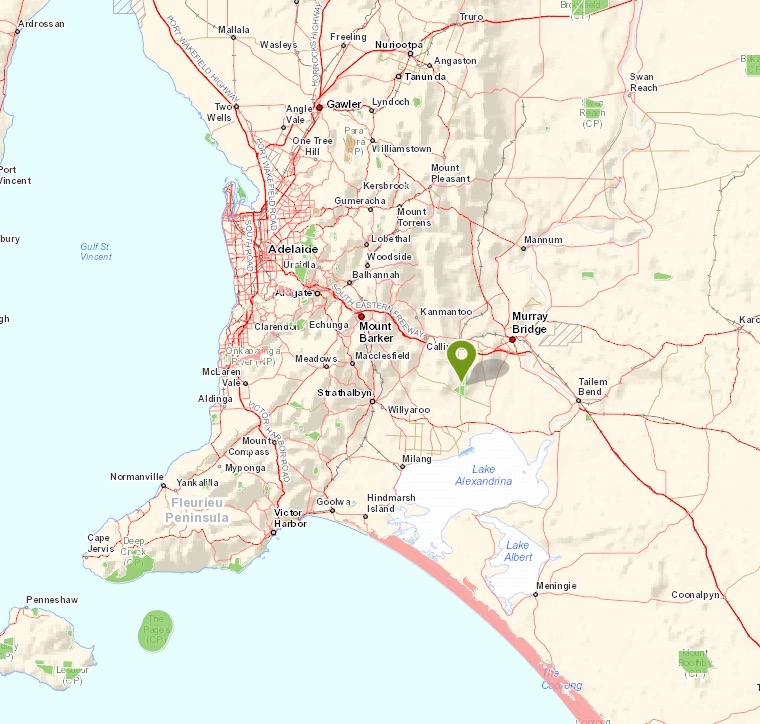
Above:- Map showing the location of the Ferries McDonald Conservation Park. Image courtesy of Location SA Map Viewer.
To get to the park today I chose to take the ‘back’ route, rather than straight down the South Eastern Freeway. I drove out along Wellington Road and into the little town of Woodchester. I then drove north east along the Callington Road until I reached Chaunceys Line Road. I stopped here briefly to have a look at the old Hartley Methodist Church which was used between 1865 to 1895. It is now just a ruin but there is a plaque here to honour its past.


I continued south east on Chaunceys Line Road until I reached Hartley. This isn’t really a town, but more a locality. Hartley which is now a ghost town, was founded way back in 1856 and once boasted the Methodist church, a post office, a school, and a creamery. I stopped to have a look at the history board in Hartley which details much of the history of the area. There is also a large gum tree here where Prince Alfred the Duke of Edinburgh rested during his royal tour in 1867.


Whilst I was here getting some photographs, a local farmer pulled up in his ute to say g’day. It turned out that he was involved in CB and UHF radio and was very interested in the antennas on my Toyota Hi Lux. I explained to him what the antennas were for, and told him where I was heading to. We had quite a lengthy chat about the hobby of amateur radio and I handed him a number of promotional brochures regarding amateur radio and the various parks awards. I also gave out my business card and I am hoping to hear back for a future candidate for the Foundation course.
I continued along Chaunceys Line Road which soon became dirt, and it wasn’t long before the park came into view on my left.


On my way to the park I worked the following stations from the mobile:
After passing the intersection of Chaunceys Line Road & Ferries McDonald Road & Kangaroo Road, I continued on until I reached the carpark in the south eastern corner of the park.
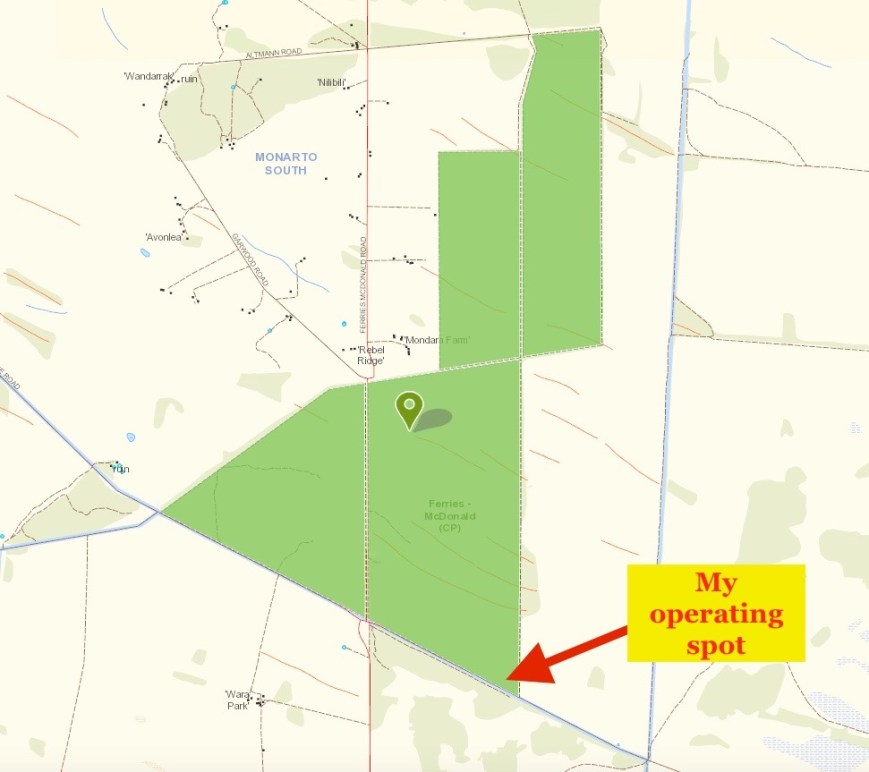
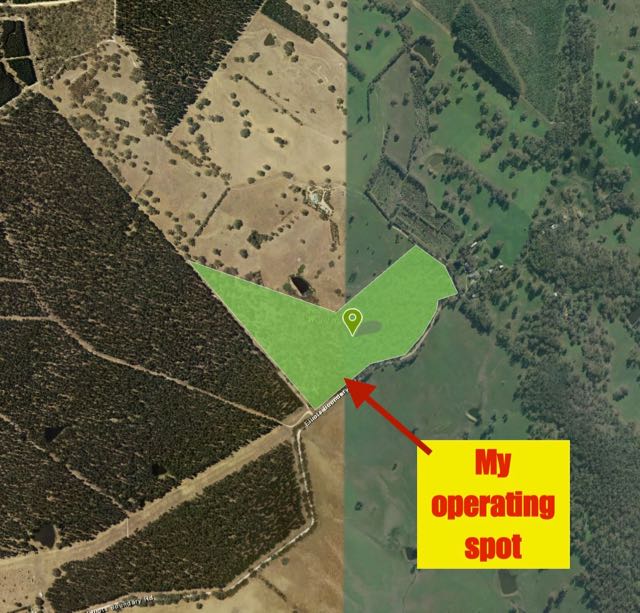
Above:- Map showing my operating spot within the Ferries McDonald Conservation Park. Image courtesy of Location SA Map Viewer.
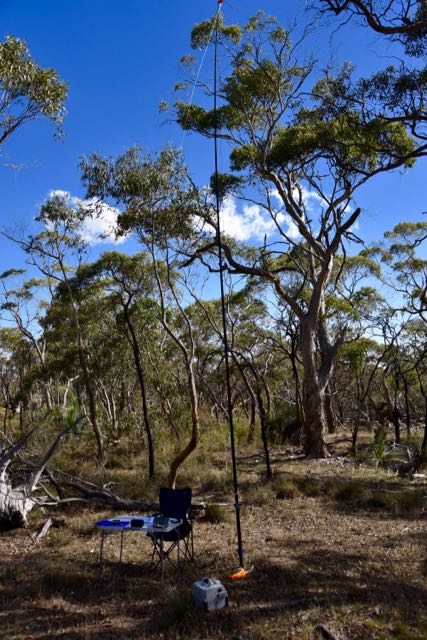
I set up on the western side of the carpark and I sought the shade of a native pine tree as it was an unusually warm day for ANZAC Day…..29 degrees C.


Ferries McDonald Conservation Park covers an area of about 860 hectares and contains one of the few pieces of remnant Mallee vegetation close to Adelaide. It is important as it has never been cleared for farming, and is an example of the original vegetation of the area. Within the park there are numerous bird species (over 60 have been recorded), echidnas, marsupial mouse, and Western Grey kangaroos. It is also home to the highly endangered malleefowl. Although I didn’t see one, I did go for a walk prior to setting up and I saw one of their nests which are built on the ground as a mound. The park is named after Mr. Ferries and Mr. McDonald who donated the land for conservation, last century.


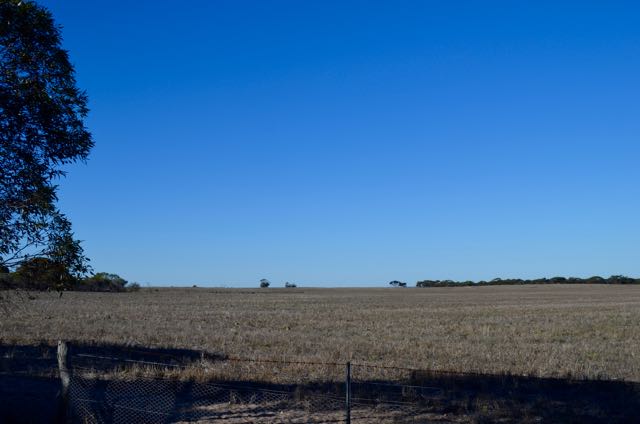
The land surrounding the park has been cleared for cropping and grazing. It is a stark contrast to the thick mallee scrub of the park.
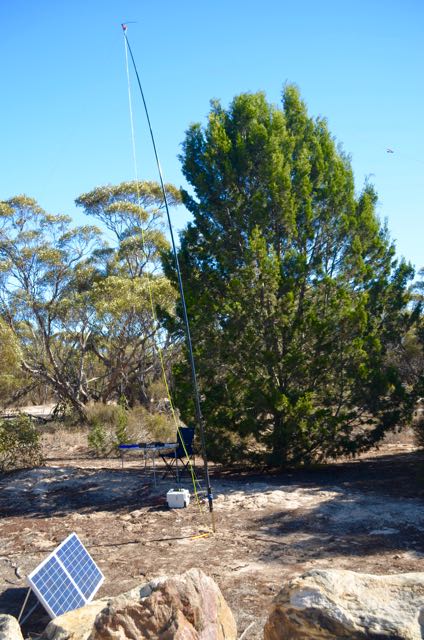
For this activation I ran the Yaesu FT-857d, 40 watts, the 40m/20m linked dipole and my 1m dipole. Both antennas were supported on top of the 7 metre heavy duty squid pole. There was no issue with driving the squid pole holder in the ground, as the soil in the park is very sandy.
I was set up and ready to go by just after 1.30 p.m. and headed straight for 7.144 where I knew that Tony AX3VTH/p was ‘babysitting’ the frequency for me. Tony was a beautiful 5/9 signal from Kinglake National Park VKFF-0264. After working Tony he kindly handed the frequency over to me. Next up was Peter AX3PF, followed by Ian VK1DI/p in the Red Hill Nature Reserve VKFF-0861. Ian was a nice 5/9 signal and this was the very first time that the park had been activated, so it was nice to bag a unique park. A number of the regular park hunters followed from VK2, VK3, and VK5.
About fourteen contacts into the activation, I was called by Peter AX3ZPF who was portable in the Mount Worth State Park VKFF-0771. This was my third Park to Park contact for the activation. I continued to work the pile up with excellent signals coming in to Ferries McDonald from VK2, VK3, VK4, & VK5. It was very pleasing to see a number of the Australian amateurs using the AX prefix. My fourth Park to Park contact was with Chris AX4FR/5 who was portable in the Swan Reach Conservation Park 5CP-221 and VKFF-0832.
I worked a total of 59 stations on 7.144 before things slowed down. I was very pleased to be able to work Joe and Julie VK3SRC (School Amateur Radio Club Network) who were portable at Victory Park at Bentleigh. I took the opportunity of tuning across the band and found Peter AX5FKLR portable at Wild Dog Hill in the Whyalla Conservation Park, 5CP-253 and VKFF-0808. This was my fourth Park to Park contact for the activation.
I then headed to 20m and found Bob VK5FO on 14.310, activating Mount Gawler VK5/ SE-013 for the Summits on the Air (SOTA) program. But Bob’s signal was that low that I decided not to call as I suspected we would not have been able to make it.
I headed up a little higher and commenced calling CQ on 14.315 and this was answered by Luciano I5FLN in Italy, followed by Axel DL1EBR in Germany. I worked 13 stations in Australia (VK4), Italy, Germany, Slovak Republic, Russia, and Belgium. This included the WWFF Publicity Manager Danny ON4VT. However, the little run of DX did not last, so I headed off for a look across the band. I had seen a spot for Chris VK4FR/5 in the Swan Reach CP on 14.320, but Chris was unreadable. I then found Lyn VK4SWE on Sweers Island chatting to Roland VK4VDX. Knowing that Lyn is friends with Chris VK4FR, I called in to let Lyn know that Chris was in a park on 14.320.
I then headed back up to 14.320 but I could still not hear Chris very well. Certainly not strong enough to work. But I was pleased to be able to hear Bob VK5FO on 14.310. We successfully worked (5/1 sent and 5/3 received).
I then lowered the squid pole and put up the 15m 1/2 wave dipole and started calling CQ on 21.244. Things were pretty slow on 15m with just 5 contacts made. That was into Northern Territory VK8, with VK8FLLA. Also two contacts into Japan. But the surprise was to work two stations in Poland. But despite numerous lengthy periods of calling CQ I had no further callers.
So it was down with the squid pole and back up with the 20m/40m linked dipole. I decided to try 20m again and went back to 14.315 where I called CQ. First taker was Mikhail LY2BIS in Lithuania, followed by Oscar EA1DR in Spain, Pehr OH6IU in Finland, and then Lars SA5BLM in Sweden. I worked a further 22 stations from Belgium, Spain, Australia (VK6), Italy, Germany, Russia, Canary Islands, Hungary, Finland, Ukraine, and England.
It was starting to get dark and the mosquitoes were starting to come out in force, but I headed back to 40m for some final calls before going QRT. It was very very hard to find a clear frequency, with everything below 7.100 taken up by South East Asia, and a lot of VK’s and North American stations above 7.100. I worked 8 stations from VK2, VK3, and VK6, before some VK3’s came up just 3 kc above on 7.140. And they were smashing anyone calling me. I worked a further 6 stations in between the very strong QRM, before I went QRT.
Thanks to everyone who called me on this very special day. For any VK’s who would like a special AX5PAS QSL card, please send me your QSL card Direct with a Stamped Self Addressed Envelope (SSAE) to PO Box 169, Mount Barker, S.A. 5251. All overseas stations please QSL via my QSL Manager, M0OXO.
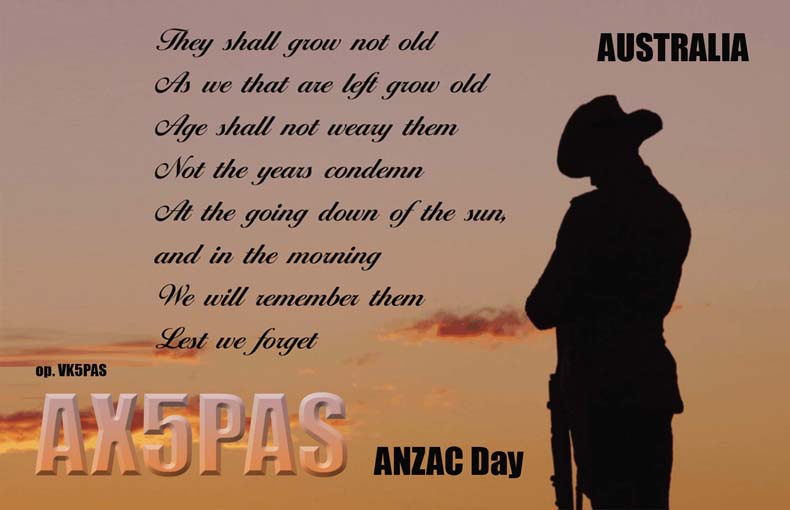
I worked the following stations on 40m SSB:-
I worked the following stations on 20m SSB:-
I worked the following stations on 15m SSB:-
Here is my latest Park to Park certificate issued for having made 88 x Park to Park contacts.
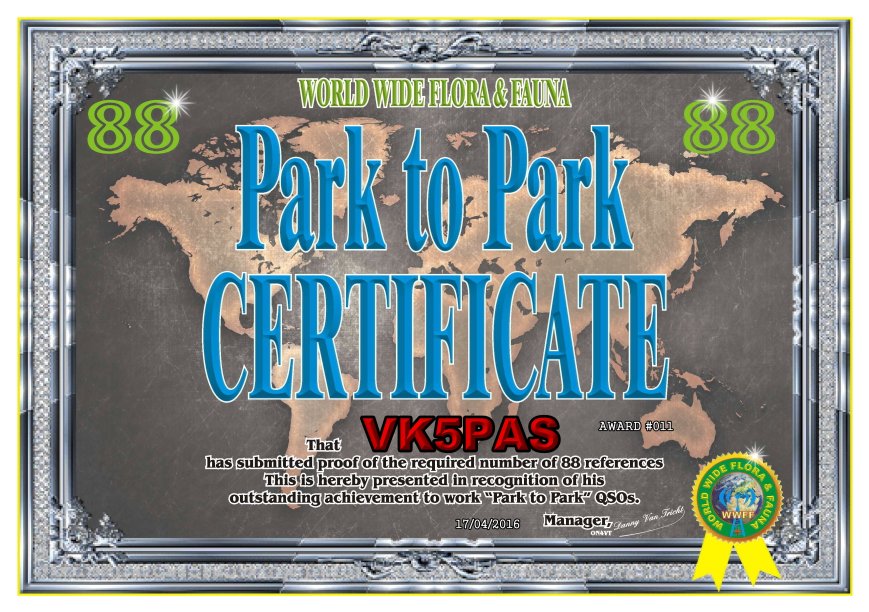
Many thanks to Danny ON4VT, the Park to Park Award Manager.
After packing up at Cooltong, Marija and I continued our journey west along the Sturt Highway and drove in to Waikerie for some lunch at the Newland bakery. We can highly recommend the bakery, as the food here is extremely fresh. I had a pastie and a custard tart, whilst Marija had a nice healthy ham and salad roll. Perhaps not the best option for me with my waistline. But what the heck.
We then headed off to the Maize Island Lagoon Conservation Park 5CP-123 and VKFF-0827, which is located about 160 km north east of Adelaide.
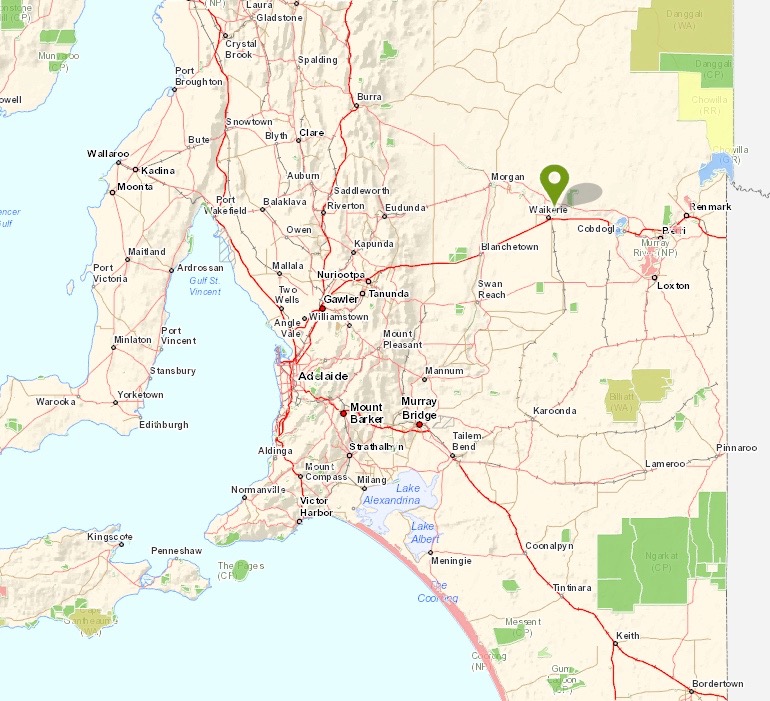
Above:- Map showing the location of the Maize Island Lagoon Conservation Park near Waikerie. Image courtesy of Location SA Map Viewer.
We then drove back along the Sturt Highway until we reached the lookout where it was a brief stop to enjoy some fantastic views of the mighty Murray River and out towards Maize Island Lagoon.
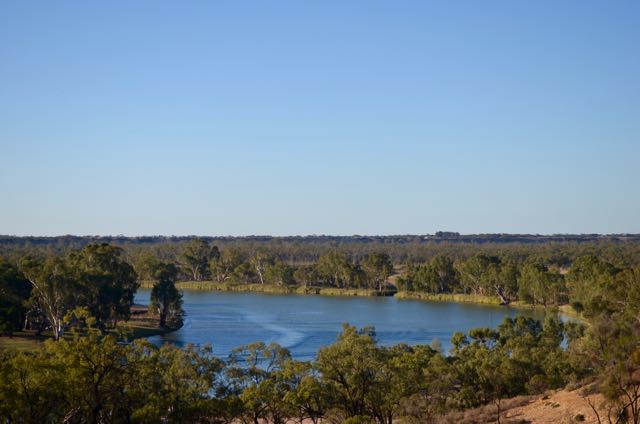
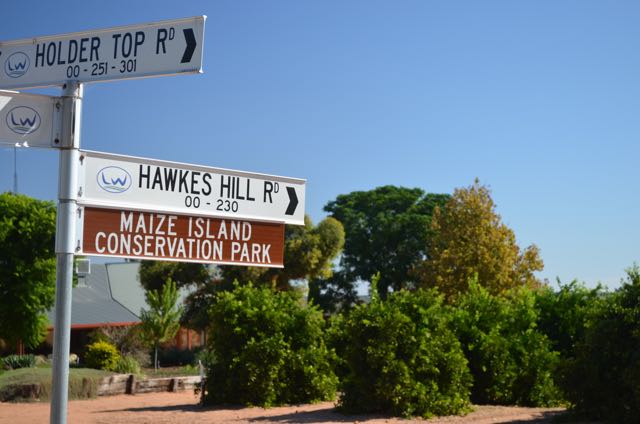
We continued east on the Sturt Highway until we reached Holder Top Road and then Hawkes Hill Road. The park is well signposted.
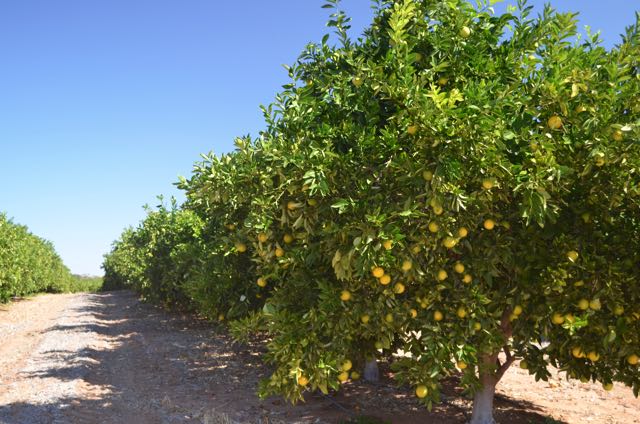
As we travelled along Hawkes Hill Road towards the park we travelled passed a number of orange orchards.
We soon entered the park and drove along the 4WD track following the Murray River. The track is a bit sandy in parts but is easily passable in a conventional vehicle.


It was a beautiful afternoon, with the temperature around 28 degrees C, so there was plenty of activity on the river.


Maize Island Lagoon CP is about 215 hectares in size and is backed by magnificent cliffs created by the mighty River Murray. The park contains many backwater lagoons lined by majestic River Red Gums. The park is alive with a variety of waterbirds. The park was so named because early pioneers had grown crops of maize as fodder for cattle and horses on the drying lagoon bed following high rivers.
The area was first settled in 1880 by the Shephard brothers who named their sheep run Waikerie Station, and built the little homestead still standing on Holder Bottom Road. In 1888 the Government cancelled pastoral leases and began surveing the country for closer settlement. Village settlers arrived in 1894 to establish themselves on horticultural allotments in the area of Holder Bottom Road. In 1921 a pipeline was built to Maize Island and orchards were established there. In 1956, the infamous Murray River flood struck, with more high rivers in the following years, which convinced the Government to resettle people in 1975 and control the area as a Conservation Park.
We found a little parking area off the 4WD track and parked the Hi Lux. There was a nice area opposite the parking area, right alongside of the river, with plenty of room to stretch out the 40m/20m linked dipole.
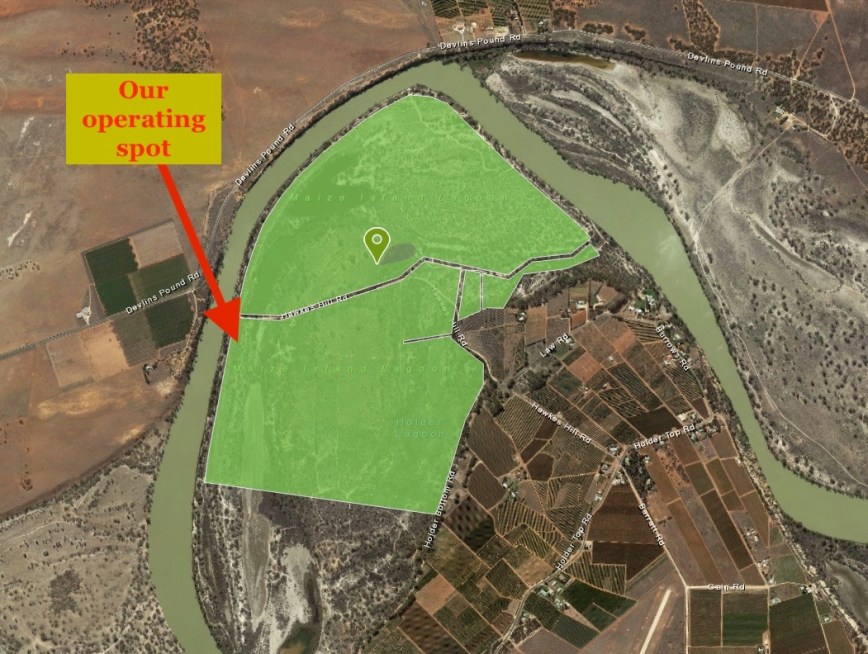
Above:- Aerial view of the Maize Island Conservation Park, showing our operating spot. Image courtesy of Location SA Map Viewer.
I headed to 7.144 and commenced calling CQ and this was answered by Jock VK2EJW with a strong 5/9 signal. Next up was Nick VK3ANL, Ron VK3MRH, and Simon VK2JAZ. Eleven contacts into the activation and I had my first Park to Park contact in the log from Maize Island Lagoon. It was Gerard VK2IO who was portable in the Hunter Wetlands National Park VKFF-0595. This was followed by another Park top Park contact with Stef VK5HSX who was portable in the nearby Morgan Conservation Park 5CP-141 and VKFF-0911.
The 40m band was in good shape, with great signals coming in from VK2, VK3, VK4 and VK5. I worked a number of stations running QRP: Ron VK3MRH in Wodonga with just 5 watts, and Terry VK3TEZ in Hoppers Crossing running just 5 watts. It was also nice to get Chris VK4FR/3 in the log, who was mobile near Murrayville in Victoria.
I worked a total of 30 stations and then handed the mic over to Marija.


Marija was keen to get on the road and head home, so she quickly made a total of 16 contacts into VK3, VK4, VK5, and VK7. This included a Park to Park contact with Rob VK4AAC/3 in the Burrowa Pine Mountain National Park VKFF-0069.


I then jumped back on air and worked a further 20 stations in VK2, VK3, VK4, and VK5. This included a Park to Park contact with John VK5BJE/3 in the Green Lake Regional Park VKFF-0967. I also worked a few more QRP stations: Alan running an SDR at 5 watts (5/8 sent) and Greg VK5GJ at Meadows in the Adelaide Hills running 4 watts (5/8 sent).
Time was marching on, so I had a quick tune across the 40m band before heading to 20m. I found Rob VK4AAC/3 in the Burrowa Pine Mountain National Park with a fantastic 5/9 signal.
I then quickly headed up to 14.310 on 20m where I made contact with Bill VK4FW, Rick VK4RF/VK4HA, Mike VK6MB, Steve VK4KUS, and finally Steve VK4QQ. Rick informed me that Gerard VK2IO was on 14.315 in Hunter Wetlands NP, and I had a quick listen there, but could not hear a sausage. So it was time to pack up and head home after a very enjoyable weekend away.
I had a total of 57 contacts in the log.
I worked the following stations on 40m SSB:-
I worked the following stations on 20m SSB:-
Marija worked the following stations on 40m SSB:-
On the way home we dropped in to the Cambrai Hotel for a meal.


On Sunday (17th April 2016) Marija and I had two planned park activations on our way back home. Our first was the Cooltong Conservation Park 5CP-046 and VKFF-0823, which is located about 250 km north east of Adelaide and just to the west of Renmark in the Riverland region of South Australia.
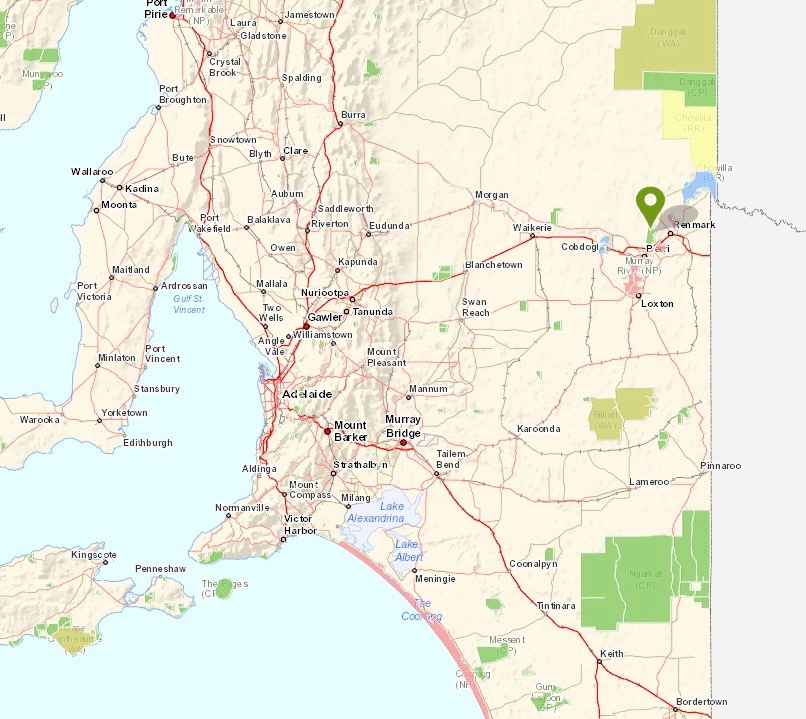
Above:- Map showing the location of Cooltong Conservation Park in the Riverland region of South Australia. Image courtesy of Location SA Map Viewer.
Prior to heading out to the park, we stopped in to Ivan VK5HS’ home for some quick earthing on my mobile in the 4WD, and the obligatory coffee and chat of course. We then drove out of Renmark west along the Sturt Highway, and then turned right onto Santos Road. There is no sign for the park. Santos Road is a dirt road but is perfectly fine for conventional vehicles.
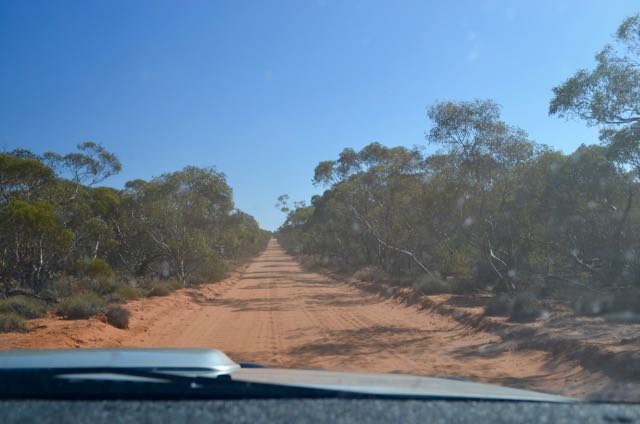
About two km along Santos Road we came across the sign for Cooltong Conservation Park. We also saw the signs for covert cameras, as there has been a problem with the illegal dumping of rubbish in the park.
http://www.abc.net.au/news/2014-12-07/tonnes-of-rubbish-dumped-illegally-left-to-rot-in-sa/5949786


Cooltong Conservation Park is a large park and comprises 3,681 hectares. The park was dedicated in 1993 to preserve quality mallee vegetation and habitat for various mallee bird species that frequent the area. This includes the endangered Malleefowl. The park is dominated by mallee vegetation, with undulating dunes and shales.
The name Cooltong is derived from a local aboriginal name meaning ‘lizard place’.


We drove towards the middle of the park along the main track, and then took another track leading off to the east. We found a nice clearing amongst the mallee and set up the 40m/20m linked dipole, and the Yaesu FT-857d. It was already a warm morning, so we ensured that the fold up table and deck chair were in the shade.
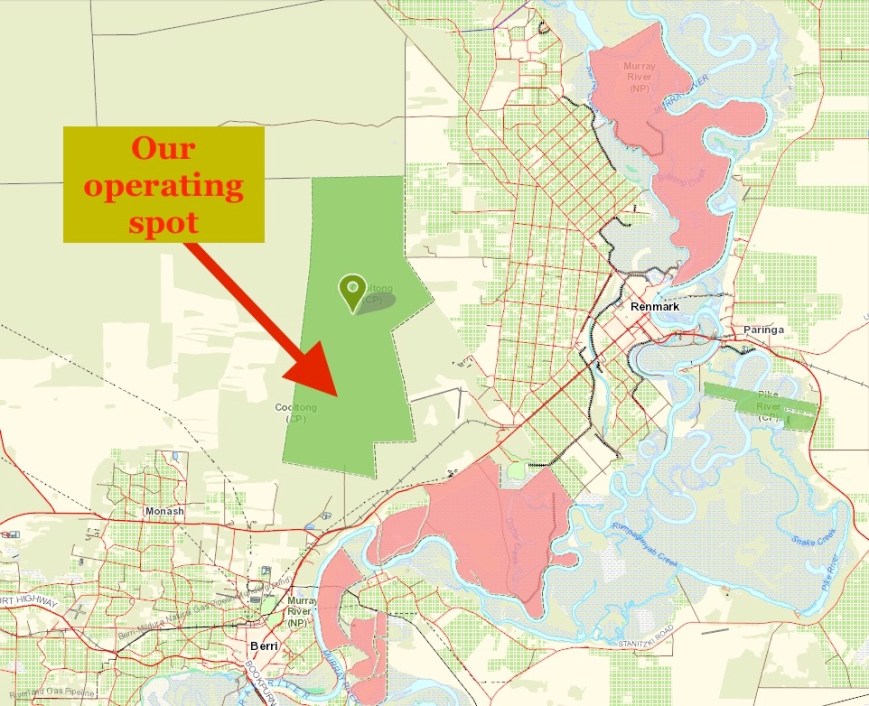
Above:- Map showing our operating spot in the park. Image courtesy of Location SA Map Viewer.
As it was a Sunday and the WIA Broadcasts take up much of the 40m band from 7.130 and above, I decided to call CQ on 7.095. My CQ call was answered by Matt VK1MA in Canberra with a very strong 5/9 signal. This was followed by Les VK2CPC who was also 5/9. Next up was John VK2AWJ/3, followed by Chris VK3PAT, both of whom were portable in the Brisbane Ranges National Park as part of a parks portable Show ‘n Tell display by Amateur Radio Victoria. During the morning I also worked John VK5BJE/3, Julie VK3FOWL/p, Joe VK3YSP/p and Bob VK3FLAK, all of whom were in the Brisbane Ranges National Park.
I also spoke with Andrew VK1DA/2 who was activating Summits on the Air (SOTA) peak Mount Mundoonen VK2/ ST-053 near Yass. Andrew had a strong 5/8 signal. Other SOTA contacts were made with Andrew VK1AD on SOTA peak Mount McDonald VK1/ AC-048 and Tony VK7LTD/p on SOTA peak Collins Bonnet VK7/ SC-002.
Other than the Park to Park contacts with the troops in the Brisbane Ranges National Park, I also had Park to Park contacts with Gerard VK2IO in the Hunter Wetlands National Park VKFF-0595, Rob VK4AAC/3 in the Burrowa Pine Mountain National Park VKFF-0069, and Will VK5AHV in the Sandy Creek Conservation Park 5CP-203 and VKFF-0933.


I also managed to drag Marija out of the 4WD and her movies on the ipad. Marija made a total of 15 contacts, thus qualifying the park for the VKFF program. Her contacts included two park to park contacts: Rob VK4AAC/3 in the Burrowa Pine Mountain National Park, and John VK2AWJ/3 in the Brisbane Ranges National Park. Also two SOTA contacts with Andrew VK1DA/p on VK2/ ST-053 and Andrew on VK1/ AC-048.


We were a bit short of time, so I only got up to 20m for around 5 minutes, where I worked Steve VK4QQ, Mike VK6MB and Neil VK4HNS. Unfortunately there was no time for 15m during this activation. Local propagation for this activation was non existent at the commencement of the activation, but opened up nicely around VK5 around 30 minutes from going QRT.
So after a little over 2 hours in Cooltong, I had a total of 59 contacts in the log.
I worked the following stations on 40m SSB:-
I worked the following stations on 20m SSB:-
Marija worked the following stations on 40m SSB:-
References.
Department of Environment and Natural Resources, June 2011, Parks of the Riverland.
When the BRL Gathering started to wrap up late on Saturday afternoon (16th April 2016), Marija and I headed out to the Pooginook Conservation Park, 5CP-186 and VKFF-0929, for a quick park activation. This is exactly what Marija and I did last year. The BRL Gathering wound up and we headed out to Pooginook, about 23 km further up the Goyder Highway. So it was a repeat performance of last year. We had time restrictions this year though, as we had arranged to go out for tea that night.
Pooginook Conservation Park is located about 200 km north east of Adelaide and about 70 km west of Renmark.
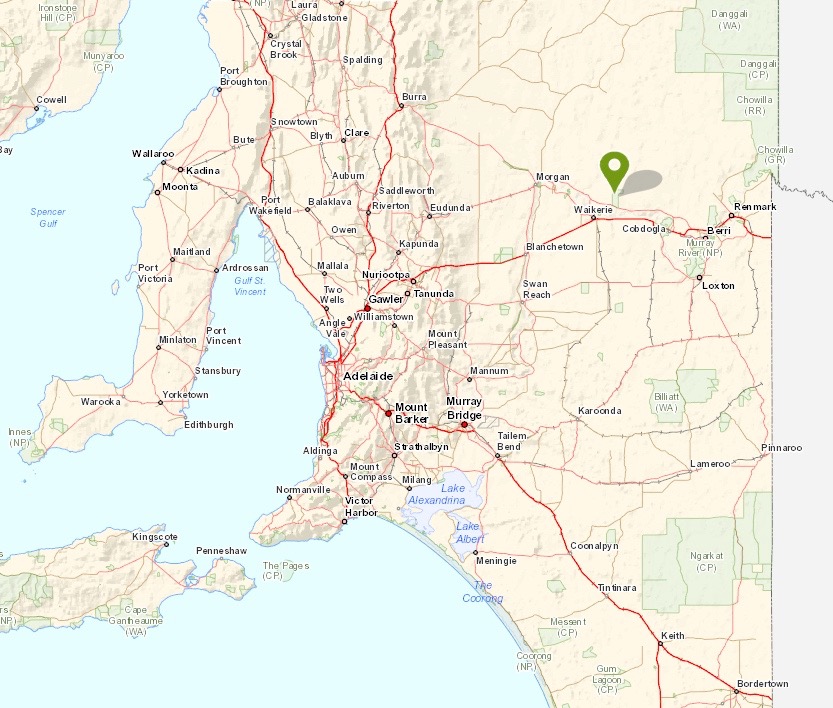
Above:- Map showing the location of the Pooginook Conservation Park in the Riverland region of South Australia. Image courtesy of Location SA Map Viewer.
Although I had activated Pooginook previously, this was to be a unique park for me for the World Wide Flora Fauna (WWFF) program. The park was not on the WWFF list at the time I last activated it for the VK5 National and Conservation Parks Award.
On the way out to the park we stopped off briefly on the Goyder Highway to admire the view out to the Murray River and the Overland Corner Hotel.


We then stopped briefly at the Overland Corner cemetery. Some of the older headstones in the cemetery belong to the Brand family, who have a long history associated with the Overland Corner Hotel.


We continued along the Goyder Highway for a number of km until we reached the sign for the park which is on the northern side of the road. If you only have a 2WD vehicle, you can enter the park through the open gate and operate just inside the boundary. But if you have a 4QD vehicle, there is a sandy 4WD track which follows the eastern boundary, and this is what Marija and I did.


Don’t attempt the track if you have a conventional vehicle. You will get bogged.
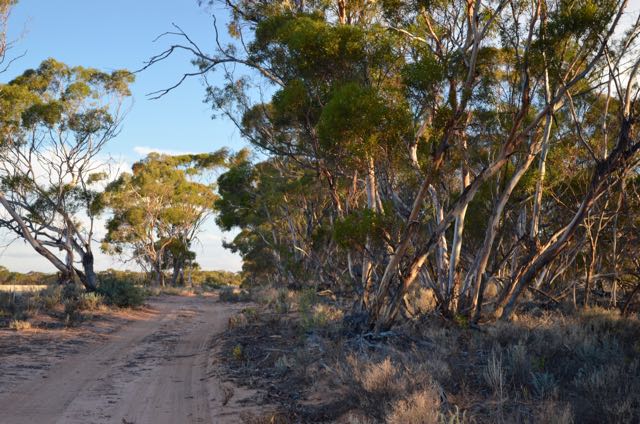
The Pooginook Conservation Park is a large park, comprising 2,862 hectares of gently rolling sand dunes covered by multi-stemmed mallee. The park contains dense mallee scrub in the northern section and open mallee in the south. This area was once used largely for wheat farming. The park provides refuge for a large amount of native wildlife including Western grey kangaroos, Red kangaroos, echidnas, hairy-nosed wombats, fat-tailed dunnarts and the rare malleefowl. Over 20 species of reptiles have been recorded in the park including Desert skinks, Nobbi dragons, Barred snake-lizards and Jewelled geckos.


The name Pooginook, comes from Aboriginal words meaning ‘place of good food’. The Ngawait aboriginal tribe occupied this area. Pooginook Station was established in 1851 by John Taylor.
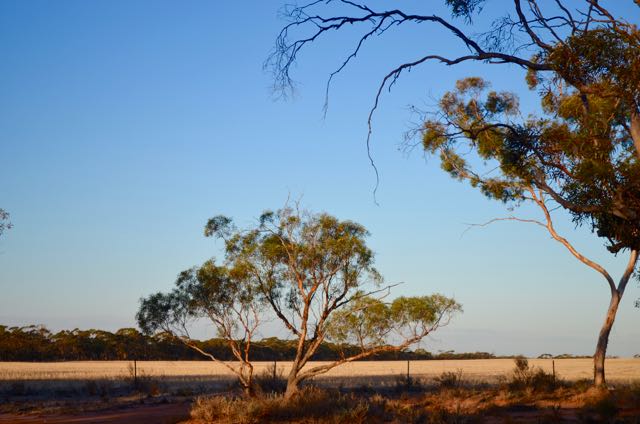
We drove a few km along the 4WD track and found a nice clearing and started setting up the gear. We used the normal portable station for this activation: the Yaesu FT-857d (set on 40 watts for me, and 10 watts for Marija), and the 40m/20m linked dipole supported on the 7 metre heavy duty telescopic squid pole.
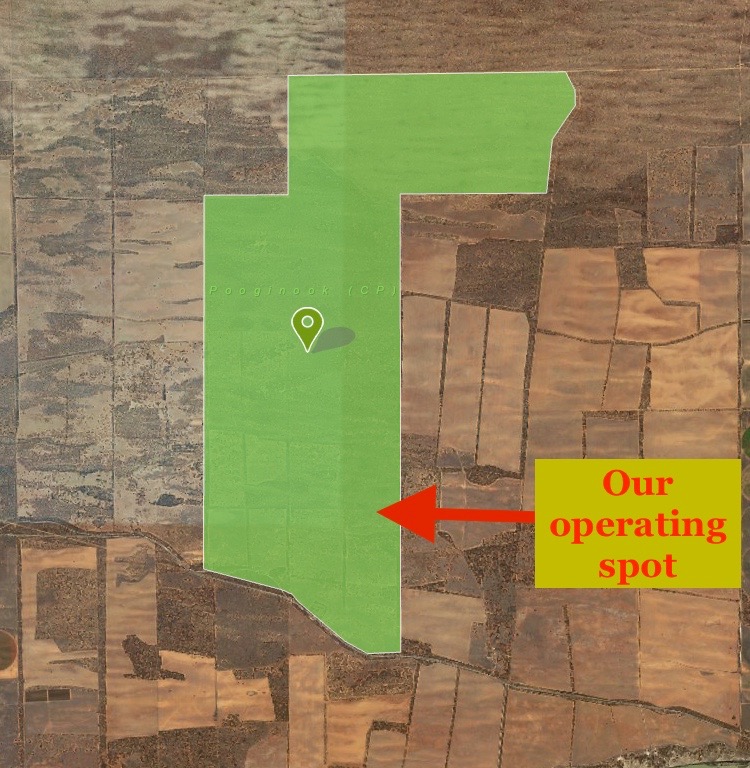
Above:- Aerial shot showing our operating spot in the eastern side of the park. Image courtesy of Location SA Map Viewer.
It was a warm aftermoon so we south the shade of some of the gum trees. I commenced calling CQ on 7.144 and our first contact was with Ivan VK5HS who was mobile from Overland Corner back into Renmark. Not surprising that Ivan was 5/9 plus to Pooginook. Next up was another mobile station. This time it was David VK3DMX with a good 5/7 signal. This was followed by Rick VK4RF/VK4HA, Bob VK5FPAC, and then Adrian VK5FANA. It wasn’t long before all the regular park hunters had come out of the woodwork and were calling.
But amongst all the locals I heard my good mate Danny ON4VT in Belgium. Danny was an excellent 5/5 signal and gave me a 4/4. It was a real pleasure to get Danny in the log on 40m, whilst running just 40 watts and a simple little dipole.
I worked a total of 45 stations on 40m from VK2, VK3, VK4, VK5, VK6, and VK7, before handing the mic over to Marija.


Marija was cognisant of our time restrictions in the park and was just seeking 10 contacts to qualify the park for the VKFF program. Which is what she did in a very short space of time. Marija’s first contact was with Greg VK4VXX/2, followed by Brian VK3BBB, Mick VK3GGG and then Geoff VK3SQ. Marija worked a total of 16 stations before handing the mic back over to me.


I worked just 4 more stations on 40m including Gerard VK2IO portable on Summits on the Air (SOTA) peak Barraba Trig VK2/ HU-065. Our time in the park was running short, so I quickly headed to 20m and started calling CQ on 14.310. This was almost immediately answered by Don G0RQL in England, followed by Adam VK2YK, and then Danny ON4VT for a second band. A steady flow of callers followed from Europe and Australia. Sadly, despite the pile up I needed to go QRT. I’m sorry to all those that were still calling.
I worked a total of 32 stations on 20m from Australia (VK2, VK4, VK6, VK7 and VK8), England, Belgium, Canary Islands, Italy, Germany, Slovak Republic, France, Hungary and Switzerland.
We had a bit of trouble during this activation to keep the squid pole in place as the ground was very hard. We propped up a number of large rocks against the squid pole holder, but as it was quite windy, I had to stand up and hold the squid pole in place whilst Marija was on air. Marija got quite a laugh at that: me at work whilst she was enjoying some air time!
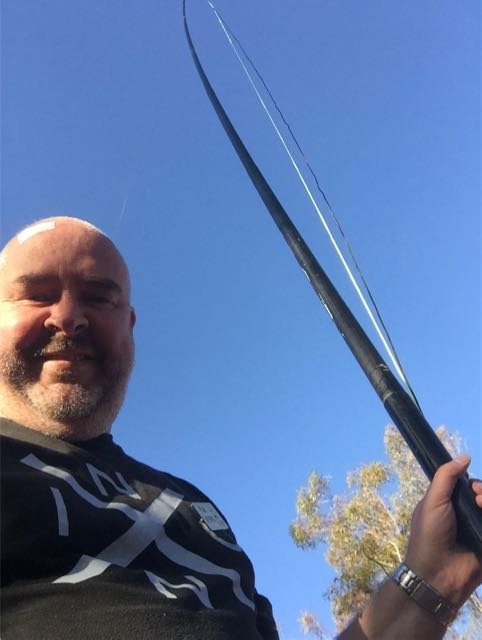
I worked the following stations on 40m SSB:-
I worked the following stations on 20m SSB:-
Marija worked the following stations on 40m SSB:-
It was a quick pack up and off we headed to Renmark. On the way back into Renmark I had a good chat with Paul VK3HN from the mobile. After arriving back at the hotel, we freshened up and headed out for tea with Ivan VK5HS and his wife Sheryl, Di (the XYL of Larry VK5LY – SK), and Peter VK5FLEX. We enjoyed a very nice meal at Ashley’s Restaurant and a few refreshing ales. It was then back to the motel room to see the last quarter of the football and a great win by the Adelaide Crows.


References.
Department of Environment and Natural Resources, June 2011, Parks of the Riverland.
National Parks South Australia, 2016, <http://www.environment.sa.gov.au/parks/Find_a_Park/Browse_by_region/Murray_River/Pooginook_Conservation_Park>, viewed 20th April 2016
On Saturday morning (16th April 2016) Marija and I made a bright and early start from Renmark, and headed out to the historic Overland Corner Hotel for the 2016 BRL Gathering. The BRL Gathering is hosted by the Riverland Radio Club, and this was to be the second year for the Gathering.
We arrived at the Overland Corner Hotel at around 7.15 a.m. and found that there was already a core group of amateurs and their wives/partners, in attendance. A number of those had stayed overnight in their caravans and campers at the rear of the pub.
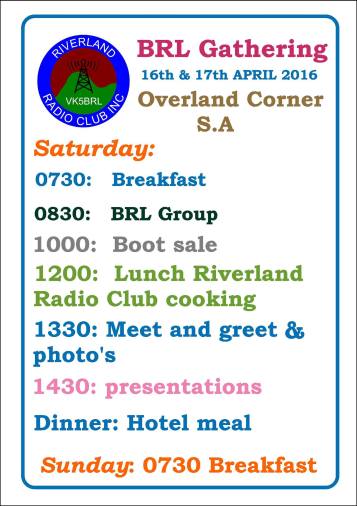
After saying g’day to everyone and helping out setting up a linked dipole for the Riverland Radio Club Net, we enjoyed a great brekkie cooked by Ivan VK5HS and Peter VK5FLEX, consisting of toast, eggs and bacon, all cooked on the barbie.


This was followed by the Riverland Radio Group Net which was run from the Overland Corner Hotel.


A boot sale then took place with a number of bargains on offer. I was fortunate to come away with a few bargains, including an IC751 transceiver, a Mini Palm Paddle and two antenna tuners (all previously owned by Larry VK5LY-now silent key).
We all then gathered together for a group photograph in front of the hotel.

It was then time for some more chatting and mingling, with the pub opening its doors. A few of the fellas, including myself took the opportunity of some nice cold beverages. We also enjoyed a very nice meal at the pub.
After lunch, the more formalised part of the day took place, with a quick chat by Ron VK5MRE and then all of the amateurs introducing themselves and telling the group a little about themselves. This was followed by the draw of the raffle, with a number of very nice prizes being awarded. Ivan introduced me as the newly elected WIA Director and kindly asked me to draw the prizes.
Tony VK5FTVR was then awarded with the BRL Award which he was very chuffed with. The Award certificate was issued for achieving the most number of points gathered during 2015 and 2016 during the Riverland Radio Group Nets.

I also gave a very short talk on the WIA and the recent proposal submitted to ACMA. I also announced details of the recently launched Murray River Parks Award and information regarding the 4th level of this award. Ivan VK5HS, Peter VK5FLEX and I had decided that a plaque would be awarded for those amateurs who activated/worked all of the qualifying parks along the Murray, in honour of Larry VK5LY. Larry became a silent key in late 2015 after battling an illness diagnosed earlier in the year. Larry was one of the stalwarts of the VK5 National and Conservation Parks Award and the World Wide Flora Fauna (WWFF) program. It is a fitting tribute then, that a plaque would be awarded in his honour. We had one minutes silence for Larry.
It was then back to enjoying the company, the sunshine, and the ice cold Bundies from the hotel.
The weather for the day could not have been better, with the top temperature reaching around 28 degrees C. The shade of the trees and the umbrellas was sought after by all.
This is always a great weekend, and I highly recommend the BRL Gathering. Marija and I will certainly be attending again next year.
Amateur Radio, Short Wave Listening, travel and history
Amateur radio experiences with VK1DA
Brisbane - Australia
german amateur radio station
Summits On The Air
SOTA on the peaks, wilderness QRP and some bushwalking
A fine WordPress.com site
Amateur Radio Adventures
Summits on the Ai
Radio craft, homebrew, QRP/SOTA, AM
Ego loqui ad viros super montes
My adventures with Amateur Radio and Geocaching!
The rantings of VK2GAZ on his SOTA experiences in Australia
A survivor, with minor cuts and abrasions.
The Art and Craft of Blogging
News, Tips & Website Tutorials
Blog of Justin Giles-Clark VK7TW's SOTA and amateur radio adventures.
Occasional SOTA & Microwave operation
Some accounts of SOTA and other radio outings

