Trip to Victoria

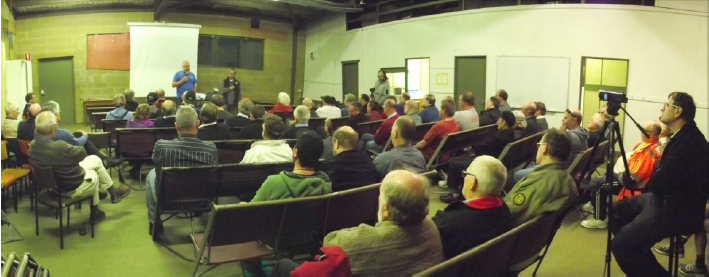
On Friday 11th November 2016 I headed to Victoria for the annual parks activation weekend for the Keith Roget Memorial National Parks Award.  And whilst interstate I had arranged to team up with fellow Director of the Wireless Institute of Australia (WIA), Andrew VK6AS to deliver some presentations.  I returned home last night (Thursday 17th Nov 2016) after delivering 4 WIA presentations and activating a total of nine parks and five summits of the Summits on the Air (SOTA) program.

WIA PRESENTATIONS

  • Four (4)
    • Tangambalanga VICTORIA
    • Frankston & Mornington Peninsula Amateur Radio Club, Melbourne VICTORIA
    • Eastern & Mountain District Amateur Radio Club (EMDRC), Melbourne VICTORIA
    • Geelong Amateur Radio Club, Geelong VICTORIA

screen-shot-2016-11-20-at-12-43-38-pm

PARKS

  • Nine (9)

SOTA SUMMITS

  • Five (5)

Details of the SOTA and Parks activations are as follows…..

Friday 11th November 2016

Leaghur State Park VKFF-0762

  • 55 contacts
  • 7 Park to Park (P2P) contacts

Kerang Regional Park VKFF-0970

  • 61 contacts
  • 5 P2P contacts
  • 1 SOTA contact

Saturday 12th November 2016

Gunbower National Park VKFF-0740

  • 68 contacts
  • 16 Park to Park contacts

Terrick Terrick National Park VKFF-0630

  • 59 contacts
  • 19 P2P
  • 1 SOTA contact

Sunday 13th November 2016

Barmah National Park VKFF-0739

  • 64 contacts
  • 16 Park to Park
  • 1 SOTA contact

Murray Valley National Park VKFF-1178

  • 72 contacts
  • 10 P2P contacts
  • 1 SOTA contact

Monday 14th November 2016

SOTA  Huon Hill VK3/ VE-237 and Wodonga Regional Park VKFF-0980

  • 32 contacts
  • 4 P2P contacts

SOTA Mount Baranduda VK3/ VE-189 and Baranduda Regional Park VKFF-0959

  • 30 contacts
  • 1 P2P contact

Tuesday 15th November 2016

Wednesday 16th November 2016

SOTA One Tree Hill VK3/ VS-036 and Ararat Hills Regional Park VKFF-0958

  • 74 contacts
  • 2 P2P contact
  • 2 SOTA contacts

Thursday 17th November 2016

SOTA Blue Mountain VK3/ VS-015

  • 22 contacts

SOTA Point 756 Pyrenees VK3/ VS-018

  • 33 contacts
  • 3 Park contacts

Montacute Conservation Park VKFF-0910 and 5CP-139

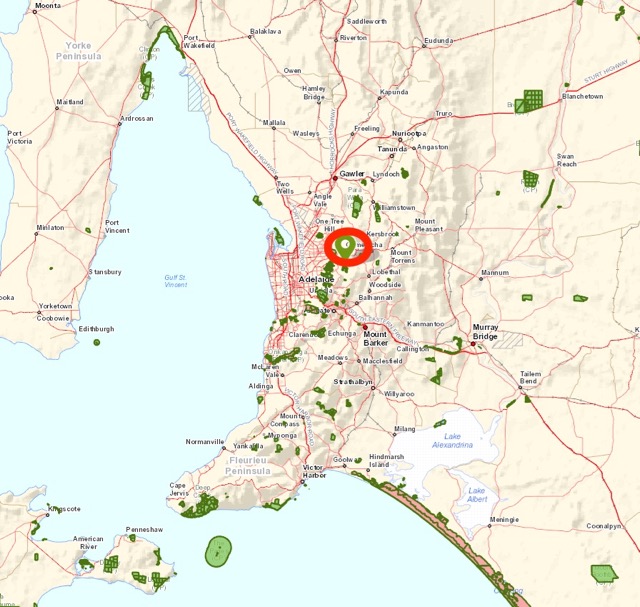
Yesterday (Sunday 6th November 2016) after getting home from the Adelaide Hills Amateur Radio Society (AHARS) Buy and Sell, myself and my wife Marija VK5FMAZ headed out to activate the Montacute Conservation Park VKFF-0910 and 5CP-139, which is located about 17 km north east of Adelaide in the Mount Lofty Ranges ‘Adelaide Hills’.
Screen Shot 2016-11-07 at 1.15.54 pm.jpg

Above:- Map showing the location of the Montacure Conservation Park in the Adelaide Hills.  Map courtesy of Location SA Map Viewer.

I have activated Montacute once before, back in July 2013, but this was before the park had been added to the World Wide Flora Fauna (WWFF) program Directory.  So my previous activation only qualified for the VK5 National and Conservation Parks Award.  This was to be a unique activation for both Marija and I for WWFF.

Last time I was at the park, I operated from the end of Valley Road.  So I was curious to see if I could access the park from another location.  I studied the maps prior to leaving home and it suggested I might be able to access the park on the eastern side, from Stone Hut Road.

So after leaving home we headed out through Woodside and then on to Lenswood.  This is a particularly beautiful part of the Adelaide Hills, with quite steep terrain and numerous cherry and apple orchards and vineyards.

We eventually reached Prankerd Road which runs off Croft Road.  It was here that we were hoping to access the park via Stone Gut Road.  But unfortunately we encountered a locked gate at the Mount Crawford Forest Reserve.

So it was an additional 30 minute drive for us through Cudlee Creek to the western side of the park.  Along the way Marija and I stopped off at the old viewing area for the Kangaroo Creek Reservoir.  Sadly this is now closed, but we parked the car at the locked boom gates and walked a few hundred metres up to the old lookout.  It is a real shame that this is now closed as it is a great tourist drawcard.

Construction of the Kangaroo Creek Reservoir commenced in 1966 and was completed in 1969.  The capacity of the reservoir is 19,160 megalitres with an area of water spread of 103 hectares.  Water from Kangaroo Creek isreleased into the River Torrens as required, to maintain the level in the Hope Valley Reservoir with the water diverted at the Gorge Weir.

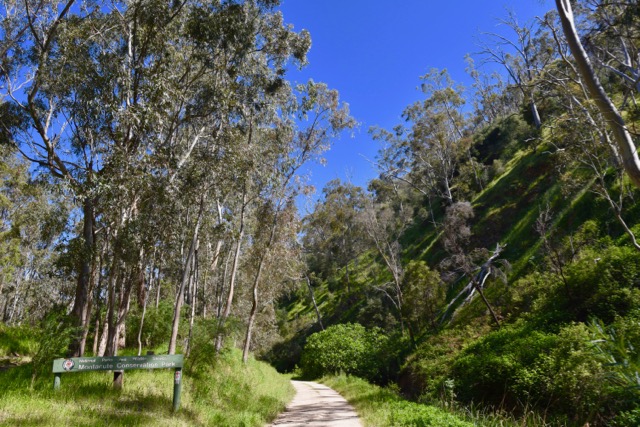
We eventually reached Corkscrew Road which runs off Gorge Road and travelled south until we reached Valley Road.  A few km along the road we entered the park.
DSC_3606.jpg

Above:- Entering the park along Valley Road.

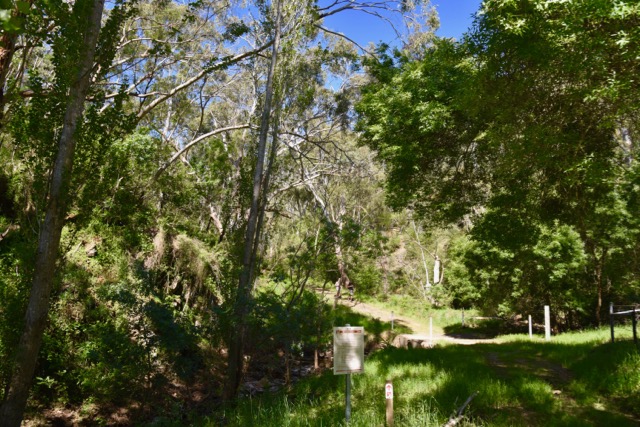
At the end of Valley Road there is a small parking area.  This is where the Heysen Trail cuts through the steep terrain of the park.  Marija and I checked out possible operating spots and decided to head back to a small off road we had see just after entering the park.
DSC_3608.jpg

Above:- The parking area and commencement of the Heysen Trail at the end of Valley Road.

Montacute Conservation Park was established on the 1st January 1971.  The park is about 200 hectares in size and preserves remnant bushland which is separated by several small creeks.  Vegetation within Montacute varies significantly from the lower to higher slopes.  The creek line is dominated by magnificent river red gums with a low understorey of grasses and exotic plants.  The higher slopes within the park support stringybarks and blue gums.

A number of hikes can be undertaken through the park, including the famous Heysen trail and the Mawson Trail.

The park is home to a large amount of native wildlife including kangaroos and wallabies.  Numerous birds can also be seen in the park including Adelaide Rosellas, Superb Fairywrens, Grey Fantails and the Rufous Whistler.

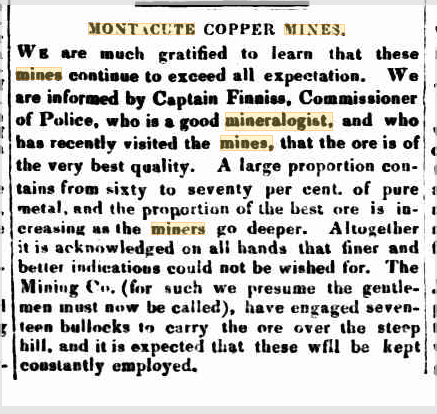
The park is located close to the little area of Montacute which has history dating back to 1843 when copper was discovered in the area .  A copper mine was established soon after, with one of the mine’s primary financiers Sir John Baker (1813-1872, naming the area after Montacute in Somerset in England, which was near his birth place.  Just as to how the copper was discovered is in dispute.  One proposition is that it was accidentally discovered by an overseer named Andrew Henderson who was searching for a strayed bullock.

The mines resulted in a small community developing along Fifith Creek, with several hundred men employed at the mine.
Screen Shot 2016-11-07 at 2.39.03 pm.png

Above:- Article from The South Australian, 23rd Feb 1844.  Courtesy of Trove

In April 1846 gold was discovered at the North Montacute Mine, 1 km north of the original Montacute Copper Mine.  A building was erected over the main mine shaft and guards were posted to keep watch over the mine 24 hours a day.  This was the first recorded production of gold in South Australia.  It is reputed that gold from this mine was used by several Adelaide jewellers to mount South Australian gems, including a brooch which was sent as a gift to Queen Victoria.  In fact the mine was later renamed the Victorian Mine in honour of the Queen.  About 1 kg of bullion was produced from the mine.

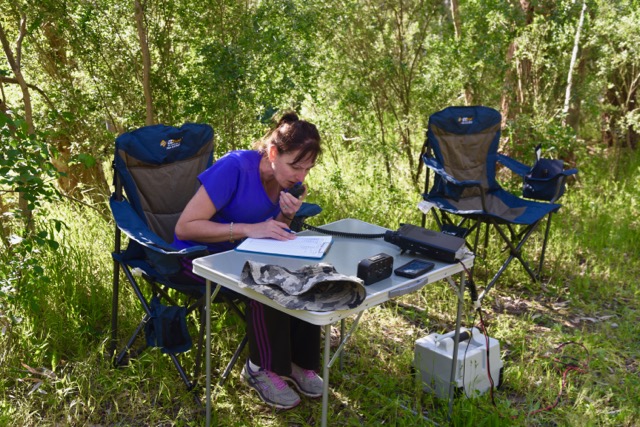
Marija and I were all set up and ready to go by 0545 UTC, about 45 minutes after our alerted time of 0500 UTC.  We ran the Yaesu FT-857d and the 20/40/80 m linked dipole for this activation.  It was a beautiful warm afternoon, around 26 degrees C, with a slight breeze.

Screen Shot 2016-11-07 at 1.15.31 pm.jpg

Above:- Map showing our operating spot in the north western section of the park.  Map coutesy of Location SA Map Viewer.

We headed for our nominated operating frequency of 7.144 and found that it was occupied by Neil VK4HNS/2 who was activating the Whian Whian State Conservation Area VKFF-1394.  Both Marija and I logged Neil for a Park to Park contact, before moving down to 7.139 where I started calling CQ.  This was answered by Adrian VK5FANA on the Yorke Peninsula who had an excellent 5/9 plus signal.  This was a good sign as the close in propagation has been less than ideal of late.  This was followed by a call from Les VK5KLB at Port Augusta who was also a great 5/9 plus signal.

Marija was quite happy in the deck chair alongside of me, reading her ipad, whilst I tried to reach the 44 QSOs required to qualify the park for WWFF.  I worked a total of 40 stations before things started to slow down, and we decided to change operators.  Band conditions were quite good with calls from VK2, VK3, VK4, and VK5.  A few good QRP contacts were logged including Nev VK5WG at Crystral Brook running 5 watts (5/9 plus both ways), and Peter VK3FPHG running 2.5 watts (5/7 sent and 5/8 received).

At around 0545 UTC Marija started calling CQ and it wasn’t long before she had a number of callers. Her first caller was Mick VK3GGG/VK3PMG, followed by Les VK5KLV and then Peter VK5KPR, both in Port Augusta north of Adelaide.
DSC_3623.jpg

Whilst Marija was on air it gave me the opportunity of having a quick walk around the park.  A number of the native plants were in flower.

I came across this very healthy fig tree.

Marija logged a total of 16 stations on 40m, and decided she had had enough and handed the mic back to me.  Marija had qualified the park for the VKFF Australian program.  We lowered the squid pole and removed the links and I headed to 14.310 on 20m hoping to work a bit of DX.  But I was to be sadly disappointed, with absolutely no callers despite numerous CQ calls.  I tuned across the 20m band and the only stations I heard were VK2CR calling CQ DX, VK4ZD on the Rotary Net, and a very weak JA.  I didn’t hear any long path Europe at all.

So we again lowered the squid pole and inserted the links in the dipole and headed to 3.610 on 80m.  I started calling CQ and this was answered by Greg VK5GJ who was running 4 watts, with a nice 5/7 signal.  Greg and I have had a number of QRP to QRP contacts in the past, so we decided to try again.  Greg lowered his power down to 400 milliwatts and his signal dropped down to 5/5.  Greg then lowered his power down to 40 milliwatts and he was 5/1.  Very low down, but perfectly readable.  Sadly Greg could not hear me at 5 watts above his noise floor.

I went on to work a total of 9 stations on 80m from VK3, VK4, and VK5.  It was a real surprise to be able to work Bill VK4FW on 80m at this time of the late afternoon.

Before going QRT I had one final run on 40m where I logged 11 stations on 7.144 including Ken ZL4KD in New Zealand.  The NSW broadcast for the Wireless Institute of Australia then started up on 7.146 just as another station gave me a call.  So I QSY’d down to 7.135 where I worked Bill VK4FW, Hans VK6XN, and finally Sergio VK3SFG, before calling it quits.

It had been a beautiful afternoon in the park, with a total of 79 contacts logged between Marija and myself.

I worked the following stations on 40m SSB:-

  1. VK4HNS/2 (Whian Whian State Conservation Area VKFF-1394)
  2. VK5FANA
  3. VK5KLV
  4. VK3PMG
  5. VK3GGG
  6. VK2FOUZ
  7. VK4AAC/3
  8. VK2PKT
  9. VK3BL
  10. VK3PF
  11. VK3DPG
  12. VK3SQ
  13. VK5BJ
  14. VK3FRAB
  15. VK3AXF
  16. VK3VBI
  17. VK3BBB
  18. VK4RF
  19. VK4HA
  20. VK5PET
  21. VK3YSP
  22. VK2YK
  23. VK7DW
  24. VK2FLEZ
  25. VK2NEO
  26. VK5WG
  27. VK3KRH
  28. VK3NBL
  29. VK3YW
  30. VK3ARH
  31. VK3FPHG
  32. VK4FFAB
  33. VK3PAT
  34. VK5KPR
  35. VK5YX
  36. VK4FDJL/2
  37. VK3TKK
  38. VK4XAC
  39. VK5FMWW
  40. VK5FVSV
  41. VK3FLCS
  42. VK3FSPG
  43. VK3PAT
  44. VK5MRT
  45. VK3MCX
  46. ZL4KD
  47. VK3ANL
  48. VK3HSB
  49. VK7FRJG
  50. VK6NU
  51. VK3FCMC
  52. VK4FW
  53. VK6XN
  54. VK5ZX

I worked the following stations on 80m SSB:-

  1. VK5GJ (QRP)
  2. VK3PMG
  3. VK3GGG
  4. VK3VT
  5. VK5BJE
  6. VK5FANA
  7. VK5YX
  8. VK4FW
  9. VK3ZVX

Marija worked the following stations on 40m SSB:-

  1. VK4HNS/2 (VKFF-1394)
  2. VK3PMG
  3. VK3GGG
  4. VK5KLV
  5. VK5KPR
  6. VK2JDR
  7. VK3VBI
  8. VK4XAC
  9. VK3FPHG
  10. VK2IO/m
  11. VK3YSP
  12. VK3FOWL
  13. VK3PF
  14. VK2FLEZ
  15. VK1AT
  16. VK4QQ

Marija and I headed for home, but not before enjoying some views of the park from Corkscrew Road.


References.

Campbelltown City Council, 2016, <http://www.campbelltown.sa.gov.au/page.aspx?c=24421&print=1&gt;, viewed 7th November 2016

National Parks South Australia, 2016, <https://www.environment.sa.gov.au/parks/Find_a_Park/Browse_by_region/Adelaide_Hills/montacute-conservation-park&gt;, viewed 7th November 2016

SA Water, 2016, <https://www.sawater.com.au/community-and-environment/our-water-and-sewerage-systems/water-sources/reservoir-data/kangaroo-creek-reservoir&gt;, viewed 7th November 2016

Wikipedia, 2016, <https://en.wikipedia.org/wiki/Montacute,_South_Australia&gt;, viewed 7th November 2016

AHARS Buy and Sell

The Adelaide Hills Amateur Radio Society (AHARS) held their annual Buy and Sell yesterday on Sunday 6th November 2016.  Myself and Ian VK5CZ, the SOTA VK5 Manager, set up a display at the Buy and Sell, promoting the various Parks programs (including World Wide Flora Fauna, & VK5 Parks Award), and the Summits on the Air (SOTA) program.

As is the case most years when we have set up this display, we had a lot of interest shown.

We had various equipment on display including various antennas, the Yaesu FT-817nd, the Elecraft KX3, the Yaesu FT-857d, various powers sources, and promotional pamphlets.

Hopefully we have sparked some more interest in these programs.

Kinchina Conservation Park VKFF-1764

This afternoon (Thursday 3rd November 2016) I headed out to the Kinchina Conservation Park, VKFF-1764 which is located abut 70 km east of Adelaide, near the town of Murray Bridge.  The park is about 25 km east of my home.

Screen Shot 2016-11-03 at 1.31.13 pm.png

Above:- Map showing the location of the Kinchina Conservation Park east of Adelaide.  Map courtesy of Location SA Map Viewer

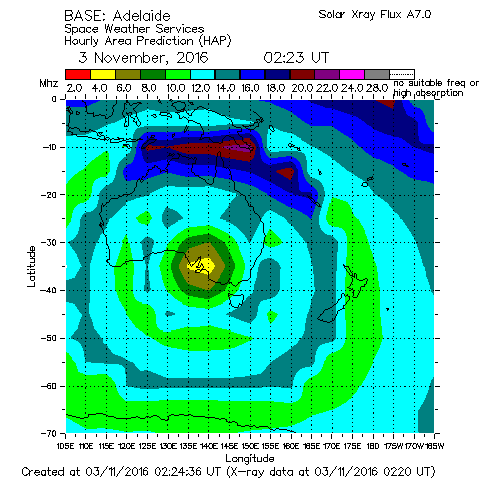
I decided that sitting in a park playing radio was far more enjoyable than sitting in front of the computer clearing emails.  Particularly as it was a sunny 26 degree C day.  But first I checked the Hourly Area Prediction (HAP) Charts to see what propagation was doing.  It suggested that any close in propagation (to around 150 km) was not going to occur on the 40m band.  In any event, I decided to head out.

Screen Shot 2016-11-03 at 12.59.15 pm.png

Above:- HAP Chart for Adelaide.  Courtesy of http://www.sws.bom.gov.au

I travelled east along the South Eastern Freeway and turned off at the Monarto exit.  I then travelled through the small ‘town’ of Monarto South and then on to the Old Princes Highway for a few km.  I then turned left onto Maurice Road.  It was slow going along the road, as there were a number of Shingleback or ‘Sleepy’ lizards crossing the road.

DSC_3505.jpg

Above:- One of my obstacles on the road, a Shingleback or Sleepy lizard.

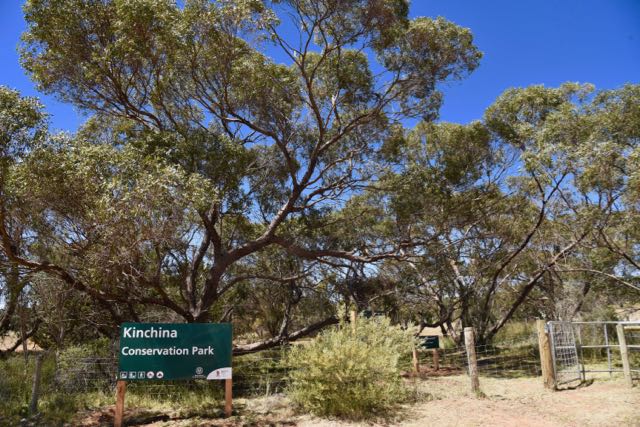
It wasn’t long and I had reached the park.  How refreshing it was to see signs for a park and pedestrian entry gates.  It is a real shame that the same cannot be said for many other South Australian parks.

dsc_3503

I did a quick reccy of this location, looking for an operating spot, and I decided to go a little further along Maurice Road.  A short distance down the road (passed the quarry), I found another parking area.  There was a freshly posted sign re the opening of the park on the 6th November 2016, in 3 days time.  Unfortunately I cannot get to the open day as it clashes with the Adelaide Hills Amateur Radio Society (AHARS) Buy and Sell.

Kinchina Conservation Park is a brand new park.  It was only gazetted in September 2016.  Kinchina is quite large, being 414 hectares in size.  The park protects grassy woodland communities considered of high conservation significance.

The park was named for the rail siding where local Monarto Granite was loaded to be sent to Adelaide by Jessie and Charles Duncan from 1879.  This granite was used in many buildings including Colonel Light’s statue, St Peters Cathedral stepgs, Electra House on King William Street and for kerbing in Adelaide’s central business district.

I decided to go for a bit of walk through the park as I still had around 1 hour before my posted activation time of 0500 UTC.  There are a number of trails in the park.  I took the Getaway Car Loop.  The Lavender Federation Trail also passes through the park.

I was hoping to get some good bird shots from the park as it is currently the week when the National TwitchathonNational Twitchathon is held.  The park provides habitat for a number of birds that are in decline in the Mount Lofty Ranges, including the Diamond Firetail, Restless Fly Catcher, Australasian Darter, and Hooded Robin.

As it was quite a warm day and the scrub here is quite thick, I was cognisant of snakes, so I made a bit of a noise as I travelled down the trail.  Unfortunately the by-product of this, was that most birds were scared off, as you can see from the photo below.

DSC_3510.jpg

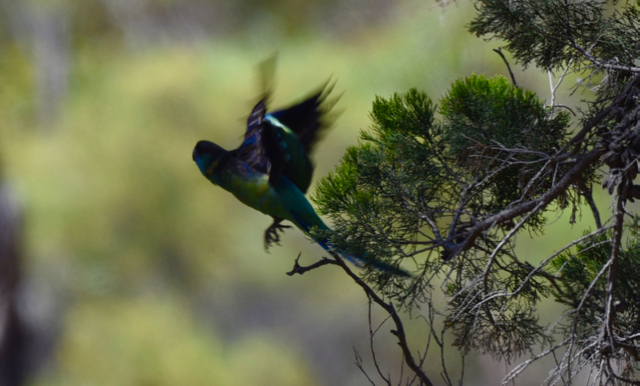
But I did manage to capture a few of the birds that frequent the park, including Australian Ringneck parrots, Magpies, Willy Wagtails, and White Winged Coughs.  Sadly my bird photography was very lacking on this occasion.

After a good walk through the park, and a bee sting to the ear, I headed back to the original gate on Maurice Road.  Yes, I did say a bee sting to the ear.  I came across a bee hive and some very angry bees.

Upon returning to this location I found one of the park rangers doing some work ina tractor, levelling the carpark.  No doubt in preparation for the open day, coming up on Sunday.  We had a chat for around 10 minutes and I explained what I was up to.  He appeared to know a bit about the parks program and warned me that snakes were not the problem in the park.  But….mosquitoes were.  And it didn’t take me long to find that out.  Make sure you have your Aeroguard if you visit Kinchina.

kinchina-conservation-park-map

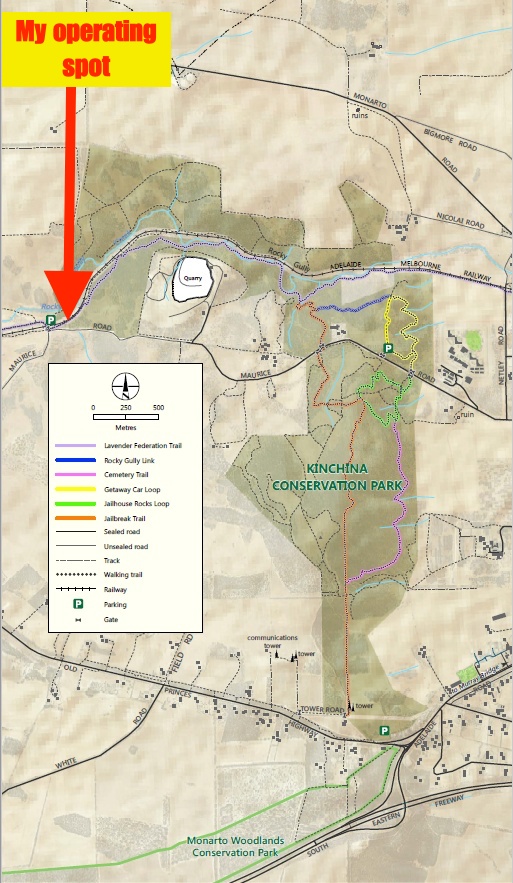
Above:- Map showing my operating spot in the park.  Map courtesy of lavenderfederationtrailorg.au

I ran my normal station for this activation comprising the Yaesu FT-857d, 40 watts, and the 2040/80m linked dipole.

After setting up I headed to 7.144 and found ZL3ADT calling CQ on 7.145.  I gave him a shout, but sadly he could not hear me.  So I took a spin across the band and found Rob VK4AAC/3 who was portable in the Mount Buangor State Park VKFF-0766.  Once Rob had finished his QSO I gave him a shout and we exchanged 5/9 signal reports.  Despite Rob’s signal being strong, very profound QSB was noted.  It was a nice way to start the activation, with a Park to Park contact.

I then headed back up the band and found that 7.144 was clear and I started calling CQ.  This was answered by Mick VK3GGG/VK3PMG at Stawell in western Victoria.  Mick had a strong 5/9 signal, but again deep QSB was present.  Next up was Ken VK2KYO, followed by Les VK5KLV and then Peter VK3PF.  I worked a further 24 stations from VK2, VK3, VK4, VK5, and VK7.  This included Tom VK5EE, Greg VK5ZGY, and Col VK5HCF who were all out portable in Mount Gambier, setting up for the Legend of the Lakes Hill Climb event.

Generally signal strengths of some of the regular park hunters was down.  There was a very brief opening into Adelaide, with Darryl VK5JDS, Trevor VK5TW, and Phil VK5RM making the log.  Phil and I only just made the contact.  He reported that I was originally 20/9 when he heard me, and I was almost gone by the end of our quick chat.  Adrian VK5FANA located on the Yorke Peninsula, and I tried to make a QSO, but we just couldnt quite exchange signal reports to make it a valid contact.

I then headed off to 20m where I worked Rick VK4RF/VK4HA, followed by Rob VK2QR/VK2SWL, and then Gerard VK2IO.  But despite numerous CQ calls, the only other station logged was Kazu JL1ELQ in Japan.

I decided to try 80m and I am very pleased I did.  I worked a total of 6 stations, including Adrian VK5FANA and Rob VK4AAC/3 in VKFF-0766.

I then moved back to 20m and worked 8 stations including Max IK1GPG in Italy, and Grant VK2GEL who was portable in the Cape Byron Marine Park VKFF-1407.  It was then back to 40m where I logged  further 11 stations, including three further Park to Park contacts.  The first being with Jarrad VK6FFAR who was portable in the Tuart Forrest National Park VKFF-0498, Andrew VK1DA who was portable in the Issacs Ridge Nature Reserve VKFF-0845, and then Grant VK2GEL who was activating the Cape Byron Marine Park VKFF-1407.

To finish off the activation I tried 15m.  But despite 10 minutes of calling CQ I had no takers.  I was also experiencing QRM from a Japanese station calling CQ on 21.244.  I tried calling him before I went QRT, but sadly he did not hear me.

It was a successful activation, with a total of 61 contacts in the log, and a unique park for me as an activator for both the World Wide Flora Fauna (WWFF) program, and the VK5 National and Conservation Parks AwardVK5 National and Conservation Parks Award.

I worked the following stations on 40m SSB:-

  1. VK4AAC/3 (Mount Buangor State Park VKFF-0766)
  2. VK3GGG
  3. VK3PMG
  4. VK2KYO
  5. VK5KLV
  6. VK3PF
  7. VK3FLCS
  8. VK7GG
  9. VK3SQ
  10. VK5EE
  11. VK5ZGY
  12. VK3VBI
  13. VK3SIM
  14. VK3MCK
  15. VK3ANL
  16. VK4RF
  17. VK4HA
  18. VK5HCF
  19. VK5JDS
  20. VK5TW
  21. VK2GKA
  22. VK5RM
  23. VK3FQSO
  24. VK3UH
  25. VK3SFG
  26. VK2FVIN
  27. VK2EJW
  28. VK2JLS
  29. VK2QR
  30. VK7AC
  31. VK2QK
  32. VK4FW
  33. VK6FFAR/p (Tuart Forrest National Park VKFF-0498)
  34. VK2SWL
  35. VK1DA/p (Issacs Ridge Nature Reserve VKFF-0845)
  36. VK7DW
  37. VK2GEL/p (Cape Byron Marine Park VKFF-1407)
  38. VK7JB
  39. VK2IO
  40. VK2PKT
  41. VK7FGGT

I worked the following stations on 20m SSB:-

  1. VK4RF
  2. VK4HA
  3. VK2QR
  4. VK2SWL
  5. VK2IO
  6. JL1ELQ
  7. VK4TJ
  8. VK4FW/m
  9. VK2GEL/p (Cape Byron Marine Park VKFF-1407)
  10. VK4KUS
  11. IK1GPG
  12. VK4NFZ
  13. ZS5AYC/VK4
  14. ZS5APT/VK4

I worked the following stations on 80m SSB:-

  1. VK5FANA
  2. VK5GJ (QRP)
  3. VK4AAC/3 (Mount Buangor State Park VKFF-0766)
  4. VK5HS
  5. VK5VRB
  6. VK5BJE

As it is National Twitchathon week, I have my special bird QSL card on offer.

Screen Shot 2016-11-03 at 1.14.11 pm.png


References.

Government of South Australia, 2016, <https://www.environment.sa.gov.au/Home/Full_newsevents_listing/News_Events_Listing/160922-new-conservation-parks&gt;, viewed 3rd November 2016
 

2016 CQ World Wide DX Contest

cq_logo

Over last weekend (Saturday 28th & Sunday 29th October 2016) the SSB section of the CQ World Wide DX Contest was held.  The CQ WW is the largest amateur radio contest in the world.  About 35,000 participants take part in the SSB section in October, and the CW section in November.  The goal is to make as many contacts as possible with as many different DXCC entities and CQ zones as possible.

I snuck into the shack as often as I could and I made a total of 331 contacts which equated to a total of 814 points.  There are two types of multiplier in this contest.  The first being a multiplier of one for each different CQ zone contacted on each band.  And the second being a multiplier of one for each different country contacted on each band.  My total claimed score was 130,240 points.

I ran VK Contest Logger for this contest.

Most of my activity was on the Saturday afternoon-early evening, and then again on Sunday afternoon-early evening.

screen-shot-2016-11-02-at-10-04-27-pm

My contacts were made on the 15m, 20m and 40m bands.

  • 15m – 88 contacts
  • 20m – 185 contacts
  • 40m – 58 contacts

Antennas used:

  • 40m
    • home brew 40m 1/2 wave dipole, inverted vee
  • 15/20m
    • TET Emtron TE53, 5 element yagi @ 16 metres

DXCC entities worked were as follows:

  1. Asiatic Russia
  2. Australia
  3. Austria
  4. Belgium
  5. Bonaire
  6. Bosnia
  7. Bulgaria
  8. Canada
  9. Canary Islands
  10. Chatham Islands
  11. Chile
  12. China
  13. Colombia
  14. Corsica
  15. Curacao
  16. Cyrpus
  17. Czech Republic
  18. East Kiribati
  19. East Malaysia
  20. England
  21. European Russia
  22. Finland
  23. France
  24. Germany
  25. Greece
  26. Guam
  27. Hawaii
  28. Hungary
  29. India
  30. Indonesia
  31. Israel
  32. Italy
  33. Jamaica
  34. Japan
  35. Kazakhstan
  36. Kuwait
  37. Laos
  38. Latvia
  39. Lithuania
  40. Macedonia
  41. Mariana Islands
  42. Mexico
  43. Micronesia
  44. Mongolia
  45. Montenegro
  46. Morocco
  47. Netherlands
  48. New Caledonia
  49. New Zealand
  50. Palau
  51. Philippines
  52. Poland
  53. Puerto Rico
  54. Serbia
  55. Singapore
  56. Slovenia
  57. Spain
  58. Sweden
  59. Taiwan
  60. Thailand
  61. Tonga
  62. Ukraine
  63. USA
  64. Vietnam
  65. West Malaysia

2016 VKFF Team Championships results

On Sunday 16th October 2016, the inaugural VKFF Team Championship took place.  The aim was to promote the World Wide Flora Fauna (WWFF) program.  Teams of between 2-4 amateurs were formed, and they activated between 0000 UTC – 0600 UTC from a WWFF reference area, with a view of logging the most number of park hunters.

The following teams took part…….

  1. ‘The Odd Couple’ comprising of husband & wife team Joe VK3YSP and Julie VK3FOWL – Churchill National Park VKFF-0621
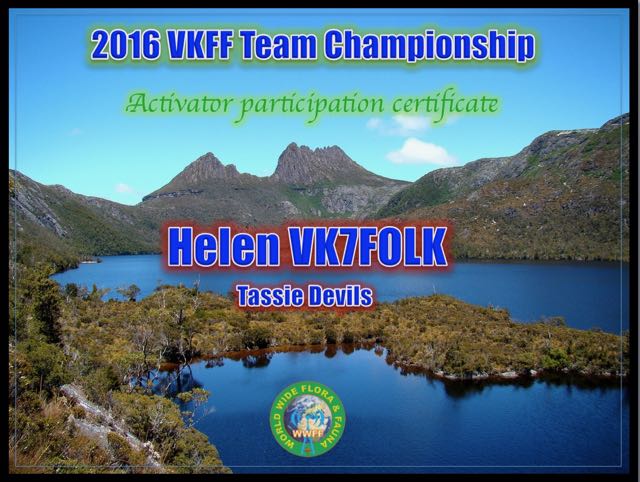
  2. ‘Tassie Devils’ comprising Jonathan VK7JON and his partner Helen VK7FOLK – Narawntapu National Park VKFF-0005
  3. ‘Team Pezo’ comprising Peter VK5PET and Steve VK5ZEO – Mount Magnificent Conservation Park VKFF-0916
  4. ‘Team Kookaburra’ comprising Tony VK3XV and Mick VK3PMG – Ararat Hills Regional Park VKFF-0958
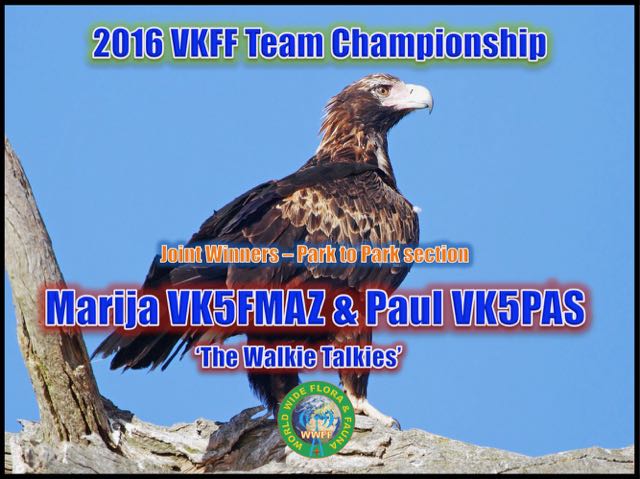
  5. ‘The Walkie Talkies’ comprising Paul VK5PAS and Marija VK5FMAZ – Monarto Conservation Park VKFF-0828
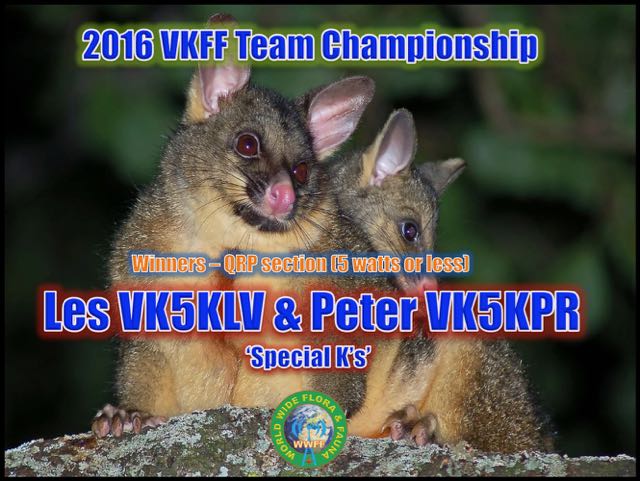
  6. ‘Special K’s’ comprising of Les VK5KLV and Peter VK5KPR – Upper Spencer Gulf Marine Park VKFF-1757
  7. ‘The Irresistbles’ comprising of Gary VK1ZZ and John VK4VHY (operating as VK4ZI) – Undara Volcanic National Park VKFF-0506
  8. ‘The Mad Mix’ comprising of Mike VK6MB, Nick VK6FSEA and Jarrad VK6FFAR – Wellington National Park VKFF-0657

A breakdown of contacts for each team is as follows…..

  1. ‘Team Kookaburra’ – 150 contacts
  2. ‘The Walkie Talkies’ – 138 contacts
  3. ‘Tassie Devils’ – 63 contacts
  4. ‘The Odd Couple’  33 contacts
  5. ‘Special K’s’ – 29 contacts
  6. ‘The Mad Mix’ – 26 contacts
  7. ‘Team Pezo’ – 20 contacts
  8. ‘The Irresistbles’ – 7 contacts

Overall winners

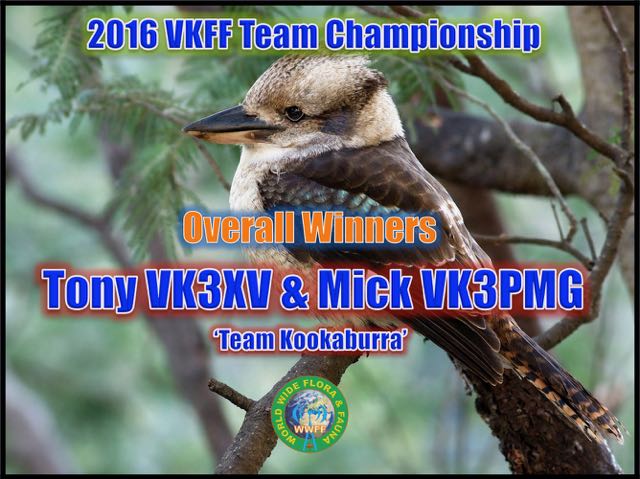
The winner of this section was ‘Team Kookaburra’ , Tony VK3XV & Mick VK3PMG, with a total of 150 contacts.  They will each receive a glass etched trophy.

This section is sponsored by a VK3 who wishes to remain anonymous who donated $100.00.

VK3PMG.jpg

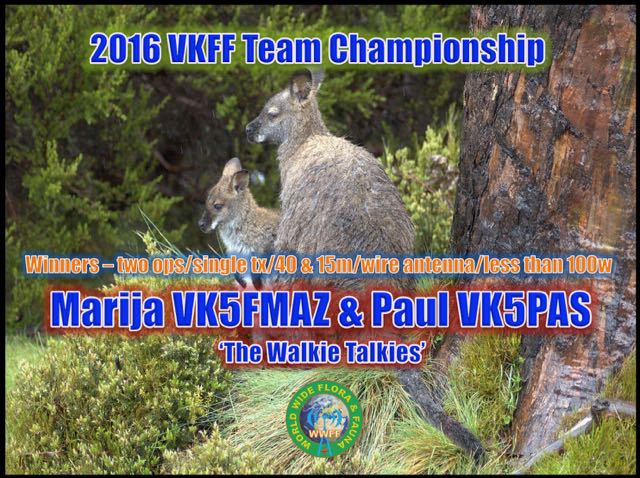
Two ops/single tx/40m & 15m/wire antenna/100 watts or less

The winner of this section was Team ‘The Walkie Talkies’ Paul VK5PAS & Marija VK5FMAZ with a total of 138 contacts.  They will each receive a glass etched trophy.

This section is sponsored by a VK4 and a VK5 who wish to remain anonymous who both donated $50.00 each.

vk5pas

QRP

The winner of this section was the Team Special K’s’, Les VK5KLV and Peter VK5KPR.  They will receive a 25 pound store credit from SOTABeams.SOTABEAMS-logo-landscape.jpg

vk5klv

Park to Park

This was shared by Team Kookaburra and The Walkie Talkies, both of whom made a total of 24 Park to Park contacts.  They will share a $50.00 voucher from Pages of Cobram.  Many thanks to Peter VK3FPSR of Pages of Cobram.

10960447_1025779397438920_5639868191681434908_o

VK3PMG P2P.jpg

VK5PAS.jpg

Participation certificates

Many thanks to everyone who took part in the event.   All activators who took part in the event have been emailed an Activator participation certificate.

vk7folk

WIA presentations in Western Australia

During my recent trip to Western Australia, Andrew VK6AS and I delivered two talks to VK6 amateurs on current Wireless Institute of Ausralia (WIA) issues.

The first being on Saturday afternoon (22nd October 2016) at the Bassendean Seniors and Community Centre, 50 Old Perth Road, Bassendean.  Around 50 amateurs attended the talk.

On Sunday (23rd October 2016) we were asked to attend the Northern Corridor Radio Group’s clubrooms and deliver a talk.  I was fortunate enough to have a tour of their very impressive facilities whilst there.

Thankyou to Andrew VK6AS and his wife Allison for their hospitality during our stay in Western Australia, and thankyou to all the amateurs in VK6 who attended our talks.  It was great to be able to put a face to the call sign of so many amateurs, and field some very important questions on WIA matters.


John Forrest National Park VKFF-0250

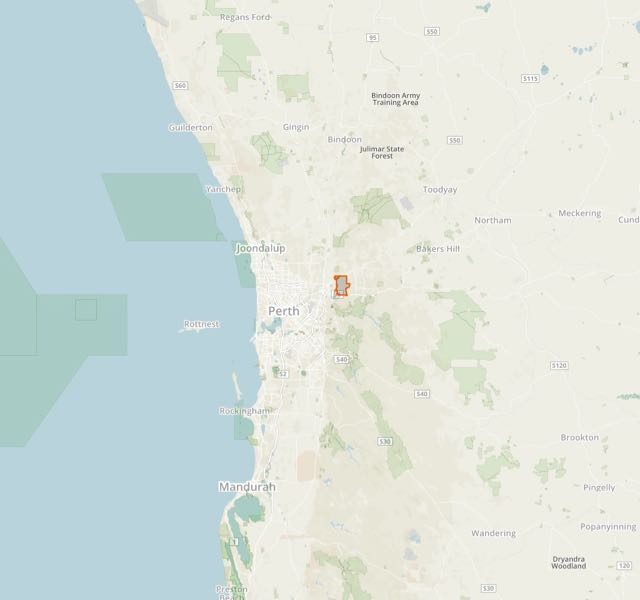
Our final activation for Saturday 22nd October 2016 was the John Forrest National Park VKFF-0250, which is located about 24 km east of Perth.

Screen Shot 2016-10-24 at 9.54.22 am.jpg

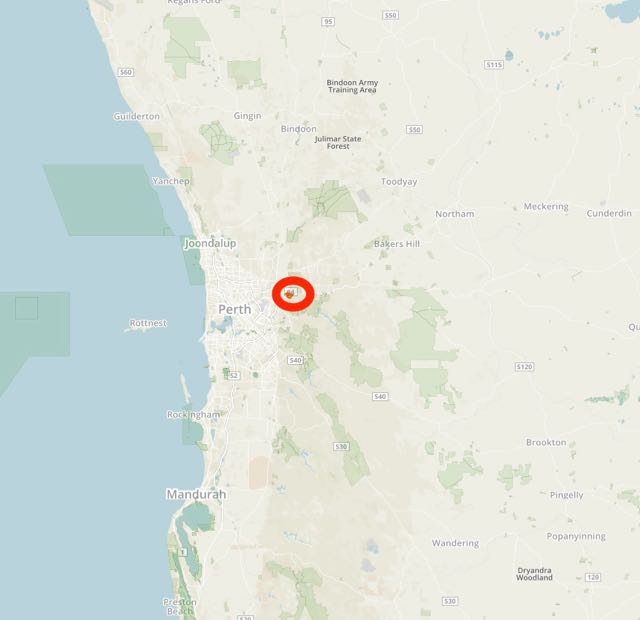
Above:- Map showing the location of the John Forrest National Park east of Perth.  Map courtesy of Protected Planet.

Again, no problems with us locating the park, as it is very well signposted.

We set up in the southern section of the park, in a little clearing just off the side of the road which passes through the park.

Screen Shot 2016-10-24 at 9.54.13 am.jpg

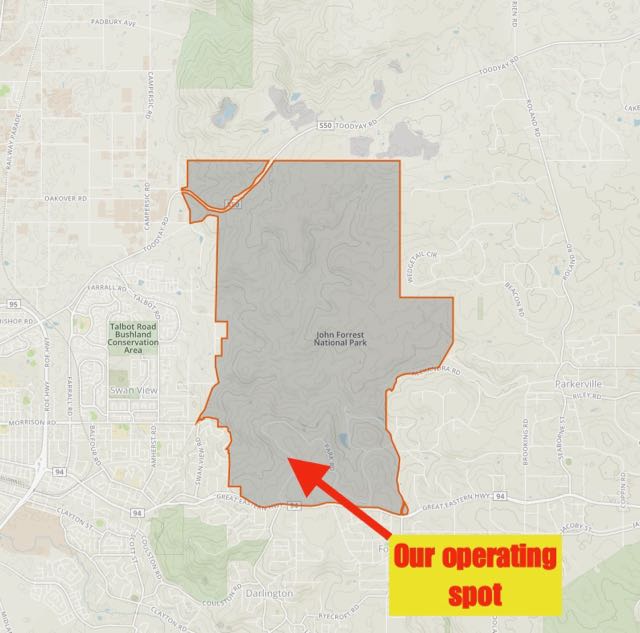
Above:- Our operating spot in the John Forrest National Park.  Map courtesy of Protected Planet.

John Forrest National Park is 26.78 km2 in size and is located in the Darling Scarp, also referred to as the Darling Ranges.  Sadly this park has been impacted by the actions of mankind.  Many of the smaller marsupials located in the park have been decimated by introduced European animals such as foxes and feral cats.  Drought and dieback have affected the jarrah forest within the park, and introduced species of weed are problematic.

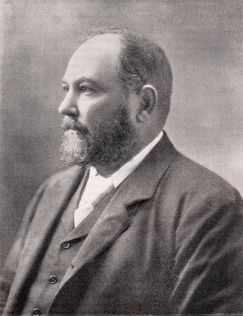
All this is rather sad, as John Forrest was the first National Park to be established in Western Australia and is one of the oldest in Australia.  The park was originally declared as a conservation reserve in 1898, and it became John Forrest National Park in 1947, in honour of the famour explorer and statesman, Sir John Forrest, who was Premier of Western Australia between 1890-1901.

John_Forrest.jpg

Above:- Sir John Forrest.  Image courtesy of wikipedia.

There are several trails through the park, including the Railway Heritage Trail, which follows the alignment of the old railway line to York.  Visitors to the park can also walk through the Swan View Tunnel, the only historical railway tunnel in Western Australia.

The park was alive with flower during my visit.

As conditions had been quite good on 20m at Greenmount, Andrew and I decided to start off this activation on the 20m band.  We commenced calling CQ on 14.310 and this was answered by Greg VK5GJ who was operating QRP.  Greg was quite low down (5/1) but we were able to hear Greg very well.  Next up was Phil VK6ADF, followed by Bill VK4FW who was portable in the Cherbourg Conservation Park VKFF-1510 (5/9 both ways).  Merv VK6LDX then called in, but despite a number of further CQ calls, we had no more takers.

So it was off to 40m where we called CQ on 7.144.  This was answered by Mike VK6MB with a strong 5/9 signal.  At this time Phil VK6ADF arrived at the park and we had a bit of a chat.  Andrew and I were sitting on 5 QSOs and still needed a further 5 to qualify the park for the Australian (VKFF) chapter of World Wide Flora Fauna.  So Phil jumped in his car and drove a few km away and gave us a call.  Number 6 for us, but we were still 4 away from qualifying the park, and our CQ calls on 40m were going unanswered.

So it was back to 20m for us for a last 10 minute dash before we had to pack up and head off to our planned talk.  We tuned to 14.310 and found Rob VK4FFAB operating as VK4SQ in the Deception Bay Conservation Park VKFF-1528.

After working Rob we headed up the band to 14.315 and started calling CQ.  Our first caller was a Croatian station much to our surprise.  It was Sasa 9A3NM with a good 5/7 signal.  Rick VK4RF/VK4HA then followed, as did Mick VK3GGG/VK3PMG.  Now we were really pushing for time.  It was just after 2.00 p.m. Western Australia local time, and we had to get to our talk by 2.30 p.m.  And we now had a little pile up going.

Sadly we only had the time to log a further 3 stations.  They being Les VK5KLV, Ozren 9A7W, and finally Chris VK6KRS.  Both Andrew and I apologise sincerely to the other stations that were calling, but we were forced to go QRT as we did not want to be late for our presentation.

I worked the following stations on 40m SSB:-

  1. VK6MB
  2. VK6ADF/p

I worked the following stations on 20m SSB:-

  1. VK5GJ
  2. VK6ADF/m
  3. VK4FW/p (Cherbourg Conservation Park VKFF-1510)
  4. VK6LDX
  5. VK4SQ/p (Deception Bay Conservation Park VKFF-1528)
  6. 9A3NM
  7. VK4RF
  8. VK4HA
  9. VK3PMG
  10. VK3GGG
  11. VK7KLV
  12. 9A7W
  13. VK6KRS


References.

Department of Parks and Wildlife, 2014, John Forrest National Park guide.

Wikipedia, 2016, <https://en.wikipedia.org/wiki/John_Forrest_National_Park&gt;, viewed 25th October 2016

Greenmount National Park VKFF-0218

Our second planned park activation of the day (Saturday 22nd October 2016) was the Greenmount National Park VKFF-0218, which is located about 22 km east of Perth.

Screen Shot 2016-10-24 at 9.52.55 am.jpg

Above:- Map showing the location of the Greenmount National Park, east of Perth.  Map courtesy of Protected Planet.

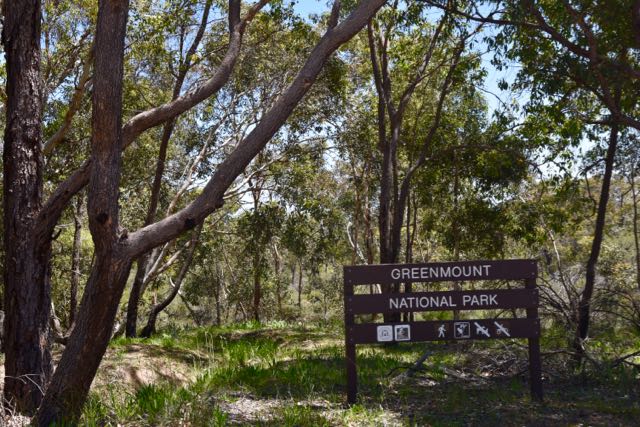
This time around we had no problems at all in finding the park and a park sign.

dsc_3457

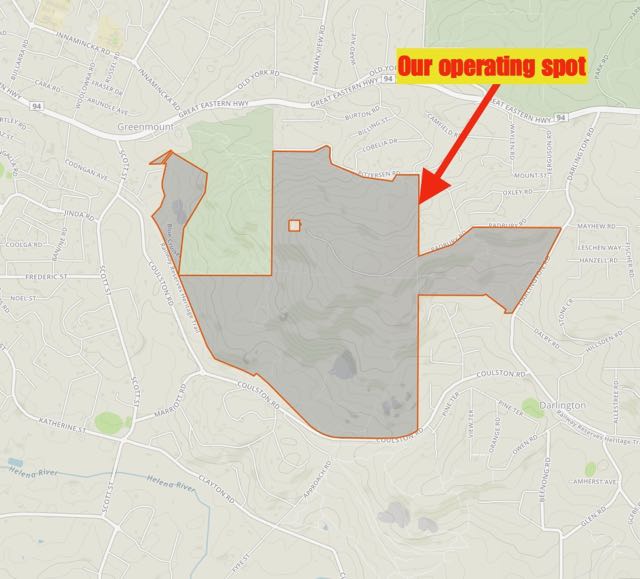
Andrew and I set up in the north eastern corner of the park, and just a few metres from the roadway, on a dirt track on the edge of the park.  We were in the process of setting up, when one of the locals joined us and was very interested in what we were up to.  The gentleman remained with us during our entire activation and was fascinated to hear us making contacts around Australia.

Screen Shot 2016-10-24 at 9.52.37 am.jpg

Above:- Map showing out operating spot in the park.  Map courtesy of Protected Planet.

Greenmount National Park is 56 hectares in size and is located on the slope of Greenmount Hill, overlooking Perth and the coastal plain.  It is one of the smaller National Parks located along the Darling Scarp.  It is located in close proximity to the John Forest National Park, our next planned park.

The dominant vegetation in the park is eucalypts such as Marri and Wandoo, along with an array of  wild flowers and heathland along the northern slopes. The hill is steep and contain several breakaways and rocky outcrops.

Mountain Quarry is one of a number of blue stone quarries located within the park.  The Mountain Quarry area is used for rock climbing and abseiling.

After setting up we started calling CQ on 7.144 on 40m and our first caller was Carsten VK6PCB who was portable in the Lesmurdie Falls National Park VKFF-0284.  It was nice to start off with a Park to Park contact.  Next up was Allen VK6XL who was a very nice 5/9.  But despite a number of CQ calls we had no further takers on 40m.  So it was down with the squid pole and out with the links and off to 20m.

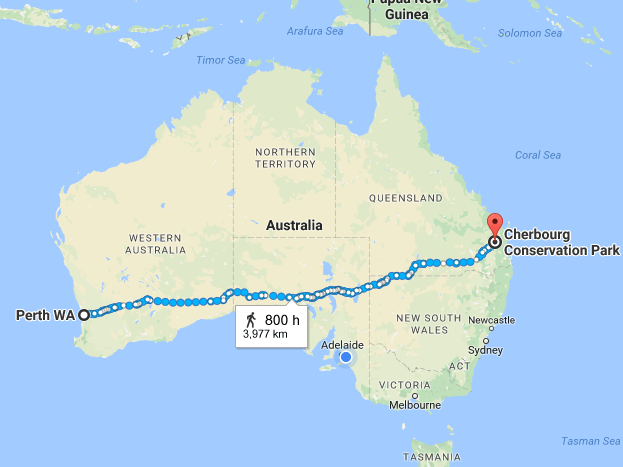
We commenced calling CQ on 14.310 and this was answered by Bill VK4FW who was operating portable in the Cherbourg Conservation Park VKFF-1510.  Another Park to Park contact in the log, and a very nice 5/8 signal from Bill.  In some parts of the world this would be classed a DX contact.  But here in Australia, this was just another ‘local’ QSO, albeit Park to Park.  In fact, our Park to Park contact was over a distance of 4,000 km, from one side of Australia to the other.

Screen Shot 2016-10-24 at 3.15.26 pm.png

Next in the log was Greg VK5GJ operating QRP from the Adelaide Hills, followed by Les VK5KLV at Port Augusta, and then Nev VK5WG at Crystal Brook.  Signals coming in from the various parts of South Australia were quite good.

Mick VK3PMG then called us.  Mick’s signal was quite low down, and despite calling Mick a few times he did not come back to our call again.  So we continued on, logging Peter VK3PF in Melbourne with 5/1 signal reports being exchanged.   Next up were some of the Western Australian locals, Allen VK6XL, Bob VK6POP, and VK6ARN.

Ian VK5IS then called us with a low but workable 5/1 signal (5/2 received), followed by Carsten VK6PCB in the Lesmurdie Falls National Park VKFF-0284.

Andrew and I were just about to pack up when Mick VK3PMG called us again, and this time Mick’s signal had come up to a good 5/5, with a 4/2 signal report received from Mick.

Time was marching on, and we still had one more planned park activation prior to our talk.  Andrew and I were happier this time, as we had qualified for park for the VKFF program, having reached the 10 QSO threshold.

I worked the following stations on 40m SSB:-

  1. VK6PCB/p (Lesmurdie Falls National Park VKFF-0284)
  2. VK6XL

The following stations were worked on 20m SSB:-

  1. VK4FW/p (Cherbourg Conservation Park VKFF-1510)
  2. VK5GJ
  3. VK5KLV
  4. VK5WG
  5. VK3PF
  6. VK6XL
  7. VK6POP
  8. VK6ARN
  9. VK5IS
  10. VK6PCB/p (Lesmurdie Falls National Park VKFF-0284)
  11. VK3PMG
  12. VK3GGG


References.

Shire of Mundaring, 2016, <http://www.mundaringtourism.com.au/Lists/All%20Listings/DispForm.aspx?ID=43&gt;, viewed 24th October 2016

Wikipedia, 2016, <https://en.wikipedia.org/wiki/Greenmount_National_Park&gt;, viewed 24th October 2016