Today I received my latest Park to Park (P2P) certificate for the World Wide Flora Fauna (WWFF) program.
Many thanks to Danny ON4VT, the P2P Awards Manager.


Today I received my latest Park to Park (P2P) certificate for the World Wide Flora Fauna (WWFF) program.
Many thanks to Danny ON4VT, the P2P Awards Manager.
Yesterday afternoon (Saturday 19th March 2016) my wife Marija and I headed up to the Monarto Conservation Park, for the 2016 John Moyle Memorial Field Day. I had planned on going to the Coorong National Park, but after feeling a bit ordinary over recent times, I decided to choose a park a little closer to home. Monarto is a nice little mallee park, and is just 30 km east from home, along the South Eastern Freeway (about 65 km east of Adelaide).
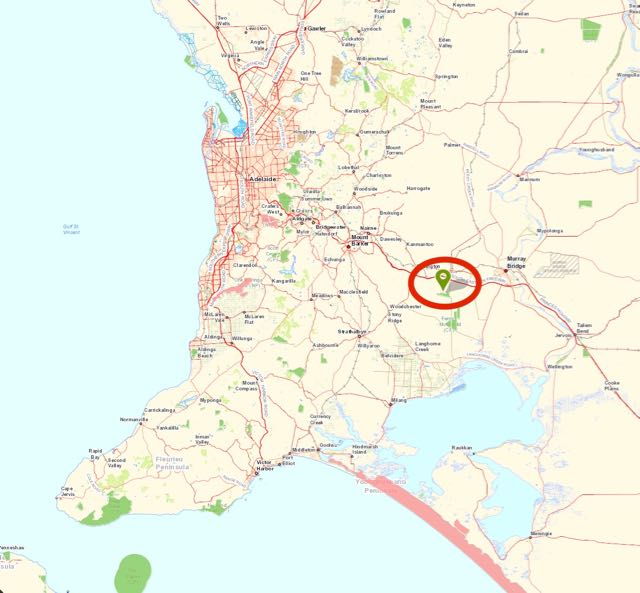
Above:- Map showing the location of the Monarto Conservation Park, east of Adelaide. Map courtesy of Location SA Map Viewer.
The John Moyle Memorial Field Day (JMMFD) is held annually in memory of the late John Moyle. The WIA website states:
“The contest is run each year in memory of the late john Moyle who was a long term editor of the Wireless Weekly, (later Radio & Hobbies – later Radio Television & Hobbies) from 1947 until his untimely death in 1960. He served in the RAAF with distinction and was responsible for a number of innovative solutions to keeping radio and radar equipment working under difficult wartime and working conditions. The WIA decided that a suitable long term memorial to John Moyle would be a Field Day with a focus on portable or field operation. The contest has been conducted annually ever since”.
In the leadup to the contest I had had heard some amateurs referring on air to: ‘bloody contests’ and ‘what do they get out of it’. Although I’m not a huge contester, I do compete in a handful of amateur radio contests during the year, and the JMMFD is one of those. The JMMFD tends to be a lot more laid back than the big international contests, and on a sunny day like yesterday, its a great way to spend an afternoon out in the field. I’m always concerned about amateurs criticising the interests of other amateurs. This is an amazing hobby, with so many diverse and interesting aspects, and we, the amateur radio community, should be embracing all of them. It’s the old saying of what floats one persons boat, doesn’t necesssarily excite another.
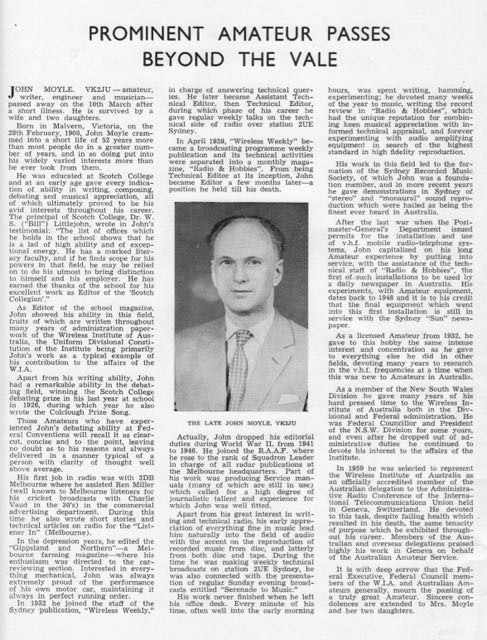
And who really is John Moyle? I had read a little bit about the man on the WIA website, but really didn’t know much about him. I had even read some Facebook posts from some hams, spelling his name incorrectly. So I decided to have a look around the internet and see what I could come up with. I was also provided an article by Peter VK3RV, the WIA Historian. Thanks Peter.
John Murray Moyle (VK2JU) was born on the 28th February 1908 in Malvern, Victoria. He was educated at Scotch College in Melbourne where he was the Editor of the school magazine and involved in the debating team. John’s first role in radio was with radio station 3DB in Melbourne where he assisted well known broadcaster Ren Miller in the commercial advertising department and also wrote short stories and technical articles on radio for the ‘Listener In’ (Melbourne). In 1932, John joined the staff of ‘Wireless Weekly‘, a Sydney publication, and soon became Assistant Technical Editor, and then Technical Editor. John was also first licenced in 1932 as a radio amateur.
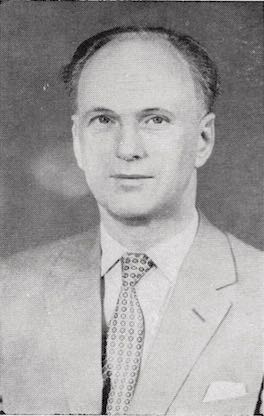
Above:- John Murray Moyle. Image courtesy of Peter VK3RV.
In 1933 John married Alice Marshall Brown (1908 Bloemfontein South Africa -2005). She was one of the seminal figures in Australian ethnomusicology and founding members of the Australian Institute of Aboriginal Studies.
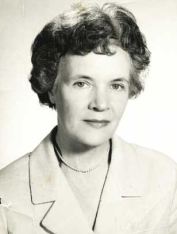
Above:- Alice Marshall Moyle nee Brown. c/o discogs.com
John and Alice had two daughters, Josephine and Carolyn.
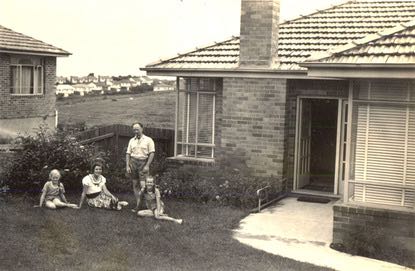
Above:- The Moyle family, c. 1950’s. Image courtesy of hiddenheroesofaustralianhistory.wikifoundry.com
In April 1939, ‘Wireless Weekly‘ became a broadcasting programme weekly publication, with its technical activities separated into a monthly magazine entitled ‘Radio and Hobbies‘. John was the Technical Editor of the new magazine, and some became the Editor.
John served as a Squadron Leader with the Royal Australian Air Force during World War II. His service number was 263664. He was in charge of all radar publications at the Melbourne RAAF Headquarters, and was discharged on the 18th January 1946.
John Moyle served for many years as a Federal Councillor with the WIA and President of the NSW Division. In 1959 he was selected to represent the WIA as an officially accredited member of the Australian delegation to the Administrative Radio Conference of the International Telecommunications Union, held in Geneva Switzerland. He also made weekly technical broadcasts on radio station 2UE in Sydney.
John Moyle died on the 10th March 1960, aged just 52 years, after a short illness. His resting place is the Northern Suburbs Memorial Gardens and Crematorium in North Ryde, NSW.
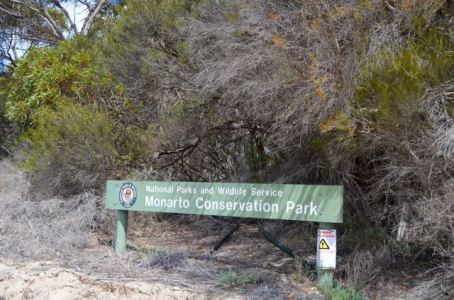
Upon leaving home it was quite overcast and there appeared to be the possibility of rain in the Adelaide Hills. We travelled along the South Eastern Freeway and turned off at Monarto and then drove south along the Ferries McDonald Road towards the park.


Monarto Conservation Park consists of typical open mallee and is surrounded by cropping lands. A large variety of native wildlife call the park home, including Western Grey kangaroos and at least two species of Marsupial Mouse. More than 80 species of birds have been recorded in the park, including the endangered Malle fowl.


The small ‘town’ of Monarto is located to the north of the park, on the opposite side of the South Eastern Freeway. This area was once earmarked (in the 1970’s) by the then South Australian Premier Don Dunstan, as a satellite city to Adelaide. However, due to a variety of reasons this never eventuated. Today, Monarto is a farming district and is situated adjacent to the main Adelaide-Melbourne rail line. Monarto is probably best known for the Monarto Zoological Park which is the world’s largest open plains zoo, featuring a variety of animals including cheetah, rhinoceros and giraffe.


Marija and I pulled in to the car parking area in the north eastern corner of the park, off Ferries McDonald Road. This is where I normally operate from. There was already a family having a picnic lunch in the carpark, and they watched on with great interest as the squid pole was erected. I had a short conversation with them, explaining what we were doing and a little bit about amateur radio.
It only took a few minutes to have everything set up. We were ready to go a little earlier than predicted. It was around 1.30 p.m. South Australian local time. This was just my normal little humble portable station consisting of a deck chair, fold up table, the solar panels topping up the 44 amp hour power pack, the Yaesu FT-857d set on 40 watts, and the 20m/40m linked dipole on top of a 7 metre heavy duty squid pole. I secured the squid pole to one of the permapine fence posts of the carpark boundary.
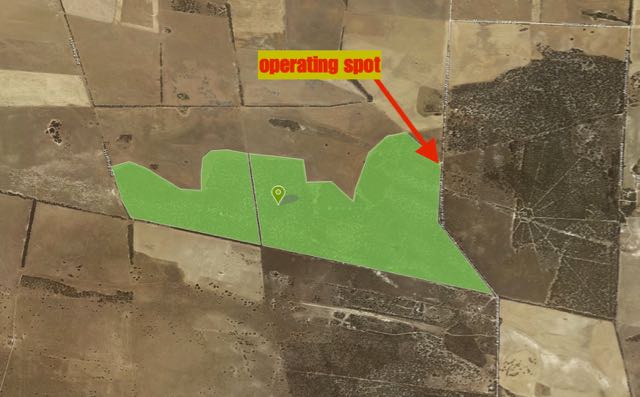
Above:- Map showing our operating spot in the park. Image courtesy of Location SA Map Viewer.
It was a very hot day, despite all the cloud cover. When that sun came out, it certainly had a bite. So out came the umbrella to shield me from getting sunburnt (which happened anyway). The 40m band was very busy and it was quite difficult to find a clear frequency but eventually I did. My first contact was with Roald VK1MTS/p in the ACT, followed by Damien VK5FDEC, and then Dale VK3VZX. My fourth and fifth contacts were park to park contacts. They being with Hans VK5YX who was portable in the Onkaparinga River National Park VKFF-0402, and Chris VK3PAT who was portable in the Avon Wilderness Area VKFF-0942.
I had not long been on air, when from underneath the umbrella, I heard Marija talking to someone. Between calls, I poked my head out to find that it was Peter VK5PM and his wife, from Nairne. Peter had phoned me a few weeks earlier and was quite interested in getting involved in portable work. So when things slowed down a little, out I popped from the umbrella for a chat.
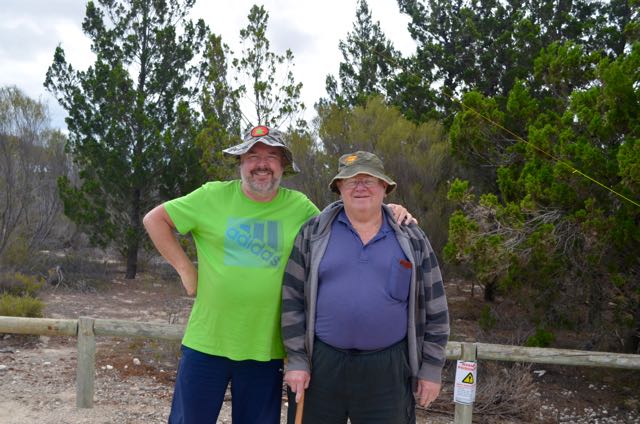
Above:- with Peter VK5PM.
Peter stayed for around an hour and we had a bit of a chat between contacts. Hopefully I may have encouraged another park activator. Fortunately the cloud cover started to move in as the afternoon went on, and the very hot sun abated, so I was able to dispense with the umbrella.
There were long periods of calling CQ with no takers which was a little disapointing, with band conditions being quite good, with a number of contacts into Queensland during the middle of the day.
I worked a number of other SOTA & park activators during the day. They included:
I did try 20m briefly during the activation but only worked four (4) stations there:- VK6BRC, VK6WE/p, VK4QD/p, and VK6NC/p.
I stopped at around 0800 UTC for a quick bite to eat and a stroll around the park, before getting stuck back into working my last couple of hours.
The laptop held out quite well for the 6 hours in the park. I have an inverter which allows me to charge the laptop via the Toyota Hi Lux battery, but it is extremely noisy, so I had to take some breaks from the radio, as it was totally impossible to operate due to the noise. This is something I’m going to have to look at.
My last contact was with Adam VK2FABJ near Coffs Harbor.


So after my 6 hours in the park I had a total of 229 contacts in the log. Down a little from last year’s 238 contacts from the Coorong National Park. But still, a very enjoyable afternoon out in the park.
Thanks to everyone who called.


Here is a 10 minute video I put together of the activation and some of the contacts…….
References.
Australian Institute of Aboriginal and Torres Strait Islander Studies, 2016, <http://aiatsis.gov.au/collections/collections-online/digitised-collections/musical-connections-alice-boyle/biography>, viewed 20th March 2016.
Commonwealth of Australia, 2016, <http://www.ww2roll.gov.au/>, viewed 20th March 2016.
Discogs, 2016, <https://www.discogs.com/artist/1792346-Alice-M-Moyle>, viewed 20th March 2016
On Friday night (11th March 2016) I headed over to the Mark Oliphant Conservation Park, 5CP-127 and VKFF-072, for the regular Friday afternoon/evening event for the VK5 National and Conservation Parks Award. But it was almost a no-goer for me, as the weather at home was extremely stormy with consistent light rain. It was not looking promising. I jumped on to the weather radar and despite the gloomy outlook outside, the radar was showing up as quite clear.
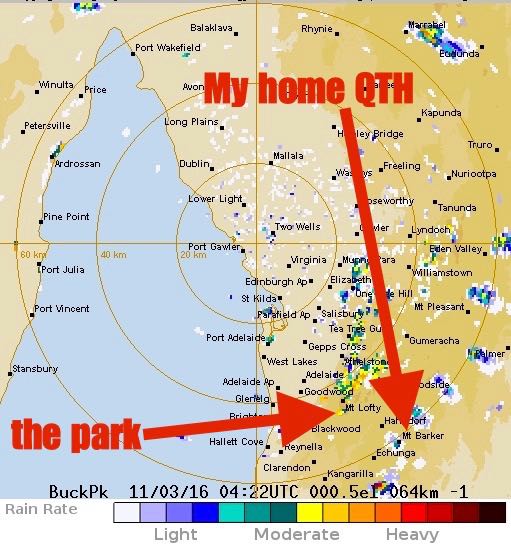 Above:- The Adelaide weather radar. Courtesy of http://www.bom.gov.au
I took a punt and packed the 4WD and headed west along the South Eastern Freeway. To my surprise the weather was clearing the further west I got. But as I looked back in the rear vision mirror, it was certainly very very black.
The Mark Oliphant Conservation Park is located about 22 km west of my home QTH and about 22 km south east of Adelaide. I have activated it a number of times previously and have well and truly qualified the park for both the VK5 Parks Award and the World Wide Flora Fauna (WWFF) program.
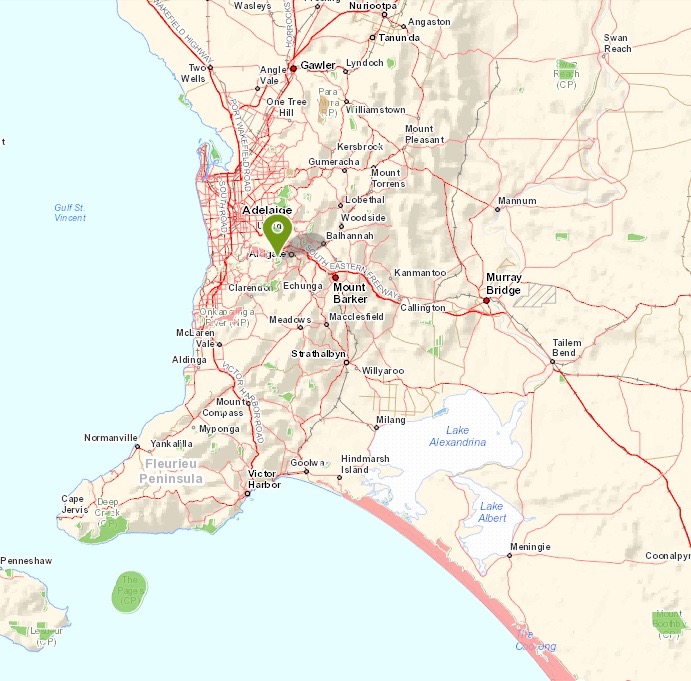
Above:- The location of the Mark Oliphant Conservation Park in the Adelaide Hills. Image courtesy of Location SA Map Viewer.
Mark Oliphant Conservation Park was first used for recreation in the 1930’s and in 1945 the park was purchased by the YMCA. In 1953 the park was acquired by the South Australian State Government, and 19 years later in 1972, the park was proclaimed as the Loftia Recreation Park. In 1996, the park was proclaimed as the Mark Oliphant Conservation Park in recognition of its conservation values and to honour physicist and humanitarian Sir Mark Oliphant’s contribution to conservation.
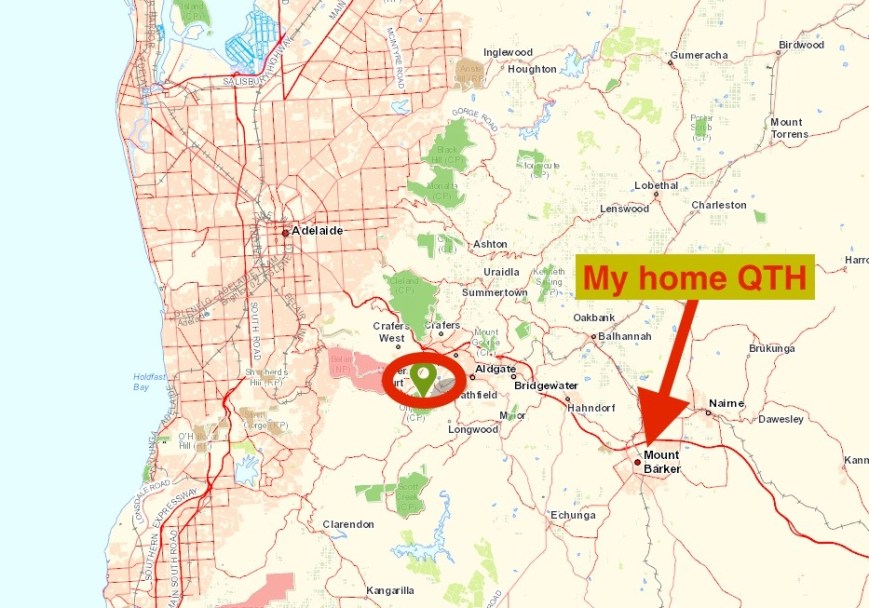
Above:- Map showing the location of the Mark Oliphant Conservation Park in the Adelaide Hills, to the west of my home QTH. Image courtesy of Location SA Map Viewer.
Sir Marcus ‘Mark’ Laurence Elwin Oliphant, AC, KBE, FRS, FAA, was born on 8th October 1901 at Kent Town in South Australia. Sir Mark Oliphant was an Australian physicist and humanitarian who played an important role in the first experimental demonstration of nuclear fusion and also the development of nuclear weapons.
For more information on Sir Mark Oliphant, please see…….
https://en.wikipedia.org/wiki/Mark_Oliphant
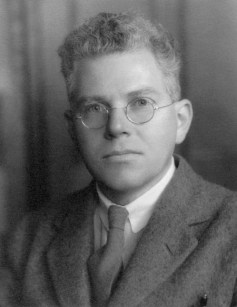
Above:- Sir Mark Oliphant. Courtesy of wikipedia.
Messmate stringy bark and brown stringy bark dominate the forest canopy in the Mark Elephant Conservation Park. A small stand of Candlebark gums can be located near the oval. This type of tall eucalyptus with white bark is rare and is only located in the higher rainfall areas of the Mount Lofty Ranges. Small patches of Pink Gum, Manna Gum and Blue Gum can also be found in the park. The forest understory contains many spring-flowering shrubs, including Myrtle-leaved Wattle, Beaked Hakea and Large-leaved Bush Pea.
A number of native animals call the park home. This includes the rare Southern Brown Bandicoot and Yellow Footed Antechinus. Several lizard, snake and for species also inhabit the park, however most of these are rarely seen. The park is alive with bird life including the Superb Fairy-wren, Scarlet Robin, Golden Whistler, and Adelaide Rosella.
A major fire burnt through the park in January 1995. Sadly, this park was deliberately lit, and I was one of the police investigators that was involved in the investigation into the arson and the subsequent arrest of the offender.
I turned right onto Evans Drive from Scott Creek Road and commenced travelling through the park, which is on either side of Evans Drive.
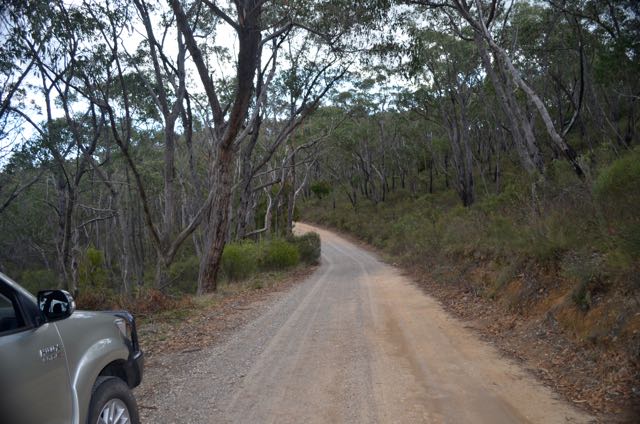
Above:- Evans Drive, with the park on either side of the road.
There are some nice views from Evans Drive out to the south towards Ironbank and Scott Creek.


As you drive further along Evans Drive, the terrain starts to drop away on the southern side of the road, into some deep gorges. This is where a lot of ferns can be located due to the cooler conditions underneath the tree canopy.


I drove a short distance along Evans Drive and stopped at gate 22. There is a small parking area here off the road. I set up just off the HoneyEater Track which is located in the north eastern corner of the park.
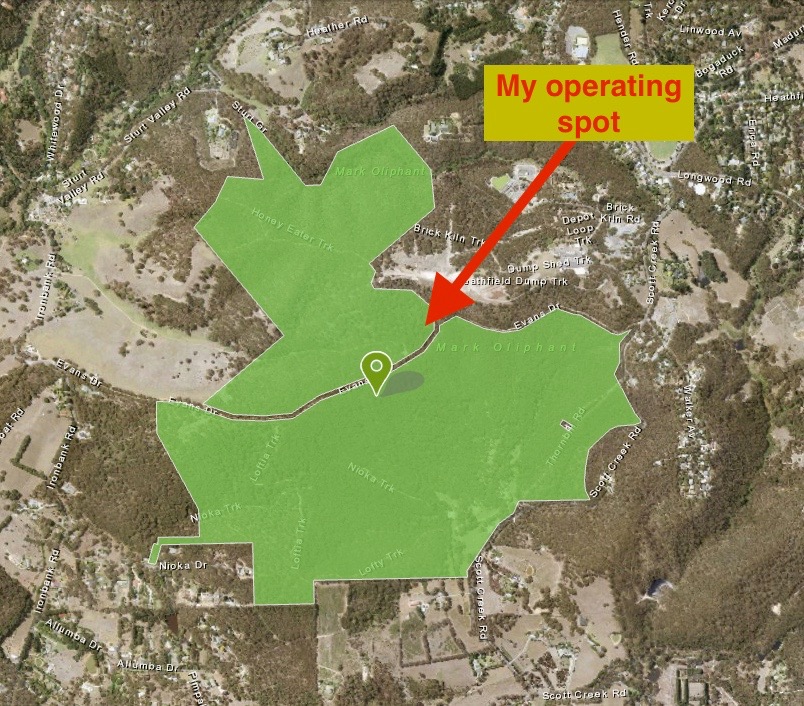
Above:- Map showing my operating spot in the north eastern area of the Mark Oliphant Conservation Park. Image courtesy of Location SA Map Viewer.
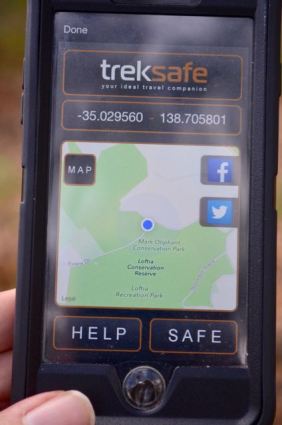
I use an app called ‘treksafe’ on my iphone to notify my wife when I’m safe in a park or on a summit. So I sent the obligatory message to Marija to let her know my location.
https://itunes.apple.com/au/app/treksafe/id633922440?mt=8
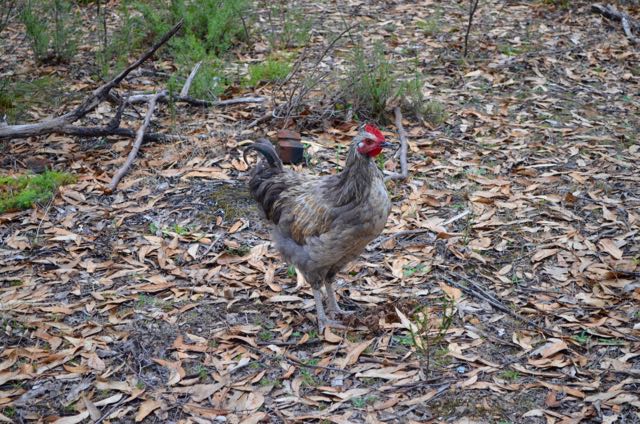
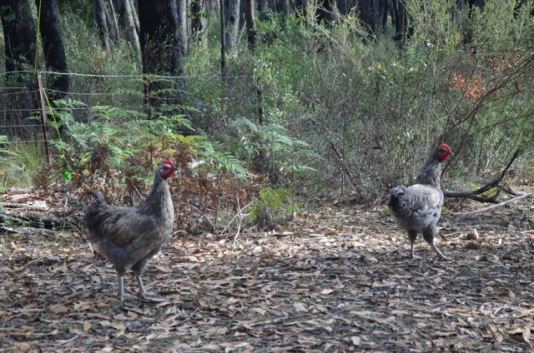
For this activation I ran my normal park set up, consisting of the Yaesu FT85As I was setting up my deck chair and fold up table I heard a noise which sounded like a chicken. Surely not? A chicken in the park. But I couldnt see anything, so I continued to set up and then heard the noise again. This time, the chicken made its appearance out of the scrub. Needless to say I was very surprised.
I was set up and ready to go by around 0600 UTC (4.30 p.m. South Australian local time). I headed for my nominated operating frequency of 7.144, however there was a VK6 calling CQ DX on the frequency. The 40m band was very very busy and it was quite difficult to find a clear frequency. As I tuned down the band I found Rob VK2QR/p on SOTA peak Mount Hudson VK2/ SM-021 (in the Kosciuszko National Park) calling CQ on 7.100. I gave Rob a shout, who was an excellent 5/9 signal into the park and Rob reciprocated with a 5/9 for me. Rob also kindly handed the frequency over to me.
I then called CQ and this was responded to by a mini pile up. First taker was Peter VK3TKK who was mobile (5/9 both ways), followed by Matt VK1MA, Peter VK3PF, and then Les VK5KLV. All with 5/9 signals. The 40m band appeared to be in good condition. I worked a further 15 stations in VK2, VK3, VK4, and VK5, before I was called by another SOTA activator. This time it was Josh VK2JOS who was on SOTA peak RichardsonVK2/ HU-074, which is located north of Newcastle in New South Wales.


Nine QSOs later, Rob VK2QR called me again, from a different SOTA peak. This time Rob was on Far Bald Mountain, VK2/ SM-023. Callers had started to slow down for me, so I thought it was only fair to return the favour for Rob, and hand the frequency over to him. I was in the process of doing so, when John VK5BJE called in and asked me to head to 2m. John had headed out that afternoon to the nearby Scott Creek Conservation Park and we had spoken about a possible 2m park to park contact.
So I went back to the 4WD and I headed to 146.500 on my Yaesu VX-6R handheld. I spoke with John who was a cracking signal from nearby Scott Creek. Unfortunately John had already returned home.
After chatting with John for a few minutes, I headed back to 40m hoping to hear some of the other VK5 Park activators who had headed out for the Friday VK5 Parks event. It didn’t take long before I found Peter VK5PET on 7.105 in the Scott Conservation Park, 5CP-206 and VKFF-0934, on the Fleurieu Peninsula, south of Adelaide. Peter had a good strong 5/8 signal and it was nice to get my first park to park contact in the log.
By this stage, one chicken had become two.
I then headed to 14.310 on 20m and self spotted myself on parksnpeaks. Typical of what often happens for me on 20m, my first taker was Rick VK4RF/VK4HA who was an excellent 5/9 signal from Queensland. Following my QSO with Rick, Luk ON4BB called in, followed by Norbert DK7TZ. I worked a further 16 stations from Europe, but conditions were less than ideal. Countries worked were Belgium, Germany, Spain, Russia, France, Italy, and Slovenia. And amongst the European callers, I was called by Marcus VK3TST/5 who was portable in the Port Gawler Conservation Park. Marcus was very low down, but we successfully exchanged signal reports (3/3 sent and 5/1 received).
Sadly the callers from Europe tapered off very quickly, so I took the opportunity of tuning across the 20m band, and found Jim E51JD calling CQ on 14.250 from the South Cook Islands. Jim was coming through nicely with a 5/7 signal and gave me a 5/1. At the end of my QSO with Jim, Jonathan VK6JON mobile called in. I arranged to QSY down to catch up with Jonathan.


So I headed down to 14.245 and had a good chat with Jonathan, and this was followed by Neil ZL2UN. Coincidentally, Neil’s brother Guy, runs a coffee shop in Aldgate in the Adelaide Hills. Next up was Bob VK6CG who portable at Margaret River in south western Western Australia, running 10 watts from his Elecraft KX3, and an end fed wire antenna modelled around an antenna from the February edition of Radcom magazine.
At the end of my chat with Bob, I headed back to 40m. There was a group of ZL’s on 7.143 so I headed up to 7.148 and started calling CQ. This was answered by Bob VK6CG portable, followed by Jonathan VK6JON mobile, both of whom had followed me down from 20m. Despite being very readable, their signals were down a little from 20m. I worked a further 10 stations, including Roscoe VK3KRH who was extremely strong with his 40m beam.
The SOTA Goat app on my mobile phone started bleated. It was a few European SOTA activators being spotted on 20m. So I lowered the squid pole and removed the links and headed for 20m hoping to get them in the log. Unfortunately I was unable to hear SQ9MOF/p in Poland on 14.288, as their was a very strong VK2 on 14.290 totally wiping him out. And ON7DQ had already QSYd to 40m.
So I took down the 20m/40m linked dipole and put up my 15m dipole and started calling CQ on 21.244. Sadly there were no takers, so I again self spotted on parksnpeaks and then commenced calling CQ again. But still no takers. I tuned across the 15m band and the only station I could hear was Emil 9A9A in Croatia, who was working a Japanese pile up on 21.277.
It was time for a walk through the park. There was a track leading up to a high point in the park, directly in front of where I was operating from, so I decided to head up there for some views across the park.


This track actually leads up to the Heathfield rubbish dump, which is on the north eastern side of the park. From the top of the ridgeline there are some great views out to the west and the south west.


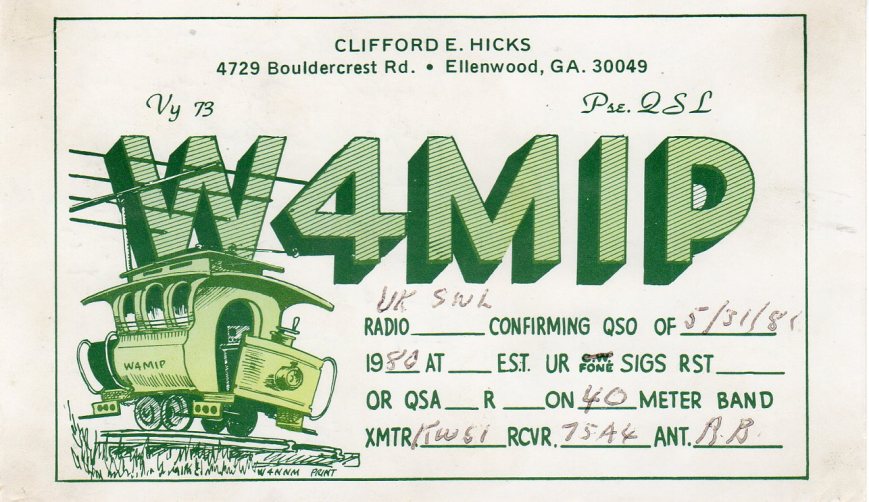
After getting back down from the track, I headed back to 40m where I found Kevin VK3CKL and Roscoe VK3KRH on 7.140 talking to Joe W5JI and a handful of other stations from the USA. Joe W5JI was previously K5THB many many years ago, and I have very good memories of listening as an SWL, to Joe some 35 plus years ago when I was a teenager. Joe was a regular on 40m talking with W4MIP and W2GO and other USA stations. So I decided to try my luck and see if Joe was able to hear me. Sadly, Joe was struggling with 5/9 plus 10 static crashes and we couldn’t make it. BUT, Roscoe was kind enough to tape one of my overs and play it back to Joe, who was blown away when I mentioned my SWL experiences all those years ago. Sadly, Joe relayed the story of W2GO, electrocuting himself when he was in his 80’s.
It was not just after 8.00 p.m. local time I prior to heading to the 7.130 DX Net I had a quick look around the band. I found TX7EU from Marquesas Islands, on 7.152 with a strong signal, working a Japanese pile up, split on 7.158. The pile up was just too intense, so I didn’t even bother trying, and I headed to the 7130 DX Net.
It was an extremely busy Net, with a huge number of checkins. So I stuck around for just one round on the Net and worked Greg NR6Q in California, and William FO5JV in French Polynesia. I the QSYd up to 7.135 where I worked 10 stations from VK2, VK3, VK4, VK5, and VK7. My last contact was with Adam VK7VAZ, and it was at this time that a JA moved in just 1 kc above us and the Over the Horizon Radar also started up.
I had one last tune across the band and heard TX7EU calling CQ on 7.152. This time he was even stronger, and the pile up had seemed to have subsided slightly. So I put the FT857D into split mode and gave him a call, and much to my surprise I got through first time. This was a new DXCC entity for me whilst portable.
The mozzies were biting hard and it was now just after 9.00 p.m. local time, so I packed up the gear and headed home with a total of 86 stations in the log.
The following stations were worked on 40m SB:-
The following stations were worked on 20m SSB:-
The following stations were worked on 2m:-
References.
Department of Environment and Natural Resources, ‘Mark Oliphant Conservation Park’
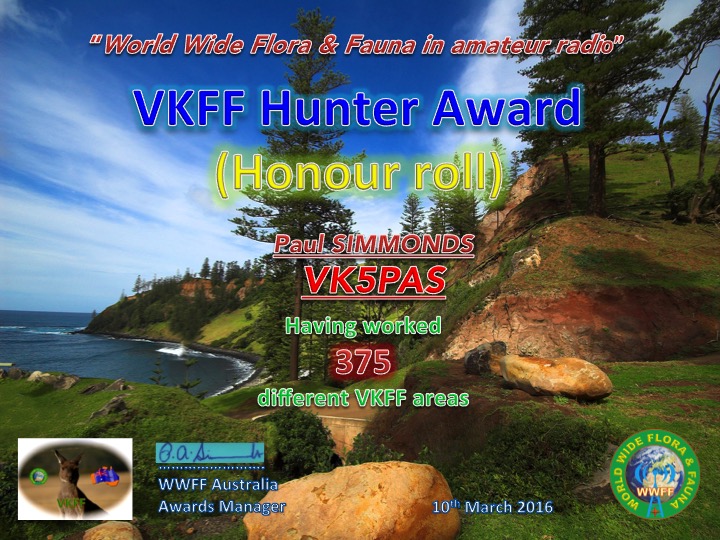
I qualified for the latest VKFF Hunter Honour Roll certificate yesterday, after getting over the line as a Hunter for working 375 different VKFF reference areas for the World Wide Flora Fauna (WWFF) program.
There is a new amateur on the bands. In fact a new amateur in our household.
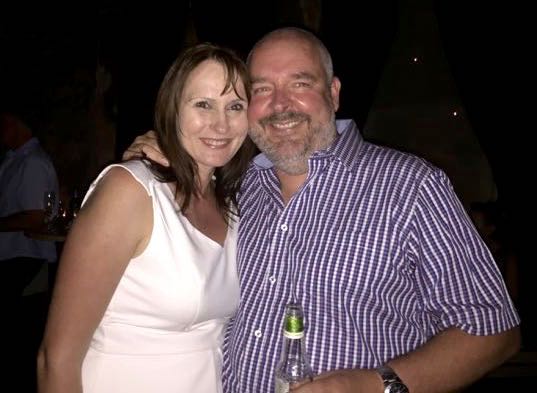
This weekend, my wife Marija undertook the Foundation licence course held by the Adelaide Hills Amateur Radio Society (AHARS). She PASSED.
So hopefully in 6 weeks time, there will be a new amateur on the bands….VK5FMAZ.
Marija has been a great supporter of my interest in the hobby over the years, and has accompanied me on many SOTA & Parks expeditions. It will be terrific to share the hobby with her and hear Marija up on air from a SOTA peak or a National or Conservation Park soon.
Well done Marija, and many thanks to AHARS and the exam/course convenors.
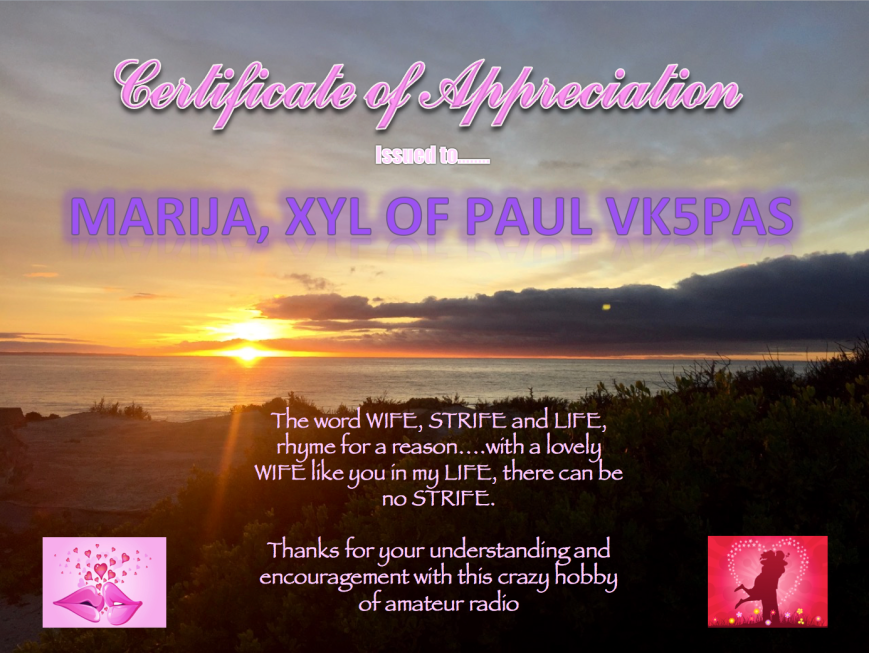
I read some ‘tongue in cheek’ comments on Facebook recently by Wendy, who is the wife of Stef VK5HSX, about a wife/partner certificate for their devotion to their partner’s crazy hobby of ham radio (particularly the SOTA & Parks activators).
I had a think about this and thought there was a lot of merit in this, and have produced the certificate below.
I know on a personal level, my wife Marija, has devoted countless hours in accompanying me to parks and summits. This has included early morning starts, late nights, long drives, making of lunches, boiling of coffee, mosquito bites, avoiding snakes, and the inevitable bumps, scratches and bruises (not to mention her missing out on the Bold and the Beautiful).
So if you’d like this certificate to present to your better half, drop me an email at……
Last Thursday night (25th February 2016) I was having a chat on 40m with 2 friends, Rob VK4FFAB and Marshall VK3MRG, when we were called by Tim VK5ML who was aeronautical mobile on his way to Sydney in a British Aerospace 146 cargo aircraft, VH-NJM.

I jumped on to Flight Radar 24 and was able to view Tim’s exact location, which was eastbound, approaching the Kanangra-Boyd National Park in New South Wales. Tim was at 17,400 feet.
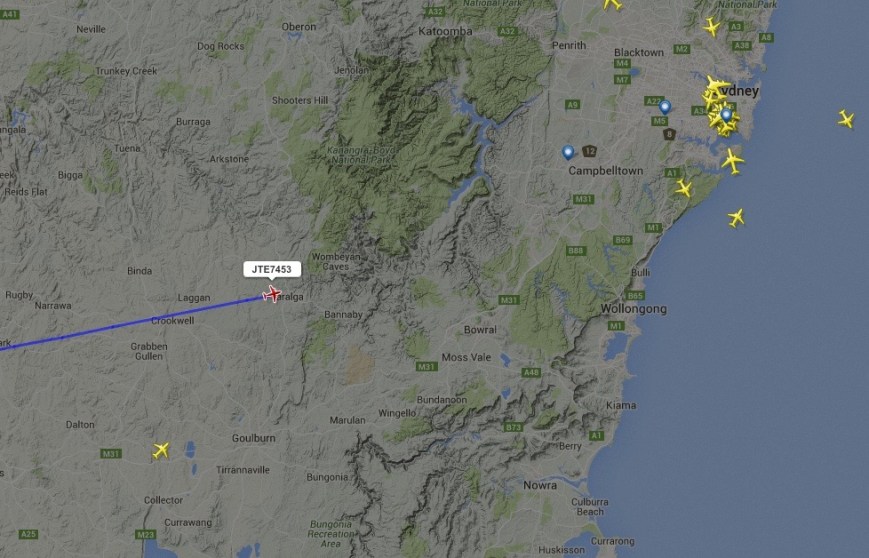
Tim had a beautiful 5/9 signal into my shack. After concluding our QSO, I continued to track Tim until he landed at Sydney Airport.
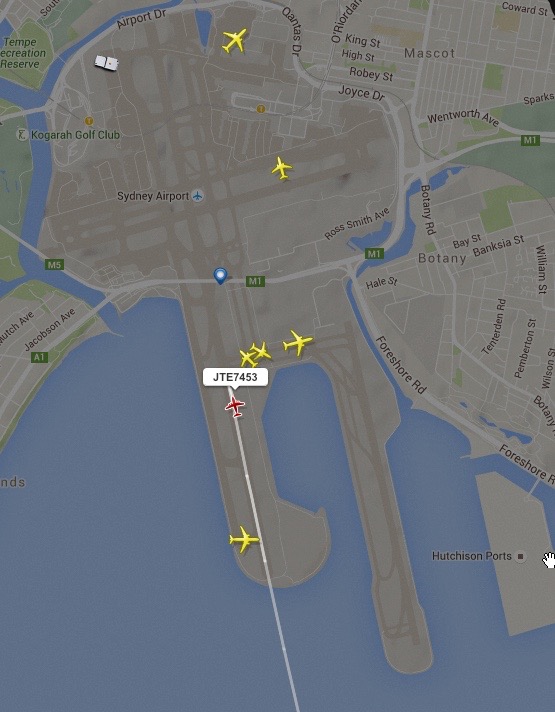
Here is some video of Tim chatting to Marshall……
Last night (Friday 26th February 2016) I activated the Kaiser Stuhl Conservation Park (CP), 5CP-097 (for the VK5 Parks Award) and VKFF-0897 (for WWFF). This was another activation for the regular Friday afternoon/evening event for the VK5 National & Conservation Parks Award.
I have activated Kaiser Stuhl CP once before. That was back in January 2014, and was with David VK5PL. But was prior to the park being added to the VKFF list for the WWFF program. So this was to be a unique park for me for VKFF. I had also arranged to meet Marcus VK3TST/5 at the park. Marcus had emailed me earlier in the day asking if he could join me.
For more information on my previous activation, check out my previous post at…..
https://vk5pas.org/2014/01/21/kaiserstuhl-conservation-park/
Kaiser Stuhl CP is about a 72 km (1 hour) drive north from home. I headed out from home via Nairne, Woodside, Charleston, and on to the historic little village of Mount Torrens. I continued on to Birdwood, the home of the National Motor Museum, and then to Mount Pleasant.
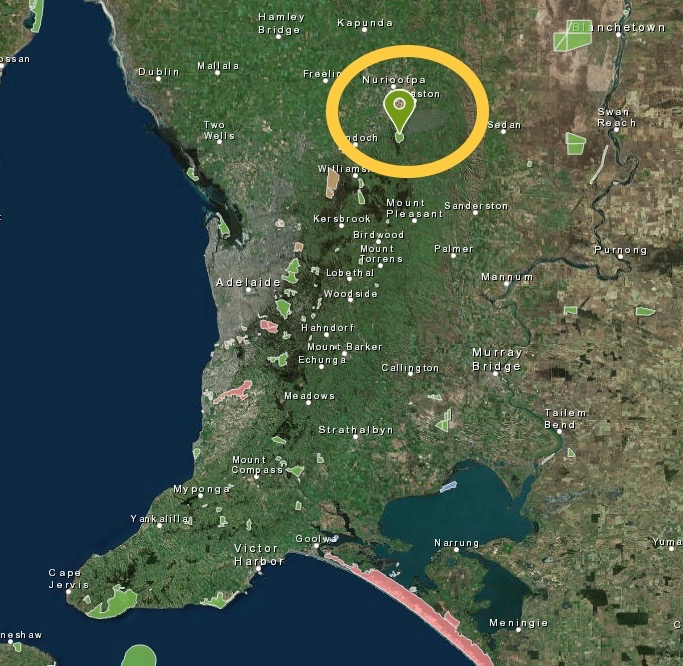
Above:- Map showing the location of the Kaiser Stuhl Conservation Park in the southern Barossa Valley. Map courtesy of Location SA Map Viewer.
After leaving Mount Pleasant I continued north to the little town of Springton. I made a small stop to take a photo of the ‘Herbig Tree’. What is the Herbig Tree I hear you ask. It is a large hollow red gum tree on the southern outskirts of the town, which was used as the home of Friedrich Herbig and his family. Friedrich migrated from The Kingdom of Prussia (now current day Germany) in 1855 and married three years later. Friedrich’s first two children were born in the tree before he built a hut nearby in 1860.


I continued on to Eden Valley, which is another historic town in the southern Barossa Valley. The town dates back to the 1950’s and contains a number of historic buildings. There is an excellent website with lots of information about Eden Valley which can be found at…..
http://www.edenvalleytourism.com.au
Whilst on my way to the park I made contact with a number of park activators including:
I continued along the Eden Valley Road and then turned left on to Seven Steps Road through the Flaxman Valley, which was devastated by a bushfire back in 2014. Over 25,000 hectares were burnt, and about five homes destroyed. This area is on the southern fringe of the Barossa Valley and is famous in its own right for wine production. One of my favourite wines is grown/produced here……Henschke Hill of Grace.
http://www.southaustralia.com/en/places-to-go/south-australia/wine-regions/eden-valley-wine-region
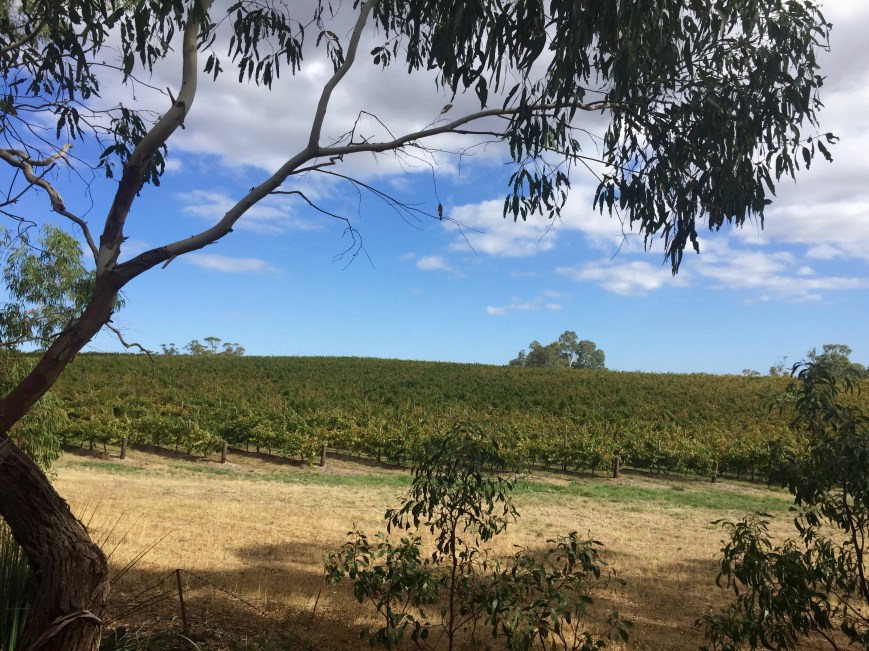
I then turned on to the Flaxmans Valley Road, and then left on to Tanunda Creek Road. The park soon came in to view on my left.
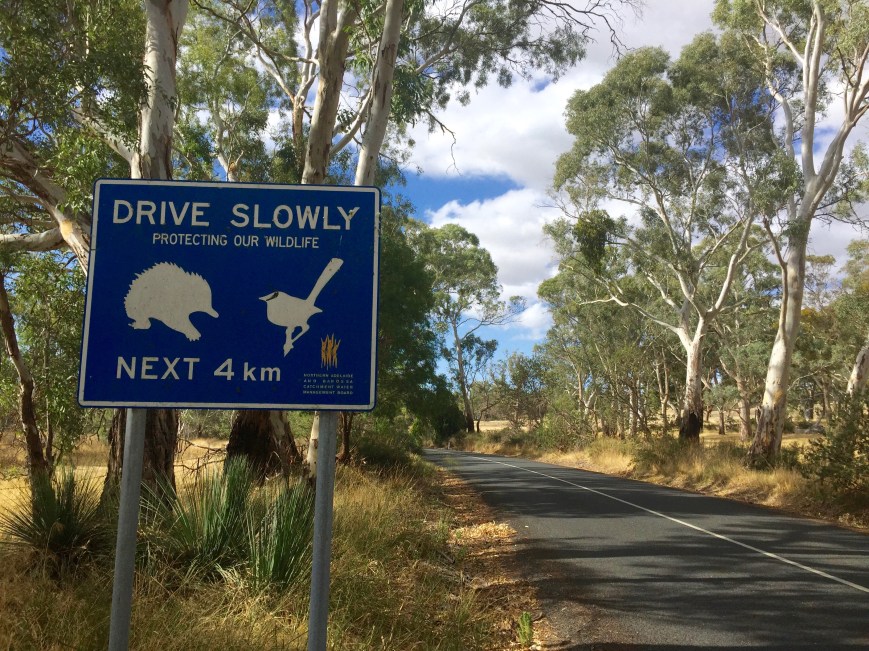
I parked the 4WD in the small area off the road and walked a short distance inside the park and started to set up my gear which consisted of the Yaesu FT-857d and the 40m/20m linked dipole supported on the 7m heavy duty squid pole. I was set up and ready to go by my nominated time of 0700 UTC (5.30 p.m. South Australian local time).
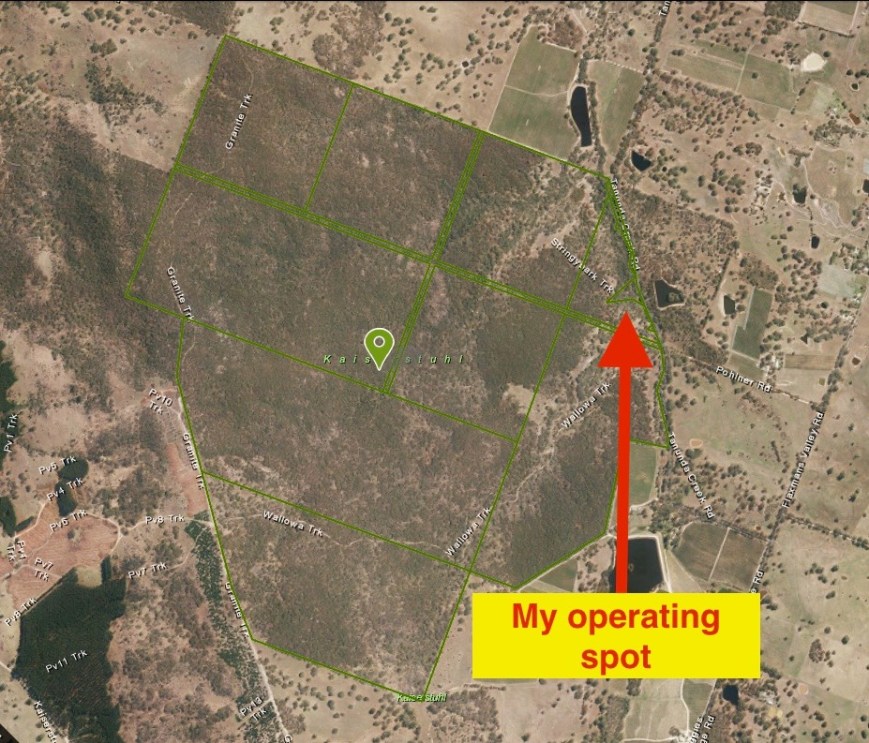
Above:- Map showing my operating spot within the park. Map courtesy of Location SA Map Viewer.
The area where the park was located was discovered in the mid 19th century by the prominent naturalists, H.H. Behr, F.J.H Von Muller, J.G.O. Tepper, and J. Menge. The Tanunda Creek Bullock Track originally crossed the creek several times within the park but was closed around 1885 in favour of the more direct route along Tanunda Creek Road. I accessed the park via Tanunda Creek Road.
A plaque within the park records the bequest to the Field Naturalists’ Society of South Australia by Mr Leo Wakem Nicholls (1894-1971). Nicholls was a keen bushwalker whose bequest to the Field Naturalists Society of S.A. enabled that organisation to contribute $30,000 towards the purchase in 1978 of the park. The official dedication ceremony took place in December, 1983.


The park includes granite features such as Horse Head Rock. Weathering and erosion have produced this rock formation which, as the name suggests, resembles a horse’s head. Capped Rock, a horizontal rock slab perched on a vertical outcrop, is another interesting feature within the park.
The park is home to native birds such as blue wrens, parrots, honeyeaters, finches and thornbills. In the late afternoon or early morning, western grey kangaroos can be seen in the open grassland areas of the park, while Euros can occasionally be seen on the rocky ridges of the higher sections of the park. Other animals to be found in the park include echidnas, possums, bats, and a variety of snakes and lizards.
About 400 plant species are supported within the park. The park was principally established to preserve the most northerly occurrence of the brown stringybark, Eucalyptus baxteri. Their multi-stemmed, mallee-like appearance is the result of earlier, regular trimming to provide wood for the Nuriootpa brick kilns.


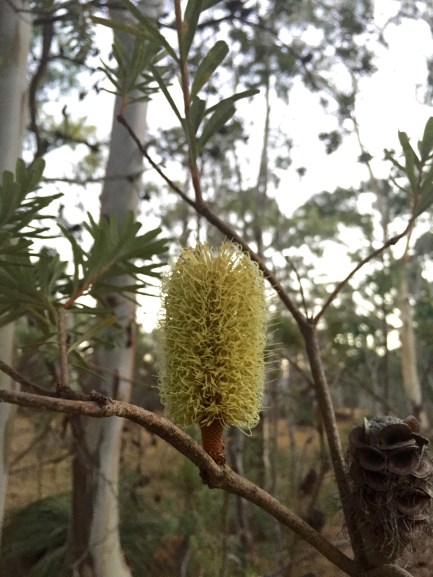
Large blue gums, river red gums, native pines and sheoaks provide shady cover for the diverse understorey of yaccas, wattles, tea-trees and silver banksias. Many of the banksias were out in flower during my visit to the park. Many plants, such as lavender grevilleas and fringe myrtles flower in spring. The green flowered hairy correa is an unusual plant that grows in the shelter of the large granite outcrops. The rare prickly tree violet also occurs in the park and is often mistaken for the African boxthorn. This native plant provides protected nesting sites for small birds.
You may see mistletoe growing on the eucalypts, acacias and casuarinas in the park. These are parasitic native plants, which provide food and shelter for many bird species. The lichens growing on the rocks are also an important part of the ecosystem helping to weather the rocks to form soil.
I headed to 7.144 and asked if the frequency was in use, and this was responded to by Stef VK5HSX/p who was portable in the Deep Creek Conservation Park. Whilst speaking with Stef I noticed that my VSWR was up a little high and Stef reported that I was cutting in and out a little. I think I found the issue…..a dodgy BNC connection. Fortunately I was able to rectify the problem.
Stef was kind enough to hand over the frequency to me, and next up was Mick VK3PMG mobile on his way to Ballarat with a good 5/8 signal. I then had three park to park contacts in a row. First was Rob VK4AAC/5 in Danggali CP, followed by Ian VK1DI/p in the Pinnacle Nature Reserve in the ACT, and then John VK5BJE/p in the Mylor CP. All had great signals to Kaiser Stuhl.
I then called for any mobile stations, and worked Greg VK5ZGY mobile in Mount Gambier, followed by Peter VK3TKK mobile in Melbourne. I then asked for any QRP (5 watts or less) stations, and Damien VK5FDEC called in with a good 5/9 signal with his 5 watts. Next up was Greg VK5GJ at Meadows in the Adelaide Hills who was running just 4 watts (5/7 signal).


A few QSOs later I worked some more mobile stations…..Daniel VK5DJW mobile in Adelaide on his way home from work (5/9 plus), and then Rob VK3FENV mobile at Sandy Creek in Victoria. I then spoke with Les VK5KLV who was operating portable from the Winninowie Conservation Park near Port Augusta. Les always has a great signal when I hear him, and this evening was no different (5/9 plus). Next up was another mobile station. This time, Tom VK5EE who was mobile at Mount Gambier in the south east of South Australia (5/9 both ways).
A slow but steady flow of callers continued to call in, with many of those being regular park hunters for both WWFF and the VK5 Parks Award. There was good representation from across Australia, with calls from VK2, VK3, VK4, VK5, and VK7. I did start to experience a little bit of QRM from some European stations on the same frequency, but as signals were so strong, there was no difficulty in copying anyone.
It was at this time that Marcus VK3TST/5 arrived at the park and I took the opportunity of having a chat to Marcus as the callers had started to slow down. I checked out Marcus’ QRP home brew double side band transceiver. Whilst Marcus and I were talking we heard the voice of Jonathan VK6JON calling CQ on 7.144. I was aware that Jonathan was going to be heading out to a park, so I quickly rushed to the mic and gave him a call. Although Jonathan’s signal was down, he was still very readable (5/1). But this didn’t last, as the European QRM picked up and Jonathan’s signal disappeared. But we had made it, exchanging signal reports.

Marcus then starting setting up, trying to get his antenna up in the air, with great difficulty. After numerous attempts, we resorted in getting out my spare squid pole from the car.
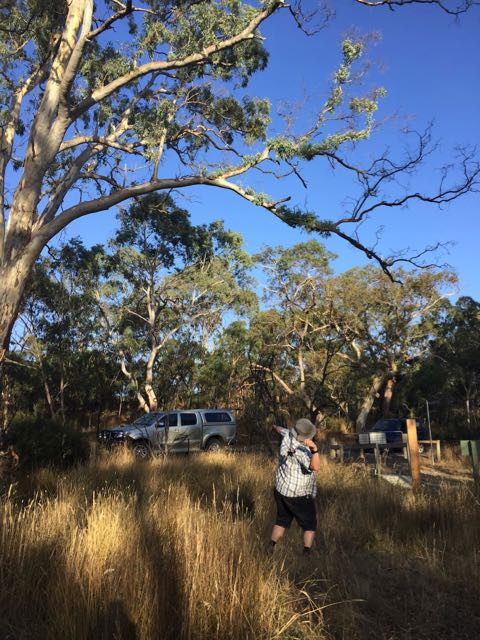
After working a total of 41 stations on 40m I lowered the squid pole and removed the links and headed to 14.310. The frequency sounded clear and I was about to ask if the frequency was in use, when I heard Rick VK4RF come back to Stef VK5HSX/p. Unfortunately I was unable to hear Stef in the Deep Creek Conservation Park. He was just too close for 20m propagation. So I headed up to 14.315 but there was a large pile up going. Not sure who it was. So I then went down to 14.300 but there was a pulsing noise on the frequency, which I suspect to be some sort of Over the Horizon Radar (OTHR). So down lower I went to 14.295 and asked if the frequency was in use.
First taker there was Jonathan VK6JON/p in the William Bay National Park, who was much stronger than he was on 40m. Marcus also spoke with Jonathan, and then continued to set up his station. Rick VK4RF/VK4HA had been patiently waiting on the side, so I worked Rick and also allowed him in to get Jonathan in the log as well. Rick was pounding in with a 5/9 plus signal
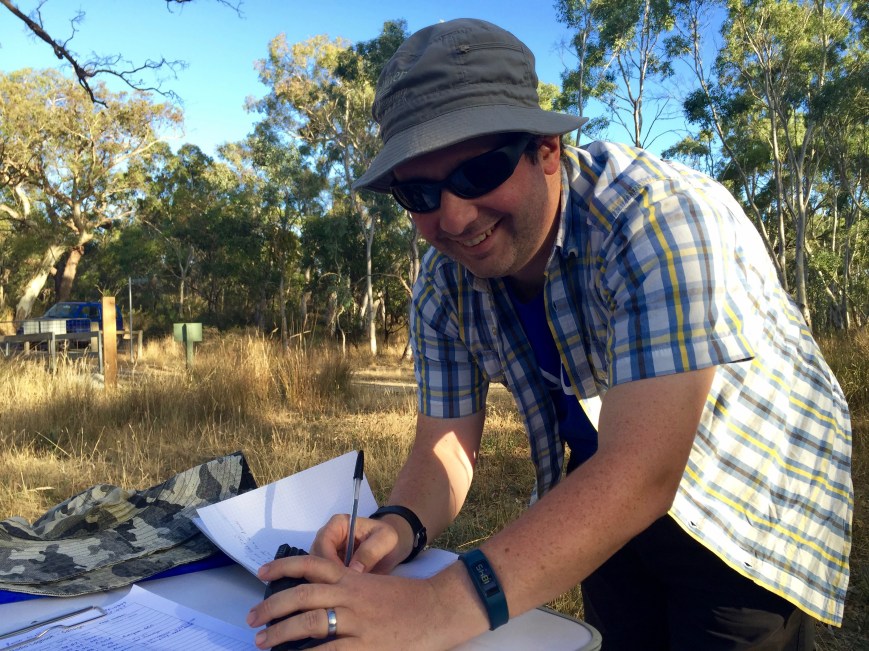
Marcus VK3TST talking to VK6JON
Rick VK4RF was kind enough to spot me on parksnpeaks and the DX Cluster, and we spoke briefly about the hope of getting some DX in the log. AFter finishing up with Rick, I then heard a very strong signal, ask “Paul, am I DX?” It was my old mate Ted VK6NTE with his normal very very strong signal from Western Australia. This was followed by a call from Greg VK8KMD from Alice Springs, who was substantially off frequency. I twirled the VFO to keep chasing Greg, who unfortunately was struggling with my signal. Ian VK6DW then called in with a beautiful 5/9 signal from Perth, and my last contact on 20m was with Ray VK4NH/6 in the shack of VK6NTE.


Despite a number of CQ calls I had no further takers and no DX. What a difference a day makes. Yesterday I worked a large pile up from home, long path into Europe. This lasted for 2 hours and I went QRT at 8.30 p.m. local time so I could have a very late tea. Admittedly that was with 100 watts and my 5 element yagi, and from Kaiser Stuhl I was running just 40 watts and a small dipole.
Marcus and I continued to chat away, and next up I tried calling CQ on 21.244 on 15m. Unfortunately I had no mobile phone coverage and was not able to spot on parksnpeaks. A quick tune across the 15m band revealed no signals.
It was not just after 8.00 p.m. and as I was unable to get a message back home to my wife that I was safe in the park, I decided to pack up.
I had a total of 48 contacts in the log for my activation of Kaiser Stuhl CP.
The following stations were worked on 40m SSB:-
The following stations were worked on 20m SSB:-
This was good timing anyway, as the 7130 DX Net had started and Marcus was tuning in to it. We decided that I would get mobile, book in to the net and let Roy Vk7ROY, the Net Control, know that Marcus was there. And this is exactly what I did.
I became mobile and booked in to the Net. Roy VK7ROY was very strong. I told Roy that Marcus was in the park and running QRP 2 watts. Roy then gave Marcus a call, and the rest is history. Marcus made a number of contacts on the net, as did I from the mobile on my way home. This included the following….
References.
‘Kaisertstuhl Conservation Park’ brochure, Department of Environment and Natural Resources.
National Parks South Australia, 2016, <http://www.environment.sa.gov.au/parks/Find_a_Park/Browse_by_region/Barossa/Kaiserstuhl_Conservation_Park>, viewed 27th February 2016
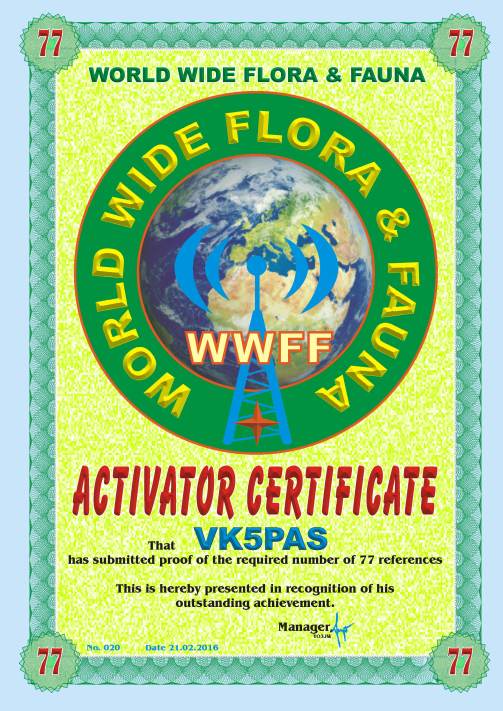
I received my latest global awards certificate for the World Wide Flora and Fauna (WWFF) program today via email.
It is issued for activating 77 unique WWFF reference areas.
Many thanks to Pit YO3JW.
As I watched the weather on Friday afternoon (19th February 2016), it was not looking very promising for my planned activation of the Black Hill Conservation Park 5CP-022 and VKFF-0778. I was hoping to get out for the 5th Friday event for the VK5 National and Conservation Parks Award. Although it was not heavy rain, it was steady drizzle up here in the Adelaide Hills.
As it got closer to time for me to leave home, I put my sandshoes on and headed outside to start loading the 4WD. But it was still drizzling, so back inside I went, feeling rather frustrated. Off came the sand shoes and onto the web I went to check out the weather radar. It looked like the activation was going to have to be cancelled. I waited a further 10 minutes, with regular trips outside to see if the weather was clearing. But sadly it wasn’t. So I decided to take a risk and headed north west to the park, with the hope that the weather was a little clearer, closer to Adelaide.
Black Hill Conservation Park is about 35 km to the north east of my home QTH, and is situated about 15 km to the north east of Adelaide.
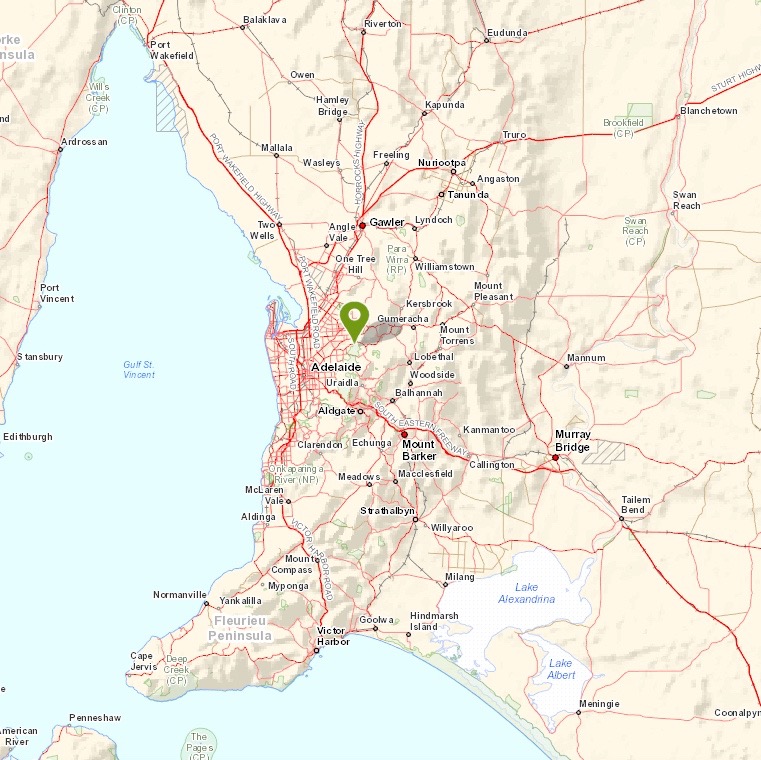
Above:- Map showing the location of the Black Hill Conservation Park in the Adelaide Hills. Image courtesy of Location SA Map Viewer.
As I travelled west along the South Eastern Freeway, it was looking less than promising. The rain was continuing to fall and the windscreen wipers were working overtime. I reachers Crafers and it was still dark and wet. I then travelled through the Piccadilly Valley and on to Summertown. Much to my surprise, as I got closer to the western fringe of the Mount Lofty Ranges ‘Adelaide Hills’ the weather started to clear. The sun was even coming out. Things were looking up.
This is a beautiful drive through the Adelaide Hills, and there are some very nice views to be enjoyed from Marble Hill Road, and Montacute Road. This is very hilly terrain, and as I drove through the area, I wondered how some of the hills here were not on the list for the Summits on the Air (SOTA) program. Clearly they do not have the required prominence, but I will have to double check on that, as many look very prominent and steep.


Above:- Views through the trees out to the west, from Marble Hill Road.
Black Hill Conservation Park covers an area of around 684 hectares and is bounded by rugged ridges on the southern side of the park. A wide variety of native plants and animals are located in the park. Bushwalkers can enjoy an extensive network of walking trails. The park features low sheoaks which give Black Hill its name. The foliage of the sheoaks gradually matures to a dark rusty, almost black colour, as summer progresses. As you look from the Adelaide Plains, the hills appear to be black in colour.
I was brought up as a boy in the north eastern suburbs of Adelaide, not far from the park. I have plenty of fond memories of climbing up onto the roof of our home, and into my cubby house in the walnut tree, which afforded great views of the surrounding area, including the Black Hill Conservation Park.
The park has a number of nearby Conservation Parks, including Montacute CP, Horsnell Gully CP, Giles CP, Cudlee Creek CP, and Morialta Conservation Park which is situated directly opposite.
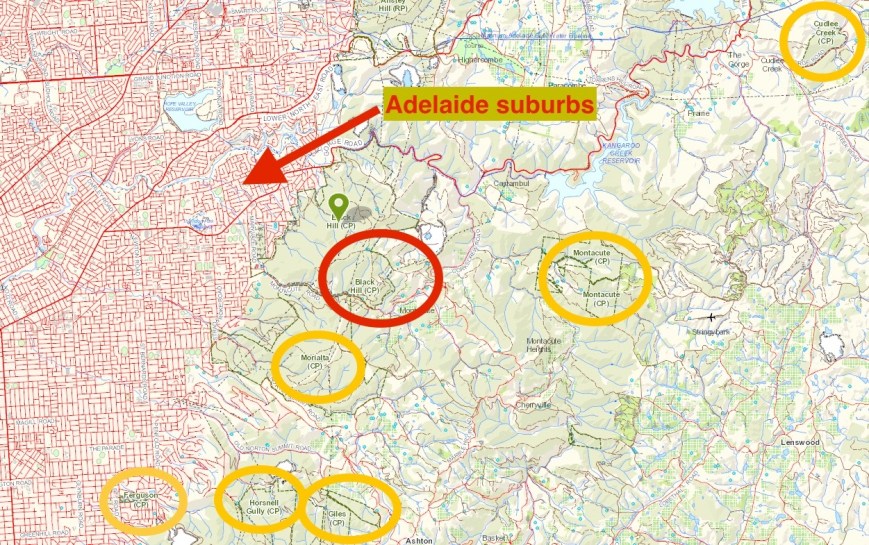
Above: Map showing the location of the Black Hill Conservation Park (marked with red circle) and various nearby Conservation Parks (marked with yellow circles). Image courtesy of Location SA Map Viewer.
Just before reaching the park I passed through the little town of Montacute. Copper was discovered in the area way back in 1834 and a mine was soon set up. Sit John Baker, one of the mine’s financiers, named the area Montacute, after Montacute in Somerset in the UK, near his birthplace. A few years later, in 1846, gold was also discovered in the area.
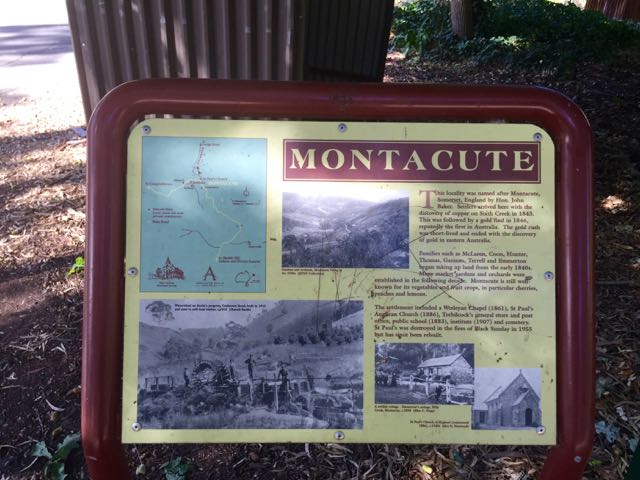
I continued west on Montacute Road, disecting the Black Hill Conservation Park on my right (to the north), and Morialta Conservation Park to my left (to the south). I soon reached the park, which is well signposted.


There is a gate on the northern side of Montacute Road, but unfortunately it is the stock standard locked gate by the Department of Water and Natural Resources (DEWNR). There is a parking area on the other side of the gate, which cannot be accessed due to the locked gate.
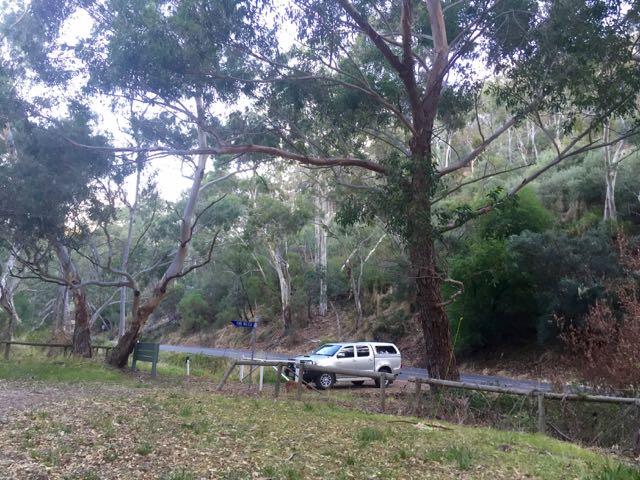
Above:- The 4WD parked at the locked gate on Montacute Road.
So your only options, are……. 1. not to stop and keep going (don’t visit the park….well at least at this point), or 2. park across the gate even though it says not to (which is what I did). There is absolutely nowhere to park on Montacute Road (way to dangerous to do so), and I figured I was going to very close to the gate anyway, so my vehicle could be moved in the event of an emergency. Not really sure why the gate is padlocked and access is prevented to the parking area, but I suspect the authorities have their own good reasons for doing so.


In any event, there is plenty of room here to stretch out an antenna. It was quite a cool afternoon, with the temperature being around 17 degrees C. But at least it wasn’t raining. There were no bushwalkers here this day, and the tranquility of the park was only broken by the occasional vehicle passing by on Montacute Road.
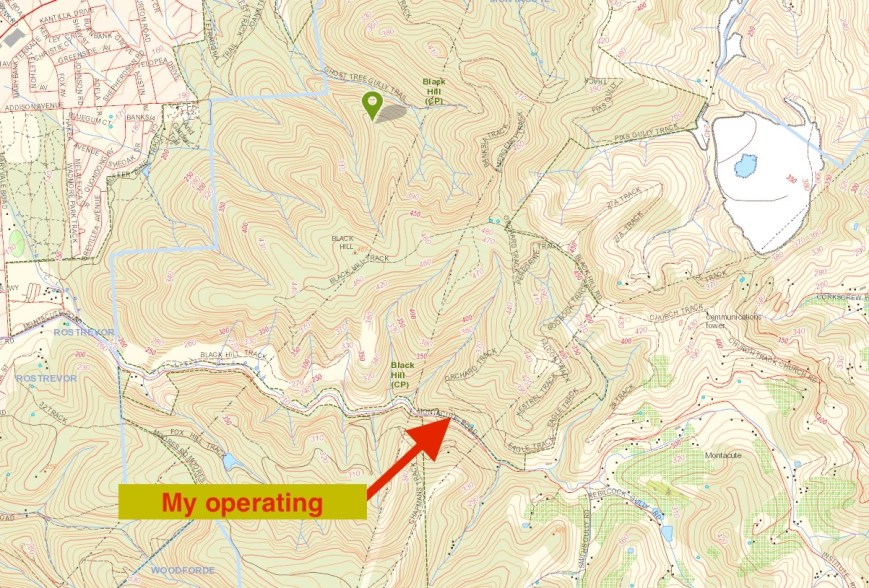
Above:- Map showing my operating spot in the Black Hill Conservation Park, just off Montacute Road. Image courtesy of Location SA Map Viewer.
This is the start of one of the walking tracks through the park, the Orchard Track. The track connects to the Eagle Track, and also the Black Hill Track, which takes you up to the Black Hill Summit, at 467 metres. Unfortunately the summit does not qualify for SOTA.
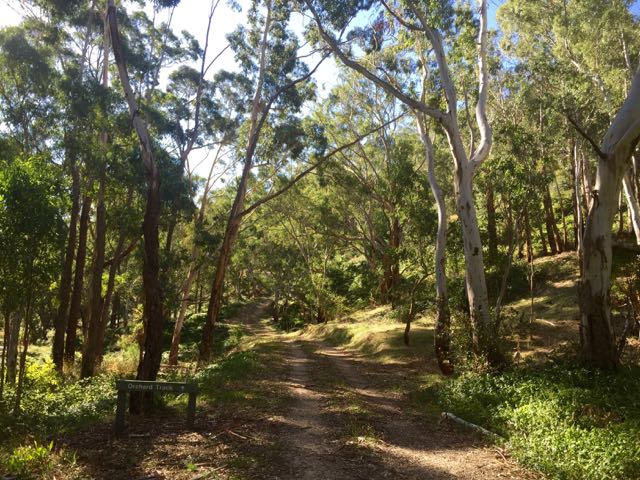
There is quite steep terrain at this location, on either side of Montacute Road, with a small creek following the roadway.
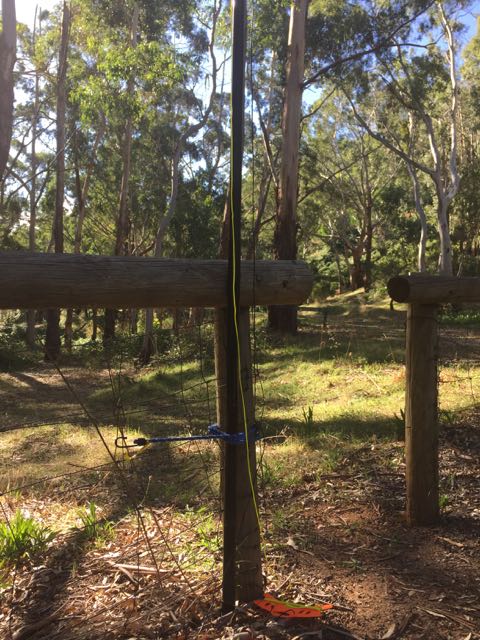
For this activation I ran the Yaesu FT-857d, 40 watts, and the 40m/20m linked dipole, which I supported on the 7 metre heavy duty squid pole. I used the permapine post and wire fence to secure the squid pole to, with the assistance of an octopus strap. I set up the fold up table and made myself comfortable in the deck chair.
I was set up and ready go, spot by my alert time of 0700 UTC (5.30 p.m. South Australian local time). I headed to 7.144, my nominated operating frequency, and asked if the frequency was in use. My query was answered by Dennis VK2HHA, who had been sitting on the frequency waiting for me to come up. Dennis was a good 5/9 signal from Albury. Next up was Mick VK3PMG in western Victoria with a very strong signal, followed by Mark VK5QI who was mobile on South Road in Adelaide. Mark was struggling at times to hear me due to power line noise.
About seven contacts into the activation, whilst speaking with Rick VK4RF, I started to experience some QRM from Mike OE6MBG in Austria, who was calling CQ DX on the frequency. I tried to get through to Mike on a handful of calls, but he was not hearing my 40 watt signal from the dipole. Mike had no takers to his CQ DX calls, and then moved off frequency.
I then worked Ian VK1DI who was operating portable in the Lower Molonglo River Corridor Nature Reserve VKFF-0990 in the ACT. Ian had a beautiful strong 5/8 signal coming in to Black Hill, and was my first Park to Park contact for the activation.
About eight contacts later I was called by Peter VK3PF/p who was near Mount Hotham in the Alpine National Park. Peter was up in the Alpine region with a number of other SOTA enthusiasts for a SOTA gathering.


A few QSOs later I spoke with Cleeve VK2MOR who was mobile in Newcastle. I was then called by Julie VK3FOWL/p, operating portable from a school in Highett in Melbourne. Julie conducts practical amateur radio sessions in a number of schools in Victoria, promoting the hobby. Unfortunately, Julie had no students in the room at the time, but we agreed that she would call back once she did.
For more information check out………
https://www.amateurradio.com.au/news/libraries-expose-amateur-radio
I then spoke with Adam VK3AGD mobile on his way to join the SOTA crew at Mount Hotham, followed by Damein VK5FDEC running just 5 watts, and then Tim VK7NSE on Flinders Island, OC-261. Soon after I was called by Mike VK6MB in Western Australia, with a good 5/6 signal (4/5 for me). I was then called by Andrew VK1AD/3, Allen VK3ARH/p, Tony VK3CAT/p, and Ron VK3AFW/p, who were all portable in the Alpine National Park for the SOTA get together.
A few QSOs later, Julie VK3FOWL/p called back in. This time she had young Aneka in the room with her. I had a chat with Aneka and explained to her where I was set up. Unfortunately the contact was spoilt a little by some European QRM and some very close by VK’s.
I worked a further 6 stations and then headed to 20m, where I commenced calling CQ on 14.310. My first taker was Rick VK4RF/VK4HA, followed by Luciano I5FLN in Italy. Luciano was not his normal booming 5/9 and was struggling to hear me. This was not a good sign of things to come. Mike VK6MB was next up. He had followed me up from 40m, and on 20m was a solid 5/9 (5/9 received as well). I worked a further seven stations on 20m which included a handful of VK3’s, Greg VK8GM in Alice Springs, and Steve G0KIK. Steve was a good 5/7 signal to me, but was really struggling with my signal in the UK (3/3 received).
I then lowered the squid pole and put up the 15m dipole, and started calling CQ on 21.244. But after 5 minutes of CQ calls, there were no takers, so I re-erected the 20m/40m linked dipole, and I returned back to 7.144. I commenced calling CQ again and this was answered by Darren VK2NNN in Bondi.
I worked just 4 more stations which included Grant ZL2GD/p who was operating portable from the Victoria Forest Park in the South Island of New Zealand. Grant was running just 25 watts into an inverted vee antenna. Unfortunately, Victoria Forest Park does not currently qualify for WWFF.
It was now just after 8.00 p.m. local time, so I headed down to the 7130 DX Net, where I worked a total of 13 stations, including William FO5JV in French Polynesia, Greg NR6Q in California, and Mike VK3XL running just 2 watts double side band (5/3 both ways).
I packed up at around 9.00 p.m. local time, with a total of 73 contacts in the log. I joined the 7130 DX Net from the mobile on the way home.
The following stations were worked on 40m SSB:-
The following stations were worked on 20m SSB:-
Amateur Radio, Short Wave Listening, travel and history
Amateur radio experiences with VK1DA
Brisbane - Australia
german amateur radio station
Summits On The Air
SOTA on the peaks, wilderness QRP and some bushwalking
A fine WordPress.com site
Amateur Radio Adventures
Summits on the Ai
Amateur radio station from Belgium
Radio craft, homebrew, QRP/SOTA, AM
Ego loqui ad viros super montes
My adventures with Amateur Radio and Geocaching!
The rantings of VK2GAZ on his SOTA experiences in Australia
A survivor, with minor cuts and abrasions.
The Art and Craft of Blogging
The latest news on WordPress.com and the WordPress community.
Blog of Justin Giles-Clark VK7TW's SOTA and amateur radio adventures.
Occasional SOTA & Microwave operation
 VK5PAS