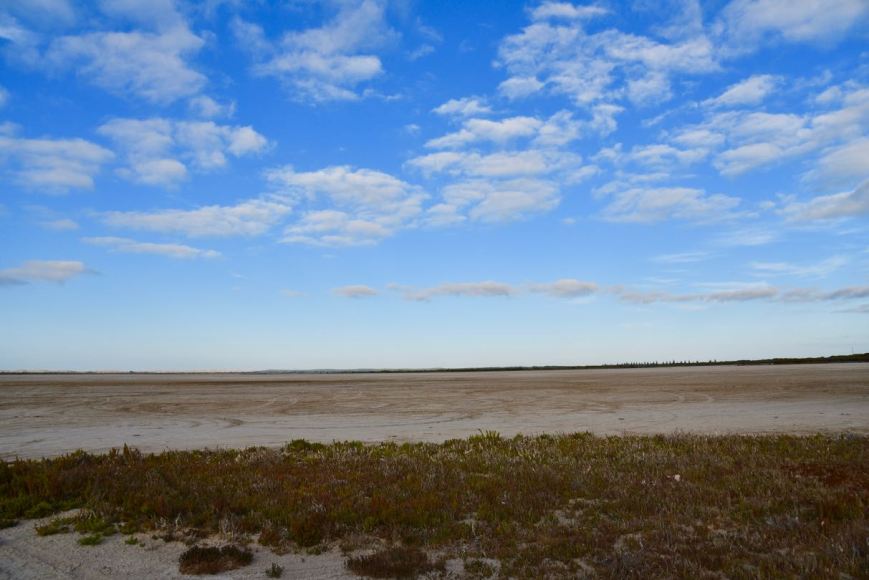
Day 16 and our final activation, the Deep Lead Nature Conservation Reserve No. 1 VKFF-2033

The final day of our trip had arrived, day 16 (Sunday 19th November 2017).  We had a 492 km drive ahead of us from Ararat in western Victoria to our home in the Adelaide Hills.

Screen Shot 2017-12-02 at 5.53.58 pm.png

Above:- Map showing the route between Ararat in western Victoria to our home in the Adelaide Hills.  Map courtesy of Plotaroute

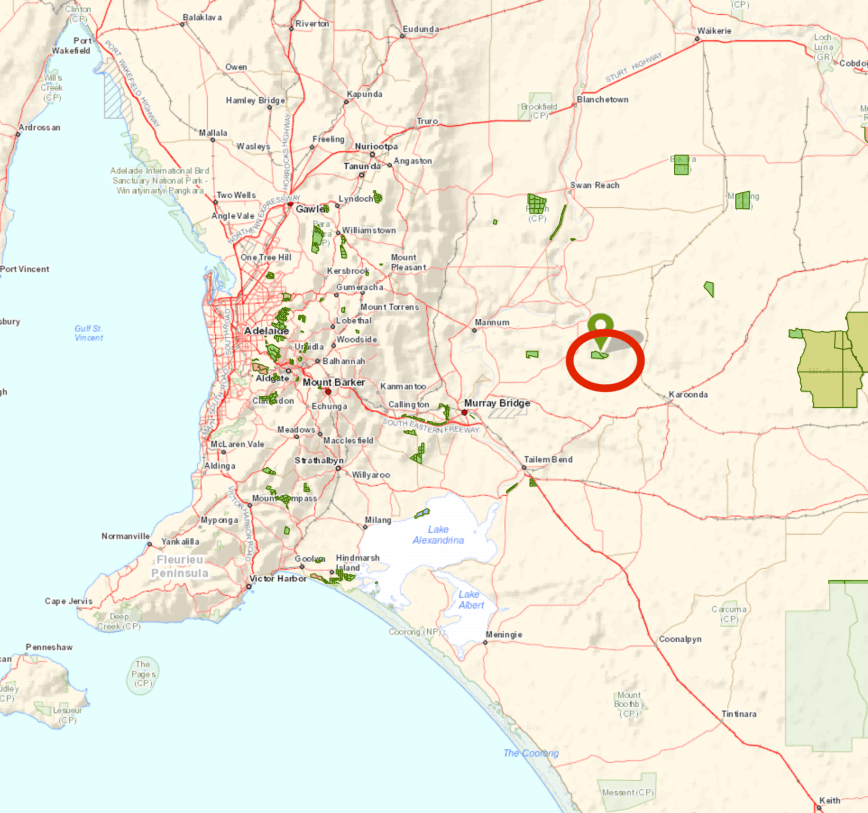
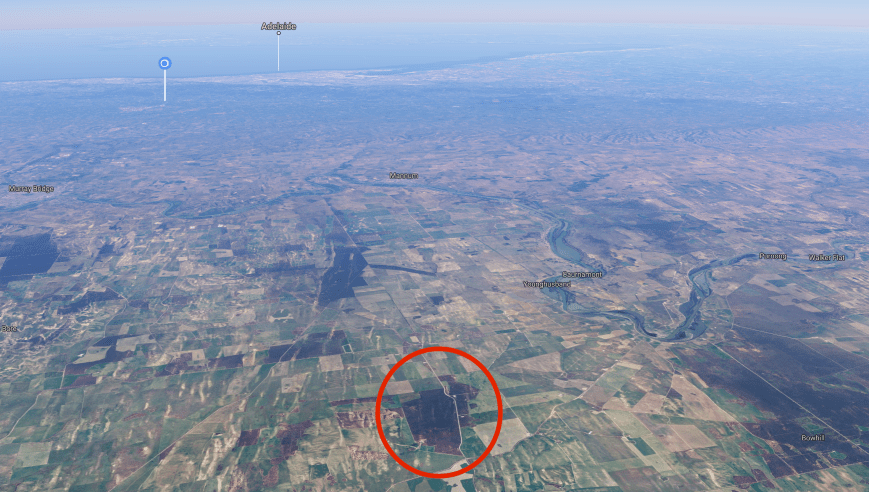
Although we didn’t have anything official down on our itinerary for this final day, we decided to activate the Deep Lead Nature Conservation Reserve No. 1 VKF-2033, which is located about 241 km north west of Melbourne, and just 5 km out of the little town of Stawell.

Screen Shot 2017-12-02 at 4.56.00 pm.png

Above:- Map showing the location of the Deep Lead Nature Conservation Reserve.  Map courtesy of google maps

We left Ararat after breakfast and headed west on the Western Highway.  We hadn’t got far out of Ararat and we encountered the scene below.  A B-Double truck had run off the road, fortunately to the left and had rolled into a ditch on the side of the road.  Luckily he had not drifted to the right and collided with an oncoming vehicle.  We waited for around 10 minutes until the police allowed us through.

DSC_1380

Marija and I then drove in to the little town of Stawell.  Whenever we are in this part of Victoria we stop off at the Stawell Bakery which has regularly won the award for the best vanilla slice in Australia.  We also were in time to have a look at the clock tower at the Town Hall.  The animated clock and bells chime every hour.

Just out of Stawell we stopped to have a look at the monument to commemorate the exploration of this part of Victoria by Major Thomas Mitchell, Surveyor-General of the Colony of N.S.W., and his party, in 1836.

A little further down the road, not far from Deep Lead is the Doctors Hill Monument.  It commemorates the establishment and erection in 1859 of the first Pleasant Creek Hospital, which served the needs of the gold miners and the rural community of western Victoria.

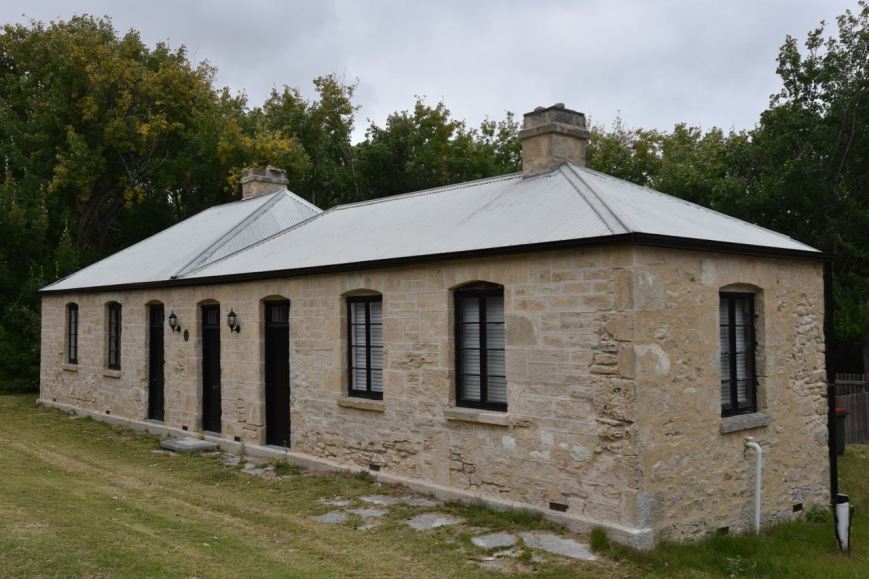
We soon reached the area of Deep Lead.  It’s not a town, but rather a geographical area.  There isn’t much here, other than a small hall, a monument

Thousands of miners and their families headed to the Stawell are following the discovery of gold in 1853.

Edward_Roper_-_Gold_diggings,_Ararat,_1854.jpg

Above:- Gold diggings at Ararat.  Courtesy of wikipedia

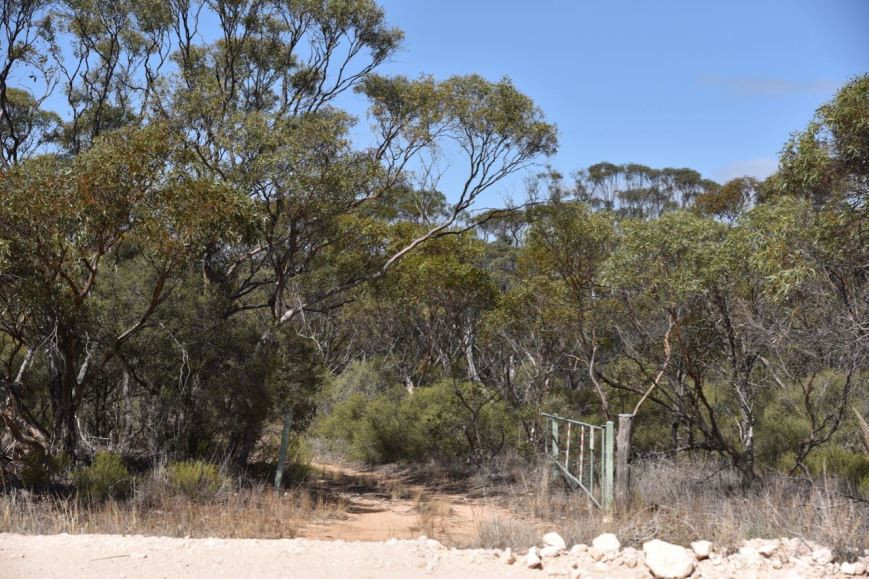
We turned down Cross Street off the Western Highway and crossed the Adelaide-Melbourne railway line and soon found the park sign.

DSC_1388

The Deep Lead Nature Conservation Reserve contains forest eucalypts which provides a habitat for a range of native birds and mammals.   The Reserve consists of two parts, number .1 and number .2 and is about 1,1823 hectares in size.

The Deep Lead Nature Conservation Reserve is the most western area of Victoria’s Box-Ironbark forest and woodland.  Once covering about 3 million hectares, today only 17% of the original forest remains.  It has been described by the Environment Conservation Council as ‘one of the most important sited for nature conservation in Victoria.   It supports at least 21 threatened species, including three plant species not found anywhere else in the world‘.  A total of 350 species of native plants has been recorded in the park.  Native flora found in the park includes Red Ironbark, Yellow Gum, Yellow Box, Longleaf Box, Red Stringybark, River Red Gum and Grey Box.  Wattles, particularly Golden Wattle, dominate the heathy shrubs, often in the company of small orchids.

A large amount of birdlife can be found in the park including Long-billed Corellas, Sulphur-crested Cockatoos, honeyeaters, parrots and lorikeets.  During winter, the endangered Swift Parrot flies in to the area from Tasmania to feed on the flowering gums.  Various native mammals call the park home including Western Grey kangaroos, Swamp wallabies, Sugar Glider, and the endangered Squirrel Glider.

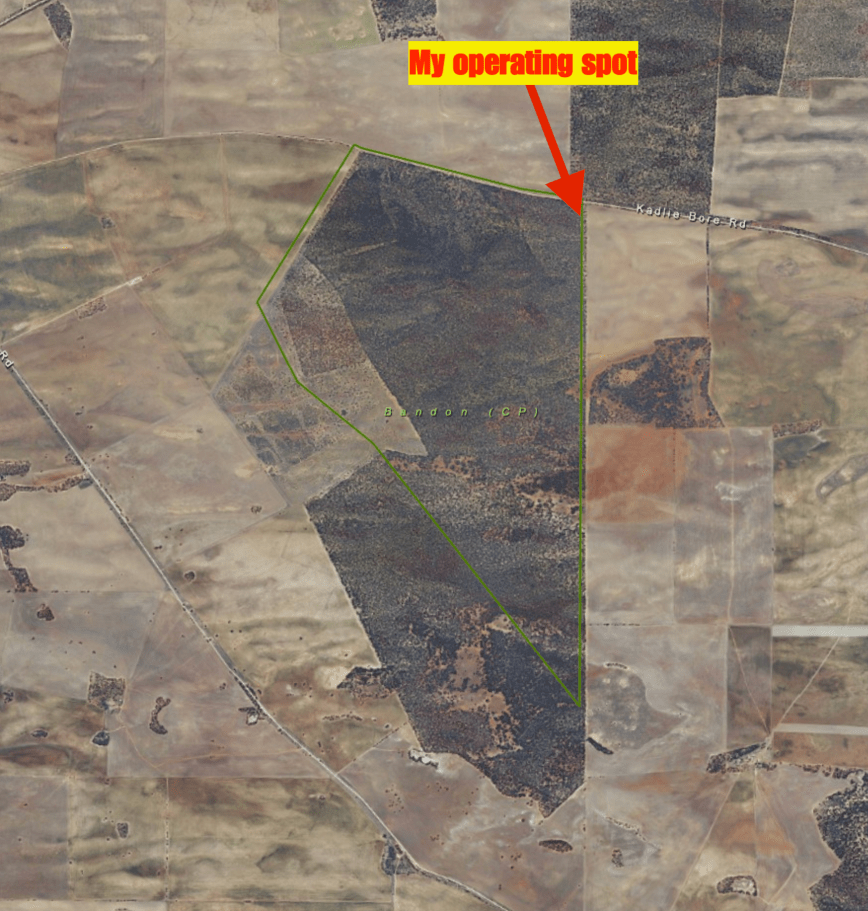
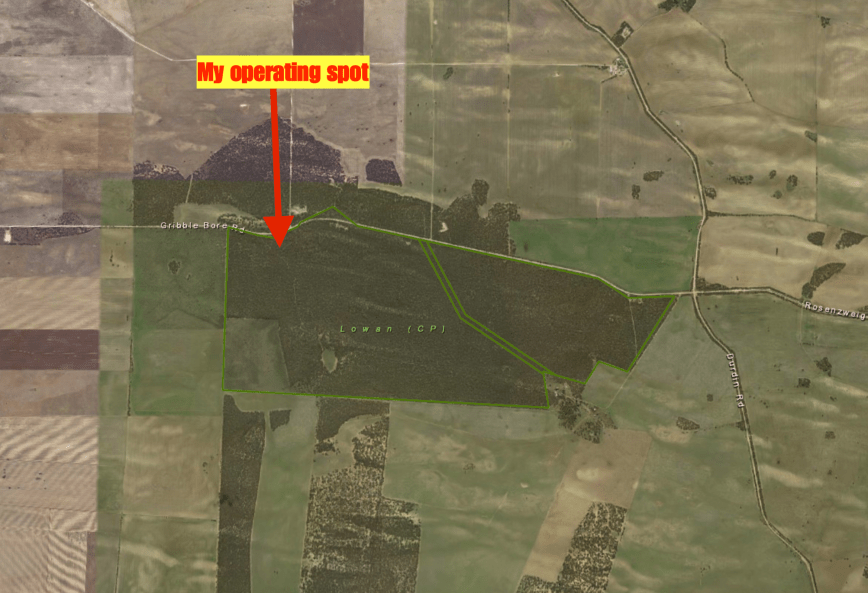
There was plenty of room here to string out the 80/40/20 m linked dipole.

Screen Shot 2017-12-02 at 7.04.44 pm.png

Above:- Aerial shot of the park showing our operating spot.  Image courtesy of google maps

Marija kicked off this activation and called CQ on 7.090.  We stayed clear of 7.144 due to the fact that it was a Sunday, and the higher portion of the 40m is always full on Sunday mornings with the Wireless Institute of Australia (WIA) broadcasts.  Marija’s first caller was John VK5BJE in the Adelaide Hills with a strong 5/9 signal.  This was followed by Les VK5KLV in Port Augusta who was also 5/9.  A few QSOs later Marija logged Al VK1RX/2 who was activating SOTA peak VK2/ ST-042.  Marija soon had 10 contacts in the log.  It only took Marija about 10 minutes, with contact number 10 being a QSO with Gerard VK2IO.

I then jumped on the mic and started calling CQ.  My first in the log was Al VK1RX/2 on his SOTA peak VK2/ ST-042, followed by Gerard BI2IO, Les VK5KLV, and then John VK5BJE.  All had strong signals.  My 10th contact came 16 minutes into the activation, that being a QSO with Rick VK4RF.  I logged a total of 38 stations on 40m including Chris VK5CP who was running QRP 1 watt.  I also spoke with Mas JA7FAS who was holidaying in South Australia, and using his Australian call of VK5FAS.

I then headed to 3.610 on the 80m band where I worked 7 stations from VK3 and VK5.  I then moved back to 40m and worked Peter VK3PF after the rollover, who told me that Marc VK3OHM was up the band working from a park.  So I went up to 7.125 where I logged Marc VK3OHM who was activating the Great Otway National Park VKFF-0405.  I then moved back to 7.090 where I logged 8 stations from VK2, VK4, VK5 and VK7, before I started to experience some interference from the VK6 WIA broadcast.

DSC_1398

During the activation I spoke with Kevin VK3VEK who lives at Stawell and we arranged on air for him to pop out to say hello.  It was great to catch up with Kevin.  We had spoken many times on air but have never met.  Other than having a good chat, I showed Kevin my portable station and he seemed keen to give parks operating a go in the near future.

DSC_1402

Above: with Kevin VK3VEK.

Marija worked the following stations on 40m SSSB:-

  1. VK5BJE
  2. VK5KLV
  3. VK4RF
  4. VK4HA
  5. VK1RX/2 (SOTA VK2/ ST-042)
  6. VK5PL
  7. VK3SQ
  8. VK5HS
  9. VK4NHH
  10. VK2IO

I worked the following stations on 40m SSB:-

  1. VK1RX/2 (SOTA VK2/ ST-042)
  2. VK2IO
  3. VK5KLV
  4. VK5BjE
  5. VK3SQ
  6. VK5HS
  7. VK7NWT
  8. VK7FOLK/m
  9. VK2HHA
  10. VK4RF
  11. VK4HA
  12. VK2PKT
  13. VK2GAZ
  14. VK2YA
  15. VK1WAT
  16. VK5CP
  17. VK2XXM
  18. VK2JNG/p
  19. VK5NJ
  20. VK5PE/m
  21. VK5FMWW
  22. VK3VEK
  23. VK5WG
  24. VK5FANA
  25. VK2NEO
  26. VK5XD
  27. VK5FAS
  28. VK2LEE
  29. VK3PF
  30. VK3UH
  31. VK5NRG
  32. VK1DI
  33. VK2YW
  34. VK4NHH
  35. VK2HJG
  36. VK3BBB
  37. VK3PF
  38. VK3KAI
  39. VK3GV
  40. VK3OHM/p (Great Otway National Park VKFF-0405)
  41. VK7KT
  42. VK4RF
  43. VK4HA
  44. VK2TCL
  45. VK5PL
  46. VK2LEE
  47. VK7MPR
  48. VK7RM

I worked the following stations on 80m SSB:-

  1. VK5HS
  2. VK3PF
  3. VK3KAI
  4. VK3GV
  5. VK3MRH
  6. VK5HS
  7. VK3PF

After leaving the park we headed towards Horsham and caught up with my Uncle and Aunty, and some of my cousins and their families.  On the way I spoke with Ron VK3MRH, Peter VK7RN, and Robert VK7VZ/2 from the mobile.

DSC_1411

After a really enjoyable few hours visiting the rellies in Horsham, we hit the road again.  On the Western Highway between Nhill and Kaniva, Marija and I spoke with Glenn VK3YY/p who was activating SOTA summit VK3/ VN-005.

Marija and I then crossed over the South Australian border and stopped briefly to have a look at the early settlers cottage just out of Keith.  The cottage dates back to 1894 and was built by the Davis family.  The cottage features natural bush timber, railway iron, sleepers and local limestone.

Our next stop to stretch the legs was the little town of Ki Ki on the Dukes Highway.  Ki Ki is aboriginal for ‘food and water’.  The town’s history dates back to the late 1800’s, but it was not proclaimed a town until 1913.  Sadly there is not much here now, of what once once a vibrant town.  The Ki Ki school closed in 1960 and the shop closed in 2003.

It was approaching dinner time, and Marija and I stopped off at the Tailem Bend Hotel, but unfortunately it was not open for another 45 minutes.  We have enjoyed a great meal here previously, so we decided to fill in the time having a look around the town.  We had a look at the ‘Tailem Bend Uneek Animals’ exhibition which was only opened on the 10th November 2017.  We also took a trip over the ferry to Jervois and back.

We returned to the pub, and as we had experienced on a prior occasion, we enjoyed another excellent meal.  Marija and I cam highly recommend the Tailem Bend Riverside Hotel.  There are some great views here as well of the mighty Murray River.

About 45 minutes later and we were home.  It was the end of a great 2 weeks away.

  • 4,500 km travelled
  • 27 parks activated
  • 6 parks activated
  • We made a total of 1,680 QSOs
  • Included 138 x Park to Park contacts and 2 x Summit to Summit contacts.


References.

Parks Victoria, ‘Deep Lead Nature Conservation Reserve Visitor Guide’.

Mount Lonarch VK3/ VS-013

Our final activation for the penultimate day of our trip was to be Mount Lonarch VK3/ VS-013, located about 207 km north east of the city of Melbourne and about 29 km north of the town Beaufort.

Screen Shot 2017-12-02 at 2.49.39 pm.png

Above:- Map showing the location of Mount Lonarch in western Victoria.  Map courtesy of google maps

Mount Lonarch is 788 metres above sea level and is worth 4 points for the Summits on the Air (SOTA) program.

Screen Shot 2017-12-02 at 2.54.00 pm.png

Above:- Aerial view showing Mount Lonarch, looking east.  Image courtesy of google maps

I have activated the summit twice before, back in 2013 and 2015.  Marija had been with me during the 2015 visit to this summit, but didn’t have her amateur licence, so this was to be a unique summit for Marija as an activator.

Screen Shot 2017-12-02 at 2.49.18 pm
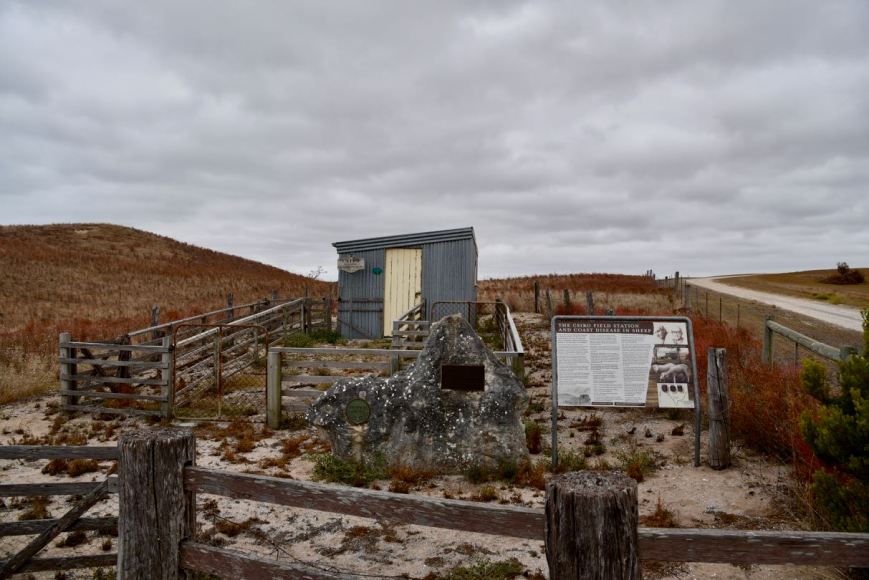
After leaving Raglan we turned on to Amphithreatre Road and on to the little town/area of Chute.  There isn’t much here.  BUT, it is the birthplace of Cyril Callister, who is the inventor of ‘vegemite’.  Amazing the places we stumble across when we are out operating portable.

DSC_1279

For anyone reading this from overseas, you are probably asking ‘what is vegemite’.  It is as Australian as a meat pie, as a Holden car, as is a surf beach and Aussie Rules Footy.  Vegemite is a thick, black good spread made from leftover brewers yeast extract with various vegetable and spice additives.  Watch the great video below when Hugh Jackman shows Jimmy Fallon how to eat vegemite.

The Mount Lonarch summit soon came into view.  Also visible to us in the near vicinity were SOTA summits, Ben Moore, Ben Major, Mount Buangor, and Mount Cole which we had just activated.

DSC_1280

The GPS then took us through the Raglan Pine plantation.  There was a bit if ducking wnd weaving along the way as there were many pine trees over the track.

DSC_1283

We enjoyed some magnificent views from the Avoca River Road.

Whilst admiring the view I spotted a paraglider.  Marija and I were to later learnt that they had launched from Mount Lonarch.

DSC_1291

We then turned on to Tower Road and followed the road up to the summit.   As we set up we noticed some vehicles parked in amongst the scrub about 100 feet away on the other side of the fire spotting tower.  At that stage we were not sure why they were there exactly, and assumed they may have been bushwalking.

Marija started off first at Mount Lonarch, calling CQ on 7.095.  This was answered by Mick VK3GGG/VK3PMG, Aaron VK1LAJ, and the Col VK3LED.  Marija had now qualified the summit which was great news.  Marija logged 15 stations including Mark VK3MDH/p and Michael VK3FCMC who were activating the French Island National Park VKFF-0622.  I also logged Mark and Michael.

Marija then handed the mic over to me and headed over to where the vehicles were parked and soon came back to let me know that there were people hangliding off the top of Mount Lonarch.

I logged a further 25 stations on 40m from VK1, VK2, VK3, VK5, and VK7.  Signals back to South Australia were very good, which I can’t say had been the case for a lot of our trip.  I worked Ian VK5CZ who was running QRP 5 watts, and he was 5/9 from the Clare Valley.  I also logged Peter VK3TKK/p in the Mount Martha Nature Conservation Reserve VKFF-2152.  Unfortunately Marija missed out on that contact as she was watching the hang gliding.

DSC_1301

I then took a break from the radio and went over to have a look myself.  One of the guys there was very friendly and explained to us some of the aspects of this exciting hobby.  We were lucky to see a couple of launches off the top of Mount Lonarch.  It was quite amazing.

This slideshow requires JavaScript.

Also in the air that afternoon were a number of Wedge-tailed Eagles.

DSC_1366.jpg

I went back to the radio and logged 4 stations on 14.310 on the 20m band, all from Queensland.  I then called CQ on 3.610 on the 80m band which was answered by Mick VK3GGG/VK3PMG who was a very strong 5/9.  I then logged Peter VK3TKK/p who was in another park, the Kangerong Nature Conservation Reserve VKFF-2122.  Peter was a beautiful strong 5/9 signal on 80m.  Whilst speaking with Peter, Marija started walking back towards me.  So I shouted out that I was working a park, which resulted in Marija running back to the radio to work Peter.

To complete the activation Marija put out a few more CQ calls on 80m, logging Allen VK3ARH and then Robert VK3KIX, whilst I took a little bit of vision of the hang gliders on my iphone.

Marija worked the following stations:-

Screen Shot 2017-12-02 at 1.24.46 pm.png

I worked the following stations:-

Screen Shot 2017-12-02 at 1.33.53 pm.png

We packed up and started our trip into the town of Ararat, stopping briefly to admire some of the magnificent views from Tower Road of the surrounding countryside.

We got back into Ararat and booked in to the motel, freshened up and headed off to a favourite restaurant of ours in Ararat, ‘Sicilians’, where we enjoyed a very nice meal and a few ales.


References.

Summits on the Air, 2017, <http://www.sota.org.uk/Summit/VK3/VS-013>, viewed 2nd December 2017

Wikipedia, 2017, <https://en.wikipedia.org/wiki/Vegemite>, viewed 2nd December 2017

Day 15, Mount Cole VK3/ VS-008
We now had just 2 days of the trip left.  It was day 15 (Saturday 18th November 2017) and we we had two planned activations for the day, both summits for the Summits on the Air (SOTA) program.  We had a 205 km journey ahead of us to our next stop for one night, the town of Ararat.

Screen Shot 2017-12-02 at 2.02.04 pm.png

Above:0 Our journey for day 15, Melbourne to Ararat.  Map courtesy of plotaroute.

After breakfast at Jacqui and Des’ s house in Melbourne we hit the road at about 10.00 a.m. Victorian local time.  We headed out of Melbourne on the Western Highway and to Rockbank where we had arranged to meet Peter VK3TKK at a local servo/McDonalds outlet.  It was great to catch up with Peter and we spent about half an hour chatting and sharing a few laughs.

DSC_1249

Above:- with Peter VK3TKK.

Marija and I then hit the road and continued our journey west on the Western Highway towards our first activation of the day, Mount Cole VK3/ VS-008. which is located in western Victoria, about 179 km west of Melbourne and about 19 km north west of Beaufort.

Screen Shot 2017-12-02 at 1.49.19 pm.png

Above:- Map showing the location of Mount Cole in western Victoria.  Map courtesy of google maps

Mount Cole is 886 metres above sea level and is worth 4 SOTA points.  It had been activated seven times previously, most recently by Allen VK3ARH.  Mount Cole was created about 390 million years ago when hot magma pushing up from deep beneath the earth, but failing to break though, crystallised to form granite rock.  Mount Cole is known as ‘Bereep-bereep’ in the local Beeripmo balug aboriginal language meaning ‘wild’.

Screen Shot 2017-12-02 at 1.50.25 pm.png

Above:- Aerial shot of Mount Cole, VK3/ VS-008.  Image courtesy of google maps

Explorer, Major Mitchell was the first European to explore the area during his 1836 expedition.  Settlers soon moved in to the area with timber harvesting commencing during the mid 1840’s by using axe and cross cut saw.  The use of steam powered mills commenced in 1856.  By 1889, demand from the goldfield towns for building materials, firewood and railway sleepers led to thirty mills operating within the region until 1904. In 1918 the Forests Commission was established and it was soon after that the Mount Cole State Forest was closed for timber harvesting.   In 1947 timber harvesting was reopened by the Forests Commission.  In the 2000’s timber harvesting was significantly scaled back and is largely a by-product of land management activities.

DSC_1265.jpg

Large native trees including Messmate, Manna Gum, and Blue Gums can be seen on the wetter southern half, while woodland species such as Yellow box and Red Stringybark grow to the north.  Plants such as the rare Mt Cole Grevillea can be found in a few locations, as can native orchids and a plethora of wild flowers.

More than 130 species of birds can be found in the Mount Cole State Forest.  Native animals include kangaroos, wallabies, echidna, koalas and possums.

Marija and I headed out of Beaufort on the Main Lead Road, then the Raglan-Elmhurst Road, and then Mount Cole Road.  The summit soon came into view.

DSC_1251

Above:- View of Mount Cole.

We had to pull right off the road at one stage as an oversize truck was coming in the opposite direction, loaded with a very large excavator.

DSC_1252

We soon entered the Mount Cole State Forest, and started making our way up towards the summit.

We turned on to Frees Point Road and then the Mount Cole Track.  The track here was very steep and very rocky.  At one stage Marija got out of the Toyota Hi Lux and did a reccy to make sure we could get up the track.  Our big concern was that if we struck any difficulties there would be no room to turn the vehicle around.  Anyway, much to Marija’s horror I suspect, we continued up the track, very slowly, in low 4WD in the HiLux.

We soon made it to the top and the GPS told us we were within metres of the actual summit point.  There weren’t many options here to set up as the scrub is so thick.  So we decided to set up on the track itself, as we didn’t expect too many visitors on the summit.  In any event we would be able to hear them coming.

Screen Shot 2017-12-02 at 2.26.34 pm.png

Above:- Aerial shot of the summit showing our operating spot.  Image courtesy of google maps

Once again Marija and I shared the mic for this activation, and left the power output at 10 watts PEP, as it was just too hard going in and out of the menu.  We called CQ on 7.095 and this was answered by Geoff VK3SQ with a strong 5/9 signal, followed by Peter VK3PF, Tony VK3CAT who also used the club call sign of VK3APC.  We had qualified the summit.

Marija then decided that she would take a break for a while and explore the summit. I took charge of the mic and logged a further 21 stations on 40m from VK3, VK4, VK5 and VK7.  This included two park activators, Michael VK3FCMC/p and Mark VK3MDH/p who were activating the French Island National Park VKFF-0622.  Marija also logged Michael and Mark.  I had a number of VK5 stations calling, but my apologies, signals from South Australia were so low, that I had real difficulty picking out the calls.  The only VK5’s logged were Ian VK5IS in the Mid North, and David VK5PL in the Barossa Valley.

I then moved down to the 80m band and called CQ on 3.610.  This was answered by Mick VK3GGG who was a strong 5/9, followed by Geoff VK3SQ.  And to finish off the activation I called CQ on 14.310 on the 20m band where I logged 4 stations from VK2 and VK7.

Marija worked the following stations:-

Screen Shot 2017-12-02 at 1.16.56 pm.png

I worked the following stations:-

Screen Shot 2017-12-02 at 1.09.22 pm.png

Marija and I packed up and headed back down the bumpy and rocky track.  Based on info from Nick VK3ANL, we did not do the loop, as apparently the other side is even worse.  So we did a 7 point turn and went back down the way we came up

We headed off towards our next activation, Mount Lonarch, enjoying the view as we headed down off Mount Cole.

We stopped off briefly to have a look at the old Raglan school building, which is now a private residence.


References.

State of Victoria, Department of Sustainability and Environment, 2012, ‘Forest Notes, Mount Cole State Forest’.

Summits on the Air, 2017, <http://www.sota.org.uk/Summit/VK3/VS-008>, viewed 2nd December 2017

An impromptu, quick activation of the Churchill National Park VKFF-0621

We left Moe by mid afternoon and still had a bit of time on our side.  We were to stay in Melbourne that night with some very good friends of ours Jacqui and Des at Kensington, but they were not going to be home from work until around 5.00 p.m. Victorian local time.  So we travelled towards Melbourne along the Princes Highway and decided to duck in to the Churchill National Park VKFF-0621 for an impromptu, quick activation.  This was to be another new park for Marija and I as activators for both the Keith Roget Memorial National Parks Award (KRMNPA) and the World Wide Flora Fauna (WWFF) program.

Screen Shot 2017-12-02 at 11.59.17 am.png

Above:- Map showing the location of the Churchill National Park.  Map courtesy of google maps

The Churchill National Park is 271-hectares (670-acres) in size and was established 12th February 1941, so it is quite an old park.  It is  situated about 31 kilometres south east of the city of Melbourne, adjacent to the suburb of Lysterfield South.  It is located adjacent to Lysterfield Park.  When combined the two parks comprise 1,668 hectares (4,120 acres).  The park is an example of the original landscape found in the region.

Screen Shot 2017-12-02 at 12.00.04 pm.png

The area that is now Churchill National Park was once the police corps headquarters for blacktrackers and provided grazing land for the police horses.  It subsequently became known as the Dandenong Police Paddocks.  Between 1912-1915, the Scoresby Tramway carried crushed rock for the Dandenong Shire Council.  In 1939 the area was set aside as the Dandenong National Park, and was gazetted as such in February 1941.  In 1944, the park was renamed Churchill National Park in honour of Sir Winston Churchill.

1920px-Sir_Winston_Churchill_-_19086236948.jpg

Above:- Sir Winston Churchill, who the park was named in honour of.  Courtesy of wikipedia.

Around 173 different species of birds can be found in the park including the various parrots, honeyeaters, wrens, thornbills, grebes, cockatoos, Australian wood duck and the Pacific black duck.  The migratory Japanese Snipe also visits the park.  Many native mammals are also found in the park, including echidnas, wallabies and kangaroos.

The main entrance to the park is located off Churchill Park Drive.  The park is open from 10.30 a.m. to 4.00  p.m. all year.  And make sure you are out in time, because they lock the gate to get in and there are spikes which prevent entry.   Don’t try crossing the spike the wrong way, because as warned at the gate, they will cause significant damage to your tyres.

Sadly, we came across what you can see below.  It never ceases to amaze Marija and I the grubs that are in this world.

DSC_1241

We set up in the picnic are within the park.  And we pretty much had the area all to ourselves, except for 2 other people.

DSC_1239

After setting up we headed to 7.144 and found Angela VK7FAMP there, calling CQ from the Three Thumbs State Reserve VKFF-1834.  Angela had quite a good signal in amongst the loud static crashes.  After logging Angela we moved down to 7.139 where Marija called CQ.  This was answered by Mick VK3GGG/VK3PMG, followed by Gerard VK2IO, and then Chris VK3PAT.  Sixteen minutes into the activation we had 10 contacts in the log, with a contact with Tony VK7LTD who was with Angela, activating the Three Thumbs State Reserve.

With 10 contacts in the log, I boxed on, hoping to get as many contacts in the log as possible.  I didn’t expect to get 44 as we were running a little short of time and I didn’t want to get locked inside the park.  There was also the ever present fear of rain, as it was very black and stormy.  I logged a further 3 stations on 40m from VK3 and VK5, before trying 3.610 on the 80m band.  On 80m I logged Peter VK3ZPF and Michael VK3FCMC.  To complete the activation I put out a few CQ calls on 14.310 on the 20m band, but only one station was logged there, a local, Peter VK3ZPF.

Marija worked the following stations on 40m SSB:-

  1. VK7FAMP/p (Three Thumbs State Reserve VKFF-1834)
  2. VK3GGG
  3. VK3PMG
  4. VK2IO
  5. VK3PAT
  6. VK5XD
  7. VK3OHM
  8. VK2HHA
  9. VK2VRC
  10. VK7LTD/p (Three Thumbs State Reserve VKFF-1834)

I worked the following stations on 40m SSB:-

  1. VK7FAMP/p (Three Thumbs State Reserve VKFF-1834)
  2. VK3GGG
  3. VK3PMG
  4. VK2IO
  5. VK3PAT
  6. VK5XD
  7. VK3OHM
  8. VK2HHA
  9. VK2VRC
  10. VK7LTD/p (Three Thumbs State Reserve VKFF-1834)
  11. VK5WG
  12. VK3FCMC
  13. VK5FMWW

I worked the following stations on 80m SSB:-

  1. VK3ZPF
  2. VK3FCMC

I worked the following station on 20m SSB:-

  1. VK3ZPF

After packing up we headed into Melbourne, battling the Melbourne traffic, before reaching Jacqui and De’s home.  That night we enjoyed a very enjoyable meal at one of the local pizza bars and of course a few ciders and a few beers.


References.

Parks Victoria, 2017, <http://parkweb.vic.gov.au/explore/parks/churchill-national-park>, viewed 2nd December 2017

Wikipedia, 2017, <https://en.wikipedia.org/wiki/Churchill_National_Park>, viewed 1st December 2017

Day 14, take two Morwell National Park VKFF-0626

It was now day 14 (Friday 17th November 2017) and time to leave Traralgon.  Marija and I had really enjoyed the night before, catching up with the guys from the Gippsland area for dinner.  We had no ‘planned’ activations for the day, but due to the thunderstorm at the Morwell National Park the day before, we decided to head back there for another crack and to see if I could pick up my 44 contacts.  I need 24 more.

After breakfast we headed back to the Billy Creek carpark area of the park.  Marija spotted me on parksnpeaks and I started calling CQ on 7.144.  But 5 minutes of calls went unanswered.  This was not looking good.  I headed down to 3.610 on the 80m band, where Marija again spotted me, and I started calling CQ.  This was answered by Peter VK3PF, who knew I was in need of more calls, so he gave me his two additional call signs of VK3KAI and VK3GV.  We also arranged to try to make a contact on 2m using my little Yaesu handheld.

Next was Sergio VK3SFG, followed by Brian VK3BBB, Chris VK2SR and finally Allen VK3ARH.  All had good 5/7-5/9 signals on the 80m band which was a little bit noisy, with a frying pan type noise.

I then put out a call on 146.500 on the handheld and this was answered by Peter VK3PF who had a great signal from nearby Churchill.  Brian VK3BBB tried calling but we were unable to make it.

DSC_1122

I then headed to the 40m band and called CQ which was answered by Adrian VK5FANA on the Yorke Peninsula.  This was followed by Trevor VK5TW in Adelaide, Cleeve VK2MOR, and then Ivan in the Riverland region.  I had a slow, but steady flow of callers, and I soon had contact number 24 in the log, and as a result I had qualified the park.  This was a QSO with Peter VK2NN who was mobile.  I then spoke with Wayne VK2VRC before calling it quits from Morwell.  Thanks to everyone who called and got me over the line.

Before leaving Morwell National Park we did a little bird of bird watching and I managed to snap a few photographs (se below).

This slideshow requires JavaScript.

I worked the following stations on 80m SSB:-

  1. VK3PF
  2. VK3KAI
  3. VK3GV
  4. VK3SFG
  5. VK3ZPF
  6. VK3BBB
  7. VK2ST
  8. VK3ARH

I worked the following stations on 2m FM:-

  1. VK3PF
  2. VK3KAI
  3. VK3GV

I worked the following stations on 40m SSB:-

  1. VK5FANA
  2. VK5TW
  3. VK2MOR
  4. BK5HS
  5. VK5WG
  6. VK2SB
  7. VK4RF
  8. VK4HA
  9. VK5ATN
  10. VK5MRT
  11. VK7FRJG
  12. VK2JNG/p
  13. VK2NN/m
  14. VK2VRC

After packing up Marija and I headed to Old Gippstown, Gippsland Heritage Park at Moe, which contains a collection of authentic buildings dating back from the 1840’s to the 1930’s.  The site covers about 8 acres and we spent a number of hours here wandering around.  We also had lunch here.  And it was timed well, as the heavens absolutely opened up with torrential rain, thunder and lightning, as we were having lunch.

This slideshow requires JavaScript.

Morwell National Park VKFF-0626

After packing up at the Tarra Bulga National Park, Marija and I headed for our second park of the day, the Morwell National Park VKFF-0626.  The park is located about 170 km east of the city of Melbourne and about 16 km south of the town of Morwell in the Latrobe Valley area of the Gippsland region of Victoria.

After receiving some local info from Peter VK3PF (thank Peter), Marija and I drove back into the town of Morwell and then travelled south out of Churchill to get to the park, rather than trying to take the dirt tracks through the mountains from Tarra Bulga.

Screen Shot 2017-12-01 at 10.21.09 pm.png

Above:- Map showing the location of the Morwell National Park.  Map courtesy of google maps

The Morwell National Park is 565-hectares (1,400-acres) in size and was established on the 26th November 1966. The park is on the lower northern slopes of the Strzelecki Ranges in the Latrobe Valley.  The park preserves a remnant of previously widespread Damp Sclerophyll forest and some Warm Temperate Rainforest remnants restricted to deep creek gullies in the park.  About 320 plant species have been recorded for this park, including five rare or threatened species and 44 orchid species. 

Screen Shot 2017-08-17 at 8.45.14 pm

Above:- Aerial shot showing the Morwell National Park, with the town of Morwell in the background.  Image courtesy of google maps 

About 129 native fauna species have been recorded in the park, including 19 mammals, 96 birds, 11 reptiles and three amphibians.  Native animals include Feathertail Gliders, Sugar Gliders and Greater Gliders, Mountain Brushtail Possum, Koala, White-footed Dunnart, Long-nosed Bandicoot and Dusky Antechinus.  The endangered Powerful Owl can be found in the park, along with the Superb Lyrebird.

Until 1956, timber harvesting occurred in the park.  Much of the park prior to it being gazetted, was privately owned, and the land has been exploited since European settlement.  The majority of the Billy’s Creek Valley, from where we operated, was cleared for grazing.  There is evidence in the park of a timber sawmill, a gravel pit and a mine shaft.

I did a spot of birdwatching from the park.  Most were a little too quick for me, but I did get some shots of some Grey Fantails and some Eastern Yellow Robins.

Marija and I also saw a number of next boxes in the park.  From what I’ve read on the internet it appears these are nesting boxes for the Sugar Gliders, and not birds?

DSC_1060

Marija and I operated from the Billy Creek carpark area of the park which is on Junction Road, which in turn runs off Monash Way.

Screen Shot 2017-12-01 at 10.27.25 pm.png

Above:- The Morwell National Park, showing our operating spot at the Billy Creek carpark.  Courtesy of Parks Victoria.

There was a wooden table and benches here, so we didn’t have to worry about getting out the fold up table and deck chairs.  It was also close to the vehicle should we have to pack up in a hurry, as the sky was getting very black.  I attached the 7m squid pole to a fence post using an octopus strap.

DSC_1051

The weather was very threatening, so again Marija and I decided to share the mic for this activation, hopefully reaching our 10 contacts before the rain hit.  We tuned to 7.144 and found Garry VK2GAZ/p who was activating the Murramarang National Park VKFF-0371.  We logged Garry who was kind enough to hand the frequency over to us.  We then called CQ and this was answered by John VK5BJE.  Next we had another Park to Park contact in the log, with a QSO with Cliff VK2NP/p who was activating the Cecil Hoskins Nature Reserve VKFF-1906.  Contact number 10 came 7 minutes into the activation, with a QSO with Mick VK3PMG.

We were now starting to experience a few drops of rain, so Marija got the bothy bag out of the vehicle.  I logged Gerard VK2IO, then Sergio VK3SFG and then Tony VK7LTD.  The rain drops started to get bigger, so I hid underneath the bothy bag to try to stay dry.  I logged a further 7 stations, before I had to call it quits, as the rain became very heavy, with the rain droplets leaking through the bothy bag.

Sorry to anybody else who was calling, but we had to call it a day as the rain had really set in and we were starting to get a little bit of lightning.  It was a mad dash to pack up the gear and get back to the vehicle.

Marija worked the following stations on 40m SSB:-

  1. VK2GAZ/p (Murramarang National Park VKFF-0371)
  2. VK2YA/p (Murramarang National Park VKFF-03171)
  3. VK1WAT/p (Murramarang National Park VKFF-0371)
  4. VK5BJE
  5. VK2NP/p (Cecil Hoskins Nature Reserve VKFF-1906)
  6. VK3PF
  7. VK3KAI
  8. VK3GV
  9. VK3GGG
  10. VK3PMG
  11. VK2IO
  12. VK3SFG

I worked the following stations on 40m SSB:-

  1. VK2GAZ/p (Murramarang National Park VKFF-0371)
  2. VK2YA/p (Murramarang National Park VKFF-03171)
  3. VK1WAT/p (Murramarang National Park VKFF-0371)
  4. VK5BJE
  5. VK2NP/p (Cecil Hoskins Nature Reserve VKFF-1906)
  6. VK3PF
  7. VK3KAI
  8. VK3GV
  9. VK3GGG
  10. VK3PMG
  11. VK2IO
  12. VK3SFG
  13. VK7LTD
  14. VK4TJ
  15. VK4/AC8WN
  16. VK4/VE6XT
  17. VK5GJ
  18. VK7WH
  19. VK2VW
  20. VK7FAMP

After packing up at the park Marija and I headed back into Traralgon and booked into the motel and freshed up a bit and got out of our wet clothing.  We then headed off to the hotel for tea.  We enjoyed a great meal and terrific company and spent about 3 hours at the hotel with Peter VK3PF, Sergio VK3SFG, Brian VK3BBB, and Ken VK3UH and his wife.  A great night, and thanks to Peter VK3PF for organising it.

DSC_1082

We then headed back to the motel and called it a night.


References.

Parks Victoria, 1998, ‘Morwell National Park Management Plan’.

Wikipedia, 2017, <https://en.wikipedia.org/wiki/Morwell_National_Park>, viewed 1st December 2017

Day 13, Tarra Bulga National Park VKFF-0480

We were now nearly 2 weeks into our trip and day 13 (Thursday 16th November 2017) had really crept up on us quickly.  Today we had a 157 km drive from Lakes Entrance to Traralgon.  I was a little sad to leave Lakes Entrance, as I had really enjoyed the stay there in the cabin.  Our trip would take us back down the Princes Highway into Bairnsdale, then Stratford, Rosedale, and on to Traralgon where we had arranged to stay for one night.

Screen Shot 2017-12-01 at 7.48.27 pm.png

Above:- Map showing our travels on day 13 from Lakes Entrance to Traralgon.  Map courtesy of google maps

We had two planned park activations for the day and then a dinner at night at one of the local pubs in Traralgon with some of the local amateurs.  Our first activation of the day was the Tarra Bulga National Park VKFF-0480, which is about 240 km east of Melbourne and about 33 km south of Traralgon.

Screen Shot 2017-12-01 at 7.31.57 pm.png

Above:- Map showing the location of the Tarra Bulga National Park.  Map courtesy of google maps

Once we got to Stratford we took a bit of a break to stretch our legs.  We stopped to have a look at the memorial to commemorate the crossing of the Avon River at Stratford by the explorer Angus McMillan in 1840.

DSC_0891

We then drove into Sale and quickly drove out to the Royal Australian Air Force base, just outside of the town.  The base opened as a training base in April 1943 and was initially the home to No. 1 Operational Training Unit (1 OTU), equipped with Bristol Beaufort light bombers.  Following World War II, the RAAF Central Flying School was relocated from RAAF Base Point Cook to East Sale in 1947.  About 700 personnel work at the base.

DSC_0896

We then drove south on the Traralgon-Balook Road, enjoying some very nice views.  The weather was still warm and very humid.  But storms were brewing, and we were a bit worried that we may not be able to get our second park activation in.

DSC_0897

We soon reached the north western corner of the Tarra Bulga National Park, which was well signposted.

DSC_0898

Tarra Bulga National Park is quite a large park, comprising 1,522-hectares (3,760-acres) of the last remnants of indigenous eucalypt forest which once covered the region.  The undisturbed mountain ash forests, fern gully communities and associated Myrtle Beech stands within the park are of considerable biogeographical significance.

Screen Shot 2017-12-01 at 7.33.36 pm.png

Above:- Aerial shot of the Tarra Bulga National Park.  Image courtesy of google maps

The area was first set aside as Bulga National Park in 1904, comprising 20 hectares (49 acres).  In 1909 Tarra Valley National Park was designated nearby, with 303 hectares (750 acres) reserved.  Over the years the two parks were gradually enlarged and then merged as the Tarra-Bulga National Park, and proclaimed on 17th June 1986.

The rainforest in the park is a haven for plants and native wildlife, and is particularly well known for its giant mountain ash trees and lush fern gullies.  There are a wide variety of birds residing in the park including the pilotbird, yellow tailed black cockatoo, eastern whipbird, and currawongs.  In the evening possums, owls and bats emerge to feed.  Lyrebirds, wombats, swamp wallabies, gliders and platypuses can also be found within the park.

Screen Shot 2017-12-01 at 7.44.00 pm.png

Above:- The Tarra Bulga National Park, showing our operating spot at the Visitor Centre.  Map courtesy of Protected Planet.

Marija and I headed for the visitor centre.  We weren’t quite sure if this was going to be a viable place to operate from because of the throng of tourists we expected to be there.  But once we arrived we were surprised to see just 2 cars in the car park, and the lawned area in front of the visitor centre was completely free.  And there were a number of wooden tables and benches.

DSC_1027

The only other occupants on the lawn were a large number of Crimson Rosellas.  In fact dozens of them.  And they were very tame.

Once again, Marija and I swapped the microphone until Marija had logged 10 stations and qualifying the park for the VKFF program.  Marija started calling CQ and this was answered by Greg VK5GJ, followed by Peter VK3PF, and then Julie VK3FOWL who was using the School Amateur Radio Club Network call of VK3SRC.  Next was a Park to Park contact, with Garry VK2GAZ/p who was activating the Murramarang National Park VKFF-0371.  Just 3 QSOs later Marija had contact number 10 in the log, with a QSO with Michael VK3FCMC.

Whilst I continued to operate, Marija went for a walk along the Ash Track and through the forest to the suspension bridge.  And Marija was in for a treat.  She photographed a female Superb Lyrebird.  These birds are noted for their elaborate tail and excellent mimicry.  The Superb Lyrebird has an extraordinary ability to accurately mimic a huge variety of sounds. Lyrebirds are shy and difficult to approach, so Marija did particularly well in getting some photos.

During the activation I had a number of rosellas land on the table in front of me.  They appeared completely unphased by the radio and the noise.

Band conditions were good and it only took me about one hour to get 44 contacts in the log.  Contact number 44 was with Des VK3PEF.  Callers in the log were from VK1, VK2, VK3, VK4, VK5, and VK7.  I then tried putting out a few calls on 14.310, but had no takers.  So to finish off the activation I called CQ on 3.610 on the 80m band and this was answered by Sergio VK3SFG.  But sadly, Sergio was my only taker on 80m.

This was another activation where we were able to promote the hobby, with Marija engaging with a few members of the public, explaining the hobby of amateur radio and the parks program.

Marija worked the following stations on 40m SSB:-

  1. VK5GJ
  2. VK3PF
  3. VK3KAI
  4. VK3GV
  5. VK3FOWL
  6. VK3SRC
  7. VK2GAZ/p (Murramarang National Park VKFF-0371)
  8. VK2YA
  9. VK1WAT
  10. VK3FCMC
  11. VK3YSP

I worked the following stations on 40m SSB:-

  1. VK5GJ
  2. VK3PF
  3. VK3KAI
  4. VK3GV
  5. VK3FOWL
  6. VK3SRC
  7. VK2GAZ/p (Murramarang National Park VKFF-0371)
  8. VK2YA/p (Murramarang National Park VKFF-0371)
  9. VK1WAT/p (Murramarang National Park VKFF-0371)
  10. VK3FCMC
  11. VK3ANL
  12. VK3UH
  13. VK5GR
  14. VK7JON
  15. VK3SFG
  16. VK5BJE
  17. VK2XXM
  18. VK5KLV
  19. VK3YSP
  20. VK3CBP
  21. VK3GGG
  22. VK3PMG
  23. VK3KIX
  24. VK7FRJG
  25. VK7VZ/2
  26. VK2HHA
  27. VK3VBI
  28. VK3SQ
  29. VK5FANA
  30. VK3DET
  31. VK3MKM
  32. VK5KKT
  33. VK7LTD
  34. VK2FANT
  35. VK2SK
  36. VK7NWT
  37. VK5FAJH
  38. VK3PNG
  39. VK7FAMP
  40. VK4TJ
  41. VK4/AC8WN
  42. VK4/VE6XT
  43. VK2HPN
  44. VK3PEF

I worked the following station on 80m SSB:-

  1. VK3SFG

Once we packed up Marija and I took a walk along the Ash Track to the Corrigan suspension bridge which stretches through the rainforest canopy.

Sadly I was not able to spot a Lyrebird like Marija.  But I did spot a number of other birds including Yellow-tailed Black cockatoos, Pied Currawongs, and Crescent Honeyeaters.

There are some huge Mountain Ash trees here in the park.  The Mountain Ash is the tallest flowering plant in the world.  The tree show below in the photograph is 75 metres tall, and is only two thirds the size of the largest recorded Mount Ash.  However, it still stands as one of Victoria’s oldest trees

We then made our way back to the vehicle and started making our way to our next activation, the Morwell National Park, admiring the amazing views of the countryside.  Our only issue was that the weather was starting to roll in, with some very black clouds in the sky.

DSC_1030

This is also an active forestry area and we encountered a number of log trucks on our way back to Traralgon.

DSC_1033


References.

Royal Australian Air Force, 2017, <https://airforce.gov.au/Bases/Victoria/RAAF-Base-East-Sale/?RAAF-QuvXzzhcggJm83SkNVAcH6pkA9k5dIb1>, viewed 1st December 2017

Wikipedia, 2017, <https://en.wikipedia.org/wiki/Tarra-Bulga_National_Park>, viewed 1st December 2017

Wikipedia, 2017, <https://en.wikipedia.org/wiki/Superb_lyrebird>, viewed 1st December 2017

Colquhoun Regional Park VKFF-0962

Following our activation at Lake Tyers, Marija and I drove the short distance into Lakes Entrance, where we had booked in to stay for one night.  Lakes Entrance is a seaside resort and fishing port, situated about 320 km east of Melbourne.  It was originally known as Cunninghame after a family of squatters who settled in the area.  The town boasts Australia’s largest inland network of waterways.  There are a number of lookout areas, one at least which we took advantage of to enjoy some spectacular views.

The local Kurnai had a Dreamtime legend explaining the lakes: a frog swallowed all of the world’s water. The other animals tried to make the frog surrender the water by making it laugh. All deliberate attempts at humour failed but the sight of the eel standing upright on its tail caused the frog to laugh, the water was disgorged and the subsequent flood is said to have created the lakes.

DSC_0698

Marija and I visited the Visitor Information Centre and decided to take a drive out to the  Nyerimilang Homestead which is contained in Nyerimiland Park.  The old homestead is located amongst beautiful gardens on a cliff top overlooking the Gippsland Lakes.  The land that is now Nyerimilang Heritage Park was first owned by Alexander Murray in 1884.  He later transferred it to Frank Stuart of Melbourne who built a home as a base for fishing and shooting holidays at the Gippsland Lakes.

This slideshow requires JavaScript.

We then headed back into Lakes Entrance and had a drive along The Esplanade, viewing many of the fishing boats and the floating restaurants.  We also stopped to have a look at the wood carvings which depict images of Australia at War, including the famous Simpson and his donkey.

We then headed out of town on the Colquhoun Road for a number of kms.  I joked with Marija that we were booked in so far out of town, it seemed that far.  And first impressions often lie.  When we pulled up to the Lakes Entrance Country Cottages, I thought to myself, ‘where the hell have we booked in?’  But once we got to the rear of the farmhouse where the cottages are located, I was very impressed.  The cottages are transportables and are set in a very picturesque environment.  And inside, the cottage was spotless and very spacious.

After offloading some of our gear Marija and I headed out to our second planned park activation of the day, the Colquhoun Regional Park VKFF-0962, which was located just a few kms away from where we were staying.

Screen Shot 2017-12-01 at 4.42.29 pm.png

Above:- Map showing the location of the Colquhoun Regional Park.  Map courtesy of google maps.

The Colquhoun Regional Park is 3,600 hecatres in size and borders the Colquhoun State Forest to its north and east.  The park has relatively gentle slops and consists of open forest, primarily Silvertop, White Stringybark and Mountain Grey Gum.

Within the current day boundaries of the park, a tramway was constructed during the early 1900s to move granite from the Mississippi Creek quarry to Lakes Entrance. The granite was used to build a new permanent entrance to the Gippsland Lakes, as the original timber pylons had been severely damaged by the marine toredo worm.  The tramway remained in use until the mid-1930s.

DSC_0745

The Colquhoun Regional Park and the adjacent State Forest support a variety of native fauna species, including Swamp Wallabies, Wombats, Brushtail Possums, and Common Ringtail Possums.  Various birds can be found in the park including the Crimson Rosella, Eastern Rosella, and the Superb Lyrebird.

Screen Shot 2017-12-01 at 4.43.41 pm.png

We turned down Blackfellows Road and soon entered the park.  Although not signposted, we ensured we were within the park boundaries by using the GPS.

We set up in a small clearing in the scrub, right alongside Blackfellows Road.  We ran the Yaesu FT-857d for this activation, and the 20/40/80m linked dipole on the 7m squid pole.  Power output was initially at 10 watts for Marija’s Foundation licence.  I then wound up the power to 40 watts.

Screen Shot 2017-12-01 at 4.42.59 pm.png

Once again Marija and I swapped the mic for this activation, until Marija had 10 contacts in the log.  First in the log was Mick VK3GGG/VK3PMG, followed by John VK4TJ, and then Gerard VK2IO.  Contact number 10 came quite quickly, just 9 minutes into the activation.  That being a QSO with Nick VK3ANL.

I then took control of the mic and logged a total of 40 stations on 40m, from VK2, VK3, VK4, VK5 and VK7.

I then moved to 3.610 on the 80m band where I logged 6 stations, all from Victoria (VK3).  All signals on 80m ranged from strength 7 to strength 9.  But despite the 80m band being quite good, they were my only stations logged on that band.

I then QSYd to 14.310 on the 20m band and started calling CQ.  Peter VK3PF had spotted me on parksnpeaks.  Unfortunately only one station was logged on 20m, that being Jonathan VK7JON who was a strong signal.  VK3AIC also called me and despite me copying him well due to no man made noise from the park, he was unable to hear me due to his noise floor.  It just highlighted one of the great reasons for operating portable…..NO man made noise.  Beautiful!

To finish off the activation I moved back to 7.144 where I logged a further 14 stations from VK1, VK2, VK3, VK4, VK5, and VK7.

DSC_0733

Marija worked the following stations on 40m SSB:-

  1. VK3GGG
  2. VK3PMG
  3. VK4TJ
  4. VK4/AC8WN
  5. VK4/VE6XT
  6. VK2IO
  7. VK5GJ
  8. VK3FRC
  9. VK3GB/p
  10. VK3ANL

I worked the following stations on 40m SSB:-

  1. VK3GGG
  2. VK3PMG
  3. VK4TJ
  4. VK4/AC8WN
  5. VK4/VE6XT
  6. VK2IO
  7. VK5GJ
  8. VK3FRC
  9. VK3GB/p
  10. VK3ANL
  11. VK3IO
  12. VK5LSB
  13. VK3GER
  14. VK3FAHS
  15. VK3SFG
  16. VK3CWF
  17. VK2VKB
  18. VK3PF
  19. VK7DX
  20. VK3OB
  21. VK3NBL
  22. VK3PAT
  23. VK2VW
  24. VK5FANA
  25. VK3FCMC
  26. VK7FRJG
  27. VK2NP/p
  28. VK5BJE
  29. VK3VIN
  30. VK4SMA/p
  31. VK5KLV
  32. VK4RF
  33. VK4HA
  34. VK3UH
  35. VK3FMLE
  36. VK3NLK/m
  37. VK3KIX
  38. VK3KAI
  39. VK3GV
  40. VK4FARR
  41. VK3SQ
  42. VK7JON
  43. VK5TW
  44. VK5PL
  45. VK1DI
  46. VK3JP
  47. VK3CA
  48. VK7RM
  49. VK3FTRI/m
  50. VK3TKK/m
  51. VK2NED
  52. VK7FGRA
  53. VK4NH
  54. VK4DXA

I worked the following stations on 80m SSB:-

  1. VK3PF
  2. VK3KAI
  3. VK3GV
  4. VK3UH
  5. VK3SFG
  6. VK3SQ

I worked the following stations on 20m SSB:-

  1. VK7JON

After packing up Marija and I headed back into Lakes Entrance and took a short walk along the beach.  It was a beautiful warm evening.

We then returned to our accomodation and whilst Marija cooked up some sausages and patties, I did a bit of bird watching.

This slideshow requires JavaScript.


References.

Aussie Towns, 2017, <http://www.aussietowns.com.au/town/lakes-entrance-vic>, viewed 1st December 2017

Lands Conservation Council 1983, ‘Gippsland Lakes Hinterland Area Final Recommendations’.

Parks Victoria, 2017, <http://parkweb.vic.gov.au/explore/parks/nyerimilang-park-g.l.r.>, viewed 1st December 2017

State of Victoria, Departmenr of Sutainability and Environment,

Wikipedia, 2017, <https://en.wikipedia.org/wiki/Lakes_Entrance,_Victoria>, viewed 1st December 2017

Day 12 and the Lake Tyers State Park VKFF-0761

Day 12 (Wednesday 15th November 2017) of our trip had rolled around and it was time to leave Mallacoota.  We had thoroughly enjoyed our time here.  Today we had a 202 km drive ahead of us, from Mallacoota to Lakes Entrance.  We had two planned park activations for the day, the first being the Lake Tyers State Park VKFF-0761.

Screen Shot 2017-08-17 at 8.33.51 pm.png

Above:- Map showing our travels on day 12.  Map courtesy of plotaroute.com

As we approached Orbost on the Princes Highway, we detoured off to have a look at the Cabbage Tree Creek Flora Reserve.  Thi is home to Australia’s most southerly palm, the Cabbage Fan-palm Livistona australis, known locally as the Cabbage Tree Palm.  It takes its name from the edible growing tip or ‘heart’, once used as a food source.

There is a very nice walk through the rainforest here.  The gentle 15 minute loop track winds through warm temperate rainforest on the banks of the Cabbage Tree Creek.  During our walk we heard what sounded like the Eastern Whipbird.  But who would know?  The forest is also home to the Lyrebird, who are excellent at mimicry of other bird calls.  I did spot a pair of Topknot pigeons.  They are a large grey pigeon with a red bill, and a swept back crest that is grey in front and rusty red behind.

DSC_0644

Above:- a pair of Topknot Pigeons

We continued on the Princes Highway through Orbost and then to Nowa Nowa.  We continued south on the highway until we reached Burnt Bridge Road and entered the park, Krowathunkooloong Country.  Lake Tyers is about 350 km east of Melbourne and 20 km north east of Lakes Entrance.

Screen Shot 2017-12-01 at 2.34.51 pm.png

Above:- Map showing the location of the Lake Tyers State Park.  Map courtesy of google maps

Just after getting into the park there are a number of information signs which explain the very interesting history of the area.  The original name of Lake Tyers was ‘Bung Yarnda’ which means ‘Big Waters’.  The Wannagetti aboriginal people, a group of the Kurnai (Gunai), lived at Bung Yarnda prior to the arrival of the Europeans.

The Lake Tyers State Park is around 7,100 hectares in size and extends from Lake Tyers Beach to Mount Nowa Nowa.  The park is jointly managed between Parks Victoria and the Gunaikurnai people.

Screen Shot 2017-12-01 at 2.36.26 pm.png

Above:- Aerial shot of the park.  Image courtesy of google maps

Marija and I initially went to the Burnt Bridge camping area, however there wasn’t enough room here to stretch out the dipole.  A little disappointing, as it was a beautiful spot alongside of the water.

We then drove to the Cherry Tree camping area at the end of the Cherry Tree Track.

Screen Shot 2017-12-01 at 2.40.52 pm.png

There was a fairly large car parking area here, and plenty of room to erect the dipole, without encroaching on the comfort of any other visitors to the area.

DSC_0687

Above:- the Cherry Tree picnic/camping area

This was also a beautiful spot, right on the water.  There was quite a bit of birdlife that we spotted, including Pelicans and White-faced Herons.  It was a warm day so we were ever vigiliant and kept an eye out for snakes.  Fortunately we did not encounter any.

Marija and I had no internet coverage from the park, so we were hoping that one of the park regulars would find us and spot us.  We started calling CQ on 7.144 and it wasn’t long before Sergio VK3SFG gave us a call with a very strong 5/9 signal.  This was followed by Ken VK3UH who was also 5/9, Ron VK5MRE who was 5/8, and then Gerard VK2IO who was 5/7.  Gerard VK2IO was kind enough to spot us on parksnpeaks.

The 40m band appeared to be in quite good condition.  Thirteen minutes into the activation we had our 10 required contacts in the log to qualify the park for the VKFF program.  That being a contact with Greg VK5GJ at Meadows in the Adelaide Hills.

As had occurred during previous activations on the trip, I continued on, hoping to get my 44 QSOs to qualify the park for the global WWFF program.  There was an initial rush of callers, but calls then started to slow down.  I logged a total of 35 stations on 40m in around 50 minutes.  I then headed to the 80m band.  Gerard VK2IO had spotted me again, so I had a few stations waiting for me on 3.610.  Nik VK3NLK mobile was first in the log on 80m, followed by Keith VK3FMKE, and then Peter VK3PF who kindly gave me his other 2 calls to help me towards my 44.

I then called CQ on 14.310 on the 20m band for around 5 minutes, but had no takers.  So I headed back to 7.144 where I logged Rick VK4RF/VK4HA.  But nobody else came back to me after 5 more minutes of CQ calls.  I was now sitting on 42 contacts and needed just 2 more to qualify the park, so I was forced to scan across the band hoping to find some stations.  I heard Rob VK7VZ/2 talking with Steve VK3NSC on 7.168, both of whom had strong signals.  I gave them a call, and as a result I got over the line with 44 QSOs.

DSC_0665

During the activation we had a visit from a number of the aboriginal rangers.  We explained the hobby of amateur radio and the parks program.  They were extremely friendly and were very interested in what we were doing, and were happy that we were promoting the park.

Marija worked the following stations on 40m SSB:-

  1. VK3SFG
  2. VK3UH
  3. VK5MRE
  4. VK2IO
  5. VK3PF
  6. VK7FRJG
  7. VK3GGG
  8. VK3PMG
  9. VK5BJE
  10. VK5GJ

I worked the following stations on 40m SSB:-

  1. VK3SFG
  2. VK3UH
  3. VK5MRE
  4. VK2IO
  5. VK3PF
  6. VK7FRJG
  7. VK3GGG
  8. VK3PMG
  9. VK5BJE
  10. VK5GJ
  11. VK4TJ
  12. VK4/AC8WN
  13. VK4/VE6XT
  14. VK4SOE/p
  15. VK4SMA/p
  16. VK3JP
  17. VK3CA
  18. VK2FANT
  19. VK5KHZ
  20. VK3MRH
  21. VK2SK
  22. VK5KLV
  23. VK2ZGH
  24. VK3PYE
  25. VK5FD/p
  26. VK2HHA
  27. VK3ALA
  28. VK3VBI
  29. VK2GKA
  30. VK5GI
  31. VK2NP/p
  32. VK3FMKE
  33. VK7LTD/p
  34. VK7OTC
  35. VK2FADV
  36. VK4RF
  37. VK4HA
  38. VK7VZ/2
  39. VK3NSC

I worked the following stations on 80m SSB:-

  1. VK3NLK/m
  2. VK3FMKE
  3. VK3PF
  4. VK3KAI
  5. VK3GV


References.

Birds in Backyards, 2017, <http://www.birdsinbackyards.net/species/Lopholaimus-antarcticus>, viewed 1st December 2017

Parks Victoria, 2017, <http://parkweb.vic.gov.au/explore/parks/lake-tyers>, viewed 1st December 2017

Day 11, plenty of sightseeing and a quick activation of Croajingolong National Park VKFF-0119

We had no planned park or SOTA activations for day eleven (Tuesday 14th November 2017).  We had booked a cruise out of Gipsy Point to view the White-bellied Sea Eagles which we were really looking forward to.

After breakfast we headed off to the Mallacoota Bunker Museum which is operated by the Mallacoota and District Historical Society.  The museum is housed in a bunker which was  major Advanced Operations Base used by the Royal Australian Air Force during World War Two for Communications.

The Bunker housed wireless equipment and trained operators who were listening to coastal shipping and gathering intelligence – surveillance which was further collated and sent to Melbourne.

Today the bunker acts as a museum and contains a large amount of Mallacoota’s unique WW2 history and the local history of the district.  We were fortunate enough that during our visit, a large number of people were visiting the museum, and as a result some of the museum staff conducted a talk which was absolutely fascinating.  Entry to the museum is only $5.00 which we thought was very low.  Marija and I highly recommend a visit to the museum if you are visiting Mallacoota.

This slideshow requires JavaScript.

As we were leaving the museum, we pulled over in the vehicle to work David VK2NU/p who was activating SOTA peak VK2/ HU-074.

We then headed out of Mallacoota and visited the little town of Genoa.  Today it is little more than an historic pub, a small general store and the historic Genoa Heritage bridge.  Genoa is the last township on the Princes Highway before New South Wales, or the first town in Victoria.

The bridge is the second parallel truss girder bridge to have been built over the Genoa River.  The first, opened in 1916 by Mrs. Alexander, was constructed entirely of wooden piles.  The structure failed to withstand the 1919 floods and collapsed.  However by 1928, the present bridge had been opened, but this time reinfoced concrete piers, founded on concrete cylinders were used to support the structure.  Genoa also had two other river crossing points.  The first was 100 m upstream and was used prior to any bridge construction.  The other was a lower level structure which served between 1919-1928 whilst the now Heritage bridge was built.

Another interesting thing to have a look at whilst in Genoa is the memorial which commemorates the discovery by Norman Wakefield of Tetrapod footprints.  In 1971, Norman Wakefield discovered the footprints laid down on sandstone of the upper Genoa River Gorge in the Coopracambra National Park, in mid Devonian times, around 380 million years ago.  This was verified by paleontologist James Warren.

The Tetrapod, an animal with four feet, were the first animals to evolve on the land from water.  Their predecessors were fish.  The Tetrapd resembles a very large salamander.

0a52438e8faf3873df5f9940d91dbf38.gif

Above:- A prehistoric Tetrapod.  Courtesy of pininterest.

We then drove back along the Genoa-Mallacoota Road and in to Gipsy Point.  WHilst waiting for the cruise we both worked John VK2AWJ/3 who was activating the Alfred National Park VKFF-0618.  John was quite low down, as Alfred was pretty close to were we were parked, but we comfortably made it.

Our cruise with Captain John Gerard’s Wilderness Cruises was scheduled for 1.30 p.m.  This was certainly one of the highlights of our trip.  The cruise was 2 & 1/2 hours long and included afternoon tea.  The cruise got you up close and personal with the very impressive, White-Bellied Sea Eagle.  John, the captain, was a very friendly guy and clearly knew his stuff.

The White-bellied Sea Eagle is about the same size and shape as a Wedge Tailed Eagle.  It is readily distinguishable by its contrasting crisp white and ashy grey plumage.  Their wingspan is about 1.8 – 2 metres.

John fed the Sea Eagles during the cruise.  Unfortunately my zoom was to close to pick up good photos during the feeding process, but Marija snapped the great shots below using the i-phone.

We also saw a number of Whistling Kites.

We were also fortunate enough to see a number of juvenile White-bellied Sea Eagles on the cruise.  At one stage, one of the juveniles landed in the water and was ‘attacked’ by its parents, apparently in an attempt to get the juvenile to be dependent and leave the area.

DSC_0519

A number of other birds were sighted, including a Kingfisher, which was a little too quick for me to catch on camera.  It flew into its hole on the bank of the river and didn’t come back out, despite us waiting for a few minutes in the hope that it did.

We also saw a number of Gippsland Water Dragons, which according to John are declining in the area due to illegal hunting and the black market.

DSC_0453

Here is some short video that Marija took using the iphone…..

At the end of the cruise we headed back into Mallacoota and drove out along the Betka Road, south of the town.  There were plenty of kangaroos out here enjoying the afternoon sunshine.

DSC_0560

We drove out to Quarry Beach where we viewed the spectacular marine sandstone sedimentary rocks.  These date back to the Ordovician period, around 500 million years ago.  This is from a time when Australia was part of Gondwanaland, prior to when Antarctica split away from Australia.

We continued on to Secret Beach.  A path and a set of steps leads down to the beach.  The walk down is well worth it.  During our visit we were the only ones on the beach, other than a pair of Australian Pied Oystercatchers.

After leaving Secret Beach, we soon entered the Croajingolong National Park.  Our intention was to travel to Shipwreck Creek, but when we saw a sign advising that it was a very long, bumpy and rocky journey, we decided against the trip as it was approaching 6.00 p.m. Victorian local time.

Instead, we decided on a very quick park activation from the vehicle, running the Icom IC-7000, 100 watts, and the Codan 9350 self tuning antenna mounted on the rear of the Toyota Hi Lux.   I called CQ on 7.134 and this was answered by Glen VK4FARR, followed by Rod VK7FRJG, and the Greg VK5LG.  Tony VK5MRT then called, followed by Peter VK5KX, with my last contact being with Steve VK4QQ.

Stations worked:-

  1. VK4FARR
  2. VK7FRJG
  3. VK5LG
  4. VK5MRT
  5. VK5KX
  6. VK4QQ

We headed back into Mallacoota, where the rainbow lorikeets were very active in the flowering native shurbs.  Marija and I went out for dinner at Lucy’s, a chinese restaurant in Mallacoota.  We enjoyed a very nice meal there and then headed back to the Bed and Breakfast.

DSC_0616


References.

Aussie Towns, 2017, <http://www.aussietowns.com.au/town/genoa-vic>, viewed 1st December 2017

Birdlife Australia, 2017, <http://www.birdlife.org.au/bird-profile/white-bellied-sea-eagle>, viewed 1st December 2017

Mallacoota WWII Bunker Museum, 2017, <http://www.mallacootabunker.com.au/about-the-bunker>, viewed 1st December 2017