Mount Arden VK5/ NE-034

It was our last day, Monday 22nd June 2015.  It had been a terrific 11 days away.  Lots of laughs (spurred on by red wine), great scenery, and some great park and SOTA activations in some quite remote parts of South Australia.  Today we were heading home, but along the way we were to stop in to Argadells and travel along one of their 4WD tracks to activate the summit, Mount Arden VK5/ NE-034, as part of the Summits on the Air (SOTA) program.  We had intended to activate Mount Arden earlier in our trip, but the bad weather had conspired against us. So we all travelled together, heading south on The Outback Highway.  Along the way, there was plenty of native fauna to view, including kangaroos, emus, and a view photogenic Wedge Tailed Eagle who was sitting up on the top of some ruins between Hawker and Quorn.

Marija and I also briefly stopped off again at the Kanyaka Ruins.  Although we had stopped in there on the way up to Farina, the weather on that day was terrible, and our exploration of these amazing ruins was cut short.

We then travelled back down the Arden Vale Road, and through the Willochra Creek, which still had a bit of water in it.  Albeit, a lot less than the week prior.

And as we travelled south on Arden Vale Road, we were able to get some great views of Mount Arden in the distance.  The tower on the top of the summit was clearly visible.  This was a very different view of the mountains compared to the wet weather days we had experienced at Argadells, when the summit and the surrounding terrain was fogged over.

Once we arrived at Argadells we touched base with Judy, the owner, and then proceeded to the campgound where John unhitched his camper trailer, and we unloaded some gear from the back seat of his Nissan.  The plan was for David & Joy to travel with John and Jenny to the top of Mount Arden.  It wasn’t long before David and Joy arrived, and we were away to the top of Mount Arden, despite the very windy conditions. Mount Arden is located on the property of Argadells and is about 350 km north of Adelaide.  The summit is 844 metres above sea level and is worth 6 SOTA points.  This was to be a unique activation for myself, John, and David.  The summit has been activated once before, by Ian VK5CZ in October 2014. Screenshot 2015-06-29 13.58.19

Above:- Map showing the location of the summit.  Map courtesy of mapcarta.com

The 4WD track to to the summit, which is rated as ‘challenging’, passes through some amazing scenery on the Argadells property.  This includes creek crossings, and steep climbs, which requires low 2WD.  The views on the way up are truly inspiring.  I was amazed at how the terrain changed quite dramatically as we travelled to the top of the summit.  The Hannimans Gorge is a pretty area with lots of water flowing through the creeks.  The terrain here is very green and lush with some spectacular river red gums.

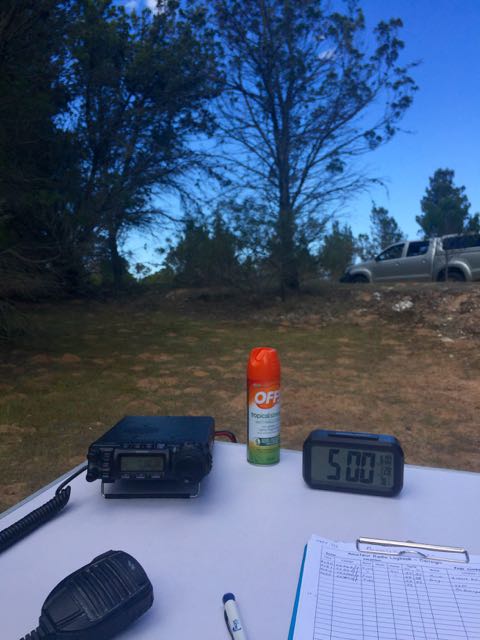
Once up on the top of the summit, we soon gathered that it would be a challenge in erecting the squid poles.  It was incredibly windy.  John was very keen to try some 6 metre action, so he tried calling on 6m, but sadly had no luck.  I set up a 40m station, and once I had qualified the summit, David VK5KC, and then John VK5BJE also qualified the SOTA peak.  Despite the towers and radio communication equipment on top of the summit, is is a very RF quiet location.

My first contact was with SOTA die-hard, Peter VK3PF with a good 5/8 signal (5/5 received), followed by Ian VK5IS at Beetaloo Valley (5/9 both ways), Rex VK3OF at Swan Hill (5/9 both ways), and then Ray VK3YAR at Mandurang near Bendigo (5/9 sent and 3/4 received).  There was quite a significant difference in the reports from Rex and Ray despite there only being a 190 km difference.

My fifth contact was a Summit to Summit contact with Gerard VK2IO who was on top of SOTA peak, Mount Meehan, VK2/ CT-042, north of Orange (5/7 both ways).

I also tried 20m briefly but could only manage 5 contacts there.  My first contact on 20m was with Ian VK5IS, followed by Phil VK2JDL, Peter VK6RZ (5/ sent and 3/2 received), Dave VK4DD, and finally Glenn VK6HAD (5/8 sent and 3/1 received).   It seemed as if it was one way propogation from/to Western Australia.  Band conditions on both 40m and 20m seemed to be very poor.  Not to mention the weather conditions on the summit.  Although it was quite a mild day, the wind was absolutely howling on the top of Mount Arden.  My squid pole collapsed on at least 2 occasions due to the very high wind speed.

This slideshow requires JavaScript.

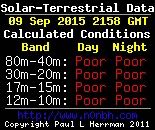
I ended up with just 11 contacts for this activation.  The bands were exceptionally quiet.  Not surprising when you look at the solar conditions.  The sun has been very unstable and there was a significant Coronal Mass Ejection (CME). It was a slow drive back down in low 2WD.  We enjoyed some amazing views and encountered quite a few kangaroos and euros on our way back to the camp ground at Argadells, where we enjoyed some lunch.

I worked the following stations:- Screenshot 2015-06-29 15.02.12

Lake Torrens National Park VKFF-278

On Sunday morning, 21st June, 2015, we all awoke to a beautiful sunny, but crisp morning.  And we were all hoping that we would get the okay from the owners of Merna Mora, for us to travel out along one of their 4WD tracks to the Lake Torrens National Park, VKFF-278.  We had planned to activate Lake Torrens on Saturday, but there had been a lot of rain here in the north, so the 4WD tracks on Merna Mora property had been closed.

So we patiently waited and were then given the thumbs up by Philip and Sonya, the owners of Merna Mora.  To say I was excited was an understatement.  The rain had affected our trip quite a lot, and I was very keen to do a bit of 4WDing out to Lake Torrens, and of course activate a unique park.

Lake Torrens National Park is a very remote park, situated about 350 km north of Adelaide.  It consists of stark wilderness and the salt lake that stretches 250km in length.  Lake Torrens is normally a dry salt flat and has only been filled with water once in the past 150 years.  Thunderstorms occasionally provide a small amount of water in the lake and when this occurs, a variety of birdlife is attracted to the area.

Screenshot 2015-06-29 13.13.34

Above:- Map showing the location of the park.  Map courtesy of mapcarta.com

By 10.15 a.m. we were on the road.  The 4WD track out to the lake is about a 110km round trip, taking you through some amazing country.

On our way out to the park I spoke with Mick VK3PMG on 7.105.  Mick was kind enough to post a message on the WWFF Australia Yahoo group and the VK5 Parks Yahoo group that we were enroute to the park, and also put up an alert on parksnpeaks for us.  Many thanks Mick

This slideshow requires JavaScript.

We activated the park from very close to the shore of the lake itself, just off the 4WD track.

Screenshot 2015-06-29 13.20.49

Above:- Map showing our operating spot.  Map courtesy of mapcarta.com

After arriving at the lake, John VK5BJE and I were quick to set up our stations.  John wanted to give 30m a crack again, so I started out on 40m, calling CQ on 7.095.  Quite appropriately, after his earlier help, my first contact was with Mick VK3PMG.  This was followed by Les VK5KLB, David VK5HYZ, and then Peter VK5FLEX.  Band conditions on 40m appeared to be very good.  It was very pleasing to have a steady flow of callers from VK2, VK3, VK5, and VK7, all with good signals.

After working a total of 22 stations I took a break, as I was getting a bit of interference from John VK5BJE.  We had set up a little bit too close to each other.  I had some lunch and enjoyed the sunshine, and admired the amazing view of Lake Torrens.

After lunch I put out a few calls on 15m, but sadly there were no takers.  And because we had no mobile phone coverage in this remote part of South Australia, we were not able to spot ourselves on parksnpeaks.  So I put a few CQ calls out on 14.310 and spoke with VK2ID portable on the beach, Alan VK4ALA, Fred VK4FE, Craig VK2PAW, and then Marc operating a military transceiver and running just 25 watts.

This slideshow requires JavaScript.

I then called CQ on 40m and my first contact there was with Cliff VK2NP, followed by Gerard VK2IO who was operating from SOTA summit, Mount Canobolas, VK2/ CT-001, near Orange.  This was followed by a call from Karl VK2GKA activating STA peak, Mount Alexandra VK2/ IL-005 near Mittagong.  A few contacts later, Peter VK3YE gave me a shout, whilst operating portable from Chelsea Beach in Melbourne, with a home brew transceiver.  I also had a contact with Ian VK1DI who was activating O’Connor Ridge Nature Reserve VKFF-857.  For more info on Ian’s activation, have a look at Ian’s blog at…..

http://vk1di.blogspot.com.au/2015/06/oconnor-ridge-vkff-857.html

I managed to push on and go past the required 44 contacts for the World Wide Flora Fauna (WWFF) program.  After 2 hours in the park I had a total of 47 contacts in the log.  We headed back to Merna Mora along the 4WD track, admiring the views of the Flinders Ranges and viewed a large amount of wildlife, including Western Grey kangaroos, Red Kangaroos, Emus, and Wedge Tailed eagles.  Also avoiding the occasional stock that we encountered along the way.

I worked the following stations on 40m SSB:-

  1. VK3PMG
  2. VK5KLV
  3. VK5HYZ
  4. VK5FLEX
  5. VK3VTH
  6. VK5NQP
  7. VK5WG
  8. VK5KFB
  9. VK3ZPF
  10. VK2YK
  11. VK5FANA
  12. VK7AN/p
  13. VK4AAC/5
  14. VK5ZAR
  15. VK3TKK
  16. VK3CRG
  17. VK3OF
  18. VK3TJK
  19. VK5KAT
  20. VK5VBR
  21. VK3FTWO
  22. VK3ANL
  23. VK2NP
  24. VK2IO/p (SOTA VK2/ CT-001)
  25. VK2GKA/p (SOTA VK2/ IL-005)
  26. VK5SFA
  27. VK5FO/m
  28. VK3IO
  29. VK3YE/p
  30. VK5KKS
  31. VK5FMID
  32. VK3AWG
  33. VK1DI/p )VKFF-857)
  34. VK5ALZ
  35. VK2RD
  36. VK5ZRY
  37. VK2NEO
  38. VK4FTWO
  39. VK4IL
  40. VK1AT
  41. VK7NWT
  42. VK3XBC

I worked the following stations on 20m SSB:-

  1. VK2ID/p
  2. VK4ALA
  3. VK4FE
  4. VK2PAW
  5. VK6HAO

After returning to Merna Mora, we stoked up the outdoor fire and cooked some potatos in jackets in alfoil, as part of our tea, which we all enjoyed together again in the indoor kitchen area.
DSC_0100

Flinders Ranges National Park VKFF-176 Wilpena Pound

After leaving the Aroona ruins, we headed a bit further east on the Brachina Gorge Road and stopped for lunch.  Whilst there I spoke with Joe VK3YSP and Julie VK3YSP who were operating portable at the Melbourne Museum as part of Museums Weekend.  Both Joe and Julie had a terrific 5/9 signal into my mobile station.

After lunch we continued east on the Brachina Gorge Road through the park until we hit the bitumen of the Flinders Ranges Way.  We travelled a bit further south and went to the top of the Stokes Hill lookout, which offers some amazing views of the Flinders Ranges.  Sadly, the summit does not qualify for the Summits on the Air program.

After leaving Stokes Hill lookout we continued south on the Flinders Ranges Way and then turned right into Wilpena Pound Road and on to the Wilpena Pound resort.  It was here that we refueled and grabbed a cup of coffee.

I headed over to a cleared area on the northern side of the main carpark and set up my station, the Yaesu FT-857d, and the 40m/20m linked dipole.  John VK5BJE headed a bit further over to the south and operated from a spot where he had activated from previously.  John was going to call on 40m and I decided to stick to 20m.

Screenshot 2015-06-29 12.35.13

Above:- Map showing my operating spot.  Map courtesy of mapcarta.com

I started calling CQ on 14.244, which is the nominated calling frequency for the WWFF program.  My first taker there was Jim VK2QA, followed by David VK4HAX (I was David’s first ever 20m contact), and then Caleb ZL2ML.  Unfortunately there was a lot of QRM from a nearby Italian station, so I QSY’d down to 14.200 and called CQ again.  This time my CQ call was answered by Karl VK2GKA, followed by James VK1DR and Bruce VK4YS.   My first DX contact was 6 calls later and it was no less than my very good friend, Marnix, OP7M in Belgium.  Marnix was 5/7 and he gave me a 5/5.  It was great to get Marnix in the log.  I went on to work a further 12 stations in VK2, Italy, Poland, Germany, England, Canada, and Switzerland, until I was called away from the radio.

It was one of the DEWNR ranges who was a little bit stand offish.  Fortunately in over 200 activations, I have only had one previous ‘bad’ contact with a DEWNR ranger who told me off for tying off one of the ends of my dipole to a gum tree.  And this fella, also did not have a lot of personal skills, I am sorry to say.  I was advised to seek permission first in future as people would ask questions about what I was doing?????  Secondly I should seek permission before driving the squid pole holder into the ground.  I bit my tongue for a while and when I questioned him about this, and asked how was it any different to a tent peg or a totem tennis pole.  I never got a sensible reply.  Oh well, it was bound to happen again, a poor interaction with somebody from DEWNR.

In any event, ‘permission’ was granted for me to continue, but by this time everyone had given up on waiting for me on 14.200.  I worked Lee, AK4QA in Alabama in the USA, Albert S58AL in Slovenia and then Gyula in Hungary.

This slideshow requires JavaScript.

My last contact for this activation was with Rob VK4FFAB who was portable in the Conondale National Park VKFF-109, which is located south west of Noosa Heads in Queensland.  Rob had a nice 5/7 signal and he reciprocated with a 5/4 for me.

It was time to pack up and head back home to Merna Mora.  David and Joy had already headed off, which left just radio die hards John and myself, and our patient wives Marija and Jenny.  We had a very enjoyable drive back to Merna Mora along the 30km long Moralana Track through Arkaba Station and Merna Mora Station.  We enjoyed the most amazing sunset and as Marija said, the most number of kangaroos we had ever seen.

And along Moralana Track I fired up the IC-7000 in the car and spoke with Rob VK4FFAB portable, Peter Vk2NEO, Jim VK5TR, Colin VK4FAAS, Perrin Vk3XPT, and Ivan VK5HS.

I worked the following stations on 20m SSB:-

  1. VK2QA
  2. VK4HAX
  3. ZL2ML
  4. VK2GKA
  5. VK1DR
  6. VK4YS
  7. VK2JF/m
  8. VK6NTE
  9. VK2HOT
  10. VK4WJW/6
  11. VK2LX
  12. OP7M
  13. VK2MI
  14. VK4OZI
  15. VK2IO/m
  16. I5FLN
  17. Sp5INQ
  18. DL7UXG
  19. G0TSQ
  20. VE7CV
  21. DJ7ZZ
  22. DL2ND
  23. M0BKV
  24. HB9FBG
  25. AK4QA
  26. S58AL
  27. HA6OB

I worked the following stations on 40m SSB:-

  1. VK5BJE/p
  2. VK4FFAB/p (Conondale National Park VKFF-109)

After gettng back to Merna Mora, and freshening up a bit, we had a very enjoyable dinner together and the obligatory few bottles of red wine.  That guy John VK5BJE is a very bad influence!

DSC_1386

Flinders Ranges National Park VKFF-176 Aroona ruins

We all enjoyed a good feed and a few more bottles of red on Friday evening at Merna Mora Station, where we stayed for 3 nights (Fri-Sun).  Merna Mora is part of a 230 sq mile sheep and cattle station located about 425 km north of Adelaide, and about 46 km north of Hawker.  About 2,500 sheep and 800 cattle are run on the property.  Merna Mora has facilities to accomodate up to 50 people.  For more information on Merna Mora, please visit their website at…..

http://www.mernamora.com.au/

Saturday morning, 20th June 2015, was a beautiful sunny morning.  After a cooked breakfast an enjoying a coffee in the sunshine watching the Miner birds and Honeyeaters in the flowering native plants out the front of our accomodation, we hit the road for the Flinders Ranges National Park, VKFF-176. 

The Flinders Ranges National Park is situated about 450 km north of Adelaide and is located in the central Flinders Ranges.  The park is about 95,000 hectares and includes the Heysen Range, Brachina and Bunyeroo Gorges and the amazing Wilpena Pound.  The Adnyamathanha people (meaning hills or rock people) are the traditional custodians of the Flinders Ranges.
Screenshot 2015-06-29 09.42.08

Above:- Map showing the location of the Flinders Ranges National Park.  Map courtesy of mapcarta.com

We drove north along The Outback Highway and turned right on the Brachina Gorge Road and headed east towards the park.  We briefly stopped at the interpretive signs and lookout, before venturing into the park through Brachina Gorge. Rocks exposed along the gorge are between 500 and 650 million years old and were deposited as sediments in an elongate depression known as the Adelaide Geosyncine.  This area was flooded by the sea for much of the 150 million year period, during which the sea level rose and fell many times.  Sediments were transported by rivers, and at times by glaciers, and deposited on the sea floor.  Rock strata along the gorge provide one of the most complete sedimentary records in the world for this time period.  It is truly and amazing and very spectacular drive through Brachina Gorge, with many interpretayive signs along the way.

We were fortunate enough to encounter a handful of the rare Yellow Footed Rock Wallabies as we drove through the gorge.  Sadly this little wallaby was once killed in large numbers for its pelt.  They scale cliffs and climb rocks with superb agility and can leap sizable chasms.  It was a real treat to be able to see them up close.

DSC_1277

We continued on to the Aroona Valley, where we set up at the end of the Aroona Valley Road, at the Aroona Ruins.  The Arrona hut was built in 1925, as an outstation for Eddie Pumps.  It consisted of a four roomed dwelling with a stone fire place and a verandah running along three sides.  The house is a typical pug and pine construction.  Slabs of native pine from this area were cut and erected vertically side by side.  Chicken wire was nailed to the framework and mud or pug was flushed to fill the gaps.  The floor was rammed earth and the roof was corrugated galvanized iron sheets.  The famous Australian artists, Sir Hans Heysen stayed here in 1927 and started the first of many sketches and paintings of the Flinders Ranges.

Screenshot 2015-06-29 09.49.28

Above:- Map showing our operating spot in the park.  Map courtesy of DEWNR

John VK5BJE was keen to try his luck again on 30m and set up near the carpark.  I set up in close proximity, a little further up the hill and started off on 20m.  David VK5KC headed a bit further to the east and worked 40m.

My first contact on 20m was with Fred VK4FE who was operating from Mowbray National Park, VKFF-367 in Queensland.  Fred was calling CQ on 14.310 and was a good 5/7 signal.  I then headed down to 14.305 and called CQ and this was answered by Michael VK6MMB who was portable in Goongarrie National Park, VKFF-209.  Michael and his off side Mike VK6MB were half way through a marathon parks trip in Western Australia.  This was followed by a call from Gerard VK2IO who was mobile on his way to a SOTA summit in the Blue Mountains.  I was then called by Adam VK2YK with a strong 5/9 signal and then Mark VK4MON with a 5/8 signal, operating portable from his back yard.

I then moved up to 40m and called CQ on 7.095 and this was answered by Larry VK5LY in the Riverland with his typical strong 5/9 plus signal.  I went on to work a total of 34 stations on 40, including Fred VK4FE in Mowbray National Park and Dale VK5DC mobile near the Northern Territory/Queensland/South Australian border.

This slideshow requires JavaScript.

I then decided to give 15m a go, and managed to work Cliff VK2NP, Fred VK4FAAP and Ian VK1DI.  Prior to packing up, I worked Rob VK4AAC who was portable in the Vivonne Bay Conservation Park, VKFF-811, on Kangaroo Island.

After 90 minutes at Arrona Ruins, it was time to pack up and head off a bit further up the Brachina Gorge Road for a bite to eat.  I had a total of 43 contacts in the log.  We were planning on activating the Flinders Ranges National Park again, later in the afternoon, so I was assured of picking up 1 more QSO to qualify the park for the World Wide Flora Fauna (WWFF) program.

I worked the following stations on 20m SSB:-

  1. VK4FE/p (Mowbray National Park VKFF-367)
  2. VK6MMB/p (Goongarrie National Park VKFF-209)
  3. VK2IO/m
  4. VK2YK
  5. VK4MON

I worked the following stations on 40m SSB:-

  1. VK5LY
  2. VK3CWM
  3. VK5FANA
  4. VK5DC/m
  5. VK5FAJS
  6. VK3PMG
  7. VK5NQP
  8. VK5FMID
  9. VK5ZAI
  10. VK3NBV
  11. VK5ZGY
  12. VK3APC
  13. VK3FLCS
  14. VK1AT
  15. VK5IS
  16. VK5NWE
  17. VK3FEUG
  18. VK5NIG/p
  19. VK3DBP
  20. VK3PRF
  21. VK5STU/p
  22. VK2GKA
  23. VK5TW
  24. VK5FTRG
  25. VK1DI
  26. VK4FE/p (VKFF-367)
  27. VK5WG
  28. VK2NP
  29. VK5JP
  30. VK5ZX/m
  31. VK5FLEX
  32. VK2IAN
  33. VK2SL
  34. VK3TKK
  35. VK4AAC/5 (Vivonne Bay Conservation Park VKFF-811)

I worked the following stations on 15m SSB:-

  1. VK2NP
  2. VK4FAAP
  3. VK1DI


References.

Department of Environment and Natural Resources, 2011, Flinders Ranges National Park

Mount Scott VK5/ NE-111

After leaving the cafe at Copley, John VK5BJE jumped in to my Toyota Hi Lux and Marija travelled with Jenny (John’s XYL) down to Beltana.  John and I headed to Mount Scott, VK5/ NE-111 for an activation for the Summits on the Air (SOTA) program.  This was to be a unique summit for John and myself, and in fact this was the first time that the summit had been activated.

Mount Scott is 526 metres above sea level and is worth 2 SOTA points.  It is located on private property (Beltana Station) and is situated between the Nankabunyana Creek and the Arooma Creek which flows into the Aroona Dam.  The summit is located about 20 km west of Leigh Creek.

Screenshot 2015-06-29 08.30.12

Above:- Map showing the location of Mt Scott.  Map courtesy of mapcarta.com

John and I travelled south on The Outback Way, passed Leigh Creek towards Beltana.  We were keeping our eye out for a track on the western side of the bitumen just after passing under the power lines.  Unfortunately we had missed it, but were lucky enough to bump into a 4WD with some local lads in it, who kindly offered to take us a short distance back up the road and point out the track to us, which they did.

John and I then drove up to the summit along the track.  It was very low going.  The track is definitely 4WD only, as it is very rocky and steep for most of the way.  There were also a number of deep washaways.  It took us about 35 minutes to travel the nearly 10 km to the summit.

We reached the Mount Scott radio station tower which is on the summit just below Mount Scott and continued further on up the track towards the second smaller tower.

Screenshot 2015-06-29 08.41.03

Above:- Mount Scott topography.  Map courtesy of mapcarta.com

We stopped the 4WD just outside of the activation zone and walked a short distance further up the hill and set up the station.  As we didn’t have to walk far, we decided to take the small fold up table and chair, as the summit was very rocky and looked very uncomfortable.

John and I took turns on the mic.  I qualified the summit and after working my fifth station, Mick VK3PMG, I handed the reigns over to John.  My first four contacts were Peter VK3PF, Nev VK5WG, John VK2YW, and Don VK5NFB.  I worked a total of 12 stations on 40m in VK1, VK2, VK3, and VK5.

After John had worked 9 stations on 40m in VK2, VK3, and VK5, we then lowered the squid pole and removed the links and tried our luck on 20m.  John called CQ on 14.310 and first taker was Dave VK2BSY who was pedestrian mobile.  Dave had a beautiful 5/9 signal and was hearing us a little weaker (5/3).  I was also keen to get Dave in the log as well, so John handed me the mic.  For more information on Dave’s pedestrian mobile set up, have a look at…..

http://www.vk2bsy.com/index.html

John worked 6 stations on 20m in VK2, Russ,a VK8, and Italy, before we swapped operators again.  I called CQ and this was answered by Albert S58AL in Slovenia, followed by Chris VK4BX and then John VK6NU.  I worked a further 7 stations on 20m in VK2, VK4, VK5, France, and Belgium.

This slideshow requires JavaScript.

After we had worked a number of stations on 20m, we then decided to have a shot on 15m.  John called CQ on 21.250 and this was answered by Phil VK2MWP, and then Hideo JA3BOA, followed by John VK6NU, Mick VK3PMG and John VK6AG.  My first taker on 15m was Rob VK4FFAB with a 5/9 signal (5/9 received), followed by Phil VK2MWP, Mick VK3PMG, Taka JA0DCQ and Nick ZL4NY.

Local time was now about 3.30 p.m. and we still had a good drive down, and had to meet up with the girls at Beltana, before driving further south to Merna Mora.  So we packed up the gear and commenced the slow decent.  John and I were very happy with the activation.

John and I had a total of 50 contacts in the log for the activation on 20m SSB, 40m SSB, and 15m SSB into VK1, VK2, VK3, VK4, VK5, VK6, VK8, Russia, Italy, Japan, Slovenia, France, and Belgium.

I worked the following stations:-

Screenshot 2015-06-29 08.26.07

Gammon Ranges National Park VKFF-189

Friday the 19th June 2015 was ‘take two’ for the Gammon Ranges National Park, VKFF-189.  This was to be a unique park for me for both the World Wide Flora Fauna (WWFF) program and the VK5 National and Conservation Parks Award.

Screenshot 2015-06-28 19.44.40

Above:- Map showing the location of the park.  Map courtesy of mapcarta.com

Marija and I travelled south along The Outback Highway towards Copley.  On the way south I had a chat with Mark VK6BSA who was mobile on his way in to work again (5/9 both ways) and Steve VK3HK who was also mobile.  I also spoke with Bill VK5MBD at Red Hill.

The Vulkathunha-Gammon Ranges National Park, which is about 660 km north of Adelaide, was proclaimed in 1970, and forms part of the traditional country of the Adnyamathanha people.  The park is rich with cultural significance.  The park is 1,257.23 km2 (485.4 sq mi) in size.  Over 900 plant and 200 fauna species have been recorded in the park, including some rare and endangered species.  The park is remote and has many contrasts, including deep gorges and chasms, towering mountains, tree-lined creeks and freshwater springs.  The park encompasses some of the most rugged and spectacular country in South Australia.

Marija and I drove out from Copley through magnificent countryside.  The road out to the park is dirt but is in good condition and is a distance of about 70 km.

We stopped briefly at Nepabunna, a small aboriginal community on the doorstep of the Gammons.  Originally established as a mission in the 1930’s, the community became a council in 1998 and has a population of about 50 people.

We continued east along the Copley Road, into the park, until we reach Italowie Gorge.  We found a nice little area close to the McKinlay Creek and set up here.  Interestingly, the bushman, R.M. Williams is reputed to have learnt everything he knew about boot-making and leather from another man he met while camping in Italalowie Gap.  R.m. Williams later became a millionaire and a renowned clothing brand carries his name.

Again, for this activation I ran my Yaesu FT-857d, 40 watts and the 40m/20m linked dipole.  For 15m I used a simple 1/2 wave 15m dipole.

Screenshot 2015-06-28 19.49.29

Above:- Map showing our operating spot.  Map courtesy of National Parks SA.

I started calling CQ on 7.095 and it wasn’t long before I had my first taker.  It was Bill VK5MBD at Red Hill with a very strong 5/9 plus signal, followed by Jess VK6JES, Brian VK5FMID at Mount Gambier, and Jim VK1AT.  I had a good steady flow of callers on 40m from around Australia: VK1, VK2, VK3, VK4, VK5, VK6 and VK7 worked.  This included some of the usual QRP suspects including Greg VK5GJ running just 4 watts (5/8 sent and 5/9 received).  Both David VK5KC and John VK5BJE called me from Farina in the throws of packing up and hitting the road.

After working 26 stations on 20m, I lowered the squid pole and put up the 1/2 wave 15m dipole and called CQ on 21.250.  My call was answered by Bill VK5MBD, who despite being very weak (5/1) was very workable.  This was followed by John VK6NU, Grant VK5VGC and Albert S58AL.  Yes Slovenia.  I couldn’t believe it.  I did not expect to work into Europe at 10.10 a.m.  And Albert and I heard each other perfectly.  In fact I was stronger to Albert than he was to me (5/3 sent and 5/7 received).

It was at this time that Marija and I were visited by two of the local rangers.  We explained to them what we were doing and assured them that we were not crazy, trying to catch squid in the creek with the squid pole.  They were quite interested in what we were doing and the hobby in general.

I then put up the 40m/20m linked dipole again and called CQ on 14.310.  But I only had the solitary caller there, and that was Bill VK5MBD, who again was weak (5/1), but again very workable.  There was no man made noise at all out here in the middle of nowhere.  I just wish it was like that at home.

This slideshow requires JavaScript.

I returned to 40m for a short time, calling CQ on 7.098, which was answered by park stalwart Mick VK3PMG, followed by Adrian VK5FANA, David VK5HYZ and then Ian VK5IS.  I worked a further 17 Australian stations in VK2, VK4, & VK4.  This included John VK2KJO who called in from nearby Arkaroola.  John and Sue had travelled through earlier.

After 2 hours in the park I had a total of 52 contacts in the log.  We packed up and headed back in to Copley.

The following stations were worked on 40m SSB:-

  1. VK5MBD
  2. VK6JES
  3. VK5FMID
  4. VK1AT
  5. VK5GJ
  6. VK5HS
  7. VK5HCF
  8. VK3PF
  9. VK7ALH
  10. VK5RM
  11. VK5DC/m
  12. VK5KC/p
  13. VK3FQSO
  14. VK5BJE/p
  15. VK2FJPR
  16. VK3FLCS
  17. VK5LY
  18. VK4FFAB
  19. VK3TKK
  20. VK5WG
  21. VK3DBP
  22. VK3YAR
  23. VK5TN
  24. VK5GJ
  25. VK5VGC
  26. VK7MK
  27. VK3PMG
  28. VK5FANA
  29. VK5HYZ
  30. VK5IS
  31. VK3FMAA/m
  32. VK5FAJS
  33. VK5KAF
  34. VK5NRG
  35. VK2KJO
  36. VK5ZA/m
  37. VK5JK
  38. VK5ZK
  39. VK2IO
  40. VK4CPS
  41. VK2MJB
  42. VK3BHR
  43. VK3OHM
  44. VK5LDM
  45. VK3PR
  46. VK3HP
  47. VK5GI

The following stations were worked on 20m SSB:-

  1. VK5MBD

The following stations were worked on 15m SSB:-

  1. VK5MBD
  2. VK6NU
  3. VK5VGC
  4. S58AL

After returning to Copley we called in to the Copley Bush Bakery and Quandong Cafe, where Marija and I caught up with John and Jenny.  We enjoyed a nice cappucinno and a warm home backed Quandong pie with cream (each that is).  We then continued south to Leigh Creek, for a quick stop and then on to our next activation, Mount Scott, VK5/ NE-111.

IMG_1477


References.

National Parks South AUstralia, 2015, Vulkathunha Gammon Ranges National Park.

Wikipedia, 2015, <https://en.wikipedia.org/wiki/Nepabunna,_South_Australia&gt;, viewed 28th June 2015

VK100ANZAC at Farina on Thursday

After breakfast, Marija and I travelled back out to Farina from Lyndhurst.  It was another beautiful morning, with relatively clear skies and thankfully no rain.  We set up again at the rear of the old Post Office.  Sadly, this was to be an exceptionally slow day on the radio.

I was set up and ready to go by 8.50 a.m. and headed to 7.073 and the morning South Aussie net, where I spoke with Gary VK5ZK, Rick VK5BGN, and Ian VK5IS.  All with great signals.

I then went up to 7.095 where I called CQ and this was answered by Ivan VK5HS in the Riverland with a good 5/9 signal, followed by Jeff VK5JK at Victor Habor (also 5/9), and then Allan in the northern suburbs of Adelaide, followed by Al VK7AN portable on the east coast of Tasmania.

But it was very slow going, with long periods of calling CQ with no takers.  After working just 15 stations on 40m, I headed up to 20m.  I called CQ on 14.250 and this was answered by Norm VK4ANB (5/8 sent and 5/7 received), then Bill VK5MBD, followed by Karl VK2GKA.  During this time I had a number of visitors to the station again, including some members of the Farina Restoration Group, and a lady whose brother was a ham.

I worked just 3 stations on 20m and decided to take the opportunity of having a look around historic Farina with Marija.  Many of the tourists had either left or were leaving.  But the Farina Restoration Group volunteers were still busy manning the underground bakery and restoring some of the buildings.  And yes, I did pay the bakery a visit again.  The underground wood fired baked pasties and apple/cinnamon scrolls were extremely yummy.

This slideshow requires JavaScript.

After a 2 and 1/2 break from the radio, I went back to 20m and called CQ again.  But nothing much had changed.  It was very slow going with just 4 takers in VK1, VK3, VK4, and VK5.  So I headed back to 40m and worked Larry VK5LY in the Riverland, Adrian VK5FANA on the Yorke Peninsula, and Brian VK5FMID in Mount Gambier.

So I tried my luck on 15m and called CQ on 21.250 but sadly had no takers.  So it was back to 20m again where I found the band to be almost dead and very flat.  I booked in to the ANZA DX Net and worked VK2, VK3, VK4, VK4, USA, New Zealand, and the Marshall Islands.  At the end of the net I called CQ on 14.250 and this was responded to by John VK3JLS, followed by Ian VK6DW, and then Noel VK3NDX.

The 20m band was clearly down (now I know why, because of the solar flares & CME’s).  Peter G2YT called me and he was only a 5/7.  Peter is normally an exceptionally strong signal on 20m and to my great disapointment Peter gave me a 2/1 signal report.  Other than Peter, the only other DX stations I worked on 20m was Joe EA8DAJ in the Canary Islands, and Jim KA3UNQ in Maryland USA.

So after working just 14 stations on 20m I tried 15m and called CQ on 21.250.  This was answered by Geoff VK6FNLW and then JR6BF in Japan.  But it was time to pack up.  It was approaching 5.00 p.m. and we had planned to travel into Lyndhurst that night for a meal at the pub.

So at the end of a rather disapointing day I had a total of 54 contacts in the log.

Making my total contacts from Farina……….162.

I was rewarded with an amazing sunset at Farina as I was packing up.

DSC_1070

On Thursday I worked the following stations on 40m SSB:-

  1. VK5ZK
  2. VK5BGN
  3. VK5IS
  4. VK5HS
  5. VK5JK
  6. VK5FD
  7. VK7AN/p
  8. VK5FMJC
  9. VK5VGC
  10. VK5TW
  11. VK3YW/m
  12. VK5KLD
  13. VK5DC/p
  14. VK5KPR
  15. VK5MBD
  16. VK5LY
  17. VK5FANA
  18. VK5FMID

I worked the following stations on 20m SSB:-

  1. VK4ANB
  2. VK5MBD
  3. VK2GKA
  4. VK4VI
  5. VK5HS
  6. VK1MCK
  7. VK3VIN
  8. VK4CC
  9. K7INA
  10. VK4SWE
  11. VK7XX
  12. VK4TD
  13. ZL2BAQ
  14. VK3IDM
  15. VK4NH/8
  16. VK2CV
  17. ZL1PWD
  18. K5KT
  19. V73/WW6RG
  20. ZL1ANF
  21. VK4EU
  22. AE7KI
  23. VK3JLS
  24. VK6DW
  25. VK3NDX
  26. VK2VU
  27. VK6TDF/m
  28. G2YT
  29. VK3GH
  30. VK4WM
  31. EA8DAJ
  32. VK2MI
  33. VK3JL
  34. KA3UNQ
  35. VK1TX
  36. VK1UU

I worked the following stations on 15m SSB:-

  1. VK6FNLW
  2. JR6BF

Here is a short video of our activation at Farina…..

VK100ANZAC at Farina on Wednesday

I woke up on Wednesday morning, a little concerned about the weather.  I hadn’t heard any rain overnight, so with a degree of nervousness, I poked my head out of the cabin door to have a look at the weather.  I was pleasantly surprised to see generally clear skies, even though it was only 7.00 a.m.  But I still hadn’t heard from David or John.  So I headed out to the HiLux and put out a call on 7.095 but didn’t hear back from my two missing mates.  So I headed back inside and had some breakfast and a shower, and by 7.40 a.m. Marija and I were on the road.

Screenshot 2015-06-28 10.32.30Above:- Map showing the location of Farina in the north of South Australia.  Map courtesy of mapcarta.com 

As a group we had intended to activate the Lake Eyre National Park, VKFF-276, but roads north of Marree were closed, so that put a halt to that.  Plus, our other 4 travelling companions were ‘MIA’.  So Marija and I decided to activate the Gammon Ranges National Park.  On the way south towards Copley, I fired up the Icom IC-7000 in the vehicle and spoke with Alan VK5FAJS at Mount Gambier (5/9 both ways), followed by a contact with Mark VK6BSA who was mobile on his way in to work.  Mark had a very nice 5/9 signal and he reciprocated with a 5/9 for me.  The Codan 9350 antenna seemed to be working well.

I then moved up to 7.098 and called CQ and much to my pleasure, this was responded to by David VK5KC.  He had and John were on the move and were heading north.  The Warrioota Creek level had dramatically dropped overnight.  I now felt a lot better.

As David & John and crew were going to head to Leigh Creek for a shower, Marija and I had a bit of time up our sleeve so we decided the activation of Gammon Ranges was a goer.  It was slow going along the bitumen as there was a lot of wildlife and stock on the road, including sheep, horses, kangaroos and emus.

Upon reaching Copley we took the time to have a look at the tourist info boards.  Copley was originally called Leigh Creek after a nearby pastoral holding, and was surveyed in 1891.  It was officially named Copley after William Copley, Commissioner of Crown Lands.  The Great Northern Railway made its way to the town in 1881.

Whilst in Copley we caught up with John VK2KJO and his wife Sue who had also pulled into the town, hoping to head out the Gammon Ranges as well.  And they were the bearers of bad news, advising that the road out to the Gammons was closed.  After a chat with John and Sue we headed out to the Copley Road which heads out to Nepabunna and the Gammons.  Sure enough, it was closed due to all the recent rain.  Marija and I were very disapointed.

So Marija and I headed south to Leigh Creek and caught up with the rest of the gang and had morning tea at the Open Cut Cafe and Visitor Centre.

John and Joy wanted to do a bit of washing, so Marija and I headed back north along the Outback Highway (Bandioota Road), and stopped briefly to view the Leigh Creek coal fields.  Sadly the viewing platform for the coal fields no longer exists.  We also stopped for a photo opportunity, as there was a magnificent Wedge Tailed Eagle in a tree not far off the road.  We continued north and stopped at the ochre pits, just north of Lyndhurst.  Aboriginal people traded ochre from Lyndhurst and other nearby quarries within the Lake Eyre region for items such as pituri (native tobacco), spinifex resin, and stone axe heads.

This slideshow requires JavaScript.

We continued north on the road between Lyndhurst and Marree, and turned left into the dirt track leading to Farina.  Farina is a ghost town and is situated about 620 km north of Adelaide.  Farina is a Latin name meaning Farinaceous or flour.  Farina was surveyed in 1876 by W.H. Cornish and R. Peachey, on a reserve baned Government Gums or Gums Waterhole.  It was laid out in the pattern first used by Colonel William Light.  Farina had 432 allotments of a 1/4 acre each and 88 suburban blocks ranging in size from 5 acres to 11 acres.  Farina was officially proclaimed on the 21st day of March, 1878.

By 1882 the narrow gauge railway had reached Government Gums.  This year also saw a severe grought, but despite this, optimists hoped that the town would become the centre of a vast agricultural storehouse.  The railway soon became known as the Transcontinteal Railway and the Great Northern Railway.

By 1888, Farina’s population had reached about 100, with about 30 houses in the town.  The town grew quickly and soon had two hotels, a church, hospital, and a school.  Farina’s population which at one point reached more than 400 people, supported several shops, including those of Manfield and Bell.

Today, Farina is a ghose town, with many of the old stone buildings, being lovingly restored by the Farina Resoration Group.

For more information on Farina and the Farina Restoration Group, have a look at the following…..

http://www.farinarestoration.com/

There is also a very good video from the ABC’s Landline program on Farina.  Please click on the link below…..

http://www.abc.net.au/landline/content/2013/s3802729.htm

Our reason for activating as VK100ANZAC from Farina was to commemorate the 75 year anniversary of a secret mission undertaken by two Australians and two Englishmen, to rescue the DeGaulle family from German occupied France during WW2.  The pilot of the aircraft flown in that mission was John Napier Bell, who came from Farina.

image_1_hires

At 2.55 a.m. on the 18th June, 1940, an amphibious Walrus aircraft, took to the sky from Mount Batten, near Plymouth in England.  There were four men aboard the plane: a crew of three and a special passenger, British Intelligence officer Captain Norman Hope.  The crew consisted of an Australian pilot, Flight Lieutenant John Napier Bell, an Australian navigator, Sergeant Charles William Harris, and a British wireless electrical mechanic, Corporal Bernard Nowell. As they left Plymouth in the early hours of the morning, the crew were totally unaware of their mission and destination.  It was the role of Captain Hope to brief the crew following their take off. What was their mission? To fly to the French coast and rescue the family of General Charles De Gaulle.  Following the invasion of France by the Germans in May 1940, De Gaulle instructed his wife to take their three children and leave their home near Rheims, and travel to Brittany.   There, safe passage to England would be arranged.  It is reported that De Gaulle flew to London and met with British Prime Minister Winston Churchill and asked him to assist in the rescue of his family from Carantec on the coast of the English Channel, where they had sought refuge with an Aunt.

However, there are no known official records to confirm this meeting.  What is known is that at 9.00 p.m. on the 17th  June, 1940 a ‘green form’ (authority for a flight) was received at Mount Batten Station at Plymouth.  It originated from Admiral Dunbar-Nasmith the Commander in Chief Western Approaches.  It stated: “One Walrus to proceed with Admiralty passenger from Plymouth sound to north coast Brittany at earliest 18/6. Passenger will give details of destination on arrival about 2359/17.  Aircraft to be fully armed and to keep defence watch at all time especially water borne. Return to base upon completion.” 

At about 4.30 a.m. on the 18th June, locals in the small village of Ploudaniel were awoken by the sound of a low flying aircraft.  It was the Walrus.  There is speculation that the plane may have been shot at.  But what is known is that the plane subsequently crashed at Kerbiquet adjacent to Ploudaniel, and all 4 on board were killed.  They were buried at the Ploudaniel churchyard, Ploudaniel, Brittany, France.

screenshot-2014-11-08-19-36-57

Above:- John Napier Bell’s headstone.  Photo courtesy of http://www.aircrewremembered.com

Since 1940, each year the people from Ploudaniel honour the crew with a special service at the crash site and the local church grave site. So who were the crew and specifically the Captain? John Napier Bell was born on the 25th day of April, 1916 at Largs Bay South, South Australia, to parents John ‘Jack’ Henry Bell and Eva Annie Bell.  Coincidentally, this was the same day that the Australian Government declared that day to be called Anzac Day.  On leaving school, Bell helped his father to run Mansfield’s Store (later renamed as Bell’s Store) at Farina in the Far North of South Australia.  Bell became an Air Force Cadet in July 1935 and in July 1936 at age 20, he was appointed Pilot Officer.  In April 1937 he was promoted to Flying Officer.

Screenshot 2015-06-28 18.21.45

Above:- Bell’s store in Farina, c. 1930.  Image courtesy of State Library of South Australia

Farina was a buzz with activity.  We saw numerous vehicles with vans entering into the old town and the camping area, with number plates representative from all around Australia.  Marija and I set up the amateur radio station behind the old Post Office, which is on the main dirt road entering Farina.  We decided it was a good operating spot, as people entering Farina could see us in clear view, but it was behind the old Post Office, so it didn’t inhibit those that wanted to admire the beautiful old building.  For the activation I ran the Yaesu FT-857d, 40 watts and the 40m/20m linked dipole, supported on the 7 metre squid pole.  Power to the radio was supplied by a 44 amp hour power pack.  As it was quite a sunny day, the solar panels were deployed to provide some extra grunt to the battery.

This slideshow requires JavaScript.

I started off on 40m and called CQ on 7.095.  Our very first station in the log for VK100ANZAC at Farina was Karl VK2GKA who had a lovely 5/9 signal.  This was followed by Adrian VK5FANA on the Yorke Peninsula running just 5 watts.  And Jeff VK5IU/8 portable at Alice Springs then called with a nice 5/8-9 signal, followed by John VK6FABC who although very weak, was extremely readable.  The noise floor at Farina was very low so I was able to hear John very clearly.  I was very pleased with the first four contacts coming from all around Australia.

Not long after setting up, David & Joy, and John & Jenny had arrived at Farina.  They headed to the camground and after settling in fired up the radio and operated from there.

After working 46 stations on 40m, I headed over to 20m and called CQ on 14.250 and this was answered by Tony VK2RI who was portable at Botany Bay.  I worked another 3 VK stations in VK7 & VK3.  And it was at this time that two families approached me and were curious in what I was doing.  So I put down the mic and gladly explained to them the hobby of amateur radio and the reason for us being at Farina.  They seemed to be very interested and continued talking for about 20 minutes.

IMG_1467

By time I had got back onto 14.250 some other VK’s were on the frequency so I headed down the band and found 14.243 clear and called CQ again.  This time my CQ call was answered by the first DX station, IU2EFB in Italy with a good 5/7 signal.  Local South Australia time was only 2.12 p.m. so long path into Europe was still opening up.  This was followed by a call from Peter VK3CFA and Alex VK4TE.  I then had another visitor to the station and again took the time to explain the hobby and why we were activating at Farina.  In fact, this trend continued for most of the day with a lot of visitors, including a crew from Chanel Seven who did a little bit of filming whilst I was operating.

I remained on 20m until about 0630 UTC (4.00 p.m. SA local time) before going QRT.  There was a planned commemorative service at the Farina War Memorial at 5.00 p.m. so I wanted to freshen up a bit and pack up the gear before that started.  I had a total of 42 stations in the log on 40m SSB and a total of 49 stations in the log on 20m SSB.  Unfortunately, it was not as busy on the bands as I would have liked.  Countries worked were Australia, Italy, USA, Belgium, Switzerland, England, Spain, Germany, Mexico, New Zealand, and Hawaii.

At 5.00 p.m. we attended at the memorial service held at the War Memorial.  There were quite a few people in attendance, including members of the Royal Australian Air Force (RAAF).  Sadly, the planned fly over by the Orion PC3 did not occur (apparently it was redployed?).

This slideshow requires JavaScript.

After the service, we all regrouped at the campground and decided what we were going to do for dinner.  We had planned on going to the Lyndhurst Hotel for tea, but the Farina Restoration Group were hosting a camp oven dinner, so that sounded like a good idea.

Me, being the crazy radio addict, I headed back to the Old Post Office and set up again.  I had promised Roy VK7ROY that I would book in to the 7130 DX Net if possible.  I was set up a little early, so I warmed up 7.130 for Roy and worked into Queensland, New Zealand, Tasmania, Western Australia and Victoria, before the 7130 DX Net commenced at 0930 UTC (7.00 p.m. SA local time).  Unfortuntaley just before the Net commenced, some JA’s came up on the frequency and they were extremely strong, making it incredibly difficult.  So the Net moved to 7.133, but it wasn’t long before we were swamped with QRM again.  A station came up on 7.135 from Honduras and he was very much in demand.  Sadly, the Net shut down early due to all the QRM,  But before it did close, I was able to work a total of 5 stations on the Net in Tasmania, New Zealand, Western Australia, Queensland, and the USA.

After the net I moved up to 7.145 and called CQ a number of times, but only worked a further 3 stations in New South Wales, Victoria, and South Australia.

So I packed up and headed back to the campsite where we set up my linked dipole for 20/40/80 metres, and we made a few contacts on 80 metres, enjoying the warmth of an open fire and a few glasses of red.

Thanks to Adrian VK5FANA for posting on the VK5 Parks Facebook site that we would not be activating the park.

Thankyou to Adrian VK5FAJH who placed us up on the VK5 Parks Yahoo group.

And thankyou to those that took the time to spot us on the DX Cluster.

So, it was the end of day one at Farina, and I had a total of 108 contacts in the log.  Marija and I headed back to the Lyndhurst Hotel.  On the way I fired up the IC7000 in the Hi Lux and booked in to the Southern Cross DX Net and worked W1FDY in Virginia, KC2KU in Florida, W9WJ in Illinois, W5IZ in Texas, AI4JU in Florida, and W4AZB in Tennessee.

I worked the following stations at Farina on 40m SSB:-

  1. VK2GKA
  2. VK5FANA
  3. VK5IU/p (Alice Springs)
  4. VK6FABC
  5. VK5KC/m
  6. VK4AAC/5
  7. VK5KAA
  8. VK5BJE/p
  9. VK5NAQ
  10. VK7ALH
  11. VK3XPT/m
  12. VK5HOS
  13. VK6POP/2
  14. VK3CWM
  15. VK7FGGT
  16. VK5FAJS
  17. VK5ZGY/m
  18. VK5KAF
  19. VK5BGN
  20. VK4UA
  21. VK5AAR
  22. VK4E
  23. VK5TW
  24. VK5FMID
  25. VK3PF
  26. VK3OB
  27. VK2SS
  28. VK3FGMO
  29. VK3TJK
  30. VK3FQSO
  31. VK5KLV
  32. VK2EXA
  33. VK3NBL
  34. VK2VU
  35. VK5FAJH
  36. VK3MC
  37. VK7EK
  38. VK3CRK/4
  39. VK3MEK
  40. VK2MJB
  41. VK4GSF
  42. VK3OW
  43. VK4MON
  44. ZL3TV/m
  45. VK4FBMW
  46. VK7LDK/4
  47. VK6ATS
  48. VK3FCAN/m
  49. VK4BR
  50. ZL1HX
  51. VK7ROY
  52. ZL2ALK
  53. VK6LCK
  54. VK4FAAS
  55. W1OW
  56. VK2QM
  57. VK3FSPG
  58. VK5FMID
  59. VK2FMIA

The following stations were worked on 20m SSB:-

  1. VK2RI/p
  2. VK7GG/m
  3. VK3GMM
  4. VK3TJK
  5. IU2EFB
  6. VK3CFA
  7. VK4TE
  8. VK3MRH
  9. VK3VBC/m
  10. VK2VU
  11. VK2GE
  12. W5THT
  13. VK7ALH
  14. VK4QO
  15. VK4JWT
  16. VK3NBV
  17. VK4KWQ
  18. VK2HL/p
  19. VK2HOT
  20. VK5PET
  21. VK3VBI
  22. IK4DDI
  23. VK6PII
  24. OP7M
  25. HB9RDE
  26. NJ1Z
  27. G2YT
  28. WB4JSB
  29. EA3HHD
  30. VK3UP
  31. VK3MBW
  32. VK7BC
  33. VK4RF
  34. VK4OZI
  35. VK3FT
  36. VK6LCK
  37. VK2YK
  38. VK2MI
  39. VK6AAV
  40. DL1WM
  41. VK3GMC
  42. VK3XS
  43. XE1H
  44. VK3MEG
  45. ZL2MM
  46. VK6ATS
  47. VK3PRF
  48. VK2NRB
  49. KH6XM

References.

South Australian Tourism Commission, 2015, <http://www.southaustralia.com/info.aspx?id=9002305&gt;, viewed 29th June 2015