Late yesterday afternoon (Friday 16th December 2016) I activated the Adelaide International Bird Sanctuary National Park Winaityinaityi Pangkara, VKFF-1766 (not yet allocated a 5NP number). This is a newly gazetted park (established 27th October 2016) and as such this was a first time activation of the park. The activation was as part of the Summer Friday afternoon/evening events for the VK5 National & Conservation Parks Award.
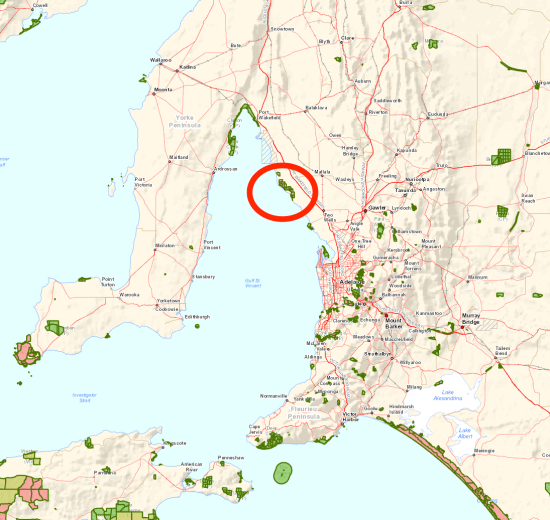 Above:- Map showing the location of the park north of Adelaide. Map courtesy of Location SA Map Viewer.
The Adelaide International Bird Sanctuary is a unique safe haven for shorebirds, with the northern section of the bird sanctuary recently being proclaimed as a National Park. It is South Australia’s first new national park in a decade.
I had quite a bit of expectation leading up the activation of this park as the National Parks South Australia website stated: “If you love bird watching the Adelaide International Bird Sanctuary and new national park present an exciting new opportunity to explore and appreciate birds in their natural habitat‘. Sadly I was to be very disappointed as I did not see to many birds at all.
The Bird Sanctuary encompasses over 60km of coastline north of Adelaide, adjacent to Gulf St Vincent, Adelaide’s northern suburbs and spans across four local council areas. Within the bird sanctuary sits the Adelaide International Bird Sanctuary National Park – Winaityinaityi Pangkara.
The park is home to numerous resident shorebirds, several of which are listed as endangered including Curlew sandpiper, Ruddy turnstone, Red knot and Eastern Curlew.


Above:- Photos courtesy of Wikipedia.
The park is visited by more than 23 migratory shorebirds, who leave their breeding grounds in the northern hemisphere on a journey that spans thousands of km across the East Asian-Australasian Flyway (EAAF). The EAAF extends from within the Arctic Circle, through East and South-east Asia, to Australia and New Zealand, stretching across 22 countries. It is used by more than 5 million birds a year, 27,000 of which call the Adelaide International Bird Sanctuary home. Birds fly from as far as Siberia and Alaska, passing through 22 countries.
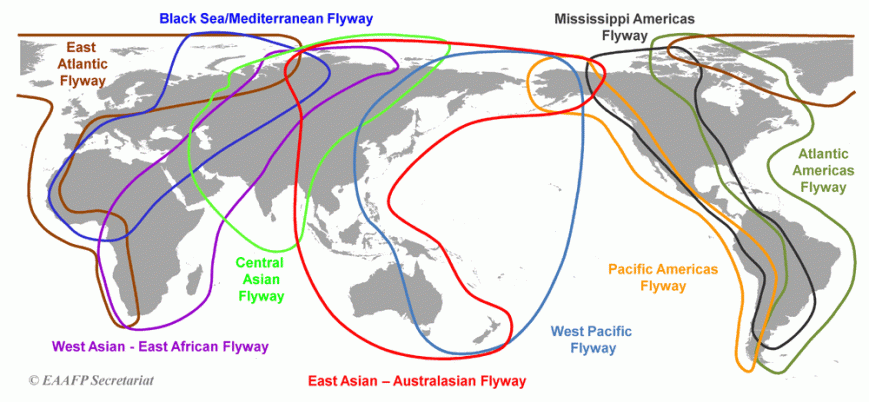
Above:- Map showing the East Asian-Australasian Flyway. Courtesy of eaaflyway.net
The Bird Sanctuary currently encompasses about 60 km of coastline to the north of Adelaide, adjacent to Gulf St Vincent, Gulf St Vincent Marine Park and the Adelaide Dolphin Sanctuary, and Adelaide’s northern suburbs. The mangroves, samphire communities, wetlands, dunes and creeks support about 263 fauna and flora species. The National Park itself is located in the northern section of the sanctuary. However over the next 12 months the park will be further expanded.
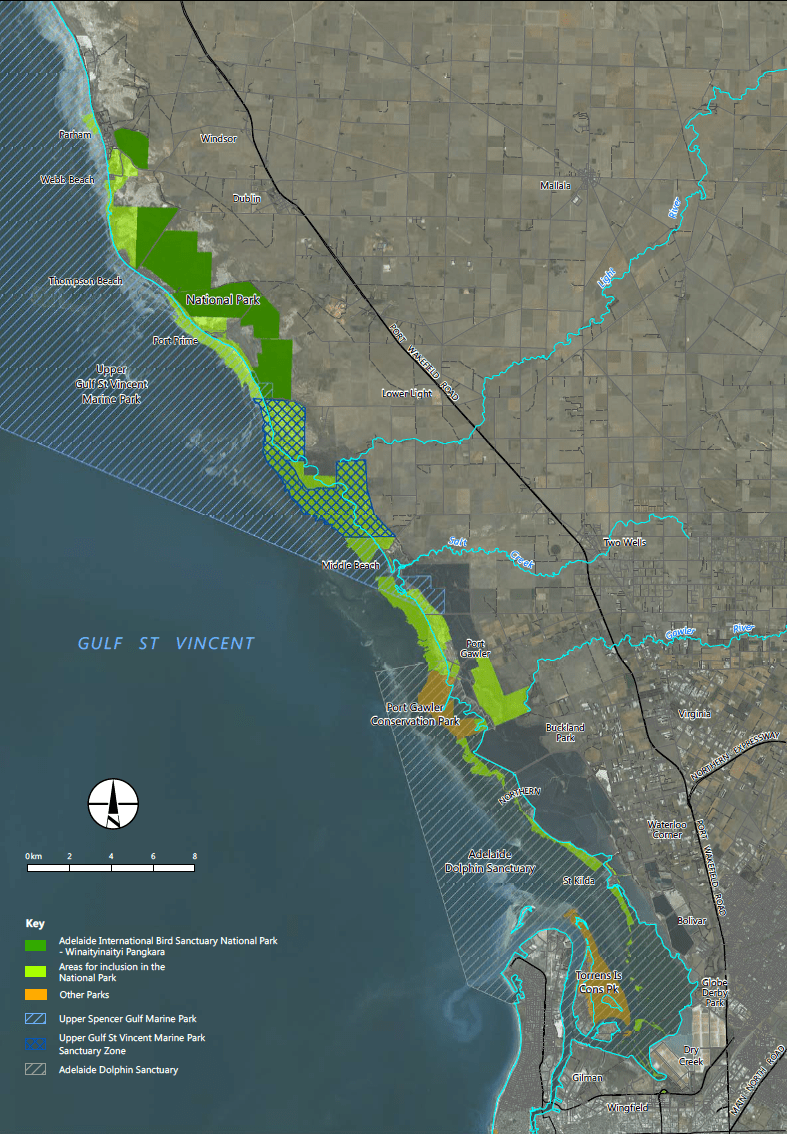
Above:- Map showing the Adelaide International Bird Sanctuary National Park, also indicated the areas for inclusion in the future. Courtesy of National Parks SA
Here is a very interesting video about the Adelaide International Bird Sanctuary……..
Prior to leaving home I had checked maps to find the best way into the park. I wrote down three possible routes. The first was via Light Beach Road.
I turned left onto Light Beach Road from the Port Wakefield Road and travelled west towards the park. The road is dirt and is easily passed using a conventional vehicle if you drive slowly. After about 4 km I reached the Lower Light rifle range and a short distance on from there I found a gate. There was a 4WD track beyond the gate, which was unlocked, and there was no sign on the gate. But I made the cautious decision not to proceed any further just in case it was private property.
It was at this time that I worked Rob VK4AAC/3 who was portable in the Dergholme State Park VKFF-0756 (5/9 both ways).


Option number two was via Ruskin Road. As there was no access to the north from Light Beach Road, I had to drive all the way back to Port Wakefield Road and travelled north until I reach Thompson Road. I drove a short distance along Thompson Road until I reached a T junction. I turned right here onto Thompson Beach Road and travelled north until I reached Ruskin Road. I then travelled west on Ruskin Road towards the beach. The maps at home had shown that the park commenced west of Beach Road, where there is a sharp left hand bend on Ruskin Road. However as I drove along Ruskin Road there were signs either side of the road stating ‘Cheetham Salt Limited. Private Property. Tresspassers Prosecuted’. Now I was really confused.


I drove to the end of Ruskin Road and into the little town of Thompson Beach. I had not been out here for years, but I have very fond memories of coming out here regularly with my grandfather when I was a boy, dabbing for Blue Swimmer Crabs.


There are some interesting interpretive signs here at Thompsons Beach which explain about the conservation importance of the area.


Maps indicated that I would be able to travel south of Thompson Beach along The Esplanade and onto Thompson Beach Road. But this wasn’t the case. I again reached a dead end.
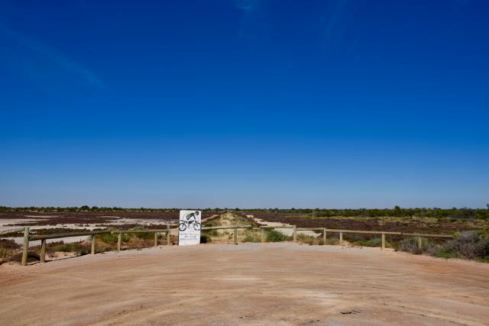
Above:- The no though road on The Esplanade
So I decided for option number three which was the northern approach along Thompson Beach Road and then Port Prime Road. I drove back along Ruskin Road, onto Thompson Road, and then south along Thompson Beach Road. I then reached the intersection with Port Prime Road and drove south west along Port Prime Road. Although not directly signposted, the park was now either side of the road. I did find a gate which had a sign on it which read ‘Conservation Area. Please keep out’ and on the other side of the road a much larger ‘Conservation Area’ sign.


I found a cleared area and set up, running the Yaseu FT-857 at 40 watts, and the 80/40/20m linked dipole. I was on air a little later than planned (about 45 minutes late). I headed to 7.144 and called CQ and this was answered by Geoff VK3SQ who has become a regular park hunter. This was followed by Trevor VK5TW with a nice 5/9 signal. This was a promising sign, with close in propagation back to Adelaide being very good.
Eight contacts into the activation, I had my first Park to Park contact in the log. It was with Les VK5KLV who was in the Munyaroo Conservation Park VKFF-0920 on the Eyre Peninsula. Les wasn’t overly strong (5/7), but was there was absolutely no man made noise in the park, I was able to receive him very well.
As is often the case during activations, there was a flurry of activity at the start, with a mini pile up. But this soon slowed down and callers started to taper off. I made a further Park to Park contact with Adrian VK5FANA who was in the Upper Gulf St Vincent Marine Park VKFF-1755. Adrian was on the oppostie side of the Gulf to me, and was 5/9 +++. A very strong signal across the water. I also worked Adam VK2YK who was activating the Glenrock State Conservation Area VKFF-1319 (5/8 sent and 5/9 received).
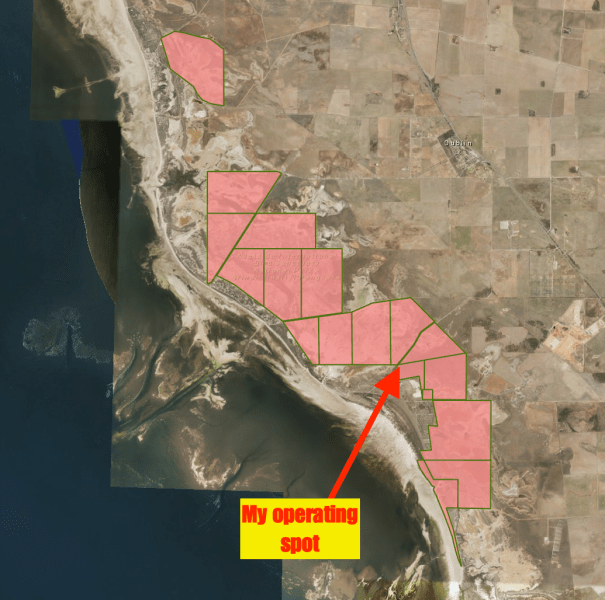
Above:- Map showing my operating spot in the park. Map courtesy of Location SA Map Viewer.
I worked a total of 36 stations on 40m, before heading over to 14.310 on the 20m band. There I worked Gerard VK2IO who was quite low down (4/1 sent and 3/3 received). Followed by Allen VK6XL and John VK6NU, who both had good signals from Western Australia. Unfortunately I only logged 3 stations on 20m. John VK6NU had told me that Mike 2E0YYY had been spotted on a SOTA peak on 14.280, but that he was not hearing Mike. So as I had no further callers I headed down to 14.280 but was unable to hear Mike. I tuned across the 20m band and could hear no European long path activity. I did hear DU2US in the Philippines working T88MZ in Palau. DU2US was strong but T88MZ was very low. I waited until the end of their conversation, hoping that it was DU2US frequency, but unfortunately it was T88MZ’s. As he was quite low down I did not bother calling.
I then lowered the squid pole and inserted the links in the dipole and headed to 3.610 on 80m where I logged four stations: David VK3BY, Tony VK5MRT, Rob VK4AAC/3 in the Dergholme State Park Park VKFF-0756, and Adrian VK5FANA in the Upper Spencer Gulf Marine Park VKFF-1755.
I then headed back to 40m where I logged a further 13 stations from VK2, VK3, VK5, VK7, and New Zealand. This included a Park to Park with Rob VK4AAC/3 in the Dergholme State Park VKFF-0756.
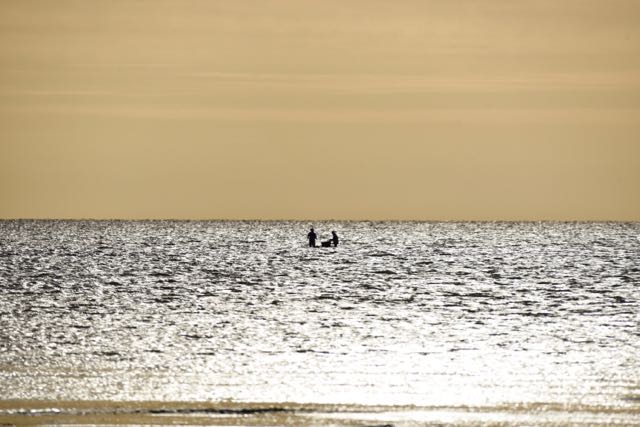
Time was marching on and I had an 8.00 p.m. Skype hook up re WIA issues, so I had to go QRT. I headed down to the beach at Port Prime, where there were quite a few people out dabbing for Blue Swimmer Crabs.
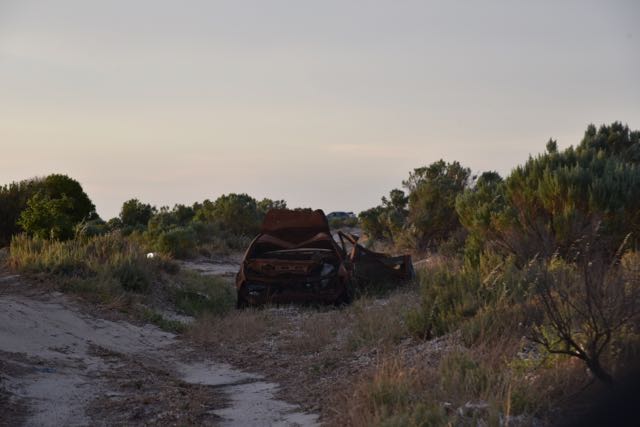
Sadly this is also a favoured car dumping ground for car thieves as it is quite remote.
Although disappointed with the bird watching aspect of this activation, I was happy in that I had qualified the park and had given a few park hunters a brand new park. It was topped off by a beautiful sunset.


On the way home (about a 120 km drive), I stopped off briefly to take some photographs of the Port Wakefield Road protest sculptures at Lower Light. Back in the 1990’s the area was earmarked to have a large waste dump installed, and a number of protest sculptures were erected over a period of time protesting the dump. Sadly the dump went ahead anyway.


On the way home I booked in to the 7130 DX Net and I made contact with a number of VK & ZL stations from the mobile.
So a total of 56 stations were logged at the Adelaide International Bird Sanctuary National Park, including six Park to Park contacts.
I worked the following stations on 40m SSB:-
- VK3SQ
- VK5TW
- VK2IO
- VK3PF
- VK3BY
- VK3PMG
- VK3GGG
- VK5KLV/p (Munyaroo Conservation Park VKFF-0920)
- VK1AD
- VK2XXM
- VK4RF
- VK4HA
- VK3FLCS
- VK3IP
- VK4GSF
- VK3SFG
- VK5SFA
- VK7FRJG
- VK4PDX
- VK4HNS/p
- VK7LTD
- VK4FFAB
- VK3FOTO/m
- VK2UH
- VK7JON
- VK5FANA/p (Upper Spencer Gulf Marine Park VKFF-1755)
- VK1DI
- VK4KUS
- VK2YK/p (Glenrock State Conservation Area VKFF-1319)
- VK7FAMP
- VK2FPRM
- VK3FPHG
- VK3MRH
- VK3WAR
- VK5VBR
- VK5EMI
- ZL2ALK
- ZL4KD
- VK7CW
- VK4AAC/3 (Dergholm State Park VKFF-0756)
- VK3KRH
- VK3TKK/m
- VK3CBP
- VK3UH
- VK2LAX
- VK3YE
- VK4SMA
- VK5FAKV
I worked the following stations on 20m SSB:-
- VK2IO
- VK6XL
- VK6NU
I worked the following stations on 80m SSB:-
- VK3BY
- VK5MRT
- VK4AAC/3 (Dergholm State Park VKFF-0756)
- VK5FANA/p (Upper Spencer Gulf Marine Park VKFF-1755)
References.
East Asian-Australasian Flyway Partnership, 2016, <http://www.eaaflyway.net/about/the-flyway/>, viewed 17th December 2016
National Parks South Australia, 2016, <http://www.environment.sa.gov.au/parks/Find_a_Park/Browse_by_region/Adelaide/adelaide-international-bird-sanctuary-national-park>, viewed 17th December 2016
National Parks South Australia, 2016, ‘Adelaide International Bird Sanctuary Interim Management Statement’.
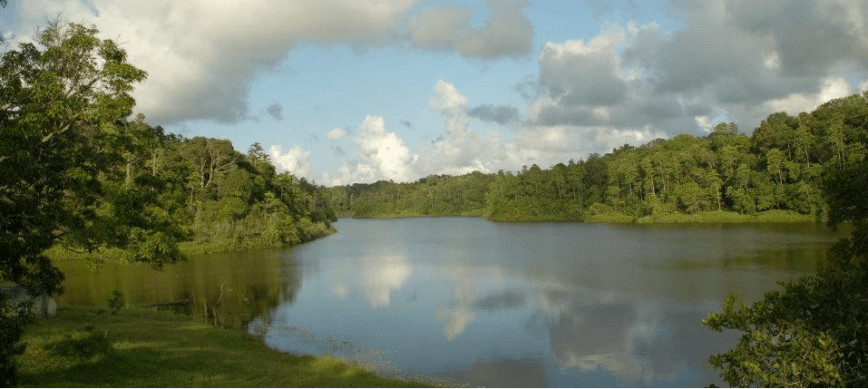 Above:- Hiyare Forest Reserve. Courtesy of Amazing Lanka.
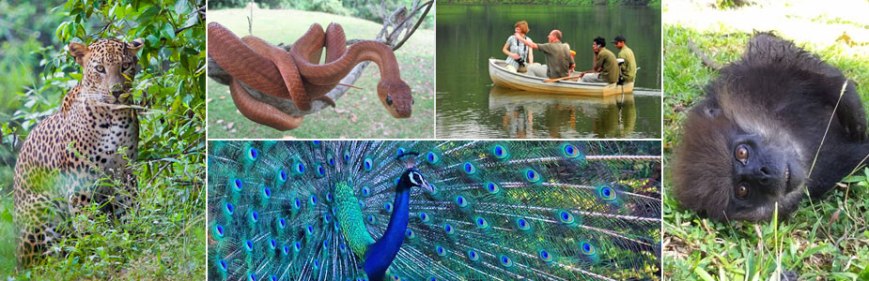 Above:- Hiyare Forest Reserve. Courtesy of Amazing Lanka.