A mate of mine who is an amateur, and is now living in Thailand, paid a visit to an electronics shop in South Thailand the other day, and found something in the shop front window (see below)…..
Category Archives: Uncategorized
A second attempt at Mowantjie Willauwar CP, VKFF-919
Yesterday (Saturday 19th September 2015) my wife Marija and I went for a drive down the South Eastern Freeway to the small but interesting Mowantjie Willauwar Conservation Park, VKFF-919. This would be my third visit to the park. The first being in 2014, for an activation as part of the VK5 National and Conservation Parks Award, and then just over a week ago I made an attempt to get 44 contacts as part of the World Wide Flora Fauna (WWFF) program, but fell short at 14 (the bands were terrible). So I decided to head back to pick up another 30 QSOs to qualify the park.
For more information on the activation about a week earlier, and some interesting information regarding the park, please see my previous post at…..
https://vk5pas.org/2015/09/10/mowantjie-willauwar-conservation-park-vkff-919/
On the way to the park I worked both Mick VK3PMG and Tony VK3VTH, who were out portable in Victorian parks as part of WWFF. I had worked Mick and Tony from home, but as they had such terrific signals into my mobile, I decided to give them a shout.
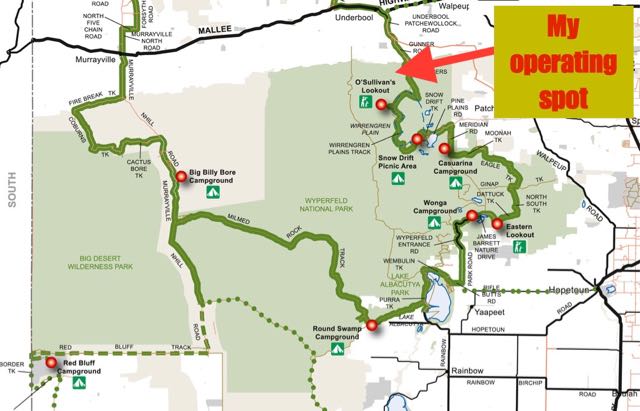
After arriving at the park, we set up in my normal operating spot, which is about 600 metres in from the gate on the northern side of Placid Estates Road. For this activation I ran the Yaesu FT-857d, and my 40m/20m linked dipole supported on a 7 metre squid pole.
It was a beautiful sunny afternoon. Local time was 2.20 p.m. and the temperature was about 22 degrees C. I had been eaten alive by sand flies and mosquitoes during my previous activation here at Mowantjie Willauwar, but this time I had come prepared with a can of ‘Off’.
Prior to calling CQ I had a quick look around the 40m band and found Norm VK5GI and Greg VK5GY on 7.100, operating out of the Bullock Hill Conservation Park on the Fleurieu Peninsula. Norm and Greg were running QRP, just 4 watts, and had a nice signal coming in to the Murray Mallee. After working Norm and Greg I found Mick VK3PMG calling CQ on 7.110 in Dergholm State Park, VKFF-756 with a beautiful 5/9 + signal. I then tuned up to 7.142 and worked Tony VK3VTH operating portable from the Mount Granya State Park, VKFF-767, again with a 5/9 + signal from Victoria. Not a bad start….four park contacts to kick off the activation.
I then headed for 7.150 and started calling CQ and this was immediately answered by regular park hunter, Rex VK3OF with his normal 5/9 + signal, followed by Les VK5KLV who was operating portable from the Winninowie Conservation Park, VKFF-820. I was very happy…my 5th park contact in just 6 QSOs from Mowantjie Willauwar.
A steady flow of callers followed, and then came another park activator. This time it was Gary VK5FGRY who was in the Morialta Conservation Park, VKFF-783. And after about a dozen more contacts I was called by Greg VK5GJ and Norm VK5GI had moved to the Cox Scrub Conservation Park.
The band was getting very busy and I had a little bit of QRM from F8CHM in France on 7.151. But I perservered and worked Brendon VK5FSCC who was portable in the Deep Creek Conservation Park on the Fleurieu Peninsula. It seemed that everyone was out enjoying the sunshine. Many of the regular VK5 and WWFF park hunters called in, but it was also pleasing ti get a number of new calls in the log. Many of whom struggled to get their tongue around Mowantjie Willauwar, which means ‘Native Pine forest’ in the local aboriginal language.
After working a total of 39 stations on 40m I headed over to 20m, and after lowering the squid pole and removing the links, I called CQ on 14.311. This was immediately answered by the ever keen Albert S58AL. He must have been there waiting for me. I went on to work stations in Slovenia, Russia, Germany, France, Hungary, Italy, Spain, Ukraine, Slovak Republic, Japan, Poland, Czech Republic, Israel, Estonia, Belgium, VK4 & VK6.
I worked a total of 47 stations on 20m, before heading back to 40m to see if I could pick up any of the die hard park stragglers. The band was very busy with lots of European and North American signals coming in. I found 7.130 clear and called CQ. Peter VK3ABM came back to my call, and this was followed by Peter VK3PF who was operating portable from Ninety Mile Beach Marine National Park, VKFF-951. I was Peter’s 44th contact to qualify the park for him. Well done Peter.
Next up was Peter VK3YE and Scott VK5FSKS who was operating portable from Chelsea Beach as part of flag pole day. Below is a video of Peter and Scott…..
A few calls later, in amongst the VK’s I heard a European accent. I asked the VK’s to stand by, and sure enough, Danny ON4VT in Belgium came back to me with a 5/3 signal, and reciprocated with a 5/3 for me. Wow, was I excited. Just 40 watts and a meager little linked dipole, and I had Belgium in the log on 40m. I’m sure I heard one or two more European callers, but the frequency was very busy and I was unable to pull out any more European call signs.
But I did work a handful of Kiwis including Lamont ZL2ALK, Willem ZL3CHE, Stan ZL1TWR, and Ken ZL4KD.
So after 3 hours in the park, I had a total of 107 contacts in the log, including some nice DX contacts on both 20m and 40m. Thanks to everyone that called, and thanks to those that took the time to spot me on the DX cluster, parknspeaks, and Facebook.
After the activation, Marija and I headed to ‘Fred’s landing’ where we watched the sunset over the Murray River. We were also fortunate enough to observe two Whistling Kites who were in a nearby gum tree enjoying a late afternoon meal (a freshly caught fish from the river). I tried to get as close as I could for a photo (didn’t have the zoom lens), and they both flew off, dropping their meal.
The following stations were worked on 40m SSB:-
- VK5GI/p (Bullock Hill CP)
- VK5GJ/p (Bullock Hill CP)
- VK3PMG/p (Dergholm State Park, VKFF-756)
- VK3VTH (Mount Granya State Park VKFF-767)
- VK3OF
- VK5KLV/p (Winninowie CP, VKFF-820)
- VK2LX
- VK4RF
- VK5ZRY
- VK4HA
- VK3TKK
- VK2NEO
- VK3XY
- VK3YSP/p
- VK3AKK
- VK5AW/m
- VK7FGGT
- VK3ANL
- VK5FGRY/p (Morialta CP, VKFF-783)
- VK3ZMD
- VK3FJIM
- VK3SIM
- VK5BC
- VK3YAR
- VK3ZPF
- VK2JDW/m
- VK3FINE
- VK3AWG
- VK7EK
- VK3TXD
- VK5GJ/p (Cox Scrub CP, VKFF-824)
- VK5GI/p (Cox Scrub CP, VKFF-824)
- VK3PI
- VK3UCD
- VK5PL
- VK5FSCC/p (Deep Creek CP, VKFF-780)
- VK5MCB
- VK2YK
- VK3UH
- VK3ABM
- VK3PF/p (Ninety Mile Beach Marine National Park, VKFF-951)
- VK3YE/p (Chelsea Beach)
- VK5FSKS/p (Chelsea Beach)
- VK2AR
- VK7CC
- VK4AJB
- ON4VT
- VK2UW
- VK4PHD
- ZL2ALK
- ZL3CHE
- ZL1TWR
- VK4SJD
- VK3PLP
- VK3FAPH
- VK6NI
- VK4SD/2
- VK8GM
- ZL4KD
The following stations were worked on 20m SSB:-
- S58AL
- S52KM
- RA3PCI
- DL2ND
- F1BLL
- HA6OB
- IZ1UJE
- DK4RM
- IK1GPG
- EA3MP
- IZ1DXG
- I5FLN
- UT5PI
- IW2NXI
- IK4IDF
- R7AY
- IK8FIQ
- RA3DAD
- UA6NT
- IZ5YHD
- OM7OM
- JA8XOK
- DL5WW
- VK4RF
- VK4HA
- IZ8EFD
- Dk1RS
- IZ8DFO
- DL2NOM
- SP6KEP
- OK7WA
- HA6NF
- SP5APW
- IK2ZJN
- EA4DTV
- VK4MWG
- 4Z4OQ
- ES5QD
- DL3APO
- ON4BB
- DK2BS
- F8DRA
- JA8RJE
- ON5SWA
- ON4VT
- F5IDJ
- VK6NU
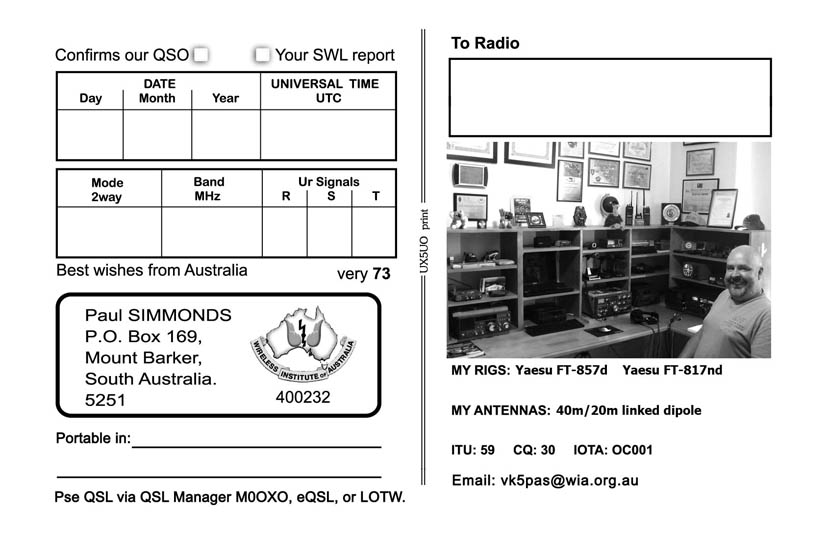
Recent portable QSL cards received
OCCFF certificate
I am very pleased to report that the brand new OCCFF Hunter award has now gone live on WWFF LogSearch.
OCCFF award certificates will be issued in increments of 7, for working Oceania DXCC entities and VK States and Territories.
All applications are electronic via LogSearch and will come via me. I will email out the certificates for FREE as a JPG or PDF file.
Many thanks to Pit YO3JW for his fantastic designs of the certificates, and thanks to Andrew M0YMAA for input to LogSearch.
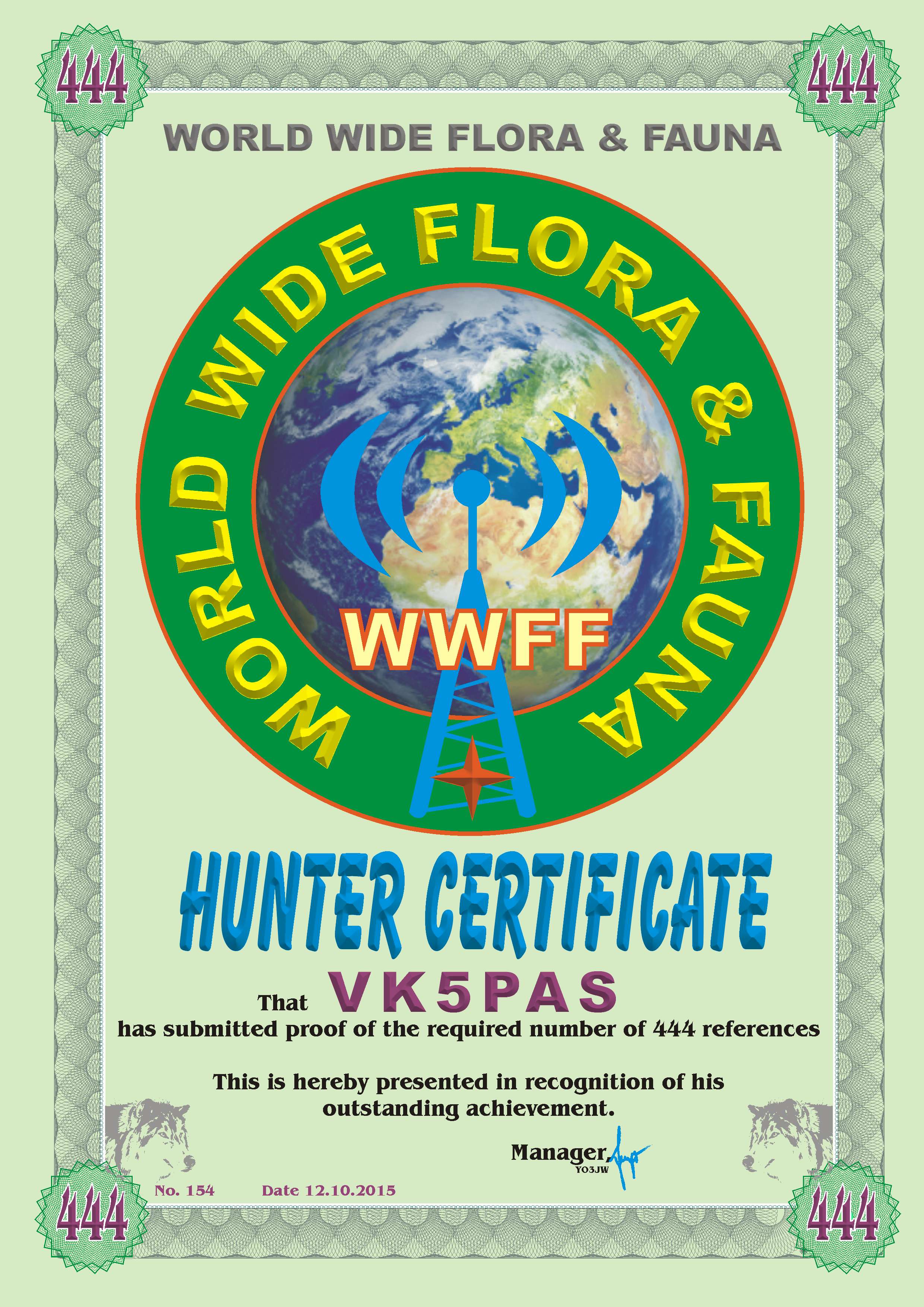
And tonight when they went live I applied for my OCCFF – 7. Here it is below…..
The OCCFF – 14 and OCCFF-21 look as follows…..
Mowantjie Willauwar Conservation Park, VKFF-919
Today (Thursday 10th September 2015) was my first of 2 days off, and the weather was beautiful…sunny and about 19 degrees C. I had planned on activating a couple of parks on my days off, but on checking my emails this morning I found a message from Gerard VK2IO with some bad news as far as propagation. All the bands were rated as poor.
I checked the Hourly Area Prediction (HAP) charts from Space Weather Services, Bureau of Meteorology and that did not make me any happier. Propagation out to around 400-500 km was only possible on 4mhz and below.
http://www.ips.gov.au/HF_Systems/1/1
Nether less it was such a glorious day that I decided to head out anyway to my planned destination of the Mowantjie Willauwar Conservation Park, VKFF-919. The park is about 75 km east from my home. I have been to this park previously, and activated as part of the VK5 National and Conservation Parks Award, but the park was recently added to the World Wide Flora and Fauna (WWFF) program. I was hoping to get 44 contacts to qualify the park for the global WWFF awards, but I wasn’t holding my breath considering the predicted band conditions. If I got 10 QSOs, then I would qualify the park for the Australian (VKFF) program and I would be very happy.
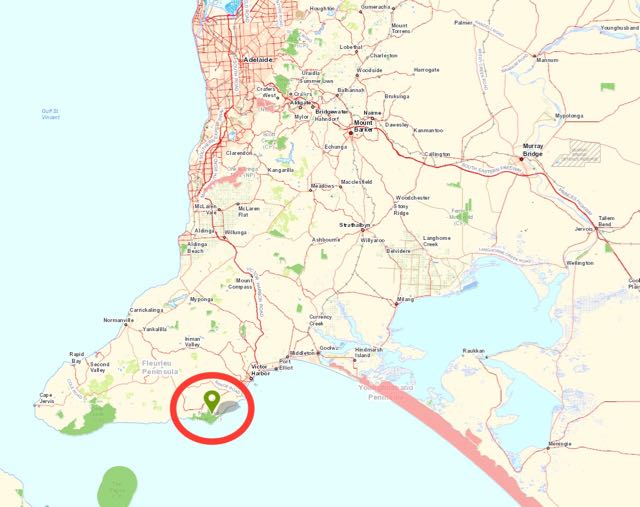
Above:- Map showing the location of the park. Image courtesy of Location SA Map Viewer.
Mowantjie Willauwar Conservation Park was proclaimed on the 2nd June 2005, and conserves nearly 143 hectares of Southern Cyprus Pine Forest. It is situated about 6 km south west of Tailem Bend. Mowantjie is the aboriginal name for the native pine found in the park, while Willauwar is a plural word meaning ‘forest of species’. Therefore the name Mowantjie Willauwar means ‘Native Pine Forest’, and this is a very accurate description of the park. The park was originally known as the Tailem Bend Forest and still appears on Google maps as such.
There are 23 species of plants located in the park which are either of regional, state or national conservation significance. The nationally vulnerable Sandhill Greenhood Orchid and nationally endangered Metallic Sun-orchid have been found in the park.
Over 40 different bird species can be found in the park. Of these at least nine native bird spcies are of state or regional conservation significance. The park was certainly alive with wrens. At one stage I even had an eagle soaring above my operating spot. Other native fauna located in the park include Eastern Grey kangaroos, and Sand Goannas.
On my way to the park I stopped off at the Frank Jackman lookout at Murray Bridge. Some excellent views can be obtained here of the mighty Murray River and the surrounding countryside.
After leaving Murray Bridge I spoke with Roald VK1MTS/2 who was activating a summit for the Summits on the Air (SOTA) program. Roald was on on the top of Bobbara Mountain, VK2/ ST-044 (5/3 sent and 5/7 received). I then continued on to the little town of Tailem Bend, where I again stopped to view the Murray River. I could see the park in the distance from my vantage point.
After leaving Tailem Bend I turned onto the Princes Highway and travelled south towards Meningie. I briefly stopped near the northern tip of the park. There is a parking area here and it was at this point that the Princes Highway previously cut through the park. The road was re-routed during the 1960’s to bypass the park. There is a monument here to commemorate the changes to the Highway. You can operate from this spot. There is a small gate leading into the park and plenty of room to park your car. But I decided to head to my previous operating spot.
Prior to setting up though, I travelled to the end of Placid Estate Road to enjoy some more views of the Murray River. There are some very impressive shacks and houses at the end of the road, overlooking the river. A very nice place to have a radio shack!
I then entered the park off Placid Estate Road. There is a gate on the northern side of the road and a track leading into the park. I found a nice shady clearing and set up my chair and table. For this activation I ran my normal portable set up, comprising the Yaesu FT-857d, 40 watts and the 40m/20m linked dipole supported on a 7 metre squid pole.

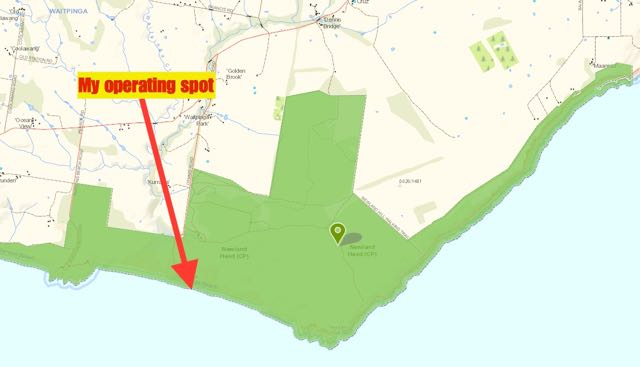
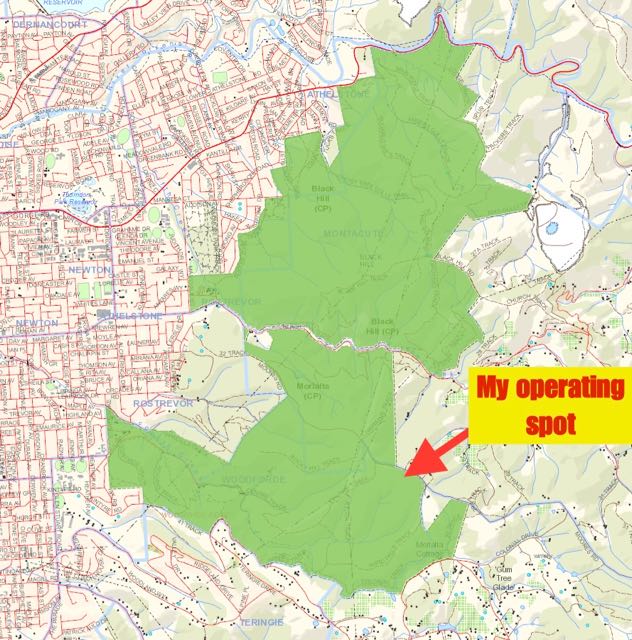
Above:- Map showing my operating spot. Image courtesy of Location SA Map Viewer.
I was set up and ready to go at 3.15 p.m. (0545 UTC). I called and called and called CQ on 7.144 on 40m with absolutely no takers. I then tuned across the band and did not hear a single station. Oh oh!! Fortunately I had phone coverage so I sent out an SMS message to some of the keen park hunters. But sadly the response was not a good one. Col VK5HCF at Mount Gambier advised that he could not hear me, as did Mick VK3PMG in Stawell in western Victoria. And then Adrian VK5FANA on the Yorke Peninsula also texted me to advise he could not hear me.
It was starting to get very frustrating. Not only was the band in poor shape, but the mosquitoes were as big as birds and were biting hard, along with the sand flies.
I called CQ again a number of times, but again, not a single taker. It was now 3.30 p.m. (0600 UTC). I tuned across the band and found the Kandos Group starting up on 7.093. Tom VK2KF, the net controller had a very strong 5/9 signal so I gave him a shout and booked in to the net. But it took a long time for my over, and the mozzies were starting to make a meal of me. So I headed for the safety of the 4WD until it was my turn on the net. I could not hear any of the VK3’s or VK5’s on the net, but the VK2’s and VK4’s were coming in quite well.
After my go on the Kandos net I headed down 5 kc and called CQ on 7.088 and this was answered by Gerard VK2IO, who is a very keen SOTA and parks activator and hunter. Gerard was 5/7 with significant QSB, and he reciprocated with a 5/5 signal report for me, also reporting QSB. I was then called by Rick VK4RF, who recently was awarded the Diamond VKFF Hunter certificate, despite being only new to the WWFF program. Rick was 5/5 and returned a 5/5 to me.
Despite the band being in poor shape I did manage to work VK1, VK2, VK4, VK7, and VK8. This included a contact with Rob VK4FFAB. I told Rob that I had brought my 15m dipole with me, but Rob advised not to even bother with 15m as he had been there a little earlier and called CQ for 30 minutes with no replies.
My last contact was with my good mate Gerald VK2HBG, who must have a very kind signal strength meter on his transceiver, because he gave me a 5/9.
I then QSY’d to 20m and called CQ on 14.310. Again I called and called and called and absolutely no takers. So again, I tuned across the band to find very few signals, and those that were there, were very low down. Back to 14.310 and CQ again. This time I was answered by Greg VK5GJ at Meadows in the Adelaide Hills. Greg was 4/1 at best with very deep QSB. And then the ever reliable Rick VK4RF called, but that was the end of activity on 20m. Not a single European!
I moved back to 40m and called CQ again, but I could only manage 1 more contact, this time with Peter VK3ZPF.
The poor band conditions and mosquitoes had got the better of me. I packed up and headed off with just 14 contacts in the log. Well short of the required 44 contacts for the global WWFF program, but fortunately I had my 10 contacts and had qualified the park for VKFF.
On my way home I stopped off briefly at a lookout just down from the park off Princes Highway for some more views of the Murray River.
When I got home, I checked the HAP charts again, and as you can see below, band conditions were very very poor. Thanks again to everyone that called, and thanks to those that took the time to spot me on either parksnpeaks, the DX cluster, and/or Facebook.
The following stations were worked on 40m SSB:-
- Tom VK2KF
- VK2IO
- VK4RF
- VK4HA
- VK7CW
- VK1ATP
- VK8GM
- VK1ZZ/4
- VK4FFAB
- VK2HBG
- VK3ZPF
The following stations were worked on 20m SSB:-
- Greg VK5GJ
- Rick VK4HF
- Rick VK4HA
References.
Department for Environment and Heritage, 2008, ‘Mowantjie Willauwar and Poonthie Ruwe Conservation Parks Management Plan’.
Horsnell Gully Conservation Park VKFF-894
After packing up at the Giles Conservation Park, I headed to the Horsnell Gully Conservation Park, VKFF-894, for my second park activation of the day. Mark VK5QI had recommended to activate from the picnic ground at the bottom of the park, but this meant a longer drive for me down into the foothills and the suburb of Skye. So I headed south along Woods Hill Road, and onto the Ashton -Mt Lofty summit Road. I then turned right into Coach Road, and travelled to the end of the road where there is a small carpark.
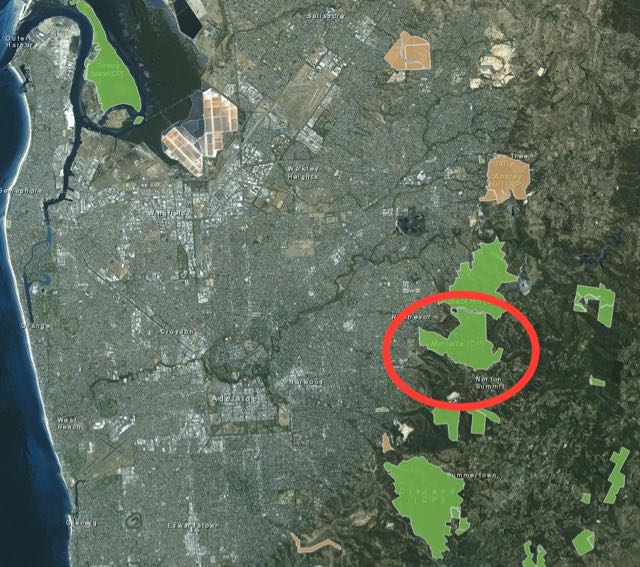
Above:- Map showing the location of Horsnelly Gully CP. Image courtesy of Location SA Map Viewer.
Horsnell Gully Conservation Park is an adjacent park to the Giles Conservation Park. Both the Heysen Trail and the Yurrebilla Trail wind their way through both parks. Horsnell Gully Conservation is located about 10 km east of Adelaide and was set aside in 1964 as a Conservation Park to conserve native vegetation in the Adelaide Hills Face Zone. The park contains a number of rare and endangered plant species. The park was named after the State Governor’s coachman, John Horsnell. Coach Road was once the principal road into Adelaide from the east during the 1870s and 1880s. There was a coach gate located on the highest point of ‘Coach Hill’, which is known today as the suburb of Skye. The driver blew a trumpet to let the settlers know that he had been through the gate and that they had to climb up to close the gate.
Above:- The location of Giles and Horsnell Gully Conservation Parks. Image courtesy of Google Earth.
I set up at the end of Coach Road. There is no through road from here down to Skye. But there is a nice parking spot and a clearing amongst the scrub making it an ideal location to activate from the park. Don’t be put off by the nearby power lines. I have operated from here previously and did not experience any issues. Nor did I on this occasion.
Above:- Image showing my operating spot in the south eastern corner of the park off Coach Road.
Image courtesy of Google Earth.
I headed for my nominating operating frequency of 7.144, but 7.145 was occupied by some European DX. In fact the 40m band was very active with lots of good signals coming in from Europe. I found 7.135 clear and asked if the frequency was in use. Steve VK3HK mobile came back to my call, advising that he had been calling CQ there but did not have any takers. Steve kindly allowed me to use the frequency and I called CQ and this was responded to by John VK5BJE, followed by Col VK5HCF in the South East, and then Roy VK5NRG.
The band was in very good shape, with strong signals from all around Australia and New Zealand. I worked a total of 57 stations from VK1, VK2, VK3, VK4, VK5, VK6, VK7, and New Zealand. Regular park hunter, Ken ZL4KD called in to say hi, along with his wife Margaret ZL3YF.
Unfortunately I did not get time to try 20m. I was kept very busy on 40m, and by the time callers slowed down, it was getting dark and very cold. So it was time to pack up and head home.
The following stations were worked on 40m SSB:-
- VK3HK
- VK5BJE
- VK5HCF
- VK5NRG
- VK5FEKH
- VK5EE
- VK5KAT
- VK3AV
- VK5TN
- VK4RF
- VK4HA
- VK1NAM
- VK5NJ
- VK3PF
- VK3FQSO
- VK5FMJC
- VK5FFAA
- VK4FFAB
- VK5ZAR
- ZL4KD
- VK3PMG
- VK5KDK
- VK5MRE
- VK3HK
- VK1DI
- VK5FMMC
- VK5MCB
- VK2IO
- VK4AAC/5
- VK3HRA
- ZL3YF
- VK4KUS
- VK6MB
- VK2XAB
- VK3IL
- VK5FANA
- VK3FPSR
- VK4MON
- VK4FTWO
- VK4QQ
- VK7MK
- VK3BSG
- VK2BOB
- VK3ZIB
- VK5DF
- VK3FKSA
- VK5KX
- VK4MWG
- VK2NEO
- VK3SOT
- VK2MRX
- VK3FSPG
- VK2WLS
- VK2FMJW
- VK6NU
- VK6APZ
- VK3TKK
References.
Department of Environment and Natural Resources, 2010, ‘Horsnell Gully Conservation park and Giles Conservation Park’.
Giles Conservation Park, VKFF-884
On Saturday 5th September 2015 I activated the Giles Conservation Park, VKFF-884. This was my second attempt at Giles. I operated from the park on 27th August, but the weather and band conditions conspired against me, and I fell short of my required 44 contacts for the World Wide Flora Fauna (WWFF) program. Unlike last time, the weather on this occasion was beautiful with long periods of sunshine.
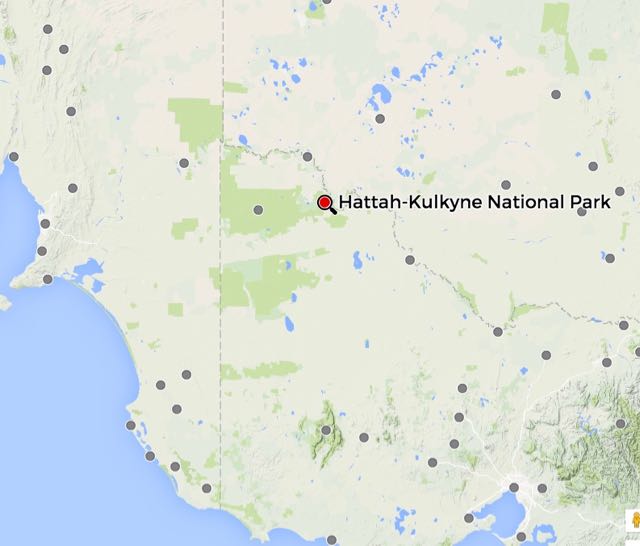
For info on my previous activation, please see…..
On my way to the park I had the IC7000 going in the Toyota Hi Lux and I was lucky enough to get three park activators in the log. The first was Mick VK3PMG (5/7 sent and 5/9 received) who was activating the Ararat Hills State Park, VKFF-958, followed by Tony VK3VTH (5/9 both ways) who was in the Broken Boosey State Park VKFF-752, and then Rob VK4AAC/5 (5/7 both ways) who was activating the Hale Conservation Park, VKFF-889.
Above:- Map showing the location of Giles CP. Image courtesy of Location SA Map Viewer.
I set up on the eastern side of the park, at gate 4 off Woods Hill Road. There was lots of activity in the park with many bushwalkers and joggers travelling passed me whilst I was setting up. Unfortunately this is not the quietest location as Woods Hill Road is quite a busy road between Norton Summit and Ashton. This includes the ‘weekend warriors’ on their high powered Japanese motorcycles, who roar passed the park on the windy stretch of road. There is a sharp right and then left hand bend just above the location where I set up, which then opens up into a short straight stretch, so the motorcyclists really accelerate hard out of those corners. I was waiting for one of them to come off and come sliding through the park fence.
And I didn’t get off to a great start. As I removed the squid pole from the car, with the linked dipole attached to it, both legs of the dipole snapped off due to the weight. So out came the leatherman and with some improvisation, I was very pleased to get the antenna working with a very flat VSWR.
I headed to 7.144 on 40m, my nominated operating frequency and asked if the frequency was in use. Tony VK3VTH came back to me from Broken Boosey State Park, to advise the frequency was all clear, and Tony became my first contact in Giles. This was followed by Mark VK5QI mobile and Gary VK5FGRY mobile, who gave me some directions on how to get to the picnic ground at Horsnell Gully Conservation Park, my next planned activation.
It wasn’t long before a little pile up ensued, with callers from VK2, VK3, VK4, VK5 and VK7. I was very pleased to hear the VK5’s coming though. This was certainly not the case last time I was here in Giles with local propagation being very poor. Eleven QSOs into the activation, and I was called by another park activator, Mick VK3PMG who was portable in VKFF-958. It was nice to speak to Mick from both the mobile and whilst I was in the park.
A handful of QRP stations called in again. They included John VK3FCAN running 5 watts from his Yaesu FT-817 (5/8 sent and 5/9 received); Peter VK3PF running 5 watts from his new Zeus ZS-1 software defined radio (5/3 sent and 5/7 received); Amanda VK3FQO running just 1 watt (5/4 sent and 5/6 received); and David VK3UCD running 5 watts from his little FT-817.
After working a total of 34 stations on 40m, I lowered the squid pole and removed the links and headed to 14.310 on 20m. I could just barely hear Tony VK3VTH calling CQ on that frequency, so I headed up to 14.315 and called CQ. This was immediately answered by Albert S58AL in Slovenia. Sadly, 20m did not appear to be in great shape. Albert did not have his normal strong 5/9 signal but was still a respectable 5/7 signal, with a 5/5 report being returned to me. Not bad, considering I was just running 40 watts and the little dipole. This was followed by S52KM and then John VK5BJE.
I worked a total of 17 stations on 20m from Slovenia, Russia, New Zealand, Italy, Czech Republic, Slovak Republic, VK4, VK5, and VK6. Things were very slow and this was not such a bad thing. I was running a bit late to get to the next park, and I was also being splattered by VK5HX who lives just down the road at Norton Summit.
After about 90 minutes in the park, I had a total of 51 contacts in the log. Combined with my 14 contacts from the August activation, I had well and truly qualified the park for WWFF. So I packed up the gear and headed to my next activation, the Horsnell Gully Conservation Park.
The following stations were worked on 40m SSB:-
- VK3VTH/p (VKFF-572)
- VK5QI/m
- VK5FGRY/m
- VK5SFA
- VK5JK
- VK5FTRG
- VK3FCAN
- VK5KDK
- VK5PL
- VK3TKK
- VK3PMG/p (VKFF-958)
- VK3PF
- VK5HCF
- VK5EE
- VK2NEO
- VK3BSG
- VK3JP
- VK3FPBI
- VK3FQSO
- VK7VDL
- VK4RF
- VK4HA
- VK3ANL
- VK2IO
- VK3ZPF
- VK5BXN
- VK4AAC/5
- VK3AUQ
- VK3SIG
- VK5WG
- VK5ZAR
- VK3UCD
- VK5FLEX
- VK3SOT
The following stations were worked on 20m SSB:-
- S58AL
- S52KM
- VK5BJE
- VK4MWG
- RA3PCI
- ZL4KD
- VK6RZ
- IZ8EFD
- VK6MB
- OK7WA
- IK1GPG
- VK4RF
- VK4HA
- IZ8DFO
- VK6NU
- OM7OM
- VK4PHD
Warren Conservation Park, VKFF-941
This afternoon (Friday 28th August 2015), the weather looked a little more promising than yesterday. Not a lot, but enough for me to brave the cold and head for my planned activation of the Warren Conservation Park, VKFF-941. This was to be another new park for me for the World Wide Flora Fauna (WWFF) program. Although I have been to the park before and activated as part of the VK5 National and Conservation Parks Award. See my previous post…..
https://vk5pas.org/2013/07/24/warren-conservation-park/
Although the weather had improved, the bands had not. There have been a number of Geomagnetic storms over the past few days, making band conditions less than ideal.
Warren Conservation Park is located about 60 km north east of Adelaide in the Mount Lofty Ranges ‘Adelaide Hills’ and is 353 hectares in size. The park is characterised by steep country with views over forests, reservoirs, pastures and bushland above the spectacular Warren Gorge. The park is most colourful in spring when wattles, banksias, hakeas, heaths and eucalypts are in flower. The park has four challenging walking trails, including a section of the long distance Heysen Trail.
Above:- Map showing the location of Warren CP. Image courtesy of Location SA Map Viewer.
I travelled out through Kersbrook and along the South Parra Road, through all the Adelaide Hills countryside that was burnt during the devastating fires at the start of this year. On the way I spoke with Rob VK2QR who was portable on SOTA peak VK2/ SW-012, in the Kosciuszko National Park VKFF-269.
I then turned into Watts Gully Road and then to the end of Woolshed Road which is a dirt road. The park is very visible in front of you as you travel down Woolshed Road. This is a no through road, but there is an area at the end where you can park your car. If you have a 4WD you can drive on a little further. But only try that last section if you have a 4WD! I parked the 4WD and made a short walk into the park.
I found a bit of a clearing and set up the 40m/20m linked dipole, and my little fold up table and chair. I had plenty of onlookers in the form of Western Grey kangaroos. And they seemed quite tame. Not at all put off by my presence.

Above:- Map showing my operating spot. Image courtesy of Location SA Map Viewer.
I started calling CQ on my nominated frequency of 7.144. But things did not look promising. No takers. More CQ calls and no takers. I couldn’t even send out an SMS to some of the regular park hunters, as I had no mobile phone coverage in this part of the park. So I perservered and eventually, Jock VK2EJW came back to my call with a 5/7 signal. But there was lots of QSB on Jock’s signal and I could only manage a 5/2 signal report from Jock.
I continued to call CQ but obviously conditions were very poor as it took a long time before my next contact was in the log. This time I was called by Ron VK3VBI who was a 5/5 with me, with a 3/2 being returned to me. Oh dear!
My third contact was with Mr. Reliable, Rick VK4RF, who was 5/4 and gave me a 5/2. Rick also called under his other call of VK4HA, so that made 4 contacts in the log. But sadly that was the limit to my contacts at that time on 40m. So I lowered the squid pole and removed the links and headed for 14.310 on 20m.
After a few CQ calls on 20m I was called by David VK5PL at nearby Williamstown, followed by Rick VK4RF who had followed me up from 40m. This time Rick was a nice strong 5/8 signal. But not his normal booming 5/9. Clearly the bands were down. I went on to work a total of 4 stations on 20m: David VK5PL, Rick signing as VK4RF and VK4HA, Mike VK6MB who was very weak, and Ralph VK4HR who also called me using VK4KDX.
I tuned around the 20m band and the only signal I could hear was that of UX2IO in the Ukraine who was calling CQ on 14.195. And his signal was quite low down. Certainly not strong enough for me to try for a QSO.
So I headed back to 40m where I put out some more calls on 7.144 and worked 4 more stations in VK1, VK2 and VK5. This included Peter VK2NEO who told me that he could hear Albert S58AL on the frequency calling me. Unfortunately I could not hear Albert, who is a regular park hunter. It was very slim pickings. And tuning across the 40m band did not reveal much activity. I heard no VK signals. But I did hear an Italian station calling CQ on 7.150 and ZL2OK speaking with some UK stations on 7.140.
I decided it was time to pack up. Local time was 2.45 p.m. (0515 UTC), and I had been in the park for about 45 minutes. Conditions were certainly not improving. Unfortunately I had just 14 contacts in the log. I had qualified the park for VKFF, but I was a bit short for qualifying the park for the WWFF global awards. It was slow going out of the park, as you can see from some of the photographs below. There was a lot of kangaroo activity.
I drove back out onto Watts Gully Road, and took the opportunity of stopping at the main entrance to the park. This is part of the Heysen trail, and as I had some time up my sleeve, I went for a walk through the park for about 30 minutes.
The following stations were worked on 40m SSB:-
- VK2EJW
- VK3VBI
- VK4RF
- VK4HA
- VK5NFB
- VK2IO/p
- VK2NEO
- VK1HW
The following stations were worked on 20m SSB:-
- VK5PL
- VK4RF
- VK4HA
- VK6MB
- VK4HR
- VK4KDX
References.
National Parks South Australia, 2015, <http://www.environment.sa.gov.au/parks/Find_a_Park/Browse_by_region/Adelaide_Hills/Warren_Conservation_Park>, viewed 28th August 2015
Giles Conservation Park, VKFF-884
Yesterday (Thursday 27th August 2015) afternoon was one of my 2 days off. I’m back to work tomorrow to work 7 straight day shifts. And of course, the weather is never kind when you’re on days off is it! I had planned to activate two parks, Giles Conservation Park, VKFF-884 on Thursday, and then Warren Conservation Park, VKFF-941, on Friday. I had activated both parks previously as part of the VK5 National and Conservation Parks Award, but both parks were recently added to the World Wide Flora and Fauna (WWFF) program. So I was hoping to obtain the required 44 contacts from each.
Unfortunately Thursday morning’s weather was very grim. The weather forecast was for ‘occasional showers, clearing in the afternoon’. But I am always cautious, because the forecast in centred around Adelaide. And although that it is only 40km away from home, the weather up here in the Adelaide Hills, can be quite dramatically different to that of Adelaide.
So I patiently waited and when the clouds and the drizzle disappeared I hit the road for the Giles CP. It was around 12.45 p.m. South Australian (S.A.) local time I had planned to be on air by 0400 UTC (1.30 p.m. SA local time). Giles CP is about 30 km to the north west of my home (by road). and is a beautiful drive through the Mount Lofty Ranges ‘Adelaide Hills’.

Above:- Map showing the location of Giles CP. Image courtesy of Location SA Map Viewer.
I travelled down the South Eastern Freeway to Crafers and then headed north through the very picturesque Piccadilly Valley and on to the little town of Summertown. I then took Tregarthen Road and then on to Woods Hill Road. I stopped at gate 4 on Woods Hill Road. This is a nice entry point into the park, and forms part of the Heysen Trail.
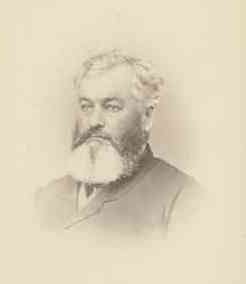
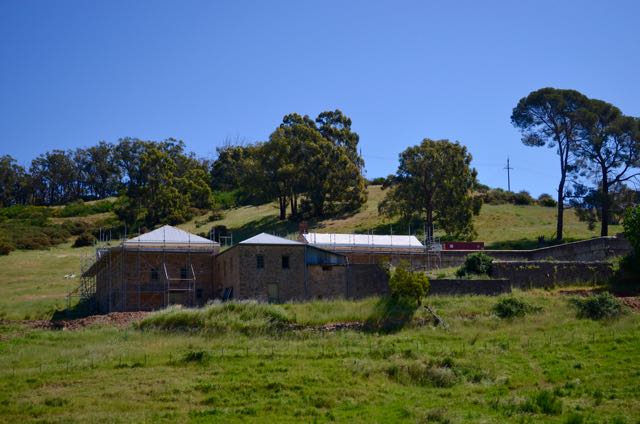
The Giles Conservation Park area was settled by Charles Giles, a pioneer of the horticultural and floricultural industry of South Australia. He purchased the land while living at another property on South Road and walked to the Summit every Monday morning with his week’s provisions, returning home on Saturdays. There was no road up the valley of Third Creek at that time, and to reach his land the creek had to be crossed 21 times. Ruins of the workers’ accommodation huts, once part of an extensive nursery and orchard, can be seen.
Above:- Charles GILES. Image courtesy of Trove
The adjacent Horsnell Gully Conservation Park, including the Giles section, was set aside as a conservation park in 1964 to conserve vegetation associations of the Hills Face Zone, including a number of rare and endangered plants species. In 2007, the eastern section of the park was renamed Giles Conservation Park to honor the Giles family’s historical connections to the park.
For more information on the park, and information on my previous activations at Giles CP, please see…..
https://vk5pas.org/2013/08/04/giles-conservation-park/
https://vk5pas.org/2014/10/18/giles-conservation-park-2/
I set up just inside the park boundary. The weather was looking nasty. Lots of big black clouds. It did not look promising. I set up my fold up table and deck chair and for this activation I used my normal set up consisting of the Yaesu FT-857d, 40 watts and the 40m/20m linked dipole.
I headed to my nominated operating frequency of 7.144 and called CQ. Much to my surprise this was answered quite quickly by Peter VK7ALB with a good strong 5/8 signal from Launceston in Tasmania. This was a good sign. The bands were predicted to be in poor shape, but Albert was nice and strong. But our QSO was dramatically cut short by rain. And it wasn’t just a shower. It was very heavy rain. So I quickly disconnected the radio and made a dash back to the 4WD, where I waited for about 20 minutes until the rain had stopped.
Take two. Back to my operating spot and a quick CQ call which was answered by John VK5BJE, who had been patiently waiting for me. John had a nice solid 5/8 signal. John’s QTH is not all that far away from the park as far as ‘the crow flies’, so it was probably ground wave propagation. Certainly, he was the only VK5 to be found in my log for this activation.
My third QSO was with Peter VK2NEO, south east of Griffith in New South Wales. Peter has one of the loudest signals on 40m. Fourth in the log was Rick VK4RF, who has become a very active participant in the WWFF program and the VK5 Parks Award.
I went on to work just 14 stations on 40m including Andre V51B/VK2. Andrew is holidaying in Australia, and this was the second park in the past couple of weeks that he has called me in. Sadly I had to cut the activation short due to heavy rain. So, no playing on 20m and no 44 contacts. I will have to venture back to this park another day to pick up another 30 contacts and qualify the park for the WWFF global award. Many thanks to all those that called and apologies to those that were after a new park. The weather gods were not smiling.
The following stations were worked on 40m SSB:-
- VK7ALB
- VK5BJE
- VK2NEO
- VK4RF
- VK4HA
- V51B/VK2
- VK2XXM
- VK3FQSO
- VK3DPG
- VK3PF
- VK2AR
- VK3KRH
- VK3MEG
- VK7DON
SOTA Activator certificate
My latest certificate for the Summits on the AIr (SOTA) program is the 250 points Activator certificate.
It has been hard going. Lots of activity in 2013 when I first kicked off in March of that year as an activator, with activations in South Australia (VK5) and Victoria (VK3). And then tapering off in 2014 with activations in VK5, VK3, Germany and Belgium (during my Europe trip). And 18 activations so far this year in VK5, and VK1 (during my visit to Canberra for the WIA AGM).
There are a total of 346 qualifying SOTA peaks in South Australia. And although I live in the Mount Lofty Ranges, there is only one that is close by to me…that being Mount Lofty, VK5/ SE-005, about 15 km west of my home QTH. The next closest is Mount Gawler, VK5/ SE-013, a very popular summit, about 40 km from home. The next closest summits are a minimum of 100 km away.
So if there were a few summits a bit closer, I would be participating a lot more often in this very enjoyable activity of SOTA.