New Belgium WWFF certificate

Today via email I received the certificate below from the Belgian Flora and Fauna Association.  This particular certificate was issued to me for working 10 different ONFF references.  It is Class 3/Bronze.

The next step is Class 2/Silver – 25 different ONFF references, then Class 1/Gold which is 50 different ONFF references.

More information on the ONFFA program can be found at…..

http://www.onff.be/

IVK5PAS 2 (1)

Morialta CP as VI5ANZAC

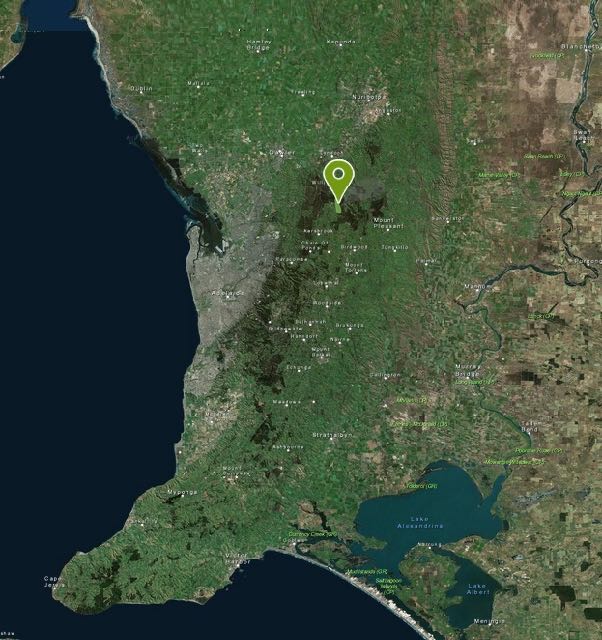
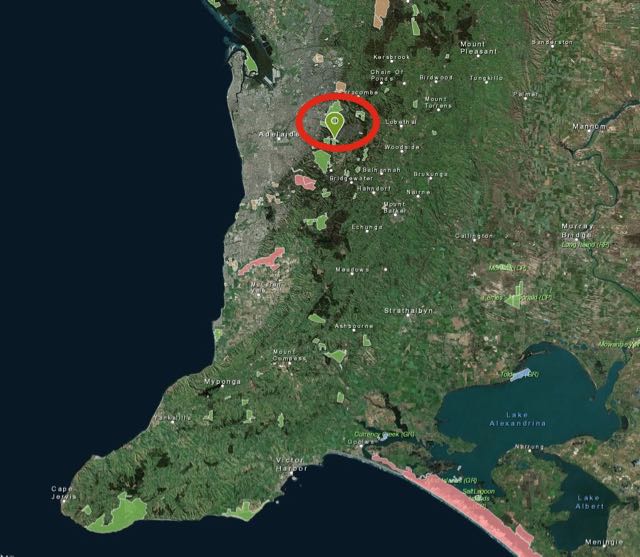
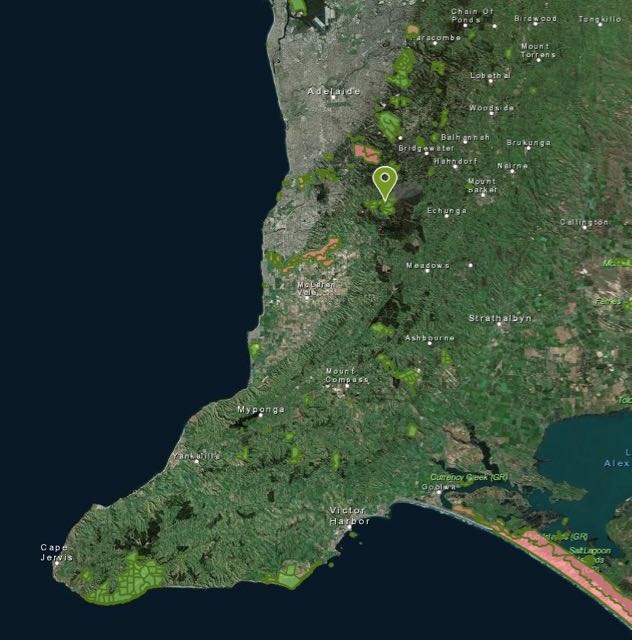
Last night (Tuesday 28th April 2015) after work I headed over to the Morialta Conservation Park which is situated about 10 km east of Adelaide.  I had been kindly asked by Bob VK5FO on behalf of the Amateur Radio Experimenters Group to participate in operating from the park with the special call of VI5ANZAC.

Screenshot 2015-04-29 19.57.17

Above:- Map showing the location of Morialta CP.  Map courtesy of mapcarta.com

Morialta Conservation Park is 533 hectares in size and contains three seasonal waterfalls along Fourth Creek.  The first two falls are the grandest, each cascading over sheer quartzite cliffs after rain.  The park contains a wide variety of wildlife including kangaroos, echidnas and wombats.  For more information on the park, please see…..

http://www.environment.sa.gov.au/parks/Find_a_Park/Browse_by_region/Adelaide_Hills/Morialta_Conservation_Park

The park is celebrating its 100 year anniversary this year.  For more information please see…..

http://www.fobhm.org/morialta100years/

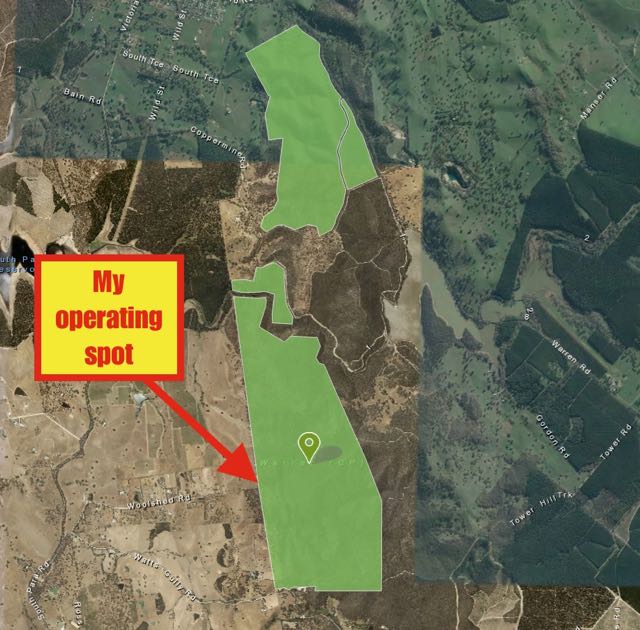
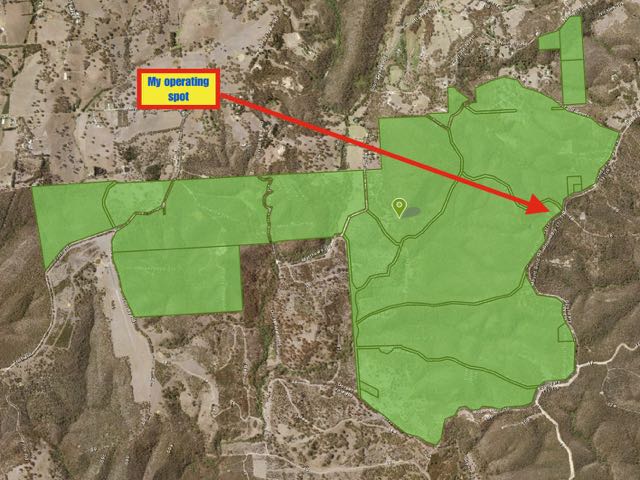
I travelled down towards the end of Moores Road and upon arrival I met up with Bob VK5FO and Gary VK5FGRY who were in the final stages of setting up some antennas.  We were on air just after 6.00 p.m. local time, and it was just after getting on air, that Andy VK5AKH also arrived.  Very soon after, Ray VK5RR also arrived.  Later in the evening Grant VK5GR arrived and operated on 2m and 70cm.

Screenshot 2015-04-29 19.59.00

Above:- Map showing our operating spot.  Map courtesy of mapcarta.com

We operated for just over 3 hours on 160m, 80m, 40m, 20m, 2m & 70 cm and logged 73 contacts.  It was quite slow going on all of the bands, but despite this all signals were quite good.  Equipment used were two Elecraft KX3 transceivers and a selection of dipole antennas.

The evening’s activation qualified for both the VK5 National and Conservation Parks Award and the World Wide Flora Fauna (WWFF) program.

More details can be found on Bob VK5FO’s site at…..

http://vk5fo.com/314/vi5anzac-activation-report

And also at the AREG site at……

http://www.areg.org.au/?p=1229

This slideshow requires JavaScript.

Monarto Conservation Park VKFF-828

Late yesterday afternoon (Sunday 26th April 2015) I rushed home from work (obeying the speed limit) and packed the 4WD and headed down the road to the Monarto Conservation Park, VKFF-828.  I have activated this park many times before but I wanted to activate the park with the special AX prefix for the ANZAC Day weekend.

Screenshot 2015-04-27 19.34.22

Above:- Map showing the location of Monarto CP.  Map courtesy of mapcarta.com

I was hoping to activate the Belair National Park on Saturday after work, but the weather all day on Saturday was terrible.  We had lots of rain both in Adelaide and up in the Mount Lofty Ranges.  Fortunately the rain had cleared by Sunday afternoon, so all systems were go.

For this activation I used my Yaesu FT-857d and the 40m/20m linked dipole on the top of the 7 metre squid pole for this activation.  I set up in my usual spot, the north eastern corner of the park, just off Ferries McDonald Road.

Screenshot 2015-04-27 19.35.04

I was set up in the park ready to go by 4.30 p.m.  I struggled to find a clear frequency on 20m as there was a JA Contest running and the JA stations were very strong and were spread across the 20m band.  But I did eventually find 14.274 clear and started calling CQ there.  My first taker was John VK5BJE in the Adelaide Hills.  John had responded to an SMS message I had sent out to some of the keen VK5 Parks hunters.  The SMS alerting system that I employ seems to work very well.  This was followed by Rod AX2TTL and then my first DX contact Xaver DK4RM in Germany, followed by Swa ON5SWA in Belgium.

I was kindly spotted on the DX Cluster by some of the DX stations and this resulted in a steady flow of callers from Europe, North America, and Japan.  Unfortunately after operating for about 15 minutes a JL1 station came up 1 kc below me and started calling CQ Contest, and this resulted in a lot of QRM and made it incredibly difficult to pick out anybody who did not have a strong signal.

But I boxed on and managed 33 contacts, before having a tune around the 20m band and found VI4AE2 calling CQ on 14.269.  This was a special call for the ANZAC commemorations, particularly to commemorate the service of the officers and sailors aboard the Royal Australian Navy submarine HMAS AE2 who fought gallantly in the Dardanelles and Sea of Marmora for just 5 days before being blown to the surface by the Turkish torpedo boat Sultanhisar.

VI4AE2_HMAS_AE2_OPS_CAPT

I then headed up to 14.310 and started calling CQ DX again.  My first contact there was with John VK2FR, followed by UR7ET in Ukraine, and then Pehr OH6IU.  I was kindly placed on the DX cluster by Albert S58AL and this resulted in many of the European park hunters giving me a call.  I worked a total of 15 stations in Europe, USA, and Canada on this frequency until being pushed off the frequency by another contester.

So I tuned around the band and found VI6ANZAC calling CQ on 14.145.  It was great to get a second ANZAC special event call in the log and it was certainly  a very strong signal coming in from Western Australia.

I then lowered the squid pole and put the links in on the 40m/20m linked dipole and found 7.150 clear.  I asked if the frequency was in use and before I even got the opportunity to call CQ, I was called by Paul AX5FUXX at Wellington on the Murray River.  This was followed by Adrian AX5FANA on the Yorke Peninsula, and then Tony AX5FTVR at Strathalbyn.

I worked a further 31 stations in VK2, VK3, VK4, VK5, VK6 & VK7.  It was pleasing to see a number of the VK’s using the special AX prefix for the ANZAC Day weekend.  We only get to use the special AX prexix, three times a year: Australia Day, ANZAC Day, and World Telecommunications Day.

I have a special AX prefix ANZAC Day QSL card on offer.

  • For VK stations, please QSL Direct to PO Box 169 Mount Barker SA 5251.  Please include a stamped self addressed envelope.
  • For DX, please QSL via my QSL Manager, M0OXO.

AX5PAS_3

After sitting in the park for about 2 & 1/2 hours I had a total of 84 stations in the log, including 42 DX contacts.  Again it was very pleasing to get a handful of calls from the USA and Canada.

The following stations were worked on 40m SSB:-

  1. AX5FUZZ
  2. AX5FANA
  3. AX5FTVR
  4. AX5FDEC
  5. AX6VSH
  6. AX5NIG
  7. AX3FASW
  8. VK5FCDL
  9. VK3PMG
  10. VK3YJK
  11. VK2YK
  12. VK2VIM/4
  13. VK3HJD
  14. VK3HRA
  15. VK5ZEA
  16. VK5LI
  17. VK5NPP
  18. AX4TE
  19. VK3LJ
  20. AX2JCC
  21. AX3BBB
  22. VK3DAC
  23. VK4FBMW
  24. AX3ANL
  25. AX4QQ
  26. VK3FNCE
  27. VK7ROY
  28. VK2UW
  29. VK2PV
  30. VK5MJ
  31. AX3PF
  32. VK6MB
  33. VK3OF
  34. VK2FMIA

The following stations were worked on 20m SSB:-

  1. VK5BJE
  2. AX2TTL
  3. DK4RM
  4. ON5SWA
  5. VK6EY
  6. IK1GPG
  7. I5FLN
  8. F2YT
  9. S58AL
  10. IZ2FOS
  11. DF1YQ
  12. ON6PV
  13. DF9OO
  14. PB5X
  15. DL2ND
  16. G0RQL
  17. S52KM
  18. W1OW
  19. ON5JE
  20. IW1PNJ
  21. DL4PT
  22. HB9QT
  23. EA1DR
  24. DL5WW
  25. S58N
  26. SP6KEP
  27. DL5EBG
  28. ON4VT
  29. DL5MEV
  30. EA3MP
  31. OH6RP
  32. DD2VO
  33. UT5PI
  34. VI4AE2
  35. VK2FR
  36. UR7ET
  37. OH6IU
  38. EA2DT
  39. VE7CV
  40. F1BLL
  41. WB8FSV
  42. ON7AB
  43. JH7WER
  44. RA3PCI
  45. AX2IO/m
  46. EA3GP
  47. DL1EBR
  48. EB1CAM
  49. AX2QO
  50. VI6ANZAC

Chasing parks and summits from home as AX5PAS

This afternoon I hurried home from work and quickly changed out of the suit into my tracksuit pants and headed for the shack to operate with the special AX prefix to commemorate ANZAC Day.  In Australia we only get to use the AX prefix three times a year:

  • Australia Day
  • ANZAC Day
  • World Telecommunications Day

ANZAC Day is held each year on the 25th April, which is the anniversary of the landing of the ANZACS at Gallipoli.  But ANZAC Day is bigger than just Gallipoli.  It is the day on which we remember all Australians who served and died in all wars, conflicts, and peacekeeping operations.  Contrary to concerns a number of years ago that ANZAC Day was going to die a slow natural death, renewed interest in this very special day has boomed.  It is now arguably one of the most important days on the Australian calendar.  It also has great significance to our friends in New Zealand.

For more information on ANZAC Day please have a look at the following……

https://www.awm.gov.au/commemoration/anzac-day/

Below is my ANZAC Day card for AX5PAS.

AX5PAS_3

I was hoping to activate the Belair National Park today but the weather was terrible.  It was raining here for most of the day, making portable activity virtually impossible.  Plus I was working dayshift today, so by time I finished work it was getting a little late.  So I decided to do some operating & chasing from home.

I jumped on to 20m first and worked quite a bit of DX, ending up with a mini pile up.  The AX prefix was in high demand as usual.  But when things got a little quiet, I took the opportunity of having a look around the bands.  I had been closely watching the DX cluster and had seen a number of park & SOTA operators spotted on the cluster.

My first park contact was with Franck F4DTO/p who was portable in FFF-300, a new park.  It was a little hard too copy Franck at times as the static crashes were very strong.  In fact they were over S9 at times.  But we managed to make it and Franck gave me a 5/7 signal from France.

IMG_7293

My first Australian SOTA contact of the afternoon was with Andrew VK1DA who was operating with the special call of VK100ANZAC from SOTA peak Mount Ainslee, VK1/ AC-040.  Andrew had a very strong 5/9 plus signal.  Mount Ainslee is 843 metres above sea level and is with 1 SOTA point.

This was followed by a SOTA contact on 15m with John VK6NU who was operating with the special call of VI6ANZAC from SOTA peak, Mount Randall, VK6/ SW-039.  John had a nice moderately strong 5/7 sign coming in from Western Australia.  Mount Randall is located in the South West region of Western Australia and is 523 metres above sea level.  It is worth 2 SOTA points.

My first DX SOTA contact for the afternoon, was on 20m and was with Mike 2E0YYYY/p who was on the top of SOTA summit, Bardon Hill G/ CE-004.  Mike was coming in beautifully on the long path, a genuine 5/8.  I received a 5/9 signal report in return from Mike.

Bardon Hill is 278 metres above seal level and is worth 1 SOTA point.  It is located in the Central England Region and is a former volcano.  The name Bardon is derived from ‘bear den’.  It is reported that the last bear in England was killed here.  More information on the summit can be found at…..

http://en.wikipedia.org/wiki/Bardon_Hill

When I finished working Mike he asked me to stand by as he had company on the summit.  I then worked Rob G7LAS/p who had a nice 5/8 signal.

Farmland_near_Appleby_Parva_-_geograph.org.uk_-_746255

Above:- Bardon Hill.  Photo courtesy of en.wikipedia.org

My next SOTA summit contact was on the 10m band, with Herbert, HB0/OE9HRV/p portable on SOTA summit, Helwangspitz, HB0/ LI-011.  The summit is located in the Raitkon range in Leichtenstein and is 2000 metres above sea level.  It is worth 8 SOTA points.

Screenshot 2015-04-25 23.00.20

Above: Helwangspitz.  Image courtesy of OE5HCE

The cluster was alive with a number of SOTA and park activators.  However, the static crashes were very severe making it incredibly difficult to hear many of them.  And sadly, those that I did hear, were only working fellow Europeans.  The ‘EU wall and the static crashes made things less than ideal.  It was quite frustrating, as I had not seen for some time, so many WWFF & SOTA activators up on the bands at the same time.

You can see below, where all the noise was coming from.  Huge storms in New South Wales.  The images are courtesy of weather zone.

But on a positive note, I did work a handful of the special ANZAC Commemorative call signs:-

  • VI4AE2
  • VI6ANZAC (John VK6NU – SOTA)
  • VK100ANZAC (Andrew VK1DA – SOTA)
  • VI5ANZAC

After tea I worked a number of VK stations hoping to get the AX prefix award on offer by the WIA.  With the special event stations in my tally, I managed to get over the 100 point line.

http://www.wia.org.au/newsevents/anzaccentenary/axaward/

I then booked in to the Southern Cross DX Net and worked  number of USA stations.  But the most interesting contact on the net was with George HP/KC0GP who was maritime mobile on the ‘Carnival Magic’ in Panama 5/7 both ways).

carnival_magic_slider1

Image courtesy of directlinecruises.com

References.

Wikipedia, 2015, <http://en.wikipedia.org/wiki/Bardon_Hill&gt;, viewed 25th April 2015

Wikipedia, 2015, <http://en.wikipedia.org/wiki/Helwangspitz&gt;, viewed 25th April 2015

Riverland Radio Club get together

On Saturday morning (18th April 2015) after a nice hot coffee in the motel room at Barmera, Marija and I got on the road and headed off to the historic Overland Corner Hotel where the Riverland Radio Club were holding a get together.  It was a very cold morning, but fortunately there was no rain.  We had a nice view out across Lake Bonney from our motel room which was the Barmera Lake Resort.  We were quite refreshed as we had a relatively early night on Friday night.  We had dinner at the Barmera Hotel which we can highly recommend, and then spent the remainder of the night in the motel room watching the AFL footy on TV.

This slideshow requires JavaScript.

It is a short 29 km drive out to Overland Corner from Barmera.  We travelled out of Barmera along the Morgan Road and then turned on to the Goyder Highway and headed west.  We then took the turn off to the hotel which is Old Coach Road, and travelled along the dirt down towards the hotel.  As it was early in the morning (7.00 a.m.) the kangaroos were out in force, so it was pretty slow going.  In fact at one stage we had a Western Grey kangaroo bounding alongside of the 4WD who then decided to jump in front of us and slipped on the road surface directly in front of us.  No damage done to the vehicle or the kangaroo I am pleased to report.

Screenshot 2015-04-22 09.44.13

Above:- Map showing the location of the Overland Corner Hotel in the Riverland.  Map courtesy of mapcarta.com

The New South Wales gold rush struck in 1851 and there was a large movement of people heading north to the goldfields via the Overland Corner area.  And then two years later, river trade commenced with the first wood fueled paddle steamers coming through.  It wasn’t long before a large woodpile was being maintained at Overland Corner.

Due to the increasing population in the area, a number of cattle duffers, escaped convicts and a handful of bushrangers, the South Australian Government established a small police post at Overland Corner in 1855.

The Overland Corner Hotel was built in 1859 and is the oldest surviving building in the Riverland region of South Australia.  The pub’s original construction was almost entirely of locally available materials, including limestone, red gum and native pine timbers, a dirt floor and thatched roof of river reeds.  The hotel was initially a little rough bush inn and was situated on a vital stock route from New South Wales.  It catered to drovers, explorers and other travellers.  The limestone used for the construction of the hotel was 15 million year old limestone from the nearby quarry.

The Brand Brothers, Henry, William, George, and James, who emigrated to Australia from Kent in England in 1851, were commissioned by John Chambers, the enterprising pastoralist, to build the Overland Corner.

The hotel became a staging point for mail coaches on the run between Wentworth in New South Wales, and South Australia.  The first publicans licence was issued in April 1860.   By the mid 1860’s, grape vineyards and garden produce was being grown on the rich alluvial river flats, and Cobb & Co coaches stopped at Overland Corner.  Business was booming, and during the 1870’s a number of other buildings were established, including a wheelwright and blacksmith, a post and telegraph office, and a new police station.

In about 1879 an underground tank was dug and it was discovered that there was an old aboriginal burial ground 3 metres beneath the building.

The Overland Corner Hotel was purchased by the National Trust of South Australia in 1965.

overland cnr pub

Above:- The location of the Overland Corner Hotel in close proximity to the River Murray.  Image courtesy of mapcarta.com

There is a very interesting marker on one of the outside walls of the hotel showing the water level during the 1956 Murray River flood.  This flood occurred due to higher than average rainfalls in Western Queensland and heavy rains in the proceedings three months in Murray catchment areas.  The river peaked 12.3 metres at nearby Morgan.  Some areas were flooded up to 100 km from the natural flow of the river.  peaked at 18.01 metres at Overland Corner.

There is a very good walking trail that takes in the hotel and many of the historic areas nearby, but unfortunately Marija and I didn’t have enough time to do this.  But we will be back.

This slideshow requires JavaScript.

When we arrived at the hotel at about 7.15 a.m, there was already a small but very keen gathering of amateurs and their wives.  Ivan VK5HS had the BBQ going and was cooking up some sausages and bacon and eggs.  So after some introductions to those that were already present, we enjoyed a very nice bacon and egg sandwich and a nice hot coffee.  We then took the opportunity of getting a group photograph of this keen early morning bunch.

This slideshow requires JavaScript.

As the morning progressed, more and more amateurs and their wives arrived at the Overland Corner Hotel.  There was also a wedding planned later for that day.  None of our group either!  So there was quite a bit of activity getting the marquee at the back of the hotel prepared.

At 8.30 a.m. local time, Ron VK5MRE fired up the radio and kicked off the Saturday morning net for the Riverland Radio Club on 7.078 on 40m.  A small marquee had been erected just on the western side of the hotel and this is where Ron ran the net from.  A number of us who were at the gathering had the mic handed over to us for a round on the net.

This slideshow requires JavaScript.

At the conclusion of the net, I fetched myself another cup of coffee.  It was still pretty chilly.  I also took the opportunity of having a bit of a walk around the hotel which certainly contains a lot of history.  It was particularly interesting to view the marker on the hotel’s outside wall for the 1956 flood.  If we had been there back in 1956, we would all be underwater and blowing bubbles.

This slideshow requires JavaScript.

Shortly after the conclusion of the net, a small car boot sale was held.  Marija was closely watching me to ensure that I wasn’t spending any $$$.  Although I was very tempted by an old Communications receiver being sold by Adrian VK5AJR.  Ron VK5MRE also had a very well kept Yaesu FRG7 communications receiver up for bids as well.

This slideshow requires JavaScript.

We then had a bit more of a chat with more arrivals at the get together, and at 11.00 a.m. the hotel opened up, so Marija and I took the opportunity of having a look through this very historic hotel.  There is a small room which contains a large amount of memorabilia.  There was even an olf CW key in there.  After we had finished looking through the hotel, I broke the ‘midday rule’ and ordered a can of Bundy and coke.

This slideshow requires JavaScript.

A lot of people had arrived by this time, and with some significant amount of organisational skills by Ron VK5MRE and Marija, we managed to get everyone in place for a group photograph in front of the hotel.

This slideshow requires JavaScript.

We all then enjoyed a very nice meal out in  the beer garden alongside of the hotel.  I had a schnitzel which I must stay was one of the nicest ‘Schnitties’ I had in a long time.  It was a beautiful sunny late morning/early afternoon at times, and in fact I had to choose a nice shady spot to get out of the sun.

This slideshow requires JavaScript.

Time was marching on and it was almost 1.30 p.m.  I had posted on parksnpeaks and the VK5 Parks Yahoo group that I was going to activate the Pooginook Conservation Park and the Murray River National Park that afternoon.  So it was time for Marija and I to say our goodbyes and hit the road.   Pooginook Conservation Park, was about 23 km west of Overland Corner, along the Goyder Highway, so as much as I would have liked to have stayed a bit longer, we really needed to make a move.

After leaving the hotel, we took a quick photo opportunity stop on the dirt road.  It was a nice view back to the south west overlooking the hotel itself and the Murray River.  When we hit the bitumen on the Goyder Highway, we took a quick stop to have a look at the old Overland Corner cemetery, and from there, briefly stopped again on the southern side of the Goyder Highway to view the hotel and Murray River.  This spot sits up quite high, so the view to the south was quite spectacular.

This slideshow requires JavaScript.

This get together was a very enjoyable morning and afternoon.  It was great to put a face to the call sign of many amateurs that I had spoken to many times over the years.  I certainly hope this is going to be an annual event held by the Riverland Radio Club.

References

Barmera Visitor Information Centre, ‘Historic Overland Corner’.
Brookfield Conservation Park, VKFF-822

On Friday 17th April, my wife Marija took an early minute from work and I took a PDO from work, as we intended to travel up to Barmera in the Riverland region of South Australia, where had booked in to the Barmera Lake Resort for 2 nights.  Why were we heading up there?  Well, the Riverland Radio Club had organised a get together at the historic Overland Corner Hotel on Saturday 18th.
We left home at about 2.30 p.m. and travelled east to Murray Bridge and then north through the little towns of Cambrai and Sedan on Ridley Road.  We continued north on the Blamchetown Road until we reached the Sturt Highway.  This is the busy highway which links the Riverland region of South Australia with Adelaide.

The weather was not looking good.  It was pouring with rain as we left the Adelaide Hills, and the rain continued, although much lighter as we headed into the more desolate areas of the Murray Mallee.

We took a short stop here at a locality called Annadale, to have a look at the old site of the hotel at Annadale, which operated between 1876-1956.  There is nothing left now, but I could only imagine the number of beers that were drunk in that pub over the years on this busy stretch of road.

DSC_0002We then took a short stop a bit further up the road to view a monument relating to Goyders Line.  Monuments to Goyders Line can be found throughout South Australia.  In 1865, Surveyor General, George Woodcrof Goyder marked on the map of South Australia, a line delineating drought affected country.  The line which passes through the area on the Sturt Highway became an important factor in settlement in the State, being regarded as an indicatio of the limits of lands considered ‘safe’ for agricultural development.

We continued east on the Sturt Highway and stopped at the Brookfield Conservation Park for what was to be a quick activation.

Screenshot 2015-04-20 09.51.47

Above:- Map showing the location of Brookfield CP.  Map courtesy of mapcarta.com

Brookfield Conservation Park is a large park and consists of 5,534 hectares.  It is located about 130 km north east of Adelaide.  The park was a gift to South Australia from the Chicago Zoological Society to conserve the Southern Hairy-nosed Wombat, which is the South Australian fauna emblem.  The park is also home to Fat-tailed Dunnarts, Western Grey kangaroos, echidnas, emus, and Red Kangaroos.  There is prolific bird life in the park including the rare Bush Stone-curlew, the nationally vulnerable Malleefowl, Ground Cuckoo-shrikes and Australian Owlet-nightjars.  Another striking bird that is found in the park is the White-winged Fairy-Wren, which is an amazing blue in colour.  The park also contains a large variety of reptiles.  The park itself is gently undulating limestone country.

Screenshot 2015-04-20 11.54.58

Above: The very colourful White-winged Fairy-Wren.  Image courtesy of http://www.conservationvolunteers.com.au

The park was originally a sheep station known as Glen Leslie Station.  But in 1971 the property was purchased by the Chicago Zoological Society for conservation of the Southern Hairy-nosed Wombat as mentioned above.  The park was originally named the Brookfield Zoo Wombat Reserve, and it was gifted to the Government of South Australia in 1977.  The park was proclaimed as the Brookfield Conservation Park, two years later, in 1978.

The park is now managed by Conservation Volunteers Australia (CVA) who undertake a range of volunteer activities both in the park and in the surrounding area.  The CVA have a focus on the research of threatened species.

Access to the park can be made by conventional vehicle, however some areas are restricted due to research on the Southern Hairy-nosed Wombat.  As Marija and I had a time limit, and the fact that the weather was lousy, we pulled in to a rest stop area and parked the car there.  I then jumped over the wire fence and set up the fold up chair and table, using one of the fence posts as an anchor point for my 7 metre telescopic squid pole.

Screenshot 2015-04-20 09.52.20

Map courtesy of mapcarta.com

For this activation I ran the Yaesu FT-857d powered by the 44 amp hour power pack, and the 40m/20m linked dipole supported on the top of the 7 metre squid pole.  I used 40 watts on 40m, and when I headed over to 20m, my output power was a huge 70 watts.

This was also the noisiest activation I have ever undertaken.  We were only a short distance from the busy Sturt Highway so we had to endure the constant noise of the Highway traffic, including the big B double trucks. For those overseas that might be reading this, a B-double is made up of a prime mover which pulls two semi trailers, which are linked by a fifth wheel and can be up to 26 metres long.

I headed up to 7.144 and called CQ.  I was asked during this activation and a few times later in the weekend, as to why I was operating on 7.144

My first contact was with Adrian VK5FANA at Arthurton on the Yorke Peninsula, following by Graham VK5GW, Mick VK3PMG at Stawell in western Victoria, and then Ivan VK5HS at nearby Renmark.   About ten minutes into operating, I started experiencing some QRM from 7.146.  I tuned up there to hear that it was a net, and it was very clear that they were not going to move.  So I decided not to push the issue and took the opportunity of QSYing to 20m.  I am sorry to those that were still calling, but the QRM was just too bad and I was running low on time.  I had 18 contacts in the log from VK1, VK2, VK3, VK4, & VK5.

I called CQ on 14.311 and this was pretty much immediately answered by Dick VK7LDK, followed by Albert S58AL.  A mini pile up ensued with a number of callers from Europe, the UK, the Caribbean, and North America.  I even managed to work my very good mate Marnix OP7M in northern Belgium (5/9 sent and 5/8 received).

This slideshow requires JavaScript.

So, after a little longer than expected in the park, I had a total of 63 contacts in the log, including 42 DX stations from Slovenia, Puerto Rico, Italy, Belgium, Spain, France, England, Slovak Republic, Germany, Romania, Ireland, Ukraine, Hungary, and Alaska.

I know that there was still a huge number of stations calling when I went QRT.  But I am terribly sorry, as it was starting to drizzle with rain again, and it was getting dark.  We were also running very late to get to our destination at Barmera.  So I again apologise to those that were calling and didn’t manage to get Brookfield Conservation Park in the log.

The following stations were worked on 40m SSB:-

  1. VK5FANA
  2. VK5GW
  3. VK3PMG
  4. VK5HS
  5. VK3OHM
  6. VK2NEO
  7. VK5ZAR
  8. VK5FCHM
  9. VK3HRA
  10. VK1DI
  11. VK1NAM
  12. VK5HAG
  13. VK3AV
  14. VK2FMIA/p
  15. VK5NQP
  16. VK5ZLR
  17. VK4FFAB
  18. VK3DBP
  19. VK7LDK

The following stations were worked on 20m SSB:-

  1. S58AL
  2. PA3EPA/VK6
  3. UT5PI
  4. KP4CAR
  5. I5FLN
  6. IZ0UIM
  7. IZ1JMN
  8. OP7M
  9. IZ2IHO
  10. IZ5JMZ
  11. OP4U
  12. IK1GPG
  13. ON4VT
  14. EA4DTV
  15. IK1DFH
  16. F5OUD
  17. G3SVD
  18. EA1DR
  19. VK2IO
  20. ON5SWA
  21. OM7OM
  22. DF1YQ
  23. YO8TK
  24. IZ1UIA
  25. HA8CE
  26. EA3MP
  27. IK2YXH
  28. EI8BLB
  29. UR7ET
  30. DF7GK
  31. IZ5YHD
  32. IT9UCS
  33. IK2TTJ
  34. EA4JJ
  35. HA0LG
  36. EC7DZZ
  37. EA1DFP
  38. F6EAS
  39. HA0IH
  40. DL1EBR
  41. F2YT
  42. AL7KC
  43. IW2NXI
  44. F8GQO

References.

Conservation Voilunteers, Brookfield Conservation Park-At the Edge

Department of Environment and Natural Resources, Parks of the Riverland.

National Parks South Australia, 2015, <http://www.environment.sa.gov.au/parks/Find_a_park/Browse_by_region/Murray_River/Brookfield_Conservation_Park&gt;, viewed 20th April 2015

An afternoon with Larry VK5LY

Yesterday (Friday 10th April 2015), I headed down to the Hampstead Rehabiliation Centre to catch up with my old mate Larry VK5LY.  Larry is very ill, and is recovering from major spinal surgery.

The afternoon was all about getting Larry up on air.  He is sadly missed from the airwaves, and all those that know Larry, know that he was a very active VK5 Parks activator before his very unexpected illness.  And I know that when Larry returns home in a few weeks from hospital, it will be very hard to keep him out of those Riverland parks.

We headed out to a nice little lawned area just a short distance from Larry’s room.  It was a beautiful sunny afternoon, and we had access to a nice shady spot on the lawn.  For this activation we used my Yaesu FT-857d and my 40m/20m linked dipole.  I even had the solar panels out to charge up the 44 amp hour power pack.

Larry’s first call was from Tom VK5EE down at Mount Gambier, followed by Adrian VK5FANA in the Yorke Peninsula, and then Larry’s great mate, Ivan VK5HS in The Riverland.  The first three callers were from various parts of country South Australia.  Larry had a steady flow of callers, including David VK5KC who was mobile in Victoria.  And Larry also scored two park contacts.  The first being with Gordon VK5GY in the Mount George Conservation Park in the Adelaide Hills, and then Mick VK3PMG in the Mount Arapiles State Park.

This slideshow requires JavaScript.

Larry ended up with a total of 15 contacts in VK1, VK2, VK3, & VK5.  Not bad at all considering this was a Friday afternoon.

Thanks to everyone that called.  I will be activating with Larry again in the very near future.

Larry worked the following stations:-

  1. Tom VK5EE
  2. Adrian VK5FANA
  3. Ivan VK5HS
  4. Gordon VK5GY/p (Mount George Conservation Park)
  5. David VK5KC/3
  6. John VK5BJE
  7. Mick VK3PMG/p (Mt Arapiles State Park)
  8. Andrew VK1NAM
  9. Arno VK5ZAR
  10. Tony VK3CAB
  11. Nev VK5WG
  12. Fred VK3DAC
  13. Paul VK3DBP
  14. Rod VK5VRB
  15. Andrew VK2UH


Operating Practice

A few days ago I saw a few posts on the Summits on the Air (SOTA) Australian Yahoo group about “SOTA activators pile up process“.  I assume these comments were a spin off to last weekend’s SOTA Spring activation weekend.  Personally, I did note a few SOTA activators not listening for QRP and mobile portable, etc, and just working the big guns.  However the majority of activators are very good.

What was more noticeable over the weekend was that there was at times some poor operating practice by SOTA chasers and park hunters.  The good operators were fortunately by far in the main, but netherless the occasional poor operating practice by some was annoying.

Here are some of my thoughts.  I am not professing to be the world’s best operator.  Far from it.

A few stations have got into the habit of calling between overs.  In other words I am in contact with VK5AA and putting it back to them for their final over, and a cheeky station calls in between overs with their call sign.  Not wanting to wait for the QSO to finish and join the other paitently waiting chasers and hunters.  I have now decided to ignore those stations.  They are simply queue jumpers.  I was questioned by a senior ham over the weekend as to why I had not acknowledged him when he did exactly this.  So please, if you are reading this and are guilty of queue jumping, please cease this practice.  Please WAIT until the QSO is completely finished.

And there are still those out there, that come up on frequency, without asking if the frequency is in use, and take over a frequency.  This happened to me a few times over the weekend.  Clearly they couldn’t hear me.  I understand that.  But to come up on frequency without asking if the frequency is in use, is just rude.  And those operators were quickly told by the chasers and hunters that I was working.

bombardment-clipart-angry_man

As for activating, this is what I TRY to do:-

  • call for any SOTA/park activators first
  • THEN…..QRP stations
  • THEN…..portable or mobile stations
  • THEN…..DX
  • THEN…..stations who can hear me, but with difficulty
  • THEN…..anybody/everybody else (now the fun starts)

Now that doesn’t always work out in practice.  Because I often find that when I ask if a frequency is in use, there is already a large crowd waiting for me, and I invariably hear, ‘no the frequency is all yours Paul‘, and then it is ‘swing into action’ time.  However, I always break from the crowd, every 10 minutes or so and call for the S2S and park to park contacts, then QRP, then portable and mobile.  If you do, it is amazing who you get in the log.

When I activated Newland Head Conservation Park earlier in the year as part of the VK5 Parks anniversary weekend, I was operating right on the beachfront, with the Southern Ocean spray on my face.  When I returned home a day or two later, and was checking my emails, I read with interest that some of my mates in Europe had written that they could hear me on 40m ssb in Europe, but couldn’t get through the VK pile up.  What I learnt from this, is that you never know who is listening.  So call for DX, you might be surprised.  Certainly if you get onto 20m from a WWFF park, there won’t be any shortage of DX callers.

And when I mention above, ‘stations who can hear me, but with difficulty’, I am sure you have heard SOTA & park activators who drift in and out with the QSB.  It is incredibly frustrating as a chaser/hunter, when the signals of these stations come up out of the noise, but they are only listening for the big guns.  So if you are an activator, please try calling for these stations as well.  I am sure those chasers and hunters will be pleased if you do.

I also tell the callers to spread out their calls, rather than calling all at once, over the top of each other.  I jot down the calls I hear and acknowledge that I have received them, and then bring them in and work them in, in the order I hear them.  It seems to work well.

Suggestions for DX Pile-ups………… by Uncle DX

1. The DX station operators are in charge of any pile-up.

2. The DX station should make and adhere to their operating rules quietly and respectfully.

3. The DX station should use, when appropriate, call areas and areas of the world for better accuracy, rate and order.

4. The DX station should use split operation and spread stations out, keeping in mind others not in the pile-ups. A must.

5. The DX station should give their call sign at least every 10 minutes and maintain a pattern especially when ending a QSO.

6. The DX station should create a rhythm or timing which maintains a good rate and allows the pile-up to call at the right time.

7. The operators in the pile-up, if not sure of a QSO, should dupe and the DX operator continue not wasting time commenting.

8. The DX station should work those who will create the fastest rate, at least at first, then make an effort to work the weaker stations.

9. No one should lecture on the air.

10. Everyone should always require and give full calls.

11. Know and practice the gray line.

12. Know the equipment being operated such as the split button, audio levels, keying wave form, etc.

13. NEVER be a “KC Cop”….never.

14. Operators giving spots on a DX Cluster should insure their accuracy!

15. Keep away from personal, political, and religious comment any time on the air and/or the DX Cluster. Keep all comments in the true spirit of ham radio whereby ALL ARE EQUAL.

16. Don’t rush when giving your call when the DX station is standing by, especially on CW. Time will be lost trying to obtain ALL of the call sign.

17. Don’t call the DX station constantly. Get in the rhythm.

18. Let the last station complete his QSO.

19. Use only the power it takes and figure out what that is!

20. Figure out the DX operator’s operating practice for greater success.

logo_dx_code_of_conduct1

Please refer to the DX Code of Conduct for some very good information…..

http://www.dx-code.org/

And finally, for a bit of a laugh…..


AHARS Buy and Sell 2014

Yesterday (Sunday 2nd November, 2014) was the annual Adelaide Hills Amateur Radio Society (AHARS) Buy and Sell, held at the Goodwood Community Hall, Rosa Street Goodwood.

As per last year, myself and Ian VK5CZ set up a display for:

  • Summits on the Air (SOTA)
  • VK5 National & Conservation Parks Award
  • World Wide Flora Fauna (WWFF)

This year we were ably assisted by Hugh VK5NHG.

During the day we had numerous people come up to the display, who were very keen on becoming involved with one or all of the programs.  Maybe we had an impact, as Ross from Strictly Ham who was at the buy and sell, sold out of Yaesu FT-817nd’s in the first 30 minutes.

On display at the table we had a Yaesu FT-817nd, an Elecraft KX3, numerous portable antennas (including home brew and commercial), various batteries (SLAB & LiFePo), my 44 amp hour power pack, tuners for portable use, various accessories including squid poles & bothy bag, various award certificates, and promotional brochures for all 3 programs.

AHARS 008

Above: Rob VK5RG in the foreground.  Rear L-R Hugh VK5NHG, Paul VK5PAS, & Ian VK5CZ

All in all, it was a great day, with lots of interest shown and plenty of stories shared with many activators, chasers/hunters, and future program participants.

Summary of my portable activities

Last evening, I added all my contacts that I have had whilst operating portable, to the Logbook of the World (LOTW) and Clublog systems.  As a result I was able to find out the total number of QSO’s I had attained whilst either sitting in a park or on a peak for the Summits on the Air (SOTA) program.  I also checked off on my spreadsheets, those South Australian National Parks and Conservation Parks that I had activated, and also National Parks for both the Keith Roget Memorial National Parks Award (KRMNPA) and the World Wide Flora Fauna (WWFF) program.  Here’s what I found….

VK5 National and Conservation Parks Award.

  • I have activated 10 of the 21 SA National Parks.
  • I have activated 80 of the 266 SA Conservation Parks.
  • I have activated a total of 90 VK5 parks (combined National Parks & Conservation Parks).
  • I have had a total of 126 South Australian park activations (as some of those parks I have visited twice)
  • My most activated park is Belair NP.
    • not surprising really considering it is just a short distance from my home.

IMG_1475

Keith Roget Memorial National Parks Award (KRMNPA)

  • I have activated 4 Victorian National Parks:
    • Grampians NP, Little Desert NP, Murray Sunset NP, and Wyperfeld NP.
  • I have worked 42 of the 45 Victorian National Parks
    • I need Erinundra NP, Lind NP, & Snowy River NP.

IMGA0037_2

World Wide Flora Fauna (WWFF).

  • I have activated a total of 15 WWFF parks
  • I have activated parks in three separate countries:
    • Australia, Belgium, & Germany
  • I have worked 172 WWFF parks around the world from 26 different DXCC entities.
    • the majority of those being from Australia (237), followed by Germany (17) and Italy (17).

IMGA0047_4

Summits on the Air (SOTA).

  • I have a total of 75 activations and 183 activator points.
  • I have activated summits in4 different Associations in 3 different countries.
    • DM (Germany)
    • ON (Belgium)
    • VK3
    • VK5
  • I have worked 1,271 activators and have 5,804 chaser points
  • I have worked 503 unique summits

IMGA0067

Other info.

I have had nearly 5,000 QSO’s whilst operating portable.  As you can see from the table below, I am 149 QSOs less than last year, with about 2 months remaining in 2014.

Screenshot 2014-10-29 15.14.01

I have worked 50 DXCC entities this year, compared to 2013 when I worked 30.

Screenshot 2014-10-29 15.18.46

I have worked a total of 52 DXCC entities whilst operating portable.  I have worked 52 DXCC entities on 20m SSB, and 8 on 40m SSB.  The vast majority of those has been whilst operating QRP with just 5 watts.

Here is a list of the DXCC entities I’ve worked whilst portable.  I’m only half way to ‘portable’ DXCC.

  1. Asiatic Russia
  2. Australia
  3. Austria
  4. Azores Islands
  5. Baeleric Islands
  6. Belarus
  7. Belgium
  8. Brazil
  9. Canary Islands
  10. Chatham Islands
  11. Costa Rica
  12. Croatia
  13. Czech Republic
  14. Denmark
  15. Ecuador
  16. England
  17. Estonia
  18. European Russia
  19. Federal Republic of Germany
  20. Finland
  21. France
  22. French Polynesia
  23. Greece
  24. Hawaii
  25. Hungary
  26. Ireland
  27. Italy
  28. Japan
  29. Lithuania
  30. Lord Howe Island
  31. Luxembourg
  32. Netherlands
  33. New Caledonia
  34. New Zealand
  35. Norfolk Island
  36. Northern Ireland
  37. Papua New Guinea
  38. Poland
  39. Portugal
  40. Puerto Rico
  41. Republic of Korea
  42. Romania
  43. Saint Helena
  44. Scotland
  45. Serbia
  46. Slovak Republic
  47. Slovenia
  48. Solomon Islands
  49. South Cook Islands
  50. Spain
  51. Sweden
  52. Switzerland
  53. Ukraine
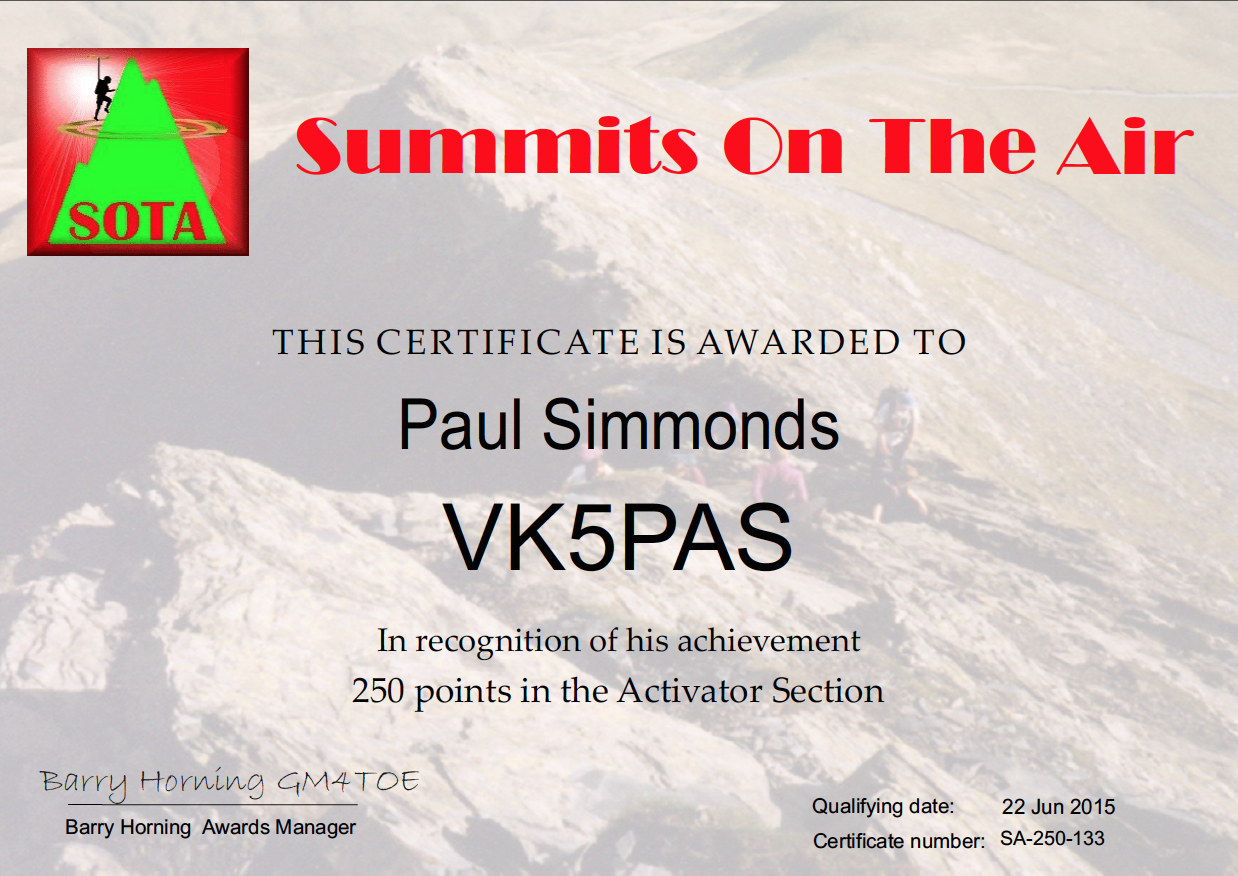
  54. United States of America
  55. Wales

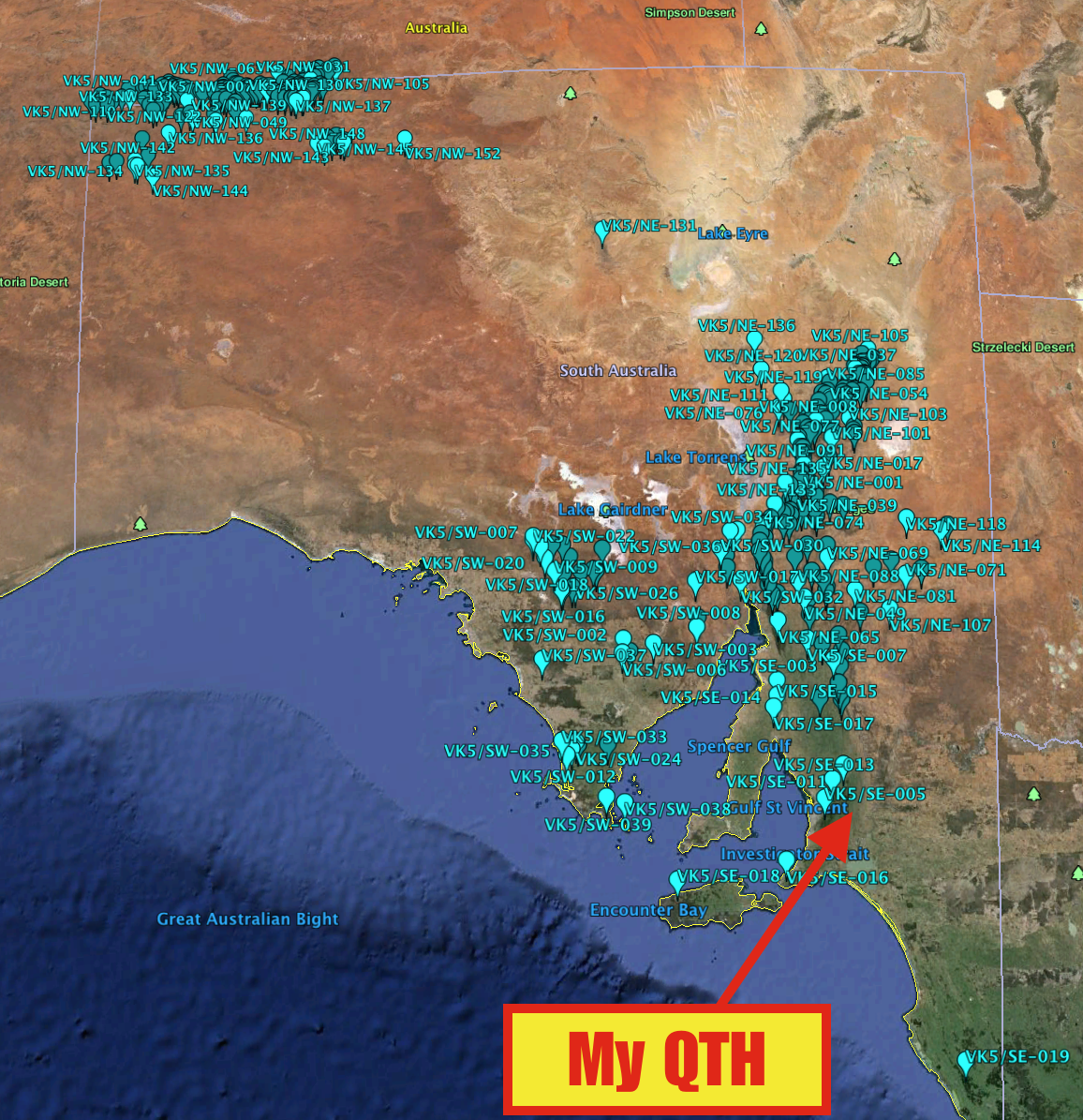
My first ever portable activity was a SOTA activation (VK5/ SE-016) in March, 2013.