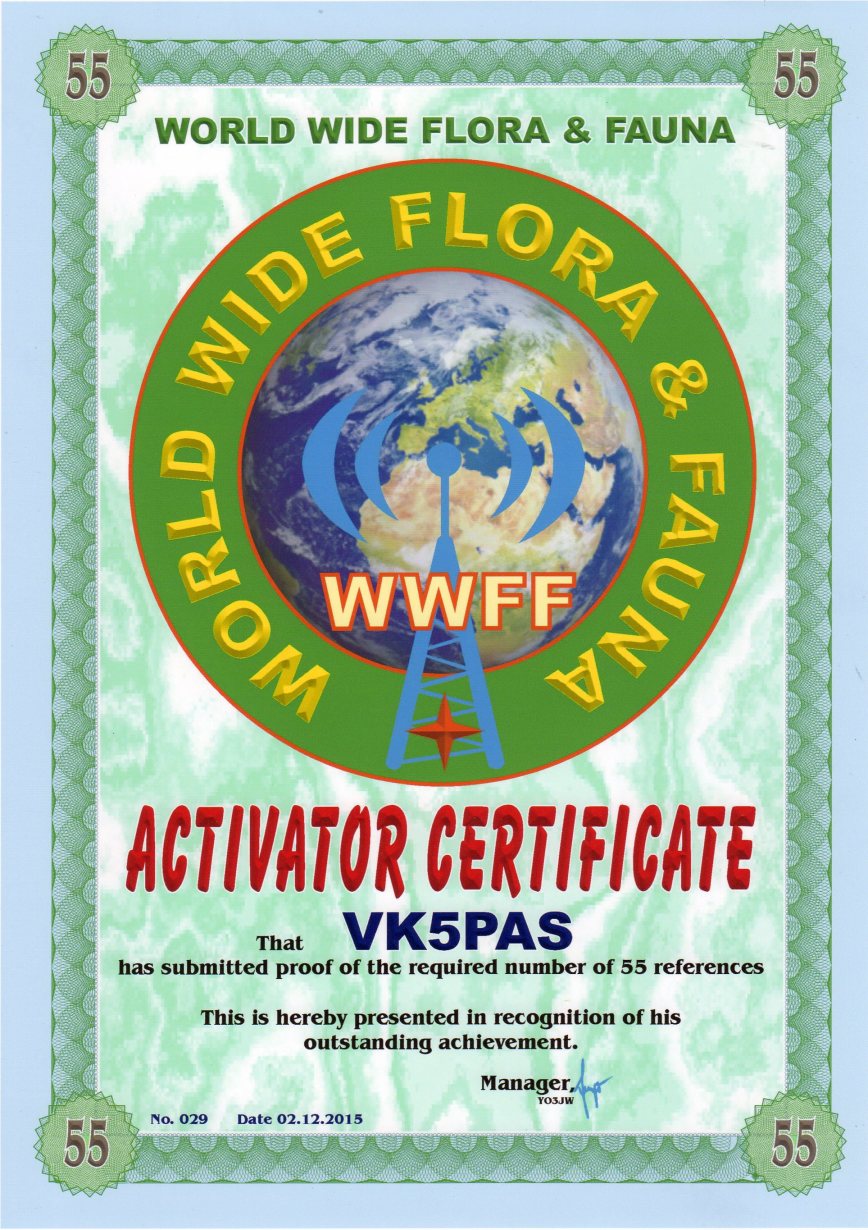
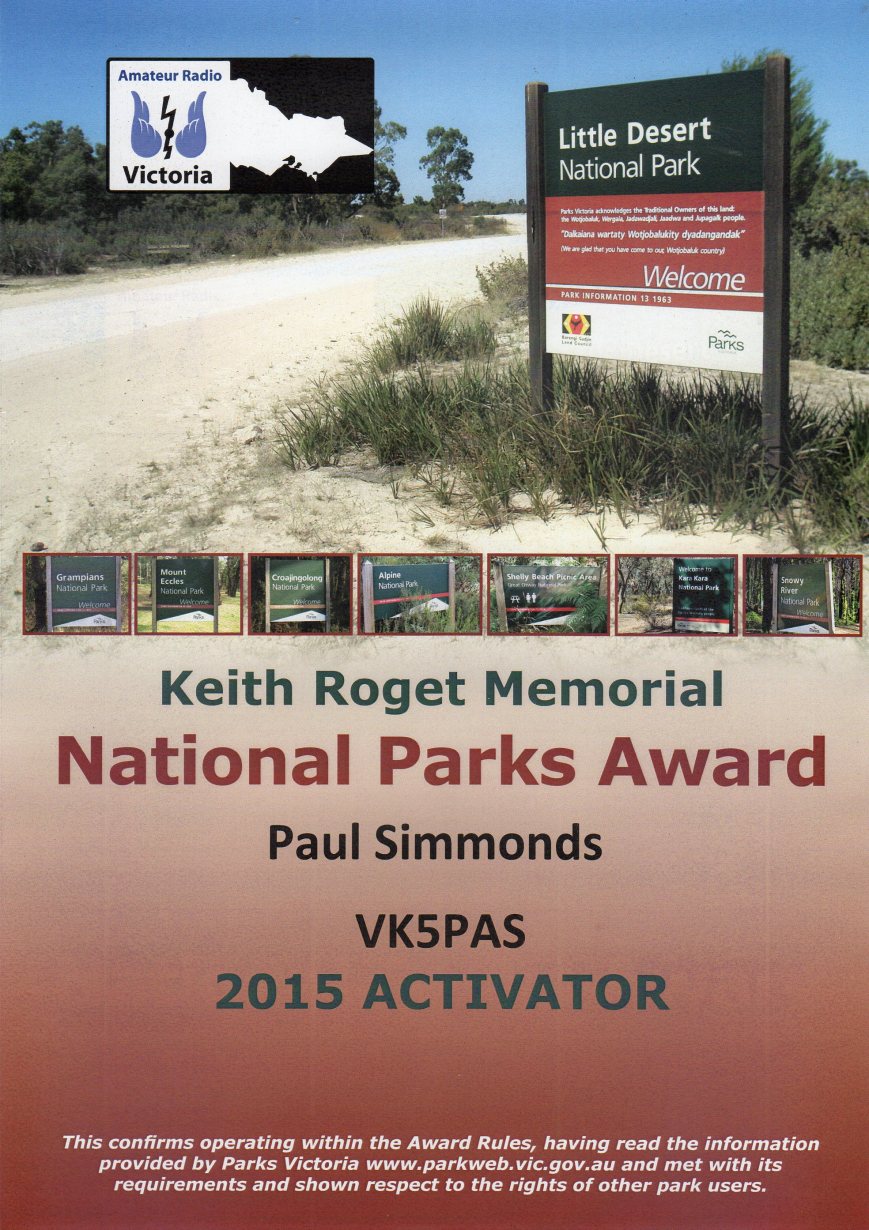
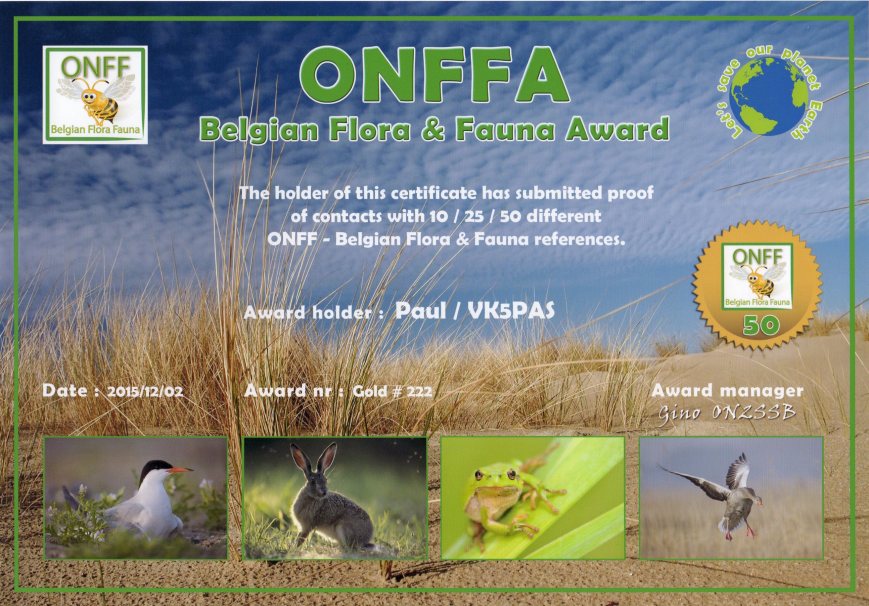
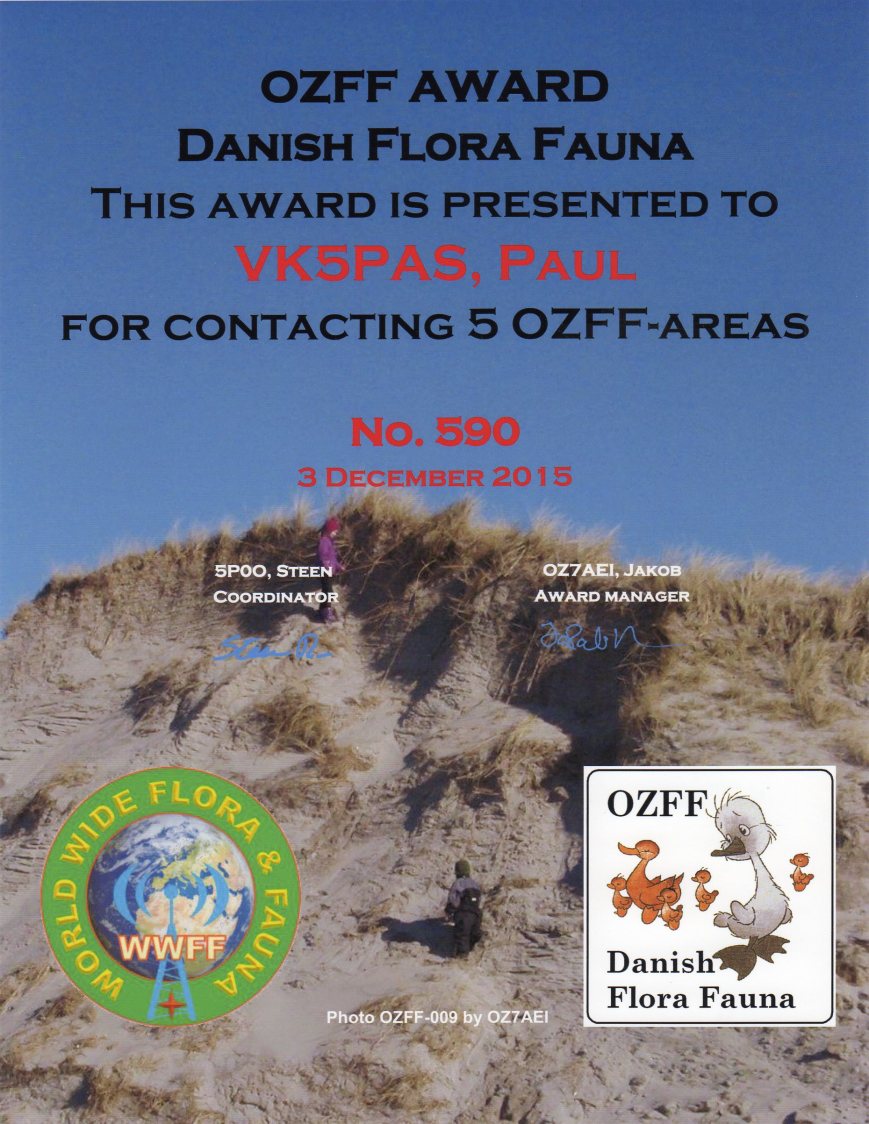
A certificate of thanks

When I got home from my trip to VK3, I had a significant number of emails to go through.  One of those that I was pleasantly surprised to find, was from Keith VK2PKT.  Keith has become a very avid park hunter and called me regularly whilst I was away.

Keith was kind enough to have designed a certificate of appreciation for my recent trip.

Many thanks Keith.  Greatly appreciated.

VK2PKT certificate152

Trip to VK3 along the Great Ocean Road

I returned home today after our 2 weeks away up in the Riverland, the South East of South Australia, along the Great Ocean Road in Victoria, and finally the Pyrenees Range area in western Victoria.

Here is a summary of the activities……

  • 2 x South Australian Conservation Parks
  • 3 x Victorian Coastal Parks
  • 3 x Victorian Marine National Parks
  • 1 x Victorian State Park
  • 3 x Victorian National Parks
  • 10 x Victorian SOTA summits
  • Total of 899 contacts
  • 3,084 km travelled.

Here is a list of activations………

Sat 7th Nov.

  • Billiatt Conservation Park VKFF-0821 – 57 contacts

Sun 8th Nov

  • Peebinga Conservation Park VKFF-0830 – 32 contacts

Mon 9th Nov

  • Discovery Bay Coastal Park VKFF-0746 – 26 contacts
  • Discovery Bay Marine National Park VKFF-0949 – 49 contacts

Tues 10th Nov

  • Discovery Bay Coastal Park VKFF-0746 – 25 contacts
  • Cape Nelson State Park VKFF-0754 – 24 contacts

Wed 11th Nov

  • SOTA Mount Clay VK3/ VS-051 – 7 contacts

Thurs 12th Nov

  • Bay of Islands Coastal Park VKFF-0743 – 46 contacts

Fri 13th Nov

  • Twelve Apostles Marine National Park – 69 contacts

Sat 14th Nov

  • Port Campbell National Park – 53 contacts
  • SOTA Crowsnest Lookout VK3/ VS-049 – 34 contacts

Sun 15th Nov

  • Great Otway National Park VKFF-0405 near Cape Otway – 69 contacts
  • Great Otway National Park VKFF-0405 Aire River – 32 contacts

Mon 16th Nov

  • SOTA Mount Cowley VK3/ VC-022 and Great Otway National Park VKFF-0405 – 48 contacts

Tues 17th Nov

  • Point Addis Marine National Park VKFF-0952 – 59 contacts

Wed 18th Nov

  • SOTA Mount Leura VK3/ VS-050 – 29 contacts
  • SOTA Mount Elephant VK3/ VS-047 – 23 contacts
  • SOTA One Tree Hill VK3/ VS-036 – 82 contacts

Thurs 19th Nov

  • SOTA Blue Mountain VK3/ VS-015 – 15 contacts
  • SOTA Point 756/Pyrenees VK3/ VS-018 – 33 contacts
  • SOTA Mount Lonarch VK3/ VS-013 – 16 contacts
  • SOTA Ben Nevis VK3/ VS-009 – 25 contacts

Fri 20th Nov

  • Little Desert National Park VKFF-0291 – 46 contacts


I would like to thank everyone who called.  Band conditions fluctuated dramatically with very good conditions during some activations, to very poor during others.

Also many thanks to those that took the time to spot me, either on parksnpeaks, the DX cluster, Facebook.  It certainly helps fill up the log.

I will post some more info & photos for each of the activations in the coming weeks.


Hattah Kulkyne National Park VKFF-0231

On Monday morning (26th October 2015) I left the Balranald Caravan Park and commenced my 500 km drive back home to the Adelaide Hills.  Along the way I planned to activate the Hattah Kulkyne National Park, VKFF-0231, in Victoria, which is about a 150 km drive south west from Balranald.  This was to be another new park for me, and I was hopeful to get my 44 contacts to qualify the park for the World Wide Flora Fauna (WWFF) program.

Screenshot 2015-10-31 10.07.01

Above:- Map showing the location of the park.  Map courtesy of mapcarta.com

I headed out west along the Sturt Highway and then turned left onto the Murray Valley Highway.  As it was early in the morning, it was relatively slow going as there were a lot of kangaroos and emus out and about.  There is not much to see along this stretch of the road.  I did stop briefly to have a look at Lake Benanee.

I then stopped briefly at Robinvale, just over the Murray River, which forms the border between the States of Victoria and New South Wales.  I was hoping to catch up with Claude VK3FCAS who was staying at the caravan park.  But I didn’t have Claude’s number and the park was absolutely brimming with vans, so unfortunately it was not to be.

After leaving Robinvale I travelled south on the Robinvale-Sea Lake Road, passing all the irrigation district where grapes, olives, carrots, and almonds are grown.  I then turned right onto the Hattah-Robinvale Road and travelled west.  I stopped briefly at a little place called Wemen to view the mighty River Murray just upstream from the Hattah Kulkyne National Park.

I accessed the park from a dirt track near Lake Kramen.  Unfortunately the track was marked with no vehicular access so I could not get all the way down to the lake.  So I was forced to activate from a less scenic part of the park, close to the Hattah-Robinvale Road.  There had been quite a bit of rain overnight, and it was still cloudy.  However, when the sun came out from behind the clouds it certainly had some bite, so I tried to find a bit of shade.

Hattah Kulyne National Park is 48,000 hectares in size and was established in June 1960.  The park lies in typical mallee country in Victoria and contains extensive low scrub and open native pine woodland.  River Red Gums are found alongside the lakes, the Murray River and adjoining creeks.  Animals, birds, and plants located in the park have adapted to survive in the poor, sandy soils and the searing hot summers.  The park contains Hattah Lakes which are seasonally filled by creeks connected to the Murray River.

A large amount of birdlife can be found in the park, ranging from wetland species including Pelicans, various species of ducks, Great Egret, Spoonbills, to mallee species such as Malleefowl, Emu Wrens, and Emus.  In fact a total of 200 species of birds have been recorded in the park.  Many native animals also call the park home including Red Kangaroos, Western Grey kangaroos and Eastern Grey kangaroos.

This area has a rich aboriginal history.  Within the park you can find scars on trees where shields and canoes were made, and also middens which are heaps of shells discarded after meals eaten over many generations.

Screenshot 2015-10-12 20.21.02

Above:- Map showing my operating spot.

It was only 2200 UTC (8.00 a.m. Victorian local time) and the 40m band was wide open to Europe, with the CQ World Wide contest still in full swing, so it was quite hard to find a clear spot on the band.  I started calling CQ on 7.143 and it wasn’t long before John VK5BJE gave me a shout with a good strong 5/8 signal from the Adelaide Hills.  This was followed by Warren VK3BYD, Gerard VK2IO, and then Ian VK5CZ/2 who was mobile 30km from Coonabarabran in New South Wales.

Things were quite slow on the band, but I managed 10 contacts in 20 minutes, to qualify the park for the VKFF program.  Many thanks to those that took the time to spot me on parksnpeaks.  The European contesters had also moved in right alongside of me, so I took the opportunity of having a listen on 20m.  I called CQ on 14.312, but it wasn’t long before I was competing with Europeans calling CQ contest.  So I moved up to 14.315 and called CQ again, and this was answered by Carl ZL3CX in  Auckland (5/7 both ways).  After my contact with Carl, park devotee Rick VK4HA then gave me a shout with a solid 5/9 signal.  This was followed by Rob VK4LS near Bribie Island in Queensland.  Unfortunately during our chat, a station from the USA came up and started calling CQ contest.

I then moved back to 7.143 with a total of 14 contacts in the log at that stage.  I still had a long way to go before reaching the required 44 contacts to qualify the park for the global WWFF program.  My first contact after returning to 40m was with Adrian VK5FANA on the Yorke Peninsula with a very strong 5/9 signal.  Rick VK4RF then called in on 40m.  Not as strong as 20m, but still a very respectable 5/7.  It was about this time that the noise floor on the band rose up to a strength 6.  I wasn’t really sure where the noise was coming from.  There was nothing around me, except for power lines, but they were a good 1 km away.  But I perservered and still managed to copy all the stations calling, including Mike VK6MB, some 2,900 km away in Western Australia (5/5 sent and 4/3 received).

I pushed on and continued to work the callers, and much to my pleasure, the noise on the band disappeared after about 15-20 minutes.  Contact number 25 was with Frank VK2BFC who said he would advise all the guys on Ron VK3MRH’s Net on 7.085 that I was in the park and in need for further contacts.  And it worked, as it wasn’t long, before I had a steady flow of callsigns that I recognised as being regulars on Ron’s net, including Dennis VK2HHA, Dik VK7DIK, Mike VK3ZMD, Tony VK5FTVR, and even Ron VK3MRH himself.  Many thanks Frank.  This certainly helped to boost the numbers.

It wasn’t long before I had reached the magical figure of 44.  Contact number 44 was Ron VK3VBI.  About 10 contacts later I was called by Peter VK3PF who was activating SOTA peak, Mount Bolga VK3/ VE-175 which is contained within the Mount Granya State Park, VKFF-0767.  This was followed by a call from Kerry VK2GQR, operating from the Mutawintji National Park north east of Broken Hill.  My last contact at Hattah Kulyne was with Rob VK4AAC/5 who was mobile on his way to activate the Padthaway Conservation Park.

At the end of my activation I went for a walk along the track leading down to Lake Kramen which was full of water.  In previous years it has been bare.

After around 3 hours in the park I had a total of 67 contacts in the log.  Thanks to everyone who called in.  The activation started off quite slowly, so I was very very pleased to reach the 44 QSO threshold.

The following stations were worked on 40m SSB:-

  1. VK5BJE
  2. VK3BYD
  3. VK2IO
  4. VK5CZ/2
  5. VK2VW
  6. VK5HCF
  7. VK3PMG
  8. VK5EE
  9. VK5BGN
  10. VK3FJUD
  11. VK5FANA
  12. VK4RF
  13. VK4HA
  14. VK3VEK
  15. VK6MB
  16. VK3FAPH
  17. VK4AAC/5
  18. VK2GKA
  19. VK3UH
  20. VK3EE
  21. VK2BFC
  22. VK3FOWL
  23. VK5HS
  24. VK3SQ
  25. VK2HHA
  26. VK3AV
  27. VK7DIK
  28. VK3ZMD
  29. VK5FTVR
  30. VK2NP
  31. VK7EE
  32. VK1NAM
  33. VK2XUP
  34. VK3UCD
  35. VK2BA
  36. VK3SIG
  37. VK3FENV
  38. VK3NU
  39. VK3FCAS/p
  40. VK3VBI
  41. VK2FBKT
  42. VK2MOR
  43. VK3MRH
  44. VK5ZA/m
  45. VK5NRG
  46. VK3JP
  47. VK5GJ
  48. VK5PL
  49. VK3PF/p (SOTA VK3/ VE-175 & VKFF-0767)
  50. VK2GQR
  51. VK5MAS
  52. VK3FAIM
  53. VK1MTS
  54. VK5KIK
  55. VK5FADP
  56. VK2MTC
  57. VK2FGAA
  58. VK5FMID
  59. VK5JK
  60. VK3KYF/5
  61. VK5GI
  62. VK3OF
  63. VK4AAC/5

The following stations were worked on 20m SSB:-

  1. ZL3CX
  2. VK4RF
  3. VK4HA
  4. VK4LS

References.

Parks Victoria, 2015, <http://parkweb.vic.gov.au/explore/parks/hattah-kulkyne-national-park&gt;, viewed 5th November 2015.

2015 SOTA & Parks Seminar at Wagga Wagga

After activating Mount Flakney I headed back into Wagga Wagga to my hotel and freshened up and then headed for the clubrooms of the Wagga Wagga Amateur Radio Club.

On my way back to the clubrooms I spoke with Roy VK5NRG on 40m, who was operating  the special call of VK100ANZAC from the clubrooms of my amateur radio club, the Adelaide Hills Amateur Radio Society.  It was a struggle but we made it.  I then spoke with Rob VK4FFAB who was portable in the Goomboorian National Park, VKFF-0722 with a very nice signal into the mobile.  Joe VK3YSP who was mobile then gave me a shout.

After arriving at the clubrooms and all the introductions, we had a BBQ lunch.  The afternoon presentations commenced soon after.  Presentations during the afternoon were:-

  • Warren VK3BYD – CW activations
  • Peter VK3PF – Portable antennas
  • John VK2YW – Log4OM logging software
  • Allen VK3HRA – Parksnpeaks and MacLogger DX
  • Paul VK5PAS – Portable DX for WWFF & SOTA
  • General brain storming and Mapping

Although the numbers in attendance were far lower than expected, it was still a very enjoyable and informative afternoon.

That evening we all attended at the William Farrer Hotel in Wagga Wagga for some refreshments and a good feed.  And a few war stories!

Oolambeyan National Park, VKFF-0403

It was a bright and early start on Friday morning (23rd October 2015).  I had a 480 km drive ahead of me to get to my intended destination of Wagga Wagga.  So I hit the road early after a brief stop at the local bakery in Balranald for a coffee.  I didn’t fancy the sachet coffee and the long life milk at the caravan park.  I had one park activation planned for the day and that was the Oolambeyan National Park, VKFF-0403.  And as far as wildlife and remoteness, this was to be the highlight of the trip for me.

Screenshot 2015-10-31 09.19.56

Above:- Map showing the location of the park.

I was on the road by about 6.30 a.m. NSW local time.  I headed east along the Sturt Highway toward the town of Hay.  This included a drive across the vast flat region of the Hay Plain, which is an ancient lake bed.  Much of this drive is flat saltbush plain, with many thousands of hectares of grazing land, with just the occasional tree in sight.

To break up the drive I had HF going in the car.  In the Toyota Hi Lux I use an Icom IC7000, with a Codan 9350 self tuning antenna mounted in the back tailgate.  I tuned across 40m and found Tom 8P5A from Barbados on 7.068 calling CQ.  I gave him a call as he was very strong and much to my surprise he came straight back to my first call and gave me a 5/9 signal report.  I was very excited, as this was a new country for me from the mobile.

I then joined the Mid South Coast Amateur Radio Club Net on 7.065, being run by John VK2NJP who had a 5/9 plus signal into the mobile.  The guys on the net kept me company as I crossed the first section of the Hay Plain.

Along the way I saw a trig point in the middle of nowhere on completely flat ground.  No SOTA peak here!  This is the Ti Tree Lake trig point and it is lcoated on a very lonely piece of the Sturt Highway between Balranald and Hay.  And a little further up the road I noticed a crop duster out in the fields.  I stopped for a brief photo opportunity and to admire some amazing flying.

I then found Troy VK4LCI mobile calling CQ on 7.120 with a good 5/5 signal.  I also received a 5/5 signal back from Troy.  Nice to work mobile to mobile.

I then drove into Hay where I made a short stop to stretch my legs.  I had not been in Hay for many many years so I drove around the town for about 15 minutes admiring the many fantastic old buildings that can be located in Hay.  Hay is the centre of a propsperous and productive agricultural district and has a population of around 2,400 people.

Whilst in Hay I spoke with Mark, VK2VW on 7.115 (5/9 both ways).  Mark has recently become an active WWFF park hunter, so I told him to keep an ear out for me at Oolambeyan.  Before leaving Hay, Hauke, VK1HW mobile in Canberra also gave me a call (5/9 both ways).

I snapped the photo below at one of the service stations in Hay.  It shows a number of trucks, including B-doubles.  What is a B-double?  Essentially it consists of two trailers that are linked together by a fifth wheel.

DSC_0163

I then left Hay and headed towards the town of Narrandera.  Again to break up the drive I occasionally tuned across the 40m band.  I found VK2MA on 7.104 and the Horsnby and District Amateur Radio Club Net.  I booked in to the net for a chat as there were some particularly strong signals on the Net.

Along the way I noticed a lone grave, outside of Hay, on the Sturt Highway.  I stopped for a brief look.  It is the resting place of Charles Dunstan Thompson who died in September 1879 at nearby  Burrabogie Station, aged just 30 years.

I continued east on the Sturt Highway until I reached Conargo Road near Carrathool.  This is where I needed to turn to head towards Oolambeyan National Park.  There is no sign here for the park.  However, the junction is distinguishable by the Carrathool Grain Complex on one corner, and a woold producing complex on the other.  This is about 64 km east of Hay.

After travelling south on Conargo Road, you will reach the junction with Gum Creek Road.  I continued down Gum Creek Road which is a dirt road, but easily passable in a conventional vehicle.  There are good signs indicating the way to the park from this point.  You need to travel through some gates and grids.

On my way to the park I put out a call on 7.144, hoping that some of the park die hards might be listening, to let them know my progress.  Sure enough my call was answered by Jeff VK5JK at Victor Harbour south of Adelaide with a magnificent 5/9 signal.  This was followed by Col VK5HCF at Mount Gambier who was also 5/9, and then Rick VK4RF with a 5/5 signal.  All were keen to work me upon my arrival at Oolambeyan National Park.

It wasn’t long before I was encountering a lot of wildlife.  As it was still quite early the kangaroos and emus were quite active.  And I don’t think I’ve ever seen so many eagles and hawks in the sky.  It was amazing.

I then travelled along Oolambeyan Road which is also a dirt road.  Another grid was required to be crossed.  This road is not accessible after rain.  And there are some sandy sections which can only be attempted in a 4WD.

And now the wildlife really appeared.  It was amazing.  Kangaroos everywhere, along with numerous emus.  It was very slow going on the road.

I continued along Oolambeyan Road and found a small clearing in the scrub.  It was shaping up to be a very hot day, so I chose a nice shady spot underneath a tree.

Oolambeyan National Park is 22,231 hectares in size and is located about 600 km west of Sydney.  The name is believed to be based on the Wiradjuri aboriginal word ‘Wulambiyan’.  ‘Wulam‘ means ‘to call or give voice to’, and ‘biyan‘ can be past tense for ‘always and continuous’.  Hence it can be interpeted as ‘have always been calling’, the ‘voice of the wind calling in the trees’, or the ‘song of the wind passing through the trees’.  This is linked to the aboriginal story that the voice of Dharramulan, one of Biamie’s sons, was put into the trees from which comes the sound of the bull roarer.

The park was once a merino stud property.  It was purchased by the New South Wales Government in late 2001 and was subsequently gazetted as a National Park on the 25th October 2002.  The park is located in the Riverina region of New South Wales which is the most poorly conserved bioregion in New South Wales, with less than 1% of its area protected within the NSW park system.

As I’ve already mentioned, the park is alive with wildlife including Red Kangaroos, Western Grey kangaroos, and Eastern Grey kangaroos.  Numerous bird species can be found in the park including the endangered Plains-wanderer, which is a quail like, ground dwelling bird.  It is estimated that only 3,100 of these birds remain in the wild.

Screenshot 2015-10-11 18.57.01

I parked the 4WD and started walking towards the shade.  Much to my surprise, I came across a small goanna at a puddle of water, getting a morning drink.  I’m not sure who was more surprised…me, or the goanna.

As I was setting up I could see a 4WD ute approaching in the distance.  I continued to set up my gear, and within a few minutes the 4WD had arrived.  As it turned out it was the park ranger who lives in the homestead at the end of Oolambeyan Road in the park.  He was a very friendly and obliging gentlemen.  I explained to him why I was out here and all about the hobby of amateur radio.  I told him of my experience with the goanna, and he warned me to be wary for Brown snakes as they were plentiful.

I was up and ready to go by 2355 UTC (8.55 a.m. NSW local time).  I called CQ on my nominated 40m frequency of 7.144 and this was immediately answered by Col VK5HCF in the South East.  Col had been patiently waiting there for me after out chat in the mobile.  This was followed by the ever keen Amanda VK3FQSO and park stalwarts Mick VK3PMG and Rick VK4RF.

I was a warm morning, and I had dozens of fury onlookers, all of whom were also seeking the shade of trees.  I even had the occasional Galah come in for a morning drink at the puddle of water.  And I also had some unwelcome visitors in the form of flies.  They were relentless and no form of spray seemed to work and keep them off me.  In the end I had to resort to the use of my fly net hat.

Even though it was a working day, I still had a steady flow of callers and I was hopeful to reach the required 44 contacts to qualify the park for the World Wide Flora Fauna (WWFF) program.  One of my contacts was with Ian VK5CZ who was also attending the get together in Wagga Wagga.  Ian was mobile on the Sturt Highway between Balranald and Hay, not all that far from where I was operating from.  I arranged to meet Ian and his wife Halima in Narrandera for lunch.

After working 36 stations on 7.144 I decided to give 20m a go.  I lowered the squid pole and removed the links in the dipole and headed for 14.310.  Unfortunately I could not spot myself as there was no mobile telephone coverage in this remote location.  I called CQ a number of times and this was eventually answered by Rick VK4RF, who I also worked under his secondary call of VK4HA.  But that was it.  I had no further takers.  I tuned across the 20m band and did not hear a single station.  It was very very inactive.

So I headed back to 40m, hoping to pick up my final 5 contacts to qualify the park.  My first taker after returning to 7.144 was Ian VK2IAN, following by Keith VK2PKT, Tom VK5AA, Mark VK7MK, and then Terry VK5TEL mobile near Victor Harbour south of Adelaide.  I had qualified the park and I was very happy.  A further 4 stations called me after Terry, all from VK3.

After a little under 2 hours in the park, I had a total of 48 contacts in the log.  I

I packed up my gear and headed out of the park, enroute to Wagga Wagga.  As I drove along the dirt roads out of the park, I took the photographs below of a hawk who had a distinct interest on something on the road ahead of me.

The following stations were worked on 40m SSB:-

  1. VK5HCF
  2. VK3FQSO
  3. VK3PMG
  4. VK4RF
  5. VK4HA
  6. VK5FANA
  7. VK4HNS/p
  8. VK3TKK
  9. VK4AAC/5
  10. VK2GKA
  11. VK3VBI
  12. VK5EE
  13. VK3GPm
  14. VK5FMID
  15. VK2MOR
  16. VK5JK
  17. VK3FINE
  18. VK5GJ
  19. VK5KLV
  20. VK5CZ/2
  21. VK2IO
  22. VK2VW
  23. VK5XGH
  24. VK5GI
  25. VK2MTC
  26. VK3DY
  27. VK5FFAA
  28. VK2XXM
  29. VK3FAPH
  30. VK5MBD
  31. VK5ZGY
  32. VK5NRG
  33. VK2YZS/m
  34. VK3MIJ
  35. VK2FABE
  36. VK2SB’
  37. VK5MAS
  38. VK2IAN
  39. VK2PKT
  40. VK5AA
  41. VK7MK
  42. VK5TEL/m
  43. VK3FARO
  44. VK3HRA
  45. VK3ALB
  46. VK3AUR

The following stations were worked on 20m SSB:-

  1. VK4RF
  2. VK4HA

References.

NSW Office of Environment and Heritage, <http://www.environment.nsw.gov.au/sop04/sop04cs4.htm&gt;, viewed 4th November 2015.

NSW Office of Environment & Heritage, Draft Management Plan Oolambyean National Park, December 2012.

Wikipedia, 2015, <https://en.wikipedia.org/wiki/Hay,_New_South_Wales&gt;, viewed 4th November 2015

Wyperfeld National Park VKFF-0549

My first activation for the Wagga Wagga trip was the Wyperfeld National Park, in Victoria, which qualifies for the Keith Roget Memorial National Parks Award (KRMNPA) and the World Wide Flora Fauna (WWFF) program.  I have activated Wyperfeld previously, back in November 2013 as part of the 2013 KRMNPA Activation Weekend.  But I had fallen short of the required 44 QSOs for the WWFF program.  In fact I had 43 contacts in the log.  Not sure what happened there?  So my activation at Wyperfeld was going to be a quick one as I only needed 1 contact to qualify the park.

Screenshot 2015-10-28 17.40.30

Above:- Map showing the location of Wyperfeld National Park.  Map courtesy of mapcarta.com

It was a bright and early start to the day (Thursday 22nd October 2015).  In fact it was a 5.15 a.m. rise out of bed.  No sleep in for me on my days off.  But, I am normally up around this time anyway to head off to work, so it wasn’t so bad.  All up, I had a 500 km drive to my intended first overnight stop, which was Balranald in New South Wales.  And it was 300km to Underbool in Victoria, from where I intended to access Wyperfeld.

Screenshot 2015-10-28 18.08.55

Above:- Map showing my drive from Mount Barker in South Australia, to Balranald in New South Wales.  Map courtesy of google maps.

After leaving home I headed east on the South Eastern Freeway and travelled over the mighty Murray River at Murray Bridge and then on to the town of Tailem Bend.  It was just out of Tailem Bend that I turned left onto the Mallee Highway, which is the main highway between Adelaide and Sydney.

My drive from there would take me east on the Mallee Highway through the little South Australian towns of Moorlands, Sherlock, Peake, Jabuk, Geranium, Parrakie, Lameroo, Parilla, and finally Pinnaroo before reaching the South Australian/Victorian border.

Mallee-PARKS-map-small

Above:-.  Courtesy of malleehighway.com.au

I briefly stopped at the little town of Peake to have a look at ‘Pollys Well’ which was sunk by John Whyte, and was an important watering point for Moorlands Station.  During the 1900’s, early farming settlers depended upon ‘Pollys Well’, as it would take a total of 8 days to travel by bullock wagon, between Tailem Bend and Pinnaroo.

I continued on to the Victorian border where I stopped for a stretch of my legs and a brief photo opportunity.

DSC_0082

I next stopped at the Victorian town of Murrayville which is about 24 km from the border.  The town is the birthplace of Australian Olympic basketballer, Rachael Sporn.  There is a great tourist stop here with some interpretive signs explaining about the local National Parks and the rare Mallee Fowl which can be found int he park.

Following after Murrayville, are some other interesting little towns including Cowangie, Underbool and then Walpeup.  Cowangie is the birthplace of V8 Supercars driver, Larry Perkins.

Wyperfeld National Park is located in the flat, semi arid western corner of Victoria.  It is a very big park consisting of 360,000 hectares.  Pressure from naturalists inspired the government to reserve 3,900 hectares in 1909.  It was proclaimed in 1921.  The name is of German original and was most likely given by German settlers who cane to the Wimmera Mallee region from South Australia.  The park contains a chain of lake beds which are connected by the normally dry Outlet Creek, which is the northern extension of the Wimmera River.

About 450 species of native plants occur in the park.  Over 200 species of birds have been recorded in Wyperfeld.

Screenshot 2015-10-28 17.49.33

Above:- courtesy of malleehighway.com.au

I was set up and ready to go by 10.00 a.m. Victorian local time.  It had just gone past midnight UTC.  For this activation I ran the Yaesu FT-857d, 40 watts, and the 30m/20m linked dipole supported on the 7m telescopic squid pole.

I headed for my nominated operating frequency of 7.144 and called CQ.  My first contact was with Mick VK3PMG who was very very strong from Stawell in Victoria.  This was followed by Adrian VK5FANA who was a good 5/8 from Arthurton on the Yorke Peninsula.  Next up with Tom VK5EE in Mount Gambier who was 5/9.

My ninth contact was with Julie VK3FOWL who was operating portable at a primary school where she shares her interest in the hobby of amateur radio with students.  So I took the time to have a chat with young Isobel and Carla at the school in Ormond.

I went on to work a further 9 stations on 40m, but it then went very quiet.  I had just started lowering the squid pole and was about to remove the links when I was called by Mark VK7MK who was way off frequency.  I responded to Mark but unfortunately he didn’t come back to me despite a few attempts at calling him in.

So I then removed the links in the dipole and called CQ on 14.310.  This was answered by Brett VK2VW with a good 5/8 signal.  This was followed by Adam VK7VAZ and then park stalwart Rick VK4RF.

After about 50 minutes in the park it was time to pull stumps and get back on the road,  I still had a 200 km drive ahead of me.  I had qualified the park and had a total of 23 contacts in the log.

The following stations were worked on 40m SSB:-

  1. VK3PMG
  2. VK5FANA
  3. VK5EE
  4. VK5VGC
  5. VK2IO
  6. VK4RF
  7. VK4HA
  8. VK3MEG
  9. VK3FOWL/p
  10. VK5JK
  11. VK5BJE
  12. VK3FAFC/2
  13. VK2VW
  14. VK2MOR
  15. VK7LTD
  16. VK3SFG
  17. VK5ZGY
  18. VK2PKT

The following stations were worked on 20m SSB:-

  1. VK2VW
  2. VK7VAZ
  3. VK4RF
  4. VK4HA
  5. VK2WWV

Trip to Wagga Wagga

Last Thursday (22nd October 2015) I headed off bright and early for Balranald in New South Wales.  My eventual destination was Wagga Wagga for the SOTA and Parks gathering being held at the Wagga Wagga Amateur Radio Club clubrooms.

I returned back home on Monday 26th October, 2015, after putting about 2,500 km on the clock on the Toyota Hi Lux.

During the trip I activated 2 x Victorian National Parks, 4 x NSW National Parks, 2 x NSW SOTA peaks, and 1 x SA Conservation Park, with a total of 484 contacts.

The following were activated…….

  • Wyperfeld National Park, VKFF-0549 – 23 contacts
  • Yanga National Park, VKFF-0554 – 94 contacts
  • Oolambeyan National Park, VKFF-0403 – 48 contacts
  • Galore Hill, VK2/ RI-047 – 69 contacts
  • Mount Flakney, VK2/ RI-025 – 36 contacts
  • Livingstone National Park, VKFF-0292 – 51 contacts
  • Cocopara National Park, VKFF-0104 – 50 contacts
  • Hattah Kulykne National Park, VKFF-0231 – 67 contacts
  • Ngarkat Conservation Park, VKFF-0829 – 46 contacts

Thanks to everyone who called in. And many thanks to everyone who took the time to spot me.

I will post more info and photographs on each activation in the coming week or so.

Pine Cone Award

In the past few days I received the certificate below.  It is the Pine Code Award issued by the Great Outdoors Radio Club (GORC).

The certificate is available to members of GORC who operate from an ‘outdoor QTH’.  The first Pine Cone is issued for working a maximum of five different stations in a 24 hour period whilst you are in a portable location.  You are limited to counting a maximum of five QSOs in a 24 hour period, and are eligible for the first Pine Cone after accumulating 25 QSOs.  You can apply for an a second Pine Cone after logging an additional 25 QSOs, and so on, up to a maximum of five Pine Cones.

For more information on the Great Outdoors Radio Club, please check out their website at…..

http://thegorc.org/

vk5pas-pinecone

Newland Head Conservation Park VKFF-0922

On Sunday 18th October 2015, my wife Marija suggested we go for a drive as it was such a beautiful day.  And she hinted to take the radio gear, so I didn’t let the opportunity slip.  We packed the 4WD and headed south for the Newland Head Conservation Park on the Fleurieu Peninsula.  The park qualifies for the World Wide Flora Fauna program and is VKFF-0922 and also qualifies for the VK5 National and Conservation Parks Award.

We drove down to the little town of Strathalbyn and then further south through Finnis and then the wine growing region of Currency Creek.  We stopped off for a stretch of the legs and a look at the magnificent canoe tree at Currency Creek on the side of the Strathalbyn – Goolwa Road.  The tree is a very large River Red Gum and is listed with the National Trust of South Australia.  Aboriginal people used wood and bark to construct canoes.  The length of this particular trees scar is about five metres, which indicates that the canoe was capable of carrying a number of people.

We continued on to the seaside towns of Middleton, Port Elliot and Victor Harbor.  We again stopped briefly to admire the view of Victor Harbor from Range Road.

Newland Head Conservation Park is located about 100 km south of Adelaide and about 15 km south west of Victor Harbor.  The park protects two long beaches, Waitpinga and Parsons, along with rocky headlands and surrounding coastal vegetation including the sand dunes.  The park takes its name from Newland Head which features prominently at the eastern boundary of the park.  The park is about 12 km2 in size and is popular with surfers and fishermen.  It is believed that Waitpinga is an aboriginal word meaning ‘Windy Place’.

Screenshot 2015-10-20 12.07.35

Above:- Map showing the location of the park, south of Adelaide.  Map courtesy of SA Maps Viewer.

We decided to head to the Waitpinga Beach section of the park, and took a brief photo stop at the corner of Waitpinga Road and Dennis Road.  If you continue west along Waitpinga Road, you will reach the Parsons Beach section of the park.

DSC_0044

The view as you travel along Dennis Road into the park is very nice.  The mighty Southern Ocean is visible, as are the sand dunes and the adjacent Waitpinga Creek which flows out into the ocean.

DSC_0047

Prior to setting up we had a quick look at all the activity on the beach.  There were quite a few surf fisherman trying their hand in catching salmon and mullett.  You certainly do not want to try swimming here.  This is not a swimming beach!  If you travelled south, the next piece of land you would reach is Antartica.  Waitpinga Beach has rough waves, power rips and not to mention the White Pointer sharks that frequent the area for a feed of fish.  There was a fatal shark attack here back in 1989, whilst I was working in the area.

We then travelled to the campground area for a look at Dennis Hut which was built in 1890.

We then headed back to the Waitpinga Beach carpark and carried the radio gear down the boardwalk and onto the beach.  I was the only one on the beach with a squid pole, not doing any fishing!  For this activation I ran the Yaesu FT-857d and 40 watts, and the 40m/20m linked dipole supported on my 7 metre telescopic squid pole.  Because it was such a sunny day, we even set up the solar panels to keep the 44 amp hour power pack charged up.

Screenshot 2015-10-20 12.07.05

Above:- Map showing my operating spot in the park, south of Adelaide.  Map courtesy of SA Maps Viewer.

Prior to calling CQ I headed for 7.144 and worked Rob VK4AAC who was operating portable from Karte Conservation Park.  Rob had a nice 5/9 signal coming in from the South Australian/Victorian border area.  I then moved down to 7.135 and asked if the frequency was in use and this was immediately answered by John VK5BJE in the Adelaide Hills.  Next up with Terry VK3UP, followed by Mick VK3PMG who was portable in the Creswick Regional Park, VKFF-0964, north of Ballarat.

Band conditions on 40m appeared to be very good and I had a nice steady flow of callers from VK5 and the eastern States of Australia.  It wasn’t long before I had another VKFF park in the log.  This time it was Dave VK2JDC who was operating portable from the Cattai National Park, VKFF-0092, in the Hawkesbury region of Sydney.  Dave had a good strong 5/8 signal coming in to Waitpinga Beach.

A number of contacts later I spoke with Richard VK5ZRY who was activating the Clinton Conservation Park, VKFF-0813, on the Yorke Peninsula.  Richard had his normal 5/9 plus signal.

I went on to work a total of 64 stations on 40m in VK2, VK3, VK4, and VK5.  This included four parks, and a nice contact with Amanda VK3FQSO who was running just 1 watt and was a very respectable 5/7.

I then QSYd to 20m where I worked a total of 49 stations in VK6, Germany, Slovenia, Italy, France, Croatia, Spain, Russia, Latvia, Ukraine, Belgium, Poland, Sweden, Finland, Czech Repiublic, and Switzerland.  The only VK caller was John VK6NU (5/5 both ways).  My first taker on 20m was Xaver DK4RM.  Prior to going QRT I worked special event call, VK2015TDF being operated by Chris VK3FY.

I was very happy as I had a total of 113 stations in the log, including some nice contacts into Europe on the long path on 20m.

After packing up we headed down Waitpinga Road and to the Parsons Beach carpark, where you can enjoy the excellent views of both Parsons Beach and Waitpinga Beach. There is a small plaque here commemorating Andrew ELLIS who drowned here back in 1986.  In fact a number of people have drowned here at Waitpinga and Parsons.  You would never catch me swimming here.

The sun was just starting to go down in the west.  The photos below are looking west along the coast towards Cape Jervis, where you catch the ferry from the South Australian mainland over to Kangaroo Island.

The following stations were worked on 40m SSB:-

  1. VK4AAC/5 (Karte Conservation Park VKFF-0898)
  2. VK5BJE
  3. VK3UP
  4. VK3PMG/p (Creswick Regional Park VKFF-0964)
  5. VK5LSB
  6. VK5STU
  7. VK3DAC
  8. VK3PF
  9. VK2VW
  10. VK5FTRG
  11. VK3NBL
  12. VK5FANA
  13. VK2JDC/p (Cattai National Park VKFF-0092)
  14. VK2NEO
  15. VK5KDK
  16. VK5PL
  17. VK2BFC
  18. VK3FOLK
  19. VK2BDR
  20. VK5FKYM
  21. VK3ZMD
  22. VK5AV
  23. VK5ZAR
  24. VK3HRA
  25. VK3HB
  26. VK5PET
  27. VK2AWJ
  28. VK4RF
  29. VK4HA
  30. VK3VKT
  31. VK3HBR
  32. VK3FRJK
  33. VK5HAC
  34. VK5NRG
  35. VK3FMRC
  36. VK3TKK
  37. VK3FQSO
  38. VK5JW
  39. VK2YK
  40. VK5JK
  41. VK3FTAD
  42. VK2PKT
  43. VK3FPSR
  44. VK3BGE
  45. VK3CNW
  46. VK2MOR
  47. VK2IO/m
  48. VK5FTCT
  49. VK3VIN/p
  50. VK3TQ
  51. VK3NBV
  52. VK5ZGY
  53. VK3FAPH
  54. VK5ZRY/p (Clinton Conservation Park VKFF-0813)
  55. VK3KLB
  56. VK1AT
  57. VK7ROY
  58. VK3FABE
  59. VK4FFAB
  60. VK3HK
  61. VK3KHZ
  62. VK3MCX
  63. VK4FBMW
  64. VK3FIRM

The following stations were worked on 20m SSB:-

  1. DK4RM
  2. S52KM
  3. I5FLN
  4. S58AL
  5. DL2ND
  6. IK1GPG
  7. F1BLL
  8. IZ5JMZ
  9. IK7MXB
  10. IZ2LSR
  11. 9A1AA
  12. DK6MP
  13. DF1YQ
  14. IZ8EFD
  15. EA5RJ
  16. IU2EFB
  17. UA6NT
  18. YL2BJ
  19. UR7ET
  20. DH4PSG
  21. ON4VT
  22. DL1EBR
  23. IZ8DFO
  24. ON4BB
  25. I5JFG
  26. SP6KD
  27. SA5ACR
  28. RA3PCI
  29. SA7AUH
  30. DK2ZT
  31. IZ8IEV
  32. DL5EBG
  33. ON5SWA
  34. DL2DQL
  35. IK3SCB
  36. F4HJO
  37. F1RHS
  38. HB9EYP
  39. OH6IU
  40. F8DWH
  41. DP6T
  42. OH6JE
  43. F4ESV
  44. F8ATM
  45. DF7GK
  46. I1JHS
  47. OK1DOY
  48. VK6NU
  49. VK2015TDF

Morialta Conservation Park VKFF-0783

On Saturday afternoon (17th October 2015) I activated the Morialta Conservation Park, VKFF-0783, situated in the Mount Lofty Ranges.

The park was not my first preference for the day.  I had nominated to activate the Cleland Conservation Park, but after driving along Summit Road and passed the entrance to the Mount Lofty summit, I found that Summit Road was closed just above the entrance to the Cleland Conservation Park.  A speed cop was manning his post at this location and I soon found out that the road was closed due to the Classic Adelaide Car Rally.  Bugger!  So I turned around and headed all the way back down Summit Road and onto the Piccadilly Road.  I stopped off briefly to admire the views out to the east from Summit Road.  And although I was very frustrated, the drive through the Piccadilly Valley was very picturesque.  The Piccadilly Valley is a market gardening centre which produces food for the Adelaide and overseas market.  Premium ‘cool climate’ grape varieties are also grown in the Valley.

After reaching the little town of Summertown I turned left and travelled west along Greenhill Road, hoping to access Cleland Conservation Park from the northern side.  But sadly, Greenhill Road was blocked off as well.  Strike two.  I didn’t feel like driving all the way back to Mount Lofty summit, so I decided to implement plan two, and head for Morialta Conservation Park.

Morialta Conservation Park is located about 10 km north east of the Adelaide Central Business District.  The park contains some very rugged bush terrain, with a narrow gorge set with three waterfalls which are bounded by steep ridges and cliffs.  It is truly an amazing park, right on Adelaide’s doorstep.

It is believed that the Morialta Conservation Park derived its name from the aboriginal Kaurna word, ‘moriatta’, meaning ‘ever flowing’ or ‘running water’.  However other linguists suggest the name was derived from the Kaurna words ‘mari yeertalla’ meaning ‘eastern cascade’.

A number of activities are undertaken in the park including bushwalking, bird watching and rock climbing.

Wednesday 15th July 2015 marked the 100 year anniversary of the proclamation of Morialta Falls as a National Pleasure Resort.  It later became a National Park in 1966/67, and then became the Morialta Conservation Park in 1972.  The park is steeped in history.  Between 1915 to 1956 a tram ran from Adelaide to the western entrance of the park.
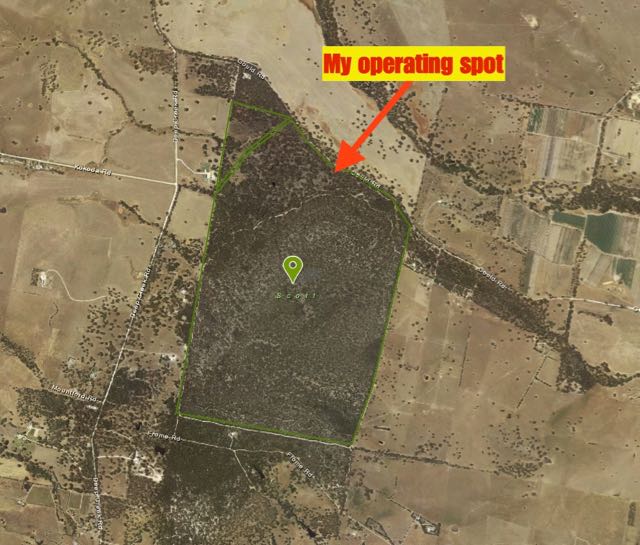
Screenshot 2015-10-18 12.40.00

Above:- Map showing the location of the park.  Map courtesy of SA Maps Viewer.

I drove to the little town or Norton Summit and then travelled west along Norton Summit Road which straddles the southern edge of the park.  But there was no where for me to park the car and the terrain along this section was just way too steep to activate from.

So I headed back into Norton Summit and turned left and travelled north along Colonial Drive.  This took me passed the historic Morialta Barns.  This was the site of the former Morialta Old Winery complex.  The buildings were constructed by South Australia’s second Premier, John BAKER, who was a businessman, parliamentarian and pastoralist.  The Barms were part of the Morialta House Estate built by BAKER, where he established a farm and orchard.  By the 1860s, Baker had established vineyards and was exporting his wine to London. Guests to Morialta House included the Duke of Edinburgh and future King George V. Baker also built a hilltop horse racing track, on which he trained the winner of the 1873 Melbourne Cup, Don Juan.

B22855

Above:- The Hon. John Baker.  Courtesy of State Library SA

Today the buildings are listed on the State Heritage Register, and are of State Heritage significance, dating from the second decade of colonial South Australia.  The Barns were most recently used as a winery, but they were recently sold.  I guess thats what all the scaffolding was about.  This impressive complex of stone buildings includes two barns (one 3 storey and the other 2 storey), a well house, a bake house, a dairy, stables, a stoned walled enclosure around the barns, and the original stables and coach house. The Barns also accommodate a poultry shed, an old piggery, and a few other small farm buildings. The site itself has impressive views across the valley to the east. These functional stone buildings are excellent examples of the early colonial agricultural and viticultural structures of South Australia.

DSC_0013

I then drove passed the historic Morialta Cottage on Colonial Drive.  This is often confused for the Morialta Homestead built by John Baker in 1847.

DSC_0014

This is a beautiful drive through this section of the Adelaide Hills.  I highly recommend it to anyone who would like a nice weekend drive.  A small creek follows the road which is lined by beautiful tall gum trees with an understorey of other plants including ferns.

I drove on to Moores Road and followed the northern boundary of the park.  Moores Road is a dirt road, but is perfectly suitable for a conventional vehicle.  Moores Road becomes a no through road.  At the end is a large parking area.  This is where I parked the 4WD and I climbed the boundary fence and set up the gear.  For this activation I ran the Yaesu FT-857d, and the 40m/20m linked dipole supported on the 7 metre squid pole.

Screenshot 2015-10-18 12.40.36

Above:- Map showing my operating spot in the park.  Map courtesy of SA Maps Viewer.

As it was Springtime, many of the local native plants were out in flower.  It was a beautiful spring day with the temperature being about 30 degrees C.  And not a cloud in the sky.

After setting up I headed to 7.144 and found that it was already occupied by Rob VK4AAC who was booming in from Peebinga Conservation Park, VKFF-0830, near the South Australian/Victorian border.  After working Rob I headed down the band to 7.135 and started calling CQ.  My CQ call was immediately answered by a number of stations who had followed me down the band.  First up was Tony VK3VTH mobile with a good strong 5/8 signal, followed by Mick VK3PMG, Roy VK5NRG, and then John VK5BJE.

About 15 minutes into the activation I was called by John VK2WG who was operating portable from the Fusion 15 Multicultural Festival at Wagga Wagga.  Unfortunately John was struggling a little with my signal over to New South Wales.  I also spoke with Ian VK5IS who was operating portable as part of the Jamboree on the Air (JOTA) weekend.  I spoke briefly with Mckay, a young 8 year old cub to enable him to qualify for a badge.

A few QRP stations also called in, including Greg VK5GJ running his normal 4 watts from Meadows, Nev VK5WG up in the Mid North operating with just 5 watts, and Gary VK5PCM operating with just 2 watts.  All had good signals into the park.

After working a total of 45 stations on 40m in VK1, VK2, VK3, VK4, VK5, and VK7, I lowered the squid pole and removed the links and headed to 20m.  I called CQ on 14.295 and this was answered by Bill VK4MWG with a very strong 5/9 plus signal.  Bill was kind enough to spot me on the DX cluster which brought in the DX.  But not before I worked Steve VK5SFA who lives near the western boundary of the park.  My first DX contact was with Luciano I5FLN in Italy, followed by Xaver DK4RM in Germany, and then Emilio IZ8VYU in Italy.  All with great signals.  I went on to work a total of 50 stations on 20m in VK4, VK5, VK6, Italy, Germany, Slovenia, France, Czech Republic, Croatia, Russia, Sweden, Lithuania, Ukraine, Belgium, Poland, Netherlands, England, Balearic Islands, and Indonesia.

Band conditions on 20m were quite good, with signals long path from Europe quite strong.  I did note that the Over the Horizon Radar (OTHR) was present intermittently on the band, and was very strong.

I also suffered a little bit of QRM about half way through the pile up.  A couple of German speaking stations came up just 1 kc above me and they were very strong.  They didn’t stick around for too long, as they were politely told by a number of the Europeans to QSY.  It did take about 5 minutes but eventually they bowed to the pressure and moved up higher in the band.  Apologies to the European stations that were calling me that I was struggling with.  The QRM was just too severe.

This slideshow requires JavaScript.

I then moved back to 40m to hopefully pick up some of the die hard park desperados.  And it didn’t take long.  First taker was Hauke VK1HW, and this was followed by park stalwart Rob VK4FFAB.  I also spoke to another park devotee, Adrian VK5FANA on the Yorke Peninsula. On my second round on 40m I worked a total of 11 stations before going QRT.  The sun was down behind the trees and the ridgeline and it was getting quite cold (11 degrees C).

The 40m band was just opening up to North America, but it was getting very cold, so I didn’t persevere.  I also heard V73D in the Marshall Islands on 7.182 working split with a great signal.  But he had a massive pile up, with stations calling from Australia, North America, and Japan.

I had a total of 106 contacts in the log.

The following stations were worked on 40m SSB:-

  1. VK4AAC/5 (Peebinga Conservation Park)
  2. VK3VTH/m
  3. VK3PMG
  4. VK5NRG
  5. VK5BJE
  6. VK3FDAS
  7. VK3HRA
  8. VK3YAR
  9. VK2WG/p
  10. VK5PZ
  11. VK1DI
  12. VK3ZMD
  13. VK4RF
  14. VK4HA
  15. VK5GJ
  16. VK3PF
  17. VK2ANM/5
  18. VK3FINE
  19. VK3FIRM
  20. VK2VW
  21. VK3AW
  22. VK3MCX
  23. VK3BBB
  24. VK2YK
  25. VK7CW
  26. VK3CM/m
  27. VK5IS/p
  28. VK5WG
  29. VK5PCM
  30. VK3KRH
  31. VK3DBP
  32. VK2IO
  33. VK3KHZ
  34. VK3VIN
  35. VK2MOR
  36. VK3ERW/p
  37. VK2JCC/p
  38. VK2HHA
  39. VK4FAAS
  40. VK5KLV
  41. VK2PKT
  42. VK5PL
  43. VK4FBBA/m
  44. VK3SIM
  45. VK3SOT
  46. VK1HW
  47. VK4FFAB
  48. VK7LCW
  49. VK3CWM
  50. VK3FVKI/p
  51. VK6NU
  52. VK7MK
  53. VK3FSPG
  54. VK4MOO
  55. VK5FANA
  56. VK3FBNG

The following stations were worked on 20m SSB:-

  1. VK4MWG
  2. VK5SFA
  3. I5FLN
  4. DK4RM
  5. IZ8VYU
  6. S58AL
  7. S52KM
  8. F1BLL
  9. VK6MAC/p
  10. IK8FIQ
  11. OK7WA
  12. OK2MI
  13. IZ8EFD
  14. 9A2HF
  15. DL2JAU
  16. IZ8DFO
  17. RA3PCI
  18. IK1GPG
  19. DL5WW
  20. VK5LZ
  21. SM0MLZ
  22. IZ5JMZ
  23. DL2ND
  24. LY3A
  25. DL2NOM
  26. DK8PY
  27. OK2BZ
  28. DJ6OI
  29. IT9ABN
  30. IZ4TNN
  31. DG5LAC
  32. UR7ET
  33. DL1EBR
  34. ON4BB
  35. SP6GVU
  36. F5IDJ
  37. DL8AAV
  38. ON3ANY
  39. IK2VUC
  40. PA1BR
  41. ON7ZM
  42. DL5EBG
  43. VK5LZ
  44. M0ZDZ/p
  45. EA6ALW
  46. VK6MSC/p
  47. YB0AR
  48. VK6NI/p
  49. ON4VT
  50. VK6NTE

References.

Commercial Real Estate, 2015, <http://www.commercialrealestate.com.au/property/colonial-drive-norton-summit-sa-5136-2009911594&gt;, viewed 18th October 2015