KRMNPA Activator certificate

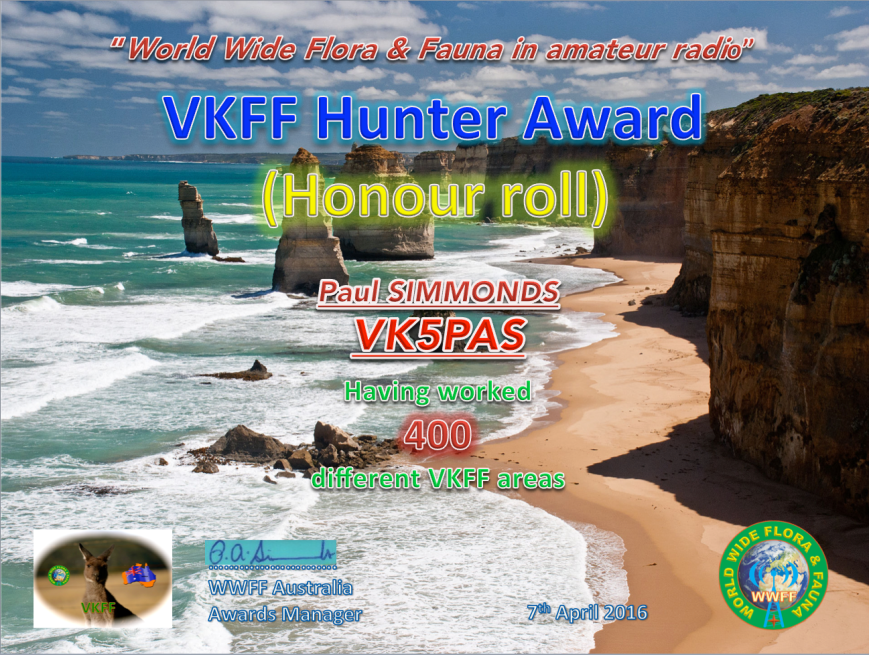
I received my Activator participation certificate the other week for the 2015 Activation Weekend for the Keith Roget Memorial National Parks Award (KRMNPA).

My wife Marija and I travelled down the Great Ocean Road and activated the Cape Otway National Park and the Port Campbell National Park.
This is a great annual event, which we always enjoy participating in.

Many thanks to Tony VK3VTH for the certificate, and for running such a great program in the KRMNPA.

KRMNPA 2015162.jpg

Mount George Conservation Park, VKFF-0784

Friday 11th December 2015 saw the recommencement of a very popular event, the Friday afternoon/evening activation sessions for the VK5 National and Conservation Parks Award.  Last Spring/Summer we held these events which encouraged amateurs to get out in the field and activate a park for the VK5 Parks Award.  They proved to be very popular and in recent times I had received a number of emails and queries wanting to know if we run something similar this Summer.  So after popular demand, they were commenced on Friday 11th.

Unfortunately I had worked on Friday so I chose a park close to home.  I can’t wait for retirement!  My park of choice was the Mount George Conservation Park, VKFF-0784, which is located near Bridgewater in the Mount Lofty Ranges ‘Adelaide Hills’.  The park is about 25 km south eeast of Adelaide.  It is just a 10 minute drive from my home.

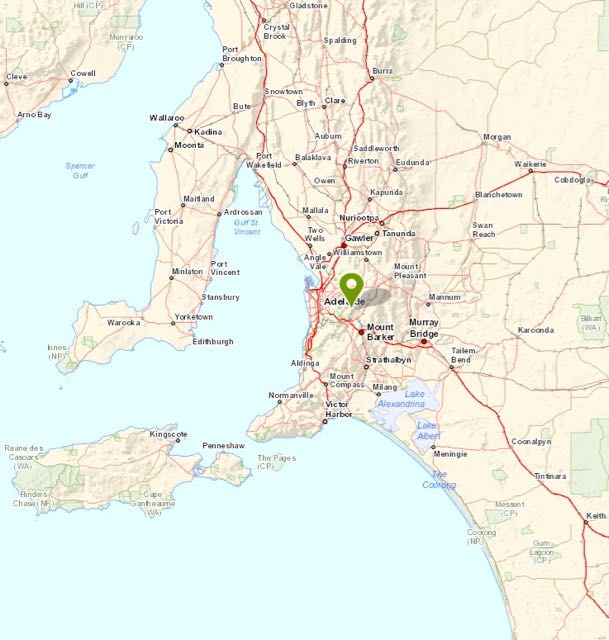
Screenshot 2015-12-14 08.41.21

Above:- Map showing the location of the park.  Image courtesy of Location SA Map Viewer.

Mount George conserves 85 hectares of native vegetation and is one of a number of small Conservation Parks scattered throughout the Mount Lofty Ranges.  It was proclaimed on 7th November 1996.  The park was originally 67 hecatres in size, but in 2003 the boundaries were extended to incorporate adjacent land of high conservation value.  The park has steep slopes which are lined with Stringybark Open Forest, a number of creeks, wetlands, and freshwater bogs.  State endangered Mountain Gum Open Forest is also found in the vicinity of the damper areas of the park.

The park incorporates the Mount George summit which rises to 520 metres, but sadly does not qualify for the Summits on the Air (SOTA_ program.  It is situated very close to the busy South Eastern Freeway.

The park provides refuge for numerous native animals including the Southern Brown Bandicoot, Common Ring-tail possum, Yellow-footed Antechinus, Western Grey Kangaroo, and Koalas.  Numerous birds can be found in the park.  In fact a total of 66 species have been recorded in the park, including the State vulnerable Yellow-tailed Black Cockatoo, of which there were a number flying overhead and in the trees during my activation.

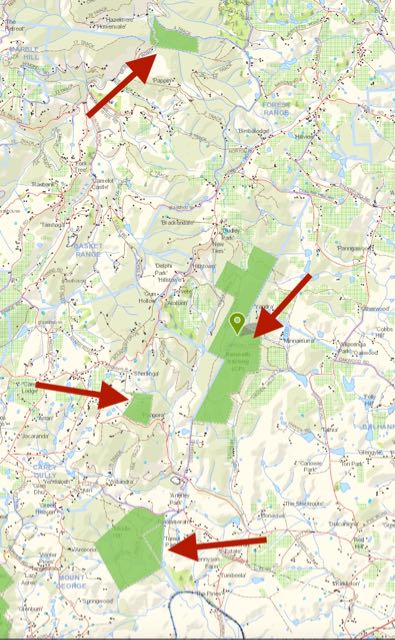
Screenshot 2015-12-14 08.40.22

Above:- Map showing the Mt George CP, in close proximity to the busy South Eastern Freeway.  Image courtesy of Location SA Map Viewer.

I have operated from this park many times before, and always from the picnic ground at the end of Mount George Road.  This is a great spot, but this time I thought I would try somewhere different within the park.  After leaving the South Eastern Freeway I drove along the Bridgewater-Carey Gully Road until I reached Worden Road.  I then turned left onto Muller and travelled south until I reached the intersection with Mount George Road.  Instead of turning left onto Mount George Road which takes you down to the picnic ground, I turned right onto Mount George Road, heading for the northern side of the park.  After viewing the GPS I saw a road that appeared to access the northern side of the park from Rangeviw Road.  But the road I was aiming to travel along to access the park, turned out to be a locked gate at the Mount Lofty Golf Club.

So I turned around and travelled back along the Mount George Road until I reached the turnoff for the picnic grounds.

It wasn’t long before I reached the park and the beautiful picnic ground area.  This certainly a pretty spot, and contains some shelters, a wooden table and benches, and plenty of opportunities ofor activating.

Screenshot 2015-12-14 09.17.24

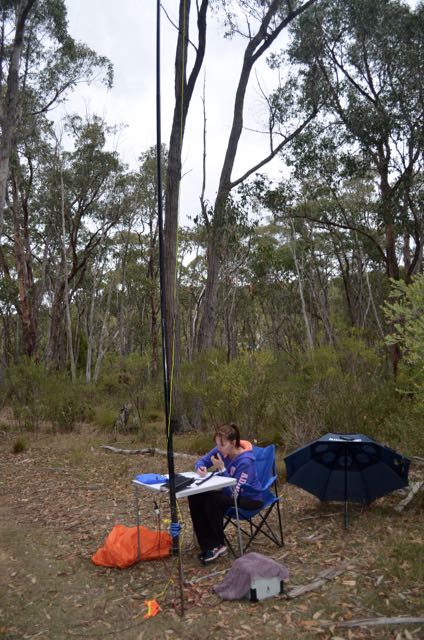
I parked the 4WD and set up my folding table and deck chair not far away.  I ran the Yaesu FT-857d, 40 watts, and the linked dipole for 20m/40m.

Screenshot 2015-12-14 08.44.37

I was set up and ready to go by 0625 UTC (4.55 p.m. South Australian local time).  I immediately headed for my nominated operating frequency of 7.144.  I had placed an earlier alert on parksnpeaks.   I commenced calling CQ and this was answered by Dennis VK2HHA in Albury with a very strong 5/9 signal.  My signal report from Dennis was down a little from usual, but I was Q5 and that is all that mattered.  Next up was Brett VK2VW, Ron VK3MRH, and then Peter VK3PF.

Sadly it wasn’t long before I was experiencing some QRM from 7.146.  Some VK’2 came up and started talking to VK9LH.  Clearly this was a sched/net.  A ZL then came up on 7.145 working into Europe.  It just wasn’t worth persevering on 7.144.  After working a total of 13 stations from VK1, VK3, VK3, VK4, and VK5, I QSYd to 7.150 and called CQ again.  Paul VK3DBP came back to my CQ call, but when I called him back in, there was no response.  I presumed that either Paul was experiencing problems, or the propagation conditions had changed dramatically.

Peter VK5PET sent me an SMS message at this point, to advise that he was in the Monarto Conservation Park and was operating on 7.090.  I headed down there and had a listen.  Although I knew Peter was there, he was just way too low for me to work.  So I returned to 7.150 and called CQ again, and this was answered by Les VK5KLV who had a good strong 5/9 signal from Port Augusta.  Paul VK3DBP then called in, this time with an excellent 5/9 signal.  I asked Paul what had happened previously and he advised that I had totally disappeared earlier after he had called me.  It appeared the 40m band was up to its old tricks.  I was certainly not hearing the VK’5.

Screenshot 2015-12-14 09.18.54

I was talking with Paul about propagation and advising him of the lack of VK5’s.  But my next QSO proved that to be incorrect.  Out of the blue, with a thumping signal, was John VK5BJE at Scott Creek.  And shortly afterwards I was called by Peter VK5PET/p.  Peter was very low down (3/3) but at least I was hearing him.  Peter was hearing me much better and gave me a 5/7.  But then during our QSO, Peter came up to a 5/7 and Peter reported that my signal had increased to a 5/9.

It was at this point that a gentleman who had been walking his dogs in the park, returned back to his car, which was parked alongside of mine.  He stood there and stared for a while, whilst I gave him the occasional wave.  He eventually came over and I explained to him what I was doing.  This turned into quite a lengthy chat, with the gentleman telling me that he was a Country Fire Service (CFS) volunteer and then commencing to highly criticise the Government Radio Network (GRN) system.

So after 20 minutes of quietly sitting back and listening, he decided to head off.  I apologise to those that were waiting on the frequency.

I called CQ again on 7.150 and this was answered by Mark VK5QI who was operating from the Horsnell Gully Conservation Park, with Gary VK5FGRY.  Mark and Gary had the strongest signal/s of the afternoon.

After working 23 stations on 40m I headed off to 20m and called CQ on 14.310.  I can almost always guarantee that Rick VK4RF/VK4HA is waiting for me on 20m, and this activation was no different.  After working Rick I was very surprised to be called by Thanie ZS4AZ in South Africa.  Thanie was 5/5 and was receiving me at just 2/2.  But despite that we managed a contact.  I was extremely excited as this was my first ever contact into South Africa whilst I was portable.

I then worked a handful of Western Australian stations including my good mate Ted VK6NTE, and Ray VK4NH/6 who was staying with Ted.  Next up was John VK6NU, and then Peter VK6RZ.  I was then surprised once more.  This time I was called by Doug VK9LA on Lord Howe Island with a very strong 5/9 signal.  Doug and I had quite a chat, until I started experiencing QRM from a German net on 14.307.

I then lowered the squid pole and removed the 20m/40m linked dipole and replaced it with the 15m antenna.  I headed to 21.244 and called CQ, but my only taker there was Rick VK4RF/VK4HA who had a 5/5 signal.

I returned back to 7.144 and worked some more of the regular park hunters, from VK2, VK3, VK5, and VK7.  But things slowed down very rapidly and I had no more callers.  I was toying with the idea to stay around for the 7130 DX Net, but I sill had a few hours before the net commenced.  I tuned across the band and heard very little activity.  Except for VK2CCW and the Slow Morse Net, which I sat back and listened to for around 30 minutes, and put my CQ to the test.

The sun was going down and it was now approaching 8.00 p.m. local time.  I spoke briefly with Peter VK3CFA, Roscoe VK3KRH and Kevin VK3CKL who were working John KA3IZE.  Unfortunately I wasn’t quite making it with John.

I then joined the 7130 DX Net where I worked a total of 12 stations including William FO5JV in French Polynesia, Brian ZL2ASH and Caleb ZL2ML in New Zealand, and Pedro NP4A in Puerto Rico.

At the end of the net I packed up and headed home, with a total of 52 contacts in the log.

The following stations were worked on 40m SSB:-

  1. VK2HHA
  2. VK2VW
  3. VK3MRH
  4. VK3PF
  5. VK4RF
  6. VK4HA
  7. VK3TKK/m
  8. VK1AT
  9. VK3FQSO
  10. VK3AV
  11. VK5GJ
  12. VK5FMID
  13. VK3PMG
  14. VK5KLV
  15. VK3DBP
  16. VK5BJE
  17. VK3UH
  18. VK2FROD
  19. VK5PET/p (Monarto Conservation Park)
  20. VK5QI/p (Horsnelly Gully Conservation Park)
  21. VK5FGRY/p (Horsnell Gully Conservation Park)
  22. VK5AV
  23. VK2DX
  24. VK3OF
  25. VK5ZGY/m
  26. VK7LCW
  27. VK3GQ
  28. VK3CFA
  29. VK3KRH
  30. VK3CKL
  31. VK7ROY
  32. FO5JV
  33. ZL2ASH
  34. ZL2ML
  35. VK4MON
  36. NP4A
  37. VK4FAAS
  38. VK6XL
  39. VK3FADM
  40. VK6WE
  41. VK4CC
  42. VK7FGGT

The following stations were worked on 20m SSB:-

  1. VK4RF
  2. VK4HA
  3. ZS4AZ
  4. VK6NTE
  5. VK4NH/6
  6. VK6NU
  7. VK6RZ
  8. VK9LA

The following stations were worked on 15m SSB:-

  1. VK4RF
  2. VK4HA

Nixon Skinner Conservation Park, VKFF-0923

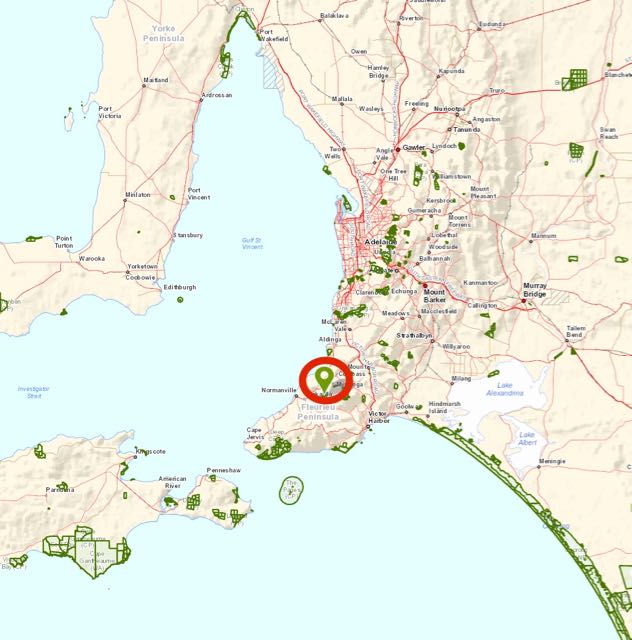
My second park activation for Sunday 30th November 2015, and my final activation for the inaugural 2015 VKFF Activation Weekend, was the Nixon Skinner Conservation Park, VKFF-0923.  The park is located on the Fleurieu Peninsula, about 5 km south of Myponga, and about 60 km south of Adelaide

Screenshot 2015-12-13 17.19.13

Above:- Map showing the location of the Nixon Skinner Conservation Park.  Image courtesy of Location SA Map Viewer.
I had activated Nixon Skinner Conservation Park previously, back in October, 2013, but as per all of my activations for the VKFF weekend, this activation was prior to the park being added to the VKFF list for the World Wide Flora and Fauna (WWFF) program.

For more information on my previous activation, please see…..

https://vk5pas.org/2013/10/14/nixon-skinner-conservation-park/

After leaving Stipiturus Conservation Park, I travelled west along Pages Flat Road, until I reached the little town of Myponga which is the hub of lush grazing and dairy country.  The name derived from the Aboriginal word ‘maippunga’ meaning locality of high cliffs.  Myponga was the venue for the first Australian performance by leading British heavy rock group Black Sabbath during the Myponga Music festival in 1971.  Prior to this festival the town’s leading claim to fame was the 1953 discovery of a uranium ore deposit at Wild Dog Hill.  Myponga is also the home of the Smiling Samoyed Brewery which is a small unique brewery and the Myponga market which is located in the old cheese factory.

I then travelled south west along Main South Road for around 5 kms.  I knew where I was heading as I had activated the park before.  But if you haven’t been to Nixon Skinner previously, then don’t blink.  You will probably miss it.   Just as you pass Causeway Road and travel over a part of the Myponga Reservoir, you will see a small track off to your right.  This is where you access the park.

There is a locked gate at this location.  Sadly, this is another locked Conservation Park.  But there is a gap in between the fence and the gate, allowing pedestrians into the park.  There is a bitumen road here and some old fire ban signs, so clearly at one stage, you could drive a vehicle down to the waterfront of the Myponga Reservoir.  If you have time I would highly recommend the walk down to the water.  It is a scenic walk and you will be rewarded with some great views of the reservoir.  And depending upon what time of the day you are here, the area is alive with kangaroos.
Nixon Skinner is only a small park.  It comprises 8 hectares of native vegetation, and backs on to the south western side of the Myponga Reservoir which provides about 5% of the drinking water for Adelaide.  It is the main source of filtered water for southern metropolitan Adelaide and the southern coast area.

This slideshow requires JavaScript.

In 1956 Mrs. Lucy Eleanor Page, a long standing and active member of the Field Naturalists Society of South Australia, donated the land.  The park was named in honour of her grandfathers and was the first privately donated reserve to be established in South Australia for the preservation in perpetuity of native plants and animals and for the enjoyment of nature lovers.  There is a memorial plaque for Mrs. Page, but keep your eye out for it.  I doubt that a DEWNR official has been in the park for a long time, as the plaque is underneath a tree and severely overgrown.

I set up in the same spot I had set up previously, just along the road inside the gate.  For this activation I used the Yaesu FT-857d, 40 watts and the 40m/20m linked dipole, supported on the 7 metre squid pole.  I supported the squid pole with the squid pole holder and an octopus strap.  It was hard going driving the holder into the ground, as it was very very dry.  Next time I think I will walk a lot further down the track, as Main South Road which passed by the park was extremely noisy and busy with tourist traffic travelling to and from the seaside tourist towns on the Fleurieu Peninsula, and Adelaide.

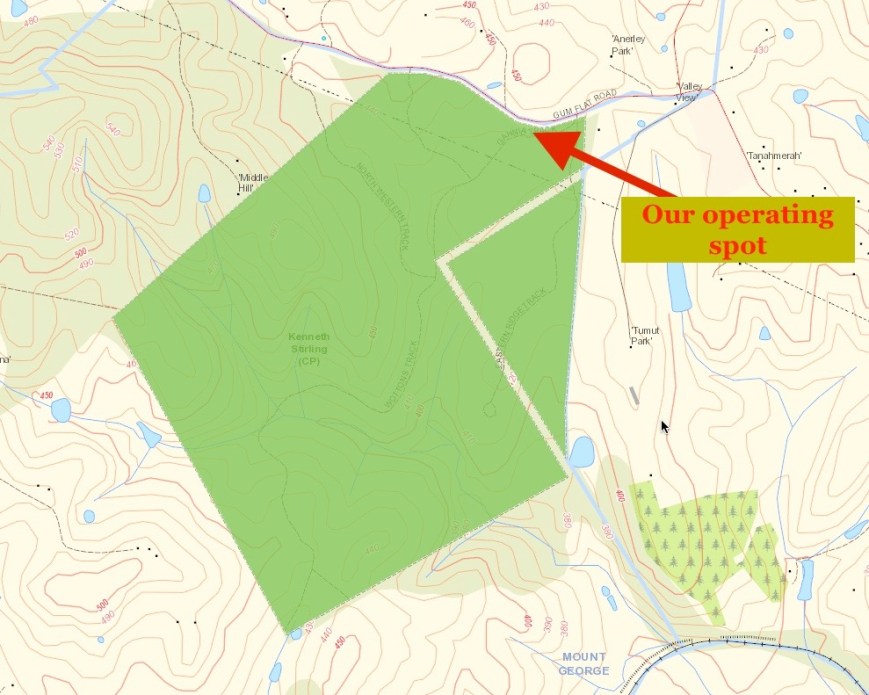
Screenshot 2015-12-13 17.19.45.jpg

Above:- Map showing my operating spot in the south western corner of the park.  Image courtesy of Location SA Map Viewer.

The start of this activation was a park to park fest.  I decided to have a tune around the 40m band before calling CQ.  And as a result I worked 7 park activators to start off the activation.

  • VK3TST/2 (Livingstone National Park VKFF-0292)
  • VK5EE/p (Ewens Ponds Conservation Park VKFF-0796)
  • VK3TKK/p (Lerderberg State Park VKFF-0763)
  • VK4AAC/5 (Beachport Conservation Park VKFF-0791)
  • VK1DI/p (Molonglo Gorge Nature Reserve VKFF-0901)
  • VK5FANA/p (Clinton Conservation Park VKFF-0813)
  • VK5HSX/2 (Murrumbidgee Valley National Park VKFF-0554)

I then headed for 7.155 and started calling CQ.  It wasn’t long before I had a mini pile up going, with the first caller being Allen VK3HRA, followed by Fred VK3DAC and then Tony VK5FTVR.  Soon after I had a call from Peter VK3PF who was portable in the Port Phillip Heads Marine National Park VKFF-0954.  This was a brand new park for me as a Hunter.  Next up was Andrew VK1DA/2 who was activating SOTA peak, Mount Bowning, VK2/ ST-042., north west of Yass.  And soon after Gary VK5FGRY called in again from the Morialta Conservation Park, along with Gerard VK2IO who was activating the Cattai National Park VKFF-0092.

When things slowed down a little, I had a glance around the 40m band again with the hope of picking up some more park activators, and that I did:

  • VK1VIC/p (Colleman Ridge Nature Reserve VKFF-0837)
  • VK5ZGY/p (Penola Conservation Park VKFF-0803)
  • VK5FFCC/p (Deep Creek Conservation Park VKFF-0780)
  • VK3YY/p (SOTA VK3/ VC-031 and VKFF-0750)
  • VK3VTH/p (Bendigo Regional Park VKFF-0960)

I then started calling CQ on 7.144 and worked a number of the regular park hunters, from VK2, VK3, VK5, and VK7, all of whom had good signals.  The band was working well.  The kookaburra sounded on my i-phone to alert me of Col VK5HCF and Tom VK5EE on 7.130 from the Douglas Point Conservation Park, VKFF-0795, so that’s where I headed for another park to park contact.

I then tried 20m briefly, but there were not a lot of takers there, with just 4 stations logged from VK2 and VK4.  So it was off to 15m where I enjoyed a little more success.  I worked a total of 10 stations on 15m from VK3, VK4, and Japan.

I then returned to 40m and worked Peter VK3PF who was now activating the Point Nepean National Park, VKFF-0628, before I propped on 7.120 and called CQ.  I worked a number of the regular park hunters and also picked up another park to park contact.  This time with David VK5PL who was activating the Kaiser Stuhl Conservation Park, VKFF-0897 in the Barrossa Valley.

I again tuned around the band and picked up some more park to park contacts:

  • VK5LOL/p (Onkaparinga River National Park VKFF-0402)
  • VK5PET/p (Coorong National Park VKFF-0115)
  • VK5AKH/p (Onkaparinga River National Park VKFF-0402)

I then commenced calling CQ on 7.115 and worked into VK2, VK3, VK5, and VK6.  This included a park to park contact with Lewis VK6FLEW who was operating portable from the Yanchep National Park, VKFF-0553.  The static crashes had really picked up and it was a very difficult contact.  But due to the perseverance of us both, we eventually made it, exchanging signal reports and park numbers (3/3 sent and 3/1 received).  Well done Lewis, it was great to get you in the log.

I tried 20m and 15m one last time each.  On 20m I worked into Italy, VK5 and VK6.  But it was so noisy on 20m with extremely loud static crashes, that I decided it just wasn’t worth continuing, and trying to get Europe on the long path.  On 15m I worked just 3 stations in Japan and VK3.

This was a great afternoon in the park with a total of 102 contacts on 40m, 20m, and 15m.  This included a total of 24 park to park QSOs.

The following stations were worked on 40m SSB:-

  1. VK3TST/2 (Livingstone National Park VKFF-0292)
  2. VK5EE/p (Ewens Ponds Conservation Park VKFF-0796)
  3. VK3TKK/p (Lerderberg State Park VKFF-0763)
  4. VK4AAC/5 (Beachport Conservation Park VKFF-0791)
  5. VK1DI/p (Molonglo Gorge Nature Reserve VKFF-0901)
  6. VK5FANA/p (Clinton Conservation Park VKFF-0813)
  7. VK5HSX/2 (Murrumbidgee Valley National Park VKFF-0554)
  8. VK3HRA
  9. VK3DAC
  10. VK5FTVR
  11. VK3OHM
  12. VK5FMID
  13. VK3PF/p (Port Phillip Heads Marine National Park VKFF-0954)
  14. VK1DA/p (SOTA VK2/ ST-042)
  15. VK3PMG
  16. VK3YAR
  17. VK5JK
  18. VK5FGRY/p (Morialta Conservation Park VKFF-0783)
  19. VK1MA
  20. VK5HS
  21. VK5FLEX
  22. VK2IO/p (Cattai National Park VKFF-0092)
  23. VK1VIC/p (Cooleman Ridge Nature Reserve VKFF-0837)
  24. VK5ZGY/p (Penola Conservation Park VKFF-0803)
  25. VK5FFCC/p (Deep Creek Conservation Park VKFF-0780)
  26. VK5TR
  27. VK3YY/p (SOTA VK3/ VC-031 and VKFF-0750)
  28. VK3VTH/p (Bendigo Regional Park VKFF-0960)
  29. VK5DJ
  30. VK5PL
  31. VK2AWJ
  32. VK2VW
  33. VK7CW
  34. VK2NEO
  35. VK2QR
  36. VK2HEW
  37. VK5GJ
  38. VK3FLCS
  39. VK3TKK/m
  40. VK5WG
  41. VK5KLV
  42. VK5AV
  43. VK5EE/p (Douglas Point Conservation Park VKFF-0795)
  44. VK5HCF/p (Douglas Point Conservation Park VKFF-0795)
  45. VK3PF/p (Point Nepean National Park VKFF-0628)
  46. VK5NFT
  47. VK5FD
  48. VK5MBD
  49. VK3FPAR
  50. VK5HYZ
  51. VK3BSG
  52. VK5NRG
  53. VK3DBP
  54. VK5PL/p (Kaiser Stuhl Conservation Park VKFF-0897)
  55. VK3ANL
  56. VK3ZD
  57. VK7FRKL
  58. VK3OF
  59. VK5LOL/p (Onkaparinga River National Park VKFF-0402)
  60. VK5PET/p (Coorong National Park VKFF-0115)
  61. VK5AKH/p (Onkaparinga River National Park VKFF-0402)
  62. VK5NIG
  63. VK3FIRM
  64. VK3UH
  65. VK3FPBI
  66. VK5AW/m
  67. VK5VBR
  68. VK5FANA
  69. VK2PKT
  70. VK3UT
  71. VK6FLEW/p (Yanchep National Park VKFF-0553)
  72. VK3BQ
  73. VK5FDEC
  74. VK3ETC
  75. VK3VEF
  76. VK5HEL
  77. VK5NJ
  78. VK5MCB

The following stations were worked on 20m SSB:-

  1. VK2YW
  2. VK4RF
  3. VK4HA
  4. VK2HOT
  5. VK6NU/p (Wandoo National Park VKFF-0656)
  6. VK5KBJ
  7. VK6DW
  8. VK4QQ
  9. IK1GPG
  10. VK6XL
  11. VK6HAO

The following stations were worked on 15m SSB:-

  1. VK4RF
  2. VK4HA
  3. JA8RJE
  4. VK4FFAB
  5. VK3FAPH
  6. JK1THF
  7. VK3PMM
  8. VK3MEG
  9. JE1GWO
  10. JA1SMM
  11. JA4SCQ
  12. VK3FIRM
  13. VK3FONZ


Scott Conservation Park, VKFF-0934

My second park for Saturday 29th November 2015 was the Scott Conservation Park, VKFF-0934, which is situated north west of Currency Creek on the Fleurieu Peninsula.  It is about 75 km south of Adelaide.

Screenshot 2015-12-12 21.46.58

Above:- Map showing the location of Scott Conservation Park.  Image courtesy of Location SA Map Viewer.

This was another park that I had activated previously as part of the VK5 National & Conservation Parks Award, but prior to it being added to the World Wide Flora Fauna (WWFF) program.  For more information on my previous activation back in December 2013, please see my previous post at…..

https://vk5pas.org/2013/12/27/scott-conservation-park/

After leaving Mount Magnificent I travelled along the Enterprise Road and then turned left onto Nangkita Road, passing through the little town of Nagkita.  I then turned right onto Deep Creek Road and then left onto Gould Road.  There is a sign for the park at this intersection.

DSC_0454

Scott Conservation Park is about 210 hectares in size.  It consists of Blue and Pink gum woodlands.  The scrub here is very thick.  That is compared to the cleared land on each side of the park.  The park is home to a large amount of native wildlife including Western Grey Kangaroos, Ringtail Possums and Western Pygmy-possums.  A number of endangered birds are also located in the park including the Chestnut-rumped Heathwren and the Diamond Firetail finch.

There is a small carpark on Gould Road on the northern side of the park.  This appears to be the only way to access the park, as it appears that private land is situated on the western, eastern and southern side of the park.  I parked the 4WD and walked a short distance down a fire access track.  There is a locked gate so you cannot drive down the track.

Screenshot 2015-12-12 21.46.21

Above:- Map showing my operating spot in the northern section of the park.  Image courtesy of Location SA Map Viewer.

I set up my fold up table and deck chair, and the Yaesu FT-857d, and my 20m/40m linked dipole.  I was a little behind schedule but was up and ready to go by 0235 UTC (11.05 a.m. South Australian local time).  I had the transceiver on 14.310 when I turned it on and heard Gerard VK2IO calling CQ from a park.  But I still had not erected the 7 metre telescopic squid pole.  So I quickly put it in place and tied the ends of the dipole to some nearby trees, hoping to get Gerard before he left the frequency.  Unfortunately I wasn’t quick enough.  I gave Gerard a call, but he had gone.

So I headed for 40m and started calling CQ on 7.145.  My first taker there was Stef VK5HSX who was portable in the Murray Sunset National Park, VKFF-0373.  Stef had a very strong 5/9 signal coming in from western Victoria.  My next caller was park regular Rex VK3OF, followed by another park stalwart Peter VK3TKK.  My fourth contact was with Greg VK5ZGY in the Nene Valley Conservation Park, VKFF-0801.

The 40m band was in good shape, with strong signals coming in from VK2, VK3, and VK5.  It wasn’t long before I had a number of other park contacts in the log.  They included:-

  • Gerard VK2IO in the Sydney Harbour National Park, VKFF-0473
  • Cliff VK2NP in the Sea Acres National Park, VKFF-0606
  • Ian VK1DI in the Goorooyaroo Nature Reserve VKFF-0841
  • Greg VK5GJ in the Kyeema Conservation Park VKFF-0826
  • Rob VK4AAC/5 in the Little Dip Conservation Park VKFF-0904
  • Les VK5KLV in the Whyalla Conservation Park, VKFF-0808
  • Pat VK5HAE in the Whyalla Conservation Park, VKFF-0808
  • Adrian VK5FANA in the Bird Islands Conservation Park, VKFF-0871
  • Tony VK3VTH in the Cobram Regional Park, VKFF-0961
  • Amanda VK3FQSO in the Kooyoora State Park VKFF-0729
  • Allen VK3HRA in the Hepburn Regional Park, VKFF-0968

I also had some good QRP contacts.  These included Ian VK5CZ running 5 watts from the Clare Valley (5/9 both ways), and Tom VK5NFT, also running 5 watts from Millicent in the South East (5/7 sent and 5/9 received).  Mal VK5MJ also called in from his boat on the Murray River near Lyrup, in the Riverland region of South Australia.

When things got a little quiet, I had a listen around the band and found Compton VK2HRX on SOTA peak, Mount Canobolas VK2/ CT-001, south west of Orange in New South Wales.  Although Compton was quite weak, we managed a contact (4/1 both ways).

I then returned back higher up the band to 7.144 and called CQ again.  This time my CQ call was answered by Peter VK5APR operating from the Adelaide Hills Amateur Radio shack at Blackwood.  Again it wasn’t long before I had some more park to park contacts in the log.  This time they were:-

  • Tom VK5EE in the Penambol Conservation Park, VKFF-0802
  • Greg VK5ZGY in the Canunda National Park, VKFF-0075
  • Col VK5HCF in the Penambol Conservation Park, VKFF-0802
  • Gary VK5FGRY in the Morialta Conservation Park, VKFF-0783

When things slowed down again I seized the opportunity of looking across the band and I soon found Peter VK3ZPF on 7.090 calling CQ from the Point Nepean National Park, VKFF-0628 (5/9 both ways).  Next up was Mick VK3PMG on 7.120 calling CQ from the Gunbower National Park, VKFF-0740 (5/8 both ways).

I then headed off to 20m and started calling CQ on 14.310.  This was answered by Brett VK2VW with a very strong 5/9 signal.  And guess who was next.  Yes, the ever  reliable and ever so keen, Rick VK4RF/VK4HA. who was also 5/9.  I worked a further 4 stations on 20m, making my total contacts 49.

It was then back to 40m briefly to work Ray VK3YAR on a SOTA peak, Mount Bealiba VK3/ VN-026, and then I tried my luck on 15m.  It was down with the 20m/40m linked dipole, which I didn’t pack away, but rather, layed on the ground.  And up with the 15m dipole.  I called CQ on 21.244 and again, my first taker was Brett VK2VW with a good 5/7 signal (5/5 received).  And next, much to my surprise, was Rob VK4FFAB portable in the Geham National Park VKFF-0679 with a good 5/4 signal (5/5 received).  Rob had been encouraging me to use 15m a bit more often, so it was a pleasure to get him in the log.  I worked a further 5 stations on 15m, from VK2, VK4, and Vk6.  This included Gerald VK2HBG in the Bimberamala National Park VKFF-0032.

I then packed away the 15m dipole and re-erected the linked dipole and worked Tony VK3VTH on 14.310, who was portable in the Cobram Regional Park VKFF-0961.

I was pushing it a bit for time, so I went back to 40m for a short period and spoke with Giles VK5GK in the Mount George Conservation Park, VKFF-0784.  This was Giles first ever park activation, so it was a pleasure to speak with Giles.  I then worked Ian VK5CZ in the Spring Gully Conservation Park, VKFF-0816, and then Greg VK5GJ in the Cox Scrub Conservation Park, VKFF-0824.

I decided to call CQ one last time on 7.135 and Joe VK3YSP responded.  Joe was operating portable from the Dromana Pier with his wife Julie VK3YSP.  My final contact was with Keith VK2PKT, who has recently become a regular park hunter.

So after about 2 and 1/2 hours in the park I had a total of 66 contacts in the log, including another 26 park to park contacts.  This was another great activation, which was watched on by the little fella below, a Shingleback lizard, who was sunning himself only a few metres away from where I was operating.  Fortunately I did not see any snakes.

DSC_0466.jpg

The following stations were worked on 40m SSB:-

  1. VK5HSX/p (Murray Sunset National Park VKFF-0373)
  2. VK3OF
  3. VK3TKK
  4. VK5ZGY/p (Nene Valley Conservation Park VKFF-0801)
  5. VK5ZTS
  6. VK5CZ
  7. VK5HYZ
  8. VK5QI/m
  9. VK3NBV
  10. VK5FMID
  11. VK5KX
  12. VK2IO/p (Sydney Harbour National Park VKFF-0473)
  13. VK5FO/m
  14. VK2NP/p (Sea Acres National Park VKFF-0606)
  15. VK1DI/p (Goorooyaroo Nature Reserve VKFF-0841)
  16. VK3PMG/m
  17. VK5GJ/p (Kyeema Conservation Park VKFF-0826)
  18. VK4AAC/5 (Little Dip Conservation Park, VKFF-0904)
  19. VK5KLV/p (Whyalla Conservation Park VKFF-0808)
  20. Pat VK5HAE/p (Whyalla Conservation Park VKFF-0808)
  21. VK5FANA/p (Bird Islands Conservation Park VKFF-0871)
  22. VK5BW
  23. VK3VTH/p (Cobram Regional Park VKFF-0961)
  24. VK3FQSO/p (Kooyoora State Park VKFF-0729)
  25. VK3HRA/p (Hepburn Regional Park VKFF-0968)
  26. VK5AVQ
  27. VK5MJ/mm
  28. VK3DBP
  29. VK5NFT
  30. VK5AV
  31. VK5PL
  32. VK5TR
  33. VK2HRX/p (SOTA VK2/ CT-001)
  34. VK5APR
  35. VK3AKK
  36. VK5EE/p (Penambol Conservation Park VKFF-0802)
  37. VK5ZGY/p (Canunda National Park VKFF-0075)
  38. VK5HCF/p (Penambol Conservation Park VKFF-0802)
  39. VK5MRE
  40. VK5FGRY/p (Morialta Conservation Park VKFF-0783)
  41. VK3PF
  42. VK3ZPF/p (Point Nepean National Park VKFF-0628)
  43. VK3PMG/p (Gunbower National Park VKFF-0740)
  44. VK3YAR/p (SOTA VK3/ VN-026)
  45. VK5GK/p (Mount George Conservation Park VKFF-0784)
  46. VK5CZ/p (Spring Gully Conservation Park VKFF-0816)
  47. VK5GJ/p (Cox Scrub Conservation Park VKFF-0824)
  48. VK3YSP/p
  49. VK3FOWL/p
  50. VK2PKT

The following stations were worked on 20m SSB:-

  1. VK2VW
  2. VK4RF
  3. VK4HA
  4. VK7CW
  5. VK2UH
  6. VK3PAT
  7. VK3HMV
  8. VK3VTH/p (Cobram Regional Park VKFF-0961)

The following stations were worked on 15m SSB:-

  1. VK2VW
  2. VK4FFAB/p (Geham National Park VKFF-0679)
  3. VK4RF
  4. VK4HA
  5. VK2PH
  6. VK2HBG/p (Bimberamala National Park VKFF-0032)
  7. VK4ZD
  8. VK6MJP

One Tree Hill, VK3/ VS-036

Our final activation for Wednesday 18th November 2015, was One Tree Hill, VK3/ VS-036, which is located just to the north west of Ararat in western Victoria.

I have activated this summit once before, back in September 2013.  For more information on that activation, please have a look at my previous post…..

https://vk5pas.org/2013/09/13/one-tree-hill-vk3-vs-036/

Screenshot 2015-12-11 15.05.03

Above:- Map showing the location of One Tree Hill.  Image courtesy of google maps.

One Tree Hill is 569 metres above sea level and is worth 2 SOTA points.  It is a very easy summit to access.  After leaving the motel room we drove up Golf Links Road and then Picnic Road.  We then took One Tree Hill Road, which takes you up to the Ararat Regional Park entrance.  This park is made up of three separate blocks.  This is the Ararat Hills block which is 820 hectares in size.  The other two sections of the park are Dunneworthy block (2,670 hectares) and Bradys block (180 hectares).

DSC_0270

Continue along this bitumen road and it will take you to the One Tree Hill lookout.  This is not the summit though.  At the end of the bitumen and the carpark, there is a narrow dirt track.  You need to head down this track to get to the summit.  This track is definitely not suitable for a conventional vehicle.  So if you have your car, leave it in the carpark, and walk the remainder of the way to the summit.  It’s not that far and is not an onerous walk.

Screenshot 2015-12-11 15.04.47

Above:- Aerial shot showing the location of the summit, to the north west of Ararat.  Image courtesy of google maps.

We stopped briefly in the carpark and took some photographs of Ararat and the surrounding countryside.  There are some great views from here of the nearby Grampian Mountains, Mount Langi Ghiran, and Mount Cole.

This slideshow requires JavaScript.

As we had the Toyota HiLux we drove along the track for a few hundred metres until we found a clearing off the dirt track.  We parked the 4WD there, and then walked a short distance to another clearing and set up our gear there.

Screenshot 2015-12-11 15.04.21Above:- Aerial shot showing the location of the summit, further to the north of the lookout.  Image courtesy of google maps.

The summit is quite heavily wooden with gum trees, so I’m really not sure why it is called One Tree Hill.

DSC_0285

I commenced calling CQ on 7.088.  I could not get onto my nominated operating frequency of 7.090 as the Kandos Net was running on 7.093.  It didn’t take long for the SOTA chasers to be queuing up to get in the log.  My first contact was with Ray VK3NBL, followed by Adrian VK5FANA, Ivan VK5HS, and then Bill VK3LY.  I was kept busy with a mini pile up with callers from VK1, VK2, VK3, VK4, VK5, and VK7.  The 40m band was in very good condition with excellent signal reports both ways.

I was pleased to be able to work Warren ZL2AJ, the New Zealand SOTA Association Manager.  Warren had a strong 5/8 signal to One Tree Hill from near Palmerston North on the North Island.  I also had some great QRP contacts.  They included Ian VK3BFR running 5 watts (5/8 sent and 5/9 received), and Andrew VK3JBL running 5 watts (5/8 sent and 5/9 received).

I worked a total of 46 stations on 40m before heading to 20m.  I commenced calling CQ on 14.311 and this was answered by Rick VK4RF/VK4HA with a very strong 5/9 signal.  This was followed by EA4DTV in Spain, Luciano I5FLN in Italy, and then Rudi DL3ARS in Germany.  Signals on the long path from Europe were very good.  Early on during my 20m stint, John VK6NU called in a number of times from Western Australia, but unfortunately he was not able to hear me.  But we did make it some 30 minutes later, albeit a little difficult.  I went on to work a total of 36 stations on 20m in VK4, Spain, Italy, Germany, Austria, France, Belgium Greece, Slovak Republic, Russia, Ukraine, England, and Switzerland.

After about 90 minutes on One Tree Hill I had a total of 82 contacts in the log.

The following stations were worked:-

Screenshot 2015-12-11 14.59.07 Screenshot 2015-12-11 14.59.15

Below is the sunset out to the west as we were leaving the summit.

DSC_0286

We headed back in to Ararat and went to one of the local hotels only to be told that they did not serve meals on a Wednesday night.  So we headed down to Sicilians Restaurant and I am very pleased we did.  The service was excellent, and the meal was superb.  My meal was so big, I couldn’t finish it, and we needed to take some of it home in a ‘doggie bag’.


References.

Parks Victoria, 2015, <http://parkweb.vic.gov.au/explore/parks/ararat-hills-r.p.&gt;, viewed 10th December 2015