Point Addis Marine National Park, VKFF-0952

Tuesday, the 17th November 20165, was day 11 of our trip away.  We had spent a quiet Monday night in the apartment, and all of this day was a planned tourist day.  So we had a little bit of a sleep in, but the quiet of the morning soon changed with the arrival of some Sulphur Crested cockatoos on our doorstep.  They were very tame and allowed us to hand feed them.  It wasn’t long before the magpies had joined in the party.

After breakfast we drove in to Lorne and had a quick look around.  This included a visit to Lorne’s historic swing bridge which spans the mouth of the Erskine River.  The bridge was constructed in 1937.  We also took a walk along Lorne’s main street on the foreshore.

We drove up to have a look at the very majestic, Grand Pacific Hotel in Lorne, which can be located at the top end of Mountjoy Parade.  Whilst there we booked a table for a meal that evening.  The Grand Pacific was built in 1875 and features superb ocean views.

Marija was very keen to travel to Torquay, about 47 km north west of Lorne.  So that is where we headed.  We stopped a number of times along the way to enjoy the amazing views of the coastline along the Great Ocean Road.  Along the way I booked in to the morning net on 40m run by Ron VK3MRH, who himself has recently become a very avid park hunter.

No trip along the Great Ocean Road is complete until you have stopped at the Memorial Arch.  So of course, that’s what we did.  Along when 10,000 other tourists.  Well, okay, that might be a slight exaggeration.  But there were certainly a lot of tourists here.

The Memorial Arch is a tribute to the World War One servicemen who constructed the Great Ocean Road.  The current day arch is the third to be built.  It replaced the second arch which was destroyed in the February 1983 Ash Wednesday bushfires.  The arch consists of a timber log archway with cement and stone supports on each side.

The Great Ocean Road was completed in 1932 and the arch was first erected in 1939.  It was replaced in 1973 and again in 1983.  There are a number of plaques here which tell all about the story of the construction of the Great Ocean Road.

This slideshow requires JavaScript.

There were also some very impressive homes along the Great Ocean Road.  I gazed at a number of them in awe as we passed them, including the one below.  What great views.  And even better, from an amateur radio operator point of view….what a great take off!

DSC_0087

We drove into the beautiful little town of Aireys Inlet, about 19 km north west of Lorne.  Aireys Inlet is a lovely little coastal town, and has a population of around 1,200 people.  The town was devastated during the 1983 Ash Wednesday bushfires, with a large number of homes completely destroyed.  The area experienced a brief lull, but interest in the area soon resumed and has been steadily increasing ever since.

We stopped briefly to have a look at the bark hut in Aireys Inlet.  In 1852, Geelong butchers, Thomas Pearse and Robert McConachy, purchased the Anglohawk cattle station which ran from the Aireys inlet side of Painkalac Creek back towards Anglesea.  Initially they built a slab house, a stone shed and 2 bark huts near there.  The bark hut in Aireys Inlet is a replica of one of the hunts, which survived until 1983, when it was destroyed by bushfire.

We then stopped off at the Split Point lighthouse at Aireys Inlet.  Construction on the lighthouse commenced in late 1890 and the lighthouse was first illuminated in September 1891.  Prior to this, there were about ten shipwrecks along the surrounding coastline.  It was these tragedies that prompted authorities to plan the lighthouse.  Originally called Eagles Nest Point, the lighthouse was renamed Split Point in 1913.

The lighthouse has featured on series 6 of Masterchef.  There is a cairn here which marks the burial site of Thomas Pearsse (mentioned above) and his wife, Martha.

For more information on the lighthouse, have a look at……

http://splitpointlighthouse.com.au/

We continued along the Great Ocean Road towards Torquay, stopping briefly to enjoy the view at Urquart Bluff.  We then drove down to the beach and had lunch, whilst sitting back enjoying the magnificent views and the sensational sunshine.

DSC_0108


After lunch we drove on to the little town of Anglesea and stopped at the Anglesea Lookout Reserve which is also known as Loveridge Lookout.  The lookout was built in 1938 as a memorial to James Loveridge by his widow Bertha.  It is located near the former Loveridge owned property, ‘Anglecrest’.  This site was chosen by Bertha, as it was James Loveridge’s favourite viewing location of Bass Strait.  Sadly, the Ash Wednesday bushfires were to take another victim, with the destruction of the original ‘Anglecrest’ homestead.  During the Second World War, Loveridge Lookout was used as an observation post for the Volunteer Air Observers Corps.

We continued on to Torquay, which is just 21 km from Geelong.  This popular tourist town is the gateway to the Great Ocean Road from Melbourne.  Torquay’s population is around 10,200 people.

Torquay is famous for its surf beaches, with Jan Juc and the world famous Bells Beach located on the town’s south-west outskirts.  As a result, there is a major complex in the town which features a number of surf shops.

It was a warm afternoon, so Marija and I took the time out to stop off at one of the cafes in Torquay and enjoy a smoothie each.  It was whilst we were sitting back relaxing, that I was going through some of the tourist brochures and learnt that we would be passing the Point Addis Marine National Park on the way back to Lorne.  A little bit of groveling to Marija, and it was agreed upon that I could do a quick activation of the park.

DSC_0124.jpg

The park was just a 14 km drive from Torquay.

Screenshot 2015-12-10 17.23.32

Above:- Map showing the location of the Point Addis Marine National Park.  Image courtesy of Forest Explorer.

We then headed back south west along the Great Ocean Road, and took the turn off to Bells Beach, travelling along Bones Road.  It wasn’t long before we reached the world famous Bells Beach.  It is named after John Cavert Bell, of the family who first took up a pastoral run in the area back in the 1840’s.  Bells Beach is the home to the world’s longest running surfing competition – the Rip Curl Pro Surf & Music Festival.  This was formerly known as the Bells Beach Surfing Classic and was first held in January 1961.

We continued along the Bells Beach Road and then Jarosite Road, until we reached the Great Ocean Road.  A short distance from there, we turned left into Point Addis Road.  We stopped off briefly at the lookout for Southside Beach.  As it turns out this is a nudist beach.  But my nudist days are well and truly passed me, so we didn’t venture down to the beach.  I am sure all of the nudists down on the beach would have appreciated my decision!

We continued along Point Addis Road and along the way I spoke with Tony VK3VTH who was operating portable from the Gippsland Lakes Coastal Park VKFF-0747.  Tony had a good 5/9 signal into the mobile.  We continued on until we reached the carpark at the end of Point Sddis Road.  There weren’t any possibilities for activation positions along the way, so we decided to try to set up in the carpark in one of the corners away from any of the tourists.

A little bit of information about Point Addis Marine National Park…..the park features spectacular scenery with wide sandy beaches, limestone and sandstone cliffs and rocky platforms.  The park is 4,600 hectares in size and is part of a system of 13 Marine National Parks in Victoria.  The park is considered to be one of the most biodiverse and unique marine ecosystems in the world.  Bells Beach is just one of the features along the 9km of rugged coastline between Torquay and Anglesea.

Screenshot 2015-12-10 17.23.06

Above:- Map showing the park, just south west of Torquay.  Image courtesy of Forest Explorer.

There is a boardwalk here at the end of Point Addis Road, which allows you to view the magnificent coastline.  If you are here between May and September, you may also be fortunate enough to see a whale.

I secured the squid pole to a fencepost, with the assistance of an octopus strap, and stretched out the legs of the 20m/40m linked dipole, securing them to the fence.  I then sat back in my deck chair and turned on the Yaesu FT-857d.  Before calling CQ I had a look around the band in the hope of working Tony VK3VTH, and perhaps finding some other park activators. I found Tony still on 7.144, calling CQ, so I gave him a shout (5/9 both ways).

Screenshot 2015-12-10 17.22.26

Above:- Map showing the park.  Our operating spot was right at the tip of Point Addis.  Image courtesy of Forest Explorer.

I then headed up the band to 7.150 and started calling CQ.  It wasn’t long before the park hunters had found me.  My second contact for the activation was with avid park hunter, Brett VK2VW, followed by another park stalwart, Mick VK3PMG, and then Steve VK7CW, who is another park regular.

I went on to work a total of 49 stations on 40m SSB.  Band conditions were excellent, with some very strong signals from VK1, VK2, VK3, VK4, VK5, and VK7.  Well at least band conditions were good.  Because the weather conditions had deteriorated rapidly.  The afternoon had started out beautifully with bright sunshine and just a gentle sea breeze.  But after about an hour of operating, the wind had picked up dramatically, and I lost the squid pole on a couple of occasions.  This resulted in another octopus strap being required to keep it upright.

As we had booked to go out for tea that evening at Lorne, I was running a bit short of time.  So battling with the wind, I lowered the squid pole and with Marija’s assistance we removed the links and then raised the squid pole back into position.  I went to 14.310 and called CQ and this was answered by Mr. Reliable, Rick VK4RF/VK4HA.  Next up was Les VK5KLV from Port Augusta.  I was very surprised to hear Les with such an exceptionally good 5/8 signal.  I thought we might have been a little too close for 20m.  I worked a further seven stations on 20m from VK2, VK4, VK6, New Zealand and Russia.  Unfortunately it was way too early for Europe on the long path.

We also had some onlookers during the activation.  A busload of tourists arrived, and I took the time to explain to them what this idiot with a squid pole was doing in a carpark overlooking the ocean.  They seemed very interested.  We were also visited by some Paramedics.  Apparently someone had fallen down a cliff face.  I never actually found out if they were rescued.

So, after about 90 minutes in the park, I had a total of 59 QSOs in the log and a brand new park under my belt as an activator.  It was time to pack up and head back to Lorne and head out for tea.

The following stations were worked on 40m SSB:-

  1. VK3VTH/p (Gippsland Lakes Coastal Park VKFF-0747)
  2. VK2VW
  3. VK3PMG
  4. VK7CW
  5. VK5FTVR
  6. VK3OHM
  7. VK3FALE
  8. VK5TN
  9. VK3MRH
  10. VK2HHA
  11. VK3PF
  12. VK3ZMD
  13. VK3DAC
  14. VK7LTD
  15. VK3FPBI
  16. VK2YW
  17. VK5EE
  18. VK2NP
  19. VK2IO
  20. VK4AAC/5
  21. VK5BJE
  22. VK5HCF
  23. VK2GKA
  24. VK5DJ
  25. VK5ZGY
  26. VK2FADV
  27. VK5FANA
  28. VK5NRG
  29. VK3KIS
  30. VK5FMID
  31. VK5ATQ
  32. VK3CFA
  33. VK4RF
  34. VK4HA
  35. VK7WN
  36. VK3DBP
  37. VK3VIN
  38. VK2PKT
  39. VK3GB
  40. VK1VIC/m
  41. VK3TKK
  42. VK2FVG
  43. VK3TJK
  44. VK3FQSO
  45. VK5KLB
  46. VK3PAT
  47. VK4ARW
  48. VK3UYS
  49. VK5HS/m

The following stations were worked on 20m SSB:-

  1. VK4RF
  2. VK4HA
  3. VK5KLV
  4. VK4ARW
  5. VK4HG
  6. RN3QN
  7. ZL4KD
  8. VK2HOT
  9. VK4BX
  10. VK6ADF/m

That night we enjoyed a very enjoyable evening at the Grand Pacific Hotel in Lorne.


References.

Parks Victoria, 2015, <http://parkweb.vic.gov.au/explore/parks/point-addis-marine-national-park&gt;, viewed 10th December 2015.

Monument Australia, 2015, <http://monumentaustralia.org.au/themes/conflict/ww1/display/31148-great-ocean-road-memorial-arch/photo/1&gt;, viewed 10th December 2015.

Wikipedia, 2015, <https://en.wikipedia.org/wiki/Aireys_Inlet&gt;, viewed 10th December 2015

Split Point Lighthouse, 2015, <http://splitpointlighthouse.com.au/&gt;, viewed 10th December 2015

Wikipedia, 2015, <https://en.wikipedia.org/wiki/Bells_Beach,_Victoria&gt;, viewed 10th December 2015


Great Otway National Park VKFF-0405, The Redwoods Picnic Area

After leaving the Cape Otway lighthouse we decided that we would visit the Otway Fly.  No, that’s not a hairy, six legged pest!  The Otway Fly is a treetop adventures venue which consists of the Treetop Walk, and also the Zipline Eco-Tour.  The Treettop Walk is a 1 hour rainforest walk experience that is about 2 km in total length, and features a 600 metre long and 30 metre high, steel structured treetop canaopy walkway which takes you right into the treetops of the rainforest.  The Zipline-Eco-Tour is a 2.5 hour, fully guided experience and included training and simulation.  It inclues 8 cloud stations, 6 flights and 2 suspension bridges.

We travelled north along the Great Ocean Road, to Lavers Hill and then back east on the Colac-Lavers Hill Road to the little area of Ferguson.  From there we travelled south along Phillips Track.

For more information on the Otway Fly, please have a look at…..

http://www.otwayflytreetopadventures.com/

This slideshow requires JavaScript.

After leaving the Otway Fly, we continued east along the Beech Forest-Lavers Hill Road, until we reached the little town of Beech Forest.  This is the home town of Albert Ernest Clifford ‘Cliff’ YOUNG, who was an Australian potato farmer and athlete.  He is best known for his unexpected win of the inaugural Sydney to Melbourne Ultramarathon in 1983, at the tender age of 61 years.  There is a little monument here in Beech Forest, which celebrates his life.

Also worth a look are the wooden sculptures designed by chainsaw sculptor, Brett DAVIES.  The sculptures comprise of a pioneering woman with babe in arms, a woodcutter to represent the timber industry, an indigeneous man in a possum skin coat, and a potato grower.

After leaving Beech Forest we travelled south along Binns Road, until we reached a beautiful little area called The Redwoods Picnic Area, which is located in the Great Otway National Park on the Aire River, near the junction with Farrell Creek.  Park activation, park activation, park activation!  Those were the thoughts going through my head and I managed to convince Marija that I would only be a short time.

There was a beautiful little lawned area right alongside a plantation of Californian Redwoods ‘Sequoia Sempervirens’.  This is where we set up the fold up table and deck chair.  There was plenty of room to stretch out the dipole, the ends of which I secured to some of the nearby trees.

I commenced getting on air, whilst Marija explained to some 4WDers in the carpark, exactly what I was doing.

Screenshot 2015-12-09 17.09.50

Above:- Aerial image showing our operating spot.  Courtesy of google maps

Screenshot 2015-12-09 17.10.23

Above:- Map showing the location of where we were operating from.  Image courtesy of http://www.here.com

After turning on the radio I had a quick tune around the band and heard the dulcet tones of Bill VK3LY who was chatting away on 7.110 with some other stations. I had met Bill a number of days earlier whilst I was portable in the Bay Of Islands Coastal Park.   Bill was actually mentioning that he had caught up with me, so I decided to pop in and say hello.  I spoke with Bill, Bob VK5FPAC, Ian VK3AXH, and Bruce VK3FBNG portable at Cow Samp near Gunbower.  All were 5/9 signals.

I then headed up to 7.144 and started calling CQ.  Unfortunately there was no mobile phone coverage so I could not spot myself on parksnpeaks.  But it wasn’t long until I had my first park hunter, and it was Jeff VK5JK at Encounter Bay south of Adelaide, with a nice 5/9 signal.  Next up was Peter VK7LCW at Penguin in Tasmania, followed by Shaun VK3VLY and then Gerard VK2IO.

A few QSOs later I was called by Gordon VK5GY who was portable in the Mark Oliphant Conservation Park in the Adelaide Hills (5/9 both ways).

After working a total of 20 stations on 40m in VK2, VK3, VK4, VK5 and VK7, I decided to have a quick listen on 20m.  In any event, I was experiencing a little bit of QRM from European stations on 40m from adjacent to where I was operating from on 7.144.

After lowering the squid pole and removing the links in the dipole, I headed for 14.310 where I called CQ.  My first taker was Rick VK4RF/VK4HA with a very nice 5/9 plus signal.  My first European followed after my contact with Rick, and that was Luciano I5FLN.  This was followed by 9A7C in Croatia, S52KM in Slovenia, and then Max IK1GPG in Italy.  I worked a further 6 stations on 20m, including John VK6NU, and a new country for me whilst portable, E51KIK in the South Cook Islands.

It was 4.30 p.m. and we still had quite a drive to get back to Apollo Bay, so it was time to pack up and hit the road.  I had a total of 32 contacts in the log.

We had intended to continue south down Binns Road until we reached the Great Ocean Road, but the local 4WDers convinced us that this would be a long drive, so we drove back to Apollo Bay via

The following stations were worked on 40m SSB:-

  1. VK3LY
  2. VK5FPAC
  3. VK3AXH
  4. VK3FBNG/p
  5. VK5JK
  6. VK7LCW
  7. VK3VLY
  8. VK2IO
  9. VK2PKT
  10. VK5GY/p (Mark Oliphant Conservation Park)
  11. VK3TJK
  12. VK5NFT
  13. VK5SFA
  14. VK3NCC
  15. VK4RF
  16. VK4HA
  17. VK5NRG
  18. VK2NP
  19. VK3UT
  20. VK5JDS

The following stations were worked on 20m SSB:-

  1. VK4RF
  2. VK4HA
  3. I5FLN
  4. 9A7C
  5. S52KM
  6. IK1GPG
  7. E51KIK
  8. VK6NU
  9. VK4SC
  10. VK4GSW
  11. DK4RM
  12. VK4QQ

An afternoon of touristy stuff

After leaving Mount Clay, Marija and I drove back to the Princes Highway and continued east through Tyrendarra and Tyrrendarra East.  We stoppe briefly at the Codrington Wind Farm for a cup of coffee and some cake.

The Codrington wind farm was Australia’s first commercial wind farm and was officially opened in July 2001.  A the time of its opening, it was also the largest wind farm iun Australia, with 14 turbines and an installed capacity of 18.2 MW.  The wind farm now generates enough electricity each year to supply the equivalent of 10,000 Victorian homes and each year avoids the emission of 49,000 tonnes of greenhouse gas emissions – the equivalent to taking more than 17,000 cars off the roads.

We continued on towards Port Fairy, kwhere we intended to have some lunch.  Along the way we passed through Yambuck and then took Craggs Road down to a little spot on the coast called The Crags, which is one of the most rugged and wild sections of Victoria’s coastline.  It is just 12 km west of Port Fairy.  Off the coast you can see Lady Julia Percy Island, which is home to more than 4000 seals, fairy penguins, birds of prey and has the largest Australian rookeries of fairy prions and diving petrels.

There is also a monument here, which was erected in memory of four Royal Australian Air Force personnel who lost their lives when their plane lost contact with its base in Mount Gambier on February 15th 1944.  The crew attempted to land the plane, which was an Avro Anson, on Lady Julia Island, but crashed.  The aircraft was on submarine surveillance at the time.

For more information, please see…..

http://www.ozatwar.com/ozcrashes/vic181.htm

We then drove in to Port Fairy which is a beautiful little town of around 2,600 people.  The town was originally known as Belfast.  At its peak, the port was the second busiest in Australia.  Wool, wheat, and grain were loaded onto sailing ships bound for England.

After stopping at the Visitor Information Centre, we went on the Port Fairy historic walk.  It was a beautiful afternoon walk in the sunshine, and there are over 50 buildings from the boom area of the town, classified by Australia’s National Trust.

We then went on the Griffiths Island Lighthouse walk.  The lighthouse was built in 1859 at the tip of Rabbit Island.  As we pulled up I worked Brian VK3MCD who was on a SOTA summit.

We also stopped off to have a look at Battery Hill.  The site of the Port Fairy Battery was used for defence purposes from 1867, when a 32 pdr smooth-bore muzzle-loaded artillery piece was installed.  Another was installed in 1872.  Further defences were added in 1874 including a redoubt.  In 1877, more permanent fortifications were constructed and 2 years later, two 80 pdr rifled muzzle-loaded Armstrong artillery pieces with iron traversing carriages were installed in concrete emplacements.

We then enjoyed some lunch down by the Moyne River which flows through the town of Port Fairy.  We were joined by some very cheeky ravens and seagulls.  It was around this time that I worked Brian VK3MCD, who was on another SOTA peak.

We continued on to the Tower Hill Wildlife Reserve, which is located between Port Fairy and Warrnambool.  This park is a major natural landmark and is a giant maar or volcanic explosion crater.  It is of international and national geological significance.  Unfortunately we did not get enough time to explore here, and this park is definitely on our list when we return to the area.  I am even thinking about adding it to the Victorian parks list for the World Wide Flora Fauna (WWFF) program.

For more information on Tower Hill, please see…..

http://www.towerhill.org.au/

After leaving Tower Hill, we continued on in to Warrnambool, where we booked in to our motel, The Blue Whale, and later that night enjoyed a very nice meal at the Whalers Hotel.


References.

Glenelg Shire, Guns & Cannon along Victoria’s South West Coastline.

Pacific Hydro, 2015, <http://www.pacifichydro.com.au/english/projects/operations/codrington-wind-farm/&gt;, viewed 4th December 2015

Port Fairy-Moyne Shire, 2015, <http://www.visitportfairy-moyneshire.com.au/activitiesattractions/coastal/476-the-crags-end-to-a-great-ocean-adventure&gt;, viewed 4th December 2015

Mount Clay VK3/ VS-051

After two enjoyable nights in Portland, it was time to continue our journey further east.  So it was a relatively early start on Wednesday 11th November, 2015.  We were to travel to Warrnambool that day, and activate SOTA summit Mount Clay in the morning.

Mount Clay is about 30 km north east of Portland, and is very easy to find.

Screenshot 2015-12-04 13.59.10

Above:- Map showing the location of Mount Clay.  Image courtesy of googlemaps.

We travelled north out of Portland along the Princes Highway through Portland North, Allestree and then Narrawong.  Just before reaching Tyrendarra, we turned left onto Mount Clay Road and travelled north west until we reached Tower Road.

Screenshot 2015-12-04 13.59.29

Above:- Map showing the location of Mount Clay, to the north east of Portland.  Image courtesy of google maps.

There were some good views of Mount Clay as we travelled along the Princes Highway.  All of the telecommunications gear on top of the summit, makes the hill very distinguishable.

DSC_0351

We continued west along Tower Road, travelling passing the State Forest on the northern side of the road,  We then turned left onto Angelino Road and travelled a short distance south.

It was slow going as there was plenty of local wildlife out and about.

At the end of Angelino Road, which is a no through road, you will reach a locked gate.  And I mean a locked gate.  There is a plethora of padlocks on the gate.

It was at the gate that we set up.  You are well within the activation zone at this location.  The trig point is clearly visible from here.  It is from this spot that I previously activated the summit.

I last activated Mount Clay summit back in November 2014, as part of the 2014 SOTA Spring Activation Weekend.  For more information on that activation, please see…..

https://vk5pas.org/2014/11/30/mount-clay-vk3-vs-051/

Screenshot 2015-12-04 13.59.42

Mount Clay, VK3/ VS-051 is 186 metres above sea level and is worth just 1 SOTA point.  But I have long given up reaching the lofty heights of Mountain Goat, and now just participate in the Summits on the Air (SOTA) program exclusively for fun.


This was another tough portable activation.  Not because the summit was difficult to get to.  In fact it is quite the opposite, as this is a very very easy summit.  The difficulty was the band conditions.  Again, they were very very poor.  I called and called CQ for many minutes until my first caller came back.  That was Adrian VK5FANA who was a good 5/6 signal from the Yorke Peninsula, west of Adelaide.  Adrian also gave me a 5/6, but it was very noticeable that there was major QSB on both of our signals.  My second caller was Cliff VK2NP who was 5/5 and gave me a 4/1.  Next up was Gerard VK2IO who was very low down (5/1) and responded with a 3/2 for me, with again huge QSB on both signals.

I continued to call CQ for the next 5 minutes but sadly I had no takers.  The fourth and qualifying contact for a successful SOTA activation was proving to be very elusive.  As it was a Wednesday morning, I knew that the Riverland Radio Group Net would be on 7.115, so that is where I headed.  Sadly I could not hear Ron VK5MRE, the Net Controller.  Not even a peep from Ron!  But I did manage to work Dennis VK2HHA who was a good strong 5/8.  As Dennis was my fourth contact, I breathed a sigh of relief, as the summit had been qualified.

I then moved back to 7.090 and called CQ again and this was answered by Greg VK2MTC, followed by Brett VK2VW, and then Nev VK5WG.  But that was the end of callers on 40m.  Numerous CQ calls went unanswered, so I decided to head up to 20m.  Sadly, it was no better there.  Despite spotting myself on SOTAWatch, I had no callers on 20m.

Netherless, I had qualified the summit and decided to pull stumps and pack up the gear.  I had noticed a tradies van at the summit, so I decided to walk over to see if they would mind if I took some photos from the eastern side of the summit.  As it turned out, it was Norbert VK5MQ from Mount Gambier, who was doing some work at the summit.

After a bit of a chat with Norbert I walked back to the 4WD where Marija was patiently waiting.  The photo below shows the view back to the gate on Angelino Road from the tower installations.

DSC_0376

It was off to Warrnambool.  And it was slow going again as we left, as we had a number of local onlookers.

DSC_0379

Not the greatest of SOTA activations in history.  Only 7 contacts in the log.  But still, the summit had been qualified.

The following stations were worked on 40m SSB:-

Screenshot 2015-12-04 13.47.56

Discovery Bay Marine National Park VKFF-0949

After packing up at the Discovery Bay Coastal Park, Marija and I continued our journey south east along the Portland-Nelson Road.  We stopped off a number of times along the way to our destination of Portland, to admire the views of Discovery Bay and the Great Australian Bight.  We then booked in to our motel in Portland which was the Melaleuca Motel (neat, tidy, friendly staff).

DSC_0190

After unpacking the 4WD, we headed to our second park activation of the day, the Discovery Bay Marine National Park, VKFF-0949, situated about 20 km west of Portland in South Western Victoria and about 380 km west of Melbourne.  The park is part of a system of 13 Marine National Parks and 11 Marine Sanctuaries in Victoria.


Screenshot 2015-12-03 22.24.08

Above:- Map showing the location of the park.  Courtesy of Forest Explorer.

We travelled west out of Portland on the Bridgewater Road and then took Knights and Parkers Road.  We then turned left onto Kitson Road and then right onto Discovery  Bay Road.  This is a no through road which leads to a small parking area overlooking the ocean.  From here there is a walking track which takes you down to the beach and the northern most part of the Discovery Bay Marine National Park.

DSC_0192

Another option is to take Amos Road, which again is a no through road, but maps show that there is a walking track down to the beach at that location as well.  A little further to the south is Peacocks Road but it appears there is no access to the beach from there.  Blowholes Road is further to the south, however, the Marine National Park is quite some distance off shore at this point.

The park which was established in November 2002, is Victoria’s marine gateway to the Great Australian Bight and the immense expanse of the Southern Ocean.  The park protects part of the largest coastal basalt formation in western Victoria.  The park is framed by the cliffs of Cape Bridgewater to the east and the white sand dunes of Discovery Bay to the north.  The park covers 2,770 hectares adjacent to Cape Bridgewater along the coast from Blacks Beach to Whites Beach and offshore to three nautical miles, the limit of Victorian waters.  Between Whites Beach and Cape Duqesne, the park boundary commences 500 metres from the coastline.

Screenshot 2015-12-03 23.13.14

Above:- Map showing the Discovery Bay Marine NP.  Courtesy of Parks Victoria.

There is a rich diversity of marine life within the park due to the cold, nutrient rich waters of the area.  Southern Rock Lobster and the very rare Southern Hooded Shrimp are found here, and the waters also support Great White Sharks and during the summer breeding season, Blue Whales.  Other inhabitants of the waters include Fur Seals and dolphins.

Birdlife here is amazing and includes Australasian Gannets, Pacific Gulls, Common Diving Petrels, and Wandering Albatrosses.

A natural occurrence called the Bonney Upwelling is the cause for the nutrient rich waters.  This occurs when cold, nutrient rich water is brought up from the ocean floor and in turn these nutrients trigger the growth of microscopic plants, which form the building blocks of the complex food web.   Creatures such as Blue Whales feed on swarms of crustaceans known as krill and sponges filter tiny invertebrates from the water. Sharks, seals, gannets and many other animals feed on the schools of fish also benefitting from the nutrient rich waters.  Upwelling events like this only cover 1% of the ocean surface worldwide, and this is the only deep water upwelling event which occurs in Australian waters.

The average depth of the water in the park increases gently, away from the shoreline, to a maximum depth of around 75 metres in the south west area of the park.  In the deep water in the west of the park, sponge gardens thrive.  Sponges, which can be found on most reefs throughout the park, are unique filter feeding animals, and come in a wide variety of colours, shapes, and sizes.

DSC_0236

Nearby is the Cape Bridgewater Wind Farm, which powers around 35,000 Victorian homes every year.  The wind farm was completed in 2008 and comprises 29 wind generators.

DSC_0211

Upon reaching the end of Discovery Bay Road, we parked the car, and packed up the gear into our backpacks.  As I mentioned there is a carpark here, but you are a bit over the 100 metre allowable distance in the World Wide Flora Fauna program for Marine National Park operation.  So to play it safe, we decided to walk down the track a bit through the sand dunes, closer to the water.

The track leading down to the beach looks a lot worse than what it really is.  The walk down (and back up) is not all that bad.  Perhaps a little bit of a calf burner on the way up due to having to tramp through the sand.

DSC_0199

As we walked down the track, we noticed that there were a lot of native flowers out in bloom.  This is actually within the Discovery Bay Coastal Park which abuts the Discovery Bay Marine National Park.  A section of the Great South Walk also passes through here.

You are also rewarded with some nice views of the coast and the surrounding countryside.

This area of the coastline overlooks Descartes Bay in the Discovery Bay Marine National Park.  Descartes Bay has a sandy seafloor and is home to a large variety of marine creatures.  Some samples of the sediment in the park found over 688 microscopic organisms.  Most of these animals are very small crustaceans known as amphipods.

Screenshot 2015-12-03 22.21.30 (1)

Above:- Map showing our operating spot.  Image courtesy of Forest Explorer

As we were not planning on being at the park for long, comfort didn’t come into the equation during this activation.  I propped on the track, changing positions from sitting to kneeling and avoiding sand and pants down the back of my tracksuit pants.

DSC_0207

After setting up I headed for my nominated operating frequency of 7.144 and called CQ.  This was answered by Ivan VK5HS who was mobile, followed by John VK5BJE, Mike VK3ZMD and then Brett VK2VW.  All had reasonable signals.  Certainly nowhere near as strong though as I normally hear John and Brett.  And my signal reports coming back from South Australia, Victoria, and New South Wales, were well down from usual.  But I was making contacts, and that’s all that counted.

I had quite a steady flow of callers during the activation, especially considering that this was a work day.   Callers on 40m were from South Australia, Victoria, New South Wales, Queensland, and Tasmania.  After working a total of 26 stations on 40m, I decided to try my luck on 20m.

My first contact on 20m was with Mr. Reliable, Rick VK4RF/VK4HA.  But despite numerous CQ calls and being placed on the DX Cluster by Rick, I had no more takers.  So tuned across the band and the only European signal that I heard was SV3AQR calling CQ, and he was not strong at all.  It was a little too early for Europe to be coming in on the long path.

I briefly joined the ANZA DX Net on 14.183 and worked two VK4’s there and my mate Ted VK6NTE who had his normal big signal.  But the Net soon wrapped up, and as their was not much activity on 20m, I decided to head back to 40m and put out more CQ calls, hoping to reach my 44 QSO threshold.  I had 31 contacts in the log, and just needed another 13 contacts to get there.  I went back to 7.144 and called CQ and this was answered by Barry VK5BW, followed by Rob VK3FENV, and then Ian VK1DI.

Unfortunately I started suffering from major QRM from a VK Net on 7.146 and I was forced to QSY.  I went down the band to 7.098 and worked a further 9 stations in VK2, VK3, VK5 and VK7.

It was now just a little after 4.00 p.m. Victorian local time, and I had a total of 49 contacts in the log.  I was happy as I had qualified the park for WWFF.

Marija and I took a brief stroll down to the beach, and then climbed back up the track through the sand dunes, back to the 4WD.


Thanks to Rick VK4RF for spotting me on the DX Cluster, and the VKFF & SOTA Facebook page.

The following stations were worked:-

  1. VK5HS/m
  2. VK5BJE
  3. VK3ZMD
  4. VK2VW
  5. VK2HHA
  6. VK5AKH
  7. VK3PF
  8. VK2NEO
  9. VK5NRG
  10. VK5WG
  11. VK7LTD
  12. VK3PMG
  13. VK3MRH
  14. VK3FINE
  15. VK3BY
  16. VK7CW
  17. VK2PKT
  18. VK5MBD
  19. VK5PL
  20. VK5CZ
  21. VK5FBAC
  22. VK3GQ/5
  23. VK4RF
  24. VK4HA
  25. VK5FANA
  26. VK5BGN
  27. VK5BW
  28. VK3FENV
  29. VK1DI
  30. VK7FRJG
  31. VK3MCX
  32. VK2IO
  33. VK5LG/p
  34. VK5HOS
  35. VK3FSPG
  36. VK5ND
  37. VK5VRT
  38. VK3TKK
  39. VK5FTVVR
  40. VK7NWT
  41. VK2MOR
  42. VK2JAZ
  43. VK5GI
  44. VK5KKT

The following stations were worked on 20m SSB:-

  1. VK4RF
  2. VK4HA
  3. VK4CC
  4. VK6NTE
  5. VK4LJ

After the activation, we drove down the Bridgewater Road and then on to Blowholes Road, to have a look at the southern section of the park.  There are some nice walks here and a number of interpretive signs.  One of the walks we undertook was to have a look at the ‘Petrified Forest’.  The formation is a collection of hollow tubes of limestone called ‘solution pipes’, eroded by millions of years of rainfall.


References.

Parks Victoria, 2015, <http://parkweb.vic.gov.au/explore/parks/discovery-bay-marine-national-park&gt;, viewed 3rd December 2015

Peebinga Conservation Park VKFF-0830

Our one and only activation for Sunday 8th November 2015 was the Peebinga Conservation Park, VKFF-0830, which is situated about 240 km east of Adelaide and just 10 km west of the Victorian border.

Screenshot 2015-11-22 10.01.31

Above:- Map showing the location of the park.  Image courtesy of Property Location Browser.

After leaving the motel early on Sunday morning, we headed back to the Renmark Hospital to catch up with Larry VK5LY.  We spent a short time there and then had a quick look around Renmark, before heading out of town.

We travelled out of Renmark on the Sturt Highway passing the Murray River National Park and into the town of Berri.  We then headed south on the Bookpurnong Road, travelling over the bridge over the mighty Murray River.  We continued on to Loxton and south on Browns Well Highway through the little towns of Paruna and Kringin.

DSC_0075

We soon reached the area of Peebinga and the intersection of the Browns Well Highway, Kringin Road and Ziersch Road.  There is a clearly visible Conservation Park sign here on the north eastern corner of the park.

DSC_0073

Peebinga Conservation Park is about 8,401 acres in size, and was originally known as the Peebinga Flora and Fauna Reserve.  It was proclaimed as a Conservation Park in 1977.  The land conserved within Peebinga was originally subject to farming.  Peebinga was set aside to conserve the habitat of the rare Western Whipbird.  The park has also been identified by BirdLife International as an Importnant Bird Area as it supports a relatively large population of Malleefowl.

The park is characterised by grassland, low stablised dunes with oper scub cover featuring Ridge-fruited and Slender-leaved Mallee with Warty Cypress over Broom Bush.  The higher areas in the park have Square-fruited, Red and White Mallees.  A total of 150 native flora species have been recorded in Peebinga Conservation Park, including 14 of conservation significance.  The park contains a wife variety of wildlife including Western Grey kangaroos and Echidnas.

We drove up to the southern boundary of the park on Browns Well Highway looking for a clearing in the mallee vegetation.  There were no obvious operating spots, so we drove back towards Kringin Road and found a small clearing in the scrub.  In hindsight, some other options should you decide to activate this park, are to travel down Kringin Road to the little area of Kringin where a dirt track runs off Kringin Road to the south, through the park.  Or continue down to Conservation Road which runs south off Kringin Road, cutting through the park.  This is opposite the property called ‘Mootatunga’.

Screenshot 2015-11-22 10.02.07

Above:- Map showing our operating spot in the park.  Image courtesy of Property Location Browser.

We were set up and ready to go by 2320 UTC (8.50 a.m. South Australian time).  I could not get onto my nominated operating frequency of 7.144 due to the New South Wales WIA broadcast on 7.146, so I started calling CQ on 7.140.  The first park hunter of the morning was Gary VK2FABE who was very weak but very readable from Cowra in New South Wales (5/1 sent and 5/3 received).

I decided to vacate this area of the 40m band due to the various Sunday morning WIA broadcasts and I headed down to 7.090.  On the way I had a listen on 7.135 for the South Australian WIA broadcast and I could barely hear Hans VK5YX, the WIA relay station.  This was not a good sign.  Clearly the close in propagation was not working on 40m.

Upon reaching 7.090 I asked if the frequency was in use and my query was immediately answered by Ray VK3NBL in Melbourne (5/7 sent and 5/5 received).  Next up was Scott VK7NWT who was 5/7 from Sisters Beach in Tasmania (5/2 received).  Peter VK3PF then called in (5/7 sent and 5/5 received).  Things were not looking good.  Signals were well down.  It was not looking promising on reaching my required 44 contacts.

My fifth contact was with Mike VK3XL who was operating portable from the Alpine National Park, VKFF-0619.  Mike had a nice 5/7 signal and gave me a 5/8.  A few calls later I spoke with Tony VK3CAT who was activating SOTA summit Mount Little Joe, VK3/ VC-027 (5/5 both ways).  This was followed by another SOTA contact, this time with Marc VK3OHM who was activating SOTA peak Mount Macedon, VK3/ VC-007 (5/5 sent and 5/6 received).

I worked a total of 16 stations on 7.090, all of whom had QSB on their signals and were reporting QSB on my signal.  I also heard Rick VK4RF calling me on a few occasions but he was very very low down and clearly could not hear me.  The Western Australia WIA broadcast had now started up on 7.088 and was causing me some grief, so I decided to QSY to 20m to try my luck there.

I called CQ on 14.310 and this was answered by Rick VK4RF, this time with a nice strong 5/9 signal.  This was followed by calls from Brett VK2VW, John VK6NU (4/1 both ways), Rober VK2XXM, Greg VK8GM from Alice Springs, and then Peter VK4ACO.  I called CQ many many times after my QSO with Peter, but sadly there were no more takers.  I tuned across the 20m band to see what was happening, and I did not hear a single signal.  Unfortunately we had no mobile phone coverage with either Telstra or Optus, so I was not able to send out an SMS or spot myself on parksnpeaks.

I now had 25 contacts in the log and was well short of my required 44, so I headed back to 40m and found Brenton VK3CM on 7.090 testing a transceiver.  I gave Brenton a call and we had a good QSO, despite the fact that signal strengths were well down (5/1 both ways).  Brenton kindly gave me the frequency and I went on to work Mark VK7FMPR in Tasmania, Col VK3LED, and Mike VK3AY.  But signals were down and there were no further takers.  I tuned across the 40m band to gauge conditions and the only signal I heard was Aub VK3Q speaking with another VK3 (who was inaudible) on 7.120.

I headed back to 7.090 and called CQ again and this was answered by Dennis VK2HHA who informed me that he had tried listening for me on 20m but could not hear me.  I only managed three more contacts on 40, before the heat, the flies and the poor band conditions had got the better of me.  I had fallen short of the required 44 contacts, with just 32 QSOs in the log.  I will have to head back to Peebinga another time.


The following stations were worked on 40m SSB:-

  1. VK2FABE
  2. VK3NBL
  3. VK7NWT
  4. VK3PF
  5. VK3XL/p (Alpine National Park VKFF-0619)
  6. VK3AFW
  7. VK3CAT/p (SOTA VK3/ VC-027)
  8. VK3OHM/p (SOTA VK3/ VC-007)
  9. VK2ABT
  10. VK3TKK
  11. VK3DAC
  12. VK1MA
  13. VK2XXM
  14. VK5NPP/p
  15. VK7CW
  16. VK2HHA
  17. VK1VIC/p
  18. VK3UH
  19. VK3CM
  20. VK7FMPR
  21. VK3LED
  22. VK3AY
  23. VK3NW
  24. VK3BJM
  25. VK3OB

The following stations were worked on 20m SSB:-

  1. VK4RF
  2. VK4HA
  3. VK2VW
  4. VK6NU
  5. VK2XXM
  6. VK8GM
  7. VK4ACO

Not far down the road from the park we discovered two feral goats grazing in a paddock on the fringe of the park.  Goat control programs have been implemented within the parks in the area in the past, to try to reduce numbers.

DSC_0087

We continued on the Browns Well Highway and stopped briefly to look at two monuments at Yarrahville, which once had a Methodist church and a school.  Nothing remains of these buildings today.

The land out here was very dry with occasional irrigation of crops.  It is quite a remote location.  We then reached the town of Pinnaroo and then travelled south on the Ngarkat Highway, eventually passing through the very vast Ngarkat Conservation Park, which I had activated a few weeks earlier.

Just after leaving Ngarkat we saw two ambulances and a few CFS applicances heading north.  A check on Marija’s iphone revealed that there had been a light aircraft incident at an area called McCallum on the southern outskirts of Ngarkat.  We didn’t see anything on the news that night, so we can only presume that the outcome was a possitive one.

We then reached Cannawigara and the intersection with the Dukes Highway.  It was here that we travelled south east to Bordertown and then travelled south on the Bordertown-Narracoorte Road and then the Riddoch Highway which took us into Narracoorte.  We were to stay with friends that night at Narracoorte.

Prior to heading to our friends house, we visited the Narracoorte Caves National Park.  I have activated this park a few times previously, so this was just a tourist stop.  We paid a visit to the Wonambi Fossil Centre and the Wet Cave.  If you are in Narracoorte, I highly recommend a visit here.  Narracoorte Caves is South Australia’s only World Heritage site and was officially recognised in 1994 due to the importance of the fossils found at the site.

After visiting the caves, we headed to our friends house, Peter & Aine, where we enjoyed a very enjoyable evening.  And even better, no hangover in the morning!

IMG_1742


References.

Mallee Bound, 2015, <http://www.malleebound.com.au/html/peebinga-conservation-park.html&gt;, viewed 22nd November 2015.

Wikipedia, 2015, <https://en.wikipedia.org/wiki/Peebinga_Conservation_Park&gt;, viewed 22nd November 2015

Billiatt Conservation Park VKFF-0821

My very first portable activation for our trip away was the Billiatt Conservation Park, VKFF-0821, which is located about 200 km east of Adelaide, 18 km south of Alawoona and about 37km north of Lameroo.

Although I had previously activated Billiatt in 2013, this was prior to the park qualifying for the World Wide Flora Fauna (WWFF) program.  So this was going to be a unique park for me for WWFF/VKFF.

Screenshot 2015-11-21 17.12.02

Above:- Map showing the location of Billiatt.  Image courtesy of Property Location Browser.

We made a relatively early start from home and were on the road by 6.30 a.m. South Australian local time with the Toyota hi Lux packed to the brim for our 2 week trip.

We headed out along the South Eastern Freeway, passing Murray Bridge and over the Swanport Bridge and the mighty Murray River.  We continued on to Tailem Bend and then  travelled north east out along the Kulde Road (Karoonda Road), passing through the little town of Naturi.  We then took the Karoonda Highway and travelled through Wynarka, Wingamin, Karoonda, Borrika, Sandalwood, Halidon, Mindarie, Wanbi, and then Alawoona.

We stopped briefly at Wynarka as there is a little commemorative plaque for Methodist Minister, Rev John Blacket who conducted the first service in the area back in 1911.

Sadly, Wynarka has been in the national news of recent times, with the discovery of a young girls remains on the side of the road in a suitcase.

We continued on to Karoonda (aboriginal word meaning ‘winter camp’), the major town in the area, and then made a brief stop at another historical marker, this time at the little rural locality of Lowaldie on the north eastern side of Karoonda.  Lowaldie once contained a number of buildings, including a school, but this closed in 1940.  Today there is very little in the area.

We then briefly stopped a bit further up the road to view the historical marker for Goyders Line.  What is Goyders Line?  It is a boundary line which runs across South Australia and is corresponding to a rainfall boundary believed to indicate the edge of the area suitable for agriculture.  Basically, anything north of Goyders Line, the rainfall is not reliable enough and the land is only suitable for grazing and not cropping.

We then reached Alawoona, a little town with a population of around 250 people.  Don’t blink.  There isn’t much here.

DSC_0009

We then drove south on Billiatt Road and soon encountered a sign for the vulnerable Malleefowl, which is a stocky ground-dwelling bird, which is about the size of a domestic chicken.  Malleefowl are shy, wary and solitary birds.  I have seen these birds, but only once.  This was in the Mount Boothby Conservation Park.  Unlike other birds, Mallefowl do not spend weeks sitting on eggs in a nest.  Rather, theMallefowl eggs are buried in a sand and compost mound that produces enough heat to incubate the eggs.  The mound is normally around one metre high and about three metres wide.

DSC_0010

For more information on the Malleefowl, have a look at the National Malleefowl Recovery Team website at…..

http://www.nationalmalleefowl.com.au/

1280px-Leipoa_ocellata_-Ongerup,_Western_Australia,_Australia-8

Above: Mallefowl.  Image courtesy of wikipedia.

After travelling about 18 km south of Alawoona, we reached the park.  There are no visitor facilities available in the park, which is quite remote and very vast.  There is no vehicular access to the park.

Screenshot 2015-11-21 17.12.39

Above:- Map of the park.  Image courtesy of Property Location Browser.

Billiatt conserves some of the largest remnant stands of pristine mallee heath and shrubland habitat in South Australia.  It is characterised by sand dunes with a mosiac of open mallee scrub.  Ridge-fruited and red tipped slender leaf mallees add colour to the dunes with broombush growing in the mottled shade.  A total of 208 native flora species have been recorded in Billiatt.

The significant ecological value of this area was first formally recognised back in 1940, when the Billiatt and Peebinga Flora and Fauna Reserves were dedicated.  In 1979, following the acquisition of additional land, the Billiatt Conservation Park was formally proclaimed.  In more recent times the majority of Billiatt Conservation Park was recommended for protection under the Wilderness Protection Act 1992, and the Billiatt Wilderness Protection Area was proclaimed on 24th July 2008, with a small area remaining as Billiatt Conservation Park.

This is a very big park.  The Conservation Park area is about 802 hectares in size (1,980 acres), whilst the Wilderness Protection Area is about 59,125 hectares (146,101 acres) in size.

A total of 93 fauna species have been recorded with Billiatt. Native mammals recorded in Billiatt include the Common Dunnart, Mitchell’s Hopping Mouse, and the Western Grey Kangaroo.  A large variety of birds are also found here including the Striated Grass-wren, Purple-gaped honeyeater, Western whipbird, Red-lored whistler, Regent Parrot and Mallee Emu-wren, all of whose numbers are in decline.  About 18 species of reptile inhabit the park.

There were some attempts to farm the land in this are between the 1870’s and the 1930’s.  However the land remained largely uncleared.  Some old signs of early pastoral activity still exist, including old wells, bores and ruins.  The Pankina Well and ruins in the Billiatt Wilderness Protection Area are remnants of Pankina Station, which was a pastoral lease which existed over the land right up until 1979.

In early 2014, South Australia and Victoria experienced devastating bushfires.  Billiatt felt the full force of one such fire.  Just after 6.00 p.m. on the 14th January, fires ignited in the Margaret Dowling campsite in the park.  The park was completely engulfed and the fire wiped out entire populations of threatened native birds.  Over 67,000 hectares were burnt.  It wasn’t until 9 days later, on 23rd January, that the fire was declared safe.

img_7223

For more information on the Billiatt fire, please see my previous post….

https://vk5pas.org/2014/02/01/

The change in the vegetation was very noticeable to Marija and I.  The park was certainly still in recovery mode.

DSC_0031

I was set up and ready to go by 2320 UTC (7.50 a.m. South Australian local time).  I headed to my nominated operating frequency of 7.144 and asked if the frequency was in use and this was answered by a couple of stations who were already there waiting for me.  First up was Mick VK3PMG in Stawell in western Victoria with a strong 5/9 signal.  This was followed by Adrian VK5FANA on the Yorke Peninsula, who was also 5/9, and then Dennis VK2HHA, again 5/9.  Dennis has become a regular park hunter.

The 40m band was in very good condition and I did not have to call CQ after the first caller, with a constant flow of callers from VK1, VK2, VK3, VK4, VK5, and VK7.  I had 20 contacts in the log in the first 20 minutes of the activation.  A number of the regular park hunters were in there, but it was very pleasing to see a number of new call signs also appear in my log.

Some of the South East guys called in whilst performing duties at the car racing event, the Legend of the Lakes Hillclimb.  This included Greg VK5ZGY and Tom VK5EE, both of whom had fine signals from their mobile/portable set ups.

I also worked a number of other mobile stations including Ken VK3ALA (5/8 both ways), Mike VK5FVSV mobile at Second Valley (5/7 sent and 5/9 received), and Rex VK3OF (5/4 sent and 5/6 received).

Local propagation around VK5 was very good, as was propagation to Victoria and New South Wales and Tasmania.  Signals to and from Queensland on 40m were not as strong.  Despite it being early in the morning, I had no VK6 callers.

After an hour and twenty minutes I had a total of 44 contacts in the log.  Contact number 44 was Jim VK1AT.

I went on to work a total of 54 stations on 40m.  My last caller being Stuart VK5STU who was out portable as well, activating the Hale Conservation Park, VKFF-0889, in the Adelaide Hills (5/9 both ways).

I then went up to 20m and called CQ on 14.310.  This was almost immediately answered by Gary VK8BN in Darwin, some 3,000 km to my north.  Gary had a good strong 5/8 signal to Billiatt and I was 5/5 in the Northern Territory.  This was followed by a contact with park die hard, Rick VK4HF, who also signed as VK4HA (5/9 both ways).

It was time to pack up and head off to Renmark.  I was very pleased as I had a new VKFF park under my belt with a total of 57 contacts in the log.

The following stations were worked on 40m SSB:-

  1. VK3PMG
  2. VK5FANA
  3. VK2HHA
  4. VK5KLV
  5. VK3ZMD
  6. VK5FAKV
  7. VK5BJE
  8. VK4AAC/5
  9. VK2PKT
  10. VK3HRA
  11. VK3ALA/m
  12. VK1DI
  13. VK4RF
  14. VK4HA
  15. VK3VIN
  16. VK3FAPH
  17. VK3DAC
  18. VK2IO
  19. VK5FTVR
  20. VK3OHM
  21. VK5NIG
  22. VK2YK
  23. VK3SIM
  24. VK3PF
  25. VK7CW
  26. VK3VKT
  27. VK5ZGY/m
  28. VK7JJJ
  29. VK5EE/m
  30. VK5FVSV/m
  31. VK5NPP/p
  32. VK3MRH
  33. VK3QD
  34. VK1MTS
  35. VK3GC
  36. VK3DCU
  37. VK3CM
  38. VK3FINE
  39. VK3UT
  40. VK5TS
  41. VK5SFA
  42. VK7LTD
  43. VK3NKC
  44. VK1AT
  45. VK3OF/m
  46. VK3BWZ
  47. VK5WG
  48. VK2NP
  49. VK3FQSO
  50. VK5LG
  51. VK3MIJ
  52. VK2MTC
  53. VK2KF
  54. VK5STU/p (Hale Conservation Park VKFF-0889)

The following stations were worked on 20m SSB:-

  1. VK8BN
  2. VK4RF
  3. VK4HA

After activating the park we headed for Renmark, travelling north on the Karoonda Highway and into Loxton.  It was here that we stopped for some lunch.

After lunch we travelled to Renmark and booked into our accomodation, the Comfort Inn, which we can highly recommend.  We then headed to the Renmark Hospital and caught up with our good friends Larry VK5LY and his wife Di.  Sadly Larry is gravely ill.  Ivan VK5HS also made a visit.  Although it was not ideal circumstances, it was fantastic to catch up with Larry.

DSC_0057

That night, Marija and I went out for tea with Di, and Ivan and his wife Sheryl, to Ashley’s Restaurant at our Motel.  A great night and excellent food.


References.

CFS, 2015, <http://www.cfs.sa.gov.au/site/about/history/bushfire_history.jsp&gt;, viwed 21st November 2015.

Department of Environment and Natural Resources, October 2011, Reserves of the Billiatt District Supplementary Document to Management Plan 2011.

Wikipedia, 2015, <https://en.wikipedia.org/wiki/Goyder%27s_Line&gt;, viewed 21st November 2015

Wikipedia, 2015, <https://en.wikipedia.org/wiki/Malleefowl&gt;, viewed 21st November 2015.


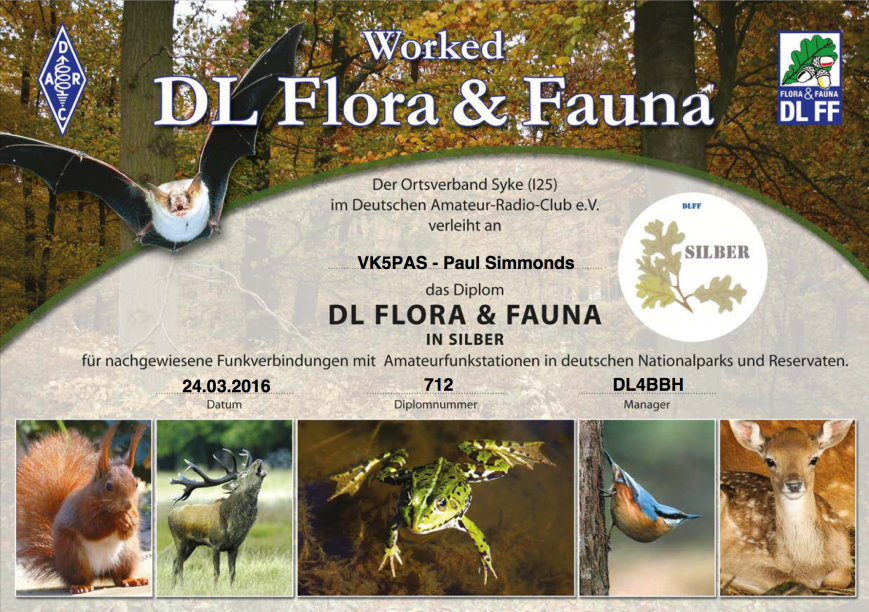
A certificate of thanks

When I got home from my trip to VK3, I had a significant number of emails to go through.  One of those that I was pleasantly surprised to find, was from Keith VK2PKT.  Keith has become a very avid park hunter and called me regularly whilst I was away.

Keith was kind enough to have designed a certificate of appreciation for my recent trip.

Many thanks Keith.  Greatly appreciated.

VK2PKT certificate152

Trip to VK3 along the Great Ocean Road

I returned home today after our 2 weeks away up in the Riverland, the South East of South Australia, along the Great Ocean Road in Victoria, and finally the Pyrenees Range area in western Victoria.

Here is a summary of the activities……

  • 2 x South Australian Conservation Parks
  • 3 x Victorian Coastal Parks
  • 3 x Victorian Marine National Parks
  • 1 x Victorian State Park
  • 3 x Victorian National Parks
  • 10 x Victorian SOTA summits
  • Total of 899 contacts
  • 3,084 km travelled.

Here is a list of activations………

Sat 7th Nov.

  • Billiatt Conservation Park VKFF-0821 – 57 contacts

Sun 8th Nov

  • Peebinga Conservation Park VKFF-0830 – 32 contacts

Mon 9th Nov

  • Discovery Bay Coastal Park VKFF-0746 – 26 contacts
  • Discovery Bay Marine National Park VKFF-0949 – 49 contacts

Tues 10th Nov

  • Discovery Bay Coastal Park VKFF-0746 – 25 contacts
  • Cape Nelson State Park VKFF-0754 – 24 contacts

Wed 11th Nov

  • SOTA Mount Clay VK3/ VS-051 – 7 contacts

Thurs 12th Nov

  • Bay of Islands Coastal Park VKFF-0743 – 46 contacts

Fri 13th Nov

  • Twelve Apostles Marine National Park – 69 contacts

Sat 14th Nov

  • Port Campbell National Park – 53 contacts
  • SOTA Crowsnest Lookout VK3/ VS-049 – 34 contacts

Sun 15th Nov

  • Great Otway National Park VKFF-0405 near Cape Otway – 69 contacts
  • Great Otway National Park VKFF-0405 Aire River – 32 contacts

Mon 16th Nov

  • SOTA Mount Cowley VK3/ VC-022 and Great Otway National Park VKFF-0405 – 48 contacts

Tues 17th Nov

  • Point Addis Marine National Park VKFF-0952 – 59 contacts

Wed 18th Nov

  • SOTA Mount Leura VK3/ VS-050 – 29 contacts
  • SOTA Mount Elephant VK3/ VS-047 – 23 contacts
  • SOTA One Tree Hill VK3/ VS-036 – 82 contacts

Thurs 19th Nov

  • SOTA Blue Mountain VK3/ VS-015 – 15 contacts
  • SOTA Point 756/Pyrenees VK3/ VS-018 – 33 contacts
  • SOTA Mount Lonarch VK3/ VS-013 – 16 contacts
  • SOTA Ben Nevis VK3/ VS-009 – 25 contacts

Fri 20th Nov

  • Little Desert National Park VKFF-0291 – 46 contacts


I would like to thank everyone who called.  Band conditions fluctuated dramatically with very good conditions during some activations, to very poor during others.

Also many thanks to those that took the time to spot me, either on parksnpeaks, the DX cluster, Facebook.  It certainly helps fill up the log.

I will post some more info & photos for each of the activations in the coming weeks.


Hattah Kulkyne National Park VKFF-0231

On Monday morning (26th October 2015) I left the Balranald Caravan Park and commenced my 500 km drive back home to the Adelaide Hills.  Along the way I planned to activate the Hattah Kulkyne National Park, VKFF-0231, in Victoria, which is about a 150 km drive south west from Balranald.  This was to be another new park for me, and I was hopeful to get my 44 contacts to qualify the park for the World Wide Flora Fauna (WWFF) program.

Screenshot 2015-10-31 10.07.01

Above:- Map showing the location of the park.  Map courtesy of mapcarta.com

I headed out west along the Sturt Highway and then turned left onto the Murray Valley Highway.  As it was early in the morning, it was relatively slow going as there were a lot of kangaroos and emus out and about.  There is not much to see along this stretch of the road.  I did stop briefly to have a look at Lake Benanee.

I then stopped briefly at Robinvale, just over the Murray River, which forms the border between the States of Victoria and New South Wales.  I was hoping to catch up with Claude VK3FCAS who was staying at the caravan park.  But I didn’t have Claude’s number and the park was absolutely brimming with vans, so unfortunately it was not to be.

After leaving Robinvale I travelled south on the Robinvale-Sea Lake Road, passing all the irrigation district where grapes, olives, carrots, and almonds are grown.  I then turned right onto the Hattah-Robinvale Road and travelled west.  I stopped briefly at a little place called Wemen to view the mighty River Murray just upstream from the Hattah Kulkyne National Park.

I accessed the park from a dirt track near Lake Kramen.  Unfortunately the track was marked with no vehicular access so I could not get all the way down to the lake.  So I was forced to activate from a less scenic part of the park, close to the Hattah-Robinvale Road.  There had been quite a bit of rain overnight, and it was still cloudy.  However, when the sun came out from behind the clouds it certainly had some bite, so I tried to find a bit of shade.

Hattah Kulyne National Park is 48,000 hectares in size and was established in June 1960.  The park lies in typical mallee country in Victoria and contains extensive low scrub and open native pine woodland.  River Red Gums are found alongside the lakes, the Murray River and adjoining creeks.  Animals, birds, and plants located in the park have adapted to survive in the poor, sandy soils and the searing hot summers.  The park contains Hattah Lakes which are seasonally filled by creeks connected to the Murray River.

A large amount of birdlife can be found in the park, ranging from wetland species including Pelicans, various species of ducks, Great Egret, Spoonbills, to mallee species such as Malleefowl, Emu Wrens, and Emus.  In fact a total of 200 species of birds have been recorded in the park.  Many native animals also call the park home including Red Kangaroos, Western Grey kangaroos and Eastern Grey kangaroos.

This area has a rich aboriginal history.  Within the park you can find scars on trees where shields and canoes were made, and also middens which are heaps of shells discarded after meals eaten over many generations.

Screenshot 2015-10-12 20.21.02

Above:- Map showing my operating spot.

It was only 2200 UTC (8.00 a.m. Victorian local time) and the 40m band was wide open to Europe, with the CQ World Wide contest still in full swing, so it was quite hard to find a clear spot on the band.  I started calling CQ on 7.143 and it wasn’t long before John VK5BJE gave me a shout with a good strong 5/8 signal from the Adelaide Hills.  This was followed by Warren VK3BYD, Gerard VK2IO, and then Ian VK5CZ/2 who was mobile 30km from Coonabarabran in New South Wales.

Things were quite slow on the band, but I managed 10 contacts in 20 minutes, to qualify the park for the VKFF program.  Many thanks to those that took the time to spot me on parksnpeaks.  The European contesters had also moved in right alongside of me, so I took the opportunity of having a listen on 20m.  I called CQ on 14.312, but it wasn’t long before I was competing with Europeans calling CQ contest.  So I moved up to 14.315 and called CQ again, and this was answered by Carl ZL3CX in  Auckland (5/7 both ways).  After my contact with Carl, park devotee Rick VK4HA then gave me a shout with a solid 5/9 signal.  This was followed by Rob VK4LS near Bribie Island in Queensland.  Unfortunately during our chat, a station from the USA came up and started calling CQ contest.

I then moved back to 7.143 with a total of 14 contacts in the log at that stage.  I still had a long way to go before reaching the required 44 contacts to qualify the park for the global WWFF program.  My first contact after returning to 40m was with Adrian VK5FANA on the Yorke Peninsula with a very strong 5/9 signal.  Rick VK4RF then called in on 40m.  Not as strong as 20m, but still a very respectable 5/7.  It was about this time that the noise floor on the band rose up to a strength 6.  I wasn’t really sure where the noise was coming from.  There was nothing around me, except for power lines, but they were a good 1 km away.  But I perservered and still managed to copy all the stations calling, including Mike VK6MB, some 2,900 km away in Western Australia (5/5 sent and 4/3 received).

I pushed on and continued to work the callers, and much to my pleasure, the noise on the band disappeared after about 15-20 minutes.  Contact number 25 was with Frank VK2BFC who said he would advise all the guys on Ron VK3MRH’s Net on 7.085 that I was in the park and in need for further contacts.  And it worked, as it wasn’t long, before I had a steady flow of callsigns that I recognised as being regulars on Ron’s net, including Dennis VK2HHA, Dik VK7DIK, Mike VK3ZMD, Tony VK5FTVR, and even Ron VK3MRH himself.  Many thanks Frank.  This certainly helped to boost the numbers.

It wasn’t long before I had reached the magical figure of 44.  Contact number 44 was Ron VK3VBI.  About 10 contacts later I was called by Peter VK3PF who was activating SOTA peak, Mount Bolga VK3/ VE-175 which is contained within the Mount Granya State Park, VKFF-0767.  This was followed by a call from Kerry VK2GQR, operating from the Mutawintji National Park north east of Broken Hill.  My last contact at Hattah Kulyne was with Rob VK4AAC/5 who was mobile on his way to activate the Padthaway Conservation Park.

At the end of my activation I went for a walk along the track leading down to Lake Kramen which was full of water.  In previous years it has been bare.

After around 3 hours in the park I had a total of 67 contacts in the log.  Thanks to everyone who called in.  The activation started off quite slowly, so I was very very pleased to reach the 44 QSO threshold.

The following stations were worked on 40m SSB:-

  1. VK5BJE
  2. VK3BYD
  3. VK2IO
  4. VK5CZ/2
  5. VK2VW
  6. VK5HCF
  7. VK3PMG
  8. VK5EE
  9. VK5BGN
  10. VK3FJUD
  11. VK5FANA
  12. VK4RF
  13. VK4HA
  14. VK3VEK
  15. VK6MB
  16. VK3FAPH
  17. VK4AAC/5
  18. VK2GKA
  19. VK3UH
  20. VK3EE
  21. VK2BFC
  22. VK3FOWL
  23. VK5HS
  24. VK3SQ
  25. VK2HHA
  26. VK3AV
  27. VK7DIK
  28. VK3ZMD
  29. VK5FTVR
  30. VK2NP
  31. VK7EE
  32. VK1NAM
  33. VK2XUP
  34. VK3UCD
  35. VK2BA
  36. VK3SIG
  37. VK3FENV
  38. VK3NU
  39. VK3FCAS/p
  40. VK3VBI
  41. VK2FBKT
  42. VK2MOR
  43. VK3MRH
  44. VK5ZA/m
  45. VK5NRG
  46. VK3JP
  47. VK5GJ
  48. VK5PL
  49. VK3PF/p (SOTA VK3/ VE-175 & VKFF-0767)
  50. VK2GQR
  51. VK5MAS
  52. VK3FAIM
  53. VK1MTS
  54. VK5KIK
  55. VK5FADP
  56. VK2MTC
  57. VK2FGAA
  58. VK5FMID
  59. VK5JK
  60. VK3KYF/5
  61. VK5GI
  62. VK3OF
  63. VK4AAC/5

The following stations were worked on 20m SSB:-

  1. ZL3CX
  2. VK4RF
  3. VK4HA
  4. VK4LS

References.

Parks Victoria, 2015, <http://parkweb.vic.gov.au/explore/parks/hattah-kulkyne-national-park&gt;, viewed 5th November 2015.