Morialta CP as VI5ANZAC

Last night (Tuesday 28th April 2015) after work I headed over to the Morialta Conservation Park which is situated about 10 km east of Adelaide.  I had been kindly asked by Bob VK5FO on behalf of the Amateur Radio Experimenters Group to participate in operating from the park with the special call of VI5ANZAC.

Screenshot 2015-04-29 19.57.17

Above:- Map showing the location of Morialta CP.  Map courtesy of mapcarta.com

Morialta Conservation Park is 533 hectares in size and contains three seasonal waterfalls along Fourth Creek.  The first two falls are the grandest, each cascading over sheer quartzite cliffs after rain.  The park contains a wide variety of wildlife including kangaroos, echidnas and wombats.  For more information on the park, please see…..

http://www.environment.sa.gov.au/parks/Find_a_Park/Browse_by_region/Adelaide_Hills/Morialta_Conservation_Park

The park is celebrating its 100 year anniversary this year.  For more information please see…..

http://www.fobhm.org/morialta100years/

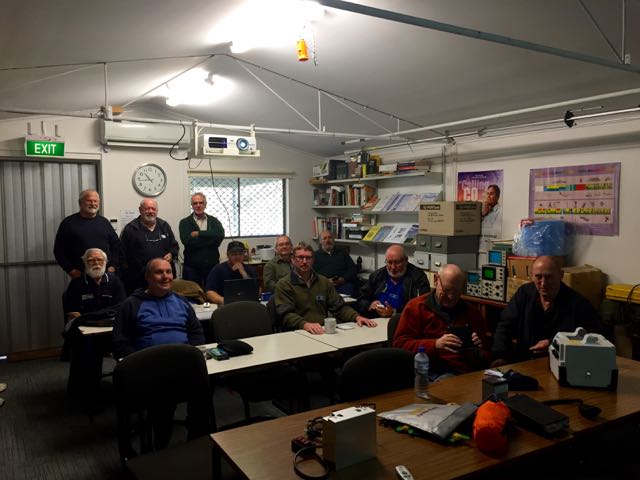
I travelled down towards the end of Moores Road and upon arrival I met up with Bob VK5FO and Gary VK5FGRY who were in the final stages of setting up some antennas.  We were on air just after 6.00 p.m. local time, and it was just after getting on air, that Andy VK5AKH also arrived.  Very soon after, Ray VK5RR also arrived.  Later in the evening Grant VK5GR arrived and operated on 2m and 70cm.

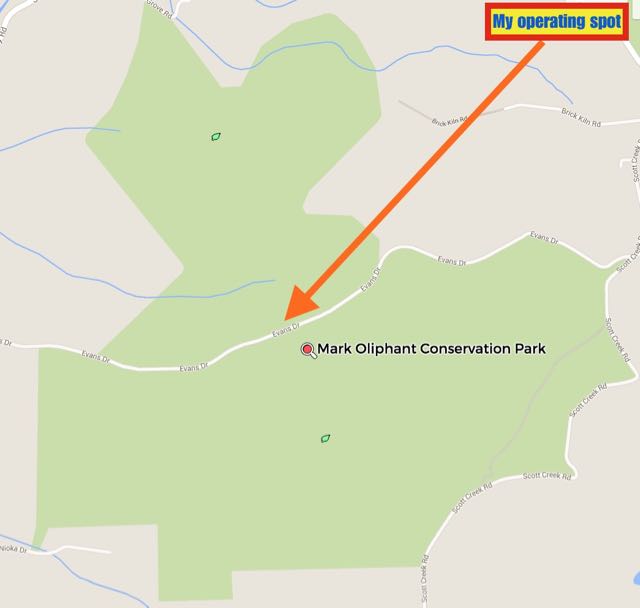
Screenshot 2015-04-29 19.59.00

Above:- Map showing our operating spot.  Map courtesy of mapcarta.com

We operated for just over 3 hours on 160m, 80m, 40m, 20m, 2m & 70 cm and logged 73 contacts.  It was quite slow going on all of the bands, but despite this all signals were quite good.  Equipment used were two Elecraft KX3 transceivers and a selection of dipole antennas.

The evening’s activation qualified for both the VK5 National and Conservation Parks Award and the World Wide Flora Fauna (WWFF) program.

More details can be found on Bob VK5FO’s site at…..

http://vk5fo.com/314/vi5anzac-activation-report

And also at the AREG site at……

http://www.areg.org.au/?p=1229

This slideshow requires JavaScript.

Monarto Conservation Park VKFF-828

Late yesterday afternoon (Sunday 26th April 2015) I rushed home from work (obeying the speed limit) and packed the 4WD and headed down the road to the Monarto Conservation Park, VKFF-828.  I have activated this park many times before but I wanted to activate the park with the special AX prefix for the ANZAC Day weekend.

Screenshot 2015-04-27 19.34.22

Above:- Map showing the location of Monarto CP.  Map courtesy of mapcarta.com

I was hoping to activate the Belair National Park on Saturday after work, but the weather all day on Saturday was terrible.  We had lots of rain both in Adelaide and up in the Mount Lofty Ranges.  Fortunately the rain had cleared by Sunday afternoon, so all systems were go.

For this activation I used my Yaesu FT-857d and the 40m/20m linked dipole on the top of the 7 metre squid pole for this activation.  I set up in my usual spot, the north eastern corner of the park, just off Ferries McDonald Road.

Screenshot 2015-04-27 19.35.04

I was set up in the park ready to go by 4.30 p.m.  I struggled to find a clear frequency on 20m as there was a JA Contest running and the JA stations were very strong and were spread across the 20m band.  But I did eventually find 14.274 clear and started calling CQ there.  My first taker was John VK5BJE in the Adelaide Hills.  John had responded to an SMS message I had sent out to some of the keen VK5 Parks hunters.  The SMS alerting system that I employ seems to work very well.  This was followed by Rod AX2TTL and then my first DX contact Xaver DK4RM in Germany, followed by Swa ON5SWA in Belgium.

I was kindly spotted on the DX Cluster by some of the DX stations and this resulted in a steady flow of callers from Europe, North America, and Japan.  Unfortunately after operating for about 15 minutes a JL1 station came up 1 kc below me and started calling CQ Contest, and this resulted in a lot of QRM and made it incredibly difficult to pick out anybody who did not have a strong signal.

But I boxed on and managed 33 contacts, before having a tune around the 20m band and found VI4AE2 calling CQ on 14.269.  This was a special call for the ANZAC commemorations, particularly to commemorate the service of the officers and sailors aboard the Royal Australian Navy submarine HMAS AE2 who fought gallantly in the Dardanelles and Sea of Marmora for just 5 days before being blown to the surface by the Turkish torpedo boat Sultanhisar.

VI4AE2_HMAS_AE2_OPS_CAPT

I then headed up to 14.310 and started calling CQ DX again.  My first contact there was with John VK2FR, followed by UR7ET in Ukraine, and then Pehr OH6IU.  I was kindly placed on the DX cluster by Albert S58AL and this resulted in many of the European park hunters giving me a call.  I worked a total of 15 stations in Europe, USA, and Canada on this frequency until being pushed off the frequency by another contester.

So I tuned around the band and found VI6ANZAC calling CQ on 14.145.  It was great to get a second ANZAC special event call in the log and it was certainly  a very strong signal coming in from Western Australia.

I then lowered the squid pole and put the links in on the 40m/20m linked dipole and found 7.150 clear.  I asked if the frequency was in use and before I even got the opportunity to call CQ, I was called by Paul AX5FUXX at Wellington on the Murray River.  This was followed by Adrian AX5FANA on the Yorke Peninsula, and then Tony AX5FTVR at Strathalbyn.

I worked a further 31 stations in VK2, VK3, VK4, VK5, VK6 & VK7.  It was pleasing to see a number of the VK’s using the special AX prefix for the ANZAC Day weekend.  We only get to use the special AX prexix, three times a year: Australia Day, ANZAC Day, and World Telecommunications Day.

I have a special AX prefix ANZAC Day QSL card on offer.

  • For VK stations, please QSL Direct to PO Box 169 Mount Barker SA 5251.  Please include a stamped self addressed envelope.
  • For DX, please QSL via my QSL Manager, M0OXO.

AX5PAS_3

After sitting in the park for about 2 & 1/2 hours I had a total of 84 stations in the log, including 42 DX contacts.  Again it was very pleasing to get a handful of calls from the USA and Canada.

The following stations were worked on 40m SSB:-

  1. AX5FUZZ
  2. AX5FANA
  3. AX5FTVR
  4. AX5FDEC
  5. AX6VSH
  6. AX5NIG
  7. AX3FASW
  8. VK5FCDL
  9. VK3PMG
  10. VK3YJK
  11. VK2YK
  12. VK2VIM/4
  13. VK3HJD
  14. VK3HRA
  15. VK5ZEA
  16. VK5LI
  17. VK5NPP
  18. AX4TE
  19. VK3LJ
  20. AX2JCC
  21. AX3BBB
  22. VK3DAC
  23. VK4FBMW
  24. AX3ANL
  25. AX4QQ
  26. VK3FNCE
  27. VK7ROY
  28. VK2UW
  29. VK2PV
  30. VK5MJ
  31. AX3PF
  32. VK6MB
  33. VK3OF
  34. VK2FMIA

The following stations were worked on 20m SSB:-

  1. VK5BJE
  2. AX2TTL
  3. DK4RM
  4. ON5SWA
  5. VK6EY
  6. IK1GPG
  7. I5FLN
  8. F2YT
  9. S58AL
  10. IZ2FOS
  11. DF1YQ
  12. ON6PV
  13. DF9OO
  14. PB5X
  15. DL2ND
  16. G0RQL
  17. S52KM
  18. W1OW
  19. ON5JE
  20. IW1PNJ
  21. DL4PT
  22. HB9QT
  23. EA1DR
  24. DL5WW
  25. S58N
  26. SP6KEP
  27. DL5EBG
  28. ON4VT
  29. DL5MEV
  30. EA3MP
  31. OH6RP
  32. DD2VO
  33. UT5PI
  34. VI4AE2
  35. VK2FR
  36. UR7ET
  37. OH6IU
  38. EA2DT
  39. VE7CV
  40. F1BLL
  41. WB8FSV
  42. ON7AB
  43. JH7WER
  44. RA3PCI
  45. AX2IO/m
  46. EA3GP
  47. DL1EBR
  48. EB1CAM
  49. AX2QO
  50. VI6ANZAC

Chasing parks and summits from home as AX5PAS

This afternoon I hurried home from work and quickly changed out of the suit into my tracksuit pants and headed for the shack to operate with the special AX prefix to commemorate ANZAC Day.  In Australia we only get to use the AX prefix three times a year:

  • Australia Day
  • ANZAC Day
  • World Telecommunications Day

ANZAC Day is held each year on the 25th April, which is the anniversary of the landing of the ANZACS at Gallipoli.  But ANZAC Day is bigger than just Gallipoli.  It is the day on which we remember all Australians who served and died in all wars, conflicts, and peacekeeping operations.  Contrary to concerns a number of years ago that ANZAC Day was going to die a slow natural death, renewed interest in this very special day has boomed.  It is now arguably one of the most important days on the Australian calendar.  It also has great significance to our friends in New Zealand.

For more information on ANZAC Day please have a look at the following……

https://www.awm.gov.au/commemoration/anzac-day/

Below is my ANZAC Day card for AX5PAS.

AX5PAS_3

I was hoping to activate the Belair National Park today but the weather was terrible.  It was raining here for most of the day, making portable activity virtually impossible.  Plus I was working dayshift today, so by time I finished work it was getting a little late.  So I decided to do some operating & chasing from home.

I jumped on to 20m first and worked quite a bit of DX, ending up with a mini pile up.  The AX prefix was in high demand as usual.  But when things got a little quiet, I took the opportunity of having a look around the bands.  I had been closely watching the DX cluster and had seen a number of park & SOTA operators spotted on the cluster.

My first park contact was with Franck F4DTO/p who was portable in FFF-300, a new park.  It was a little hard too copy Franck at times as the static crashes were very strong.  In fact they were over S9 at times.  But we managed to make it and Franck gave me a 5/7 signal from France.

IMG_7293

My first Australian SOTA contact of the afternoon was with Andrew VK1DA who was operating with the special call of VK100ANZAC from SOTA peak Mount Ainslee, VK1/ AC-040.  Andrew had a very strong 5/9 plus signal.  Mount Ainslee is 843 metres above sea level and is with 1 SOTA point.

This was followed by a SOTA contact on 15m with John VK6NU who was operating with the special call of VI6ANZAC from SOTA peak, Mount Randall, VK6/ SW-039.  John had a nice moderately strong 5/7 sign coming in from Western Australia.  Mount Randall is located in the South West region of Western Australia and is 523 metres above sea level.  It is worth 2 SOTA points.

My first DX SOTA contact for the afternoon, was on 20m and was with Mike 2E0YYYY/p who was on the top of SOTA summit, Bardon Hill G/ CE-004.  Mike was coming in beautifully on the long path, a genuine 5/8.  I received a 5/9 signal report in return from Mike.

Bardon Hill is 278 metres above seal level and is worth 1 SOTA point.  It is located in the Central England Region and is a former volcano.  The name Bardon is derived from ‘bear den’.  It is reported that the last bear in England was killed here.  More information on the summit can be found at…..

http://en.wikipedia.org/wiki/Bardon_Hill

When I finished working Mike he asked me to stand by as he had company on the summit.  I then worked Rob G7LAS/p who had a nice 5/8 signal.

Farmland_near_Appleby_Parva_-_geograph.org.uk_-_746255

Above:- Bardon Hill.  Photo courtesy of en.wikipedia.org

My next SOTA summit contact was on the 10m band, with Herbert, HB0/OE9HRV/p portable on SOTA summit, Helwangspitz, HB0/ LI-011.  The summit is located in the Raitkon range in Leichtenstein and is 2000 metres above sea level.  It is worth 8 SOTA points.

Screenshot 2015-04-25 23.00.20

Above: Helwangspitz.  Image courtesy of OE5HCE

The cluster was alive with a number of SOTA and park activators.  However, the static crashes were very severe making it incredibly difficult to hear many of them.  And sadly, those that I did hear, were only working fellow Europeans.  The ‘EU wall and the static crashes made things less than ideal.  It was quite frustrating, as I had not seen for some time, so many WWFF & SOTA activators up on the bands at the same time.

You can see below, where all the noise was coming from.  Huge storms in New South Wales.  The images are courtesy of weather zone.

But on a positive note, I did work a handful of the special ANZAC Commemorative call signs:-

  • VI4AE2
  • VI6ANZAC (John VK6NU – SOTA)
  • VK100ANZAC (Andrew VK1DA – SOTA)
  • VI5ANZAC

After tea I worked a number of VK stations hoping to get the AX prefix award on offer by the WIA.  With the special event stations in my tally, I managed to get over the 100 point line.

http://www.wia.org.au/newsevents/anzaccentenary/axaward/

I then booked in to the Southern Cross DX Net and worked  number of USA stations.  But the most interesting contact on the net was with George HP/KC0GP who was maritime mobile on the ‘Carnival Magic’ in Panama 5/7 both ways).

carnival_magic_slider1

Image courtesy of directlinecruises.com

References.

Wikipedia, 2015, <http://en.wikipedia.org/wiki/Bardon_Hill&gt;, viewed 25th April 2015

Wikipedia, 2015, <http://en.wikipedia.org/wiki/Helwangspitz&gt;, viewed 25th April 2015

Hogwash Bend Conservation Park

Our third and final activation for Sunday was the Hogwash Bend Conservation Park, which is located near Waikerie in the Riverland region of South Australia, about 183 km north east of Adelaide.  This was to be another unique park for me.

Screenshot 2015-04-23 13.59.23

Above:- the location of the Hogwash Bend CP.  Image courtesy of mapcarta.com

The Hogwash Bend CP was gazetted in 2012 and is about 286 hectares in size.  It is located on the banks of the mighty River Murray.  I have not been able to find out how the park got its name.

The park was acquired by the South Australian State Government and the Australian Federal Government under the National Reserve System program to protect the largest breeding colony of Regent Parrots in South Australia.  There are thought to be only 300 breeding pairs of Regent parrots along the Murray.  And in Hogwash Bend, around 50 pairs use the ideal breeding habittat of mature river red gums, nesting sites and large areas of mature mallee scrubland.  Hogwash Bend plays an important role in the bird’s future which is listed as vulnerable at both State and National level.

1280px-Polytelis_anthopeplus_2_edit1

Above:- Regent parrot.  Image courtesy of wikipedia

There is an excellent website dedicated to Regent parrots which can be found at…..

http://regentparrot.org

In fact, the group is very keen to hear from people who sight a Regent Parrot.  You can telephone 1800PARROT.

Hogwash Bend was just a  short 14 km drive from the Ramco Point Conservation Park.  We entered the park off Cadell Valley Road.  The park is well signposted and there is a nice dirt road down to the park which is easily negotiated with a car and even a caravan.  The camping area was very busy with lots of campers and caravaners.  So we headed to the eastern side of the camping area and set up in the scrub.

Screenshot 2015-04-23 13.59.11

Above:- My operating spot.  Image courtesy of mapcarta.com

The park was alive with birdlife, but unfortunately we did not spot a Regent parrot.  But I did see a Whistling kite which flew into a nearby gumtree and sat there for some time, allowing me to take a number of photographs.

http://www.birdsinbackyards.net/species/Haliastur-sphenurus

There was also a Spoonbill busy in a nearby pond and a number of pelicans on the river.

I did intend to operate on 7.095 but there were some VK6 guys operating on 7.093.  A few of them were mobile, and had very good signals into Hogwash Bend.  So I moved up a little higher to 7.096 and called CQ and this was answered by David VK5KC and then Les VK5KLV, followed by Al VK7AN and then Tony VK3VTH mobile.  I then called for any QRP stations and I worked Adrian VK5FANA QRP 5 watts and Bernard VK3AV QRP 4 watts.  I had quite a steady flow of callers from VK3 & VK5.

I managed one park to park contact and that was with Stef VK5HSX who was portable in the Flinders Ranges National Park.  I also worked Allen VK3HRA who was portable on SOTA peak Crowsnest Lookout, VK3/ VS-049.

I then moved over to 20m and called CQ on 14.312.  This was answered by Gerard VK2IO who had a lovely 5/9 signal, followed by Xaver DK4RM, Jarrad VK3HXT, and then Albert S58AL.  I went on to work a total of 38 stations on 20m from VK2, VK3, VK6, Germany, Slovenia, Italy, USA, France, Ukraine, Switzerland, Belgium, Spain, Russia, Hungary, and New Zealand.  It was very pleasing to get a number of calls from USA stations who were copying me well.  And again I managed to work my very good mate Marnix OP7M.  Copy this time at Marnix end was not as good as previously.  But the 20m band was still opening up.

Unfortunately time was marching on and I needed to pack up, as I still had a 2 & 1/2 hour drive to get home.  I had a total of 62 contacts in the log.

This slideshow requires JavaScript.

The following stations were worked on 40m SSB:-

  1. VK5KC
  2. VK5KLV
  3. VK7AN
  4. VK3VTH/m
  5. VK5FANA
  6. VK3AV
  7. VK5FTVR
  8. VK5ZAR
  9. VK5MRE
  10. VK5NRG
  11. VK3ANL
  12. VK5EE
  13. VK3PF
  14. VK3FMRC
  15. VK3KAB
  16. VK5NQP
  17. VK5FADP/p
  18. VK5ZRY/m
  19. VK2IO
  20. VK5FTRG
  21. VK3OF
  22. VK5HSX/p (Flinders Ranges National Park)
  23. VK5FCDL
  24. VK3HRA/p (SOTA VK3/ VS-049)

The following stations were worked on 20m SSB:-

  1. VK2IO
  2. DK4RM
  3. VK3HXT
  4. S58AL
  5. VK2HOT
  6. I5FLN
  7. IK1GPG
  8. KD8GEH
  9. F2YT
  10. WB2ZAB
  11. DL4PT
  12. S5KM
  13. VK4MWG
  14. UT5PI
  15. V4TH
  16. DL5WW
  17. HB9EFJ
  18. VK2YK
  19. KG7HAX
  20. DL1EBR
  21. IZ1UKG
  22. KC5JAV
  23. ON4VT
  24. N4WMB
  25. EA5HPX
  26. ON5SWA
  27. HA6OB
  28. ON4BB
  29. OP7M
  30. IW1FZR
  31. EA1SB
  32. KK4PWE
  33. RA3PCI
  34. HA6NF
  35. DL2NOM
  36. VK4AJR
  37. VK6NI
  38. ZL3CHE

References

Government of South Australia, 2014, River Murray-South East Nature Link

Ramco Point Conservation Park

Our second park on Sunday was the Ramco Point Conservation Park, which is located near the town of Waikerie in the Riverland region of South Australia, about 180 km north east of Adelaide.  This was another unique park for me.

Screenshot 2015-04-23 13.03.59

Above:- Map showing the location of Ramco Point CP.  Map courtesy of mapcarta.com

The park is located between the Murray River and Hart Lagoon and was proclaimed in 2006.  I could not find a huge amount of information on the internet about this park.  And it is one of those small South Australian Conservation parks which does not show up on Google maps.

Access to the park was quite difficult.  If we did not have the Toyota Hi Lux we would not have made it in there.  The Riverland had experienced a lot of rain over the past 48 hours and many of the off road tracks had become very wet and boggy.

This slideshow requires JavaScript.

We set up on the banks of the River Murray between the river and Hart Lagoon.  It was a beautiful idealic spot, and fortunately the weather was holding off for us with no rain.

Screenshot 2015-04-23 13.03.49Above:- Our operating spot.  Image courtesy of mapcarta.com

Prior to calling CQ I scouted around the 40m band and found Tony VK3VTH calling CQ from the Oolambeyan National Park in New South Wales (5/9 both ways).  I then headed down to 7.095 and called CQ and this was answered by Nigel VK5NIG with a very strong 5/9 signal, followed by Arno VK5ZAR, David VK5NQP, and then Fred VK3DAC.  And then much to my surprise I received a call from Mark VK6BSA in Western Australia.  It was 12.15 p.m SA local time and I was very surprised to get a call from a VK6 on 40m at this time of the day.  Mark was 5/6 and gave me a 5/1.  Not bad considering I was running 40 watts and my simple linked dipole.

A few calls later I spoke with Stef VK5HSX who was portable in Wilpena Pound in the Flinders Ranges National Park (5/5 sent and 5/7 received).   I then asked for any other QRP, portable or mobile stations and this was answered by Peter VK3PF running QRP, Adrian VK5FANA running QRP, Mark VK3OHM running QRP, Allen Vk3HRA portable on SOTA peak Mount Cowley VK3/ VC-022 in the Great Otway National Park, and Geoff VK5HEL mobile.

After working a total of 33 stations on 40m I headed over to 20m where I spoke with Lee VK2LEE and Gerard VK2IO.  Both Lee and Gerard had nice strong 5/9 signals.  I then went QRT and headed off for the Hogwash Bend Conservation Park.

On the way to Hogwash Bend, we made a quick stop off at a lookout on the Cadell Valley Road, where we were able to view the Hart Lagoon and the Ramco Point Conservation Park.

The following stations were worked on 40m SSB:-

  1. VK3VTH/2 (Oolambeyan National Park)
  2. VK5NIG
  3. VK5ZAR
  4. VK5NQP
  5. VK3DAC
  6. VK6BSA
  7. VK2WE/m
  8. VK5HSX/p (Flinders Ranges National Park)
  9. VK3PF
  10. VK5FANA
  11. VK3OHM
  12. VK3HRA/p (SOTA VK3/ VC-022)
  13. VK5HSX/m
  14. VK5HEL/m
  15. VK3ANL
  16. VK3OF
  17. VK5KLV
  18. VK3DBP
  19. VK5DF
  20. VK3TKK
  21. VK3YDN
  22. VK5FTVR
  23. VK3BWZ
  24. VK1MA
  25. VK5FDEC
  26. VK5NPP/p
  27. VK3NHL/m
  28. VK2KYO
  29. VK2LEE
  30. VK5ZLT
  31. VK3KAB
  32. VK3GFS
  33. VK2IO

The following stations were worked on 20m SSB:-

  1. VK2LEE
  2. VK2IO

Maize Island Lagoon Conservation Park VKFF-827

Our first park activation for Sunday (19th April 2015) was the Maize Island Lagoon Conservation Park, which is located about 160 km north east of Adelaide, near the town of Waikerie.  The park qualifies for the World Wide Flora Fauna (WWFF) program and is VKFF-827.  This was to be a unique park for me as an activator.

Screenshot 2015-04-23 12.16.10

Above: Map showing the location of Maize Island Lagoon CP.  Map courtesy of mapcarta.com

On the way we stopped off to view the memorial cairn for two police officers killed in the line of duty back in the 1800’s.  As a serviving police officer, I am always extremely interested in police history.  Corporal William Murray Wickham and Mounted Constable John Dunning Carter who lost their lives on the 7th of May 1847.  In early May, 1847, the pair received orders to travel to Overland Corner, where they were to deal with reported disturbances.  Overland Corner, although used as a resting and grazing area by drovers, had neither facilities nor status as a township.  The pair set out from Moorundee on horseback and, dressed in full uniform – heavy tunics, trousers, riding boots, sabres and firearms – rode through mallee scrub.  Some way into their journey on May 7, the officers decided to stay overnight at the river-front station of J.H. Wigley.  Then, undeterred by major risks, the officers bravely attempted the river-crossing that killed them.  Local Aborigines later recovered the two bodies, which they laid to rest on the river bank.  At a later date, the bodies were exhumed and reburied at West Terrace Cemetery.

This slideshow requires JavaScript.

Maize Island Lagoon CP is about 215 hectares in size and is backed by magnificent cliffs created by the mighty River Murray.  The park contains many backwater lagoons lined by majestic River Red Gums.  The park is alive with a variety of waterbirds.  The park was so named because early pioneers had grown crops of maize as fodder for cattle and horses on the drying lagoon bed following high rivers.

The area was first settled in 1880 by the Shephard brothers who named their sheep run Waikerie Station, and built the little homestead still standing on Holder Bottom Road.  In 1888 the Government cancelled pastoral leases and began surveing the country for closer settlement.  Village settlers arrived in 1894 to establish themselves on horticultural allotments in the area of Holder Bottom Road.  In 1921 a pipeline was built to Maize Island and orchards were established there.  In 1956, the infamous Murray River flood struck, with more high rivers in the following years, which convinced the Government to resettle people in 1975 and control the area as a Conservation Park.

Screenshot 2015-04-23 12.16.57

Above: Image chowing our operating spot.  Courtesy of mapcarta.com

Again for this activation I had nominated an operating frequency of 7.144.  I called CQ a few times and this was answered by Les VK5KLV at Port Augusta, followed by Tony VK5FTVR at Strathalbyn, Tony VK3VTH mobile near Hay in New South Wales, and then Adrian VK5FANA on the Yorke Peninsula.

Tony was the first of a number of mobile and QRP stations that called me.  I also worked Mike VK3NMK in the Lake Colac Caravan Park, John VK3PXJ mobile at Nagambie, Bernard Vk3AV QRP 5 watts, Peter VK3PF who was QRP, and Peter VK3TKK mobile.

At about the commencement of the new UTC day, after working 34 stations I started to experience a little bit of QRM.  It was one of the many Sunday morning WIA broadcasts.  So, not wanting to cause any grief to anyone listening to the broadcast, I QSYd down the band to 7.095.  But not before I had worked John VK5BJE who was operating portable in the Terrick Terrick National Park, VKFF-630 (5/9 both ways).


This slideshow requires JavaScript.

After QSYing to 7.095 I worked a further 14 stations in VK3, VK5 & VK7.  This included Mike VK3XL mobile, Alan VK5AR mobile at Mitcham in the Adelaide suburbs, and Stef VK5HSX mobile at STokes Hill lookout in the Flinders Ranges,

I did call CQ on 14.310 a number of times, but had no takers.  I had a total of 48 stations in the log. So we packed up and headed in to Waikerie for some morning tea at the Waikerie bakery, which we can highly recommend.  We alo stopped off at the lookout taking in the views of the Murray River and the park we had just activated.

This slideshow requires JavaScript.

The following stations were worked:-

  1. VK5KLV
  2. VK5FTVR
  3. VK3VTH/m
  4. VK5FANA
  5. VK3NMK/p
  6. VK3PXJ/m
  7. VK3AV
  8. VK5ZAR
  9. VK5KC
  10. VK3DAC
  11. VK3PF
  12. VK3HRA
  13. VK2NEO
  14. VK5EE
  15. VK5ZLR
  16. VK5NJ
  17. VK3OF
  18. VK5NQP
  19. VK3TKK/m
  20. VK5TN
  21. VK5AV
  22. VK5LA
  23. VK2LEE
  24. VK5IS
  25. VK5KLV
  26. VK5ADL
  27. VK5ZGY
  28. VK3NMK/p
  29. VK5WG
  30. VK2LX
  31. VK5BJE/3 (Terrick Terrick National Park)
  32. VK3KAI
  33. VK1MA
  34. VK5FMID
  35. VK5NRG
  36. VK5HCF
  37. VK3SQ
  38. VK3XL.m
  39. VK5FTVR
  40. VK5AR/m
  41. VK3HSR
  42. VK7VDL
  43. VK3OHM
  44. VK3UP
  45. VK3AFW
  46. VK5FTRG
  47. VK5KBM
  48. VK5HSX/m


References.

Department of Environment and Natural Resources, Parks of the Riverland

Monument Australia, 2015, <http://monumentaustralia.org.au/themes/people/government—state/display/98413-corporal-william-murray-wickham-and-mounted-constable-john-dunning&gt;, viewed 23rd April 2015

National Parks South Ausralia, 2015, <http://www.environment.sa.gov.au/parks/Find_a_park/Browse_by_region/Murray_River/Maize_Island_Lagoon_Conservation_Park&gt;, viewed 23rd April 2015

Murray River National Park VKFF-372

After activating the Pooginook Conservation Park, Marija and I headed to the Murray River National Park.  The park is located in the Riverland region of South Australia, and is about 220 km north east of Adelaide.  The park qualifies for the World Wide Flora Fauna (WWFF) program and is VKFF-372.

Screenshot 2015-04-23 11.41.06

Above: Map showing the location of the Murray River NP.  Courtesy of mapcarta.com

On the way we stopped off and had a look at the Lake Bonney Hotel ruins.  This is also known as Napper’s Ruins, and is located on the north side of Lake Bonney.  Napper’s Ruins once stood strong as a hotel built for former workers of Cobdogla Station.  It was originally called Lake Bonney Hotel and consisted of 11 rooms that included a well stocked bar and an eating room that could cater for 12 people.  This room was occasionally used as a dance room.  The hotel is now nothing more than ruins and includes some interpretive information signs.

The ruins are the remains of the accomodation house which was built by William Parnell in 1859 and later sold to William Napper in 1863.  Napper’s first wife is buried in Cobdogla and was the first white woman buried in the Riverland.  The graves of William Napper and his second wife are also in this cicinity.  The cottage behind the ruins is locally known as the Fisherman’s cottage.  During the 1956 flood, this building was inundated with water.

The buidlings belong to the local branch of the National Trust but unfortunately have fallen victim to vandals.  We were saddened to see all the grafitti over the Fishermans cottage.

This slideshow requires JavaScript.

We continued on south down through Loveday and into the Katarapko Section of the Murray River National Park.  The park is very well signposted and easy to find.  We headed down to the water’s edge of Katarapko Creek and set up there, right alongside of the creek.

The Murray River National Park is 13,000 hectares in size and consists of three separate areas: Katarapko, Lyrup Flats, and Bulyong Island.  The largest and most popular area of the park is Katarapko.  This area features floodplains and several permanent and semi-permanent wetlands.  The area is a breeding ground for most of southern Australia’s waterfowl and other waterbirds.

Screenshot 2015-04-23 11.20.54

Above: Map showing my operating spot.  Map courtesy of National Parks SA.

It was still quite overcast, but fortunately no rain, so ideal for park activating.  And it was a very idealic setting alongside of Katarapko Creek.  I went to my nominated operating frequency of 7.144 and called CQ and this was answered by my old mate Dave VK3VCE in Victoria, followed by Tom VK5FTRG in Millicent, and then Rex VK3OF and then Les VK5KLV in Port Augusta.  This was a good spread for the first 4 callers, all the way from the north of South Australia down to the very south east and across to Victoria.  All had 5/9 signals.

Many thanks to Arno VK5ZAR, who was my fifth contact, for placing me on parksnpeaks.  A steady flow of callers followed from VK1, VK2, VK3, VK4, and VK5.

But only five calls in, I started to receive extremely bad bleed over from somebody nearby.  I tuned down the band and found that it was one of the AM fellas on 7.125.  And boy was he wide.  I thought perhaps it might have been the sensitive front end of the Yaesu FT-857, but Andrew VK1NAM agreed.  The VK2 on 7.125 was 10kc wide.

I worked a total of 21 stations on 40m including a few QRP stations.  This included Peter VK3PF and Cleeve VK2MOR who was running just 2 watts (5/9 sent and 5/8 received).

I then QSY’d up to 20m and started calling CQ.  My first taker there was Cleeve VK2MOR who had followed me up from 40m.  This was followed by Gerard VK2IO and then the first of the DX, Swa ON5SWA and then Albert S58AL.  A very big pile up ensued with so many stations calling it made it very very difficult to pull out callsigns.  So for the first time ever, I operated split.  Because I had not operated split previously using the FT-857d, I had to quickly work out via the menu on how to do this.  I couldn’t find out how to listen up, so I listened down 5 kc.

I worked a total of 43 DX stations in Belgium, Italy, Spain, England, Denmark, Germany, Portugal, Slovak Republic, Hungary, Canary Islands, Czech Republic, France, Japan, Puerto Rico, & USA.  This included my very good mate Marnix OP7M.  And also some VK’s amongst the DX including Greg VK8GM, Adam VK2YK, John VK6NU in the Avon National Park, and Mike VK6MB.

This slideshow requires JavaScript.

I then headed back to 40m briefly, on 7.144, for any last desperados who would like Murray River National Park.  First taker there was John VK2YW in Wagga, followed by Adam VK2YK, Ian VK5CZ, Adrian VK5FANA, and then Adrian VK4FBMW who was running QRP 5 watts.

Whilst I was working Adrian, I heard a very pronounced noise coming from behind me.  It sounded like a big gust of wind.  However, it was quite calm up until this point and the sun had just set and it was now almost completely dark.  As I looked over my should downstream along Katarapko Creek, I soon worked out what the noise was.  It wasn’t wind.  It was rain…and heavy rain!  So unfortunately in the middle of the QSO with Adrian I had to shut down in huge hurry and rush back to the 4WD with the FT-857D.  Sorry to cut it short so quickly Adrian.  And I am also sorry to others that I know were waiting to work me including Rob VK4FFAB.

So after 90 minutes in Murray River NP, I had a total of 74 contacts in the log.  We then headed off the the Barmera Hotel for our evening meal and a few beverages.

IMG_1224

The following stations were worked on 40m SSB:-

  1. VK3VCE
  2. VK5FTRG
  3. VK3OF
  4. VK5KLV
  5. VK5ZAR
  6. VK4FBMW
  7. VK1NAM
  8. VK2YW
  9. VK5KPR
  10. VK1EM
  11. VK2UH
  12. VK3PF
  13. VK3OHM
  14. VK1MA
  15. VK1ATP
  16. VK3ARR
  17. VK3DAC
  18. VK3DBP
  19. VK3HRA
  20. VK2MOR
  21. VK5NQP
  22. VK2YW
  23. VK2YK
  24. VK5CZ
  25. VK5FANA
  26. VK4FBMW

The following stations were worked on 20m SSB:-

  1. VK2MOR
  2. VK2IO
  3. ON5SWA
  4. S58AL
  5. S52KM
  6. I5FLN
  7. IK1GPG
  8. EA4DTV
  9. ON4VY
  10. ON4BB
  11. M0WYZ
  12. OZ5HP
  13. OP7M
  14. VK8GM
  15. M0HDX
  16. DL5WW
  17. DK4RM
  18. RA3PCI
  19. IK2TTJ
  20. CT1IUA
  21. VK2YK
  22. HB9AFI
  23. EA3MP
  24. OM7OM
  25. DF1YQ
  26. VK6NU/p (Avon National Park)
  27. ON4GI
  28. HA6NF
  29. IZ1JMN
  30. ON5JE
  31. K4MIJ
  32. EA8AXT
  33. OK7WA
  34. EC7DZZ
  35. DL2NOM
  36. EA1DR
  37. JA8RJE
  38. F1RUK
  39. VK6MB
  40. OH6IUDL1EBR
  41. DL5JK
  42. I3FGX
  43. WP3EF
  44. EA2DT
  45. F4HJO
  46. EA1DFP
  47. F4FFH
  48. DD3SAT

References.

Barmera Visitor Information Centre, Historical Icons

Pooginook Conservation Park

Pooginook Conservation Park was our first park activation for Saturday (18th April 2015) after leaving the Riverland Radio Club’s get together at Overland Corner.  Pooginook was just 23 km up the road from Overland Corner.  It was well sign posted and easy to find and easy to access.  The park is located about 200 km north east of Adelaide and is located in the Riverland region of South Australia.

Screenshot 2015-04-23 08.46.54

Above: Map showing the location of Pooginook CP.  Map courtesy of mapcarta.com

Pooginook CP consists of mallee scrub and rolling sand dunes.  The northern part of the park is dense mallee scrub, while the southern section features open mallee as the area was once largely used for wheat farming.  The park provides refuge to a large amount of wildlife including Western grey kangaroos, Red kangaroos, echidnas, fat tailed dunnarts, Southern Hairy-nosed wombats, Balam’s mouse, and the rare malleefowl.  Marija and I saw quite a few wombat burrows in the park.  The wombat population was introduced to the park in 1971 and have become well established.  Over 20 species of reptiles have been recorded in the park including Desert skinks, Nobbi dragons, Barred snake-lizards and Jewelled geckos.

The park is quite large and is about 2,862 hectares in size.  The name Pooginook, comes from Aboriginal words meaning ‘place of good food’.  The Ngawait aboriginal tribe occupied this area.  Pooginook Station was established in 1851 by John Taylor.

We accessed the park off the Goyder Highway and followed the eastern boundary track.  I strongly suggest that if you venture to far into the park, that you only try to do so if you have a 4WD.  If you try your luck with a conventional vehicle, I am quite confidence in saying that you will get bogged.

Although it had become quite overcast, the rain was holding off.  In fact, when the sun poked its head out from behind the clouds, it was quite warm.  We parked the 4WD just off the main track and walked a bit into the scrub and set up my fold up table and deck chair and all the radio gear.

Screenshot 2015-04-23 08.46.27 Above: Map showing out operating location.  Map courtesy of mapcarta.com

Prior to calling CQ I had a quick look around the 40m band and found Tony VK3VTH calling CQ from the Barmah National Park VKFF-739.  Tony had a solid 5/9 signal.  I then went down to 7.095 and started calling CQ and this was responded to by Greg VK5GJ, then David VK5KC, and then Arno VK5ZAR.  A good little flow of callers from VK2, VK3 & VK5 ensured.  My 17th contact for the afternoon was with Tim VK3MTB who was portable in Holy Plains State Park VKFF-758, near Sale in Victoria (5/7 sent and 5/8 received).

As I normally do during my activations I listened out for QRP, mobile and portable stations.  It can be a bit of a challenge to break through the mini park pile ups if you are one of these stations, so I always ask for the QRO stations to stand by while I give the lower power stations a chance.  This resulted in me working Matt VK5ZX who was mobile at Freeling, Marc VK3OHM operating QRP, Peter VK3PF QRP, and Brendon VK5FBFB who was also QRP.

After working 42 stations on 40m I decided to head over quickly to 20m and try for some of the further afield VK’s.  I called CQ on 14.310 and this was answered by Gerard VK2IO (5/9 both ways).  But Gerard was the only taker after about a dozen CQ calls.

This slideshow requires JavaScript.

Marija and I spent about 1 hour in the park, before packing up and heading off to the Murray River National Park.  I had a total of 43 contacts in the log.

The following stations were worked on 40m SSB:-

  1. Tony VK3VTH/2 (Barmah National Park)
  2. VK5GJ
  3. VK5KC
  4. VK5ZAR
  5. VK3FQSO
  6. VK5ZGY
  7. VK5EE
  8. VK5KBJ
  9. VK5HEL
  10. VK2EMF
  11. VK3OF
  12. VK2YW
  13. VK3YAR
  14. VK5AV
  15. VK2UH
  16. VK3DAC
  17. VK3MTB/p (Holy Plains National Park)
  18. VK5KLV
  19. VK3CRG
  20. VK5ZX/m
  21. VK3OHM
  22. VK3PF
  23. VK5FBFB
  24. VK5DF
  25. VK5JK
  26. VK5NQP
  27. VK5HCF
  28. VK2YK
  29. VK1NAM
  30. VK3VIN
  31. VK3HRA
  32. VK3FLCS
  33. VK3HJD
  34. VK3TKK/m
  35. VK3DBP
  36. VK7BO
  37. VK5ZGG
  38. VK2NEO
  39. VK2KF
  40. VK3YDN
  41. VK4GSF
  42. VK4FAJB

The following station was worked on 20m SSB:-

  1. VK2IO

References.

Department of Environment and Natural Resources, Parks of the Riverland

National Parks South Australia, 2015, <http://www.environment.sa.gov.au/parks/Find_a_Park/Browse_by_region/Murray_River/Pooginook_Conservation_Park&gt;, viewed 23rd April 2015

National Parks and Wildlife, Conservation Parks of the Murraylands (North West Zone) Management Plans, 1994.

Rootsweb, 2015, <http://www.rootsweb.ancestry.com/~safpfhg/counties_hundreds_sa.htm&gt;, viewed 23rd April 2015

SA Herpetology Group and Field Naturalists Society SA Mammal Club, <http://www.swiftpages.com/site_images/289/PooginookCP%20Info%20Sheet.pdf&gt;, viewed 23rd April 2015

Riverland Radio Club get together

On Saturday morning (18th April 2015) after a nice hot coffee in the motel room at Barmera, Marija and I got on the road and headed off to the historic Overland Corner Hotel where the Riverland Radio Club were holding a get together.  It was a very cold morning, but fortunately there was no rain.  We had a nice view out across Lake Bonney from our motel room which was the Barmera Lake Resort.  We were quite refreshed as we had a relatively early night on Friday night.  We had dinner at the Barmera Hotel which we can highly recommend, and then spent the remainder of the night in the motel room watching the AFL footy on TV.

This slideshow requires JavaScript.

It is a short 29 km drive out to Overland Corner from Barmera.  We travelled out of Barmera along the Morgan Road and then turned on to the Goyder Highway and headed west.  We then took the turn off to the hotel which is Old Coach Road, and travelled along the dirt down towards the hotel.  As it was early in the morning (7.00 a.m.) the kangaroos were out in force, so it was pretty slow going.  In fact at one stage we had a Western Grey kangaroo bounding alongside of the 4WD who then decided to jump in front of us and slipped on the road surface directly in front of us.  No damage done to the vehicle or the kangaroo I am pleased to report.

Screenshot 2015-04-22 09.44.13

Above:- Map showing the location of the Overland Corner Hotel in the Riverland.  Map courtesy of mapcarta.com

The New South Wales gold rush struck in 1851 and there was a large movement of people heading north to the goldfields via the Overland Corner area.  And then two years later, river trade commenced with the first wood fueled paddle steamers coming through.  It wasn’t long before a large woodpile was being maintained at Overland Corner.

Due to the increasing population in the area, a number of cattle duffers, escaped convicts and a handful of bushrangers, the South Australian Government established a small police post at Overland Corner in 1855.

The Overland Corner Hotel was built in 1859 and is the oldest surviving building in the Riverland region of South Australia.  The pub’s original construction was almost entirely of locally available materials, including limestone, red gum and native pine timbers, a dirt floor and thatched roof of river reeds.  The hotel was initially a little rough bush inn and was situated on a vital stock route from New South Wales.  It catered to drovers, explorers and other travellers.  The limestone used for the construction of the hotel was 15 million year old limestone from the nearby quarry.

The Brand Brothers, Henry, William, George, and James, who emigrated to Australia from Kent in England in 1851, were commissioned by John Chambers, the enterprising pastoralist, to build the Overland Corner.

The hotel became a staging point for mail coaches on the run between Wentworth in New South Wales, and South Australia.  The first publicans licence was issued in April 1860.   By the mid 1860’s, grape vineyards and garden produce was being grown on the rich alluvial river flats, and Cobb & Co coaches stopped at Overland Corner.  Business was booming, and during the 1870’s a number of other buildings were established, including a wheelwright and blacksmith, a post and telegraph office, and a new police station.

In about 1879 an underground tank was dug and it was discovered that there was an old aboriginal burial ground 3 metres beneath the building.

The Overland Corner Hotel was purchased by the National Trust of South Australia in 1965.

overland cnr pub

Above:- The location of the Overland Corner Hotel in close proximity to the River Murray.  Image courtesy of mapcarta.com

There is a very interesting marker on one of the outside walls of the hotel showing the water level during the 1956 Murray River flood.  This flood occurred due to higher than average rainfalls in Western Queensland and heavy rains in the proceedings three months in Murray catchment areas.  The river peaked 12.3 metres at nearby Morgan.  Some areas were flooded up to 100 km from the natural flow of the river.  peaked at 18.01 metres at Overland Corner.

There is a very good walking trail that takes in the hotel and many of the historic areas nearby, but unfortunately Marija and I didn’t have enough time to do this.  But we will be back.

This slideshow requires JavaScript.

When we arrived at the hotel at about 7.15 a.m, there was already a small but very keen gathering of amateurs and their wives.  Ivan VK5HS had the BBQ going and was cooking up some sausages and bacon and eggs.  So after some introductions to those that were already present, we enjoyed a very nice bacon and egg sandwich and a nice hot coffee.  We then took the opportunity of getting a group photograph of this keen early morning bunch.

This slideshow requires JavaScript.

As the morning progressed, more and more amateurs and their wives arrived at the Overland Corner Hotel.  There was also a wedding planned later for that day.  None of our group either!  So there was quite a bit of activity getting the marquee at the back of the hotel prepared.

At 8.30 a.m. local time, Ron VK5MRE fired up the radio and kicked off the Saturday morning net for the Riverland Radio Club on 7.078 on 40m.  A small marquee had been erected just on the western side of the hotel and this is where Ron ran the net from.  A number of us who were at the gathering had the mic handed over to us for a round on the net.

This slideshow requires JavaScript.

At the conclusion of the net, I fetched myself another cup of coffee.  It was still pretty chilly.  I also took the opportunity of having a bit of a walk around the hotel which certainly contains a lot of history.  It was particularly interesting to view the marker on the hotel’s outside wall for the 1956 flood.  If we had been there back in 1956, we would all be underwater and blowing bubbles.

This slideshow requires JavaScript.

Shortly after the conclusion of the net, a small car boot sale was held.  Marija was closely watching me to ensure that I wasn’t spending any $$$.  Although I was very tempted by an old Communications receiver being sold by Adrian VK5AJR.  Ron VK5MRE also had a very well kept Yaesu FRG7 communications receiver up for bids as well.

This slideshow requires JavaScript.

We then had a bit more of a chat with more arrivals at the get together, and at 11.00 a.m. the hotel opened up, so Marija and I took the opportunity of having a look through this very historic hotel.  There is a small room which contains a large amount of memorabilia.  There was even an olf CW key in there.  After we had finished looking through the hotel, I broke the ‘midday rule’ and ordered a can of Bundy and coke.

This slideshow requires JavaScript.

A lot of people had arrived by this time, and with some significant amount of organisational skills by Ron VK5MRE and Marija, we managed to get everyone in place for a group photograph in front of the hotel.

This slideshow requires JavaScript.

We all then enjoyed a very nice meal out in  the beer garden alongside of the hotel.  I had a schnitzel which I must stay was one of the nicest ‘Schnitties’ I had in a long time.  It was a beautiful sunny late morning/early afternoon at times, and in fact I had to choose a nice shady spot to get out of the sun.

This slideshow requires JavaScript.

Time was marching on and it was almost 1.30 p.m.  I had posted on parksnpeaks and the VK5 Parks Yahoo group that I was going to activate the Pooginook Conservation Park and the Murray River National Park that afternoon.  So it was time for Marija and I to say our goodbyes and hit the road.   Pooginook Conservation Park, was about 23 km west of Overland Corner, along the Goyder Highway, so as much as I would have liked to have stayed a bit longer, we really needed to make a move.

After leaving the hotel, we took a quick photo opportunity stop on the dirt road.  It was a nice view back to the south west overlooking the hotel itself and the Murray River.  When we hit the bitumen on the Goyder Highway, we took a quick stop to have a look at the old Overland Corner cemetery, and from there, briefly stopped again on the southern side of the Goyder Highway to view the hotel and Murray River.  This spot sits up quite high, so the view to the south was quite spectacular.

This slideshow requires JavaScript.

This get together was a very enjoyable morning and afternoon.  It was great to put a face to the call sign of many amateurs that I had spoken to many times over the years.  I certainly hope this is going to be an annual event held by the Riverland Radio Club.

References

Barmera Visitor Information Centre, ‘Historic Overland Corner’.

Brookfield Conservation Park, VKFF-822

On Friday 17th April, my wife Marija took an early minute from work and I took a PDO from work, as we intended to travel up to Barmera in the Riverland region of South Australia, where had booked in to the Barmera Lake Resort for 2 nights.  Why were we heading up there?  Well, the Riverland Radio Club had organised a get together at the historic Overland Corner Hotel on Saturday 18th.

We left home at about 2.30 p.m. and travelled east to Murray Bridge and then north through the little towns of Cambrai and Sedan on Ridley Road.  We continued north on the Blamchetown Road until we reached the Sturt Highway.  This is the busy highway which links the Riverland region of South Australia with Adelaide.

The weather was not looking good.  It was pouring with rain as we left the Adelaide Hills, and the rain continued, although much lighter as we headed into the more desolate areas of the Murray Mallee.

We took a short stop here at a locality called Annadale, to have a look at the old site of the hotel at Annadale, which operated between 1876-1956.  There is nothing left now, but I could only imagine the number of beers that were drunk in that pub over the years on this busy stretch of road.

DSC_0002We then took a short stop a bit further up the road to view a monument relating to Goyders Line.  Monuments to Goyders Line can be found throughout South Australia.  In 1865, Surveyor General, George Woodcrof Goyder marked on the map of South Australia, a line delineating drought affected country.  The line which passes through the area on the Sturt Highway became an important factor in settlement in the State, being regarded as an indicatio of the limits of lands considered ‘safe’ for agricultural development.

We continued east on the Sturt Highway and stopped at the Brookfield Conservation Park for what was to be a quick activation.

Screenshot 2015-04-20 09.51.47

Above:- Map showing the location of Brookfield CP.  Map courtesy of mapcarta.com

Brookfield Conservation Park is a large park and consists of 5,534 hectares.  It is located about 130 km north east of Adelaide.  The park was a gift to South Australia from the Chicago Zoological Society to conserve the Southern Hairy-nosed Wombat, which is the South Australian fauna emblem.  The park is also home to Fat-tailed Dunnarts, Western Grey kangaroos, echidnas, emus, and Red Kangaroos.  There is prolific bird life in the park including the rare Bush Stone-curlew, the nationally vulnerable Malleefowl, Ground Cuckoo-shrikes and Australian Owlet-nightjars.  Another striking bird that is found in the park is the White-winged Fairy-Wren, which is an amazing blue in colour.  The park also contains a large variety of reptiles.  The park itself is gently undulating limestone country.

Screenshot 2015-04-20 11.54.58

Above: The very colourful White-winged Fairy-Wren.  Image courtesy of http://www.conservationvolunteers.com.au

The park was originally a sheep station known as Glen Leslie Station.  But in 1971 the property was purchased by the Chicago Zoological Society for conservation of the Southern Hairy-nosed Wombat as mentioned above.  The park was originally named the Brookfield Zoo Wombat Reserve, and it was gifted to the Government of South Australia in 1977.  The park was proclaimed as the Brookfield Conservation Park, two years later, in 1978.

The park is now managed by Conservation Volunteers Australia (CVA) who undertake a range of volunteer activities both in the park and in the surrounding area.  The CVA have a focus on the research of threatened species.

Access to the park can be made by conventional vehicle, however some areas are restricted due to research on the Southern Hairy-nosed Wombat.  As Marija and I had a time limit, and the fact that the weather was lousy, we pulled in to a rest stop area and parked the car there.  I then jumped over the wire fence and set up the fold up chair and table, using one of the fence posts as an anchor point for my 7 metre telescopic squid pole.

Screenshot 2015-04-20 09.52.20

Map courtesy of mapcarta.com

For this activation I ran the Yaesu FT-857d powered by the 44 amp hour power pack, and the 40m/20m linked dipole supported on the top of the 7 metre squid pole.  I used 40 watts on 40m, and when I headed over to 20m, my output power was a huge 70 watts.

This was also the noisiest activation I have ever undertaken.  We were only a short distance from the busy Sturt Highway so we had to endure the constant noise of the Highway traffic, including the big B double trucks. For those overseas that might be reading this, a B-double is made up of a prime mover which pulls two semi trailers, which are linked by a fifth wheel and can be up to 26 metres long.

I headed up to 7.144 and called CQ.  I was asked during this activation and a few times later in the weekend, as to why I was operating on 7.144

My first contact was with Adrian VK5FANA at Arthurton on the Yorke Peninsula, following by Graham VK5GW, Mick VK3PMG at Stawell in western Victoria, and then Ivan VK5HS at nearby Renmark.   About ten minutes into operating, I started experiencing some QRM from 7.146.  I tuned up there to hear that it was a net, and it was very clear that they were not going to move.  So I decided not to push the issue and took the opportunity of QSYing to 20m.  I am sorry to those that were still calling, but the QRM was just too bad and I was running low on time.  I had 18 contacts in the log from VK1, VK2, VK3, VK4, & VK5.

I called CQ on 14.311 and this was pretty much immediately answered by Dick VK7LDK, followed by Albert S58AL.  A mini pile up ensued with a number of callers from Europe, the UK, the Caribbean, and North America.  I even managed to work my very good mate Marnix OP7M in northern Belgium (5/9 sent and 5/8 received).

This slideshow requires JavaScript.

So, after a little longer than expected in the park, I had a total of 63 contacts in the log, including 42 DX stations from Slovenia, Puerto Rico, Italy, Belgium, Spain, France, England, Slovak Republic, Germany, Romania, Ireland, Ukraine, Hungary, and Alaska.

I know that there was still a huge number of stations calling when I went QRT.  But I am terribly sorry, as it was starting to drizzle with rain again, and it was getting dark.  We were also running very late to get to our destination at Barmera.  So I again apologise to those that were calling and didn’t manage to get Brookfield Conservation Park in the log.

The following stations were worked on 40m SSB:-

  1. VK5FANA
  2. VK5GW
  3. VK3PMG
  4. VK5HS
  5. VK3OHM
  6. VK2NEO
  7. VK5ZAR
  8. VK5FCHM
  9. VK3HRA
  10. VK1DI
  11. VK1NAM
  12. VK5HAG
  13. VK3AV
  14. VK2FMIA/p
  15. VK5NQP
  16. VK5ZLR
  17. VK4FFAB
  18. VK3DBP
  19. VK7LDK

The following stations were worked on 20m SSB:-

  1. S58AL
  2. PA3EPA/VK6
  3. UT5PI
  4. KP4CAR
  5. I5FLN
  6. IZ0UIM
  7. IZ1JMN
  8. OP7M
  9. IZ2IHO
  10. IZ5JMZ
  11. OP4U
  12. IK1GPG
  13. ON4VT
  14. EA4DTV
  15. IK1DFH
  16. F5OUD
  17. G3SVD
  18. EA1DR
  19. VK2IO
  20. ON5SWA
  21. OM7OM
  22. DF1YQ
  23. YO8TK
  24. IZ1UIA
  25. HA8CE
  26. EA3MP
  27. IK2YXH
  28. EI8BLB
  29. UR7ET
  30. DF7GK
  31. IZ5YHD
  32. IT9UCS
  33. IK2TTJ
  34. EA4JJ
  35. HA0LG
  36. EC7DZZ
  37. EA1DFP
  38. F6EAS
  39. HA0IH
  40. DL1EBR
  41. F2YT
  42. AL7KC
  43. IW2NXI
  44. F8GQO

References.

Conservation Voilunteers, Brookfield Conservation Park-At the Edge

Department of Environment and Natural Resources, Parks of the Riverland.

National Parks South Australia, 2015, <http://www.environment.sa.gov.au/parks/Find_a_park/Browse_by_region/Murray_River/Brookfield_Conservation_Park&gt;, viewed 20th April 2015