After sharing a story or two with the guys at Bulls Head, Andrew, John, & I, hit the road again and headed for our second summit and park for the day…… Mount Ginini VK1/ AC-008, which is also located in the Namadgi National Park VKFF-377.
Above:- Map showing the location of Mount Ginini. Courtesy of mapcarta.com
Mount Ginini is 1,760 metres above sea level and is worth 8 points for the Summits on the Air (SOTA) program. The summit is located in the Brindabella Ranges and is located on the border between the Australian Capital Territory (ACT) and New South Wales (NSW). The summit is the eighth highest mountain in the Territory.
For this activation we drove right up to the very top of the summit and walked to our operating spot, a short distance away. Although it was a little less windy up here compared to Mount Coree, it was a lot colder. In fact very cold! Four (4) degrees celsius.
For this activation we ran QRP 5 watts into a linked dipole. John VK5BJE started off first, adopting his yoga position, and had soon racked up 10 contacts, thus qualifying the summit for Summits on the Air (SOTA) and the park for the World Wide Flora Fauna (WWFF) program. I then tried my luck on 40m and had soon also accrued 10 contacts on 40m including three summit to summit contacts: Andrew VK1NAM on Mount Stromlo VK1/ AC-043, and Onno VK6FLAB and Marc VK3OHM both portable on Mount Coree VK1/ AC-023 (the mountain we had just come from).
Andrew then asked if I would like to try 20m. I didn’t hesitate as I was hoping that I could reach 44 contacts for the Namadgi National Park. I had ten contacts from the last activation, so with the ten on 40m here on Ginini, I just needed another 24 contacts. So down came the squid pole and out came some of the links in the dipole. We tuned to 14.244 but the frequency was already in use. In fact it was Danny OT6V who was portable in a WWFF park, Mosterdpot, ONFF-447. Danny had a few European callers but I patiently waited and gave Danny a call and managed to make contact. Although Danny’s signal was not all that strong, we were able to hear each other very well (5/5 both ways). For more information on Danny’s activation, have a look at the following……
I then moved up to 14.250 and put out a number of CQ calls, and these were finally answered by Bruce VK4YS. This was followed by a call from Dwight VE7BV in Canada, who was kind enough to place me on the DX cluster. This resulted in a number of callers from Europe and North America. I would also like to thank the other 3 stations that placed me on the DX Cluster. It is a big help to drag in callers when this is done.
It was so cold on the summit that Andrew and John went back to the vehicle and the warmth of the heater, while I braved the elements, and kept on working the DX on 20m. But it became that cold that I could no longer hold the pen in my hand, so it was time to pack up and head home. I am sorry to those stations that were still calling when I went QRT. It was just way too cold.
By the time we had packed up the gear and got back into the car, the temperature had gone down to 2 deg C (as can be seen in the photograph below).
I worked the following stations:-
I would like to acknowledge and thank Andrew VK1DA who kindly took John and I out for the day. It was a pleasure to meet Andrew ‘in the flesh’. I had spoken with Andrew many many times previously on air, but this was the first time we had ever met in person. Again, thanks Andrew.
On Thursday afternoon (7th May 2015) I flew over to Canberra to attend the Wireless Institute of Australia (WIA) Annual General Meeting. I spent a nice Thursday evening with John VK5BJE and a good meal and a few reds. And on Friday morning (8th May 2015), Andrew VK1DA was kind enough to pick myself and John up from our hotel, the Novotel and take us up into the mountains outside of Canberra for two activations for the Summits on the Air (SOTA) program and the World Wide Flora Fauna (WWFF) program. We were very fortunate weather wise, as although it was a very cold morning, there was no rain, and it was quite sunny. It was a beautiful drive out of Canberra up in to the Namadgi National Park.
Our first activation for the day was Mount Coree, VK1/AC-023 which is located in the Namadgi National Park, VKFF-377, about 56 km by road from Canberra. It may have only been a short distance km wise, but it took about 90 minutes to get there due to the terrain.
Above: Map showing the location of Mount Coree. Image courtesy of mapcarta.com
Mount Coree was formerly known as Pabral, and is 1,421 metres above sea level. It is with 4 points for the Summits on the Air (SOTA) program. The summit is located within the Brindabella Range on the border between the Australian Capital Territory (ACT) and New South Wales (NSW). The actual summit is located within the ACT. The mountain is situated in the Brindabella National Park on the NSW side and in the Namdgi National Park on the ACT side. Prior to European settlement, the mountain was used by local Aboriginal tribes to hunt for Bogong moths. In fact, ‘Coree’ is an aboriginal name for moth. The Bogong moth is a temperate species of night flying moth. The mountain was originally shown as ‘Pabral’ on an 1834 map of the famous explorer, Major Sir Thomas Mitchell. The Namadgi National Park was declared as a National Park in 1984 and covers an area of 106,095 hectares, almost half of the ACT. About 35 species of native mammals can be located in the park including Swamp wallabies, Eastern Grey Kangaroos, echidnas, wombats, emus, pygmy possums and numerous reptiles. There are 13 threatened species documented including the Smoky mouse, River Blackfish, and Northern Corroboree Frog.
Above:- Map showing the location of the summit on the ACT/NSW border. Image courtesy of http://www.sotamaps.org
Andrew parked his car just off the track leading up to the summit and we walked the remainder of the way, a short distance of about 300 metres.
This slideshow requires JavaScript.
This is a very exposed summit with some amazing views of the Namadgi National Park and the Brindabella National Park. The summit is right on the ACT and New South Wales border and offers spectacular views of the surrounding countryside. And because it was so exposed, it was very windy. And I mean, very windy.
This slideshow requires JavaScript.
Andrew used the trig point on the summit to secure his squid pole with his home brew linked dipole on the top. John VK5BJE, started off first, followed by myself, and then Andrew. It was very windy and cool on the summit, and after reaching 10 contacts each, John and I were very happy. We had qualified the summit for SOTA and had qualified the National Park for the WWFF program. Of my ten contacts, four were summit to summit contacts: with Peter VK3PF/1 on Bobogon Range VK1/ AC-044, Andrew VK1NAM/2 on VK2/ SM-093, Onno VK6FLAB/1 on Mount Ginini VK1/ AC-008, and Gerard VK2IO/1 on Mount Gingera VK1/ AC-002
John VK5BJE on air
Squid pole attached to the trig point
I worked the following stations:- At the bottom of the summit, we stopped for a quick photo opportunity. There was a great view back up to the trig point on the summit. It certainly highlighted the sheer cliff face of Mount Coree.
We then headed to ‘Bulls Head’ picnic/camp ground, for a quick lunch break and a catch up with some other keen amateurs that were out activating summits and parks as well. This included Onno VK6FLAB and Marc VK3OHM. These guys had just activated Mount Ginini and were heading to Mount Coree. And we had just activated Mount Coree and were heading to Mount Ginini.
After my activation of Murray Sunset National Park in north western Victoria, I headed back over the border and travelled to the Lyrup Flats section of the Murray River National Park near Renmark in South Australia. I had earlier arranged an activation at Murray River NP with Larry VK5LY, Ivan VK5HS & Peter VK5FLEX.
The Murray River National Park comprises three sections, Katarapko, Lyrup Flats and Bulyong Island. These three areas of similar habitat form an archipelago (group of islands) park and are important in conserving a number of flood plain environments.
Lyrup Flats encompasses an area along the flood plain on the northern side of the River Murray. Opposite the township of Lyrup, the park is easily reached by turning off the Sturt Highway just past Berri and continuing down to the River Murray. Lyrup Flats provides wonderful opportunities for birdwatching, fishing, camping, and bushwalking along the majestic River Murray.
Above:- Map showing the location of the Murray River NP. Image courtesy of mapcarta.com
I accessed the park off the Sturt Highway and travelled down the dirt road into the park. The park is well sign posted on the Sturt Highway.
The sign on the Sturt Hwy
The dirt road leading into the park
As you travel along the dirt road through the park you will notice all of the dead trees. This is due to the salinity in the soil in the Flats area of the park.
I travelled down to one of the smaller dirt tracks leading off to the River itself and set up at one of the campsites. It was a real shame to see that somebody had been there before me, and had left their campfire full of broken bottles and empty food cans. Not surprising really, as I would imagine there is very little policing of the park by DEWNT due to staff shortages. A real pity!
For this activation I used the Yaesu FT-857d and the 40m/20m linked dipole on top of the 7 metre squid pole.
Despite the grubs that had left the campsite untidy, this was a very beautiful spot right alongside of the Murray River. It was a beautiful mild day with minimal breeze and the river was very still most of the time, except for the occasional boat that passed by.
This slideshow requires JavaScript.
It wasn’t long before Ivan, Larry and Peter were on scene and we were up on air. The main reason for this activation was to get Larry VK5LY out and about in his first park after a long absence due to ill health. And it wasn’t long before Larry had a pile up going on 40m. It was great to see.
Thanks to everyone that called Larry. It was extremely pleasing to see Larry back on air, with a smile on his face, operating from a park.
This slideshow requires JavaScript.
Peter VK5FLEX then worked a few stations on 40m, and when Peter had finished I jumped on to 20m and worked a total of 28 stations in Europe. But it was starting to get quite late in the afternoon and I still had a 2 & 1/2 hour drive to get home, so I had to go QRT. I am sorry to all those that were still calling.
As I mentioned earlier, the River was very still at times and presented with some excellent photo opportunities, with the River Red Gums on the other side of the river, reflecting off the water.
And as we left the park, there was plenty of wildlife to be seen, including Western Grey kangaroos and Emus.
And I was blessed with a beautiful drive home to the Adelaide Hills. The moon was coming out as the sun started to set in the west. And it was an amazing sunset.
I worked the following stations during the activation:-
VK5BJE/p (Belair National Park)
VK3ARR/p
I5FLN
S58AL
ON5SWA
IK1GPG
EA3MP
DL1EBR
UT5PI
RA3PCI
ON4ATK
OP7M
OZ5HP
IC8ATA
DL4PT
DL5WW
DJ8QP
VK6MB
ON7AB
VK4QO
VK2BSY/pedestrian mobile
F5OUD
SA5ACR
PE1DH
UR7ET
MM0GTU
F6HQP
G0RQL
M0HOO
References.
Department of Environment and Heritage, 2011, Parks of the Riverland.
My first park for Sunday (3rd May 2015) was to be the Murray Sunset National Park, which is located about 29 km down the Sturt Highway from Renmark and is just over the border in the State of Victoria.
To get to the park I travelled east on the Sturt Highway, back out towards the Pike River Conservation, where I had been on Saturday night. I stopped briefly at a lookout area to view the park during the daylight and also at a few items of interest including an old timber jinker. I continued on towards the Victorian border, and stopped very briefly at Yamba. The Yamba road block was set up in March 1957 to protect South Australia from any fruit fly outbreaks that are likely likely to occur inter State. Initially the road block operated from a caravan which was located on the Sturt Highway, at the Victorian border. Currently it operates from a permanent site located east of Renmark.
This slideshow requires JavaScript.
Murray-Sunset National Park, in Victoria’s far north-west corner, is in one of the few remaining semi-arid regions in the world where the environment is relatively untouched. This is a big park. It is 677,000 hectares in size and is Victoria’s largest National Park after a further 44,000 hectares were added to the park in 2012. It stretches from the Murray River at Lindsay Island in the north to Pink Lakes near Underbool in the south.
The park which was declared in 1991, protects 183 species of threatened plants and animals. And I certainly saw quite a bit of wildlife including Western Grey kangaroos and emus. Victoria’s largest flower, the Murray lily, the restricted Silvery Emu-bush and the rare Blue-leafed Mallee all grow within the park.
Above:- Map showing the location of Murray Sunset NP. Image courtesy of mapcarta.com
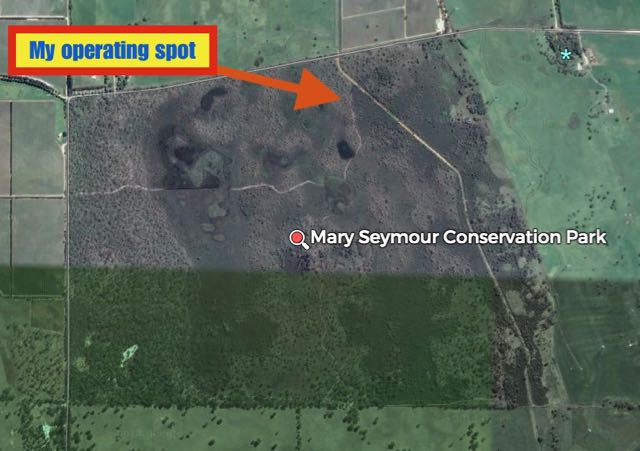
Once I crossed the Victorian border, the signs for the park were very visible either side of the Sturt Highway. I decided to take a track on the northern side of the Sturt Highway. I travelled a few km along the track until I found a nice clearing and that is there I set up. I would not recommend this track if you only have a conventional vehicle….you will get bogged.
Above:- Map showing my operating spot. Image courtesy of mapcarta.com
It was quite a nice mild morning, although when I first got up it was extremely cold. The fog that I experienced as I approached the Victorian border was starting to burn off and the sun was coming in with quite a bite to it.
Above:- Map showing the park and my operating spot. Courtesy of parks Victoria.
For this activation I ran the Yaesu FT-857d, 40 watts and the 40m/20m linked dipole supported on the top of the 7m squid pole. As I was setting up I was fortunate enough to see quite a bit of the local wildlife, including Western Grey kangaroos and Emus.
I headed for 7.095 and started calling CQ there and this was immediately answered by Scott VK7NWT with a great 5/9 signal, followed by John VK5BJE who was portable in the Belair National Park, VKFF-022, in the Adelaide Hills. John was a nice 5/8. My next caller was local Renmark resident Ivan VK5HS, followed by Adrian VK5FANA over on the Yorke Peninsula, and then Richard VK5U mobile 3 near Barmah.
Quite a steady flow of callers followed from VK1, VK2, VK3, VK4, VK5, VK6. Band conditions on 40m were very good, with excellent signals from all parts of Australia.
It is always great to work the QRP stations, and this activation didn’t disapoint. My first QRP contact for the activation was with Gerard VK2JNG running 2 watts from Orange (5/7 sent and 5/9 received). This was followed by Nick VK3FNCE running 3 watts (5/9 both ways) and then Peter VK3PF running 5 watts (5/9 both ways). Regular park hunter and regular QRP operator, Amanda VK3FQSO then gave me a shout with just 500 milliwatts (5/8 sent and 5/9 received). Next up was Bill VK2YKW running 5 watts from his X1M and an inverted vee antenna from the Hunter Valley, and then George VK4GSF. George initially called on high power (5/9 both ways). He then lowered his power down to 5 watts and was 5/5 with me. And then lowered the power again to just 2 watts, and was still a good 5/4 signal. A little later I spoke with Greg VK5GJ running 4 watts from Meadows in the Adelaide Hills and my last QRP contact was with Damien VK5FDEC running 5 watts from north of Adelaide.
This slideshow requires JavaScript.
I also was fortunate to be called by two ACT Summits on the Air (SOTA) activators. The first being Andrew VK1DA portable on Mount Majura, VK1/ AC-034 (5/7 sent and 5/8 received). And then Ian VK1DI portable on Booroomba Rocks, VK1/ AC-026 (5/8 both ways).
After working a total of 46 stations on 7.095 I went for a look around the band. I found special event station, VK100ANZAC calling CQ on 7.100 and gave him a call (5/9 sent and 5/8 received).
I then went to 7.105 and again called CQ and much to my great pleasure, my old mate Larry VK5LY gave me a call from nearby Renmark. This was followed by a well known Victorian park activator, Joe VK3YSP, and then Arno VK5ZAR and another Riverland local, Peter VK5FLEX.
I worked a total of 14 stations on 7.105 and I was just about QSY to 20m when the goat bleeted on my i-phone. It was a spot for Ian VK5CZ operating portable from SOTA peak VK5/ SE-007. So I hurriedly headed to 7.112 and found Ian calling CQ, with a very nice 5/9 signal from his end fed antenna.
I then spoke with Andrew (VK1NAM) operating the special call of VI1ANZAC from SOTA peak, Orroral Hill, VK1/ AC-012, contained within the Namadgi National Park VKFF-377 (5/7 sent and 5/8 received).
After working Andrew I headed to 14.310 on 20m and started calling CQ. However, my only taker there was Barry VK5KBJ who was portable on the Fleurieu Peninsula south of Adelaide. So I headed back to 40m and worked Stef VK5HSX who was operating portable from the Hallett Cove Conservation Park south of Adelaide (5/9 both ways). My last contact in the park was with Andrew (VK1NAM) operating as VI1ANZAC on SOTA peak Orroral Hill, VK1/ AC-012 (5/9 both ways). My i-phone had bleeted again just after working Stef, so down came the squid pole and out came the links again in the dipole.
I did listen around on 20m before going QRT but I did not hear a lot of activity. I did hear OD5ZZ in Lebanon, working lots of stations in the USA. I called a number of times, but just couldn’t break through the North American pile up.
This was another very enjoyable activation with a total of 66 contacts in the log, including four SOTA contacts, 2 ACT Park contacts, and 2 South Australian park contacts.
After packing up I headed back over the Victorian/South Australia border, and on to Yamba where I stopped for a cup of coffee and a healthy hot dog with the lot. I then travelled back over the Murray River, where I stopped briefly for some more photographs of the historic Paringa lifting bridge and the mighty Murray River.
This slideshow requires JavaScript.
The following stations were worked on 40m SSB:-
VK7NWT
VK5BJE/p (Belair National Park)
VK5HS
VK5FANA
VK5UK/3
VK5FTVR
VK2JNG/p
VK5AKH
VK3FNCE
VK3PMG
VK3UP
VK5KBJ/p
VK3PF
VK3NBL
VK3FQSO
VK5WG
VK2YKW
VK3PI
VK4GSF
VK3DAC
VK5FMJC
VK5FMID
VK6MB
VK3FCAS
VI2IO
VK5EE
VK3TKK
VK1UU
VK3HK
VK5KLV
VK3SQ
VK5ZGY/m
VK3DF
VK5GJ
VK5AR/m
VK5CZ/m
VK2FMIA
VK1DA/p (SOTA VK1/ AC-034)
VK7FMPR
VK3HRA
VK1DI/p (SOTA VK1/ AC-026)
VK3FSPG
VK2FW/p
VK2QK
VK2PKT
VK5KKT
VK100ANZAC
VK5LY
VK3YSP
VK5ZAR
VK5FLEX
VK5LDM
VK5JP
VK5FDEC
VK5FTRG/m
VK5KLV
VK5NQP
VK5NAQ
VK5RZ
VK3NSC
VK5BJE/p
VK5CZ/p (SOTA VK5/ SE-007)
VI1ANZAC/p (SOTA VK1/ AC-012 and Namadgi NP VKFF-377)
VK5HSX/p (Hallett Cove Conservation Park)
The following stations were worked on 20m SSB:-
VK5KBJ/p
VI1ANZAC/p (SOTA VK1/ AC-012 and Namdgi NP VKFF-377)
Below is a short video of some of the stations that I heard, in particular Stef VK5HSX/p, John VK5BJE/p and Andrew VK1NAM/p.
Most of Saturday (2nd May 2015) I spent around the home of Ivan VK5HS at Renmark, having my new Codan 9350 antenna installed on my Toyota Hi Lux. During the morning Peter VK5FLEX called in, as did John VK5FANG. It was a long day. In fact we didn’t finish until late in the afternoon, and after a few beers I headed back to my motel room.
This slideshow requires JavaScript.
But there wasn’t a lot on the television, so I decided to head out to activate the Pike River Conservation Park, which was to be another new unique park for me as an activator. The park is just a short drive out of Renmark along the Sturt Highway towards the Victorian/South Australian border.
To get to the park, you need to cross the historic Paringa lifting bridge which I took the opportunity of stopping here for some photographs. The Paringa Bridge, which was constructed in 1927, is one of only two opening bridges in South Australia. The other is at Port Adelaide. The Paringa Bridge is technically a ‘lift span’ bridge as it has a section that lifts up to allow large vessels through.
This slideshow requires JavaScript.
The Pike River CP is about 296 hectares in size and consists of a major floodplain and a branch system of the River Murray. The park has a number of species of national significance including the Southern Bell Frog, Murray Cod, and the Regent Parrot. It also contained an additional 18 species with State Conservation significance.
Again, this park is not at all signposted. So you will need to rely upon your GPS. There is an open and unlocked gate on the western side of the Sturt Highway which takes you into the park. The track is okay, but in 2WD, you will only be able to reach a certain point. I drove all the way down to the water’s edge and set up on the edge of the track.
As it was quite late (4.45 p.m.) I headed straight to 20m. For this activation I ran the Yaesu Ft-857d, 70 watts and the 40m/20m linked dipole supported on the 7 metre telescopic squid pole. I called CQ only once, on 14.310, and to my surprise, my CQ call was immediately answered by ON6PV in Belgium. And I was even more surprised when my second caller was Danny OT6V who was portable in a park in Belgium, Rodebos en Laanvallei, ONFF-391 (5/3 sent and 5/5 received). Here is a link to Danny’s page about that activation…..
I was then called by Rod VK4NUM, followed by Ray VK4NH portable near Bourketown, and then Aaron AL4Y in Alaska. Aaron was a very nice 5/8 signal and he gave me a 5/6 signal report. Aaron was also kind enough to spot me on the DX cluster and this resulted in a large pile up. In fact I worked a total of 60 stations in Belgium, VK4, Alaska, Italy, VK6, Denmark, Hungary, Germany, France, Switzerland, Slovenia, Lithuania, Sweden, Azores Islands, Russia, Slovak Republic, Spain, Estonia, Portugal, Canary Islands, Ireland, Netherlands, USA, and England. And again, I spoke to my good friend Marnix, OP7M in Belgium.
Thanks to everyone that spotted me on the DX cluster.
I then moved over to 40m. It was now totally dark and the local time was 6.00 p.m. I called CQ on 7.110 and this was answered by Adam VK2YK in Newcastle, followed by John VK5NJ in Mount Gambier, and then Rex VK3OF.
I had some excellent QRP contacts on 40m whilst in the park. This included Amanda VK3FQSO running 500 milliwatts (5/7 both ways), Roald VK1FIVE running 5 watts (5/6 sent and 5/9 received), Tony VK3VTH running 500 millwatts (5/8 sent and 5/9 received), Adrian VK5FANA running 5 watts (5/9 both ways), Peter VK3PF running 5 watts (5/9 both ways), Dave VK2BDR rnning 5 watts (5/9 both ways), Steve VK2FAJF also running 5 watts (5/9 both ways), Alan VK2AJG running 5 watts (5/8 both ways); Doug VK2FMIA running 5 watts (5/8 sent and 5/9 received), and Rob VK3EY running 1.5 watts (5/7 sent and 5/9 received). Band conditions on 40m were excellent.
This slideshow requires JavaScript.
I also managed a park to park contact with newly licenced amateur, Brendon VK5FFCC who was operating portable from the Morialta Conservation Park. Brendon had a nice sounding station with his Elecraft KX3, 10 watts and end fed antenna. Not a bad effort at all Brendon. Licenced for one week, and already out in a park, and sounding like a pro. Congratulations. Below is a quick video of what Brendon sounded like to me……
I also worked Ken ZL4KD in new Zealand, who has now become a familiar caller and is a member of the VK5 Parks Yahoo group.
There was an annoying noise on 7.110 though. I am not sure what it was. I’ve attached a video below, so if anyone knows what the noise is, I would be pleased to hear from you…..
When things slowed down a little I had a tune around the band and heard NP4A calling CQ on 7.129. I patiently waited my turn and gave Pedro a call and got through on the first go. I have worked Pedro a few times before whilst I’ve been out in a park, and he always puts a great signal into Australia.
This was a very successful activation, with a total of 118 contacts in the log, including some nice DX contacts.
On Friday night (1st May 2015) after checking in to my motel I drove east out of Renmark along the Sturt Highway and headed into the Cooltong Conservation Park, via Santos Road. This was to be another unique park for me as an activator for both the VK5 National & Conservation Parks Award and the World Wide Flora Fauna (WWFF) program.
Cooltong Conservation Park is situated about 250 km north east of Adelaide, and is located between Renmark and Berri. Cooltong is a large park. It is 3,681 hectares in size and was dedicated to preserve quality males vegetation and habitat for the mallee bird species that frequent the area, in particular the Malleefowl. The park is a typical mallee park, with undulating dunes and shales. The park is accessible to conventional vehicles, however some sections of the park are only accessible by 4WD.
Above:- Map showing the location of Cooltong CP. Image courtesy of mapcarta.com
I drove a few km into the park and found a little track off to the east and in turn a nice clearing in the scrub. It was an ideal spot to set up. It was slow going into the park as it was fully dark (6.30 p.m.) and the local wildlife was out in force, including the kangaroos.
Above:- My operating spot. Image courtesy of mapcarta.com
The entire 40m band above 7.135 was decimated by the Over the Horizon Radar (OTHR). This made it totally impossible to operate in that portion of the band. The OTHR radar was still audible on 7.135, but I couldn’t go any lower on the band, as the 7.130 DX Net would kick off at 0930 UTC, and everything below 7.130 was taken up by stations from South East Asia.
Below is a video of the radar…..
So I called CQ on 7.135 and it wasn’t long, before the hungry park hunters started to respond. First up was Theo VK3AP with a nice 5/9 plus signal, followed by three regular park hunters: Andrew VK1NAM, Dave VK3VCE and John VK5BJE. Local Renmark resident and mate of mine, Ivan VK5HS then called in. Interestingly Ivan said he could not hear the radar and thought the noise I was hearing might be something generated out of my vehicle. I assured him that it was definitely the OTHR.
Some of the usual QRP suspects called in for this activation. They were Adrian VK5FANA on 5 watts from the Yorke Peninsula (4/6 sent and 5/7 received), and also Peter VK3PF running 5 watts (5/9 both ways). I was also called by Adrian VK4FBMW running 5 watts. Unfortunately the JA QRM was also quite heavy on the frequency, but still, I was able to copy Adrian well with his QRP signal (4/7 sent and 5/8 received).
I also worked some stations outside of VK. They were John Zl2BH in Blenheim in New Zealand, and Ken ZL4KD in Christchurch. Ken informed me that he had seen me spotted on parksnpeaks and had decided to give me a call, and that I was his first ever VK5 Conservation Park contact. I was very pleased to have Ken in the log.
This slideshow requires JavaScript.
It was a beautiful mild evening in the park. The moon was out and due to the cloud cover, it had a very distinctive ring around it. There were quite a few bumps and crashes in the scrub whilst I was operating and I had the occasional fleeting glimpse of some of the local kangaroos.
Within the park I did see some signs that surveillance cameras were in operation. I thought this may have been due to bird trapping, but as I later found out, it is due to the dumping of rubbish. It never ceases to amaze me how poorly some people treat our environment.
I worked 38 stations on 7.135 and then at 8.10 p.m. I decided to head down to the 7.130 DX Net which is held on 7.130 every Monday, Wednesday and Friday. I worked a total of 6 stations on the net, bringing me to my required 44 contacts for the global WWFF program. I was very pleased to work the special New Zealand ANZAC call, ZL100ANZAC on the net, and also Brian ZL2ASH in Wellington.
The following stations were worked on 40m SSB:-
VK3AP
VK1NAM
VK3VCE
VK5BJE
VK5HS
VK5AKH
VK5FANA
VK2IO
VK3PF
VK1AT/3
VK3DAC
VK3JAP
VK3FSPG
VK2FMIA
ZL2BH
VK5HCF
VK5ZGY
VK3ANL
VK2QM
ZL4KD
VK3YW/m
VK4FFAB
VK5KLV
VK2GKA
VK2MRX
VK3HRA
VK2PKT
VK5EE/m
VK3BBB
VK3AN
VK3FIRM
VK3NSC
VK2BDR
VK4FBMW
VK2FAAA
VK7LCW
VK3TKK
VK3EY
ZL100ANZAC
ZL2ASH
VK5MJ
VK2FROX
VK7ROY
VK6FBMW
References.
Department of Environment and Heritage, 2011. Parks of the Riverland.
On Friday afternoon (1st May 2015), I packed the Toyota Hi Lux and headed off towards Renmark in the Riverland region of South Australia. My reason for heading there was that Ivan VK5HS was going to instal a Codan self tuning 9350 antenna in the vehicle for me. And I was also planning on a park activation with my old mate Larry VK5LY who has not been travelling well of late.
My first park activation along the way was the Bakara Conservation Park (CP), which was a unique park for me to add to my activator list.
Bakara CP is located about 32 km east of Swan Reach. The park is 2,029 hectares (5,010 acres) in size and was established back in 1986 to conserve the Malleefowl habitat. The park area was doubled in size in 2009 by the addition of the adjacent section of land to the north of the original park.
Above:- The location of Bakara CP. Map courtesy of mapcarta.com
After leaving home, I travelled east along the South Eastern Freeway to Murray Bridge and then headed north east long the Bowhill Road. I then drove north along Hunter Road (Swan Reach – Walker Flat Road), which runs alongside the mighty Murray River. I stopped at Len Kroehn’s Lookout near the little town of Nildottie, to stretch my legs and take some photographs of the Murray and some of its spectacular cliffs.
This slideshow requires JavaScript.
I continued on and I accessed the park via Start Road, which is a well graded dirt road which runs off the Stott Highway (Swan Reach-Loxton Road). Don’t bother looking for any signage off the Highway. There isn’t any. A common theme with many South Australian Conservation Parks. You will need to rely on your GPS. And dont blink, because you may also miss the park signs hidden amongst the scrub.
I travelled a few km down Start Road and I found a little track leading off Start Road and then a clearing amongst the mallee scrub, and that was where I set up.
Above:- My operating spot. Image courtesy of mapcarta.com
As is the case with the majority of my park activations, I ran the Yaesu FT-857d, 40 watts and the 40m/20m linked dipole supported on the 7 metre telescopic squid pole. There were no problems here with driving in the squid pole holder as the ground was very sandy and quite soft.
I called CQ on 7.095 and my first taker was Greg VK5GJ running about 4 watts from Meadows in the Adelaide Hills. As per normal, Greg had a lovely signal (5/8 sent and 5/9 received). This was followed by a call from Brad Vk2HAV who was very light to me, but due to the non existant man made noise floor in the park, Brad was very workable. This was followed by a call from another New South Welshman, Ian VK2GDI who had a strong 5/8 signal. My next contact was with Jim VK4OK who was quite weak (5/3) but again very readable in the park. Jim gave me a 5/1 signal report. So that was an interesting start to the activation. A QRP VK5, followed by two VK2’s and then a VK4.
This slideshow requires JavaScript.
My next contact was with Tony VK5ZAI who who on holidays down in Tasmania and was about 50 km north of Launceston. Tony had a very nice 5/7 signal and he reciprocated with a 5/8 for me. Some of the more regular park hunters had obviously found me and then started to call. This included some of the regular QRP callers. Adrian VK5FANA on the Yorke Peninsula with his 5 watts had a nice 5/9 signal. And Paul VK3DBP also on 5 watts had a strong 5/8 signal. Mobile callers included Tom VK5EE in the South East (5/9 both ways), Peter VK3PF (5/8 sent and 5/7 received), Ivan VK5HS mobile at nearby Blanchetown, Perrin VK3XPT (5/8 sent and 5/9 received), and John VK3FCAN mobile near Traralgon (5/5 sent and 5/9 received).
After working 30 stations on 40m SSB in VK2, VK3, VK4, VK5, & VK7, I decided to have a quick listen on 20m SSB, as I had promised Gerard VK2IO that I would try 20m for him. Gerard was one of my last contacts on 40m and although I could hear him very well and he could hear me, we agreed that we would give 20m a go.
My first contact on 20m after calling CQ a few times on 14.311 was with Sergey RA3PCI in Russia. Sergey spotted me on the DX cluster and this resulted in quite a large pile up with lots of callers from Europe. But as the number of callers started to increase, I did worry that this activation might cause some confusion with some of the European park hunters. Bakara CP does not currently qualify for the World Wide Flora Fauna (WWFF) program and so therefore does not have a VKFF number. But most of the Europeans that I worked, appeared to understand that this was not a WWFF activation and that the park qualified for the VK5 Parks Award only.
I went on to work a total of 61 stations on 20m. Most of those contacts were long path into Europe ( I worked Russia, Italy, Belgium, Ukraine, Slovenia, Poland, England, Sweden, Switzerland, Spain, Croatia, France, Germany, Estonia, Greece, Portugal, and the Netherlands). However there were a few VK’s scattered in there as well, including Perrin VK3XPT mobile, Gerard VK2IO, Andrew VK1NAM, and Craig VK6VCK mobile. Also outside of Europe was Warren ZL2JML in New Zealand. And again I managed to make a QSO with my very good friend, Marnix OP7M in Belgium.
Thanks to everyone that took the time to spot me on the DX cluster. It certainly helped to drag in the park hunters.
During the pile up into Europe, Craig VK6VCK who was mobile in Western Australia, gave me a call and asked if I had upgraded my call. I replied that I hadn’t and was then asked why I was outside of the Standard call portion of 20m. This really threw me. I was on 14.311 and well inside the 14.350 limit. But Craig was insistent that Standard calls could not operate above 14.300. I knew this to be incorrect, but a few calls on, I started to doubt myself a little. But my doubts only lasted a short time as I knew that I could operate up to 14.350. It was one of those strange tricks that you mind plays on itself.
Other than the usual callers, I also had some interesting contacts on 20m. That included a call from my mate Phil 2E0UDX mobile in the United Kingdom (UK). And then a call from Dave G4AKC who was pedestrian mobile (5/9 both ways) and shortly afterwards a call from Dave M0DAD who was also pedestrian mobile in the UK. Dave was not as strong as G4AKC, but was still a very readable 5/3 signal. I received a 5/7 signal report.
It was starting to get a little late. The local time was nearly 4.30 p.m. and I still had a way to travel to get to my destination of Renmark. So I packed up the gear, feeling a little disapointed as the conditions on 20m into Europe were very good.
I had a total of 91 contacts in the log from this new unique park for me as an activator. I was very happy.
I was very pleased the other day to find an email from the SPFF Award Managers with my certificate for the next level of the SPFF Hunter Award. It was awarded to me for working 12 different SPFF reference areas.
More information on the SPFF-Polska Flora Fauna program can be found at…..
The results are out for the 2015 John Moyle Field Day (JMMFD). I am pleased to report that I came first in the Six Hour Portable Operation-Single Operator (PHONE HF) section.
The JMMFD is a great contest, the aim of which is to “encourage and provide familiarisation with portable and field operation, and provide training for emergency situations”.
Today via email I received the certificate below from the Belgian Flora and Fauna Association. This particular certificate was issued to me for working 10 different ONFF references. It is Class 3/Bronze.
The next step is Class 2/Silver – 25 different ONFF references, then Class 1/Gold which is 50 different ONFF references.
More information on the ONFFA program can be found at…..