Hunting/Chasing European Parks and SOTA in the wee hours of the night

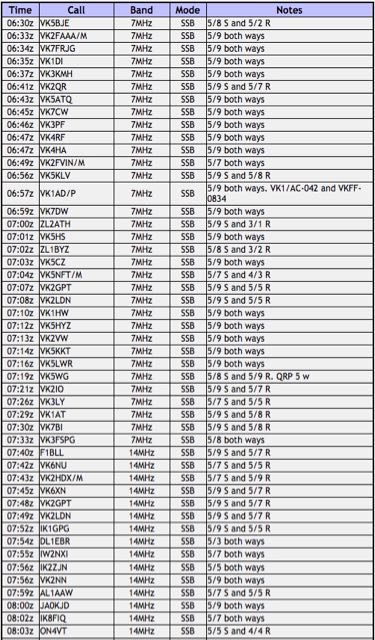
Last weekend (Saturday 3rd and Sunday 4th September 2016) was the 57th All Asian DX Contest, which coincided with the IARU Region 1 Field Day.  So for the first time in a long time I was up late into the morning working DX.

In amongst the All Asian DX Contest contacts, I made a few contacts on the 20m band into Europe with Park activators for the World Wide Flora Fauna (WWFF) program and summit activators for the Summits on the Air (SOTA) program.

Activators worked were:-

  • Andy G7SQW/p, WWFF GFF-0198
  • Bernard PB7Z/p, WWFF PAFF-0061
  • Chris OU7M/p, WWFF OZFF-0012
  • Iratxe EA2DNO/p, SOTA summit EA/ LE-182
  • Antonio EC2AG/p, SOTA summit EA1/ CT-081
  • Dariusz SP9DPM/p, SOTA summit SP/ BS-026

Equipment used at home here in the shack was my Yaesu FT-2000 and 100 watts, Heil Pro4 headset, and TET Emtron TE-53, a 5 element tribander @ 16 metres on the tower in the back yard.

dsc_0001

First up for the morning was Andy G7SQW who was operating portable from Orford Ness National Nature Reserve, GFF-0198.  This was at 1446 UTC (12.16 a.m. South Australian local time).  Due to antenna restrictions, Andy only operates on HF from his mobile station.  Andy had a very nice 5/8 signal on the short path to me and reciprocated with a 5/9 for me from England.

G7SQW_2014_2_.jpg

Orford Ness National Nature Reserve is an internationally important coastal nature reserve which is located in Orford in Suffolk in the United Kingdom.  It has a diverse range of habitats including shingle, saltmarsh, mudflat, brackish lagoons and grazing marsh.  The Reserve is the largest vegetated shingle spit in Europe.

Above:- Orford Ness National Nature Reserve.  Photos courtesy of https://anneguygardendesigns.files.wordpress.com

More information on Orford Ness can be found at…..

https://www.nationaltrust.org.uk/orford-ness-national-nature-reserve

Next up was Bernard PB7Z who was portable in Boswachterij Sleenerzand PAFF-0061 in the Netherlands.  UTC time was 1453 (12.23 a.m. local time).  My noise floor at home on 20m was strength 1, so I was receiving Bernard very well at 5/5.  Bernard gave me a 5/9 signal report.

pb7z_qrzcom

Boswachterij Sleenerzand is located near the town of Wezeperbrug, in the Drenthe region of the Netherlands.  It contains quiet wood with ancient burial mounds and dolmens (a type of single-chamber megalithic tomb), which are interspersed with shifting sands, moors and fens.

Screen Shot 2016-09-08 at 7.41.33 PM.png  Above:- Map showing the location of Boswachterij Sleenerzand.  Map courtesy of Google maps.

I then spoke with Chris who was at the mic of OU7M, the club station for the EDR Mors-Nordthy Radio Club in Denmark.  Chris was portable in Feggeklit OZFF-0012 and had a very nice 5/7 signal to me, with my signal being 5/9 to Denmark.  The time had now crept up to 1542 UTC (1.12 a.m. local time).

Feggeklit is a large moler embankment which previously lay as an island in the sea.  It is located on the northern tip of the island of Mors.  To the west Feggeklit is covered in grass, and on the steep slopes the shelves of earth slides are clearly seen.  On the east side the moler is visible on the steep cliff and to the south west Skamol, the factory which processes the moler, can be seen.  In 1916 Denmark’s first moler tile works ”Skarrehage Molerværk” was established on this site.

dk_fegge03
Above:-Feggeklit.  Image courtesy of http://www.geospectra.net/

A Danish Myth tells that it was on Feggeklit that Hamlet murdered his wicked stepfather, King Fegge, who had his royal estate here.  King Fegge had in jealous rage killed his brother, and then, married his sister-in-law, Geruth, thus becoming Hamlet’s stepfather. After Hamlet’s revenge, King Fegge was buried at the top of Feggeklit in a grave surrounded by large stones which can still be seen today.

feggeklit9-17a

Above:- King Fegge’s grave.  Image courtesy of http://thyra2005.blogspot.com.au/

My first European SOTA activator logged for the morning was with Iratxe EA2DNO who was portable on SOTA peak Pico del Águila EA1/ LE-182.  I was receiving Iratxe at 5/5 and she was receiving me on the summit in Spain at 5/7.  UTC time was 1639 (1.39 a.m. local time).

Pico del Águila, meaning ‘Beak of the Eagle’ is a tabular mountain at the limits of the high plane Alcarria in the Spanish province of Guadalajara with a prominent drop of about 200 m at its northern side.  The summit is 1,451 metres above sea level and is worth 6 SOTA points.

I was Iraxte’s first contact into Australia and she told me “I am very happy‘.  Iraxte was kind enough to send me some photographs of her activation.

Iratxe has a WordPress site which can be found at…..

http://www.irratimendi.com/

My second SOTA contact was at 1643 UTC (2.13 a.m. South Australian local time) with Antonio EC2AG who was portable on La Nieves, pico de EA1/ CT-081 in the Cantabria region of Spain.  I have worked Antonio previously when he has been activating a summit for SOTA.  On this occasion Antonio was running QRP 5 watts from a Yaesu FT-817 and a dipole and had a good 5/5 signal to me, with a 5/8 signal report coming back from Spain.

screen-shot-2016-09-08-at-7-13-05-pm

Above:- Map showing the location of the summit.  Image courtesy of Google maps.

Las Nievos, pico de, also known as Castro de Las Nieves, is 778 metres and is worth 2 SOTA points.  It is located in northern Spain north west of the city of Bilbao.  It is not to be confused with the summit of the same name on the island of Gran Canaria in the Canary Islands.  The summit is typically rocky and is the highest in a series of craggy elevations or forts that rise above the dividing of the Ason and Aguera point.

Screen Shot 2016-09-09 at 11.49.54 AM.png

Above:- view of the summit.  Courtesy of Google maps.

Every 5th August the summit is climbed by people all around the area as part of the Feast of the Virgin.  On the top of the summit you can find the little chapel of the Virgen de las Nieves.

Antonio was kind enough to put a short video together of our contact.  You can watch it below……..

My last portable contact for the morning was with Dariusz SP9DPM who portable on SOTA peak Chyrowa SP/ BS-026 in Poland.  It was now getting pretty late for me….1646 UTC (2.16 a.m. local time).

Screen Shot 2016-09-08 at 8.10.12 PM.png

Above:- Map showing the location of Chyrowa.  Map courtesy of Google maps.

The summit which is located in the Beskidy Srodkowe region of Poland is 695 metres above sea level and is worth 2 SOTA points. Dariusz was the weakest of the portable stations of the morning, being only 5/2, but very readable.  Dariusz gave me a 5/1 signal report.

Screen Shot 2016-09-09 at 12.20.34 PM.png

Above:- Chyrowa summit.  Image courtesy of Google maps.

A fun morning, in the wee hours of the night, working both stations for the contest and 3 WWFF stations and 3 SOTA stations.


References.

Mendikat, <http://www.mendikat.net/com/mount/1610&gt;, viewed 8th September 2016

Suffolk Tourist Guide, 2016, <http://www.suffolktouristguide.com/Orford/Orford-Ness-National-Nature-Reserve-1133.asp&gt;, viewed 8th September 2016
Summits on the Air, 2016, <http://www.sota.org.uk/&gt;, viewed 8th September 2016

Wikipedia, 2016, <https://da.wikipedia.org/wiki/Feggeklit&gt;, viewed 8th September 2016

Logging contacts whilst portable

I’ve been asked a few times of late, ‘How do you log contacts in the field?’.

Well I still use a good old paper log whilst activating either a park for World Wide Flora Fauna (WWFF) or the VK5 Parks Award, or a hilltop for Summits on the Air (SOTA).  I have a good supply of the logsheet you can see below, which is A4 in size and sits nicely on a plastic A4 clipboard which I carry.

logsheet371.jpg

I like to scribble down information, names, etc.  I also use a technique in the field to run the small VK pileups, whereby I get stations to spread their calls out and I jot down the call signs I hear, and I bring the stations in that way.  I find it works very well to move through the mini pile ups that parks and SOTA activators now often experience.

I must admit that I have not tried out some of the available portable logging apps such as Peter VK3ZPF’s logger.  I have only ever used paper for my parks and SOTA trips, except for those occasions when it has been an event such as the John Moyle Memorial Field Day.  That is when I have used VK Contest Log.

So, paper it is for me in the field.  But, at home, I do run an electonic log, and have done so ever since becoming a licenced amateur back in June 2010.  I have never had a paper log at home.  I am a Mac fan and I use an electronic logging program called MacLoggerDX.

Screen Shot 2016-09-05 at 6.08.45 PM.png

So, what do I do with the contacts from the paper log when I get home?   I use a program called Fast Log Entry (FLE) to rapidly enter my QSOs from my park/SOTA activation, and this creates an ADIF file which I can then use to upload to MacLoggerDX and also WWFF Logsearch, the electronic database for the WWFF program.

Screen Shot 2016-09-05 at 6.24.54 PM

What is an ADIF file?  ADIF stands for Amateur Data Interchange Format.  It is an open standard for exchange of data between amateur radio software packages available from different vendors.  More information can be found at http://www.adif.org/

The latest version of FLE is version 2.8 which was released on August 30th 2016.  This latest version of FLE now not only includes WWFF logging, but SOTA logging has also been introduced.

Screen Shot 2016-09-05 at 6.07.31 PM.png

FLE can be used for:

  • regular logging
  • contest logging
  • WWFF logging
  • SOTA logging

Even though I use a Mac, I run a virtual machine program called Parallels which allows me to run Windows on my Mac.

More information on Fast Log Entry can be found at…..

http://www.df3cb.com/fle/

So for me, at the moment, logging in the field using paper is the way to go.  And now that I understand FLE well, it takes me a very very short period of time to enter 100 QSOs or more.

DSC_2191.jpg


Baudin Conservation Park, 5CP-012 and VKFF-1002

My third park activation for Wednesday 24th August 2016, and my final activation whilst on Kangaroo Island was the Baudin Conservation Park 5CP-012 and VKFF-1002.  This was to be another unique park me to add my to my activator tally.

Screen Shot 2016-08-15 at 10.06.53 PM.jpg

Above:- Map showing the location of the Baudin Conservation Park on the Dudley Peninsula on Kangaroo Island.  Map courtesy of Protected Planet.

Prior to heading to Baudin, I drove down to the beach at Antechamber Bay after my activation at Lashmar.    This is part of the Lashmar Conservation Park and is a spectacular part of KangarooIsland.

When you reach the end of Shorty Road (which becomes Lashmar Road) you will notice two gravesites underneath a pepper tree  They are for Jane Lashmar (1847-1865) and Thomas Clark (-1894).  Jane Hannah Lashmar died aged just 18 years.  Her father was Thomas Young Lashmar (b. c. 1813.  d. Dec 1860).  The Clark family married into the Lashmar family.

I then headed for the Baudin Conservation Park, travelling west on Cape Willoughby Road for a few km and then turning on to Binneys Track (pposite Willson River Road).  The first few km of this road are okay for a conventional vehicle, but you will then reach a sign which states ‘4WD’s only’.  If you have a car, you will need to park here and walk the rest of the way to the park.  The road is easily passable however if you have 4WD, which fortunately I did.

Baudin Conservation Park is located on the north coast of the Dudley Peninsula, about 2 km south east of Penneshaw.  The park is 310 ha (770 acres) in size and was established on the 28th March 2002.  Prior to this time the park was originally a family farm, between 1861-2001.  It comprised os she-oak woodland and rolling hills, with some fantastic views out across Backstairs Passage to the Fleurieu Peninsula on the mainland of South Australia.

Within the park you can undertake the Ironstone Hill hike which follows part of the original bullock track to Cape Willoughby.  The area was previously farmed by the Bates family, and remnants of the Bates cottage can still be seen.

The park is home to a large amount of wildlife including tammar wallabies, wedge tailed eagles and the rare glossy black cockatoo.

The park is named after Nicolas Baudin (1754-1803, a French explorer, cartographer, naturalist and hydrographer.

Nicolas_Baudin_2.jpeg

Above:- Nicolas Baudin.  Courtesy of wikipedia.

Baudin was responsible for the Freycinet map of 1811, which was the first full map of Australia to be published which howed the full outline of Australia.  It preceded the publication of British explorer Matthew Flinders’ map of Australia, Terra Australis or Australia, by three years.

1280px-1811_Freycinet_Map

Above:- The Freycinet map of 1811.  Courtesy of wikipedia.

There were no places for me to pull off the side of the road, so after driving a short distance down Binneys Track, I pulled the HiLux as far to the left of the track as possible.  This was on a downward part of the track.  I set up my fold up table and deck chair in a small clearing of the scrub and then ran out the 20/40/80m linked dipole.  There wasn’t much room, so the antenna actually straddled across the track.

Screen Shot 2016-08-15 at 10.06.35 PM

Above:- Aerial shot showing my operating spot in the Baudin Conservation Park.  Image courtesy of Protected Planet.

My first contact from Baudin was with Peter VK3PF on 7.144 on the 40m band.  This was followed by Les VK5KLV and then Dennis VK2HHA.  Already a pile up had ensued.  But Peter had informed me that Charlie VK5KDK was in a park a little higher up the band.  So after working Dennis I slid up to 7.153 and spoke with Charlie who was in the Venus Bay Conservation Park VKFF-1111 on the Eyre Peninsula.  I then moved back to 7.144 where the masses were waiting.  I worked a total of 38 stations on 40m from VK1, VK2, VK3, VK4, VK5, VK6, and VK7.

Whilst operating on 40m, one of the local farmers drove down the track and I took a bit of time out to explain to him what I was doing.  He seemed very interested.  Band conditions on 40m were exceptionally good, with great signals from all across Australia.  I experienced a little bit of QRM from a VK2 net on 7.146 which started up about 10 minutes into my activation, and also a little bit of QRM from below as well.  Marcos CT1EHI was attracting a bit of attention on 7.142.

I then lowered the squid pole and removed the links in the dipole and headed for 14.310 on the 20m band.  First taker was the ever reliable Rick VK4RF/VK4HA, followed by Mike VK6MB and then Mark VK4MON.  It wasn’t long and the DX long path from Europe started to call in.  Gerard F1BLL was the first, followed by Max IK4GRO.  But it was at this time that a 4WD with 3 ladies came down the track and they were…..number one……curious what I was doing…….and number two……concerned about the track.  So I took the time out to explain to them the hobby of amateur radio and handed out a few promotional brochures on amateur radio and the parks programs.

Once they were on their way, I decided that time was marching on, so rather than call CQ on 20m again, I headed off to 80m where I logged a total of 16 stations from VK1, VK2, VK3, VK4, and VK5.  I’m sure that I could have kept going and got a lot more contacts but it had just passed 5.00 p.m. local time and I really needed to pack up.

I was more than happy with a total of 61 contacts in the log.

The following stations were worked on 40m SSB:-

  1. VK3PF
  2. VK5KLV
  3. VK2HHA
  4. VK5KDK/p (Venus Bay VKFF-1111)
  5. VK3OHM
  6. VK4RF
  7. VK4HA
  8. VK3UH
  9. VK3MRH
  10. VK2KYO
  11. VK3SQ
  12. VK5FANA
  13. VK2XXm
  14. VK3SFG
  15. VK7BC
  16. VK5FMLO
  17. VK3HSB
  18. VK6MB
  19. VK3ELH
  20. VK3BBB
  21. VK2EJW
  22. VK2NP
  23. VK1HW
  24. VK7ALH
  25. VK4JK
  26. VK3ANP
  27. VK4AAc/3
  28. VK2IO
  29. VK7FPRN
  30. VK2QH
  31. VK4FE
  32. VK3MCK
  33. VK3SIM
  34. VK3CM
  35. VK4MON
  36. VK4FAAS
  37. VK3ZMD
  38. VK5YX

The following stations were worked on 20m SSB:-

  1. VK4RF
  2. VK4HA
  3. VK6MB
  4. VK4MON
  5. VK4NHT
  6. F1BLL
  7. IK4GRO

The following stations were worked on 80m SSB:-

  1. VK3GGG
  2. VK3PMG
  3. VK4RF
  4. VK4HA
  5. VK5FMLO
  6. VK5PL
  7. VK3BSG
  8. VK5BRT
  9. VK3FI
  10. Vk5FMID
  11. VK5FANA
  12. VK2NP
  13. Vk5FVSV
  14. VK5FGAZ
  15. VK1DI
  16. VK3SQ

Following the activation I headed into Penneshaw.  It was around 5.15 p.m. and I had a little over 2 hours before my ferry departed Kangaroo Island.  As I drove down Binneys Track into the eastern section of Penneshaw I could see the 5.00 p.m. ferry departing Penneshaw on its way to Cape Jervis.

DSC_2374

I stopped to have a look at ‘Frenchman’s Rock’.  It was here, that in 1803, French explorer Nicolas Baudin anchored in Hog Bay.  One of his crew noted their arrival of the expedition by carving on a rock.  The rock was subsequently removed and is now located in the Gateway Information Centre.  A replica now stands in its place.

The rock reads……

“Expedition de decourverte par le commandant Baudin sur le Geographe 1803”

Meaning in English……”Expedition of discovery by Captain Baudin in the Geographe 1803″.

Just above Frenchmans Rock is the Contemplation Seat.  Here, you can sit, whilst admiring the view, and recall the aboriginal women who were brought o Kangaroo Island to assist the whalers and sealers prior to official settlement of the island.

Prior to heading to the hotel for a meal, I admired a magnificent sunset at Penneshaw.

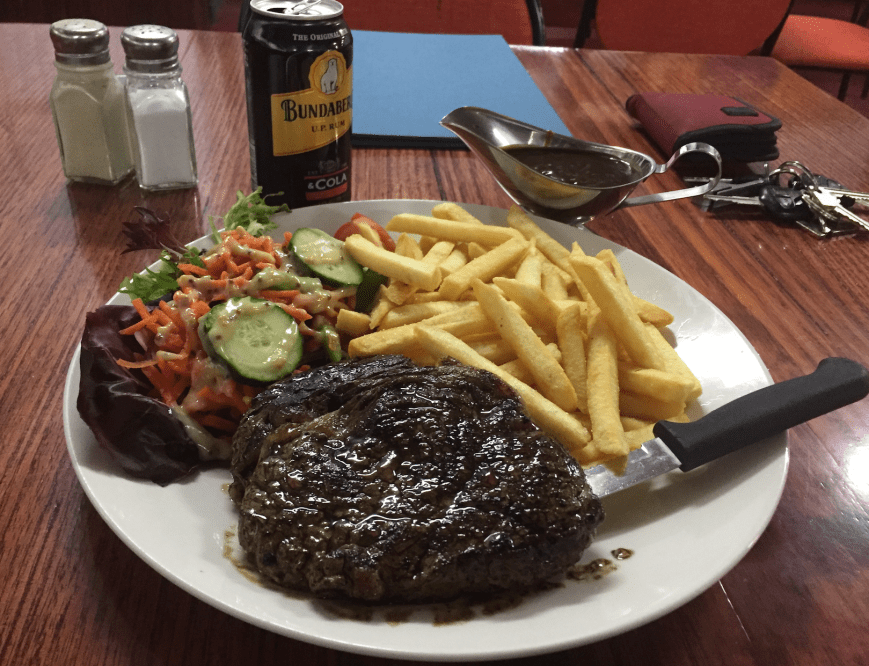
I was then off to the Penneshaw pub for a meal.  I had Kangaroo washed down by a few cans of Bundy and coke.

DSC_2397

Screen Shot 2016-08-25 at 1.41.56 PM

By 7.15 p.m. the ferry had commenced loading vehicles.  As it was the late ferry there wasn’t a huge amount of traffic, so I did not have to take the whip off the Codan antenna.

I sat back and relaxed and enjoyed the 45 minute trip back to the mainland.  It had been a fantastic 6 days on beautiful Kangaroo Island.


References

National Parks South Australia, <https://www.environment.sa.gov.au/parks/Find_a_Park/Browse_by_region/kangaroo-island/baudin-conservation-park&gt;, viewed 6th September 2016

Wikipedia, 2016, <https://en.wikipedia.org/wiki/Baudin_Conservation_Park&gt;, viewed 6th September 2016.

Wikipedia, 2016, <https://en.wikipedia.org/wiki/Nicolas_Baudin&gt;, viewed 6th September 2016
Lashmar Conservation Park 5CP-113 and VKFF-0902

After leaving Pelican Lagoon I continued my drive along the Dudley Peninsula on Kangaroo Island (KI) to my second intended park for the day, the Lashmar Conservation Park 5CP-113 and VKFF-0902.

Screen Shot 2016-08-15 at 10.03.10 PM.jpg

Above:- Map showing the location of the Lashmar Conservation Park on the Dudley Peninsula, Kangaroo Island.  Map courtesy of Protected Planet.

As I approached Penneshaw on the Hog Bay Road I was rewarded with some amazing views of Penneshaw, Backstairs Passage, and the South Australian (SA) mainland.  Penneshaw is a little town on the north east coast of KI and is the island’s main ferry port from the island to Cape Jervis on the SA mainland.  Penneshaw was originally known as Hog Bay due to the pigs which were released by French Commander Nicholas Baudin.  It was to eventually be named Penneshaw, which was a combination of the names of Dr. F.W.Pennefather, the private secretary to Governor Jervois, and Flora Louisa Shaw, The Times colonial editor, a visitor to Government House.

One of my various hobbies, includes family history research, and South Australian history in general.  So I couldn’t help but stop briefly at the historic Penneshaw cemetery.  This cemetery contains the graves of numerous pioneers to the island, including George Bates.

Time was marching on, so it was back in the 4WD and then onto the Cape WIlloughby Road.  On the way to the park I spoke to Dennis VK2HHA from the mobile.  He kindly put a post up on Facebook to advise the ever keen hunters that I would be set up in the park shortly.

As I drove along the Cape Willoughby Road I stopped a few times to admire the views across Backstairs Passage over to the SA mainland.

DSC_2328

DSC_2330

Lashmar Conservation Park soon came into view, as it is well signposted.  Lashmar is located on the north coast of the Dudley Peninsula and is 3.59 kmin size.  The park was established on 16th September 1993 and includes the Lashmar Lagoon, a home to numerous waterbirds.  The park also adjoins the long sandy beach at Antechamber Bay, which was christened by explorer Matthew Flinders in April 1802 when he wrote in his journal:

“Our soundings were irregular, and some rocky islets being seen without sight of the opening.  I stood in at nine o’clock to look for anchorage at the east end of Kanguroo Island.  Finding no shelter there, we ran a little to leeward into a small bay, which I had observed before dark.  It is called the Ante-chamber’.

And before you pick up the spelling mistake……Kanguroo…..that’s the way Flinders always spelt Kangaroo.

The park was named after the Lashmar family, one of the pioneering families of Kangaroo Island who during the 1850’s held the Antechamber Bay Run.  In 2012 when I attended KI for the International Lighthouse and Lightship Weekend (ILLW) I met Wren Lashmar, a fifth generation Kangaroo Islander.  Wren came out to the lighthouse and was very interested in what we were up to.

I found a small track off Cape Willoughby Road which led into a small clearing.  It was an ideal spot to set up and string out the 20/40/80m linked dipole.  It was a beautiful sunny afternoon, so I chose the shade of some gum trees.

Screen Shot 2016-09-05 at 11.40.44 AM

Above:- Map showing my operating spot in the Lashmar Conservation Park.  Map courtesy of Protected Planet.

Fittingly, as he had helped me earlier, Dennis VK2HHA was my first contact in the log from Lashmar.  Dennis was 5/9 plus from Albury.  Geoff Vk3SQ at Beechworth was next, followed by Ron VK3MRH and Wodonga, and then Marc VK3OHM.  All had 5/9 or 5/9 plus signals into Lashmar.  As is often the case with park activations, the first 10-15 minutes was quite frenetic, with a mini pile up developing.  Callers were from VK2, VK3, VK4, VK6, and VK7.  Noticably absent was VK5.  All except for Michael VK5FMLO in the southern suburbs of Adelaide who was 5/7 (5/8 received).  It was clear the 40m band was not open for most of the areas of VK5.

The signals coming in from Western Australia, considering the time of the day, were particularly good.  Mike VK6MB was a good 5/7 (5/5 received), Max VK6FN was also 5/7 (5/5 received), and Peter VK6APZ was 5/3 from his mobile (5/3 received).  I made one Park to Park contact during this activation at Lashmar, and that was with Geoff VK4XA who was portable in the Forty Mile Scrub Conservation Park VKFF-0181.

I worked a total of 34 stations and then headed to 20m where I spoke with Rick VK4RF/VK4HA and Mike VK6MB.  Both had good signals to Lashmar, but despite numerous CQ calls, they were my only takers on the 20m band.

So it was off to 80m for me, and first contact there was with Adrian VK5FANA on the Yorke Peninsula.  Michael VK5FMLO then called in, and this was followed by Mick VK3GGG/VK3PMG.  Mick was a good 5/7 signal to me, but somebody he was having great difficulty with me.  We perservered for a few minutes until we successfully exchanged signal reports.  Just at the same time that somebody came up and relayed the signal report.  Fortunately, Mick and I had legitimately made the contact.  I’ve mentioned it in a previous post, PLEASE DO NOT RELAY SIGNAL REPORTS.  Doing so, makes the contact invalid.  I suspect the offender was from VK5, as their signal strength was very strong.  Despite me asking them if they would like to come up and make a contact, they declined.  The silence was deafining.  My final contact on 80m was with Gerry VK5NMG at Moonta Bay on the Yorke Peninsula.

I headed back to 40m briefly, working a further 7 stations, making my total QSO count from Lashmar, 49.

Thankyou to the following who spotted me on parksnpeaks, Facebook, Yahoo group, etc.  It really does help.  They included David VK5PL

The following stations were worked on 40m SSB:-

  1. VK2HHA
  2. VK3SQ
  3. VK3MRH
  4. VK3OHM
  5. VK3UH
  6. VK4RF
  7. VK4HA
  8. VK2NP
  9. VK6MB
  10. VK6FN
  11. VK2EXA
  12. VK4TSB
  13. VK4AAC/3
  14. VK3ZMD
  15. VK4XA/p (Forty Mile Scrub National Park VKFF-0181)
  16. VK3CM/p
  17. BK2IO/m
  18. VK6APZ/m
  19. VK3NXT
  20. VK2XXM
  21. VK2EJW
  22. VK6JON/7
  23. VK3BBB
  24. VK5FMLO
  25. VK2KYO
  26. VK3SFG
  27. VK3PF
  28. VK7CW
  29. VK3ANP
  30. VK3MCK
  31. VK2KJJ
  32. VK3FARO
  33. VK4ARW
  34. VK4HNS
  35. VK4FAAS
  36. VK3KAI
  37. VK3GV
  38. VK2HEW
  39. VK3ELH
  40. VK4FFAB
  41. VK2PDW/m

The following stations were worked on 20m SSB:-

  1. VK4RF
  2. VK4HA
  3. VK6MB

The following stations were worked on 80m SSB:-

  1. VK5FANA
  2. VK5FMLO
  3. VK3GGG
  4. VK3PMG
  5. VK5NMG


References.

Cockburn; R, 2002, South Australia What’s in a Name?

Wikipedia, 2016, <https://en.wikipedia.org/wiki/Penneshaw,_South_Australia&gt;, viewed 6th September 2016
Wikipedia, 2016, <https://en.wikipedia.org/wiki/Lashmar_Conservation_Park&gt;, viewed 6th September 2016

Pelican Lagoon Conservation Park 5CP-174 and VKFF-0926

I had three planned park activations for Wednesday 24th August 2016, the first of which was the Pelican Lagoon Conservation Park 5CP and VKFF-0926.  If successfully activated, it would be another unique park for me.

Screen Shot 2016-08-15 at 10.00.10 PM.jpg

Above:- Map showing the location of the Pelican Lagoon Conservation Park on Kangaroo Island,  Image courtesy of Protected Planet.

After breakfast I headed into Parndana to refuel the 4WD.  It was a beautiful morning on Kangaroo Island.  Quite brisk but sunny and clear.  I had been very lucky in the past few days considering it was August.

Parndana is a small town and farming community, located in the middle of Kangaroo Island (KI).  It is around 40km west of Kingscote.  Parndana was established following World War Two, to support the Soldier Settlement Scheme on Kangaroo Island.  It was during 1948 that soldiers and their families commenced arriving on Kangaroo Island and settling at Parndana.  They occupied huts which had been brought to the area from a former internment camp.  As a result, by 1954, KI’s population had doubled due to 174 families settling in the Parndana area.
Nowadays Parndana services the farming community and has a school, general store, and service station.

DSC_2294

Above:- the main street of Parndana.

I continued along the Playford Highway, stopping a few times to admire the view of the surround lush countryside, a combination of native scrub and cleared land for farming.  The Playford Highway was named in honour of Sir Thomas Playford, who was a South Australian politician.  He served continuosly as the Premier of South Australiaand leader of the Liberal and Country League from 5th November 1938 to 10th March 1965.

DSC_2295

Above:- view from the Playford Highway.

Prior to heading to Pelican Lagoon I deviated into Kingscote, the largest town on KI.  I headed to the Island Beehive to purchase some honey and salad dressing for Lyn VK4SWE who lives on Sweers Island in the Gulf of Carpentaria.  Prior to leaving for KI I had promised that I would purchase this for Lyn as she had heard about the famous KI salad dressing which is produced on the island.

Not many people may know, but Kangaroo Island has a thriving honey industry.  And its mainstay is the Ligurian bee.  In fact, KI has the purest strain of Ligurian bee anywhere in the world.  Ligurian bees, compared to other bee species, are:

  • Are far more friendly.
  • Possess longer tongues and so can gather from flowers that are useless to other bees.
  • Are more active and with the same opportunities will collect more honey.
  • Work earlier and later. This is true not only of the day but also the season.
  • Are far better at protecting their hive against
  • The queens are more prolific. They are less apt to breed in winter when it is desirable to have the bees
  • The queen is more readily found which is a great advantage to apiarists.
  • Are less likely to rob other bees.

For more information on Ligurian bees, check out the following…..

http://www.island-beehive.com.au/history-of-ligurian-bees.php

So after my brief stop at Kingscote, I headed out along Hog Bay Road towards Pelican Lagoon.

Pelican Lagoon Conservation Park is located on the Dudley Peninsula on KI and was dedicated on the 1s January 1967 for the protection of wildlife.  The park is 397 hectares (980 acres) in size and lies immediately to the south of American River, and about 25 km south east of Kingscote.  The park consists of land on the peninsula of the north side of the tidal inlet of Pelican Lagoon, and additionally five small islets within the inlet itself. Pelican Lagoon includes woodland, scrub and heath, as well as wetland vegetation.  It also adjoins samphire Mudflats,  providing habitat for several species of woodland and wetland birds and other animals.

I turned off onto Island Beach Road and headed into the little settlement of Sapphiretown.  But I was really struggling to find anywhere to set up in the park.  There were very few options. I then headed along Mitchell Drive for a short distance and found a clearing in amongst the scrub.  But, and it was a big but, it had powerlines overhead.

I quickly set up and sure enough when I turned the Yaesu FT-857d on, the noise floor was a very annoying strength 8.  First in the log was Don VK3MCK who was 5/9 and above the noise, followed by Rick VK4RF/VK4HA and then William VK2NWB.  I could hear others calling but just could not pull them out of the noise.  So after just 4 contacts in the log and feeling extremely frustrated, I pulled down the station, and it was off to search for a new operating location.

DSC_2308 (1)

After packing up I headed back into Sapphiretown but could not find a track leading down to the park.  So I headed back along Mitchell Drive, following the eastern boundary of the park.  There weren’t too many options as the scrub was so thick.

I eventually found a clearing in some scrub down towards the south eastern corner of the park.  This overlooked the lagoon, and there was enough room to string out the 20/40/80m linked dipole.

Screen Shot 2016-09-05 at 10.06.17 AM

The noise floor here was non existant and it was a pleasure to be on air, compared to my previous spot.  First in the log here was Mike VK6MB with a lovely 5/7 signal from Western Australia.  This was followed by Tom VK3NXT, Cliff VK2NP and then Ken VK3UH.  Despite the band conditions being quite good, it was really slow going.  Peter VK3PF sensed this and came up to give me a few new call signs to add to the log: VK3KAI and VK3GV.  I logged stations from VK2, VK3, VK4, and VK6.  But it was clear that the close in propagation was not working well.  The only South Australian logged on 40m was Michael VK5FMLO in the southern suburbs (5/6 both ways).  One contact I was really amazed with though, was with Peter VK6APZ.  Despite it being the middle of the morning, Peter was a solid 5/9 to me and reciprocated with a 5/8 for me.

I headed off to 20m where I made a total of 4 contacts.  The first being with Mike VK6MB, then Rick VK4RF/VK4HA, and Peter VK6APZ, all of whom had followed me up from 40m.  It was interesting to note that the VK6 signals were down in signal strength on 20m compared to 40m.

DSC_2314

I then lowered the squid pole and inserted the links and it was off to 3.610 on 80m.  Adrian VK5FANA on the Yorke Peninsula was the first to call in with a strong 5/8 signal.  Adrian advised that he could not hear me on 40m and was hoping that I would come up on 80m.  Next up was David VK5PL from the Barossa Valley who was 4/3 (5/7 received), followed by Mick VK3GG/VK3PMG in western Victoria (5/3 sent & 3/3 received).

A number of the South East amateurs then called in, including John VK5DJ who was 5/9, followed by Tom VK5EE, Col VK5HCF, and Brian VK5FMID.  Sadly Col was suffering from noise at his home qth and just could not quite pull me through.  I was hearing Col very well…5/5….but I was in a noise free location.  Despite numerous attempts in me counting out the signal strength, Col just couldn’t quite get me.  And then, unfortunately, another VK5 came up and relayed the signal report.  That was the end of the contact with Col.  It made any contact void.  Please do not relay signal reports!  You may think you are doing the right thing, but you are not.

Brian VK3MCD called in from SOTA peak Albion Point VK3/ VE-080 with a very nice 5/7 signal, with Brian giving me a 5/9.  My final contact from pelican Lagoon was with Marc VK3OHM.  So after a very shaky and then slow start, I had qualified the park, and had a total of 45 contacts in the log.  It was off to Lashmar Conservation Park.

The following stations were worked on 40m SSB:-

  1. VK3MCK
  2. VK4RF
  3. VK4HA
  4. VK2NWB
  5. VK6MB
  6. VK3NXT
  7. VK2NP
  8. VK3UH
  9. VK2HHA
  10. VK2KYO
  11. VK3BBB
  12. VK2IO
  13. VK3PF
  14. VK2EJW
  15. VK7FPRN
  16. VK3ELH
  17. VK2YW
  18. VK3SFG
  19. VK3SQ
  20. VK2MTC
  21. VK2QH
  22. VK3KAI
  23. VK3GV
  24. VK3ANP
  25. VK6APZ
  26. VK5FMLO
  27. VK3MRH
  28. VK3TKK/m

The following stations were worked on 20m SSB:-

  1. VK6MB
  2. VK4RF
  3. VK4HA
  4. VK6APZ

The following stations were worked on 80m SSB:-

  1. VK5FANA
  2. VK5PL
  3. VK3GGG
  4. VK3PMG
  5. VK5DJ
  6. VK5EE
  7. VK5AA
  8. VK5TA
  9. VK5FMID
  10. VK3PAT
  11. VK3MCD
  12. VK2XXM
  13. VK3OHM

Thankyou to the following who spotted me on parksnpeaks, Facebook, Yahoo group, etc.  It really does help.

  • David VK5PL
  • Adrian VK5FANA
  • Mike VK6MB
  • Dennis VK2HHA


References.

Wikipedia, 2016, <https://en.wikipedia.org/wiki/Parndana,_South_Australia&gt;, viewed 6th September 2016

Wikipedia, 2016, <https://en.wikipedia.org/wiki/Thomas_Playford_IV&gt;, viewed 6th September 2016

Wikipedia, 2016, <https://en.wikipedia.org/wiki/Pelican_Lagoon_Conservation_Park&gt;, viewed 6th September 2016

Lathami Conservation Park 5CP-114 and VKFF-0903

My fourth and final park activation for Tuesday 23rd August 2016 was the Lathami Conservation Park 5CP-114 and VKFF-0903.  This was to be another unique park for me.

Screen Shot 2016-08-15 at 9.57.07 PM

Above:- Map showing the location of the Lathami Conservation Park on the northern side of Kangaroo Island.  Image courtesy of Protected Planet.

After activating the Beyeria Conservation Park I headed back into the little village of Cygnet River and detoured out along Duck Lagoon Road.  Why?  Well one of the people I spoke to earlier in the day at the Cygnet Estuary Conservation Park, suggested I might want to have a look at Duck Lagoon and thought that it was part of the Cygnet Estuary Conservation Park.  As it has it, Duck Lagoon is not part of the park.  But I’m very pleased that I took the time to go out there for a look.

Duck Lagoon Road crosses the Cygnet River, and after all the recent rain on Kangaroo Island, the road almost resembled a river itself.  Certainly not passable in a conventional vehicle.

DSC_2266.jpg

Its just a short drive out along Duck Lagoon Road until you reach the lagoon itself.  There are camping facilities here and lots of interpretive signs.  As you would expect it was alive with bird life.  There is a bird hide at the lagoon where you can observe the various birdlife on the lagoon.

Duck Lagoon was quite different in appearance prior to the 1960’s, to what it is today.  The area was covered in Bullrushes and Water weeds and was teaming with birdlife including ducks, moor hens, coot, egrets, herons, kingfishers, finches and wrens.  Sadly the lagoon became affected by increasing salinity due to land clearance and this resulted in the degradation of the plant life and thus the birds.  During the 1990’s the entire area was the subject of a re-vegetation process undertaken by 15 local trainees who were enrolled in a 6 month Youth Conservation Corps project.

You can also view some historic ruins and an old eucalyptus still.  Arthur Weatherspoon (1882-1942), his wife, and their six children lived here in the early 1900’s.  Arthur built the old house and sheds that you can find and also established the eucalyptus still.  He strained his heart trying to put a beam on the roof of the log shed and was told by his doctor never to work again.  However whilst harvesting in the paddock with his horses, he suffered his first heart attack.  At age 60, he had another heart attack whilst crutching sheep in the shearing shed, and died as a result.  It is certainly very interesting walking around here.

I then headed off to Lathami, which is just one km up the road from my accomodation at Stokes Bay, and around 17 km north of Parndana.   The Lathami Conservation Park was proclaimed on the 1st October 1987 and comprises 1,175 hectares (2,900 acres).  The park’s name related to the scientific name for the Glossy Black Cockatoo (Calyptorhynchus lathami halmaturinis).

The park provides a foraging and breeding habitat for this subspecies of Glossy Black Cockatoo, which is an endangered species in South Australia.  About 250 of these birds remain.  Once found as far north as Adelaide, these birds are now mostly confined to Kangaroo Island, with some occasional sightings on the Fleurieu Peninsula.  The main predator of the Glossy Black is the Brush Tail possum which has been found to take the single egg or chick from many nests.

A local KI initiative to save the Glossy Black Cockatoo is ongoing, with various nesting boxes being established and replanting of the Drooping Sheaok feeding habitat.

1280px-Glossy_Black_Cockatoo_(Calyptorhynchus_lathami)

Above:- Glossy Black Cockatoo.  Courtesy of Wikipedia.

In the higher portions of the park, tall shrubland exists, dominated by Brown Stringybark, Tates Grass-tree, Broombush, Slaty Sheoak, and Sugar Gum.  In the lower section of the park, an open forest is found with is dominated by Sugar Gum and South Australian Blue Gum.  The northern area of the park includes the Deep Gully Creek.

The park was expanded in 1985, when around 1,200 ha were purchased and added to the park.  During the latter half of the 19th century, a large amount of timber was cut from this are for use in the copper mines at Moonta.  This was mostly South Australian Blue Gum and Sugar Gum.  A number of aboriginal artefacts have been located in the park and in the Stokes Bay area generally.

I set up in the carpark of Lathami, using the park sign to secure the squid pole.  I was all ready to go by around 5.55 p.m. South Australian local time (0825 UTC).

Screen Shot 2016-09-04 at 8.08.20 PM.jpg

Above:- Aerial shot showing the Lathami Conservation Park, and my operating spot, and also my accomodation at Stokes Bay.  Image courtesy of Protected Planet.

As is my custom, I started off on 40m, with the first station logged being park stalwart, Mike VK6MB who was an excellent 5/9 signal.  This was followed by some more of the park die hards in the form of Peter VK3PF and Rick VK4RF.  I worked a total of 22 stations on 40m from VK2, VK3, VK4, VK6, and VK7.  Almost all signals were 5/9 in signal strength.  My last contact on 40m was with Roald VK1MTS who was running just 2 watts from a home brew double sideband transceiver.  Roald started off as a good 5/4 and gave me a 5/7.  But a few minutes into our QSO, we totally dropped out to each other.  It was time for 80m.

DSC_2287

I then lowered the squid pole and inserted the links and headed off to 80m in the hope that I might be able to work some of the local VK5’s, as there was no close in propagation on 40m.  I called CQ on 3.610 and this was answered by Mick VK3GGG/VK3PMG in western Victoria with a very strong 5/9 signal.  This was followed by Rick VK4RF/VK4HA who was also 5/9.  The 80m band was in great shape.  A further 21 stations gave me a shout, from VK1, VK2, VK3, VK4, and VK5.  My last contact from Lathami was with the Battle of Long Tan special event call of VI1BLT50, with Tex VK1TX at the mic.

It was getting pretty chilly and I was hungry.  The local time in SA was now approaching 7.30 p.m.  I had a total of 48 contacts in the log and another unique park in the log.

DSC_2290

The following stations were worked on 40m SSB:-

  1. VK6MB
  2. VK3PF
  3. VK4RF
  4. VK4HA
  5. VK4ME
  6. VK3FSPG
  7. VK2IO
  8. VK6NU
  9. VK3BL
  10. VK2SI/p
  11. VK2HHA
  12. VK7FPRN
  13. VK4FFAB
  14. VK6JES
  15. VK2NP
  16. VK3MRH
  17. VK2LAD
  18. VK2FSAV
  19. VK2NWB
  20. VK7BC
  21. VK2ZWZ
  22. VK1MTS

The following stations were worked on 80m SSB:-

  1. VK3GGG
  2. VK3PMG
  3. VK4RF
  4. VK4HA
  5. VK3SQ
  6. VK2NP
  7. VK5FMID
  8. VK5FVSV
  9. VK2GPT
  10. VK2LDN
  11. VK3BBB
  12. VK4AAC/3
  13. VK5FANA
  14. VK3MCK
  15. VK5FMLO
  16. VK4FPAT
  17. VK5PL
  18. VK3ELH
  19. VK5KLV
  20. VK1MTS
  21. VK2VOO
  22. VK3UH
  23. VK3HSB
  24. VK2NN
  25. VK5ATQ
  26. VI1BLT50

Thanks to everyone who spotted me, including Mike VK6MB.


References.

Kangaroo-island.com, <http://www.kangaroo-island-au.com/attractions/duck_lagoon/dl_introduction.html&gt;, viewed 5th September 2016

Kangaroo-island.com, <http://www.kangaroo-island-au.com/attractions/duck_lagoon/dl_introduction.html>, viewed 5th September 2016

National Parks and Wildlife Service, 1992, Beyeria and Lathami Conservation Parks Management Plan

Beyeria Conservation Park 5CP-017 and VKFF-1005

My third park activation for Tuesday 23rd August 2016 was the Beyeria Conservation Park 5CP-017 and VKFF-1005.  This was to be another unique park for me, for both the World Wide Flora Fauna (WWFF) program and the VK5 National & Conservation Parks Award.

Screen Shot 2016-08-15 at 9.53.54 PM.jpg

Above:- Map showing the location of the Beyeria Conservation Park on Kangaroo Island.  Image courtesy of Protected Planet.

The Beyeria Conservation Park was established on 14th May 1987, and comprised 188 hectares (460 acres).  The park is located about 16 kilometres south of Kingscote on the northern edge of the MacGillivray Plain.  It was proclaimed a conservation park following requests to the state government by conservation groups and botanists to prevent further land clearing for agriculture in the vicinity, as well as to protect populations of rare plant species. The name of the conservation park is taken from the generic name of one of the plants so protected – the Kangaroo Island Turpentine Bush (Beyeria subtecta).

More information on Beyeria subteca can be found at……

http://saseedbank.com.au/species_information.php?rid=675

DSC_2182.jpg

Prior to its acquisition, the park saw repeated burning and clearing, particularly in the northern section.

The park contains  a small, seasonally-filled swamp in the south-eastern corner.  The vegetation in the park consists of Eucalyptus cneorifolia woodland with Melaleuca uncinata, and Callistemon rugulosus in the swampy area.  Apart from the turpentine bush, rare endemic plants in the reserve include Grevillea muricata, Olearia microdisca and Caladenia ovata.  The park was alive in flower during my visit.

There was no issue in finding Beyeria.  It is well signposted off Willsons Road and clearly has had financial contributions, as there are visitor signs and a nice parking area out the front of the park.

John VK5BJE activated this park back in May 2014.  Here is a link to his post on his WordPress site…..

Beyeria Conservation Park, Kangaroo Island, 12 May 2014

I set up the fold up table and deck chair in the carpark and used a permapine post to secure the squid pole with the assistance of a few octopus straps.  After setting up I headed to 7.144 and asked if the frequency was in use.  I didn’t even get the chance to call CQ.  A pile of hungry park activators were there waiting for me.  First cab off the rank was Dennis VK2HHA, followed by Tom VK5EE, Col VK5HCF and then Geoff VK3SGQ.  All the usual suspects followed, with terrific signals coming into Beyeria from VK2, VK3, VK4, VK5, VK6, and VK7.

Screen Shot 2016-09-04 at 7.24.04 PM.jpg

Above:- Aerial shot showing my operating spot in the Beyeria Conservation Park.  Image courtesy of Protected Planet.

I was 19 QSOs into the activation, and chatting to Greg VK5GJ who was running QRP 4 watts, when the heavens started to open up.  So it was a quick scramble to the 4WD to grab the bothy bag.  Fortunately my time under the bothy bag was limited to around 5 minutes, and the showers cleared.

Soon after I started to experience a little bit of QRM from 7.145.  I went up 1kc and kindly asked the VK2 guys if they would mind QSYing and they obliging did so.

This particular activation was a good one for acquiring a few more Park to Park (P2P) contacts.  The first was with Neil VK4HNS/2 who was in the Koreelah National Park VKFF-0268 (5/8 sent and 5/7 received).  Next was Phil VK6ADF/p in the Hassell National Park VKFF-0228, a distance of around 2,500 km (5/5 sent and 5/6 received).  But the icing in the cake was yet to come.

After working a total of 50 stations on 40m I lowered the squid pole and removed the links and then headed to 14.310 on 20m.  First taker there was Rick VK4RF.  Wow, has Rick got dedication.  He features in virtually all of my park activations that I’ve conducted in recent times.  Steve VK4KUS then called in to say g’day from Hervey Bay, followed by Cliff VK2NP.  The DX then started to roll in.  First up was DK0EE in Germany, followed by Oliver DK7TX in Dusseldorf, Germany.  I worked a total of 21 stations on 20m, but the highlight was working my very good friend Marnix OP7M (who I stayed with whilst in Europe), and also two European P2P contacts.

The first was with my good mate Danny OT4V/p who was portable in Vallei van de Helderbeek ONFF-0296.  Danny was quite weak (3/3) but we made it, with Danny giving me a 4/4 signal report from his park in Belgium.


ot4v_onff0296.jpg

Danny OT4V has a nice WordPress site of all his park activations which can be found at…..

http://www.on4vt.be/

This was followed by a P2P contact with Swa ON5SWA who was portable in Wolvertemse Beemden ONFF-0499.  Swa was a little stronger than Danny (5/3) and Swa gave me a 4/4 from his park in Belgium.

So after nearly 90 minutes in the park I had a total of 71 contacts in the log on 20m and 40m, and two memorable P2P contacts into Belgium.

The following stations were worked:-

  1. VK2HHA
  2. VK5EE
  3. VK5HCF
  4. VK3SQ
  5. VK4RF
  6. VK4HA
  7. VK3BBB/m
  8. VK3TKK/m
  9. VK5MRT
  10. VK5BJE
  11. VK3GGG
  12. VK3PMG
  13. VK5KLV
  14. VK2KYO
  15. VK3PF
  16. VK3MRH
  17. VK5FANA
  18. VK5FMJC
  19. VK5GJ
  20. VK3ZMD
  21. VK2MOR/m
  22. VK5ZK
  23. VK3UH
  24. VK2IO
  25. VK7DIK
  26. VK5FMID
  27. VK5FMLO
  28. VK2NP
  29. VK5APV
  30. VK4FFAB
  31. VK3HSB
  32. VK5KKT
  33. VK2MTC
  34. VK6MB
  35. VK4JK
  36. VK2PDW/m
  37. VK4HNS/2 (Koreelah National Park VKFF-0268)
  38. VK5GI
  39. VK5IS
  40. VK5JK
  41. VK5ZZ/m
  42. VK3FRAB
  43. VK5ZGY/m
  44. VK3MCK
  45. VK3ZZS/4
  46. VK3SFG
  47. VK5GJ/p
  48. VK3ADM/4
  49. VK6ADF/p (Hassell National Park VKFF-0228)
  50. VK5VRB

The following stations were worked on 20m SSB:-

  1. VK4RF
  2. VK4HA
  3. VK4KUS
  4. VK2NP
  5. DK0EE
  6. DK7TX
  7. VK6DW/m
  8. VK3NCC/4
  9. VK6MB
  10. ON4CB
  11. ON8BE
  12. OH6IU
  13. ON3ANY
  14. DL1EBR
  15. OT4V/p (Vallei van de Helderbeek ONFF-0296)
  16. F1BLL
  17. OP7M
  18. IK2ZJN
  19. IK8FIQ
  20. ON4ON
  21. ON5SWA/p (Wolvertemse Beemden ONFF-0499).

Thanks to everyone who spotted me, including Rob VK4FFAB.

At the end of the activation I went for a walk around the loop circuit in the park.  It’s well worth doing and gives you a good appreciation of the park.


References.

National Parks and Wildlife Service, 1992, Beyeria and Lathami Conservation Parks Management Plan.

Wikipedia, 2016, <https://en.wikipedia.org/wiki/Beyeria_Conservation_Park&gt;, viewed 5th September 2016

Nepean Bay Conservation Park 5CP-159 and VKFF-1067

I was already running behind schedule for my second park of the day and it wasn’t going to get any better.  Access to the Nepean Bay Conservation Park 5CP-159 and VKFF-1067 proved a little trickier than originally planned.  So if I sounded a little flustered or grumpy during this action, you’re about to read why.

Screen Shot 2016-08-15 at 9.50.02 PM

Above:- Map showing the location of the Nepean Bay Conservation Park on Kangaroo Island.  Image courtesy of Protected Planet.

After leaving Cygnet Estuary with wet feet I headed south east along the Hog Bay Road and into the little settlement of Nepean Bay.  My plans were to travel along Sea Vista Road.  But what appeared on the maps as a road, is little more than a very neglected 4WD track.  And many sections were impassable (see below).  So this park required a bit of walking and carrying of gear to get into as well.

DSC_2175

The only pleasing thing was that the view of Nepean Bay was truly beautiful.  And the weather on Kangaroo Island, despite it being August, was mild and slightly overcast, with plenty of blue sky.

Nepean Bay was named by Captain Matthew Flinders (1774-1814) on 21st March 1802 after Sir Evan Nepean.  Sir Evan was a British politician and colonial administrator.

Above:- Captain Matthew Flinders (left) and Sir Evan Nepean (right.  Images courtesy of Wikipedia.

Nepean Bay Conservation Park comprises 32 hectares (79 acres) and was proclaimed on 11th July 1974.  It was dedicated for the protection of flora and fauna, and is the only reserved area of coastal sandplain on Kangaroo Island.  The park lies on the southern shoreline of Western Cove in Nepean Bay, about 1.5 kilometres to the east of the Nepean Bay settlement, and about 9 km south of Kingscote.

The park’s vegetation is mostly an open scrub of Eucalyptus diversifolia and Callitris preissii with areas of low shrubland, tussock sedgeland and Allocasuarina verticillata low open forest.  Other significant plant species include Melaleuca halmaturorum, Acacia sophorae and Leucopogon parviflorus.  There is a nesting colony of fairy terns on the coast adjacent to the  park and Tammar wallabies are common, as I found.


I set up in a clearing amongst the scrub and was all set and ready to go by 1.00 p.m. SA local time (a long way behind schedule).  My first contact on 40m was with Geoff VK3SQ, followed by Mick VK3GGG, and then Jonathan VK6JON/7.

Screen Shot 2016-09-04 at 6.58.01 PM

Above:- Aerial shot showing the Nepean Bay Conservation Park, about 1.5 km east of the Nepean Bay settlement.  Image courtesy of Protected Planet.

It was very pleasing to see the 40m band open locally with a number of South Australian stations logged including Tom VK5EE, Col VK5HCF, Brian VK5FMID, John VK5DJ & Greg VK5ZGY mobile all in the South East, John VK5EMI in the Adelaide Hills, Adrian VK5FANA & Bevan VK5APV on the Yorke Peninsula, Michael VK5FMLO in the southern suburbs of Adelaide, David VK5PL in the Barossa Valley, Les VK5KLV at Port Augusta, Jeff VK5JK at Victor Harbour and Gary VK5ZK at Goolwa south of Adelaide.  All from very diverse locations around the State, and all with great signals.  This certainly has not been the case in recent months, with close in propagation on 40m at times being non existant.

DSC_2174.jpg

The little guy (or girl?) below, a Tammar wallaby, kept a close on me for around 15 minutes of my activation.  I was very surprised.  I thought that with the noise associated with setting up, and talking on the radio, he/she would have scampered off into the scrub.  But no, they hung around for quite some time watching proceedings.

DSC_2173

I worked a total of 29 stations on 40m.  Contact number 44 was Cliff VK2NP, and this was 40 minutes into the activation.  A total of 44 QSOs are required to qualify the park for the global section of the World Wide Flora Fauna (WWFF) program.  Here in Australia, park activators and hunters tend to talk a lot more and exchange information, compared to European park activators where it is pretty much ‘5/9 thanks…..73 and 44’, and then on to the next contact.  So to qualify the park in just 40 minutes was very pleasing, especially considering I was behind schedule and had 2 parks to activate that day.

I managed to accrue a further two Park to Park (P2P) contacts from Nepean Bay.  They were with VK4AAC/3 in the Point Addis Marine National Park VKFF-0952 on the Great Ocean Road, and Neil VK4HNS/p who was in the Koreelah National Park VKFF-0268.  I activated Point Addis myself back in November 2015 and have a clear memory of the activation as the Paramedics were called during the activation, as somebody (not me) had fallen down a nearby cliff face.  For more information on that activation, please have a look at……

https://vk5pas.org/2015/12/10/point-addis-marine-national-park-vkff-0952/

After things slowed down on 40m I headed over to 20m where I worked Cliff Vk2NP, WIlliam VK2NWB, Mike VK6MB, and Colin VK3NCC/4.   It was still a little too early for any DX on 20m.  I did not bother trying 80m during this activation due to time constraints and also because 40m was open to VK5.

Another successful activation, with a total of 54 contacts in the log.  And again many thanks to those who posted me, including Jonathan VK6JON.  It certainly does help fill up the logbook.

The following stations were worked on 40m SSB:-

  1. VK3SQ
  2. VK3GGG
  3. VK3PMG
  4. VK6JON/7
  5. VK2PDW
  6. VK3BBB
  7. VK3UH
  8. VK3MRH
  9. VK3MCK
  10. VK3TKK
  11. VK5EE
  12. VK2IO
  13. VK5HCF
  14. VK3NXT
  15. VK5EMI
  16. VK2HHA
  17. VK5ZGY/m
  18. VK5FANA
  19. VK5FMLO
  20. VK2NWB
  21. VK4RF
  22. VK4HA
  23. VK3PAT
  24. VK5GJ
  25. VK4AAC/3 (Point Addis Marine National Park VKFF-0952)
  26. VK4ARW
  27. VK5ZK
  28. VK4HNS/p (Koreelah National Park VKFF-0952)
  29. VK4RZ
  30. VK3FINE
  31. VK5FMID
  32. VK5DJ
  33. VK5JK
  34. VK5PL
  35. VK5HS/2
  36. Vk5FLEX/2
  37. VK2KYO
  38. VK5KLV
  39. VK2JAZ
  40. VK3SFG
  41. VK3FRAB
  42. VK5ZGG
  43. VK6MB
  44. VK2NP
  45. VK3FARO
  46. VK5APV
  47. VK3FABE
  48. VK2FMJW
  49. VK7CW
  50. VK3NCC/4

The following stations were worked on 20m SSB:-

  1. VK2NP
  2. VK2NWB
  3. VK6MB
  4. VK3NCC/4


References.

Wikipedia, 2016, <https://en.wikipedia.org/wiki/Nepean_Bay_Conservation_Park&gt;, viewed 17th August 2016

Cygnet Estuary Conservation Park 5CP-273 and VKFF-1130

My first planned park activation for Tuesday 23rd August 206 was the Cygnet Estuary Conservation Park 5CP-273 and VKFF-1130.  This was to be the first of four scheduled park activations for Tuesday, and all unique parks towards my activator tally for both the VK5 National & Conservation Parks Award, and the World Wide Flora Fauna (WWFF) program.

Screen Shot 2016-08-15 at 9.46.15 PM.jpg

Above:- Map showing the location of the Cygnet Estuary Conservation Park on Kangaroo Island.  Map courtesy of Protected Planet.

I had a bit of a sleep in on Tuesday morning, rising from my slumber at around 8.00 a.m. SA local time.  The coffee pot was the first point of call for the morning, followed by breakfast on the porch of the cabin.  As I had arrived at Waves & Wildlife on Monday night whilst it was dark, this was the first opportunity I had to see my surrounds during daylight.  The cabins are set on the top of a hill on acreage overlooking Stokes Bay.

There were a large number of Western grey kangaroos grazing in front of the cabins and also enjoying the beautiful morning sunlight.  I suspect waiting for a possible breakfast from some of the tourists.  Alongside of my cabin a number of Crimson Rosellas were also busy feeding on the seeds from some of the native plants.

After breakfast I headed down to Stokes Bay itself where I sat for a while enjoying the morning and taking a few photographs of the plethora of seabirds.  It is believed that Stokes Bay was named after the first mate of the Hartley which arrived in South Australia in October 1837.

I then commenced heading south on the Stokes Bay Road towards Parndana.  There were some nice views of Stokes Bay in the rear vision mirror as I reached the high point of the road.  A short photo stopped ensued.

DSC_2121.jpg

Mobile telephone reception on Kangaroo Island, depending on your carrier, can be very patchy.  And that’s certainly what I experienced with Optus.  There was no mobile phone reception at Stokes Bay, so once I got to Parndana, I stopped to view the best route into the Cygnet Estuary Conservation Park.  It appeared that I might be able to get into the park via Estuary Road, off the Playford Highway, but I was wrong.  I drove down a dirt track off Estuary Road but reached a sign saying no entry.  So it was back to Playford Highway and a review of the map on the phone.

There appeared to be a track running off Hog Bay Road, so I travelled back in that direction, but sadly that was a no go as well.  So it was back into Bronwlow for me and with the assistance of some of the friendly locals, I drove along the beach at Brownlow.

DSC_2145

I reached a point where I couldn’t go any further so it was out on foot for the rest of the way.

DSC_2163

As I was near the mouth of the Cygnet, the area was alive with birdlife, including Pied Oystercatchers, pelicans, cormorants, and Black swans.

Cygnet Estuary Conservation Park is located on the west coast of Nepean Bay on Kangaroo Island, about 5 kilometres west southwest of Kingscote.  It was proclaimed under the National Parks and Wildlife Act 1972 in 2014 on the basis that some existing crown land ‘should be protected and preserved for the purpose of conserving any wildlife and the natural features of the land’.  The Cygnet Estuary which is considered to be a significant wetland is located within the boundaries of the conservation park.

The Cygnet River took its name from the Cygnet, which was the second ship to arrive in the colony of South Australia.  She sailed from England under the command of Captain John Rolls, and arrived in Nepean Bay on Kangaroo Island on 11th September 1836.  The Cygnet which had been built of teak in India in 1827 had been chartered by the Colonisation Commissioners to sail for South Australia in 1836, carrying many or the survey staff, along with a number of emigrants.

Screen Shot 2016-09-04 at 5.39.23 PM

Above:- Sketch of the Cygnet at anchorage at Port Augusta, 1833.  Image courtesy of State Libarary of Western Australia.

However the river has not always been known as the Cygnet.  It was originally known as the Three Wells River, and also the Morgan River after Captain R.G. Morgan of the Duke of York, the first vessel to bring immigrants.  The first reference of the Cygnet (or Three Wells River) can be found in a letter which Colon William Light wrote to the Colonial Storekeeper on 6th September 1836, in which Light recommended him to land stores on Kangaroo Island from the Cygnet at the mouth of the freshwater river.

After some negotiation of the estuary, and a few trips back to the 4WD, I found an operating spot.  This definitely wellington boots territory!  I ran the Yaesu FT-857d, 40 watts and the 20/40/80m linked dipole for this activation.

Screen Shot 2016-09-04 at 11.11.57 AM.jpg

Above:- Aerial shot showing my operating spot.  Courtesy of Protected Planet

I was set up and ready to go a little later than planned, just after 10.00 a.m. South Australian local time.  I was very pleased to have Rob VK4AAC/3 as number one in the log at Cygnet Estuary.  Rob was portable in the Great Otway National Park VKFF-0405 and had a beautiful 5/9 signal.  Not a bad way to start the activation….a Park to Park (P2P).  The frustration of getting lost and the backwards and forwards travel to get into the park, was tethered a little by the P2P contact with Rob.  This was followed by the ever reliable Mick VK3GGG/VK3PMG, Peter VK3TKK, and then Peter VK3PF.

DSC_2141

The 40m band was behaving itself, with some great signals from VK2, VK3, VK4, VK5, VK6 and VK7.  A number of mobile stations were logged including Greg VK5ZGY mobile in the South East, Peter VK5FLEX/2 and VK5HS/2 at Byrock in New South Wales, and John VK2YW mobile near Hay.  Jarrad VK6FFAR/p who was alongside the ocean running his 10 watts was a very nice 5/5 signal to Cygnet River.

I was pleasantly surprised at how well the Western Australian stations were coming in on 40m considering the time of the day.  Mike VK6MB was a good 5/7 (5/5 received), whilst Don VK6EY at Busselton in the South West was a strong 5/8 (5/8 received).

DSC_2150

Neil VK4HNS portable in the Koreelah National Park VKFF-0268 called in and was a 5/3 signal at Cygnet Estuary (5/3 received).  Another P2P contact for the log.

After working a total of 48 stations on 40m I headed over to 14.310 on 80m where I worked Rick VK4RF/VK4HA, John VK5EMI, Mike VK6MB and Brooke VK4RZ.  I was very surprised to work John VK5EMI on 20m.  John lives in the Adelaide Hills and although not strong, was very readable in Cygnet Estuary (5/2 sent and 4/3 received).  I would have loved to try 80m, but it was a bit tricky with the length of the antenna, and my feet were already sopping wet, and I was way behind schedule.  So it was time to pack up, with a total of 53 contacts in the log.

DSC_2156

The following stations were worked on 40m SSB:-

  1. VK4AAC/3 (Great Otway National Park VKFF-0405)
  2. VK3GGG
  3. VK3PMG
  4. VK3TKK
  5. VK3PF
  6. VK3BBB
  7. VK2IO
  8. VK2KYO
  9. VK6FFAR/p
  10. VK2NP
  11. VK3PAT
  12. VK5HCF
  13. VK5EE
  14. VK5ZGY/m
  15. VK3SQ
  16. VK3SFG
  17. VK4RF
  18. VK4HA
  19. VK6MB
  20. VK5FVSV
  21. VK5FANA
  22. VK2XXM
  23. VK5PL
  24. VK3MCK
  25. VK5MRT
  26. VK5FLEX/2
  27. VK5HS/2
  28. VK5KLV
  29. VK3NXT
  30. VK2YW/m
  31. VK2NWB
  32. VK4FFAB
  33. VK4NBX
  34. VK3MRH
  35. VK6ET
  36. VK3ANP
  37. VK4HNS/p (Koreelah National Park VKFF-0268)
  38. VK4RZ
  39. VK3CM
  40. VK5EMI
  41. VK5FMID
  42. VK5DJ
  43. VK2HHA
  44. VK2MOR
  45. VK7WN
  46. VK7FPRN
  47. VK5BJE
  48. VK3UH

The following stations were worked on 20m SSB:-

  1. VK4RF
  2. VK4HA
  3. VK5EMI
  4. VK6MB
  5. VK4RZ

Again, thanks to all those that took the time to spot me, including Gerard VK2IO.


References.

Bound for South Australia, 206, <http://boundforsouthaustralia.com.au/journey-content/cygnet.html&gt;, viewed 5th September 2016.

Cockburn; R, 2002, South Australia Whats in a name?,

Wikipedia, 2016, <https://en.wikipedia.org/wiki/Cygnet_Estuary_Conservation_Park&gt;, viewed 17th August 2016